

Isaiah 40:9

Hebrew (Westminster Leningrad Codex) Isaiah 40:9 appears in the Hebrew Old Testament. The text above is from the Westminster Leningrad Codex. Each word links to its Strong’s number, a concise gloss, and parsing drawn from the Open Scriptures Hebrew Bible morphology. Click any word for its full Brown-Driver-Briggs (BDB) entry.
Download image
Cite this verse

Isaiah 40:9 (World English Bible). Public Domain. Lemma interlinear Bible study tool, https://lemma.gebible.app/v/isaiah/40/9.

Show BibTeX & RIS
BibTeX
RIS
English Translation
You who tell good news to Zion, go up on a high mountain; you who tell good news to Jerusalem, lift up your voice with strength; lift it up, don't be afraid; say to the cities of Judah, Behold, your God!
World English Bible · Public Domain
Download a study sheet

One document with this verse’s original text, its word-by-word gloss line, the meaning frame, cross-references with their text, attributed commentary, and full source and license credits — printable, and it pastes into notes with its structure intact.

This verse Autodidact and up

Study sheet (.html) Plain text (.txt)

A passage Seminary Student

Up to 50 verses in one chapter. A passage sheet keeps up to 6 commentary sources and 12 cross-references per verse, in the order this page ranks them, and says so on the sheet whenever that leaves anything out. Ask for a single verse and you get the Autodidact verse sheet above.

Everything on this page stays free to read, with no account — the sheet is a download of what is already on screen, not access to it.

Want to remove ads? Support Godless Engineer
Compare translations 3

The same verse in 3 English versions, stacked beneath the original-language interlinear above. Click any original word for its lexicon entry.

Each is an independent rendering of the whole verse — the interlinear is not word-aligned to these translations.

Highlighted words mark where these versions differ — a whole-verse word diff, not a word-by-word alignment.

  • World English Bible Public Domain
    You who tell good news to Zion, go up on a high mountain; you who tell good news to Jerusalem, lift up your voice with strength; lift it up, don't be afraid; say to the cities of Judah, Behold, your God!
  • King James Version Public Domain
    O Zion, that bringest good tidings, get thee up into the high mountain; O Jerusalem, that bringest good tidings, lift up thy voice with strength; lift it up, be not afraid; say unto the cities of Judah, Behold your God!
  • unfoldingWord Literal Text CC BY-SA 4.0
    Go up for yourself on a high mountain, herald of Zion. Raise your voice with might, herald of Jerusalem. Raise, do not fear. Say to the cities of Judah, “Behold, your God!”

unfoldingWord Literal Text — © unfoldingWord, licensed CC BY-SA 4.0. Word-aligned USFM3 via Door43 (git.door43.org/unfoldingWord/en_ult).

Versions to compare (up to 4)

3 of 4 selected

Show all 18 translations

Every available English version of this verse, each an independent rendering of the whole verse.

  • World English Bible Public Domain
    You who tell good news to Zion, go up on a high mountain; you who tell good news to Jerusalem, lift up your voice with strength; lift it up, don't be afraid; say to the cities of Judah, Behold, your God!
  • Berean Standard Bible Public Domain
    Go up on a high mountain, O Zion, herald of good news. Raise your voice loudly, O Jerusalem, herald of good news. Lift it up, do not be afraid! Say to the cities of Judah, “Here is your God!”
  • Majority Standard Bible Public Domain
    Go up on a high mountain, O Zion, herald of good news. Raise your voice loudly, O Jerusalem, herald of good news. Lift it up, do not be afraid! Say to the cities of Judah, “Here is your God!”
  • King James Version Public Domain
    O Zion, that bringest good tidings, get thee up into the high mountain; O Jerusalem, that bringest good tidings, lift up thy voice with strength; lift it up, be not afraid; say unto the cities of Judah, Behold your God!
  • American Standard Version (1901) Public Domain
    O thou that tellest good tidings to Zion, get thee up on a high mountain; O thou that tellest good tidings to Jerusalem, lift up thy voice with strength; lift it up, be not afraid; say unto the cities of Judah, Behold, your God!
  • Revised Version (1885) Public Domain
    O thou that tellest good tidings to Zion, get thee up into the high mountain: O thou that tellest good tidings to Jerusalem, lift up thy voice with strength; lift it up, be not afraid; say unto the cities of Judah, Behold, your God!
  • Geneva Bible (1599) Public Domain
    O Zion, that bringest good tidings, get thee vp into the hie mountaine: O Ierusalem, that bringest good tidings, lift vp thy voyce with strength: lift it vp, be not afraide: say vnto the cities of Iudah, Beholde your God.
  • Douay-Rheims (1899) Public Domain
    Get thee up upon a high mountain, thou that bringest good tidings to Sion: lift up thy voice with strength, thou that bringest good tidings to Jerusalem: lift it up, fear not. Say to the cities of Juda: Behold your God:
  • Young's Literal Translation Public Domain
    On a high mountain get thee up, O Zion, Proclaiming tidings, Lift up with power thy voice, O Jerusalem, proclaiming tidings, Lift up, fear not, say to cities of Judah, `Lo, your God.'
  • Literal Standard Version CC BY-SA 4.0
    Get up on a high mountain, O Zion, || Proclaiming tidings, || Lift up your voice with power, O Jerusalem, proclaiming tidings, || Lift up, do not fear, say to cities of Judah, “Behold, your God.”
  • Unlocked Literal Bible CC BY-SA 4.0
    Go up on a high mountain, Zion, bearer of good news. Shout out loud, Jerusalem. You who bring good news, raise your voice, do not be afraid. Say to the cities of Judah, “Here is your God!”
  • unfoldingWord Literal Text CC BY-SA 4.0
    Go up for yourself on a high mountain, herald of Zion. Raise your voice with might, herald of Jerusalem. Raise, do not fear. Say to the cities of Judah, “Behold, your God!”
  • Darby Bible Public Domain
    O Zion, that bringest glad tidings, get thee up into a high mountain; O Jerusalem, that bringest glad tidings, lift up thy voice with strength: lift it up, be not afraid; say unto the cities of Judah, Behold your God!
  • World Messianic Bible Public Domain
    You who tell good news to Zion, go up on a high mountain. You who tell good news to Jerusalem, lift up your voice with strength! Lift it up! Don’t be afraid! Say to the cities of Judah, “Behold, your God!”
  • Webster's Bible Public Domain
    O Zion, that bringest good tidings, go up upon the high mountain: O Jerusalem, that bringest good tidings, lift up thy voice with strength; lift it up, be not afraid; say to the cities of Judah, Behold your God!
  • Free Bible Version CC BY-SA 4.0
    Zion, bringer of good news, go up a high mountain. Jerusalem, bringer of good news, raise your voice and shout out loud. Don't be afraid to shout really loud! Tell the towns of Judah, “Here is your God!”
  • Bible in Basic English Public Domain
    You who give good news to Zion, get up into the high mountain; you who give good news to Jerusalem, let your voice be strong; let it be sounding without fear; say to the towns of Judah, See, your God!
  • JPS Tanakh (1917) Public Domain
    O thou that tellest good tidings to Zion, get thee up into the high mountain; O thou that tellest good tidings to Jerusalem, lift up thy voice with strength; lift it up, be not afraid; say unto the cities of Judah: 'Behold your God!'

Literal Standard Version (2020), Covenant Press — licensed CC BY-SA 4.0. Text via the HelloAO Bible API (eBible.org). Unlocked Literal Bible (unfoldingWord) — licensed CC BY-SA 4.0. Text via the HelloAO Bible API (eBible.org). unfoldingWord Literal Text — © unfoldingWord, licensed CC BY-SA 4.0. Word-aligned USFM3 via Door43 (git.door43.org/unfoldingWord/en_ult). Free Bible Version, Dr. Jonathan Gallagher — licensed CC BY-SA 4.0. Text via the HelloAO Bible API (eBible.org).

Word by word

More ways to search: Search by grammar → Find every occurrence → Compare this word →

Practice this passage: Drill this verse → Learn its vocabulary →

מְבַשֶּׂ֣רֶת
bâsar
H1319
“preaching”
Verb, Piel, Participle Active, Feminine, Singular, Construct
Part of Speech
Verb
Stem
Piel
Form
Participle Active
Gender
Feminine
Number
Singular
State
Construct
Full BDB Definition

Origin: a primitive root

TWOT: 291

to bear news, bear tidings, publish, preach, show forth - (Piel) - to gladden with good news - to bear news - to announce (salvation) as good news, preach - (Hithpael) to receive good news
  1. עַ֣ל ʻal H5921 “upon” Preposition
  2. הַר har H2022 “mountain” Noun, Common, Masculine, Singular, Absolute
  3. גָּבֹ֤הַ gâbôahh H1364 “high” Adjective, Adjective, Masculine, Singular, Absolute
  4. עֲלִי ʻâlâh H5927 “go up” Verb, Qal, Imperative, 2nd Person, Feminine, Singular
  5. צִיּ֔וֹן Tsîyôwn H6726 “Zion” Noun, Proper
  6. הָרִ֤ימִי rûwm H7311 “rise” Verb, Hiphil, Imperative, 2nd Person, Feminine, Singular
  7. בַכֹּ֨חַ֙ kôach H3581 “in/at the · strength” Preposition, Determined + Noun, Common, Masculine, Singular, Absolute
  8. קוֹלֵ֔ךְ qôwl H6963 “voice · your” Noun, Common, Masculine, Singular, Construct + Suffix, Personal, 2nd Person, Feminine, Singular
  9. מְבַשֶּׂ֖רֶת bâsar H1319 “preaching” Verb, Piel, Participle Active, Feminine, Singular, Construct
  10. יְרוּשָׁלִָ֑ם Yᵉrûwshâlaim H3389 “Jerusalem” Noun, Proper
  11. הָרִ֨ימִי֙ rûwm H7311 “rise” Verb, Hiphil, Imperative, 2nd Person, Feminine, Singular
  12. אַל ʼal H408 “not” Particle, Negative
  13. תִּירָ֔אִי yârêʼ H3372 “to fear” Verb, Qal, Jussive, 2nd Person, Feminine, Singular
  14. אִמְרִי֙ ʼâmar H559 “say” Verb, Qal, Imperative, 2nd Person, Feminine, Singular
  15. לְעָרֵ֣י ʻîyr H5892 “to/for · cities of” Preposition + Noun, Common, Feminine, Plural, Construct
  16. יְהוּדָ֔ה Yᵉhûwdâh H3063 “Judah” Noun, Proper
  17. הִנֵּ֖ה hinnêh H2009 “behold” Particle, Demonstrative
  18. אֱלֹהֵיכֶֽם ʼĕlôhîym H430 “God(s) · your” Noun, Common, Masculine, Plural, Construct + Suffix, Personal, 2nd Person, Masculine, Plural

About this verse

These counts appear in no published source. They are computed here, from the morphology-tagged text and Lemma’s own curated glosses. What Lemma adds →

20
words
17
distinct lemmas
Prophets
section

Notable vocabulary

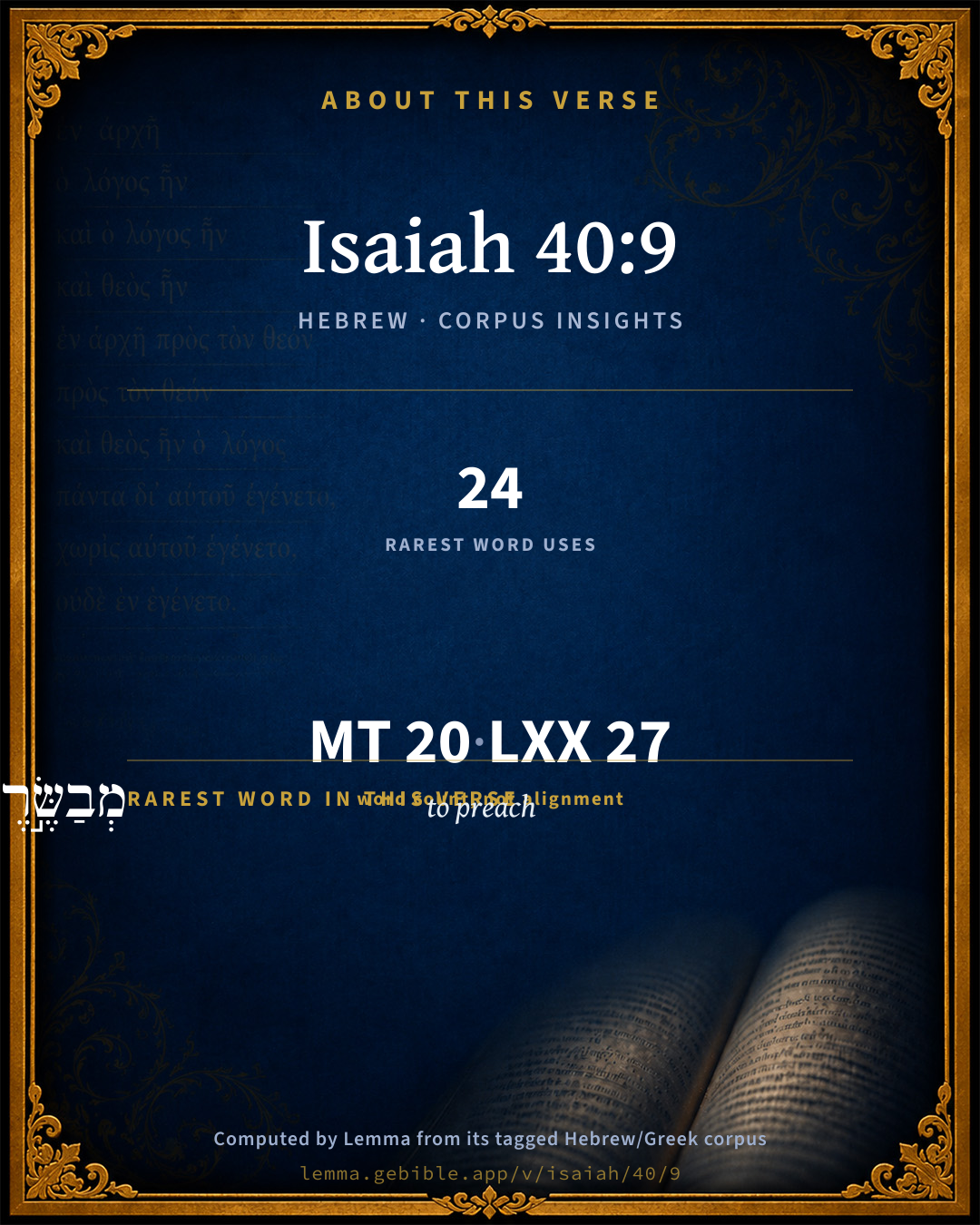
The rarest word here is מְבַשֶּׂ֣רֶת to preach H1319 — appearing just 24 times in the whole Hebrew Bible.

Shared distinctive vocabulary

מְבַשֶּׂ֣רֶת to preach H1319 occurs in 21 verses of the Hebrew Bible. Also found in:

Grammatical profile

  • 7 verbs
  • 8 nouns
  • 1 adjective
  • 2 prepositions
  • 2 particles

Verb forms

  • עֲלִי Qal · Imperative
  • מְבַשֶּׂ֣רֶת Piel · Participle Active
  • הָרִ֤ימִי Hiphil · Imperative
  • מְבַשֶּׂ֖רֶת Piel · Participle Active
  • הָרִ֨ימִי֙ Hiphil · Imperative
  • תִּירָ֔אִי Qal · Jussive
  • אִמְרִי֙ Qal · Imperative

Repetition

Words recur within this verse — often emphatic in Hebrew:

  • מְבַשֶּׂ֣רֶת to preach H1319 ×2
  • הָרִ֤ימִי to rise H7311 ×2

Hebrew & Septuagint length

In English translation the verse runs 41 words from the Hebrew and 41 from the Septuagint (LXX English) — the same length.

A rough comparison of the two English renderings, which tokenize alike — not a word-level alignment.

Word counts can differ between the Hebrew and the Greek without any difference in meaning — e.g. the Hebrew direct-object marker אֵת has no separate Greek word, and Greek often adds the article ὁ.

In the original languages it is 20 Hebrew tokens and 27 Greek tokens — but the two are counted differently (Hebrew bundles its prefixes and suffixes into one token; the Greek is in lemma form), so that isn’t a like-for-like length.

Cross-references

25

Topical passages linked to Isaiah 40:9 in the Treasury of Scripture Knowledge — connected by theme and wording, ordered by reader-vote popularity; previews shown in the World English Bible.

  • Isaiah 52:7–8 How beautiful on the mountains are the feet of him who brings good news, who publishes peace, who brings good news of good, who publishes salvation, who says to Zion, Your God reigns!
  • Isaiah 12:2 Behold, God is my salvation. I will trust, and will not be afraid; for Yah, Yahweh, is my strength and song; and he has become my salvation."
  • Ephesians 6:19 on my behalf, that utterance may be given to me in opening my mouth, to make known with boldness the mystery of the Gospel,
  • Isaiah 25:9 It shall be said in that day, Behold, this is our God; we have waited for him, and he will save us: this is Yahweh; we have waited for him, we will be glad and rejoice in his salvation.
  • Isaiah 61:1 The Spirit of the Lord Yahweh is on me; because Yahweh has anointed me to preach good news to the humble; he has sent me to bind up the broken-hearted, to proclaim liberty to the captives, and the opening [of the prison] to those who are bound;
  • Acts 2:14 But Peter, standing up with the eleven, lifted up his voice, and spoke out to them, "You men of Judea, and all you who dwell at Jerusalem, let this be known to you, and listen to my words.
  • Acts 4:13 Now when they saw the boldness of Peter and John, and had perceived that they were unlearned and ignorant men, they marveled. They recognized that they had been with Jesus.
  • Acts 4:29 Now, Lord, look at their threats, and grant to your servants to speak your word with all boldness,
  • Judges 9:7 When they told it to Jotham, he went and stood on the top of Mount Gerizim, and lifted up his voice, and cried, and said to them, Listen to me, you men of Shechem, that God may listen to you.
  • 1 Samuel 26:13–14 Then David went over to the other side, and stood on the top of the mountain afar off; a great space being between them;
  • 2 Chronicles 13:4 Abijah stood up on Mount Zemaraim, which is in the hill-country of Ephraim, and said, Hear me, Jeroboam and all Israel:
  • Ezra 1:1–2 Now in the first year of Cyrus king of Persia, that the word of Yahweh by the mouth of Jeremiah might be accomplished, Yahweh stirred up the spirit of Cyrus king of Persia, so that he made a proclamation throughout all his kingdom, and [put it] also in writing, saying,
  • Isaiah 35:3–4 Strengthen you the weak hands, and confirm the feeble knees.
  • Isaiah 41:27 [I am the] first [who says] to Zion, Behold, behold them; and I will give to Jerusalem one who brings good news.
  • Isaiah 51:7 Listen to me, you who know righteousness, the people in whose heart is my law; don't you fear the reproach of men, neither be you dismayed at their insults.
  • Isaiah 51:12 I, even I, am he who comforts you: who are you, that you are afraid of man who shall die, and of the son of man who shall be made as grass;
  • Isaiah 58:4 Behold, you fast for strife and contention, and to strike with the fist of wickedness: you don't fast this day so as to make your voice to be heard on high.
  • Jeremiah 22:20 Go up to Lebanon, and cry; and lift up your voice in Bashan, and cry from Abarim; for all your lovers are destroyed.
  • Luke 24:47 and that repentance and remission of sins should be preached in his name to all the nations, beginning at Jerusalem.
  • Acts 5:41–42 They therefore departed from the presence of the council, rejoicing that they were counted worthy to suffer dishonor for Jesus' name.
  • Romans 10:18 But I say, didn't they hear? Yes, most assuredly, "Their sound went out into all the earth, Their words to the ends of the world."
  • Philippians 1:28–29 and in nothing frightened by the adversaries, which is for them a proof of destruction, but to you of salvation, and that from God.
  • 1 Timothy 3:16 Without controversy, the mystery of godliness is great: God was revealed in the flesh, Justified in the spirit, Seen by angels, Preached among the nations, Believed on in the world, And received up in glory.
  • 1 Peter 3:14 But even if you should suffer for righteousness' sake, you are blessed. "Don't fear what they fear, neither be troubled."
  • 1 John 5:20–21 We know that the Son of God has come, and has given us an understanding, that we know him who is true, and we are in him who is true, in his Son Jesus Christ. This is the true God, and eternal life.

Cross-references courtesy of OpenBible.info (CC BY 4.0).

Hebrew and Greek witnesses Masoretic Hebrew ↔ Greek Septuagint

The same verse in the two great witnesses to the Old Testament, shown verse-for-verse.

These are two independent witnesses, not word-aligned to each other, and the Septuagint is shown in lemma (dictionary) form.

Hebrew Isaiah 40:9 Masoretic · Westminster Leningrad Codex

עַ֣ל הַר גָּבֹ֤הַ עֲלִי לָךְ֙ מְבַשֶּׂ֣רֶת צִיּ֔וֹן הָרִ֤ימִי בַכֹּ֨חַ֙ קוֹלֵ֔ךְ מְבַשֶּׂ֖רֶת יְרוּשָׁלִָ֑ם הָרִ֨ימִי֙ אַל תִּירָ֔אִי אִמְרִי֙ לְעָרֵ֣י יְהוּדָ֔ה הִנֵּ֖ה אֱלֹהֵיכֶֽם

You who tell good news to Zion, go up on a high mountain; you who tell good news to Jerusalem, lift up your voice with strength; lift it up, don't be afraid; say to the cities of Judah, Behold, your God!

World English Bible · Public Domain

Greek LXX Isaiah 40:9 Septuagint · lemma form

ἐπί ὄρος ὑψηλός ἀναβαίνω ὁ εὐαγγελίζω σιων ὑψόω ὁ ἰσχύς ὁ φωνή σύ ὁ εὐαγγελίζω ἰερουσαλήμ ὑψόω μή φοβέω εἶπον ὁ πόλις ιουδα ἰδού ὁ θεός σύ

O you that bring glad tidings to Zion, go up on the high mountain; lift up your voice with strength, you that bring glad tidings to Jerusalem; lift it up, fear not; say to the cities of Juda, Behold your God!

LXX2012 (modern English Septuagint) · Public Domain

On this verse, Ellicott's Commentary for English Readers discusses the Septuagint’s reading. Read the note in Commentary ↓

Hebrew: Westminster Leningrad Codex (CC BY 4.0). Greek: Septuagint (public domain); English from LXX2012 (modern English Septuagint) (Public Domain). How the Septuagint differs from the Hebrew →

Targum (Aramaic paraphrase)

1

The Targum is the ancient Jewish Aramaic paraphrase of the Hebrew Scriptures — an interpretive translation, not the Hebrew text itself. Onkelos (literal) and Pseudo-Jonathan (expansive) render the Torah, and Jonathan the Prophets. Coverage is partial: where no permissively-licensed English translation exists for a verse, only the Aramaic is shown. This is verse-level text, not a word-by-word alignment to the Hebrew.

  1. Targum Jonathan Prophets (Joshua–Malachi)
    עַל טוּר רָם סַקוּ לְכוֹן נְבִיַיָא דִי מְבַשְׂרִין לְצִיוֹן אֲרִימוּ בְחֵילָא קָלְכוֹן דִי מְבַשְׂרִין לִירוּשְׁלֵם אֲרִימוּ לָא תִדְחֲלוּן אֲמָרוּ לְקִרְוַיָא דְבֵית יְהוּדָה אִתְגְלִיאַת מַלְכוּתָא דֶאֱלָהָכוֹן:

    Upon a high mountain get up, ye prophets, that bring good tidings unto Zion; lift ye up your voice with strength that bring good tidings to Jerusalem; lift it up, be not afraid, say to the cities of the house of Judah, The kingdom of your God is revealed.

    Targum Jonathan — Aramaic: “Mikraot Gedolot” (public domain). English: “Sefaria Community Translation” (CC0 1.0 (public-domain dedication)); “London "Chaldee Paraphrase," 1871” (public domain). Text via Sefaria.

Commentary

Notes on Isaiah 40:9 from classic Christian and Jewish commentators (each source and its license shown beneath its notes). The classic Christian expositions comment on the surrounding passage and are grouped to its opening verse, so a note may address several verses; the Jewish commentaries on the Tanakh (Rashi and others) are per-verse, so they appear only where the commentator wrote on this verse.

Lemma curates 59 commentaries, every one of them public domain or Creative Commons licensed, each selected and text-cleaned for this edition rather than reprinted as found. About our sources →

Matthew Henry's Commentary

It was promised (Isa 40:5) that the glory of the Lord shall be revealed; that is it with the hopes of which God's people must be comforted. Now here we are told,

I. How it shall be revealed, Isa 40:9. 1. It shall be revealed to Zion and Jerusalem; notice shall be given of it to the remnant that are left in Zion and Jerusalem, the poor of the land, who were vine-dressers and husbandmen; it shall be told them that their brethren shall return to them. This shall be told also to the captives who belonged to Zion and Jerusalem, and retained their affection for them. Zion is said to dwell with the daughter of Babylon (Zac 2:7); and there she receives notice of Cyrus's gracious proclamation; and so the margin reads it, O thou that tellest good tidings to Zion, etc., meaning the persons who were employed in publishing that proclamation; let them do it with a good will, let them make the country ring of it, and let them tell it to the sons of Zion in their own language, saying to them, Behold your God. 2. It shall be published by Zion and Jerusalem (so the text reads it); those that remain there, or that have already returned, when they find the deliverance proceeding towards perfection, let them proclaim it in the most public places, whence they may be best heard by all the cities of Judah; let them proclaim it as loudly as they can: let them lift up their voice with strength, and not be afraid of overstraining themselves; let them not be afraid lest the enemy should hear it and quarrel with them, or lest it should not prove true, or not such good tidings as at first it appeared; let them say to the cities of Judah, and all the inhabitants of the country, Behold your God. When God is going on with the salvation of his people, let them industriously spread the news among their friends, let them tell them that it is God that has done it; whoever were the instruments, God was the author; it is their God, a God in covenant with them, and he does it as theirs, and they will reap the benefit and comfort of it. "Behold him, take notice of his hand in it, and look above second causes; behold, the God you have long looked for has come at last (Isa 25:9): This is our God, we have waited for him." This may refer to the invitation which was sent forth from Jerusalem to the cities of Judah, as soon as they had set up an altar, immediately upon their return out of captivity, to come and join with them in their sacrifices, Ezr 3:2-4. "When the worship of God is set up again, send notice of it to all your brethren, that they may share with you in the comfort of it." But this was to have its full accomplishment in the apostles' public and undaunted preaching of the gospel to all nations, beginning at Jerusalem. The voice crying in the wilderness gave notice that he was coming; but now notice is given that he has come. Behold the Lamb of God; take a full view of your Redeemer. Behold your King, behold your God.

II. What that glory is which shall be revealed. "Your God will come, will show himself,"

1. "With the power and greatness of a prince (Isa 40:10): He will come with strong hand, too strong to be obstructed, though it may be opposed. His strong hand shall subdue his people to himself, and shall restrain and conquer his and their enemies. He will come who is strong enough to break through all the difficulties that lie in his way." Our Lord Jesus was full of power, a mighty Saviour. Some read, it, He will come against the mighty one, and overpower him, overcome him. Satan is the strong man armed; but our Lord Jesus is stronger than he, and he shall make it to appear that he is so, for, (1.) He shall reign in defiance of all opposition: His arm shall rule, shall overrule for him, for the fulfilling of his counsels, to his own glory; for he is his own end. (2.) He shall recompense to all according to their works, as a righteous Judge: His reward is with him; he brings along with him, as a returning prince, punishments for the rebels and preferments for his loyal subjects. (3.) He shall proceed and accomplish his purpose: His work is before him, that is, he knows perfectly well what he has to do, which way to go about it, and how to compass it. He himself knows what he will do.

2. "With the pity and tenderness of a shepherd," Isa 40:11. God is the Shepherd of Israel (Psa 80:1); Christ is the good Shepherd, Joh 10:11. The same that rules with the strong hand of a prince leads and feeds with the kind hand of a shepherd. (1.) He takes care of all his flock, the little flock: He shall feed his flock like a shepherd. His word is food for his flock to feed on; his ordinances are fields for them to feed in; his ministers are under-shepherds that are appointed to attend them. (2.) He takes particular care of those that most need his care, the lambs that are weak, and cannot help themselves, and are unaccustomed to hardship, and those that are with young, that are therefore heavy, and, if any harm be done them, are in danger of casting their young. He particularly takes care for a succession, that it may not fail or be cut off. The good Shepherd has tender care for children that are towardly and hopeful, for young converts, that are setting out in the way to heaven, for weak believers, and those that are of a sorrowful spirit. These are the lambs of his flock, that shall be sure to want nothing that their case requires. [1.] He will gather them in the arms of his power; his strength shall be made perfect in their weakness, Co2 12:9. He will gather them in when they wander, gather them up when they fall, gather them together when they are dispersed, and gather them home to himself at last; and all this with his own arm, out of which none shall be able to pluck them, Joh 10:28. [2.] He will carry them in the bosom of his love and cherish them there. When they tire or are weary, are sick and faint, when they meet with foul ways, he will carry them on, and take care they are not left behind. [3.] He will gently lead them. By his word he requires no more service, and by his providence he inflicts no more trouble, than he will fit them for; for he considers their frame.

Matthew Henry's Commentary on the Whole Bible (1708–1710) — public domain (CC PDM 1.0). Text via the HelloAO Bible API.

Trapp's Complete Commentary

John Trapp

Isa 40:9 O Zion, that bringest good tidings, get thee up into the high mountain; O Jerusalem, that bringest good tidings, lift up thy voice with strength; lift [it] up, be not afraid; say unto the cities of Judah, Behold your God!

Ver. 9. Oh Zion, that bringest good tidings.] That evangelist. The gospel is the sum of all the good news in the world. Christ’s incarnation (bisher, the word here used, cometh of bashar, which signifieth flesh), was "glad tidings of great joy to all people." {Luk 2:10}

Get thee up into the high mountain.] Zion was itself a high mountain, yet is bidden to ascend into a higher, for the better promulgation of the gospel.

Lift it up, be not afraid,] viz., For persecution, which is evangelii genius, the evil angel that doggeth the gospel at the heels, as Calvin wrote to the French king.

Behold your God.] Behold the Messiah, who hath been so long expected, is now exhibited.

John Trapp, A Commentary or Exposition upon All the Books of the Old and New Testament (1647–1656) — public domain. Text from a community e-Sword module.

The Biblical Illustrator

Joseph S. Exell

Isa_40:9

O Zion, that bringest good tidings

The tidings the Church has to publish

The text has been variously rendered.

The best authorities give it, Thou that bringest good tidings to Zion, which rendering better agrees with the latter part of the verse, with some parallel passages, and with the scope of the passage. Our translators took Zion and Jerusalem in the nominative case, and so did others before them, as if the prophet called on the chief city to acquaint the other cities of Judah with the joyful news of their returning inhabitants: but there is far more congruity in the heralds being instructed to ascend the high mountains that the Jewish captives in the remotest corners of Chaldea may hear the joyful proclamation of liberty, and prepare to return to their own country. The Jewish Targum (no mean authority) paraphrases the words thus: O ye prophets that bring glad tidings to Zion Vitringa supports the same idea, as does also Bishop Lowth. The language may, with great force, be addressed to the missionaries of every denomination. O thou that hast good tidings to tell, get thee up into the high mountain. Say to the cities of the Eastern and the Western world, Behold your God.

I. THE CHRISTIAN CHURCH HAS GREAT TIDINGS TO TELL TO THE WORLD AT LARGE. The Jewish prophets were the heralds of a Saviour to come, and beautiful upon the mountains were the feet of those who published peace; but the Christian Church has to proclaim the actual accomplishment of the great salvation. We have to tell of a Saviour incarnate, crucified, enthroned. We have to tell of a justifying righteousness, a sanctifying spirit, a pardoning God: of Satan vanquished. The Christian Church has to reveal--

1. A system of truth as opposed to the errors of heathenism. These truths are universally applicable. All have minds to which truth is precious as life to the eye, and the truth as it is in Jesus is more needful than life itself.

2. A system of devotion, as opposed to the absurdities of their superstition. Would you choose to have them still ignorant of the attributes of acceptable devotion?

3. A system of purity, as opposed to the shameless vices of their idolatry. Morality is interested in the triumph of missions.

4. The Christian Church can tell them of the life and immortality brought to light by the Gospel, as opposed to their obscure and degrading notions of futurity.

II. THESE TIDINGS OUGHT NOT TO BE KEPT SECRET, BUT ARE TO BE URGENTLY AND UNIVERSALLY PROCLAIMED. Lift up thy voice with strength: say, Behold your God. This light ought to be held forth as a burning torch, like the beacon light of ancient Pharos, that it may scatter the darkness of the night, and guide the tempest-tossed vessel of distant nations to the safe anchorage and peaceful haven of the welcome shore. We are bound by every tie, by all that can constitute the most solemn and religious obligation, to diffuse far and wide the grand principles of salvation. Dwell upon the moral destitution and wretchedness of the nations sitting in darkness, and simply ask whether this be a desirable state of things.

III. THE CERTAINTY THAT THESE TIDINGS SHALL NOT BE PROCLAIMED IN VAIN. God has said, My Word shall not return void. The Spirit is promised. (S. Thodey.)

The Church and her message

I. THE THOUGHTS THAT CLUSTER AROUND THE NAME. O Zion, that bringest glad tidings. That is almost a definition of the Church; at any rate, it is a description of her by her most characteristic office and function--that which marks and separates her from all associations and societies of men. Her true dignity is that she bears a Gospel in her hand, and grace is poured into her lips. We are to suppose the manifestation and approach of the Divine Deliverer; hence what constitutes Zion the messenger of good tidings is the presence in her of the living God. Translate that into New Testament language, and it just comes to this: that what constitutes the Church the evangelist for the world is the simple possession of Christ, or of the Gospel, and that breaks out into two or three points.

1. Whoever has Christ has the power to impart Him.

2. The possession of Christ for yourselves imposes upon you the obligation to impart Him.

(1) All property in this world is trust property, and everything that a man knows that can help or bless the moral or spiritual age or intellectual condition of his fellows, he is thereby under solemn obligation to impart. There is an obligation arising from the bands that knit us to one another, so that no man can possess his good alone without being untrue to the solidarity of humanity. You have got, you say, the remedy, healing for all the diseases of humanity. What would you think of a man who in a pestilence was contented with swallowing his own specific, and leaving others to die? You have got the Christ, and you have got Him that you may impart Him.

(2) It is an obligation that arises, too, from the very purposes of your calling. What are you saved for? For your own blessedness? Yes, and No. No creature in Gods great universe but is great enough to be a worthy end of the Divine action. But no creature in Gods universe so great as that he is a worthy end of the Divine action, if he is going to keep all the Divine gifts in himself. We are all brought into the light that we may impart light.

3. The very fact of the possession of this Gospel, or of this Christ, for ourselves ought to--and in all healthy conditions will--inspire the impulse to impart. All deep conviction longs to be vocal.

II. We have here, in a very picturesque and vivid form, the setting forth of THE MANNER IN WHICH THE EVANGELIST ZION IS TO PROCLAIM HER MESSAGE. The fair-featured herald is bidden to get up into the high mountain, perhaps a mere picturesque detail, perhaps some reference to the local position of the city set upon a hill, like the priests of Ebal or Gerizim, or Alpine shepherds, calling to each other across the valleys, to secure some vantage ground; and, next, to let her voice roll out across the glen. No faltering whisper will do, but a voice that compels audience. Lift up thy voice with strength. But a timid heart will make a tremulous voice, and fear and doubt will whisper when courage will ring it out. So be not afraid; there is the foundation of the clearness and the loudness with which the word is to be uttered. Our message is to be given with a courage and a force that are worthy of it. Be not afraid. That is a lesson for this day. There are plenty of causes of fear round about us, if, like Peter on the water, we look at the waves instead of at the Master.

1. Let us cherish a firm, soul-absorbing confidence in the power and truth of the message we have to tell.

2. Do not let us make too much of the enemy.

3. Let us remember the victories of the past.

4. Above all, let us remember who fights with us.

III. THE SUBSTANCE AND CONTENTS OF THE EVANGELIST ZIONS MESSAGE, Say unto the cities of Judah, Behold you God! They were to be pointed to a great historical act, in which God had manifested Himself to men; and the words are not only an exclamation, but an entreaty, and the message was to be given to these little daughter cities of Judah as representing all of those for whom the deliverance had been wrought;--all which things are paralleled in the message that is committed to our hand. We all have given to us the charge of pointing men to the great historical fact wherein God is visible to men. You cannot reveal God by word, you cannot reveal God by thought. There is no way open to Him to make Himself known to His creatures except the way by which men make themselves known to one another, that is, by their deeds; and so high above all speculation, high above all abstraction, nearer to us than all thought, stands the historical fact in which God shows Himself to the world, and that is in the person of Jesus Christ. How beautiful in that connection the verses following my text are: Behold, the Lord God will come with strong hand; yet He shall feed His flock like a shepherd. And so in that Christ is the power of God, for He is the arm of the Lord; and in that Christ is the gentleness of God; and whilst men grope in the darkness, our business is to point to the living, dying Son, and to say, There you have the ultimate, the perfect representation of the unseen God. (A. Maclaren, D. D.)

News proclaimed on mountain-tops

Some suppose an allusion to the practice of addressing large assemblies from the summit or declivity of hills Jdg_9:7; Deu_27:12; Mat_5:1). J.D. Michaelis compares the ancient practice of transmitting news by shouting from one hill-top to another, as described by Caesar (Bell. Gall. 7.3)

. The essential idea is that of local elevation as extending the diffusion of the sound. (J. A. Alexander.)

Behold your God

The manifestation of God

Taking the words as they stand in the text, consider them in--

I. THEIR EXTERNAL ACCOMPLISHMENT in the incarnation, nativity, personal appearance, and ministration of the Son of God in Jerusalem and in the cities of Judah.

II. THEIR INTERNAL ACCOMPLISHMENT in the hearts of all those who have spiritually received the tidings of His Gospel. It is the process of Christ, from His incarnation to His ascension, spiritually repeated within us; God and Saviour and our salvation entirely depends upon our beholding this, manifesting Himself in all His amiable attributes within us, and by our will cheerfully co-operating with Him in His great work of love. (J. Duche, M. A.)

The beholding of Jesus Christ

The prophet is directing the attention of his countrymen and of the Church in every age to the Messiah who is the true God and eternal life. This illustrious personage we may behold in a variety of interesting and instructive situations.

1. Carry your thoughts back into eternity, and behold Him, who in time was made of a woman, sitting upon the circle of the heavens, in the essential glory of the Godhead; His habitation immensity, His duration eternity, His perfections uncreated and infinite.

2. As a confirmation of the original glory and Godhead of Jesus Christ, behold your God at the morning of creation, the dawn of time. Was it not His effective hand that planted the pillars of the universe and raised the magnificent fabric of earth and heaven? What He formed as the God of creation, He preserves as the God of power.

3. From the fall of our first parents to the birth of Jesus Christ, the Redeemer is only to be seen in promises and prophecies, in sacrifices and ceremonies. Passing over, therefore, this long lapse of time, suffer me to conduct your thoughts to Bethlehem. There, behold your God.

4. Omitting the occurrences of His childhood and youth, let me invite you to look at Jesus entering into the wilderness under the influence and direction of the Holy Ghost. Behold Him tempted of the devil forty days and forty nights. It is a Divine maxim that God cannot be tempted, neither tempteth He any man. But God in human flesh sustained the hour of trial.

5. After this strange event, permitted to the powers of darkness, Jesus appears in a new scene of life. Behold, then, your God going forth as a teacher, accompanying His ministrations and instructions with signs and wonders, and all the marks of Deity. And He is the same yesterday, to-day, and for ever. In every age, as well as in the days of His flesh, there is treasured up in Him, for the flee use of all that come unto Him, pardon, and peace, and grace, and strength, and life, and salvation.

6. Just before the close of His ministrations, a profitable view of the Lord Jesus opens to us in the garden of Gethsemane: there behold your God! He appears emphatically a man of sorrows, and acquainted with grief. But let us follow Him from the garden, through all the intermediate scenes of insult, reproach, and ignominy, to the bar of Pontius Pilate: there at the tribunal of man behold your God! He, who shall one day appear to judge every man according to his deeds, now stands arraigned as a criminal before the judgment-seat of man. Judgment is perverted: Pilate declares Him innocent, yet suffers Him to be mocked, and scourged, and crucified. Mingling in the crowd, follow Him from the common hall, and behold your God as He passes through, the streets of Jerusalem,. bearing. His cross amidst the revilings and tauntmgs of the people, who, m all the virulence of persecution, exclaim, Away with Him, away with Him! crucify Him! Behold your God ascending the summit of Calvary. Oh, what a scene was here! a scene which all nature seems backward to behold. Standing at the foot of the Cross, learn that ye were not redeemed with corruptible things, etc. (1Pe_1:18-19).

7. The last view which we have to take of Jesus Christ closes His sufferings, and accomplishes our redemption. Behold your God bursting the barriers of the tomb, vanquishing the king of terrors, despoiling the sepulchre, breaking the bands of corruption, and rising to life, never to die again. Then was fulfilled that prophecy, O death, I will be thy plagues. To enter into the spirit of the passage, you must keep your minds eye upon the Saviour, and behold your God as He is ascending to the realms of bliss. Conclusion--Now is the accepted time, now is the day of salvation. Now it is your privilege by faith to behold your God as a Saviour, delighting in mercy. (S. Payne.)

The Biblical Illustrator, edited by Joseph S. Exell (c. 1880s–1900s) — public domain. Text from a community e-Sword module.

Joseph Benson's Commentary

Isa 40:9. O Zion, thou bringest good tidings — Of deliverance from the Babylonish captivity, to other cities, and parts of the country; and of redemption by Christ to other nations. Lowth, and many other interpreters, think the marginal reading is to be preferred, as giving a better sense, O thou that bringest good tidings to Zion, &c. According to which, Zion is not the deliverer, but the receiver of the tidings, as she is in the parallel place, chap. 52:7. But the translation in our text agrees better with the Hebrew, in which the word for the bringer of the tidings, מבשׂרת, and the verb עריו, get thee up, are both in the feminine gender, and agree with Zion and Jerusalem, continually spoken of, as cities generally are, in that gender, but not with any prophet, apostle, or other messenger of God in the masculine gender. It is true, Bishop Lowth supplies a word to suit the text, as to this particular, and reads, O daughter, that bringest good tidings. But that seems to be taking a liberty with the text which necessity only could warrant, a necessity which certainly does not here exist. For the passage, as we have it rendered, makes good sense, representing Zion or Jerusalem, collectively considered, and including its inhabitants, as the publisher, and the cities of Judah as the hearers of the good tidings. The glad tidings of the coming of Christ into the world, and of the salvation of mankind through him, having been made known to Zion, or Jerusalem, were carried from thence, first to all the cities of Judah, and then to the most distant nations. For out of Zion went forth the gospel law, and the word of the Lord from Jerusalem: and the rod of the Messiah’s strength, the gospel word, was sent forth out of Zion. See notes on Isa 2:3; and Psa 110:2. Get thee up upon the high mountain — That thy voice may be better heard. Lift up thy voice; be not afraid — Lest thou shouldest be found a false witness, for the declaration shall certainly be verified; say to the cities of Judah — To all my people in the several places of their abode, whether cities or countries; behold your God — Take notice of God’s appearance for your comfort and deliverance; and also that the Messiah, so long expected, is now at last exhibited, in and through whom God will be so present with you, that men may point at him, and say, Behold, here he is! See Hag 2:7; Zec 9:9; Mal 3:1; Act 13:32-33.

Joseph Benson's Commentary on the Old and New Testaments (1811–1818) — public domain. Text from a community e-Sword module.

The Preacher's Complete Homiletical Commentary

Joseph S. Exell (gen. ed.)

THE PREACHER’S TASK

(Ordination or Missionary Sermon.)

Isa_40:9. O Zion, that bringest good tidings! &c.

This chapter commences the second part of Isaiah’s prophecies, in which the local and national is less prominent than in the former, and the visions are carried forward to the time of Messiah. The prophet hears voices, each of which contains a message of consolation. The first bids him announce the coming of the King and command the preparation of His way; the second affirms the everlasting duration of the Lord’s Word; the third calls attention to the fact of His coming.

The third is our text. It is differently rendered in the margin. “O thou that tellest good tidings unto Zion; O thou that tellest good tidings to Jerusalem.” This version is adopted in Handel’s Oratorio. It is generally preferred. It makes Zion and Jerusalem the recipients of the good tidings along with the cities of Judah.

God’s strong hand would terminate the long Babylonian captivity, and lead His people back, as a shepherd leads his flock. But beyond this is the great salvation the Messiah would accomplish. The call is addressed to those whose business is to proclaim that salvation. Their occupation is described; their challenge is dictated; their methods are prescribed; their sphere is defined.

I. THEIR OCCUPATION IS DESCRIBED.

They are evangelists: tellers of good tidings—a suitable description of the preachers of the Gospel, and their work. The Gospel contains the good news men need. The world lies in ruin. It is sick. It has no power of recuperation. Its disease produces a fatal unwillingness to be cured, if only its consequences may be escaped. The preacher is charged with the good news that the disease can be cured, its consequences averted, the dislike of recovery removed. God’s love in Christ is the essence of the news (Joh_3:16-17). If it came to you for the first time, you would say it was the most astonishing statement possible. It involves the whole work of Christ. It involves the proclamation of God’s readiness to forgive and cleans the sinner. It is salvation.

Whoever makes this known to any one previously ignorant of it i an evangelist—a teller of good tiding—a preacher of the Gospel. Conventionally this name is given to a professional class. There are many reasons for the existence of such a class. But serious loss is sustained, if the preaching of the Gospel is confined to them. Others should also preach. Parents, Sunday-school teachers, friends in conversation, letters, visitors of the ignorant and neglected, distributors of tracts and books. Every man who has heard and believed the glad tidings should himself be an evangeliser. Every Christian is such a man. He has not heard a secret, but a glorious truth which he is to proclaim.

II. THEIR CHALLENGE IS DICTATED.

The announcement of the glad tidings of salvation does not terminate in itself. It is proclaimed with a view to action. “Behold your God.” Hence the Gospel is a manifestation of God and a summons to man.

1. A manifestation of God. He is the Author of the salvation, the Doer of the great and gracious things announced. When surveying a manufactory and its machinery, your thoughts turn to the manufacturer and the engineer. Going over a hospital, you think of the benevolence of the man by whom it was built and endowed. Studying the heavens and the earth, you think of their Maker’s power and skill. So when you think of the Gospel, think of God. It is the medium through which He is best known. His full manifestation waited for the incarnation of His Son (H. E. I. 855–857). “The world by wisdom knew not God.” That was true of the ancient world. It is true still. Men think and dream about God. But they do not know Him until they come in humility to the Cross. It reveals His holiness and His love. It shows Him righteous, yet delighting in mercy. And this representation of Him has ever been most effective in the reclamation of the heathen from idolatry. Judaism was comparatively uninfluential. When Christianity arose, the idols fell (1Th_1:9-10). The overthrow of ancient idolatry was the work of two or three hundred years. Modern heathenism is falling in like manner before the manifestation of God in Christ as the redeeming God.

2. A summons to man. “Behold your God!” This is the action required on the part of those to whom the Gospel is addressed. Men must not turn away from the manifestation of God. If a prince were to show himself in an impoverished part of his dominions for the purpose of relieving the people’s wants, would indifference become them? Would they not look to him? This is the look the Gospel demands. Behold Him with the eye of faith. When you carry the Gospel to others, call upon them thus to behold Him. If there are those here who are not saved, we call on you thus to behold Him. As the Israelites, when bitten by the serpents, were told to look to the serpent of brass, we tell you to look to Jesus (Joh_1:29; Isa_45:22). Helpless and ruined without Him, we proclaim salvation by Him, and call upon you to look and live.

III. THEIR METHODS ARE PRESCRIBED.

1. For the message they must endeavour to secure publicity. “Get thee up into the high mountain,” where you can be seen and heard. Go where the people are; seek the centres of population; avail yourselves of all circumstances to attract attention.

2. The message must be delivered with energy. “Lift up thy voice with strength; lift it up.” As if you believed in it, realised its importance, sympathised with its gladness. Bring into the announcement the vigour of mind and body that is born of earnestness.

3. The message must be proclaimed with courage. “Be not afraid.” Fearless preaching carries authority and weight. The Gospel has never wanted men of such courage. And it is displayed. Recent offer of Christian young men in South Sea island to take the place of the teachers massacred in New Guinea.

IV. THEIR SPHERE IS DEFINED.

“Zion, Jerusalem, the cities of Judah.” Every one must have a definite work. It will gradually expand from nearest relations and friends to neighbours, our country, the world.

Tell it, brethren, because—

1. It is time.

2. It is needed.

3. Its proclamation is commanded.

4. Success is assured.

5. Faithful service will be rewarded.—J. Rawlinson.

The Preacher's Complete Homiletical Commentary (gen. ed. Joseph S. Exell; Funk & Wagnalls, c. 1892) — public domain (pre-1929). A full-Bible homiletical/sermon-outline anthology covering 65 of 66 books (2 John is absent from the source module). Text from a community e-Sword module.

Tyndale Open Study Notes

Tyndale Open Resources

40:9-11 God is the good news. Although he comes like a warrior to rescue his people with power, he also holds them tenderly as a shepherd.

40:9 God is coming to save and restore human beings (see also 35:4; Rev 22:12).

Tyndale Open Study Notes — © Tyndale Open Resources, licensed CC BY-SA 4.0. Text via the HelloAO Bible API.

Geneva Bible (1599)

Geneva Bible translators

He showeth at one word the perfection of all man’s felicity, which is to have God’s presence.

To publish this benefit through all the world.

Geneva Bible (1599) marginal notes — public domain. Text via Bolls.life.

Jamieson, Fausset & Brown

Robert Jamieson, A. R. Fausset & David Brown

Rather, "Oh, thou that bringest good things to Zion; thou that bringest good tidings to Jerusalem." "Thou" is thus the collective personification of the messengers who announce God's gracious purpose to Zion (see on Isa 40:1); Isa 52:7 confirms this [Vulgate and GESENIUS]. If English Version be retained, the sense will be the glad message was first to be proclaimed to Jerusalem, and then from it as the center to all "Judea, Samaria, and the uttermost parts of the earth" (Luk 24:47, Luk 24:49; Act 1:8) [VITRINGA and HENGSTENBERG].

mountain--It was customary for those who were about to promulgate any great thing, to ascend a hill from which they could be seen and heard by all (Jdg 9:7; Mat 5:1).

be not afraid--to announce to the exiles that their coming return home is attended with danger in the midst of the Babylonians. The gospel minister must "open his mouth boldly" (Pro 29:25; Eph 6:19).

Behold--especially at His second coming (Zac 12:10; Zac 14:5).

Jamieson, Fausset & Brown — Commentary Critical and Explanatory on the Whole Bible (1871) — public domain (CC PDM 1.0). Text via the HelloAO Bible API.

Adam Clarke's Commentary

Verse 9. O Zion, that bringest good tidings - "O daughter, that bringest glad tidings to Zion"] That the true construction of the sentence is this, which makes Zion the receiver, not the publisher, of the glad tidings, which latter has been the most prevailing interpretation, will, I think, very clearly appear, if we rightly consider the image itself, and the custom and common practice from which it is taken. I have added the word daughter to express the feminine gender of the Hebrew participle, which I know not how to do otherwise in our language; and this is absolutely necessary in order to ascertain the image. For the office of announcing and celebrating such glad tidings as are here spoken of, belongs peculiarly to the women. On occasion of any great public success, a signal victory, or any other joyful event, it was usual for the women to gather together, and with music, dances, and songs, to publish and celebrate the happy news. Thus after the passage of the Red Sea, Miriam, and all the women, with timbrels in their hands, formed a chorus, and joined the men in their triumphant song, dancing, and throwing in alternately the refrain or burden of the song: -

"Sing ye to JEHOVAH, for he is greatly exalted;

The horse and his rider hath he cast into the sea."

Ex 15:20-21.

So Jephthah's daughter collected a chorus of virgins, and with dances and songs came out to meet her father, and to celebrate his victory, Jdg 11:34. After David's conquest of Goliath, "all the women came out of the cities of Israel singing and dancing to meet Saul, with tabrets, with joy, and with instruments of music;" and, forming themselves into two choruses, they sang alternately: -

"Saul has slain his thousands:

And David his ten thousands."

1Sa 18:6-7.

And this gives us the true sense of a passage in the sixty-eighth Psalm, which has frequently been misunderstood: -

"JEHOVAH gave the word, (that is, the joyful news,)

The women, who published the glad tidings, were a great

company;

The kings of mighty armies did flee, did flee:

And even the matron, who stayed at home, shared the spoil."

The word signifying the publishers of glad tidings is the same, and expressed in the same form by the feminine participle, as in this place, and the last distich is the song which they sang. So in this place, JEHOVAH having given the word by his prophet, the joyful tidings of the restoration of Zion, and of God's returning to Jerusalem, (see Isa 52:8,) the women are exhorted by the prophet to publish the joyful news with a loud voice from eminences, whence they might best be heard all over the country; and the matter and burden of their song was to be, "Behold your God!" See on Ps 68:11.

Adam Clarke's Commentary on the Bible (1810–1826) — public domain. Text from a community e-Sword/MySword module.

Ellicott's Commentary for English Readers

(9) O Zion, that bringest good tidings.—A new section begins. In some versions (LXX. and Targum) and by some interpreters “Zion” is taken as in the objective case, O thou that bringest glad tidings to Zion; but as the participle, “thou that bringest,” is in the feminine, and a female evangeliser other than Jerusalem has not appeared on the scene, the Authorised Version is preferable. In that rendering the ideal Zion, seeing or hearing of the return of the exiles, becomes the bearer of the good news to the other cities of Judah. It is not without emotion that we note the first occurrence of the word which, passing through the Greek of the LXX. and the New Testament (ευαγγελίςεσθαι), has had so fruitful a history, as embodying the message of the Gospel—good-spell, glad tidings—to mankind. The primary meaning of the Hebrew word is to make smooth, or bright, and so “to gladden.” (Comp. the connection of this English word with the German glatten.)

The high mountain.—There is no article in the Hebrew, but the word is probably connected with the ideal exaltation of the holy city, as in Isa_2:1.

Behold your God!—The words have, in one sense, only an ideal fulfilment; but the prophet contemplates the return of the exiles and the restoration of the Temple worship, as involving the renewed presence of Jehovah in the sanctuary which He had apparently abandoned. He would come back with His people, and abide with them.

A Bible Commentary for English Readers, edited by Charles John Ellicott (1878–1897) — public domain. Text from a community e-Sword module.

The Cambridge Bible for Schools and Colleges

gen. ed. J. J. S. Perowne

9–11. The prophet announces the triumphal approach of Jehovah to Zion.

O Zion … tidings] R.V. has O thou that tellest good tidings to Zion. Either translation is grammatically admissible; but the second is to be preferred, (1) because of the analogous passages Isa_41:27 and Isa_52:7, and (2) because Zion always in this prophecy represents the community as the passive recipient of salvation. The other rendering might seem to be recommended by the apparent distinction between Jerusalem and the cities of Judah, but this is probably not intended; Zion itself is included among the cities of Judah. The verb employed (mìbasséreth) is the Hebrew basis (through the LXX.) of the N.T. εὐαγγελίζειν; the fem. partic. is collective, denoting an ideal band of messengers (less probably the company of prophets). These Evangelists are bidden to “go up to a high mountain” to see from afar the coming of Jehovah, then to “lift up their voice without fear” (of being put to shame) and proclaim the glad tidings.

The Cambridge Bible for Schools and Colleges (gen. ed. J. J. S. Perowne; Cambridge University Press, 1878–1918) — public domain. Text from a community e-Sword module.

John Gill's Exposition

O Zion, that bringest good tidings,.... Or, "O thou that bringest good tidings to Zion (n)"; which rendering of the words is more agreeable to the latter part of the verse,

say unto the cities of Judah, &c. and to some parallel places, Isa 41:27 and to the type, the deliverance of the Jews from Babylon; the tidings of which came from Babylon to Zion, or Jerusalem; and to the Targum which paraphrases the words thus,

"O ye prophets, that bring good tidings to Zion;''

and so may be applied to Gospel ministers, who bring the good tidings of the good will, grace, and favour of God, to men, through Christ; of the grace of Christ, in his suretyship engagements and performances; in his incarnation, sufferings, and death, and in his advocacy and intercession; and of the good things that come by him, as peace, pardon, righteousness, salvation, and eternal life:

get thee up into the high mountain; to declare these good tidings, in the most open and public manner, that all might hear and receive them, and rejoice at them; it may also point at the place, the church of God, comparable to a high mountain for its visibility and immovableness, where the Gospel is to be published:

O Jerusalem, that bringest good tidings: the church of God so called, to whom the faith of the Gospel is delivered, which is the pillar and ground of truth; which receives, retains, and maintains it, and sends forth ministers to proclaim it; particularly the first church at Jerusalem, where it was first preached, and from whence it went forth into other parts of Judea, and into all the world; here the apostles of Christ were, and from hence they set out, and published the Gospel all the world over, and who seem to be chiefly meant; for the words may be rendered, as the other clause, "O thou that bringest good tidings to Jerusalem (o)"; so the Targum: "lift up thy voice with strength"; or preach the Gospel with a strong voice, speak it out; do not mutter it over, or whisper it in a corner; proclaim it on the housetops, cry aloud that all may hear; lift up thy voice like a trumpet; blow the trumpet of the Gospel with all the strength thou hast; cause the joyful sound to be heard far and near:

lift it up, and be not afraid; of the reproaches and revilings of men on account of it, or of their persecutions for it; or lest it should not be welcome, or be received as truth:

say unto the cities of Judah; the inhabitants of them literally understood, and to the several churches and congregations of the saints everywhere:

behold your God! that divine Person is come, that was promised, prophesied of, and expected; even Immanuel, God with us, God in our nature, God manifest in the flesh, God your Saviour, and who being God, truly God, is able to save to the uttermost; look to him with an eye of faith, and be saved; behold the Son of God, the Lamb of God, that has bore your sins, and took them away; behold him now, as your King and your God, on the throne, made and declared, Lord and Christ, crowned with glory and honour, on the same throne with his divine Father, having all power in heaven and earth; and let the echo of your faith be,

my Lord and my God. The Targum is,

"the kingdom of your God is revealed; see Mat 3:2.''

(n) "O quae evangelizas Tsijoni", Juntas & Tremellius, Piscator. (o) "O quae evangelizas Jeruschalaimo", Junius & Tremellius, Piscator.

John Gill's Exposition of the Whole Bible (1746–1763) — public domain (CC PDM 1.0). Text via the HelloAO Bible API.

Albert Barnes' Notes on the Bible

O Zion, that bringest good tidings - This is evidently the continuance of what the ‘voice’ said, or of the annunciation which was to give joy to an afflicted and oppressed people. There has been, however, much diversity of opinion in regard to the meaning of the passage. The margin renders it, ‘Thou that tellest good tidings to Zion,’ making Zion the receiver, and not the publisher of the message that was to convey joy. The Vulgate, in a similar way, renders it, ‘Ascend a high mountain, thou who bringest good tidings to Zion’ (qui evangelizas Zion). So the Chaldee, understanding this as an address to the prophet, as in Isa 40:1, ‘Ascend a high mountain, ye prophets, who bring glad tidings to Zion.’ So Lowth, Noyes, Gesenius. Grotius, and others. The word מבשׂרת mebas'eret, from בשׂר bâs'ar, means cheering with good tidings; announcing good news; bearing joyful intelligence.

It is a participle in the feminine gender; and is appropriately applicable to some one that bears good tidings to Zion, and not to Zion as appointed to bear glad titlings. Lowth supposes that it is applicable to some female whose office it was to announce glad tidings, and says that it was the common practice for females to engage in the office of proclaiming good news. On an occasion of a public victory or rejoicing, it was customary, says he, for females to assemble together, and to celebrate it with songs, and dances, and rejoicings; and he appeals to the instance of Miriam and the chorus of women Exo 15:20-21, and to the instance where, after the victory of David over Goliath, ‘all the women came out of the cities of Israel singing and dancing to meet Saul’ 1Sa 18:7. But there are objections to this interpretation; first, if this was the sense, the word would bare been in the plural number, since there is no instance in which a female is employed alone in this service; and, secondly, it was not, according to this, the office of the female to announce good tidings, or to communicate a joyful message, but to celebrate some occasion of triumph or victory.

Grotius supposes that the word is ‘feminine in its sound, but common in its signification;’ and thus denotes any whose office it was to communicate glad tidings. Gesenius (Commentary in loc.) says, that the feminine form here is used in a collective sense for מבשׂרים mebas'eriym in the plural; and supposes that it thus refers to the prophets, or others who were to announce the glad tidings to Zion. Vitringa coincides with our translation, and supposes that the sense is, that Zion was to make proclamation to the other cities of Judah of the deliverance; that the news was first to be communicated to Jerusalem, and that Jerusalem was entrusted with the office of announcing this to the other cities of the land; and that the meaning is, that the gospel was to be preached first at Jerusalem, and then from Jerusalem as a center to the ether cities of the land, agreeably to Luk 24:49. In this view, also, Hengstenberg coincides (Christol. vol. i. p. 424). But that the former interpretation, which regards Zion as the receiver, and not the promulgator, of the intelligence, is the true one, is apparent, I think, from the following considerations:

1. It is that which is the obvious and most correct construction of the Hebrew.

2. It is that which is found in the ancient versions.

3. It accords with the design of the passage.

The main scope of the passage is not to call upon Jerusalem to make known the glad tidings, but it is to convey the good news to Jerusalem; to announce to her, lying desolate and waste, that her hard service was at an end, and that she was to be blessed with the return of happier and better times (see Isa 40:2). It would be a departure from this, to suppose that the subject was diverted in order to give Jerusalem a command to make the proclamation to the other cities of the land to say nothing of the impropriety of calling on a city to go up into a high mountain, and to lift up its voice. On the meaning of the word ‘Zion,’ see the note at Isa 1:8.

Get thee up into a high mountain - You who make this proclamation to Zion. It was not uncommon in ancient times, when a multitude were to be addressed, or a proclamation to be made, for the crier to go into a mountain, where he could be seen and heard. Thus Jotham, addressing the men of Shechem, is said to have gone and ‘stood on the top of mount Gerizim, and lifted up his voice’ (Jdg 9:7; compare Mat 5:1). The sense is, that the messengers of the joyful news to Zion were to make themselves distinctly heard by all the inhabitants of the city, and of the land.

Lift up thy voice - As with a glad and important message. Do not deliver the message as if you were afraid that it should be heard. It is one of joy; and it should be delivered in a clear, decided, animated manner, as if it were important that it should be heard.

With strength - Aloud; with effort; with power (compare Isa 35:3-4).

Lift it up - Lift up the voice. The command is repeated, to denote emphasis. The mind is full of the subject, and the prophet repeats the command, as a man often does when his mind is full of an idea. The command to deliver the message of God with animation, earnestness, and zeal is one that is not unusual in Isaiah. It should be delivered as if it were true, and as if it were believed to be true. This will not justify, however, boisterous preaching, or a loud and unnatural tone of voice - alike offensive to good taste, injurious to the health, and destructive of the life of the preacher. It is to be remarked, also, that this command to lift up the voice, pertains to the glad tidings of the gospel, and not to the terrors of wrath; to the proclamation of mercy, and not to the denunciation of woe. The glad tidings of salvation should be delivered in an animated and ardent manner; the future punishment of the wicked in a tone serious, solemn, subdued.

Say unto the cities of Judah - Not to Jerusalem only, but to all the cities of the land. They were alike to be blessed on the return from the captivity - Mike in the preaching of the gospel.

Behold your God! - Lo! your God returns to the city, the temple, and the land! Lo! he comes (note, Isa 40:3), conducting his people as a king to their land! Lo! he will come - under the Messiah in future times - to redeem and save! What a glad announcement was this to the desolate and forsaken cities of Judah! What a glad announcement to the wide world, ‘Lo! God has come to redeem and save; and the desolate world shall be visited with his salvation and smile, in his mercy through the Messiah!’

Albert Barnes' Notes on the Bible (1834–1885) — public domain. Text from a community e-Sword/MySword module.

Haydock's Catholic Bible Commentary

Thou, female. How beautiful are the feet of those who announce good tidings! (Romans x. 15.) (Haydock) --- Thus a feminine noun is applied to Solomon, Ecclesiastes i. Prophets make known to all the coming of the Saviour. (Calmet) --- Christ preaches from the mountain, and his apostles over the world. (Worthington)

George Leo Haydock (1774–1849), Haydock's Catholic Family Bible and Commentary, 1859 edition — public domain. Excludes Psalms (Douay-Rheims chapter numbering differs from Protestant) and Deuterocanonical books (Catholic canon only).

Matthew Poole's English Annotations

O Zion, that bringest good tidings; O Zion, to whom the glad tidings of the coming of Christ into the world, and of the salvation of mankind by him, were first published by Christ and his apostles, and by whom they were published to all nations. But the words are otherwise rendered in the margin, and by others, O thou (whosoever thou art, prophet or apostle)

that bringest good tidings to Zion. So Zion is not the deliverer, but the receiver, of these good tidings, as she is in the parallel place, Isa 52:7. But our translation seems to agree better with the Hebrew text, in which the particle unto is not here expressed, as it is in the latter part of the verse; by comparing which part with the former, it seems most probable that Zion or Jerusalem is the speaker or publisher, and

the cities of Judah the hearers.

Get thee up into the high mountain, that thy voice may be better heard, as appears from the next branch of the verse: see Jdg 9:7; 1Sa 26:13,14.

Be not afraid, lest thou shouldst be found a false prophet; for it shall certainly be fulfilled.

Say unto the cities of Judah; to all my people in the several places of their abode, whether cities or countries. Only he names cities, to intimate that they also, though they should be destroyed, yet should afterwards be rebuilt, and inhabited again.

Behold your God! take notice of this wonderful work and glorious appearance of your God, who will be visibly present with you, so that men may point at him, and say, Behold, here he is.

Matthew Poole's English Annotations on the Holy Bible (1683–1685) — public domain. Text from a community e-Sword/MySword module.

Whedon's Commentary on the Bible

Daniel D. Whedon

9. O Zion — The English Version makes Zion the announcer of the message; in the margin, (backed by nearly all commentators,) Zion is the receiver of it. So the order is in the Hebrew, and so in the Septuagint.

That bringest — Rather, thou that receivest.

Good tidings — To Zion, to Jerusalem. The one speaking is the “voice,” — perhaps in the person of the prophet — hitherto proclaiming comfort to exiled ones, now uttering good news to a voice from the high mountain — an ideal elevation between Babylon and Jerusalem.

Lift up… with strength — Fearlessly ring out the words.

Behold… God — Speak to the people to be returned to their native land and native cities in Judah: speak with bold, confident strength of voice: speak with full knowledge of the case — “Behold your God!” Why so speak? Because this watchful, mighty God of Israel does at last restore his remnant people back to Jerusalem. This, indeed: but more than this. Merely for this result the language is too strong. Superadded is the idea of the coming One, the Messiah, whose power to save meek and submissive ones shall be to the end of days! No doubt the outlook takes in unlimited ages. This typical restoration involves victories unnumbered till error and sin are put away, and holiness and truth are forever established; else the terms here used seem strained and extravagant.

Daniel D. Whedon (gen. ed.), Commentary on the Old and New Testaments (1874–1909) — public domain. Text from a community e-Sword module.

The Pulpit Commentary

Vers. 9-11. The time of Israel"s restoration has drawn nigh. The preparation has been made. The voice calling to preparation is silent. The promises are now on the verge of receiving their accomplishment. It is fitting that some one should announce the fact to the nation. Isaiah calls on the company of prophets living at the time to do so (ver. 9). They are to take up a commanding position, to speak with a loud voice, and to proclaim the good tidings to Zion, to Jerusalem, and to the cities of Judah. (Isa_44:26) The terms of the proclamation are then given (vers. 10, 11).

O Zion, that bringest good tidings, etc.; rather, as in the margin, O thou that tellest good tidings to Zion (so the LXX, Gesenius, Rosenmuller, Maurer, Hitzig, Knobel, and Kay). Get thee up into the high mountain ; rather, into a high mountain. Choose an elevated spot from which to make proclamation. O Jerusalem, that bringest, etc.; again, as in the margin, O thou that tellest good tidings to Jerusalem. The repetition, with a slight change, is quite in the manner of Isaiah. The cities of Judah. These would be in rains, no less than Jerusalem herself. (see Isa_46:2-6 Isa_64:10)

Vers. 9, 10. God: his presence, power, and grace.

Such good tidings are to be brought to Zion that the language used is that of exultation; the messenger is to stand upon a high mountain, to lift up his voice with strength, to proclaim so that every one, far and near, shall hear. The message to be delivered is the presence of Jehovah, his everlasting power, his grace in bringing a large reward in his bountiful hand. The primary reference is obvious (see previous homilies); the secondary one is to Messiah"s kingdom, and the glory which is yet to be revealed. The most striking applications are to

I GOD"S PRESENCE IN JESUS CHRIST HIS SON. Then, when God was manifest in the flesh," when "the Word was made flesh, and dwelt among us," the "Brightness of the Father"s glory, and the express Image of his Person," might these words be most appropriately used, "Behold your God." Then One was present who

(1) while he had in his nature and his character all Divine attributes (Divine knowledge, power, truth, purity, love, etc.),

(2) was visible to the human eye, audible to the human ear, accessible to the human race; then he that was "above all" was "with us" all, the Immanuel.

II GOD"S POWER IN THE ESTABLISHMENT OF HIS KINGDOM OF RIGHTEOUSNESS. No doubt it seemed to the Jews a very glorious illustration of Divine power to overcome all the obstacles that stood in the way of their return from exile to guide them into and establish them in the land of their fathers. But it is an incalculably greater instance of Divine power to overcome all the hindrances in the way of a spiritual redemption of the race, and to secure that glorious issue. This is that which the ruling and overruling arm of the Almighty is now accomplishing. Well might such a work be published with farthest-reaching voice from the highest mountain! God is doing that with which no victories that human monarchs ever won will for one small moment compare. He is triumphing over the prejudices, the superstitions, the vices, the selfishness, the individual and the organized iniquities of the world; and on the ruins of sin and wrong he is rearing the mighty and majestic edifice of universal righteousness and peace.

III GOD"S GRACE IN CONFERRING IMMORTAL GLORY. "His reward is with him." God comes to us in the gospel with a very large reward. On them who seek for honour and glory in his appointed way, he confers "eternal life;" that is to say,

(1) life of the very highest kind life that is spiritual and Divine, spent in his near presence and in his holy service; and

(2) life that never fails, but evermore enlarges life that does not, as dues our mortal existence, ascend and then descend till the end is reached, but that continually and eternally ascends, enlarging and expanding as the centuries pass away. Well is it for these, and wise is it of them, to rejoice in his manifested presence, to take a sympathetic and active share in the outworking of his great accomplishment, to have for their chief hope a share in that heavenly heritage. C.

The Pulpit Commentary (1880–1919), ed. H.D.M. Spence-Jones & Joseph S. Exell — public domain. Text from a community e-Sword module.

John Wesley's Explanatory Notes

Zion - Zion or Jerusalem is the publisher, and the cities of Judah the hearers. Get up - That thy voice may be better heard. Afraid - Lest thou shouldest be found a false prophet. Say - To all my people in the several places of their abode. Behold - Take notice of this wonderful work, and glorious appearance of your God.

John Wesley, Explanatory Notes Upon the Whole Bible (1754–1765) — public domain. Text via the GEBible commentary corpus.

Keil & Delitzsch

C. F. Keil & F. Delitzsch

The prophet accordingly now takes, as his standpoint, the time when Jehovah will already have come. "Upon a high mountain get thee up, O evangelistess Zion; lift up they voice with strength, evangelistess Jerusalem: lift up, be not afraid; say to the cities of Judah, Behold your God." Knobel and others follow the lxx and Targum, and regard Zion and Jerusalem as accusatives of the object, viz., "preacher of salvation (i.e., a chorus of preachers) to Zion-Jerusalem;" but such parallels as Isa 52:7 and Isa 62:11 are misleading here. The words are in apposition (A. S. Th. εὐαγγελιζομένη Σιών). Zion-Jerusalem herself is called an evangelistess: the personification as a female renders this probable at the outset, and it is placed beyond all doubt by the fact, that it is the cities of Judah (the daughters of Zion-Jerusalem) that are to be evangelized. The prophet's standpoint here is in the very midst of the parousia. When Jerusalem shall have her God in the midst of her once more, after He has broken up His home there for so long a time; she is then, as the restored mother-community, to ascend a high mountain, and raising her voice with fearless strength, to bring to her daughters the joyful news of the appearance of their God. The verb bissēr signifies literally to smooth, to unfold, then to make glad, more especially with joyful news.

(Note: The verb bissēr signifies primarily to stroke, rub, shave, or scratch the surface of anything; then to stroke off or rub off the surface, or anything which covers it; then, suggested by the idea of "rubbing smooth" (glatt), "to smooth a person" (jemanden gltten; compare the English, to gladden a person), i.e., vultum ejus diducere, to make him friendly and cheerful, or "to look smoothly upon a person," i.e., to show him a friendly face; and also as an intransitive, "to be glad," to be friendly and cheerful; and lastly, in a general sense, aliquid attingere, tractare, attrectare, to grasp or handle a thing (from which comes bâsâr, the flesh, as something tangible or material). In harmony with the Hebrew bissēr (Jer 20:15), they say in Arabic basarahu (or intensive, bassarahu) bi-maulûdin, he has gladdened him with the news of the birth of a son.)

It lies at the root of the New Testament εὐαγγελίζειν (evangelize), and is a favourite word of the author of chapters 40-66, that Old Testament evangelist, though it is no disproof of Isaiah's authorship (cf., Nah 2:1). Hitherto Jerusalem has been in despair, bowed down under the weight of the punishment of her sins, and standing in need of consolation. But now that she has Jehovah with her again, she is to lift up her voice with the most joyful confidence, without further anxiety, and to become, according to her true vocation, the messenger of good tidings to all Judaea.

Keil & Delitzsch — Biblical Commentary on the Old Testament (1861–1891) — public domain (CC PDM 1.0). Text via the HelloAO Bible API. (Old Testament only.)

J. A. Alexander on Isaiah

Joseph Addison Alexander

“Upon a high mountain get thee up, bringer of good news, Zion. Raise with strength thy voice, bringer of good news, Jerusalem! aid (it), fear not, say to the towns of Judah, Lo your God!” The reflective form, ‘get thee up’, though not a literal translation, is an idiomatic equivalent to the Hebrew phrase (ascend for thee or for thyself). Some suppose an allusion to the practice of addressing large assemblies from the summit or acclivity of hills (See Jdg 9:7; Deu 27:12; Mat 5:1). But the essential idea is that of local elevation as extending the diffusion of the sound. Zion or Jerusalem herself is represented as the bearer of good tidings to the towns of Judah. This construction is recommended by the beautiful personification, which it introduces, of the Holy City as the seat of the true religion and the center of the church. The office here ascribed to it is the same that is recognized in Isa 2:3: ‘the law shall go forth from Zion, and the word of the Lord from Jerusalem’. Not only in the restoration from captivity, or in the personal advent of the Savior, but in every instance of the Lord’s return to His forsaken people, it is the duty of the church to communicate as well as to receive the joyful tidings.

Joseph Addison Alexander, The Prophecies of Isaiah (1846–1847; New York: Scribner, 1870–1878) — public domain. Text from a community e-Sword module.

unfoldingWord translationNotes

Door43 World Missions Community

Go up on a high mountain, Zion, bearer of good news

The writer speaks of Zion as if it were a messenger who declares good news from a mountain top. (See: Personification)

Go up on a high mountain

Messengers would often stand on elevated land, such as mountains, so that many people could hear what they proclaimed. (See: Assumed Knowledge and Implicit Information)

Zion

This refers to the people who live in Zion. AT: "you people of Zion" (See: Metonymy)

Jerusalem. You who bring good news

The writer speaks of Jerusalem as if it were a messenger who declares good news. (See: Personification)

his strong arm rules for him

Here the word "arm" represents God's power. AT: "he rules with great power" (See: Metonymy)

his reward is with him ... those he has rescued go before him

These two phrases mean basically the same thing. The ones he rescued are his "reward." AT: "he is bringing those he rescued with him as his reward" (See: Parallelism)

translationWords

Zion

good news

Jerusalem

preach

fear

Judah

God

Lord Yahweh

reward

unfoldingWord translationNotes — © Distant Shores Media and the Door43 World Missions Community, licensed CC BY-SA 4.0. Source: git.door43.org/Door43/en_tn.

Rashi

Rabbi Shlomo Yitzchaki (Rashi)

O herald of Zion Heb. מְבַשֶּׂרֶת. The prophets who herald Zion. [This is the feminine form.] Elsewhere (infra 52:7), he says, “the feet of the herald (מְבַשֵּׂר).” [This is the masculine form.] This denotes that if they are worthy, he will be as swift as a male. If they are not worthy, he will be as weak as a female and will delay his steps until the end.

Rashi on the Tanakh — English translations: “The Judaica Press complete Tanach with Rashi, translated by A. J. Rosenberg” (CC BY 4.0); “Pentateuch with Rashi's commentary by M. Rosenbaum and A.M. Silbermann, 1929-1934” (public domain); “The Metsudah Tanach series, Lakewood, N.J” (CC BY 4.0); and “The Book of Joshua, Metsudah Publications, 1997” (CC BY 4.0). Text via Sefaria.

Ibn Ezra

Rabbi Abraham ibn Ezra

מבשרת That bringeth good tidings. The feminine is used because עדה the congregation is to be supplied, but not because it signifies a female person.

Ibn Ezra on the Tanakh — English translations: “Sefaria Community Translation” (CC0 1.0 (public-domain dedication)); “Yalkut, Sifsei Chachomim Chumash, Metsudah Publications, 2009” (CC BY 4.0); and “Commentary of Ibn Ezra on Isaiah - trans. by M. Friedlander, 1873” (public domain). Text via Sefaria.

Lesson kit

Teaching starters — assembled from the data on this page, not authored interpretation. Every prompt links to the verse data it draws on. Edit before teaching.

Isaiah, in the Prophets, opens this verse with 20 words (17 distinct Hebrew lemmas). Its most distinctive word is bâsar (“to preach”). A historical commentator’s framing appears above. Read the whole chapter for the surrounding context.

Discussion questions

  1. The word bâsar carries the sense “to preach.” How does it shape the verse?
  2. 1 Samuel 4:17 shares the word «to preach» with this verse. How do the two illuminate each other?
  3. “to preach” occurs 2× in this one verse. What is the effect of the repetition?
  4. These translations render this verse differently; the difference is in the English rendering, not the original. What questions does that raise?
  5. The verb «עֲלִי» is Qal Imperative. How does its form color the action?
  6. Reading how Matthew Henry's Commentary and Trapp's Complete Commentary read this verse, where do the two commentators agree and where do they part?

Things to notice

Reading settings

Reading text

Shown beneath each verse's original-language words.

Old Testament
Old Testament edition

Read the OT as the Masoretic Hebrew (MT) or the Greek Septuagint (LXX).

English shown for the Greek Septuagint (in the Hebrew ↔ Greek comparison).

Comparing translations? Open the Compare panel on any verse page to stack up to four side by side.