
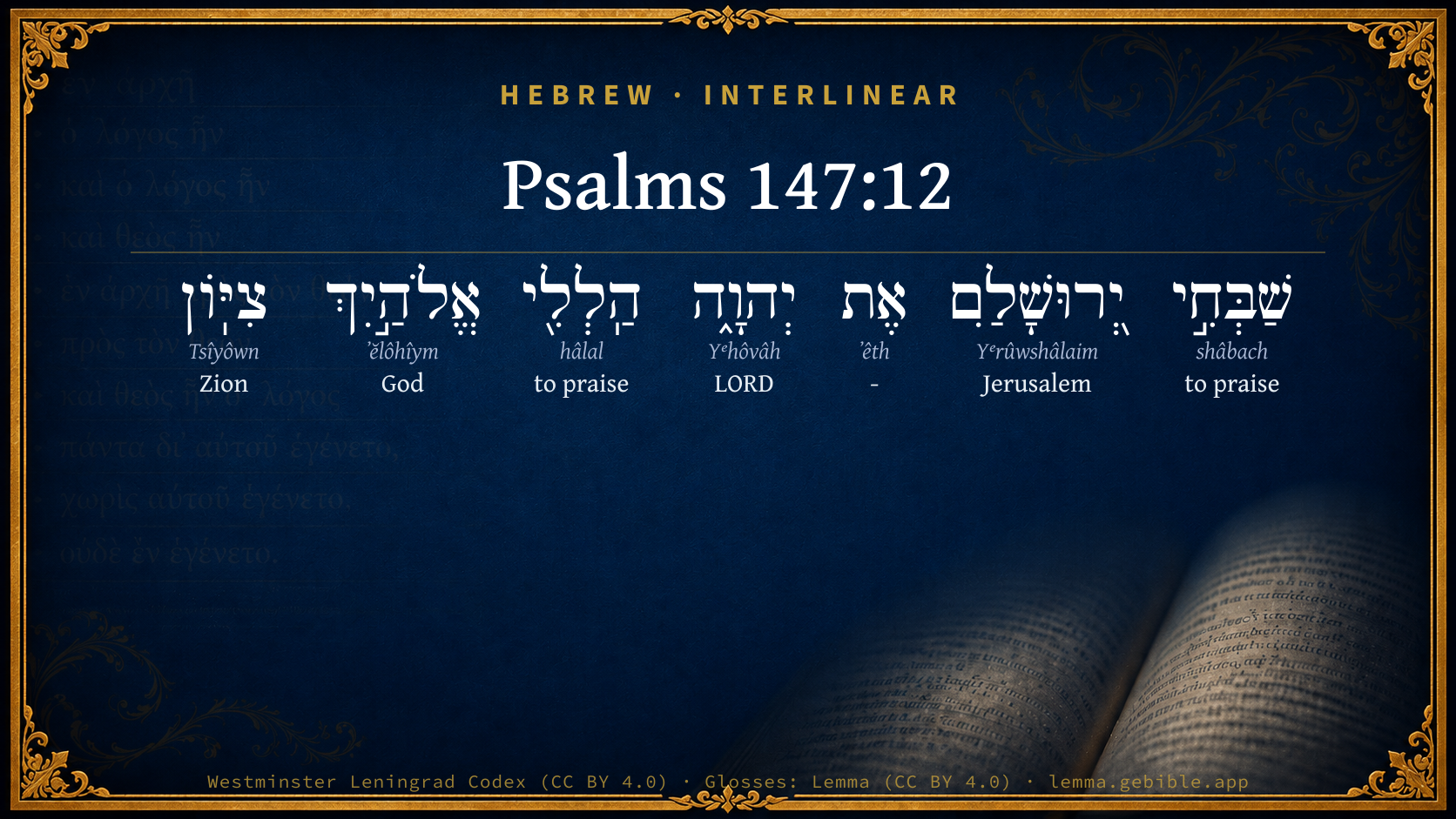
Psalms 147:12

Hebrew (Westminster Leningrad Codex) Psalms 147:12 appears in the Hebrew Old Testament. The text above is from the Westminster Leningrad Codex. Each word links to its Strong’s number, a concise gloss, and parsing drawn from the Open Scriptures Hebrew Bible morphology. Click any word for its full Brown-Driver-Briggs (BDB) entry.
Download image
Cite this verse

Psalms 147:12 (World English Bible). Public Domain. Lemma interlinear Bible study tool, https://lemma.gebible.app/v/psalms/147/12.

Show BibTeX & RIS
BibTeX
RIS
English Translation
Praise Yahweh, Jerusalem! Praise your God, Zion!
World English Bible · Public Domain
Download a study sheet

One document with this verse’s original text, its word-by-word gloss line, the meaning frame, cross-references with their text, attributed commentary, and full source and license credits — printable, and it pastes into notes with its structure intact.

This verse Autodidact and up

Study sheet (.html) Plain text (.txt)

A passage Seminary Student

Up to 50 verses in one chapter. A passage sheet keeps up to 6 commentary sources and 12 cross-references per verse, in the order this page ranks them, and says so on the sheet whenever that leaves anything out. Ask for a single verse and you get the Autodidact verse sheet above.

Everything on this page stays free to read, with no account — the sheet is a download of what is already on screen, not access to it.

Want to remove ads? Support Godless Engineer
Compare translations 3

The same verse in 3 English versions, stacked beneath the original-language interlinear above. Click any original word for its lexicon entry.

Each is an independent rendering of the whole verse — the interlinear is not word-aligned to these translations.

Highlighted words mark where these versions differ — a whole-verse word diff, not a word-by-word alignment.

  • World English Bible Public Domain
    Praise Yahweh, Jerusalem! Praise your God, Zion!
  • King James Version Public Domain
    Praise the LORD, O Jerusalem; praise thy God, O Zion.
  • unfoldingWord Literal Text CC BY-SA 4.0
    Extol Yahweh, Jerusalem; praise your God, Zion.

unfoldingWord Literal Text — © unfoldingWord, licensed CC BY-SA 4.0. Word-aligned USFM3 via Door43 (git.door43.org/unfoldingWord/en_ult).

Versions to compare (up to 4)

3 of 4 selected

Show all 17 translations

Every available English version of this verse, each an independent rendering of the whole verse.

  • World English Bible Public Domain
    Praise Yahweh, Jerusalem! Praise your God, Zion!
  • Berean Standard Bible Public Domain
    Exalt the LORD, O Jerusalem; praise your God, O Zion!
  • Majority Standard Bible Public Domain
    Exalt the LORD, O Jerusalem; praise your God, O Zion!
  • King James Version Public Domain
    Praise the LORD, O Jerusalem; praise thy God, O Zion.
  • American Standard Version (1901) Public Domain
    Praise Jehovah, O Jerusalem; Praise thy God, O Zion.
  • Revised Version (1885) Public Domain
    Praise the LORD, O Jerusalem; praise thy God, O Zion.
  • Geneva Bible (1599) Public Domain
    Prayse the Lord, O Ierusalem: prayse thy God, O Zion.
  • Young's Literal Translation Public Domain
    Glorify, O Jerusalem, Jehovah, Praise thy God, O Zion.
  • Literal Standard Version CC BY-SA 4.0
    Glorify, O Jerusalem, YHWH, || Praise your God, O Zion.
  • Unlocked Literal Bible CC BY-SA 4.0
    Praise Yahweh, Jerusalem, praise your God, Zion.
  • unfoldingWord Literal Text CC BY-SA 4.0
    Extol Yahweh, Jerusalem; praise your God, Zion.
  • Darby Bible Public Domain
    Laud Jehovah, O Jerusalem; praise thy God, O Zion.
  • World Messianic Bible Public Domain
    Praise the LORD, Jerusalem! Praise your God, Zion!
  • Webster's Bible Public Domain
    Praise the LORD, O Jerusalem; praise thy God, O Zion.
  • Free Bible Version CC BY-SA 4.0
    Jerusalem, praise the Lord! Zion, praise your God!
  • Bible in Basic English Public Domain
    Give praise to the Lord, O Jerusalem; give praise to your God, O Zion.
  • JPS Tanakh (1917) Public Domain
    Glorify the LORD, O Jerusalem; praise thy God, O Zion.

Literal Standard Version (2020), Covenant Press — licensed CC BY-SA 4.0. Text via the HelloAO Bible API (eBible.org). Unlocked Literal Bible (unfoldingWord) — licensed CC BY-SA 4.0. Text via the HelloAO Bible API (eBible.org). unfoldingWord Literal Text — © unfoldingWord, licensed CC BY-SA 4.0. Word-aligned USFM3 via Door43 (git.door43.org/unfoldingWord/en_ult). Free Bible Version, Dr. Jonathan Gallagher — licensed CC BY-SA 4.0. Text via the HelloAO Bible API (eBible.org).

Word by word

More ways to search: Search by grammar → Find every occurrence → Compare this word →

Practice this passage: Drill this verse → Learn its vocabulary →

About this verse

These counts appear in no published source. They are computed here, from the morphology-tagged text and Lemma’s own curated glosses. What Lemma adds →

7
words
7
distinct lemmas
Wisdom
section

Notable vocabulary

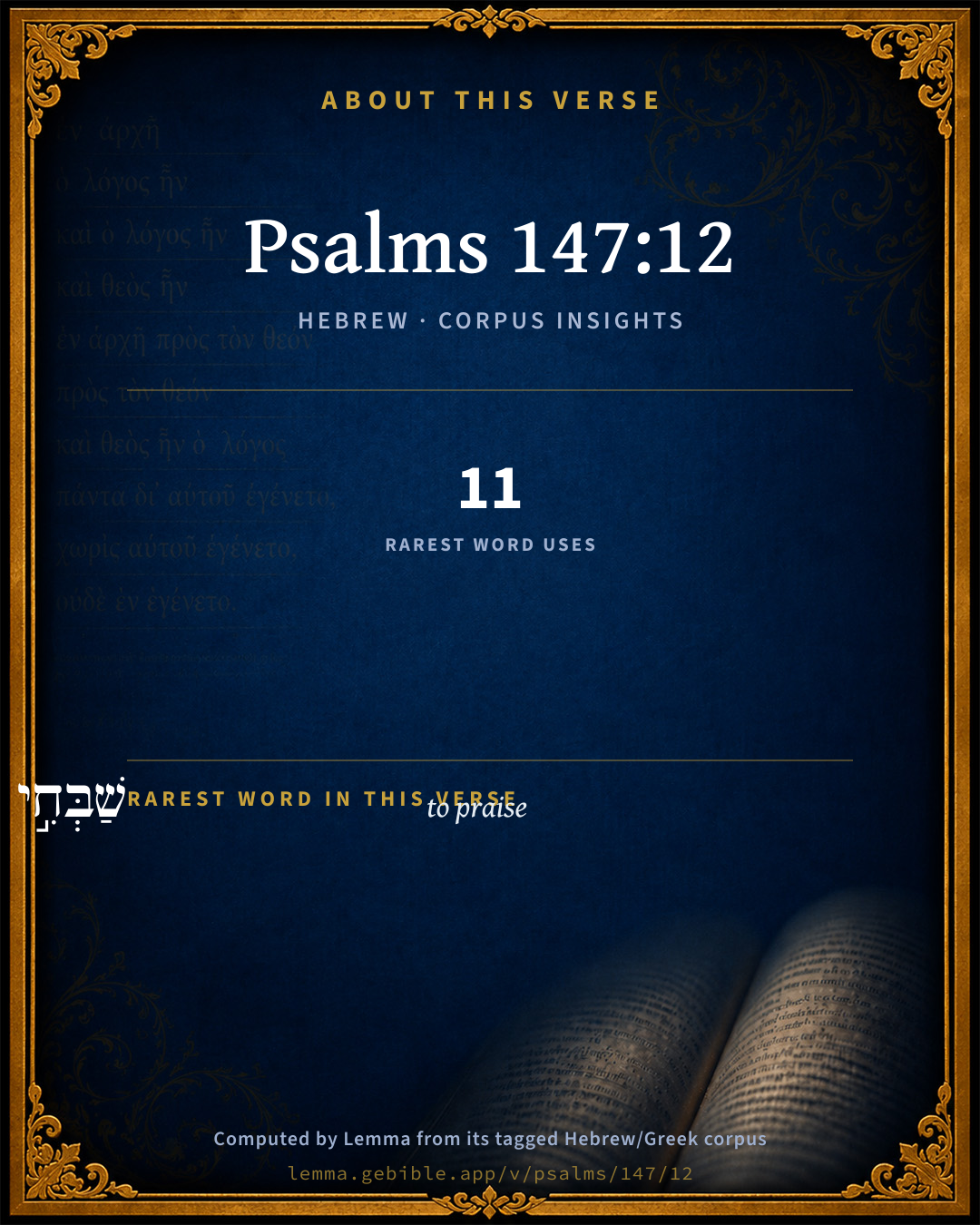
The rarest word here is שַׁבְּחִ֣י to praise H7623 — appearing just 11 times in the whole Hebrew Bible.

Shared distinctive vocabulary

שַׁבְּחִ֣י to praise H7623 occurs in 11 verses of the Hebrew Bible. Also found in:

Grammatical profile

  • 2 verbs
  • 4 nouns
  • 1 particle

Verb forms

  • שַׁבְּחִ֣י Piel · Imperative
  • הַֽלְלִ֖י Piel · Imperative

Cross-references

6

Topical passages linked to Psalms 147:12 in the Treasury of Scripture Knowledge — connected by theme and wording, ordered by reader-vote popularity; previews shown in the World English Bible.

  • Isaiah 12:6 Cry aloud and shout, you inhabitant of Zion; for great in the midst of you is the Holy One of Israel!"
  • Isaiah 52:7 How beautiful on the mountains are the feet of him who brings good news, who publishes peace, who brings good news of good, who publishes salvation, who says to Zion, Your God reigns!
  • Joel 2:23 "Be glad then, you children of Zion, And rejoice in Yahweh, your God; For he gives you the former rain in just measure, And he causes the rain to come down for you, The former rain and the latter rain, As before.
  • Psalms 135:19–21 House of Israel, praise Yahweh! House of Aaron, praise Yahweh!
  • Psalms 146:10 Yahweh will reign forever; Your God, O Zion, to all generations. Praise Yah!
  • Psalms 149:2 Let Israel rejoice in him who made them. Let the children of Zion be joyful in their King.

Cross-references courtesy of OpenBible.info (CC BY 4.0).

Hebrew and Greek witnesses Masoretic Hebrew ↔ Greek Septuagint

The same verse in the two great witnesses to the Old Testament, shown verse-for-verse.

You’re reading Greek Psalm 146 (Hebrew Psalm 147). The Septuagint counts the superscription, so verse numbers can differ from the Hebrew — chapter-level alignment, not verse-by-verse. Numbering follows Rahlfs.

These are two independent witnesses, not word-aligned to each other, and the Septuagint is shown in lemma (dictionary) form.

Hebrew Psalms 147:12 Masoretic · Westminster Leningrad Codex

שַׁבְּחִ֣י יְ֭רוּשָׁלִַם אֶת יְהוָ֑ה הַֽלְלִ֖י אֱלֹהַ֣יִךְ צִיּֽוֹן

Praise Yahweh, Jerusalem! Praise your God, Zion!

World English Bible · Public Domain

On this verse, John Gill's Exposition discusses the Septuagint’s reading. Read the note in Commentary ↓

Hebrew: Westminster Leningrad Codex (CC BY 4.0). Greek: Septuagint (public domain); English from a public-domain English Septuagint. How the Septuagint differs from the Hebrew →

Commentary

Notes on Psalms 147:12 from classic Christian and Jewish commentators (each source and its license shown beneath its notes). The classic Christian expositions comment on the surrounding passage and are grouped to its opening verse, so a note may address several verses; the Jewish commentaries on the Tanakh (Rashi and others) are per-verse, so they appear only where the commentator wrote on this verse.

Lemma curates 59 commentaries, every one of them public domain or Creative Commons licensed, each selected and text-cleaned for this edition rather than reprinted as found. About our sources →

Matthew Henry's Commentary

Jerusalem, and Zion, the holy city, the holy hill, are here called upon to praise God, Psa 147:12. For where should praise be offered up to God but where his altar is? Where may we expect that glory should be given to him but in the beauty of holiness? Let the inhabitants of Jerusalem praise the Lord in their own houses; let the priests and Levites, who attend in Zion, the city of their solemnities, in a special manner praise the Lord. They have more cause to do it than others, and they lie under greater obligations to do it than others; for it is their business, it is their profession. "Praise thy God, O Zion! he is thine, and therefore thou art bound to praise him; his being thine includes all happiness, so that thou canst never want matter for praise." Jerusalem and Zion must praise God,

I. For the prosperity and flourishing state of their civil interests, Psa 147:13, Psa 147:14. 1. For their common safety. They had gates, and kept their gates barred in times of danger; but that would not have been an effectual security to them if God had not strengthened the bars of their gates and fortified their fortifications. The most probable means we can devise for our own preservation will not answer the end, unless God give his blessing with them; we must therefore in the careful and diligent use of those means, depend upon him for that blessing, and attribute the undisturbed repose of our land more to the wall of fire than to the wall of water round about us, Zac 2:5. 2. For the increase of their people. This strengthens the bars of the gates as much as any thing: He hath blessed thy children within thee, with that first and great blessing, Be fruitful, and multiply, and replenish the land. It is a comfort to parents to see their children blessed of the Lord (Isa 61:9), and a comfort to the generation that is going off to see the rising generation numerous and hopeful, for which blessing God must be blessed. 3. For the public tranquillity, that they were delivered from the terrors and desolations of war: He makes peace in thy borders, by putting an end to the wars that were, and preventing the wars that were threatened and feared. He makes peace within thy borders, that is, in all parts of the country, by composing differences among neighbours, that there may be no intestine broils and animosities, and upon thy borders, that they may not be attacked by invasions from abroad. If there be trouble any where, it is in the borders, the marches of a country; the frontier-towns lie most exposed, so that, if there be peace in the borders, there is a universal peace, a mercy we can never be sufficiently thankful for. 4. For great plenty, the common effect of peace: He filleth thee with the finest of the wheat - wheat, the most valuable grain, the fat, the finest of that, and a fulness thereof. What would they more? Canaan abounded with the best wheat (Deu 32:14) and exported it to the countries abroad, as appears, Eze 27:17. The land of Israel was not enriched with precious stones nor spices, but with the finest of the wheat, with bread, which strengthens man's heart. This made it the glory of all lands, and for this God was praised in Zion.

II. For the wonderful instances of his power in the weather, particularly the winter-weather. He that protects Zion and Jerusalem is that God of power from whom all the powers of nature are derived and on whom they depend, and who produces all the changes of the seasons, which, if they were not common, would astonish us.

1. In general, whatever alterations there are in this lower world (and it is that world that is subject to continual changes) they are produced by the will, and power, and providence of God (Psa 147:15): He sendeth forth his commandment upon earth, as one that has an incontestable authority to give orders, and innumerable attendants ready to carry his orders and put them in execution. As the world was at first made, so it is still upheld and governed, by a word of almighty power. God speaks and it is done, for all are his servants. That word takes effect, not only surely, but speedily. His word runneth very swiftly, for nothing can oppose or retard it. As the lightning, which passes through the air in an instant, such is the word of God's providence, and such the word of his grace, when it is sent forth with commission, Luk 17:24. Angels, who carry his word and fulfil it, fly swiftly, Dan 9:21.

2. In particular, frosts and thaws are both of them wonderful changes, and in both we must acknowledge the word of his power.

(1.) Frosts are from God. With him are the treasures of the snow and the hail (Job 38:22, Job 38:23), and out of these treasures he draws as he pleases. [1.] He giveth snow like wool. It is compared to wool for its whiteness (Isa 1:18), and its softness; it falls silently, and makes no more noise than the fall of a lock of wool; it covers the earth, and keeps it warm like a fleece of wool, and so promotes its fruitfulness. See how God can work by contraries, and bring meat out of the eater, can warm the earth with cold snow. [2.] He scatters the hoar-frost, which is dew congealed, as the snow and hail are rain congealed. This looks like ashes scattered upon the grass, and is sometimes prejudicial to the products of the earth and blasts them as if it were hot ashes, Psa 78:47. [3.] He casts forth his ice like morsels, which may be understood either of large hail-stones, which are as ice in the air, or of the ice which covers the face of the waters, and when it is broken, though naturally it was as drops of drink, it is as morsels of meat, or crusts of bread. [4.] When we see the frost, and snow, and ice, we feel it in the air: Who can stand before his cold? The beasts cannot; they retire into dens (Job 37:8); they are easily conquered then, Sa2 23:20. Men cannot, but are forced to protect themselves by fires, or furs, or both, and all little enough where and when the cold is in extremity. We see not the causes when we feel the effects; and therefore we must call it his cold; it is of his sending, and therefore we must bear it patiently, and be thankful for warm houses, and clothes, and beds, to relieve us against the rigour of the season, and must give him the glory of his wisdom and sovereignty, his power and faithfulness, which shall not cease any more than summer, Gen 8:22. And let us also infer from it, If we cannot stand before the cold of his frosts, how can we stand before the heat of his wrath?

(2.) Thaws are from God. When he pleases (Psa 147:18) he sends out his word and melts them; the frost, the snow, the ice, are all dissolved quickly, in order to which he causes the wind, the south wind, to blow, and the waters, which were frozen, flow again as they did before. We are soon sensible of the change, but we see not the causes of it, but must resolve it into the will of the First Cause. And in it we must take notice not only of the power of God, that he can so suddenly, so insensibly, make such a great and universal alteration in the temper of the air and the face of the earth (what cannot he do that does this every winter, perhaps often every winter?) but also of the goodness of God. Hard weather does not always continue; it would be sad if it should. He does not contend for ever, but renews the face of the earth. As he remembered Noah, and released him (Gen 8:1), so he remembers the earth, and his covenant with the earth, Sol 2:11, Sol 2:12. This thawing word may represent the gospel of Christ, and this thawing wind the Spirit of Christ (for the Spirit is compared to the wind, Joh 3:8); both are sent for the melting of frozen souls. Converting grace, like the thaw, softens the heart that was hard, moistens it, and melts it into tears of repentance; it warms good affections, and makes them to flow, which, before, were chilled and stopped up. The change which the thaw makes is universal and yet gradual; it is very evident, and yet how it is done is unaccountable: such is the change wrought in the conversion of a soul, when God's word and Spirit are sent to melt it and restore it to itself.

III. For his distinguishing favour to Israel, in giving them his word and ordinances, a much more valuable blessing than their peace and plenty (Psa 147:14), as much as the soul is more excellent than the body. Jacob and Israel had God's statutes and judgments among them. They were under his peculiar government; the municipal laws of their nation were of his framing and enacting, and their constitution was a theocracy. They had the benefit of divine revelation; the great things of God's law were written to them. They had a priesthood of divine institution for all things pertaining to God, and prophets for all extraordinary occasions. No people besides went upon sure grounds in their religion. Now this was, 1. A preventing mercy. They did not find out God's statutes and judgments of themselves, but God showed his word unto Jacob, and by that word he made known to them his statutes and judgments. It is a great mercy to any people to have the word of God among them; for faith comes by hearing and reading that word, that faith without which it is impossible to please God. 2. A distinguishing mercy, and upon that account the more obliging: "He hath not dealt so with every nation, not with any nation; and, as for his judgments, they have not known them, nor are likely to know them till the Messiah shall come and take down the partition-wall between Jew and Gentile, that the gospel may be preached to every creature." Other nations had plenty of outward good things; some nations were very rich, others had pompous powerful princes and polite literature, but none were blessed with God's statutes and judgments as Israel were. Let Israel therefore praise the Lord in the observance of these statutes. Lord, how is it that thou wilt manifest thyself to us, and not to the world! Even so, Father, because it seemed good in thy eyes.

Matthew Henry's Commentary on the Whole Bible (1708–1710) — public domain (CC PDM 1.0). Text via the HelloAO Bible API.

Trapp's Complete Commentary

John Trapp

Psa 147:12 Praise the LORD, O Jerusalem; praise thy God, O Zion.

Ver. 12. Praise the Lord, O Jerusalem] Whatever the world doth, let not the Church defraud God of his due praises; "though thou, Israel, play the harlot, yet let not Judah offend," Hos 4:15. God’s blessings go round about graceless and ungrateful people; and they are no more moved than the earth that hath the circumference carried about it, and itself standeth still; but the saints must be of another alloy, Col 3:15, and there is good reason for it.

John Trapp, A Commentary or Exposition upon All the Books of the Old and New Testament (1647–1656) — public domain. Text from a community e-Sword module.

The Biblical Illustrator

Joseph S. Exell

Psa_147:12

Praise the Lord, O Jerusalem.

Crowning Christ in city life

Some time ago, in one of the reviews, a writer gave a picture of the London of the future, when all sanitary and political improvements shall have been perfected. No dust in the streets, no smoke in the air, no noise, no fog, spaces everywhere for flowers and sunlight, the sky above always pure, the Thames running below a tide of silver; but think of the city of the future in whose life, laws, institutions, trade, politics, pleasure, the righteousness of Christ shall find full and final manifestation. Where is the poet, the painter, who shall paint for us that golden city, so holy and clean? It is painted for us in the Book of Revelation, in the Holy Jerusalem, descending out of heaven from God, having the glory of God, etc. (W. L. Watkinson.)

The Biblical Illustrator, edited by Joseph S. Exell (c. 1880s–1900s) — public domain. Text from a community e-Sword module.

Joseph Benson's Commentary

Psa 147:12. Praise the Lord, O Jerusalem, O Zion — O holy city, O holy hill. For where should praise be offered to God, if not there where his altar is? And where should glory be given to him, if not in his house, the beauty of holiness? Let the inhabitants of Jerusalem praise God in their own houses; let the priests and Levites that attend in Zion, the city of their solemnities, in a special manner praise him. They have more cause to do it than others. and they lie under greater obligations; for it is their business, it is their profession. Praise thy God, O Zion — He is thine, and therefore thou art bound to praise him; his being thine includes all happiness, and therefore thou canst never want matter for praise.

Joseph Benson's Commentary on the Old and New Testaments (1811–1818) — public domain. Text from a community e-Sword module.

J. A. Alexander on Psalms

Joseph Addison Alexander

12. (Psa 147:12) Laud, 0 Jerusalem, Jehovah! Praise thy God, 0 Zion! Here begins the second division of the psalm, in which the goodness of God to his people is the theme, and the people itself the object of address.

Joseph Addison Alexander, The Psalms Translated and Explained (1850) — public domain. Text from a community e-Sword module.

John Calvin's Commentaries

12. Celebrate Jehovah, O Jerusalem! Having spoken in general of the mercies of God, he again addresses his discourse to the Lord’s people, who alone, as we have remarked already, can appreciate them, calling upon them to recognize with thanksgiving the blessings which others riot upon without acknowledgment. Under the name of Jerusalem, he comprises the whole Church, for in that place the faithful then held their religious assemblies, and flowed together as it were to the standard of the Lord. Although he will take occasion afterwards again to speak of the government of the world at large, he here commemorates the goodness of God as manifested to his own people, in protecting his own Church, bountifully cherishing it, enriching it abundantly with all blessings, and preserving it in peace and safety from all harm. When he says that the bars of the gates are strengthened by God, he means that the holy city was perfectly guarded by him from all fear of hostile attack. To the same effect is the other expression which comes after — that all its bounds were made peace Enemies were under divine restraint so as to cause no disturbance or confusions. Not that the Church is always in a state of peace throughout its whole extent, and exempt from attack, but that God in a visible manner stretches forth his hand to repel these assaults, and it can securely survey the whole array of its enemies. A more extensive meaning indeed may be given to the term peace, which is often taken to signify a happy and prosperous condition. But as mention is made of bounds, the former sense seems most appropriate. The blessing of God enjoyed within is next spoken of, consisting in this, that the citizens dwell prosperously and happily in it, and are fed bountifully, even to satiety; which does not mean that the children of God always wallow in abundance. This might be the means of corrupting them, prone as our nature is to wantonness; but it suggests that they recognize the liberality of God in their daily food more clearly than others who want faith, and whom either abundance renders blind, or poverty vexes with deplorable anxiety, or covetousness inflames with a desire that never can be satisfied. God’s paternal favor was shown more particularly to our fathers under the law in the abundance of temporal provision, it being necessary to lead them forward to something higher by what was elementary.

John Calvin's Commentaries (1540-1563) — public domain. Text from the Calvin Translation Society English edition (1840s-50s) via the Christian Classics Ethereal Library (ccel.org). Calvin's coverage is partial (roughly two-thirds of the Bible); uncommented books and verses are honest gaps, never fabricated. The 19th-century editor's footnotes and remarks are omitted so the notes are faithfully Calvin's own voice.

Ellicott's Commentary for English Readers

(12) Praise.—For this verb, properly stroke, or soothe, see Psa_63:5.

A Bible Commentary for English Readers, edited by Charles John Ellicott (1878–1897) — public domain. Text from a community e-Sword module.

The Cambridge Bible for Schools and Colleges

gen. ed. J. J. S. Perowne

12. Praise the Lord] Laud Jehovah.

thy God, O Zion] As Psa_146:10.

12–20. Zion is summoned to praise Jehovah for the blessings of peace and prosperity. The Lord of Nature is He Who has endowed Israel with unique privileges.

The Cambridge Bible for Schools and Colleges (gen. ed. J. J. S. Perowne; Cambridge University Press, 1878–1918) — public domain. Text from a community e-Sword module.

John Gill's Exposition

Praise the Lord, O Jerusalem,.... The inhabitants of it, as Kimchi; not Jerusalem in a literal sense, for this respects future time, as Aben Ezra; the world to come, the times of the Messiah: and intends the spiritual Jerusalem, as Arama; that which is free, the mother of us all; the Gospel church, and the members of it; which have great reason to praise the Lord, for their special blessings and peculiar privileges; see Gal 4:26;

praise thy God, O Zion; not the house and family of David, as R. Obadiah; nor the priests and Levites in the temple, as others; but the same as before, the church and people of God; the Mount Zion God has loved and chose for his habitation; the city of our solemnities in Gospel times; the perfection of beauty and joy of the whole earth; whose God and King is Christ; and whom Zion and all her children should praise, being her incarnate God, Immanuel, God manifest in the flesh. With this verse, the Septuagint, Vulgate Latin, Syriac, Arabic, and Ethiopic versions, begin the psalm.

John Gill's Exposition of the Whole Bible (1746–1763) — public domain (CC PDM 1.0). Text via the HelloAO Bible API.

Albert Barnes' Notes on the Bible

Praise the Lord, O Jerusalem ... - In addition to this general praise in which all may unite, there are special reasons why Jerusalem and its inhabitants should praise God: just as now, in addition to the general reasons pertaining to all people why they should praise God, there are special reasons why Christians - why his redeemed people - should do it. What those reasons, as pertaining to the inhabitants of Jerusalem, were, is specified in the following verses.

Albert Barnes' Notes on the Bible (1834–1885) — public domain. Text from a community e-Sword/MySword module.

The Treasury of David

Charles H. Spurgeon

Ver. 12. Praise the Lord, O Jerusalem; praise thy God, O Zion. How the poet insists upon praise: he cries praise, praise, as if it were the most important of all duties. A peculiar people should render peculiar praise. The city of peace should be the city of praise; and the temple of the covenant God should resound with his glories. If nowhere else, yet certainly in Zion there should be joyful adoration of Zion's God. Note, that we are to praise the Lord in our own houses in Jerusalem as well as in his own house in Zion. The holy city surrounds the holy hill, and both are dedicated to the holy God, therefore both should ring with hallelujahs.

Ver. 12. That all Creation must involuntarily praise the Lord, and that the primary duty of conscious intelligence is the willing praise of the same Deity, are the two axioms of the Psalmist's theology. He has in the first part of this Psalm been stating the first, and now he is about to announce the second. Martin Geier.

Ver. 12.

1. The Lord whom we praise.

2. His praise in our housesJerusalem.

3. Our praise in his houseZion.

Psalms 147:13*

Charles H. Spurgeon's The Treasury of David (1869–1885) — public domain. Psalms only. Text from a community e-Sword/MySword module.

Whedon's Commentary on the Bible

Daniel D. Whedon

12. Praise the Lord—The psalm bursts out afresh with joy at the condition of Jerusalem and the prospects of the nation. Israel returned from the captivity with the profound conviction, never again to be shaken, that the gods of other nations were vanity, and that Jehovah was God— almighty, eternal, and alone.

Daniel D. Whedon (gen. ed.), Commentary on the Old and New Testaments (1874–1909) — public domain. Text from a community e-Sword module.

The Pulpit Commentary

Praise the Lord, O Jerusalem. The other exhortations to praise in the psalm are general (vers. 1, 7); now a special call is made on Jerusalem to give him praise, since Jerusalem has lately experienced special mercies (vers. 13, 14). Praise thy God, O Zion. (comp. Psa_146:10)

Vers. 12-20. National well-being.

Piety and patriotism, that go so well together and were so intimately bound together in the mind of the Jews, are here very closely associated. We, too, are convinced that the future of our country will be determined by its faithfulness or unfaithfulness to the Lord whom it professes to serve. There are four features of national well-being here.

I SECURITY. (Ver. 13) "He hath strengthened the bars of thy gates." Jerusalem was surrounded by its protecting walls, (Neh_2:12) and its citizens could work in safety and rest in peace. In our island home, which has known no shadow of fear of invasion for eighty years, we cannot realize how great a blessing is freedom from that great national evil, or from the dread of it. The thought hardly enters into our minds. But we have, if we would think about it, all the more occasion for gratitude that we abide in such continuous safety and security; we have "peace in our borders.

II PROSPERITY. (Vers. 14-18) The wealth of a country depends very largely on the industry, the frugality, and the forethought of its people. If they do not carefully, systematically, and (we may add) scientifically cultivate its fields, spare and plant its trees, penetrate its mines and its waters, save their resources for renewed fertilization and for enterprise of various kinds, the country will, in these times of competition more especially, certainly decline. But its prosperity also depends on the bounties of Divine providence: on the fall of rain and snow; on the regular return of the seasons in their order; on the cold winds of winter, and the warm airs of summer; on the pulverizing frosts and the ripening sunshine. It is the bountiful hand of Heaven that gives the rich harvest, and fills the garners with the "finest of the wheat.

III HOMES AND HOME-LIFE. "He hath blessed thy children within thee" (ver. 13). No product of field or mine can be compared with that of the homes of the people. Happy is the nation that dwells in homes of purity, peace, love, piety!

IV RELIGIOUS PRIVILEGE. (Vers. 19, 20) The distinguishing blessing of Israel was its knowledge of the true God, and its consequent training in all personal, domestic, and social virtues. The people of Israel were acquainted with the "word," and therefore with the will of God, and their life was, to some large extent in their better days, ordered according to his "statutes" and "judgments." In their worship, in their pursuits, and in their homes, they rejoiced before the Lord, and they walked in his ways. This is the crowning blessing. Perhaps we may think that we in this country may adopt the language of the psalmist, and apply it to ourselves: "he hath not dealt so with any nation." That might be the exaggeration of a complacent patriotism, but would it not rather be the right feeling of a grateful piety? With all our sacred edifices, our Christian ministry, our evangelizing and philanthropic institutions (healing, preserving, remedial), our educational advantages, our preservation of the seventh day as a day of rest and worship, have we not received, and do we not retain, a measure of privilege which calls for intense gratitude, which also lays us under very serious obligation? For, from those to whom much is given much will be required; "exalted to heaven" in privilege, let us see that we are not "cast down to hell" in condemnation for not availing ourselves of it, and "knowing the day of our visitation,"

The Pulpit Commentary (1880–1919), ed. H.D.M. Spence-Jones & Joseph S. Exell — public domain. Text from a community e-Sword module.

unfoldingWord translationNotes

Door43 World Missions Community

Jerusalem ... Zion

The writer speaks to Jerusalem, which he also calls Zion, as if it were a person. The names of the city are metonyms for the people who live in it. AT: "people of Jerusalem ... people of Zion" (See: Personification and Metonymy)

For he strengthens the bars of your gates

The phrase "the bars of your gates" represent the city as a whole. Yahweh will make Jerusalem secure from enemy invasion. AT: "For he protects Jerusalem" (See: Synecdoche)

he blesses ... among you

The writer speaks of those who live in Jerusalem as if they were Jerusalem's children. AT: "he blesses those who live in Jerusalem" (See: Metaphor)

He brings prosperity

"He brings peace." Possible meanings are 1) Yahweh causes the people who live in Jerusalem to prosper materially and financially or 2) the word translated as "prosperity" means "peace" and Yahweh keeps Jerusalem safe from enemy attack.

translationWords

Jerusalem

Zion

gate

prosper

wheat

unfoldingWord translationNotes — © Distant Shores Media and the Door43 World Missions Community, licensed CC BY-SA 4.0. Source: git.door43.org/Door43/en_tn.

Lesson kit

Teaching starters — assembled from the data on this page, not authored interpretation. Every prompt links to the verse data it draws on. Edit before teaching.

Psalms, in the Wisdom, opens this verse with 7 words (7 distinct Hebrew lemmas). Its most distinctive word is shâbach (“to praise”). A historical commentator’s framing appears above. Read the whole chapter for the surrounding context.

Discussion questions

  1. The word shâbach carries the sense “to praise.” How does it shape the verse?
  2. How does 1 Chronicles 16:35, which shares the word «to praise», read alongside this verse?
  3. These translations render this verse differently. What is at stake in choosing one wording over another?
  4. «שַׁבְּחִ֣י» is a Piel Imperative verb. How does that grammatical form shape the action described?
  5. Compare how Matthew Henry's Commentary and Trapp's Complete Commentary read this verse. Where do they agree or differ?

Things to notice

Reading settings

Reading text

Shown beneath each verse's original-language words.

Old Testament
Old Testament edition

Read the OT as the Masoretic Hebrew (MT) or the Greek Septuagint (LXX).

English shown for the Greek Septuagint (in the Hebrew ↔ Greek comparison).

Comparing translations? Open the Compare panel on any verse page to stack up to four side by side.