
Daniel 9:7

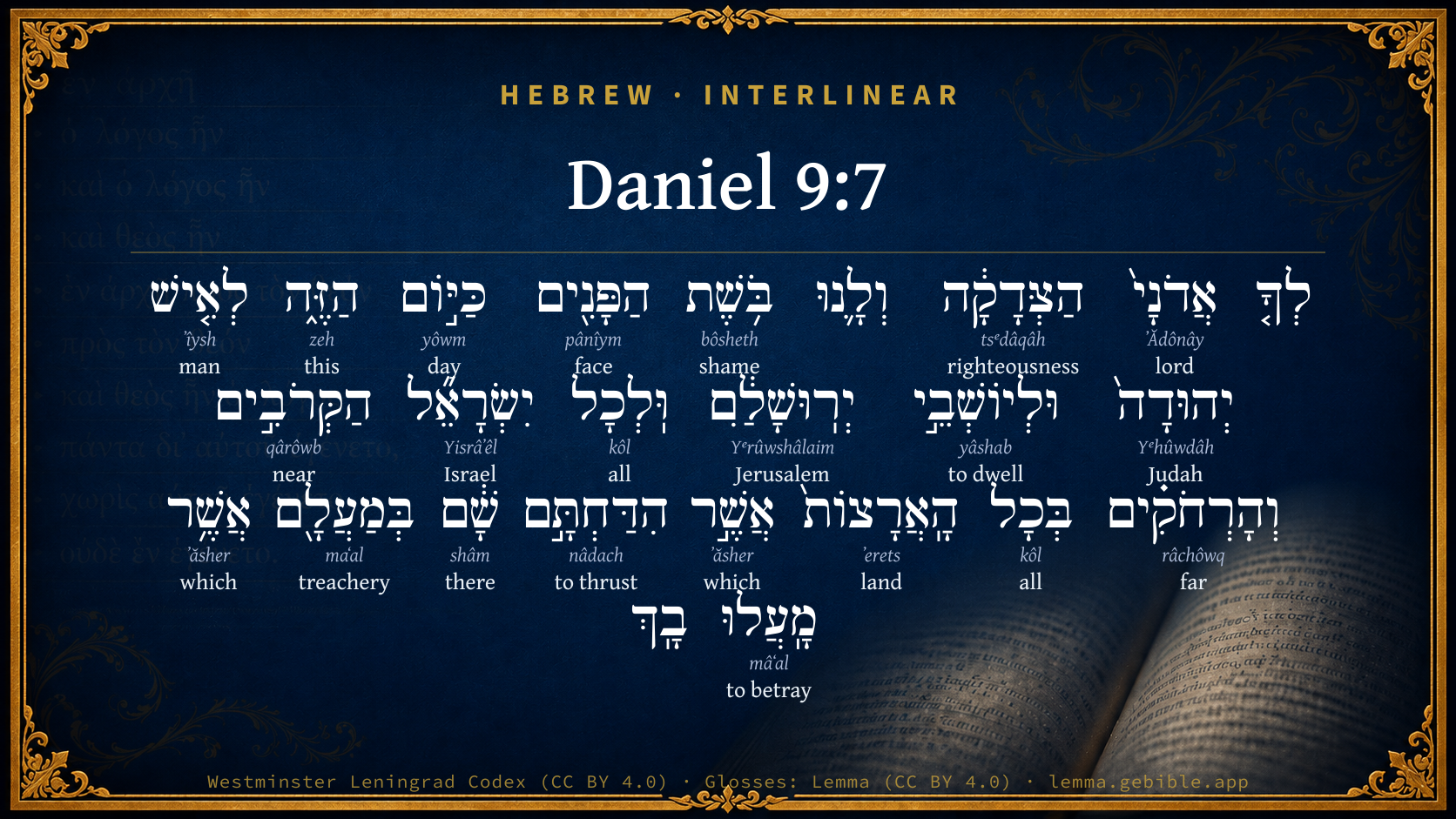
Hebrew (Westminster Leningrad Codex) Daniel 9:7 appears in the Hebrew Old Testament. The text above is from the Westminster Leningrad Codex. Each word links to its Strong’s number, a concise gloss, and parsing drawn from the Open Scriptures Hebrew Bible morphology. Click any word for its full Brown-Driver-Briggs (BDB) entry.
Download image
Cite this verse

Daniel 9:7 (World English Bible). Public Domain. Lemma interlinear Bible study tool, https://lemma.gebible.app/v/daniel/9/7.

Show BibTeX & RIS
BibTeX
RIS
English Translation
Lord, righteousness belongs to you, but to us confusion of face, as at this day; to the men of Judah, and to the inhabitants of Jerusalem, and to all Israel, who are near, and who are far off, through all the countries where you have driven them, because of their trespass that they have trespassed against you.
World English Bible · Public Domain
Download a study sheet

One document with this verse’s original text, its word-by-word gloss line, the meaning frame, cross-references with their text, attributed commentary, and full source and license credits — printable, and it pastes into notes with its structure intact.

This verse Autodidact and up

Study sheet (.html) Plain text (.txt)

A passage Seminary Student

Up to 50 verses in one chapter. A passage sheet keeps up to 6 commentary sources and 12 cross-references per verse, in the order this page ranks them, and says so on the sheet whenever that leaves anything out. Ask for a single verse and you get the Autodidact verse sheet above.

Everything on this page stays free to read, with no account — the sheet is a download of what is already on screen, not access to it.

Want to remove ads? Support Godless Engineer
Compare translations 3

The same verse in 3 English versions, stacked beneath the original-language interlinear above. Click any original word for its lexicon entry.

Each is an independent rendering of the whole verse — the interlinear is not word-aligned to these translations.

Highlighted words mark where these versions differ — a whole-verse word diff, not a word-by-word alignment.

  • World English Bible Public Domain
    Lord, righteousness belongs to you, but to us confusion of face, as at this day; to the men of Judah, and to the inhabitants of Jerusalem, and to all Israel, who are near, and who are far off, through all the countries where you have driven them, because of their trespass that they have trespassed against you.
  • King James Version Public Domain
    O LORD, righteousness belongeth unto thee, but unto us confusion of faces, as at this day; to the men of Judah, and to the inhabitants of Jerusalem, and unto all Israel, that are near, and that are far off, through all the countries whither thou hast driven them, because of their trespass that they have trespassed against thee.
  • unfoldingWord Literal Text CC BY-SA 4.0
    To you, O Lord, belongs righteousness, but to us belongs shame on our faces, as it is this day—to the men of Judah, to the inhabitants of Jerusalem, and to all Israel, those who are near and those who are far away, in all the lands where you have driven them, because of their treachery which they have committed against you.

unfoldingWord Literal Text — © unfoldingWord, licensed CC BY-SA 4.0. Word-aligned USFM3 via Door43 (git.door43.org/unfoldingWord/en_ult).

Versions to compare (up to 4)

3 of 4 selected

Show all 18 translations

Every available English version of this verse, each an independent rendering of the whole verse.

  • World English Bible Public Domain
    Lord, righteousness belongs to you, but to us confusion of face, as at this day; to the men of Judah, and to the inhabitants of Jerusalem, and to all Israel, who are near, and who are far off, through all the countries where you have driven them, because of their trespass that they have trespassed against you.
  • Berean Standard Bible Public Domain
    To You, O Lord, belongs righteousness, but this day we are covered with shame—the men of Judah, the people of Jerusalem, and all Israel near and far, in all the countries to which You have driven us because of our unfaithfulness to You.
  • Majority Standard Bible Public Domain
    To You, O Lord, belongs righteousness, but this day we are covered with shame—the men of Judah, the people of Jerusalem, and all Israel near and far, in all the countries to which You have driven us because of our unfaithfulness to You.
  • King James Version Public Domain
    O LORD, righteousness belongeth unto thee, but unto us confusion of faces, as at this day; to the men of Judah, and to the inhabitants of Jerusalem, and unto all Israel, that are near, and that are far off, through all the countries whither thou hast driven them, because of their trespass that they have trespassed against thee.
  • American Standard Version (1901) Public Domain
    O Lord, righteousness belongeth unto thee, but unto us confusion of face, as at this day; to the men of Judah, and to the inhabitants of Jerusalem, and unto all Israel, that are near, and that are far off, through all the countries whither thou hast driven them, because of their trespass that they have trespassed against thee.
  • Revised Version (1885) Public Domain
    O Lord, righteousness belongeth unto thee, but unto us confusion of face, as at this day; to the men of Judah, and to the inhabitants of Jerusalem, and unto all Israel, that are near, and that are far off, through all the countries whither thou hast driven them, because of their trespass that they have trespassed against thee.
  • Geneva Bible (1599) Public Domain
    O Lord, righteousnes belongeth vnto thee, and vnto vs open shame, as appeareth this day vnto euery man of Iudah, and to the inhabitants of Ierusalem: yea, vnto all Israel, both neere and farre off, through all the countreys, whither thou hast driuen them, because of their offences, that they haue committed against thee.
  • Douay-Rheims (1899) Public Domain
    To thee, O Lord, justice: but to us confusion of face, as at this day to the men of Juda, and to the inhabitants of Jerusalem, and to all Israel to them that are near, and to them that are far off in all the countries whither thou hast driven them, for their iniquities by which they have sinned against thee.
  • Young's Literal Translation Public Domain
    `To Thee, O Lord, `is' the righteousness, and to us the shame of face, as `at' this day, to the men of Judah, and to the inhabitants of Jerusalem, and to all Israel, who are near, and who are far off, in all the lands whither Thou hast driven them, in their trespass that they have trespassed against Thee.
  • Literal Standard Version CC BY-SA 4.0
    To You, O Lord, [is] the righteousness, and to us the shame of face, as [at] this day, to the men of Judah, and to the inhabitants of Jerusalem, and to all Israel, who are near, and who are far off, in all the lands to where You have driven them, in their trespass that they have trespassed against You.
  • Unlocked Literal Bible CC BY-SA 4.0
    To you, Lord, belongs righteousness. To us today, however, belongs shame on our faces—for the people of Judah and those who live in Jerusalem, and to all Israel. This includes those who are near and those who are far away in all the lands where you scattered them. This is because of the great treachery that we committed against you.
  • unfoldingWord Literal Text CC BY-SA 4.0
    To you, O Lord, belongs righteousness, but to us belongs shame on our faces, as it is this day—to the men of Judah, to the inhabitants of Jerusalem, and to all Israel, those who are near and those who are far away, in all the lands where you have driven them, because of their treachery which they have committed against you.
  • Darby Bible Public Domain
    Thine, O Lord, is the righteousness, but unto us confusion of face, as at this day, to the men of Judah, and to the inhabitants of Jerusalem, and unto all Israel, that are near, and that are far off, in all the countries whither thou hast driven them, because of their unfaithfulness in which they have been unfaithful against thee.
  • World Messianic Bible Public Domain
    “Lord, righteousness belongs to you, but to us confusion of face, as it is today; to the men of Judah, and to the inhabitants of Jerusalem, and to all Israel, who are near and who are far off, through all the countries where you have driven them, because of their trespass that they have trespassed against you.
  • Webster's Bible Public Domain
    O Lord, righteousness belongeth to thee, but to us confusion of faces, as at this day; to the men of Judah, and to the inhabitants of Jerusalem, and to all Israel, that are near, and that are far off, through all the countries whither thou hast driven them, because of their trespass that they have trespassed against thee.
  • Free Bible Version CC BY-SA 4.0
    Lord, you always do what is right, but we continue to be ashamed to this very day—we the people of Judah, the inhabitants of Jerusalem, and all Israel, those nearby and those far away, those of every country where you have driven them because of their unfaithfulness to you.
  • Bible in Basic English Public Domain
    O Lord, righteousness is yours, but shame is on us, even to this day; and on the men of Judah and the people of Jerusalem, and on all Israel, those who are near and those who are far off, in all the countries where you have sent them because of the sin which they have done against you.
  • JPS Tanakh (1917) Public Domain
    Unto Thee, O Lord, belongeth righteousness, but unto us confusion of face, as at this day; to the men of Judah, and to the inhabitants of Jerusalem, and unto all Israel, that are near, and that are far off, through all the countries whither Thou hast driven them, because they dealt treacherously with Thee.

Literal Standard Version (2020), Covenant Press — licensed CC BY-SA 4.0. Text via the HelloAO Bible API (eBible.org). Unlocked Literal Bible (unfoldingWord) — licensed CC BY-SA 4.0. Text via the HelloAO Bible API (eBible.org). unfoldingWord Literal Text — © unfoldingWord, licensed CC BY-SA 4.0. Word-aligned USFM3 via Door43 (git.door43.org/unfoldingWord/en_ult). Free Bible Version, Dr. Jonathan Gallagher — licensed CC BY-SA 4.0. Text via the HelloAO Bible API (eBible.org).

Word by word

More ways to search: Search by grammar → Find every occurrence → Compare this word →

Practice this passage: Drill this verse → Learn its vocabulary →

בְּמַעֲלָ֖ם
maʻal
H4604
“in/at · treachery · their”
Preposition + Noun, Common, Masculine, Singular, Construct + Suffix, Personal, 3rd Person, Masculine, Plural
Part of Speech
Preposition + Noun
Type
Common
Gender
Masculine
Number
Singular
State
Construct
Full BDB Definition

Origin: from H4603

TWOT: 1230a

unfaithful or treacherous act, trespass - against man - against God
  1. אֲדֹנָי֙ ʼĂdônây H136 “Lord · my” Noun, Common, Masculine, Plural, Construct + Suffix, Personal, 1st Person, Common, Singular
  2. הַצְּדָקָ֔ה tsᵉdâqâh H6666 “the · righteousness” Particle, Definite Article + Noun, Common, Feminine, Singular, Absolute
  3. בֹּ֥שֶׁת bôsheth H1322 “shame of” Noun, Common, Feminine, Singular, Construct
  4. הַפָּנִ֖ים pânîym H6440 “the · face(s)” Particle, Definite Article + Noun, Common, Both, Plural, Absolute
  5. כַּיּ֣וֹם yôwm H3117 “like/as the · day” Preposition, Determined + Noun, Common, Masculine, Singular, Absolute
  6. הַזֶּ֑ה zeh H2088 “the · this” Particle, Definite Article + Pronoun, Demonstrative, Masculine, Singular
  7. לְאִ֤ישׁ ʼîysh H376 “to/for · man of” Preposition + Noun, Common, Masculine, Singular, Construct
  8. יְהוּדָה֙ Yᵉhûwdâh H3063 “Judah” Noun, Proper
  9. וּלְיוֹשְׁבֵ֣י yâshab H3427 “and · to/for · dwelling” Conjunction + Preposition + Verb, Qal, Participle Active, Masculine, Plural, Construct
  10. יְרֽוּשָׁלִַ֔ם Yᵉrûwshâlaim H3389 “Jerusalem” Noun, Proper
  11. וּֽלְכָל kôl H3605 “and · to/for · all of” Conjunction + Preposition + Noun, Common, Masculine, Singular, Construct
  12. יִשְׂרָאֵ֞ל Yisrâʼêl H3478 “Israel” Noun, Proper
  13. הַקְּרֹבִ֣ים qârôwb H7138 “the · near” Particle, Definite Article + Adjective, Adjective, Masculine, Plural, Absolute
  14. וְהָרְחֹקִ֗ים râchôwq H7350 “and · the · far” Conjunction + Particle, Definite Article + Adjective, Adjective, Masculine, Plural, Absolute
  15. בְּכָל kôl H3605 “in/at · all of” Preposition + Noun, Common, Masculine, Singular, Construct
  16. הָֽאֲרָצוֹת֙ ʼerets H776 “the · lands” Particle, Definite Article + Noun, Common, Both, Plural, Absolute
  17. אֲשֶׁ֣ר ʼăsher H834 “which” Particle, Relative
  18. הִדַּחְתָּ֣ם nâdach H5080 “to thrust · them” Verb, Hiphil, Perfect, 2nd Person, Masculine, Singular + Suffix, Personal, 3rd Person, Masculine, Plural
  19. שָׁ֔ם shâm H8033 “there” Adverb
  20. אֲשֶׁ֥ר ʼăsher H834 “which” Particle, Relative
  21. מָֽעֲלוּ mâʻal H4603 “to betray” Verb, Qal, Perfect, 3rd Person, Common, Plural

About this verse

These counts appear in no published source. They are computed here, from the morphology-tagged text and Lemma’s own curated glosses. What Lemma adds →

25
words
20
distinct lemmas
Prophets
section

Shared distinctive vocabulary

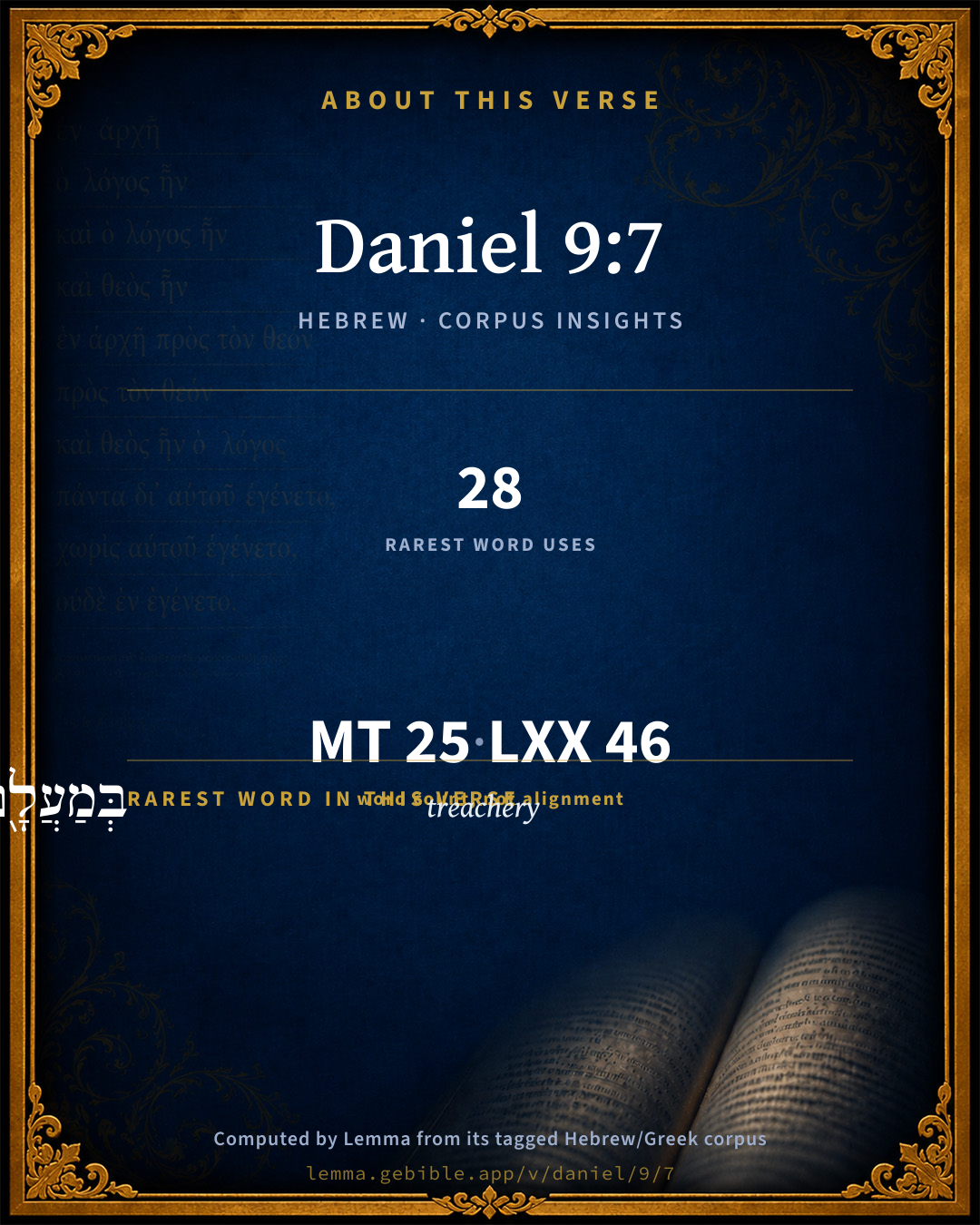
בְּמַעֲלָ֖ם treachery H4604 occurs in 28 verses of the Hebrew Bible. Also found in:

Grammatical profile

  • 3 verbs
  • 13 nouns
  • 2 adjectives
  • 1 pronoun
  • 3 prepositions
  • 1 adverb
  • 2 particles

Verb forms

  • וּלְיוֹשְׁבֵ֣י Qal · Participle Active
  • הִדַּחְתָּ֣ם Hiphil · Perfect
  • מָֽעֲלוּ Qal · Perfect

Repetition

Words recur within this verse — often emphatic in Hebrew:

  • וּֽלְכָל all H3605 ×2
  • אֲשֶׁ֣ר which H834 ×2

Hebrew & Septuagint length

In English translation the verse runs 57 words from the Hebrew and 58 from the Septuagint (LXX English) — closely comparable.

A rough comparison of the two English renderings, which tokenize alike — not a word-level alignment.

Word counts can differ between the Hebrew and the Greek without any difference in meaning — e.g. the Hebrew direct-object marker אֵת has no separate Greek word, and Greek often adds the article ὁ.

In the original languages it is 25 Hebrew tokens and 46 Greek tokens — but the two are counted differently (Hebrew bundles its prefixes and suffixes into one token; the Greek is in lemma form), so that isn’t a like-for-like length.

Cross-references

25

Topical passages linked to Daniel 9:7 in the Treasury of Scripture Knowledge — connected by theme and wording, ordered by reader-vote popularity; previews shown in the World English Bible.

  • Deuteronomy 4:27 Yahweh will scatter you among the peoples, and you shall be left few in number among the nations, where Yahweh shall lead you away.
  • Psalms 44:15 All day long my dishonor is before me, And shame covers my face,
  • Jeremiah 2:26–27 As the thief is ashamed when he is found, so is the house of Israel ashamed; they, their kings, their princes, and their priests, and their prophets;
  • Jeremiah 3:25 Let us lie down in our shame, and let our confusion cover us; for we have sinned against Yahweh our God, we and our fathers, from our youth even to this day; and we have not obeyed the voice of Yahweh our God.
  • Daniel 9:8 Lord, to us belongs confusion of face, to our kings, to our princes, and to our fathers, because we have sinned against you.
  • Daniel 9:14 Therefore has Yahweh watched over the evil, and brought it on us; for Yahweh our God is righteous in all his works which he does, and we have not obeyed his voice.
  • Amos 9:9 "For, behold, I will command, and I will sift the house of Israel among all the nations, as grain is sifted in a sieve, yet not the least kernel will fall on the earth.
  • Romans 6:21 What fruit then did you have at that time in the things of which you are now ashamed? For the end of those things is death.
  • Leviticus 26:33–34 I will scatter you among the nations, and I will draw out the sword after you: and your land will be a desolation, and your cities shall be a waste.
  • Deuteronomy 32:4 The Rock, his work is perfect; For all his ways are justice: A God of faithfulness and without iniquity, Just and right is he.
  • 2 Kings 17:6–7 In the ninth year of Hoshea the king of Assyria took Samaria, and carried Israel away to Assyria, and placed them in Halah, and on the Habor, the river of Gozan, and in the cities of the Medes.
  • Ezra 9:6–7 and I said, my God, I am ashamed and blush to lift up my face to you, my God; for our iniquities are increased over our head, and our guiltiness is grown up to the heavens.
  • Ezra 9:13 After all that is come on us for our evil deeds, and for our great guilt, seeing that you our God have punished us less than our iniquities deserve, and have given us such a remnant,
  • Nehemiah 9:33 However you are just in all that is come on us; for you have dealt truly, but we have done wickedly;
  • Psalms 51:4 Against you, and you only, have I sinned, And done that which is evil in your sight; That you may be proved right when you speak, And justified when you judge.
  • Psalms 51:14 Deliver me from bloodguiltiness, O God, the God of my salvation. My tongue shall sing aloud of your righteousness.
  • Psalms 119:137 You are righteous, Yahweh. Your judgments are upright.
  • Isaiah 11:11 It shall happen in that day, that the Lord will set his hand again the second time to recover the remnant of his people, who shall remain, from Assyria, and from Egypt, and from Pathros, and from Cush, and from Elam, and from Shinar, and from Hamath, and from the islands of the sea.
  • Isaiah 45:16 They shall be disappointed, yes, confounded, all of them; they shall go into confusion together who are makers of idols.
  • Jeremiah 12:1 Righteous are you, Yahweh, when I contend with you; yet would I reason the cause with you: why does the way of the wicked prosper? why are all they at ease who deal very treacherously?
  • Jeremiah 24:9 I will even give them up to be tossed back and forth among all the kingdoms of the earth for evil; to be a reproach and a proverb, a taunt and a curse, in all places where I shall drive them.
  • Ezekiel 16:63 that you may remember, and be confounded, and never open your mouth any more, because of your shame, when I have forgiven you all that you have done, says the Lord Yahweh.
  • Ezekiel 36:31 Then shall you remember your evil ways, and your doings that were not good; and you shall loathe yourselves in your own sight for your iniquities and for your abominations.
  • Luke 23:40–41 But the other answered, and rebuking him said, "Don't you even fear God, seeing you are under the same condemnation?
  • Acts 2:5–11 Now there were dwelling in Jerusalem Jews, devout men, from every nation under the sky.

Cross-references courtesy of OpenBible.info (CC BY 4.0).

Hebrew and Greek witnesses Masoretic Hebrew ↔ Greek Septuagint

The same verse in the two great witnesses to the Old Testament, shown verse-for-verse.

These are two independent witnesses, not word-aligned to each other, and the Septuagint is shown in lemma (dictionary) form.

Hebrew Daniel 9:7 Masoretic · Westminster Leningrad Codex

לְךָ֤ אֲדֹנָי֙ הַצְּדָקָ֔ה וְלָ֛נוּ בֹּ֥שֶׁת הַפָּנִ֖ים כַּיּ֣וֹם הַזֶּ֑ה לְאִ֤ישׁ יְהוּדָה֙ וּלְיוֹשְׁבֵ֣י יְרֽוּשָׁלִַ֔ם וּֽלְכָל יִשְׂרָאֵ֞ל הַקְּרֹבִ֣ים וְהָרְחֹקִ֗ים בְּכָל הָֽאֲרָצוֹת֙ אֲשֶׁ֣ר הִדַּחְתָּ֣ם שָׁ֔ם בְּמַעֲלָ֖ם אֲשֶׁ֥ר מָֽעֲלוּ בָֽךְ

Lord, righteousness belongs to you, but to us confusion of face, as at this day; to the men of Judah, and to the inhabitants of Jerusalem, and to all Israel, who are near, and who are far off, through all the countries where you have driven them, because of their trespass that they have trespassed against you.

World English Bible · Public Domain

Greek LXX Daniel 9:7 Septuagint · lemma form

σύ κύριος ὁ δικαιοσύνη καί ἐγώ ὁ αἰσχύνη ὁ πρόσωπον κατά ὁ ἡμέρα οὗτος ἄνθρωπος ιουδα καί καταἧμαι ἐν ἰερουσαλήμ καί πᾶς ὁ λαός ἰσραήλ ὁ ἐγγύς καί ὁ ἀπωτέρω ἐν πᾶς ὁ χώρα εἰς ὅς διασκορπίζω αὐτός ἐκεῖ ἐν ὁ πλημμέλεια ὅς πλημμελέω ἐναντίον σύ

To you, O Lord, belongs righteousness, and to us confusion of face, as at this day; to the men of Juda, and to the dwellers in Jerusalem, and to all Israel, to them that are near, and to them that are far off in all the earth, wherever you have scattered them, for the sin which they committed.

LXX2012 (modern English Septuagint) · Public Domain

On this verse, The Pulpit Commentary discusses the Septuagint’s reading. Read the note in Commentary ↓

Hebrew: Westminster Leningrad Codex (CC BY 4.0). Greek: Septuagint (public domain); English from LXX2012 (modern English Septuagint) (Public Domain). How the Septuagint differs from the Hebrew →

Commentary

Notes on Daniel 9:7 from classic Christian and Jewish commentators (each source and its license shown beneath its notes). The classic Christian expositions comment on the surrounding passage and are grouped to its opening verse, so a note may address several verses; the Jewish commentaries on the Tanakh (Rashi and others) are per-verse, so they appear only where the commentator wrote on this verse.

Lemma curates 59 commentaries, every one of them public domain or Creative Commons licensed, each selected and text-cleaned for this edition rather than reprinted as found. About our sources →

The Cambridge Bible for Schools and Colleges

gen. ed. J. J. S. Perowne

7. Thus righteousness belongs only to God: to the sinful people only confusion and shame. With Dan_9:7-8 b, cf. Bar_1:15-17.

confusion of faces, &c.] Cf. Ezr_9:7, ‘and for our iniquities have we, our kings, and our priests, been delivered … to confusion of face, as (it is) this day.’ Lit. ‘shame of face,’ as the same expression is rendered in 2Ch_32:21; cf. Psa_44:15, ‘shame of my face;’ Jer_7:19, ‘the shame of their own faces’; also Psa_69:7. The meaning is the shame (i.e. disappointment) which is visible upon the face after a repulse, disaster, &c.

as (it is) this day] as experience shews is now the case.

the men (lit. man,—collectively) of Judah, and to the inhabitants of Jerusalem] A combination found otherwise only in Jer. (8 times),—e.g. Jer_4:4, Jer_32:32,—and 2Ki_23:2 (= 2Ch_34:30). An evident reminiscence of the language of Jer.: cf. ‘all the countries whither thou hast driven them’ from Jer_16:15; Jer_23:3; Jer_23:8; Jer_32:37.

that are near and that are far off] Jer_25:26; cf. Isa_57:19.

their unfaithfulness wherein they have dealt unfaithfully against thee] The idea of mâ‘al is disloyalty rather than ‘trespass.’ The same phrase Lev_26:40; Eze_17:20; Eze_18:24; Eze_39:26; 1Ch_10:13. Both the subst. and the cognate verb are almost confined to the priestly sections of the Hexateuch, to Ezek., and the Chronicles: cf., however, the subst. in Ezr_9:2; Ezr_9:4; Ezr_10:6, and the verb in Ezr_10:2; Ezr_10:10; Neh_1:8; Neh_13:27.

The Cambridge Bible for Schools and Colleges (gen. ed. J. J. S. Perowne; Cambridge University Press, 1878–1918) — public domain. Text from a community e-Sword module.

Trapp's Complete Commentary

John Trapp

Dan 9:7 O Lord, righteousness [belongeth] unto thee, but unto us confusion of faces, as at this day; to the men of Judah, and to the inhabitants of Jerusalem, and unto all Israel, [that are] near, and [that are] far off, through all the countries whither thou hast driven them, because of their trespass that they have trespassed against thee.

Ver. 7. O Lord, righteousness belongeth unto thee.] Let God be justified in all his judgments; say of him as in Deu 32:4; - "A God of truth, and without iniquity; just and right is he."

But unto us confusion of faces] {a} While we look upon flagitia aeque ac flagella nostra, our sins and miseries, we cannot but blush and bleed before thee.

{a} Deo da claritatem, tibi humilitatem. - Aug.

John Trapp, A Commentary or Exposition upon All the Books of the Old and New Testament (1647–1656) — public domain. Text from a community e-Sword module.

Joseph Benson's Commentary

Dan 9:7-10. O Lord, righteousness belongeth unto thee — Thou hast done us no wrong in any of the calamities which thou hast brought upon us; but hast shown thyself to be just and holy, nay, merciful and gracious, punishing us far less than our iniquities deserved. But unto us confusion of faces — But ignominy and shame belong to us; and the contempt and ill treatment we have met with has been no more than we justly deserved. To the men of Judah, and unto all Israel that are near, &c. — To the two tribes of Judah and Benjamin, that are near, by the rivers of Babylon; and to the ten tribes, that are afar off, in the land of Assyria. Confusion belongs not only to the common people of our land, but to our kings, our princes, and to our fathers, who ought to have set a better example, and to have used their authority and influence for the checking of the threatening torrent of vice and profaneness. Neither have we obeyed the voice of the Lord — Though we were under infinite obligations to obey him; to walk in his laws — Which were all holy, just, and good; which he set before us by his servants the prophets — By Moses, and the succession of prophets that followed him; who re-enforced the law of Moses, and gave the people new instructions from God upon emergent occasions.

Joseph Benson's Commentary on the Old and New Testaments (1811–1818) — public domain. Text from a community e-Sword module.

The Pulpit Commentary

Vers. 7, 8. O Lord, righteousness belongeth unto thee, but unto us confusion of faces, as at this day; to the men of Judah, and to the inhabitants of Jerusalem, and unto all Israel, that are near, and that are far off, through all the countries whither thou hast driven them. because of their trespass that they have trespassed against thee. O Lord, to us belongeth confusion of face, to our kings, to our princes, and to our fathers, because we have sinned against thee. The versions are all very close to the Massoretic text. The most important variation is Theodotion"s repetition of the first clause of ver. 7 at the beginning of ver. 8. Neither of the English versions brings out the contrast in the Hebrew ofthe second clause of ver. 7; it is "man," not "men," of Judah. This contrast is observed by Theodotion and Jerome, but not by the LXX or the Peshitta. These two verses have a strong resemblance to RAPC Bar 1:15, 16, "And ye shall say, To our God belongeth righteousness, but unto us the confusion of faces, as it is come to pass this day to man of Judah, and to the inhabitants of Jerusalem, and to our kings, and to our princes, and to our priests, and to our prophets, and to our fathers." This confession is introduced into the text of Baruch as a quotation. The captives on the river Lud send money to Jerusalem for offerings and sacrifices, and with the money send certain advices. As the circumstances in which the Baruch version purports to be written do not so naturally suit the words used, we can, we think, have no difficulty in recognizing that it is not the primitive recension. The words have the look of a liturgic prayer. The relationship between the present passage and Jeremiah is close; "confusion of face" occurs in Jer_7:19 as well as Ezr_9:7. The most marked case is the collocation, "man of Judah, and inbabitants of Jerusalem." This phrase is frequent in Jeremiah; e.g Jer_4:4 Jer_11:2 Jer_17:25. There is also a resemblance to Ezekiel in the phrase, "their trespass that they have trespassed against thee;" e.g. Eze_15:8 Eze_20:27. The language thus is in strict dramatic suitability to one who has just been studying the prophets of the Captivity. To our kings, to oar princes. This could not be used naturally after the date of Daniel. To him who remembered kings and princes in Judah and Jerusalem, this language is natural. In the age of Epiphanes it would be absurd and meaningless. The phrase is used in the liturgic prayer in Nehemiah, because there is a narrative of the history of the people. When we compare the Psalter of Solomon, we find the only King of Israel is God: yet Alexander Jannseus, who was not long dead when that Psalter was written, had assumed the crown; and his sons had competed for the possession of it.

The Pulpit Commentary (1880–1919), ed. H.D.M. Spence-Jones & Joseph S. Exell — public domain. Text from a community e-Sword module.

Tyndale Open Study Notes

Tyndale Open Resources

9:7-14 Lord, you are in the right: God orchestrated the Exile as a judgment on unfaithful Israel (9:11-14). God had given ample warning that it would happen (see Deut 28:36-37, 49-68).

Tyndale Open Study Notes — © Tyndale Open Resources, licensed CC BY-SA 4.0. Text via the HelloAO Bible API.

Geneva Bible (1599)

Geneva Bible translators

Hebrew, confusion of face.

He showeth that whensoever God punisheth, he doeth it for just cause: and thus the godly never accuse him of rigor as the wicked do, but acknowledge that in themselves there is just cause why he should so entreat them.

Geneva Bible (1599) marginal notes — public domain. Text via Bolls.life.

Jamieson, Fausset & Brown

Robert Jamieson, A. R. Fausset & David Brown

confusion of faces, as at this day--Shame at our guilt, betrayed in our countenance, is what belongs to us; as our punishment "at this day" attests.

near, and . . . far off--the chastisement, however varied, some Jews not being cast off so far from Jerusalem as others, all alike were sharers in the guilt.

Jamieson, Fausset & Brown — Commentary Critical and Explanatory on the Whole Bible (1871) — public domain (CC PDM 1.0). Text via the HelloAO Bible API.

Adam Clarke's Commentary

Verse 7. All Israel, that are near, and that are far off] He prays both for Judah and Israel. The latter were more dispersed, and had been much longer in captivity.

Adam Clarke's Commentary on the Bible (1810–1826) — public domain. Text from a community e-Sword/MySword module.

John Calvin's Commentaries

He next subjoins, To thee, O Lord, belongs righteousness, and to us confusion of face, as it is at this day The meaning is, God’s wrath, which he manifests towards his people, is just, and nothing else remains but for the whole people to fall down in confusion, and candidly acknowledge itself deservedly condemned. But this contrast which unites opposite clauses, ought also to be noticed, because we gather from the Prophet’s words that God can neither be esteemed just nor his equity be sufficiently illustrious, unless when the mouths of men are closed, and all are covered and buried in disgrace, and confess themselves subject to just accusation, as Paul also says, Let God be just, and let all men’s mouths be stopped, (Romans 3:4, 26;) that is, let men cease to cavil and to seek any alleviation of their guilty their subterfuges. While, therefore, men are thus cast down and prostrate, God’s true glory is illustrated. The Prophet now utters the same instruction by joining these two clauses, of opposite meaning’s. Righteousness is to thee, but shame to us. Thus we cannot praise God, and especially while he chastises us and punishes us for our sins, unless we become ashamed of our sins, and feel ourselves destitute of all righteousness. Lastly, when we both feel and confess the equity of our condemnation, and when this shame seizes upon our minds, then we begin to confess God’s justice; for whoever cannot bear this self-condemnation, displays his willingness to contend against God. Although hypocrites apparently bear witness to God’s justice, yet whenever they claim anything as due to their own worthiness, they at the same time derogate from their judge, because it is clear that God’s righteousness cannot shine forth unless we bury ourselves in shame and confusion. According as at this day, says Daniel. He adds this to confirm his teaching; as if he had said, the impiety of the people is sufficiently conspicuous from their punishment. Meanwhile, he holds the principle that the people were justly chastised; for hypocrites, when compelled to acknowledge God’s power, still cry out against his equity. Daniel joins both points together: thus, God has afflicted his people, and this very fact proves them to be wicked and perfidious, impious and rebellious. As it is at this day, meaning, I will not complain of any immoderate rigor, I will not say thou hast treated my people cruelly; for even if the punishments which thou hast inflicted on us are severe, yet thy righteousness shines forth in them: I therefore confess how fully we deserve them all. To a man of Judah, says he. Here Daniel seems to wish purposely to strip the mask off the Israelites, under which they thought to hide themselves. For it was an honorable title to be called a Jew, an inhabitant of Jerusalem, an Israelite. It was a sacred race, and Jerusalem was a kind of sanctuary and kingdom of God. But now, says he, though we have hitherto been elevated aloft so as to surpass the whole world, and though God has deigned to bestow upon us so many favors and benefits, yet confusion of face is upon us: let our God be just. Meanwhile, let all these empty boastings cease, such as our deriving our origin from holy fathers and dwelling in a sacred land; let us no longer cling to these things, says he, because they will profit us nothing before God. But I see that I am already too prolix.

John Calvin's Commentaries (1540-1563) — public domain. Text from the Calvin Translation Society English edition (1840s-50s) via the Christian Classics Ethereal Library (ccel.org). Calvin's coverage is partial (roughly two-thirds of the Bible); uncommented books and verses are honest gaps, never fabricated. The 19th-century editor's footnotes and remarks are omitted so the notes are faithfully Calvin's own voice.

Ellicott's Commentary for English Readers

(7) Righteousness.—The absolute righteousness of God appears distinct and clear in spite of the chastisement from which the nation suffers. Meanwhile, the humble looks of the devout part of the nation show that it feels the present shame and confusion.

All the countries.—See Isa_11:11-12. In the midst of his sorrow for the past, the mind of the prophet recurs unconsciously to the great promise of future deliverance by “the root of Jesse.”

A Bible Commentary for English Readers, edited by Charles John Ellicott (1878–1897) — public domain. Text from a community e-Sword module.

John Gill's Exposition

O Lord, righteousness belongeth unto thee,.... It is essential to him, it is his nature, and appears in all his works; he is perfectly pure, holy, and righteous; he is just, and without iniquity; and there is no unrighteousness in him, nor any to be charged upon him, on account of anything done by him: punitive justice belongs to him; nor is he to be complained of because of his judgments, which are righteous altogether; nor had the prophet, or any of his countrymen, just reason to complain of the evils brought on them; the desolations of their land, city, and temple, and their captivity in a strange land; by all which no injustice was done, nor could they charge the Lord with any: and with him also is righteousness wrought out by his Son, to justify sinners that believe in him; he has accepted of it, and imputes it without works.

But unto us confusion of face, as at this day; both on account of their sins, which stared them in the face, loaded their consciences with guilt, and filled them with shame; and on account of their punishment, the miserable condition in which their country was and they themselves were at that day; which declared to all the world what sinners they had been, and what sins they had committed, which had brought this ruin upon them, and them into such sad circumstances:

to the men of Judah, and inhabitants of Jerusalem; or, "man of Judah" (f); to every man of the tribes of Judah and Benjamin; who once dwelt in that land flowing with milk and honey, and now in a strange land for their sins; and to every inhabitant of that renowned city of jerusalem, the metropolis of the nation, the seat, of the kings of Judah; yea, the city of the great King, where the temple stood, and divine worship was performed, but now lay in ruins, through the iniquity of its inhabitants, and therefore had just reason to be ashamed:

and unto all Israel, that are near, and that are afar off, through all the countries whither thou hast driven them, because of the trespass that they have trespassed against thee; shame and confusion of face also belonged to the ten tribes of Israel; to such of them as were mixed with the Jews in Babylon, or were in those parts of Assyria that lay nearest to it; and to those that were at a greater distance, in Media, Iberia, Colchis, and other places; yea, in all kingdoms and countries where they were dispersed for their trespass against the Lord; particularly in worshipping the calves at Dan and Bethel, and other acts of idolatry and impiety.

(f) "vire Judae", Cocceius.

John Gill's Exposition of the Whole Bible (1746–1763) — public domain (CC PDM 1.0). Text via the HelloAO Bible API.

Albert Barnes' Notes on the Bible

O Lord, righteousness belongeth unto thee - Margin, “or, thou hast.” The Hebrew is, “to thee is righteousness, to us shame, etc.” The state of mind in him who makes the prayer is that of ascribing righteousness or justice to God. Daniel feels and admits that God has been right in his dealings. He is not disposed to blame him, but to take all the shame and blame to the people. There is no murmuring or complaining on his part as if God had done wrong in any way, but there is the utmost confidence in him, and ia his government. This is the true feeling with which to come before God when we are afflicted, and when we plead for his mercy and favor. God should be regarded as righteous in all that he has done, and holy in all his judgments and claims, and there should be a willingness to address him as holy, and just, and true, and to take shame and confusion of face to ourselves. Compare Psa 51:4.

But unto us confusion of faces - Hebrew, “shame of faces;” that is, that kind of shame which we have when we feel that we are guilty, and which commonly shows itself in the countenance.

As at this day - As we actually are at this time. That is, he felt that at that time they were a down-trodden, an humbled, a condemned people. Their country was in ruins; they were captives in a far distant land, and all on which they had prided themselves was laid waste. All these judgments and humiliating things he says they had deserved, for they had grievously sinned against God.

To the men of Judah - Not merely to the tribe of Judah, but to the kingdom of that name. After the revolt of the ten tribes - which became known as the kingdom of Ephraim, because Ephraim was the largest tribe, or as the kingdom of Israel - the other portion of the people, the tribes of Judah and Benjamin were known as the kingdom of Judah, since Judah was by far the larger tribe of the two. This kingdom is referred to here, because Daniel belonged to it, and because the ten tribes had been carried away long before and scattered in the countries of the East. The ten tribes had been carried to Assyria. Jerusalem always remained as the capital of the kingdom of Judah, and it is to this portion of the Hebrew people that the prayer of Daniel more especially pertains.

And to the inhabitants of Jerusalem - Particularly to them, as the heaviest calamities had come upon them, and as they had been prominent in the sins for which these judgments had come upon the people.

And unto all Israel - All the people who are descendants of Israel or Jacob, wherever they may be, embracing not only those of the kingdom of Judah properly so called, but all who pertain to the nation. They were all of one blood. They had had a common country. They had all revolted, and a succession of heavy judgments had come upon the nation as such, and all had occasion for shame and confusion of face.

That are near, and that are far off - Whether in Babylon, in Assyria, or in more remote countries. The ten tribes had been carried away some two hundred years before this prayer was offered by Daniel, and they were scattered in far distant lands.

Through all the countries whither thou hast driven them ... - In Babylonia, in Assyria, in Egypt, or in other lands. They were scattered everywhere, and wherever they were they had common cause for humiliation and shame.

Albert Barnes' Notes on the Bible (1834–1885) — public domain. Text from a community e-Sword/MySword module.

Whedon's Commentary on the Bible

Daniel D. Whedon

7, 8. The Lord is righteous, and all the sorrows which have fallen upon Israel have been because of their trespass (or, because of the unfaithfulness that they have committed). (Compare Lev_26:40.) It is this unfaithfulness which causes confusion of faces to all Israel, both rulers and people; those that are near (in Palestine) and those that are far off (the captives in foreign countries).

Daniel D. Whedon (gen. ed.), Commentary on the Old and New Testaments (1874–1909) — public domain. Text from a community e-Sword module.

unfoldingWord translationNotes

Door43 World Missions Community

General Information:

Daniel continues praying to the Lord about the people of Israel.

To you, Lord, belongs righteousness

Being righteous is spoken of as if "righteousness" were an object that belongs to Yahweh. The abstract noun "righteousness" can be stated as "righteous." AT: "Lord, you are righteous" (See: Metaphor and Abstract Nouns)

To us today, however, belongs shame on our faces—for the people

Being ashamed is spoken of as if "shame" were an object that belongs to people. The abstract noun "shame" can be stated as "ashamed." AT: "But as for us, we are ashamed of what we have done—the people" (See: Metaphor and Abstract Nouns)

To us today

The word "us" includes Daniel and the Israelites, but it does not include God. (See: Exclusive and Inclusive "We")

belongs shame on our faces

This idiom means their shame is visible to all. (See: Idiom)

because of the great treachery that we committed against you

"because we greatly betrayed you" or "because we were very unfaithful to you"

translationWords

lord

righteous

shame

Judah

Jerusalem

Israel

Yahweh

king

sin

unfoldingWord translationNotes — © Distant Shores Media and the Door43 World Missions Community, licensed CC BY-SA 4.0. Source: git.door43.org/Door43/en_tn.

Rashi

Rabbi Shlomo Yitzchaki (Rashi)

To you, O Lord, is the righteousness i.e., Your judgments and retributions that You have brought upon us—justice and righteousness are with You.

and to us is the shamefacedness We should be ashamed for what has happened to us, for we caused it for ourselves.

as of this day as we see today.

Rashi on the Tanakh — English translations: “The Judaica Press complete Tanach with Rashi, translated by A. J. Rosenberg” (CC BY 4.0); “Pentateuch with Rashi's commentary by M. Rosenbaum and A.M. Silbermann, 1929-1934” (public domain); “The Metsudah Tanach series, Lakewood, N.J” (CC BY 4.0); and “The Book of Joshua, Metsudah Publications, 1997” (CC BY 4.0). Text via Sefaria.

Lesson kit

Teaching starters — assembled from the data on this page, not authored interpretation. Every prompt links to the verse data it draws on. Edit before teaching.

Daniel, in the Prophets, opens this verse with 25 words (20 distinct Hebrew lemmas). Its most distinctive word is maʻal (“treachery”). A historical commentator’s framing appears above. Read the whole chapter for the surrounding context.

Discussion questions

  1. The word maʻal carries the sense “treachery.” How does it shape the verse?
  2. How does Leviticus 5:15, which shares the word «treachery», read alongside this verse?
  3. What does the repetition of “all” (2× in this one verse) do in this verse?
  4. These translations render this verse differently. What is at stake in choosing one wording over another?
  5. «וּלְיוֹשְׁבֵ֣י» is a Qal Participle Active verb. How does that grammatical form shape the action described?
  6. Compare how The Cambridge Bible for Schools and Colleges and Trapp's Complete Commentary read this verse. Where do they agree or differ?

Things to notice

Reading settings

Reading text

Shown beneath each verse's original-language words.

Old Testament
Old Testament edition

Read the OT as the Masoretic Hebrew (MT) or the Greek Septuagint (LXX).

English shown for the Greek Septuagint (in the Hebrew ↔ Greek comparison).

Comparing translations? Open the Compare panel on any verse page to stack up to four side by side.