
2 Chronicles 34:5

Hebrew (Westminster Leningrad Codex) 2 Chronicles 34:5 appears in the Hebrew Old Testament. The text above is from the Westminster Leningrad Codex. Each word links to its Strong’s number, a concise gloss, and parsing drawn from the Open Scriptures Hebrew Bible morphology. Click any word for its full Brown-Driver-Briggs (BDB) entry.
Download image
Cite this verse

2 Chronicles 34:5 (World English Bible). Public Domain. Lemma interlinear Bible study tool, https://lemma.gebible.app/v/2-chronicles/34/5.

Show BibTeX & RIS
BibTeX
RIS
English Translation
He burnt the bones of the priests on their altars, and purged Judah and Jerusalem.
World English Bible · Public Domain
Download a study sheet

One document with this verse’s original text, its word-by-word gloss line, the meaning frame, cross-references with their text, attributed commentary, and full source and license credits — printable, and it pastes into notes with its structure intact.

This verse Autodidact and up

Study sheet (.html) Plain text (.txt)

A passage Seminary Student

Up to 50 verses in one chapter. A passage sheet keeps up to 6 commentary sources and 12 cross-references per verse, in the order this page ranks them, and says so on the sheet whenever that leaves anything out. Ask for a single verse and you get the Autodidact verse sheet above.

Everything on this page stays free to read, with no account — the sheet is a download of what is already on screen, not access to it.

Want to remove ads? Support Godless Engineer
Compare translations 3

The same verse in 3 English versions, stacked beneath the original-language interlinear above. Click any original word for its lexicon entry.

Each is an independent rendering of the whole verse — the interlinear is not word-aligned to these translations.

Highlighted words mark where these versions differ — a whole-verse word diff, not a word-by-word alignment.

  • World English Bible Public Domain
    He burnt the bones of the priests on their altars, and purged Judah and Jerusalem.
  • King James Version Public Domain
    And he burnt the bones of the priests upon their altars, and cleansed Judah and Jerusalem.
  • unfoldingWord Literal Text CC BY-SA 4.0
    And the bones of the priests he burned on their altars. And he cleansed Judah and Jerusalem,

unfoldingWord Literal Text — © unfoldingWord, licensed CC BY-SA 4.0. Word-aligned USFM3 via Door43 (git.door43.org/unfoldingWord/en_ult).

Versions to compare (up to 4)

3 of 4 selected

Show all 18 translations

Every available English version of this verse, each an independent rendering of the whole verse.

  • World English Bible Public Domain
    He burnt the bones of the priests on their altars, and purged Judah and Jerusalem.
  • Berean Standard Bible Public Domain
    Then he burned the bones of the priests on their altars. So he cleansed Judah and Jerusalem.
  • Majority Standard Bible Public Domain
    Then he burned the bones of the priests on their altars. So he cleansed Judah and Jerusalem.
  • King James Version Public Domain
    And he burnt the bones of the priests upon their altars, and cleansed Judah and Jerusalem.
  • American Standard Version (1901) Public Domain
    And he burnt the bones of the priests upon their altars, and purged Judah and Jerusalem.
  • Revised Version (1885) Public Domain
    And he burnt the bones of the priests upon their altars, and purged Judah and Jerusalem.
  • Geneva Bible (1599) Public Domain
    Also he burnt the bones of the Priests vpon their altars, and purged Iudah and Ierusalem.
  • Douay-Rheims (1899) Public Domain
    And he burnt the bones of the priests on the altars of the idols, and he cleansed Juda and Jerusalem.
  • Young's Literal Translation Public Domain
    and the bones of the priests he hath burnt on their altars, and cleanseth Judah and Jerusalem,
  • Literal Standard Version CC BY-SA 4.0
    and he has burned the bones of the priests on their altars, and cleanses Judah and Jerusalem,
  • Unlocked Literal Bible CC BY-SA 4.0
    He burned the bones of their priests on their altars. In this way, he cleansed Judah and Jerusalem.
  • unfoldingWord Literal Text CC BY-SA 4.0
    And the bones of the priests he burned on their altars. And he cleansed Judah and Jerusalem,
  • Darby Bible Public Domain
    and he burned the bones of the priests upon their altars, and purged Judah and Jerusalem.
  • World Messianic Bible Public Domain
    He burned the bones of the priests on their altars, and purged Judah and Jerusalem.
  • Webster's Bible Public Domain
    And he burnt the bones of the priests upon their altars, and cleansed Judah and Jerusalem.
  • Free Bible Version CC BY-SA 4.0
    He burned the bones of the idolatrous priests on their altars. In this way he cleansed Judah and Jerusalem.
  • Bible in Basic English Public Domain
    And he had the bones of the priests burned on their altars, and so he made Judah and Jerusalem clean.
  • JPS Tanakh (1917) Public Domain
    And he burnt the bones of the priests upon their altars, and purged Judah and Jerusalem.

Literal Standard Version (2020), Covenant Press — licensed CC BY-SA 4.0. Text via the HelloAO Bible API (eBible.org). Unlocked Literal Bible (unfoldingWord) — licensed CC BY-SA 4.0. Text via the HelloAO Bible API (eBible.org). unfoldingWord Literal Text — © unfoldingWord, licensed CC BY-SA 4.0. Word-aligned USFM3 via Door43 (git.door43.org/unfoldingWord/en_ult). Free Bible Version, Dr. Jonathan Gallagher — licensed CC BY-SA 4.0. Text via the HelloAO Bible API (eBible.org).

Word by word

More ways to search: Search by grammar → Find every occurrence → Compare this word →

Practice this passage: Drill this verse → Learn its vocabulary →

וַיְטַהֵ֥ר
ṭâhêr
H2891
“and · to cleanse”
Conjunction + Verb, Piel, Sequential Imperfect, 3rd Person, Masculine, Singular
Part of Speech
Conjunction + Verb
Stem
Piel
Form
Sequential Imperfect
Person
3rd Person
Gender
Masculine
Number
Singular
Full BDB Definition

Origin: a primitive root

TWOT: 792

to be clean, be pure - (Qal) - to be clean (physically - of disease) - to be clean ceremonially - to purify, be clean morally, made clean - (Piel) - to cleanse, purify - physically - ceremonially - morally - to pronounce clean - to perform the ceremony of cleansing - (Pual) to be cleansed, be pronounced clean - (Hithpael) - to purify oneself - ceremonially - morally - to present oneself for purification
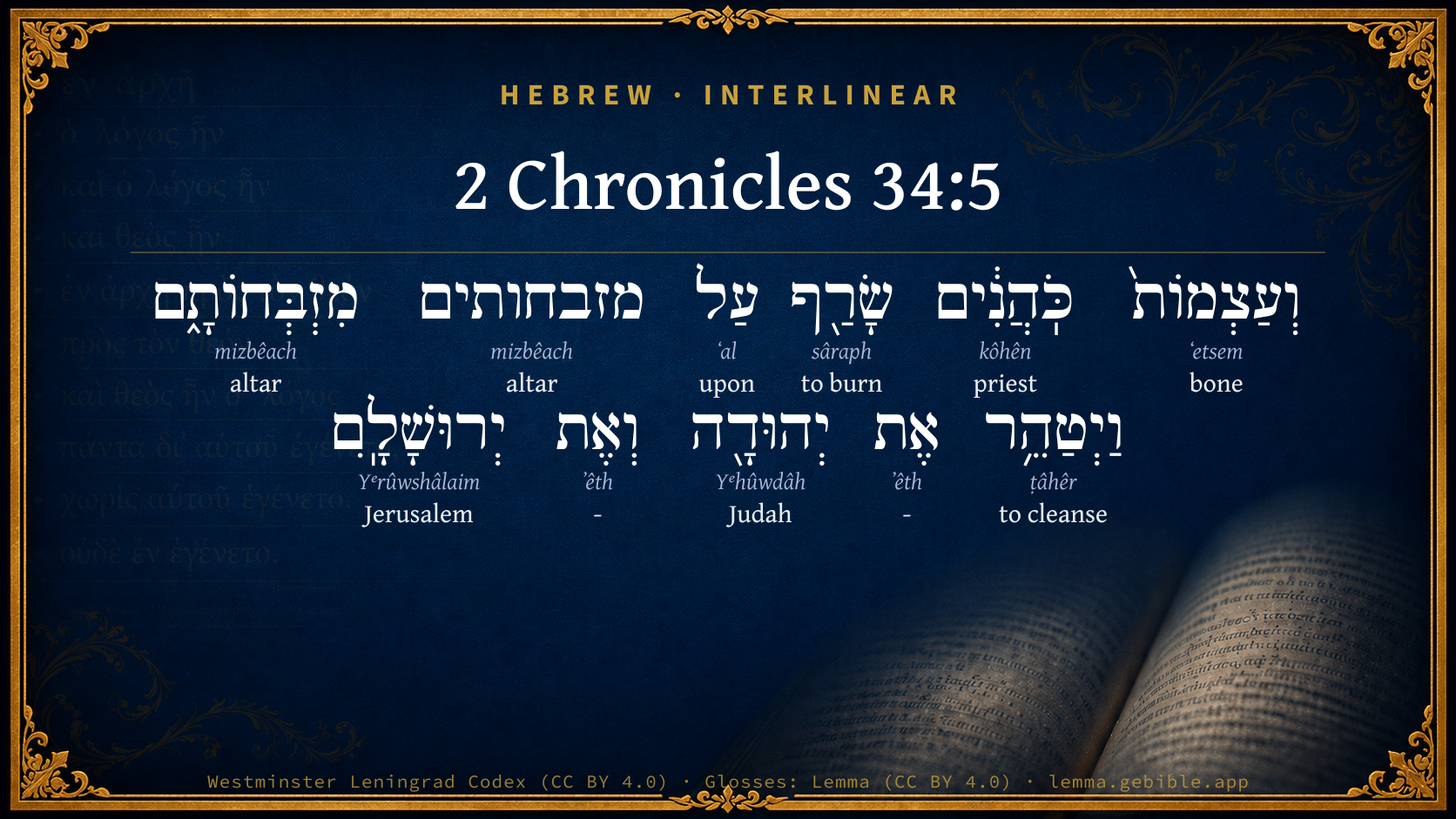
  1. וְעַצְמוֹת֙ ʻetsem H6106 “and · bones of” Conjunction + Noun, Common, Feminine, Plural, Construct
  2. כֹּֽהֲנִ֔ים kôhên H3548 “priests” Noun, Common, Masculine, Plural, Absolute
  3. שָׂרַ֖ף sâraph H8313 “to burn” Verb, Qal, Perfect, 3rd Person, Masculine, Singular
  4. עַל ʻal H5921 “upon” Preposition
  5. מזבחותים mizbêach H4196 “altars” Noun, Common, Masculine, Plural, Absolute
  6. מִזְבְּחוֹתָ֑ם mizbêach H4196 “altars · their” Noun, Common, Masculine, Plural, Construct + Suffix, Personal, 3rd Person, Masculine, Plural
  7. אֶת ʼêth H853 “-” Particle, Direct Object
  8. יְהוּדָ֖ה Yᵉhûwdâh H3063 “Judah” Noun, Proper
  9. וְאֶת ʼêth H853 “and · -” Conjunction + Particle, Direct Object
  10. יְרוּשָׁלִָֽם Yᵉrûwshâlaim H3389 “Jerusalem” Noun, Proper

About this verse

These counts appear in no published source. They are computed here, from the morphology-tagged text and Lemma’s own curated glosses. What Lemma adds →

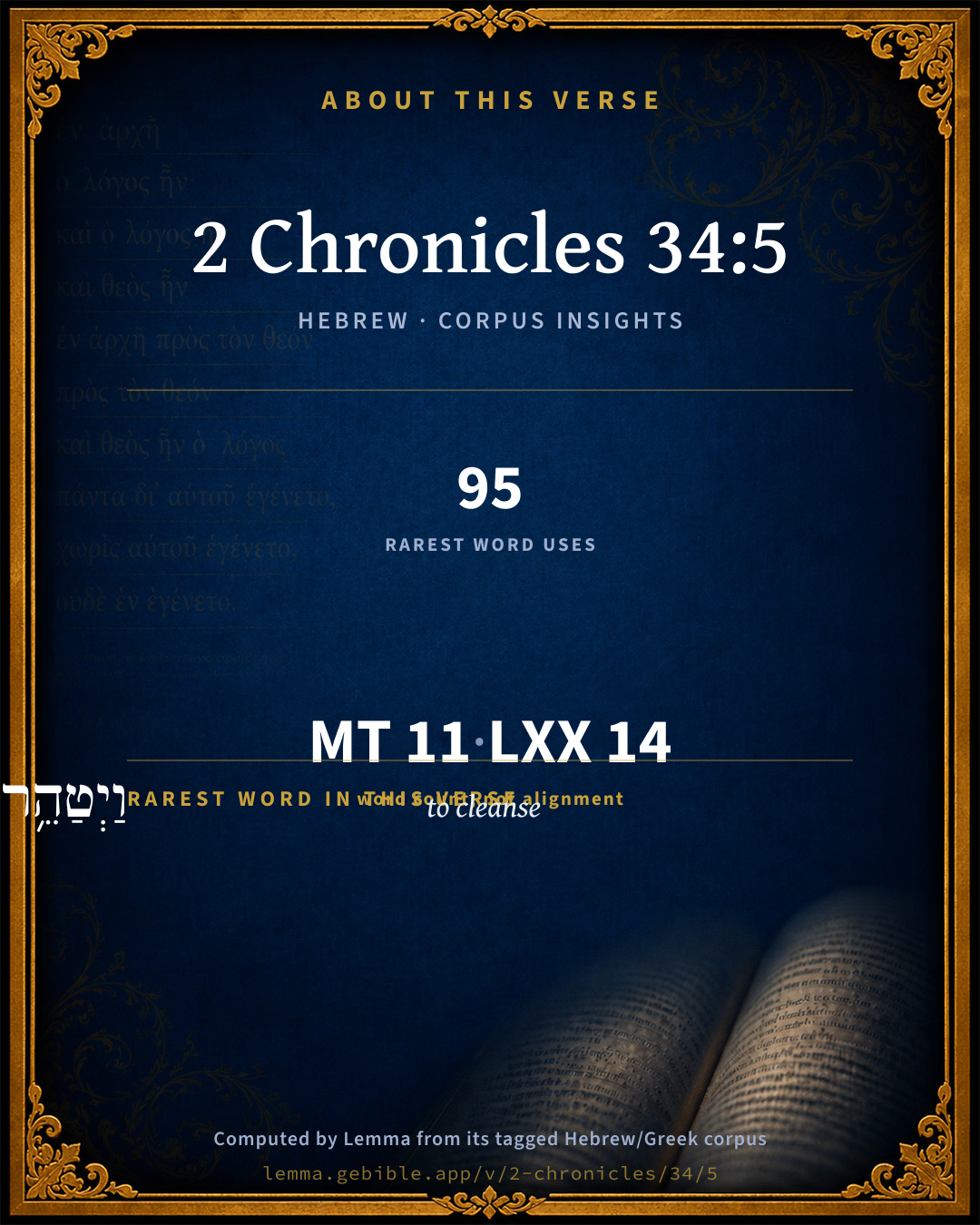
11
words
9
distinct lemmas
Historical
section

Grammatical profile

  • 2 verbs
  • 6 nouns
  • 1 preposition
  • 2 particles

Verb forms

  • שָׂרַ֖ף Qal · Perfect
  • וַיְטַהֵ֥ר Piel · Sequential Imperfect

Repetition

A word recurs within this verse — often emphatic in Hebrew:

  • מזבחותים altar H4196 ×2

Hebrew & Septuagint length

In English translation the verse runs 15 words from the Hebrew and 16 from the Septuagint (LXX English) — closely comparable.

A rough comparison of the two English renderings, which tokenize alike — not a word-level alignment.

Word counts can differ between the Hebrew and the Greek without any difference in meaning — e.g. the Hebrew direct-object marker אֵת has no separate Greek word, and Greek often adds the article ὁ.

In the original languages it is 11 Hebrew tokens and 14 Greek tokens — but the two are counted differently (Hebrew bundles its prefixes and suffixes into one token; the Greek is in lemma form), so that isn’t a like-for-like length.

Cross-references

9

Topical passages linked to 2 Chronicles 34:5 in the Treasury of Scripture Knowledge — connected by theme and wording, ordered by reader-vote popularity; previews shown in the World English Bible.

  • 1 Kings 13:2 He cried against the altar by the word of Yahweh, and said, altar, altar, thus says Yahweh: Behold, a son shall be born to the house of David, Josiah by name; and on you shall he sacrifice the priests of the high places who burn incense on you, and men's bones shall they burn on you.
  • Numbers 35:33 So you shall not pollute the land in which you are: for blood, it pollutes the land; and no expiation can be made for the land for the blood that is shed therein, but by the blood of him who shed it.
  • 2 Kings 23:16 As Josiah turned himself, he spied the tombs that were there in the mountain; and he sent, and took the bones out of the tombs, and burned them on the altar, and defiled it, according to the word of Yahweh which the man of God proclaimed, who proclaimed these things.
  • 2 Kings 23:20 He killed all the priests of the high places that were there, on the altars, and burned men's bones on them; and he returned to Jerusalem.
  • 2 Chronicles 34:7 He broke down the altars, and beat the Asherim and the engraved images into powder, and hewed down all the sun-images throughout all the land of Israel, and returned to Jerusalem.
  • Jeremiah 3:10 Yet for all this her treacherous sister Judah has not returned to me with her whole heart, but only in pretense, says Yahweh.
  • Jeremiah 4:14 Jerusalem, wash your heart from wickedness, that you may be saved. How long shall your evil thoughts lodge within you?
  • Jeremiah 8:1–2 At that time, says Yahweh, they shall bring out the bones of the kings of Judah, and the bones of his princes, and the bones of the priests, and the bones of the prophets, and the bones of the inhabitants of Jerusalem, out of their graves;
  • Ezekiel 22:24 Son of man, tell her, You are a land that is not cleansed, nor rained on in the day of indignation.

Cross-references courtesy of OpenBible.info (CC BY 4.0).

Hebrew and Greek witnesses Masoretic Hebrew ↔ Greek Septuagint

The same verse in the two great witnesses to the Old Testament, shown verse-for-verse.

These are two independent witnesses, not word-aligned to each other, and the Septuagint is shown in lemma (dictionary) form.

Hebrew 2 Chronicles 34:5 Masoretic · Westminster Leningrad Codex

וְעַצְמוֹת֙ כֹּֽהֲנִ֔ים שָׂרַ֖ף עַל מזבחותים מִזְבְּחוֹתָ֑ם וַיְטַהֵ֥ר אֶת יְהוּדָ֖ה וְאֶת יְרוּשָׁלִָֽם

He burnt the bones of the priests on their altars, and purged Judah and Jerusalem.

World English Bible · Public Domain

Greek LXX 2 Chronicles 34:5 Septuagint · lemma form

καί ὀστέον ἱερεύς κατακαύω ἐπί ὁ θυσιαστήριον καί καθαρίζω ὁ ἰούδας καί ὁ ἰερουσαλήμ

And he burnt the bones of the priests upon the altars, and purged Juda and Jerusalem.

LXX2012 (modern English Septuagint) · Public Domain

Hebrew: Westminster Leningrad Codex (CC BY 4.0). Greek: Septuagint (public domain); English from LXX2012 (modern English Septuagint) (Public Domain). How the Septuagint differs from the Hebrew →

Commentary

Notes on 2 Chronicles 34:5 from classic Christian and Jewish commentators (each source and its license shown beneath its notes). The classic Christian expositions comment on the surrounding passage and are grouped to its opening verse, so a note may address several verses; the Jewish commentaries on the Tanakh (Rashi and others) are per-verse, so they appear only where the commentator wrote on this verse.

Lemma curates 59 commentaries, every one of them public domain or Creative Commons licensed, each selected and text-cleaned for this edition rather than reprinted as found. About our sources →

Trapp's Complete Commentary

John Trapp

2Ch 34:5 And he burnt the bones of the priests upon their altars, and cleansed Judah and Jerusalem.

Ver. 5. And he burnt the bones.] That those altars might be defiled, discredited, and abhorred for ever.

He cleansed Judah and Jerusalem.] Cleansed it as well as he could; bringing them to an outward conformity, whose hearts were still full of harlotry; as well appeared when Josiah’s head was laid.

John Trapp, A Commentary or Exposition upon All the Books of the Old and New Testament (1647–1656) — public domain. Text from a community e-Sword module.

Geneva Bible (1599)

Geneva Bible translators

Read 2 Kings 23:16.

Geneva Bible (1599) marginal notes — public domain. Text via Bolls.life.

Jamieson, Fausset & Brown

Robert Jamieson, A. R. Fausset & David Brown

he burnt the bones of the priests upon their altars--A greater brand of infamy could not have been put on idolatrous priests than the disinterment of their bones, and a greater defilement could not have been done to the altars of idolatry than the burning upon them the bones of those who had there officiated in their lifetime.

Jamieson, Fausset & Brown — Commentary Critical and Explanatory on the Whole Bible (1871) — public domain (CC PDM 1.0). Text via the HelloAO Bible API.

Adam Clarke's Commentary

Verse 5. He burnt the bones of the priests] כומריא kumeraiya, the kemarim, says the Targum. See this word explained, 2Kg 23:5.

Adam Clarke's Commentary on the Bible (1810–1826) — public domain. Text from a community e-Sword/MySword module.

Ellicott's Commentary for English Readers

(5) And he burnt . . . upon their altar.—See 2Ki_23:13-14; 2Ki_23:16; 2Ki_23:20 for details. Literally, and bones of priests he burnt. They were bones taken from the graves of the idolatrous priests, who were thus punished, while their altars were irreparably defiled. (For the horror with which such a violation of the dead was then regarded, see Amo_2:1.)

And cleansed (i.e., “purged,” 2Ch_34:3) Judah and Jerusalem.—This phrase does not occur at all in the parallel account.

A Bible Commentary for English Readers, edited by Charles John Ellicott (1878–1897) — public domain. Text from a community e-Sword module.

The Cambridge Bible for Schools and Colleges

gen. ed. J. J. S. Perowne

5. he burnt the bones of the priests] Specially at Beth-el; 2Ki_23:15-16.

cleansed] R.V. purged (as in 2Ch_34:3; 2Ch_34:8).

The Cambridge Bible for Schools and Colleges (gen. ed. J. J. S. Perowne; Cambridge University Press, 1878–1918) — public domain. Text from a community e-Sword module.

John Gill's Exposition

And so did he in the cities of Manasseh, and Ephraim, and Simeon, even unto Naphtali,.... Which though they belonged to the ten tribes, yet these being carried captive by the king of Assyria, they that were left became subject to the kings of Judah; see Gill on Kg2 23:19,

with their mattocks round about; or hammers or mauls, as Kimchi, or pick axes, such sort of instruments as were used in demolishing altars and images: the Targum is,"in the house of their desolation;''

and so other versions, "in their desolate places" (x), which were become such, the inhabitants being carried captive, and few left behind.

(x) "in desolatis locis suis, vel eorum", Montanus, Tigurine version, Rambachius.

John Gill's Exposition of the Whole Bible (1746–1763) — public domain (CC PDM 1.0). Text via the HelloAO Bible API.

Haydock's Catholic Bible Commentary

Priests, whom he slew upon the altars, 4 K. xxiii.

George Leo Haydock (1774–1849), Haydock's Catholic Family Bible and Commentary, 1859 edition — public domain. Excludes Psalms (Douay-Rheims chapter numbering differs from Protestant) and Deuterocanonical books (Catholic canon only).

The Pulpit Commentary

Note herein the striking fulfilment of 1Ki_13:1-3, of which our parallel (2Ki_23:12-14, 2Ki_23:16-20) gives a more detailed account, especially as regards Israel, though not failing to recognize Judah and Jerusalem"s share in the need of purgation and punishment.

The Pulpit Commentary (1880–1919), ed. H.D.M. Spence-Jones & Joseph S. Exell — public domain. Text from a community e-Sword module.

Keil & Delitzsch

C. F. Keil & F. Delitzsch

And he burnt the bones of the priests upon their altars, i.e., he caused the bones of the idolatrous priests to be taken from their graves and burnt on the spot where the destroyed altars had stood, that he might defile the place with the ashes of the dead. In these words is summarized what is stated in Kg2 23:13 and Kg2 23:14 as to the defilement of the places of sacrifice built upon the Mount of Olives by the bones of the dead, and in Kg2 23:16-20 as to the burning of the bones of the high priests of Bethel, after they had been taken from their graves, upon their own altars. מזבחותים is an orthographical error for מזבּחותם.

Keil & Delitzsch — Biblical Commentary on the Old Testament (1861–1891) — public domain (CC PDM 1.0). Text via the HelloAO Bible API. (Old Testament only.)

Lesson kit

Teaching starters — assembled from the data on this page, not authored interpretation. Every prompt links to the verse data it draws on. Edit before teaching.

2 Chronicles, in the Historical, opens this verse with 11 words (9 distinct Hebrew lemmas). Its most distinctive word is ṭâhêr (“to cleanse”). A historical commentator’s framing appears above. Read the whole chapter for the surrounding context.

Discussion questions

  1. The word ṭâhêr carries the sense “to cleanse.” How does it shape the verse?
  2. 1 Kings 13:2 shares this passage’s theme. How do the two illuminate each other?
  3. “altar” occurs 2× in this one verse. What is the effect of the repetition?
  4. These translations render this verse differently. What is at stake in choosing one wording over another?
  5. The verb «שָׂרַ֖ף» is Qal Perfect. How does its form color the action?
  6. Reading how Trapp's Complete Commentary and Geneva Bible (1599) read this verse, where do the two commentators agree and where do they part?

Things to notice

Reading settings

Reading text

Shown beneath each verse's original-language words.

Old Testament
Old Testament edition

Read the OT as the Masoretic Hebrew (MT) or the Greek Septuagint (LXX).

English shown for the Greek Septuagint (in the Hebrew ↔ Greek comparison).

Comparing translations? Open the Compare panel on any verse page to stack up to four side by side.