
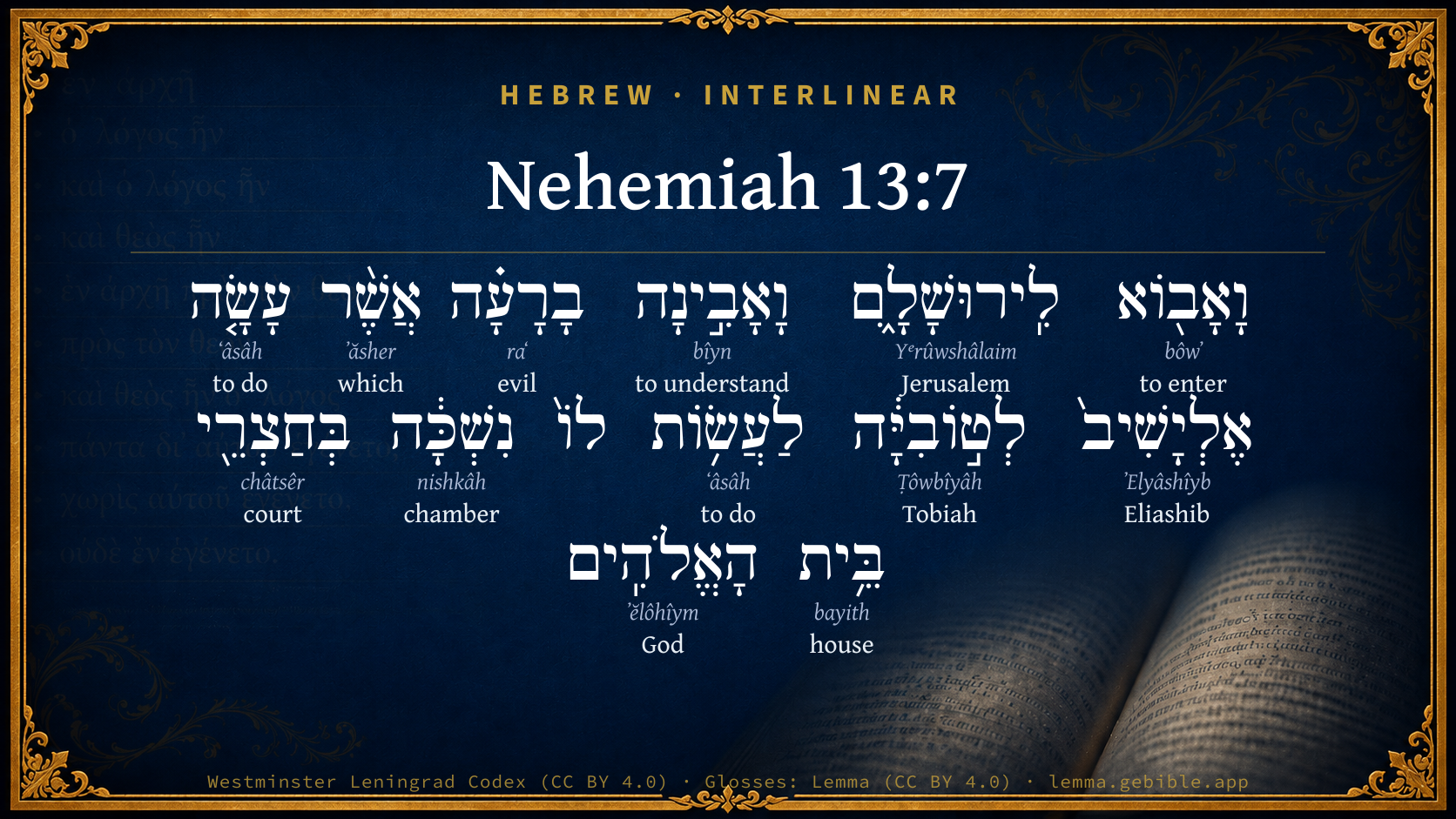
Nehemiah 13:7

Hebrew (Westminster Leningrad Codex) Nehemiah 13:7 appears in the Hebrew Old Testament. The text above is from the Westminster Leningrad Codex. Each word links to its Strong’s number, a concise gloss, and parsing drawn from the Open Scriptures Hebrew Bible morphology. Click any word for its full Brown-Driver-Briggs (BDB) entry.
Download image
Cite this verse

Nehemiah 13:7 (World English Bible). Public Domain. Lemma interlinear Bible study tool, https://lemma.gebible.app/v/nehemiah/13/7.

Show BibTeX & RIS
BibTeX
RIS
English Translation
and I came to Jerusalem, and understood the evil that Eliashib had done for Tobiah, in preparing him a chamber in the courts of the house of God.
World English Bible · Public Domain
Download a study sheet

One document with this verse’s original text, its word-by-word gloss line, the meaning frame, cross-references with their text, attributed commentary, and full source and license credits — printable, and it pastes into notes with its structure intact.

This verse Autodidact and up

Study sheet (.html) Plain text (.txt)

A passage Seminary Student

Up to 50 verses in one chapter. A passage sheet keeps up to 6 commentary sources and 12 cross-references per verse, in the order this page ranks them, and says so on the sheet whenever that leaves anything out. Ask for a single verse and you get the Autodidact verse sheet above.

Everything on this page stays free to read, with no account — the sheet is a download of what is already on screen, not access to it.

Want to remove ads? Support Godless Engineer
Compare translations 3

The same verse in 3 English versions, stacked beneath the original-language interlinear above. Click any original word for its lexicon entry.

Each is an independent rendering of the whole verse — the interlinear is not word-aligned to these translations.

Highlighted words mark where these versions differ — a whole-verse word diff, not a word-by-word alignment.

  • World English Bible Public Domain
    and I came to Jerusalem, and understood the evil that Eliashib had done for Tobiah, in preparing him a chamber in the courts of the house of God.
  • King James Version Public Domain
    And I came to Jerusalem, and understood of the evil that Eliashib did for Tobiah, in preparing him a chamber in the courts of the house of God.
  • unfoldingWord Literal Text CC BY-SA 4.0
    And I came to Jerusalem. And I noticed the evil that Eliashib had done for Tobiah by making for him a chamber in the courts of the house of God.

unfoldingWord Literal Text — © unfoldingWord, licensed CC BY-SA 4.0. Word-aligned USFM3 via Door43 (git.door43.org/unfoldingWord/en_ult).

Versions to compare (up to 4)

3 of 4 selected

Show all 18 translations

Every available English version of this verse, each an independent rendering of the whole verse.

  • World English Bible Public Domain
    and I came to Jerusalem, and understood the evil that Eliashib had done for Tobiah, in preparing him a chamber in the courts of the house of God.
  • Berean Standard Bible Public Domain
    to return to Jerusalem. Then I discovered the evil that Eliashib had done on behalf of Tobiah by providing him a room in the courts of the house of God.
  • Majority Standard Bible Public Domain
    to return to Jerusalem. Then I discovered the evil that Eliashib had done on behalf of Tobiah by providing him a room in the courts of the house of God.
  • King James Version Public Domain
    And I came to Jerusalem, and understood of the evil that Eliashib did for Tobiah, in preparing him a chamber in the courts of the house of God.
  • American Standard Version (1901) Public Domain
    and I came to Jerusalem, and understood the evil that Eliashib had done for Tobiah, in preparing him a chamber in the courts of the house of God.
  • Revised Version (1885) Public Domain
    and I came to Jerusalem, and understood of the evil that Eliashib had done for Tobiah, in preparing him a chamber in the courts of the house of God.
  • Geneva Bible (1599) Public Domain
    And when I was come to Ierusalem, I vnderstood the euil that Eliashib had done for Tobiah, in that hee had made him a chamber in the court of the house of God,
  • Douay-Rheims (1899) Public Domain
    And I came to Jerusalem, and I understood the evil that Eliasib had done for Tobias, to make him a storehouse in the courts of the house of God.
  • Young's Literal Translation Public Domain
    and I come in to Jerusalem, and understand concerning the evil that Eliashib hath done for Tobiah, to make to him a chamber in the courts of the house of God,
  • Literal Standard Version CC BY-SA 4.0
    and I come to Jerusalem, and understand concerning the evil that Eliashib has done for Tobiah, to make to him a chamber in the courts of the house of God,
  • Unlocked Literal Bible CC BY-SA 4.0
    and I returned to Jerusalem. I understood the evil that Eliashib had done by giving Tobiah a storeroom in the courts of the house of God.
  • unfoldingWord Literal Text CC BY-SA 4.0
    And I came to Jerusalem. And I noticed the evil that Eliashib had done for Tobiah by making for him a chamber in the courts of the house of God.
  • Darby Bible Public Domain
    And I came to Jerusalem, and observed the evil that Eliashib had done for Tobijah, in preparing him a chamber in the courts of the house of God.
  • World Messianic Bible Public Domain
    and I came to Jerusalem, and understood the evil that Eliashib had done for Tobiah, in preparing him a room in the courts of God’s house.
  • Webster's Bible Public Domain
    And I came to Jerusalem, and understood of the evil that Eliashib did for Tobiah, in preparing for him a chamber in the courts of the house of God.
  • Free Bible Version CC BY-SA 4.0
    When I arrived back in Jerusalem I discovered the dreadful thing Eliashib had done in providing Tobiah a room in the courtyard of God's Temple.
  • Bible in Basic English Public Domain
    And I came to Jerusalem; and it was clear to me what evil Eliashib had done for Tobiah, in making ready for him a room in the buildings of the house of God.
  • JPS Tanakh (1917) Public Domain
    and I came to Jerusalem, and understood the evil that Eliashib had done for Tobiah, in preparing him a chamber in the courts of the house of God.

Literal Standard Version (2020), Covenant Press — licensed CC BY-SA 4.0. Text via the HelloAO Bible API (eBible.org). Unlocked Literal Bible (unfoldingWord) — licensed CC BY-SA 4.0. Text via the HelloAO Bible API (eBible.org). unfoldingWord Literal Text — © unfoldingWord, licensed CC BY-SA 4.0. Word-aligned USFM3 via Door43 (git.door43.org/unfoldingWord/en_ult). Free Bible Version, Dr. Jonathan Gallagher — licensed CC BY-SA 4.0. Text via the HelloAO Bible API (eBible.org).

Word by word

More ways to search: Search by grammar → Find every occurrence → Compare this word →

Practice this passage: Drill this verse → Learn its vocabulary →

נִשְׁכָּ֔ה
nishkâh
H5393
“chamber”
Noun, Common, Feminine, Singular, Absolute
Part of Speech
Noun
Type
Common
Gender
Feminine
Number
Singular
State
Absolute
Full BDB Definition

Origin: for H3957

TWOT: 1431

chamber, room, cell
  1. וָאָב֖וֹא bôwʼ H935 “and · to enter” Conjunction + Verb, Qal, Sequential Imperfect, 1st Person, Common, Singular
  2. לִֽירוּשָׁלִָ֑ם Yᵉrûwshâlaim H3389 “to/for · Jerusalem” Preposition + Noun, Proper
  3. וָאָבִ֣ינָה bîyn H995 “and · to understand” Conjunction + Verb, Qal, Sequential Imperfect, 1st Person, Common, Singular + Suffix, h
  4. בָרָעָ֗ה raʻ H7451 “in/at the · evil” Preposition, Determined + Noun, Common, Feminine, Singular, Absolute
  5. אֲשֶׁ֨ר ʼăsher H834 “which” Particle, Relative
  6. עָשָׂ֤ה ʻâsâh H6213 “to do” Verb, Qal, Perfect, 3rd Person, Masculine, Singular
  7. אֶלְיָשִׁיב֙ ʼElyâshîyb H475 “Eliashib” Noun, Proper
  8. לְט֣וֹבִיָּ֔ה Ṭôwbîyâh H2900 “to/for · Tobiah” Preposition + Noun, Proper
  9. לַעֲשׂ֥וֹת ʻâsâh H6213 “to do” Preposition + Verb, Qal, Infinitive Construct
  10. בְּחַצְרֵ֖י châtsêr H2691 “in/at · courts of” Preposition + Noun, Common, Both, Plural, Construct
  11. בֵּ֥ית bayith H1004 “house of” Noun, Common, Masculine, Singular, Construct
  12. הָאֱלֹהִֽים ʼĕlôhîym H430 “the · God(s)” Particle, Definite Article + Noun, Common, Masculine, Plural, Absolute

About this verse

These counts appear in no published source. They are computed here, from the morphology-tagged text and Lemma’s own curated glosses. What Lemma adds →

14
words
12
distinct lemmas
Historical
section

Notable vocabulary

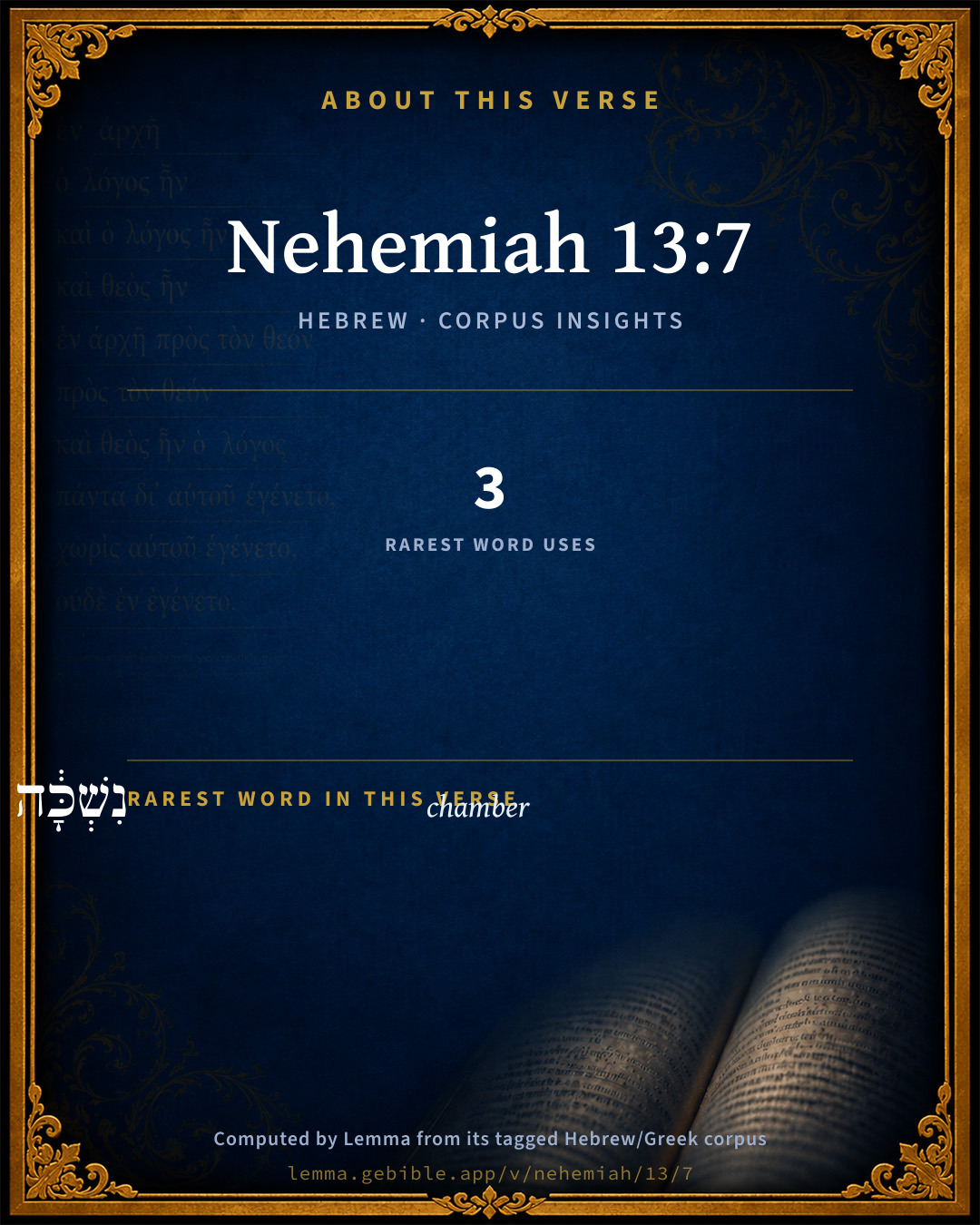
The rarest word here is נִשְׁכָּ֔ה chamber H5393 — appearing just 3 times in the whole Hebrew Bible.

Shared distinctive vocabulary

נִשְׁכָּ֔ה chamber H5393 occurs in 3 verses of the Hebrew Bible. Also found in:

Grammatical profile

  • 4 verbs
  • 8 nouns
  • 1 preposition
  • 1 particle

Verb forms

  • וָאָב֖וֹא Qal · Sequential Imperfect
  • וָאָבִ֣ינָה Qal · Sequential Imperfect
  • עָשָׂ֤ה Qal · Perfect
  • לַעֲשׂ֥וֹת Qal · Infinitive Construct

Repetition

A word recurs within this verse — often emphatic in Hebrew:

  • עָשָׂ֤ה to do H6213 ×2

Cross-references

7

Topical passages linked to Nehemiah 13:7 in the Treasury of Scripture Knowledge — connected by theme and wording, ordered by reader-vote popularity; previews shown in the World English Bible.

  • Nehemiah 13:5 had prepared for him a great chamber, where before they laid the meal-offerings, the frankincense, and the vessels, and the tithes of the grain, the new wine, and the oil, which were given by commandment to the Levites, and the singers, and the porters; and the heave-offerings for the priests.
  • Matthew 21:12–13 Jesus entered into the temple of God, and drove out all of those who sold and bought in the temple, and overthrew the money-changers' tables and the seats of those who sold the doves.
  • Ezra 9:1 Now when these things were done, the princes drew near to me, saying, The people of Israel, and the priests and the Levites, have not separated themselves from the peoples of the lands, [doing] according to their abominations, even of the Canaanites, the Hittites, the Perizzites, the Jebusites, the Ammonites, the Moabites, the Egyptians, and the Amorites.
  • Nehemiah 13:1 On that day they read in the book of Moses in the audience of the people; and therein was found written, that an Ammonite and a Moabite should not enter into the assembly of God forever,
  • Lamentations 1:10 The adversary has spread out his hand on all her pleasant things: For she has seen that the nations are entered into her sanctuary, Concerning whom you did command that they should not enter into your assembly.
  • Acts 21:28–29 crying out, "Men of Israel, help! This is the man who teaches all men everywhere against the people, and the law, and this place. Moreover, he also brought Greeks into the temple, and has defiled this holy place!"
  • 1 Corinthians 1:11 For it has been reported to me concerning you, my brothers, by those who are from Chloe's household, that there are contentions among you.

Cross-references courtesy of OpenBible.info (CC BY 4.0).

Hebrew and Greek witnesses Masoretic Hebrew ↔ Greek Septuagint

The same verse in the two great witnesses to the Old Testament, shown verse-for-verse.

These are two independent witnesses, not word-aligned to each other, and the Septuagint is shown in lemma (dictionary) form.

Hebrew Nehemiah 13:7 Masoretic · Westminster Leningrad Codex

וָאָב֖וֹא לִֽירוּשָׁלִָ֑ם וָאָבִ֣ינָה בָרָעָ֗ה אֲשֶׁ֨ר עָשָׂ֤ה אֶלְיָשִׁיב֙ לְט֣וֹבִיָּ֔ה לַעֲשׂ֥וֹת לוֹ֙ נִשְׁכָּ֔ה בְּחַצְרֵ֖י בֵּ֥ית הָאֱלֹהִֽים

and I came to Jerusalem, and understood the evil that Eliashib had done for Tobiah, in preparing him a chamber in the courts of the house of God.

World English Bible · Public Domain

Greek LXX Structure differs

The Septuagint has no separate book of Nehemiah. Its Greek text is the second half of Esdras B (2 Esdras), chapters 11–23; Ezra is the first half (1–10).

A verse-for-verse comparison isn’t shown here because the chapters and verses don’t line up. Switch to the LXX edition with the MT / LXX toggle above to read the Greek directly.

Hebrew: Westminster Leningrad Codex (CC BY 4.0). Greek: Septuagint (public domain); English from a public-domain English Septuagint. How the Septuagint differs from the Hebrew →

Commentary

Notes on Nehemiah 13:7 from classic Christian and Jewish commentators (each source and its license shown beneath its notes). The classic Christian expositions comment on the surrounding passage and are grouped to its opening verse, so a note may address several verses; the Jewish commentaries on the Tanakh (Rashi and others) are per-verse, so they appear only where the commentator wrote on this verse.

Lemma curates 59 commentaries, every one of them public domain or Creative Commons licensed, each selected and text-cleaned for this edition rather than reprinted as found. About our sources →

Trapp's Complete Commentary

John Trapp

Neh 13:7 And I came to Jerusalem, and understood of the evil that Eliashib did for Tobiah, in preparing him a chamber in the courts of the house of God.

Ver. 7. And I came to Jerusalem] There was his heart before, Animus est ubi amat, non ubi animat (Aug. de Cir. Dei, 1.9, e. 16). No sooner, therefore, had he got his conge d’aller at court, but he flees to Jerusalem, as the doves do to their windows. Fugiendum est ad clarissimam patriam; ibi pater, ibi omnia, saith Plotinus, the philosopher: hasten we all to our heavenly home; there is all that heart can wish, &c. Nehemiah lacketh nothing, with Artaxerxes, Hadad with Pharaoh; yet, in any case, will go into his own country, 1Ki 11:22. Rivers run into the sea, whence they came; the dove resteth not but upon the ark. Nescio qua natale solum dulcedine cunctos Ducit - (Ovid).

And understood not of the evil that Eliashib did] As Joseph brought his brethrens’ evil report to their father, Gen 37:2, as the household of Chloe declared unto St Paul the contentions at Corinth, 1Co 1:11, so did some good souls this high priest’s miscarriages to Nehemiah, and that in an ordinance; not to disgrace him, but to reclaim him, and to free themselves from the guilt of a sinful silence.

John Trapp, A Commentary or Exposition upon All the Books of the Old and New Testament (1647–1656) — public domain. Text from a community e-Sword module.

The Biblical Illustrator

Joseph S. Exell

Neh_13:7-31

And I came to Jerusalem, and understood of the evil that Elashib did.

The religious reformer

Remark--

I. The state of Jerusalem during Nehemiahs absence.

II. The reforms he achieved.

1. His purification of the temple.

2. His renewal of the observance of Divine ordinances.

3. His promoting the sanctification of the Sabbath.

4. His setting apart Judah from mingling with the heathen. (W. Ritchie.)

Personal purification of the believer

We must never forget that the Christian is now what the temple was of old, the dwelling-place of the Most High (1Co_6:19). Luther observes: A Christian may be compared with the tripartite temple of Solomon. His spirit is the holy of holies, Gods dwelling amid the darkness of faith (he believes what he neither sees, nor feels, nor grasps); his soul is the holy place, where are the seven lights of the golden candlesticks; his body is the fore-court exposed to general view, where every one can observe how he lives and what he does; in the fore-court stands the altar of burnt-offerings, whereon we are to lay our bodies as living sacrifices unto God. How sad when the temple in any part of it is desecrated! When the heart in which Christ should dwell is occupied by the world, many things must be cast forth, in order that it may become the abode of the King. (W. P. Lockhart.)

The devoted patriot

The story commences with the return of Nehemiah to Babylon. Either through the reports that his enemies had sent to the court, or the leave of absence having expired (Neh_2:6), Nehemiah returns to the king to report himself, and to seek permission for a further sojourn in Jerusalem. The fact that Ezra is absent at the same time strengthens the opinion that the misrepresentations of those about them moved the jealousy of the king and led to their recall. It is scarcely possible to think of the swift and complete destruction of the religious life of the city apart from a deeply-laid plot on the part of the foes who saw in the recall of Nehemiah their own Opportunity, and whose plans were carefully laid and boldly carried out as soon as he had left. The building of the walls and gateways of the city had been followed by a yet bolder effort for the security of Jerusalem. Taking advantage of the fervour of the new religious life which had sprung up amongst them, Nehemiah had gathered the people together and got them to enter into a very solemn covenant, which they had signed and sealed. The list of those who signed this covenant is given--in itself a suggestion that it was not signed by all. The first name is that of Nehemiah: and next to his we should naturally look for that of Eliashib, the high priest, and of Jehoiada his son. But these two are conspicuously absent. So then it is plain that before the departure of Nehemiah there were two parties whose antagonism could only be fierce and bitter; a party which had surrendered itself to the strictest observance and enforcement of the law, and another party which had entangled itself by heathen relationships; and of this latter party the first and foremost was Eliashib, the high priest. As soon as Nehemiah has gone this Eliashib at once becomes the head and ruler of the city. Now comes the collision of the two parties; on the one side a people like the Puritans of old--stern, resolute, exclusive, hateful of everything that swerved a hairs breadth from the letter of the law. On the other side was the party of the court--hand in glove with the wealthy people of the land; eager for their own advancement and position. Eliashib, the leader of the courtiers, had nothing to expect from the covenanters but a stem and bitter opposition. To strengthen his position, and perhaps for his own personal security, he gathers about him these from the outside, intending doubtless to draw the line sharply as soon as they had served his purpose, but finding, as such men always do, that he has to yield step by step, until everything that the law held sacred was broken down before the influx of the people of the land. A swift and terrible reaction followed the high-pitched fervour of the great revival. First to be swept away were the reforms that Nehemiah had introduced in the matter of mixed marriages. That which the high priest himself had sanctioned by the example of his own family was speedily imitated, until it seems to have become a rage amongst the people, many of the Jews putting away their own wives for these women of Ammon and Moab and Ashdod. The Book of Malachi throws a lurid light upon the condition of things in this as in other respects (Mal_2:11; Mal_2:14; Mal_2:16). Eliashib seeks further to strengthen his position and to weaken his opponents by a concession to the greed of the people, as he had previously indulged their lust. The tithes and offerings which were claimed by the priests and Levites were withheld from them, or the people brought only that which was diseased or torn by the wild beasts; the people robbed God, as Malachi says. Thus the female came to be neglected, as the priests had to go every one to his own field. With this must have fallen every barrier for the protection of Jerusalem. When thin us had reached such a pass it was evident that the heathen had everything their own way. The occupations of the people went on as if there were no Sabbath day. The wine presses were trodden; the corn was carried; the asses were laden; through the city gates same the men of Tyre with their fruit and fish for sale; foreigners filled the streets with their cries, and the place rang with the noisy chaffering of those who stood to sell and those who came to buy. With them these strangers brought their evil ways, and their foul idolatries--the sorceries of which Malachi speaks (Mal_3:5). Such is the state of things which Nehemiah finds on his return to Jerusalem. Perhaps his coming was unlooked for, the enemy hoping to keep him still at the court of the king. We have thought perhaps of Nehemiah as the graceful courtier, the stately cupbearer, whose appearance would have much to do with his high position. But here is a very different man. He seems to stand before us with knitted brows and flashing eyes--a man who does not hesitate to lay hands upon the offenders, and whose words terrify the city. Nehemiahs indignation is kindled first by the tidings of the desecration of the House of God; and hastening thither he faces Eliashib on his own ground, and with his own hands he flings out the household stuff of the intruding Tobiah, and has the chambers cleansed from the defilement, and the holy vessels set again in them. That Eliashib and his party should have submitted to such a high-handed proceeding may seem surprising; but the conscience of the people was with Nehemiah, and they felt that it was useless to resist one of such resoluteness, backed by such authority as he possessed. Then he priests and Levites were again set in their places, and the provisions were duly delivered, treasurers being appointed to receive and distribute the offerings of corn and oil and wine. Meanwhile the rulers had gathered themselves together, as they did when Christ came to the temple. The interference with the hope of their gains stirred their resentment; for to those nobles a working day was not to be lightly parted with, since others did the Work of which they reaped the advantage. Nehemiah orders the gates to be shut at sunset on the Sabbath eve, and that none shall enter bearing burdens until the day is done. Yet more difficult and involved was the matter of the mixed marriages. But in this as in everything else Nehemiah would tolerate no half measures. When the people gathered to protest, he tells us that I contended with them, and cursed them, and plucked off their hair, and made them swear by God, saying, Ye shall not give your daughters unto their sons, nor take their daughters unto your sons, or for yourselves. Jehoiada, the son of the high priest, and the son-in-law of Sanballat, thought doubtless to screen himself behind these high relationships. But instead of defence it added to the wrong, and the indignant governor chased him out of the city, and forbade him to return. Taking refuge-in Samaria with others who resented the action of Nehemiah, he set up there a rival temple and service, and thus cleared the way for the reforms which were established in Jerusalem. Looking back over the chapter, we see a lesson for all time and for us: that we can never loosen the law of God in one particular without loosening it in all. The law of God is one, and to break it in any point is to endanger it in all. The thickening of the ills about Eliashib one by one until everything is lost, is the story of the destruction of the individual and the nation. (M. G. Pearse.)

The Biblical Illustrator, edited by Joseph S. Exell (c. 1880s–1900s) — public domain. Text from a community e-Sword module.

Joseph Benson's Commentary

Neh 13:7. The evil Eliashib did in preparing him a chamber — “Tobiah had insinuated himself into the good opinion of many of the people, and especially those of note, by his making two alliances with families of this sort: for Johanan his son had married the daughter of Meshullam, the son of Berechiah, (Neh 6:18; Neh 3:4,) who was one of the chief managers of the building of the wall of Jerusalem, and he himself had married the daughter of Shechaniah, another great man among the Jews. By these means he had formed an interest, and was looked upon as a worthy man, though, being an Ammonite, he could not but bear a national hatred to all that were of the race of Israel.” See Prideaux, An. 425.

Joseph Benson's Commentary on the Old and New Testaments (1811–1818) — public domain. Text from a community e-Sword module.

Geneva Bible (1599)

Geneva Bible translators

Thus we see to what inconveniences the people fall into, when they are destitute of one that hath the fear of God, seeing that their chief governor was but a while absent, and yet they fell into such great absurdities: as appeareth also, Exod. 32:1.

Geneva Bible (1599) marginal notes — public domain. Text via Bolls.life.

The Cambridge Bible for Schools and Colleges

gen. ed. J. J. S. Perowne

7. understood of the evil] i.e. ‘gave attention to,’ ‘perceived its significance.’ ‘The evil’ inflicted by the pernicious example of the high-priest lay in the disregard of all the measures recently taken to separate the people from ‘the heathen nations.’

did] R.V. had done, i.e. not so much by continual alliance, but by this notorious instance, combining sacrilege towards the Temple and complaisance towards the idolater.

The Cambridge Bible for Schools and Colleges (gen. ed. J. J. S. Perowne; Cambridge University Press, 1878–1918) — public domain. Text from a community e-Sword module.

John Gill's Exposition

And it grieved me sore,.... That such a sacred place should be converted to common use, and to that of an Heathen, and of an enemy to the Jews and their religion:

therefore I cast forth all the household stuff of Tobiah out of the chamber; as being chief magistrate, and acting by commission under the king of Persia, and to regulate everything amiss, according to the Jewish laws, as well as those of the king, his power being, no doubt, as large as Ezra's, Ezr 7:25, by "household stuff" is meant what is movable in the house, as chairs, tables, vessels for dressing, caring, drinking, &c. there are various opinions about this with the ancients (e).

(e) Vid. Alex. ab Alex. Genial. Dier. l. 1. c. 19.

John Gill's Exposition of the Whole Bible (1746–1763) — public domain (CC PDM 1.0). Text via the HelloAO Bible API.

The Pulpit Commentary

A chamber in the courts of the house of God. It would seem by this expression that the chamber made over to Tobiah was not part of the main building of the temple, but a portion of some detached building belonging to the "courts." This, no doubt, made the desecration less flagrant, but was far from justifying it.

The Pulpit Commentary (1880–1919), ed. H.D.M. Spence-Jones & Joseph S. Exell — public domain. Text from a community e-Sword module.

Keil & Delitzsch

C. F. Keil & F. Delitzsch

At his return he directed his attention to the evil committed by Eliashib in preparing a chamber in the court of the temple (בּ הבין like Ezr 8:15) for Tobiah.

Keil & Delitzsch — Biblical Commentary on the Old Testament (1861–1891) — public domain (CC PDM 1.0). Text via the HelloAO Bible API. (Old Testament only.)

Scofield Reference Notes

C. I. Scofield

Tobiah

(See Scofield "Neh 2:10") .

The Scofield Reference Bible (1917 edition), notes by C. I. Scofield — public domain. Text from a community e-Sword module.

Lesson kit

Teaching starters — assembled from the data on this page, not authored interpretation. Every prompt links to the verse data it draws on. Edit before teaching.

Nehemiah, in the Historical, opens this verse with 14 words (12 distinct Hebrew lemmas). Its most distinctive word is nishkâh (“chamber”). A historical commentator’s framing appears above. Read the whole chapter for the surrounding context.

Discussion questions

  1. The word nishkâh carries the sense “chamber.” How does it shape the verse?
  2. Nehemiah 3:30 shares the word «chamber» with this verse. How do the two illuminate each other?
  3. “to do” occurs 2× in this one verse. What is the effect of the repetition?
  4. These translations render this verse differently; the difference is in the English rendering, not the original. What questions does that raise?
  5. The verb «וָאָב֖וֹא» is Qal Sequential Imperfect. How does its form color the action?
  6. Reading how Trapp's Complete Commentary and The Biblical Illustrator read this verse, where do the two commentators agree and where do they part?

Things to notice

Reading settings

Reading text

Shown beneath each verse's original-language words.

Old Testament
Old Testament edition

Read the OT as the Masoretic Hebrew (MT) or the Greek Septuagint (LXX).

English shown for the Greek Septuagint (in the Hebrew ↔ Greek comparison).

Comparing translations? Open the Compare panel on any verse page to stack up to four side by side.