
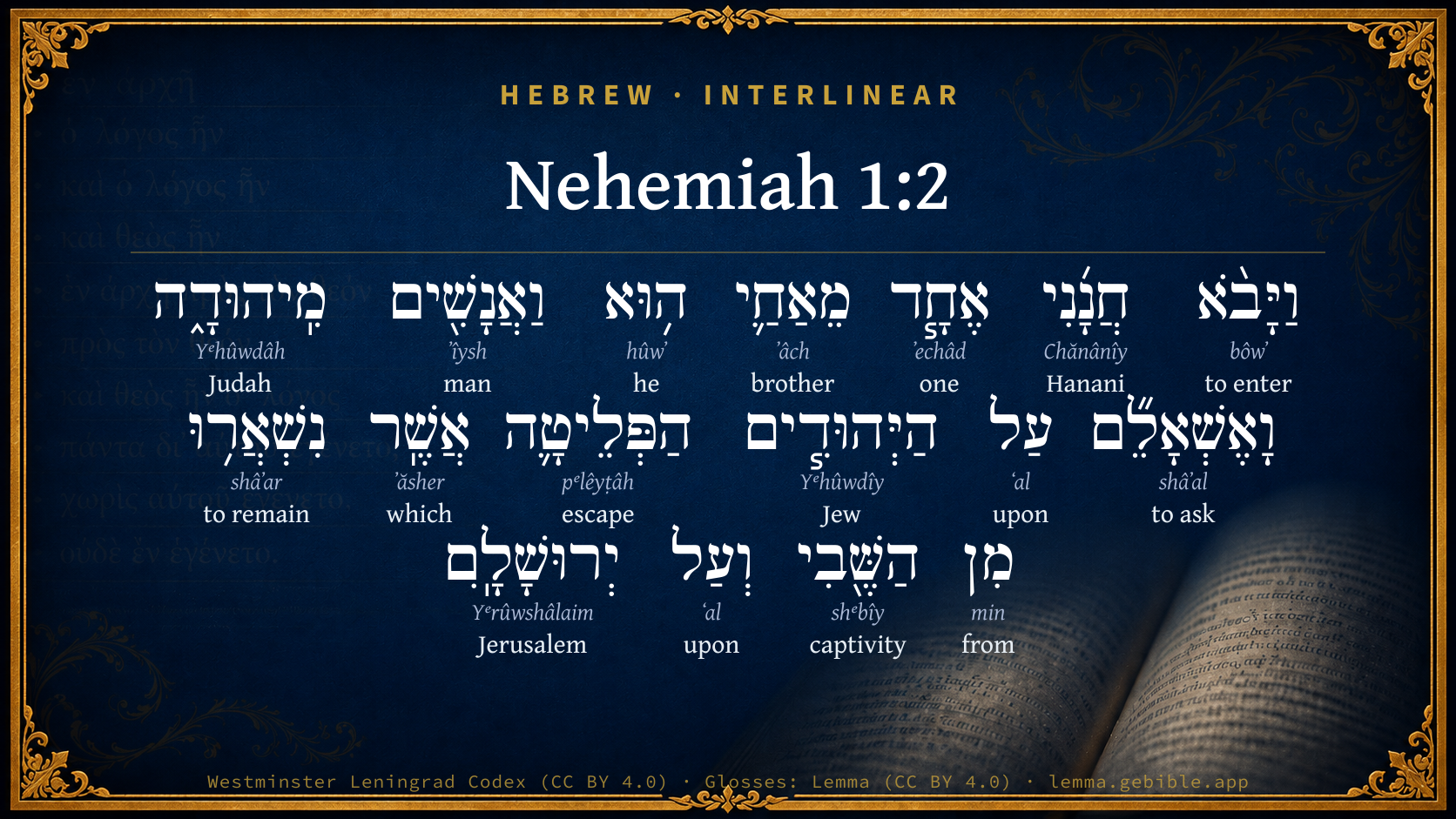
Nehemiah 1:2

Hebrew (Westminster Leningrad Codex) Nehemiah 1:2 appears in the Hebrew Old Testament. The text above is from the Westminster Leningrad Codex. Each word links to its Strong’s number, a concise gloss, and parsing drawn from the Open Scriptures Hebrew Bible morphology. Click any word for its full Brown-Driver-Briggs (BDB) entry.
Download image
Cite this verse

Nehemiah 1:2 (World English Bible). Public Domain. Lemma interlinear Bible study tool, https://lemma.gebible.app/v/nehemiah/1/2.

Show BibTeX & RIS
BibTeX
RIS
English Translation
that Hanani, one of my brothers, came, he and certain men out of Judah; and I asked them concerning the Jews who had escaped, who were left of the captivity, and concerning Jerusalem.
World English Bible · Public Domain
Download a study sheet

One document with this verse’s original text, its word-by-word gloss line, the meaning frame, cross-references with their text, attributed commentary, and full source and license credits — printable, and it pastes into notes with its structure intact.

This verse Autodidact and up

Study sheet (.html) Plain text (.txt)

A passage Seminary Student

Up to 50 verses in one chapter. A passage sheet keeps up to 6 commentary sources and 12 cross-references per verse, in the order this page ranks them, and says so on the sheet whenever that leaves anything out. Ask for a single verse and you get the Autodidact verse sheet above.

Everything on this page stays free to read, with no account — the sheet is a download of what is already on screen, not access to it.

Want to remove ads? Support Godless Engineer
Compare translations 3

The same verse in 3 English versions, stacked beneath the original-language interlinear above. Click any original word for its lexicon entry.

Each is an independent rendering of the whole verse — the interlinear is not word-aligned to these translations.

Highlighted words mark where these versions differ — a whole-verse word diff, not a word-by-word alignment.

  • World English Bible Public Domain
    that Hanani, one of my brothers, came, he and certain men out of Judah; and I asked them concerning the Jews who had escaped, who were left of the captivity, and concerning Jerusalem.
  • King James Version Public Domain
    That Hanani, one of my brethren, came, he and certain men of Judah; and I asked them concerning the Jews that had escaped, which were left of the captivity, and concerning Jerusalem.
  • unfoldingWord Literal Text CC BY-SA 4.0
    And Hanani, one of my brothers, came, he and men from Judah. And I asked them about the Jews who escaped, who were left behind from the captivity, and about Jerusalem.

unfoldingWord Literal Text — © unfoldingWord, licensed CC BY-SA 4.0. Word-aligned USFM3 via Door43 (git.door43.org/unfoldingWord/en_ult).

Versions to compare (up to 4)

3 of 4 selected

Show all 18 translations

Every available English version of this verse, each an independent rendering of the whole verse.

  • World English Bible Public Domain
    that Hanani, one of my brothers, came, he and certain men out of Judah; and I asked them concerning the Jews who had escaped, who were left of the captivity, and concerning Jerusalem.
  • Berean Standard Bible Public Domain
    Hanani, one of my brothers, arrived with men from Judah. So I questioned them about the remnant of the Jews who had survived the exile, and also about Jerusalem.
  • Majority Standard Bible Public Domain
    Hanani, one of my brothers, arrived with men from Judah. So I questioned them about the remnant of the Jews who had survived the exile, and also about Jerusalem.
  • King James Version Public Domain
    That Hanani, one of my brethren, came, he and certain men of Judah; and I asked them concerning the Jews that had escaped, which were left of the captivity, and concerning Jerusalem.
  • American Standard Version (1901) Public Domain
    that Hanani, one of my brethren, came, he and certain men out of Judah; and I asked them concerning the Jews that had escaped, that were left of the captivity, and concerning Jerusalem.
  • Revised Version (1885) Public Domain
    that Hanani, one of my brethren, came, he and certain men out of Judah; and I asked them concerning the Jews that had escaped, which were left of the captivity, and concerning Jerusalem.
  • Geneva Bible (1599) Public Domain
    Came Hanam, one of my brethren, he and the men of Iudah, and I asked them concerning the Iewes that were deliuered, which were of the residue of the captiuitie, and concerning Ierusalem.
  • Douay-Rheims (1899) Public Domain
    That Hanani one of my brethren came, he and some men of Juda; and I asked them concerning the Jews, that remained and were left of the captivity, and concerning Jerusalem.
  • Young's Literal Translation Public Domain
    and come in doth Hanani, one of my brethren, he and men of Judah, and I ask them concerning the Jews, the escaped part that have been left of the captivity, and concerning Jerusalem;
  • Literal Standard Version CC BY-SA 4.0
    and Hanani, one of my brothers, he and men of Judah come in, and I ask them concerning the Jews, the escaped part that have been left of the captivity, and concerning Jerusalem;
  • Unlocked Literal Bible CC BY-SA 4.0
    that one of my brothers, Hanani, came with some people from Judah, and I asked them about the Jews who had escaped, the remnant of the Jews who were there, and about Jerusalem.
  • unfoldingWord Literal Text CC BY-SA 4.0
    And Hanani, one of my brothers, came, he and men from Judah. And I asked them about the Jews who escaped, who were left behind from the captivity, and about Jerusalem.
  • Darby Bible Public Domain
    that Hanani, one of my brethren, came, he and [certain] men of Judah. And I asked them concerning the Jews that had escaped, who were left of the captivity, and concerning Jerusalem.
  • World Messianic Bible Public Domain
    Hanani, one of my brothers, came, he and certain men out of Judah; and I asked them about the Jews who had escaped, who were left of the captivity, and concerning Jerusalem.
  • Webster's Bible Public Domain
    That Hanani, one of my brethren, came, he and certain men of Judah; and I asked them concerning the Jews that had escaped, who were left of the captivity, and concerning Jerusalem.
  • Free Bible Version CC BY-SA 4.0
    Hanani, one of my brothers, came from Judah with some other men. I asked them about the remnant of the Jewish exiles who had returned from captivity, and also about Jerusalem.
  • Bible in Basic English Public Domain
    That Hanani, one of my brothers, came with certain men from Judah; and in answer to my request for news of the Jews who had been prisoners and had got away, and of Jerusalem,
  • JPS Tanakh (1917) Public Domain
    that Hanani, one of my brethren, came out of Judah, he and certain men; and I asked them concerning the Jews that had escaped, that were left of the captivity, and concerning Jerusalem.

Literal Standard Version (2020), Covenant Press — licensed CC BY-SA 4.0. Text via the HelloAO Bible API (eBible.org). Unlocked Literal Bible (unfoldingWord) — licensed CC BY-SA 4.0. Text via the HelloAO Bible API (eBible.org). unfoldingWord Literal Text — © unfoldingWord, licensed CC BY-SA 4.0. Word-aligned USFM3 via Door43 (git.door43.org/unfoldingWord/en_ult). Free Bible Version, Dr. Jonathan Gallagher — licensed CC BY-SA 4.0. Text via the HelloAO Bible API (eBible.org).

Word by word

More ways to search: Search by grammar → Find every occurrence → Compare this word →

Practice this passage: Drill this verse → Learn its vocabulary →

חֲנָ֜נִי
Chănânîy
H2607
“Hanani”
Noun, Proper
Part of Speech
Noun
Type
Proper
Full BDB Definition

Origin: from H2603

TWOT: None

Hanani = "gracious" - one of the sons of Heman, a chief musician of David, and head of the 18th course of the service - a seer who rebuked Asa, king of Judah, and was imprisoned - maybe, father of Jehu the seer who testified against Baasha - one of the priests who in the time of Ezra took a foreign wife - brother of Nehemiah whom Nehemiah appointed governor of Jerusalem - another priest who was the chief musician under Nehemiah
  1. וַיָּבֹ֨א bôwʼ H935 “and · to enter” Conjunction + Verb, Qal, Sequential Imperfect, 3rd Person, Masculine, Singular
  2. אֶחָ֧ד ʼechâd H259 “one” Adjective, Cardinal number, Masculine, Singular, Absolute
  3. מֵאַחַ֛י ʼâch H251 “from · brothers · my” Preposition + Noun, Common, Masculine, Plural, Construct + Suffix, Personal, 1st Person, Common, Singular
  4. ה֥וּא hûwʼ H1931 “he” Pronoun, Personal, 3rd Person, Masculine, Singular
  5. וַאֲנָשִׁ֖ים ʼîysh H376 “and · men” Conjunction + Noun, Common, Masculine, Plural, Absolute
  6. מִֽיהוּדָ֑ה Yᵉhûwdâh H3063 “from · Judah” Preposition + Noun, Proper
  7. וָאֶשְׁאָלֵ֞ם shâʼal H7592 “and · to ask · them” Conjunction + Verb, Qal, Sequential Imperfect, 1st Person, Common, Singular + Suffix, Personal, 3rd Person, Masculine, Plural
  8. עַל ʻal H5921 “upon” Preposition
  9. הַיְּהוּדִ֧ים Yᵉhûwdîy H3064 “the · Jews” Particle, Definite Article + Noun, Gentilic, Masculine, Plural, Absolute
  10. הַפְּלֵיטָ֛ה pᵉlêyṭâh H6413 “the · escape” Particle, Definite Article + Noun, Common, Feminine, Singular, Absolute
  11. אֲשֶֽׁר ʼăsher H834 “which” Particle, Relative
  12. נִשְׁאֲר֥וּ shâʼar H7604 “to remain” Verb, Niphal, Perfect, 3rd Person, Common, Plural
  13. מִן min H4480 “from” Preposition
  14. הַשֶּׁ֖בִי shᵉbîy H7628 “the · captivity” Particle, Definite Article + Noun, Common, Both, Singular, Absolute
  15. וְעַל ʻal H5921 “and · upon” Conjunction + Preposition
  16. יְרוּשָׁלִָֽם Yᵉrûwshâlaim H3389 “Jerusalem” Noun, Proper

About this verse

These counts appear in no published source. They are computed here, from the morphology-tagged text and Lemma’s own curated glosses. What Lemma adds →

17
words
16
distinct lemmas
Historical
section

Notable vocabulary

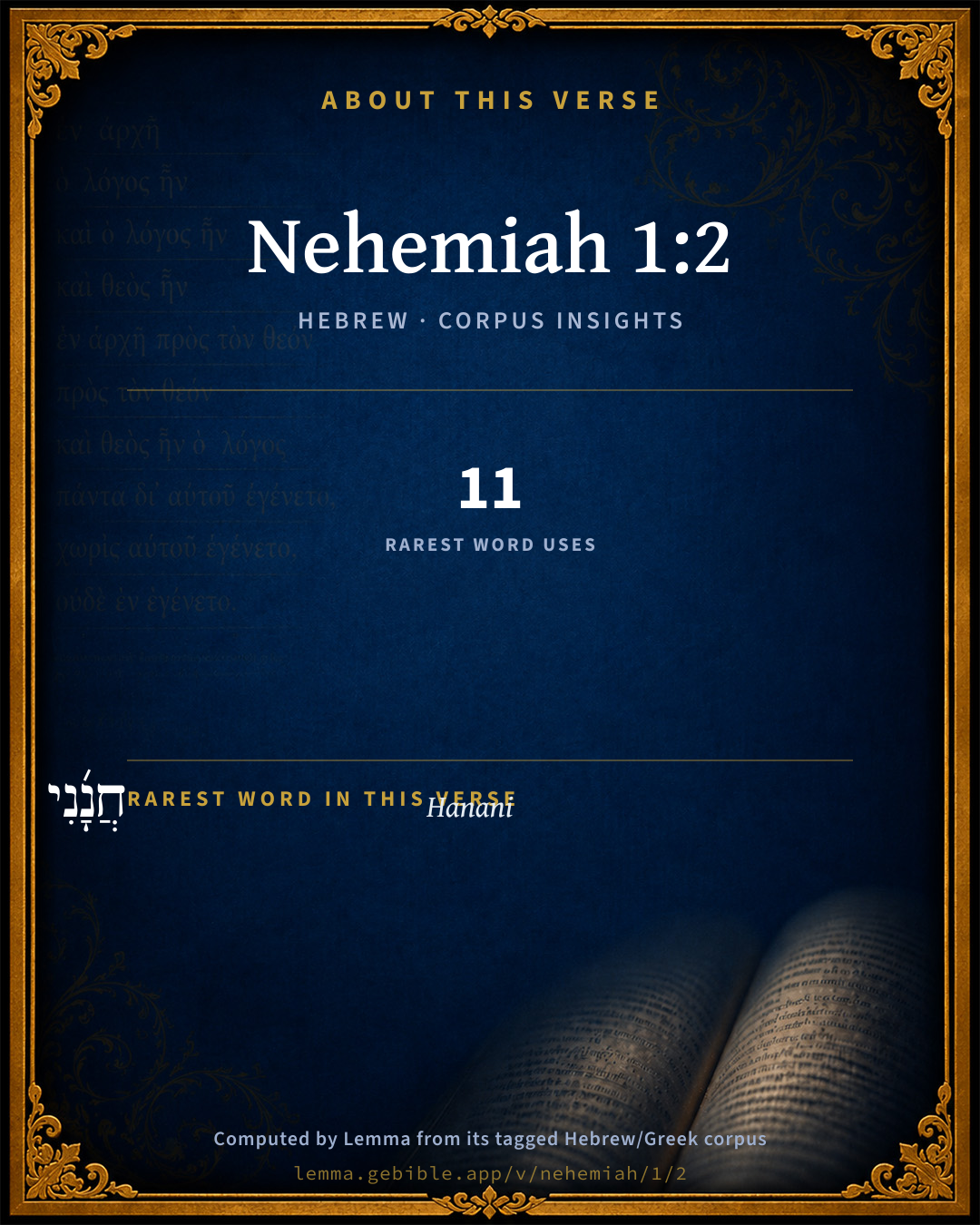
The rarest word here is חֲנָ֜נִי Hanani H2607 — appearing just 11 times in the whole Hebrew Bible.

Shared distinctive vocabulary

חֲנָ֜נִי Hanani H2607 occurs in 11 verses of the Hebrew Bible. Also found in:

Grammatical profile

  • 3 verbs
  • 8 nouns
  • 1 adjective
  • 1 pronoun
  • 3 prepositions
  • 1 particle

Verb forms

  • וַיָּבֹ֨א Qal · Sequential Imperfect
  • וָאֶשְׁאָלֵ֞ם Qal · Sequential Imperfect
  • נִשְׁאֲר֥וּ Niphal · Perfect

Repetition

A word recurs within this verse — often emphatic in Hebrew:

Cross-references

9

Topical passages linked to Nehemiah 1:2 in the Treasury of Scripture Knowledge — connected by theme and wording, ordered by reader-vote popularity; previews shown in the World English Bible.

  • Nehemiah 7:2 that I gave my brother Hanani, and Hananiah the governor of the castle, charge over Jerusalem; for he was a faithful man, and feared God above many.
  • Ezekiel 6:9 Those of you that escape shall remember me among the nations where they shall be carried captive, how that I have been broken with their lewd heart, which has departed from me, and with they eyes, which play the prostitute after their idols: and they shall loathe themselves in their own sight for the evils which they have committed in all their abominations.
  • Ezra 9:8–9 Now for a little moment grace has been shown from Yahweh our God, to leave us a remnant to escape, and to give us a nail in his holy place, that our God may lighten our eyes, and give us a little reviving in our bondage.
  • Ezra 9:14 shall we again break your commandments, and join in affinity with the peoples that do these abominations? would not you be angry with us until you had consumed us, so that there should be no remnant, nor any to escape?
  • Psalms 122:6–9 Pray for the peace of Jerusalem. Those who love you will prosper.
  • Psalms 137:5–6 If I forget you, Jerusalem, Let my right hand forget its skill.
  • Jeremiah 44:14 so that none of the remnant of Judah, who have gone into the land of Egypt to sojourn there, shall escape or be left, to return into the land of Judah, to which they have a desire to return to dwell there: for none shall return save such as shall escape.
  • Ezekiel 7:16 But those of those who escape shall escape, and shall be on the mountains like doves of the valleys, all of them moaning, every one in his iniquity.
  • Ezekiel 24:26–27 that in that day he who escapes shall come to you, to cause you to hear it with your ears?

Cross-references courtesy of OpenBible.info (CC BY 4.0).

Hebrew and Greek witnesses Masoretic Hebrew ↔ Greek Septuagint

The same verse in the two great witnesses to the Old Testament, shown verse-for-verse.

These are two independent witnesses, not word-aligned to each other, and the Septuagint is shown in lemma (dictionary) form.

Hebrew Nehemiah 1:2 Masoretic · Westminster Leningrad Codex

וַיָּבֹ֨א חֲנָ֜נִי אֶחָ֧ד מֵאַחַ֛י ה֥וּא וַאֲנָשִׁ֖ים מִֽיהוּדָ֑ה וָאֶשְׁאָלֵ֞ם עַל הַיְּהוּדִ֧ים הַפְּלֵיטָ֛ה אֲשֶֽׁר נִשְׁאֲר֥וּ מִן הַשֶּׁ֖בִי וְעַל יְרוּשָׁלִָֽם

that Hanani, one of my brothers, came, he and certain men out of Judah; and I asked them concerning the Jews who had escaped, who were left of the captivity, and concerning Jerusalem.

World English Bible · Public Domain

Greek LXX Structure differs

The Septuagint has no separate book of Nehemiah. Its Greek text is the second half of Esdras B (2 Esdras), chapters 11–23; Ezra is the first half (1–10).

A verse-for-verse comparison isn’t shown here because the chapters and verses don’t line up. Switch to the LXX edition with the MT / LXX toggle above to read the Greek directly.

Hebrew: Westminster Leningrad Codex (CC BY 4.0). Greek: Septuagint (public domain); English from a public-domain English Septuagint. How the Septuagint differs from the Hebrew →

Commentary

Notes on Nehemiah 1:2 from classic Christian and Jewish commentators (each source and its license shown beneath its notes). The classic Christian expositions comment on the surrounding passage and are grouped to its opening verse, so a note may address several verses; the Jewish commentaries on the Tanakh (Rashi and others) are per-verse, so they appear only where the commentator wrote on this verse.

Lemma curates 59 commentaries, every one of them public domain or Creative Commons licensed, each selected and text-cleaned for this edition rather than reprinted as found. About our sources →

Trapp's Complete Commentary

John Trapp

Neh 1:2 That Hanani, one of my brethren, came, he and [certain] men of Judah; and I asked them concerning the Jews that had escaped, which were left of the captivity, and concerning Jerusalem.

Ver. 2. That Hanani] A gracious man, according to his name ( Nomine tu, quin sis natura Gratius, ac te Gratius hoc Christi gratia praestet, Amen), and zealous for his country; which indeed is a man’s self; and therefore when our Saviour used that proverb, Physician, heal thyself, the sense is, heal thy country, Luk 4:23.

One of my brethren] Not by race, perhaps, but surely by grace and place; a Jew, and that inwardly, and therefore intrusted, after this, by Nehemiah with a great charge, Neh 7:2.

Came, he and certain men of Judah] Upon some great suit, likely, for their country; because they took so long and troublesome a journey in the winter, not without that Roman resolution of Pompey in like case, Necesse est ut eam, non ut vivam. It is necessary that I go not that I live. Whatever their business was, these men had better success than afterwards Philo the Jew and his colleagues had in their embassy to Caligula the emperor; who cast them out with contempt, and would not hear their apology against Appion of Alexandria, their deadly enemy.

And I asked them concerning the Jews] The Church was his care; neither could he enjoy aught so long as it went ill with Zion. He was even sick of the affliction of Joseph; and glad he had got any of whom to inquire; he asked them, not out of an itch after news; but of an earnest desire to know how it fared with God’s poor people, that he might cum singulis pectus suum copulate, with singleness of purpose, having bound him, as Cyprian speaketh, rejoice with them that rejoiced, and weep with those that wept, Rom 12:15, a sure sign of a sound member.

Which were left of the captivity] One of whom he well knew to be more worth than a rabble of rebels, a world of wicked persons; as the Jews rise to say of those seventy souls that went down with Jacob into Egypt, that they were better worth than all the seventy nations of the world besides.

John Trapp, A Commentary or Exposition upon All the Books of the Old and New Testament (1647–1656) — public domain. Text from a community e-Sword module.

Joseph Benson's Commentary

Neh 1:2. I asked them concerning the Jews that had escaped — Either concerning those who were not carried captives when others were, but remained in the land; or rather, those that had escaped out of the slavery which they had endured in Assyria, Babylon, and other strange lands. Which were left of the captivity — The remnant of those numerous captives, now returned and settled in Jerusalem, and other parts of Judea. Though Nehemiah lived in ease, honour, and affluence himself, he could not forget that he was an Israelite, nor shake off the thoughts of his brethren, or his concern for their welfare. He therefore inquires in what condition they were, and whether Jerusalem was again become a flourishing city.

Joseph Benson's Commentary on the Old and New Testaments (1811–1818) — public domain. Text from a community e-Sword module.

Tyndale Open Study Notes

Tyndale Open Resources

1:2 Hanani might have been one of Nehemiah’s blood brothers; this word in Hebrew can also mean “fellow countryman” (e.g., Deut 1:16, “fellow Israelite”). • the Jews who had returned: See Ezra 2:64-65; 8:1-14.

Tyndale Open Study Notes — © Tyndale Open Resources, licensed CC BY-SA 4.0. Text via the HelloAO Bible API.

Geneva Bible (1599)

Geneva Bible translators

A Jew as I was.

Geneva Bible (1599) marginal notes — public domain. Text via Bolls.life.

Jamieson, Fausset & Brown

Robert Jamieson, A. R. Fausset & David Brown

Hanani, one of my brethren, came, he and certain men of Judah--Hanani is called his brother (Neh 7:2). But as that term was used loosely by Jews as well as other Orientals, it is probable that no more is meant than that he was of the same family. According to JOSEPHUS, Nehemiah, while walking around the palace walls, overheard some persons conversing in the Hebrew language. Having ascertained that they had lately returned from Judea, he was informed by them, in answer to his eager enquiries, of the unfinished and desolate condition of Jerusalem, as well as the defenseless state of the returned exiles. The commissions previously given to Zerubbabel and Ezra extending only to the repair of the temple and private dwellings, the walls and gates of the city had been allowed to remain a mass of shattered ruins, as they had been laid by the Chaldean siege.

Jamieson, Fausset & Brown — Commentary Critical and Explanatory on the Whole Bible (1871) — public domain (CC PDM 1.0). Text via the HelloAO Bible API.

Adam Clarke's Commentary

Verse 2. I asked them concerning the Jews] Josephus gives a probable account of this business: "Nehemiah, being somewhere out of Susa, seeing some strangers, and hearing them converse in the Hebrew tongue, he went near; and finding they were Jews from Jerusalem, he asked them how matters went with their brethren in that city, and what was their state?" And the answer they gave him is, in substance, that recorded in the text; though with several aggravations in Josephus. - Joseph. Ant. lib. xi., c. 5.

Adam Clarke's Commentary on the Bible (1810–1826) — public domain. Text from a community e-Sword/MySword module.

Ellicott's Commentary for English Readers

(2) He and certain men of Judah.—From Judah: Hanani was Nehemiah’s own brother (Neh_7:1). He and his companions came from “the province” of Judah (Neh_1:3); nothing is said as to their motive in coming; and certainly there is no intimation that they had been sent to the Persian court on account of recent disturbances.

A Bible Commentary for English Readers, edited by Charles John Ellicott (1878–1897) — public domain. Text from a community e-Sword module.

John Gill's Exposition

That Hanani, one of my brethren,.... Either in natural relation, Neh 7:2, or being a Jew of the same nation and religion; so Jarchi interprets it, one of my companions or acquaintance:

he and certain men of Judah; who came from thence to Shushan on some account or another:

and I asked them concerning the Jews that had escaped, which were left of the captivity; who were returned from it to their own land; he inquired of their health and prosperity, in what circumstances they were, whether prosperous or adverse, whether they flourished, or were in distress:

and concerning Jerusalem; whether it was rebuilt, the houses and walls of it, and in what condition it was.

John Gill's Exposition of the Whole Bible (1746–1763) — public domain (CC PDM 1.0). Text via the HelloAO Bible API.

Albert Barnes' Notes on the Bible

Hanani seems to have been an actual brother of Nehemiah Neh 7:2.

Albert Barnes' Notes on the Bible (1834–1885) — public domain. Text from a community e-Sword/MySword module.

Haydock's Catholic Bible Commentary

Hanani, a relation, whom Nehemias brought back, chap. vii. 2. --- Came. Some Latin copies add, "to me," (Lyranus) as if a deputation had been sent; but of this the text is silent. (Calmet)

George Leo Haydock (1774–1849), Haydock's Catholic Family Bible and Commentary, 1859 edition — public domain. Excludes Psalms (Douay-Rheims chapter numbering differs from Protestant) and Deuterocanonical books (Catholic canon only).

Matthew Poole's English Annotations

One of my brethren; of my family, or tribe, or nation.

That had escaped out of the slavery which they endured in strange lands.

Which, were left of the captivity; the remnant of those numerous captives.

Matthew Poole's English Annotations on the Holy Bible (1683–1685) — public domain. Text from a community e-Sword/MySword module.

Whedon's Commentary on the Bible

Daniel D. Whedon

2. Hanani, one of my brethren — Called emphatically his own brother in Neh_7:2.

I asked them — Hence it does not seem that they were sent, as some suggest, expressly to inform Nehemiah of the sad state of things at Jerusalem.

Jews that had escaped — Those that had survived all the calamities and dangers to which the new community at Jerusalem had been exposed.

Which were left of the captivity — Or, which remained. This further defines the preceding clause, as meaning those returned exiles who were still to be found in Judea; those who remained out of multitudes that had fallen.

Daniel D. Whedon (gen. ed.), Commentary on the Old and New Testaments (1874–1909) — public domain. Text from a community e-Sword module.

The Pulpit Commentary

Hanani, one of my brethren. Afterwards given the charge of the gates of Jerusalem by Nehemiah. (Neh_7:2)

The Pulpit Commentary (1880–1919), ed. H.D.M. Spence-Jones & Joseph S. Exell — public domain. Text from a community e-Sword module.

Rashi

Rabbi Shlomo Yitzchaki (Rashi)

one of my brethren one of my companions.

and I asked them about the Jews I asked them about the Jews who had escaped the Babylonian captivity and remained in Jerusalem.

who had escaped because they were saved from the Babylonian exile.

and about Jerusalem And I asked them about the city.

Rashi on the Tanakh — English translations: “The Judaica Press complete Tanach with Rashi, translated by A. J. Rosenberg” (CC BY 4.0); “Pentateuch with Rashi's commentary by M. Rosenbaum and A.M. Silbermann, 1929-1934” (public domain); “The Metsudah Tanach series, Lakewood, N.J” (CC BY 4.0); and “The Book of Joshua, Metsudah Publications, 1997” (CC BY 4.0). Text via Sefaria.

Lesson kit

Teaching starters — assembled from the data on this page, not authored interpretation. Every prompt links to the verse data it draws on. Edit before teaching.

Nehemiah, in the Historical, opens this verse with 17 words (16 distinct Hebrew lemmas). Its most distinctive word is Chănânîy (“Hanani”). A historical commentator’s framing appears above. Read the whole chapter for the surrounding context.

Discussion questions

  1. How does “Hanani” (Chănânîy) shape what this verse is saying?
  2. 1 Kings 16:1 shares the word «Hanani» with this verse. How do the two illuminate each other?
  3. “upon” occurs 2× in this one verse. What is the effect of the repetition?
  4. These translations render this verse differently. What is at stake in choosing one wording over another?
  5. The verb «וַיָּבֹ֨א» is Qal Sequential Imperfect. How does its form color the action?
  6. Reading how Trapp's Complete Commentary and Joseph Benson's Commentary read this verse, where do the two commentators agree and where do they part?

Things to notice

Reading settings

Reading text

Shown beneath each verse's original-language words.

Old Testament
Old Testament edition

Read the OT as the Masoretic Hebrew (MT) or the Greek Septuagint (LXX).

English shown for the Greek Septuagint (in the Hebrew ↔ Greek comparison).

Comparing translations? Open the Compare panel on any verse page to stack up to four side by side.