
Psalms 147:2

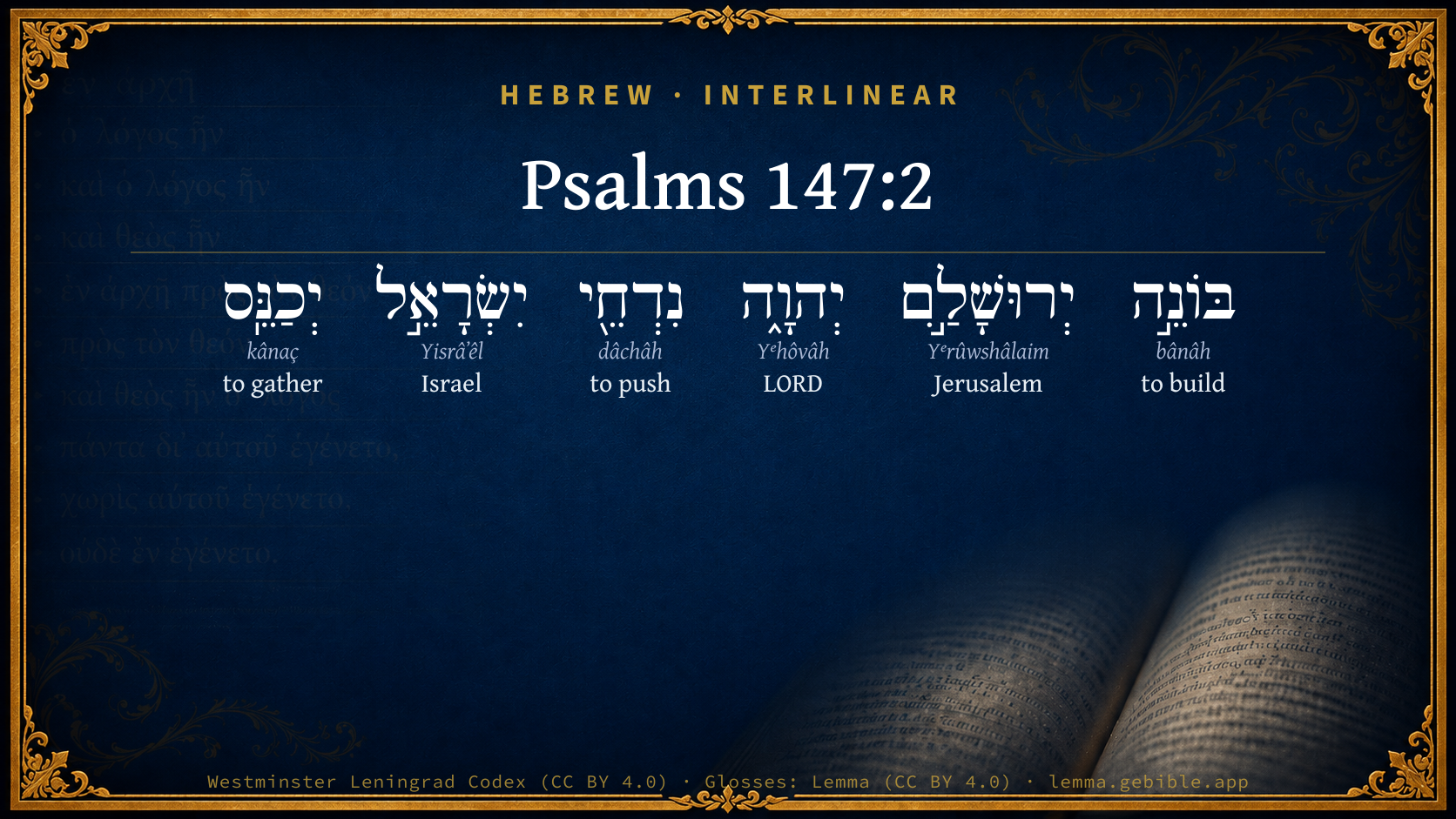
Hebrew (Westminster Leningrad Codex) Psalms 147:2 appears in the Hebrew Old Testament. The text above is from the Westminster Leningrad Codex. Each word links to its Strong’s number, a concise gloss, and parsing drawn from the Open Scriptures Hebrew Bible morphology. Click any word for its full Brown-Driver-Briggs (BDB) entry.
Download image
Cite this verse

Psalms 147:2 (World English Bible). Public Domain. Lemma interlinear Bible study tool, https://lemma.gebible.app/v/psalms/147/2.

Show BibTeX & RIS
BibTeX
RIS
English Translation
Yahweh builds up Jerusalem. He gathers together the outcasts of Israel.
World English Bible · Public Domain
Download a study sheet

One document with this verse’s original text, its word-by-word gloss line, the meaning frame, cross-references with their text, attributed commentary, and full source and license credits — printable, and it pastes into notes with its structure intact.

This verse Autodidact and up

Study sheet (.html) Plain text (.txt)

A passage Seminary Student

Up to 50 verses in one chapter. A passage sheet keeps up to 6 commentary sources and 12 cross-references per verse, in the order this page ranks them, and says so on the sheet whenever that leaves anything out. Ask for a single verse and you get the Autodidact verse sheet above.

Everything on this page stays free to read, with no account — the sheet is a download of what is already on screen, not access to it.

Want to remove ads? Support Godless Engineer
Compare translations 3

The same verse in 3 English versions, stacked beneath the original-language interlinear above. Click any original word for its lexicon entry.

Each is an independent rendering of the whole verse — the interlinear is not word-aligned to these translations.

Highlighted words mark where these versions differ — a whole-verse word diff, not a word-by-word alignment.

  • World English Bible Public Domain
    Yahweh builds up Jerusalem. He gathers together the outcasts of Israel.
  • King James Version Public Domain
    The LORD doth build up Jerusalem: he gathereth together the outcasts of Israel.
  • unfoldingWord Literal Text CC BY-SA 4.0
    Yahweh builds up Jerusalem; he gathers the scattered of Israel,

unfoldingWord Literal Text — © unfoldingWord, licensed CC BY-SA 4.0. Word-aligned USFM3 via Door43 (git.door43.org/unfoldingWord/en_ult).

Versions to compare (up to 4)

3 of 4 selected

Show all 18 translations

Every available English version of this verse, each an independent rendering of the whole verse.

  • World English Bible Public Domain
    Yahweh builds up Jerusalem. He gathers together the outcasts of Israel.
  • Berean Standard Bible Public Domain
    The LORD builds up Jerusalem; He gathers the exiles of Israel.
  • Majority Standard Bible Public Domain
    The LORD builds up Jerusalem; He gathers the exiles of Israel.
  • King James Version Public Domain
    The LORD doth build up Jerusalem: he gathereth together the outcasts of Israel.
  • American Standard Version (1901) Public Domain
    Jehovah doth build up Jerusalem; He gathereth together the outcasts of Israel.
  • Revised Version (1885) Public Domain
    The LORD doth build up Jerusalem; he gathereth together the outcasts of Israel.
  • Geneva Bible (1599) Public Domain
    The Lord doth builde vp Ierusalem, and gather together the dispersed of Israel.
  • Douay-Rheims (1899) Public Domain
    Praise the Lord, O my soul, in my life I will praise the Lord: I will sing to my God as long as I shall be. Put not your trust in princes:
  • Young's Literal Translation Public Domain
    Building Jerusalem `is' Jehovah, The driven away of Israel He gathereth.
  • Literal Standard Version CC BY-SA 4.0
    YHWH [is] building Jerusalem, || He gathers the driven away of Israel.
  • Unlocked Literal Bible CC BY-SA 4.0
    Yahweh rebuilds Jerusalem, he gathers together the scattered people of Israel.
  • unfoldingWord Literal Text CC BY-SA 4.0
    Yahweh builds up Jerusalem; he gathers the scattered of Israel,
  • Darby Bible Public Domain
    Jehovah doth build up Jerusalem: he gathereth the outcasts of Israel.
  • World Messianic Bible Public Domain
    The LORD builds up Jerusalem. He gathers together the outcasts of Israel.
  • Webster's Bible Public Domain
    The LORD buildeth up Jerusalem: he gathereth together the outcasts of Israel.
  • Free Bible Version CC BY-SA 4.0
    The Lord is rebuilding Jerusalem, gathering together the people of Israel who have been scattered.
  • Bible in Basic English Public Domain
    The Lord is building up Jerusalem; he makes all the outlaws of Israel come together.
  • JPS Tanakh (1917) Public Domain
    The LORD doth build up Jerusalem, He gathereth together the dispersed of Israel;

Literal Standard Version (2020), Covenant Press — licensed CC BY-SA 4.0. Text via the HelloAO Bible API (eBible.org). Unlocked Literal Bible (unfoldingWord) — licensed CC BY-SA 4.0. Text via the HelloAO Bible API (eBible.org). unfoldingWord Literal Text — © unfoldingWord, licensed CC BY-SA 4.0. Word-aligned USFM3 via Door43 (git.door43.org/unfoldingWord/en_ult). Free Bible Version, Dr. Jonathan Gallagher — licensed CC BY-SA 4.0. Text via the HelloAO Bible API (eBible.org).

Word by word

More ways to search: Search by grammar → Find every occurrence → Compare this word →

Practice this passage: Drill this verse → Learn its vocabulary →

About this verse

These counts appear in no published source. They are computed here, from the morphology-tagged text and Lemma’s own curated glosses. What Lemma adds →

6
words
6
distinct lemmas
Wisdom
section

Notable vocabulary

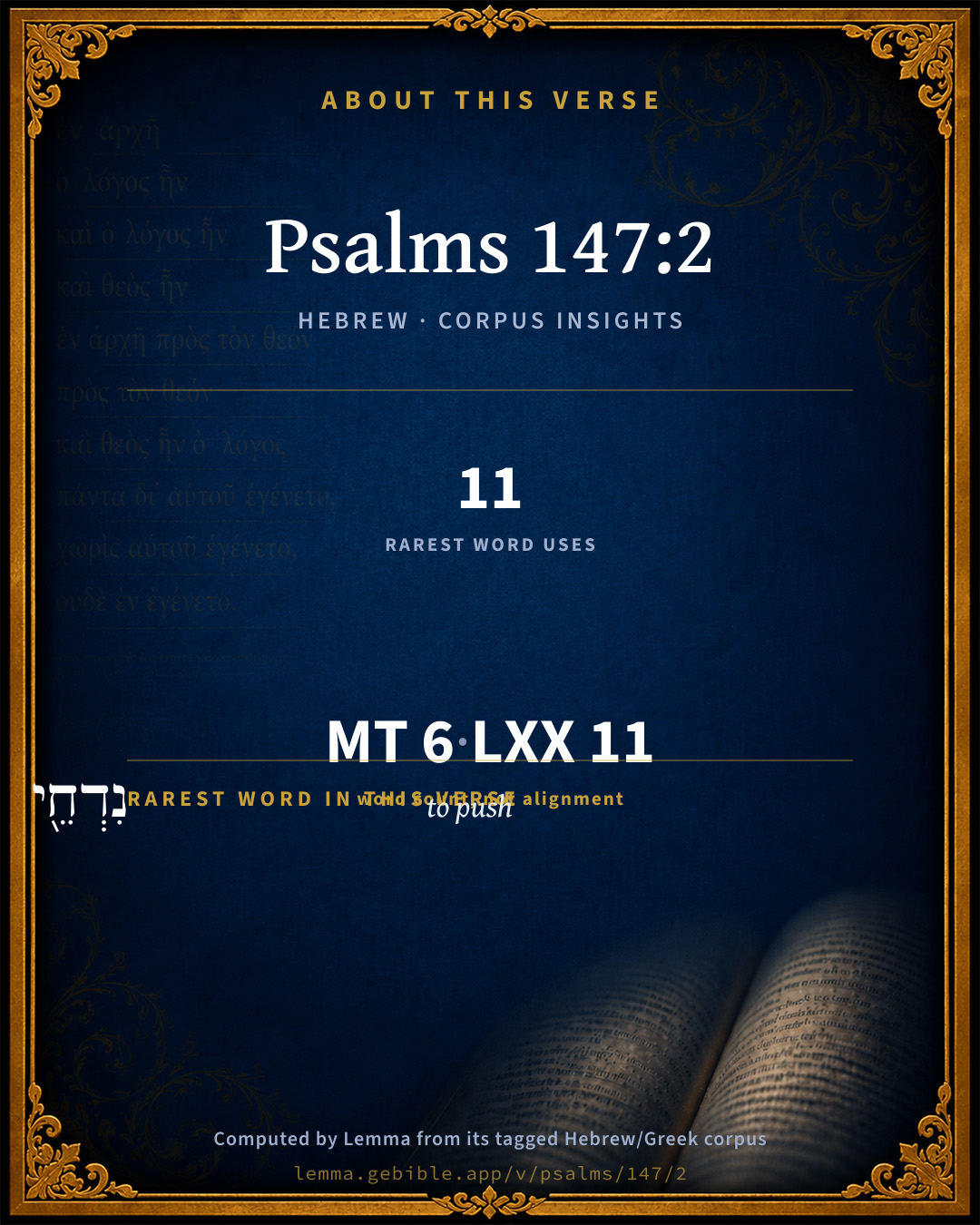
The rarest word here is נִדְחֵ֖י to push H1760 — appearing just 11 times in the whole Hebrew Bible.

Shared distinctive vocabulary

נִדְחֵ֖י to push H1760 occurs in 10 verses of the Hebrew Bible. Also found in:

Grammatical profile

  • 3 verbs
  • 3 nouns

Verb forms

  • בּוֹנֵ֣ה Qal · Participle Active
  • נִדְחֵ֖י Niphal · Participle Active
  • יְכַנֵּֽס Piel · Imperfect

Hebrew & Septuagint length

In English translation the verse runs 11 words from the Hebrew and 14 from the Septuagint (LXX English) — closely comparable.

A rough comparison of the two English renderings, which tokenize alike — not a word-level alignment.

Word counts can differ between the Hebrew and the Greek without any difference in meaning — e.g. the Hebrew direct-object marker אֵת has no separate Greek word, and Greek often adds the article ὁ.

In the original languages it is 6 Hebrew tokens and 11 Greek tokens — but the two are counted differently (Hebrew bundles its prefixes and suffixes into one token; the Greek is in lemma form), so that isn’t a like-for-like length.

Cross-references

22

Topical passages linked to Psalms 147:2 in the Treasury of Scripture Knowledge — connected by theme and wording, ordered by reader-vote popularity; previews shown in the World English Bible.

  • Deuteronomy 30:3 that then Yahweh your God will turn your captivity, and have compassion on you, and will return and gather you from all the peoples, where Yahweh your God has scattered you.
  • Isaiah 56:8 The Lord Yahweh, who gathers the outcasts of Israel, says, Yet will I gather [others] to him, besides his own who are gathered.
  • Psalms 51:18 Do well in your good pleasure to Zion. Build the walls of Jerusalem.
  • Psalms 102:20–22 To hear the groans of the prisoner; To free those who are condemned to death;
  • Isaiah 62:7 and give him no rest, until he establish, and until he make Jerusalem a praise in the earth.
  • Isaiah 14:32 What then shall one answer the messengers of the nation? That Yahweh has founded Zion, and in her shall the afflicted of his people take refuge.
  • Jeremiah 32:37 Behold, I will gather them out of all the countries, where I have driven them in my anger, and in my wrath, and in great indignation; and I will bring them again to this place, and I will cause them to dwell safely:
  • Ezekiel 38:8 After many days you shall be visited: in the latter years you shall come into the land that is brought back from the sword, that is gathered out of many peoples, on the mountains of Israel, which have been a continual waste; but it is brought forth out of the peoples, and they shall dwell securely, all of them.
  • Ezekiel 39:27–28 when I have brought them back from the peoples, and gathered them out of their enemies' lands, and am sanctified in them in the sight of many nations.
  • Ephesians 2:12–19 that you were at that time separate from Christ, alienated from the commonwealth of Israel, and strangers from the covenants of the promise, having no hope and without God in the world.
  • Isaiah 27:13 It shall happen in that day, that a great trumpet shall be blown; and they shall come who were ready to perish in the land of Assyria, and those who were outcasts in the land of Egypt; and they shall worship Yahweh in the holy mountain at Jerusalem.
  • Jeremiah 31:4 Again will I build you, and you shall be built, O virgin of Israel: again shall you be adorned with your tambourines, and shall go forth in the dances of those who make merry.
  • Ezekiel 36:24–38 For I will take you from among the nations, and gather you out of all the countries, and will bring you into your own land.
  • Ezra 2:64–65 The whole assembly together was forty-two thousand three hundred sixty,
  • Nehemiah 3:1–16 Then Eliashib the high priest rose up with his brothers the priests, and they built the sheep gate; they sanctified it, and set up the doors of it; even to the tower of Hammeah they sanctified it, to the tower of Hananel.
  • Nehemiah 7:4 Now the city was wide and large; but the people were few therein, and the houses were not built.
  • Psalms 102:13–16 You will arise and have mercy on Zion; For it is time to have pity on her. Yes, the set time has come.
  • Isaiah 11:11–12 It shall happen in that day, that the Lord will set his hand again the second time to recover the remnant of his people, who shall remain, from Assyria, and from Egypt, and from Pathros, and from Cush, and from Elam, and from Shinar, and from Hamath, and from the islands of the sea.
  • Ezra 8:1–14 Now these are the heads of their fathers' [houses], and this is the genealogy of those who went up with me from Babylon, in the reign of Artaxerxes the king:
  • Ezekiel 37:21–28 Say to them, Thus says the Lord Yahweh: Behold, I will take the children of Israel from among the nations, where they are gone, and will gather them on every side, and bring them into their own land:
  • Daniel 9:25 Know therefore and discern, that from the going forth of the commandment to restore and to build Jerusalem to the Anointed One, the prince, shall be seven weeks, and sixty-two weeks: it shall be built again, with street and moat, even in troubled times.
  • Matthew 16:18 I also tell you that you are Peter, and on this rock I will build my assembly, and the gates of Hades will not prevail against it.

Cross-references courtesy of OpenBible.info (CC BY 4.0).

Hebrew and Greek witnesses Masoretic Hebrew ↔ Greek Septuagint

The same verse in the two great witnesses to the Old Testament, shown verse-for-verse.

You’re reading Greek Psalm 146 (Hebrew Psalm 147). The Septuagint counts the superscription, so verse numbers can differ from the Hebrew — chapter-level alignment, not verse-by-verse. Numbering follows Rahlfs.

These are two independent witnesses, not word-aligned to each other, and the Septuagint is shown in lemma (dictionary) form.

Hebrew Psalms 147:2 Masoretic · Westminster Leningrad Codex

בּוֹנֵ֣ה יְרוּשָׁלִַ֣ם יְהוָ֑ה נִדְחֵ֖י יִשְׂרָאֵ֣ל יְכַנֵּֽס

Yahweh builds up Jerusalem. He gathers together the outcasts of Israel.

World English Bible · Public Domain

Greek LXX Greek Psalm 146:2 Septuagint · lemma form

οἰκοδομέω ἰερουσαλήμ ὁ κύριος καί ὁ διασπορά ὁ ἰσραήλ ἐπι συνἄγω

The Lord builds up Jerusalem; and he will gather together the dispersed of Israel.

LXX2012 (modern English Septuagint) · Public Domain

On this verse, Ellicott's Commentary for English Readers discusses the Septuagint’s reading. Read the note in Commentary ↓

Hebrew: Westminster Leningrad Codex (CC BY 4.0). Greek: Septuagint (public domain); English from LXX2012 (modern English Septuagint) (Public Domain). How the Septuagint differs from the Hebrew →

Commentary

Notes on Psalms 147:2 from classic Christian and Jewish commentators (each source and its license shown beneath its notes). The classic Christian expositions comment on the surrounding passage and are grouped to its opening verse, so a note may address several verses; the Jewish commentaries on the Tanakh (Rashi and others) are per-verse, so they appear only where the commentator wrote on this verse.

Lemma curates 59 commentaries, every one of them public domain or Creative Commons licensed, each selected and text-cleaned for this edition rather than reprinted as found. About our sources →

Trapp's Complete Commentary

John Trapp

Psa 147:2 The LORD doth build up Jerusalem: he gathereth together the outcasts of Israel.

Ver. 2. The Lord doth build up Jerusalem] He is the only architect of his Church. He layeth the foundation of it in election (saith a good expositor), and buildeth it progressively by faith and sanctification; and finisheth his work of grace and his people’s happiness in glorification.

He gathereth together the outcasts of Israel] He will surely bring home his banished; yea, because they called thee an outcast, saying, This is Zion, whom no man seeketh after, therefore I will restore health unto thee, &c., Jer 30:17. Qui nil sperare potest, desperet nihil.

John Trapp, A Commentary or Exposition upon All the Books of the Old and New Testament (1647–1656) — public domain. Text from a community e-Sword module.

The Biblical Illustrator

Joseph S. Exell

Psa_147:2-5

The Lord doth build up Jerusalem.

The greatness and gentleness of God

The text reveals the constructive side of the Divine government.

I. As shown in the building of the Church.

1. The Lord doth build up Jerusalem, etc. That He should do so shows--

(1) That the Church is self-demolished.

(2) That it is self-helpless.

(3) That God is the Gatherer, the Redeemer, and the Builder of the Church.

2. It is not Gods purpose to destroy. It is His very nature to preserve, extend, complete, and glorify. He does destroy, but never willingly. His arm does not become terrible until His heart has been grieved, until His patience has been exhausted, and until the vital interests of the universe have been put in peril.

II. As seen in the gentle care of human hearts. He healeth the broken in heart, and bindeth up their wounds. Still, you see how constructive and preservative is God. His work is edification, not destruction. Who cares for broken-hearted men? Who has patience with the weak and faint? The greater the nature, the greater the compassion.

1. The personality of Gods knowledge. He knows every bruised reed. Hears suffer in secret; there is nothing hidden from God!

2. The infinite adaptations of Divine grace. Every heart, whatever its grief, may be healed. There is a sovereign balm for every wound.

3. The perfectness of Divine healing. Other healers say, Peace, peace, when there is no peace. Others heal the hurt of the daughter of My people slightly. We are not healed until God heals us. God offers to heal us; our disease and our sorrow are challenges to prove His grace. What of the responsibility of refusal?

III. As seen in the order, the regularity, and the stability of creation.

1. Creation is a volume open to all eyes. Read it, and see the might and gentleness, the wisdom and patience of God. Jesus Christ taught us to reason from the natural to the spiritual: Consider the lilies, etc; Behold the fowls of the air, etc.

(1) God takes care of the great universe, may I not trust Him with my life?

(2) Where Gods will is unquestioned, the result is light, beauty, music: why should I oppose myself to its gracious dominion?

2. Let the Church be of good courage. When the Lord shall build up Zion, He shall appear in His glory. The gates of hell shall not prevail. (J. Parker, D. D.)

He gathereth together the outcasts of Israel.--

Good cheer for outcasts

Does not this showy us the great gentleness and infinite mercy of God? And as we know most of God in the person of our Lord Jesus Christ, should it not charm us to remember that when He came on earth He did not visit kings and princes, but He came unto the humble and simple folk. I think you may judge of a mans character by the persons whose affection he seeks. If you find a man seeking only the affection of those who are great, depend upon it he is ambitious and self-seeking; but when you observe that a man seeks the affection of those who can do nothing for him, but for whom he must do everything, you know that he is not seeking himself, but that pure benevolence sways his heart (Mat_11:29). I also see here an illustration of His love to men, as men. If you seek only after rich men the suspicion arises, and it is more than a suspicion that you rather seek their wealth than them. If you aim only at the benefit of wise men, it is probably true that it is their wisdom which attracts you, and not their manhood: but the Lord Jesus Christ did not love men because of any advantageous circumstances, or any commendable incidents of their condition: His love was to manhood. Another thing is also clear. If Jesus gathers together the outcasts el Israel, it proves His power over the hearts of men.

I. To whom may this text apply?

1. The very poorest and most despised among men. The Lord Jesus Christ looks with love on those whom others look down upon with scorn.

2. Those who have made themselves outcasts by their wickedness, and are deservedly cast out of society.

3. Those who judge themselves to be outcasts, though as to outward actions they certainly do not deserve the character. Now, listen, thou who hast condemned thyself. The Lord absolves thee. Thou who hast shut thyself out as an outcast, thou shalt be gathered; for whereas they call thee an outcast, whom no man seeket, h after, thou shalt be called Hephzibah, for the Lords delight is in thee. Only believe thou in Jesus Christ, and cast thyself upon Him.

4. Backsliders.

5. Depressed Christians.

6. Those who suffer for righteousness sake, till they are regarded as the offscouring of all things. Blessed are those who are outcasts for Christi Rich are those who are so honoured as to be permitted to become poor for Him l Happy they who have had this grace given them to be permitted to lay life itself down for Jesus Christs sake!

II. In what sense the Lord Jesus gathers together these outcasts of different classes.

1. He gathers them to hear the Gospel.

2. He gathers them to Himself--to blessedness and peace through reconciliation with the Father.

3. He gathers them into the Divine family--makes them children of God--heirs with Himself.

4. In due time He gathers them into His visible Church, and He gathers them into His work.

5. He gathers them into heaven.

III. Lessons.

1. Encouragement to those who are unworthy, or who think themselves so, to go to Jesus Christ to-night.

2. If Jesus Christ received some of us when we felt ourselves to be outcasts, how we ought to love Him!

3. Let us always feel that if the Lord Jesus Christ took us up when we were not worth having, we will never be ashamed to try and pick up others who are in a like condition. (C. H. Spurgeon.)

The Biblical Illustrator, edited by Joseph S. Exell (c. 1880s–1900s) — public domain. Text from a community e-Sword module.

J. A. Alexander on Psalms

Joseph Addison Alexander

2. (Psa 147:2) Building Jerusalem (is) Jehovah; the outcasts of Israel he gathers. The rebuilding of the walls in the days of Nehemiah, may be said to have completed tha fulfilment of the promise in Isa 11:12; Isa 56:8. Compare Psa 107:3

Joseph Addison Alexander, The Psalms Translated and Explained (1850) — public domain. Text from a community e-Sword module.

Tyndale Open Study Notes

Tyndale Open Resources

147:2-6 The psalmist recalls the restoration of Jerusalem and the Lord’s afflicted exiles.

Tyndale Open Study Notes — © Tyndale Open Resources, licensed CC BY-SA 4.0. Text via the HelloAO Bible API.

Geneva Bible (1599)

Geneva Bible translators

Because the Lord is the founder of the Church, it cannot be destroyed, though the members thereof be dispersed, and seem as it were for a time to be cut off.

Geneva Bible (1599) marginal notes — public domain. Text via Bolls.life.

Jamieson, Fausset & Brown

Robert Jamieson, A. R. Fausset & David Brown

(Compare Psa 107:3; Isa 11:12).

Jamieson, Fausset & Brown — Commentary Critical and Explanatory on the Whole Bible (1871) — public domain (CC PDM 1.0). Text via the HelloAO Bible API.

Adam Clarke's Commentary

Verse 2. The Lord doth build up] The psalmist appears to see the walls rising under his eye, because the outcasts of Israel, those who had been in captivity, are now gathered together to do the work.

Adam Clarke's Commentary on the Bible (1810–1826) — public domain. Text from a community e-Sword/MySword module.

John Calvin's Commentaries

2. Jehovah building up, etc. He begins with the special mercy of God towards his Church and people, in choosing to adopt one nation out of all others, and selecting a fixed place where his name might be called upon. When he is here called the builder of Jerusalem, the allusion is not so much to the outward form and structure, as to the spiritual worship of God. It is a common figure in treating of the Church to speak of it as a building or temple. The meaning is, that the Church was not of human erection, but formed by the supernatural power of God; for it was from no dignity of the place itself that Jerusalem became the only habitation of God in our world, nor did it come to this honor by counsel, industry, effort or power of man, but because God was pleased to consecrate it to himself. He employed the labor and instrumentality of men indeed in erecting his sanctuary there, but this ought never to take from his grace, which alone distinguished the holy city from all others. In calling God the former and architect of the Church, his object is to make us aware that by his power it remains in a firm condition, or is restored when in ruins. Hence he infers that it is in his power and arbitrament to gather those who have been dispersed. Here the Psalmist would comfort those miserable exiles who had been scattered in various quarters, with the hope of being recovered from their dispersion, as God had not adopted them without a definite purpose into one body. As he had ordered his temple and altar to be erected at Jerusalem, and had fixed his seat there, the Psalmist would encourage the Jews who were exiles from their native country, to entertain good hope of a return, intimating that it was no less properly God’s work to raise up his Church when ruined and fallen down, than to found it at first. It was not, therefore, the Psalmist’s object directly to celebrate the free mercy of God in the first institution of the Church, but to argue from its original, that God would not suffer his Church altogether to fall, having once founded it with the design of preserving it for ever; for he forsakes not the work of his own hands. This comfort ought to be improved by ourselves at the present period, when we see the Church on every side so miserably rent asunder, leading us to hope that all the elect who have been adjoined to Christ’s body, will be gathered unto the unity of the faith, although now scattered like members torn from one another, and that the mutilated body of the Church, which is daily distracted, will be restored to its entireness; for God will not suffer his work to fail.

In the following verse he insists upon the same truth, the figure suggesting that though the Church labor under, and be oppressed by many diseases, God will speedily and easily recover it from all its wounds. The same truth, therefore, is evidently conveyed, under a different form of expression — that the Church, though it may not always be in a flourishing condition, is ever safe and secure, and that God will miraculously heal it, as though it were a diseased body.

John Calvin's Commentaries (1540-1563) — public domain. Text from the Calvin Translation Society English edition (1840s-50s) via the Christian Classics Ethereal Library (ccel.org). Calvin's coverage is partial (roughly two-thirds of the Bible); uncommented books and verses are honest gaps, never fabricated. The 19th-century editor's footnotes and remarks are omitted so the notes are faithfully Calvin's own voice.

Ellicott's Commentary for English Readers

(2) Build up—i.e., of course, “rebuild.” The word “outcasts,” which is that used in Isa_11:12; Isa_56:8, shows that the rebuilding after the captivity is intended. The LXX. and Vulg. have “dispersion;” Symmachus, “those thrust out.”

A Bible Commentary for English Readers, edited by Charles John Ellicott (1878–1897) — public domain. Text from a community e-Sword module.

The Cambridge Bible for Schools and Colleges

gen. ed. J. J. S. Perowne

2, 3. Jehovah’s goodness to Jerusalem.

doth build up] The restoration and repeopling of the city generally are meant, not merely the reconstruction of its houses and walls. It is regarded as a continuous process, still in progress.

he gathereth together &c.] Cp. Deu_30:1-4; Isa_56:8; Isa_11:12; Neh_1:9.

This verse is imitated in the hymn in the Hebrew text of Sir_51:12 (6, 7). See p. 776.

The Cambridge Bible for Schools and Colleges (gen. ed. J. J. S. Perowne; Cambridge University Press, 1878–1918) — public domain. Text from a community e-Sword module.

John Gill's Exposition

The Lord doth build up Jerusalem,.... Literally, after the Babylonish captivity, according to some; or rather when taken from the Jebusites by David; or spiritually the church, which is often called Jerusalem, even the Gospel church, of which Christ is the builder, his ministers are instruments, his people are the materials, and which, though now greatly fallen to decay, will be rebuilt by him in the latter day; when his work will be revived among his saints, his Gospel more powerfully preached, his ordinances more purely administered, and multitudes of souls converted; and which will be matter of praise and thanksgiving, as it is now matter of prayer; see Psa 51:18;

he gathereth together the outcasts of Israel; the exiles from Babylon, as some; or rather such who in the times of the judges had been carried captive by their neighbours, or fled from their cities, in the times of Saul for fear of the Philistines, and who were gathered to their own country, cities, and houses, when David began to reign. Spiritually this regards the whole Israel of God, the elect of God, whether Jews or Gentiles, and the outcasts of them; so called, not because ever cast out or cast off by the Lord, being received into his favour, covenant, and church; but either because cast out of the company of profane men, as evil and unworthy; or cast out of Israel, the church of God, very justly, for offences given; but, being brought to repentance, are restored and gathered in again: or rather this may represent the Lord's people as in a state of nature, like the wretched infant cast out into the open field, scattered up and down in the world, in a state of distance from God, Christ, and his people; these are gathered by Christ in redemption, who came to seek and collect them together; and by his spirit in conversion, when he gathers them to himself, and into his fold; and this, as it is an occasion of joy to angels and saints, is matter of praise and thanksgiving to the outcasts themselves, thus gathered in. The Septuagint render it, to the dispersion or dispersed of Israel; see Joh 7:35.

John Gill's Exposition of the Whole Bible (1746–1763) — public domain (CC PDM 1.0). Text via the HelloAO Bible API.

Albert Barnes' Notes on the Bible

The Lord doth build up Jerusalem - He builds up the walls; he restores the city; he has caused the temple to be reconstructed. This language would be applicable to a return from the captivity. There may be an allusion here to the language in Psa 102:16 : “When the Lord shall build up Zion, he shall appear in his glory.” See the notes at that passage. What is there spoken of as what would be in the future is here spoken of as accomplished, and as a ground of praise.

He gathereth together the outcasts of Israel - Those who have been exiled from their native land, and who have been scattered as outcasts in a foreign country. This is appropriate language to use on the supposition that the psalm was composed after the return from the exile, for it is in such language that that return was predicted by the prophets. Isa 11:12 : “and he shall assemble the outcasts of Israel, and gather together the dispersed of Judah,” etc. Isa 56:8 : “the Lord God which gathereth the outcasts of Israel,” etc.

Albert Barnes' Notes on the Bible (1834–1885) — public domain. Text from a community e-Sword/MySword module.

Matthew Poole's English Annotations

Build up Jerusalem; it is the Lord’s own doing, and not man’s.

The outcasts; or, the banished, who were carried captives out of their own land, and dispersed in divers strange countries.

Matthew Poole's English Annotations on the Holy Bible (1683–1685) — public domain. Text from a community e-Sword/MySword module.

The Treasury of David

Charles H. Spurgeon

Ver. 2. The Lord doth build up Jerusalem. God appears both ill the material and spiritual world as a Builder and Maker, and therein he is to be praised. His grace, wisdom, and power are all seen in the formation and establishment of the chosen seat of his worship; once a city with material walls, but now a church composed of spiritual stones. The Jews rejoiced in the uprising of their capital from its ruins, and we triumph in the growth of the church from among a godless world. He gathereth together the outcasts of Israel; and thus he repairs the waste places, and causes the former desolations to be inhabited. This sentence may relate to Nehemiah and those who returned with him; but there is no reason why it should not with equal fitness be referred to David, who, with his friends, was once an outcast, but ere long became the means of building up Jerusalem. In any case, the Psalmist ascribes to Jehovah all the blessings enjoyed; the restoration of the city and the restoration of the banished he equally traces to the divine hand. How clearly these ancient believers saw the Lord present, working among them and for them! Spiritually we see the hand of God in the edification of the church, and in the ingathering of sinners. What are men tinder conviction of sin but outcasts from God, from holiness, from heaven, and even from hope? Who could gather them from their dispersions, and make citizens of them in Christ Jesus save the Lord our God? This deed of love and power he is constantly performing. Therefore let the song begin at Jerusalem our home, and let every living stone in the spiritual city echo the strain; for it is the Lord who has brought again his banished ones, and builded them together in Zion.

Ver. 2. The Lord doth build up Jerusalem, etc. If this Psalm were written on occasion of the return from Babylon, and the rebuilding of the earthly city, the ideas are to be transferred, as in other Psalms of the same kind, to a more important restoration from a much worse captivity, and to the building up of the church under the gospel, when Christ "gathered together in one the children of God that were scattered abroad" (Joh 11:52); that is, in the words of our Psalm, he gathered together the outcasts of Israel. So shall he again, at the resurrection, "gather together his elect from the four winds" (Mt 24:31), and "build up a Jerusalem", in which they shall serve and praise him for ever. George Horne.

Ver. 2. The Lord doth build up Jerusalem, etc.

Jerusalem! Jerusalem! the blessing lingers yet

On the city of the chosen, where the Sabbath seal was set;

And though her sons are scattered, and her daughters weep

apart,

While desolation, like a pall, weighs down each faithful

heart;

As the plain beside the waters, as the cedar on the hills,

She shall rise in strength and beauty when the Lord Jehovah

wills:

He has promised her protection, and the holy pledge is good,

'Tis whispered through the olive groves, and murmured by

the flood,

As in thee Sabbath stillness the Jordan's flow is heard,

And by the Sabbath breezes the hoary trees are stirred. Mrs. Hale, in "The Rhyme of Life."

Ver. 2. He gathereth together the outcasts of Israel. Wonder not that God calls together "the outcasts", and singles them out from every corner for a return; why can he not do this, as well as "tell the number of the stars, and call them all by their names"? There are none of his people so despicable in the eye of man, but they are known and regarded by God. Though they are clouded in the world, yet they are the stars of the world; and shall God number the inanimate stars in the heavens, and make no account of his living stars on the earth? No; wherever they are dispersed, he will not forget them: however they are afflicted, he will not despise them. The stars are so numerous that they are innumerable by man; some are visible and known by men, others lie more hid and undiscovered in a confused light, as those in the milky way; a man cannot see one of them distinctly. God knows all his people. As he can do what is above the power of man to perform, so he understands what is above the skill of man to discover. Stephen Charnock.

Ver. 2. He gathereth together the outcasts of Israel. David might well have written feelingly about the "outcasts", for he had himself been one; and even from Jerusalem, in his age, when driven forth from thence by his unnatural son, he went up by the ascent of Olivet, weeping and barefooted, and other "outcasts" with him, weeping also as they went. Barton Bouchier.

Ver. 2. The Lord is Architect, Builder, Sustainer, Restorer, and Owner of the Church. In each relation let him be praised.

Ver. 2. The Great Gatherer.

1. Strange persons sought for.

2. Special search and means made use of.

3. Selected centre to which he brings them.

4. Singular exhibition of them for ever and ever in heaven.

Ver. 2. First the church built and then the sinners gathered into it. A prosperous state of the church within necessary to her increase from without.

Ver. 2. See "Spurgeon's Sermons", No. 1302: "Good Cheer for Outcasts."

Ver. 2. Upbuilding and Ingathering.

1. The church may be in a fallen condition.

2. Its upbuilding is the Lord's work.

3. He accomplishes it by gathering together its outcast citizens. C.A.D.

Psalms 147:3*

Charles H. Spurgeon's The Treasury of David (1869–1885) — public domain. Psalms only. Text from a community e-Sword/MySword module.

Whedon's Commentary on the Bible

Daniel D. Whedon

2. The Lord… build—The king of Persia and Nehemiah are recognised only as subordinates. It was the Lord who gathered home his banished ones and restored their city.

Daniel D. Whedon (gen. ed.), Commentary on the Old and New Testaments (1874–1909) — public domain. Text from a community e-Sword module.

The Pulpit Commentary

The Lord doth build up Jerusalem. The rebuilding of Jerusalem after the return from the Babylonish captivity covered a space of above ninety years, from B.C. 538 till B.C. 445. First the temple was built (B.C. 533-515); then the city; finally, the walls and the gates (B.C. 445). It was in connection with this last portion of the building that the present psalm seems to have been written. He gathereth together the outcasts of Israel. The exiles returned gradually some with Zerubbabel (B.C. 538); some with Ezra, in B.C. 457; others, doubtless, with Nehemiah, in B.C. 445; and again in B.C. 434.

The Pulpit Commentary (1880–1919), ed. H.D.M. Spence-Jones & Joseph S. Exell — public domain. Text from a community e-Sword module.

unfoldingWord translationNotes

Door43 World Missions Community

He heals the brokenhearted and binds up their wounds

The writer speaks of the people's sorrow and discouragement as if they were physical wounds, and of Yahweh encouraging them as if he were healing those wounds. AT: "He encourages those who are sad and helps them to heal from their emotional wounds" (See: Metaphor)

translationWords

Jerusalem

people group

Israel

heart

unfoldingWord translationNotes — © Distant Shores Media and the Door43 World Missions Community, licensed CC BY-SA 4.0. Source: git.door43.org/Door43/en_tn.

Ibn Ezra

Rabbi Abraham ibn Ezra

"[He will] build," "He will bring in" - like [it says] "Go, bring in all the Jews..." (Esther 4:16).

Ibn Ezra on the Tanakh — English translations: “Sefaria Community Translation” (CC0 1.0 (public-domain dedication)); “Yalkut, Sifsei Chachomim Chumash, Metsudah Publications, 2009” (CC BY 4.0); and “Commentary of Ibn Ezra on Isaiah - trans. by M. Friedlander, 1873” (public domain). Text via Sefaria.

Lesson kit

Teaching starters — assembled from the data on this page, not authored interpretation. Every prompt links to the verse data it draws on. Edit before teaching.

Psalms, in the Wisdom, opens this verse with 6 words (6 distinct Hebrew lemmas). Its most distinctive word is dâchâh (“to push”). A historical commentator’s framing appears above. Read the whole chapter for the surrounding context.

Discussion questions

  1. What does “to push” (dâchâh) contribute to the verse as a whole?
  2. Psalms 35:5 shares the word «to push» with this verse. How do the two illuminate each other?
  3. These translations render this verse differently; the difference is in the English rendering, not the original. What questions does that raise?
  4. The verb «בּוֹנֵ֣ה» is Qal Participle Active. How does its form color the action?
  5. Reading how Trapp's Complete Commentary and The Biblical Illustrator read this verse, where do the two commentators agree and where do they part?

Things to notice

Reading settings

Reading text

Shown beneath each verse's original-language words.

Old Testament
Old Testament edition

Read the OT as the Masoretic Hebrew (MT) or the Greek Septuagint (LXX).

English shown for the Greek Septuagint (in the Hebrew ↔ Greek comparison).

Comparing translations? Open the Compare panel on any verse page to stack up to four side by side.