Isaiah 66:10

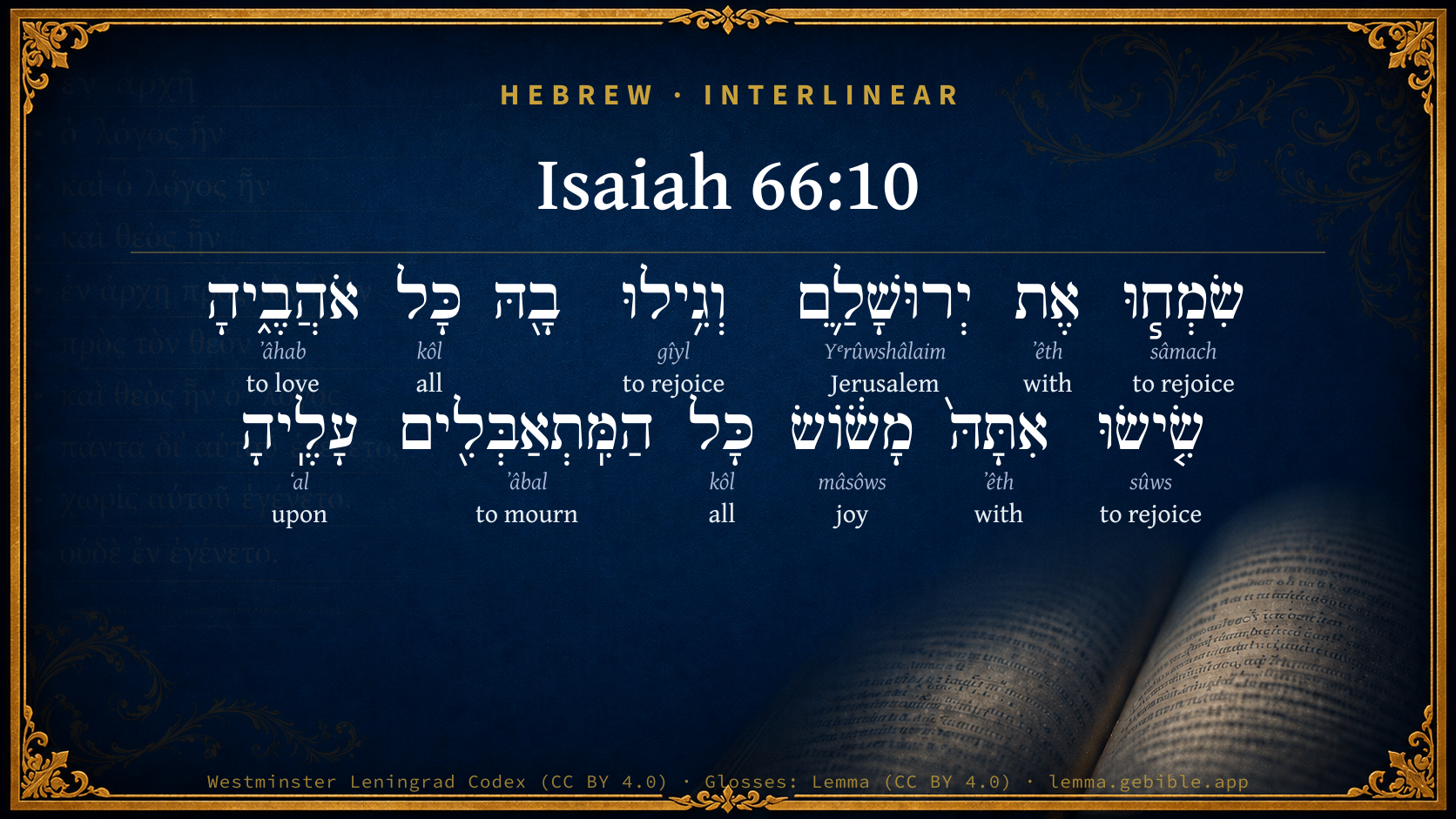
Hebrew (Westminster Leningrad Codex) Isaiah 66:10 appears in the Hebrew Old Testament. The text above is from the Westminster Leningrad Codex. Each word links to its Strong’s number, a concise gloss, and parsing drawn from the Open Scriptures Hebrew Bible morphology. Click any word for its full Brown-Driver-Briggs (BDB) entry.
Download image
Cite this verse

Isaiah 66:10 (World English Bible). Public Domain. Lemma interlinear Bible study tool, https://lemma.gebible.app/v/isaiah/66/10.

Show BibTeX & RIS
BibTeX
RIS
English Translation
Rejoice you with Jerusalem, and be glad for her, all you who love her: rejoice for joy with her, all you who mourn over her;
World English Bible · Public Domain
Download a study sheet

One document with this verse’s original text, its word-by-word gloss line, the meaning frame, cross-references with their text, attributed commentary, and full source and license credits — printable, and it pastes into notes with its structure intact.

This verse Autodidact and up

Study sheet (.html) Plain text (.txt)

A passage Seminary Student

Up to 50 verses in one chapter. A passage sheet keeps up to 6 commentary sources and 12 cross-references per verse, in the order this page ranks them, and says so on the sheet whenever that leaves anything out. Ask for a single verse and you get the Autodidact verse sheet above.

Everything on this page stays free to read, with no account — the sheet is a download of what is already on screen, not access to it.

Want to remove ads? Support Godless Engineer
Compare translations 3

The same verse in 3 English versions, stacked beneath the original-language interlinear above. Click any original word for its lexicon entry.

Each is an independent rendering of the whole verse — the interlinear is not word-aligned to these translations.

Highlighted words mark where these versions differ — a whole-verse word diff, not a word-by-word alignment.

  • World English Bible Public Domain
    Rejoice you with Jerusalem, and be glad for her, all you who love her: rejoice for joy with her, all you who mourn over her;
  • King James Version Public Domain
    Rejoice ye with Jerusalem, and be glad with her, all ye that love her: rejoice for joy with her, all ye that mourn for her:
  • unfoldingWord Literal Text CC BY-SA 4.0
    Rejoice with Jerusalem and be glad with her, all lovers of her! Rejoice with her gladness, all ones mourning over her,

unfoldingWord Literal Text — © unfoldingWord, licensed CC BY-SA 4.0. Word-aligned USFM3 via Door43 (git.door43.org/unfoldingWord/en_ult).

Versions to compare (up to 4)

3 of 4 selected

Show all 18 translations

Every available English version of this verse, each an independent rendering of the whole verse.

  • World English Bible Public Domain
    Rejoice you with Jerusalem, and be glad for her, all you who love her: rejoice for joy with her, all you who mourn over her;
  • Berean Standard Bible Public Domain
    Be glad for Jerusalem and rejoice over her, all who love her. Rejoice greatly with her, all who mourn over her,
  • Majority Standard Bible Public Domain
    Be glad for Jerusalem and rejoice over her, all who love her. Rejoice greatly with her, all who mourn over her,
  • King James Version Public Domain
    Rejoice ye with Jerusalem, and be glad with her, all ye that love her: rejoice for joy with her, all ye that mourn for her:
  • American Standard Version (1901) Public Domain
    Rejoice ye with Jerusalem, and be glad for her, all ye that love her: rejoice for joy with her, all ye that mourn over her;
  • Revised Version (1885) Public Domain
    Rejoice ye with Jerusalem, and be glad for her, all ye that love her: rejoice for joy with her, all ye that mourn over her:
  • Geneva Bible (1599) Public Domain
    Reioyce ye with Ierusalem, and be gladde with her, all ye that loue her: reioyce for ioy with her, all ye that mourne for her,
  • Douay-Rheims (1899) Public Domain
    Rejoice with Jerusalem, and be glad with her, all you that love her: rejoice for joy with her, all you that mourn for her.
  • Young's Literal Translation Public Domain
    Rejoice ye with Jerusalem, And be glad in her, all ye loving her, Rejoice ye with her for joy, All ye are mourning for her,
  • Literal Standard Version CC BY-SA 4.0
    “Rejoice with Jerusalem, || And be glad in her, all you loving her, || Rejoice with her for joy, || All you who are mourning for her,
  • Unlocked Literal Bible CC BY-SA 4.0
    Rejoice with Jerusalem and be glad for her, all you who love her; rejoice with her, all you who mourned over her!
  • unfoldingWord Literal Text CC BY-SA 4.0
    Rejoice with Jerusalem and be glad with her, all lovers of her! Rejoice with her gladness, all ones mourning over her,
  • Darby Bible Public Domain
    Rejoice with Jerusalem, and be glad for her, all ye that love her; rejoice for joy with her, all ye that mourn over her:
  • World Messianic Bible Public Domain
    “Rejoice with Jerusalem, and be glad for her, all you who love her. Rejoice for joy with her, all you who mourn over her;
  • Webster's Bible Public Domain
    Rejoice ye with Jerusalem, and be glad with her, all ye that love her: rejoice for joy with her, all ye that mourn for her:
  • Free Bible Version CC BY-SA 4.0
    Celebrate with Jerusalem and be happy for her, everyone who loves her; celebrate with her and sing for joy, everyone who mourns over her.
  • Bible in Basic English Public Domain
    Have joy with Jerusalem, and be glad with her, all you her lovers: take part in her joy, all you who are sorrowing for her:
  • JPS Tanakh (1917) Public Domain
    Rejoice ye with Jerusalem, and be glad with her, all ye that love her; rejoice for joy with her, all ye that mourn for her;

Literal Standard Version (2020), Covenant Press — licensed CC BY-SA 4.0. Text via the HelloAO Bible API (eBible.org). Unlocked Literal Bible (unfoldingWord) — licensed CC BY-SA 4.0. Text via the HelloAO Bible API (eBible.org). unfoldingWord Literal Text — © unfoldingWord, licensed CC BY-SA 4.0. Word-aligned USFM3 via Door43 (git.door43.org/unfoldingWord/en_ult). Free Bible Version, Dr. Jonathan Gallagher — licensed CC BY-SA 4.0. Text via the HelloAO Bible API (eBible.org).

Word by word

More ways to search: Search by grammar → Find every occurrence → Compare this word →

Practice this passage: Drill this verse → Learn its vocabulary →

מָשׂ֔וֹשׂ
mâsôws
H4885
“joy”
Noun, Common, Masculine, Singular, Absolute
Part of Speech
Noun
Type
Common
Gender
Masculine
Number
Singular
State
Absolute
Full BDB Definition

Origin: from H7797

TWOT: 2246b

exultation, joy, rejoicing
  1. שִׂמְח֧וּ sâmach H8055 “rejoice” Verb, Qal, Imperative, 2nd Person, Masculine, Plural
  2. אֶת ʼêth H854 “with” Preposition
  3. יְרוּשָׁלִַ֛ם Yᵉrûwshâlaim H3389 “Jerusalem” Noun, Proper
  4. וְגִ֥ילוּ gîyl H1523 “and · rejoice” Conjunction + Verb, Qal, Imperative, 2nd Person, Masculine, Plural
  5. כָּל kôl H3605 “all of” Noun, Common, Masculine, Singular, Construct
  6. אֹהֲבֶ֑יהָ ʼâhab H157 “loving · her” Verb, Qal, Participle Active, Masculine, Plural, Construct + Suffix, Personal, 3rd Person, Feminine, Singular
  7. שִׂ֤ישׂוּ sûws H7797 “rejoice” Verb, Qal, Imperative, 2nd Person, Masculine, Plural
  8. אִתָּהּ֙ ʼêth H854 “with · her” Preposition + Suffix, Personal, 3rd Person, Feminine, Singular
  9. כָּל kôl H3605 “all of” Noun, Common, Masculine, Singular, Construct
  10. הַמִּֽתְאַבְּלִ֖ים ʼâbal H56 “the · mourning” Particle, Definite Article + Verb, Hithpael, Participle Active, Masculine, Plural, Absolute
  11. עָלֶֽיהָ ʻal H5921 “upon · her” Preposition + Suffix, Personal, 3rd Person, Feminine, Singular

About this verse

These counts appear in no published source. They are computed here, from the morphology-tagged text and Lemma’s own curated glosses. What Lemma adds →

13
words
10
distinct lemmas
Prophets
section

Notable vocabulary

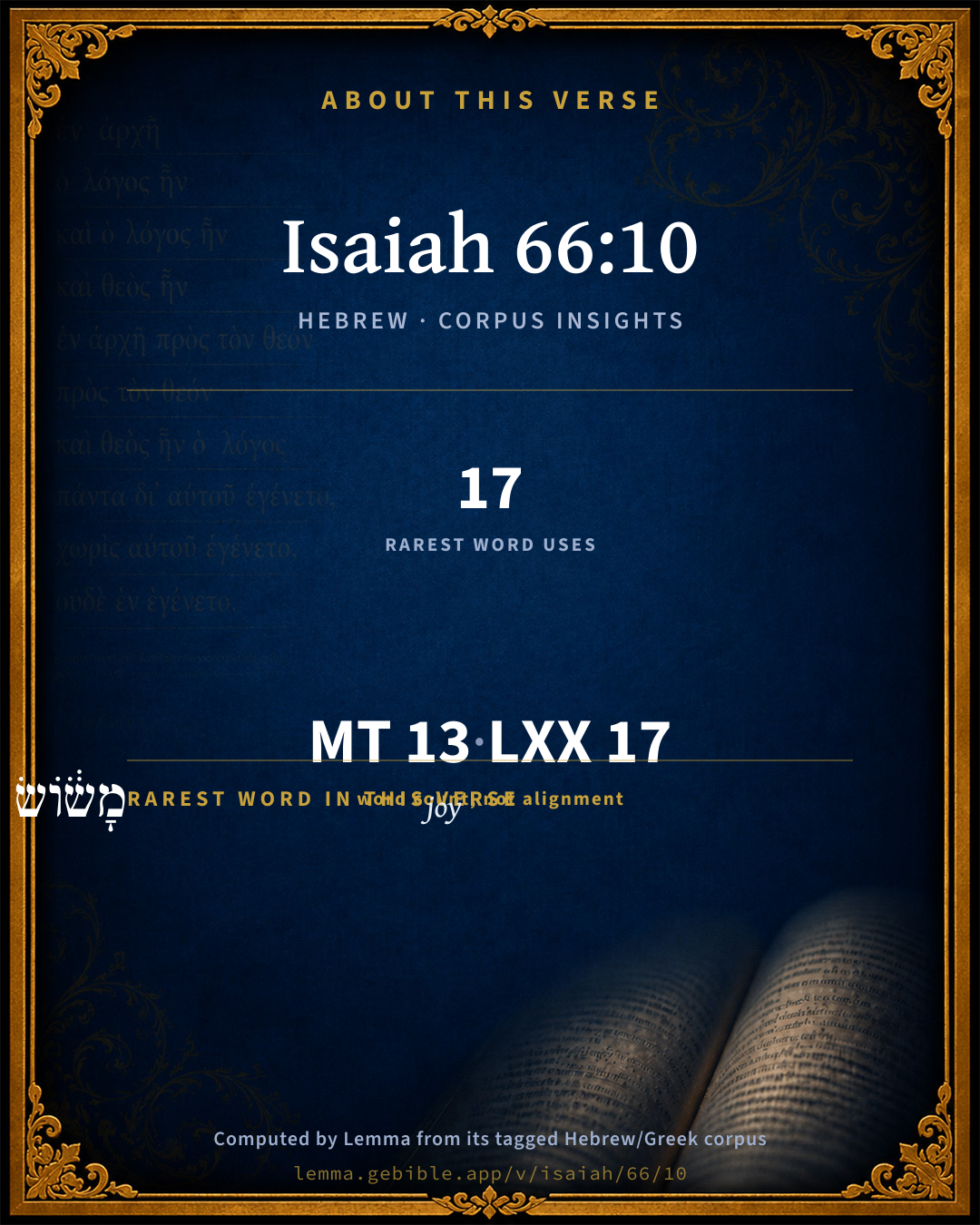
The rarest word here is מָשׂ֔וֹשׂ joy H4885 — appearing just 17 times in the whole Hebrew Bible.

Shared distinctive vocabulary

מָשׂ֔וֹשׂ joy H4885 occurs in 16 verses of the Hebrew Bible. Also found in:

Grammatical profile

  • 5 verbs
  • 4 nouns
  • 4 prepositions

Verb forms

  • שִׂמְח֧וּ Qal · Imperative
  • וְגִ֥ילוּ Qal · Imperative
  • אֹהֲבֶ֑יהָ Qal · Participle Active
  • שִׂ֤ישׂוּ Qal · Imperative
  • הַמִּֽתְאַבְּלִ֖ים Hithpael · Participle Active

Repetition

Words recur within this verse — often emphatic in Hebrew:

  • כָּל all H3605 ×2
  • אֶת with H854 ×2

Hebrew & Septuagint length

In English translation the verse runs 25 words from the Hebrew and 25 from the Septuagint (LXX English) — the same length.

A rough comparison of the two English renderings, which tokenize alike — not a word-level alignment.

Word counts can differ between the Hebrew and the Greek without any difference in meaning — e.g. the Hebrew direct-object marker אֵת has no separate Greek word, and Greek often adds the article ὁ.

In the original languages it is 13 Hebrew tokens and 17 Greek tokens — but the two are counted differently (Hebrew bundles its prefixes and suffixes into one token; the Greek is in lemma form), so that isn’t a like-for-like length.

Cross-references

12

Topical passages linked to Isaiah 66:10 in the Treasury of Scripture Knowledge — connected by theme and wording, ordered by reader-vote popularity; previews shown in the World English Bible.

  • Deuteronomy 32:43 Rejoice, you nations, [with] his people: For he will avenge the blood of his servants, Will render vengeance to his adversaries, Will make expiation for his land, for his people.
  • Psalms 26:8 Yahweh, I love the habitation of your house, The place where your glory dwells.
  • Psalms 137:6 Let my tongue stick to the roof of my mouth if I don't remember you; If I don't prefer Jerusalem above my chief joy.
  • Isaiah 65:18 But be you glad and rejoice forever in that which I create; for, behold, I create Jerusalem a rejoicing, and her people a joy.
  • Ezekiel 9:4 Yahweh said to him, Go through the midst of the city, through the midst of Jerusalem, and set a mark on the foreheads of the men that sigh and that cry over all the abominations that are done in the midst of it.
  • Psalms 84:1–4 How lovely are your dwellings, Yahweh of Hosts!
  • Psalms 122:6 Pray for the peace of Jerusalem. Those who love you will prosper.
  • Isaiah 44:23 Sing, you heavens, for Yahweh has done it; shout, you lower parts of the earth; break forth into singing, you mountains, O forest, and every tree therein: for Yahweh has redeemed Jacob, and will glorify himself in Israel.
  • Isaiah 61:2–3 to proclaim the year of Yahweh's favor, and the day of vengeance of our God; to comfort all who mourn;
  • John 16:20–22 Most assuredly I tell you, that you will weep and lament, but the world will rejoice. You will be sorrowful, but your sorrow will be turned into joy.
  • Revelation 11:3–15 I will give power to my two witnesses, and they will prophesy one thousand two hundred sixty days, clothed in sackcloth."
  • Romans 15:9–12 and that the Gentiles might glorify God for his mercy. As it is written, "Therefore will I give praise to you among the Gentiles, And sing to your name."

Cross-references courtesy of OpenBible.info (CC BY 4.0).

Hebrew and Greek witnesses Masoretic Hebrew ↔ Greek Septuagint

The same verse in the two great witnesses to the Old Testament, shown verse-for-verse.

These are two independent witnesses, not word-aligned to each other, and the Septuagint is shown in lemma (dictionary) form.

Hebrew Isaiah 66:10 Masoretic · Westminster Leningrad Codex

שִׂמְח֧וּ אֶת יְרוּשָׁלִַ֛ם וְגִ֥ילוּ בָ֖הּ כָּל אֹהֲבֶ֑יהָ שִׂ֤ישׂוּ אִתָּהּ֙ מָשׂ֔וֹשׂ כָּל הַמִּֽתְאַבְּלִ֖ים עָלֶֽיהָ

Rejoice you with Jerusalem, and be glad for her, all you who love her: rejoice for joy with her, all you who mourn over her;

World English Bible · Public Domain

Greek LXX Isaiah 66:10 Septuagint · lemma form

εὐφραίνω ἰερουσαλήμ καί πανηγυρίζω ἐν αὐτός πᾶς ὁ ἀγαπάω αὐτός χαίρω χαρά πᾶς ὅσος πενθέω ἐπί αὐτός

Rejoice, O Jerusalem, and all you⌃ that love her hold in her a general assembly: rejoice greatly with her, all that now mourn over her:

LXX2012 (modern English Septuagint) · Public Domain

Hebrew: Westminster Leningrad Codex (CC BY 4.0). Greek: Septuagint (public domain); English from LXX2012 (modern English Septuagint) (Public Domain). How the Septuagint differs from the Hebrew →

Targum (Aramaic paraphrase)

1

The Targum is the ancient Jewish Aramaic paraphrase of the Hebrew Scriptures — an interpretive translation, not the Hebrew text itself. Onkelos (literal) and Pseudo-Jonathan (expansive) render the Torah, and Jonathan the Prophets. Coverage is partial: where no permissively-licensed English translation exists for a verse, only the Aramaic is shown. This is verse-level text, not a word-by-word alignment to the Hebrew.

  1. Targum Jonathan Prophets (Joshua–Malachi)
    חֲדוֹ בִירוּשְׁלֵם וּבוּעוּ בָהּ כָּל רָחֲמָהָא דוּצוּ עִמָהּ דַיִץ כָּל דַהֲווֹ מִתְאַבְּלִין עֲלָה:

    Rejoice ye on account of Jerusalem, and be ye glad on account of her, all ye that love her: rejoice greatly with her, all ye that mourn for her:

    Targum Jonathan — Aramaic: “Mikraot Gedolot” (public domain). English: “Sefaria Community Translation” (CC0 1.0 (public-domain dedication)); “London "Chaldee Paraphrase," 1871” (public domain). Text via Sefaria.

Commentary

Notes on Isaiah 66:10 from classic Christian and Jewish commentators (each source and its license shown beneath its notes). The classic Christian expositions comment on the surrounding passage and are grouped to its opening verse, so a note may address several verses; the Jewish commentaries on the Tanakh (Rashi and others) are per-verse, so they appear only where the commentator wrote on this verse.

Lemma curates 59 commentaries, every one of them public domain or Creative Commons licensed, each selected and text-cleaned for this edition rather than reprinted as found. About our sources →

Trapp's Complete Commentary

John Trapp

Isa 66:10 Rejoice ye with Jerusalem, and be glad with her, all ye that love her: rejoice for joy with her, all ye that mourn for her:

Ver. 10. Rejoice ye with Jerusalem.] As friends use to do with her that is newly made a mother. {Luk 1:58}

Rejoice for joy with her.] Out of the Church there is no solid joy. See Hos 9:1. {See Trapp on "Hos 9:1"} Others may revel, the godly only rejoice; their joy is not that of the mouth, but of the heart - nec in labris nascitur sed fibris; it doth not only smooth the brow, but fills the breast; wet the mouth, but warm the heart, &c.

John Trapp, A Commentary or Exposition upon All the Books of the Old and New Testament (1647–1656) — public domain. Text from a community e-Sword module.

The Biblical Illustrator

Joseph S. Exell

Isa_66:10

Rejoice for joy with her, all ye that mourn for her

A dirge for the down-grade, and a song for faith

A mourner is always an interesting person.

The highest style of mourner is one whose griefs are neither selfish nor grovelling. He who bears spiritual sorrow on account of others is of a nobler order than the man who laments his personal woes. The most excellent style of mourner is the mourner in Zion, the mourner for Zion, the mourner with Zion.

I. WHO ARE THOSE THAT MOURN WITH JERUSALEM? Those that love the Church of God, and desire her prosperity; and when they do not see that prosperity, are depressed in spirit.

1. nothing can make the heart of the people of God more heavy than to think that the Gospel glory of the Church is declining.

2. Another cause of mourning is when we see the holiness of the visible Church beclouded.

3. Moreover, we see her sacred ardour is cooling.

4. There is grave cause of mourning in Zion because the services of Gods house are neglected.

5. Another very grave cause for mourning to all true Christians is the multitude of sinners that remain unsaved.

II. WE MAY YET REJOICE WITH JERUSALEM.

1. When we remember that God has not changed, either in nature or in love to His people, or in the purpose of His grace.

2. We may expect the Lord to appear. He shall appear to your joy, etc. (Isa_66:5.)

3. When the Lord shall put on strength, then shall His Church be aroused.

4. Then shall the Church have many converts.

5. Then shall she nourish them well.

6. At such times there is an abundant degree of peace and joy in all believing hearts (Isa_66:12).

7. God will raise up men fitted to do His work (Isa_66:21).

III. WHY SHOULD WE PERSONALLY BE OF THE NUMBER THAT MOURN WITH THE CHURCH, AND THAT REJOICE WITH HER?

1. There is our own sin and ruin to mourn over.

2. We might wisely become mourners when we think of our own want of zeal.

3. May we not add to this our own failures in the matter of holiness?

4. We have all a great concern in this matter, and we ought, therefore, to join with the Church in all her griefs. If the ministry of our pastors be not successful, we shall lose by its want of power. If the Gospel is not preached our souls will not be fed. Suppose the Gospel is not preached with saving power, then we shall have our children unconverted, and they will not be our joy and crown. There cannot be a deficiency in the pulpit without its bringing mischief to our households. We are members of one body, and if any part of the body suffers, every other part of the body will have to suffer too. (C. H. Spurgeon.)

The Biblical Illustrator, edited by Joseph S. Exell (c. 1880s–1900s) — public domain. Text from a community e-Sword module.

Joseph Benson's Commentary

Isa 66:10-11. Rejoice ye with Jerusalem — Let all that wish her well congratulate her for the favours God hath conferred upon her, and particularly let the Gentiles rejoice with the Jewish Church, for her advancement shall redound to their benefit. Thus Moses, (Deu 32:43,) referring probably to the very events here predicted by Isaiah, Rejoice, O ye nations, with his people; for he will avenge the blood of his servants, and will render vengeance to his adversaries, and will be merciful unto his land and to his people. Be glad with her, all ye that love her — All that love God love the church of God, lay its interests very near their hearts, and heartily espouse its cause. And they that have a sincere affection for it have a cordial sympathy with it in all the cares and sorrows of its militant state. They mourn for Zion in her afflictions and troubles: her grievances excite their sorrows; and if she be in distress, their harps are hung on the willows. But here Jerusalem is represented as having great cause for rejoicing; the days of her mourning are at an end, and she is comforted according to the time in which she hath seen adversity. And of course all her friends, who sympathized with her in her sorrows, are here invited to join with her in her joys, because they are to participate in those blessings from which her joys are derived. That ye may suck — Or, because ye shall suck: and be satisfied with the breasts of her consolations — The word of God, the covenant of grace, especially the promises of that covenant, gospel ordinances, and all the opportunities of attending on God, and conversing with him, are breasts of the church’s consolations. In these her comforts are laid up, and thence they are drawn by faith and prayer. From these breasts, therefore, we must suck by an application of the promises of God to ourselves, and a diligent attendance on his ordinances; and with the consolations which are drawn thence we must be satisfied, and not be unsatisfied though we have a very small share of earthly comforts. That ye may be delighted with the abundance of her glory — It is the glory of the church that she hath the Lord for her God; that to her pertains the adoption and the service of God; and with the abundance of this glory we must be delighted. We must take more pleasure in our relation to God, and communion with him, than in all the delights of the sons and daughters of men. Whatever is the glory of the church must be our glory and joy, particularly her purity, unity, and increase.

Joseph Benson's Commentary on the Old and New Testaments (1811–1818) — public domain. Text from a community e-Sword module.

Lange's Commentary on the Holy Scriptures

8. THE MATERIAL CHARACTER OF NEW ORDER OF LIFE

Isa_66:10-14

10          Rejoice ye with Jerusalem, and be glad 17with her, all ye that love her:

Rejoice for joy with her, all ye that mourn for her:

11     That ye may suck, and be satisfied with the breasts of her consolations;

That ye may 18milk out, and be delighted with the 19 20abundance of her glory

12     For thus saith the Lord,

Behold, I will extend peace to her like a river,

And the glory of the Gentiles like a flowing stream:

Then shall ye suck, ye shall be borne upon 21her sides,

And be dandled upon her knees.

13     22As one whom his mother comforteth,

So will I comfort you;

And ye shall be comforted in Jerusalem.

14     And when ye see this, your heart shall rejoice,

And your bones shall flourish like 23an herb:

And the hand of the Lord shall be known 24 toward his servants,

And his indignation 25toward his enemies.

TEXTUAL AND GRAMMATICAL

Isa_66:10. גִּיל with בְּ of the object is the common construction, comp. Isa_65:19; Pro_24:17. שׂישׂו משׂושׂ On this connection of a verb with a substantive instead of the infinitive absolute comp. Isa_22:17-18; Isa_24:19; Isa_24:22; Isa_42:17.

Isa_66:12. The Masoretes take כבוד גוים as the object of both clauses, and consequently נָהָר שָׁלוֹם=a river which is peace, a peaceful river. But this is artificial. שָׁ‍ֽעֲשַׁע is Pulpal from שׁעע. The word is one which is used especially by Isaiah. It is found besides here Isa_6:10; Isa_11:8; Isa_29:9 (bis).

Isa_66:14. There should properly be a כִּי before יד־יהוה. But the thrice-repeated conjunction Vav in the preceding part of the verse, as it were, governed the flow of speech, and carried it over the syntax. Therefore ונודעה stands as resumption of ראיתם, which is for רְאִיתֶם כִּי. I therefore take וְשָׂשׂ to תִפְרַחִנָם as a parenthesis which is intended to declare by what emotions that “seeing” will be accompanied. [But it is much easier, with the E. V., to supply the pronoun this or it, meaning the fulfilment of the promise, after ראיתם, and then there will be no need of assuming a break in the sentence and a parenthesis.—D. M.]. In the clause יד י׳ את־ע׳ we have to take את as a preposition, while before איביו it marks the accusative. [In the E. V. זָעַם is regarded as a noun. But the noun would have Pattach under its first syllable. The verb governs the accusative.—D. M.].

EXEGETICAL AND CRITICAL

1. After all that has been said, all the friends of Jerusalem, who had before mourned over her, are now justly called upon to rejoice over her (Isa_66:10), and gloriously to participate in her happiness (Isa_66:11). For the Lord will turn to her peace and all glory in abundance; the Israelites will be treated with the tenderest care (Isa_66:12). The Lord Himself will comfort them with a mother’s love (Isa_66:13). Then they shall have joy, and the Lord’s hand will be manifest on them; but His enemies will be made to feel the indignation of the Lord (Isa_66:14).

2. Rejoice ye—His enemies.

Isa_66:10-14. The joy at Jerusalem’s prosperity is also the condition of participation in that prosperity. For he who has not mourned with Jerusalem and does not rejoice with her will not be regarded as her child, and is not suffered to satiate himself with delight on her maternal breast. This is, I think, the meaning of למען Isa_66:11. [“Jerusalem is thought of as a mother, and the rich consolation (not in word but in deed) which she receives (Isa_51:3) as the milk which comes into her breasts (שֹׁד as Isa_60:16), with which she now nourishes her children abundantly.” Del.]. The image of suckling to designate the most loving and assiduous care, has been already before us Isa_49:23; Isa_60:16. We should rather expect the consolations of her breast; but the putting of שֹׁד first is the effect of the idea of sucking being before the mind of the writer. [“Sack and be satisfied, milk out and enjoy yourselves, may be regarded as examples of hendiadys, meaning suck to satiety, and milk out with delight; but no such change in the form of translation is required or admissible.” Alexander. D. M.]. The word זִיז which stands parallel with שֹׁד, is found besides here only Psa_50:11; Psa_80:14. Its signification is still disputed. Some take זוּז = צוּץ in the signification micare, emicare, and hence זִיז = lac ex ubere radiatim defluens (Schroeder, Gesen.). [So Gesen. in Thes.; but in Lexicon he gives the meaning, full breast. D. M.]. But the signification of shining forth, belongs essentially to צוּץצִיץ, whence צִיץ, a shining plate, a flower, a glittering feather. זִיז on the contrary, denotes according to the meaning of its root, which occurs in Syriac, though not in Hebrew, id quod movetur, that which moves itself to and fro. Hence זִיזPsa_50:11; Psa_80:14, the beasts that move about on the field. Hence here, too, זִיז is synonymous with mamma, the breast that moves this way and that. So Delitzsch. [Delitzsch assigns to זִיז the meaning abundance (Ueberschwang) as the E. V., does, and, moreover, he expressly states that the parallelism does not force us to give to the word the signification of teats, dugs. See his comment, in loc. 2 Ed. D. M.]. The joy to which the Prophet, Isa_66:10, summons the friends of Jerusalem is well-founded. For the Lord Himself declares that He will extend, (direct) to Jerusalem peace, the highest of all inward blessings, as a river (comp. Isa_48:18; Isa_8:7), and as a torrent (נַחַל Arabic Wadi, comp. Isa_30:28) the glory of the Gentiles, which comprehends all desirable outward things (comp. Isa_16:14; Isa_17:4; Isa_21:16; Isa_35:2). And because the Prophet has here before his mind the image of maternal love and solicitude on the one hand, and on the other that of a child’s wants, he adds here, and ye shall suck. Herewith he points back to Isa_66:11, where he had designated Jerusalem as the source of consolations. Here he tells us that the spring of that spring will be the Lord. But that maternal care is not restricted to the affording of nourishment. The children shall also be faithfully carried (על־צדon the hip, after the common oriental custom, Isa_60:4). They will also be lovingly played with, caressed, and rocked on the knees. The Lordhere again ascribes to Himself maternal love and maternal conduct (comp. Isa_42:14; Isa_46:3 sq.; Isa_49:15). Is the term אִֹשׁ to be pressed? I believe that it ought, for it contains a fine climax. A mother who comforts her child is an affecting image. But a mother’s love is still more gloriously displayed when it shows itself to be strong enough to raise up again the son, the strong man, who is bowed down by misfortune. [“The E. V. here dilutes a man to one. The same liberty is taken by many other versions. But comp. Gen_24:67; Jdg_17:2; 1Ki_19:19-20, and the affecting scenes between Thetis and Achilles in the Iliad.”—Alexander. “The Prophet now thinks of the people as one man. Before he had thought of them as children. Israel is as a man returned from a foreign country, escaped from bondage, full of sad recollections, which are wholly obliterated in the maternal arms of divine love yonder in Jerusalem, the dear home, which even in a strange land was the home of their thoughts.”—Delitzsch. “The in Jerusalem suggests the only means by which these blessings are to be secured, viz., a union of affection and of interest with the Israel of God to whom alone they are promised.” Alexander.—D. M.]. The beginning of Isa_66:14 recalls Isa_60:5. In this place, too, the meaning of the Prophet is, that what Jerusalem shall see is the manifestation of the power of Jehovah on His friends and foes. For the aim and scope of all divine training is that God may be known from all nature and history as the supreme good (comp. Isa_41:20; Isa_42:12 sqq.; Isa_43:10 sqq.; Isa_45:3 sqq. et saepe). The heart, the centre of life, shall rejoice, the bones, the parts forming the periphery, will shoot as young grass, i. e., they will feel themselves excited to fresh, vigorous manifestation of life (comp. Isa_44:4; Isa_58:11; Isa_61:3). [The latter part of the verse is “in accordance with the Prophet’s constant practice of presenting the salvation of God’s people as coincident and simultaneous with the destruction of His enemies.” Alexder.—D. M.].

DOCTRINAL AND ETHICAL

1. On Isa_65:1-2. Our Lord has said, “He that seeketh findeth” (Mat_7:8). How, then, does it come that the Jews do not find what they seek, but the heathen find what they did not seek? The Apostle Paul puts this question and answers it, Rom_9:30 sqq.; Isa_10:19 sqq.; Isa_11:7. [See also Isa_10:3]. All depends on the way in which we seek. Luther says: Quaerere fit dupliciter. Primo, secundum praescriptum verbi Dei, et sic invenitur Deus, Secundo, quaeritur nostris studiis et consiliis, et sic non invenitur.” The Jews, with exception of the ἐκλογή (Rom_11:7), sought only after their own glory and merit. They sought what satisfies the flesh. They did not suffer the spirit in the depths of their heart to speak,—the spirit which can be satisfied only by food fitted for it. The law which was given to them that they might perceive by means of it their own impotence, became a snare to them. For they perverted it, made what was of minor importance the chief matter, and then persuaded themselves that they had fulfilled it and were righteous. But the Gentiles who had not the law, had not this snare. They were not tempted to abuse the pædagogical discipline of the law. They felt simply that they were forsaken by God. Their spirit was hungry. And when for the first time God’s word in the Gospel was presented to them, then they received it the more eagerly in proportion to the poverty, wretchedness and hunger in which they had been. The Jews did not find what they sought, because they had not a spiritual, but a carnal apprehension of the law, and, like the elder brother of the prodigal son, were full, and blind for that which was needful for them. But the Gentiles found what they did not seek, because they were like the prodigal son, who was the more receptive of grace, the more he needed it, and the less claim he had to it. [There is important truth stated in the foregoing remarks. But it does not fully explain why the Lord is found of those who sought Him not. The sinner who has obtained mercy when he asks why? must have recourse to a higher cause, a cause out of himself, even free, sovereign, efficacious grace. “It is of God that showeth mercy,” Rom_9:16. “Though in after-communion God is found of those that seek Him (Pro_8:17), yet in the first conversion He is found of those that seek Him not; for therefore we love Him, because He first loved us.” Henry. D. M.].

2. On Isa_65:2. God’s long-suffering is great. He stretches out His hands the whole day and does not grow weary. What man would do this? The disobedient people contemns Him, as if He knew nothing, and could do nothing.

3. On Isa_65:2. “It is clear from this verse gratiam esse resistibilem. Christ earnestly stretched out His hands to the Jews. He would, but they would not. This doctrine the Remonstrants prove from this place, and rightly too, in Actis Synodi Dodrac. P. 3. p. 76.” Leigh. [The grace of God which is signified by His stretching out His hands can be, and is, resisted. That figurative expression denotes warning, exhorting, entreating, and was never set forth by Reformed theologians as indicating such grace as was necessarily productive of conversion. The power by which God quickens those who were dead in sins (Eph_2:5), by which He gives a new heart (Eze_36:26), by which He draws to the Son (Joh_6:44-45; Joh_6:65), is the grace which is called irresistible. The epithet is admitted on all hands to be faulty; but the grace denoted by it is, from the nature of the case, not resisted. Turrettin in treating De Vocatione et Fide thus replies to this objection, “Aliud est Deo monenti et vocanti externe resistere; Aliud est conversionem intendenti et efficaciter ac interne vocanti. Prius asseritur Isa. lxv. 2, 3. Quum dicit Propheta se expandisse totâ die manus ad populum perversum etc., non posterius. Expansio brachiorum notat quidem blandam et benevolam Dei invitationem, quâ illos extrinsecus sive Verbo, sive beneficiis alliciebat, non semel atque iterum, sed quotidie ministerio servorum suorum eos compellando. Sed non potest designate potentem et efficacem operationem, quâ brachium Domini illis revelatur qui docentur á Deo et trahuntur a Patre, etc.” Locus XV.; Quaestio VI .25.—D. M.].

4. On Isa_65:2. (Who walk after their own thoughts.)

Duc me, nec sine, me per me, Deus optime, duci.

Nam duce me pereo, te duce certus eo.

[“If our guide be our own thoughts, our way is not likely to be good; for every imagination of the thought of our hearts is only evil.” Henry. D. M.].

5. On Isa_65:3 sq. “The sweetest wine is turned into the sourest vinegar; and when God’s people apostatize from God, they are worse than the heathen (Jer_3:11).” Starke.

6. On Isa_65:5. [I am holier than thou. “A deep insight is here given us into the nature of the mysterious fascination which heathenism exercised on the Jewish people. The law humbled them at every turn with mementoes of their own sin and of God’s unapproachable holiness. Paganism freed them from this, and allowed them (in the midst of moral pollution) to cherish lofty pretensions to sanctity. The man, who had been offering incense on the mountain-top, despised the penitent who went to the temple to present ‘a broken and contrite heart.’ If Pharisaism led to a like result, it was because it, too, had emptied the law of its spiritual import, and turned its provisions into intellectual idols.” Kay. D. M.].

7. On Isa_65:6-7. “The longer God forbears, the harder He punishes at last. The greatness of the punishment compensates for the delay (Psa_50:21).” Starke after Leigh.

8. On Isa_65:8 sqq. [“This is expounded by St. Paul, Rom_11:1-5, where, when upon occasion of the rejection of the Jews, it is asked Hath God then cast away His people? He answers, no; for, at this time there is a remnant according to the election of grace. This prophecy has reference to that distinguished remnant…Our Saviour has told us that for the sake of these elect the days of the destruction of the Jews should be shortened, and a stop put to the desolation, which otherwise would have proceeded to that degree that no flesh should be saved. Mat_24:22. Henry. D. M.].

9. On Isa_65:15. The judgment which came upon Israel by the hand of the Romans, did not altogether destroy the people, but it so destroyed the Old Covenant, i.e., the Mosaic religion, that the Jews can no more observe its precepts in essential points. For no Jew knows to what tribe he belongs. Therefore, they have no priests, and, consequently, no sacrifices. The Old Covenant is now only a ruin. We see here most clearly that the Old Covenant, as it was designed only for one nation, and for one country, was to last only for a certain time. If we consider, moreover, the way in which the judgment was executed, (comp. Josephus), we can truly say that the Jews bear in themselves the mark of a curse. They bear the stamp of the divine judgment. The beginning of the judgment on the world has been executed on them as the house of God. But how comes it that the Jews have become so mighty, so insolent in the present time, and are not satisfied with remaining on the defensive in their attitude toward the Christian church, but have passed over to the offensive? This has arisen solely from Christendom having to a large extent lost the consciousness of its new name. There are many Christians who scoff at the name of Christian, and seek their honor in combating all that is called Christian. This is the preparation for the judgment on Christendom itself. If Christendom would hold fast her jewel, she would remain strong, and no one would dare to mock or to assail her. For she would then partake of the full blessing which lies in the principle of Christianity, and every one would be obliged to show respect for the fruits of this principle. But an apostate Christendom, that is ashamed of her glorious Christian name, is something more miserable than the Jews, judged though they have been, who still esteem highly their name, and what remains to them of their old religion. Thus Christendom, in so far as it denies the worth and significance of its name, is gradually reaching a condition in which it will be so ripe for the second act of the judgment on the world, that this will be longed for as a benefit. For, this apostate Christendom will be the kingdom of Antichrist, as Antichrist will manifest himself in Satanic antagonism to God by sitting in the temple of God, and pretending to be God (2Th_2:3 sqq.). [We do not quite share all the sentiments expressed in this paragraph. We are far from being so despondent as to the prospects of Christendom, and think that there is a more obvious interpretation of the prophecy quoted from 2 Thess., than that indicated.—D. M.].

10. On Isa_65:17. [If we had only the present passage to testify of new heavens and a new earth, we might say, as many good interpreters do, that the language is figurative, and indicates nothing more than a great moral and spiritual revolution. But we cannot thus explain 2Pe_3:10-13. The present earth and heavens shall pass away; (comp. Isa_51:6; Psa_102:25-26). But how can we suppose that our Prophet here refers to the new heavens and new earth, which are to succeed the destruction of the world by fire? In the verses that follow Isa_65:17, a condition of things is described which, although better than the present, is not so good as that perfectly sinless, blessed state of the redeemed, which we look for after the coming of the day of the Lord. Yet the Apostle Peter (2Pe_3:13) evidently regards the promise before us of new heavens and a new earth, as destined to receive its accomplishment after the conflagration which is to take place at the end of the world. If we had not respect to other Scriptures, and if we overlooked the use made by Peter of this passage, we should not take it literally. But we can take it literally, if we suppose that the Prophet brings together future events not according to their order in time. He sees the new heavens and new earth arise. Other scenes are disclosed to his prophetic eye of a grand and joy-inspiring nature. He announces them as future. But these scenes suppose the continued prevalence of death and labor (Isa_65:20 sqq.), which, we know from definite statements of Scripture, will not exist when the new heaven and new earth appear (comp. Rev_21:1-4). The proper view then of Isa_65:17 is to take its prediction literally, and to hold at the same time that in the following description (which is that of the millennium) future things are presented to us which are really prior, and not posterior to the promised complete renovation of heaven and earth. Nor should this surprise us, as Isaiah and the other Prophets place closely together in their pictures future things which belong to different times. They do not draw the line sharply between this world and the next. Compare Isaiah’s prophecy of the abolition of death (Isa_25:8) in connection with other events that must happen long before that state of perfect blessedness.—D. M.].

11. On Isa_65:20. [“The extension of the Gospel every where,—of its pure principles of temperance in eating and drinking, in restraining the passions, in producing calmness of mind, and in arresting war, would greatly lengthen out the life of man. The image here employed by the Prophet is more than mere poetry; it is one that is founded in reality, and is designed to convey most important truth.” Barnes. D. M.].

12. On Isa_65:24. [It occurs to me that an erroneous application is frequently made of the promise, Before they call, etc. This declaration is made in connection with the glory and blessedness of the last days. It belongs specifically to the millennium. There are, indeed, occasions when God even now seems to act according to this law. (Comp. Dan_9:23). But Paul had to pray thrice before he received the answer of the Lord (2Co_12:8). Compare the parable of the importunate widow, Luk_18:1-7. The answer to prayer may be long delayed. This is not only taught in the Bible, but is verified in Christian experience. But the time will come when the Lord will not thus try and exercise the faith of His people.—D. M.].

13. On Isa_65:25. “If the lower animals live in hostility in consequence of the sin of man, a state of peace must be restored to them along with our redemption from sin.” J. G. Mueller in Herz. R.-Encycl. xvi. p. 45. [“By the serpent in this place there seems every reason to believe that Satan, the old seducer and author of discord and misery, is meant. During the millennium he is to be subject to the lowest degradation. Compare for the force of the phrase to lick the dust, Psa_72:9; Mic_7:17. This was the original doom of the tempter, Gen_3:14, and shall be fully carried into execution. Comp. Rev_20:1-3.” Henderson. D. M.].

14. On Isa_66:1. [“Having held up in every point of view the true design, mission and vocation of the church or chosen people, its relation to the natural descendants of Abraham, the causes which required that the latter should be stripped of their peculiar privileges, and the vocation of the Gentiles as a part of the divine plan from its origin, the Prophet now addresses the apostate and unbelieving Jews at the close of the old dispensation, who, instead of preparing for the general extension of the church and the exchange of ceremonial for spiritual worship, were engaged in the rebuilding and costly decoration of the temple at Jerusalem. The pride and interest in this great public work, felt not only by the Herods but by all the Jews, is clear from incidental statements of the Scriptures (Joh_2:20; Mat_24:1), as well as from the ample and direct assertions of Josephus. That the nation should have been thus occupied precisely at the time when the Messiah came, is one of those agreements between prophecy and history, which cannot be accounted for except upon the supposition of a providential and designed assimilation.” Alexander after Vitringa. D. M.].

15. On Isa_66:1-2. What a grand view of the nature of God and of the way in which He is made known lies at the foundation of these words! God made all things. He is so great that it is an absurdity to desire to build a temple for Him. The whole universe cannot contain Him (1Ki_8:27)! But He, who contains all things and can be contained by nothing, has His greatest joy in a poor, humble human heart that fears Him. He holds it worthy of His regard, it pleases Him, He enters into it, He makes His abode in it. The wise and prudent men of science should learn hence what is chiefly necessary in order to know God. We cannot reach Him by applying force, by climbing up to Him, by attempting to take Him by storm. And if science should place ladder upon ladder upwards and downwards, she could not attain His height or His depth. But He enters of His own accord into a child-like, simple heart. He lets Himself be laid hold of by it, kept and known. It is not, therefore, by the intellect [alone] but by the heart that we can know God.

16. On Isa_66:3. He who under the Christian dispensation would retain the forms of worship of the ancient ritual of shadows would violate the fundamental laws of the new time, just as a man by killing would offend against the foundation of the moral law, or as he would by offering the blood of dogs or swine offend against the foundation of the ceremonial law. For when the body, the substance has appeared, the type must vanish. He who would retain the type along with the reality would declare the latter to be insufficient, would, therefore, found his salvation not upon God only, but also in part on his own legal performance. But God will brook no rival. He is either our All, or nothing. Christianity could tolerate animal sacrifices just as little as the Old Testament law could tolerate murder or the offering of abominable things.

17. On Isa_66:5. [“The most malignant and cruel persecutions of the friends of God have been originated under the pretext of great zeal in His service, and with a professed desire to honor His name. So it was with the Jews when they crucified the Lord Jesus. So it is expressly said it would be when His disciples would be excommunicated and put to death, Joh_16:2. So it was in fact in the persecutions excited against the apostles and early Christians. See Act_6:13-14; Act_21:28-31. So it was in all the persecutions of the Waldenses, in all the horrors of the Inquisition, in all the crimes of the Duke of Alva. So it was in the bloody reign of Mary; and so it has ever been in all ages and in all countries where Christians have been persecuted.” Barnes.—D. M.].

18. On Isa_66:10. “The idea which is presented in this verse is, that it is the duty of all who love Zion to sympathize in her joy. The true friends of God should rejoice in every real revival of religion, they should rejoice in all the success which attends the Gospel in heathen lands. And they will rejoice. It is one evidence of piety to rejoice in her joy; and they who have no joy when souls are born into the kingdom of God, when He pours down His Spirit and in a revival of religion produces changes as sudden and transforming as if the earth were suddenly to pass from the desolation of winter to the verdure and bloom of summer, or when the Gospel makes sudden and rapid advances in the heathen world, have no true evidence that they love God and His cause. They have no religion.” Barnes.—D. M.

19. On Isa_66:13. The Prophet is here completely governed by the idea that in the glorious time of the end, love, maternal love will reign. Thus He makes Zion appear as a mother who will bring forth with incredible ease and rapidity innumerable children (Isa_66:7-9). Then the Israelites are depicted as little children who suck the breasts of their mother. Further, the heathen who bring back the Israelites into their home, must do this in the same way in which mothers in the Orient are wont to carry their little children. Lastly, even to the Lord Himself maternal love is ascribed (comp. Isa_42:14; Isa_49:15), and such love as a mother manifests to her adult son. Thus the Israelites will be surrounded in that glorious time on all sides by maternal love. Maternal love will be the characteristic of that period.

20. On Isa_66:19 sqq. The Prophet describes remote things by words which are borrowed from the relations and conceptions of his own time, but which stand in strange contrast to the reality of the future which he beholds. Thus the Prophet speaks of escaped persons who go to Tarshish, Pul, Lud, Tubal, and Javan. Here he has rightly seen that a great act of judgment must have taken place. And this act of judgment must have passed on Israel, because they who escape, who go to the Gentiles to declare to them the glory of Jehovah, must plainly be Jews How accurately, in spite of the strange manner of expression, is the fact here stated that the Gospel of Jesus Christ was proclaimed to the Gentiles exactly at the time when the old theocracy was destroyed! How justly does he indicate that there was a causal connection between these events! He did not, indeed, know that the shattering of the old form was necessary in order that the eternal truth enclosed in it might be set free, and fitted for filling the whole earth. For the Old Covenant cannot exist along with the New, the Law cannot stand with equal dignity beside the Gospel. The Law must be regarded as annulled, in order that the Gospel may come into force. How remarkably strange is it, however, that he calls the Gentile nations Tarshish, Pul, Lud, etc. And how singular it sounds to be told that the Israelites shall be brought by the Gentiles to Jerusalem as an offering for Jehovah! But how accurately has he, notwithstanding, stated the fact, which, indeed, still awaits its fulfilment, that it is the conversion of the heathen world which will induce Israel to acknowledge their Saviour, and that they both shall gather round the Lord as their common centre! How strange it sounds that then priests and Levites shall be taken from the Gentiles also, and that new moon and Sabbath shall be celebrated by all flesh in the old Jewish fashion! But how accurately is the truth thereby stated that in the New Covenant there will be no more the priesthood restricted to the family of Aaron, but a higher spiritual and universal priesthood, and that, instead of the limited local place of worship of the Old Covenant, the whole earth will be a temple of the Lord! Verily the prophecy of the two last chapters of Isaiah attests a genuine prophet of Jehovah. He cannot have been an anonymous unknown person. He can have been none other than Isaiah the son of Amoz!

HOMILETICAL HINTS

1. On Isa_65:1 sq. [I. “It is here foretold that the Gentiles, who had been afar off, should be made nigh, Isa_65:1. II. It is here foretold that the Jews, who had long been a people near to God, should be cast off, and set at a distance, Isa_65:2.” Henry, III. We are informed of the cause of the rejection of the Jews. It was owing to their rebellion, waywardness and flagrant provocations, Isa_65:2 sqq.—D. M.]

2. On Isa_65:1-7. A Fast-Day Sermon. When the Evangelical Church no more holds fast what she has; when apostasy spreads more and more, and modern heathenism (Isa_65:3-5 a) gains the ascendency in her, then it can happen to her as it did to the people of Israel, and as it happened to the Church in the Orient. Her candlestick can be removed out of its place.—[By the Evangelical Church we are not to understand here the Church universal, for her perpetuity is certain. The Evangelical Church is in Germany the Protestant Church, and more particularly the Lutheran branch of it.—D. M.]

3. On Isa_65:8-10. Sermon on behalf of the mission among the Jews. Israel’s hope. 1) On what it is founded (Israel is still a berry in which drops of the divine blessing are contained); 2) To what this hope is directed (Israel’s Restoration).

4. On Isa_65:13-16. [“The blessedness of those that serve God, and the woful condition of those that rebel against him, are here set the one over against the other, that they may serve as a foil to each other. The difference of their states here lies in two things: 1) In point of comfort and satisfaction, a. God’s servants shall eat and drink; they shall have the bread of life to feed, to feast upon continually, and shall want nothing that is good for them. But those who set their hearts upon the world, and place their happiness in it, shall be hungry and thirsty, always empty, always craving. In communion with God and dependence upon Him there is full satisfaction; but in sinful pursuits there is nothing but disappointment. b. God’s servants shall rejoice and sing for joy of heart; they have constant cause for joy, and there is nothing that may be an occasion of grief to them but they have an allay sufficient for it. But, on the other hand, they that forsake the Lord shut themselves out from all true joy, for they shall be ashamed of their vain confidence in themselves, and their own righteousness, and the hopes they had built thereon. When the expectations of bliss, wherewith they had flattered themselves, are frustrated, O what confusion will fill their faces! Then shall they cry for sorrow of heart and howl for vexation of spirit. 2) In point of honor and reputation, Isa_65:15-16. The memory of the just is, and shall be, blessed; but the memory of the wicked shall rot.” Henry.—D. M.]

5. On Isa_66:1-2. Carpzov has a sermon on this text. He places it in parallel with Luk_18:9-14, and considers, 1) The rejection of spiritual pride; 2) The commendation of filial fear.

6. On Isa_66:2 Arndt, in his True Christianity I. cap. 10, comments on this text. He says among other things: “The man who will be something is the material out of which God makes nothing, yea, out of which He makes fools. But a man who will be nothing, and regards himself as nothing, is the material out of which God makes something, even glorious, wise people in His sight.”

7. On Isa_66:3. [Saurin has a sermon on this text entitled “Sur l’ Insuffisance du culte exterieur” in the eighth volume of his sermons.—D. M.]

8. On Isa_66:13. As one whom his mother comforteth, so will I comfort you. “These words stand, let us consider it, 1) In the Old Testament; 2) In the heart of God always; 3) But are they realized in our experience?” Koegel in “Aus dem Vorhof ins Heiligthum, II. Bd., p. 242, 1876.

9. On Isa_66:24. The punishment of sin is twofold—inward and outward. The inward is compared with a worm that dies not; the outward with a fire that is not quenched. This worm and this fire are at work even in this life. He who is alarmed by them and hastens to Christ can now be delivered from them.—[“It is better not to fall into this fire and never to have any experience of this worm, even though, as some imagine, eternity should not be eternal, and the unquenchable fire might be quenched, and the worm that shall never die, should die, and Jesus and His apostles should not have expressed themselves quite in accordance with the compassionate taste of our time. Better, I say, is better. Save thyself and thy neighbor before the fire begins to burn, and the smoke to ascend.” Gossner.—D. M.]

Lange's Commentary on the Holy Scriptures (Critical, Doctrinal, and Homiletical), ed. John Peter Lange, English translation edited by Philip Schaff (1864–1880) — public domain. Text from a community e-Sword module.

Jamieson, Fausset & Brown

Robert Jamieson, A. R. Fausset & David Brown

love . . . mourn for her-- (Psa 102:14, Psa 102:17, Psa 102:20; Psa 122:6).

Jamieson, Fausset & Brown — Commentary Critical and Explanatory on the Whole Bible (1871) — public domain (CC PDM 1.0). Text via the HelloAO Bible API.

Ellicott's Commentary for English Readers

(10) Rejoice ye with Jerusalem . . .—The holy city is still thought of as a mother rejoicing in her new-born child; friends and neighbours (i e., the nations friendly to Israel) who had shown pity for her sufferings are now invited to participate in her joy.

A Bible Commentary for English Readers, edited by Charles John Ellicott (1878–1897) — public domain. Text from a community e-Sword module.

The Cambridge Bible for Schools and Colleges

gen. ed. J. J. S. Perowne

10. that mourn for her] Cf. ch. Isa_57:18, Isa_61:2-3.

10, 11. Invitation to the sorrowing children of Zion to rejoice in their mother’s consolation.

The Cambridge Bible for Schools and Colleges (gen. ed. J. J. S. Perowne; Cambridge University Press, 1878–1918) — public domain. Text from a community e-Sword module.

John Gill's Exposition

Rejoice ye with Jerusalem, and be glad with her,.... The church; she bringing forth so many spiritual children to Christ; just as, when a woman is delivered of a child, her friends and neighbours congratulate her upon it, and rejoice with her on that account; as Elisabeth's neighbours and relations did, at the birth of John the Baptist, Luk 1:57, so the church's friends here are called together to rejoice with her, at the numerous birth and conversion of souls in her, than which nothing is more joyful to the saints; see Luk 15:6,

all ye that love her; wish her well, and pray for her peace and prosperity; all that love God love his church, the habitation of his house, the place where his honour dwells; all that love Christ love her who is his spouse and bride, and purchased by his blood; all that love the word and ordinances love the church where they are administered:

rejoice for joy with her, all ye that mourn for her; that had mourned for her, when things went ill with her; these are they that mourn in Zion, and for Zion, because of the sins of her professors; corruptions in doctrine, discipline, and worship; declensions in grace; want of love to one another, and few instances of conversion: but now things being the reverse, and it going well with her, they are called upon to rejoice exceedingly with her; for such is the sympathizing spirit of the saints, that they rejoice with them that rejoice, and weep with them that weep, Rom 12:15.

John Gill's Exposition of the Whole Bible (1746–1763) — public domain (CC PDM 1.0). Text via the HelloAO Bible API.

Albert Barnes' Notes on the Bible

Rejoice ye with Jerusalem - The idea which is presented in this verse is, that it is the duty of all who love Zion to sympathize in her joys. It is one evidence of piety to rejoice in her joy; and they who have no true joy when God pours down his Spirit, and, in a revival of religion, produces changes as sudden and transforming as if the earth were suddenly to pass from the desolation of winter to the verdure and bloom of summer; or when the gospel makes rapid advances in the pagan world, have no true evidence that they love God or his cause. Such scenes awaken deep interest in the bosoms of angels, and in the bosom of God the Saviour; and they who love that God and Saviour will rejoice in such scenes, and will mingle their joys and thanksgivings with the joys and thanksgivings of those who are thus converted and saved.

All ye that mourn for her - That sympathize in her sorrows, and that mourn over her desolations.

Albert Barnes' Notes on the Bible (1834–1885) — public domain. Text from a community e-Sword/MySword module.

Haydock's Catholic Bible Commentary

For her. Ye shall be comforted, (Haydock) when the captives return, and the gospel is propagated.

George Leo Haydock (1774–1849), Haydock's Catholic Family Bible and Commentary, 1859 edition — public domain. Excludes Psalms (Douay-Rheims chapter numbering differs from Protestant) and Deuterocanonical books (Catholic canon only).

Matthew Poole's English Annotations

There is nothing more ordinary amongst men, than for friends and neighbours to meet together with their friends recovered from affliction, or brought into a better state, to rejoice with them, especially such friends as in their afflictions have mourned with them. Thus Mary, Luk 1:40, went to rejoice with Elisabeth, and Job’s friends came to rejoice with him, Job 42:11. The prophet in like manner calls to all the friends of Jerusalem, especially such as in the days of her affliction had mourned for her, to come and rejoice and be glad with her, upon the prospect of her better state after the Babylonish captivity; or at least in the time of the Messiah; for though joy and gladness be the affection of the soul that works upon its union with its desirable object, and the deliverance of the people out of Babylon was not to be for many years after this, nor the Messiah to come for many years after that; yet faith being the evidence of things not seen, there is a rejoicing of hope, hope giving the soul a union with its object hoped for; and these things were now present to believers, who by faith called the things that were not as if they were, because they had the security of a Divine revelation for them, and they were already existent in their necessary causes.

Matthew Poole's English Annotations on the Holy Bible (1683–1685) — public domain. Text from a community e-Sword/MySword module.

Whedon's Commentary on the Bible

Daniel D. Whedon

10, 11. Rejoice ye with Jerusalem — “Jerusalem is now a happy mother, rejoicing that a son is born to her — a birth which really means a nation — a new and world-embracing Zion. Now therefore let her friends gather round her with their hearts of glowing sympathy and words of grateful cheer. Let those who have wept in her grief rejoice in her joy. Remarkably these rejoicing friends are accounted as among her infant children, still clinging to a dear mother’s bosom to feast there at the full breasts of her glory.” — Cowles.

Daniel D. Whedon (gen. ed.), Commentary on the Old and New Testaments (1874–1909) — public domain. Text from a community e-Sword module.

The Pulpit Commentary

Rejoice ye with Jerusalem... all ye that love her. The call to rejoicing is general. Restored Jerusalem is to be hailed with joy "by all who love her," whether her own children or foreigners. To both she will be a blessing (vers. 11-13).

Vers. 10-14. The blessedness of the restored Church.

The restored Church is to Isaiah the Church that will endure from the return of the captives to the end of the world. The later Jewish period and the entire Christian period are with him blended into one, and present themselves to him as constituting a single phase of the Church"s life. Here he speaks to encourage the exiles, and dwells especially, though not exclusively, on the immediate blessings.

I THE CHURCH WILL TEACH HER CHILDREN SOUND DOCTRINE. This is the special object of the existence of a Church, which claims to have a revealed "deposit" committed to it by God, and has, as the first end and aim of its being, to communicate this revelation to all who come within the sphere of its teaching. Doctrine is the milk on which the Church nourishes her children, and the restored Church will teach a doctrine which may well "satisfy" and which will be full of "consolation" (ver. 11).

II THE CHURCH WILL BE GLORIOUS, AND WILL IMPART TO HER CHILDREN OF HER GLORY. Though the Church is frequently, if not even continually, oppressed and downtrodden by the world, yet a glory attaches to her, whereof no persecution, no contempt, no contumely, can altogether deprive her. She is, whatever the world may think or say, "the holy Catholic Church," with Christ as her Founder, with Christ as her Lord and Master, with Christ as her King, the oldest and most venerable society in the Western world at any rate, and one in which membership cannot but ever be a high honour.

III THE CHURCH WILL ENJOY, BY GOD"S BLESSING, MUCH OUTWARD AND INWARD PEACE. Peace was our Lord"s legacy to his Church: "Peace I leave with you; my peace I give unto you"; (Joh_14:27) and notwithstanding the facts of external persecutions, and internal quarrels and schisms, which occupy so large a space in Church histories, and so large a share in the thoughts of most Christians, it is nevertheless true that, on the whole, peace has flowed over the Church "like a river," and has flowed into the hearts of the bulk of her true members like an abounding stream. "There is no peace, saith my God, to the wicked"; (Isa_57:21) but in the soul of the true Christian is a "peace that passeth all understanding," that wells up continually as from an inexhaustible fountain, and spreads around him an atmosphere of happiness.

IV THE CHURCH WILL DERIVE HONOUR FROM THE COMING IN OF THE GENTILES. Further and further, as time goes on, does the light of Christianity shine, and more and more are the dark places of the earth illuminated. Long since did the Gentiles begin to come to the Church"s light, and "kings to the brightness of her rising". (Isa_60:3) But the process is not yet complete. Not a year passes but the gospel is carried into some new region by faithful and true missionaries, and the Lord adds to the Church fresh souls whom he wills to be saved. The incoming of the Gentiles does not now bring her wealth or worldly honor; but it is yet more for the true honour of the Church than it was when she converted the court and camp and people of the Caesars. For now her efforts bring her no worldly gain. She has to go out into the highways and hedges the wild lauds of savage tribes or the yet wilder courts and allies of great towns and to bring in the poor, and the maimed, and the halt, and the blind, the downtrodden, and the ignorant, and the criminal, and the houseless; to civilize and train them, and frequently to feed them and clothe them; thus following the commands of her blessed Master, and preparing for herself the high honour of hearing one day the glorious words, "Well done, good and faithful servant: enter thou into the joy of thy Lord

V THE CHURCH WILL DERIVE CONTINUAL COMFORT FROM HER LORD. "I will not leave you comfortless," said the blessed Jesus; "I will come to you". (Joh_14:18) In all their difficulties, in all their troubles, Christ comforts his people comforts them with his Word of truth, comforts them with his gracious promises, comforts them with his presence in their hearts and souls. He comes to them, and makes his abode with them, and is a continual inward sustaining power, raising them above the cares and troubles and vexations of the world, inspiring in their hearts love and joy and peace.

Vers. 10-14. Sympathy with the Church"s joy.

I SYMPATHY SHOULD BE FELT WITH THE PROSPERITY OF THE CHURCH. Zion stands for the Church of the ages; in her weal is wrapped up the weal of the world. If we love humanity, we love the institution created for the good and salvation of humanity. Every revival of religion at home, every fresh conquest in the fields of heathendom, affords fresh occasion of such joy. "Those who have no true joy when souls are born into the kingdom of God; when he pours down his Spirit, and in a revival of religion produces changes as sudden and transforming as if the earth were suddenly to pass from the desolation of winter to the verdure and bloom of summer; or when the gospel makes sudden and rapid advances in the heathen world, have no true evidence that they love God or his cause. They have no religion. Such scenes are fitted to excite the highest joy and praise. They awaken deep interest in the bosoms of angels, and of God the Saviour, and they who love that God and Saviour will rejoice at such scenes, and mingle their joys and thanksgivings with those of the converted and saved" (Barnes).

II THE IDEAL OF THE CHURCH. She is like a mother, and the blessings she imparts are like mother"s milk. (cf. Isa_49:23 Isa_60:16) "They who sympathize with her shall be nourished by the same truth and comforted with the same sources of consolation." She is a mother full of tenderness, even of caressing, towards her children; full also of sweetest power to comfort. Such is in every age the true ideal of the Church. All that is rich and sweet, deep and tender, should be associated with her; and in her the hearts of weary men should find full expansion and rest. Peace is also strongly associated with the Church; and that in the comprehensive sense in which the prophet uses the word for all manner of prosperity. (Isa_9:6, 7 26:12 32:17 45:7 46:1-6 52:7 54:13 55:12 57:19) The image seems to be that of a broad majestic river, like the Nile, overflowing its banks, and producing prosperity on every hand. Another image is that of the bones, dried up like the branches of a withered tree, now full of sap and vigour. (Isa_58:11 Pro_3:8 Pro_15:20 Pro_16:24) It is true religion which causes the family, the home, the ecclesiastical institution, the state, to flourish. Religion stimulates all that it touches morality, art, political life; and decay of patriotism and of morals may be traced to the languor of religious life. J.

The Pulpit Commentary (1880–1919), ed. H.D.M. Spence-Jones & Joseph S. Exell — public domain. Text from a community e-Sword module.

Keil & Delitzsch

C. F. Keil & F. Delitzsch

In the anticipation of such a future, those who inwardly participate in the present sufferings of Zion are to rejoice beforehand in the change of all their suffering into glory. "Rejoice ye with Jerusalem, and exult over her, all ye that love her; be ye delightfully glad with her, all ye that mourn over her, that he may suck and be satisfied with the breast of her consolations, that ye may sip and delight yourselves in the abundance of her glory." Those who love Jerusalem (the abode of the church, and the church itself), who mourn over her (hith'abbēl, inwardly mourn, Sa1 15:35, prove and show themselves to be mourners and go into mourning, b. Mod katan 20b, the word generally used in prose, whereas אבל, to be thrown into mourning, to mourn, only occurs in the higher style; compare ציּון אבלי, Isa 57:18; Isa 61:2-3; Isa 60:20), these are even now to rejoice in spirit with Jerusalem and exult on her account (bâh), and share her ecstatic delight with her ('ittâh), in order that when that in which they now rejoice in spirit shall be fulfilled, they may suck and be satisfied, etc. Jerusalem is regarded as a mother, and the rich actual consolation, which she receives (Isa 51:3), as the milk that enters her breasts (shōd as in Isa 60:16), and from which she now supplies her children with plentiful nourishment. זיז, which is parallel to שׁד (not זיו, a reading which none of the ancients adopted), signifies a moving, shaking abundance, which oscillates to and fro like a great mass of water, from זאזא, to move by fits and starts, for pellere movere is the radical meaning common in such combinations of letters as זא, זע, רא, Psa 42:5, to which Bernstein and Knobel have correctly traced the word; whereas the meaning emicans fluxus (Schrder), or radians copia (Kocher), to pour out in the form of rays, has nothing to sustain it in the usage of the language.

Keil & Delitzsch — Biblical Commentary on the Old Testament (1861–1891) — public domain (CC PDM 1.0). Text via the HelloAO Bible API. (Old Testament only.)

J. A. Alexander on Isaiah

Joseph Addison Alexander

“Rejoice ye with Jerusalem and exult in her, all that love her; be glad with her with gladness, all those mourning for her.” This is an indirect prediction of the joyful change awaiting Zion, clothed in the form of a command or invitation to her friends to rejoice with her. Different interpreters, according to their various exegetical hypotheses, explain this as a prophecy of Israel’s ancient restoration from the Babylonish exile, or of their future restoration from the present exile and dispersion, or of the glorious enlargement of the church after the excision of the unbelieving Jews and the throes of that great crisis in which old things passed away and the new heavens and the new earth came into existence; which last I believe to be the true sense, for reasons which have been already fully stated.

Joseph Addison Alexander, The Prophecies of Isaiah (1846–1847; New York: Scribner, 1870–1878) — public domain. Text from a community e-Sword module.

Kretzmann's Popular Commentary

Paul E. Kretzmann

The Happiness of the New Testament Church

v. 10. Rejoice ye with Jerusalem, so the prophet calls out to all believers, and be glad with her, all ye that love her; rejoice for joy with her, all ye that mourn for her, all those who formerly shared her misery and tribulation,

v. 11. that ye, as the spiritual children of Zion, may suck and be satisfied with the breasts of her consolations, enjoying her spiritual blessings and treasures to the full; that ye may milk out, drain the riches of the Gospel mercies, and be delighted with the abundance of her glory.

v. 12. For thus saith the Lord, Himself the covenant God, Behold, I will extend peace to her like a river, in great quantities, and the glory of the Gentiles, all the power and the gifts which they possess, like a flowing stream, which threatens to overflow its banks; then shall ye suck, drinking in full measure; ye shall be borne upon (her) sides, and be dandled upon (her) knees, the Lord Himself taking His children into His arms and extending to them the fullness of His mercy.

v. 13. As one whom his mother comforteth, like a mother consoling her grown-up boy with true maternal sympathy, so will I comfort you; and ye shall be comforted in Jerusalem, whose glory is now the means of the divine consolation.

v. 14. And when ye see this, realizing, to some extent, the riches of God’s mercy, your heart shall rejoice, and your bones shall flourish, be filled with new life and strength, like an herb; and the hand of the Lord shall be known toward His servants, in love and kindness, and His indignation toward His enemies, who would feel His wrath in an everlasting punishment.

v. 15. For, behold, the Lord will come with fire, with a devastating punishment, and with His chariots like a whirlwind, to render His anger with fury and His rebuke with flames of fire, for fire is mentioned throughout the Bible as an instrument of God’s avenging anger.

v. 16. For by fire and by His sword will the Lord plead with all flesh, carrying out the sentence of His justice upon all men; and the slain of the Lord shall be many, because all unbelievers make themselves the objects of His wrath and heap damnation upon themselves.

v. 17. They that sanctify themselves and purify themselves in the gardens behind one tree in the midst, that is, the idol-worshipers who anxiously observe all the ceremonies of cleansing under the direction of some priest or master, eating swine’s flesh, and the abomination, some other forbidden meat, and the mouse, also Levitically unclean, Lev 11:29, shall be consumed together, by the judgment of His wrath, saith the Lord.

v. 18. For I know their works and their thoughts, or, "so far as their works and their ideas are concerned. " It shall come that I will gather all nations and tongues; and they shall come and see My glory, which would be revealed in the Lord’s judgment upon the reprobate Jews, this warning being intended to prepare the way for the spread of the Gospel among the heathen.

v. 19. And I will set a sign among them, performing a miracle in their midst, and I will send those that escape of them unto the nations, these messengers being the few who escaped His great punishment upon the apostates, brands snatched from the burning, to Tarshish, Tartessus in Spain, in the extreme West, Pul, in Northeastern Africa, between Egypt and Ethiopia, and Lud, the Libyans of Africa, that draw the bow, renowned warriors, to Tubal, in Asia Minor, south of the Caucasus, and Javan, the Ionians of Greece and Asia Minor, to the isles afar off that have not heard My fame, neither have seen My glory; in short, His Gospel-message was to be carried into all the world; and they, the Lord’s ambassadors, shall declare My glory among the Gentiles.

v. 20. And they shall bring all your brethren, the so-called dispersion among the heathen, for an offering unto the Lord out of all nations, these being brought to Him as a precious gift, upon horses, and in chariots, and in litters, low and comfortable wagons, and upon mules, and upon swift beasts, dromedaries, to My holy mountain Jerusalem, saith the Lord, as the children of Israel bring an offering in a clean vessel into the house of the Lord.

v. 21. And I will also take of them for priests and for Levites, saith the Lord, there being no difference in the Church of Christ between Jews and Gentiles, all of them being of equal rank as spiritual priests before the Lord.

v. 22. For as the new heavens and the new earth which I will make, the new creation of which He spoke Isa 65:17, shall remain before Me, saith the Lord, so shall your seed and your name remain, namely, that of the believers, the spiritual children of Israel, gathered from Jews and Gentiles alike.

v. 23. And it shall come to pass that from one new moon to another and from one Sabbath to another, with clocklike regularity, shall all flesh come to worship before Me, all the members of the new, wonderful kingdom of the Messiah, saith the Lord.

v. 24. And they shall go forth, namely, the members of the Church of the Lord, represented as coming out of the Temple of Jehovah, engaged in His worship, and look upon the carcasses of the men that have transgressed against Me, as the people of Jerusalem had a view of the carcasses in the Valley of Hinnom; for their worm shall not die, neither shall their fire be quenched, and they shall be an abhorring unto all flesh. Thus the punishment which comes upon the enemies of the Lord will be both a source of satisfaction to the believers and an example of warning. Op. Mat 13:42. To this day and hour the words of the Lord hold true: "He that believeth and is baptized shall be saved, but he that believeth not shall be damned. " Mar 16:16.

Paul E. Kretzmann, Popular Commentary of the Bible (1921–1924) — public domain. Text from a community e-Sword module.

unfoldingWord translationNotes

Door43 World Missions Community

General Information:

Yahweh continues speaking about Jerusalem as if it were a mother and the inhabitants of Jerusalem as if they were newly born children. (See: Isaiah 66:7-8)

For you will nurse and be satisfied; with her breasts you will be comforted

This means Jerusalem will be a place of safety and comfort for God's people. This can be stated in active form. AT: "For she will satisfy you with her milk; she will comfort you with her breasts" (See: Metaphor and Active or Passive)

translationWords

joy

Jerusalem

love

mourn

comfort

glory

unfoldingWord translationNotes — © Distant Shores Media and the Door43 World Missions Community, licensed CC BY-SA 4.0. Source: git.door43.org/Door43/en_tn.

Ibn Ezra

Rabbi Abraham ibn Ezra

all ye that mourn for her in exile.

Ibn Ezra on the Tanakh — English translations: “Sefaria Community Translation” (CC0 1.0 (public-domain dedication)); “Yalkut, Sifsei Chachomim Chumash, Metsudah Publications, 2009” (CC BY 4.0); and “Commentary of Ibn Ezra on Isaiah - trans. by M. Friedlander, 1873” (public domain). Text via Sefaria.

Lesson kit

Teaching starters — assembled from the data on this page, not authored interpretation. Every prompt links to the verse data it draws on. Edit before teaching.

Isaiah, in the Prophets, opens this verse with 13 words (10 distinct Hebrew lemmas). Its most distinctive word is mâsôws (“joy”). A historical commentator’s framing appears above. Read the whole chapter for the surrounding context.

Discussion questions

  1. What does “joy” (mâsôws) contribute to the verse as a whole?
  2. Job 8:19 shares the word «joy» with this verse. How do the two illuminate each other?
  3. “all” occurs 2× in this one verse. What is the effect of the repetition?
  4. The translations on this page render this verse differently — a whole-verse word diff, not a word-by-word alignment. What might account for the different wordings?
  5. The verb «שִׂמְח֧וּ» is Qal Imperative. How does its form color the action?
  6. Reading how Trapp's Complete Commentary and The Biblical Illustrator read this verse, where do the two commentators agree and where do they part?

Things to notice

Reading settings

Reading text

Shown beneath each verse's original-language words.

Old Testament
Old Testament edition

Read the OT as the Masoretic Hebrew (MT) or the Greek Septuagint (LXX).

English shown for the Greek Septuagint (in the Hebrew ↔ Greek comparison).

Comparing translations? Open the Compare panel on any verse page to stack up to four side by side.