
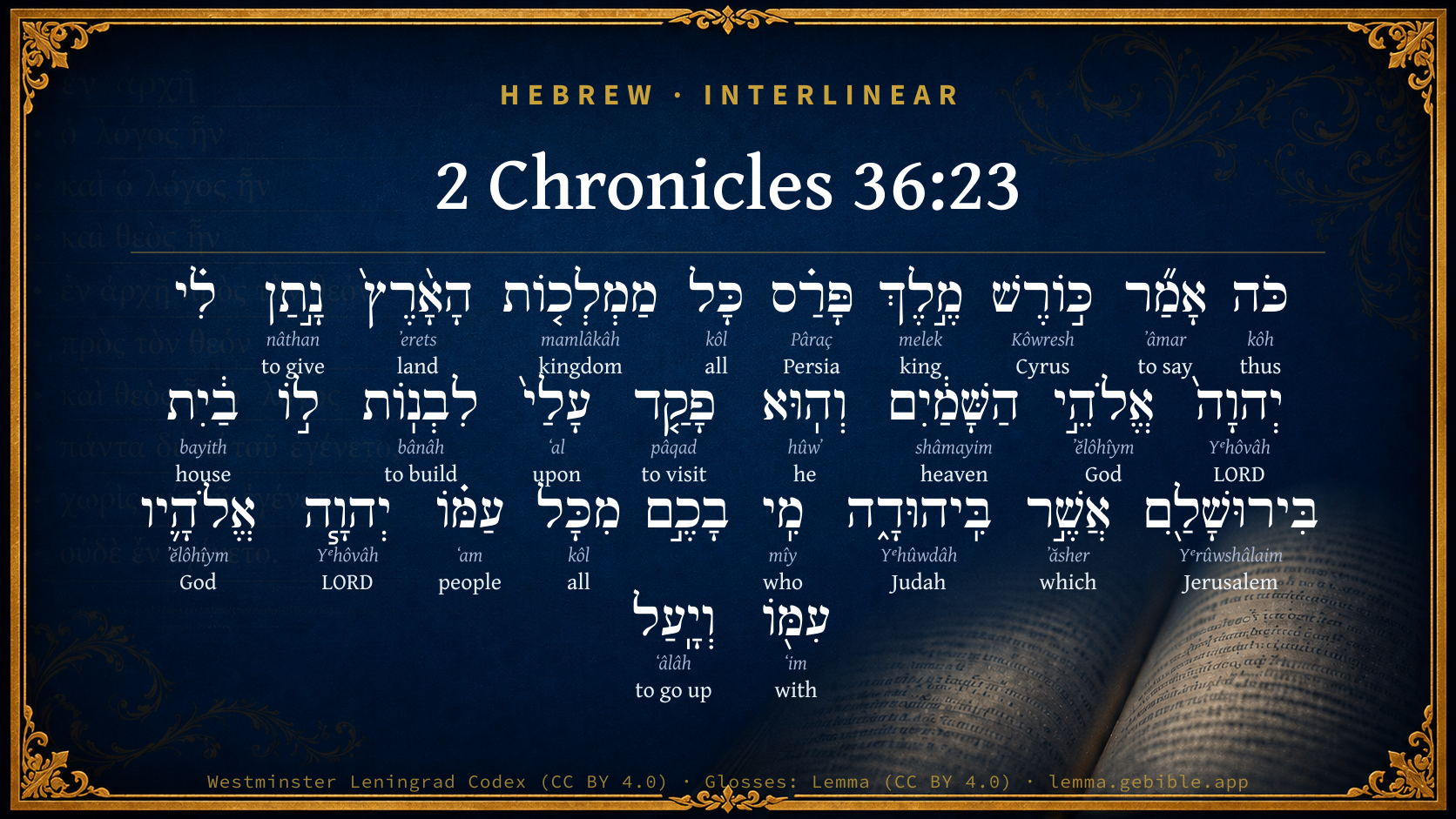
2 Chronicles 36:23

Hebrew (Westminster Leningrad Codex) 2 Chronicles 36:23 appears in the Hebrew Old Testament. The text above is from the Westminster Leningrad Codex. Each word links to its Strong’s number, a concise gloss, and parsing drawn from the Open Scriptures Hebrew Bible morphology. Click any word for its full Brown-Driver-Briggs (BDB) entry.
Download image
Cite this verse

2 Chronicles 36:23 (World English Bible). Public Domain. Lemma interlinear Bible study tool, https://lemma.gebible.app/v/2-chronicles/36/23.

Show BibTeX & RIS
BibTeX
RIS
English Translation
Thus says Cyrus king of Persia, All the kingdoms of the earth has Yahweh, the God of heaven, given me; and he has charged me to build him a house in Jerusalem, which is in Judah. Whoever there is among you of all his people, Yahweh his God be with him, and let him go up.
World English Bible · Public Domain
Download a study sheet

One document with this verse’s original text, its word-by-word gloss line, the meaning frame, cross-references with their text, attributed commentary, and full source and license credits — printable, and it pastes into notes with its structure intact.

This verse Autodidact and up

Study sheet (.html) Plain text (.txt)

A passage Seminary Student

Up to 50 verses in one chapter. A passage sheet keeps up to 6 commentary sources and 12 cross-references per verse, in the order this page ranks them, and says so on the sheet whenever that leaves anything out. Ask for a single verse and you get the Autodidact verse sheet above.

Everything on this page stays free to read, with no account — the sheet is a download of what is already on screen, not access to it.

Want to remove ads? Support Godless Engineer
Compare translations 3

The same verse in 3 English versions, stacked beneath the original-language interlinear above. Click any original word for its lexicon entry.

Each is an independent rendering of the whole verse — the interlinear is not word-aligned to these translations.

Highlighted words mark where these versions differ — a whole-verse word diff, not a word-by-word alignment.

  • World English Bible Public Domain
    Thus says Cyrus king of Persia, All the kingdoms of the earth has Yahweh, the God of heaven, given me; and he has charged me to build him a house in Jerusalem, which is in Judah. Whoever there is among you of all his people, Yahweh his God be with him, and let him go up.
  • King James Version Public Domain
    Thus saith Cyrus king of Persia, All the kingdoms of the earth hath the LORD God of heaven given me; and he hath charged me to build him an house in Jerusalem, which is in Judah. Who is there among you of all his people? The LORD his God be with him, and let him go up.
  • unfoldingWord Literal Text CC BY-SA 4.0
    “Thus says Cyrus, the king of Persia: ‘All the kingdoms of the earth Yahweh, the God of the heavens, has given to me. And he himself has charged me to build for him a house in Jerusalem, which is in Judah. Whoever is among you all from all his people, may Yahweh his God, be with him, and let him go up.’”

unfoldingWord Literal Text — © unfoldingWord, licensed CC BY-SA 4.0. Word-aligned USFM3 via Door43 (git.door43.org/unfoldingWord/en_ult).

Versions to compare (up to 4)

3 of 4 selected

Show all 18 translations

Every available English version of this verse, each an independent rendering of the whole verse.

  • World English Bible Public Domain
    Thus says Cyrus king of Persia, All the kingdoms of the earth has Yahweh, the God of heaven, given me; and he has charged me to build him a house in Jerusalem, which is in Judah. Whoever there is among you of all his people, Yahweh his God be with him, and let him go up.
  • Berean Standard Bible Public Domain
    “This is what Cyrus king of Persia says: ‘The LORD, the God of heaven, who has given me all the kingdoms of the earth, has appointed me to build a house for Him at Jerusalem in Judah. Whoever among you belongs to His people, may the LORD his God be with him, and may he go up.’”
  • Majority Standard Bible Public Domain
    “This is what Cyrus king of Persia says: ‘The LORD, the God of heaven, who has given me all the kingdoms of the earth, has appointed me to build a house for Him at Jerusalem in Judah. Whoever among you belongs to His people, may the LORD his God be with him, and may he go up.’”
  • King James Version Public Domain
    Thus saith Cyrus king of Persia, All the kingdoms of the earth hath the LORD God of heaven given me; and he hath charged me to build him an house in Jerusalem, which is in Judah. Who is there among you of all his people? The LORD his God be with him, and let him go up.
  • American Standard Version (1901) Public Domain
    Thus saith Cyrus king of Persia, All the kingdoms of the earth hath Jehovah, the God of heaven, given me; and he hath charged me to build him a house in Jerusalem, which is in Judah. Whosoever there is among you of all his people, Jehovah his God be with him, and let him go up.
  • Revised Version (1885) Public Domain
    Thus saith Cyrus king of Persia, All the kingdoms of the earth hath the LORD, the God of heaven, given me; and he hath charged me to build him an house in Jerusalem, which is in Judah. Whosoever there is among you of all his people, the LORD his God be with him, and let him go up.
  • Geneva Bible (1599) Public Domain
    Thus saith Cyrus King of Persia, All the kingdomes of the earth hath the Lord God of heauen giuen me, and hath commanded me to build him an house in Ierusalem, that is in Iudah. Who is among you of all his people, with whom the Lord his God is? let him goe vp.
  • Douay-Rheims (1899) Public Domain
    Thus saith Cyrus king of the Persians: All the kingdoms of the earth hath the Lord the God of heaven given to me, and he hath charged me to build him a house in Jerusalem, which is in Judea: who is there among you of all his people? The Lord his God be with him, and let him go up.
  • Young's Literal Translation Public Domain
    `Thus said Cyrus king of Persia, All kingdoms of the earth hath Jehovah, God of the heavens, given to me, and He hath laid a charge on me to build to Him a house in Jerusalem, that `is' in Judah; who is among you of all His people? Jehovah his God `is' with him, and he doth go up.'
  • Literal Standard Version CC BY-SA 4.0
    “Thus said Cyrus king of Persia: YHWH, God of the heavens, has given all kingdoms of the earth to me, and He has laid a charge on me to build a house for Him in Jerusalem which [is] in Judah; who is among you of all His people? His God YHWH [is] with him, and he goes up!”
  • Unlocked Literal Bible CC BY-SA 4.0
    “This is what Cyrus, king of Persia, says: Yahweh, the God of heaven, has given me all the kingdoms of the earth. He has commanded me to build a house for him in Jerusalem, which is in Judah. Whoever is among you from all his people, may Yahweh your God, be with you. Let him go up to the land.”
  • unfoldingWord Literal Text CC BY-SA 4.0
    “Thus says Cyrus, the king of Persia: ‘All the kingdoms of the earth Yahweh, the God of the heavens, has given to me. And he himself has charged me to build for him a house in Jerusalem, which is in Judah. Whoever is among you all from all his people, may Yahweh his God, be with him, and let him go up.’”
  • Darby Bible Public Domain
    Thus says Cyrus king of Persia: All the kingdoms of the earth has Jehovah the God of the heavens given to me, and he has charged me to build him a house at Jerusalem, which is in Judah. Whosoever there is among you of all his people, Jehovah his God be with him, and let him go up.
  • World Messianic Bible Public Domain
    “Cyrus king of Persia says, ‘The LORD, the God of heaven, has given all the kingdoms of the earth to me; and he has commanded me to build him a house in Jerusalem, which is in Judah. Whoever there is among you of all his people, the LORD his God be with him, and let him go up.’”
  • Webster's Bible Public Domain
    Thus saith Cyrus king of Persia, All the kingdoms of the earth hath the LORD God of heaven given me; and he hath charged me to build him a house in Jerusalem, which is in Judah. Who is there among you of all his people? The LORD his God be with him, and let him go up.
  • Free Bible Version CC BY-SA 4.0
    “This is what Cyrus king of Persia says: ‘The Lord, the God of heaven, who has given to me all the kingdoms of the earth, has given me the responsibility to build a Temple for him at Jerusalem in Judah. Anyone among you who belongs to his people can go there. May the Lord your God be with you.’”
  • Bible in Basic English Public Domain
    Cyrus, king of Persia, has said, All the kingdoms of the earth have been given to me by the Lord, the God of heaven; and he has made me responsible for building a house for him in Jerusalem, which is in Judah. Whoever there is among you of all his people, may the Lord his God be with him and let him go up.
  • JPS Tanakh (1917) Public Domain
    'Thus saith Cyrus king of Persia: All the kingdoms of the earth hath the LORD, the God of heaven, given me; and He hath charged me to build Him a house in Jerusalem, which is in Judah. Whosoever there is among you of all His people — the LORD his God be with him — let him go up.'

Literal Standard Version (2020), Covenant Press — licensed CC BY-SA 4.0. Text via the HelloAO Bible API (eBible.org). Unlocked Literal Bible (unfoldingWord) — licensed CC BY-SA 4.0. Text via the HelloAO Bible API (eBible.org). unfoldingWord Literal Text — © unfoldingWord, licensed CC BY-SA 4.0. Word-aligned USFM3 via Door43 (git.door43.org/unfoldingWord/en_ult). Free Bible Version, Dr. Jonathan Gallagher — licensed CC BY-SA 4.0. Text via the HelloAO Bible API (eBible.org).

Word by word

More ways to search: Search by grammar → Find every occurrence → Compare this word →

Practice this passage: Drill this verse → Learn its vocabulary →

כּ֣וֹרֶשׁ
Kôwresh
H3566
“Cyrus”
Noun, Proper
Part of Speech
Noun
Type
Proper
Full BDB Definition

Origin: from the Persians

TWOT: None

Cyrus = "posses thou the furnace" - the king of Persia and conqueror of Babylon; first ruler of Persia to make a decree allowing the Israelite exiles to return to Jerusalem
  1. כֹּה kôh H3541 “thus” Adverb
  2. אָמַ֞ר ʼâmar H559 “to say” Verb, Qal, Perfect, 3rd Person, Masculine, Singular
  3. מֶ֣לֶךְ melek H4428 “king of” Noun, Common, Masculine, Singular, Construct
  4. פָּרַ֗ס Pâraç H6539 “Persia” Noun, Proper
  5. כָּל kôl H3605 “all of” Noun, Common, Masculine, Singular, Construct
  6. מַמְלְכ֤וֹת mamlâkâh H4467 “kingdoms of” Noun, Common, Feminine, Plural, Construct
  7. הָאָ֨רֶץ֙ ʼerets H776 “the · land” Particle, Definite Article + Noun, Common, Both, Singular, Absolute
  8. נָ֣תַן nâthan H5414 “to give” Verb, Qal, Perfect, 3rd Person, Masculine, Singular
  9. יְהוָה֙ Yᵉhôvâh H3068 “LORD” Noun, Proper
  10. אֱלֹהֵ֣י ʼĕlôhîym H430 “God(s) of” Noun, Common, Masculine, Plural, Construct
  11. הַשָּׁמַ֔יִם shâmayim H8064 “the · heaven(s)” Particle, Definite Article + Noun, Common, Masculine, Plural, Absolute
  12. וְהֽוּא hûwʼ H1931 “and · he” Conjunction + Pronoun, Personal, 3rd Person, Masculine, Singular
  13. פָקַ֤ד pâqad H6485 “to visit” Verb, Qal, Perfect, 3rd Person, Masculine, Singular
  14. עָלַי֙ ʻal H5921 “upon · me” Preposition + Suffix, Personal, 1st Person, Common, Singular
  15. לִבְנֽוֹת bânâh H1129 “to build” Preposition + Verb, Qal, Infinitive Construct
  16. בַ֔יִת bayith H1004 “house” Noun, Common, Masculine, Singular, Absolute
  17. בִּירוּשָׁלִַ֖ם Yᵉrûwshâlaim H3389 “in/at · Jerusalem” Preposition + Noun, Proper
  18. אֲשֶׁ֣ר ʼăsher H834 “which” Particle, Relative
  19. בִּֽיהוּדָ֑ה Yᵉhûwdâh H3063 “in/at · Judah” Preposition + Noun, Proper
  20. מִֽי mîy H4310 “who” Particle, Interrogative
  21. מִכָּל kôl H3605 “from · all of” Preposition + Noun, Common, Masculine, Singular, Construct
  22. עַמּ֗וֹ ʻam H5971 “people · his” Noun, Common, Masculine, Singular, Construct + Suffix, Personal, 3rd Person, Masculine, Singular
  23. יְהוָ֧ה Yᵉhôvâh H3068 “LORD” Noun, Proper
  24. אֱלֹהָ֛יו ʼĕlôhîym H430 “God(s) · his” Noun, Common, Masculine, Plural, Construct + Suffix, Personal, 3rd Person, Masculine, Singular
  25. עִמּ֖וֹ ʻim H5973 “with · him” Preposition + Suffix, Personal, 3rd Person, Masculine, Singular
  26. וְיָֽעַל ʻâlâh H5927 “and · to go up” Conjunction + Verb, Qal, Imperfect, 3rd Person, Masculine, Singular

About this verse

These counts appear in no published source. They are computed here, from the morphology-tagged text and Lemma’s own curated glosses. What Lemma adds →

30
words
24
distinct lemmas
Historical
section

Notable vocabulary

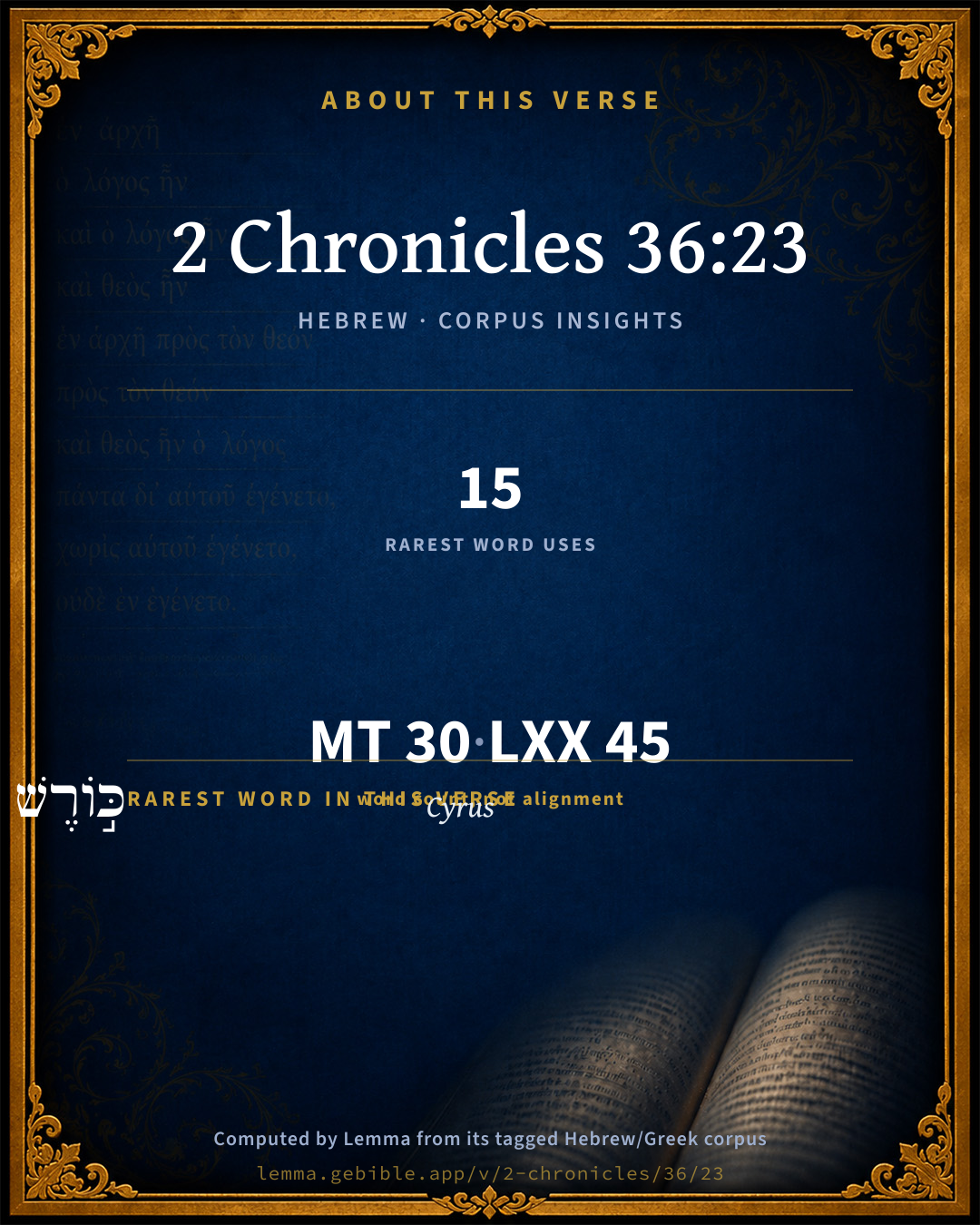
The rarest word here is כּ֣וֹרֶשׁ Cyrus H3566 — appearing just 15 times in the whole Hebrew Bible.

Shared distinctive vocabulary

כּ֣וֹרֶשׁ Cyrus H3566 occurs in 13 verses of the Hebrew Bible. Also found in:

Grammatical profile

  • 5 verbs
  • 16 nouns
  • 1 pronoun
  • 5 prepositions
  • 1 adverb
  • 2 particles

Verb forms

  • אָמַ֞ר Qal · Perfect
  • נָ֣תַן Qal · Perfect
  • פָקַ֤ד Qal · Perfect
  • לִבְנֽוֹת Qal · Infinitive Construct
  • וְיָֽעַל Qal · Imperfect

Repetition

Words recur within this verse — often emphatic in Hebrew:

  • כָּל all H3605 ×2
  • יְהוָה֙ LORD H3068 ×2
  • אֱלֹהֵ֣י God H430 ×2

Hebrew & Septuagint length

In English translation the verse runs 56 words from the Hebrew and 58 from the Septuagint (LXX English) — closely comparable.

A rough comparison of the two English renderings, which tokenize alike — not a word-level alignment.

Word counts can differ between the Hebrew and the Greek without any difference in meaning — e.g. the Hebrew direct-object marker אֵת has no separate Greek word, and Greek often adds the article ὁ.

In the original languages it is 30 Hebrew tokens and 45 Greek tokens — but the two are counted differently (Hebrew bundles its prefixes and suffixes into one token; the Greek is in lemma form), so that isn’t a like-for-like length.

Cross-references

12

Topical passages linked to 2 Chronicles 36:23 in the Treasury of Scripture Knowledge — connected by theme and wording, ordered by reader-vote popularity; previews shown in the World English Bible.

  • Ezra 7:13 I make a decree, that all those of the people of Israel, and their priests and the Levites, in my realm, who are minded of their own free will to go to Jerusalem, go with you.
  • Psalms 75:5–7 Don't lift up your horn on high. Don't speak with a stiff neck."
  • Isaiah 44:26–28 who confirms the word of his servant, and performs the counsel of his messengers; who says of Jerusalem, She shall be inhabited; and of the cities of Judah, They shall be built, and I will raise up the waste places of it;
  • Daniel 2:21 He changes the times and the seasons; he removes kings, and sets up kings; he gives wisdom to the wise, and knowledge to those who have understanding;
  • Daniel 2:37 You, O king, are king of kings, to whom the God of heaven has given the kingdom, the power, and the strength, and the glory;
  • Daniel 4:35 All the inhabitants of the earth are reputed as nothing; and he does according to his will in the army of heaven, and among the inhabitants of the earth; and none can stay his hand, or tell him, What do you?
  • Daniel 5:23 but have lifted up yourself against the Lord of heaven; and they have brought the vessels of his house before you, and you and your lords, your wives and your concubines, have drunk wine from them; and you have praised the gods of silver and gold, of brass, iron, wood, and stone, which don't see, nor hear, nor know; and the God in whose hand your breath is, and whose are all your ways, you have not glorified.
  • Zechariah 2:6–7 Come! Come! Flee from the land of the north,' says Yahweh; 'for I have spread you abroad as the four winds of the sky,' says Yahweh.
  • Romans 8:31 What then shall we say about these things? If God is for us, who can be against us?
  • 1 Chronicles 22:16 of the gold, the silver, and the brass, and the iron, there is no number. Arise and be doing, and Yahweh be with you.
  • 1 Chronicles 29:5 of gold for the [things of] gold, and of silver for the [things of] silver, and for all manner of work [to be made] by the hands of artificers. Who then offers willingly to consecrate himself this day to Yahweh?
  • Daniel 5:18 You king, the Most High God gave Nebuchadnezzar your father the kingdom, and greatness, and glory, and majesty:

Cross-references courtesy of OpenBible.info (CC BY 4.0).

Hebrew and Greek witnesses Masoretic Hebrew ↔ Greek Septuagint

The same verse in the two great witnesses to the Old Testament, shown verse-for-verse.

These are two independent witnesses, not word-aligned to each other, and the Septuagint is shown in lemma (dictionary) form.

Hebrew 2 Chronicles 36:23 Masoretic · Westminster Leningrad Codex

כֹּה אָמַ֞ר כּ֣וֹרֶשׁ מֶ֣לֶךְ פָּרַ֗ס כָּל מַמְלְכ֤וֹת הָאָ֨רֶץ֙ נָ֣תַן לִ֗י יְהוָה֙ אֱלֹהֵ֣י הַשָּׁמַ֔יִם וְהֽוּא פָקַ֤ד עָלַי֙ לִבְנֽוֹת ל֣וֹ בַ֔יִת בִּירוּשָׁלִַ֖ם אֲשֶׁ֣ר בִּֽיהוּדָ֑ה מִֽי בָכֶ֣ם מִכָּל עַמּ֗וֹ יְהוָ֧ה אֱלֹהָ֛יו עִמּ֖וֹ וְיָֽעַל

Thus says Cyrus king of Persia, All the kingdoms of the earth has Yahweh, the God of heaven, given me; and he has charged me to build him a house in Jerusalem, which is in Judah. Whoever there is among you of all his people, Yahweh his God be with him, and let him go up.

World English Bible · Public Domain

Greek LXX 2 Chronicles 36:23 Septuagint · lemma form

ὅδε λέγω κῦρος βασιλεύς πέρσης πᾶς ὁ βασιλεία ὁ γῆ δίδωμι ἐγώ κύριος ὁ θεός ὁ οὐρανός καί αὐτός ἐντέλλω ἐγώ οἰκοδομέω αὐτός οἶκος ἐν ἰερουσαλήμ ἐν ὁ ἰουδαία τίς ἐκ σύ ἐκ πᾶς ὁ λαός αὐτός εἰμί ὁ θεός αὐτός μετά αὐτός καί ἀναβαίνω

Thus says Cyrus king of the Persians to all the kingdoms of the earth, The Lord God of heaven has given me power, and he has commanded me to build a house to him in Jerusalem, in Judea. Who is there of you of all his people? His God shall be with him, and let him go up.

LXX2012 (modern English Septuagint) · Public Domain

Hebrew: Westminster Leningrad Codex (CC BY 4.0). Greek: Septuagint (public domain); English from LXX2012 (modern English Septuagint) (Public Domain). How the Septuagint differs from the Hebrew →

Commentary

Notes on 2 Chronicles 36:23 from classic Christian and Jewish commentators (each source and its license shown beneath its notes). The classic Christian expositions comment on the surrounding passage and are grouped to its opening verse, so a note may address several verses; the Jewish commentaries on the Tanakh (Rashi and others) are per-verse, so they appear only where the commentator wrote on this verse.

Lemma curates 59 commentaries, every one of them public domain or Creative Commons licensed, each selected and text-cleaned for this edition rather than reprinted as found. About our sources →

Geneva Bible (1599)

Geneva Bible translators

God had so forewarned by his Prophet above an hundred years before Cyrus was born, Isa. 44:28, that Jerusalem and the Temple should be built again by Cyrus his anointed: so called, because God used his service for a time to deliver his Church.

Geneva Bible (1599) marginal notes — public domain. Text via Bolls.life.

Adam Clarke's Commentary

Verse 23. The Lord his God be with him] "Let the WORD of the Lord be his helper, and let him go up." - Targum. See the notes on the beginning of Ezra. See Clarke on Ezr 1:1.

THUS ends the history of a people the most fickle, the most ungrateful, and perhaps on the whole the most sinful, that ever existed on the face of the earth. But what a display does all this give of the power, justice, mercy, and long-suffering of the Lord! There was no people like this people, and no God like their God.

MASORETIC NOTES

The sum of the verses in both books of Chronicles is 1656. Middle verse, 1Ch 27:25. Its Masoretic sections, twenty-five.

Having made particular remarks on every thing which I judged of importance in these and the preceding historical books, and in the course of this work having often found the want of a chronological list of the kings of Israel and Judah, in the consecutive order of their reigns; for the reader's information I have brought all the facts into a synopsis or general view, so that he may see at once the contemporary reigns in those two kingdoms, as well as the leading facts by which their reigns were distinguished. In this table will be seen, at one view, the year of the world; the year before Christ; the year before and after the First Olympiad; the year before and from the building of Rome; and under them the Jewish history, from its first kings till the time in which its regal state was entirely abolished, and both kingdoms led into captivity, never more to arise to any political consequence till they acknowledge the Lion of the tribe of Judah, and take Jesus the Christ, the son and only legitimate heir of David, for their Saviour and their Lord. I hope that the table which is here subjoined will be found, in every point of view, both interesting and instructive.

A. CLARKE.

Millbrook, December 7, 1819.

Finished correcting the two books of Chronicles,

March 28th, 1828. - A. CLARKE.

Adam Clarke's Commentary on the Bible (1810–1826) — public domain. Text from a community e-Sword/MySword module.

The Cambridge Bible for Schools and Colleges

gen. ed. J. J. S. Perowne

23. All the kingdoms of the earth] The king of Babylon bore the title of “king of the four quarters of the world.” Cyrus succeeded to this title on his conquest of Babylon.

God of heaven] R.V. the God of heaven.

Who is there among you of all his people? The Lord … etc.] R.V. Whosoever there is among you of all his people, the LORD … etc.

let him go up] i.e. to Jerusalem; cp. Ezr_1:3. Since Chronicles is the last book of the Old Testament (according to the Hebrew order), these words are to be reckoned the last words of the Old Testament.

The Cambridge Bible for Schools and Colleges (gen. ed. J. J. S. Perowne; Cambridge University Press, 1878–1918) — public domain. Text from a community e-Sword module.

Haydock's Catholic Bible Commentary

The Lord, (Jehova.) In Esdras we find yehi, "Let," his God. H. --- Up. The sentence is completed in the following book, which makes it probable that these verses are here inserted improperly, by some transcriber. The book of Chronicles, though for many ages the last in the Hebrew MSS. was, perhaps, once followed by Ezra, as in Camb. MS. 1., (Kennicott) and as it is now in the Protestant version, taken from the Hebrew. H.

George Leo Haydock (1774–1849), Haydock's Catholic Family Bible and Commentary, 1859 edition — public domain. Excludes Psalms (Douay-Rheims chapter numbering differs from Protestant) and Deuterocanonical books (Catholic canon only).

The Pulpit Commentary

Hath the Lord God of heaven given me the Lord his God be with him. The adopting by Cyrus of the Hebrew "Jehovah" in both these places cannot escape our notice. There can be no room to doubt that Cyrus was acquainted with the sacred literature of the Hebrews, and especially with the writings of Isaiah, Jeremiah, and Ezekiel, as with the language of Daniel. It may have been partly a graceful act on the part of Cyrus to word his proclamation to the Jews thus, or it may have been simply, what under the circumstances came most naturally to him, with little or no intention in it either way. The numerous passages in Ezra parallel in matter with this verse do not need specification here. Now begins the new period of Jewish life, with fiercer probation, with unbounded and various trial, and probably of world-length continuance.

The Pulpit Commentary (1880–1919), ed. H.D.M. Spence-Jones & Joseph S. Exell — public domain. Text from a community e-Sword module.

Rashi

Rabbi Shlomo Yitzchaki (Rashi)

So said Cyrus, the king of Persia, All the kingdoms of the earth For I reign as king over all the kingdoms.

and He commanded me And He commanded me through Isaiah to build Him a House in Jerusalem, as it is said (Isa. 44:2845:1): “Who says of Cyrus, etc. So said the Lord to His anointed one, to Cyrus.” And this prophecy of Isaiah had already been said to him.

which is in Judea Jerusalem is in the provinces of Judea.

Who among you is of all His people, may the Lord his God be with him, and he may ascend So was the proclamation to the provinces: Whoever is of the people of the Holy One, blessed be He, may come to build His House, which is in Jerusalem.

and he may ascend and may the Holy One, blessed be He, help him and us.

Rashi on the Tanakh — English translations: “The Judaica Press complete Tanach with Rashi, translated by A. J. Rosenberg” (CC BY 4.0); “Pentateuch with Rashi's commentary by M. Rosenbaum and A.M. Silbermann, 1929-1934” (public domain); “The Metsudah Tanach series, Lakewood, N.J” (CC BY 4.0); and “The Book of Joshua, Metsudah Publications, 1997” (CC BY 4.0). Text via Sefaria.

Lesson kit

Teaching starters — assembled from the data on this page, not authored interpretation. Every prompt links to the verse data it draws on. Edit before teaching.

2 Chronicles, in the Historical, opens this verse with 30 words (24 distinct Hebrew lemmas). Its most distinctive word is Kôwresh (“Cyrus”). A historical commentator’s framing appears above. Read the whole chapter for the surrounding context.

Discussion questions

  1. What does “Cyrus” (Kôwresh) contribute to the verse as a whole?
  2. 2 Chronicles 36:22 shares the word «Cyrus» with this verse. How do the two illuminate each other?
  3. “all” occurs 2× in this one verse. What is the effect of the repetition?
  4. These translations render this verse differently. What is at stake in choosing one wording over another?
  5. The verb «אָמַ֞ר» is Qal Perfect. How does its form color the action?
  6. Reading how Geneva Bible (1599) and Adam Clarke's Commentary read this verse, where do the two commentators agree and where do they part?

Things to notice

Reading settings

Reading text

Shown beneath each verse's original-language words.

Old Testament
Old Testament edition

Read the OT as the Masoretic Hebrew (MT) or the Greek Septuagint (LXX).

English shown for the Greek Septuagint (in the Hebrew ↔ Greek comparison).

Comparing translations? Open the Compare panel on any verse page to stack up to four side by side.