
Ezra 3:8

Hebrew (Westminster Leningrad Codex) Ezra 3:8 appears in the Hebrew Old Testament. The text above is from the Westminster Leningrad Codex. Each word links to its Strong’s number, a concise gloss, and parsing drawn from the Open Scriptures Hebrew Bible morphology. Click any word for its full Brown-Driver-Briggs (BDB) entry.
Download image
Cite this verse

Ezra 3:8 (World English Bible). Public Domain. Lemma interlinear Bible study tool, https://lemma.gebible.app/v/ezra/3/8.

Show BibTeX & RIS
BibTeX
RIS
English Translation
Now in the second year of their coming to the house of God at Jerusalem, in the second month, began Zerubbabel the son of Shealtiel, and Jeshua the son of Jozadak, and the rest of their brothers the priests and the Levites, and all those who were come out of the captivity to Jerusalem, and appointed the Levites, from twenty years old and upward, to have the oversight of the work of the house of Yahweh.
World English Bible · Public Domain
Download a study sheet

One document with this verse’s original text, its word-by-word gloss line, the meaning frame, cross-references with their text, attributed commentary, and full source and license credits — printable, and it pastes into notes with its structure intact.

This verse Autodidact and up

Study sheet (.html) Plain text (.txt)

A passage Seminary Student

Up to 50 verses in one chapter. A passage sheet keeps up to 6 commentary sources and 12 cross-references per verse, in the order this page ranks them, and says so on the sheet whenever that leaves anything out. Ask for a single verse and you get the Autodidact verse sheet above.

Everything on this page stays free to read, with no account — the sheet is a download of what is already on screen, not access to it.

Want to remove ads? Support Godless Engineer
Compare translations 3

The same verse in 3 English versions, stacked beneath the original-language interlinear above. Click any original word for its lexicon entry.

Each is an independent rendering of the whole verse — the interlinear is not word-aligned to these translations.

Highlighted words mark where these versions differ — a whole-verse word diff, not a word-by-word alignment.

  • World English Bible Public Domain
    Now in the second year of their coming to the house of God at Jerusalem, in the second month, began Zerubbabel the son of Shealtiel, and Jeshua the son of Jozadak, and the rest of their brothers the priests and the Levites, and all those who were come out of the captivity to Jerusalem, and appointed the Levites, from twenty years old and upward, to have the oversight of the work of the house of Yahweh.
  • King James Version Public Domain
    Now in the second year of their coming unto the house of God at Jerusalem, in the second month, began Zerubbabel the son of Shealtiel, and Jeshua the son of Jozadak, and the remnant of their brethren the priests and the Levites, and all they that were come out of the captivity unto Jerusalem; and appointed the Levites, from twenty years old and upward, to set forward the work of the house of the LORD.
  • unfoldingWord Literal Text CC BY-SA 4.0
    Then in the second year of their coming to the house of God in Jerusalem, in the second month, Zerubbabel the son of Shealtiel, and Jeshua the son of Jozadak, and the rest of their brothers the priests and the Levites, and all the ones who came from captivity to Jerusalem began, and they appointed the Levites from a son of 20 years and above to act as overseers for the work of the house of Yahweh.

unfoldingWord Literal Text — © unfoldingWord, licensed CC BY-SA 4.0. Word-aligned USFM3 via Door43 (git.door43.org/unfoldingWord/en_ult).

Versions to compare (up to 4)

3 of 4 selected

Show all 18 translations

Every available English version of this verse, each an independent rendering of the whole verse.

  • World English Bible Public Domain
    Now in the second year of their coming to the house of God at Jerusalem, in the second month, began Zerubbabel the son of Shealtiel, and Jeshua the son of Jozadak, and the rest of their brothers the priests and the Levites, and all those who were come out of the captivity to Jerusalem, and appointed the Levites, from twenty years old and upward, to have the oversight of the work of the house of Yahweh.
  • Berean Standard Bible Public Domain
    In the second month of the second year after they had arrived at the house of God in Jerusalem, Zerubbabel son of Shealtiel, Jeshua son of Jozadak, and the rest of their associates including the priests, the Levites, and all who had returned to Jerusalem from the captivity, began the work. They appointed Levites twenty years of age or older to supervise the construction of the house of the LORD.
  • Majority Standard Bible Public Domain
    In the second month of the second year after they had arrived at the house of God in Jerusalem, Zerubbabel son of Shealtiel, Jeshua son of Jozadak, and the rest of their associates including the priests, the Levites, and all who had returned to Jerusalem from the captivity, began the work. They appointed Levites twenty years of age or older to supervise the construction of the house of the LORD.
  • King James Version Public Domain
    Now in the second year of their coming unto the house of God at Jerusalem, in the second month, began Zerubbabel the son of Shealtiel, and Jeshua the son of Jozadak, and the remnant of their brethren the priests and the Levites, and all they that were come out of the captivity unto Jerusalem; and appointed the Levites, from twenty years old and upward, to set forward the work of the house of the LORD.
  • American Standard Version (1901) Public Domain
    Now in the second year of their coming unto the house of God at Jerusalem, in the second month, began Zerubbabel the son of Shealtiel, and Jeshua the son of Jozadak, and the rest of their brethren the priests and the Levites, and all they that were come out of the captivity unto Jerusalem, and appointed the Levites, from twenty years old and upward, to have the oversight of the work of the house of Jehovah.
  • Revised Version (1885) Public Domain
    Now in the second year of their coming unto the house of God at Jerusalem, in the second month, began Zerubbabel the son of Shealtiel, and Jeshua the son of Jozadak, and the rest of their brethren the priests and the Levites, and all they that were come out of the captivity unto Jerusalem; and appointed the Levites, from twenty years old and upward, to have the oversight of the work of the house of the LORD.
  • Geneva Bible (1599) Public Domain
    And in the seconde yeere of their comming vnto the house of God in Ierusalem in the second moneth began Zerubbabel the sonne of Shealtiel, and Ieshua the sonne of Iozadak, and the remnant of their brethren the Priests and the Leuites, and all they that were come out of the captiuitie vnto Ierusalem, and appointed the Leuites from twentie yeere olde and aboue, to set forwarde the worke of the house of the Lord.
  • Douay-Rheims (1899) Public Domain
    And in the second year of their coming to the temple of God in Jerusalem, the second month, Zorobabel the son of Salathiel, and Josue the son of Josedec, and the rest of their brethren the priests, and the Levites, and all that were come from the captivity to Jerusalem began, and they appointed Levites from twenty years old and upward, to hasten forward the work of the Lord.
  • Young's Literal Translation Public Domain
    And in the second year of their coming in unto the house of God, to Jerusalem, in the second month, began Zerubbabel son of Shealtiel, and Jeshua son of Jozadak, and the remnant of their brethren the priests and the Levites, and all those coming from the captivity to Jerusalem, and they appoint the Levites from a son of twenty years and upward, to overlook the work of the house of Jehovah.
  • Literal Standard Version CC BY-SA 4.0
    And in the second year of their coming to the house of God, to Jerusalem, in the second month, began Zerubbabel son of Shealtiel, and Jeshua son of Jozadak, and the remnant of their brothers the priests and the Levites, and all those coming from the captivity to Jerusalem, and they appoint the Levites from a son of twenty years and upward, to overlook the work of the house of YHWH.
  • Unlocked Literal Bible CC BY-SA 4.0
    Then in the second month of the second year after they came to the house of God in Jerusalem, Zerubbabel son of Shealtiel, Jeshua son of Jozadak, the rest of the priests, the Levites, and those who came from captivity back to Jerusalem began the work. They assigned the Levites twenty years old and older to oversee the work of Yahweh's house.
  • unfoldingWord Literal Text CC BY-SA 4.0
    Then in the second year of their coming to the house of God in Jerusalem, in the second month, Zerubbabel the son of Shealtiel, and Jeshua the son of Jozadak, and the rest of their brothers the priests and the Levites, and all the ones who came from captivity to Jerusalem began, and they appointed the Levites from a son of 20 years and above to act as overseers for the work of the house of Yahweh.
  • Darby Bible Public Domain
    And in the second year of their coming to the house of God at Jerusalem, in the second month, began Zerubbabel the son of Shealtiel, and Jeshua the son of Jozadak, and the remnant of their brethren the priests and the Levites, and all they that had come out of the captivity to Jerusalem; and they appointed the Levites, from twenty years old and upward, to superintend the work of the house of Jehovah.
  • World Messianic Bible Public Domain
    Now in the second year of their coming to God’s house at Jerusalem, in the second month, Zerubbabel the son of Shealtiel, Yeshua the son of Jozadak, and the rest of their brothers the priests and the Levites, and all those who had come out of the captivity to Jerusalem, began the work and appointed the Levites, from twenty years old and upward, to have the oversight of the work of the LORD’s house.
  • Webster's Bible Public Domain
    Now in the second year of their coming to the house of God at Jerusalem, in the second month, began Zerubbabel the son of Shealtiel, and Jeshua the son of Jozadak, and the remnant of their brethren the priests and the Levites, and all they that had come out of the captivity to Jerusalem; and appointed the Levites, from twenty years old and upward, to set forward the work of the house of the LORD.
  • Free Bible Version CC BY-SA 4.0
    In the second month of the second year after arriving at God's Temple in Jerusalem, Zerubbabel, son of Shealtiel, Jeshua, son of Jozadak, and those with them—the priests, the Levites, and everyone who had come back to Jerusalem from captivity—began the work. They put Levites twenty years and older in charge of building the Lord's Temple.
  • Bible in Basic English Public Domain
    Now in the second year of their coming into the house of God in Jerusalem, in the second month, the work was taken in hand by Zerubbabel, the son of Shealtiel, and Jeshua, the son of Jozadak, and the rest of their brothers the priests and the Levites, and all those who had come from the land where they were prisoners to Jerusalem: and they made the Levites, of twenty years old and over, responsible for overseeing the work of the house of the Lord.
  • JPS Tanakh (1917) Public Domain
    Now in the second year of their coming unto the house of God at Jerusalem, in the second month, began Zerubbabel the son of Shealtiel, and Jeshua the son of Jozadak, and the rest of their brethren the priests and the Levites, and all they that were come out of the captivity unto Jerusalem; and appointed the Levites, from twenty years old and upward, to have the oversight of the work of the house of the LORD.

Literal Standard Version (2020), Covenant Press — licensed CC BY-SA 4.0. Text via the HelloAO Bible API (eBible.org). Unlocked Literal Bible (unfoldingWord) — licensed CC BY-SA 4.0. Text via the HelloAO Bible API (eBible.org). unfoldingWord Literal Text — © unfoldingWord, licensed CC BY-SA 4.0. Word-aligned USFM3 via Door43 (git.door43.org/unfoldingWord/en_ult). Free Bible Version, Dr. Jonathan Gallagher — licensed CC BY-SA 4.0. Text via the HelloAO Bible API (eBible.org).

Word by word

More ways to search: Search by grammar → Find every occurrence → Compare this word →

Practice this passage: Drill this verse → Learn its vocabulary →

יֽוֹצָדָ֜ק
Yôwtsâdâq
H3136
“Jozadak”
Noun, Proper
Part of Speech
Noun
Type
Proper
Full BDB Definition

Origin: a form of H3087

TWOT: None

Jozadak = "Jehovah is righteous" - grandson of the high priest Hilkiah; son of the high priest Seraiah; and father of the high priest Joshua; he never attained the office of high priest himself because he was carried captive to Babylon by Nebuchadnezzar
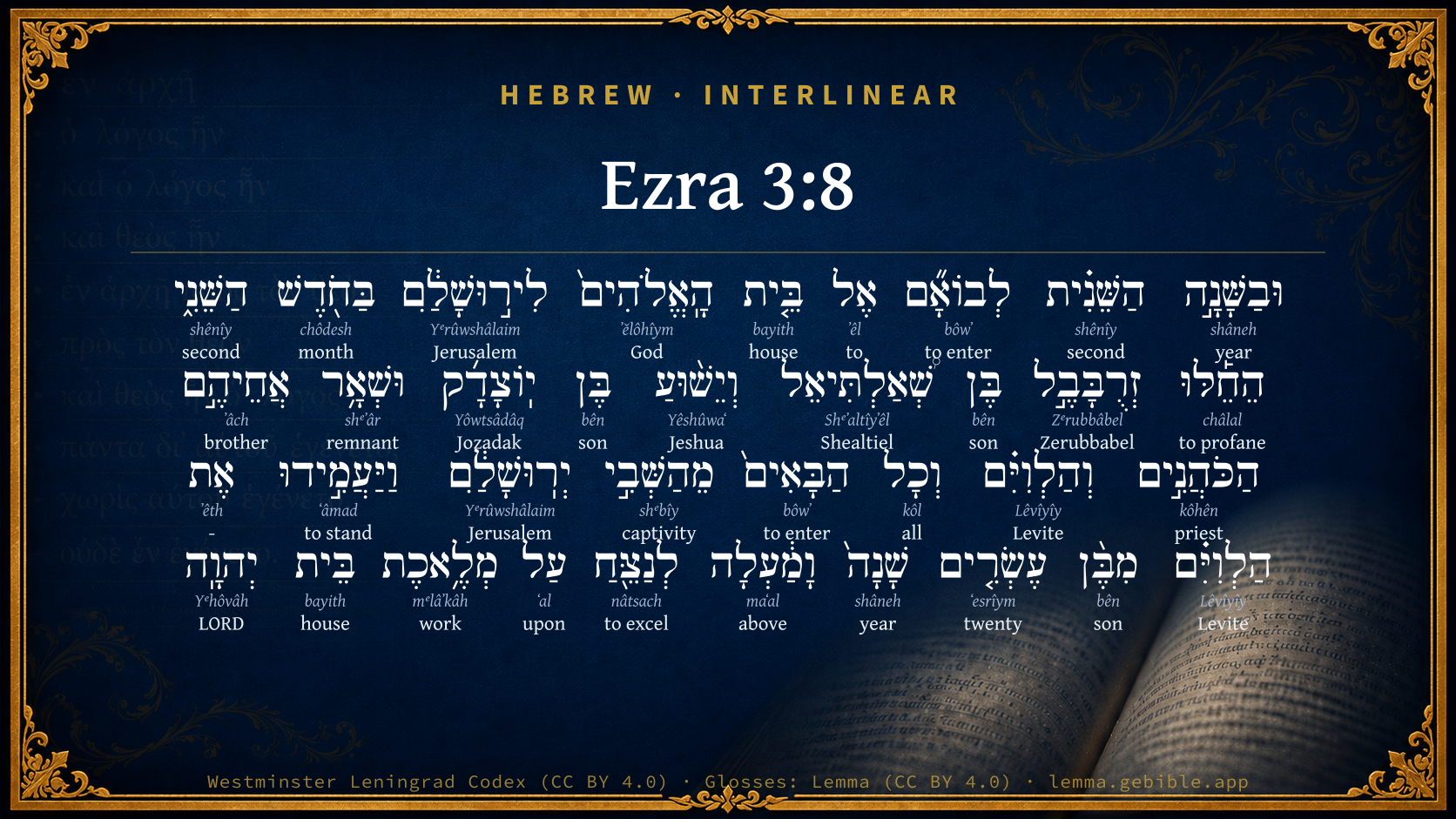
  1. וּבַשָּׁנָ֣ה shâneh H8141 “and · in/at the · year” Conjunction + Preposition, Determined + Noun, Common, Feminine, Singular, Absolute
  2. הַשֵּׁנִ֗ית shênîy H8145 “the · second” Particle, Definite Article + Adjective, Ordinal number, Feminine, Singular, Absolute
  3. לְבוֹאָ֞ם bôwʼ H935 “to enter · them” Preposition + Verb, Qal, Infinitive Construct + Suffix, Personal, 3rd Person, Masculine, Plural
  4. אֶל ʼêl H413 “to” Preposition
  5. בֵּ֤ית bayith H1004 “house of” Noun, Common, Masculine, Singular, Construct
  6. הָֽאֱלֹהִים֙ ʼĕlôhîym H430 “the · God(s)” Particle, Definite Article + Noun, Common, Masculine, Plural, Absolute
  7. לִיר֣וּשָׁלִַ֔ם Yᵉrûwshâlaim H3389 “to/for · Jerusalem” Preposition + Noun, Proper
  8. בַּחֹ֖דֶשׁ chôdesh H2320 “in/at the · month” Preposition, Determined + Noun, Common, Masculine, Singular, Absolute
  9. הַשֵּׁנִ֑י shênîy H8145 “the · second” Particle, Definite Article + Adjective, Ordinal number, Masculine, Singular, Absolute
  10. הֵחֵ֡לּוּ châlal H2490 “to profane” Verb, Hiphil, Perfect, 3rd Person, Common, Plural
  11. זְרֻבָּבֶ֣ל Zᵉrubbâbel H2216 “Zerubbabel” Noun, Proper
  12. בֶּן bên H1121 “son of” Noun, Common, Masculine, Singular, Construct
  13. שְׁ֠אַלְתִּיאֵל Shᵉʼaltîyʼêl H7597 “Shealtiel” Noun, Proper
  14. וְיֵשׁ֨וּעַ Yêshûwaʻ H3442 “and · Jeshua” Conjunction + Noun, Proper
  15. בֶּן bên H1121 “son of” Noun, Common, Masculine, Singular, Construct
  16. וּשְׁאָ֥ר shᵉʼâr H7605 “and · remnant of” Conjunction + Noun, Common, Masculine, Singular, Construct
  17. אֲחֵיהֶ֣ם ʼâch H251 “brothers · their” Noun, Common, Masculine, Plural, Construct + Suffix, Personal, 3rd Person, Masculine, Plural
  18. הַכֹּהֲנִ֣ים kôhên H3548 “the · priests” Particle, Definite Article + Noun, Common, Masculine, Plural, Absolute
  19. וְהַלְוִיִּ֗ם Lêvîyîy H3881 “and · the · Levites” Conjunction + Particle, Definite Article + Noun, Gentilic, Masculine, Plural, Absolute
  20. וְכָל kôl H3605 “and · all of” Conjunction + Noun, Common, Masculine, Singular, Construct
  21. הַבָּאִים֙ bôwʼ H935 “the · entering” Particle, Definite Article + Verb, Qal, Participle Active, Masculine, Plural, Absolute
  22. מֵהַשְּׁבִ֣י shᵉbîy H7628 “from · the · captivity” Preposition + Particle, Definite Article + Noun, Common, Both, Singular, Absolute
  23. יְרֽוּשָׁלִַ֔ם Yᵉrûwshâlaim H3389 “Jerusalem” Noun, Proper
  24. וַיַּעֲמִ֣ידוּ ʻâmad H5975 “and · to stand” Conjunction + Verb, Hiphil, Sequential Imperfect, 3rd Person, Masculine, Plural
  25. אֶת ʼêth H853 “-” Particle, Direct Object
  26. הַלְוִיִּ֗ם Lêvîyîy H3881 “the · Levites” Particle, Definite Article + Noun, Gentilic, Masculine, Plural, Absolute
  27. מִבֶּ֨ן bên H1121 “from · son of” Preposition + Noun, Common, Masculine, Singular, Construct
  28. עֶשְׂרִ֤ים ʻesrîym H6242 “twenty” Adjective, Cardinal number, Both, Plural, Absolute
  29. שָׁנָה֙ shâneh H8141 “year” Noun, Common, Feminine, Singular, Absolute
  30. וָמַ֔עְלָה maʻal H4605 “and · above · toward” Conjunction + Adverb + Suffix, Demonstrative
  31. לְנַצֵּ֖חַ nâtsach H5329 “to excel” Preposition + Verb, Piel, Infinitive Construct
  32. עַל ʻal H5921 “upon” Preposition
  33. מְלֶ֥אכֶת mᵉlâʼkâh H4399 “work of” Noun, Common, Feminine, Singular, Construct
  34. בֵּית bayith H1004 “house of” Noun, Common, Masculine, Singular, Construct
  35. יְהוָֽה Yᵉhôvâh H3068 “LORD” Noun, Proper

About this verse

These counts appear in no published source. They are computed here, from the morphology-tagged text and Lemma’s own curated glosses. What Lemma adds →

36
words
28
distinct lemmas
Historical
section

Notable vocabulary

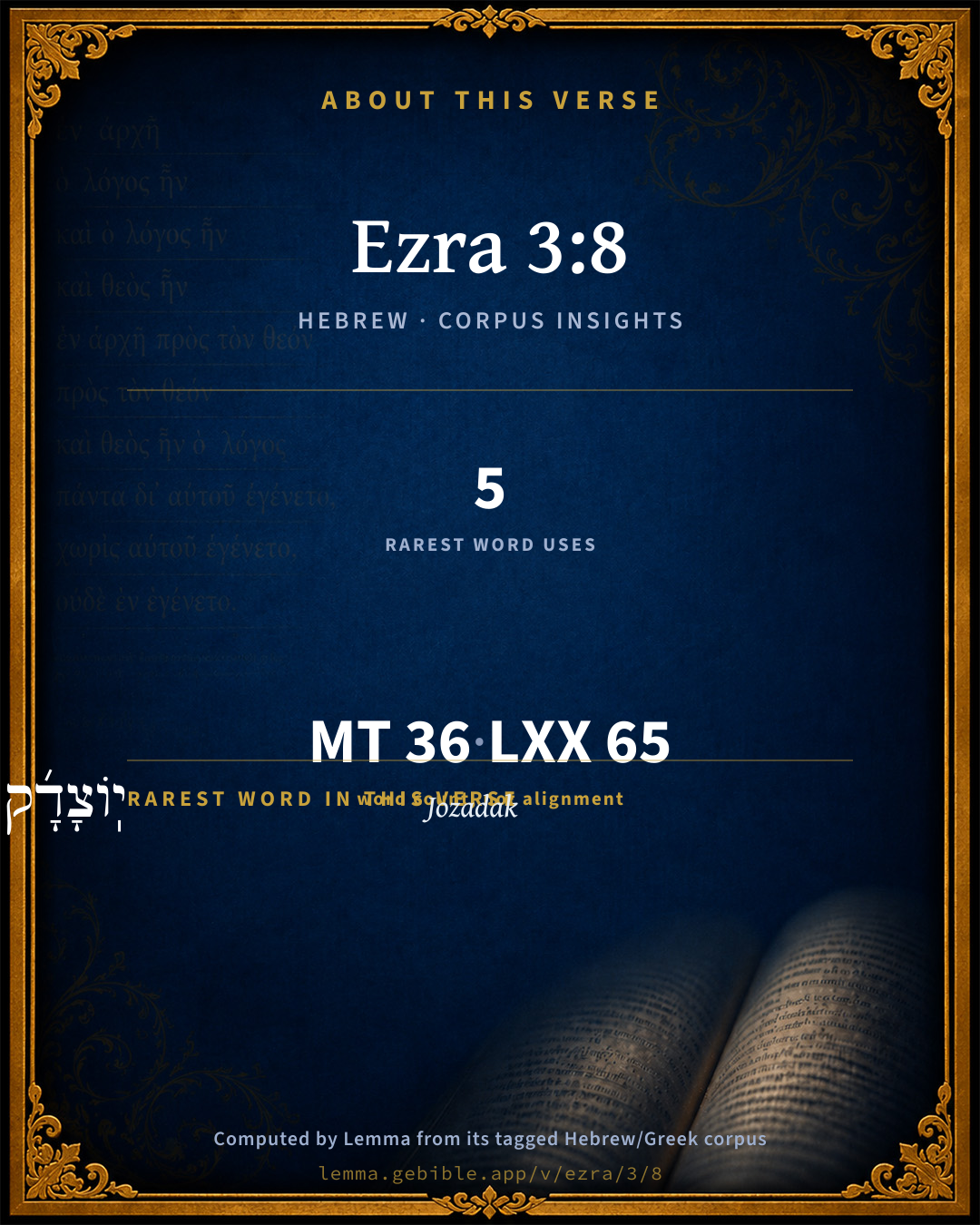
The rarest word here is יֽוֹצָדָ֜ק Jozadak H3136 — appearing just 5 times in the whole Hebrew Bible.

Shared distinctive vocabulary

יֽוֹצָדָ֜ק Jozadak H3136 occurs in 5 verses of the Hebrew Bible. Also found in:

Grammatical profile

  • 5 verbs
  • 24 nouns
  • 3 adjectives
  • 2 prepositions
  • 1 adverb
  • 1 particle

Verb forms

  • לְבוֹאָ֞ם Qal · Infinitive Construct
  • הֵחֵ֡לּוּ Hiphil · Perfect
  • הַבָּאִים֙ Qal · Participle Active
  • וַיַּעֲמִ֣ידוּ Hiphil · Sequential Imperfect
  • לְנַצֵּ֖חַ Piel · Infinitive Construct

Repetition

Words recur within this verse — often emphatic in Hebrew:

  • בֶּן son H1121 ×3
  • וּבַשָּׁנָ֣ה year H8141 ×2
  • הַשֵּׁנִ֗ית second H8145 ×2
  • לְבוֹאָ֞ם to enter H935 ×2
  • בֵּ֤ית house H1004 ×2
  • לִיר֣וּשָׁלִַ֔ם Jerusalem H3389 ×2
  • וְהַלְוִיִּ֗ם Levite H3881 ×2

Hebrew & Septuagint length

In English translation the verse runs 76 words from the Hebrew and 71 from the Septuagint (LXX English) — closely comparable.

A rough comparison of the two English renderings, which tokenize alike — not a word-level alignment.

Word counts can differ between the Hebrew and the Greek without any difference in meaning — e.g. the Hebrew direct-object marker אֵת has no separate Greek word, and Greek often adds the article ὁ.

In the original languages it is 36 Hebrew tokens and 65 Greek tokens — but the two are counted differently (Hebrew bundles its prefixes and suffixes into one token; the Greek is in lemma form), so that isn’t a like-for-like length.

Cross-references

4

Topical passages linked to Ezra 3:8 in the Treasury of Scripture Knowledge — connected by theme and wording, ordered by reader-vote popularity; previews shown in the World English Bible.

  • Ezra 4:3 But Zerubbabel, and Jeshua, and the rest of the heads of fathers' [houses] of Israel, said to them, You have nothing to do with us in building a house to our God; but we ourselves together will build to Yahweh, the God of Israel, as king Cyrus the king of Persia has commanded us.
  • 1 Chronicles 23:4 Of these, twenty-four thousand were to oversee the work of the house of Yahweh; and six thousand were officers and judges;
  • Numbers 4:3 from thirty years old and upward even until fifty years old, all who enter into the service, to do the work in the Tent of Meeting.
  • 1 Chronicles 23:24–32 These were the sons of Levi after their fathers' houses, even the heads of the fathers' [houses] of those of those who were counted, in the number of names by their polls, who did the work for the service of the house of Yahweh, from twenty years old and upward.

Cross-references courtesy of OpenBible.info (CC BY 4.0).

Hebrew and Greek witnesses Masoretic Hebrew ↔ Greek Septuagint

The same verse in the two great witnesses to the Old Testament, shown verse-for-verse.

These are two independent witnesses, not word-aligned to each other, and the Septuagint is shown in lemma (dictionary) form.

Hebrew Ezra 3:8 Masoretic · Westminster Leningrad Codex

וּבַשָּׁנָ֣ה הַשֵּׁנִ֗ית לְבוֹאָ֞ם אֶל בֵּ֤ית הָֽאֱלֹהִים֙ לִיר֣וּשָׁלִַ֔ם בַּחֹ֖דֶשׁ הַשֵּׁנִ֑י הֵחֵ֡לּוּ זְרֻבָּבֶ֣ל בֶּן שְׁ֠אַלְתִּיאֵל וְיֵשׁ֨וּעַ בֶּן יֽוֹצָדָ֜ק וּשְׁאָ֥ר אֲחֵיהֶ֣ם הַכֹּהֲנִ֣ים וְהַלְוִיִּ֗ם וְכָל הַבָּאִים֙ מֵהַשְּׁבִ֣י יְרֽוּשָׁלִַ֔ם וַיַּעֲמִ֣ידוּ אֶת הַלְוִיִּ֗ם מִבֶּ֨ן עֶשְׂרִ֤ים שָׁנָה֙ וָמַ֔עְלָה לְנַצֵּ֖חַ עַל מְלֶ֥אכֶת בֵּית יְהוָֽה

Now in the second year of their coming to the house of God at Jerusalem, in the second month, began Zerubbabel the son of Shealtiel, and Jeshua the son of Jozadak, and the rest of their brothers the priests and the Levites, and all those who were come out of the captivity to Jerusalem, and appointed the Levites, from twenty years old and upward, to have the oversight of the work of the house of Yahweh.

World English Bible · Public Domain

Greek LXX Ezra 3:8 Septuagint · lemma form

καί ἐν ὁ ἔτος ὁ δεύτερος ὁ ἔρχομαι αὐτός εἰς οἶκος ὁ θεός εἰς ἰερουσαλήμ ἐν μήν ὁ δεύτερος ἄρχω ζοροβαβελ ὁ ὁ σαλαθιηλ καί ἰησοῦς ὁ ὁ ιωσεδεκ καί ὁ κατάλοιπος ὁ ἀδελφός αὐτός ὁ ἱερεύς καί ὁ λευείτης καί πᾶς ὁ ἔρχομαι ἀπό ὁ αἰχμαλωσία εἰς ἰερουσαλήμ καί ἵστημι ὁ λευείτης ἀπό εἰκοσαετής καί ἐπάνω ἐπί ὁ ποιέω ὁ ἔργον ἐν οἶκος κύριος

And in the second year of their coming to the house of God in Jerusalem, in the second month, began Zorobabel the son of Salathiel, and Jesus the son of Josedec, and the rest of their brethren the priests and the Levites, and all who came from the captivity to Jerusalem, and they appointed the Levites, from twenty years old and upward, over the workmen in the house of the Lord.

LXX2012 (modern English Septuagint) · Public Domain

In the Septuagint this is one book — Esdras B (2 Esdras): Ezra is chapters 1–10, Nehemiah 11–23.

Hebrew: Westminster Leningrad Codex (CC BY 4.0). Greek: Septuagint (public domain); English from LXX2012 (modern English Septuagint) (Public Domain). How the Septuagint differs from the Hebrew →

Commentary

Notes on Ezra 3:8 from classic Christian and Jewish commentators (each source and its license shown beneath its notes). The classic Christian expositions comment on the surrounding passage and are grouped to its opening verse, so a note may address several verses; the Jewish commentaries on the Tanakh (Rashi and others) are per-verse, so they appear only where the commentator wrote on this verse.

Lemma curates 59 commentaries, every one of them public domain or Creative Commons licensed, each selected and text-cleaned for this edition rather than reprinted as found. About our sources →

Matthew Henry's Commentary

There was no dispute among the returned Jews whether they should build the temple or no; that was immediately resolved on, and that it should be done with all speed; what comfort could they take in their own land if they had not that token of God's presence with them and the record of his name among them? We have here therefore an account of the beginning of that good work. Observe,

I. When it was begun-in the second month of the second year, as soon as ever the season of the year would permit (Ezr 3:8), and when they had ended the solemnities of the passover. They took little more than half a year for making preparation of the ground and materials; so much were their hearts upon it. Note, When any good work is to be done it will be our wisdom to set about it quickly, and not to lose time, yea, though we foresee difficulty and opposition in it. Thus we engage ourselves to it, and engage God for us. Well begun (we say) is half ended.

II. Who began it - Zerubbabel, and Jeshua, and their brethren. Then the work of God is likely to go on well when magistrates, ministers, and people, are hearty for it, and agree in their places to promote it. It was God that gave them one heart for this service, and it boded well.

III. Who were employed to further it. They appointed the Levites to set forward the work (Ezr 3:8), and they did it by setting forward the workmen (Ezr 3:9), and strengthening their hands with good and comfortable words. Note, Those that do not work themselves may yet do good service by quickening and encouraging those that do work.

IV. How God was praised at the laying of the foundation of the temple (Ezr 3:10, Ezr 3:11); the priests with the trumpets appointed by Moses, and the Levites with the cymbals appointed by David, made up a concert of music, not to please the ear, but to assist the singing of that everlasting hymn which will never be out of date, and to which our tongues should never be out of tune, God is good, and his mercy endureth for ever, the burden of Ps. 136. Let all the streams of mercy be traced up to the fountain. Whatever our condition is, how many soever our griefs and fears, let it be owned that God is good; and, whatever fails, that his mercy fails not. Let this be sung with application, as here; not only his mercy endures for ever, but it endures for ever towards Israel, Israel when captives in a strange land and strangers in their own land. However it be, yet God is good to Israel (Psa 73:1), good to us. Let the reviving of the church's interests, when they seemed dead, be ascribed to the continuance of God's mercy for ever, for therefore the church continues.

V. How the people were affected. A remarkable mixture of various affections there was upon this occasion. Different sentiments there were among the people of God, and each expressed himself according to his sentiments, and yet there was no disagreement among them, their minds were not alienated from each other nor the common concern retarded by it. 1. Those that only knew the misery of having no temple at all praised the Lord with shouts of joy when they saw but the foundation of one laid, Ezr 3:11. To them even this foundation seemed great, and was as life from the dead; to their hungry souls even this was sweet. They shouted, so that the noise was heard afar off. Note, We ought to be thankful for the beginnings of mercy, though we have not yet come to the perfection of it; and the foundations of a temple, after long desolations, cannot but be fountains of joy to every faithful Israelite. 2. Those that remembered the glory of the first temple which Solomon built, and considered how far this was likely to be inferior to that, perhaps in dimensions, certainly in magnificence and sumptuousness, wept with a loud voice, Ezr 3:12. If we date the captivity with the first, from the fourth of Jehoiakim, it was about fifty-two years since the temple was burnt; if from Jeconiah's captivity, it was but fifty-nine. So that many now alive might remember it standing; and a great mercy it was to the captives that they had the lives of so many of their priests and Levites lengthened out, who could tell them what they themselves remembered of the glory of Jerusalem, to quicken them in their return. These lamented the disproportion between this temple and the former. And, (1.) There was some reason for it; and if they turned their tears into the right channel, and bewailed the sin that was the cause of this melancholy change, they did well. Sin sullies the glory of any church or people, and, when they find themselves diminished and brought low, that must bear the blame. (2.) Yet it was their infirmity to mingle those tears with the common joys and so to cast a damp upon them. They despised the day of small things, and were unthankful for the good they enjoyed, because it was not so much as their ancestors had, though it was much more than they deserved. In the harmony of public joys, let not us be jarring strings. It was an aggravation of the discouragement they hereby gave to the people that they were priests and Levites, who should have known and taught others how to be duly affected under various providences, and not to let the remembrance of former afflictions drown the sense of present mercies. This mixture of sorrow and joy here is a representation of this world. Some are bathing in rivers of joy, while others are drowned in floods of tears. In heaven all are singing, and none sighing; in hell all are weeping and wailing, and none rejoicing; but here on earth we can scarcely discern the shouts of joy from the noise of the weeping. Let us learn to rejoice with those that do rejoice and weep with those that weep, and ourselves to rejoice as though we rejoiced not, and weep as though we wept not.

Matthew Henry's Commentary on the Whole Bible (1708–1710) — public domain (CC PDM 1.0). Text via the HelloAO Bible API.

Jamieson, Fausset & Brown

Robert Jamieson, A. R. Fausset & David Brown

THE FOUNDATION OF THE TEMPLE LAID. (Ezr 3:8-13)

appointed the Levites . . . to set forward the work--that is, to act as overseers of the workmen, and to direct and animate the laborers in the various departments.

Jamieson, Fausset & Brown — Commentary Critical and Explanatory on the Whole Bible (1871) — public domain (CC PDM 1.0). Text via the HelloAO Bible API.

Trapp's Complete Commentary

John Trapp

Ezr 3:8 Now in the second year of their coming unto the house of God at Jerusalem, in the second month, began Zerubbabel the son of Shealtiel, and Jeshua the son of Jozadak, and the remnant of their brethren the priests and the Levites, and all they that were come out of the captivity unto Jerusalem; and appointed the Levites, from twenty years old and upward, to set forward the work of the house of the LORD.

Ver. 8. To set forward the work] To urge the continuance of it to the end, as the word siguifieth; to encourage and call upon the workmen to hasten and go through; to be as so many Eργοδιωκται, that the business might go on end, and come to a good upshot.

John Trapp, A Commentary or Exposition upon All the Books of the Old and New Testament (1647–1656) — public domain. Text from a community e-Sword module.

Joseph Benson's Commentary

Ezr 3:8. In the second month began Zerubbabel, &c. — The building of the temple was begun as soon as ever the season of the year would permit, and as soon as they had ended the solemnities of the passover. They took little more than half a year for preparing the ground and materials; so much were their hearts upon the work. And Jeshua, and their brethren the priests and Levites, &c. — Then the work of God is likely to go on well when magistrates, ministers, and people are zealously affected toward it, and agree in their places to promote it. It was God that gave them one heart for this service, and it promised a happy issue.

Joseph Benson's Commentary on the Old and New Testaments (1811–1818) — public domain. Text from a community e-Sword module.

Whedon's Commentary on the Bible

Daniel D. Whedon

THE FOUNDATION OF THE SECOND TEMPLE LAID, Ezr_3:8-13.

8. The second year — More than a year elapsed before the new community began… to set forward the work of the house of the Lord — Other things first required attention. The people were to be numbered, classified, and settled in new homes, and many had to build them houses. Much time also was necessary to arrange for the feasts and offerings, and also for bringing material from Lebanon.

Daniel D. Whedon (gen. ed.), Commentary on the Old and New Testaments (1874–1909) — public domain. Text from a community e-Sword module.

The Pulpit Commentary

CHAPTER 3:8-13

REBUILDING OF THE TEMPLE AND OPPOSITION MADE TO IT.

LAYING OF THE FOUNDATION OF THE TEMPLE AND CEREMONIAL ON THE OCCASION (vers. 8-13). Seven months were occupied with preparations. The winter was past, and the spring had arrived. It was the second month, Zif, the month of "blossom," corresponding to our May the same month in which Solomon had laid the foundation of the first temple (1Ki_6:1) when Zerubbabel judged that the time had come for commencing the foundation of the second. The correspondence of the month was no doubt intentional, like the correspondence of the foundations of the altar (ver. 3), and was to mark that all was to be as before, that nothing was to be wantonly changed. Zerubbabel and Jeshua presided; hut to Zerubbabel is assigned the chief part in the work. "The hands of Zerubbabel have laid the foundation of this house" are the words of God himself to Zechariah. (Zec_4:9) It was arranged that the work should commence with a religious ceremonial, natural piety here suggesting what was not recorded of the "first house," though it may have occurred and not have been put on record. The ceremonial consisted chiefly of praise, and was accompanied with sacred music, according to the pattern set by David and Solomon in their sacred processions and ceremonies (1Ch_15:19, 24 16:5; 2Ch_5:12, etc.) Their special parts in it were assigned beforehand to the priests, the Levites, and the people.

In the second year. In B.C. 537, the second year of Cyrus in Babylon, which was also the second year of their coming (i.e. after their coming) to the (ruined) house of God, (Ezr_2:68) began Zerubbabel, and the others, and appointed the Levites. Small as the number of the Levites who returned with Zerubbabel was, to them especially was intrusted the work of the house of the Lord, i.e. the superintendence of the workmen employed to rebuild it (see ver. 9).

Vers. 8-13.

The first stone.

We now come in this story to a very critical time. The great work of the restoration of the house, for the sake of which the partial restoration of Israel to Canaan had been brought about and was to continue (see again Ezr_1:2, Ezr_1:3, Ezr_1:4, Ezr_1:5; also Ezr_6:3, noting further how, in fact, all recorded in Ezra, and even in Nehemiah, may be regarded as introductory, subsidiary, or supplementary to this point), at last is before us. We read, on the one hand, of the very last step in the way of prelude and preparation. We read, on the other, of the very first step in the way of actual construction. In both we shall find how much importance is attached to the juncture.

I THE LAST PRELIMINARY. The site being fixed, the workmen engaged, as also, we may suppose (the "second month of the second year" having arrived), the proper materials being now on the spot, it only remains to arrange, before finally starting, for proper superintendence. Who so likely for this as those who had a kind of family fitness or hereditary call to that work, viz., the Levites of sufficient age? And what so proper an age (i.e. if second thoughts are best) as the age fixed by the "last words of David" (1Ch_23:27, compared with vers. 3, 24-26; and see? 2Ch_29:25 as further evidence of the authority attaching to all David"s arrangements concerning the house) Such, accordingly, was the precedent followed by all concerned in this case. All who helped to make up the whole "remnant" that had returned to Jerusalem (including by name both leaders, and by express mention the priests and Levites, and by implication all other Israelites) approved of this plan. And all thus called and "appointed," i.e. all those Levites belonging to those families which had that hereditary acquaintance before referred to, equally approved of it too. Two families of such have been already mentioned among those that came up. (Ezr_2:40) We find mention now for the first time, though not for the only time, (Neh_3:18, 24 10:9) of a third, viz., the family or "sons of Henadad." Possibly these may have come up at some subsequent date, or it may be that they only form some minor division, which, as being specially qualified for the work now to be entered on, come specially now to the front. In any case it is a significant indication of the universal readiness on the part of all qualified Levites "to set forward the work." Indeed, in this "last preliminary" this seems the principal feature presented to us, this marked unanimity of will and judgment. As they appear to have travelled from Babylon, as they had harmoniously arranged in distributing the people, (Ezr_2:70) as they had all agreed about erecting the altar, (Ezr_3:2) so are they all of one mind also in this finishing touch. We may well believe that it was one secret of their happy progress so far. There is nothing so fatal as the absence of unanimity in building a house. (Gen_11:6-8) Nothing so effectual as its presence, especially where God"s house is concerned. (see Zep_3:9, Zep_3:10; Joh_13:34, 35 17:20, 21; also Act_4:32, Act_4:33; Eph_2:19; 1Pe_2:5)

II THE FIRST MOVE. This was the action, of course, of placing the first stone. (Contrast, as a description of utter destruction, Mat_24:2) How important a step this was considered may be seen by noting the formalities observed on the occasion, being almost identical with those observed at that more than royal progress described in 2Ch_5:4-14. (comp. also 1Ch_15:27, 1Ch_15:28) How significant too these formalities were in themselves. "Trumpets" are used commonly on occasions of state, to notify the approach of the sovereign, to draw attention to proclamations made in his name. In the Old Testament we find them employed to "sound an alarm," or assemble the people, or proclaim the Jubilee year (Lev_25:8-10; Num_10:9, Num_10:10; Joe_2:1; Amo_3:6) and that generally, though not always, in the hands of the priests. (Jos_6:6, Jos_6:8, 13 Jud_1:7; 1Ch_15:24 1Ch_16:4; 2Ch_5:12) The priests, therefore, as here, sounding these, and clad in official garments, made the occasion one of state in God"s name, as though himself present and speaking peace. On the other hand, the cymbals and songs of the Levites, praising God again in the ancient, national, and highly-esteemed manner, (1Ch_16:41 Ps 136; and the prophecy of Jer_33:10, Jer_33:11) was a kind of response to that voice. One is almost reminded of the "goodwill towards man" and "glory to God in the highest," when the foundation-stone of redemption was laid in Christ"s birth. (Luk_2:14) How important also the occasion was found to be in practice. Well begun is half done." A foundation-stone is both a proof and a promise a proof of much, a promise of more. How much had now been accomplished! How great a step at last taken I How much more might be hoped! When the heart is full of such feelings, what can it do but shout out. (see Zep_3:14; Zec_9:9) Compare also the shout of Xenophon"s returning ten thousand when they found out how far they had travelled towards the goal they desired on first catching sight of the sea. Just so the men here. "The foundation is laid. We shall soon have the house. Praise God." So they felt, so they shouted in the exuberance of their joy. So may a Christian also, when laying, as it were, by simple faith in Christ, the "foundation-stone" of his hope. With these "pleasures of hope," however, there were also sorrows of memory. Some fifty years or thereabouts before then there had been another house on that spot. There were "ancient men" present there who had seen it in all its glory. They could see it still in their minds. To them, therefore, this present "foundation-stone" recalled years of shame, and terror, and agony. Oh, that such a thing as this should ever have been required! That there should ever have been this pitiable necessity for thus beginning again! That there should be such a scene around them as they saw at that time! (see, even long afterwards, Neh_7:4; also Hag_2:3; Zec_4:10) Bursting into uncontrollable tears at these thoughts, they filled the air with their cries. It was impossible indeed for any to distinguish which kind of cry prevailed most, the cries of sorrow or those of joy. No wonder the story adds that "the noise was heard afar off." Regarded, indeed, from a typical and prophetical point of view, has it ceased echoing yet? (see inter Psa_118:22-24; Isa_28:16; 1Pe_2:4-8)

HOMILIES BY J.S. EXELL Vers. 8-13.

The joyful and sorrowful in religious worship.

Here we have illustrated the power of a right leadership, the wisdom of devout co-operation, and the progress of a great enterprise (vers. 8-10).

I The. JOYFUL. in religious WORSHIP. "They sang together" (ver. 11).

1. That God will deign to consecrate by his Presence the temple erected. God will dwell in the temple made with hands; what a condescension and benediction is this toward man; hence the joy.

2. What God is in himself to those who worship him. "Because he is good, for his mercy endureth for ever toward Israel" (ver. 11).

3. In the strength which worship imparts during the trying circumstances of life. Who can tell the gladness put into the heart of Israel during their arduous task by their worship. Worship inspires joy in time of difficulty.

4. In the progress of religious enterprise. Another house to be erected for moral uses.

5. In religious youth the joy of worship is eminently strong. Natural feeling combines with spiritual delight.

II The SORROWFUL in religious WORSHIP. "Wept with a loud voice" (ver. 12).

1. That sin has thrown life into such a condition that a temple should be necessary. Eden had no temple; heaven has none. Sin has rendered necessary the material aids to worship.

2. That disobedience should ever violate the holy sanctuary of God. The first temple had been destroyed; its glory had departed.

3. That the best temple man could build should be so poor and imperfect. The poverty of their work awakened tears.

4. That the temple should be so little cared for by man, and that so little good should be gained by its frequenters; so many of their comrades were left in Babylon.

III THE BLENDING-OF JOY AND SORROW IN RELIGIOUS WORSHIP. "So that the people could not discern the noise of the shout of joy from the noise of the weeping of the people" (ver. 13).

1. A scene in the soul. In the soul joy blends with sorrow.

2. A scene in the sanctuary. In the same Church joy and sorrow blend in the experience of the worshippers.

3. A scene in the world. Sorrow and joy blend on earth.

4. Not a scene in heaven; there no more tears. E.

The Pulpit Commentary (1880–1919), ed. H.D.M. Spence-Jones & Joseph S. Exell — public domain. Text from a community e-Sword module.

Keil & Delitzsch

C. F. Keil & F. Delitzsch

The foundation of the temple laid. - Ezr 3:8 In the second year of their coming to the house of God at Jerusalem, i.e., after their arrival at Jerusalem on their return from Babylon, in the second month, began Zerubbabel and Joshua to appoint the Levites from twenty years old and upwards to the oversight of the work (the building) of the house of the Lord. That is to say, the work of building was taken in hand. Whether this second year of the return coincides with the second year of the rule of Cyrus, so that the foundations of the temple were laid, as Theophil. Antioch. ad Autolic. lib. 3, according to Berosus, relates, in the second year of Cyrus, cannot be determined. For nothing more is said in this book than that Cyrus, in the first year of his reign, issued the decree concerning the return of the Jews from Babylon, whereupon those named in the list, Ezra 2, set out and returned, without any further notice as to whether this also took place in the first year of Cyrus, or whether the many necessary preparations delayed the departure of the first band till the following year. The former view is certainly a possible though not a very probable one, since it is obvious from Ezr 2:1 that they arrived at Jerusalem and betook themselves to their cities as early as the seventh month of the year. Now the period between the beginning of the year and the seventh month, i.e., at most six months, seems too short for the publication of the edict, the departure, and the arrival at Jerusalem, even supposing that the first year of Cyrus entirely coincided with a year of the Jewish calendar. The second view, however, would not make the difference between the year of the rule of Cyrus and the year of the return to Jerusalem a great one, since it would scarcely amount to half a year. ויּעמידוּ...החלּוּ, they began and appointed, etc., they began to appoint, i.e., they began the work of building the temple by appointing. Those enumerated are-1. Zerubbabel and Joshua, the two rulers: 2. The remnant of their brethren = their other brethren, viz., a, the priests and Levites as brethren of Joshua; b, all who had come out of captivity, i.e., the men of Israel, as brethren of Zerubbabel. These together formed the community who appointed the Levites to preside over, i.e., to conduct the building of the temple. For the expression, comp. 1 Chron 23:4-24.

Ezr 3:9

The Levites undertook this appointment, and executed the commission. The singular ויּעמד stands before a plural subject, as is frequently the case when the verb precedes its subject. Three classes or orders of Levites are named: 1. Jeshua with his sons and brethren; 2. Kadmiel with his sons, the sons of Hodaviah; 3. The sons of Henadad, their sons and brethren. Jeshua and Kadmiel are the two heads of orders of Levites already named (Ezr 2:40). From a comparison of these passages, we perceive that יהוּדה בּני is a clerical error for הודויה (or הודיּה) בּני. This more precise designation is not "a comprehensive appellation for all hitherto enumerated" (Bertheau), but, as is undoubtedly obvious from Ezr 2:40, only a more precise designation of the sons of Kadmiel. כּאחד, as one, i.e., all, without exception. The third class, the sons of Henadad, are not expressly named in Ezr 2:40 among those who returned from Babylon; but a son of Henadad appears, Neh 3:24 and Neh 10:10, as head of an order of Levites. The naming of this order after the predicate, in the form of a supplementary notice, and unconnected by a ו cop., is striking. Bertheau infers therefrom that the construction of the sentence is incorrect, and desires to alter it according to 1 Esdr. 5:56, where indeed this class is named immediately after the two first, but יהוּדה בּני is separated from what precedes; and of these בני יהודה is made a fourth class, υἱοὶ Ἰωδά τοῦ Ἡλιαδούδ. All this sufficiently shows that this text cannot be regarded as authoritative. The striking position or supplementary enumeration of the sons of Henadad may be explained by the fact to which the placing of כּאחד after בני יהודה points, viz., that the two classes, Jeshua with his sons and brethren, and Kadmiel with his sons, were more closely connected with each other than with the sons of Henadad, who formed a third class. The הלויּם at the end of the enumeration offers no argument for the transposition of the words, though this addition pertains not only to the sons of Henadad, but also to the two first classes. hm' עשׂה is plural, and only an unusual reading for עשׁי; see on Ch1 23:24.

Ezr 3:10-11

When the builders laid the foundation of the temple of the Lord, they (Zerubbabel and Joshua, the heads of the community) set the priests in their apparel with trumpets, and the Levites the sons of Asaph with cymbals, to praise the Lord after the ordinance of David. The perf. ויסּדוּ, followed by an imperf. connected by a Vav consecutive, must be construed: When they laid the foundations, then. מלבּשׁים, clothed, sc. in their robes of office; comp. Ch2 5:12; Ch2 20:21. ידי על as Ch1 25:2. On Ezr 3:11, comp. remarks on Ch1 16:34, Ch1 16:41; Ch2 5:13; Ch2 7:3, and elsewhere. Older expositors (Clericus, J. H. Mich.), referring to Exo 15:21, understand בהלּל ויּענוּ of the alternative singing of two choirs, one of which sang, "Praise the Lord, for He is good;" and the other responded, "And His mercy endureth for ever." In the present passage, however, there is no decided allusion to responsive singing; hence (with Bertheau) we take יענוּ in the sense of, "They sang to the Lord with hymns of thanksgiving." Probably they sang such songs as Ps 106-107, or Ps 118, which commence with an invitation to praise the Lord because He is good, etc. All the people, moreover, raised a loud shout of joy. גּדולה תּרוּעה is repeated in Ezr 3:13 by השּׂמחה תּרוּעת. הוּסד על, on account of the founding, of the foundation-laying, of the house of the Lord. הוּסד as in Ch2 3:3.

Ezr 3:12

But many of the priests and Levites, and chief of the people, the old men who had seen (also) the former temple, at the foundation of this house before their eyes (i.e., when they saw the foundation of this house laid), wept with a loud voice. Solomon's temple was destroyed b.c. 588, and the foundation of the subsequent temple laid b.c. 535 or 534: hence the older men among those present at the latter event might possibly have seen the former house; indeed, some (according to Hagg. Ezr 2:2) were still living in the second year of Darius Hystaspis who had beheld the glory of the earlier building. Upon these aged men, the miserable circumstances under which the foundations of the new temple were laid produced so overwhelming an impression, that they broke into loud weeping. בּיסדו is connected by its accents with the words preceding: the former temple in its foundation, i.e., in its stability. But this can scarcely be correct. For not only does no noun יסד, foundation, occur further on; but even the following words, "of this house before their eyes," if severed from בּיסדו, have no meaning. Hence (with Aben Ezra, Cler., Berth., and others) we connect בּיסדו with the parenthetical sentence following, "when the foundation of this house was laid before their eyes;" and then the suffix of the infinitive יסדו expressly refers to the object following, as is sometimes the case in Hebrew, e.g., Ch2 26:14; Ezr 9:1, and mostly in Chaldee; comp. Ew. 209, c, "But many were in rejoicing and joy to raise their voice," i.e., many so joyed and rejoiced that they shouted aloud.

Ezr 3:13

And the people could not discern (distinguish) the loud cry of joy in the midst of (beside) the loud weeping of the people; for the people rejoiced with loud rejoicings, and the sound was heard afar off. The meaning is not, that the people could not hear the loud weeping of the older priests, Levites, and heads of the people, because it was overpowered by the loud rejoicings of the multitude. The verse, on the contrary, contains a statement that among the people also (the assembly exclusive of priests, Levites, and chiefs) a shout of joy and a voice of weeping arose; but that the shouting for joy of the multitude was so loud, that the sounds of rejoicing and weeping could not be distinguished from each other. הכּיר, with the acc. and ל, to perceive something in the presence of (along with) another, i.e., to distinguish one thing from another. "The people could not discern" means: Among the multitude the cry of joy could not be distinguished from the noise of weeping. למרחוק עד as Ch2 26:15.

Keil & Delitzsch — Biblical Commentary on the Old Testament (1861–1891) — public domain (CC PDM 1.0). Text via the HelloAO Bible API. (Old Testament only.)

Tyndale Open Study Notes

Tyndale Open Resources

3:8 In midspring, the dry season was beginning and workers would not have to contend with mud. • The second year after they arrived was probably 536 BC. The delay in rebuilding reflects the time it took to get wood from Lebanon to Jerusalem. • The work force was made up of everyone: This showed the spirit of unity among the returned exiles. Putting the Levites . . . in charge ensured that the work was done according to God’s specifications.

Tyndale Open Study Notes — © Tyndale Open Resources, licensed CC BY-SA 4.0. Text via the HelloAO Bible API.

Geneva Bible (1599)

Geneva Bible translators

Which month contained part of April and part of May: for in the mean season they had provided for things necessary for the work.

Geneva Bible (1599) marginal notes — public domain. Text via Bolls.life.

Adam Clarke's Commentary

Verse 8. In the second year] The previous time had been employed in clearing the ground, felling timber, hewing stones, and transporting them to the place, and making other necessary preparations for the commencement of the building.

Adam Clarke's Commentary on the Bible (1810–1826) — public domain. Text from a community e-Sword/MySword module.

Ellicott's Commentary for English Readers

(8) In the second year.—The second year of Cyrus, B.C. 537, was their second year in the holy place.

In the second month.—Zif, chosen apparently because it was the same month in which Solomon laid the first foundation (1 Kings 6).

Appointed the Levites, from twenty years.—Their appointment to superintend, and their specified age, are in strict harmony with the original ordinances of David (1 Chronicles 23).

A Bible Commentary for English Readers, edited by Charles John Ellicott (1878–1897) — public domain. Text from a community e-Sword module.

The Cambridge Bible for Schools and Colleges

gen. ed. J. J. S. Perowne

8–13. The Foundation of the Temple

8. The Second Year of the Return.

of their coming unto the house of God at Jerusalem] cf. Ezr_2:68. Where the old Temple had been and the new was to be.

began] The meaning of this verb standing by itself, without an object and without a verb depending upon it, is not at first sight obvious. There are two ways of explaining it. (1) = ‘they made a beginning and appointed’—referring to the work generally; the verb ‘began’ being used without an object expressed. (2) = ‘began to appoint’—the two words ‘began’ and ‘appointed’ being, by a common Hebrew usage, placed coordinately. Of these two the former is the preferable. ‘Began to appoint’ gives a feeble sense. ‘Began and appointed’, i.e. ‘began by appointing’ expresses the full meaning.

Zerubbabel &c., and the remnant &c.] R.V. … and the rest &c. We find mentioned here (a) the two leaders, Zerubbabel the head of the royal, Jeshua the head of the priestly house, (b) the priests and Levites, (c) the rest of the returned community.

Zerubbabel here has the place of honour (see Ezr_3:2) in connexion with the building of the Temple, the commission which he had received from Cyrus. The prominence of the Levites in comparison with the smallness of their numbers (cf. Ezr_2:40-42) deserves attention. ‘Their brethren the priests and Levites’. (Cf. Ezr_3:2, Jeshua—his brethren the priests.)

appointed the Levites] The word ‘appointed’, lit. ‘to cause to stand’, is one very common in our author. Used of a building ‘to set up’, Ezr_2:68, Ezr_3:3, Ezr_9:9; Neh_3:1; Neh_3:3; Neh_3:6; Neh_3:13; Neh_6:1; Neh_7:1; of persons ‘to appoint’, ‘set over’, Ezr_3:9, Neh_4:13; Neh_6:7; 1Ch_6:31; 1Ch_15:17.

from twenty years old and upward] The limits of age for the Levite laid down in Num_8:24-25 excluded from service those younger than 25 and older than 50. The religious reorganization under David required the services of the Levite ‘from twenty years old and upward’; so 1Ch_23:24; 1Ch_23:27. The small number of Levites available made it all the more important to lower the standard of age. (For modification of original legislation see also on Ezr_6:20.)

to set forward the work] R.V. ‘to have the oversight of’, (Marg.) ‘set forward’. A rare word used in Ezra and 1Ch_23:4. Elsewhere it occurs only as a participle in titles to Psalms and in Hab_3:19 ‘for the Chief Musician.’

The Latin version ‘ut urgerent opus’ has suggested the rendering of the A.V. But the sense, suggested by the participial title ‘the Chief Musician, Conductor or Director’, is that of superintendence and direction. The R.V. construes ‘to have the oversight of’ here, and ‘to oversee’ in 1Ch_23:4, the word being in both places used of the Levites appointed to superintend the work to be done in the ‘House of the Lord’.

The Cambridge Bible for Schools and Colleges (gen. ed. J. J. S. Perowne; Cambridge University Press, 1878–1918) — public domain. Text from a community e-Sword module.

John Gill's Exposition

Now in the second year of their coming unto the house of God at Jerusalem,.... The place where it formerly stood; the Jews seem to have set out from Babylon, in the spring of the preceding year, as it was now of this; which to Jerusalem was a journey of about four months, as Ezra performed it, Ezr 7:9, but might take up longer time for such a body of people to do it in, being larger than that with him; wherefore, after they had visited their respective cities, and settled their affairs there, they came to Jerusalem on the seventh month, or September, and kept the feast of tabernacles, and then they returned to their cities again, the winter season being an improper time to begin the building of the temple; having given money to workmen to purchase materials with, and no doubt left a sufficient number to clear away the rubbish, and get things ready by the returning spring to set about the work:

in the second month; the mouth Ijar, as Jarchi observes, answering to part of April and May, having, as may be supposed, kept the passover the month before:

began Zerubbabel the son of Shealtiel, and Jeshua the son of Jozadak: the prince, and the high priest:

and the remnant of their brethren, the priests and Levites, and all they that were come out of the captivity unto Jerusalem; whose names and numbers are given in the preceding chapter:

and appointed the Levites from twenty years old and upwards to set forward the work of the house of the Lord; to put men to work upon it, and direct them what to do, and urge them to attend closely to it; ever since David's time the Levites were employed at twenty years of age, when before not till thirty, or twenty five; see Ch1 23:24.

John Gill's Exposition of the Whole Bible (1746–1763) — public domain (CC PDM 1.0). Text via the HelloAO Bible API.

Albert Barnes' Notes on the Bible

Unto the house of God - i. e., to the place where the house of God had been, and where God was believed still to have His special dwelling.

And appointed the Levites - This is the emphatic clause of the present verse. Though so small a number of Levites had returned from Babylon Ezr 2:40, yet they were especially singled out to be entrusted with the task of superintending and advancing the building of the temple.

Albert Barnes' Notes on the Bible (1834–1885) — public domain. Text from a community e-Sword/MySword module.

Haydock's Catholic Bible Commentary

Work. Hebrew adds, "of the house." Josias had appointed the Levites overseers, 2 Paralipomenon xxiv. 12. (Calmet)

George Leo Haydock (1774–1849), Haydock's Catholic Family Bible and Commentary, 1859 edition — public domain. Excludes Psalms (Douay-Rheims chapter numbering differs from Protestant) and Deuterocanonical books (Catholic canon only).

Scofield Reference Notes

C. I. Scofield

second month

i.e. May.

The Scofield Reference Bible (1917 edition), notes by C. I. Scofield — public domain. Text from a community e-Sword module.

Kretzmann's Popular Commentary

Paul E. Kretzmann

The Foundation of the Temple Laid

v. 8. Now, in the second year of their coming unto the house of God at Jerusalem, in the second month, about in April or the beginning of May, began Zerubbabel, the son of Shealtiel, by whom he had been brought up, Cf 1Ch 3:17-19, and Jeshua, the son of Jozadak, and the remnant of their brethren, the priests and the Levites, as many as lived in or near Jerusalem, and all they that were come out of the captivity unto Jerusalem, and appointed the Levites, from twenty years old and upward, to set forward the work of the house of the Lord, to act as overseers and to expedite the work.

v. 9. Then stood Jeshua with his sons and his brethren, Kadmiel and his sons, the sons of Judah (or Hodaviah), together, all agreed on a plan of action, working in perfect harmony, to set forward the workmen in the house of God: the Sons of Henadad with their sons and their brethren, the Levites. So the work, under the joint superintendence of all the Levites, moved forward systematically and efficiently.

v. 10. And when the builders laid the foundation of the Temple of the Lord, when the formal celebration of the laying of the corner-stone or of the completion of the foundation was held, they set the priests in their apparel, in the garments of their office, with trumpets, the musical instruments used by the priests exclusively, and the Levites, the sons of Asaph, with cymbals, 1Ch 13:8; 1Ch 15:16-19, to praise the Lord, after the ordinance of David, king of Israel.

v. 11. And they sang together by course, in antiphonal chorus chanting, in praising and giving thanks unto the Lord, because He is good, for His mercy endureth forever toward Israel, a section taken from one of the psalms of praise, as Psalm 106, 107, 118, or 136. And all the people, carried away with enthusiastic joy, shouted with a great shout when they praised the Lord, because the foundation of the house of the Lord was laid, so much at least was accomplished toward the erection of this new Temple.

v. 12. But many of the priests and Levites and chief of the fathers, who were ancient men, of very great age, that had seen the first house, even if only in their early youth, when the foundation of this house was laid before their eyes, when they estimated its dimensions and the size of the new Temple from the work done so far, wept with a loud voice, because it was evident to them that the size and the beauty of the new building would not reach that of Solomon’s Temple, not to speak of the loss of the ark and of many other costly treasures which could not be replaced; and many shouted aloud for joy,

v. 13. so that the people could not discern the noise of the shout of joy from the noise of the weeping of the people; for the people shouted with a loud shout, and the noise was heard afar off. The wailing howls of those carried away with grief was not easily distinguishable from the joyful acclamations of those who were filled with joy, so that only a great clamor was heard. Such was the celebration at the completion of the foundation of the second Temple. The little flock of believers certainly had reason for praising the Lord for all His goodness as they had experienced it.

Paul E. Kretzmann, Popular Commentary of the Bible (1921–1924) — public domain. Text from a community e-Sword module.

unfoldingWord translationNotes

Door43 World Missions Community

second month

This is the second month of the Hebrew calendar. This is during the warm season when people are harvesting crops. It is during the last part of April and the first part of May on Western calendars. (See: Hebrew Months and Ordinal Numbers)

the second year

This is during the year after the one in which they returned. (See: Ordinal Numbers)

to the house of God

You may need to make explicit that there was no house of God standing when they arrived. AT: "to where the house of God had stood" or "to where they were going to build the house of God" (See: Assumed Knowledge and Implicit Information)

Jeshua ... Jozadak ... Henadad

These are the names of men. (See: How to Translate Names)

twenty years old

"20 years old" (See: Numbers)

Kadmiel

This is a man's name. See how you translated this in Esra 2:40.

translationWords

year

house of God

Jerusalem

Zerubbabel

priest

Levi

captive

descend

Judah

unfoldingWord translationNotes — © Distant Shores Media and the Door43 World Missions Community, licensed CC BY-SA 4.0. Source: git.door43.org/Door43/en_tn.

Rashi

Rabbi Shlomo Yitzchaki (Rashi)

in the second month That is the month of Iyar.

from the captivity all those who came from the captivity to Jerusalem.

and they stationed They stationed the Levite singers to harmonize and to recite a song before the builders at the time of the building of the foundation of the Temple.

to conduct Heb. לְנַצֵחַ. These two expressions of נִצוּחַ are harmonies of song, like (Ps. 4:1): “To the conductor (לַּמְנַצֵחַ), a song of David.”

Rashi on the Tanakh — English translations: “The Judaica Press complete Tanach with Rashi, translated by A. J. Rosenberg” (CC BY 4.0); “Pentateuch with Rashi's commentary by M. Rosenbaum and A.M. Silbermann, 1929-1934” (public domain); “The Metsudah Tanach series, Lakewood, N.J” (CC BY 4.0); and “The Book of Joshua, Metsudah Publications, 1997” (CC BY 4.0). Text via Sefaria.

Lesson kit

Teaching starters — assembled from the data on this page, not authored interpretation. Every prompt links to the verse data it draws on. Edit before teaching.

Ezra, in the Historical, opens this verse with 36 words (28 distinct Hebrew lemmas). Its most distinctive word is Yôwtsâdâq (“Jozadak”). A historical commentator’s framing appears above. Read the whole chapter for the surrounding context.

Discussion questions

  1. The word Yôwtsâdâq carries the sense “Jozadak.” How does it shape the verse?
  2. How does Ezra 3:2, which shares the word «Jozadak», read alongside this verse?
  3. What does the repetition of “son” (3× in this one verse) do in this verse?
  4. These translations render this verse differently; the difference is in the English rendering, not the original. What questions does that raise?
  5. «לְבוֹאָ֞ם» is a Qal Infinitive Construct verb. How does that grammatical form shape the action described?
  6. Compare how Matthew Henry's Commentary and Jamieson, Fausset & Brown read this verse. Where do they agree or differ?

Things to notice

Reading settings

Reading text

Shown beneath each verse's original-language words.

Old Testament
Old Testament edition

Read the OT as the Masoretic Hebrew (MT) or the Greek Septuagint (LXX).

English shown for the Greek Septuagint (in the Hebrew ↔ Greek comparison).

Comparing translations? Open the Compare panel on any verse page to stack up to four side by side.