Nehemiah 4:8

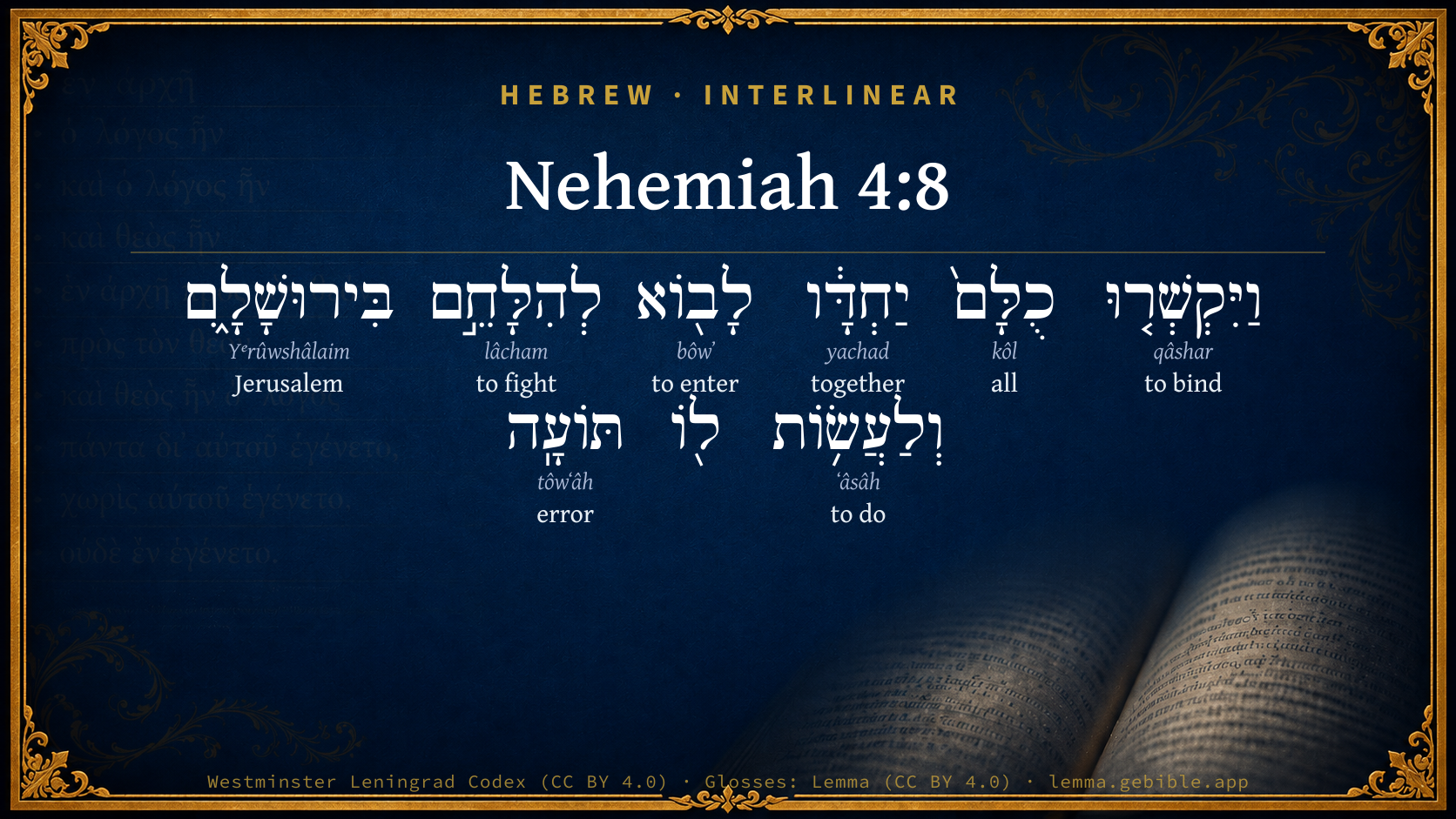
Hebrew (Westminster Leningrad Codex) Nehemiah 4:8 appears in the Hebrew Old Testament. The text above is from the Westminster Leningrad Codex. Each word links to its Strong’s number, a concise gloss, and parsing drawn from the Open Scriptures Hebrew Bible morphology. Click any word for its full Brown-Driver-Briggs (BDB) entry.
Download image
Cite this verse

Nehemiah 4:8 (World English Bible). Public Domain. Lemma interlinear Bible study tool, https://lemma.gebible.app/v/nehemiah/4/8.

Show BibTeX & RIS
BibTeX
RIS
English Translation
and they conspired all of them together to come and fight against Jerusalem, and to cause confusion therein.
World English Bible · Public Domain
Highlights
  • 1 first appearance in the Hebrew Bible
Full analysis ↓
Download a study sheet

One document with this verse’s original text, its word-by-word gloss line, the meaning frame, cross-references with their text, attributed commentary, and full source and license credits — printable, and it pastes into notes with its structure intact.

This verse Autodidact and up

Study sheet (.html) Plain text (.txt)

A passage Seminary Student

Up to 50 verses in one chapter. A passage sheet keeps up to 6 commentary sources and 12 cross-references per verse, in the order this page ranks them, and says so on the sheet whenever that leaves anything out. Ask for a single verse and you get the Autodidact verse sheet above.

Everything on this page stays free to read, with no account — the sheet is a download of what is already on screen, not access to it.

Want to remove ads? Support Godless Engineer
Compare translations 3

The same verse in 3 English versions, stacked beneath the original-language interlinear above. Click any original word for its lexicon entry.

Each is an independent rendering of the whole verse — the interlinear is not word-aligned to these translations.

Highlighted words mark where these versions differ — a whole-verse word diff, not a word-by-word alignment.

  • World English Bible Public Domain
    and they conspired all of them together to come and fight against Jerusalem, and to cause confusion therein.
  • King James Version Public Domain
    And conspired all of them together to come and to fight against Jerusalem, and to hinder it.
  • unfoldingWord Literal Text CC BY-SA 4.0
    And all of them together conspired to come to fight against Jerusalem and to make confusion for it.

unfoldingWord Literal Text — © unfoldingWord, licensed CC BY-SA 4.0. Word-aligned USFM3 via Door43 (git.door43.org/unfoldingWord/en_ult).

Versions to compare (up to 4)

3 of 4 selected

Show all 18 translations

Every available English version of this verse, each an independent rendering of the whole verse.

  • World English Bible Public Domain
    and they conspired all of them together to come and fight against Jerusalem, and to cause confusion therein.
  • Berean Standard Bible Public Domain
    and all of them conspired to come and fight against Jerusalem and create a hindrance.
  • Majority Standard Bible Public Domain
    and all of them conspired to come and fight against Jerusalem and create a hindrance.
  • King James Version Public Domain
    And conspired all of them together to come and to fight against Jerusalem, and to hinder it.
  • American Standard Version (1901) Public Domain
    and they conspired all of them together to come and fight against Jerusalem, and to cause confusion therein.
  • Revised Version (1885) Public Domain
    and they conspired all of them together to come and fight against Jerusalem, and to cause confusion therein.
  • Geneva Bible (1599) Public Domain
    And conspired all together to come and to fight against Ierusalem, and to hinder them.
  • Douay-Rheims (1899) Public Domain
    And they all assembled themselves together, to come, and to fight against Jerusalem, and to prepare ambushes.
  • Young's Literal Translation Public Domain
    and they conspire, all of them together, to come in to fight against Jerusalem, and to do to it injury.
  • Literal Standard Version CC BY-SA 4.0
    and they conspire, all of them together, to come to fight against Jerusalem, and to do to it injury.
  • Unlocked Literal Bible CC BY-SA 4.0
    They all conspired together, and they came to fight against Jerusalem and to cause confusion in it.
  • unfoldingWord Literal Text CC BY-SA 4.0
    And all of them together conspired to come to fight against Jerusalem and to make confusion for it.
  • Darby Bible Public Domain
    and conspired all of them together to come to fight against Jerusalem, and to hinder it.
  • World Messianic Bible Public Domain
    and they all conspired together to come and fight against Jerusalem, and to cause confusion among us.
  • Webster's Bible Public Domain
    And conspired all of them together to come and to fight against Jerusalem, and to hinder it.
  • Free Bible Version CC BY-SA 4.0
    They all plotted together to come and attack Jerusalem and to throw everything into confusion.
  • Bible in Basic English Public Domain
    And they made designs, all of them together, to come and make an attack on Jerusalem, causing trouble there.
  • JPS Tanakh (1917) Public Domain
    (4-2) and they conspired all of them together to come and fight against Jerusalem, and to cause confusion therein.

Literal Standard Version (2020), Covenant Press — licensed CC BY-SA 4.0. Text via the HelloAO Bible API (eBible.org). Unlocked Literal Bible (unfoldingWord) — licensed CC BY-SA 4.0. Text via the HelloAO Bible API (eBible.org). unfoldingWord Literal Text — © unfoldingWord, licensed CC BY-SA 4.0. Word-aligned USFM3 via Door43 (git.door43.org/unfoldingWord/en_ult). Free Bible Version, Dr. Jonathan Gallagher — licensed CC BY-SA 4.0. Text via the HelloAO Bible API (eBible.org).

Word by word

More ways to search: Search by grammar → Find every occurrence → Compare this word →

Practice this passage: Drill this verse → Learn its vocabulary →

About this verse

These counts appear in no published source. They are computed here, from the morphology-tagged text and Lemma’s own curated glosses. What Lemma adds →

9
words
8
distinct lemmas
Historical
section

Notable vocabulary

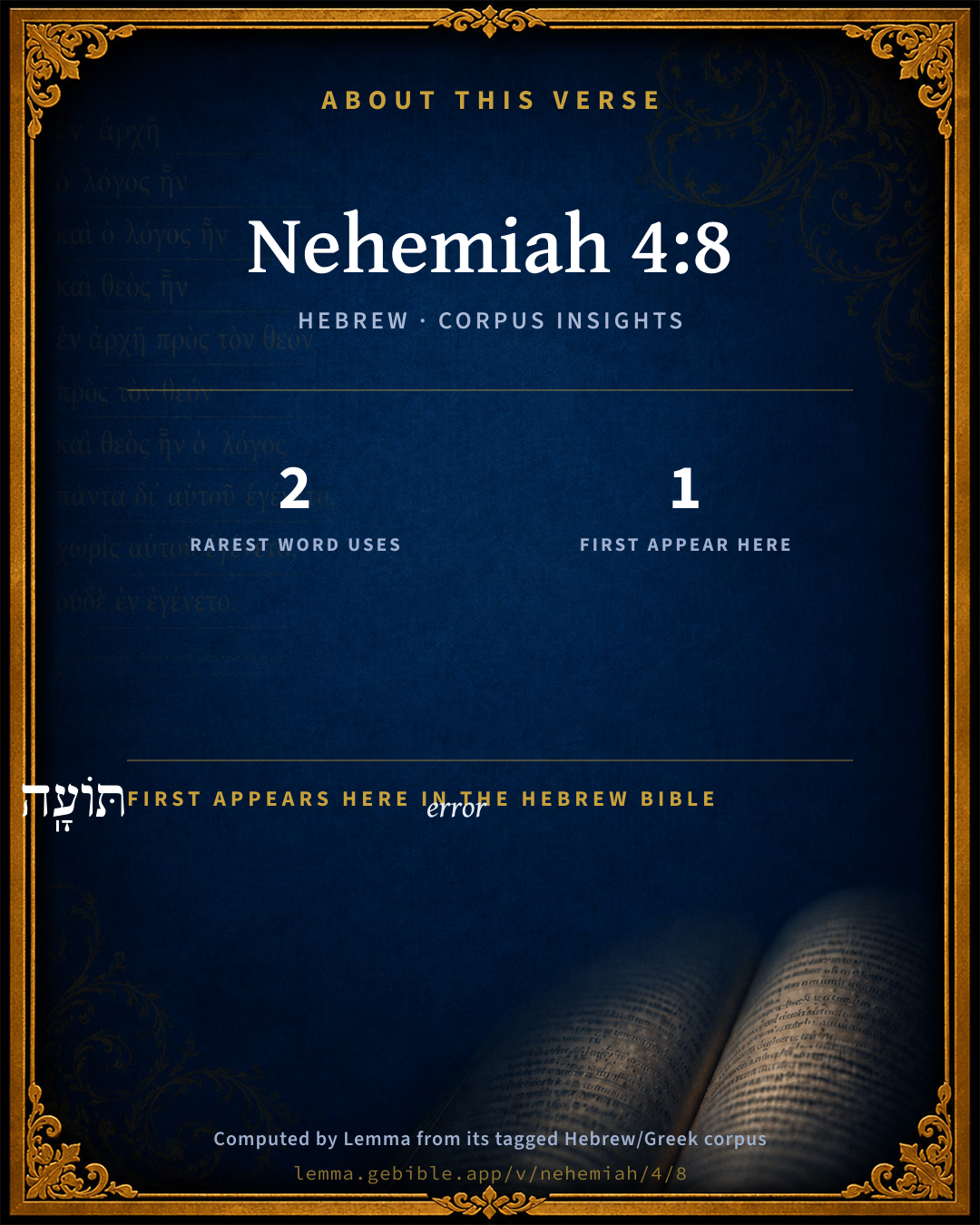
The rarest word here is תּוֹעָֽה error H8442 — appearing just 2 times in the whole Hebrew Bible.

First appearance in Scripture

This word makes its first canonical appearance in the Hebrew Bible here:

  • תּוֹעָֽה error H8442

Shared distinctive vocabulary

תּוֹעָֽה error H8442 occurs in 2 verses of the Hebrew Bible. Also found in:

Grammatical profile

  • 4 verbs
  • 3 nouns
  • 1 preposition
  • 1 adverb

Verb forms

  • וַיִּקְשְׁר֤וּ Qal · Sequential Imperfect
  • לָב֖וֹא Qal · Infinitive Construct
  • לְהִלָּחֵ֣ם Niphal · Infinitive Construct
  • וְלַעֲשׂ֥וֹת Qal · Infinitive Construct

Cross-references

5

Topical passages linked to Nehemiah 4:8 in the Treasury of Scripture Knowledge — connected by theme and wording, ordered by reader-vote popularity; previews shown in the World English Bible.

  • Psalms 83:3–11 They conspire with cunning against your people. They plot against your cherished ones.
  • Psalms 2:1–3 Why do the nations rage, And the peoples plot a vain thing?
  • Isaiah 8:9–10 Make an uproar, O you peoples, and be broken in pieces! And give ear, all you of far countries: gird yourselves, and be broken in pieces! Gird yourselves, and be broken in pieces!
  • Jeremiah 20:10 For I have heard the defaming of many, terror on every side. Denounce, and we will denounce him, [say] all my familiar friends, those who watch for my fall; peradventure he will be persuaded, and we shall prevail against him, and we shall take our revenge on him.
  • Acts 23:12–13 When it was day, some of the Jews banded together, and bound themselves under a curse, saying that they would neither eat nor drink until they had killed Paul.

Cross-references courtesy of OpenBible.info (CC BY 4.0).

Hebrew and Greek witnesses Masoretic Hebrew ↔ Greek Septuagint

The same verse in the two great witnesses to the Old Testament, shown verse-for-verse.

These are two independent witnesses, not word-aligned to each other, and the Septuagint is shown in lemma (dictionary) form.

Hebrew Nehemiah 4:8 Masoretic · Westminster Leningrad Codex

וַיִּקְשְׁר֤וּ כֻלָּם֙ יַחְדָּ֔ו לָב֖וֹא לְהִלָּחֵ֣ם בִּירוּשָׁלִָ֑ם וְלַעֲשׂ֥וֹת ל֖וֹ תּוֹעָֽה

and they conspired all of them together to come and fight against Jerusalem, and to cause confusion therein.

World English Bible · Public Domain

Greek LXX Structure differs

The Septuagint has no separate book of Nehemiah. Its Greek text is the second half of Esdras B (2 Esdras), chapters 11–23; Ezra is the first half (1–10).

A verse-for-verse comparison isn’t shown here because the chapters and verses don’t line up. Switch to the LXX edition with the MT / LXX toggle above to read the Greek directly.

On this verse, The Cambridge Bible for Schools and Colleges discusses the Septuagint’s reading. Read the note in Commentary ↓

Hebrew: Westminster Leningrad Codex (CC BY 4.0). Greek: Septuagint (public domain); English from a public-domain English Septuagint. How the Septuagint differs from the Hebrew →

Commentary

Notes on Nehemiah 4:8 from classic Christian and Jewish commentators (each source and its license shown beneath its notes). The classic Christian expositions comment on the surrounding passage and are grouped to its opening verse, so a note may address several verses; the Jewish commentaries on the Tanakh (Rashi and others) are per-verse, so they appear only where the commentator wrote on this verse.

Lemma curates 59 commentaries, every one of them public domain or Creative Commons licensed, each selected and text-cleaned for this edition rather than reprinted as found. About our sources →

Trapp's Complete Commentary

John Trapp

Neh 4:8 And conspired all of them together to come [and] to fight against Jerusalem, and to hinder it.

Ver. 8. And conspired all of them together] All of them, and together; and yet this was not unity, but conspiracy; such as is that among devils, Mar 5:9, among Antichristians, Rev 17:13, among Turks, who have as little dissension in their religion as any. But well may that garment have no seam that hath no shape. The army of Nineveh was quiet, Nah 1:12, no falling out nor complaining in their hosts; hence their king marched on, passed through. But so did not these conspirators, because they met with those that were no less well combined and far better resolved than themselves. The Thebans had a band of men they called Sacra Cohors, sacred cohorts, ιερος λοχος (Athen. 1.3), consisting of such only as were joined in the bonds of love, and resolved to live and die together. These Jews under the command of Nehemiah were none other, and were therefore insuperable.

To come and to fight] To turn their works into knocks.

And to hinder it] Heb. To make an error in it. The Hebrew word is used both of the error of the heart and of the foot, Isa 63:17 Psa 119:176. It may be rendered here, to hinder him, to make an error in him; to make Nehemiah at a stand, or rather to run away, to creep into corners, and give over the work.

John Trapp, A Commentary or Exposition upon All the Books of the Old and New Testament (1647–1656) — public domain. Text from a community e-Sword module.

Geneva Bible (1599)

Geneva Bible translators

Hebrew, make to stay, meaning the people.

Geneva Bible (1599) marginal notes — public domain. Text via Bolls.life.

Ellicott's Commentary for English Readers

(8) And conspired.—Not fearing the Persian authority, they resolved to attack the city; but it will be seen that they soon abandoned that project.

To hinder it.—Rather, to do it hurt.

A Bible Commentary for English Readers, edited by Charles John Ellicott (1878–1897) — public domain. Text from a community e-Sword module.

The Cambridge Bible for Schools and Colleges

gen. ed. J. J. S. Perowne

8. and conspired all of them] R.V. and they conspired all of them. R.V. makes a stronger pause at the close of Neh_4:7, substituting a semicolon for the comma. ‘Conspired.’ The word here used is the usual term for secret treachery.

to come and to fight] R.V. to come and fight. Literally ‘to come fight’ without the copula. This idiom, which occurs again in Neh_9:15; Neh_9:23 (cf. 1Ch_12:31; 2Ch_20:11), combines the thought of the two infinitives, the latter being epexegetic of the former. It is equivalent ‘to come for the purpose of fighting.’

and to hinder it] R.V. and to cause confusion therein. More literally ‘and to cause confusion to him.’ The masc. pronoun is here used, referring to the dwellers in Jerusalem. ‘to cause or make confusion’, the word rendered ‘confusion’ occurs only here and in Isa_32:6, ‘to utter error against the Lord.’ The rareness of the word occasioned difficulty to the versions. Hence LXX. ποιῆσαι αὐτὴν ἀφανῆ, Vulg. molirentur insidias.

The sudden arrival of hostile forces outside Jerusalem would be calculated ‘to cause confusion.’ It would encourage those who were already disaffected, and would terrify the timid. It would impede the work; for the patriot Jews would have to abandon the building for the sake of defending their walls, while the unwilling workers would gladly avail themselves of the pretext.

The Cambridge Bible for Schools and Colleges (gen. ed. J. J. S. Perowne; Cambridge University Press, 1878–1918) — public domain. Text from a community e-Sword module.

John Gill's Exposition

And conspired all of them together,.... All the above men and people entered into a confederacy and combination:

to come and to fight against Jerusalem; to bring an army with them, and by force cause the Jews to desist; the Jews (e) pretend they came to war, and brought with them an army of 180,000 men, which is not probable:

and to hinder it; the building of the walls of it; or "to make a wandering for him" (f); for Nehemiah, or the people, or both, to, cause them to stray from their work, to frighten them from it, that they might become like men at their wits end, not knowing what to do, where to turn themselves, or what course to steer, but to wander about as persons out of their senses; so Aben Ezra. De Dieu joins this clause to the next verse, to cause everyone of them to wander, we prayed, &c.

(e) Pirke Eliezer, c. 38. (f) "ad faciendum ei errorem", Montanus; "ei aberrationem", Genevenses; "vagationem et palationem", alii apud De Dieu.

John Gill's Exposition of the Whole Bible (1746–1763) — public domain (CC PDM 1.0). Text via the HelloAO Bible API.

Haydock's Catholic Bible Commentary

Together, to the number of 180,000, according to the Jews; who say that they were terrified, at the excommunication pronounced by 300 priests against them, while 300 young men sounded trumpets; and they fled, leaving Nehemias at liberty to continue the work. It is a pity that we have no foundation for this in Scripture. (Calmet) See 1 Esdras iv. 3. (Haydock) --- The Samaritans durst not openly attack the Jews, who were under the protection of the Persian monarch. But they endeavoured clandestinely to injure them, (Tirinus) and to prepare ambushes. (Haydock)

George Leo Haydock (1774–1849), Haydock's Catholic Family Bible and Commentary, 1859 edition — public domain. Excludes Psalms (Douay-Rheims chapter numbering differs from Protestant) and Deuterocanonical books (Catholic canon only).

Whedon's Commentary on the Bible

Daniel D. Whedon

8. To come… to fight… to hinder — None of these purposes, however, seem to have been carried out by the conspiring parties. The Hebrew here for hinder, is, literally to do to it a disturbance.

Daniel D. Whedon (gen. ed.), Commentary on the Old and New Testaments (1874–1909) — public domain. Text from a community e-Sword module.

The Pulpit Commentary

To hinder it. Rather, "to do it hurt." The word used is a rare one. According to Gesenius, it has the two senses of "error" and "injury."

The Pulpit Commentary (1880–1919), ed. H.D.M. Spence-Jones & Joseph S. Exell — public domain. Text from a community e-Sword module.

Rashi

Rabbi Shlomo Yitzchaki (Rashi)

And I saw, and I arose And when I saw the enemies coming, I arose to speak to the nobles and to the prefects to spur them to fight against our enemy.

for your brethren Heb. עַל אֲחֵיכֶם, for the sake of your brethren.

Rashi on the Tanakh — English translations: “The Judaica Press complete Tanach with Rashi, translated by A. J. Rosenberg” (CC BY 4.0); “Pentateuch with Rashi's commentary by M. Rosenbaum and A.M. Silbermann, 1929-1934” (public domain); “The Metsudah Tanach series, Lakewood, N.J” (CC BY 4.0); and “The Book of Joshua, Metsudah Publications, 1997” (CC BY 4.0). Text via Sefaria.

Lesson kit

Teaching starters — assembled from the data on this page, not authored interpretation. Every prompt links to the verse data it draws on. Edit before teaching.

Nehemiah, in the Historical, opens this verse with 9 words (8 distinct Hebrew lemmas). Its most distinctive word is tôwʻâh (“error”). A historical commentator’s framing appears above. Read the whole chapter for the surrounding context.

Discussion questions

  1. How does “error” (tôwʻâh) shape what this verse is saying?
  2. This is the first place “error” appears in Scripture (first appears here). What does its debut here establish?
  3. How does Isaiah 32:6, which shares the word «error», read alongside this verse?
  4. These translations render this verse differently. What is at stake in choosing one wording over another?
  5. «וַיִּקְשְׁר֤וּ» is a Qal Sequential Imperfect verb. How does that grammatical form shape the action described?
  6. Compare how Trapp's Complete Commentary and Geneva Bible (1599) read this verse. Where do they agree or differ?

Things to notice

  • 1 word makes its first canonical appearance in Scripture here.
  • These translations choose different wording for 5 words in this verse.
  • 8 distinct Hebrew lemmas span 9 words in this verse.

Reading settings

Reading text

Shown beneath each verse's original-language words.

Old Testament
Old Testament edition

Read the OT as the Masoretic Hebrew (MT) or the Greek Septuagint (LXX).

English shown for the Greek Septuagint (in the Hebrew ↔ Greek comparison).

Comparing translations? Open the Compare panel on any verse page to stack up to four side by side.