Isaiah 36:20

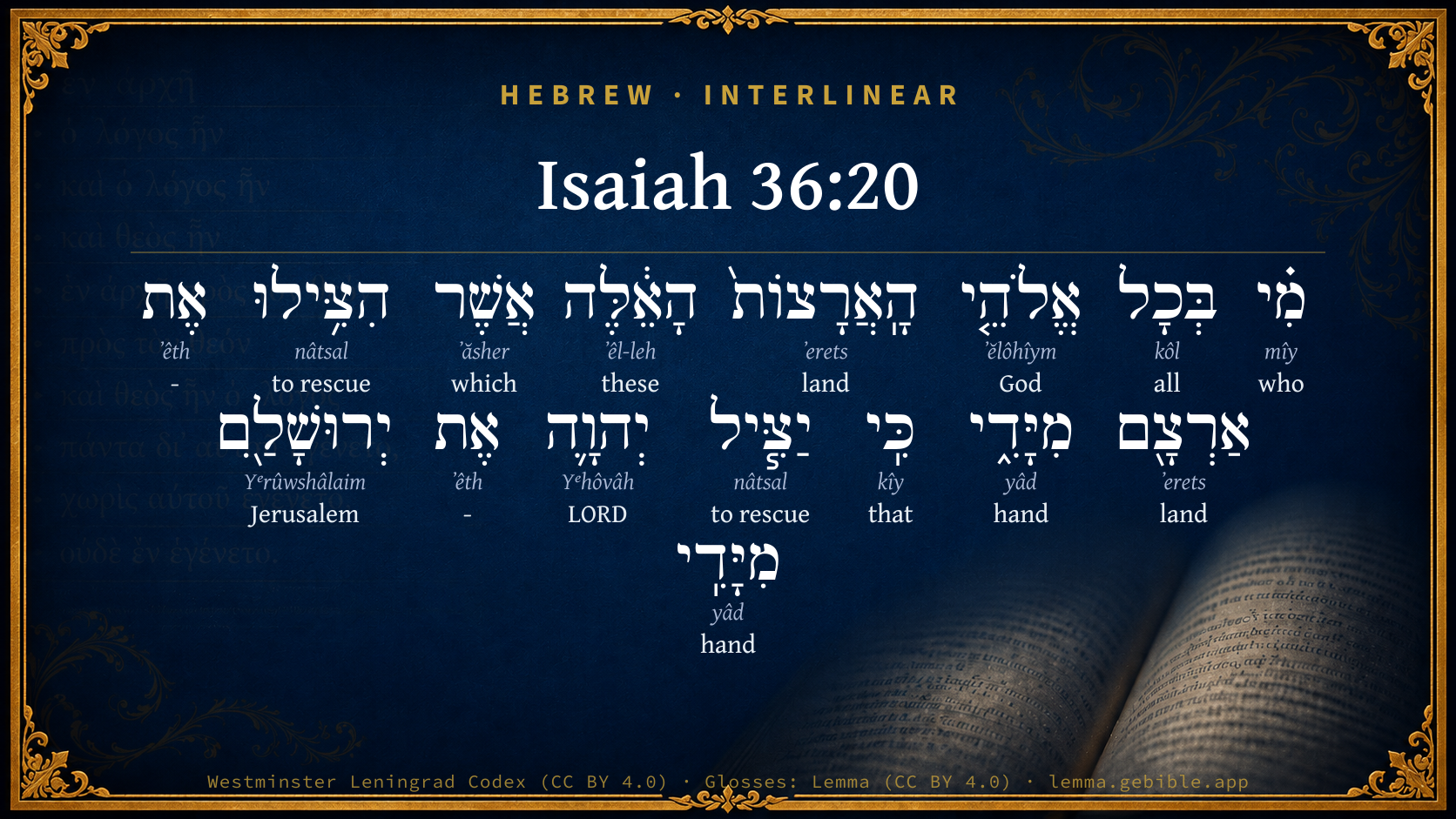
Hebrew (Westminster Leningrad Codex) Isaiah 36:20 appears in the Hebrew Old Testament. The text above is from the Westminster Leningrad Codex. Each word links to its Strong’s number, a concise gloss, and parsing drawn from the Open Scriptures Hebrew Bible morphology. Click any word for its full Brown-Driver-Briggs (BDB) entry.
Download image
Cite this verse

Isaiah 36:20 (World English Bible). Public Domain. Lemma interlinear Bible study tool, https://lemma.gebible.app/v/isaiah/36/20.

Show BibTeX & RIS
BibTeX
RIS
English Translation
Who are they among all the gods of these countries, that have delivered their country out of my hand, that Yahweh should deliver Jerusalem out of my hand?
World English Bible · Public Domain
Download a study sheet

One document with this verse’s original text, its word-by-word gloss line, the meaning frame, cross-references with their text, attributed commentary, and full source and license credits — printable, and it pastes into notes with its structure intact.

This verse Autodidact and up

Study sheet (.html) Plain text (.txt)

A passage Seminary Student

Up to 50 verses in one chapter. A passage sheet keeps up to 6 commentary sources and 12 cross-references per verse, in the order this page ranks them, and says so on the sheet whenever that leaves anything out. Ask for a single verse and you get the Autodidact verse sheet above.

Everything on this page stays free to read, with no account — the sheet is a download of what is already on screen, not access to it.

Want to remove ads? Support Godless Engineer
Compare translations 3

The same verse in 3 English versions, stacked beneath the original-language interlinear above. Click any original word for its lexicon entry.

Each is an independent rendering of the whole verse — the interlinear is not word-aligned to these translations.

Highlighted words mark where these versions differ — a whole-verse word diff, not a word-by-word alignment.

  • World English Bible Public Domain
    Who are they among all the gods of these countries, that have delivered their country out of my hand, that Yahweh should deliver Jerusalem out of my hand?
  • King James Version Public Domain
    Who are they among all the gods of these lands, that have delivered their land out of my hand, that the LORD should deliver Jerusalem out of my hand?
  • unfoldingWord Literal Text CC BY-SA 4.0
    Who among all of the gods of these lands that have delivered their land from my hand, that Yahweh should deliver Jerusalem from my hand?’”

unfoldingWord Literal Text — © unfoldingWord, licensed CC BY-SA 4.0. Word-aligned USFM3 via Door43 (git.door43.org/unfoldingWord/en_ult).

Versions to compare (up to 4)

3 of 4 selected

Show all 18 translations

Every available English version of this verse, each an independent rendering of the whole verse.

  • World English Bible Public Domain
    Who are they among all the gods of these countries, that have delivered their country out of my hand, that Yahweh should deliver Jerusalem out of my hand?
  • Berean Standard Bible Public Domain
    Who among all the gods of these lands has delivered his land from my hand? How then can the LORD deliver Jerusalem from my hand?”
  • Majority Standard Bible Public Domain
    Who among all the gods of these lands has delivered his land from my hand? How then can the LORD deliver Jerusalem from my hand?”
  • King James Version Public Domain
    Who are they among all the gods of these lands, that have delivered their land out of my hand, that the LORD should deliver Jerusalem out of my hand?
  • American Standard Version (1901) Public Domain
    Who are they among all the gods of these countries, that have delivered their country out of my hand, that Jehovah should deliver Jerusalem out of my hand?
  • Revised Version (1885) Public Domain
    Who are they among all the gods of these countries, that have delivered their country out of my hand, that the LORD should deliver Jerusalem out of my hand?
  • Geneva Bible (1599) Public Domain
    Who is hee among all the gods of these lands, that hath deliuered their countrey out of mine hand, that the Lord should deliuer Ierusalem out of mine hand?
  • Douay-Rheims (1899) Public Domain
    Who is there among all the gods of these lands, that hath delivered his country out of my hand, that the Lord may deliver Jerusalem out of my hand?
  • Young's Literal Translation Public Domain
    Who among all the gods of these lands `are' they who have delivered their land out of my hand, that Jehovah doth deliver Jerusalem out of my hand?'
  • Literal Standard Version CC BY-SA 4.0
    Who among all the gods of these lands [are] they who have delivered their land out of my hand, that YHWH delivers Jerusalem out of my hand?”
  • Unlocked Literal Bible CC BY-SA 4.0
    Among all the gods of these lands, is there any god who has rescued his land from my power, as if Yahweh could save Jerusalem from my power?”
  • unfoldingWord Literal Text CC BY-SA 4.0
    Who among all of the gods of these lands that have delivered their land from my hand, that Yahweh should deliver Jerusalem from my hand?’”
  • Darby Bible Public Domain
    Who are they among all the gods of these countries that have delivered their country out of my hand, that Jehovah should deliver Jerusalem out of my hand?
  • World Messianic Bible Public Domain
    Who are they among all the gods of these countries that have delivered their country out of my hand, that the LORD should deliver Jerusalem out of my hand?’”
  • Webster's Bible Public Domain
    Who are they among all the gods of these lands, that have delivered their land out of my hand, that the LORD should deliver Jerusalem out of my hand?
  • Free Bible Version CC BY-SA 4.0
    Which one of all the gods of these countries has saved their land from me? How then could the Lord save Jerusalem from me?”
  • Bible in Basic English Public Domain
    Who among all the gods of these countries have kept their country from falling into my hand, to give cause for the thought that the Lord will keep Jerusalem from falling into my hand?
  • JPS Tanakh (1917) Public Domain
    Who are they among all the gods of these countries, that have delivered their country out of my hand, that the LORD should deliver Jerusalem out of my hand?'

Literal Standard Version (2020), Covenant Press — licensed CC BY-SA 4.0. Text via the HelloAO Bible API (eBible.org). Unlocked Literal Bible (unfoldingWord) — licensed CC BY-SA 4.0. Text via the HelloAO Bible API (eBible.org). unfoldingWord Literal Text — © unfoldingWord, licensed CC BY-SA 4.0. Word-aligned USFM3 via Door43 (git.door43.org/unfoldingWord/en_ult). Free Bible Version, Dr. Jonathan Gallagher — licensed CC BY-SA 4.0. Text via the HelloAO Bible API (eBible.org).

Word by word

More ways to search: Search by grammar → Find every occurrence → Compare this word →

Practice this passage: Drill this verse → Learn its vocabulary →

הִצִּ֥ילוּ
nâtsal
H5337
“to rescue”
Verb, Hiphil, Perfect, 3rd Person, Common, Plural
Part of Speech
Verb
Stem
Hiphil
Form
Perfect
Person
3rd Person
Gender
Common
Number
Plural
Full BDB Definition

Origin: a primitive root

TWOT: 1404

to snatch away, deliver, rescue, save, strip, plunder - (Niphal) - to tear oneself away, deliver oneself - to be torn out or away, be delivered - (Piel) - to strip off, spoil - to deliver - (Hiphil) - to take away, snatch away - to rescue, recover - to deliver (from enemies or troubles or death) - to deliver from sin and guilt - (Hophal) to be plucked out - (Hithpael) to strip oneself
  1. מִ֗י mîy H4310 “who” Particle, Interrogative
  2. בְּכָל kôl H3605 “in/at · all of” Preposition + Noun, Common, Masculine, Singular, Construct
  3. אֱלֹהֵ֤י ʼĕlôhîym H430 “God(s) of” Noun, Common, Masculine, Plural, Construct
  4. הָֽאֲרָצוֹת֙ ʼerets H776 “the · lands” Particle, Definite Article + Noun, Common, Both, Plural, Absolute
  5. הָאֵ֔לֶּה ʼêl-leh H428 “the · these” Particle, Definite Article + Pronoun, Demonstrative, Common, Plural
  6. אֲשֶׁר ʼăsher H834 “which” Particle, Relative
  7. אֶת ʼêth H853 “-” Particle, Direct Object
  8. אַרְצָ֖ם ʼerets H776 “land · their” Noun, Common, Both, Singular, Construct + Suffix, Personal, 3rd Person, Masculine, Plural
  9. מִיָּדִ֑י yâd H3027 “from · hand · my” Preposition + Noun, Common, Both, Singular, Construct + Suffix, Personal, 1st Person, Common, Singular
  10. כִּֽי kîy H3588 “that” Conjunction
  11. יַצִּ֧יל nâtsal H5337 “to rescue” Verb, Hiphil, Imperfect, 3rd Person, Masculine, Singular
  12. יְהוָ֛ה Yᵉhôvâh H3068 “LORD” Noun, Proper
  13. אֶת ʼêth H853 “-” Particle, Direct Object
  14. יְרוּשָׁלִַ֖ם Yᵉrûwshâlaim H3389 “Jerusalem” Noun, Proper
  15. מִיָּדִֽי yâd H3027 “from · hand · my” Preposition + Noun, Common, Both, Singular, Construct + Suffix, Personal, 1st Person, Common, Singular

About this verse

These counts appear in no published source. They are computed here, from the morphology-tagged text and Lemma’s own curated glosses. What Lemma adds →

16
words
12
distinct lemmas
Prophets
section

Grammatical profile

  • 2 verbs
  • 8 nouns
  • 1 pronoun
  • 1 conjunction
  • 4 particles

Verb forms

  • הִצִּ֥ילוּ Hiphil · Perfect
  • יַצִּ֧יל Hiphil · Imperfect

Repetition

Words recur within this verse — often emphatic in Hebrew:

  • הָֽאֲרָצוֹת֙ land H776 ×2
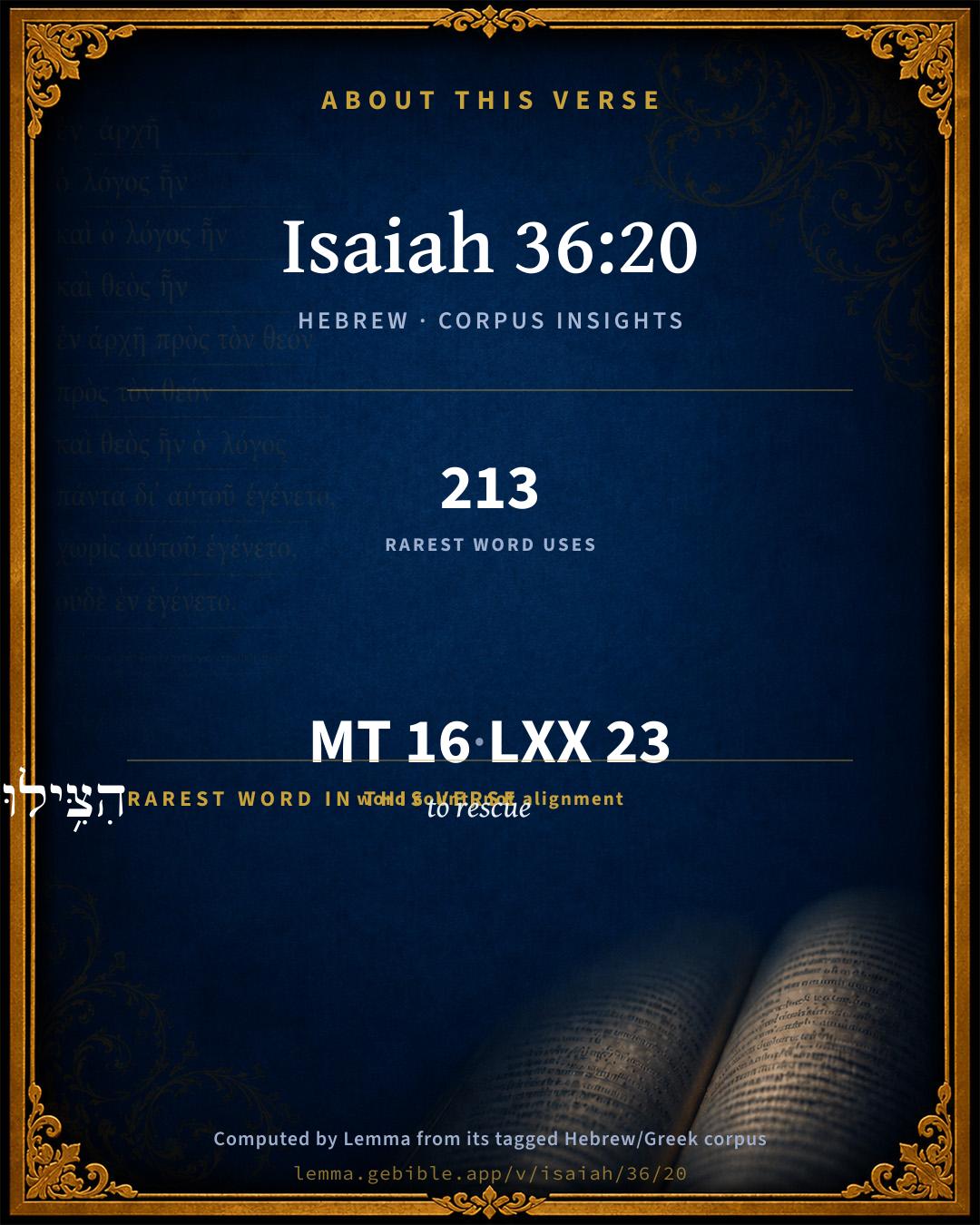
  • הִצִּ֥ילוּ to rescue H5337 ×2
  • מִיָּדִ֑י hand H3027 ×2

Hebrew & Septuagint length

In English translation the verse runs 28 words from the Hebrew and 26 from the Septuagint (LXX English) — closely comparable.

A rough comparison of the two English renderings, which tokenize alike — not a word-level alignment.

Word counts can differ between the Hebrew and the Greek without any difference in meaning — e.g. the Hebrew direct-object marker אֵת has no separate Greek word, and Greek often adds the article ὁ.

In the original languages it is 16 Hebrew tokens and 23 Greek tokens — but the two are counted differently (Hebrew bundles its prefixes and suffixes into one token; the Greek is in lemma form), so that isn’t a like-for-like length.

Cross-references

13

Topical passages linked to Isaiah 36:20 in the Treasury of Scripture Knowledge — connected by theme and wording, ordered by reader-vote popularity; previews shown in the World English Bible.

  • 2 Chronicles 32:19 They spoke of the God of Jerusalem, as of the gods of the peoples of the earth, which are the work of men's hands.
  • Psalms 50:21 You have done these things, and I kept silent. You thought that the "I AM" was just like you. I will rebuke you, and accuse you in front of your eyes.
  • Exodus 5:2 Pharaoh said, "Who is Yahweh, that I should listen to his voice to let Israel go? I don't know Yahweh, and moreover I will not let Israel go."
  • 1 Kings 20:23 The servants of the king of Syria said to him, Their god is a god of the hills; therefore they were stronger than we: but let us fight against them in the plain, and surely we shall be stronger than they.
  • 2 Kings 19:22–37 Whom have you defied and blasphemed? and against whom have you exalted your voice and lifted up your eyes on high? [even] against the Holy One of Israel.
  • 2 Chronicles 32:15 Now therefore don't let Hezekiah deceive you, nor persuade you after this manner, neither believe you him; for no god of any nation or kingdom was able to deliver his people out of my hand, and out of the hand of my fathers: how much less shall your God deliver you out of my hand?
  • Job 15:25–26 Because he has stretched out his hand against God, And behaves himself proudly against the Almighty;
  • Psalms 73:9 They have set their mouth in the heavens. Their tongue walks through the earth.
  • Isaiah 37:18–19 Of a truth, Yahweh, the kings of Assyria have laid waste all the countries, and their land,
  • Isaiah 37:23–29 Whom have you defied and blasphemed? and against whom have you exalted your voice and lifted up your eyes on high? [even] against the Holy One of Israel.
  • Isaiah 45:16–17 They shall be disappointed, yes, confounded, all of them; they shall go into confusion together who are makers of idols.
  • Daniel 3:15 Now if you are ready whenever you hear the sound of the horn, flute, zither, lyre, harp, pipe, and all kinds of music to you fall down and worship the image which I have made, [well]: but if you don't worship, you shall be cast the same hour into the midst of a burning fiery furnace; and who is that god that shall deliver you out of my hands?
  • Job 40:9–12 Or have you an arm like God? Can you thunder with a voice like him?

Cross-references courtesy of OpenBible.info (CC BY 4.0).

Hebrew and Greek witnesses Masoretic Hebrew ↔ Greek Septuagint

The same verse in the two great witnesses to the Old Testament, shown verse-for-verse.

These are two independent witnesses, not word-aligned to each other, and the Septuagint is shown in lemma (dictionary) form.

Hebrew Isaiah 36:20 Masoretic · Westminster Leningrad Codex

מִ֗י בְּכָל אֱלֹהֵ֤י הָֽאֲרָצוֹת֙ הָאֵ֔לֶּה אֲשֶׁר הִצִּ֥ילוּ אֶת אַרְצָ֖ם מִיָּדִ֑י כִּֽי יַצִּ֧יל יְהוָ֛ה אֶת יְרוּשָׁלִַ֖ם מִיָּדִֽי

Who are they among all the gods of these countries, that have delivered their country out of my hand, that Yahweh should deliver Jerusalem out of my hand?

World English Bible · Public Domain

Greek LXX Isaiah 36:20 Septuagint · lemma form

τίς ὁ θεός πᾶς ὁ ἔθνος οὗτος ῥύομαι ὁ γῆ αὐτός ἐκ ὁ χείρ ἐγώ ὅτι ῥύομαι ὁ θεός ἰερουσαλήμ ἐκ χείρ ἐγώ

Which is the god of all these nations, that has delivered his land out of my hand, that God should deliver Jerusalem out of my hand?

LXX2012 (modern English Septuagint) · Public Domain

Hebrew: Westminster Leningrad Codex (CC BY 4.0). Greek: Septuagint (public domain); English from LXX2012 (modern English Septuagint) (Public Domain). How the Septuagint differs from the Hebrew →

Targum (Aramaic paraphrase)

1

The Targum is the ancient Jewish Aramaic paraphrase of the Hebrew Scriptures — an interpretive translation, not the Hebrew text itself. Onkelos (literal) and Pseudo-Jonathan (expansive) render the Torah, and Jonathan the Prophets. Coverage is partial: where no permissively-licensed English translation exists for a verse, only the Aramaic is shown. This is verse-level text, not a word-by-word alignment to the Hebrew.

  1. Targum Jonathan Prophets (Joshua–Malachi)
    מַן בְּכָל דַחֲלַת מְדִינָתָא הָאִלֵין דְשֵׁיזָבוּ יַת אַרְעֲהוֹן מִן יְדִי אֲרֵי יְשֵׁיזִיב יְיָ יַת יְרוּשְׁלֵם מִן יְדִי:

    Who are they among all the gods of these lands, that have delivered their land from my hand, that the Lord shall deliver Jerusalem from my hand?

    Targum Jonathan — Aramaic: “Mikraot Gedolot” (public domain). English: “Sefaria Community Translation” (CC0 1.0 (public-domain dedication)); “London "Chaldee Paraphrase," 1871” (public domain). Text via Sefaria.

Commentary

Notes on Isaiah 36:20 from classic Christian and Jewish commentators (each source and its license shown beneath its notes). The classic Christian expositions comment on the surrounding passage and are grouped to its opening verse, so a note may address several verses; the Jewish commentaries on the Tanakh (Rashi and others) are per-verse, so they appear only where the commentator wrote on this verse.

Lemma curates 59 commentaries, every one of them public domain or Creative Commons licensed, each selected and text-cleaned for this edition rather than reprinted as found. About our sources →

Jamieson, Fausset & Brown

Robert Jamieson, A. R. Fausset & David Brown

(Compare Isa 10:11; Ch2 32:19). Here he contradicts his own assertion (Isa 36:10), that he had "come up against the land with the Lord." Liars need good memories. He classes Jehovah with the idols of the other lands; nay, thinks Him inferior in proportion as Judah, under His tutelage, was less than the lands under the tutelage of the idols.

Jamieson, Fausset & Brown — Commentary Critical and Explanatory on the Whole Bible (1871) — public domain (CC PDM 1.0). Text via the HelloAO Bible API.

John Gill's Exposition

Who are they amongst all the gods of these lands, that have delivered their land out of my hand?.... Not one of them, it is suggested; wherefore then should it be thought practicable,

that the Lord should deliver Jerusalem out of my hand? thus blasphemously setting the Lord God of Israel upon a level with the fictitious gods of the Gentiles; though these could not, the Lord could, being the Lord God Almighty. If Rabshakeh was an apostate Jew, he must have known better; but the malice of such is usually the greatest.

John Gill's Exposition of the Whole Bible (1746–1763) — public domain (CC PDM 1.0). Text via the HelloAO Bible API.

Whedon's Commentary on the Bible

Daniel D. Whedon

20-22. Rabshakeh continues his impious, Jehovah-defying argument, but to no avail. They, the Jews, held their peace, according to the instruction of their king Hezekiah. Rabshakeh’s eloquence was spent in vain. The God-fearing Hezekiah had succeeded well in his reformation of the masses.

A few worldly or false ones at court had not reformed, and they doubtless had caused the king to fall in with their temporizing policy of securing a promise of help from Egypt. It is fair to believe, with Delitzsch, that the commissioners, on Rabshakeh’s turning to the people on the wall, retired at once to Hezekiah, rending their clothes in grief at the disgrace they had experienced.

The second attempt of the Assyrians to force the surrender of Jerusalem begins at Isa_37:8, and closes the chapter.

Daniel D. Whedon (gen. ed.), Commentary on the Old and New Testaments (1874–1909) — public domain. Text from a community e-Sword module.

J. A. Alexander on Isaiah

Joseph Addison Alexander

“Who (are they) among all the gods of these lands, that have delivered their land out of my hand, that Jehovah should deliver Jerusalem out of my hand?” In this argumentative interrogation, he puts Jehovah on a level with the gods of the surrounding nations. This is still more frequently and pointedly expressed in the parallel passage in Chronicles. “Know ye not what I and my fathers have done unto all the nations of the countries? Were the gods of the nations of the countries able to deliver their country out of my hand? Who was there among all the gods of these nations, which my fathers utterly destroyed, that was able to deliver his people out of my hand, that your God should be able to deliver you out of my hand? And now, let not Hezekiah deceive you, and let him not seduce you, neither believe him; for no god of any nation or kingdom has been able to deliver his people out of my hand, and out of the hand of my fathers; how much less shall your God deliver you out of my hand” (2Ch 32:13-15). From the same authority we learn that over and above what is recorded, Sennacherib’s servants spake still more against the God Jehovah and against Hezekiah his servant (v.16), and that they cried with a loud voice in the Jewish language, to the people of Jerusalem who were on the wall, to affright them, and to trouble them, that they might take the city; and they spake against the God of Jerusalem as against the gods of the nations of the earth, the work of man’s hands.

Joseph Addison Alexander, The Prophecies of Isaiah (1846–1847; New York: Scribner, 1870–1878) — public domain. Text from a community e-Sword module.

Lesson kit

Teaching starters — assembled from the data on this page, not authored interpretation. Every prompt links to the verse data it draws on. Edit before teaching.

Isaiah, in the Prophets, opens this verse with 16 words (12 distinct Hebrew lemmas). Its most distinctive word is nâtsal (“to rescue”). A historical commentator’s framing appears above. Read the whole chapter for the surrounding context.

Discussion questions

  1. The word nâtsal carries the sense “to rescue.” How does it shape the verse?
  2. 2 Chronicles 32:19 shares this passage’s theme. How do the two illuminate each other?
  3. “land” occurs 2× in this one verse. What is the effect of the repetition?
  4. These translations render this verse differently. What is at stake in choosing one wording over another?
  5. The verb «הִצִּ֥ילוּ» is Hiphil Perfect. How does its form color the action?
  6. Reading how Jamieson, Fausset & Brown and John Gill's Exposition read this verse, where do the two commentators agree and where do they part?

Things to notice

Reading settings

Reading text

Shown beneath each verse's original-language words.

Old Testament
Old Testament edition

Read the OT as the Masoretic Hebrew (MT) or the Greek Septuagint (LXX).

English shown for the Greek Septuagint (in the Hebrew ↔ Greek comparison).

Comparing translations? Open the Compare panel on any verse page to stack up to four side by side.