
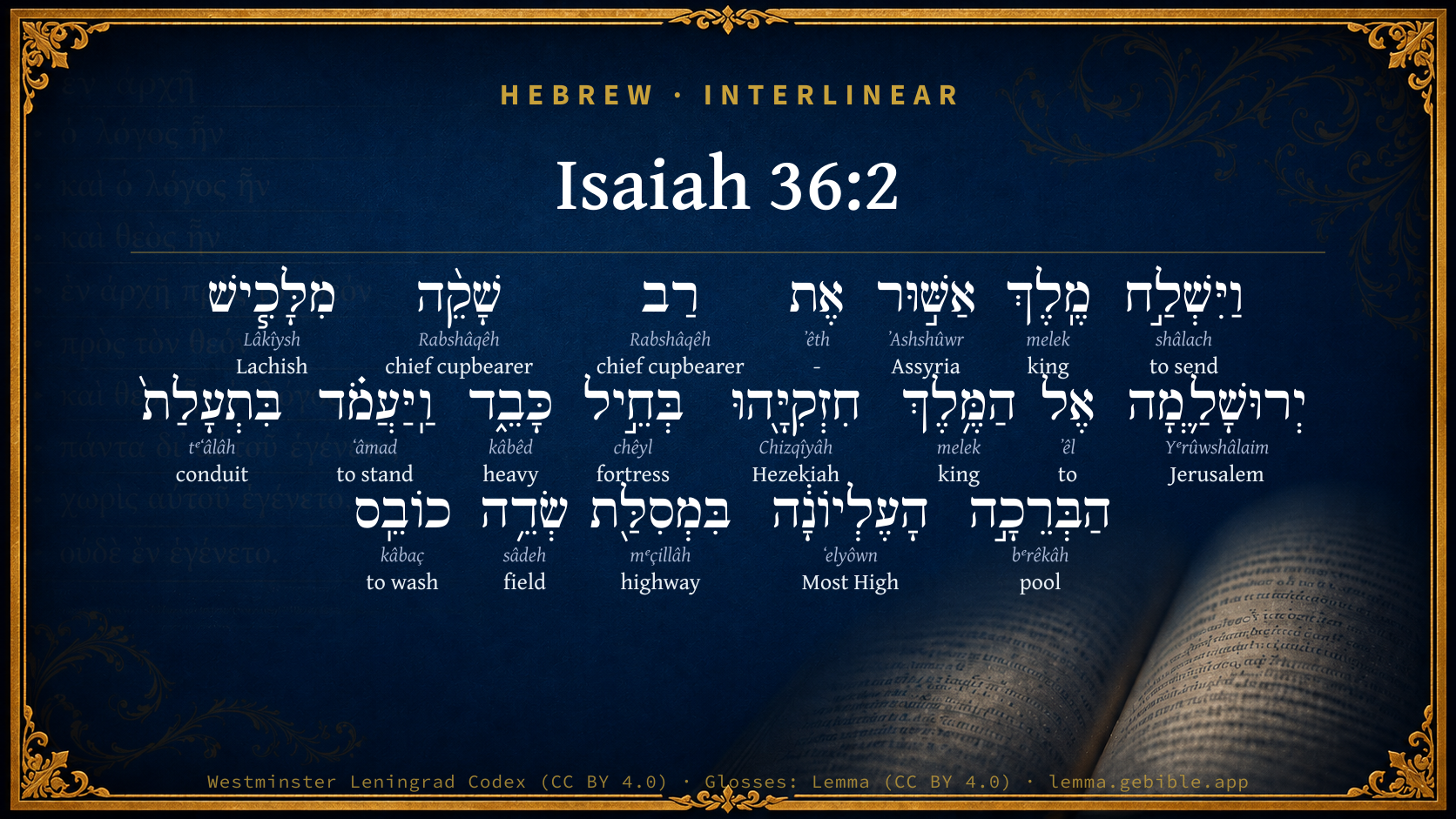
Isaiah 36:2

Hebrew (Westminster Leningrad Codex) Isaiah 36:2 appears in the Hebrew Old Testament. The text above is from the Westminster Leningrad Codex. Each word links to its Strong’s number, a concise gloss, and parsing drawn from the Open Scriptures Hebrew Bible morphology. Click any word for its full Brown-Driver-Briggs (BDB) entry.
Download image
Cite this verse

Isaiah 36:2 (World English Bible). Public Domain. Lemma interlinear Bible study tool, https://lemma.gebible.app/v/isaiah/36/2.

Show BibTeX & RIS
BibTeX
RIS
English Translation
The king of Assyria sent Rabshakeh from Lachish to Jerusalem to king Hezekiah with a great army. He stood by the conduit of the upper pool in the highway of the fuller's field.
World English Bible · Public Domain
Download a study sheet

One document with this verse’s original text, its word-by-word gloss line, the meaning frame, cross-references with their text, attributed commentary, and full source and license credits — printable, and it pastes into notes with its structure intact.

This verse Autodidact and up

Study sheet (.html) Plain text (.txt)

A passage Seminary Student

Up to 50 verses in one chapter. A passage sheet keeps up to 6 commentary sources and 12 cross-references per verse, in the order this page ranks them, and says so on the sheet whenever that leaves anything out. Ask for a single verse and you get the Autodidact verse sheet above.

Everything on this page stays free to read, with no account — the sheet is a download of what is already on screen, not access to it.

Want to remove ads? Support Godless Engineer
Compare translations 3

The same verse in 3 English versions, stacked beneath the original-language interlinear above. Click any original word for its lexicon entry.

Each is an independent rendering of the whole verse — the interlinear is not word-aligned to these translations.

Highlighted words mark where these versions differ — a whole-verse word diff, not a word-by-word alignment.

  • World English Bible Public Domain
    The king of Assyria sent Rabshakeh from Lachish to Jerusalem to king Hezekiah with a great army. He stood by the conduit of the upper pool in the highway of the fuller's field.
  • King James Version Public Domain
    And the king of Assyria sent Rabshakeh from Lachish to Jerusalem unto king Hezekiah with a great army. And he stood by the conduit of the upper pool in the highway of the fuller's field.
  • unfoldingWord Literal Text CC BY-SA 4.0
    And the king of Assyria sent the Rabshakeh from Lachish to Jerusalem to King Hezekiah with a heavy army. And he stood by the conduit of the Upper Pool on the highway of the Field of the Fuller.

unfoldingWord Literal Text — © unfoldingWord, licensed CC BY-SA 4.0. Word-aligned USFM3 via Door43 (git.door43.org/unfoldingWord/en_ult).

Versions to compare (up to 4)

3 of 4 selected

Show all 18 translations

Every available English version of this verse, each an independent rendering of the whole verse.

  • World English Bible Public Domain
    The king of Assyria sent Rabshakeh from Lachish to Jerusalem to king Hezekiah with a great army. He stood by the conduit of the upper pool in the highway of the fuller's field.
  • Berean Standard Bible Public Domain
    And the king of Assyria sent the Rabshakeh, with a great army, from Lachish to King Hezekiah at Jerusalem. And he stopped by the aqueduct of the upper pool, on the road to the Launderer’s Field.
  • Majority Standard Bible Public Domain
    And the king of Assyria sent the Rabshakeh, with a great army, from Lachish to King Hezekiah at Jerusalem. And he stopped by the aqueduct of the upper pool, on the road to the Launderer’s Field.
  • King James Version Public Domain
    And the king of Assyria sent Rabshakeh from Lachish to Jerusalem unto king Hezekiah with a great army. And he stood by the conduit of the upper pool in the highway of the fuller's field.
  • American Standard Version (1901) Public Domain
    And the king of Assyria sent Rabshakeh from Lachish to Jerusalem unto king Hezekiah with a great army. And he stood by the conduit of the upper pool in the highway of the fuller's field.
  • Revised Version (1885) Public Domain
    And the king of Assyria sent Rabshakeh from Lachish to Jerusalem unto king Hezekiah with a great army. And he stood by the conduit of the upper pool in the highway of the fuller’s field.
  • Geneva Bible (1599) Public Domain
    And the King of Asshur sent Rabshakeh from Lachish toward Ierusalem vnto King Hezekiah, with a great hoste, and he stood by ye conduite of the vpper poole in the path of the fullers fielde.
  • Douay-Rheims (1899) Public Domain
    And the king of the Assyrians sent Rabsaces from Lachis to Jerusalem, to king Ezechias with a great army, and he stood by the conduit of the upper pool in the way of the fuller's held.
  • Young's Literal Translation Public Domain
    And the king of Asshur sendeth Rabshakeh from Lachish to Jerusalem, unto the king Hezekiah, with a heavy force, and he standeth by the conduit of the upper pool, in the highway of the fuller's field,
  • Literal Standard Version CC BY-SA 4.0
    And the king of Asshur sends Rabshakeh from Lachish to Jerusalem, to King Hezekiah, with a heavy force, and he stands by the conduit of the upper pool, in the highway of the fuller’s field,
  • Unlocked Literal Bible CC BY-SA 4.0
    Then the king of Assyria sent the chief commander from Lachish to Jerusalem to King Hezekiah with a great army. He approached the conduit of the upper pool, on the highway to the launderers' field, and stood by it.
  • unfoldingWord Literal Text CC BY-SA 4.0
    And the king of Assyria sent the Rabshakeh from Lachish to Jerusalem to King Hezekiah with a heavy army. And he stood by the conduit of the Upper Pool on the highway of the Field of the Fuller.
  • Darby Bible Public Domain
    And the king of Assyria sent Rab-shakeh from Lachish to Jerusalem, to king Hezekiah, with a strong force. And he stood by the aqueduct of the upper pool, on the highway of the fuller's field.
  • World Messianic Bible Public Domain
    The king of Assyria sent Rabshakeh from Lachish to Jerusalem to King Hezekiah with a large army. He stood by the aqueduct from the upper pool in the fuller’s field highway.
  • Webster's Bible Public Domain
    And the king of Assyria sent Rabshakeh from Lachish to Jerusalem against king Hezekiah with a great army. And he stood by the conduit of the upper pool in the highway of the fuller's field.
  • Free Bible Version CC BY-SA 4.0
    The king of Assyria sent his army general, along with a large army, from Lachish to King Hezekiah at Jerusalem. He stopped by the aqueduct of the upper pool, on the road to the Launderer's Field.
  • Bible in Basic English Public Domain
    And the king of Assyria sent the Rab-shakeh from Lachish to Jerusalem to King Hezekiah with a strong force, and he took up his position by the stream of the higher pool, by the highway of the washerman's
  • JPS Tanakh (1917) Public Domain
    And the king of Assyria sent Rab-shakeh from Lachish to Jerusalem unto king Hezekiah with a great army. And he stood by the conduit of the upper pool in the highway of the fullers' field.

Literal Standard Version (2020), Covenant Press — licensed CC BY-SA 4.0. Text via the HelloAO Bible API (eBible.org). Unlocked Literal Bible (unfoldingWord) — licensed CC BY-SA 4.0. Text via the HelloAO Bible API (eBible.org). unfoldingWord Literal Text — © unfoldingWord, licensed CC BY-SA 4.0. Word-aligned USFM3 via Door43 (git.door43.org/unfoldingWord/en_ult). Free Bible Version, Dr. Jonathan Gallagher — licensed CC BY-SA 4.0. Text via the HelloAO Bible API (eBible.org).

Word by word

More ways to search: Search by grammar → Find every occurrence → Compare this word →

Practice this passage: Drill this verse → Learn its vocabulary →

בִּתְעָלַת֙
tᵉʻâlâh
H8585
“in/at · conduit of”
Preposition + Noun, Common, Feminine, Singular, Construct
Part of Speech
Preposition + Noun
Type
Common
Gender
Feminine
Number
Singular
State
Construct
Full BDB Definition

Origin: from H5927

TWOT: 1624n , 1624o

conduit, water course, trench - healing (of new flesh and skin forming over wound) - (CLBL) bandage, plaister (for healing of wound)
  1. וַיִּשְׁלַ֣ח shâlach H7971 “and · to send” Conjunction + Verb, Qal, Sequential Imperfect, 3rd Person, Masculine, Singular
  2. מֶֽלֶךְ melek H4428 “king of” Noun, Common, Masculine, Singular, Construct
  3. אַשּׁ֣וּר ʼAshshûwr H804 “Assyria” Noun, Proper
  4. אֶת ʼêth H853 “-” Particle, Direct Object
  5. רַב Rabshâqêh H7262 “chief cupbearer” Noun, Proper
  6. שָׁקֵ֨ה Rabshâqêh H7262 “chief cupbearer” Noun, Proper
  7. מִלָּכִ֧ישׁ Lâkîysh H3923 “from · Lachish” Preposition + Noun, Proper
  8. יְרוּשָׁלְַ֛מָה Yᵉrûwshâlaim H3389 “Jerusalem · toward” Noun, Proper + Suffix, Demonstrative
  9. אֶל ʼêl H413 “to” Preposition
  10. הַמֶּ֥לֶךְ melek H4428 “the · king” Particle, Definite Article + Noun, Common, Masculine, Singular, Absolute
  11. חִזְקִיָּ֖הוּ Chizqîyâh H2396 “Hezekiah” Noun, Proper
  12. בְּחֵ֣יל chêyl H2426 “in/at · fortress of” Preposition + Noun, Common, Masculine, Singular, Construct
  13. כָּבֵ֑ד kâbêd H3515 “heavy” Adjective, Adjective, Masculine, Singular, Absolute
  14. וַֽיַּעֲמֹ֗ד ʻâmad H5975 “and · to stand” Conjunction + Verb, Qal, Sequential Imperfect, 3rd Person, Masculine, Singular
  15. הַבְּרֵכָ֣ה bᵉrêkâh H1295 “the · pool” Particle, Definite Article + Noun, Common, Feminine, Singular, Absolute
  16. הָעֶלְיוֹנָ֔ה ʻelyôwn H5945 “the · Most High” Particle, Definite Article + Adjective, Adjective, Feminine, Singular, Absolute
  17. בִּמְסִלַּ֖ת mᵉçillâh H4546 “in/at · highway of” Preposition + Noun, Common, Feminine, Singular, Construct
  18. שְׂדֵ֥ה sâdeh H7704 “field of” Noun, Common, Masculine, Singular, Construct
  19. כוֹבֵֽס kâbaç H3526 “washing” Verb, Qal, Participle Active, Masculine, Singular, Absolute

About this verse

These counts appear in no published source. They are computed here, from the morphology-tagged text and Lemma’s own curated glosses. What Lemma adds →

20
words
18
distinct lemmas
Prophets
section

Notable vocabulary

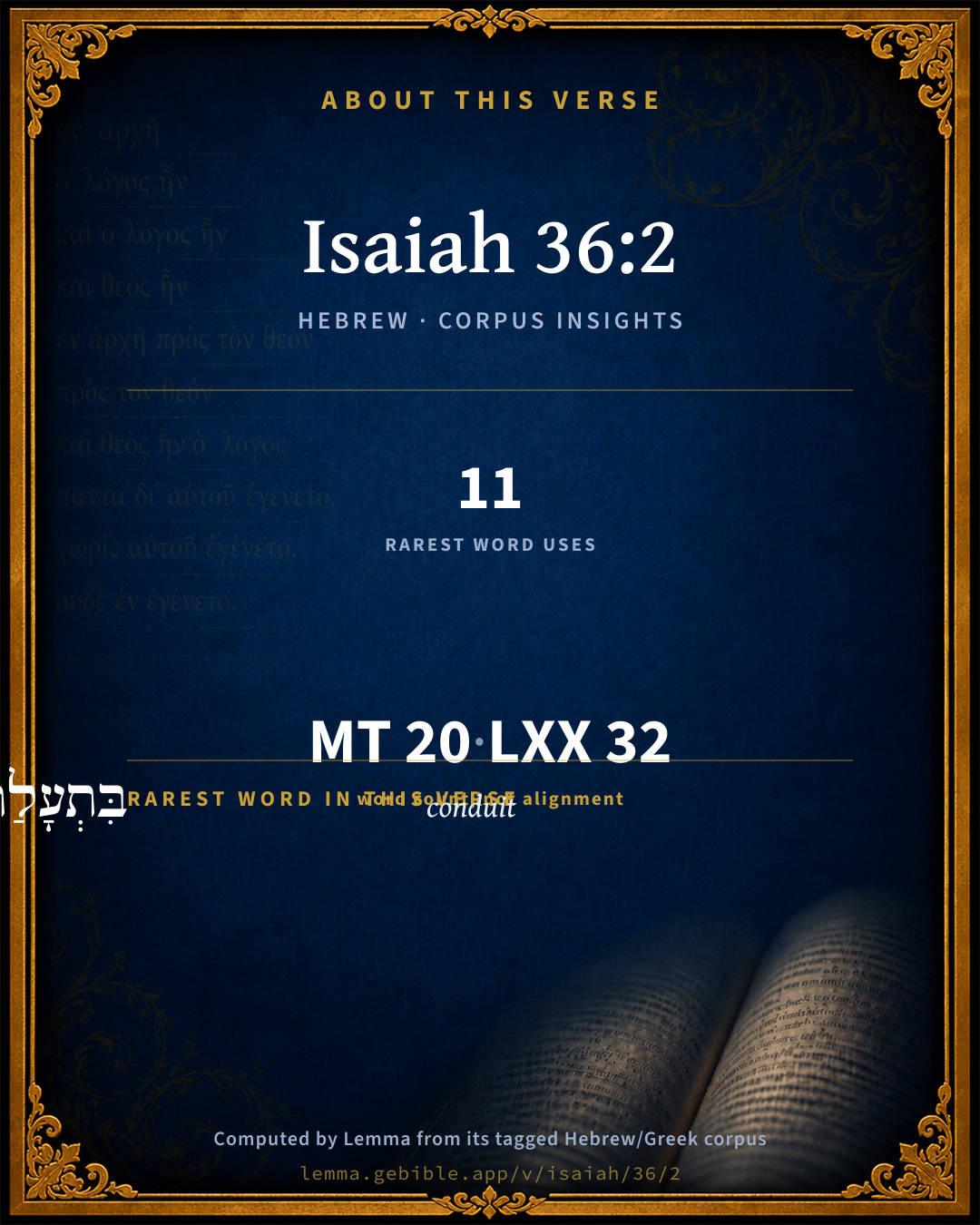
The rarest word here is בִּתְעָלַת֙ conduit H8585 — appearing just 11 times in the whole Hebrew Bible.

Shared distinctive vocabulary

בִּתְעָלַת֙ conduit H8585 occurs in 11 verses of the Hebrew Bible. Also found in:

Grammatical profile

  • 3 verbs
  • 13 nouns
  • 2 adjectives
  • 1 preposition
  • 1 particle

Verb forms

  • וַיִּשְׁלַ֣ח Qal · Sequential Imperfect
  • וַֽיַּעֲמֹ֗ד Qal · Sequential Imperfect
  • כוֹבֵֽס Qal · Participle Active

Repetition

Words recur within this verse — often emphatic in Hebrew:

  • מֶֽלֶךְ king H4428 ×2
  • רַב chief cupbearer H7262 ×2

Hebrew & Septuagint length

In English translation the verse runs 33 words from the Hebrew and 37 from the Septuagint (LXX English) — closely comparable.

A rough comparison of the two English renderings, which tokenize alike — not a word-level alignment.

Word counts can differ between the Hebrew and the Greek without any difference in meaning — e.g. the Hebrew direct-object marker אֵת has no separate Greek word, and Greek often adds the article ὁ.

In the original languages it is 20 Hebrew tokens and 32 Greek tokens — but the two are counted differently (Hebrew bundles its prefixes and suffixes into one token; the Greek is in lemma form), so that isn’t a like-for-like length.

Cross-references

4

Topical passages linked to Isaiah 36:2 in the Treasury of Scripture Knowledge — connected by theme and wording, ordered by reader-vote popularity; previews shown in the World English Bible.

  • 2 Chronicles 32:9–23 After this did Sennacherib king of Assyria send his servants to Jerusalem, (now he was before Lachish, and all his power with him), to Hezekiah king of Judah, and to all Judah who were at Jerusalem, saying,
  • Isaiah 7:3 Then Yahweh said to Isaiah, "Go out now to meet Ahaz, you, and Shearjashub your son, at the end of the conduit of the upper pool, on the highway of the fuller's field.
  • 2 Kings 18:17–37 The king of Assyria sent Tartan and Rabsaris and Rabshakeh from Lachish to king Hezekiah with a great army to Jerusalem. They went up and came to Jerusalem. When they were come up, they came and stood by the conduit of the upper pool, which is in the highway of the fuller's field.
  • Isaiah 22:9–11 You saw the breaches of the city of David, that they were many; and you gathered together the waters of the lower pool;

Cross-references courtesy of OpenBible.info (CC BY 4.0).

Hebrew and Greek witnesses Masoretic Hebrew ↔ Greek Septuagint

The same verse in the two great witnesses to the Old Testament, shown verse-for-verse.

These are two independent witnesses, not word-aligned to each other, and the Septuagint is shown in lemma (dictionary) form.

Hebrew Isaiah 36:2 Masoretic · Westminster Leningrad Codex

וַיִּשְׁלַ֣ח מֶֽלֶךְ אַשּׁ֣וּר אֶת רַב שָׁקֵ֨ה מִלָּכִ֧ישׁ יְרוּשָׁלְַ֛מָה אֶל הַמֶּ֥לֶךְ חִזְקִיָּ֖הוּ בְּחֵ֣יל כָּבֵ֑ד וַֽיַּעֲמֹ֗ד בִּתְעָלַת֙ הַבְּרֵכָ֣ה הָעֶלְיוֹנָ֔ה בִּמְסִלַּ֖ת שְׂדֵ֥ה כוֹבֵֽס

The king of Assyria sent Rabshakeh from Lachish to Jerusalem to king Hezekiah with a great army. He stood by the conduit of the upper pool in the highway of the fuller's field.

World English Bible · Public Domain

Greek LXX Isaiah 36:2 Septuagint · lemma form

καί ἀποστέλλω βασιλεύς ἀσσύριος ραψακης ἐκ λαχις εἰς ἰερουσαλήμ πρός ὁ βασιλεύς εζεκιας μετά δύναμις πολύς καί ἵστημι ἐν ὁ ὑδραγωγός ὁ κολυμβήθρα ὁ ἄνω ἐν ὁ ὁδός ὁ ἀγρός ὁ γναφεύς

And the king of the Assyrians sent Rabsaces out of Laches to Jerusalem to king Ezekias with a large force: and he stood by the conduit of the upper pool in the way of the fuller's field.

LXX2012 (modern English Septuagint) · Public Domain

Hebrew: Westminster Leningrad Codex (CC BY 4.0). Greek: Septuagint (public domain); English from LXX2012 (modern English Septuagint) (Public Domain). How the Septuagint differs from the Hebrew →

Targum (Aramaic paraphrase)

1

The Targum is the ancient Jewish Aramaic paraphrase of the Hebrew Scriptures — an interpretive translation, not the Hebrew text itself. Onkelos (literal) and Pseudo-Jonathan (expansive) render the Torah, and Jonathan the Prophets. Coverage is partial: where no permissively-licensed English translation exists for a verse, only the Aramaic is shown. This is verse-level text, not a word-by-word alignment to the Hebrew.

  1. Targum Jonathan Prophets (Joshua–Malachi)
    וּשְׁלַח מַלְכָּא דְאַתּוּר יַת רַבְשָׁקֵה מִלָכִישׁ לִירוּשְׁלֵם לְוַת מַלְכָּא חִזְקִיָה בְּמַשִׁרְיָת סַגִיאָן וְקָם בִּמְזִיקַת בְרֵיכְתָּא עִלִיתָא דִכְבִישׁ חֲקַל מִשְׁטַח קַצָרַיָא:

    And the king of Assyria sent Rabshakeh from Lachish to Jerusalem unto king Hezekiah with a great army. And he stood by the conduit of the upper pool in the highway of the field of the fullers.

    Targum Jonathan — Aramaic: “Mikraot Gedolot” (public domain). English: “Sefaria Community Translation” (CC0 1.0 (public-domain dedication)); “London "Chaldee Paraphrase," 1871” (public domain). Text via Sefaria.

Commentary

Notes on Isaiah 36:2 from classic Christian and Jewish commentators (each source and its license shown beneath its notes). The classic Christian expositions comment on the surrounding passage and are grouped to its opening verse, so a note may address several verses; the Jewish commentaries on the Tanakh (Rashi and others) are per-verse, so they appear only where the commentator wrote on this verse.

Lemma curates 59 commentaries, every one of them public domain or Creative Commons licensed, each selected and text-cleaned for this edition rather than reprinted as found. About our sources →

The Biblical Illustrator

Joseph S. Exell

Isa_36:2

And the King of Assyria sent Rabshakeh

Invasion of Judah by Assyria

In chaps, 36-39, a historical part follows, which retiring from the ideal distances of chaps, 34.

, 35. into the historical realities of chap. 33., begins with the statement that at the conduit of the upper pool in the road of the fullers field, where Ahaz preferred the help of Assyria to that of Jehovah (Isa_7:3), stands anembassy of the King of Assyria with a section of his army. (F. Delitzsch, D.D.)

Rabshakeh

Rabshakeh or Rab-Sak, the chief cup-bearer, or general staff-officer in the Assyrian service, entrusted with diplomatic business. It is the title of an office, and not the name of a person. The Tartan was the supreme military officer, or commander-in-chief, while the Rab Saris was the chief of the Eunuchs, and a confidential officer. Rab-chief. (B. Blake, B.D.)

The Rabshakeh,

Sennacheribs Bismarck. (Prof. G. A. Smith, D.D.)

The Biblical Illustrator, edited by Joseph S. Exell (c. 1880s–1900s) — public domain. Text from a community e-Sword module.

Tyndale Open Study Notes

Tyndale Open Resources

36:2 Lachish was a city overlooking the low-lying hills to the west of Jerusalem. It had to be taken before the final attack on Jerusalem could be launched. • the aqueduct that feeds water into the upper pool: This was a pool on the north side of Jerusalem, not the Gihon Spring in the Kidron valley. • Isaiah had met Ahaz on this same road leading to the field where cloth is washed some thirty-three years earlier (see Isa 7:3). At that time he had challenged Ahaz to trust God. However, Ahaz trusted Assyria instead, and this desperate situation was a result. Now the challenge to trust God came from mocking, foreign lips (see 28:11-13).

Tyndale Open Study Notes — © Tyndale Open Resources, licensed CC BY-SA 4.0. Text via the HelloAO Bible API.

Jamieson, Fausset & Brown

Robert Jamieson, A. R. Fausset & David Brown

Rab-shakeh--In Kg2 18:17, Tartan and Rab-saris are joined with him. Rab-shakeh was probably the chief leader; Rab is a title of authority, "chief-cup-bearer."

Lachish--a frontier town southwest of Jerusalem, in Judah; represented as a great fortified city in a hilly and fruitful country in the Koyunjik bas-reliefs, now in the British Museum; also, its name is found on a slab over a figure of Sennacherib on his throne.

upper pool--the side on which the Assyrians would approach Jerusalem coming from the southwest (see on Isa 7:3).

Jamieson, Fausset & Brown — Commentary Critical and Explanatory on the Whole Bible (1871) — public domain (CC PDM 1.0). Text via the HelloAO Bible API.

Ellicott's Commentary for English Readers

(2) The king of Assyria sent Rabshakeh.—The word is a title (the Rabshakeh) probably the chief officer or cup-bearer. In 2 Kings 18; 2 Chronicles 32, we have the previous history of the war. Hezekiah, on hearing Sennacherib’s reproach, began to strengthen the fortifications of Jerusalem, called his officers and troops together, and made an appeal to their faith and courage. In Isaiah 22 we have the prophet’s view of those preparations. Probably by Isaiah’s advice, who put no confidence in this boastful and blustering courage, Hezekiah sent to Sennacherib, who was then besieging Lachish, to sue for peace, acknowledging that he had offended. A penalty of three hundred talents of silver and thirty talents of gold was imposed and paid, Hezekiah being reduced to empty his own treasury and that of the Temple, and even to strip the Temple doors and pillars of the plates of gold with which they were overlaid. Peace, however, was not to be had even at that price. Encouraged, perhaps, by this prompt submission, and tearing up the treaty (the breach of covenant of which Isaiah complains in Isa_35:1), Sennacherib sent his officers, the Tartan, the Rabsaris, and the Rabshakeh (the names are all official titles) to demand an unconditional surrender.

He stood by the conduit of the upper pool.—The spot was the same as that at which Isaiah had addressed Ahaz thirty or more years before (Isa_7:3). It was probably chosen by the Rabshakeh as commanding one end of the aqueduct which supplied the city with water, and thus enabling him to threaten that he would cut off the supply (Isa_36:12).

A Bible Commentary for English Readers, edited by Charles John Ellicott (1878–1897) — public domain. Text from a community e-Sword module.

The Cambridge Bible for Schools and Colleges

gen. ed. J. J. S. Perowne

2. Rabshakeh is not a proper name, but an official designation, like the Tartan (see ch. Isa_20:1) and the Rab-saris (chief eunuch) who are mentioned along with him in 2Ki_18:17. The Assyrian word is Rab-saq, said to mean “chief of the officers.”

from Lachish] The most important Judæan fortress in the Shephelah, commanding the road from Egypt. Recent excavations by Mr Flinders Petrie have identified its site with Tell-el-Hesy, a few miles distant from the modern Umm Lakis.

the conduit of the upper pool …] See on ch. Isa_7:3.

The Cambridge Bible for Schools and Colleges (gen. ed. J. J. S. Perowne; Cambridge University Press, 1878–1918) — public domain. Text from a community e-Sword module.

John Gill's Exposition

And the king of Assyria sent Rabshakeh from Lachish to Jerusalem unto King Hezekiah with a great army,.... Notwithstanding he had taken Hezekiah's money to withdraw his army out of his country, yet sends it out to his very capital; along with this Rabshakeh he sent two other generals, Tartan and Rabsaris, Kg2 18:17 though they are not mentioned, only Rabshakeh, because he was the principal person, however the chief speaker. Lachish was a city in the tribe of Judah, Jos 15:39, which Sennacherib was now besieging, Ch2 32:9. This message was sent, Bishop Usher says, three years after the former expedition:

and he stood by the conduit of the upper pool, in the highway of the fullers' field; where they spread their clothes, as the Targum, having washed them in the pool, of which see Isa 7:3. Ben Melech thus describes the pool, conduit, and highway: the pool is a ditch, built with stone and lime, where rainwater was collected, or where they drew water from the fountain, and the waters were gathered into this pool; and there was in this pool a hole, which they stopped, until the time they pleased to fetch water, out of the pool: and the conduit was a ditch near to the pool, and they brought water out of the pool into the conduit, when they chose to drink, or wash garments: the highway was a way paved with stones, so that they could walk upon it in rainy days; and here they stood and washed their garments in the waters of the conduit, and in the field they spread them to the sun. This pool lay outside the city, yet just by the walls of it, which showed the daring insolence of Rabshakeh to come so very nigh, for he was in the hearing of the men upon the walls, Isa 36:12, this Rabshakeh is by the Jewish writers thought to be an apostate Jew, because he spoke in the Jews' language; and some of them, as Jerome says, will have him to be a son of the Prophet Isaiah's, but without any foundation, Procopius, in Kg2 18:18, thinks it probable that he was a Hebrew, who either had fled on his own accord to the Assyrians, or was taken captive by them.

John Gill's Exposition of the Whole Bible (1746–1763) — public domain (CC PDM 1.0). Text via the HelloAO Bible API.

Albert Barnes' Notes on the Bible

And the king of Assyria sent Rabshakeh - In 2Ki 18:17, it is said that he sent Tartan, and Rabsaris, and Rabshakeh. In regard to Tartan, see the note at Isa 20:1. It is probable that Rabshakeh only is mentioned in Isaiah because the expedition may have been mainly under his direction, or more probably because he was the principal speaker on the occasion to which he refers.

From Lachish - This was a city in the south of the tribe of Judah, and was southwest of Jerusalem Jos 10:23; Jos 15:39. It was situated in a plain, and was the seat of an ancient Canaanite king. It was rebuilt and fortified by Rehoboam 2Ch 11:9. It was in some respects a border town, and was a defense against the incursions of the Philistines. It was therefore situated between Jerusalem and Egypt, and was in the direct way of Sennacherib in his going to Egypt, and on his return. It lay, according to Eusebius and Jerome, seven Roman miles from Eleutheropolis toward the south. No trace of the town, however, is now to be found (see Robinson’s “Bib. Researches,” vol. ii. pp. 388, 389).

With a great army - Sennacherib remained himself for a time at Lachish, though he followed not long after. It is probable that he sent forward a considerable portion of his immense army, retaining only so many forces as he judged would be necessary to carry on the siege of Lachish. In 2Ch 32:9, it is said that Sennacherib, while he sent his servants to Jerusalem, ‘laid siege to Lachish and all his power with him;’ but this must mean that he retained with him a considerable part of his army, and doubtless all that contributed to his magnificence and splendor. The word ‘power’ in 2Ch 32:9, means also ‘dominion’ (see the margin), and denotes all the insignia of royalty: and this might have been retained while a considerable part of his forces had been sent forward to Jerusalem.

And he stood - He halted; he encamped there; He intended to make that the point of attack.

By the conduit ... - (See the notes at Isa 7:3)

Albert Barnes' Notes on the Bible (1834–1885) — public domain. Text from a community e-Sword/MySword module.

Whedon's Commentary on the Bible

Daniel D. Whedon

2. Sent Rabshakeh — In 2Ki_18:17, Tartan and Rabsaris are added. These are not personal, but official, names; Rabshakeh means cupbearer. The Jews have a tradition that he was a renegade, or apostate Jew, as he spoke their language.

With a great army — Probably only a portion of Sennacherib’s army.

By the conduit — The aqueduct of the upper pool — The upper Gihon “pool,” just a little northwest of the present Jaffa gate. [See illustrative map on page 158.] This was the place of conference on the terms of the city’s capitulation to the Assyrian. The highway is still in its old place, passing, as of old, the Gihon pool; and the washing places are also there. Roads in Palestine at present are little better than bridle paths. They have never changed in plan or condition since the Roman occupation of the country.

Daniel D. Whedon (gen. ed.), Commentary on the Old and New Testaments (1874–1909) — public domain. Text from a community e-Sword module.

The Pulpit Commentary

And the King of Assyria sent Rabshakeh... with a great army. (comp. 2Ki_18:13-17, where we find sufficient ground for believing that this expedition is entirely distinct from that of ver. 1, which was conducted by Sennacherib in person, and led to Hezekiah"s submission and the payment of a large tribute) It is inconceivable that, immediately after the grant of terms of peace and their acceptance, Sennacherib should have renewed the war; there must have been an interval, and a fresh provocation. The interval can have been only a short one, since Hezekiah died in B.C. 697. It may have been a couple of years, or perhaps no more than a year, or possibly only a few months. The fresh provocation probably consisted in an application for aid, made by Hezekiah to Tir-hakah, or to the subordinate Egyptian kings, which is glanced at in ver. 6. The Assyrian annals, which never record any reverse or defeat, are wholly silent as to this second expedition. The only profane confirmation of it is to be found in Herodotus (2:141). From Lackish. Laehish, an ancient city of the Amorites, (Jos_10:5) was assigned by Joshua to the tribe of Judah, (Jos_15:39) and seems to have been still a Jewish possession. (2Ki_14:19) It occupied "a low round swell or knoll" in the Shefelch, or low tract between the Judaean highland and the Mediterranean, and lay near, if not directly on, the direct route which armies commonly followed in their march from Syria into Egypt. The site is now known as Um-Lakis; it lies between Gaza and Ajlan (Eglon), about two miles west of the hitter. Sennacherib represents himself as engaged in its siege on a bas-relief in the British Museum (see Layard, "Monuments of Nineveh," second series, pl. 21). The conduit of the upper pool. (see the comment on Isa_7:3) The spot was that at which Isaiah had been commanded to meet Ahaz some forty years previously. It was probably on the north side of Jerusalem, not tar from the Damascus gate.

Right attitude in times of threatening.

This general of the Assyrian army seems to have been a rude, violent, boastful man, who thought to do his work by means of great swelling words. He was big in threatening; and it is not often that such men prove big in deeds. Dean Plumptre says that "his words, in their brutal coarseness, have hardly a parallel in history, till we come to Bismarck"s telling the Parisians that they may "stew in their own gravy. The Rabshakeh, it should be observed, stood in the position, while he thus threatened, which intimated his power to destroy the aqueduct which supplied the city with water. Times of threatening are to be clearly distinguished from times of actual calamity. Trouble threatened is apt to relax our natures and weaken us with fears. Trouble actually come calls out our powers of endurance, and braces us for bearing and battling. And so, sometimes, trouble threatened, taking bigger shape in appearance than it ever can take in reality, has a special work of testing to do. He must be well centred in God who holds fast his calmness and trust, even in times of fright. Society is peculiarly liable more especially highly civilized society to sudden fears, which very easily become helpless panic. A few criminals in a great city get an hour"s licence, and loot the shops in one district, and the whole city goes into a panic, stops its business, and pours its wealth into a fund to quiet the people who had little or nothing to do with the looting. So it has been again and again in the world"s history. Threatenings have been more morally mischievous than actual calamity. The godly man should be easily master even of such circumstances.

I HE KNOWS WELL THE DIFFERENCE BETWEEN BOAST AND PERFORMANCE, Observation teaches him that the man who threatens much accomplishes little; the man who swears and yields to passion is always weak in action. There is "sound, and nothing more." There is always room for this good advice, "Let not him that putteth on his armour boast as he that putteth it off.

II HE KNOWS THAT THIS CONDITION APPLIES TO ALL THREATENINGS AND ALARMS: "IF THE LORD WILL." Men cannot, any more than tidal waves, go beyond their appointed bounds. Threats may do the Lord"s will, but they can do nothing beyond the Lord"s will. The godly man, therefore, waits to read God"s will behind the threats or the fears, and can afford to be quite calm, and master of all circumstances.

III HE KNOWS THAT GOD IS ALWAYS ON THE SIDE OF THE PERMANENTLY GOOD, AND IS ALWAYS WORKING TOWARDS IT. The way to the good is often like the twisting and winding of the stream of Jordan; but the godly man does not make too much of the rushes and rapids in the twists and falls he knows Jordan moves steadily on to the sea, and life, however ruffled may be its surface, moves on to fulfil the good purpose of God. We may do as did the apostolic company when its leaders were threatened we may bend before our God, and pray, "Now, Lord, behold their threatenings". R.T. (Act_4:29, Act_4:30)

The Pulpit Commentary (1880–1919), ed. H.D.M. Spence-Jones & Joseph S. Exell — public domain. Text from a community e-Sword module.

J. A. Alexander on Isaiah

Joseph Addison Alexander

“And the king of Assyria sent Rabshakeh from Lachish to Jerusalem, to king Hezekiah, with a strong force, and he stood by the conduit (or aqueduct) of the upper pool, in the highway of the fuller’s field.” Besides Rabshakeh, the narrative in Kings mentions Tartan and Rabsaris; that in Chronicles uses the general expression his servants. Rabshakeh may be named alone here as the chief speaker, or as the commander of the expedition. The Jews have a tradition that he was a renegade or apostate Jew. Others account for his knowledge of Hebrew by supposing him to have acquired it by intercourse with captives of the ten tribes. Lachish was a town of Judah south-west of Jerusalem on the way to Egypt. This place Sennacherib was now besieging (2Ch 32:9} and being probably detained longer than he had expected, he detached a part of his forces to attack Jerusalem, or rather to summon Hezekiah to surrender.

That the main body of the army afterwards advanced against Jerusalem is nowhere explicitly recorded, although some infer from Isa 10:28-32 that they did so, making a circuit to the north for the purpose of surprising the city. It is said in Chronicles that Sennacherib was now before Lachish, in the military sense, (i.e., besieging it, with all his force), which some explain to mean with a large part of it, others with his court and the usual accompaniments of an eastern camp, in order to remove a supposed inconsistency with what is here said. But the phrase in Chronicles relates to the Assyrian force at Lachish before Rabshakeh was detached, and is inserted merely to explain the statement that he came from Lachish, because Sennacherib had halted there with all his army. The verb may also be referred to the halt of Rabshakeh’s detachment, or to the position which they took up on arriving; but it is simpler to refer it to the spot on which Rabshakeh himself stood during the interview about to be described. The spot was doubtless one of great resort. For the localities here mentioned. See the notes on Isa 7:3 and Isa 22:9-11.

Joseph Addison Alexander, The Prophecies of Isaiah (1846–1847; New York: Scribner, 1870–1878) — public domain. Text from a community e-Sword module.

Rashi

Rabbi Shlomo Yitzchaki (Rashi)

near the conduit fosed (fosse) in French, (a ditch, a trench, a moat.)

the pool A place where water is gathered, dug in the ground by man, in which to put fish. It is long and wide.

on the road A paved road. (chemin in French.)

the washer’s field Jonathan renders: A field where the washers stretch out, i.e., where the washers stretch out the garments.

Rashi on the Tanakh — English translations: “The Judaica Press complete Tanach with Rashi, translated by A. J. Rosenberg” (CC BY 4.0); “Pentateuch with Rashi's commentary by M. Rosenbaum and A.M. Silbermann, 1929-1934” (public domain); “The Metsudah Tanach series, Lakewood, N.J” (CC BY 4.0); and “The Book of Joshua, Metsudah Publications, 1997” (CC BY 4.0). Text via Sefaria.

Lesson kit

Teaching starters — assembled from the data on this page, not authored interpretation. Every prompt links to the verse data it draws on. Edit before teaching.

Isaiah, in the Prophets, opens this verse with 20 words (18 distinct Hebrew lemmas). Its most distinctive word is tᵉʻâlâh (“conduit”). A historical commentator’s framing appears above. Read the whole chapter for the surrounding context.

Discussion questions

  1. The word tᵉʻâlâh carries the sense “conduit.” How does it shape the verse?
  2. 1 Kings 18:32 shares the word «conduit» with this verse. How do the two illuminate each other?
  3. “king” occurs 2× in this one verse. What is the effect of the repetition?
  4. The translations on this page render this verse differently — a whole-verse word diff, not a word-by-word alignment. What might account for the different wordings?
  5. The verb «וַיִּשְׁלַ֣ח» is Qal Sequential Imperfect. How does its form color the action?
  6. Reading how The Biblical Illustrator and Tyndale Open Study Notes read this verse, where do the two commentators agree and where do they part?

Things to notice

Reading settings

Reading text

Shown beneath each verse's original-language words.

Old Testament
Old Testament edition

Read the OT as the Masoretic Hebrew (MT) or the Greek Septuagint (LXX).

English shown for the Greek Septuagint (in the Hebrew ↔ Greek comparison).

Comparing translations? Open the Compare panel on any verse page to stack up to four side by side.