Isaiah 44:28

Hebrew (Westminster Leningrad Codex) Isaiah 44:28 appears in the Hebrew Old Testament. The text above is from the Westminster Leningrad Codex. Each word links to its Strong’s number, a concise gloss, and parsing drawn from the Open Scriptures Hebrew Bible morphology. Click any word for its full Brown-Driver-Briggs (BDB) entry.
Download image
Cite this verse

Isaiah 44:28 (World English Bible). Public Domain. Lemma interlinear Bible study tool, https://lemma.gebible.app/v/isaiah/44/28.

Show BibTeX & RIS
BibTeX
RIS
English Translation
Who says of Cyrus, [He is] my shepherd, and shall perform all my pleasure, even saying of Jerusalem, She shall be built; and of the temple, Your foundation shall be laid.
World English Bible · Public Domain
Download a study sheet

One document with this verse’s original text, its word-by-word gloss line, the meaning frame, cross-references with their text, attributed commentary, and full source and license credits — printable, and it pastes into notes with its structure intact.

This verse Autodidact and up

Study sheet (.html) Plain text (.txt)

A passage Seminary Student

Up to 50 verses in one chapter. A passage sheet keeps up to 6 commentary sources and 12 cross-references per verse, in the order this page ranks them, and says so on the sheet whenever that leaves anything out. Ask for a single verse and you get the Autodidact verse sheet above.

Everything on this page stays free to read, with no account — the sheet is a download of what is already on screen, not access to it.

Want to remove ads? Support Godless Engineer
Compare translations 3

The same verse in 3 English versions, stacked beneath the original-language interlinear above. Click any original word for its lexicon entry.

Each is an independent rendering of the whole verse — the interlinear is not word-aligned to these translations.

Highlighted words mark where these versions differ — a whole-verse word diff, not a word-by-word alignment.

  • World English Bible Public Domain
    Who says of Cyrus, [He is] my shepherd, and shall perform all my pleasure, even saying of Jerusalem, She shall be built; and of the temple, Your foundation shall be laid.
  • King James Version Public Domain
    That saith of Cyrus, He is my shepherd, and shall perform all my pleasure: even saying to Jerusalem, Thou shalt be built; and to the temple, Thy foundation shall be laid.
  • unfoldingWord Literal Text CC BY-SA 4.0
    the one saying of Cyrus, ‘My shepherd, and he will complete all of my desire,’ and saying to Jerusalem, ‘You will be built,’ and the temple, ‘You will be founded.’

unfoldingWord Literal Text — © unfoldingWord, licensed CC BY-SA 4.0. Word-aligned USFM3 via Door43 (git.door43.org/unfoldingWord/en_ult).

Versions to compare (up to 4)

3 of 4 selected

Show all 18 translations

Every available English version of this verse, each an independent rendering of the whole verse.

  • World English Bible Public Domain
    Who says of Cyrus, [He is] my shepherd, and shall perform all my pleasure, even saying of Jerusalem, She shall be built; and of the temple, Your foundation shall be laid.
  • Berean Standard Bible Public Domain
    who says of Cyrus, ‘My shepherd will fulfill all that I desire,’ who says of Jerusalem, ‘She will be rebuilt,’ and of the temple, ‘Let its foundation be laid.’”
  • Majority Standard Bible Public Domain
    who says of Cyrus, ‘My shepherd will fulfill all that I desire,’ who says of Jerusalem, ‘She will be rebuilt,’ and of the temple, ‘Let its foundation be laid.’”
  • King James Version Public Domain
    That saith of Cyrus, He is my shepherd, and shall perform all my pleasure: even saying to Jerusalem, Thou shalt be built; and to the temple, Thy foundation shall be laid.
  • American Standard Version (1901) Public Domain
    That saith of Cyrus, `He is' my shepherd, and shall perform all my pleasure, even saying of Jerusalem, She shall be built; and of the temple, Thy foundation shall be laid.
  • Revised Version (1885) Public Domain
    That saith of Cyrus, He is my shepherd, and shall perform all my pleasure: even saying of Jerusalem, She shall be built; and to the temple, Thy foundation shall be laid.
  • Geneva Bible (1599) Public Domain
    He saith to Cyrus, Thou art my shepheard: and he shall performe all my desire: saying also to Ierusalem, Thou shalt be built: and to the Temple, Thy foundation shall be surely layed.
  • Douay-Rheims (1899) Public Domain
    Who say to Cyrus: Thou art my shepherd, and thou shalt perform all my pleasure. Who say to Jerusalem: Thou shalt be built: and to the temple: Thy foundations shall be laid.
  • Young's Literal Translation Public Domain
    Who is saying of Cyrus, My shepherd, And all my delight He doth perfect, So as to say of Jerusalem, Thou art built, And of the temple, Thou art founded.
  • Literal Standard Version CC BY-SA 4.0
    Who is saying of Cyrus, My shepherd, || And he perfects all My delight, || So as to say of Jerusalem, You are built, || And of the temple, You are founded.”
  • Unlocked Literal Bible CC BY-SA 4.0
    Yahweh is the one who says of Cyrus, 'He is my shepherd, he will do my every wish; he will decree about Jerusalem, 'She will be rebuilt,' and about the temple, 'Let its foundations be laid.'”
  • unfoldingWord Literal Text CC BY-SA 4.0
    the one saying of Cyrus, ‘My shepherd, and he will complete all of my desire,’ and saying to Jerusalem, ‘You will be built,’ and the temple, ‘You will be founded.’
  • Darby Bible Public Domain
    that saith of Cyrus, [He is] my shepherd, and he shall perform all my pleasure; even saying to Jerusalem, Thou shalt be built; and to the temple, Thy foundation shall be laid.
  • World Messianic Bible Public Domain
    who says of Cyrus, ‘He is my shepherd, and shall perform all my pleasure,’ even saying of Jerusalem, ‘She will be built;’ and of the temple, ‘Your foundation will be laid.’”
  • Webster's Bible Public Domain
    That saith of Cyrus, He is my shepherd, and he shall perform all my pleasure: even saying to Jerusalem, Thou shalt be built; and to the temple, Thy foundation shall be laid.
  • Free Bible Version CC BY-SA 4.0
    When I say to Cyrus, ‘You are my shepherd,’ he will carry out everything I wish. He will give the order, ‘Jerusalem shall be rebuilt,’ and he will say, ‘the Temple shall be restored.’”
  • Bible in Basic English Public Domain
    Who says of Cyrus, He will take care of my sheep, and will do all my pleasure: who says of Jerusalem, I will give the word for your building; and of the Temple, Your bases will be put in place.
  • JPS Tanakh (1917) Public Domain
    That saith of Cyrus: 'He is My shepherd, and shall perform all My pleasure'; even saying of Jerusalem: 'She shall be built'; and to the temple: 'My foundation shall be laid.'

Literal Standard Version (2020), Covenant Press — licensed CC BY-SA 4.0. Text via the HelloAO Bible API (eBible.org). Unlocked Literal Bible (unfoldingWord) — licensed CC BY-SA 4.0. Text via the HelloAO Bible API (eBible.org). unfoldingWord Literal Text — © unfoldingWord, licensed CC BY-SA 4.0. Word-aligned USFM3 via Door43 (git.door43.org/unfoldingWord/en_ult). Free Bible Version, Dr. Jonathan Gallagher — licensed CC BY-SA 4.0. Text via the HelloAO Bible API (eBible.org).

Word by word

More ways to search: Search by grammar → Find every occurrence → Compare this word →

Practice this passage: Drill this verse → Learn its vocabulary →

רֹעִ֔י
rôʻîy
H7473
“shepherd · me”
Verb, Qal, Participle Active, Masculine, Singular, Construct + Suffix, Personal, 1st Person, Common, Singular
Part of Speech
Verb
Stem
Qal
Form
Participle Active
Gender
Masculine
Number
Singular
State
Construct
Full BDB Definition

Origin: from act part of H7462

TWOT: None

shepherd (substantive)
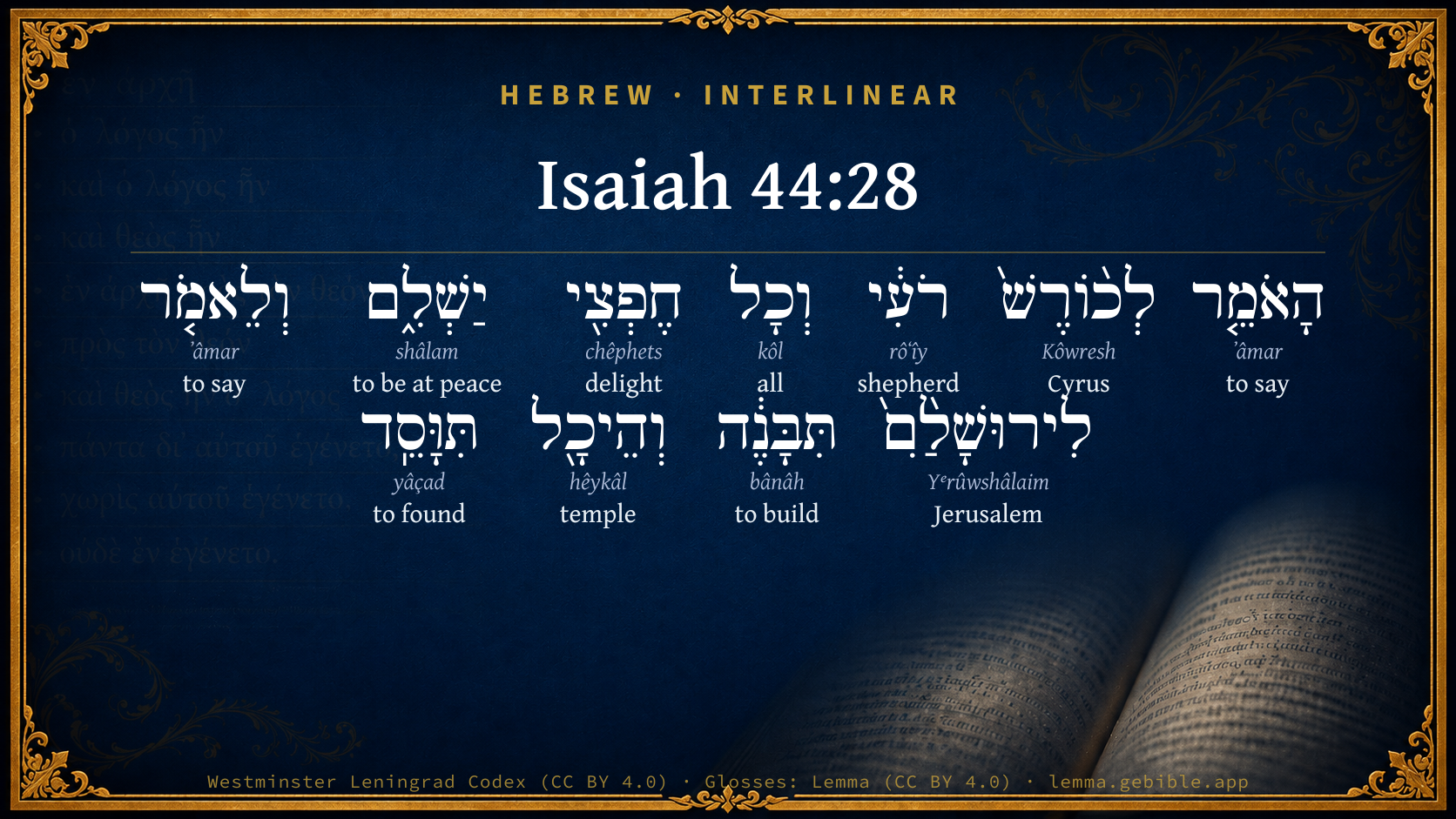
  1. הָאֹמֵ֤ר ʼâmar H559 “the · saying” Particle, Definite Article + Verb, Qal, Participle Active, Masculine, Singular, Absolute
  2. לְכ֨וֹרֶשׁ֙ Kôwresh H3566 “to/for · Cyrus” Preposition + Noun, Proper
  3. וְכָל kôl H3605 “and · all of” Conjunction + Noun, Common, Masculine, Singular, Construct
  4. חֶפְצִ֖י chêphets H2656 “delight · my” Noun, Common, Masculine, Singular, Construct + Suffix, Personal, 1st Person, Common, Singular
  5. יַשְׁלִ֑ם shâlam H7999 “to be at peace” Verb, Hiphil, Imperfect, 3rd Person, Masculine, Singular
  6. וְלֵאמֹ֤ר ʼâmar H559 “and · to say” Conjunction + Preposition + Verb, Qal, Infinitive Construct
  7. לִירוּשָׁלִַ֨ם֙ Yᵉrûwshâlaim H3389 “to/for · Jerusalem” Preposition + Noun, Proper
  8. תִּבָּנֶ֔ה bânâh H1129 “to build” Verb, Niphal, Imperfect, 3rd Person, Feminine, Singular
  9. וְהֵיכָ֖ל hêykâl H1964 “and · temple” Conjunction + Noun, Common, Masculine, Singular, Absolute
  10. תִּוָּסֵֽד yâçad H3245 “to found” Verb, Niphal, Imperfect, 3rd Person, Feminine, Singular

About this verse

These counts appear in no published source. They are computed here, from the morphology-tagged text and Lemma’s own curated glosses. What Lemma adds →

11
words
10
distinct lemmas
Prophets
section

Notable vocabulary

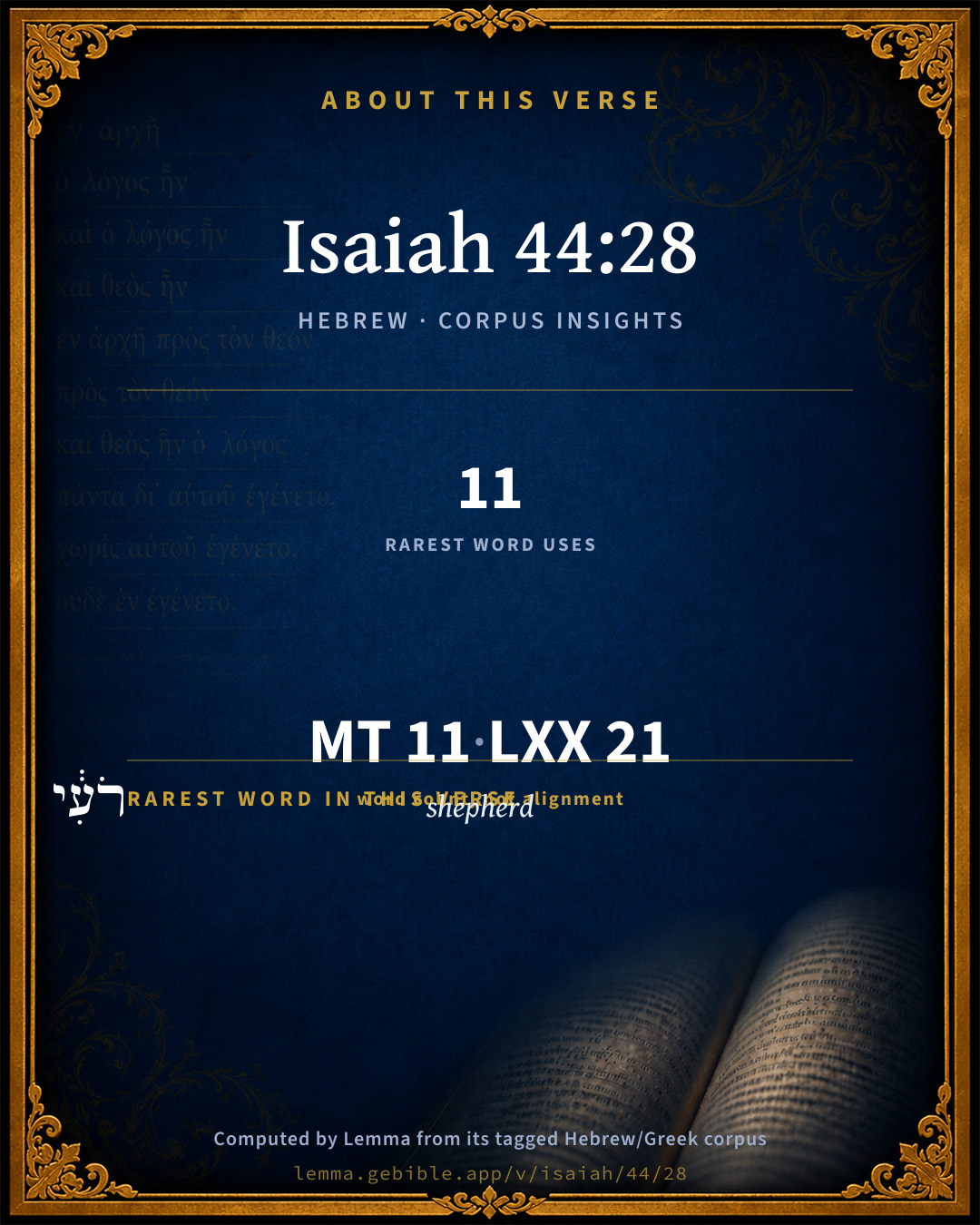
The rarest word here is רֹעִ֔י shepherd H7473 — appearing just 11 times in the whole Hebrew Bible.

Shared distinctive vocabulary

רֹעִ֔י shepherd H7473 occurs in 8 verses of the Hebrew Bible. Also found in:

Grammatical profile

  • 6 verbs
  • 5 nouns

Verb forms

  • הָאֹמֵ֤ר Qal · Participle Active
  • רֹעִ֔י Qal · Participle Active
  • יַשְׁלִ֑ם Hiphil · Imperfect
  • וְלֵאמֹ֤ר Qal · Infinitive Construct
  • תִּבָּנֶ֔ה Niphal · Imperfect
  • תִּוָּסֵֽד Niphal · Imperfect

Repetition

A word recurs within this verse — often emphatic in Hebrew:

  • הָאֹמֵ֤ר to say H559 ×2

Hebrew & Septuagint length

In English translation the verse runs 31 words from the Hebrew and 30 from the Septuagint (LXX English) — closely comparable.

A rough comparison of the two English renderings, which tokenize alike — not a word-level alignment.

Word counts can differ between the Hebrew and the Greek without any difference in meaning — e.g. the Hebrew direct-object marker אֵת has no separate Greek word, and Greek often adds the article ὁ.

In the original languages it is 11 Hebrew tokens and 21 Greek tokens — but the two are counted differently (Hebrew bundles its prefixes and suffixes into one token; the Greek is in lemma form), so that isn’t a like-for-like length.

Cross-references

11

Topical passages linked to Isaiah 44:28 in the Treasury of Scripture Knowledge — connected by theme and wording, ordered by reader-vote popularity; previews shown in the World English Bible.

  • 2 Chronicles 36:22 Now in the first year of Cyrus king of Persia, that the word of Yahweh by the mouth of Jeremiah might be accomplished, Yahweh stirred up the spirit of Cyrus king of Persia, so that he made a proclamation throughout all his kingdom, and [put it] also in writing, saying,
  • Isaiah 45:1 Thus says Yahweh to his anointed, to Cyrus, whose right hand I have held, to subdue nations before him, and I will loose the loins of kings; to open the doors before him, and the gates shall not be shut:
  • Ezra 6:3–18 In the first year of Cyrus the king, Cyrus the king made a decree: Concerning the house of God at Jerusalem, let the house be built, the place where they offer sacrifices, and let the foundations of it be strongly laid; the height of it sixty cubits, and the breadth of it sixty cubits;
  • Isaiah 45:13 I have raised him up in righteousness, and I will make straight all his ways: he shall build my city, and he shall let my exiles go free, not for price nor reward, says Yahweh of Hosts.
  • Daniel 10:1 In the third year of Cyrus king of Persia a thing was revealed to Daniel, whose name was called Belteshazzar; and the thing was true, even a great warfare: and he understood the thing, and had understanding of the vision.
  • Isaiah 46:11 calling a ravenous bird from the east, the man of my counsel from a far country; yes, I have spoken, I will also bring it to pass; I have purposed, I will also do it.
  • Isaiah 63:11 Then he remembered the days of old, Moses [and] his people, [saying], Where is he who brought them up out of the sea with the shepherds of his flock? where is he who put his holy Spirit in the midst of them?
  • Psalms 78:71–72 From following the ewes that have their young, He brought him to be the shepherd of Jacob, his people, And Israel, his inheritance.
  • Isaiah 45:3 and I will give you the treasures of darkness, and hidden riches of secret places, that you may know that it is I, Yahweh, who call you by your name, even the God of Israel.
  • Isaiah 48:14–15 Assemble yourselves, all you, and hear; who among them has declared these things? He whom Yahweh loves shall perform his pleasure on Babylon, and his arm [shall be on] the Chaldeans.
  • Isaiah 42:15 I will lay waste mountains and hills, and dry up all their herbs; and I will make the rivers islands, and will dry up the pools.

Cross-references courtesy of OpenBible.info (CC BY 4.0).

Hebrew and Greek witnesses Masoretic Hebrew ↔ Greek Septuagint

The same verse in the two great witnesses to the Old Testament, shown verse-for-verse.

These are two independent witnesses, not word-aligned to each other, and the Septuagint is shown in lemma (dictionary) form.

Hebrew Isaiah 44:28 Masoretic · Westminster Leningrad Codex

הָאֹמֵ֤ר לְכ֨וֹרֶשׁ֙ רֹעִ֔י וְכָל חֶפְצִ֖י יַשְׁלִ֑ם וְלֵאמֹ֤ר לִירוּשָׁלִַ֨ם֙ תִּבָּנֶ֔ה וְהֵיכָ֖ל תִּוָּסֵֽד

Who says of Cyrus, [He is] my shepherd, and shall perform all my pleasure, even saying of Jerusalem, She shall be built; and of the temple, Your foundation shall be laid.

World English Bible · Public Domain

Greek LXX Isaiah 44:28 Septuagint · lemma form

ὁ λέγω κῦρος φρονέω καί πᾶς ὁ θέλημα ἐγώ ποιέω ὁ λέγω ἰερουσαλήμ οἰκοδομέω καί ὁ οἶκος ὁ ἅγιος ἐγώ θεμελιόω

Who bids Cyrus be wise, and he shall perform all my will: who says to Jerusalem, You shall be built, and I will lay the foundation of my holy house.

LXX2012 (modern English Septuagint) · Public Domain

On this verse, Adam Clarke's Commentary discusses the Septuagint’s reading. Read the note in Commentary ↓

Hebrew: Westminster Leningrad Codex (CC BY 4.0). Greek: Septuagint (public domain); English from LXX2012 (modern English Septuagint) (Public Domain). How the Septuagint differs from the Hebrew →

Targum (Aramaic paraphrase)

1

The Targum is the ancient Jewish Aramaic paraphrase of the Hebrew Scriptures — an interpretive translation, not the Hebrew text itself. Onkelos (literal) and Pseudo-Jonathan (expansive) render the Torah, and Jonathan the Prophets. Coverage is partial: where no permissively-licensed English translation exists for a verse, only the Aramaic is shown. This is verse-level text, not a word-by-word alignment to the Hebrew.

  1. Targum Jonathan Prophets (Joshua–Malachi)
    דַאֲמַר עַל כּוֹרֶשׁ לְמִתַּן לֵיהּ מַלְכוּ וְכָל רְעוּתִי יְקַיֵם וְלִדְאֲמַר לִירוּשְׁלֶם תִּתְבְּנֵי וְהֵיכְלָא יִשְׁתַּכְלֵל:

    That promises Cyrus that He will give him a kingdom; and that he shall establish all my pleasure, even to him that saith to Jerusalem, Thou shalt be built, and the temple shall have its foundation laid.

    Targum Jonathan — Aramaic: “Mikraot Gedolot” (public domain). English: “Sefaria Community Translation” (CC0 1.0 (public-domain dedication)); “London "Chaldee Paraphrase," 1871” (public domain). Text via Sefaria.

Commentary

Notes on Isaiah 44:28 from classic Christian and Jewish commentators (each source and its license shown beneath its notes). The classic Christian expositions comment on the surrounding passage and are grouped to its opening verse, so a note may address several verses; the Jewish commentaries on the Tanakh (Rashi and others) are per-verse, so they appear only where the commentator wrote on this verse.

Lemma curates 59 commentaries, every one of them public domain or Creative Commons licensed, each selected and text-cleaned for this edition rather than reprinted as found. About our sources →

Trapp's Complete Commentary

John Trapp

Isa 44:28 That saith of Cyrus, [He is] my shepherd, and shall perform all my pleasure: even saying to Jerusalem, Thou shalt be built; and to the temple, Thy foundation shall be laid.

Ver. 28. That saith of Cyrus.] One hundred and seventy years, at least, before he was born.

Thou art my shepherd,] i.e., Princeps meus beneficus. Coresh, in the Persian tongue, signifieth food, saith Scaliger; and then there might be some allusion here to his name in calling him a "shepherd," or feeder.

John Trapp, A Commentary or Exposition upon All the Books of the Old and New Testament (1647–1656) — public domain. Text from a community e-Sword module.

The Biblical Illustrator

Joseph S. Exell

Isa_44:28

That saith of Cyrus, He is my shepherd

Cyrus, the Lords shepherd

Cyrus was the ideal king of the Persians and Greeks.

His is the only name that is mentioned with any detail, I believe, both in the Persian and in the Greek, and also in the Hebrew literature. We speak of the great heroes of the world as Alexander and Caesar and Napoleon. That list begins too late. We ought to begin instead with Cyrus, who was at first a prince of a small principality at the head of the Gulf of Oman. Later he conquered the Medes and Persians. Later Asia Minor, including Lydia, and at last he captured Babylon. In capturing Babylon he released from captivity the chosen people, and it is because of that fact that he is called in the Scriptures, and that he is known in history by the very unique title of the Lords shepherd. There is only one other person to whom that phrase has ever been applied, and it is a very singular fact that a heathen king, one entirely out of all line with the chosen people, one so far away from traditions, which we have been in the habit of calling sacred, holy, as if his name had been Confucius or Buddha, in the Scriptures should have been given exactly the same title that was given to our Lord Jesus Christ Himself. (A. H. Bradforad, D. D.)

The unity of history:

We will observe a few facts in support of my contention that history is the record of a beneficent development.

1. The governments of the world. In the early time government was simply for a few; there was no monarchy but force; there was no place for love. In the present time, in the immortal words of our President,. Government is of the people, by the people, for the people. The word which I best remember of any which I heard spoken in London was by Dr. Bevan, Of old, government was for the few; to-day, government is for the many. And that is what things have been moving towards as the years have been passing.

2. Take another illustration, and that from the realm of religion. We think of one God; but to those early Hebrews there were many gods. They were not those who believed simply in one God for all the world. They believed in Jehovah as the God able to subdue all the gods of the heathen. They had not reached, except in the person of a few of their leaders, the sublime altitude of modern times of one pervading and all-enduring Unity, one holy, spiritual, true, and loving God. What was their worship?

3. We come to another illustration quite as familiar. We hear very much in our time concerning the social condition of the labouring people. The great dumb multitudes have found a voice; and every now and then, some man, ignorant of history, writes to say the rich were never so rich, and the poor never so poor; the condition of one class was never so luxurious, the condition of the other class was never so mean. He does not know what the condition of the masses was in the time when the pyramids were built, in the time when the Caesars ruled in Rome and doled out corn to the multitude. He has not read the history of Great Britain, or of France, or of any other nation of Europe, or on the face of the earth. The condition of the world is improving. In the old time the condition of the woman was that of a thing or an animal; she belonged to her husband. She is a woman now, the equal of her husband. In the old time the child was absolutely under the power of the father. If the child was an orphan he was put on the street. Now, to use the phrase of a contemporary writer, If he hath no father and if he hath no mother, he becomes the child of the public. What mean our charities? Conclusion--

(1) Providence is compelling progress and no individual can possibly prevent it.

(2) Not all are equally worthy of blessing, of commendation; although all may bear their part in bringing about the glorious consummation.

(3) Cyrus shows to us the sweep of the Divine purpose. Gods plan includes the nations and the ages. There is a place for Greece, for India, for China, for Rome, for Great Britain, there is a place for every nation as well as for Judah. There is a place for Napoleon, and Confucius, and Buddha, because there was a place for Cyrus.

(4) But the other One to whom that glorious name was applied, the Lords Shepherd, shows us what Cyrus does not show us, namely, the nature of that plan, revealing to us the nature of the One who made the plan. I look upon the face of Jesus Christ, and I see there is a person, and a sacrificial purpose, and a sacrifice which reaches even to the uttermost. (A. H. Bradford, D. D.)

Notables fulfilling Gods purpose

Rich princes shall do what poor prophets have foretold. (M. Henry.)

.

The Biblical Illustrator, edited by Joseph S. Exell (c. 1880s–1900s) — public domain. Text from a community e-Sword module.

Joseph Benson's Commentary

Isa 44:28. That saith of Cyrus — Whom God here mentions by his proper name, two hundred years before he was born, that this might be an undeniable evidence of the exactness of God’s foreknowledge, and a convincing argument to conclude this dispute between God and idols. He is my shepherd — Him will I set up to be the shepherd of my people, to rescue them from wolves or tyrants, to gather them together, to rule them gently, and to provide comfortably for them. Xenophon tells us, that Cyrus used to compare kings in general, and himself in particular, to a shepherd. — Cyropæd., lib. 8. And shall perform all my pleasure — All that I command him to do, especially to give leave and order for the rebuilding of the city and temple of Jerusalem, as it here follows. This prophecy, which thus speaks of Cyrus by name, as foreknown and appointed by the divine counsel for the performance of the great work designed by providence, is one of the most remarkable contained in Scripture, of the same kind with that 1Ki 13:1-2.

Joseph Benson's Commentary on the Old and New Testaments (1811–1818) — public domain. Text from a community e-Sword module.

The Preacher's Complete Homiletical Commentary

Joseph S. Exell (gen. ed.)

THE FULFILMENT OF PROPHECY IN THE CAREER OF CYRUS

Isa_44:28. Cyrus, my shepherd, shall perform all my pleasure.

The fulfilment of prophecy is one of the two supernatural arguments for the truth of the Scriptures. I now present in some detail the fulfilment of prophecy in the career and conquests of Cyrus.

Isaiah wrote not less than a hundred and thirty years before Cyrus was born; and not less than a hundred and fifty years before his conquest of Babylon. It was long before the Median kingdom existed. The captivity of Judah had not begun. Three or four generations lived and died between the prophet and the Persian prince. The prophet could not possibly have other means of knowing who Cyrus was to be, or what he was to do in the world, than the simple revelation of the facts by the Spirit of God. Yet that he foretold the conqueror’s career, down to minutest details, is established by precisely the same kind and amount of evidence which proves that either Cyrus or Isaiah existed at all.

1. The name of Cyrus, the point of the compass indicative of his birthplace, and the direction of his march upon Babylon, are distinctly foretold. “Thus saith the Lord to Cyrus, I have raised up one from the North. From the rising of the sun—that is, from the East—shall he call upon my name.” The two points of the compass named in this language of Isaiah are singularly true. Cyrus was born in Persia, which was east of Babylon. It was commonly called “the East.” One historian speaks of it as the “land of the sunrising.” But at a very early age Cyrus was removed to Media, lying on the north of Babylon; and it was from Media that he came down, at the head of victorious hosts, upon the doomed capital. The prophet thus sees in a vision a prince of eastern birth marching upon the city from the north, and that his name is Cyrus.

Small matters these, but all the more significant for that. The question is: Who told Isaiah such minute details about a man he never saw or heard of; coming from a kingdom which at that time had no existence; achieving a conquest which then had not been dreamed of? How did he know what name the future conqueror would bear, a hundred and thirty years before he had a name?

Did anybody ever predict Bonaparte’s conquest of Italy a century before his birth? Did ever statesman or magician, as far back as A.D. 1650, declare that, a century and a half later, a conqueror born in the west of Italy would come down from the north and take possession of Rome, and that his name would be Napoleon? Yet this is in kind what the Hebrew prophet did. The question is, Who told him all that? How did he alone, of all the inhabitants of the world, find out the facts so exactly and so minutely?

2. Isaiah furthermore describes with remarkable accuracy the personal character of Cyrus. His warlike spirit, his towering ambition, the rapidity of his conquests, the equity of his administration, and his heathen religion, are all declared after the manner of prophecy. “Calling a ravenous bird from the East,” is the prophet’s language. Prophetic vision deals largely in symbols. The eagle is its favourite symbol of an aspiring, warlike, swift conqueror. “Who raised up the righteous man from the East” is the prophetic description of Cyrus. It is almost the exact language in which historians describe the government of the Persian king. “The just one” he is often called. “Take example from the Persian,” the tutors of Oriental princes used to say to their royal pupils. “I have girded thee, though thou hast not known Me,” are the words which prophecy puts into the mouth of God concerning him. This is a distinct prediction of his ignorance of the true God.

These are but a few specimens of the prophetic touches of which there are many more, portraying with an artist’s skill the character of this monarch. Imagine now that, in addition to announcing the name and the birthplace of Napoleon a hundred and thirty years before he was born, the magician had described him as an eagle in his conquests; had said that he would originate a superior code of jurisprudence,—the “Code Napoleon;” and that in his religion he would be a Romanist. Would not such hints, added to the items before named, redouble the surprise at the magician’s power? Would not men ask with astonishment who he was, where he came from, by whose authority he spoke, and where he got his information? Yet this is just what Isaiah declares of the great conqueror of the East.

3. The significance of the prophecy deepens, when it comes to describe the conquests achieved by Cyrus. Passages abound of which these are specimens: “He gave the nations before him. He made him ruler over kings. He made them as dust to his sword, and as driven stubble to his bow. The isles saw it and feared, they helped every one his neighbour. Every one said to his neighbour, ‘Be of good courage.’ I will subdue nations under him. I will loose the loins of kings.”

By such rapid glances, the half of which I do not quote, the prophet foretells the victories of Cyrus over the great nations of the East; the consternation of their kings; their alliances for mutual defence; and the velocity with which the Persian legions marched from victory to victory.

Turn we now to history: what has that to say? It does but repeat the prophecy in describing the facts as they occurred. Says one: “He had scarcely gained one victory, before his tumultuous forces poured down on other battle-grounds. Scarcely had one city fallen, before he stood thundering at the gates of another. Empires were like dust before him, and cities like chaff.” That prophecy, “I will loose the loins of kings,” had its exact fulfilment in the consternation of Belshazzar at the handwriting on the wall, when the Persian armies were on the march, and within twenty-four hours would be heard tramping the streets of the doomed capital.

4. The prophecy of the downfall of Babylon deserves distinct review. The prophetic story runs in this style: “Evil shall come upon thee. Thou shalt not know from whence it ariseth. Thou shalt not be able to put it off. Desolation shall come suddenly, which thou shalt not know.” Thus is expressed the sudden, the unexpected, the irresistible, and the improbable calamity which was coming upon that haughty city.

Just such, in fact, was its conquest by Cyrus. That event, to begin with, was in itself, and in any form, improbable. The military science of the age pronounced Babylon impregnable by any methods of assault or siege then known. So secure did king and people feel that it could not be taken by human force or strategy, that on the very night of its capture by Cyrus, they were given up to feasting and carousal behind their insurmountable walls. The king would not believe the rumour of the enemy’s entrance, even when the blood of his people was flowing in the streets.

Here, again, little incidents are detailed which no soothsayer would have thought of, or would have dared to predict, if he had thought of them. “I will say to the deep, ‘Be dry.’ I will dry up thy rivers. I will open before him the two-leaved gates. The gates shall not be shut.” The significance of this language will appear from arraying it side by side with the historic facts. Babylon was a city fifteen miles square. It was intersected by the river Euphrates, as London is by the Thames, and Paris by the Seine. Solid walls surrounded it three hundred and fifty feet high, and broad enough on the top for four chariots to be driven abreast. The two sections again were separated by walls running along both banks of the river. Fronting the streets on either side were folding gates for convenience of access to the stream by day, which the police were instructed to close at the setting of the sun.

Cyrus took the city by a remarkable stratagem. He invented a novel way of marching his army into impregnable Babylon. If he could not march over the walls, he would contrive to march under. He did it by a very simple expedient, when once thought of, but only he had the genius to think of it. He dug an immense canal around the walls, and turned the river Euphrates into it. Then he marched his army at dead of night, and in dead silence, under the walls, in the vacant bed of the river. But this brought him only between the two other immense river-walls inside. How to surmount these was the question. The indomitable general had provided scaling-ladders for the purpose. But the God of Isaiah had done better for him than that. He found those gates which let the citizens down to the river in the day-time—“two-leaved,” that is, folding-gates—wide open. Like other drunken policemen, the custodians of Babylon had neglected to close those gates. Even the palace gates were not closed. The invader got near enough to hear the drunken carousals of the king and his courtiers inside, before they were convinced of his approach. Do you not now see a new meaning in the words, “I will dry up thy rivers; I will open the two-leaved gates; the gates shall not be shut; I will loose the loins of kings”?

Herodotus, writing seventy years afterwards, says, “If the besieged had been aware of the designs of Cyrus, they might have destroyed his troops. They had only to secure the folding gates leading to the river, and to have manned the embankments on either side, and they would have enclosed the Persians in a trap from which they could never have escaped. As it happened, they were taken by surprise; and such is the extent of the city that they who lived in the extremities were made prisoners before the alarm reached the palace.” “As it happened.” Yes, it happened; but a hundred and more years before God had said by His prophet how it should happen. He had said, “I will open the two-leaved gates.” So Cyrus found them wide open, and the way clear to the very banquet-hall of the palace, just as Isaiah had said, before Cyrus was born, that they should be.

The question therefore returns, laden with redoubled significance, Where did Isaiah get his information? Who told him that Babylon, a hundred and fifty years afterwards, would be shut off from the Euphrates by gates? Who told him that they would be folding-gates? How did he know that a man named Cyrus would enter the capital in the bed of the river, and on that particular night, contrary to usage and to law, would find that the police had left those gates open, as if on purpose to let the invader in? In short, how came he to write history a hundred and fifty years beforehand? Did any other historian ever write his history a century and a half before it happened, instead of a century and a half later, and be lucky enough to have it all happen to be true, even down to the structure and the opening of gates?

5. One other feature of the prophecy and the history in parallels remains to be noticed. Isaiah explicitly foretells the restoration of Judah from captivity, and the rebuilding of the temple at Jerusalem, through the agency of Cyrus, God declares by the mouth of the prophet: “I will direct all his ways. He shall let go my captives;” even saying to Jerusalem, “Be built,” and to the temple, “Thy foundations shall be laid. He shall let go my captives, not for price or reward. Ye shall be redeemed without money. Ye shall not go out with haste, nor go by flight.”

Here we find another group of details which no uninspired mind could have guessed at, and no soothsayer would have dared to predict. Every one of them was to the last degree improbable. No statesman of the age did conjecture them. In the prophet’s time there were no captives at all in Babylon from Judah. When they became captives, long after, it was improbable that they would be released in any way by an Oriental despot, flushed with victory. They were very valuable captives. They were of an intelligent race. Good servants, able-bodied men and women for household use, skilful artisans, honest labourers, were abundant among them. Men of learning and genius, like Daniel, some of whom were deservedly advanced to high places in the realm, were Hebrews. Never was a more valuable class of slaves of equal number held by the rights of war than those held under command of Cyrus from Judea. It was the last thing to be expected from an Eastern despot, that he should let such a people go free; that he should charge no ransom for them; that they should not be compelled to take their freedom by force or stratagem; that their master himself should restore to them their plundered treasures, and direct the rebuilding of their desolated temple. Never was a prediction more improbable on the face of it.

Yet all these things happened, just as Isaiah said they would. The truth of the history no infidel presumes to question, whatever he may think of the prophecy. The question therefore returns again, How did Isaiah get his knowledge of coming events? Who told him facts a hundred and more years before the wisest statesman of the age had once thought of them as conjectures? Did any other man, not inspired of God, ever coin history thus out of guess-work? Did ever romance fall true like this? Sir Walter Scott wrote historical romances. Has “Ivanhoe” or “Quentin Durward” ever come true? Toss up a font of alphabetic type at random in the air, and will they come down all set and ready for the press in the form of the “Arabian Nights?” Yet this is, in substance, what infidelity asks us to believe, when it denies the gift of Divine inspiration to the Hebrew prophets.

Such, then, is the argument from fulfilled prophecy for the Divine origin of the Scriptures. The career of Cyrus is but a single sample. Other cases of the same kind swell the proof to volumes. The present condition of Babylon, the destruction of Moab, the fall of Tyre, the conquest of Egypt, the doom of Damascus, the desolation of Idumea, the sack of Jerusalem, the life, death, and burial of Christ, are events which belong to the same class. They all abound with the same sort of coincidence between the prophecy and the history. The coincidence extends to minute details. It is sustained without a break through long-continued narrative, covering years—yes, centuries, and involving the destiny of individuals with the fate of nations and of empires.

Such intricate and involved prevision no human mind could have painted without a break in the truthfulness of the story, unless inspired by an omniscient God. Any other solution of the mystery throws upon us a weight of credulity a hundredfold greater than that of faith in the “Arabian Nights” as authentic history. For the most part infidelity feels this, and very shrewdly decides to let the fulfilled prophecies of the Bible alone. There is no other argument for the truth of the Christian Scriptures, which infidels so generally agree to ignore as this.—Austin Phelps, D.D.

The Preacher's Complete Homiletical Commentary (gen. ed. Joseph S. Exell; Funk & Wagnalls, c. 1892) — public domain (pre-1929). A full-Bible homiletical/sermon-outline anthology covering 65 of 66 books (2 John is absent from the source module). Text from a community e-Sword module.

Tyndale Open Study Notes

Tyndale Open Resources

44:28 He is my shepherd: Cyrus went beyond simply permitting the Jews to return to their homeland. He facilitated a major restoration project to rebuild Jerusalem and restore the Temple (see 45:13; Ezra 1:2-4; 6:3-5).

Tyndale Open Study Notes — © Tyndale Open Resources, licensed CC BY-SA 4.0. Text via the HelloAO Bible API.

Geneva Bible (1599)

Geneva Bible translators

To assure them of their deliverance, he nameth the person by whom it should be, more than an hundred years before he was born.

Geneva Bible (1599) marginal notes — public domain. Text via Bolls.life.

Jamieson, Fausset & Brown

Robert Jamieson, A. R. Fausset & David Brown

my shepherd--type of Messiah (Isa 40:11; Psa 23:1; Psa 77:20; Eze 34:23).

all my pleasure--so Messiah (Isa 42:1; Isa 53:10). This is the first time Cyrus is named expressly; and that, a hundred fifty years before the time when in 550 B.C. he began his reign. The name comes from the Persian khorschid, "the sun"; kings often taking their names from the gods; the sun was worshipped as a god in Persia.

saying--rather, "and that saith"; construed with God, not with Cyrus. God's word is instantaneously efficient in accomplishing His will.

to . . . to--or, "of Jerusalem . . . of the temple," as previously, the same Hebrew word is translated, "of Cyrus" [BARNES]. English Version is more graphic. Cyrus, according to JOSEPHUS, heard of this prophecy of Isaiah delivered so long before; hence he was induced to do that which was so contrary to Oriental policy, to aid in restoring the captive Jews and rebuilding their temple and city.

Next: Isaiah Chapter 45

Jamieson, Fausset & Brown — Commentary Critical and Explanatory on the Whole Bible (1871) — public domain (CC PDM 1.0). Text via the HelloAO Bible API.

Adam Clarke's Commentary

Verse 28. That saith of Cyrus, He is my shepherd - "Who saith to Cyrus, Thou art my shepherd"] Pastor meus es; Vulg. The true reading seems to be רעי אתה roi attah; the word אתה attah, has probably been dropped out of the text. The same word is lost out of the text, Ps 119:57. It is supplied in the Septuagint by the word ει, thou art.

Saying to Jerusalem] For ולאמר velemor, the Septuagint and Vulgate read האומר haomer.

And to the temple] ולהיכל uleheychal, as לירושלם lirushalayim, before; the preposition is necessary, and the Vulgate seems to read so. - Houbigant.

That saith of CYRUS, He is, or thou art, my shepherd - Saving to JERUSALEM, "Thou shalt be built;" and to the TEMPLE, "Thy foundation shall be laid." - There is a remarkable beauty and propriety in this verse.

1. Cyrus is called God's shepherd. Shepherd was an epithet which Cyrus took to himself; and what he gave to all good kings.

2. This Cyrus should say to the temple: "Thy foundation shall be laid." Not - thou shalt be built. The fact is, only the foundation was laid in the days of Cyrus, the Ammonites having prevented the building; nor was it resumed till the second year of Darius, one of his successors. There is often a precision in the expressions of the prophets which is as honourable to truth, as it is unnoticed by careless readers.

Adam Clarke's Commentary on the Bible (1810–1826) — public domain. Text from a community e-Sword/MySword module.

Ellicott's Commentary for English Readers

(28) That saith of Cyrus.—The Hebrew form is Koresh, answering to the Kur’us of the inscription of the king’s tomb in the Murghab valley. The prediction of the name of the future deliverer has its only parallel in that of Josiah (1Ki_13:2). Such a phenomenon admits of three possible explanations:—(1) That it is a prophecy after the event—i.e., that the whole of Isaiah, or this part of it, was written at the close of the exile. (2) That the name was revealed to the prophet in a way altogether supernatural. (3) That the name came within the horizon of the prophet’s vision from his natural stand-point, the supernatural element being found in the facts which he is led to connect with it. Of these, (3) seems to commend itself as most analogous with the methods of prophetic teaching. The main facts in the case are these—(1) Events had made Isaiah acquainted with the name of the Medes, and with a people bearing the name (Elam), afterwards given by the Jews to the Persians of the Greeks (Isa_11:1; Isa_13:7; Isa_21:2; 2Ki_17:6; 2Ki_18:11). (2) Koresh or Kyros was the name of a river in that region, and the conqueror is said to have changed his previous name (Agradates) for it (Strab. Xv. 3, 6). (3) The name has been said to mean “the sun” (Plutarch, Ctesias), and this, though not accepted by many modern scholars as philologically accurate, at least indicates that the Greeks assigned that meaning to it. It would be a natural name for one who, as a worshipper of Ormuzd, saw in the sun the supreme symbol of the God of heaven. (4) The grandfather of the great Cyrus is said to have borne the same name (Herod. i. 111). (5) The facts point to the conclusion that the name Kursus; if not a titular epithet, like the Pharaoh of Egypt, may yet have had the prestige of antiquity and dignity, historical or mythical. (6) Is it altogether impossible that the prophecy, circulating among the Babylonian exiles, helped to bring about its own fulfilment, and that Agradates may have been led to take the name of Kur’us because he found his work described in connection with it (Josh. Ant., xii. 1, 2)?

My shepherd.—As guiding the flock of Jehovah, each to their own pasture.

Thou shalt be built.—Both verbs are better taken as imperatives, Let her be built; Let thy foundations be laid.

A Bible Commentary for English Readers, edited by Charles John Ellicott (1878–1897) — public domain. Text from a community e-Sword module.

The Cambridge Bible for Schools and Colleges

gen. ed. J. J. S. Perowne

28. The series of predicates here culminates in the mention by name of the conqueror of Babylon and liberator of Israel. The name Cyrus is in Persian Kûrush, in Babylonian Kurash, in Greek Κῦρος. The traditional Hebrew pronunciation is Kôresh, but it is probable that the original form preserved the characteristic long u which appears in the other languages. On the career of Cyrus see Introduction, pp. 17 ff.

He is my shepherd] Or simply, My Shepherd. “Shepherd” here means “ruler” as in Jer_3:15; Ezekiel 34. pass.; Mic_5:5 : comp. the Homeric ποιμένες λαῶν. It is one of the honorific titles alluded to in ch. Isa_45:4.

perform all my pleasure] Or, complete all my purpose; cf. ch. Isa_46:10, Isa_48:14, Isa_53:10. This use of the Heb. word for “pleasure” illustrates the transition to its later sense of “business” (ch. Isa_58:3; Isa_58:13) or “matter” (Ecc_5:8; Ecc_8:6). Comp. Arab. shay’ (= thing) from shâ’a (to will).

even saying] If the text be right the meaning would probably be that Cyrus would accomplish Jehovah’s purpose by giving the order for the rebuilding of the Temple &c. LXX. and Vulg. read “that saith,” substituting a participle for the inf. of the Heb. In this case the subject is Jehovah, as throughout the passage.

Instead of to Jerusalem, Thou shalt be …, the Heb. has of Jerusalem, Let her be.… See on Isa_44:26.

According to Josephus (Ant. XI. Isa_1:2) it was the reading of this verse that fired Cyrus with the ambition to restore the Jewish Temple and nationality. The statement, if true, would of course detract nothing from the significance of the prophecy. But it has no claim to be accepted, and would assuredly never have been made but for the assumption that the words were written by Isaiah “one hundred and forty years before the destruction of the Temple.”

The Cambridge Bible for Schools and Colleges (gen. ed. J. J. S. Perowne; Cambridge University Press, 1878–1918) — public domain. Text from a community e-Sword module.

John Gill's Exposition

That saith of Cyrus, he is my shepherd,.... Or Coresh, as his name in the Hebrew language is; and in the Persian tongue signifies the "sun"; from whence he had his name, as Ctesias (q) and Plutarch (r) say; to which the Hebrew word "cheres", which signifies the "sun", has some affinity; though Joseph Scaliger (s) would have the name of Cyrus to signify "food" in the Persian language, and which answers to his character as a shepherd. The father of this illustrious person was Cambyses, king of Persia; his mother's name was Mandane, daughter of Astyages, king of Media (t). This prophecy, concerning him, was nearly two hundred years before he was born. Josephus says (u), that Cyrus read this prophecy himself, which Isaiah had delivered out two hundred and ten years before; and which is a proof both of God's prescience of future contingencies, and of the truth of divine revelation. The Lord honours him with the title and character of his "shepherd", who was to lead his flock, the people of Israel, out of the Babylonish captivity, and guide them into their own land. It is very usual, both in sacred and profane writings, for kings to be called shepherds; and if Cyrus signifies "food", as before observed, his name and office agree. Justin (w) says, he had this name given him, while he was among the shepherds, by whom he was brought up, having been exposed in his infancy. Cyrus himself compares a king to a shepherd, and observes a likeness between them (x):

and shall perform all my pleasure; concerning the deliverance of the Jews from Babylon, and the encouragement of them to go up to their own land, and rebuild their city and temple; and many other things which he did, agreeably to the secret will of God, though he knew it not; and what he did he did not do in obedience to his will, but as overruled by the power and providence of God:

even saying to Jerusalem, thou shalt be built; these are not the words of the Lord, as before, but of Cyrus, giving orders that Jerusalem should be built:

and to the temple, thy foundation shall be laid; with great propriety this is said, since only the foundation was laid in his time; the Jews being discouraged and hindered by their enemies from going on with the building in his reign, until the times of Darius, king of Persia. See Ezr 1:1.

(q) Excerpta, p. 648. Ed. Gronov. (r) In Vita Artaxerxis, (s) Emendat. Temp. I. 6. (t) Xenophon. Cyropaedia, l. 1. sect. 1. (u) Antiqu. l. 11. c. 1. sect. 2. (w) Hist. ex Trogo l. 1. c. 5. (x) Xenophon, Cyropaedia, l. 8. sect. 18.

Next: Isaiah Chapter 45

John Gill's Exposition of the Whole Bible (1746–1763) — public domain (CC PDM 1.0). Text via the HelloAO Bible API.

Albert Barnes' Notes on the Bible

That saith of Cyrus - This is the first time in which Cyrus is expressly named by Isaiah, though he is often referred to. He is mentioned by him only in one other place expressly by name Isa 45:1. He is several times mentioned elsewhere in the Old Testament 2Ch 26:22-23; Ezr 1:1-2, Ezr 1:7; Ezr 3:7; Ezr 4:3; Ezr 5:13, Ezr 5:17; Dan 1:21; Dan 6:28; Dan 10:1. He began his reign about 550 b.c., and this prophecy was therefore delivered not far from a hundred and fifty years before he ascended the throne. None but God himself, or he whom God inspired, could have mentioned so long before, the name of him who should deliver the Jewish people from bondage; and if this was delivered, therefore, by Isaiah, it proves that he was under divine inspiration. The name of Cyrus (כורשׁ kôresh; Greek Κῦrος Kuros) the Greek writers say, means ‘the sun.’ It is contracted from the Persian word khorschid, which in that language has this signification. Cyrus was the celebrated king of the Medes and Persians, and was the son of Cambyses the Persian, and of Mandane, daughter of Astyages, king of the Medes. For an account of his character and reign, see the notes at Isa 41:2, where I have anticipated all that is needful to be said here.

He is my shepherd - A shepherd is one who leads and guides a flock, and then the word denotes, by a natural and easy metaphor, a ruler, or leader of a people. Thus the name is given to Moses in Isa 43:2; compare Psa 77:20, and Eze 34:23. The name here is given to Cyrus because God would employ him to conduct his people again to their own land. The word ‘my’ implies, that he was under the direction of God, and was employed in his service.

And shall perform all my pleasure - In destroying the city and kingdom of Babylon; in delivering the Jewish captives; and in rebuilding Jerusalem, and the temple.

Even saying to Jerusalem - That is, I say to Jerusalem. The Vulgate, and the Septuagint renders this as meaning God, and not Cyrus, and doubtless this is the true construction. It was one of the things which God would do, to say to Jerusalem that it should be rebuilt.

And to the temple - Though now desolate and in ruins, yet it shall be reconstructed, and its foundation shall be firmly laid. The phrase ‘to Jerusalem,’ and ‘to the temple,’ should be rendered ‘of,’ in accordance with a common signification of the preposition ל (l), and as it is rendered in the former part of the verse when speaking of Cyrus (compare Gen 20:13; Jdg 9:54). It was indeed under the direction of Cyrus that the city of Jerusalem was rebuilt, and the temple reconstructed Ezr 1:1; but still it was to be traced to God, who raised him up for this purpose. That this passage was seen by Cyrus is the testimony of Josephus, and is morally certain from the nature of the case, since, otherwise, it is incredible that he should have aided the Jews in returning to their own land, and in rebuilding their city and temple (see the Introduction, Section 2). This is one of the numerous instances in the Bible, in which God claims control and jurisdiction even over pagan princes and monarchs, and in which he says that their plans are under his direction, and made subservient to his will. It is one of the proofs that God presides over all, and that he makes the voluntary purposes of people subservient to him, and a part of the means of executing his glorious designs in relation to his people. Indeed, all the proud monarchs and conquerors of the earth have been in some sense instruments in his hand of executing his pleasure.

Albert Barnes' Notes on the Bible (1834–1885) — public domain. Text from a community e-Sword/MySword module.

Haydock's Catholic Bible Commentary

CHAPTER XLIV.

Cyrus. This was spoken 110 years before his birth, which shews the prescience and power of God, so as not to injure free-will. The parents of Cyrus could not give him this name to fulfill the prediction, as they knew nothing of it. Amon was apprised that a person called Josias would overturn idolatry; but he had no reason to suppose that it would be his son, 1 Kings xiii. 2. --- My shepherd. Chaldean, "that he shall reign." This was shewn by the Jews to Cyrus, on which account, (Calmet) he gave them leave to return, &c. (Josephus, [Antiquities?] xi. 1.) --- The title of shepherd is given to Agamemnon by Homer, and it denotes a good prince, such as historians represent Cyrus to have been. He observed that kings and shepherds had the like duties to perform; (Xenophon viii.) and after his death he was bewailed as a "father." (Herodotus iii. 89.) --- At first he did not bear the name of Cyrus, (Herodotus i. 113.) which in the Persian language means "the sun." (Ctesias.) (Plut.[Plutarch?])

George Leo Haydock (1774–1849), Haydock's Catholic Family Bible and Commentary, 1859 edition — public domain. Excludes Psalms (Douay-Rheims chapter numbering differs from Protestant) and Deuterocanonical books (Catholic canon only).

Matthew Poole's English Annotations

Cyrus, whom God here designeth by his proper name two hundred years before he was born, that this might be an undeniable evidence of the certainty and exactness of God’s foreknowledge, and a convincing argument, and so most fit to conclude this dispute between God and idols.

He is my shepherd; him will I set up to be the shepherd of my people, to rescue them from wolves or tyrants, to gather them together, to rule them gently, and to provide comfortably for them.

All my pleasure; all that I command him to do, even to give leave and order for the rebuilding of the city and temple of Jerusalem, as it here follows.

Matthew Poole's English Annotations on the Holy Bible (1683–1685) — public domain. Text from a community e-Sword/MySword module.

The Pulpit Commentary

That saith of Cyrus. The mention of Cyrus by name, here and again in Isa_45:1, has no doubt been one of the main grounds on which has been set up the theory of two Isaiahs. It has been thought incredible, or at any rate contrary to the analogy of prophetical revelation, that so minute a matter as the name of a man should have been announced in prophecy more than a century before his birth. There is, however, the parallel case of Josiah, who, according to the author of the Books of Kings, was announced by name more than three centuries before his birth. (1Ki_13:2) And there are the extremely minute facts noted in Da 11, which were prophetically de-dared from two centuries to three centuries and a half before they happened. It is, perhaps, assuming that we know more than we really do know about the object and laws of prophetic utterance, to lay it down that there can be no minute prophecy except when the prophet is living in the midst of the events. It is certainly a very marvellous thing that Isaiah, living at the close of the eighth and the beginning of the seventh century B.C., should -mention a king by name who did not ascend the throne till the middle of the sixth; but no one can suppose that God could not have made such a revelation to him if he pleased. An attempt to minimize the marvel, without postulating two Isaiahs, has been made by the supposition that "Cyrus" was not really a proper name, but an old title of the Persian (Achaemenian) kings, signifying" the sun," and that Isaiah, therefore, only meant to point out Persia as the power which would destroy Babylon, which he had already done in effect in Isa_21:2. But, in reality, there is no sufficient ground for either of the two statements

(1) that Cyrus meant "the sun," and

(2) that it was an old titular name of all the Persian kings.

That "Cyrus" meant "the sun," rests upon the weak authorities of Plutarch and Ctesias, and has been disproved by Sir H. Rawlinson ("Cuneiform Inscriptions," vol. 2, p. 112). That it was an old titular name of all the Persian kings is directly contrary to the evidence. Out of fourteen Achaemenian kings, two only bore the name; and they bore it as their one and only personal appellation. It was also borne by an Achaemenian prince who had no other name. It is as purely a proper name as Cambyses, or Xerxes, or Darius. The theory of Dean Plumptre ("Biblical Studies," p. 195) must therefore be set aside as untenable, and we must face the fact that the great Cyrus, who reigned from B.C. 559 to B.C. 529, is mentioned in prophecies attributed to a writer whose death cannot be placed much later than B.C. 700. The name which the Greeks expressed by Kurov and the Romans by "Cyrus," is in the original Persian Kurush, in the old Babylonian Kuras, and in the Hebrew Koresh. He is my shepherd; i.e. not a mere ordinary king, who was often called "the shepherd of his people (poimh )," but "my shepherd the shepherd of my people, who will tend them and care for them. And shall perform (literally, accomplish) all my pleasure. Cyrus is said by Josephus to have had ibis prophecy pointed out to him on his conquest of Babylon, and to have thereupon determined to fulfil what was written. ("Ant. Jud:," 12:1, His edict, reported by Ezra, (Ezr_1:2-4) contained a statement that "Jehovah had charged him to build him a house at Jerusalem." It is difficult to see any sufficient political object for his restoration of the Jews to their country. Thou shalt be built; rather, it shall be built. Thy foundation shall be laid; literally, it shall be founded. The decree of Cyrus found by Darius at Ecbatana required that "the foundations of the house should be strongly laid", (Ezr_6:3) and prescribed its dimensions and materials. (On the actual laying of the foundations, see Ezr_3:8-13)

The duty of kings to be God"s shepherds.

"By me kings reign," says God, "and princes decree justice". (Pro_8:15) Though the expression, "the Divine right of kings, has been greatly abused, it is yet a truth which all must acknowledge, that monarchs are placed in their responsible position by God, and must answer to him for the use which they make of that position. The whole world is, in a certain sense, God"s flock, and the various chief rulers who hold authority over different portions of the human race are rightly viewed as shepherds entrusted by God with the care of this or that division of the flock which is primarily and really his. Thus

I EACH KING IS REQUIRED TO ACT AS A SHEPHERD TOWARDS THE NATION OVER WHICH HE IS SET. A true shepherd seeks the good of his flock, not his own good. He is watchful, vigilant, wisely provident. He seeks to benefit his flock, not to pleasure them. Oftentimes he must check their desires, restrain their wanderings, keep them back from alluring pastures, confine them to high regions, where the herbage is short, scant, and far from succulent. He must be specially careful of the weak and sickly, and of such as have suffered any hurt. He must spare no trouble or pains to secure, so far as he can, the well-being of every sheep and lamb committed to his charge. And further

II EACH KING IS SPECIALLY REQUIRED TO ACT AS A SHEPHERD TOWARDS THE PORTION OF THE CHURCH OF CHRIST WHICH IS WITHIN HIS KINGDOM. Within the universal fleck, which is coextensive with mankind, our Lord has a special flock, enclosed within a special fold, which he calls in a special sense his own. (Joh_10:1-16) This flock is not, however, confined to one place it is "dispersed throughout the whole world." Kings are required to look to its interests in some special way. They are to be "its nursing fathers," as queens are to be "its nursing mothers". (Isa_49:23) Cyrus, from the time of his conquest of Babylon, while in a general way the shepherd of all the nations under his rule, was especially the shepherd of Israel. And the case is the same with all those monarchs within whose dominions any portion of the Church of Christ has its abode. England"s monarchs bear, among their other titles, the proud one of Fidei Defensor of the Faith" The faith which they have to defend is the faith of Christ, and in this defence is necessarily included the special protection of Christ"s faithful ones, or of the Christian community within their realm.

God"s rights in the individual.

God made us, gave us breath and being. We are his, and for his use. He can call any man into any sphere he pleases. It ought to be true of him that he saith to one "Come," and he cometh; to another "Go," and he goeth. Every man s true attitude is figured m the attitude of the six-winged seraphim before the throne. "With twain he covered his face, with twain he covered his feet, and with twain he did fly," or did stand ready to fly. Of every man, great and small, our God may say, "He is my under-shepherd, and shall perform all my pleasure." Josephus has a very curious statement concerning Cyrus, which may have some basis of truth. "Now this became known to Cyrus by his reading the book which Esaias left behind him of his prophecy; for this man said that God had spoken thus to him in secret: "My will is that Cyrus," etc. This was prophesied by Esaias one hundred and forty years before the demolition of the temple. When, therefore, Cyrus had read this, and marvelled at the divinity, a kind of impulse and ambition seized upon him to fulfil what was so written." Modern discoveries are changing our received notions respecting Cyrus; they do not alter the fact of his having been the agent in securing the return of the exiles, but they indicate that, so far as he was concerned, his action was strictly one of state policy. The idea that he was a pure monotheist is greatly shaken. The line of thought which may be followed can only be indicated.

I God has absolute rights over every individual.

II He makes particular claims on individuals for particular services.

III The duty of each individual is response to the gracious claims.

IV The highest well-being of the individual lies in his yielding all supposed individual rights, in order that he may, entirely and faithfully, meet the claims of God.

Cyrus (Koresh) was required to be a shepherd, and lead God"s flock back to its old pastures. Whatsoever we may be required to do, that must be done as unto the Lord. We should not want any other man"s place or work.

The best for us is just that one which is given to us. And the daily, lifelong, attitude which we should keep should inspire the daily prayer, "Lord, what wilt thou have me to do?" "It is the greatest honour of the greatest men to be employed for God as instruments of his favour to his people. It was more the praise of Cyrus to be God"s shepherd than to be Emperor of the East. R.T.

The Pulpit Commentary (1880–1919), ed. H.D.M. Spence-Jones & Joseph S. Exell — public domain. Text from a community e-Sword module.

John Wesley's Explanatory Notes

Cyrus - Whom God here mentions by his proper name, two hundred years before he was born, that this might be an undeniable evidence of the exactness of God's fore-knowledge, and a convincing argument to conclude this dispute between God and idols. Shepherd - Then will I set up to be the shepherd of my people, to rescue them from wolves or tyrants, to gather them together, to rule them gently, and to provide comfortably for them.

John Wesley, Explanatory Notes Upon the Whole Bible (1754–1765) — public domain. Text via the GEBible commentary corpus.

J. A. Alexander on Isaiah

Joseph Addison Alexander

“The (One) saying to (or as to) Cyrus, ‘My shepherd, and all my pleasure he will fulfill,’ and saying to Jerusalem, ‘Thou shalt be built,’ and (to) the temple, ‘Thou shalt be founded’.” It is now universally admitted that this verse has reference to Cyrus the Elder or the Great, the son of Cambyses king of Persia and the grandson of Astyages the Mede, the hero of the Cyropoedia and of the first book of Herodotus, the same who appears in sacred history (2Ch 36:23; Ezr 5:1) as the actual restorer of the Jews from exile. He is here called Jehovah’s shepherd, which may either be the usual poetical designation of a king, so common in the oldest classics, or a special description of his mission and vocation to gather the lost sheep of the house of Israel. ‘All my pleasure,’ (i.e., with respect to the deliverance of the Jews from exile). The construction of the word translated ‘saying’ is obscure and difficult. Some refer it to Cyrus, and understand it as explaining how he was to fulfil Jehovah’s pleasure, namely, by saying etc. This, on the whole, is the most natural construction; although, like the others, it leaves unexplained the introduction of the copulative particle before the verb, which must either be rendered as in the English Version (even saying), or disregarded as an idiomatic pleonasm. The same ambiguity respecting the person of the verb exists in the last clause of this verse as in v. 25.

Joseph Addison Alexander, The Prophecies of Isaiah (1846–1847; New York: Scribner, 1870–1878) — public domain. Text from a community e-Sword module.

Scofield Reference Notes

C. I. Scofield

Cyrus

Cf. 1Ki 13:2 where Josiah was mentioned by name three hundred years before his birth.

The Scofield Reference Bible (1917 edition), notes by C. I. Scofield — public domain. Text from a community e-Sword module.

unfoldingWord translationNotes

Door43 World Missions Community

General Information:

Yahweh continues speaking.

He is my shepherd

Yahweh speaks of Cyrus ruling and protecting the people of Israel as if Cyrus is their shepherd. (See: Metaphor)

She will be rebuilt

This can be stated in active form. AT: "Let the people rebuild the city" (See: Active or Passive)

Let its foundations be laid

This can be stated in active form. AT: "Let the people lay its foundations" (See: Active or Passive)

translationWords

Cyrus

shepherd

decree

Jerusalem

temple

found

unfoldingWord translationNotes — © Distant Shores Media and the Door43 World Missions Community, licensed CC BY-SA 4.0. Source: git.door43.org/Door43/en_tn.

Rashi

Rabbi Shlomo Yitzchaki (Rashi)

My shepherd My king.

Rashi on the Tanakh — English translations: “The Judaica Press complete Tanach with Rashi, translated by A. J. Rosenberg” (CC BY 4.0); “Pentateuch with Rashi's commentary by M. Rosenbaum and A.M. Silbermann, 1929-1934” (public domain); “The Metsudah Tanach series, Lakewood, N.J” (CC BY 4.0); and “The Book of Joshua, Metsudah Publications, 1997” (CC BY 4.0). Text via Sefaria.

Ibn Ezra

Rabbi Abraham ibn Ezra

That saith to Cyrus, etc. This verse proves that Jerusalem was built in the days of Cyrus; the words thy foundation shall be laid contain an allusion to the fact, that Cyrus ordered the temple to be built, but after its foundation had been laid by Zerubbabel, prohibited its further restoration; it is therefore clear, that Daniel made no mistake in his calculations, as I have already explained.

Ibn Ezra on the Tanakh — English translations: “Sefaria Community Translation” (CC0 1.0 (public-domain dedication)); “Yalkut, Sifsei Chachomim Chumash, Metsudah Publications, 2009” (CC BY 4.0); and “Commentary of Ibn Ezra on Isaiah - trans. by M. Friedlander, 1873” (public domain). Text via Sefaria.

Lesson kit

Teaching starters — assembled from the data on this page, not authored interpretation. Every prompt links to the verse data it draws on. Edit before teaching.

Isaiah, in the Prophets, opens this verse with 11 words (10 distinct Hebrew lemmas). Its most distinctive word is rôʻîy (“shepherd”). A historical commentator’s framing appears above. Read the whole chapter for the surrounding context.

Discussion questions

  1. The word rôʻîy carries the sense “shepherd.” How does it shape the verse?
  2. How does Genesis 13:7, which shares the word «shepherd», read alongside this verse?
  3. What does the repetition of “to say” (2× in this one verse) do in this verse?
  4. These translations render this verse differently. What is at stake in choosing one wording over another?
  5. «הָאֹמֵ֤ר» is a Qal Participle Active verb. How does that grammatical form shape the action described?
  6. Compare how Trapp's Complete Commentary and The Biblical Illustrator read this verse. Where do they agree or differ?

Things to notice

Reading settings

Reading text

Shown beneath each verse's original-language words.

Old Testament
Old Testament edition

Read the OT as the Masoretic Hebrew (MT) or the Greek Septuagint (LXX).

English shown for the Greek Septuagint (in the Hebrew ↔ Greek comparison).

Comparing translations? Open the Compare panel on any verse page to stack up to four side by side.