
Isaiah 30:19

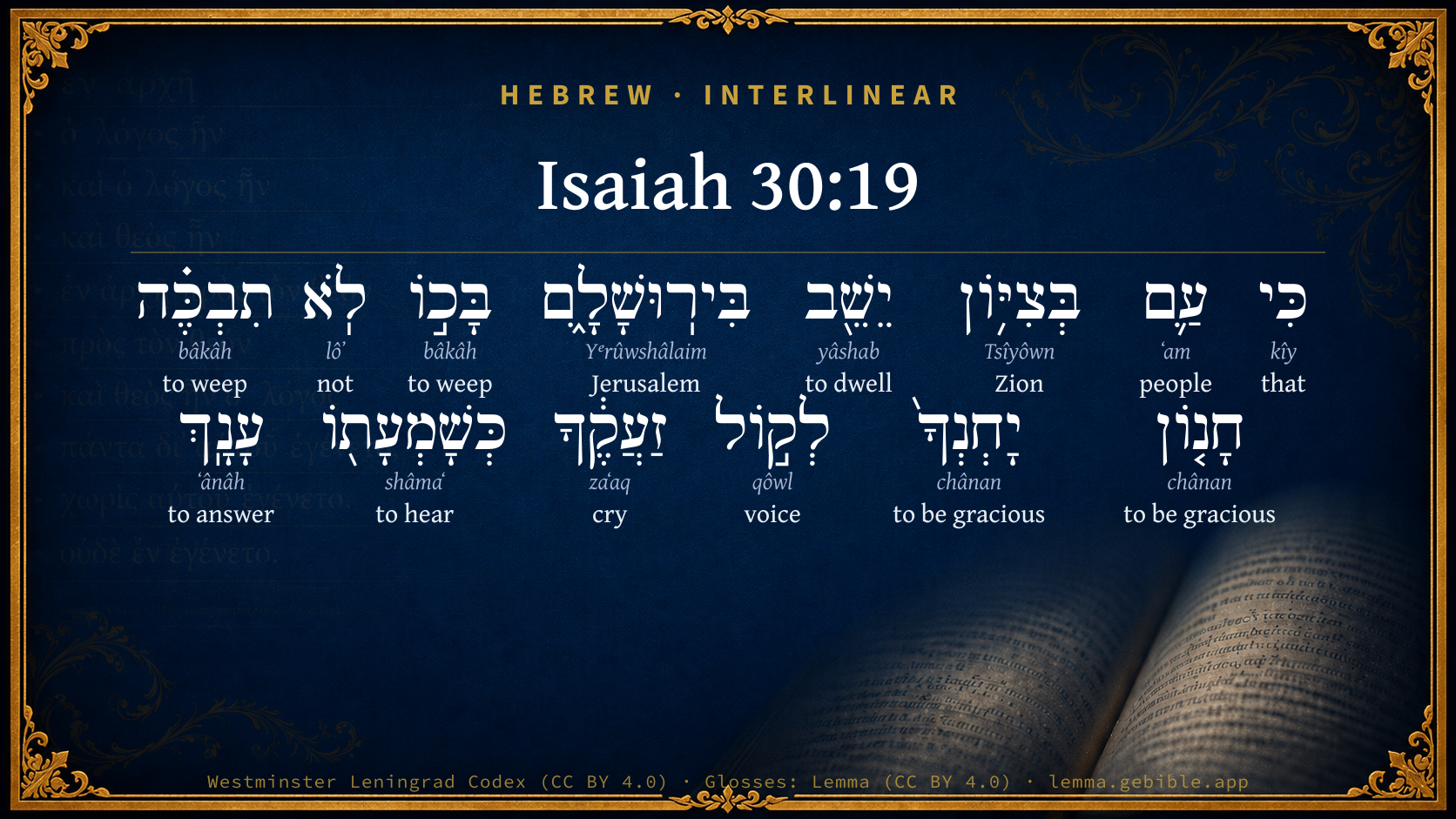
Hebrew (Westminster Leningrad Codex) Isaiah 30:19 appears in the Hebrew Old Testament. The text above is from the Westminster Leningrad Codex. Each word links to its Strong’s number, a concise gloss, and parsing drawn from the Open Scriptures Hebrew Bible morphology. Click any word for its full Brown-Driver-Briggs (BDB) entry.
Download image
Cite this verse

Isaiah 30:19 (World English Bible). Public Domain. Lemma interlinear Bible study tool, https://lemma.gebible.app/v/isaiah/30/19.

Show BibTeX & RIS
BibTeX
RIS
English Translation
For the people shall dwell in Zion at Jerusalem; you shall weep no more; he will surely be gracious to you at the voice of your cry; when he shall hear, he will answer you.
World English Bible · Public Domain
Download a study sheet

One document with this verse’s original text, its word-by-word gloss line, the meaning frame, cross-references with their text, attributed commentary, and full source and license credits — printable, and it pastes into notes with its structure intact.

This verse Autodidact and up

Study sheet (.html) Plain text (.txt)

A passage Seminary Student

Up to 50 verses in one chapter. A passage sheet keeps up to 6 commentary sources and 12 cross-references per verse, in the order this page ranks them, and says so on the sheet whenever that leaves anything out. Ask for a single verse and you get the Autodidact verse sheet above.

Everything on this page stays free to read, with no account — the sheet is a download of what is already on screen, not access to it.

Want to remove ads? Support Godless Engineer
Compare translations 3

The same verse in 3 English versions, stacked beneath the original-language interlinear above. Click any original word for its lexicon entry.

Each is an independent rendering of the whole verse — the interlinear is not word-aligned to these translations.

Highlighted words mark where these versions differ — a whole-verse word diff, not a word-by-word alignment.

  • World English Bible Public Domain
    For the people shall dwell in Zion at Jerusalem; you shall weep no more; he will surely be gracious to you at the voice of your cry; when he shall hear, he will answer you.
  • King James Version Public Domain
    For the people shall dwell in Zion at Jerusalem: thou shalt weep no more: he will be very gracious unto thee at the voice of thy cry; when he shall hear it, he will answer thee.
  • unfoldingWord Literal Text CC BY-SA 4.0
    For a people in Zion will dwell in Jerusalem. Weeping, you will not weep. Favoring, he will favor you at the sound of your crying out. When he hears it, he will answer you.

unfoldingWord Literal Text — © unfoldingWord, licensed CC BY-SA 4.0. Word-aligned USFM3 via Door43 (git.door43.org/unfoldingWord/en_ult).

Versions to compare (up to 4)

3 of 4 selected

Show all 18 translations

Every available English version of this verse, each an independent rendering of the whole verse.

  • World English Bible Public Domain
    For the people shall dwell in Zion at Jerusalem; you shall weep no more; he will surely be gracious to you at the voice of your cry; when he shall hear, he will answer you.
  • Berean Standard Bible Public Domain
    O people in Zion who dwell in Jerusalem, you will weep no more. He will surely be gracious when you cry for help; when He hears, He will answer you.
  • Majority Standard Bible Public Domain
    O people in Zion who dwell in Jerusalem, you will weep no more. He will surely be gracious when you cry for help; when He hears, He will answer you.
  • King James Version Public Domain
    For the people shall dwell in Zion at Jerusalem: thou shalt weep no more: he will be very gracious unto thee at the voice of thy cry; when he shall hear it, he will answer thee.
  • American Standard Version (1901) Public Domain
    For the people shall dwell in Zion at Jerusalem; thou shalt weep no more; he will surely be gracious unto thee at the voice of thy cry; when he shall hear, he will answer thee.
  • Revised Version (1885) Public Domain
    For the people shall dwell in Zion at Jerusalem: thou shalt weep no more; he will surely be gracious unto thee at the voice of thy cry; when he shall hear, he will answer thee.
  • Geneva Bible (1599) Public Domain
    Surely a people shall dwell in Zion, and in Ierusalem: thou shalt weepe no more: he wil certainly haue mercy vpon thee at the voyce of thy crye: when he heareth thee, he wil answere thee.
  • Douay-Rheims (1899) Public Domain
    For the people of Sion shall dwell in Jerusalem: weeping thou shalt not weep, he will surely have pity on thee: at the voice of thy cry, se soon as he shell hear, he will answer thee.
  • Young's Literal Translation Public Domain
    For the people in Zion dwell in Jerusalem, Weep thou not, weeping, Pitying, He pitieth thee at the voice of thy cry, When He heareth He answereth thee.
  • Literal Standard Version CC BY-SA 4.0
    For the people in Zion dwell in Jerusalem, || Do not weep—weeping, || Pitying, He pities you at the voice of your cry, || When He hears He answers you.
  • Unlocked Literal Bible CC BY-SA 4.0
    For a people will live in Zion, in Jerusalem, and you will weep no more. He will surely be gracious to you at the sound of your cry. When he hears it, he will answer you.
  • unfoldingWord Literal Text CC BY-SA 4.0
    For a people in Zion will dwell in Jerusalem. Weeping, you will not weep. Favoring, he will favor you at the sound of your crying out. When he hears it, he will answer you.
  • Darby Bible Public Domain
    For the people shall dwell in Zion, at Jerusalem. Thou shalt weep no more; he will be very gracious unto thee at the voice of thy cry; as he heareth it, he will answer thee.
  • World Messianic Bible Public Domain
    For the people will dwell in Zion at Jerusalem. You will weep no more. He will surely be gracious to you at the voice of your cry. When he hears you, he will answer you.
  • Webster's Bible Public Domain
    For the people shall dwell in Zion at Jerusalem: thou shalt weep no more: he will be very gracious to thee at the voice of thy cry; when he shall hear it, he will answer thee.
  • Free Bible Version CC BY-SA 4.0
    People of Zion, you who live in Jerusalem, you won't have to weep any more. When you cry for help he will be kind to you. He will answer you immediately when he hears you.
  • Bible in Basic English Public Domain
    O people, living in Zion, at Jerusalem, your weeping will be ended; he will certainly have mercy on you at the sound of your cry; when it comes to his ear, he will give you an answer.
  • JPS Tanakh (1917) Public Domain
    For, O people that dwellest in Zion at Jerusalem, thou shalt weep no more; He will surely be gracious unto thee at the voice of thy cry, when He shall hear, He will answer thee.

Literal Standard Version (2020), Covenant Press — licensed CC BY-SA 4.0. Text via the HelloAO Bible API (eBible.org). Unlocked Literal Bible (unfoldingWord) — licensed CC BY-SA 4.0. Text via the HelloAO Bible API (eBible.org). unfoldingWord Literal Text — © unfoldingWord, licensed CC BY-SA 4.0. Word-aligned USFM3 via Door43 (git.door43.org/unfoldingWord/en_ult). Free Bible Version, Dr. Jonathan Gallagher — licensed CC BY-SA 4.0. Text via the HelloAO Bible API (eBible.org).

Word by word

More ways to search: Search by grammar → Find every occurrence → Compare this word →

Practice this passage: Drill this verse → Learn its vocabulary →

זַעֲקֶ֔ךָ
zaʻaq
H2201
“cry · you”
Verb, Qal, Infinitive Construct + Suffix, Personal, 2nd Person, Masculine, Singular
Part of Speech
Verb
Stem
Qal
Form
Infinitive Construct
Full BDB Definition

Origin: from H2199

TWOT: 570a

cry, outcry - outcry - cry of distress - outcry, clamour
  1. כִּי kîy H3588 “that” Conjunction
  2. עַ֛ם ʻam H5971 “people” Noun, Common, Masculine, Singular, Absolute
  3. בְּצִיּ֥וֹן Tsîyôwn H6726 “in/at · Zion” Preposition + Noun, Proper
  4. יֵשֵׁ֖ב yâshab H3427 “to dwell” Verb, Qal, Imperfect, 3rd Person, Masculine, Singular
  5. בִּירֽוּשָׁלִָ֑ם Yᵉrûwshâlaim H3389 “in/at · Jerusalem” Preposition + Noun, Proper
  6. בָּכ֣וֹ bâkâh H1058 “to weep” Verb, Qal, Infinitive Absolute
  7. לֹֽא lôʼ H3808 “not” Particle, Negative
  8. תִבְכֶּ֗ה bâkâh H1058 “to weep” Verb, Qal, Imperfect, 2nd Person, Masculine, Singular
  9. חָנ֤וֹן chânan H2603 “to be gracious” Verb, Qal, Infinitive Absolute
  10. יָחְנְךָ֙ chânan H2603 “to be gracious · you” Verb, Qal, Imperfect, 3rd Person, Masculine, Singular + Suffix, Personal, 2nd Person, Masculine, Singular
  11. לְק֣וֹל qôwl H6963 “to/for · voice of” Preposition + Noun, Common, Masculine, Singular, Construct
  12. כְּשָׁמְעָת֖וֹ shâmaʻ H8085 “like/as · to hear · him” Preposition + Verb, Qal, Infinitive Construct + Suffix, Personal, 3rd Person, Masculine, Singular
  13. עָנָֽךְ ʻânâh H6030 “to answer · you” Verb, Qal, Perfect, 3rd Person, Masculine, Singular + Suffix, Personal, 2nd Person, Feminine, Singular

About this verse

These counts appear in no published source. They are computed here, from the morphology-tagged text and Lemma’s own curated glosses. What Lemma adds →

14
words
12
distinct lemmas
Prophets
section

Notable vocabulary

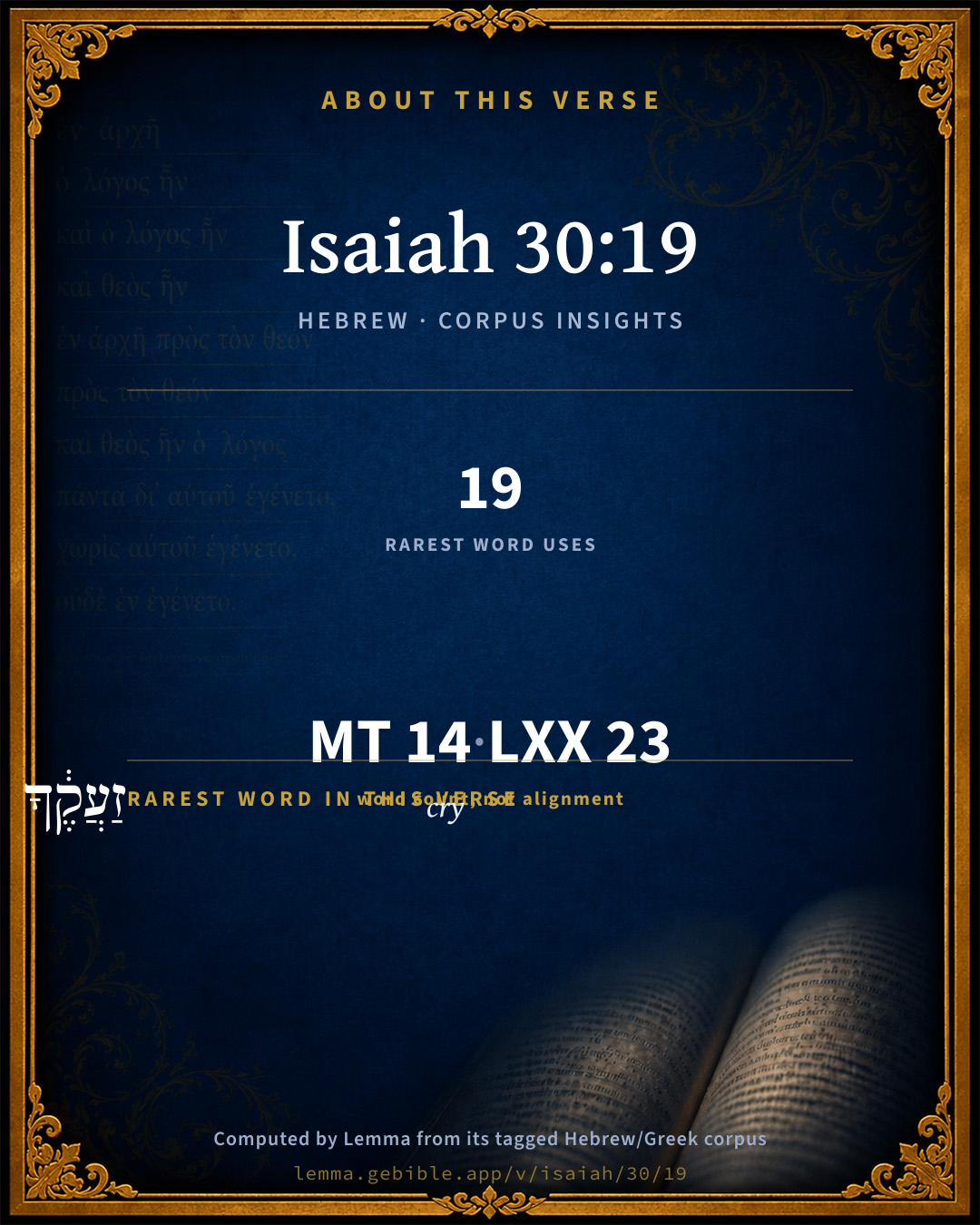
The rarest word here is זַעֲקֶ֔ךָ cry H2201 — appearing just 19 times in the whole Hebrew Bible.

Shared distinctive vocabulary

זַעֲקֶ֔ךָ cry H2201 occurs in 19 verses of the Hebrew Bible. Also found in:

Grammatical profile

  • 8 verbs
  • 4 nouns
  • 1 conjunction
  • 1 particle

Verb forms

  • יֵשֵׁ֖ב Qal · Imperfect
  • בָּכ֣וֹ Qal · Infinitive Absolute
  • תִבְכֶּ֗ה Qal · Imperfect
  • חָנ֤וֹן Qal · Infinitive Absolute
  • יָחְנְךָ֙ Qal · Imperfect
  • זַעֲקֶ֔ךָ Qal · Infinitive Construct
  • כְּשָׁמְעָת֖וֹ Qal · Infinitive Construct
  • עָנָֽךְ Qal · Perfect

Repetition

Words recur within this verse — often emphatic in Hebrew:

  • בָּכ֣וֹ to weep H1058 ×2
  • חָנ֤וֹן to be gracious H2603 ×2

Hebrew & Septuagint length

In English translation the verse runs 35 words from the Hebrew and 33 from the Septuagint (LXX English) — closely comparable.

A rough comparison of the two English renderings, which tokenize alike — not a word-level alignment.

Word counts can differ between the Hebrew and the Greek without any difference in meaning — e.g. the Hebrew direct-object marker אֵת has no separate Greek word, and Greek often adds the article ὁ.

In the original languages it is 14 Hebrew tokens and 23 Greek tokens — but the two are counted differently (Hebrew bundles its prefixes and suffixes into one token; the Greek is in lemma form), so that isn’t a like-for-like length.

Cross-references

38

Topical passages linked to Isaiah 30:19 in the Treasury of Scripture Knowledge — connected by theme and wording, ordered by reader-vote popularity; previews shown in the World English Bible.

  • Isaiah 60:20 Your sun shall no more go down, neither shall your moon withdraw itself; for Yahweh will be your everlasting light, and the days of your mourning shall be ended.
  • Psalms 50:15 Call on me in the day of trouble. I will deliver you, and you will honor me."
  • Isaiah 65:24 It shall happen that, before they call, I will answer; and while they are yet speaking, I will hear.
  • Isaiah 58:9 Then shall you call, and Yahweh will answer; you shall cry, and he will say, Here I am. If you take away from the midst of you the yoke, the putting forth of the finger, and speaking wickedly;
  • Matthew 7:7–11 "Ask, and it will be given you. Seek, and you will find. Knock, and it will be opened for you.
  • 1 John 5:14–15 This is the boldness which we have toward him, that, if we ask anything according to his will, he listens to us.
  • Revelation 7:17 for the Lamb who is in the midst of the throne shepherds them, and leads them to springs of waters of life. And God will wipe away every tear from their eyes."
  • Isaiah 25:8 He has swallowed up death forever; and the Lord Yahweh will wipe away tears from off all faces; and the reproach of his people will he take away from off all the earth: for Yahweh has spoken it.
  • Luke 6:21 Blessed are you who hunger now, For you will be filled. Blessed are you who weep now, For you will laugh.
  • Jeremiah 33:3 Call to me, and I will answer you, and will show you great things, and difficult, which you don't know.
  • Isaiah 65:9 I will bring forth a seed out of Jacob, and out of Judah an inheritor of my mountains; and my chosen shall inherit it, and my servants shall dwell there.
  • Isaiah 61:1–3 The Spirit of the Lord Yahweh is on me; because Yahweh has anointed me to preach good news to the humble; he has sent me to bind up the broken-hearted, to proclaim liberty to the captives, and the opening [of the prison] to those who are bound;
  • Jeremiah 31:12 They shall come and sing in the height of Zion, and shall flow to the goodness of Yahweh, to the grain, and to the new wine, and to the oil, and to the young of the flock and of the herd: and their soul shall be as a watered garden; and they shall not sorrow any more at all.
  • Jeremiah 50:4–5 In those days, and in that time, says Yahweh, the children of Israel shall come, they and the children of Judah together; they shall go on their way weeping, and shall seek Yahweh their God.
  • Zechariah 1:16–17 Therefore thus says Yahweh: "I have returned to Jerusalem with mercy. My house shall be built in it," says Yahweh of Hosts, "and a line shall be stretched forth over Jerusalem."'
  • Ephesians 3:20 Now to him who is able to do exceedingly abundantly above all that we ask or think, according to the power that works in us,
  • Isaiah 10:24 Therefore thus says the Lord, Yahweh of Hosts, my people who dwell in Zion, don't be afraid of the Assyrian, though he strike you with the rod, and lift up his staff against you, after the manner of Egypt.
  • Isaiah 40:1–2 Comfort you, comfort you my people, says your God.
  • Jeremiah 30:12 For thus says Yahweh, Your hurt is incurable, and your wound grievous.
  • Jeremiah 31:6 For there shall be a day, that the watchmen on the hills of Ephraim shall cry, Arise you, and let us go up to Zion to Yahweh our God.
  • Jeremiah 50:28 The voice of those who flee and escape out of the land of Babylon, to declare in Zion the vengeance of Yahweh our God, the vengeance of his temple.
  • Ezekiel 36:37 Thus says the Lord Yahweh: For this, moreover, will I be inquired of by the house of Israel, to do it for them: I will increase them with men like a flock.
  • Micah 4:9 Now why do you cry out aloud? Is there no king in you? Has your counselor perished, That pains have taken hold of you as of a woman in travail?
  • Romans 11:26 and so all Israel will be saved. Even as it is written, "There will come out of Zion the Deliverer, And he will turn away ungodliness from Jacob.
  • Revelation 5:4 And I wept much, because no one was found worthy to open the book, or to look in it.
  • Isaiah 12:3–6 Therefore with joy you shall draw water out of the wells of salvation.
  • Isaiah 35:10 and the ransomed of Yahweh shall return, and come with singing to Zion; and everlasting joy shall be on their heads: they shall obtain gladness and joy, and sorrow and sighing shall flee away.
  • Isaiah 46:13 I bring near my righteousness, it shall not be far off, and my salvation shall not wait; and I will place salvation in Zion for Israel my glory.
  • Isaiah 54:6–14 For Yahweh has called you as a wife forsaken and grieved in spirit, even a wife of youth, when she is cast off, says your God.
  • Jeremiah 29:11–13 For I know the thoughts that I think toward you, says Yahweh, thoughts of peace, and not of evil, to give you hope in your latter end.
  • Jeremiah 31:9 They shall come with weeping; and with petitions will I lead them: I will cause them to walk by rivers of waters, in a straight way in which they shall not stumble; for I am a father to Israel, and Ephraim is my firstborn.
  • Jeremiah 51:10 Yahweh has brought forth our righteousness: come, and let us declare in Zion the work of Yahweh our God.
  • Ezekiel 20:40 For in my holy mountain, in the mountain of the height of Israel, says the Lord Yahweh, there shall all the house of Israel, all of them, serve me in the land: there will I accept them, and there will I require your offerings, and the first fruits of your offerings, with all your holy things.
  • Ezekiel 37:25–28 They shall dwell in the land that I have given to Jacob my servant, in which your fathers lived; and they shall dwell therein, they, and their children, and their children's children, forever: and David my servant shall be their prince for ever.
  • Zephaniah 3:14–20 Sing, daughter of Zion! Shout, Israel! Be glad and rejoice with all your heart, daughter of Jerusalem.
  • Zechariah 2:4–7 and said to him, "Run, speak to this young man, saying, 'Jerusalem will be inhabited as villages without walls, because of the multitude of men and cattle in it.
  • Zechariah 8:3–8 Thus says Yahweh: "I have returned to Zion, and will dwell in the midst of Jerusalem. Jerusalem shall be called 'The City of Truth;' and the mountain of Yahweh of Hosts, 'The Holy Mountain.'"
  • Isaiah 65:18 But be you glad and rejoice forever in that which I create; for, behold, I create Jerusalem a rejoicing, and her people a joy.

Cross-references courtesy of OpenBible.info (CC BY 4.0).

Hebrew and Greek witnesses Masoretic Hebrew ↔ Greek Septuagint

The same verse in the two great witnesses to the Old Testament, shown verse-for-verse.

These are two independent witnesses, not word-aligned to each other, and the Septuagint is shown in lemma (dictionary) form.

Hebrew Isaiah 30:19 Masoretic · Westminster Leningrad Codex

כִּי עַ֛ם בְּצִיּ֥וֹן יֵשֵׁ֖ב בִּירֽוּשָׁלִָ֑ם בָּכ֣וֹ לֹֽא תִבְכֶּ֗ה חָנ֤וֹן יָחְנְךָ֙ לְק֣וֹל זַעֲקֶ֔ךָ כְּשָׁמְעָת֖וֹ עָנָֽךְ

For the people shall dwell in Zion at Jerusalem; you shall weep no more; he will surely be gracious to you at the voice of your cry; when he shall hear, he will answer you.

World English Bible · Public Domain

Greek LXX Isaiah 30:19 Septuagint · lemma form

διότι λαός ἅγιος ἐν σιων οἰκέω καί ἰερουσαλήμ κλαυθμός κλαίω ἐλεέω ἐγώ ἐλεέω σύ ὁ φωνή ὁ κραυγή σύ ἡνίκα ὁράω ἐπιἀκούω σύ

For the holy people shall dwell in Sion: and whereas Jerusalem has wept bitterly, saying, Pity me; he shall pity you: when he perceived the voice of your cry, he listened to you.

LXX2012 (modern English Septuagint) · Public Domain

On this verse, Lange's Commentary on the Holy Scriptures discusses the Septuagint’s reading. Read the note in Commentary ↓

Hebrew: Westminster Leningrad Codex (CC BY 4.0). Greek: Septuagint (public domain); English from LXX2012 (modern English Septuagint) (Public Domain). How the Septuagint differs from the Hebrew →

Targum (Aramaic paraphrase)

1

The Targum is the ancient Jewish Aramaic paraphrase of the Hebrew Scriptures — an interpretive translation, not the Hebrew text itself. Onkelos (literal) and Pseudo-Jonathan (expansive) render the Torah, and Jonathan the Prophets. Coverage is partial: where no permissively-licensed English translation exists for a verse, only the Aramaic is shown. This is verse-level text, not a word-by-word alignment to the Hebrew.

  1. Targum Jonathan Prophets (Joshua–Malachi)
    אֲרֵי עַמָא בְּצִיוֹן יָתֵיב בִּירוּשְׁלֵם מִבְכָּא לָא תִבְכֵּי רַחֲמָא יְרַחֵם עֲלָךְ קָל צְלוֹתָךְ יְקַבֵּל וְיַעְבֵּיד בָעוּתָךְ:

    For the people of Zion shall dwell in Jerusalem thou shalt weep no more. He will assuredly shew thee compassion: the voice of thy prayer He will hear, and He will answer thy supplication.

    Targum Jonathan — Aramaic: “Mikraot Gedolot” (public domain). English: “Sefaria Community Translation” (CC0 1.0 (public-domain dedication)); “London "Chaldee Paraphrase," 1871” (public domain). Text via Sefaria.

Commentary

Notes on Isaiah 30:19 from classic Christian and Jewish commentators (each source and its license shown beneath its notes). The classic Christian expositions comment on the surrounding passage and are grouped to its opening verse, so a note may address several verses; the Jewish commentaries on the Tanakh (Rashi and others) are per-verse, so they appear only where the commentator wrote on this verse.

Lemma curates 59 commentaries, every one of them public domain or Creative Commons licensed, each selected and text-cleaned for this edition rather than reprinted as found. About our sources →

Trapp's Complete Commentary

John Trapp

Isa 30:19 For the people shall dwell in Zion at Jerusalem: thou shalt weep no more: he will be very gracious unto thee at the voice of thy cry; when he shall hear it, he will answer thee.

Ver. 19. For the people shall dwell in Zion, &c.] Or, For thou, the people of Zion that dwell in Jerusalem, shalt weep no more;

“ Flebile principium melior fortuna sequetur. ”

At the voice of thg cry.] Thou shalt pray; thou shalt also hear the Word of God, {Isa 30:20-21} and reform thy life; {Isa 30:22} so shall good be done unto thee.

When he shall hear it, he will answer thee.] Yea, before, {Isa 65:24} before thy prayer can get from thy heart to thy mouth, it is got as high as heaven.

John Trapp, A Commentary or Exposition upon All the Books of the Old and New Testament (1647–1656) — public domain. Text from a community e-Sword module.

Albert Barnes' Notes on the Bible

For the people shall dwell in Zion - (see the note at Isa 1:8). The language here is evidently adapted to a return from the captivity. The whole design of the passage Isa 30:19-26 is to describe a future state of prosperity by images mainly drawn from the idea of temporal enjoyment. The sense is, that in some period subsequent to the calamities that would befall them for their improper reliance on the aid of Egypt Isa 30:16-17, there would be prosperity, peace, and joy in Jerusalem. The order of events, as seen by the prophet in vision, seems to be this. He sees the people threatened with an invasion by Sennacherib. He sees them forget their reliance on God and seek the aid of Egypt. He sees, as a consequence of this, a long series of calamities resulting in the downfall of the republic, the destruction of the city, and the captivity at Babylon. Yet he sees, in the distant prospect, prosperity, happiness, security, piety, the blessing of God, and rich and abundant future mercies resting on his people. That the blessings under the Messiah constitute a part of this “series” of mercies no one can doubt who attentively considers the language in Isa 30:25-26.

Thou shalt weep no more - (see the note at Isa 25:8).

He will be very gracious unto thee at the voice of thy cry - When in your calamities you shall cry unto him for deliverance, he shall hear you, and restore you to your own land. This is in accordance with the statements in Isa 26:8-9 (see the notes at these verses), that in their captivity in Babylon they would seek God.

He will answer thee - (see Jer 29:12-14).

Albert Barnes' Notes on the Bible (1834–1885) — public domain. Text from a community e-Sword/MySword module.

The Biblical Illustrator

Joseph S. Exell

Isa_30:19

He will be very gracious unto thee

Encouragements for faith

Observe the kind of prayer which is here said to move the Divine pity and win the Divine favour.

It is designated a cry, i.e., it is a very fervent, earnest, importunate prayer. It is a prayer that comes out of the depths of the heart. It expresses a very deep sense of need. It utters a very longing desire after God. There is very good reason why our prayers should very often tale this form. Our sins are such that they should work in us a penitence that may fitly take expression in a cry. Our spiritual needs are so urgent that we may give utterance to them in a cry. The strife is, sometimes at least, so hot, and the battle seems so going against us, that it may very reasonably be expected from us that we should cry unto God for His help. And God is such a necessity to these natures of ours, and God as a possession is so sufficing, that our desire for Him may well be intense enough to require this language to give expression to our prayer.

I. There is encouragement for faith in prayer to be found in THE NATURE OF GOD HIMSELF, as we cannot help conceiving of it. Goodness enters into His very nature. We find it necessary to believe that. It is too dreadful to believe the contrary. If I apprehend Him as perfectly good He must be pitiful, He must be tender in His pity; and if so, He is surely likely to be very gracious when He hears the voice of our cry.

II. There is encouragement, too, in THE RELATIONS WHICH WE MUST CONCEIVE GOD AS SUSTAINING TO US. He is our Creator, and there is no reason at all in the suspicion that He who has made us is looking with indifferent eyes upon us or listening with indifference when the voice of our cry reaches His ear. He is our Father. He has communicated to us of His own nature, and so has become our Father as He is not the Father of other creatures that live on the face of this earth. But how does He fill up your idea of Father if, when you are in want, He does not heed? if, when you express your want of Him and of His help by a cry, He is not moved?

III. THE INSTINCT OF PRAYER which we have offers encouragement to us that He will be moved when we call. We are in pain; some One is near who can relieve us, and we instinctively cry for relief at His hands. Your child is in imminent peril, and there is a man near who can rescue him; you instinctively call for the help of that man. And so we feel great wants which God only can supply. We are in great peril, from which God only can deliver us. There is something which instinctively moves us to appeal to God, to cry to Him. If God has put that instinct in our nature, He mast have intended to gratify it. There is no instinct of human nature for the gratification of which God has not in some way provided.

IV. We have encouragement, too, in THE ANALOGY TO ALL HUMAN RESPONSE GIVEN TO GREAT NEED. It is not to children only that we give our compassion when they appeal to us in great distress; we are moved by the lower animals when in their great trouble they make an appeal to us. But you are not more pitiful than God. There is no love or pity in man that was not first in God.

V. We have the highest encouragement to this faith in God in THE REVELATION OF HIM IN THE SCRIPTURES. It is a positive command of His that we should call upon Him when we need Him, that we should cry unto Him when we are in distress. His command means His purpose to hear; His command involves a promise in it. What do we find given in the revelation? Explicit promises without number, and in every form--proofs and illustrations and examples without number of Gods readiness to be very gracious unto those that cry unto Him. What do we see in the revelation of God in the Christian Scriptures? God showing what He is through a man. He went about in the form of a man. The sinning, and the needy, and the suffering came to Him, surrounded Him, tracked His steps, and cried to Him for His pithy and for His help. And was He not very gracious! When He was suffering, dying Himself, there came a cry from another who was in great distress, saying to Him, Remember me; and He was very gracious at the voice of that cry. But some are thinking that it is all true about the nature of God, but that they are guilty, and there are Gods law, and Gods government, and Gods justice, in the way of His nature expressing itself in His pitifulness to them in answer to their cry. Whatever hindrance they put in the way has been taken away by Christ. (D. Thomas, B. A.)

Encouragement to trust and pray

I. THIS ASSURANCE IS PARTICULARLY SUITABLE TO CERTAIN CHARACTERS.

1. This is applicable and comfortable to all afflicted people.

2. To those who are troubled on account of sin.

3. To backsliders filled with their own ways, who are alarmed and distressed at their grievous departures from their God.

4. To all believers in Christ who are at all exercised in heart.

II. THE ASSURANCE HERE GIVEN IS VERY FIRMLY BASED. The words of our text are no old wives fable, they are not such a pretty tale as mothers sometimes tell their children, a story made to please them, but not actually true. What is the ground of this assurance?

1. The plain promise of God.

2. The gracious nature of God.

3. The prevalence of prayer. He will be very gracious unto thee at the voice of thy cry.

4. Personal testimony as to the result of faith in God and supplication to

III. THE ASSURANCE OF THE TEXT BEING SO WELL CONFIRMED SHOULD BE PRACTICALLY ACCEPTED AT ONCE.

1. Let us renounce all earthborn confidences.

2. Refuse despair.

3. Try the power of prayer and childlike confidence in God. (C. H.Spurgeon.)

The Biblical Illustrator, edited by Joseph S. Exell (c. 1880s–1900s) — public domain. Text from a community e-Sword module.

Joseph Benson's Commentary

Isa 30:19. For, &c. — “The consolatory part of this discourse begins here, which is connected with the preceding part by the last clause of the former verse, Blessed, &c. Here follows, therefore, a series of excellent blessings, to be conferred by God after these judgments. And the prophet hath so ordered his style in setting them forth, that when he seems to promise only temporal blessings to the church, he would be understood mystically under these figurative emblems.” — Vitringa. The people shall dwell in Zion, &c. — This is the first of these blessings, the restoration of their state upon their repentance and earnest prayers: as if he had said, Although the time is coming when the people shall be banished from Jerusalem and carried into captivity; yet after a set time they shall return and have a fixed and comfortable abode in Jerusalem, the seat of their religion, and metropolis of their republic. This was in part fulfilled upon their return from Babylon, “when the tears which they had shed in their banishment were wiped away, and God heard the prayers and vows of his people, after the time of his indignation was expired.” But it was more fully accomplished in the times of the gospel, when many of them were, and the whole body of them shall be, brought into Christ’s church, often called Zion and Jerusalem.

Joseph Benson's Commentary on the Old and New Testaments (1811–1818) — public domain. Text from a community e-Sword module.

The Preacher's Complete Homiletical Commentary

Joseph S. Exell (gen. ed.)

GOD’S READINESS TO LISTEN TO THE NEEDY

Isa_30:19. He will be very gracious unto thee at the voice of thy cry.

I. There are persons before me for whom this gracious assurance is particularly suitable. It is most comforting—

1. To all afflicted people. You are depressed; things have gone amiss; you do not prosper in business, or you are sickening in body, or a dear one lies at home pining away. In your straits possibly you may be ready to try some wrong way of helping yourself out of your difficulties. Yield not to Satan. There is help in God for you now. The Lord is not now visiting you in wrath; there is kindness in His severity. By yielding yourself to God, and trusting Him in this your evil plight, you will obtain deliverance (Isa_30:15).

2. To those who are troubled on account of sin. In order to escape from sin and punishment, the very first thing with you is to come back to your God whom you have offended, since He alone can pardon you. There must be a turning of the face in repentance, and a looking of the eye by faith unto God in Christ Jesus, or you will die in your sins (H. E. I., 1479–1484). The natural tendency of your heart, even when under a sense of sin, will be to keep from the Lord. Alas! you will look at your sin again and again till you are ready to pine away in despair, but you will not look to Christ Jesus and be saved. Possibly you may conclude that there is no hope for you in better things, and that therefore you had better enjoy such pleasures as may be found in sin, and take your swing while you may. Do not believe this lie of Satan. There is hope; you are in the land of mercy still. You need do nothing to make the Lord propitious, He is love already; you need not undergo penance, nor pass through grievous anguish of spirit in order to render God more merciful, for His grace aboundeth. Therefore we say to you, Go to Him and test Him, for He will be gracious to the voice of your cry.

3. To backsliders filled with their own ways, who are alarmed and distressed at their grievous departures from God. You may well be grieved, for you have done much dishonour to the name of God amongst the ungodly; you have pierced His saints with many sorrows. If you were cast off for ever as a traitor and left to die as a son of perdition, what could be said but that you were reaping the fruit of your own ways? Yet the text rings in your ears at this time like a clear silver bell, and its one note is grace. “He will be very gracious unto thee” (Jer_3:14; H. E. I., 424).

4. To all believers in Christ who are at all exercised in heart; and we are all in that condition at times. Even when by full assurance we can read our title clear to-day, we become anxious as to the morrow. If trials multiply, how will faith be able to stand? When the days of weakness arrive, what shall we do in our old age? Behind all stands the skeleton form of death. “What shall we do in the swellings of Jordan?” We recollect how we ran with the footmen in our former trials, and they wearied us, and we ask ourselves, “How shall we contend with horsemen?” When standing, as we shall, on the brink of eternity, will our religion then prove a reality, or will our hope dissolve like a dream? Such questions torment our souls. Let all such fears vanish. In child-like confidence come to God, and go no more from Him. Let this verse smile on you, and beckon you to your Father’s heart.

II. The assurance here given is very firmly based. It rests—

1. On the plain promise of God as given in the text, and in many similar declarations scattered all over the Scriptures.

2. On the gracious nature of God. It is His nature to be gracious. Judgment is His strange work, but He delighteth in mercy. Nothing pleases Him more than to pass by transgression, iniquity, and sin when we lie humble and penitent before Him.

3. On the prevalence of prayer. This we know, an experience of eight-and-twenty years has proved that God heareth prayer; therefore we say to you, Go to Him and test Him, for He will be gracious to the voice of your cry.

III. The well-confirmed assurance of the text should be practically accepted at once.

1. Let us renounce at once all earth-born confidences. What is your confidence? Your wealth? Your strong common-sense? Your stalwart frame? What are you relying on? Will it support you in death? Will it stand you in good stead in eternity? It will not if it be anything short of the love of God in Christ Jesus our Lord. Let us flee from all creature-confidence as from a filthy thing, for it is base to the last degree to be trusting in another creature and putting that creature into the place of its Creator.

2. Refuse despair.

3. Try now the power of prayer and child-like confidence in God.—C. H. Spurgeon: Metropolitan Tabernacle Pulpit, vol. xxiv. pp. 337–348.

The Preacher's Complete Homiletical Commentary (gen. ed. Joseph S. Exell; Funk & Wagnalls, c. 1892) — public domain (pre-1929). A full-Bible homiletical/sermon-outline anthology covering 65 of 66 books (2 John is absent from the source module). Text from a community e-Sword module.

Keil & Delitzsch

C. F. Keil & F. Delitzsch

None but such are heirs of the grace that follows the judgment - a people, newly pardoned in response to its cry for help, conducted by faithful teachers in the right way, and renouncing idolatry with disgust. "For a people continues dwelling in Zion, in Jerusalem; thou shalt not weep for ever: He will prove Himself gracious to thee at the sound of thy cry for help; as soon as He hears, He answers thee. And the Lord giveth you bread in penury, and water for your need; and thy teachers will not hide themselves any more, and thine eyes come to see thy teachers. And thine ears will hear words behind thee, saying, 'This is the way, walk ye in it!' whether ye turn to the right hand or to the left. And ye defile the covering of thy graven images of silver, and the clothing of thy molten images of gold; thou wilt scatter them like filthy thing: 'Get out!' thou sayest to it." We do not render Isa 30:19, "For O people that dwelleth in Zion, in Jerusalem!" For although the personal pronoun may be omitted after Vav in an apostrophizing connection (Pro 8:5; Joe 2:23), we should certainly expect to find אתּה here. The accent very properly marks these words as forming an independent clause. The apparent tautology in the expression, "in Zion, in Jerusalem," is emphatic and explanatory. The fate of Zion-Jerusalem will not be the same as that of the imperial city (Isa 13:20; Isa 25:2); for it is the city of Jehovah, which, according to His promise, cannot become an eternally deserted ruin. After this promising declaration, the prophet turns and addresses the people of the future in the people of his own time; bâkhō strengthens the verbal notion with the mark of duration; chânōn with the mark of certainty and fulness. יחנך, with an advanced ŏ, as in Gen 43:29, for יחן. כּ is the shortest expression used to denote simultaneous occurrence; answering and hearing would coincide (shom‛âh, nomen actionis, as in Isa 47:9; Isa 55:2; Ges. 45, 1b; ‛ânâkh, the pausal form here, as in Jer 23:37). From this lowest stage of response to the penitential cry for help, the promise rises higher and higher. The next stage is that in which Jerusalem is brought into all the distress consequent upon a siege, as threatened by the prophet in Isa 29:3-4; the besieged would not be allowed by God to die of starvation, but He would send them the necessary support. The same expression, but very little altered, viz., "to give to eat lechem lachatz ūmayim lachatz," signifies to put any one upon the low rations of a siege or of imprisonment, in Kg1 22:27 and Ch2 18:26; but here it is a promise, with the threat kept in the background. צר and לחץ are connected with the absolute nouns לחם and מים, not as adverbial, but as appositional definitions (like תּרעלה יין, "wine which is giddiness," in Psa 60:5; and בּרכּים מים, "water which is knees," i.e., which has the measure of the knees, where birkayim is also in apposition, and not the accusative of measurement): literally, bread which is necessity, and water which is affliction; that is to say, nourishment of which there is extreme need, the very opposite of bread and water in abundance. Umbreit and Drechsler understand this spiritually. But the promise rises as it goes on. There is already an advance, in the fact that the faithful and well-meaning teachers (mōrı̄m) no longer keep themselves hidden because of the hard-heartedness and hatred of the people, as they have done ever since the time of Ahaz (נכנף, a denom.: to withdraw into כּנף, πτέρυξ, the utmost end, the most secret corner; though kânaph in itself signifies to cover or conceal). Israel, when penitent, would once more be able to rejoice in the sight of those whom it longed to have back again. מוריך is a plural, according to the context (on the singular of the previous predicate, see Ges. 147). As the shepherds of the flock, they would follow the people with friendly words of admonition, whilst the people would have their ears open to receive their instruction. תּאמינוּ is here equivalent to תּימינוּ, תּימינוּ. The abominations of idolatry (which continued even in the first years of Hezekiah's reign: Isa 31:7; Mic 1:5; Mic 5:11-13; Mic 6:16) would now be regarded as abominations, and put away. Even gold and silver, with which the images that were either carved or cast in inferior metal were overlaid, would be made unclean (see 2 Kings 28:8ff.); that is to say, no use would be made of them. Dâvâh is a shorter expression for kelı̄ dâvâh, the cloth worn by a woman at the monthly period. On zârâh, to dispense - to which dâvâh would be inappropriate if understood of the woman herself, as it is by Luzzatto - compare Kg2 23:6. With זהבך, the plural used in the general address passes over into the individualizing singular; לו is to be taken as a neuter pointing back to the plunder of idols.

Keil & Delitzsch — Biblical Commentary on the Old Testament (1861–1891) — public domain (CC PDM 1.0). Text via the HelloAO Bible API. (Old Testament only.)

Lange's Commentary on the Holy Scriptures

4. THE SANCTIFICATION AND SALVATION OF THE PEOPLE

Isa_30:19-26

19          For 14the people shall dwell in Zion at Jerusalem:

Thou shalt weep no more:

He will be very gracious unto thee at the voice of thy cry;

When he shall hear it, he will answer thee.

20     And though the Lord give you the bread of adversity, and the water of 15affliction,

Yet shall not thy teachers be removed into a corner any more,

But thine eyes shall see thy teachers:

21     And thine ears shall hear a word behind thee, saying,

This is the way, walk ye in it,

When ye turn to the right hand, and when ye turn to the left.

22     Ye shall defile also the covering of 16thy graven images of silver,

And the ornament of thy molten images of gold:

Thou shalt 17cast them away as a menstruous cloth;

Thou shalt say unto it, Get thee hence.

23     Then shall he give the rain of thy seed,

That thou shalt sow the ground withal;

And bread of the increase of the earth,

And it shall be 18fat and plenteous:

In that day shall thy cattle feed in large pastures.

24     The oxen likewise and the young asses that ear the ground

Shall eat 1920clean provender,

Which hath been winnowed with the 21shovel and with the fan.

25     And there shall be upon every high mountain and upon every 22high hill,

Rivers and streams of waters

In the day of the great slaughter,

When the towers fall.

26     Moreover the light of the moon shall be as the light of the sun,

And the light of the sun shall be seven-fold,

As the light of seven days,

In the day that the Lord bindeth up the breach of his people,

And healeth the stroke of their wound.

TEXTUAL AND GRAMMATICAL

Isa_30:19. יָחְנְךָ for יְחָנְךָ as Gen_43:29. Comp. Olshausen, Gr., § 243, a. כְּ before שׁמעתו marks coincidence. Comp. Gen_24:30; Gen_34:7; Gen_39:15, et saepe. The Infinitive שְׁמֹעַ with the feminine ending is found only here.

Isa_30:20. מַים is in the absolute state instead of the construct. [On this kind of apposition the note in Delitzsch’s Commentary in loco may be consulted.—D. M.]. כָּנַף occurs as a verb only here. There is no reason apparent why this word should not be the root of כָּנָף covering, wing, and accordingly signify to cover, to hide, in the Niphal to hide one’s-self. The singular is used because יכנף is the prefixed predicate.

Isa_30:21. תאמינו for תֵּימִינוּ (comp. Ewald, (Gr., § 122, e). This form occurs only here.

Isa_30:22. [דָוהָ is abbreviation for כְּלִי דָוהָ. Del.].

Isa_30:23. מקניך could be in the singular. But forms such as מִקְנַי Exo_17:3; Num_20:19, show that the word is also actually used in the plural. ירעה is therefore singular as יכנף in Isa_30:20. (See remark on the latter place).

Isa_30:24. זֹרֶרּ is either Pual part. for מְזֹרֶה, or Part. Kal as a verbal form in which the subject is implied (comp. Isa_2:9; Isa_24:2; Isa_29:8).

Isa_30:26. Lowth, Gesenius, Hitzig, Hendewerk and Knobel regard the words כאור שׁבעת הימים as a gloss because they are wanting in the LXX. and form a needless epexegesis which disturbs the parallelism. But their absence in the LXX. is no reason for treating them as an interpolation. They are found in the Targum, in the Syriac and in Jerome. There is here no fixed metre. We can neither affirm that the verse consists of four members, nor that a definite length is required for each line. And in regard to the sense, the epexegesis is not so needless. For who is not sensible that the שבעתים is set more vividly before us by the addition that follows?

EXEGETICAL AND CRITICAL

1. The Prophet, after preparing the way by Isa_30:18, looks into the distant future. It presents itself to him as a blessed time. He gives a general picture of it in colors borrowed from the present. We call it a general picture, because it will not be realized in a fixed time; but it comprehends as in a frame what will take place for the good of the people from the proximate till the most remote future. But this picture of the future is painted with colors of the present, for the circumstances of the present supply the images under which the Prophet represents the blessings of the future. He assumes that there will always be a people dwelling in Zion, i.e., Jerusalem. This people will not always have to weep; a time will come when its requests will be speedily answered (Isa_30:19). They will not indeed be without bread of distress and water of tribulation in the future, but their eyes will also be constantly able to see the teachers who will show them the way out of distress (Isa_30:20); and the ears of the people will hearken every moment to the voice which will call from behind the direction as to the way they should go (Isa_30:21). Then will the people put away the abominations of idolatry (Isa_30:22). And the Lord will grant rain and glorious fruit to nourish men and cattle (Isa_30:23-24). Springs of water, too, will gush forth on the high mountains in the time when the Lord by rivers of blood has made this possible (Isa_30:25). The light of sun and moon will shine many times brighter than now, in that time when the Lord shall have healed the wounds of His people (Isa_30:26).

2. For the people——Get thee hence.

Isa_30:19-22. The cheering prospect of which Isa_30:18 permitted a view, is now fully and completely unfolded. First of all, the Prophet promises that in Zion—Jerusalem a people will always dwell, i.e., the holy city will never like the world-city become a desert forsaken by men (Isa_13:19 sqq.; Isa_25:2; Jer_50:13 et saepe). בירושׁלם is added for nearer explanation, and as if to prevent a misunderstanding. If the Prophet had written only Zion, it might have been supposed that he speaks of the kingdom whose proper centre was Zion, the seat of the house of David (comp. Psa_2:6; Psa_110:2 et saepe). By the addition “Jerusalem” the Prophet renders it impossible to mistake that he means the city. And in fact Jerusalem has never ceased to be inhabited, whereby it is distinguished from the world-cities Babylon and Nineveh, which have lain desolate for thousands of years. We may not take עַם as a vocative, though in that case תבכה would fitly follow; but the first clause would then have no meaning. The sudden change of person, which occurs frequently in this paragraph, should not cause surprise. Comp. Isa_30:20לָכֶם, Isa_30:21לְכוּ ,אָזְנֶיךָ, ver.22כַּסְפֶֽךָ טִמֵּאתֶם. The infinitive absolute בּכָוֹ has evidently the force that the weeping will not be long continued, as the Lord will speedily have mercy. In the future to which the look of the Prophet is directed, Israel will not be without tribulation. But this tribulation the Prophet comprises in the expression bread of distress, water of affliction.לֶחֶם צַר is found only here. 1Ki_22:27; 2Ch_18:26 we find לחם לחץ ומים לחץ to designate the meagre fare of prisoners. As the Prophet according to what follows (comp. especially Isa_30:26) has the entire future in his eye, we cannot refer the expressions “bread of distress and water of affliction” merely to the siege of Jerusalem by the Assyrians (Isa_29:3 sqq.). But, although that siege stands in the fore-ground of the Prophet’s field of vision, we have to look upon that siege with its bread of distress and its water of affliction only as a type and representative of all the affliction which Israel must endure in the future. And if this affliction is here alluded to only in sparing terms, this is owing to the character of this second part of our prophecy, in which the threatening almost disappears behind the promise. But Israel will bear affliction quite otherwise than formerly. Hitherto they displayed in times of need their rage against the Prophets of the Lord. These were called those who trouble Israel (1Ki_18:17), were treated as ring leaders of sedition (Amo_7:10), and traitors to their country (Jer_38:4 sqq.); all misery was attributed to the forsaking of the worship of idols owing to their urgent effort (Jer_44:16 sqq.). Then the Prophets were persecuted, and must conceal themselves (Mat_23:37; Jer_36:26). This will happen henceforth no more. But Jerusalem will, on the contrary, in affliction direct its eyes to the teachers in order to follow them; it will open its ears to the word of the Lord which the servants of God, who are conceived as commanders marching behind a procession, will call to it, and will direct its steps exactly according to their commands.

[“Their teachers were to be before them, but when they declined from the right way, their backs would be turned to them, consequently, the warning voice would be heard behind them. The first and last clauses of the verse closely cohere.”—Henderson. D. M.]. This obedience to the word of Jehovah implies that they will abandon idols. This will be done while they treat the silver and golden images, without (see command Deu_7:25) regard to the precious metal, as impure things, yea, cast them away as objects of abhorrence (comp. Isa_2:20). טִמֵּא as 2Ki_23:8; 2Ki_23:10; 2Ki_23:16 (only here in Isaiah). צפוי is the metal covering of statues (Deu_17:3-4; Exo_38:7; Exo_38:19) אפדה is found besides only in Exo_28:8; Exo_39:5 in the expression הֵשֶׁב אֲפֻדָּה, a part of the priest’s dress. [“The word is the feminine of אֵפוֹד: but here, as parallel with צפוי, it signifies a covering or plating over the body of an image.”—Henderson]. מַסֵּכָה (Isa_30:1) fusio, fusura, fusile, a molten image (Exo_32:4; Exo_32:8 et saepe, further in Isaiah only Isa_42:17). The expression תזרםthou shalt scatter them, recalls Exo_32:20. צֵא is a strong expression (comp. 2Sa_16:7). The singular לוֹ here involves the notion of something contemptible: Get out! thou wilt say to the trash.

3. Then shall he give——their wound.

Isa_30:23-26. To the change of life described there is now attached the promise of the richest blessing even of a temporal kind. First, to the seed the necessary rain is promised, a blessing which could never be wanting in an oriental picture of prosperity, and is therefore also so frequently referred to in the theocratic promises: Lev_26:4; Deu_14:11; Joe_2:23; Jer_5:24; Zec_10:1 et saepe. The rain which is to fructify the seed is the seed-rain or early rain (יוֹרֶה) which falls in October. The expression “He shall give the rain of thy seed” instead of “to thy seed” recalls places such as Gen_39:21; Num_12:6. אשׁר תזרע = with which thou shalt sow (comp. Isa_17:10) זָרַע is here construed with a double accusative]. לחם is by תבואת הא׳ generalized. It is therefore all that the earth produces for the food of man, as לחם is used also in this comprehensive sense in the expression “to eat bread.” (Gen_31:54; Gen_43:16; Jer_41:1 et saepe). All these products of the field serving for food shall be of the best quality, full of sap and strength (דָּשֵן as an adjective only here in Isaiah: comp. Psa_92:15; Gen_49:20). כַּר in the signification of pascuum only here and Ps. 37:20; 65:14. The Niphal נרחבdilatatum, spatiosum esse is likewise found only here. The oxen and asses which till [In the E. V., we have the word ear which is now obsolete and means to plough or to till.—D. M.] the land are the animals employed by the farmer for draught and carrying burdens. These shall be fed with the best provender.בְּלִיל (only here in Isaiah, besides Job_6:5; Job_24:6) is a mixture, a mash, provender consisting of grain (comp. the following זֹרֶה) and chopped herbs. חָמִיץ leavened, salted (comp. חֹמֶץ ,חָמֵץ) is ἅπ. λεγ. The provender is salted with salt or saltish herbs, in order to make it more palatable. It has previously to be cleansed from impurities that it may be more excellent. This is done by winnowing. The implements which serve for winnowing are רַחַת and מִזְרֶח which are still called Racht and Midra. The former is a flat shovel and serves, according to the interesting Excursus of Wetzstein in Delitzsch’s Commentary, to winnow leguminous fruits, and the mixed remains of the better kinds of grain. The latter is a five or six pronged fork which is employed in winnowing the superior kinds of grain. If the Prophet had mentioned the winnowing shovel only (racht), the meaning would be that the cattle would be fed only with inferior provender. The mention of the מִזְרֶה intimates that they should also have grain of wheat and barley. רַחַת is ἅπ. λεγ.מִזְרֶה occurs further in Jer_15:7. On all high mountains and towering hills were the places of idolatrous worship, where flowed the blood of the offerings so offensive to God, especially of the children sacrificed to Moloch (1Ki_14:23; 2Ki_17:10; Jer_2:20; Jer_3:6; Eze_6:13; Eze_20:28). Instead thereof there should now flow on the mountains and hills water-brooks, a blessing hitherto confined to the valleys (Isa_41:8). פלגים are certainly natural brooks; יְבָלִים (besides Isa_44:4) are perhaps water-courses turned off from them. But as the Prophet had already, Isa_30:20, intimated by the mention of bread of distress and water of affliction, that distress and affliction would not be wanting, so here at the close of his discourse he sets forth the prospect of great slaughter and falling of towers. By these intimations he lets us perceive that the glorious time of the end lies beyond a dreadful period which first must be passed through. This latter he has described often enough (comp. 24 sqq.), to be able to suppose that these brief allusions would be quite well understood by his readers. ביום is to be taken here in that general sense in which we have already frequently met it (comp. e.g., Isa_27:1); but in our place the occurrence following that time is placed first. It is implied, too, in the ביום that there is a certain connection between the occurrences mentioned. There is no chasm lying between them, so that the following time has absolutely nothing to do with the foregoing. That water-streams of blessing succeed streams of blood is not accidental. These streams of blood must atone and purify so as to prepare the ground for blessing. הֶרֶג occurs further Isa_27:7. I find in הרג and נפל מגדלים simply an allusion to the great judgments which must fall on people and city before the day of redemption. The old, theocratic Jerusalem with its towers and its temple is reduced to ruins, while streams of blood have at the same time flown. And here the Prophet takes in one view the first and second destruction of Jerusalem. But immediately behind this destruction he sees the time of blessing. That long periods of time must intervene between these occurrences is matter of no moment. Verse 26 transports us into a time which lies beyond the present state of things, though not into the time of the new heaven and new earth, for the present sun and the present moon still exist. But their influence is intensified; they are elevated in the scale of existence. Delitzsch is certainly right in saying: “It is not the new heaven of which the Prophet here speaks, but that glorification of nature promised both in Old and New Testament prophecy for the final period of the world’s history.” Comp. Rev_20:1-4. The light of the moon (לבנה besides only Isa_24:23; Son_6:10) will then be as the light of the sun (חמה, likewise in Isa_24:23 and Son_6:10, besides Job_30:28); but the light of the sun will be the seven-fold (septuplum Gen_4:15; Gen_4:24; Psa_12:7) of what it now is. For it will be as the light of seven days, i.e., the quantity of light which has hitherto been sufficient for seven days will then be concentrated in a single day. On this day all the wounds which the Lord must inflict on His people before and after the time of the Prophets (Isa_30:20; Isa_30:25), will be healed. שֶׁבֶר is a word of very frequent use by Isaiah. מחץ מכתו is the fracture, contusion of the bone caused by the stroke which it receives. מחץ seems to indicate a sorer evil than שׁבר. [Instead of the E. V., the stroke of their wound, we should rather render the wound of their stroke. It is doubtful whether the suffix in מכתו should be referred to עַם or יהוה—D. M.].

Footnotes:

[14]a people.

[15]Or, oppression.

[16]Heb. the graven images of thy silver.

[17]Heb. scatter.

[18]full of sap and fat.

[19]Or, savory. Heb. leavened.

[20]salted.

[21]fan and fork.

[22]Heb. lifted up.

Lange's Commentary on the Holy Scriptures (Critical, Doctrinal, and Homiletical), ed. John Peter Lange, English translation edited by Philip Schaff (1864–1880) — public domain. Text from a community e-Sword module.

Tyndale Open Study Notes

Tyndale Open Resources

30:19 This was probably a challenge and promise to Hezekiah during the Assyrian siege of Jerusalem (see chs 36–37). If he would just trust in God, his people would weep no more. • The Lord cares for the needs of his people; when they ask for something, he will surely respond.

Tyndale Open Study Notes — © Tyndale Open Resources, licensed CC BY-SA 4.0. Text via the HelloAO Bible API.

Jamieson, Fausset & Brown

Robert Jamieson, A. R. Fausset & David Brown

(Isa 65:9). The restoration from Babylon only typifies the full accomplishment of the prophecy (Isa. 30:18-33).

weep no more-- (Isa 25:8).

thy cry-- (Isa 26:8-9; Jer 29:12-14).

Jamieson, Fausset & Brown — Commentary Critical and Explanatory on the Whole Bible (1871) — public domain (CC PDM 1.0). Text via the HelloAO Bible API.

Adam Clarke's Commentary

Verse 19. For the people shall dwell in Zion - "When a holy people shall dwell in Sion"] Λαος ἁγιος, Septuagint; עם קדוש am kadosh. The word קדוש kadosh, lost out of the text, but happily supplied by the Septuagint, clears up the sense, otherwise extremely obscure. When the rest of the cities of the land were taken by the king of Assyria, Zion was preserved, and all that were in it.

Thou shalt weep no more - "Thou shalt implore him with weeping"] The negative particle לא lo is not acknowledged by the Septuagint. It may perhaps have been written by mistake for לו lo, to him, of which there are many examples.

Adam Clarke's Commentary on the Bible (1810–1826) — public domain. Text from a community e-Sword/MySword module.

Ellicott's Commentary for English Readers

(19) Shall dwell in Zion at Jerusalem.—The two words are, of course, practically synonymous; but the prophet dwells with a patriot’s affection on both the names which were dear to him. The words admit of being taken as a vocative, “Yea, O people that dwellest.”

A Bible Commentary for English Readers, edited by Charles John Ellicott (1878–1897) — public domain. Text from a community e-Sword module.

The Cambridge Bible for Schools and Colleges

gen. ed. J. J. S. Perowne

19. The answer to prayer.

For the people shall dwell …] Rather For, O people in Zion that dwellest in Jerusalem.

thou shalt weep no more … gracious] weep thou shalt not, he will surely be gracious.

The Cambridge Bible for Schools and Colleges (gen. ed. J. J. S. Perowne; Cambridge University Press, 1878–1918) — public domain. Text from a community e-Sword module.

John Gill's Exposition

For the people shall dwell in Zion at Jerusalem,.... Or, "for the people of Zion (z) shall dwell in Jerusalem"; those that belonged to the fort of Zion should dwell in Jerusalem, or "abide" there, both they and the inhabitants of it, at least many of them should quietly continue there, waiting the Lord's time to appear for them, and not run here and there, and particularly to Egypt for help or shelter. Seeing there are many things in the following verses which have respect to Gospel times, and best suit with them, this may be understood of the safe and comfortable dwelling of the children of Zion, or regenerate persons, in a Gospel church state, which is often called Jerusalem, both in the Old and New Testament:

thou shalt weep no more; or, "in weeping thou shall not weep" (a); though they had been weeping because of the enemy's invasion of their land, and besieging their city, yet now all tears should be wiped away from their eyes, being delivered from him; this may very well be accommodated to Gospel times:

he will be very gracious unto thee, at the voice of thy cry; these are the words of the prophet, declaring that the Lord would be gracious to his people at the voice of their prayer and supplication to him in their distress, as he was to the voice of Hezekiah's cry and supplication to him:

when he shall hear it, he will answer thee; he always hears the prayers of his people, and he always answers them, sooner or later, in his own time, and in his own way; see Isa 65:24.

(z) "polpulus Sion", V. L. Gataker. (a) "plorando non plorabis", Pagninus, Montanus.

John Gill's Exposition of the Whole Bible (1746–1763) — public domain (CC PDM 1.0). Text via the HelloAO Bible API.

Haydock's Catholic Bible Commentary

Weep. The citizens expected certain death, (Haydock) or slavery. (Calmet)

George Leo Haydock (1774–1849), Haydock's Catholic Family Bible and Commentary, 1859 edition — public domain. Excludes Psalms (Douay-Rheims chapter numbering differs from Protestant) and Deuterocanonical books (Catholic canon only).

Matthew Poole's English Annotations

For the people shall dwell in Zion at Jerusalem; for although the time is coming, when the people shall be banished from Jerusalem, and carried captives into Babylon; yet after a set time they shall return to Jerusalem, and have a fixed and comfortable abode there: which was in part accomplished upon their return from Babylon; but more fully in the times of the gospel, when many of them were, and the whole body of them shall be, brought into Christ’s church, which is oft called Zion and Jerusalem, both in the Old and New Testament.

He will answer thee; whereas now he seems to be deaf to thy prayers.

Matthew Poole's English Annotations on the Holy Bible (1683–1685) — public domain. Text from a community e-Sword/MySword module.

Whedon's Commentary on the Bible

Daniel D. Whedon

19-26. Having opened thus the ever-pleasing thought of the prophet — namely, the divine forbearance — the way is prepared now for comfort to the devout class of people in Jerusalem.

The people shall dwell in Zion — He yearns for all to become devout, which, if they will, safety is a sure thing for the whole nation. The nation is between two fires — Egypt and Assyria. Worldly court partisans waver as to policy between these. The religious party denounce every object of trust but Jehovah. The prophet is their uncompromising leader. He encourages in no faint terms. The nation is kept down by the powers on either side, but he claims it is not extinct, with Mount Zion in their midst. Jehovah is ready to reinstate the nation in its true glory. Weeping shall cease! Crying to Jehovah shall be heard as soon as uttered! The prophet uses soaring words. He addresses the future as well as the present.

Though — This is not in the Hebrew, yet the complete sense requires it, else neither member of the sentence is intelligible.

Bread of adversity, and the water of affliction — Expressions for doled out bread and water, as is customary in sieges because of their scarcity: but on condition of return to Jehovah, these shall pass away, and plenteousness take their place.

Shall not thy teachers be removed — Their “teachers,” or true prophets, were also often removed, or obliged to hide themselves, in times when the idolatrous anti-reformers were in complete power, but this evil should also come to an end.

A word behind thee — “Behind thee” may be a figure drawn from shepherd life, and seems to intimate that some of the flock, instead of strictly following the shepherd as is the Eastern custom, had gone in front, and were wandering aside of the true way, when the shepherd’s voice “behind them” is heard in warning.

Defile… images — The true people are seen by the prophet in the glorious times, putting away idolatry as a polluted abomination. Ahaz had not been slow in filling Jerusalem with it. The images thus worshipped are to be cast away with utter disgust, as is also expressed in the final words,

Get… hence. Then shall he [Jehovah] give the rain of thy seed — The rains needed to insure an ample harvest — the first rains in autumn, after seed sowing, the latter in the spring. Earthly images of this sort are figures of grand spiritual blessings to the people of Israel.

Fat and plenteous — Fatness, fertility, plenty for man and beast, and every thing contributing to these, yield, in the Old Testament, the richest descriptions for conceptions spiritual.

Light… sun… sevenfold — The sevenfold increase of the light of heaven’s luminaries, and the concentrated light of seven days into one, represent the advanced spiritual state of the children of Jehovah.

Daniel D. Whedon (gen. ed.), Commentary on the Old and New Testaments (1874–1909) — public domain. Text from a community e-Sword module.

The Pulpit Commentary

For the people shall dwell in Zion; rather, a people shall continue. Jerusalem shall not now be made desolate, or deprived of its inhabitants. Whatever the number of captives taken, "a people shall remain." Thou shalt weep no more. The reasons for weeping shall be removed. He will be very gracious unto thee at the voice of thy cry. For God to be gracious to them, they must first "cry" to him make an earnest, hearty appeal to him for mercy. Their "cry" will be answered as soon as heard, is as soon as uttered.

Vers. 19-22. Turning to God.

It is the intention of God"s chastisements, and their natural, though perhaps scarcely their ordinary, result, to stir the soul to penitence, and produce a turning of the heart to God. When the spirit of the man is truly touched, the steps on the path of repentance are commonly

I THE UTTERANCE OF A CRY. Men and brethren, what shall we. (Act_2:37) Sirs, what must I do to be saved?". (Act_16:30) Lord, what wilt thou have me to do?". (Act_9:6) "Lord, save us, we perish!". (Mat_8:25) Some bitter cry or other is wrung from the lips of the awakened sinner, who feels his own weakness and guilt, despairs of saving himself, and makes appeal to him who is alone mighty to save," in tones of earnest entreaty and extreme longing for help. The "cry" is answered as soon as heard (ver. 19). By external teaching, or an inward secret voice, men are warned what they must do as the next step on the path which leads to life. This is

II THE FORSAKING OF THEIR SINS. Be it impurity, be it lying, be it idolatry, that has separated between the sinner and God, he must at once set himself to cast it off, and rid himself of it. "Ye shall defile the covering of thy graven images" (ver. 22). "Put away the evil of your doings: cease to do evil". (Isa_1:16) It is sin, and sin only, that separates us from God. If we would be at one with him, sin must be put away. All, however, is not completed yet. Those who truly turn to God will not be content with a negative goodness; they will follow up the forsaking of their sing by

III THE EARNEST ENDEAVOR TO LEAD A LIFE OF ACTIVE WELL-DOING. "Cease to do evil; learn to do well," says the prophet. (Isa_1:16) It is not enough to "put off the old man;" we must "put on the new man, which after God is created in righteousness and true holiness". (Eph_4:24) For every weed that we pluck from our hearts, we must put in a flower; for every vice that we uproot, we must plant a virtue. God wills that we should "add to our faith virtue; and to virtue knowledge; and to knowledge temperance; and to temperance patience; and to patience godliness; and to godliness brotherly kindness; and to brotherly kindness charity". (2Pe_1:5-7) We must endeavor, by "patient continuance in well-doing," at once to improve our own characters, to help the brethren, and to rebuke, if we cannot convince, the gainsayer.

Vers. 19-26. The blessedness of Zion.

Throughout the book the idea of temporal blends with that of spiritual weal. The images are drawn from the state of temporal happiness and prosperity. Yet Zion and Jerusalem may be regarded as symbolical of the Church in general.

I JOY IN GOD. There will be "no more weeping." Tears are significant of the lot of humanity; and in the poetry of the Old Testament we hear, as Lord Bacon says, "as many hearse-like airs as carols," and the pencil of the Holy Ghost has labored more in depicting the sorrows of David than the felicities of Solomon. It is because the gospel meets the mood of tears in us that its assurances fall so sweetly on the heart. Burns the poet said, "After all that has been said on the other side of the question, man is by no means a happy creature. I do not speak of the selected few, favored by partial Heaven, whose souls are tuned to gladness, and riches, and honors, and prudence, and wisdom; I speak of the neglected many, whose nerves, whose sinews, whose days, are sold to the minion of fortune." It is this way of thinking it is these melancholy truths, that make religion so precious to the poor miserable children of men. If it is a mere phantom, existing only in the heated imagination of enthusiasm, "what truth on earth so precious as the lie?" What is needed is "the expulsive power of a new affection in the sense of the nearness of God the sense that he does hear and that he does answer out of the vastness and the void." And he will so answer, if he be sought for with "all the heart". (Jer_29:12-14)

II THE BLESSING OF TEACHERS. On the one hand, here is physical want of adversity, and water of affliction." On the other hand, a perpetual supply of spiritual food and spiritual consolation. The best of the people felt that it was the saddest thing that could be suffered to have no more "signs" from God, to be destitute of the prophet, and of the man of superior insight. (Psa_74:9) The famine of "not hearing the Word of Jehovah" (Amo_8:11) is bitterer than hunger or thirst. The effect may be traced to a definite cause the sin of the people or of the teachers themselves. (Isa_43:27) The one might be unworthy to listen to, the other to deliver, the truth of God. (Isa_43:27) There is no calling more glorious, none which leads to a more lustrous immortality, (Dan_12:3) than that of the religious teacher, none which is of greater service in the promotion of the kingdom of God. If so great be the blessing of the ministry of the truth, it flows from the goodness of God that, in the happy times to come, teachers shall never be absent from the people.

III THE BLESSING OF INWARD ILLUMINATION. The "word behind them" may be the Bath-Kol, the daughter of the Voice, as the Jews say, or, according to a way of thinking more familiar to ourselves, the voice of conscience. "God is not a hidden God in the sense that his life is closed up within himself. His Word goes forth to the world, that it may come into being, and to the children of men that they may know it and find life in it. (Psa_33:6; cf. Deu_4:12 1Sa_3:4 1Ki_19:11, sqq.) (On the Bath-Kol, see Mat_3:17 Mat_17:5 Joh_12:28) The notion is that of invisible and unexpected agency. The admonitions of providence, of conscience, of the Holy Spirit, seem often to come behind us to recall us from the path on which we were going, from the course that would be fraught with danger. When in danger of straying to this side or to that, the voice will call us back. In this respect the Divine voice is like the daemonion of Socrates, which was a restraining influence.

IV PURITY AND PROSPERITY. A symptom of a return to true religion will be the casting away of the relics and reminders of idolatry the defiling in the Name of the holy God of that which to heathen eyes was holy. Josiah"s conduct was an example of this. (2Ki 23) The expression of abhorrence for the symbol expresses at the same time abhorrence for the thing symbolized. The repentance of the individual, the reformation of the nation, must be signalized by the "rending of the idol," not merely from its high place, but from the heart itself. When the heart is brought into the fuller knowledge of God, it loves what he loves, and hates what he hates. The thought of what is "an abomination to Jehovah" (Deu_7:25) is reflected in an intense distaste in the soul.

2. This will be consistent with external prosperity. Rain will come down upon the sown seed. As the withholding of the rain followed upon national iniquity as the greatest curse, (Zec_14:17, Zec_14:18) so the giving of the rain meant at once all physical blessing and all Divine favors. (Zec_10:1, etc.) Bread rich and abundant produce of the land cattle teeming in the wide pastures; it is the happy picture of a golden age. Bread and water simple elements of living; yet what poetry hangs upon their supply! and what woe, what tragedy and horror, upon the want of them! J.

Vers. 19-26. The people of God in their prosperity.

These verses are primarily applicable, and they are more or less true as they are applied, to the return of the Jews from captivity, and their residence in their own land. But they find a larger fulfillment in the condition of the Church of Christ in its last days. Possibly they anticipate the felicities of the heavenly future. We refer them to the Church in its prosperity, and conclude

I THAT THE PEOPLE OF GOD ARE THOSE THAT HAVE KNOWN A TIME OF TROUBLE. Dark days have passed over their heads; there has been "the breach of his people, and the stroke of his wound" (ver. 26). God once made them to "eat the bread of adversity," etc. (ver. 20). They have passed through grave spiritual anxieties; they have felt the burden of unforgiven sin; they have sighed for the sense of God"s favor; they have known the miseries of separation from God, and the weariness of a life unbrightened with sacred joy.

II THAT IN THEIR DISTRESS THEY MADE EFFECTUAL APPEAL TO GOD. (Ver. 19.) God is never deaf to the cry of sorrow; but to the appeal of the penitent spirit, longing to return unto him, his ear is peculiarly alive; he will be "very gracious" at the voice of that cry he shall hear it, he will answer thee." No loudest sounds will drown the sigh of the contrite spirit, no multiplied activities will prevent the heavenly Father from giving it his immediate regard.

III THAT THE DAY OF CHRISTIAN PRIVILEGE IS ONE OF VERY BLESSED ILLUMINATION. In the day of its prosperity there should be abundance of light for the Christian Church. Its teachers should not have to hide in obscurity, but should be visible and accessible to all (ver. 20); and there should be times when the light of Divine truth would be not only clear, but brilliant and powerful, making other clays to seem dark by comparison. (ver. 26; see 2Co_3:9, 2Co_3:10) Compared with the condition of heathen lauds, or even with the state of Israel under Samuel or David, or even with many Christian countries now, how blessed the state in which the gospel of the grace of God shall be made known in its freedom and its fullness in every town and hamlet, and in every cottage home!

IV THAT THIS DAY OF CHRISTIAN PRIVILEGE WILL BE ONE OF KIND AND FAITHFUL WATCHFULNESS. (Ver. 21.) The vision is one of high, but not heavenly, blessedness; of advanced, but not absolute excellency. The citizens of the holy kingdom will be found walking in the King"s highway, but there will remain a tendency to "turn-to the right hand or to the left," to go off into by-paths of error, or mistake, or unwisdom, if not of actual transgression. In this case there will be the faithful monitor, the Christian teacher, who will be ready with the timely intervention, "This is the way, walk ye in it." This readiness to intervene at the moment of digression ought to characterize our own times; it should be the holy habit, the careful acquirement, of the Christian pastor. On the other hand, a readiness to be admonished is one of the graces of a godly character.

V THAT THE TIME OF TRUE PROSPERITY WILL BE MARKED BY THE DECISIVE INTOLERANCE OF EVIL. (Ver. 22.) They that name the Name of Christ will not only "depart from all iniquity," but they will reprobate it; they will thrust it away; they will not like even to allude to shameful things (Eph_5:3) these will be hateful, intolerable to them. We may measure our nearness to God by the degree of our abhorrence of evil. (Heb_1:13 Rom_12:9)

VI THAT THE TIME OF CHRISTIAN PRIVILEGE WILL BE ONE OF ABOUNDING JOY. (Vers. 23-25.) This language is clearly figurative; it is the utterance of exultation. Everything contributes to joyous prosperity the timely rain, the large increase of seed, the rich pastures, abundance of food for cattle as well as for man, unfailing "brooks that make the meadows green." The land will laugh with exuberance, the nation will exult in overflowing wealth. In the days of unfettered liberty and universal privilege the Christian Church will delight itself in God; its songs of peace and of hope will arise from every valley; its life will be touched and lighted with the sunshine of a holy gladness. The light of God"s countenance will rest upon it, and it will rejoice greatly in his salvation. C.

The Pulpit Commentary (1880–1919), ed. H.D.M. Spence-Jones & Joseph S. Exell — public domain. Text from a community e-Sword module.

John Wesley's Explanatory Notes

Shall dwell - After a set time, they shall return to Jerusalem, and have a fixed abode. This was in part accomplished upon their return from Babylon; but more fully in the times of the gospel, when many of them were, and the whole body of them shall be brought into Christ's church.

John Wesley, Explanatory Notes Upon the Whole Bible (1754–1765) — public domain. Text via the GEBible commentary corpus.

J. A. Alexander on Isaiah

Joseph Addison Alexander

“For the people in Zion shall dwell in Jerusalem; thou shalt weep no more; he will be very gracious unto thee at the voice of thy cry; as he hears it he will answer thee.” The position of the first verb in this English sentence leaves it doubtful whether it is to be construed with what follows or what goes before. Precisely the same ambiguity exists in the original, which may either mean that the people who are now in Zion shall dwell in Jerusalem, or that the people shall dwell in Zion, in Jerusalem. This last is the most natural construction. It is adopted in the English version, but with a needless variation of the particle, in Zion at Jerusalem. In the translation above given the Hebrew order is restored.

Joseph Addison Alexander, The Prophecies of Isaiah (1846–1847; New York: Scribner, 1870–1878) — public domain. Text from a community e-Sword module.

Rashi

Rabbi Shlomo Yitzchaki (Rashi)

For days will yet come that he who remains to be dwelling in Zion and in Jerusalem, will be righteous. ([Manuscripts read:] For days will yet come and a righteous nation will dwell in Zion and in Jerusalem.) ([Other manuscripts read:] For the nation that He shall leave to be dwelling in Zion and in Jerusalem, shall be righteous people.)

you shall not weep You shall not need to offer supplication to the Holy One, blessed be He, with weeping, for, at the sound of your cry, He shall respond to you.

Rashi on the Tanakh — English translations: “The Judaica Press complete Tanach with Rashi, translated by A. J. Rosenberg” (CC BY 4.0); “Pentateuch with Rashi's commentary by M. Rosenbaum and A.M. Silbermann, 1929-1934” (public domain); “The Metsudah Tanach series, Lakewood, N.J” (CC BY 4.0); and “The Book of Joshua, Metsudah Publications, 1997” (CC BY 4.0). Text via Sefaria.

Ibn Ezra

Rabbi Abraham ibn Ezra

Thou shalt weep no more, says the prophet to his people, for he will be, etc. God will be gracious unto thee.

לקול זעקך. The ל indicates the cause: At the voice of thy cry, that is, because thou hast cried unto Him.

עָנָ He hath answered thee. It is an irregular form; comp. פֵּאֲרָ He hath glorified thee (55:5).

Ibn Ezra on the Tanakh — English translations: “Sefaria Community Translation” (CC0 1.0 (public-domain dedication)); “Yalkut, Sifsei Chachomim Chumash, Metsudah Publications, 2009” (CC BY 4.0); and “Commentary of Ibn Ezra on Isaiah - trans. by M. Friedlander, 1873” (public domain). Text via Sefaria.

Lesson kit

Teaching starters — assembled from the data on this page, not authored interpretation. Every prompt links to the verse data it draws on. Edit before teaching.

Isaiah, in the Prophets, opens this verse with 14 words (12 distinct Hebrew lemmas). Its most distinctive word is zaʻaq (“cry”). A historical commentator’s framing appears above. Read the whole chapter for the surrounding context.

Discussion questions

  1. How does “cry” (zaʻaq) shape what this verse is saying?
  2. Genesis 18:20 shares the word «cry» with this verse. How do the two illuminate each other?
  3. “to weep” occurs 2× in this one verse. What is the effect of the repetition?
  4. These translations render this verse differently. What is at stake in choosing one wording over another?
  5. The verb «יֵשֵׁ֖ב» is Qal Imperfect. How does its form color the action?
  6. Reading how Trapp's Complete Commentary and Albert Barnes' Notes on the Bible read this verse, where do the two commentators agree and where do they part?

Things to notice

Reading settings

Reading text

Shown beneath each verse's original-language words.

Old Testament
Old Testament edition

Read the OT as the Masoretic Hebrew (MT) or the Greek Septuagint (LXX).

English shown for the Greek Septuagint (in the Hebrew ↔ Greek comparison).

Comparing translations? Open the Compare panel on any verse page to stack up to four side by side.