
2 Chronicles 30:1

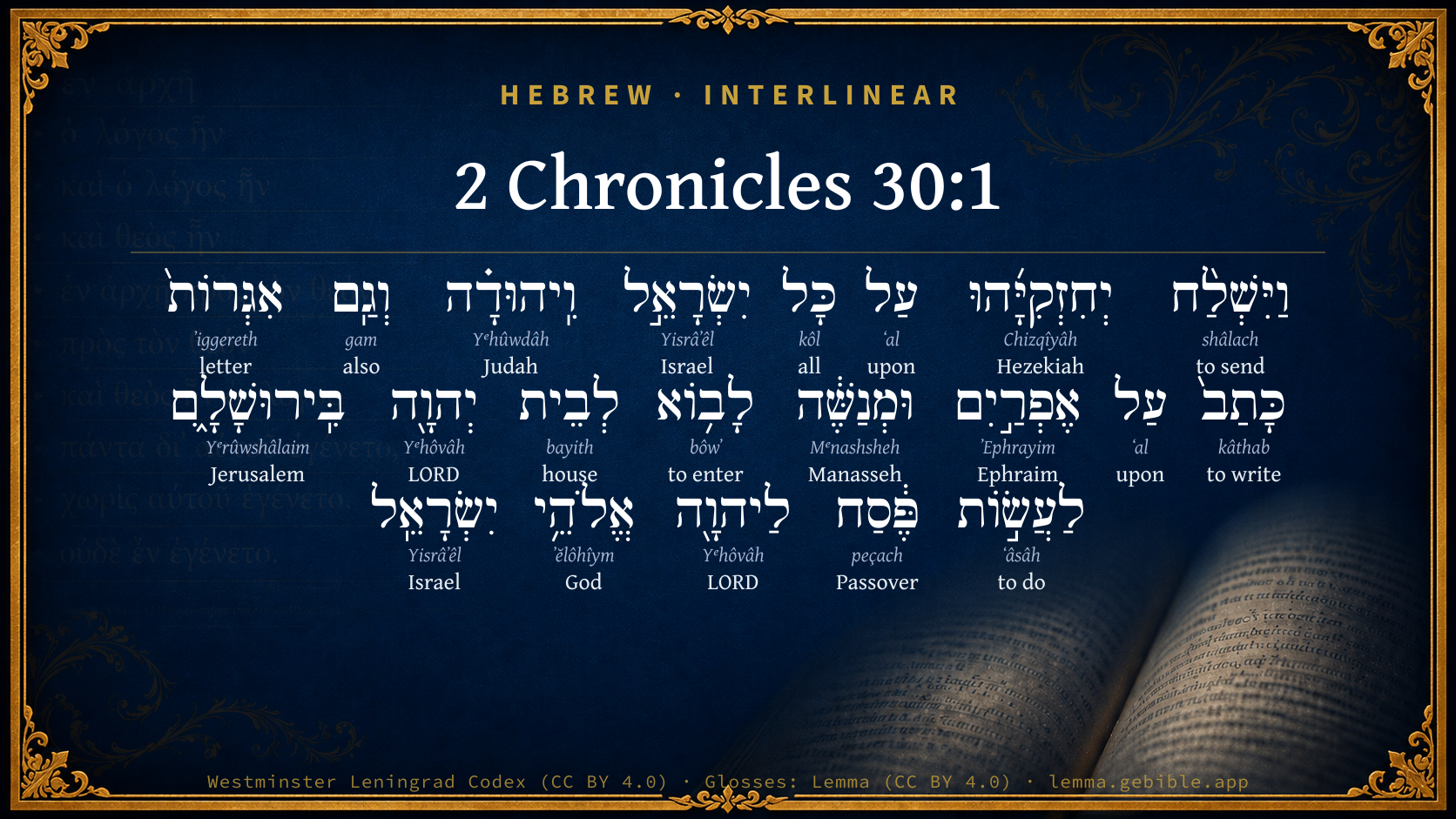
Hebrew (Westminster Leningrad Codex) 2 Chronicles 30:1 appears in the Hebrew Old Testament. The text above is from the Westminster Leningrad Codex. Each word links to its Strong’s number, a concise gloss, and parsing drawn from the Open Scriptures Hebrew Bible morphology. Click any word for its full Brown-Driver-Briggs (BDB) entry.
Download image
Cite this verse

2 Chronicles 30:1 (World English Bible). Public Domain. Lemma interlinear Bible study tool, https://lemma.gebible.app/v/2-chronicles/30/1.

Show BibTeX & RIS
BibTeX
RIS
English Translation
Hezekiah sent to all Israel and Judah, and wrote letters also to Ephraim and Manasseh, that they should come to the house of Yahweh at Jerusalem, to keep the Passover to Yahweh, the God of Israel.
World English Bible · Public Domain
Highlights
  • 1 first appearance in the Hebrew Bible
Full analysis ↓
Download a study sheet

One document with this verse’s original text, its word-by-word gloss line, the meaning frame, cross-references with their text, attributed commentary, and full source and license credits — printable, and it pastes into notes with its structure intact.

This verse Autodidact and up

Study sheet (.html) Plain text (.txt)

A passage Seminary Student

Up to 50 verses in one chapter. A passage sheet keeps up to 6 commentary sources and 12 cross-references per verse, in the order this page ranks them, and says so on the sheet whenever that leaves anything out. Ask for a single verse and you get the Autodidact verse sheet above.

Everything on this page stays free to read, with no account — the sheet is a download of what is already on screen, not access to it.

Want to remove ads? Support Godless Engineer
Compare translations 3

The same verse in 3 English versions, stacked beneath the original-language interlinear above. Click any original word for its lexicon entry.

Each is an independent rendering of the whole verse — the interlinear is not word-aligned to these translations.

Highlighted words mark where these versions differ — a whole-verse word diff, not a word-by-word alignment.

  • World English Bible Public Domain
    Hezekiah sent to all Israel and Judah, and wrote letters also to Ephraim and Manasseh, that they should come to the house of Yahweh at Jerusalem, to keep the Passover to Yahweh, the God of Israel.
  • King James Version Public Domain
    And Hezekiah sent to all Israel and Judah, and wrote letters also to Ephraim and Manasseh, that they should come to the house of the LORD at Jerusalem, to keep the passover unto the LORD God of Israel.
  • unfoldingWord Literal Text CC BY-SA 4.0
    And Hezekiah sent to all Israel and Judah, and also letters he wrote to Ephraim and Manasseh to come to the house of Yahweh in Jerusalem to do a Passover to Yahweh, the God of Israel.

unfoldingWord Literal Text — © unfoldingWord, licensed CC BY-SA 4.0. Word-aligned USFM3 via Door43 (git.door43.org/unfoldingWord/en_ult).

Versions to compare (up to 4)

3 of 4 selected

Show all 18 translations

Every available English version of this verse, each an independent rendering of the whole verse.

  • World English Bible Public Domain
    Hezekiah sent to all Israel and Judah, and wrote letters also to Ephraim and Manasseh, that they should come to the house of Yahweh at Jerusalem, to keep the Passover to Yahweh, the God of Israel.
  • Berean Standard Bible Public Domain
    Then Hezekiah sent word throughout all Israel and Judah, and he also wrote letters to Ephraim and Manasseh inviting them to come to the house of the LORD in Jerusalem to keep the Passover of the LORD, the God of Israel.
  • Majority Standard Bible Public Domain
    Then Hezekiah sent word throughout all Israel and Judah, and he also wrote letters to Ephraim and Manasseh inviting them to come to the house of the LORD in Jerusalem to keep the Passover of the LORD, the God of Israel.
  • King James Version Public Domain
    And Hezekiah sent to all Israel and Judah, and wrote letters also to Ephraim and Manasseh, that they should come to the house of the LORD at Jerusalem, to keep the passover unto the LORD God of Israel.
  • American Standard Version (1901) Public Domain
    And Hezekiah sent to all Israel and Judah, and wrote letters also to Ephraim and Manasseh, that they should come to the house of Jehovah at Jerusalem, to keep the passover unto Jehovah, the God of Israel.
  • Revised Version (1885) Public Domain
    And Hezekiah sent to all Israel and Judah, and wrote letters also to Ephraim and Manasseh, that they should come to the house of the LORD at Jerusalem, to keep the passover unto the LORD, the God of Israel.
  • Geneva Bible (1599) Public Domain
    And Hezekiah sent to all Israel, and Iudah, and also wrote letters to Ephraim and Manasseh, that they should come to the house of the Lord at Ierusalem, to keepe the Passeouer vnto the Lord God of Israel.
  • Douay-Rheims (1899) Public Domain
    And Ezechias sent to all Israel and Juda: and he wrote letters to Ephraim and Manasses, that they should come to the house of the Lord in Jerusalem, and keep the phase to the Lord the God of Israel.
  • Young's Literal Translation Public Domain
    And Hezekiah sendeth unto all Israel and Judah, and also letters he hath written unto Ephraim and Manasseh, to come in to the house of Jehovah in Jerusalem, to make a passover to Jehovah, God of Israel.
  • Literal Standard Version CC BY-SA 4.0
    And Hezekiah sends to all Israel and Judah, and he has also written letters to Ephraim and Manasseh, [to cause them] to come to the house of YHWH in Jerusalem, to make a Passover to YHWH, God of Israel.
  • Unlocked Literal Bible CC BY-SA 4.0
    Hezekiah sent messengers to all Israel and Judah, and also wrote letters to Ephraim and Manasseh, that they should come to the house of Yahweh in Jerusalem, to celebrate the Passover to Yahweh, the God of Israel.
  • unfoldingWord Literal Text CC BY-SA 4.0
    And Hezekiah sent to all Israel and Judah, and also letters he wrote to Ephraim and Manasseh to come to the house of Yahweh in Jerusalem to do a Passover to Yahweh, the God of Israel.
  • Darby Bible Public Domain
    And Hezekiah sent to all Israel and Judah, and wrote letters also to Ephraim and Manasseh, that they should come to the house of Jehovah at Jerusalem, to hold the passover to Jehovah the God of Israel.
  • World Messianic Bible Public Domain
    Hezekiah sent to all Israel and Judah, and wrote letters also to Ephraim and Manasseh, that they should come to the LORD’s house at Jerusalem, to keep the Passover to the LORD, the God of Israel.
  • Webster's Bible Public Domain
    And Hezekiah sent to all Israel and Judah, and wrote letters also to Ephraim and Manasseh, that they should come to the house of the LORD at Jerusalem, to keep the passover to the LORD God of Israel.
  • Free Bible Version CC BY-SA 4.0
    Then Hezekiah sent an announcement to everyone in Israel and Judah, and also sent letters to Ephraim and Manasseh, inviting them to come to the Lord's Temple in Jerusalem to celebrate the Passover of the Lord, the God of Israel.
  • Bible in Basic English Public Domain
    Then Hezekiah sent word to all Israel and Judah, and sent letters to Ephraim and Manasseh, requesting them to come to the house of the Lord at Jerusalem, to keep the Passover to the Lord, the God of Israel.
  • JPS Tanakh (1917) Public Domain
    And Hezekiah sent to all Israel and Judah, and wrote letters also to Ephraim and Manasseh, that they should come to the house of the LORD at Jerusalem, to keep the passover unto the LORD, the God of Israel.

Literal Standard Version (2020), Covenant Press — licensed CC BY-SA 4.0. Text via the HelloAO Bible API (eBible.org). Unlocked Literal Bible (unfoldingWord) — licensed CC BY-SA 4.0. Text via the HelloAO Bible API (eBible.org). unfoldingWord Literal Text — © unfoldingWord, licensed CC BY-SA 4.0. Word-aligned USFM3 via Door43 (git.door43.org/unfoldingWord/en_ult). Free Bible Version, Dr. Jonathan Gallagher — licensed CC BY-SA 4.0. Text via the HelloAO Bible API (eBible.org).

Word by word

More ways to search: Search by grammar → Find every occurrence → Compare this word →

Practice this passage: Drill this verse → Learn its vocabulary →

אִגְּרוֹת֙
ʼiggereth
H107
“letters”
Noun, Common, Feminine, Plural, Absolute
Part of Speech
Noun
Type
Common
Gender
Feminine
Number
Plural
State
Absolute
Full BDB Definition

Origin: from H104

TWOT: 23b

letter, missive
  1. וַיִּשְׁלַ֨ח shâlach H7971 “and · to send” Conjunction + Verb, Qal, Sequential Imperfect, 3rd Person, Masculine, Singular
  2. יְחִזְקִיָּ֜הוּ Chizqîyâh H2396 “Hezekiah” Noun, Proper
  3. עַל ʻal H5921 “upon” Preposition
  4. כָּל kôl H3605 “all of” Noun, Common, Masculine, Singular, Construct
  5. יִשְׂרָאֵ֣ל Yisrâʼêl H3478 “Israel” Noun, Proper
  6. וִֽיהוּדָ֗ה Yᵉhûwdâh H3063 “and · Judah” Conjunction + Noun, Proper
  7. וְגַֽם gam H1571 “and · also” Conjunction + Particle, Accusative
  8. כָּתַב֙ kâthab H3789 “to write” Verb, Qal, Perfect, 3rd Person, Masculine, Singular
  9. עַל ʻal H5921 “upon” Preposition
  10. אֶפְרַ֣יִם ʼEphrayim H669 “Ephraim” Noun, Proper
  11. וּמְנַשֶּׁ֔ה Mᵉnashsheh H4519 “and · Manasseh” Conjunction + Noun, Proper
  12. לָב֥וֹא bôwʼ H935 “to enter” Preposition + Verb, Qal, Infinitive Construct
  13. לְבֵית bayith H1004 “to/for · house of” Preposition + Noun, Common, Masculine, Singular, Construct
  14. יְהוָ֖ה Yᵉhôvâh H3068 “LORD” Noun, Proper
  15. בִּֽירוּשָׁלִָ֑ם Yᵉrûwshâlaim H3389 “in/at · Jerusalem” Preposition + Noun, Proper
  16. לַעֲשׂ֣וֹת ʻâsâh H6213 “to do” Preposition + Verb, Qal, Infinitive Construct
  17. פֶּ֔סַח peçach H6453 “Passover” Noun, Common, Masculine, Singular, Absolute
  18. לַיהוָ֖ה Yᵉhôvâh H3068 “to/for · LORD” Preposition + Noun, Proper
  19. אֱלֹהֵ֥י ʼĕlôhîym H430 “God(s) of” Noun, Common, Masculine, Plural, Construct
  20. יִשְׂרָאֵֽל Yisrâʼêl H3478 “Israel” Noun, Proper

About this verse

These counts appear in no published source. They are computed here, from the morphology-tagged text and Lemma’s own curated glosses. What Lemma adds →

21
words
18
distinct lemmas
Historical
section

Notable vocabulary

The rarest word here is אִגְּרוֹת֙ letter H107 — appearing just 10 times in the whole Hebrew Bible.

First appearance in Scripture

This word makes its first canonical appearance in the Hebrew Bible here:

  • אִגְּרוֹת֙ letter H107

Shared distinctive vocabulary

אִגְּרוֹת֙ letter H107 occurs in 10 verses of the Hebrew Bible. Also found in:

Grammatical profile

  • 4 verbs
  • 14 nouns
  • 2 prepositions
  • 1 particle

Verb forms

  • וַיִּשְׁלַ֨ח Qal · Sequential Imperfect
  • כָּתַב֙ Qal · Perfect
  • לָב֥וֹא Qal · Infinitive Construct
  • לַעֲשׂ֣וֹת Qal · Infinitive Construct

Repetition

Words recur within this verse — often emphatic in Hebrew:

  • עַל upon H5921 ×2
  • יִשְׂרָאֵ֣ל Israel H3478 ×2
  • יְהוָ֖ה LORD H3068 ×2

Hebrew & Septuagint length

In English translation the verse runs 36 words from the Hebrew and 37 from the Septuagint (LXX English) — closely comparable.

A rough comparison of the two English renderings, which tokenize alike — not a word-level alignment.

Word counts can differ between the Hebrew and the Greek without any difference in meaning — e.g. the Hebrew direct-object marker אֵת has no separate Greek word, and Greek often adds the article ὁ.

In the original languages it is 21 Hebrew tokens and 29 Greek tokens — but the two are counted differently (Hebrew bundles its prefixes and suffixes into one token; the Greek is in lemma form), so that isn’t a like-for-like length.

Cross-references

11

Topical passages linked to 2 Chronicles 30:1 in the Treasury of Scripture Knowledge — connected by theme and wording, ordered by reader-vote popularity; previews shown in the World English Bible.

  • 1 Corinthians 5:7–8 Purge out the old yeast, that you may be a new lump, even as you are unleavened. For indeed Christ, our Passover, has been sacrificed in our place.
  • Exodus 12:3–20 Speak to all the congregation of Israel, saying, 'On the tenth day of this month, they shall take to them every man a lamb, according to their fathers' houses, a lamb for a household;
  • Deuteronomy 16:2–6 You shall sacrifice the Passover to Yahweh your God, of the flock and the herd, in the place which Yahweh shall choose, to cause his name to dwell there.
  • 2 Chronicles 11:13 The priests and the Levites who were in all Israel resorted to him out of all their border.
  • 2 Chronicles 11:16 After them, out of all the tribes of Israel, such as set their hearts to seek Yahweh, the God of Israel, came to Jerusalem to sacrifice to Yahweh, the God of their fathers.
  • 2 Chronicles 25:7 But there came a man of God to him, saying, O king, don't let the army of Israel go with you; for Yahweh is not with Israel, [to wit], with all the children of Ephraim.
  • 2 Chronicles 30:10–11 So the posts passed from city to city through the country of Ephraim and Manasseh, even to Zebulun: but they ridiculed them, and mocked them.
  • 2 Chronicles 35:6 Kill the Passover, and sanctify yourselves, and prepare for your brothers, to do according to the word of Yahweh by Moses.
  • Hosea 5:4 Their deeds won't allow them to turn to their God; For the spirit of prostitution is within them, And they don't know Yahweh.
  • Hosea 7:8–9 Ephraim, he mixes himself among the nations. Ephraim is a pancake not turned over.
  • Hosea 11:8 "How can I give you up, Ephraim? How can I hand you over, Israel? How can I make you like Admah? How can I make you like Zeboiim? My heart is turned within me, My compassion is aroused.

Cross-references courtesy of OpenBible.info (CC BY 4.0).

Hebrew and Greek witnesses Masoretic Hebrew ↔ Greek Septuagint

The same verse in the two great witnesses to the Old Testament, shown verse-for-verse.

These are two independent witnesses, not word-aligned to each other, and the Septuagint is shown in lemma (dictionary) form.

Hebrew 2 Chronicles 30:1 Masoretic · Westminster Leningrad Codex

וַיִּשְׁלַ֨ח יְחִזְקִיָּ֜הוּ עַל כָּל יִשְׂרָאֵ֣ל וִֽיהוּדָ֗ה וְגַֽם אִגְּרוֹת֙ כָּתַב֙ עַל אֶפְרַ֣יִם וּמְנַשֶּׁ֔ה לָב֥וֹא לְבֵית יְהוָ֖ה בִּֽירוּשָׁלִָ֑ם לַעֲשׂ֣וֹת פֶּ֔סַח לַיהוָ֖ה אֱלֹהֵ֥י יִשְׂרָאֵֽל

Hezekiah sent to all Israel and Judah, and wrote letters also to Ephraim and Manasseh, that they should come to the house of Yahweh at Jerusalem, to keep the Passover to Yahweh, the God of Israel.

World English Bible · Public Domain

Greek LXX 2 Chronicles 30:1 Septuagint · lemma form

καί ἀποστέλλω εζεκιας ἐπί πᾶς ἰσραήλ καί ἰούδας καί ἐπιστολή γράφω ἐπί ὁ ἐφράιμ καί μανασσή ἔρχομαι εἰς οἶκος κύριος εἰς ἰερουσαλήμ ποιέω ὁ φασεκ ὁ κύριος θεός ἰσραήλ

And Ezekias sent to all Israel and Juda, and wrote letters to Ephraim and Manasse, that they should come into the house of the Lord to Jerusalem, to keep the passover to the Lord God of Israel.

LXX2012 (modern English Septuagint) · Public Domain

On this verse, Ellicott's Commentary for English Readers discusses the Septuagint’s reading. Read the note in Commentary ↓

Hebrew: Westminster Leningrad Codex (CC BY 4.0). Greek: Septuagint (public domain); English from LXX2012 (modern English Septuagint) (Public Domain). How the Septuagint differs from the Hebrew →

Commentary

Notes on 2 Chronicles 30:1 from classic Christian and Jewish commentators (each source and its license shown beneath its notes). The classic Christian expositions comment on the surrounding passage and are grouped to its opening verse, so a note may address several verses; the Jewish commentaries on the Tanakh (Rashi and others) are per-verse, so they appear only where the commentator wrote on this verse.

Lemma curates 59 commentaries, every one of them public domain or Creative Commons licensed, each selected and text-cleaned for this edition rather than reprinted as found. About our sources →

Matthew Henry's Commentary

Here is, I. A passover resolved upon. That annual feast was instituted as a memorial of the bringing of the children of Israel out of Egypt. It happened that the reviving of the temple service fell within the appointed days of that feast, the seventeenth day of the first month: this brought that forgotten solemnity to mind. "What shall we do," says Hezekiah, "about the passover? It is a very comfortable ordinance, and has been long neglected. How shall we revive it? The time has elapsed for this year; we cannot go about it immediately; the congregation is thin, the people have not notice, the priests are not prepared, Ch2 30:3. Must we defer it till another year?" Many, it is likely, were for deferring it; but Hezekiah considered that by that time twelve-month the good affections of the people would cool, and it would be too long to want the benefit of the ordinance; and therefore, finding a proviso in the law of Moses that particular persons who were unclean in the first month might keep the passover the fourteenth day of the second month and be accepted (Num 9:11), he doubted not but that it might be extended to the congregation. Whereupon they resolved to keep the passover in the second month. Let the circumstance give way to the substance, and let not the thing itself be lost upon a nicety about the time. It is good striking while the iron is hot, and taking people when they are in a good mind. Delays are dangerous.

II. A proclamation issued out to give notice of this passover and to summon the people to it.

1. An invitation was sent to the ten revolted tribes to stir them up to come and attend this solemnity. Letters were written to Ephraim and Manasseh to invite them to Jerusalem to keep this passover (Ch2 30:1), not with any political design, to bring them back to the house of David, but with a pious design to bring them back to the Lord God of Israel. "Let them take whom they will for their king," says Hezekiah, "so they will but take him for their God." The matters in difference between Judah and Israel, either upon a civil or sacred account, shall not hinder but that if the people of Israel will sincerely return to the Lord their God Hezekiah will bid them as welcome to the passover as any of his own subjects. Expresses are sent post throughout all the tribes of Israel with memorials earnestly pressing the people to take this opportunity of returning to the God from whom they had revolted. Now here we have,

(1.) The contents of the circular letters that were despatched upon the occasion, in which Hezekiah discovers a great concern both for the honour of God and for the welfare of the neighbouring kingdom, the prosperity of which he seems passionately desirous of, though he not only received no toll, tribute, or custom, from it, but it had often, and not long since, been vexatious to his kingdom. This is rendering good for evil. Observe,

[1.] What it is which he presses them to (Ch2 30:8): "Yield yourselves unto the Lord. Before you can come into communion with him you must come into covenant with him." Give the hand to the Lord (so the word is), that is, "Consent to take him for your God." A bargain is confirmed by giving the hand. "Strike this bargain. Join yourselves to him in an everlasting covenant. Subscribe with the hand to be his, Isa 44:5. Give him your hand, in token of giving him your heart. Lay your hand to his plough. Devote yourselves to his service, to work for him. Yield to him," that is, "Come up to his terms, come under his government, stand it not out any longer against him." "Yield to him, to be absolutely and universally at his command, at his disposal, to be, and do, and have, and suffer, whatever he pleases. In order to this, be not stiff-necked as your fathers were; let not your corrupt and wicked wills rise up in resistance of and rebellion against the will of God. Say not that you will do what you please, but resolve to do what he pleases." There is in the carnal mind a stiffness, an obstinacy, an unaptness to comply with God. We have it from our fathers; it is bred in the bone with us. This must be conquered; and the will that had in it a spirit of contradiction must be melted into the will of God; and to his yoke the neck that was an iron sinew must be bowed and fitted. In pursuance of this resignation to God, he presses them to enter into his sanctuary, that is, to attend upon him in that place which he had chosen, to put his name there, and serve him in the ordinances which he had appointed. "The doors of the sanctuary are now opened, and you have liberty to enter; the temple service is now revived, and you are welcome to join in it." The king says, Come; the princes and priests say, Come; whosoever will, let him come. This he calls (Ch2 30:6) turning to the Lord God; for they had forsaken him, and worshipped other gods. Repent now, and be converted. Thus those who through grace have turned to God themselves should do all they can to bring others back to him.

[2.] What arguments he uses to persuade them to do this. First, "You are children of Israel, and therefore stand related, stand obliged, to the God of Israel, from whom you have revolted." Secondly, "The God you are called to return to is the God of Abraham, Isaac, and Jacob, a God in covenant with your first fathers, who served him and yielded themselves to him; and it was their honour and happiness that they did so." Thirdly, "Your late fathers that forsook him and trespassed against him have been given up to desolation; their apostasy and idolatry have been their ruin, as you see (Ch2 30:7); let their harms be your warnings." Fourthly, "You yourselves are but a remnant narrowly escaped out of the hands of the kings of Assyria (Ch2 30:6), and therefore are concerned to put yourselves under the protection of the God of your fathers, that you be not quite swallowed up." Fifthly, "This is the only way of turning away the fierceness of God's anger from you (Ch2 30:8), which will certainly consume you if you continue stiff-necked." Lastly, "If you return to God in a way of duty, he will return to you in a way of mercy." This he begins with (Ch2 30:6) and concludes with, Ch2 30:9. In general, "You will find him gracious and merciful, and one that will not turn away his face from you, if you seek him, notwithstanding the provocations you have given him." Particularly, "You may hope that he will turn again the captivity of your brethren that are carried away, and bring them back to their own land." Could any thing be expressed more pathetically, more movingly? Could there be a better cause, or could it be better pleaded?

(2.) The entertainment which Hezekiah's messengers and message met with. It does not appear that Hoshea, who was now king of Israel, took any umbrage from, or gave any opposition to, the dispersing of these proclamations through his kingdom, nor that he forbade his subjects to accept the invitation. He seems to have left them entirely to their liberty. They might go to Jerusalem to worship if they pleased; for, though he did evil, yet not like the kings of Israel that were before him, Kg2 17:2. He saw ruin coming upon his kingdom, and, if any of his subjects would try this expedient to prevent it, they had his full permission. But, for the people, [1.] The generality of them slighted the call and turned a deaf ear to it. The messengers went from city to city, some to one and some to another, and used pressing entreaties with the people to come up to Jerusalem to keep the passover; but they were so far from complying with the message that they abused those that brought it, laughed them to scorn, and mocked them (Ch2 30:10), not only refused, but refused with disdain. Tell them of the God of Abraham! they knew him not, they had other gods to serve, Baal and Ashtaroth. Tell them of the sanctuary! their high places were as good. Tell them of God's mercy and wrath! they neither dreaded the one nor desired the other. No marvel that the king's messengers were thus despitefully used by this apostate race when God's messengers were so, his servants the prophets, who produced credentials from him. The destruction of the kingdom of the ten tribes was now at hand. It was but two or three years after this that the king of Assyria laid siege to Samaria, which ended in the captivity of those tribes. Just before this they had not only a king of their own that permitted them to return to God's sanctuary, but a king of Judah that earnestly invited them to do it. Had they generally accepted this invitation, it might have prevented their ruin; but their contempt of it hastened and aggravated it, and left them inexcusable. [2.] Yet there were some few that accepted the invitation. The message, though to some it was a savour of death unto death, was to others a savour of life unto life, Ch2 30:11. In the worst of times God has had a remnant; so he had here, many of Asher, Manasseh, and Zebulun (here is no mention of any out of Ephraim, though some of that tribe are mentioned, Ch2 30:18), humbled themselves, and came to Jerusalem, that is, were sorry for their sins and submitted to God. Pride keeps men from yielding themselves to the Lord; when that is brought down, the work is done.

2. A command was given to the men of Judah to attend this solemnity; and they universally obeyed it, v. 12. They did it with one heart, were all of a mind in it, and the hand of God gave them that one heart; for it is in the day of power that Christ's subjects are made willing. It is God that works both to will and to do. When people, at any time, manifest an unexpected forwardness to do that which is good, we must acknowledge that hand of God in it.

Matthew Henry's Commentary on the Whole Bible (1708–1710) — public domain (CC PDM 1.0). Text via the HelloAO Bible API.

Ellicott's Commentary for English Readers

XXX.

HEZEKIAH’S PASSOVER—THE ROYAL SUMMONS TO ALL ISRAEL FROM DAN TO BEER-SHEBA (2Ch_30:1-12).

(1) Sent to.— ‘al, i.e., ’el. (Jer_26:15; Neh_6:3.)

Letters.—‘Iggĕrôth. Apparently a word of Persian origin. (Comp. ‘engâre, “something written;” ‘engârîden, “to paint” or “write;” from which comes the Greek ᾰγγαρος, a royal messenger; Est_9:26; comp. Mat_5:41.) Only used in late Hebrew.

To Ephraim and Manasseh.—That is, the northern kingdom. (Comp. 2Ch_30:10.)

To keep (make) the passover unto the Lord.—Exo_12:48 (same phrase); LXX., ποιῆσαι τὸ φασεκ (Pascha). The first year of Hezekiah was the third of Hoshea, the last king of Samaria, who is described as a better king than his predecessors. Doubtless, therefore, Hoshea did not actively oppose Hezekiah’s wish for a really national Passover. (See 2Ki_18:1; 2Ki_17:2.)

A Bible Commentary for English Readers, edited by Charles John Ellicott (1878–1897) — public domain. Text from a community e-Sword module.

The Cambridge Bible for Schools and Colleges

gen. ed. J. J. S. Perowne

Ch. 2Ch_30:1-12 (not in 2 Kin.). Hezekiah Invites all Israel to keep the Passover

This Passover took place in the first year of Hezekiah while the Northern Kingdom was still standing. The Chronicler, however, takes no note of merely political conditions, and it is not improbable that Hezekiah ventured to do in the fallen state of Israel that which earlier kings would not have dared to do.

The Cambridge Bible for Schools and Colleges (gen. ed. J. J. S. Perowne; Cambridge University Press, 1878–1918) — public domain. Text from a community e-Sword module.

Trapp's Complete Commentary

John Trapp

2Ch 30:1 And Hezekiah sent to all Israel and Judah, and wrote letters also to Ephraim and Manasseh, that they should come to the house of the LORD at Jerusalem, to keep the passover unto the LORD God of Israel.

Ver. 1. To Ephraim and Manasseh.] That is, To all that were left of the ten tribes under king Hoshea, who, being rather atheist than idolater, and brought very low by the Assyrian, hindered not the people’s going up to the temple. The good of our brethren in other kingdoms mast also be minded.

John Trapp, A Commentary or Exposition upon All the Books of the Old and New Testament (1647–1656) — public domain. Text from a community e-Sword module.

Joseph Benson's Commentary

2Ch 30:1. Hezekiah sent to all Israel — To all the persons of the ten tribes who were settled in his kingdom, as well as to those of the tribe of Judah. And wrote letters also to Ephraim and Manasseh — To all the remainder of the ten tribes, (2Ch 30:5,) here expressed by the names of Ephraim and Manasseh, as elsewhere by the name of Ephraim only. But he names these two tribes, because they were nearest to his kingdom, and a great number of them had long since, and from time to time, joined themselves to the kingdom of Judah, 2Ch 15:8-9. That they should come to the house of the Lord — Admonishing them of their duty to God, and persuading them to comply with it.

Joseph Benson's Commentary on the Old and New Testaments (1811–1818) — public domain. Text from a community e-Sword module.

The Preacher's Complete Homiletical Commentary

Joseph S. Exell (gen. ed.)

CRITICAL NOTES.] Preparations for Passover (2Ch_30:1-12); the keeping of Passover (2Ch_30:13-17); H.’S prayer for unclean persons (2Ch_30:18-22); the solemnities of the second seven days.

2Ch_30:1-12.—Preparations for Passover. Sent messengers. Special letters to remote and near tribes (cf. ch. 2Ch_29:24 for object in sending them). 2Ch_30:2. Second month, a time which allowed for purification of priests, proclamation to be made through all Israel and for absentees. 2Ch_30:3. Other reasons assigned. Pleased, i.e., arrangements made. 2Ch_30:5. Order made and proclaimed from Dan to Beer., i.e., the extent of Israel; “for they had not (for some time) kept the Passover in full numbers, as required (written) by law. 2Ch_30:6. Posts, runners or bearers of letters (ch. 2Ch_23:1-2). Remnant, portions of people had been removed by Assyrian invasions to Asshur (2Ki_15:20), the rest now tributary (2Ki_17:1-4). 2Ch_30:8. Stiffnecked, hardening neck (Deu_10:16); gesture of disobedience (2Ki_17:14; Ezr_10:19; Eze_17:18). Yield, lit., give the hand, i.e., submit (1Ch_29:24; Lam_5:6). 2Ch_30:9. Find, “shall be for compassion before your captors.” 2Ch_30:10. Zeb., extreme north. 2Ch_30:11. Divers, certain; representatives of five tribes sent. 2Ch_30:12. Hand, direct ascription to God for united national response.

2Ch_30:13-17.—The keeping of Passover. 2Ch_30:14. Altars which Ahaz had erected in city (ch. 2Ch_28:24) partly for victims and partly for incense—a sign of earnestness. 2Ch_30:15. Ashamed, behind in zeal for worship or given to idolatry, put now to blush by forwardness of people; received burnt-offerings from offerers at doors of inner court, and took them to brazen altar in front of porch. 2Ch_30:16. Hand, Levites being obliged to help in slaying numerous victims. 2Ch_30:17. Charge, because unsanctified people could not do it themselves.

2Ch_30:18-22.—His prayer for unclean. Otherwise, i.e., contrary to Mosaic rites. 2Ch_30:19. Prepareth, so is sincere. 2Ch_30:20. Healed, forgave (sin) uncleanness and delivered from physical or moral consequences. 2Ch_30:21. Seven, according to requirement (Exo_12:18; Exo_23:15); loud, strong instruments, ascribing might to the Lord. 2Ch_30:22. Comfortably, encouragingly to heart. Confession of past sin and keeping feast full appointed time.

2Ch_30:23-27.—Solemnities of second seven days. Took, resolved to imitate Solomon’s feast at dedication of temple (1Ki_8:65). 2Ch_30:24. Give, lit., gave as heave-offering (cf. ch. 2Ch_35:7). Thousand, victims liberally offered by kings and princes, many priests sanctified themselves to overtake this extraordinary abundance. Strangers responded to invitation, and not such a national feast since time of Solomon (cf. Josiah’s Passover, 2Ki_23:22-23). 2Ch_30:27. Blessed, benediction of priests, who were entitled to bless, reached to heaven itself (cf. Num_6:24-26).

HOMILETICS

THE PROCLAMATION OF THE PASSOVER.—2Ch_30:1-12

Division of kingdom, disorders which followed, and prevalent idolatry prevented national observance for long time. Hezekiah desired to revive it, consulted princes and chief men, met with hearty response, and resolved to proclaim it.

I. The invitation to keep the passover.

1. Official, from kings and princes.

2. Special, by decree (2Ch_30:5).

3. Pressing, by letters and proclamation.

4. Universal, to Israel as well as Judah. Indicating zeal, generosity, and love.

5. Timely, though temple, priests, and people not duly sanctified by 14th day of first month Nisan. Yet only postponed till 14th day of second month, not a whole year.

II. The motives to comply with this invitation. In passionate language he urges personal obedience and ready response.

1. Their covenant relation urged them. God forsaken, though “the Lord God of their fathers” and “the Lord their God.”

2. Their present condition urged them. Trans-Jordanic region desolate. Two tribes in captivity would find compassion from their captors (Psa_106:46), and God would return unto the remnant.

3. If they complied God would be gracious. “Gracious and merciful, &c.” (2Ch_30:9). His fierce wrath would be turned away if they sought him (Joe_2:13).

4. If they refused God would be angry.

III. The response which was given to the invitation. A twofold reception.

1. Some were ready and willing. “Divers of Asher and Manasseh and of Zebulun humbled themselves and came to Jerusalem.” “In Judah” God’s power seen in zeal and unanimity of people.

2. Others mocked and insulted. Not merely refused, but openly derided. “Laughed them to scorn.” A type of gospel message, “a savour of life unto life or of death unto death.” Which to you? Neutrality impossible. Are you refusing or yielding? “They mocked the messengers of God and despised his words, and misused his prophets, until the wrath of the Lord arose against his people, till there was no remedy.”

HEZEKIAH’S INVITATION.—2Ch_30:1-12

Hezekiah determined to keep passover not in selfish spirit within narrow limits of Judah or Jerusalem, but commanded “that the burnt-offering and the sin-offering should be made for all Israel.” In this we learn—

I. The centre of unity for all God’s people. “The house of the Lord.” The sanctuary the centre round which all Israel should gather. Through Jeroboam’s act three centres, Jerusalem, Bethel, and Dan. Hezekiah pointed out one. “Turn again to the Lord God of your fathers.” Not places of worship, cities of refuge, creeds or denominations, but Christ the centre and bond of unity. One Lord, one table, one object.

II. The method of securing this unity.

1. Cherish and cultivate a spirit of love. Hezekiah not cold and exclusive, thought not of his own people merely, but of those in connection with him. Too much sectarianism and bigotry separate true believers one from another and repel the world.

2. By personal effort endeavour to bring it about. Discountenance everything that promotes separation. Encourage and incite in minds of all Christians a desire to be found together. Not the purpose of God that his people should be “scattered abroad” in bitter feelings, sectarian feuds, and selfish actions. Working to secure the unity of the body, we co-operate with God for a divine object. That “he should gather together in one the children of God that were scattered abroad.”

THE OBSERVANCE OF THE PASSOVER.—2Ch_30:13-26

I. At an unusual though legal time. “In the second month.” “At that time” (in the first month, ch. 2Ch_29:3), they could not keep passover, because priests had not sanctified themselves in sufficient numbers, nor had the people assembled. King and princes consulted not to delay another year, but to hold it second month. Zeal of people might cool down. Present benefit desired. Let circumstances give way to realities. Never neglect a greater for a smaller good.

II. By an unprecedented number of victims. Hezekiah gave a thousand bullocks and seven thousand sheep. The princes gave a thousand bullocks and ten thousand sheep. These besides the stock of sacrificial animals brought by the people which soon were exhausted. Pious example should ever incite. Rich will never be poorer for genuine liberality.

III. By the great numbers who attended. Some refused, but others gladly observed passover. All Judah with priests and Levites, some from Israel, the northern kingdom, and strangers—probably proselytes from both Judah and Israel. “A very great congregation” (2Ch_30:13), to whom God’s arm was revealed (Isa_53:1), and who were made willing in the day of God’s power. No passover like this since the great festival of Solomon, which lasted fourteen days, for excess of Levitical zeal, unbounded joy, and extent of duration.

HEZEKIAH’S PRAYER.—2Ch_30:18-20

Passover kept, but remarkable is the description, “otherwise than it was written.” Many involved in ceremonial or moral uncleanness, and unfit to slay their own lambs; needed intercession of the king, who proved himself to be a true ruler and a true priest for the people. Learn—

I. That purity of heart is required for sanctuary worship. Outward cleansing of Old Testament a symbol of inward. Truth in the inward parts, sincerity of heart and mind needful. Worship is not sensual, but a living fellowship with Christ; for this, preparation must be made. “If thou prepare thine heart, and stretch out thine hands towards him, &c.” (Job_11:13).

II. That the best preparation in sanctuary worship is defective. Not what law requires, not up to spiritual ideal, “according to the purification of the sanctuary.” Iniquity cleaves to our holy things, and “there is not a just man upon earth, that doeth good and sinneth not.” Best offerings, holiest worshippers unworthy—need the intercession, the incense of the great High-Priest.

III. That when the heart is sincere God will hear prayer. God is Jehovah the good, kind and merciful; proclaiming goodness in forgiving iniquity, transgression and sin. Prayer to Him will be heard. “And the Lord hearkened to Hezekiah.” God ever condescending to the upright in shortcomings and defects. But this no excuse for negligence in preparation, for reliance upon duty performed as well as we can perform it, nor any ground for despair on account of weakness or imperfection. “If there be first a willing mind, it is accepted according to that a man hath, and not according to that he hath not.”

A SECOND JOYFUL MONTH.—2Ch_30:23-26

A voluntary service made in addition to requirements of law, a fruit and sign of abundant zeal and gladness. This illustrates—

I. The true method of deliverance from sectarianism. No form prescribed. Law not exactly obeyed. The sweetness of unity in decided hostility to separation, idolatry, and narrow-mindedness. Hospitality warmed, the nation enthusiastic and one; numbers grow, and pardon multiplies at the feast.

II. The true principle of all reformation. Not to pull down what is false, but to build up what is true. Assemble Israel round the altar, lead them into the presence of the God of their fathers; then a mighty power will go forth from Jerusalem to sweep the land from idols, upset the seats of superstition, and confirm righteous works. Not to resuscitate fallen religion by novel measures, to promote excitement, and raise up a denomination, but to return to appointed means, regularly, orderly, and reverently observe divine worship, and restore to freedom and efficiency old institutions by which God will raise the Church and bless the nation.

III. The only way to secure service out of worship. “When all this was finished, all Israel that were present went out to the cities of Judah, and brake the images in pieces,” &c. (ch. 2Ch_31:1). Altars not destroyed in going up to Jerusalem. They needed the experience of the feast, the blessings of worship. Hezekiah began with God in sanctuary, Israel pursued the same order. Power to reform and execute judgment derived from God’s presence. Luther and Knox prayerful in closet, therefore successful in reform. “Not by might, &c.”

HOMILETIC HINTS AND SUGGESTIONS

2Ch_30:14-17. Removal of altars.

1. Destruction after construction. Evil taken away before good accomplished.

2. Official lukewarmness to remove evil. Its widespread and its future end.

3. Personal revival to stir up others.

2Ch_30:18-20. Hez.’s prayer.

1. Sin brings sickness. Ceremonial uncleanness exposure to danger. In consequence of transgression they had cause to fear physical and moral disease (Lev_15:31).

2. God the physician. Will heal this moral sickness. “The Lord healed and restored to penitence and health.” This revealed probably by a prophet (cf. 2Ki_19:20; 2Ki_20:5).

2Ch_30:22. Hez.’s encouragement to Levites. Work holy and great. Unity and resources of all to accomplish it. Hence “H. spake comfortably.” I. Qualifications required. (a) Knowledge, good and extensive, ritual and musical. (b) Wisdom to execute and consecrate it to God’s service, (c) Humility before God. “Knowledge is proud because she knows so much, wisdom humble because she knows no more.” II. The advantages of possessing these qualifications, (a) Ability to encourage others. (b) Facility to arrange and conduct public worship.

2Ch_30:1-27. Reviewing whole, we have—I. A revival of theocratic spirit. II. Destruction of idolatrous customs. III. Establishment of true unity in public worship. IV. A pattern Reformation, in its benevolent design, in the spirit in which it was conducted, and in the priestly blessing it secured. Benedictions fell from lips of leaders, praises of the people ascended to heaven, the nation restored to God “and great joy.”

ILLUSTRATIONS TO CHAPTER 30

2Ch_30:1-12. Zeal (“My sons, be not negligent”) should be inspired by principles, not by circumstances. Yet the value of circumstances must not be underrated, for they are means which God employs to awaken our attention to duty. It is not difficult to trace the course of events through which the dying embers of religious zeal, and especially of zeal for Christian missions, have been kindled by the breath of God. We may not overlook the happy results from the commanding influences of leading men and the powerful impressions produced on the lethargy into which the public mind is ever sinking, by the stirring appeals of pulpit, platform, and press. By such means it has pleased God, in a degree, to conquer public opinion, and they must continue to be plied with unabating energy till the conquest is complete [W. H. Stowel, D.D.].

2Ch_30:22. Confession.

“What better can we do than to the place

Repairing where he judged us, prostrate fall

Before him reverent, and there confess

Humbly our faults, and pardon beg with tears” [Milton].

2Ch_30:23-27. Universal joy. I am not unmindful of the assertion that the God of the Hebrews is usually thought of as a Being of preternatural severity, overwhelming men by his majesty, begetting profound and soul-filling awe by his greatness, dwelling in the thick darkness, making clouds his chariot, and sweeping down on his foes like a cyclone. But this representation is one-sided and unfair to a religion which had more festivals than fasts, more psalms than prophecies, and more triumphs than despairs. By the side of intolerance of sin there is mercy that reacheth to the very heavens, and near to the righteousness that is like the great mountains there is a forgiveness that inspires hopeful petition, even out of depth of sufferings and misfortune [Dr. J. Clifford].

The Preacher's Complete Homiletical Commentary (gen. ed. Joseph S. Exell; Funk & Wagnalls, c. 1892) — public domain (pre-1929). A full-Bible homiletical/sermon-outline anthology covering 65 of 66 books (2 John is absent from the source module). Text from a community e-Sword module.

MacLaren's Expositions of Holy Scripture

Alexander MacLaren

2 Chronicles

A LOVING CALL TO REUNION

2Ch 30:1 - 2Ch 30:13.

The date of Hezekiah’s passover is uncertain, for, while the immediate connection of this narrative with the preceding account of his cleansing the Temple and restoring the sacrificial worship suggests that the passover followed directly on those events, which took place at the beginning of the reign, the language employed in the message to the northern tribes {2Ch 30:6 - 2Ch 30:7, 2Ch 30:9} seems to imply the previous fall of the kingdom of Israel, If so, this passover did not occur till after 721 B.C., the date of the capture of Samaria, six years after Hezekiah’s accession.

The sending of messengers from Jerusalem on such an errand would scarcely have been possible if the northern kingdom had still been independent. Perhaps its fall was thought by Hezekiah to open the door to drawing ‘the remnant that were escaped’ back to the ancient unity of worship, at all events, if not of polity. No doubt a large number had been left in the northern territory, and Hezekiah may have hoped that calamity had softened their enmity to his kingdom, and perhaps touched them with longings for the old worship. At all events, like a good man, he will stretch out a hand to the alienated brethren, now that evil days have fallen on them. The hour of an enemy’s calamity should be our opportunity for seeking to help and proffering reconciliation. We may find that trouble inclines wanderers to come back to God.

The alteration of the time of keeping the passover from the thirteenth day of the first month to the same day of the second was in accordance with the liberty granted in Num 9:10 - Num 9:11, to persons unclean by contact with a dead body or ‘in a journey afar off.’ The decision to have the passover was not taken in time to allow of the necessary removal of uncleanness from the priests nor of the assembling of the people, and therefore the permission to defer it for a month was taken advantage of, in order to allow full time for the despatch of the messengers and the journeys of the farthest northern tribes. It is to be observed that Hezekiah took his subjects into counsel, since the step intended was much too great for him to venture on of his own mere motion. So the overtures went out clothed with the authority of the whole kingdom of Judah. It was the voice of a nation that sought to woo back the secessionists.

The messengers were instructed to supplement the official letters of invitation with earnest entreaties as from the king, of which the gist is given in 2Ch 30:6 - 2Ch 30:9. With the skill born of intense desire to draw the long-parted kingdoms together, the message touches on ancestral memories, recent bitter experiences, yearnings for the captive kinsfolk, the instinct of self-preservation, and rises at last into the clear light of full faith in, and insight into, God’s infinite heart of pardoning pity.

Note the very first words, ‘Ye children of Israel,’ and consider the effect of this frank recognition of the northern kingdom as part of the undivided Israel. Such recognition might have been misunderstood or spurned when Samaria was gay and prosperous; but when its palaces were desolate, the effect of the old name, recalling happier days, must have been as if the elder brother had come out from the father’s house and entreated the prodigal to come back to his place at the fireside. The battle would be more than half won if the appeal that was couched in the very name of Israel was heeded.

Note further how firmly and yet lovingly the sin of the northern kingdom is touched on. The name of Jehovah as the God of Abraham, Isaac, and Israel, recalls the ancient days when the undivided people worshipped Him, and the still more ancient, and, to hearers and speakers alike, more sacred, days when the patriarchs received wondrous tokens that He was their God, and they were His people; while the recurrence of ‘Israel’ as the name of Jacob adds force to its previous use as the name of all His descendants. The possible rejection of the invitation, on the ground which the men of the north, like the Samaritan woman, might have taken, that they were true to their fathers’ worship, is cut away by the reminder that that worship was an innovation, since the fathers of the present generation had been apostate from the God of their fathers. The appeal to antiquity often lands men in a bog because it is not carried far enough back. ‘The fathers’ may lead astray, but if the antiquity to which we appeal is that of which the New Testament is the record, the more conservative we are, the nearer the truth shall we be.

Again, the message touched on a chord that might easily have given a jarring note; namely, the misfortunes of the kingdom. But it was done with so delicate a hand, and so entirely without a trace of rejoicing in a neighbour’s calamities, that no susceptibilities could be ruffled, while yet the solemn lesson is unfalteringly pointed. ‘He gave them up to desolation, as ye see.’ Behind Assyria was Jehovah, and Israel’s fall was not wholly explained by the disparity between its strength and the conquerors’. Under and through the play of criminal ambition, cruelty, and earthly politics, the unseen Hand wrought; and the teaching of all the Old Testament history is condensed into that one sad sentence, which points to facts as plain as tragical. In deepest truth it applies to each of us; for, if we trespass against God, we draw down evil on our heads with both hands, and shall find that sin brings the worst desolation-that which sheds gloom over a godless soul.

We note further the deep true insight into God’s character and ways expressed in this message. There is a very striking variation in the three designations of Jehovah as ‘the God of Abraham, Isaac, and Israel’ {2Ch 30:6}, ‘the god of their [that is, the preceding generation] fathers’ {ver. 7}, and ‘your God’ {2Ch 30:8}. The relation which had subsisted from of old had not been broken by man’s apostasy, Jehovah still was, in a true sense, their God, even if His relation to them only bound Him not to leave them unpunished. So their very sufferings proved them His, for ‘What son is he whom the father chasteneth not?’ But strong, sunny confidence in God shines from the whole message, and reaches its climax in the closing assurance that He is merciful and gracious. The evil results of rebellion are not omitted, but they are not dwelt on. The true magnet to draw wanderers back to God is the loving proclamation of His love. Unless we are sure that He has a heart tender with all pity, and ‘open as day to melting charity,’ we shall not turn to Him with our hearts.

The message puts the response which it sought in a variety of ways; namely, turning to Jehovah, not being stiff-necked, yielding selves to Jehovah, entering into His sanctuary. More than outward participation in the passover ceremonial is involved. Submission of will, abandonment of former courses of action, docility of spirit ready to be directed anywhere, the habit of abiding with God by communion-all these, the standing characteristics of the religious life, are at least suggested by the invitations here. We are all summoned thus to yield ourselves to God, and especially to do so by surrendering our wills to Him, and to ‘enter into His sanctuary,’ by keeping up such communion with Him as that, however and wherever occupied, we shall still ‘dwell in the house of the Lord all the days of our lives.’

And the summons to return unto God is addressed to us all even more urgently than to Israel. God Himself invites us by the voice of His providences, by His voice within, and by the voice of Jesus Himself, who is ever saying to each of us, by His death and passion, by His resurrection and ascension, ‘Turn ye! turn ye! why will ye die?’ and who has more than endorsed Hezekiah’s messengers’ assurance that ‘Jehovah will not turn away His face from’ us by His own gracious promise, ‘Him that cometh to Me I will in no wise cast out.’

The king’s message met a mingled reception. Some mocked, some were moved and accepted. So, alas! is it with the better message, which is either ‘a savour of life unto life or of death unto death.’ The same fire melts wax and hardens clay. May it be with all of us as it was in Judah-that we ‘have one heart, to do the commandment’ and to accept the merciful summons to the great passover!

Alexander MacLaren, Expositions of Holy Scripture (1904–1910) — public domain. Text from a community e-Sword module.

The Annotated Bible

Arno C. Gaebelein

CHAPTER 30 The Passover

1. Preparations for the great Passover (2Ch 30:1-14)

2. The celebration of the Passover (2Ch 30:15-22)

3. The concluding festive days (2Ch 30:23-27)

The Passover is next celebrated. It was, so to speak, the birthday of the nation, and typified the great redemption by the blood of the true Passover-Lamb. It had not been kept for a long time and as the proper yearly time for its celebration had passed, the first month, they concluded to keep it in the second month. The law had made provision for that and therefore what they did was according to the Word. (See Num 9:6-13 and the annotations given there.) And the king recognized the unity of the people of God and their need. Therefore he sent letters to all Israel and Judah, also to Ephraim and Manasseh, that they should come to the house of the LORD, to keep the passover unto the LORD God of Israel. The posts went with the letters throughout the entire land. The letter in itself is beautiful and was addressed to the children of Israel, not mentioning the sad division which had taken place. A considerable part of the house of Israel, the ten tribes, had already been carried into captivity. The letter reached, therefore, only the remnant which escaped out of the hand of the Kings of Assyria (30:6; 2Ki 15:19; 1Ch 5:26). It was the Spirit of God who would bring all the people of God together around the table of the great feast. He always unites God’s people. And the posts passing along even unto Zebulun with the God-given message of the king, were treated by some of the remnant with mockery. But others humbled themselves and came to Jerusalem. Without such humbling a coming together of the people of God is not possible.

The great feast then was kept by the great multitude after they had taken away the false altars. They killed the passover. The priests sprinkled the blood, which they had received from the Levites. Many of them who had come were not cleansed; Hezekiah prayed for them. “The good LORD pardon every one.” And the LORD hearkened and healed the people, so that the divine threat was not carried out (Lev 15:31). The feast of unleavened bread was also kept for the appointed seven days with great gladness; yet throughout the days of gladness and remembering Jehovah confession was made to the LORD (verse 22). Everything shows that the Spirit of God was in the great revival. Other festive days followed with more gladness. The king gave great gifts and the princes did likewise, while a great number of priests gave their continued service. Not since the days of Solomon, when he had dedicated the house and reigned over Israel, had Jerusalem seen anything like it. The whole scene ended by the priests blessing the people (Num 6:23-27). Heaven heard and rejoiced with His people.

Dispensationally the great revival foreshadows what will take place when the King of Israel will occupy the throne and reign, when all Israel is united and back in the land (Ezek. 37), when His people will worship and praise the Holy One of Israel.

Arno C. Gaebelein, The Annotated Bible (1913–1922) — public domain. Text from a community e-Sword module.

Tyndale Open Study Notes

Tyndale Open Resources

30:1-27 This account of Hezekiah’s celebration of Passover reflects the Chronicler’s concern with the unity of Israel, the spiritual preparedness of the people, and the success of following the formula for restoration given by Solomon at the dedication of the Temple (7:14).

Tyndale Open Study Notes — © Tyndale Open Resources, licensed CC BY-SA 4.0. Text via the HelloAO Bible API.

Geneva Bible (1599)

Geneva Bible translators

Meaning, all Israel, whom Tiglath-Pileser had not taken away into the captivity, 2 Kings 15:29.

Geneva Bible (1599) marginal notes — public domain. Text via Bolls.life.

Adam Clarke's Commentary

CHAPTER XXX

Hezekiah invites all Israel and Judah, and writes letters to

Ephraim and Manasseh to come up to Jerusalem, and hold a

passover to the Lord, 1-4.

The posts go out with the king's proclamation from Dan to

Beer-sheba, and pass from city to city through the coasts

of Ephraim, Manasseh, and Zebulun, but are generally mocked

in Israel, 5-10.

Yet several of Asher, Manasseh, and Zebulun, humble themselves,

and come to Jerusalem, 11.

But in Judah they are all of one heart, 12, 13.

They take away the idolatrous altars, kill the passover,

sprinkle the blood, and, as circumstances will permit,

sanctify the people, 14, 15.

Many having eaten of the passover, who were not purified

according to the law, Hezekiah prays for them; and the Lord

accepts his prayer, and heals them, 16-20.

Hezekiah exhorts them; and they hold the feast seven additional

days, fourteen in all, and the people greatly rejoice, 21-26.

The priests and the Levites bless the people, and God accepts

their prayers and thanksgivings, 27.

NOTES ON CHAP. XXX

Verse 1. Hezekiah sent to all Israel] It is not easy to find out how this was permitted by the king of Israel; but it is generally allowed that Hoshea, who then reigned over Israel, was one of their best kings. And as the Jews allow that at this time both the golden calves had been carried away by the Assyrians,-that at Dan by Tiglath-pileser, and that at Bethel by Shalmaneser,-the people who chose to worship Jehovah at Jerusalem were freely permitted to do it, and Hezekiah had encouragement to make the proclamation in question.

Adam Clarke's Commentary on the Bible (1810–1826) — public domain. Text from a community e-Sword/MySword module.

John Gill's Exposition

And Hezekiah sent to all Israel and Judah,.... Sent messengers to them, not only to the subjects of his own kingdom, Judah, but to all the Israelites that dwelt in it, who were come thither for the sake of religion, and the worship of God:

and wrote letters also to Ephraim and Manasseh; which are put for all the ten tribes, as appears from Ch2 30:10 and are distinguished from Israel in the preceding clause:

that they should come to the house of the Lord at Jerusalem; not that he laid his commands upon them to come, they not being his subjects, namely, those of the ten tribes; but he hereby admonished them of their duty, and gave them a kind invitation, signifying the doors of the temple were open for them, and they were welcome to come thither:

to keep the passover unto the Lord God of Israel; to the glory of his name, who was the common Lord of them all, and whose command it was to keep the passover, and that at Jerusalem, and nowhere else, see Deu 16:1.

John Gill's Exposition of the Whole Bible (1746–1763) — public domain (CC PDM 1.0). Text via the HelloAO Bible API.

Albert Barnes' Notes on the Bible

Compare 2Ch 29:24 note.

Albert Barnes' Notes on the Bible (1834–1885) — public domain. Text from a community e-Sword/MySword module.

Haydock's Catholic Bible Commentary

Manasses. The pious king thought he might give a general invitation, without umbrage. King Osee was not so impious as his predecessors, 4 K. xvii. 2. Afflictions had made his people more docile. The Jews say (C.) that the golden calves had been taken away by the Assyrians, and that the king removed the guards, which had been placed to hinder his subjects from repairing to Jerusalem. M. Salien, the year of the world 3305. --- Ezechias writes privately to the house of Joseph, as the people were prouder on account of the royal dignity. S. Jerom, Trad.

George Leo Haydock (1774–1849), Haydock's Catholic Family Bible and Commentary, 1859 edition — public domain. Excludes Psalms (Douay-Rheims chapter numbering differs from Protestant) and Deuterocanonical books (Catholic canon only).

Matthew Poole's English Annotations

To all Israel; whereby he understands all the persons of the ten tribes, who were now settled in his kingdom; as appears by their contradistinction to Ephraim and Manasseh here following. To Ephraim and Manasseh, i.e. to all the remainders of the ten tribes, 2Ch 30:5, who ave here synecdochically expressed by the names of Ephraim and Manasseh, as elsewhere by the name of Ephraim only. But he names these two tribes, because they were nearest to his kingdom, and a great number of them had long since, and from time to time, joined themselves to the kingdom of Judah, 2Ch 15:8,9, and therefore he had most hopes of success amongst them. That they should come to the house of the Lord at Jerusalem; admonishing them of their duty to God, and persuading them to comply with it.

Matthew Poole's English Annotations on the Holy Bible (1683–1685) — public domain. Text from a community e-Sword/MySword module.

Dummelow's Commentary on the Holy Bible

J. R. Dummelow

Reign of Hezekiah (continued)

This chapter relates how a passover was kept on the second month for Israel and Judah.

1. Should come.. at Jerusalem] This implies an endeavour to centralise the national worship by the abolition of the local sanctuaries (as described in 2Ki_18:4).

2. In the second month] The Law allowed individuals to keep the Passover in the second month instead of the first, if they were prevented by some temporary hindrance (Num_9:10-11), and this permission Hezekiah thought might be extended to the whole community.

3. At that time] i.e. at the proper season, viz. the 14th day of the first month. The cleansing of the Temple was not completed till the 16th day of that month: 2Ch_29:17.

5. Done it of a long time] RV 'kept it in great numbers.' According to Exo_12:8 the Passover was to be observed by 'the whole assembly of the congregation of Israel.'

6. The posts] bit. 'the couriers,' who were probably some of the royal guards. You, that.. Assyria] Since what is here related took place (according to 2Ch_29:3) in Hezekiah's first year, the reference must be to the invasion of Tiglath-pileser: 2Ki_15:29; 1Ch_5:26.

13. The feast of unleavened bread] This, though distinct from the Passover, was not separated from it by any interval, and the two came to be treated as one which could be described indifferently by either name: 2Ch_30:2, 2Ch_30:13, 2Ch_30:15.

14. The altars] i.e. those erected by Ahaz: 2Ch_28:24.

15. Were ashamed] The zeal of the laity roused the priests, who had formerly been remiss (2Ch_29:34), to a sense of their duty.

17. The passovers] i.e. the paschal lambs, which (according to Exo_12:6-7) ought to have been killed by the head of each household.

18. Otherwise than it was .written] As this Passover in the second month took the place of the one ordinarily held in the first month, there could be no supplementary passover for such as were unclean; so Hezekiah preferred that the people should break the letter of the Law and eat without being sanctified than that they should be debarred from such an important festival and so be unfaithful to the spirit of the divine legislation.

20. Healed] i.e. did not send upon them, the punishment which they had incurred: cp. Lev_15:31.

25. The strangers] i.e. proselytes of foreign descent, who either had come out of the northern kingdom or were settled in Judah.

J. R. Dummelow, A Commentary on the Holy Bible (Macmillan, 1909) — public domain. Text from a community e-Sword module.

Whedon's Commentary on the Bible

Daniel D. Whedon

THE CELEBRATION OF THE PASSOVER.

1. Hezekiah sent to all Israel — Already had he caused an atonement to be made for “all Israel,” (2Ch_29:24,) and now he seeks by special invitations to urge the several tribes of the northern kingdom to unite with Judah at the ancient temple in keeping the passover. Ephraim and Manasseh, though a part of all Israel, are specifically mentioned because of their historical importance.

Daniel D. Whedon (gen. ed.), Commentary on the Old and New Testaments (1874–1909) — public domain. Text from a community e-Sword module.

The Pulpit Commentary

This chapter contains the account of Hezekiah"s arrangements after the restoration for the observance of the Passover arrangements more than ordinarily interesting to notice in respect of, first, the unusual time appointed for the celebration; and, second, the determined and brave attempt of the good king to win again to the worship of Jerusalem (though, as was no doubt anticipated, it subjected his royal proffers to scorn, ver. 10) the separated people of "all Israel" (vers. 1-12); and further, the celebration itself, the happy omen (ver. 14) with which it opened, its duration; and certain several other incidents attending it (vers. 13-27).

Hezekiah sent wrote letters also to Ephraim and Manasseh. Some have sought to bring into the appearance of harmony the two first clauses of this verse by supposing that the former clause purports to say that Hezekiah sent messengers to all Israel and Judah, and in particular letters in addition to Ephraim and Manasseh, the chief tribes of the northern kingdom and the Joseph tribes. Vers. 6 and 10, however, seem to dispose effectually of this offer of explanation; while another explanation, that the names of the two tribes are simply to be taken as equivalent to "all Israel," seems true, though, in fact, it may be to advance us no way at all. We should prefer in the difficulty, unimportant though it is, yet one facing us, rather to assume that the verse wishes to say that Hezekiah sent (i.e. sent messengers, which prove to be the runners, rendered the "posts") to all Israel and Judah, and to Ephraim, Manasseh, and the rest of their allied tribes by implication, but not to Judah wrote letters also which were carried by the posts (.or runners). It is true that ver. 6 may negative even this conjecture for getting over the difficulty, but not necessarily no, for it only says that the posts went throughout Israel and Judah with the letters, which they may be supposed to have dropped only to some, not to all, and those some Israel, or Ephraim, Manasseh, and brethren. There will have been to hand other, the usual methods of communication with Judah, from Jerusalem its metropolis, and from its king. The thing different from "letters" that was circulated may have been just the "proclamation" of ver. 5. It has been suggested that the now King of Israel, Hoshea, was very probably a captive of Assyria at this exact time. (2Ki_17:4)

Vers. 1-27.

The celebration of the Passover, with its sacred suggestions.

The whole of this chapter is concerned with Hezekiah"s call of priests, Levites, princes, and congregation of the people to observe and celebrate with himself the grand solemnity of the Passover. From the analogy of the precedent provided for individual cases of certain kinds of necessity, (Num_9:10) this celebration for the whole nation is fixed for the fourteenth day of the second month instead of the first. This was the fourth of the seven special occasions, of which description with detail is given us in Scripture the first of all in Egypt, (Ex 12) the first in the desert, (Nu 9) and that of Joshua at Gilgal, after the circumcision of the people and when the manna ceased, (Jos 5) being the three which preceded; and those that came after being the Passover celebrated by Josiah (ch. 35.), by Ezra on the return from the captivity at Babylon, (Ezr 6) and that ever-memorable one, the last of our blessed Lord"s life on earth. The Passover was the first in time of the three great annual feasts which called together to Jerusalem all yes, in happier times, all from Dan even to Beersheba, the other two being the Feasts of Pentecost and of Tabernacles. It was also the first in the lifetime of the nation, and always the first in solemn significance. Not only the energy and earnestness, therefore, of Hezekiah in carrying through this celebration from first to last, but his Diviner wisdom and piety in determining and appointing it, may be noted, and dwelt upon in useful and suggestive detail as adapted to modern days. That great revival, for instance one of the greatest the world and Church have ever seen of modern Church-life, familiarly known to ourselves, was rooted in, and has grown up proportioned to, zealous attention to the sacraments, faith in them, and faithful observance of them. This goes to the root of all a nation"s evil and malady! "If once" thought Hezekiah but once a healthy breeze could pass over this erring and idolatrous, fevered and long-forlorn people, all might yet be well!" At his prayer, and as the reward of his effort, the breeze came, and swept over the land. It refreshed weary and parched wastes; and some signs of healthiness, mingled with some signs of suspiciousness, appeared. Perhaps all was too late; the disease too deep, and gone too far, too long! Nevertheless, it was none the less right on the part of Hezekiah to have tried the religious means, and used the highest of them. We may notice in them not as matter of historic interest in the life of another nation merely how, in virtue mainly of the presence of the Passover, they were fitted to touch all that was deepest, all that haply might "remain" (Rev_3:2) deepest and best in the hearts of the people. For instance, the Passover was undoubtedly

I THE VIVID MEMORIAL OF AN UNPRECEDENTED BIRTH OF A NATION, Nor can it be said that this was an instance of a "nation born in a day." It gives more point, and it is just and true, to remember, that now it may be said of it that it was a nation born in a night! One supreme, extraordinary effort of faith and obedience ushered that nation out of darkness into light. It might, indeed, have been hoped that this would stamp it for ever with the corresponding native and hereditary grand qualities. There are senses in which it may be said that the nation had received in yet earlier ages its existence. Certainly the promise and the earnest of this had been fact. The germ of its existence had been in Abraham, and God"s covenant with him. It showed to view in distinctness and separateness at the time and in the fact of its compact corporate descent into Egypt. There was a semblance of truth to support this, and there would have been real truth in it, if a family could be called a nation. "Israel" went into Egypt "three score and ten souls"; (Gen_46:27) Israel came out of Egypt a nation born, that night of the Passover a vast separate nation, a peculiar people. Hezekiah"s celebration of the Passover, therefore, at this time suggested to every feeling and instinct of honest national love and pride that king, priests, and people should live worthily of their origin, raise the fortunes and restore the glory of the nation that had so greatly declined (ver. 6).

II THE VIVID MEMORIAL OF THE GREAT DELIVERANCE WHICH GOD WROUGHT FOR HIS PEOPLE, FROM SORE BONDAGE, UNDER CIRCUMSTANCES OF AN EXTRAORDINARY NATURE. The power and the pity of God were alike demonstrated by the rescue of the hosts of Israel from the midst of Egypt. His pity heard their groanings, his power subdued their oppressors. Of such things as these the people needed at this time the teaching and the inspiriting influences. Every observance of the Passover was a commemoration and rehearsal of this great deliverance, and suggested the long and thick succession of Divine interpositions during a period of now nearly eight centuries.

III BOTH THE OUTCOME AND THE FOUNDATION OF A COVENANT. The Passover marked a foregoing faith and obedience on the part of Moses, Aaron, and all the houses of the rescued, and it inferred an unending continuance of the same, so often as they should be called for on special occasions, as well as for the rule of every day"s life. Upon these conditions being met on the one side, God"s great deliverance and his continued protection took effect on the other side. Upon this practical aspect it is evident that Hezekiah laid great stress (vers. 7-9). The remembrance of the saving of all the firstborn of the Hebrews, by the side of the slaying of all the firstborn of the Egyptians, both man and beast, was fitted to be a most powerful incentive of loyalty to him who had thus bought a people to himself most significantly. This was an inevitable memory of the sprinkled blood of the Paschal lamb in every celebration.

IV THE FORESHADOWING OF THE ONE ETERNAL SACRIFICE. For the devout Hebrew, the Israelite who was "an Israelite indeed," even in these most degenerate days of the nation, the Passover must have taken a leading share among all other sacrifices, in teaching and shadowing forth "the good things to come;" the "better hope;" the "better covenant;" the "better sacrifices". (Heb_7:19, 22 8:6 9:23) The "foreshadowing" itself was indeed plain and powerful, which used such a designation for the central fact of all the observances of the Passover, as "my sacrifice"; (Exo_23:18 Exo_34:25) and nothing can be deducted from our estimate of the meaning of such passages, and generally of the typical virtue of the whole celebration, when we remember the language of St. Paul respecting "Christ our Passover". (1Co_5:7) The faith of the people of Israel and their sacrament were looking forward to this Passover, as our faith and our sacrament look back to it, and of a truth ever upward! The suggestions that St. Paul awakes within us by the fulness of the last-quoted verse, as well as the time and all the circumstance of the death of Christ, compel us indeed to see in the entire features and services of the completed Passover the type of our One sacrifice and our second sacrament! The peace offering, the thank offering, the solemn dedication of ourselves, as "a kingdom of priests and a holy nation," the unbroken "unity of the body" (Exo_12:46; Joh_19:36) the "keeping of the feast with theunleavened bread of sincerity and truth," and all the sacred, unbounded eucharistic enjoyments of that feast, in a word, the need of deliverance, the Deliverer, and our joyful acknowledgment of the same, are all outlined for us in the Hebrew"s Passover, and according to the measure of his faith and illumination were once all outlined for him, even in Hezekiah"s time and celebration.

HOMILIES BY W. CLARKSON Vers. 1, 10, 11.

Letters to Ephraim: generosity.

Hezekiah now took a very bold and decided course. There had been no direct dealings between the king or court of Judah and the people of Ephraim (Israel) since the kingdom of David was rent in twain. If we understand that this action was taken in the first year of his reign, while Hoshea was on the throne of Samaria, it certainly was bold even to audacity, and was calculated to rouse the resentment of that ruler. If, however, we hold (with Keil and others) that it was not until the sixth year of Hezekiah"s reign, when Shalmaneser had wrought his will with the sister kingdom, that the great Passover was held, the measure taken by the pious king is still one of considerable vigour and of no little generosity. We learn therefrom

I THAT A RIGHT COURSE WILL PROVE ONE OF SPIRITUAL ENLARGEMENT. Had not Hezekiah been a faithful servant of Jehovah, he would not have concerned himself about the moral and spiritual condition of Ephraim and Manasseh. He might have rejoiced in anything that would degrade and therefore enfeeble them. But as the servant of God, and therefore of the truth and of righteousness, he looked with sorrow upon the separation of those tribes of Israel from the God of their fathers, and it was "in his heart" (2Ch_29:10) to take a step that might restore them to the faith they had abandoned and to the favour they had lost. His "heart was enlarged toward them". (2Co_6:11) There was nothing that was singular, but everything that was natural and usual in this. Let a man determine to take the right course, to set his whole life as well as rule his whole nature by principles which he believes to be Divine, and for him there will be a very blessed spiritual enlargement. He will come to see truths which had been quite out of sight, and to cherish feelings to which he had been a stranger, and to proceed upon lines high and far above the old levels. His life will be lifted up, himself will be enlarged and enriched abundantly.

II THAT ADVANCES TOWARDS ESTRANGED RELATIVES ARE PECULIARLY HONOURABLE. It probably cost Hezekiah and his counsellors some considerable effort to make overtures to Israel. These tribes had revolted from the kingdom; they had lately inflicted a most severe and humiliating defeat upon Judah. (2Ch 6-8) It may be taken that there existed a strong, if not an intense, animosity between those so nearly related to and yet so distinctly divided from one another (see Joh_4:9; Luk_9:52, Luk_9:53) Nevertheless, they were regarded and treated as brethren. It is here where we so often fail in the illustration of Christian principles. We can show magnanimity toward those who are afar off, who belong to a different nation, or to another Church, or to a separate family; but we find it hard, perhaps impossible, to make advances toward those of our own people, of our own community, of our own family, between whom and ourselves some estrangement has come. Truly said the wise man, "A brother offended is harder to be won than a strong city." And wisely says our English poet that

to be wroth with one we love Doth work like madness in the brain.

They stood aloof, the scars remaining, Like cliffs which had been rent asunder. (Coleridge.)

But there is one thing that can bring together the divided hearts and lives of brethren the generous heart which takes its rule of life and which gains "the spirit of its mind" from Jesus Christ.

III THAT WE SHOULD NOT BE DETERRED FROM THE NOBLER COURSE BY THE POSSIBILITY OR EVEN THE LIKELIHOOD OF REPULSE. Hezekiah and his council faced this probability, and they ventured, notwithstanding. Their messengers did meet with much scornful rejection (ver. 10); but on this they must have Counted, and by it they were not moved. In spite of all the mockery they encountered, they went through the land as they proposed. If we are careful to Count all the possible consequences to ourselves, we shall never do noble deeds. The soldier does not weigh the chances of his being wounded as he goes into the battle; he does not mind if he goes home with some sears upon his countenance. Nor will the good soldier of Jesus Christ.

IV THAT WE SHALL NOT GO UNREWARDED IF WE TAKE THIS GENEROUS COURSE. "Nevertheless divers humbled themselves, and came to Jerusalem " (ver. 11). The mission was not altogether a failure, even judged by its visible and calculable results. Any serious and generous attempt to heal old wounds and restore broken friendships, or to bring back to God those estranged from him, will not be unrewarded.

1. If it does not succeed wholly, it will in part. If it does not win affectionand reopen fellowship, it may weaken resentment and make return easier another time. It may avail with one or two, if not with all. It may succeed in time, if not at once.

2. It will certainly result in some spiritual advancement on our own part.No true act of Christian love is ever lost to the agent himself.

3. It will win the smile and benediction of the magnanimous Saviour. C.

HOMILIES BY T. WHITELAW

Vers. 1-12.

Preparations for a grand national Passover.

I A PASSOVER DECIDED ON. (Vers. 1, 5.)

1. By whom! Hezekiah, his princes, and all the congregation in Jerusalem, with both of whom he had taken counsel. The important step, not adopted without deliberation, was concurred in by the entire body of the people (ver. 4). If any in the nation held aloof, these were the priests and the Levites (ver. 15).

2. For whom? All Israel and Judah. The contemplated Passover should not be sectional or provincial, but national. For "all Israel, from Beersheba to Dan for the inhabitants of the two kingdoms, which ought never to have been divided, and in religion at least should ever have been one.

3. On what ground?

(1) That it was their duty to keep such a Passover. It was written in the Law of Moses that all the congregation of Israel should eat the Passover; (Exo_12:47) that three times a year should all the males of the nation keep a feast unto the Lord, one of these feasts being that of Unleavened Bread, or the Passover; (Exo_23:14, Exo_23:15) and that the Passover should be "sacrificed in the place which Jehovah should choose to set his Name there". (Deu_16:2)

(2) That such a Passover had not been observed by them either in great numbers (Revised Version), en masse, by the whole body of the people (Bertheau, Keil), or for a long time (Authorized Version, De Wette). Certainly since the division of the kingdom they had not observed the Passover; and even prior to that it is doubtful if the feast had been observed by such numbers as to amount to a national celebration. The unsettled state of the country during the period of the judges was not favourable to the carrying out of the Deuteronomic programme; and the same might be said (though perhaps in a less degree) of the early years of the monarchy; so that probably for a Paschal celebration on a truly national scale the historian must go back to the days of Joshua immediately after entering Canaan, and before the dispersion of the people had commenced. (Jos_5:10, Jos_5:11)

II THE TIME OF CELEBRATION FIXED. (Ver. 2.)

1. In the second month.

(1) This not the regular or legal month, which was the first, or Abib (Exo_12:18; Lev_23:5, Lev_23:8) the month in which Jehovah brought his people out of Egypt. (Deu_16:1, Deu_16:2)

(2) This, however, allowable in special circumstances, as e.g. when through absence on a journey or ceremonial uncleanness it could not be kept on the statutory day. (Num_9:6-12) In the present instance the special circumstances were that when the decision to hold a Passover was arrived at, the 14th of Abib was too near to admit of either the priests getting themselves sanctified in sufficient numbers to do the necessary work, or the population of the country gathering at Jerusalem in time to give to the feast the character of a national celebration.

2. In the first or sixth (perhaps seventh) year of Hezekiahs reign.

(1) In favour of the former view (Bertheau, Jamieson), it may be urged that it is the most natural; that Hezekiah would more likely take advantage of the widespread religious enthusiasm evoked by the purification and rededication of the temple to appoint a Passover than delay for five if not six years; and that the difficulty of understanding how he got permission to send heralds through the northern kingdom may be overcome by remembering that Hoshea, the last King of Israel, was not so bad as his predecessors on the throne had been, (2Ki_17:2) and that Hezekiah may have obtained his consent to the proposal of a grand Passover for all Israel and Judah (Bertheau). An obvious objection to this is that Hezekiah"s letters represented the inhabitants of Israel as "the remnant escaped out of the hands of the kings of Assyria" (ver. 6), and that the siege of Samaria did not commence till Hezekiah"s fourth year, (2Ki_18:9) while the only deportation of people from the northern kingdom before that was the removal of the trans-Jordanic tribes and Naphtalites by Tiglath-Pileser II (2Ki_15:29) which would hardly have justified the strong language of Hezekiah with reference to Israel"s depleted condition. Another difficulty is that, as during the first years of Hezekiah"s reign Hoshea was becoming restive under the heavy tribute of ten talents of gold and a thousand of silver imposed on him by Tiglath-Pileser II ("Records," etc., 5:52; Schrader, Keiliuschriften,"256), and was even negotiating with So (Sabako), King of Egypt, about throwing off the Assyrian yoke, (2Ki_17:4) it is hardly to be supposed he would readily consent to the absence of all his male subjects at Jerusalem even for a limited time. Besides, it is doubtful if a month was not too short a space to admit of the king"s runners travelling from Dan to Beersheba, and of the people assembling from all corners of the land at Jerusalem.

(2) In favour of the second view (Keil, Caspari), that the Passover was held after the capture of Samaria, in B.C. 720, and the deportation of its inhabitants according to an inscription of Sargon, 27, 280 (Schrader, "Keilin-schriften," 272; "Records," etc., 7:28) it may be pointed out that after that event the situation in Israel corresponded more exactly with the language of Hezekiah (ver. 6), and that, Israel having no more an independent sovereign, Hezekiah may have deemed the moment opportune for attempting a reunion of the nations.

III THE INVITATIONS ISSUED. (Vers. 6-10.)

1. In whose name they were given. In that of Hezekiah and his princes. The absence of any reference to Hoshea points to a time subsequent to the captivity of Israel.

2. By whom they were carried. The pests, or runners, i.e. king"s messengers, (Est_3:13, 15 8:14) who may have been members of the royal body-guard. (2Ch_12:10)

3. To what purport they ran.

(1) A threefold exhortation.

(a) To turn again to Jehovah, renouncing idolatry and embracing the religion prescribed by Moses (ver. 6).

(b) Not to imitate the stubborn conduct of their fathers, who had been carried away captive (vers. 7, 8).

(c) To resume attendance at the sanctuary, which Jehovah had sanctified for ever as the central place of his worship (ver. 8).

(2) A four-fold argument.

(a) Duty. Jehovah was the Lord God of their fathers, even of Abraham, Isaac, and Jacob, and, as the one living and true, gracious, and covenant-keeping God, was entitled to their allegiance (vers. 6, 7).

(b) Fear. If they continued rebellious, Jehovah"s anger would fall on and consume them who were but a remnant, as already it had fallen on and consumed their fathers.

(c) Clemency. If they returned to Jehovah, Jehovah would turn away the fierceness of his anger from them, and extend mercy to those who had been carried away captive, causing them to find favour in the eyes of their captors and even to return to their own land (ver. 9).

(d) Hope. The certainty that they would thus be treated was guaranteed by the fact that Jehovah, whom they had forsaken, and to whom they were now invited to return, was a gracious and merciful God (ver. 9). Or otherwise, Hezekiah pleaded with them to return on the grounds of national unity Jehovah was Israel"s God as well as Judah"s; of historic continuity Jehovah had been the Lord God of their fathers; of self-interest it was the only way to avert their total extinction; of brotherly compassion it was the most effectual means of helping their exiled brethren.

IV THE RECEPTION ACCORDED TO THE MESSENGERS. (Vers. 10-12.)

1. In Israel.

(1) From the main body of the population, laughter and scorn. Seemingly they ridiculed the idea of having to protect themselves from extermination by finding a sovereign in Hezekiah and a God in Jehovah. Tiglath-Pileser II, if the earlier date be adopted, had only overrun and laid waste a portion of their country, the trans-Jordanic tribes, with the land of Naphtali, and from these had carried away not all the population, but only the principal inhabitants; while, if the latter date be accepted as the more probable, Sargon in addition had removed only 27, 280 persons ("Records," 7:28). Hence as yet they perceived not the necessity of either abandoning hope for the kingdom or of repairing to Jerusalem to find a king and a God. So the ambassadors of a greater King than Hezekiah, wandering from city to city throughout the world and carrying to their fellows a better invitation than Hezekiah"s runners did to Israel, are frequently met with derision for themselves and their glad tidings; as e.g. Paul at Athens, (Act_17:32) as Christ himself, God"s chief Ambassador and Plenipotentiary in the city of Jerusalem. (Joh_1:11)

(2) From individuals, especially in Asher, Manasseh, Zabulon (ver. 11), and Issachar (ver. 8), the northern tribes contiguous to Naphtali, cordial acceptance. These, being country-people, were meek ones, not ashamed to humble themselves on account of their own and their nation"s wickedness, and to embrace the opportunity of becoming reconciled to Jehovah and their brethren in Judah. Accordingly they spurned not the invitation addressed to them, but "came to Jerusalem." In like manner is the King"s letter in the gospel oftener welcomed and accepted by unlearned rustics than by gay and wise residents in cities; and always by the poor in spirit, who, conscious of their sin and misery, long to be reconciled to God. (Mat_5:3-6)

2. In Judah. The people generally responded to their sovereign"s invitation.

(1) With unanimity. They were of one mind to do the commandment of the king and the princes. A united heart an invaluable preparation for obedience, whether for individual or for state (Jer_32:39; Eze_11:19, Eze_11:20)

(2) In a spirit of obedience. They recognized the king"s and princes" commandment to be in accordance with the word of Jehovah (cf. ch. 29:15). The Word of God, in the Old and New Testaments, the supreme directory for faith and practice. "To the Law and to the testimony". (Isa_8:20) The Bereans searched the Scriptures. (Act_17:11)

(3) In compliance with a heavenly impulse. That they were thus enlightened and unanimous was owing to Divine grace; "The hand of God was upon them" for good, as it always is upon them that seek him. (Ezr_8:22)

Learn:

1. The unspeakable blessing to a land of a pious king and court.

2. The certainty that God will aid all who seek to extend his cause andkingdom.

3. The necessity of diligence, fidelity, sympathy, and courage on the part ofall "runners" to the King of heaven.

4. The hopefulness with which divinely commissioned preachers may enteron their mission there will always be found a remnant to hear and obey.

5. The excellence of a humble spirit in disposing one to listen to the gospel. W.

The Pulpit Commentary (1880–1919), ed. H.D.M. Spence-Jones & Joseph S. Exell — public domain. Text from a community e-Sword module.

John Wesley's Explanatory Notes

The king and people resolve to keep the passover, ver. 1-5. He invites Judah and Israel to it, ver. 6-12. The joyful celebration of it, ver. 13-27.

Israel - All the persons of the ten tribes, who were settled in his kingdom. Ephraim, &c. - To all the remainder of the ten tribes, ver. 5, here expressed by the names of Ephraim and Manasseh, as elsewhere by the name of Ephraim only. But he names these two tribes, because they were nearest to his kingdom, and a great number of them had long since, and from time to time joined themselves to the kingdom of Judah, chap. xv, 8, 9. At Jerusalem - Admonishing them of their duty to God, and persuading them to comply with it.

John Wesley, Explanatory Notes Upon the Whole Bible (1754–1765) — public domain. Text via the GEBible commentary corpus.

Kretzmann's Popular Commentary

Paul E. Kretzmann

The Festival Proclaimed by the King

v. 1. And Hezekiah sent to all Israel and Judah, to the entire congregation adhering to the worship of Jehovah, and wrote letters also to Ephraim and Manasseh, the chief tribes of the northern kingdom, as many of them as were left after the bulk of the people had been led into captivity by the king of Assyria, that they should come to the house of the Lord at Jerusalem to keep the Passover unto the Lord God of Israel, for he was anxious to restore the observance of the festival, as in ancient days.

v. 2. For the king had taken counsel, and his princes, and all the congregation in Jerusalem, upon the occasion of the rededication of the Temple, to keep the Passover in the second month, as the Lord had provided for in cases of emergency, Num 9:10-11.

v. 3. For they could not keep it at that time because the priests had not sanctified themselves sufficiently; they were slow about putting away the personal defilements and about returning to Jerusalem; neither had the people gathered themselves together to Jerusalem, the time had been too brief to summon them all for a general celebration.

v. 4. And the thing pleased the king and all the congregation.

v. 5. So they established a decree, they settled the matter, resolved upon their course of action, to make proclamation throughout all Israel, the entire country occupied by the tribes, from Beersheba, in the extreme south, even to Dan, in the far north, that they should come to keep the Passover unto the Lord God of Israel at Jerusalem; for they had not done it of a long time in such sort as it was written, with an attendance of all the men of the congregation, as the precept of the Lord required; it had been celebrated more as a local festival.

v. 6. So the posts, special runners, acting as messengers of the king, went with the letters from the king and his princes throughout all Israel and Judah and according to the commandment of the king, saying, Ye children of Israel, turn again unto the Lord God of Abraham, Isaac, and Israel, and He will return to the remnant of you that are escaped out of the hand of the kings of Assyria; for both Pul and Tiglath-pileser had taken away large numbers of Israelites captive into Northern Media, the latter in two campaigns, 2Ki 15:29; 2Ki 17:6.

v. 7. And be not ye like your fathers and like your brethren, which trespassed against the Lord God of their fathers, who therefore gave them up to desolation, as ye see; for the territory of the northern tribes was now lying desolate.

v. 8. Now, be ye not stiff-necked as your fathers were, the picture being that of a stubborn animal refusing to yield to guidance, but yield yourselves unto the Lord, submitting to His guidance by giving Him their hand, and enter into His Sanctuary which He hath sanctified forever; and serve the Lord, your God, that the fierceness of His wrath may turn away from you.

v. 9. For if ye turn again unto the Lord, your brethren and your children shall find compassion before them that lead them captive, through their intercession and the power of their example, so that they shall come again into this land; for the Lord, your God, is gracious and merciful and will not turn away His face from you if ye return unto Him. This appeal to repentance is always held out before every sinner, bidding him return to the Lord in true penitence.

v. 10. So the posts passed from city to city through the country of Ephraim and Manasseh even unto Zebulun, toward the north and northwest. But they laughed them to scorn and mocked them, the majority of those invited ridiculed the messengers and even openly insulted them.

v. 11. Nevertheless, divers of Asher and Manasseh and of Zebulun humbled themselves and came to Jerusalem; they heeded the invitation, because their hearts were struck by the appeal of the king. Even so there are always some in the great mass of people who heed the invitation of the Gospel and accept Jesus, their Savior.

v. 12. Also in Judah, rather, "in Judah, on the other hand," by way of contrast, the hand of God was to give them one heart to do the commandment of the king and of the princes, by the word of the Lord; they were practically unanimous in their acceptance of the invitation. There is always a better opportunity for the Word of God in a community where it is in general use.

Paul E. Kretzmann, Popular Commentary of the Bible (1921–1924) — public domain. Text from a community e-Sword module.

The Sermon Bible

William Robertson Nicoll (ed.)

2Ch 30:18

For Jewish festivals think of Christian ordinances, and apply the principle of the text to their observance. Take the two great ordinances of baptism and the Lord’s Supper. Baptism by water will save no man; neither will eating and drinking, the symbolical elements at the Lord’s Table. The vital baptism is the baptism of the Holy Ghost; the saving act is eating and drinking the body and the blood of Jesus Christ by faith. Far be it from me to assert that a man cannot have the spiritual because he has not had the material baptism, or that a man cannot have partaken spiritually and savingly of Jesus Christ because he has never attended what is known as the Sacrament of the Lord’s Supper. At the same time, those who have had the opportunity of fulfilling such ordinances and have neglected to do so need to be prayed for as having omitted services which are full of spiritual meaning and privilege. Apply this thought (1) to church attendance; (2) to Church membership; (3) to various methods of thinking.

Parker, The Ark of God, p. 230.

References: 2Ch 30:18-20.—Homiletic Quarterly, vol. i., p. 232. 2Ch 30:21.—J. E. Vaux, Sermon Notes, 2nd series, p. 96. 2Ch 30:27.—Spurgeon, Evening by Evening, p. 310. 2Ch 31:1.—Ibid., Sermons, vol. v., No. 238.

The Sermon Bible, ed. William Robertson Nicoll (1888–1900) — public domain. Text from a community e-Sword module.

unfoldingWord translationNotes

Door43 World Missions Community

all Israel and Judah

This represents the nation of Israel in general. Earlier the nation had been split into two kingdoms called by these names.

Ephraim and Manasseh

Ephraim and Manasseh were two of the tribes in the northern part of Israel. Here the phrase "Ephraim and Manasseh" refers to the people who belonged to all ten of the northern tribes of Israel. AT: "the northern tribes of Israel" (See: Synecdoche)

deciding to celebrate the Passover in the second month

The Israelites normally celebrated the passover during the first month of the Hebrew calendar. The first month is during the last part of March and the first part of April on Western calendars.

second month

This is the second month of the Hebrew calendar. It is during the last part of April and the first part of May on Western calendars. (See: Hebrew Months and Ordinal Numbers)

translationWords

Hezekiah

messenger

kingdom of Israel

kingdom of Judah

epistle

Ephraim

Manasseh

house of God

Jerusalem

Passover

consecrate

unfoldingWord translationNotes — © Distant Shores Media and the Door43 World Missions Community, licensed CC BY-SA 4.0. Source: git.door43.org/Door43/en_tn.

Rashi

Rabbi Shlomo Yitzchaki (Rashi)

and he also wrote letters to Ephraim and Manasseh, etc. because they were not yet exiled, because this was in the first year of his reign and they were not exiled until the sixth year of his reign as it is written (II Kings 18:10): “And they captured it at the end of three years, in the sixth year of Hezekiah, which was the ninth year of Hoshea, king of Israel,” as you will find at the end of the Book.

Rashi on the Tanakh — English translations: “The Judaica Press complete Tanach with Rashi, translated by A. J. Rosenberg” (CC BY 4.0); “Pentateuch with Rashi's commentary by M. Rosenbaum and A.M. Silbermann, 1929-1934” (public domain); “The Metsudah Tanach series, Lakewood, N.J” (CC BY 4.0); and “The Book of Joshua, Metsudah Publications, 1997” (CC BY 4.0). Text via Sefaria.

Lesson kit

Teaching starters — assembled from the data on this page, not authored interpretation. Every prompt links to the verse data it draws on. Edit before teaching.

2 Chronicles, in the Historical, opens this verse with 21 words (18 distinct Hebrew lemmas). Its most distinctive word is ʼiggereth (“letter”). A historical commentator’s framing appears above. Read the whole chapter for the surrounding context.

Discussion questions

  1. What does “letter” (ʼiggereth) contribute to the verse as a whole?
  2. The word “letter” first appears here in Scripture. What is being introduced at this debut?
  3. 2 Chronicles 30:6 shares the word «letter» with this verse. How do the two illuminate each other?
  4. “upon” occurs 2× in this one verse. What is the effect of the repetition?
  5. The translations on this page render this verse differently — a whole-verse word diff, not a word-by-word alignment. What might account for the different wordings?
  6. The verb «וַיִּשְׁלַ֨ח» is Qal Sequential Imperfect. How does its form color the action?
  7. Reading how Matthew Henry's Commentary and Ellicott's Commentary for English Readers read this verse, where do the two commentators agree and where do they part?

Things to notice

Reading settings

Reading text

Shown beneath each verse's original-language words.

Old Testament
Old Testament edition

Read the OT as the Masoretic Hebrew (MT) or the Greek Septuagint (LXX).

English shown for the Greek Septuagint (in the Hebrew ↔ Greek comparison).

Comparing translations? Open the Compare panel on any verse page to stack up to four side by side.