
Jeremiah 3:17

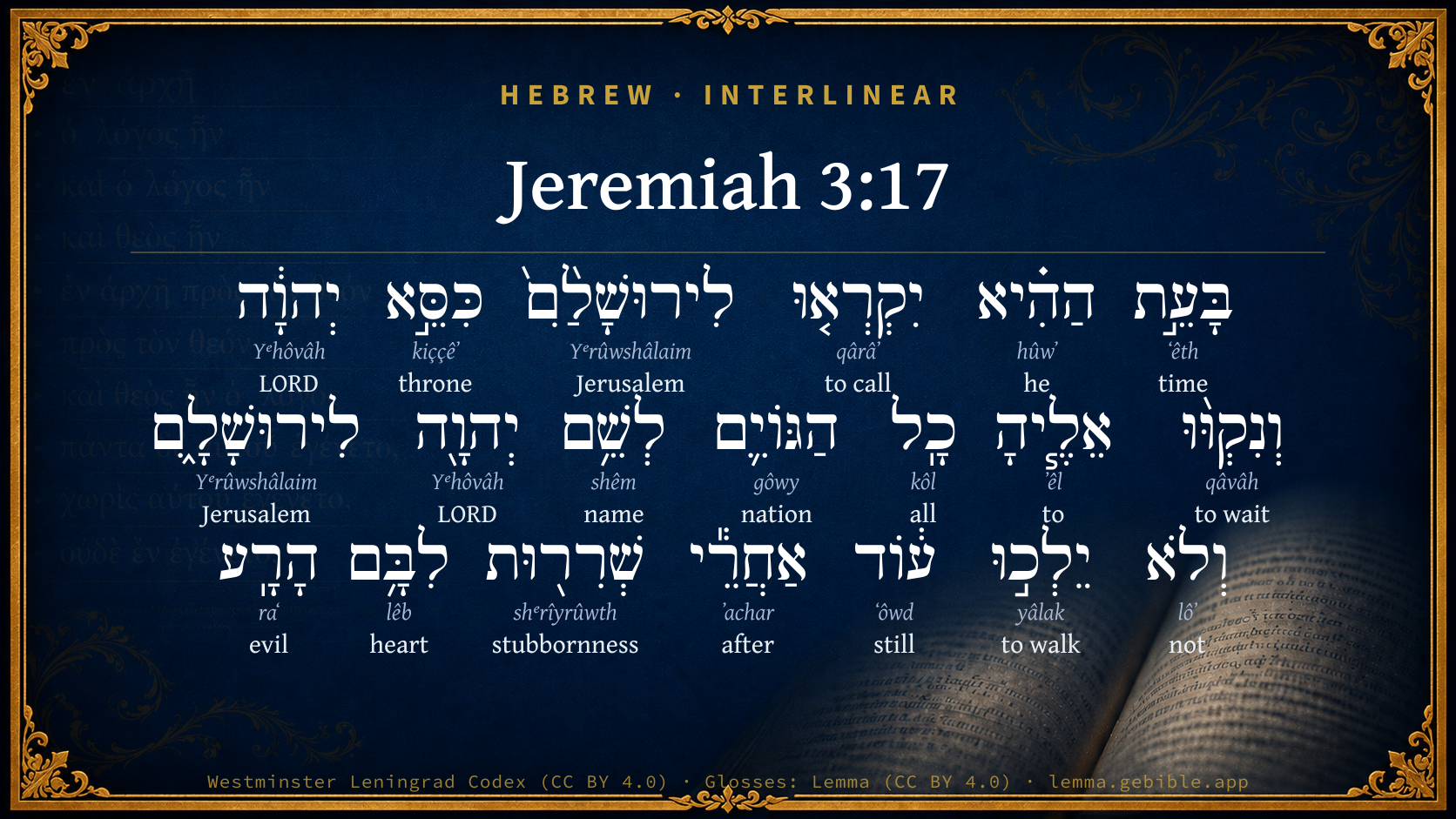
Hebrew (Westminster Leningrad Codex) Jeremiah 3:17 appears in the Hebrew Old Testament. The text above is from the Westminster Leningrad Codex. Each word links to its Strong’s number, a concise gloss, and parsing drawn from the Open Scriptures Hebrew Bible morphology. Click any word for its full Brown-Driver-Briggs (BDB) entry.
Download image
Cite this verse

Jeremiah 3:17 (World English Bible). Public Domain. Lemma interlinear Bible study tool, https://lemma.gebible.app/v/jeremiah/3/17.

Show BibTeX & RIS
BibTeX
RIS
English Translation
At that time they shall call Jerusalem the throne of Yahweh; and all the nations shall be gathered to it, to the name of Yahweh, to Jerusalem: neither shall they walk any more after the stubbornness of their evil heart.
World English Bible · Public Domain
Download a study sheet

One document with this verse’s original text, its word-by-word gloss line, the meaning frame, cross-references with their text, attributed commentary, and full source and license credits — printable, and it pastes into notes with its structure intact.

This verse Autodidact and up

Study sheet (.html) Plain text (.txt)

A passage Seminary Student

Up to 50 verses in one chapter. A passage sheet keeps up to 6 commentary sources and 12 cross-references per verse, in the order this page ranks them, and says so on the sheet whenever that leaves anything out. Ask for a single verse and you get the Autodidact verse sheet above.

Everything on this page stays free to read, with no account — the sheet is a download of what is already on screen, not access to it.

Want to remove ads? Support Godless Engineer
Compare translations 3

The same verse in 3 English versions, stacked beneath the original-language interlinear above. Click any original word for its lexicon entry.

Each is an independent rendering of the whole verse — the interlinear is not word-aligned to these translations.

Highlighted words mark where these versions differ — a whole-verse word diff, not a word-by-word alignment.

  • World English Bible Public Domain
    At that time they shall call Jerusalem the throne of Yahweh; and all the nations shall be gathered to it, to the name of Yahweh, to Jerusalem: neither shall they walk any more after the stubbornness of their evil heart.
  • King James Version Public Domain
    At that time they shall call Jerusalem the throne of the LORD; and all the nations shall be gathered unto it, to the name of the LORD, to Jerusalem: neither shall they walk any more after the imagination of their evil heart.
  • unfoldingWord Literal Text CC BY-SA 4.0
    In that time they will call Jerusalem, ‘the throne of Yahweh,’ and all the nations will gather to her—to the name of Yahweh, to Jerusalem. And they will no longer walk after the stubbornness of their evil heart.

unfoldingWord Literal Text — © unfoldingWord, licensed CC BY-SA 4.0. Word-aligned USFM3 via Door43 (git.door43.org/unfoldingWord/en_ult).

Versions to compare (up to 4)

3 of 4 selected

Show all 18 translations

Every available English version of this verse, each an independent rendering of the whole verse.

  • World English Bible Public Domain
    At that time they shall call Jerusalem the throne of Yahweh; and all the nations shall be gathered to it, to the name of Yahweh, to Jerusalem: neither shall they walk any more after the stubbornness of their evil heart.
  • Berean Standard Bible Public Domain
    At that time Jerusalem will be called The Throne of the LORD, and all the nations will be gathered in Jerusalem to honor the name of the LORD. They will no longer follow the stubbornness of their evil hearts.
  • Majority Standard Bible Public Domain
    At that time they will call Jerusalem The Throne of the LORD, and all the nations will be gathered in Jerusalem to honor the name of the LORD. They will no longer follow the stubbornness of their evil hearts.
  • King James Version Public Domain
    At that time they shall call Jerusalem the throne of the LORD; and all the nations shall be gathered unto it, to the name of the LORD, to Jerusalem: neither shall they walk any more after the imagination of their evil heart.
  • American Standard Version (1901) Public Domain
    At that time they shall call Jerusalem the throne of Jehovah; and all the nations shall be gathered unto it, to the name of Jehovah, to Jerusalem: neither shall they walk any more after the stubbornness of their evil heart.
  • Revised Version (1885) Public Domain
    At that time they shall call Jerusalem the throne of the LORD; and all the nations shall be gathered unto it, to the name of the LORD, to Jerusalem: neither shall they walk any more after the stubbornness of their evil heart.
  • Geneva Bible (1599) Public Domain
    At that time they shall cal Ierusalem, The throne of the Lord, and all the nations shall be gathered vnto it, euen to the Name of the Lord in Ierusalem: and thence foorth they shall follow no more the hardnesse of their wicked heart.
  • Douay-Rheims (1899) Public Domain
    At that time Jerusalem shall be called the thrown of the Lord: and all the nations shall be gathered together to it, in the name of the Lord to Jerusalem, and they shall not walk after the perversity of their most wicked heart.
  • Young's Literal Translation Public Domain
    At that time they cry to Jerusalem, `O throne of Jehovah,' And gathered unto her hath been all the nations, For the name of Jehovah, to Jerusalem, Nor do they go any more after the stubbornness of their evil heart.
  • Literal Standard Version CC BY-SA 4.0
    At that time they cry to Jerusalem, O throne of YHWH, || And all the nations have been gathered to her, || For the Name of YHWH, to Jerusalem, || Nor do they go after the stubbornness of their evil heart anymore.
  • Unlocked Literal Bible CC BY-SA 4.0
    In that time they will proclaim about Jerusalem, 'This is Yahweh's throne,' and all the other nations will gather at Jerusalem in Yahweh's name. They will no longer walk in the stubbornness of their wicked hearts.
  • unfoldingWord Literal Text CC BY-SA 4.0
    In that time they will call Jerusalem, ‘the throne of Yahweh,’ and all the nations will gather to her—to the name of Yahweh, to Jerusalem. And they will no longer walk after the stubbornness of their evil heart.
  • Darby Bible Public Domain
    At that time they shall call Jerusalem the throne of Jehovah; and all the nations shall be gathered unto it, to the name of Jehovah, to Jerusalem; and they shall no more walk after the stubbornness of their evil heart.
  • World Messianic Bible Public Domain
    At that time they will call Jerusalem ‘The LORD’s Throne;’ and all the nations will be gathered to it, to the LORD’s name, to Jerusalem. They will no longer walk after the stubbornness of their evil heart.
  • Webster's Bible Public Domain
    At that time they shall call Jerusalem the throne of the LORD; and all the nations shall be gathered to it, to the name of the LORD, to Jerusalem; neither shall they walk any more after the imagination of their evil heart.
  • Free Bible Version CC BY-SA 4.0
    When that time comes Jerusalem will be called the Throne of the Lord, and all the nations will come together in Jerusalem to honor the Lord. They won't be stubborn or wicked anymore.
  • Bible in Basic English Public Domain
    At that time Jerusalem will be named the seat of the Lord's kingdom; and all the nations will come together to it, to the name of the Lord, to Jerusalem: and no longer will their steps be guided by the purposes of their evil hearts.
  • JPS Tanakh (1917) Public Domain
    At that time they shall call Jerusalem The throne of the LORD; and all the nations shall be gathered unto it, to the name of the LORD, to Jerusalem; neither shall they walk any more after the stubbornness of their evil heart.

Literal Standard Version (2020), Covenant Press — licensed CC BY-SA 4.0. Text via the HelloAO Bible API (eBible.org). Unlocked Literal Bible (unfoldingWord) — licensed CC BY-SA 4.0. Text via the HelloAO Bible API (eBible.org). unfoldingWord Literal Text — © unfoldingWord, licensed CC BY-SA 4.0. Word-aligned USFM3 via Door43 (git.door43.org/unfoldingWord/en_ult). Free Bible Version, Dr. Jonathan Gallagher — licensed CC BY-SA 4.0. Text via the HelloAO Bible API (eBible.org).

Word by word

More ways to search: Search by grammar → Find every occurrence → Compare this word →

Practice this passage: Drill this verse → Learn its vocabulary →

שְׁרִר֖וּת
shᵉrîyrûwth
H8307
“stubbornness of”
Noun, Common, Feminine, Singular, Construct
Part of Speech
Noun
Type
Common
Gender
Feminine
Number
Singular
State
Construct
Full BDB Definition

Origin: from H8324 in the sense of twisted, i.e. firm

TWOT: 2469d

stubbornness, hardness, firmness
  1. בָּעֵ֣ת ʻêth H6256 “in/at the · time” Preposition, Determined + Noun, Common, Both, Singular, Absolute
  2. הַהִ֗יא hûwʼ H1931 “the · he” Particle, Definite Article + Pronoun, Personal, 3rd Person, Feminine, Singular
  3. יִקְרְא֤וּ qârâʼ H7121 “to call” Verb, Qal, Imperfect, 3rd Person, Masculine, Plural
  4. לִירוּשָׁלִַ֨ם֙ Yᵉrûwshâlaim H3389 “to/for · Jerusalem” Preposition + Noun, Proper
  5. כִּסֵּ֣א kiççêʼ H3678 “throne of” Noun, Common, Masculine, Singular, Construct
  6. יְהוָ֔ה Yᵉhôvâh H3068 “LORD” Noun, Proper
  7. וְנִקְוּ֨וּ qâvâh H6960 “and · to wait” Conjunction + Verb, Niphal, Sequential Perfect, 3rd Person, Common, Plural
  8. אֵלֶ֧יהָ ʼêl H413 “to · her” Preposition + Suffix, Personal, 3rd Person, Feminine, Singular
  9. כָֽל kôl H3605 “all of” Noun, Common, Masculine, Singular, Construct
  10. הַגּוֹיִ֛ם gôwy H1471 “the · nations” Particle, Definite Article + Noun, Common, Masculine, Plural, Absolute
  11. לְשֵׁ֥ם shêm H8034 “to/for · name of” Preposition + Noun, Common, Masculine, Singular, Construct
  12. יְהוָ֖ה Yᵉhôvâh H3068 “LORD” Noun, Proper
  13. לִירוּשָׁלִָ֑ם Yᵉrûwshâlaim H3389 “to/for · Jerusalem” Preposition + Noun, Proper
  14. וְלֹא lôʼ H3808 “and · not” Conjunction + Particle, Negative
  15. יֵלְכ֣וּ yâlak H3212 “to walk” Verb, Qal, Imperfect, 3rd Person, Masculine, Plural
  16. ע֔וֹד ʻôwd H5750 “still” Adverb
  17. אַחֲרֵ֕י ʼachar H310 “after” Preposition
  18. לִבָּ֥ם lêb H3820 “heart · their” Noun, Common, Masculine, Singular, Construct + Suffix, Personal, 3rd Person, Masculine, Plural
  19. הָרָֽע raʻ H7451 “the · evil” Particle, Definite Article + Adjective, Adjective, Masculine, Singular, Absolute

About this verse

These counts appear in no published source. They are computed here, from the morphology-tagged text and Lemma’s own curated glosses. What Lemma adds →

20
words
18
distinct lemmas
Prophets
section

Notable vocabulary

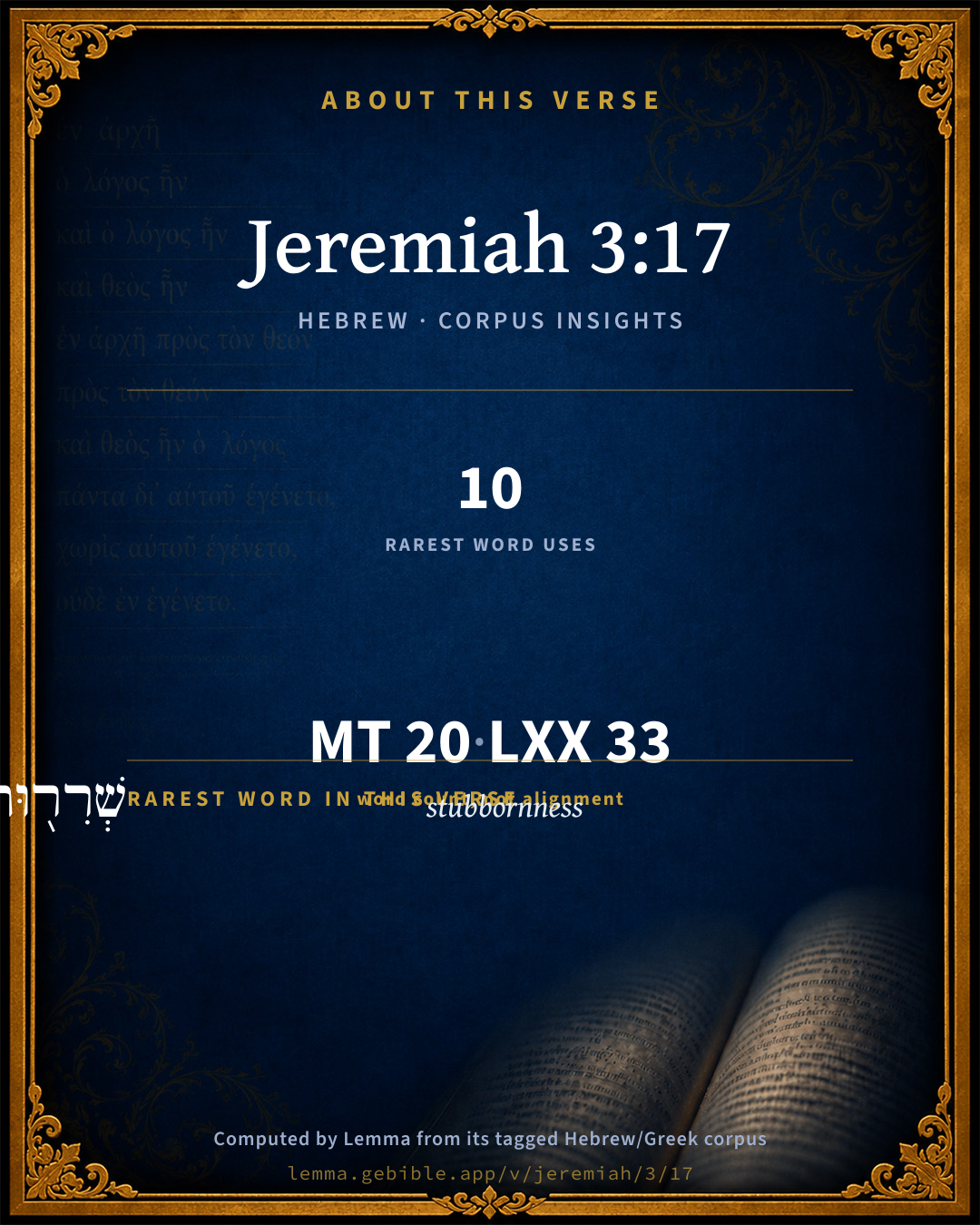
The rarest word here is שְׁרִר֖וּת stubbornness H8307 — appearing just 10 times in the whole Hebrew Bible.

Shared distinctive vocabulary

שְׁרִר֖וּת stubbornness H8307 occurs in 10 verses of the Hebrew Bible. Also found in:

Grammatical profile

  • 3 verbs
  • 11 nouns
  • 1 adjective
  • 1 pronoun
  • 2 prepositions
  • 1 adverb
  • 1 particle

Verb forms

  • יִקְרְא֤וּ Qal · Imperfect
  • וְנִקְוּ֨וּ Niphal · Sequential Perfect
  • יֵלְכ֣וּ Qal · Imperfect

Repetition

Words recur within this verse — often emphatic in Hebrew:

  • לִירוּשָׁלִַ֨ם֙ Jerusalem H3389 ×2
  • יְהוָ֔ה LORD H3068 ×2

Hebrew & Septuagint length

In the original languages it is 20 Hebrew tokens and 33 Greek tokens — but the two are counted differently (Hebrew bundles its prefixes and suffixes into one token; the Greek is in lemma form), so that isn’t a like-for-like length.

Cross-references

33

Topical passages linked to Jeremiah 3:17 in the Treasury of Scripture Knowledge — connected by theme and wording, ordered by reader-vote popularity; previews shown in the World English Bible.

  • Ezekiel 43:7 He said to me, Son of man, [this is] the place of my throne, and the place of the soles of my feet, where I will dwell in the midst of the children of Israel forever. The house of Israel shall no more defile my holy name, neither they, nor their kings, by their prostitution, and by the dead bodies of their kings [in] their high places;
  • Jeremiah 17:12 A glorious throne, [set] on high from the beginning, is the place of our sanctuary.
  • Micah 4:1–5 But in the latter days, It will happen that the mountain of Yahweh's temple will be established on the top of the mountains, And it will be exalted above the hills; And peoples will stream to it.
  • Jeremiah 11:8 Yet they didn't obey, nor turn their ear, but walked everyone in the stubbornness of their evil heart: therefore I brought on them all the words of this covenant, which I commanded them to do, but they didn't do them.
  • Zechariah 2:11 Many nations shall join themselves to Yahweh in that day, and shall be my people; and I will dwell in the midst of you, and you shall know that Yahweh of Hosts has sent me to you.
  • Zechariah 8:20–23 Thus says Yahweh of Hosts: "Many peoples, and the inhabitants of many cities will yet come;
  • Isaiah 2:2–4 It shall happen in the latter days, that the mountain of Yahweh's house shall be established on the top of the mountains, And shall be raised above the hills; And all nations shall flow to it.
  • Isaiah 49:18–23 Lift up your eyes round about, and see: all these gather themselves together, and come to you. As I live, says Yahweh, you shall surely clothe you with them all as with an ornament, and gird yourself with them, like a bride.
  • Isaiah 56:6 Also the foreigners who join themselves to Yahweh, to minister to him, and to love the name of Yahweh, to be his servants, everyone who keeps the Sabbath from profaning it, and holds fast my covenant;
  • Isaiah 60:3–9 Nations shall come to your light, and kings to the brightness of your rising.
  • Isaiah 66:20 They shall bring all your brothers out of all the nations for an offering to Yahweh, on horses, and in chariots, and in litters, and on mules, and on dromedaries, to my holy mountain Jerusalem, says Yahweh, as the children of Israel bring their offering in a clean vessel into the house of Yahweh.
  • Genesis 8:21 Yahweh smelled the sweet savor. Yahweh said in his heart, "I will not again curse the ground any more for man's sake, because the imagination of man's heart is evil from his youth; neither will I ever again strike everything living, as I have done.
  • Numbers 15:39 and it shall be to you for a fringe, that you may look on it, and remember all the commandments of Yahweh, and do them; and that you not follow after your own heart and your own eyes, after which you use to play the prostitute;
  • Deuteronomy 29:29 The secret things belong to Yahweh our God; but the things that are revealed belong to us and to our children forever, that we may do all the words of this law.
  • Judges 2:19 But it happened, when the judge was dead, that they turned back, and dealt more corruptly than their fathers, in following other gods to serve them, and to bow down to them; they didn't cease from their doings, nor from their stubborn way.
  • Psalms 78:8 And might not be as their fathers, A stubborn and rebellious generation, A generation that didn't make their hearts loyal, Whose spirit was not steadfast with God.
  • Psalms 87:3 Glorious things are spoken about you, city of God. Selah.
  • Isaiah 6:1 In the year that king Uzziah died, I saw the Lord sitting on a throne, high and lifted up; and his train filled the temple.
  • Isaiah 26:8 Yes, in the way of your judgments, Yahweh, have we waited for you; to your name, even to your memorial [name], is the desire of our soul.
  • Isaiah 59:19 So shall they fear the name of Yahweh from the west, and his glory from the rising of the sun; for he will come as a rushing stream, which the breath of Yahweh drives.
  • Isaiah 66:1 Thus says Yahweh, heaven is my throne, and the earth is my footstool: what manner of house will you build to me? and what place shall be my rest?
  • Jeremiah 7:24 But they didn't listen nor turn their ear, but walked in [their own] counsels [and] in the stubbornness of their evil heart, and went backward, and not forward.
  • Jeremiah 9:14 but have walked after the stubbornness of their own heart, and after the Baals, which their fathers taught them;
  • Jeremiah 14:21 Do not abhor [us], for your name's sake; do not disgrace the throne of your glory: remember, don't break your covenant with us.
  • Jeremiah 16:12 and you have done evil more than your fathers; for, behold, you walk every one after the stubbornness of his evil heart, so that you don't listen to me:
  • Jeremiah 18:12 But they say, It is in vain; for we will walk after our own devices, and we will do everyone after the stubbornness of his evil heart.
  • Jeremiah 31:23 Thus says Yahweh of Hosts, the God of Israel, Yet again shall they use this speech in the land of Judah and in the cities of it, when I shall bring again their captivity: Yahweh bless you, habitation of righteousness, mountain of holiness.
  • Romans 1:21 Because, knowing God, they didn't glorify him as God, neither gave thanks, but became vain in their reasoning, and their senseless heart was darkened.
  • Galatians 4:26 But the Jerusalem that is above is free, which is the mother of us all.
  • Ezekiel 1:26 Above the expanse that was over their heads was the likeness of a throne, as the appearance of a sapphire stone; and on the likeness of the throne was a likeness as the appearance of a man on it above.
  • Romans 6:14 For sin will not have dominion over you. For you are not under law, but under grace.
  • 2 Corinthians 10:4–5 for the weapons of our warfare are not of the flesh, but mighty before God to the throwing down of strongholds,
  • Ephesians 4:17–19 This I say therefore, and testify in the Lord, that you no longer walk as the rest of the Gentiles also walk, in the futility of their mind,

Cross-references courtesy of OpenBible.info (CC BY 4.0).

Hebrew and Greek witnesses Masoretic Hebrew ↔ Greek Septuagint

The same verse in the two great witnesses to the Old Testament, shown verse-for-verse.

These are two independent witnesses, not word-aligned to each other, and the Septuagint is shown in lemma (dictionary) form.

Hebrew Jeremiah 3:17 Masoretic · Westminster Leningrad Codex

בָּעֵ֣ת הַהִ֗יא יִקְרְא֤וּ לִירוּשָׁלִַ֨ם֙ כִּסֵּ֣א יְהוָ֔ה וְנִקְוּ֨וּ אֵלֶ֧יהָ כָֽל הַגּוֹיִ֛ם לְשֵׁ֥ם יְהוָ֖ה לִירוּשָׁלִָ֑ם וְלֹא יֵלְכ֣וּ ע֔וֹד אַחֲרֵ֕י שְׁרִר֖וּת לִבָּ֥ם הָרָֽע

At that time they shall call Jerusalem the throne of Yahweh; and all the nations shall be gathered to it, to the name of Yahweh, to Jerusalem: neither shall they walk any more after the stubbornness of their evil heart.

World English Bible · Public Domain

Greek LXX Structure differs

In the Septuagint, Jeremiah is about an eighth shorter than the Hebrew and arranges its material differently — the Oracles Against the Nations (Hebrew chapters 46–51) appear in the middle of the Greek book, after 25:13. Because the chapter and verse boundaries do not line up, a verse-for-verse comparison with the Hebrew is not shown.

A verse-for-verse comparison isn’t shown here because the chapters and verses don’t line up. Switch to the LXX edition with the MT / LXX toggle above to read the Greek directly.

On this verse, Albert Barnes' Notes on the Bible discusses the Septuagint’s reading. Read the note in Commentary ↓

Hebrew: Westminster Leningrad Codex (CC BY 4.0). Greek: Septuagint (public domain); English from a public-domain English Septuagint. How the Septuagint differs from the Hebrew →

Targum (Aramaic paraphrase)

1

The Targum is the ancient Jewish Aramaic paraphrase of the Hebrew Scriptures — an interpretive translation, not the Hebrew text itself. Onkelos (literal) and Pseudo-Jonathan (expansive) render the Torah, and Jonathan the Prophets. Coverage is partial: where no permissively-licensed English translation exists for a verse, only the Aramaic is shown. This is verse-level text, not a word-by-word alignment to the Hebrew.

  1. Targum Jonathan Prophets (Joshua–Malachi)
    בְּעִידָנָא הַהִיא יִקְרוּן לִירוּשְׁלֵם אֲתַר בֵּית שְׁכִנְתָּא דַייָ וְיִתְנְהוֹן לְמִפְלַח בָּהּ כָּל עַמְמַיָא לִשְׁמָא דַייָ לִירוּשְׁלֵם וְלָא יְהָכוּן עוֹד בָּתַר הִרְהוּר לִבְּהוֹן בִּישָׁא:

    (no public-domain English translation for this verse)

    Targum Jonathan — Aramaic: “Mikraot Gedolot” (public domain). English: “Sefaria Community Translation” (CC0 1.0 (public-domain dedication)); “London "Chaldee Paraphrase," 1871” (public domain). Text via Sefaria.

Commentary

Notes on Jeremiah 3:17 from classic Christian and Jewish commentators (each source and its license shown beneath its notes). The classic Christian expositions comment on the surrounding passage and are grouped to its opening verse, so a note may address several verses; the Jewish commentaries on the Tanakh (Rashi and others) are per-verse, so they appear only where the commentator wrote on this verse.

Lemma curates 59 commentaries, every one of them public domain or Creative Commons licensed, each selected and text-cleaned for this edition rather than reprinted as found. About our sources →

Trapp's Complete Commentary

John Trapp

Jer 3:17 At that time they shall call Jerusalem the throne of the LORD; and all the nations shall be gathered unto it, to the name of the LORD, to Jerusalem: neither shall they walk any more after the imagination of their evil heart.

Ver. 17. They shall call Jerusalem,] i.e., The Church Christian.

The throne of the Lord.] The throne of glory; {Jer 4:2} so Exo 17:16, because the hand upon the throne of the Lord - that is, say some, Amalek’s hand upon the Church, which is elsewhere also called the temple of God.

Neither shall they walk any more, &c., ] i.e., Not at random, but by rule. {Eph 5:15} Heb., Not any more after the sight of their heart - i.e., as themselves thought good, but as God directeth them.

John Trapp, A Commentary or Exposition upon All the Books of the Old and New Testament (1647–1656) — public domain. Text from a community e-Sword module.

The Biblical Illustrator

Joseph S. Exell

Jer_3:17

The throne of the Lord.

The Church Christs throne

1. Jerusalem had been of old the throne of God: the symbol of God rested on the ark. Hence called the city of the Great King.

2. Jerusalem became the throne of God as never before when Emmanuel visited her. Yet she rejected her King.

3. Christ by His death founded a kingdom in which His Church has become the true throne of God.

I. In the conversion of sinners the kingly power and authority of Christ is manifested. Each case is a victory of Christ over the enmity of the carnal mind and the resistance of hellish foes.

II. In maintaining his ascendency over the lives and affections of His converts. Law in their members at war with Him. The world strives to wrest them from His rule. Satan strives to recover his lost power. But they are held in obedience to Christ, and kept by the power of God unto salvation.

III. In governing the world providentially for His Churchs advantage. Christ reigns as mediator: works all things for our good and His glory; and by, and for, and from His Church He puts forth His power, that shall subdue all enemies under His feet. How does Christs rule affect individual members of His Church?

1. To what extent can and may they enjoy personally the presence of their King? Sits enthroned in their heart and affections individually.

2. Christ must hold unrivalled and unlimited sway and sovereignty over their liven His kingship absolute: their affections undivided: they habitually and entirely under the constraining influences of His love.

3. They will recognise that His care extends to every individual believer, sending expressions of His kindness and love to each, and never--save in faithfulness--afflicting them. (R. Gordon, D. D.)

The Biblical Illustrator, edited by Joseph S. Exell (c. 1880s–1900s) — public domain. Text from a community e-Sword module.

Joseph Benson's Commentary

Jer 3:17. At that time — Of reformation, διορθωσεως, emendation, (Heb 9:10,) when things should be put into a better state by the coming of the Messiah; they shall call Jerusalem the throne of the Lord — Instead of the ark, the Christian Church, typified by Jerusalem, shall be the place of God’s special residence, power, and glory; where he will rule and act, and display his glory, in and by his word and ordinances, and especially in and by the Messiah. And all the nations shall be gathered unto it — Not only the Jews and Israelites, but many of all nations: many of the heathen shall be brought to worship the true God, and to embrace the Christian faith. To the name of the Lord — Which shall be both manifested and called upon in his church, as formerly at Jerusalem. Neither shall they walk, &c. — Both Jews and Gentiles shall now conform themselves to the will of God. The word שׁררות, here rendered imagination, is derived from a root that signifies to see, and is sometimes applied to the judgment, and sometimes to the affections. Here it may comprehend both: they shall neither follow their own corrupt judgment nor affection, but wholly the word of God.

Joseph Benson's Commentary on the Old and New Testaments (1811–1818) — public domain. Text from a community e-Sword module.

Tyndale Open Study Notes

Tyndale Open Resources

3:17 In the future, the city of Jerusalem would be a global center of worship called The Throne of the Lord, and people from nations around the earth would renounce their rebellion (7:24; Deut 29:19; Isa 60:9).

Tyndale Open Study Notes — © Tyndale Open Resources, licensed CC BY-SA 4.0. Text via the HelloAO Bible API.

Geneva Bible (1599)

Geneva Bible translators

Meaning, the Church, where the Lord will be present to the world’s end, Matt. 28:20.

Geneva Bible (1599) marginal notes — public domain. Text via Bolls.life.

Jamieson, Fausset & Brown

Robert Jamieson, A. R. Fausset & David Brown

Jerusalem--the whole city, not merely the temple. As it has been the center of the Hebrew theocracy, so it shall be the point of attraction to the whole earth (Isa 2:2-4; Zac 2:10-11; Zac 14:16-21).

throne of . . . Lord--The Shekinah, the symbol of God's peculiar nearness to Israel (Deu 4:7) shall be surpassed by the antitype, God's own throne in Jerusalem (Psa 2:6, Psa 2:8; Eze 34:23-24; Zac 2:5).

imagination--rather, as Margin, "the obstinacy" or stubbornness.

Jamieson, Fausset & Brown — Commentary Critical and Explanatory on the Whole Bible (1871) — public domain (CC PDM 1.0). Text via the HelloAO Bible API.

Adam Clarke's Commentary

Verse 17. They shall call Jerusalem the throne of the Lord] The new Jerusalem, the universal Church of Christ, shall be God's throne: and wherever he is acknowledged as the Lamb of God who takes away the sin of the world, there God sits on his throne, and holds his court.

Adam Clarke's Commentary on the Bible (1810–1826) — public domain. Text from a community e-Sword/MySword module.

John Calvin's Commentaries

We now understand more clearly what I have already said, — that the Prophet promises here that there would be concord between the ten tribes and the kingdom of Judah, when both returned from exile; as though he had said, that their condition would be better than it ever had been; for the seed of Abraham had been torn as it were asunder; and the people whom God intended that they should continue in a holy union had become divided in the most shameful manner. We indeed know that there had been inveterate hatred between the Jews and the Israelites. As then there had been such disgraceful division for a long time between the children of Abraham, the Prophet now shews what would be the fruit of exile; for after having been for a time chastised by the Lord, they would return to their own country, not to entertain the same emulation as had existed, but to unite together in calling on God, in order that the Jews might be as brethren to the Israelites, and the Israelites might cultivate mutual concord with the tribe of Judah.

John Calvin's Commentaries (1540-1563) — public domain. Text from the Calvin Translation Society English edition (1840s-50s) via the Christian Classics Ethereal Library (ccel.org). Calvin's coverage is partial (roughly two-thirds of the Bible); uncommented books and verses are honest gaps, never fabricated. The 19th-century editor's footnotes and remarks are omitted so the notes are faithfully Calvin's own voice.

Ellicott's Commentary for English Readers

(17) They shall call Jerusalem the throne of the Lord.—Up to Jeremiah’s time that title, “the throne of God,” though the language of the Old Testament had referred it to the “heavens” (Psa_11:4; Psa_103:19), had probably been applied, in popular language, to the ark where the Lord “dwelt between the cherubim” (1Sa_4:4; 2Ki_19:15). The prophet extends it to the whole city, in that future of which he was doubtless thinking. To him, as to Micah (Mic_4:1-2) and Isaiah (Isa_2:1-3), there came a vision of the holy city as the centre of the divine Kingdom. It was not given to him to see what even the Apostles were slow to understand, that there is no holy city upon earth, and that his hopes would only be fulfilled in the heavenly Jerusalem which is the Church or family of God.

The imagination.—Better, stubbornness, as in the margin.

A Bible Commentary for English Readers, edited by Charles John Ellicott (1878–1897) — public domain. Text from a community e-Sword module.

The Cambridge Bible for Schools and Colleges

gen. ed. J. J. S. Perowne

17. all the nations] Gentile peoples shall be gathered into the Church of God, which shall thus become Universal. But see introd. note on Jer_3:14-18.

stubbornness] a favourite word in this Book.

The Cambridge Bible for Schools and Colleges (gen. ed. J. J. S. Perowne; Cambridge University Press, 1878–1918) — public domain. Text from a community e-Sword module.

John Gill's Exposition

At that time they shall call Jerusalem the throne of the Lord,.... That is, the Gospel church, the heavenly Jerusalem, the Jerusalem above, that is free, and the mother of us all; which is Christ's kingdom, where he has his throne and subjects, and where he sits and reigns as King of saints; and where they yield a cheerful and ready subjection to him, signified by calling the church his throne:

and all the nations shall be gathered unto it: which shows that Jerusalem, literally understood, cannot be meant, but the church of Christ; to which the Gentiles, being converted, should join themselves in great numbers in all nations, as they have done; and which will be more largely accomplished and verified in the latter day, Isa 2:2.

to the name of the Lord, to Jerusalem; to name his name, to trust in his name, to call upon it, and to worship him in Jerusalem, in his church, and among his people; and so the Targum,

"and all nations shall give themselves to worship in it the name of the Lord, in Jerusalem:''

neither shall they walk any more after the imagination of their evil heart; for the Gospel being preached to all nations, according to Christ's commission, by the pastors he promises, and that being blessed to the turning of the Gentiles from their idols to serve the living God, they shall no more worship the gods they chose for themselves, and their evil hearts devised.

John Gill's Exposition of the Whole Bible (1746–1763) — public domain (CC PDM 1.0). Text via the HelloAO Bible API.

Albert Barnes' Notes on the Bible

The throne of the Lord - Yahweh’s throne shall not be the ark, but Jerusalem, i. e., the Christian Church Rev 21:2; Gal 4:26.

To Jerusalem - The Septuagint and Syriac are probably right in omitting this word.

Imagination ... - Stubbornness (margin). A word always used in a bad sense, for “obstinacy.”

Albert Barnes' Notes on the Bible (1834–1885) — public domain. Text from a community e-Sword/MySword module.

Haydock's Catholic Bible Commentary

All. Many might embrace the Jewish religion. But the predictions of the prophets on this head, were not verified, till the gospel was preached. (Calmet) --- Then many embraced the faith: several captives also returned to God. (Worthington)

George Leo Haydock (1774–1849), Haydock's Catholic Family Bible and Commentary, 1859 edition — public domain. Excludes Psalms (Douay-Rheims chapter numbering differs from Protestant) and Deuterocanonical books (Catholic canon only).

Matthew Poole's English Annotations

They shall call Jerusalem the throne of the Lord; instead of the ark, whereon was the mercy-seat, now the church, typified by Jerusalem, Gal 4:26; Rev 21:2, shall be the place of God’s residence, where by his Spirit he will rule and act in his word and ordinances, and in special the Messias. See Jer 14:21, and Jer 3:16.

All the nations shall be gathered unto it; intimating both their readiness to come in, and their number, according to first prophecy of Jacob, Gen 49:10. See Isa 2:2. By

nations here understand either the ten tribes, who are called many people, both Israel and Judah united, their distance being taken away; see Jer 3:18; or rather some of all nations, that shall flock into the gospel church; for when the prophets foretell this state, they generally usher it in with the return of this people, at which time the church shall be greatly enlarged.

To the name of the Lord, to Jerusalem, i.e. dwelling in Jerusalem, or where the Lord placed his name, viz. of old in Jerusalem, Psa 122:2,3, &c., but now in the church, Rev 21:2,3, without ark or temple, Rev 21:22, where he will be known as it were by his proper name, Isa 60:9, or as manifest in the flesh.

Neither shall they walk any more after the imagination of their evil heart; both Jew and Gentile shall now conform themselves to the will of God, Isa 2 3.

The word imagination here comes from a root that signifies to see, and thus it is sometimes applied to the judgment, Psa 17:2, and sometimes to the affection, Psa 66:18; here it may comprehend both, they will follow neither their own judgment nor affection, but wholly the word of God. The word is thus phrased Num 15:39; Ecc 11:9; some read it after the hardness, Deu 29:19.

Matthew Poole's English Annotations on the Holy Bible (1683–1685) — public domain. Text from a community e-Sword/MySword module.

Whedon's Commentary on the Bible

Daniel D. Whedon

17. All the nations shall be gathered — Let this passage, the meaning of which is so unmistakable, explain all similar passages. The sense in which the nations of the earth shall gather to Jerusalem, according to this golden vision, is doubtless that in which the Jewish people shall gather there. It only means that the spiritual Jerusalem shall be the capital of the world, and all nations shall “bring their glory and honour into it.”

Daniel D. Whedon (gen. ed.), Commentary on the Old and New Testaments (1874–1909) — public domain. Text from a community e-Sword module.

The Pulpit Commentary

Jerusalem"s spiritual glory. With Jeremiah"s description, comp. that of Ezekiel," The name of the city from that day shall be, "The Lord is there". (Eze_48:35) This gives us the positive aspect of the Messianic period (comp. on ver. 16). Jerusalem shall be the spiritual center of the universe, because it is pervaded by the presence of the Most High. (Isa_4:5) May we explain with Dr. Payne Smith, "Jerusalem, i.e . the Christian Church?" Only if the provisional character of the existing Church be kept well in view. All the nations; i.e. all except the chosen people. The word for "nations" (goyim) is that often rendered "heathen." To the name; or, because of the name, i.e. because Jehovah has revealed his name at Jerusalem. The phrase occurs again with a commentary in Jos_9:9, "Thy servants are come because of the name of Jehovah thy God, for we have heard the fame of him, and all that he did in Egypt." But we must not suppose that "name" is equivalent to "revelation;" rather, there is here an ellipsis of the name" is equivalent to "because of the revelation of the name," or better still, "... of the Name." The "Name of Jehovah" is in fact a distinct hypostasis in the Divine Being; no mere personification of the Divine attributes (as the commentators are fond of saying), but (in the theological sense) a Person. The term, "Name of such and such a God,:" is common to Hebrew with Phoenician religion. In the famous inscription of Eshmunazar, King of Zidon, Ashtoreth is called "Name of Baal;" and to whichever proper name the religious term Name may be attached, it means a personal existence in the Divine nature, specially related to the world of humanity; or, to use the language of Hengstenberg, the bridge between the latter and the transcendent heights of God as he is in himself. In short, the Name of Jehovah is virtually identical with the Logos of St. John, or the second Person in the blessed Trinity. Hence the personal language now and again used of this Name in the Old Testament, e.g. Isa_30:27, "The Name of Jehovah cometh from far... his lips are full of indignation;" Isa_26:8, "The desire of our soul was to thy Name;" Isa_59:19, "So shall they fear the Name of Jehovah from the west, and his glory from the rising of the sun." Comp. Pro_18:10; men do not run for safety to an abstract idea. Nor will all nations in the latter days resort either to a localized or to a spiritually diffused Jerusalem in the future, to gratify a refined intellectual curiosity. Neither shall they walk, etc.; i.e. the Israelites of the latter days; not the "nations" before mentioned (as Hengstenberg). The phrase occurs eight times in Jeremiah, and is always used of the Israelites. The word rendered "imagination" is peculiar (sheri-ruth). As Hengstenberg has pointed out, it occurs independently only in a single passage; (Deu_29:18) for in Psa_81:13, it is plainly derived, not from the living language, from which it had disappeared, but from the written. (The close phraseological affinity between the Books of Deuteronomy and Jeremiah has been already indicated.) The rendering of the Authorized Version, which is supported by the Septuagint, Peshito, Targum, is certainly wrong; the Vulgate has pravitatum; the etymological meaning is "stubbornness." The error of the versions may perhaps have arisen out of a faulty inference from Psa_81:13, where it stands in parallelism to "their counsels.

The gathering of the nations to Jehovah"s throne.

I THE NEW CHARACTER IN WHICH JERUSALEM APPEARS. It is no longer to be considered simply as the center of Israelite affection and devotion, the city where was the palace of a human king, and the temple of Jehovah as the peculiar deity of Israel. It is no longer to be the place of a peculiar worship. Its character henceforth is to be far more glorious, one in which Israel shall lose nothing, yea, rather gain, in remembering what it has been able to contribute in attaining such an end. Jerusalem, that had been associated with all sorts of idolatrous abominations, is first of all to be desolated and humbled, whatever human pride and glory there was in it extinguished; and then the true glory will come. The city shall be Jehovah"s throne, the throne of him who is God above all gods and King above all kings. And when men would recognize the authority of a king, his throne is the place they must come to. Hence to Jehovah, seated on his throne, all the nations are to be gathered; forsaking national idols and national ideals, all that is local and narrow and self-originated will vanish. The ark of the covenant passes away, and the tables of stone become unnecessary, for from his throne Jehovah will take means whereby he may write on the fleshy tables of every human heart the two great principles, "Love God and love thy fellow-man.

II How THE GATHERING IS TO BE BROUGHT ABOUT. How clear it is that, the Ark of the Covenant passing away, mere local, terrestrial Jerusalem must also cease to have any peculiar value! The taking away of the Ark of the Covenant is really the taking away of all in the way of dependence that is merely visible and material. It is plain that the gathering together to Jerusalem cannot mean an actual travelling there from all parts of the earth"s surface. Not that the mere local Jerusalem can become as a common spot of earth. After these northern desolators, of whom Jeremiah so often spoke, had done with it, it was rebuilt, and in due time became the scene of great spiritual redeeming acts profoundly affecting every child of man. The thought of the local scenes where-Christ-died, rose again, and ascended into glory, may well help every sinner in his believing approaches to his Savior. Those who gather at Jerusalem gather there by virtue of the power which there is in every believing heart. Innumerable pilgrims, on piety intent, have gone on pilgrimage to Jerusalem, doing laborious penances by the way, only to discover in the end that they have been walking after the imaginations of their evil hearts. There may be great value in a journey to the Holy Land, if only those who go there have first of all had their minds opened to apprehend the work which he who died at Jerusalem did for them; otherwise their travels, whatever the human joy and interest of them, may only add to their subsequent condemnation. To go to Jerusalem spiritually is the great thing. The Jerusalem of our journey is situated in the pages of the New Testament rather than in Palestine. It is as we read the Gospels that we feel how Jerusalem is indeed the throne of Jehovah in this sense, that there, through his Son Jesus, he manifested righteousness, power, and love, all the glorious attributes of his eternal reign. The transactions at Jerusalem are incomparable. No transactions in any one nation, however much they may affect the career of that nation, can rival the transactions at Jerusalem. The Englishman as an Englishman may feel his deep concern in Magna Charta and the Bill of Rights. The American as an American thinks of Philadelphia and the Declaration of Independence. The Negro as a Negro remembers Lincoln and the proclamation, which gave freedom to the slaves. But underneath the natural, the peculiar, the merely terrestrial, there is another man, the man who has to think of sin within him, and death and eternity before him. Such a man, if he thinks rightly, will feel that it is towards Jerusalem that his most earnest considerations should gather. All who truly ponder the great questions of life must gather there, and thence in faith their thoughts will ascend to the true, the heavenly, the everlasting Jerusalem. Y.

The Pulpit Commentary (1880–1919), ed. H.D.M. Spence-Jones & Joseph S. Exell — public domain. Text from a community e-Sword module.

John Wesley's Explanatory Notes

The throne - Instead of the ark, the church typified by Jerusalem, shall be the place of God's residence, where by his spirit he will rule and act in his word and ordinances. Jerusalem - Dwelling in Jerusalem, or where the Lord placed his name, of old in Jerusalem, but now in the church. Neither - Both Jews and Gentiles shall now conform themselves to the will of God.

John Wesley, Explanatory Notes Upon the Whole Bible (1754–1765) — public domain. Text via the GEBible commentary corpus.

unfoldingWord translationNotes

Door43 World Missions Community

This is Yahweh's throne

Here "Yahweh's throne" represents the place from where Yahweh rules. AT: "This is from where Yahweh rules" (See: Metonymy)

They will no longer walk in the stubbornness of their wicked hearts

Yahweh speaks of people's actions as if the people were walking along a path. Here the word "hearts" represents their minds or wills. AT: "They will no longer stubbornly do the wicked things that they want to do" (See: Metaphor and Metonymy)

the house of Judah will walk with the house of Israel

Here "walk with" represents being united. AT: "the people of Judah will be united with the people of Israel" (See: Metaphor)

the house of Judah

The word "house" is a metonym for the family that lives in the house. In this case it refers to the kingdom of Judah, which included the descendants of Judah and Benjamin. AT: "Judah" or "the kingdom of Judah" or "the people of Judah" (See: Metonymy)

the house of Israel

The word "house" is a metonym for the family that lives in the house. In this case it refers to the kingdom of Israel. AT: "Israel" or "the kingdom of Israel" or "the people of Israel" (See: Metonymy)

the land that I gave your ancestors as an inheritance

God speaks of giving them the land to possess forever as if it were an inheritance. AT: "the land that I gave to your ancestors so that it would belong to their descendants forever" (See: Metaphor)

translationWords

Jerusalem

throne

nation

name

walk

stiff-necked

house

inherit

unfoldingWord translationNotes — © Distant Shores Media and the Door43 World Missions Community, licensed CC BY-SA 4.0. Source: git.door43.org/Door43/en_tn.

Rashi

Rabbi Shlomo Yitzchaki (Rashi)

shall gather Heb. ונקוו, an expression of: מקוה מים, a gathering of water.

the idea of an expression of seeing. Comp. אשורנו “I see him” (Num. 24:17).

Rashi on the Tanakh — English translations: “The Judaica Press complete Tanach with Rashi, translated by A. J. Rosenberg” (CC BY 4.0); “Pentateuch with Rashi's commentary by M. Rosenbaum and A.M. Silbermann, 1929-1934” (public domain); “The Metsudah Tanach series, Lakewood, N.J” (CC BY 4.0); and “The Book of Joshua, Metsudah Publications, 1997” (CC BY 4.0). Text via Sefaria.

Lesson kit

Teaching starters — assembled from the data on this page, not authored interpretation. Every prompt links to the verse data it draws on. Edit before teaching.

Jeremiah, in the Prophets, opens this verse with 20 words (18 distinct Hebrew lemmas). Its most distinctive word is shᵉrîyrûwth (“stubbornness”). A historical commentator’s framing appears above. Read the whole chapter for the surrounding context.

Discussion questions

  1. How does “stubbornness” (shᵉrîyrûwth) shape what this verse is saying?
  2. Deuteronomy 29:19 shares the word «stubbornness» with this verse. How do the two illuminate each other?
  3. “Jerusalem” occurs 2× in this one verse. What is the effect of the repetition?
  4. The translations on this page render this verse differently — a whole-verse word diff, not a word-by-word alignment. What might account for the different wordings?
  5. The verb «יִקְרְא֤וּ» is Qal Imperfect. How does its form color the action?
  6. Reading how Trapp's Complete Commentary and The Biblical Illustrator read this verse, where do the two commentators agree and where do they part?

Things to notice

Reading settings

Reading text

Shown beneath each verse's original-language words.

Old Testament
Old Testament edition

Read the OT as the Masoretic Hebrew (MT) or the Greek Septuagint (LXX).

English shown for the Greek Septuagint (in the Hebrew ↔ Greek comparison).

Comparing translations? Open the Compare panel on any verse page to stack up to four side by side.