2 Chronicles 30:14

Hebrew (Westminster Leningrad Codex) 2 Chronicles 30:14 appears in the Hebrew Old Testament. The text above is from the Westminster Leningrad Codex. Each word links to its Strong’s number, a concise gloss, and parsing drawn from the Open Scriptures Hebrew Bible morphology. Click any word for its full Brown-Driver-Briggs (BDB) entry.
Download image
Cite this verse

2 Chronicles 30:14 (World English Bible). Public Domain. Lemma interlinear Bible study tool, https://lemma.gebible.app/v/2-chronicles/30/14.

Show BibTeX & RIS
BibTeX
RIS
English Translation
They arose and took away the altars that were in Jerusalem, and all the altars for incense took they away, and cast them into the brook Kidron.
World English Bible · Public Domain
Download a study sheet

One document with this verse’s original text, its word-by-word gloss line, the meaning frame, cross-references with their text, attributed commentary, and full source and license credits — printable, and it pastes into notes with its structure intact.

This verse Autodidact and up

Study sheet (.html) Plain text (.txt)

A passage Seminary Student

Up to 50 verses in one chapter. A passage sheet keeps up to 6 commentary sources and 12 cross-references per verse, in the order this page ranks them, and says so on the sheet whenever that leaves anything out. Ask for a single verse and you get the Autodidact verse sheet above.

Everything on this page stays free to read, with no account — the sheet is a download of what is already on screen, not access to it.

Want to remove ads? Support Godless Engineer
Compare translations 3

The same verse in 3 English versions, stacked beneath the original-language interlinear above. Click any original word for its lexicon entry.

Each is an independent rendering of the whole verse — the interlinear is not word-aligned to these translations.

Highlighted words mark where these versions differ — a whole-verse word diff, not a word-by-word alignment.

  • World English Bible Public Domain
    They arose and took away the altars that were in Jerusalem, and all the altars for incense took they away, and cast them into the brook Kidron.
  • King James Version Public Domain
    And they arose and took away the altars that were in Jerusalem, and all the altars for incense took they away, and cast them into the brook Kidron.
  • unfoldingWord Literal Text CC BY-SA 4.0
    And they rose, and they took away the altars that were in Jerusalem, and all the incense altars they took away, and they threw into the brook Kidron.

unfoldingWord Literal Text — © unfoldingWord, licensed CC BY-SA 4.0. Word-aligned USFM3 via Door43 (git.door43.org/unfoldingWord/en_ult).

Versions to compare (up to 4)

3 of 4 selected

Show all 18 translations

Every available English version of this verse, each an independent rendering of the whole verse.

  • World English Bible Public Domain
    They arose and took away the altars that were in Jerusalem, and all the altars for incense took they away, and cast them into the brook Kidron.
  • Berean Standard Bible Public Domain
    They proceeded to remove the altars in Jerusalem and to take away the incense altars and throw them into the Kidron Valley.
  • Majority Standard Bible Public Domain
    They proceeded to remove the altars in Jerusalem and to take away the incense altars and throw them into the Kidron Valley.
  • King James Version Public Domain
    And they arose and took away the altars that were in Jerusalem, and all the altars for incense took they away, and cast them into the brook Kidron.
  • American Standard Version (1901) Public Domain
    And they arose and took away the altars that were in Jerusalem, and all the altars for incense took they away, and cast them into the brook Kidron.
  • Revised Version (1885) Public Domain
    And they arose and took away the altars that were in Jerusalem, and all the altars for incense took they away, and cast them into the brook Kidron.
  • Geneva Bible (1599) Public Domain
    And they arose, and tooke away the altars that were in Ierusalem: and all those for incense tooke they away, and cast them into the brooke Kidron.
  • Douay-Rheims (1899) Public Domain
    And much people were assembled to Jerusalem to celebrate the solemnity of the unleavened bread in the second month:
  • Young's Literal Translation Public Domain
    And they arise and turn aside the altars that `are' in Jerusalem, and all the perfume altars they have turned aside, and cast `them' to the brook Kidron;
  • Literal Standard Version CC BY-SA 4.0
    And they arise and turn aside the altars that [are] in Jerusalem, and they have turned aside all the incense altars, and cast [them] into the Brook of Kidron;
  • Unlocked Literal Bible CC BY-SA 4.0
    They rose and took away the altars that were in Jerusalem, and all the altars for incense; they threw them into the brook Kidron.
  • unfoldingWord Literal Text CC BY-SA 4.0
    And they rose, and they took away the altars that were in Jerusalem, and all the incense altars they took away, and they threw into the brook Kidron.
  • Darby Bible Public Domain
    And they rose up and took away the altars that were in Jerusalem; and they took away all the incense-altars, and cast them into the torrent Kidron.
  • World Messianic Bible Public Domain
    They arose and took away the altars that were in Jerusalem, and they took away all the altars for incense and threw them into the brook Kidron.
  • Webster's Bible Public Domain
    And they arose and took away the altars that were in Jerusalem, and all the altars for incense they took away, and cast them into the brook Kidron.
  • Free Bible Version CC BY-SA 4.0
    They went and removed the pagan altars in Jerusalem as well as the incense altars and threw them into the Kidron Valley.
  • Bible in Basic English Public Domain
    And they got to work and took away all the altars in Jerusalem, and they put all the vessels for burning perfumes into the stream Kidron.
  • JPS Tanakh (1917) Public Domain
    And they arose and took away the altars that were in Jerusalem, and all the altars for incense took they away, and cast them into the brook Kidron.

Literal Standard Version (2020), Covenant Press — licensed CC BY-SA 4.0. Text via the HelloAO Bible API (eBible.org). Unlocked Literal Bible (unfoldingWord) — licensed CC BY-SA 4.0. Text via the HelloAO Bible API (eBible.org). unfoldingWord Literal Text — © unfoldingWord, licensed CC BY-SA 4.0. Word-aligned USFM3 via Door43 (git.door43.org/unfoldingWord/en_ult). Free Bible Version, Dr. Jonathan Gallagher — licensed CC BY-SA 4.0. Text via the HelloAO Bible API (eBible.org).

Word by word

More ways to search: Search by grammar → Find every occurrence → Compare this word →

Practice this passage: Drill this verse → Learn its vocabulary →

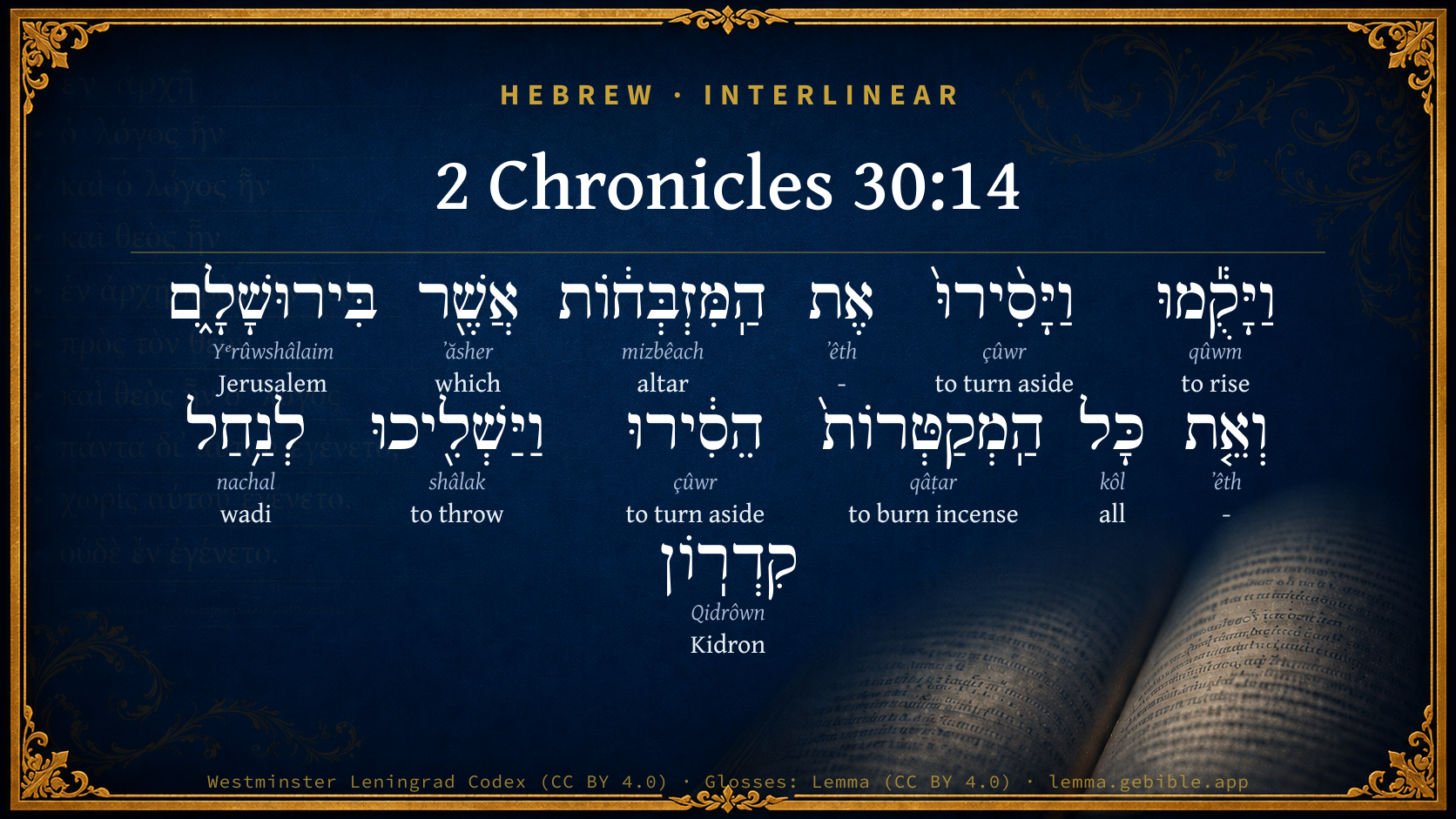
קִדְרֽוֹן
Qidrôwn
H6939
“Kidron”
Noun, Proper
Part of Speech
Noun
Type
Proper
Full BDB Definition

Origin: from H6937

TWOT: None

Kidron = "dark" - a stream east of Jerusalem
  1. וַיָּקֻ֕מוּ qûwm H6965 “and · to rise” Conjunction + Verb, Qal, Sequential Imperfect, 3rd Person, Masculine, Plural
  2. וַיָּסִ֨ירוּ֙ çûwr H5493 “and · to turn aside” Conjunction + Verb, Hiphil, Sequential Imperfect, 3rd Person, Masculine, Plural
  3. אֶת ʼêth H853 “-” Particle, Direct Object
  4. הַֽמִּזְבְּח֔וֹת mizbêach H4196 “the · altars” Particle, Definite Article + Noun, Common, Masculine, Plural, Absolute
  5. אֲשֶׁ֖ר ʼăsher H834 “which” Particle, Relative
  6. בִּירוּשָׁלִָ֑ם Yᵉrûwshâlaim H3389 “in/at · Jerusalem” Preposition + Noun, Proper
  7. וְאֵ֤ת ʼêth H853 “and · -” Conjunction + Particle, Direct Object
  8. כָּל kôl H3605 “all of” Noun, Common, Masculine, Singular, Construct
  9. הַֽמְקַטְּרוֹת֙ qâṭar H6999 “the · incense offerings” Particle, Definite Article + Noun, Common, Feminine, Plural, Absolute
  10. הֵסִ֔ירוּ çûwr H5493 “to turn aside” Verb, Hiphil, Perfect, 3rd Person, Common, Plural
  11. וַיַּשְׁלִ֖יכוּ shâlak H7993 “and · to throw” Conjunction + Verb, Hiphil, Sequential Imperfect, 3rd Person, Masculine, Plural
  12. לְנַ֥חַל nachal H5158 “to/for · wadi of” Preposition + Noun, Common, Masculine, Singular, Construct

About this verse

These counts appear in no published source. They are computed here, from the morphology-tagged text and Lemma’s own curated glosses. What Lemma adds →

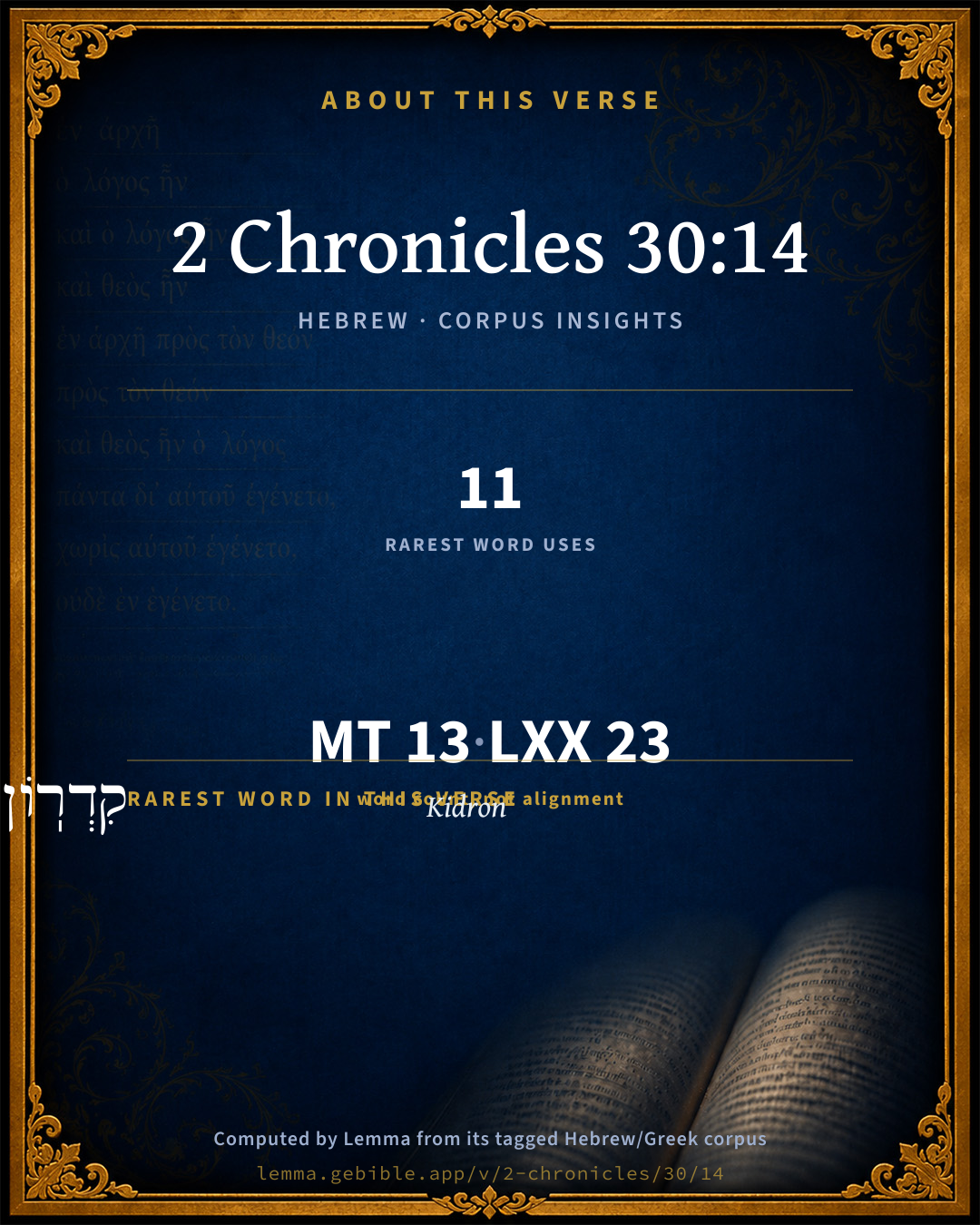
13
words
11
distinct lemmas
Historical
section

Notable vocabulary

The rarest word here is קִדְרֽוֹן Kidron H6939 — appearing just 11 times in the whole Hebrew Bible.

Shared distinctive vocabulary

קִדְרֽוֹן Kidron H6939 occurs in 10 verses of the Hebrew Bible. Also found in:

Grammatical profile

  • 4 verbs
  • 6 nouns
  • 3 particles

Verb forms

  • וַיָּקֻ֕מוּ Qal · Sequential Imperfect
  • וַיָּסִ֨ירוּ֙ Hiphil · Sequential Imperfect
  • הֵסִ֔ירוּ Hiphil · Perfect
  • וַיַּשְׁלִ֖יכוּ Hiphil · Sequential Imperfect

Repetition

A word recurs within this verse — often emphatic in Hebrew:

  • וַיָּסִ֨ירוּ֙ to turn aside H5493 ×2

Hebrew & Septuagint length

In English translation the verse runs 27 words from the Hebrew and 31 from the Septuagint (LXX English) — closely comparable.

A rough comparison of the two English renderings, which tokenize alike — not a word-level alignment.

Word counts can differ between the Hebrew and the Greek without any difference in meaning — e.g. the Hebrew direct-object marker אֵת has no separate Greek word, and Greek often adds the article ὁ.

In the original languages it is 13 Hebrew tokens and 23 Greek tokens — but the two are counted differently (Hebrew bundles its prefixes and suffixes into one token; the Greek is in lemma form), so that isn’t a like-for-like length.

Cross-references

10

Topical passages linked to 2 Chronicles 30:14 in the Treasury of Scripture Knowledge — connected by theme and wording, ordered by reader-vote popularity; previews shown in the World English Bible.

  • 2 Chronicles 28:24 Ahaz gathered together the vessels of the house of God, and cut in pieces the vessels of the house of God, and shut up the doors of the house of Yahweh; and he made him altars in every corner of Jerusalem.
  • 2 Samuel 15:23 All the country wept with a loud voice, and all the people passed over: the king also himself passed over the brook Kidron, and all the people passed over, toward the way of the wilderness.
  • 2 Chronicles 15:16 Also Maacah, the mother of Asa the king, he removed from being queen, because she had made an abominable image for an Asherah; and Asa cut down her image, and made dust of it, and burnt it at the brook Kidron.
  • 2 Chronicles 29:16 The priests went in to the inner part of the house of Yahweh, to cleanse it, and brought out all the uncleanness that they found in the temple of Yahweh into the court of the house of Yahweh. The Levites took it, to carry it out abroad to the brook Kidron.
  • 2 Kings 18:22 But if you tell me, We trust in Yahweh our God; isn't that he whose high places and whose altars Hezekiah has taken away, and has said to Judah and to Jerusalem, You shall worship before this altar in Jerusalem?
  • 2 Kings 23:12–13 The altars that were on the roof of the upper chamber of Ahaz, which the kings of Judah had made, and the altars which Manasseh had made in the two courts of the house of Yahweh, did the king break down, and beat [them] down from there, and cast the dust of them into the brook Kidron.
  • 2 Chronicles 34:4 They broke down the altars of the Baals in his presence; and the sun-images that were on high above them he hewed down; and the Asherim, and the engraved images, and the molten images, he broke in pieces, and made dust of them, and strewed it on the graves [of those] who had sacrificed to them.
  • 2 Chronicles 34:7 He broke down the altars, and beat the Asherim and the engraved images into powder, and hewed down all the sun-images throughout all the land of Israel, and returned to Jerusalem.
  • Isaiah 2:18–20 The idols shall utterly pass away.
  • John 18:1 When Jesus had spoken these words, he went out with his disciples over the brook Kidron, where was a garden, into which he and his disciples entered.

Cross-references courtesy of OpenBible.info (CC BY 4.0).

Hebrew and Greek witnesses Masoretic Hebrew ↔ Greek Septuagint

The same verse in the two great witnesses to the Old Testament, shown verse-for-verse.

These are two independent witnesses, not word-aligned to each other, and the Septuagint is shown in lemma (dictionary) form.

Hebrew 2 Chronicles 30:14 Masoretic · Westminster Leningrad Codex

וַיָּקֻ֕מוּ וַיָּסִ֨ירוּ֙ אֶת הַֽמִּזְבְּח֔וֹת אֲשֶׁ֖ר בִּירוּשָׁלִָ֑ם וְאֵ֤ת כָּל הַֽמְקַטְּרוֹת֙ הֵסִ֔ירוּ וַיַּשְׁלִ֖יכוּ לְנַ֥חַל קִדְרֽוֹן

They arose and took away the altars that were in Jerusalem, and all the altars for incense took they away, and cast them into the brook Kidron.

World English Bible · Public Domain

Greek LXX 2 Chronicles 30:14 Septuagint · lemma form

καί ἀναἵστημι καί κατααἱρέω ὁ θυσιαστήριον ὁ ἐν ἰερουσαλήμ καί πᾶς ἐν ὅς θυμιάω ὁ ψευδής κατασπάω καί ῥίπτω εἰς ὁ χειμάροος κεδρων

And they arose, and took away the altars that were in Jerusalem, and all on which they burnt incense to false gods they tore down and cast into the brook Kedron.

LXX2012 (modern English Septuagint) · Public Domain

Hebrew: Westminster Leningrad Codex (CC BY 4.0). Greek: Septuagint (public domain); English from LXX2012 (modern English Septuagint) (Public Domain). How the Septuagint differs from the Hebrew →

Commentary

Notes on 2 Chronicles 30:14 from classic Christian and Jewish commentators (each source and its license shown beneath its notes). The classic Christian expositions comment on the surrounding passage and are grouped to its opening verse, so a note may address several verses; the Jewish commentaries on the Tanakh (Rashi and others) are per-verse, so they appear only where the commentator wrote on this verse.

Lemma curates 59 commentaries, every one of them public domain or Creative Commons licensed, each selected and text-cleaned for this edition rather than reprinted as found. About our sources →

Trapp's Complete Commentary

John Trapp

2Ch 30:14 And they arose and took away the altars that [were] in Jerusalem, and all the altars for incense took they away, and cast [them] into the brook Kidron.

Ver. 14. And took away the altars.] With other instruments of superstition: the brazen serpent also, because it was abused by the people. See 2Ki 18:4. {See Trapp on "2Ki 18:4"}

John Trapp, A Commentary or Exposition upon All the Books of the Old and New Testament (1647–1656) — public domain. Text from a community e-Sword module.

Joseph Benson's Commentary

2Ch 30:14. They arose and took away the altars, &c. — As soon as they came to Jerusalem, they began to show their zeal against idolatry, by throwing down the altars that Ahaz had erected in high places, either for sacrifice or burning incense, which were very many, (2Ch 28:24,) stamping them to powder, and then casting them into the brook Kidron. Thus, before they kept the feast, they purged out the old leaven.

Joseph Benson's Commentary on the Old and New Testaments (1811–1818) — public domain. Text from a community e-Sword module.

Tyndale Open Study Notes

Tyndale Open Resources

30:14 Several challenges faced Hezekiah before Passover could be observed. Although the Temple had been purified, the city was not pure. The first task of the assembled multitude was to remove all pagan altars, which they disposed of in the Kidron Valley, where they could be burned.

Tyndale Open Study Notes — © Tyndale Open Resources, licensed CC BY-SA 4.0. Text via the HelloAO Bible API.

Geneva Bible (1599)

Geneva Bible translators

Which declareth that we must put away those things wherewith God is offended, before we can serve him aright.

Geneva Bible (1599) marginal notes — public domain. Text via Bolls.life.

Jamieson, Fausset & Brown

Robert Jamieson, A. R. Fausset & David Brown

THE ASSEMBLY DESTROYS THE ALTARS OF IDOLATRY. (Ch2 30:13-27)

they arose and took away the altars that were in Jerusalem--As a necessary preparation for the right observance of the approaching solemnity, the removal of the altars, which Ahaz had erected in the city, was resolved upon (Ch2 28:24); for, as the people of God, the Hebrews were bound to extirpate all traces of idolatry; and it was a happy sign and pledge of the influence of the Spirit pervading the minds of the people when they voluntarily undertook this important preliminary work.

Jamieson, Fausset & Brown — Commentary Critical and Explanatory on the Whole Bible (1871) — public domain (CC PDM 1.0). Text via the HelloAO Bible API.

Ellicott's Commentary for English Readers

(14) Took away the altars.—The altars of burnt offering erected by Ahaz “in every corner” of the city (2Ch_28:24).

Altars for incense.—Ha-mĕqattĕrôth—literally, the incense-burners. The term occurs here only.

Cast them into the brook Kidron.—See on 2Ch_29:16. Thus the city was purified as well as the Temple.

A Bible Commentary for English Readers, edited by Charles John Ellicott (1878–1897) — public domain. Text from a community e-Sword module.

The Cambridge Bible for Schools and Colleges

gen. ed. J. J. S. Perowne

14. the altars] Cp. 2Ch_28:24.

altars for incense] R.V. mg. vessels for incense.

The Cambridge Bible for Schools and Colleges (gen. ed. J. J. S. Perowne; Cambridge University Press, 1878–1918) — public domain. Text from a community e-Sword module.

John Gill's Exposition

Then they killed the passover on the fourteenth day of the second month,.... For though they could not keep it in the month in which it should have been kept, for the reasons before given, yet they kept it on the day of the month in which it was observed:

and the priests and the Levites were ashamed; of their negligence and backwardness to service, and to fit themselves for it, when they saw the people so forward and ready to attend to it:

and they sanctified themselves; by washing their bodies and their garments:

and brought in the burnt offerings into the house of the Lord; to be offered up on the altar of burnt offerings, to expiate their own sins, and the sins of the people; though some take these to be the passover offerings; but they were not offered until the fifteenth day, and besides were peace offerings, mentioned Ch2 30:22, rather these were the daily sacrifices.

John Gill's Exposition of the Whole Bible (1746–1763) — public domain (CC PDM 1.0). Text via the HelloAO Bible API.

Albert Barnes' Notes on the Bible

The continuance of the idolatrous altars to this time shows that Hezekiah had been more anxious to construct than to destroy, to establish the Yahweh-worship than to root out idolatry. Now, however, that the more important work was done, the temple open, and the daily service restored, attention could be turned to the secondary object of removing from the city all traces of the late apostasy.

Albert Barnes' Notes on the Bible (1834–1885) — public domain. Text from a community e-Sword/MySword module.

Haydock's Catholic Bible Commentary

Burnt, both vessels and altars. C. --- To idols, corresponding with the Sept. "the false ones," and is added by way of explanation, unless it be lost in Hebrew. The illegal (H.) altars had been set up by Achaz, C. xxviii. 24. M.

George Leo Haydock (1774–1849), Haydock's Catholic Family Bible and Commentary, 1859 edition — public domain. Excludes Psalms (Douay-Rheims chapter numbering differs from Protestant) and Deuterocanonical books (Catholic canon only).

Matthew Poole's English Annotations

The altars, to wit, of burnt-offerings; because they are distinguished from the altars of incense here following; both which were removed and destroyed, partly because all the Israelites were confined to the altars of the temple, and partly because these altars were erected to idols.

Matthew Poole's English Annotations on the Holy Bible (1683–1685) — public domain. Text from a community e-Sword/MySword module.

Whedon's Commentary on the Bible

Daniel D. Whedon

14. Took away the altars that were in Jerusalem — That is, the numerous idolatrous altars that had been erected by Ahaz. 2Ch_28:24.

Daniel D. Whedon (gen. ed.), Commentary on the Old and New Testaments (1874–1909) — public domain. Text from a community e-Sword module.

The Pulpit Commentary

Took away the altars the brook Kidron. (see 2Ch_28:24 2Ch_29:16)

The Pulpit Commentary (1880–1919), ed. H.D.M. Spence-Jones & Joseph S. Exell — public domain. Text from a community e-Sword module.

Rashi

Rabbi Shlomo Yitzchaki (Rashi)

the altars for incense a place where there were priests and Levites.

Rashi on the Tanakh — English translations: “The Judaica Press complete Tanach with Rashi, translated by A. J. Rosenberg” (CC BY 4.0); “Pentateuch with Rashi's commentary by M. Rosenbaum and A.M. Silbermann, 1929-1934” (public domain); “The Metsudah Tanach series, Lakewood, N.J” (CC BY 4.0); and “The Book of Joshua, Metsudah Publications, 1997” (CC BY 4.0). Text via Sefaria.

Lesson kit

Teaching starters — assembled from the data on this page, not authored interpretation. Every prompt links to the verse data it draws on. Edit before teaching.

2 Chronicles, in the Historical, opens this verse with 13 words (11 distinct Hebrew lemmas). Its most distinctive word is Qidrôwn (“Kidron”). A historical commentator’s framing appears above. Read the whole chapter for the surrounding context.

Discussion questions

  1. How does “Kidron” (Qidrôwn) shape what this verse is saying?
  2. 2 Samuel 15:23 shares the word «Kidron» with this verse. How do the two illuminate each other?
  3. “to turn aside” occurs 2× in this one verse. What is the effect of the repetition?
  4. These translations render this verse differently; the difference is in the English rendering, not the original. What questions does that raise?
  5. The verb «וַיָּקֻ֕מוּ» is Qal Sequential Imperfect. How does its form color the action?
  6. Reading how Trapp's Complete Commentary and Joseph Benson's Commentary read this verse, where do the two commentators agree and where do they part?

Things to notice

Reading settings

Reading text

Shown beneath each verse's original-language words.

Old Testament
Old Testament edition

Read the OT as the Masoretic Hebrew (MT) or the Greek Septuagint (LXX).

English shown for the Greek Septuagint (in the Hebrew ↔ Greek comparison).

Comparing translations? Open the Compare panel on any verse page to stack up to four side by side.