
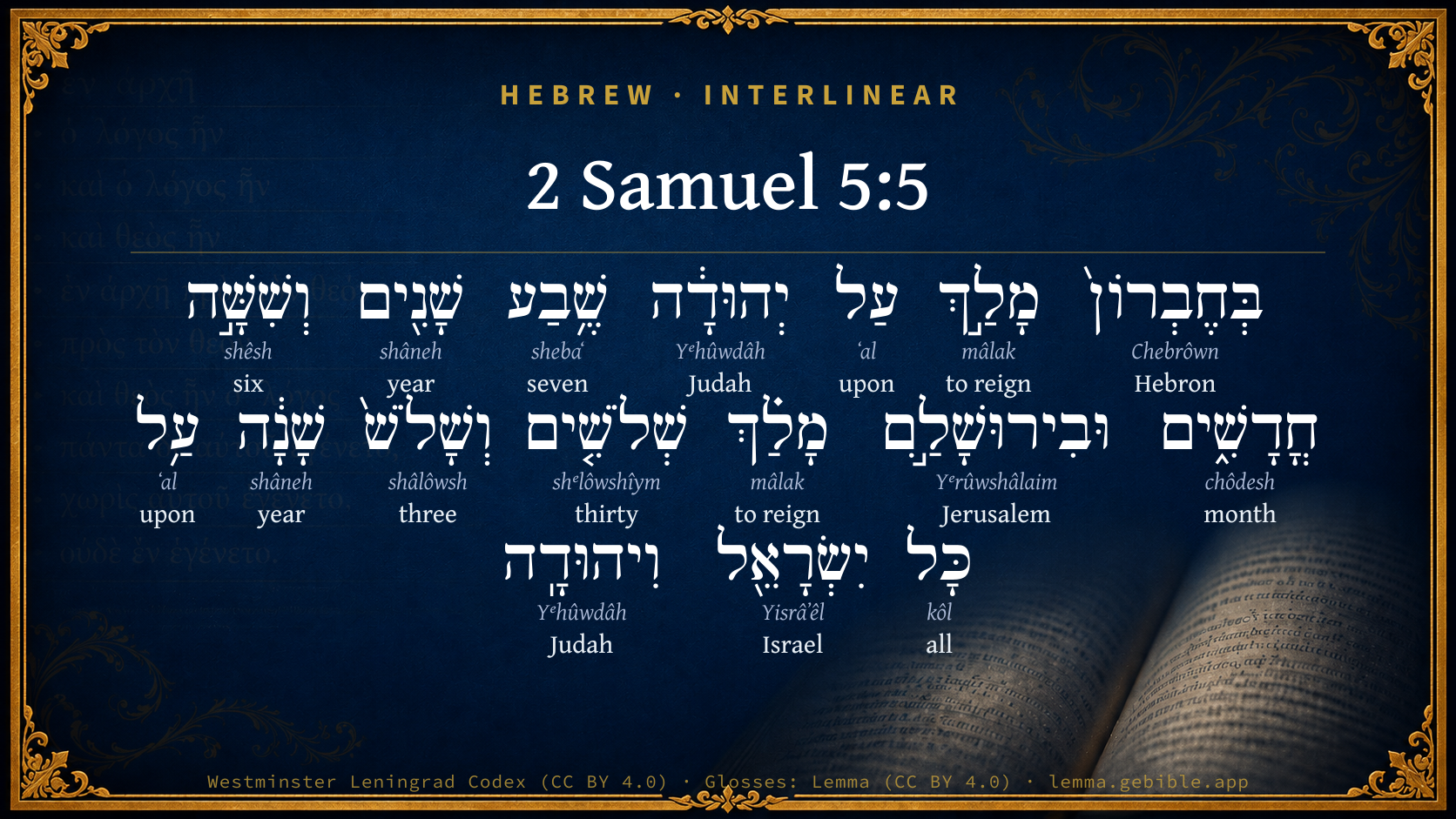
2 Samuel 5:5

Hebrew (Westminster Leningrad Codex) 2 Samuel 5:5 appears in the Hebrew Old Testament. The text above is from the Westminster Leningrad Codex. Each word links to its Strong’s number, a concise gloss, and parsing drawn from the Open Scriptures Hebrew Bible morphology. Click any word for its full Brown-Driver-Briggs (BDB) entry.
Download image
Cite this verse

2 Samuel 5:5 (World English Bible). Public Domain. Lemma interlinear Bible study tool, https://lemma.gebible.app/v/2-samuel/5/5.

Show BibTeX & RIS
BibTeX
RIS
English Translation
In Hebron he reigned over Judah seven years and six months; and in Jerusalem he reigned thirty-three years over all Israel and Judah.
World English Bible · Public Domain
Download a study sheet

One document with this verse’s original text, its word-by-word gloss line, the meaning frame, cross-references with their text, attributed commentary, and full source and license credits — printable, and it pastes into notes with its structure intact.

This verse Autodidact and up

Study sheet (.html) Plain text (.txt)

A passage Seminary Student

Up to 50 verses in one chapter. A passage sheet keeps up to 6 commentary sources and 12 cross-references per verse, in the order this page ranks them, and says so on the sheet whenever that leaves anything out. Ask for a single verse and you get the Autodidact verse sheet above.

Everything on this page stays free to read, with no account — the sheet is a download of what is already on screen, not access to it.

Want to remove ads? Support Godless Engineer
Compare translations 3

The same verse in 3 English versions, stacked beneath the original-language interlinear above. Click any original word for its lexicon entry.

Each is an independent rendering of the whole verse — the interlinear is not word-aligned to these translations.

Highlighted words mark where these versions differ — a whole-verse word diff, not a word-by-word alignment.

  • World English Bible Public Domain
    In Hebron he reigned over Judah seven years and six months; and in Jerusalem he reigned thirty-three years over all Israel and Judah.
  • King James Version Public Domain
    In Hebron he reigned over Judah seven years and six months: and in Jerusalem he reigned thirty and three years over all Israel and Judah.
  • unfoldingWord Literal Text CC BY-SA 4.0
    In Hebron, he reigned over Judah seven years and six months. And in Jerusalem, he reigned 33 years over all of Israel and Judah.

unfoldingWord Literal Text — © unfoldingWord, licensed CC BY-SA 4.0. Word-aligned USFM3 via Door43 (git.door43.org/unfoldingWord/en_ult).

Versions to compare (up to 4)

3 of 4 selected

Show all 18 translations

Every available English version of this verse, each an independent rendering of the whole verse.

  • World English Bible Public Domain
    In Hebron he reigned over Judah seven years and six months; and in Jerusalem he reigned thirty-three years over all Israel and Judah.
  • Berean Standard Bible Public Domain
    In Hebron he reigned over Judah seven years and six months, and in Jerusalem he reigned thirty-three years over all Israel and Judah.
  • Majority Standard Bible Public Domain
    In Hebron he reigned over Judah seven years and six months, and in Jerusalem he reigned thirty-three years over all Israel and Judah.
  • King James Version Public Domain
    In Hebron he reigned over Judah seven years and six months: and in Jerusalem he reigned thirty and three years over all Israel and Judah.
  • American Standard Version (1901) Public Domain
    In Hebron he reigned over Judah seven years and six months; and in Jerusalem he reigned thirty and three years over all Israel and Judah.
  • Revised Version (1885) Public Domain
    In Hebron he reigned over Judah seven years and six mouths: and in Jerusalem he reigned thirty and three years over all Israel and Judah.
  • Geneva Bible (1599) Public Domain
    In Hebron hee reigned ouer Iudah seuen yeere, and sixe moneths: and in Ierusalem hee reigned thirtie and three yeeres ouer all Israel and Iudah.
  • Douay-Rheims (1899) Public Domain
    David was thirty years old when he began to reign, and he reigned forty years.
  • Young's Literal Translation Public Domain
    in Hebron he reigned over Judah seven years and six months, and in Jerusalem he reigned thirty and three years, over all Israel and Judah.
  • Literal Standard Version CC BY-SA 4.0
    he reigned over Judah in Hebron [for] seven years and six months, and in Jerusalem he reigned [for] thirty-three years, over all Israel and Judah.
  • Unlocked Literal Bible CC BY-SA 4.0
    In Hebron he reigned over Judah seven years and six months, and in Jerusalem he reigned thirty-three years over all Israel and Judah.
  • unfoldingWord Literal Text CC BY-SA 4.0
    In Hebron, he reigned over Judah seven years and six months. And in Jerusalem, he reigned 33 years over all of Israel and Judah.
  • Darby Bible Public Domain
    In Hebron he reigned over Judah seven years and six months; and in Jerusalem he reigned thirty-three years over all Israel and Judah.
  • World Messianic Bible Public Domain
    In Hebron he reigned over Judah seven years and six months, and in Jerusalem he reigned thirty-three years over all Israel and Judah.
  • Webster's Bible Public Domain
    In Hebron he reigned over Judah seven years and six months: and in Jerusalem he reigned thirty and three years over all Israel and Judah.
  • Free Bible Version CC BY-SA 4.0
    He reigned over Judah seven years and six months from Hebron, and he reigned over all of Israel and Judah for thirty-three years from Jerusalem.
  • Bible in Basic English Public Domain
    Ruling over Judah in Hebron for seven years and six months, and in Jerusalem, over all Israel and Judah, for thirty-three years.
  • JPS Tanakh (1917) Public Domain
    In Hebron he reigned over Judah seven years and six months; and in Jerusalem he reigned thirty and three years over all Israel and Judah.

Literal Standard Version (2020), Covenant Press — licensed CC BY-SA 4.0. Text via the HelloAO Bible API (eBible.org). Unlocked Literal Bible (unfoldingWord) — licensed CC BY-SA 4.0. Text via the HelloAO Bible API (eBible.org). unfoldingWord Literal Text — © unfoldingWord, licensed CC BY-SA 4.0. Word-aligned USFM3 via Door43 (git.door43.org/unfoldingWord/en_ult). Free Bible Version, Dr. Jonathan Gallagher — licensed CC BY-SA 4.0. Text via the HelloAO Bible API (eBible.org).

Word by word

More ways to search: Search by grammar → Find every occurrence → Compare this word →

Practice this passage: Drill this verse → Learn its vocabulary →

בְּחֶבְרוֹן֙
Chebrôwn
H2275
“in/at · Hebron”
Preposition + Noun, Proper
Part of Speech
Preposition + Noun
Type
Proper
Full BDB Definition

Origin: from H2267

TWOT: 598i

Hebron = "association" - a city in south Judah approx 20 south of Jerusalem and approx 20 miles (30 kilometers) north of Beersheba and near where Abraham built an altar (noun proper locative) - the 3rd son of Kohath and grandson of Levi (noun proper masculine) - a descendant of Caleb (noun proper masculine)
  1. מָלַ֣ךְ mâlak H4427 “to reign” Verb, Qal, Perfect, 3rd Person, Masculine, Singular
  2. עַל ʻal H5921 “upon” Preposition
  3. יְהוּדָ֔ה Yᵉhûwdâh H3063 “Judah” Noun, Proper
  4. שֶׁ֥בַע shebaʻ H7651 “seven” Adjective, Cardinal number, Feminine, Singular, Absolute
  5. שָׁנִ֖ים shâneh H8141 “years” Noun, Common, Feminine, Plural, Absolute
  6. וְשִׁשָּׁ֣ה shêsh H8337 “and · six” Conjunction + Adjective, Cardinal number, Masculine, Singular, Absolute
  7. חֳדָשִׁ֑ים chôdesh H2320 “months” Noun, Common, Masculine, Plural, Absolute
  8. וּבִירוּשָׁלִַ֣ם Yᵉrûwshâlaim H3389 “and · in/at · Jerusalem” Conjunction + Preposition + Noun, Proper
  9. מָלַ֗ךְ mâlak H4427 “to reign” Verb, Qal, Perfect, 3rd Person, Masculine, Singular
  10. שְׁלֹשִׁ֤ים shᵉlôwshîym H7970 “thirty” Adjective, Cardinal number, Both, Plural, Absolute
  11. וְשָׁלֹשׁ֙ shâlôwsh H7969 “and · three” Conjunction + Adjective, Cardinal number, Feminine, Singular, Absolute
  12. שָׁנָ֔ה shâneh H8141 “year” Noun, Common, Feminine, Singular, Absolute
  13. עַ֥ל ʻal H5921 “upon” Preposition
  14. כָּל kôl H3605 “all of” Noun, Common, Masculine, Singular, Construct
  15. יִשְׂרָאֵ֖ל Yisrâʼêl H3478 “Israel” Noun, Proper
  16. וִיהוּדָֽה Yᵉhûwdâh H3063 “and · Judah” Conjunction + Noun, Proper

About this verse

These counts appear in no published source. They are computed here, from the morphology-tagged text and Lemma’s own curated glosses. What Lemma adds →

17
words
13
distinct lemmas
Historical
section

Grammatical profile

  • 2 verbs
  • 9 nouns
  • 4 adjectives
  • 2 prepositions

Verb forms

  • מָלַ֣ךְ Qal · Perfect
  • מָלַ֗ךְ Qal · Perfect

Repetition

Words recur within this verse — often emphatic in Hebrew:

  • מָלַ֣ךְ to reign H4427 ×2
  • עַל upon H5921 ×2
  • יְהוּדָ֔ה Judah H3063 ×2
  • שָׁנִ֖ים year H8141 ×2

Hebrew & Septuagint length

In English translation the verse runs 23 words from the Hebrew and 23 from the Septuagint (LXX English) — the same length.

A rough comparison of the two English renderings, which tokenize alike — not a word-level alignment.

Word counts can differ between the Hebrew and the Greek without any difference in meaning — e.g. the Hebrew direct-object marker אֵת has no separate Greek word, and Greek often adds the article ὁ.

In the original languages it is 17 Hebrew tokens and 23 Greek tokens — but the two are counted differently (Hebrew bundles its prefixes and suffixes into one token; the Greek is in lemma form), so that isn’t a like-for-like length.

Cross-references

3

Topical passages linked to 2 Samuel 5:5 in the Treasury of Scripture Knowledge — connected by theme and wording, ordered by reader-vote popularity; previews shown in the World English Bible.

  • 2 Samuel 2:11 The time that David was king in Hebron over the house of Judah was seven years and six months.
  • 1 Chronicles 3:4 six were born to him in Hebron; and there he reigned seven years and six months. In Jerusalem he reigned thirty-three years;
  • 1 Kings 2:11 The days that David reigned over Israel were forty years; seven years reigned he in Hebron, and thirty-three years reigned he in Jerusalem.

Cross-references courtesy of OpenBible.info (CC BY 4.0).

Hebrew and Greek witnesses Masoretic Hebrew ↔ Greek Septuagint

The same verse in the two great witnesses to the Old Testament, shown verse-for-verse.

These are two independent witnesses, not word-aligned to each other, and the Septuagint is shown in lemma (dictionary) form.

Hebrew 2 Samuel 5:5 Masoretic · Westminster Leningrad Codex

בְּחֶבְרוֹן֙ מָלַ֣ךְ עַל יְהוּדָ֔ה שֶׁ֥בַע שָׁנִ֖ים וְשִׁשָּׁ֣ה חֳדָשִׁ֑ים וּבִירוּשָׁלִַ֣ם מָלַ֗ךְ שְׁלֹשִׁ֤ים וְשָׁלֹשׁ֙ שָׁנָ֔ה עַ֥ל כָּל יִשְׂרָאֵ֖ל וִיהוּדָֽה

In Hebron he reigned over Judah seven years and six months; and in Jerusalem he reigned thirty-three years over all Israel and Judah.

World English Bible · Public Domain

Greek LXX 2 Samuel 5:5 Septuagint · lemma form

ἑπτά ἔτος καί ἕξ μήν βασιλεύω ἐν χεβρων ἐπί ὁ ἰούδας καί τριάκοντα τρεῖς ἔτος βασιλεύω ἐπί πᾶς ἰσραήλ καί ἰούδας ἐν ἰερουσαλήμ

Seven years and six months he reigned in Chebron over Juda, and thirty-three years he reigned over all Israel and Juda in Jerusalem.

LXX2012 (modern English Septuagint) · Public Domain

Hebrew: Westminster Leningrad Codex (CC BY 4.0). Greek: Septuagint (public domain); English from LXX2012 (modern English Septuagint) (Public Domain). How the Septuagint differs from the Hebrew →

Targum (Aramaic paraphrase)

1

The Targum is the ancient Jewish Aramaic paraphrase of the Hebrew Scriptures — an interpretive translation, not the Hebrew text itself. Onkelos (literal) and Pseudo-Jonathan (expansive) render the Torah, and Jonathan the Prophets. Coverage is partial: where no permissively-licensed English translation exists for a verse, only the Aramaic is shown. This is verse-level text, not a word-by-word alignment to the Hebrew.

  1. Targum Jonathan Prophets (Joshua–Malachi)
    בְּחֶבְרוֹן מְלַךְ עַל דְּבֵית יְהוּדָה שְׁבַע שְׁנִין וְשִׁתָּא יַרְחִין וּבִירוּשָׁלַם מְלַךְ תְּלָתִין וּתְלַת שְׁנִין עַל כָּל יִשְׂרָאֵל וִיהוּדָה:

    (no public-domain English translation for this verse)

    Targum Jonathan — Aramaic: “Mikraot Gedolot” (public domain). English: “Sefaria Community Translation” (CC0 1.0 (public-domain dedication)); “London "Chaldee Paraphrase," 1871” (public domain). Text via Sefaria.

Commentary

Notes on 2 Samuel 5:5 from classic Christian and Jewish commentators (each source and its license shown beneath its notes). The classic Christian expositions comment on the surrounding passage and are grouped to its opening verse, so a note may address several verses; the Jewish commentaries on the Tanakh (Rashi and others) are per-verse, so they appear only where the commentator wrote on this verse.

Lemma curates 59 commentaries, every one of them public domain or Creative Commons licensed, each selected and text-cleaned for this edition rather than reprinted as found. About our sources →

Trapp's Complete Commentary

John Trapp

2Sa 5:5 In Hebron he reigned over Judah seven years and six months: and in Jerusalem he reigned thirty and three years over all Israel and Judah.

Ver. 5. Seven years and six months.] These last six months are not reckoned in the whole sum for the roundness of the number: or, as some Rabbis {a} will have it, because six months David lay sick in Hebron: or, six months he fled before Absalom; and so there is no count made of them.

{a} Jerome in Tradit.

John Trapp, A Commentary or Exposition upon All the Books of the Old and New Testament (1647–1656) — public domain. Text from a community e-Sword module.

The Biblical Illustrator

Joseph S. Exell

2Sa_5:5

In Jerusalem he reigned thirty and three years.

Jerusalem, the Holy City

It was highly desirable that the capital should be accessible to the whole country, and should possess the necessary features that rendered it fit to become the heart and brain of the national life. It must be capable of being strongly fortified, so as to preserve the sacred treasures of the kingdom inviolate. All these features blended in Jerusalem, and commended it to Davids Divinely-guided judgment. In this he greatly differed from Saul, who had made his own city, Gibeah, his capital--an altogether insignificant place, and the scene of an atrocious crime, the infamy of which could not be obliterated. To have made Hebron the capital would have excited the jealousy of the rest of Israel; and Bethlehem, his birthplace, would have struck too low a keynote, None were to be compared with the site of Jerusalem, on the frontier between Judah and Benjamin, surrounded on three sides by valleys, and on the other side, the north, strongly fortified.

I. Its previous history. To the Jew there was no city like Jerusalem. It was the city of his God, situate in His holy mountain: Beautiful in elevation, the joy of the whole earth. The high hills of Bashan were represented as jealous of the lowlier hill of Zion, because God had chosen it for His abode. The mountains that stood around her seemed to symbolize the environing presence of Jehovah. The exile in his banishment opened his windows towards Jerusalem as he knelt in prayer, and wished that his right hand might forget its cunning sooner than his heart fail to prefer Jerusalem above its chief joy. The charm of the yearly pilgrimage to the sacred feasts was that the feet of the pilgrim should stand within her gates; and when at a distance from her walls and palaces, pious hearts were wont to pray that peace and prosperity might be within them for the sake of those brethren and companions who were favoured to live within her precincts. But it had not always been so. Her birth and nativity were of the land of the Canaanite. An Amorite was her father, and her mother a Hittite. In the day that she was born she was cast out as a deserted child on the open field, weltering in her blood. For a brief spell the priest-king Melchizedek reigned over her, and during his life her future glory must have been presaged; the thin spiral columns of smoke that arose from his altars, anticipating the stately worship of the Temple; his priesthood foreshadowing a long succession of priests. Thereafter a long spell of darkness befell her; and for years after the rest of the country was in occupation of Israel, Jerusalem was still held by the Jebusites. Joshua, indeed, nominally subdued the city in his first occupation of the land, and slew its king; but his tenure of it was very brief and slight, and the city speedily relapsed under the sway of its ancient occupants.

II. The capture. Making a levy of all Israel, David went up to Jerusalem. For the first time after seven years, he took the lead of his army in person. Passive, when he was called to wait for the gift of God, he was intensely active and energetic when he discerned the Divine summons. Davids first act was to extend the fortifications; He built round about from Millo and inward; whilst Joab seems to have repaired and beautified the buildings in the city itself. This first success laid the foundation of Davids greatness. He waxed greater and greater; for the Lord, the God of Hosts, was with him. Indeed, neighbouring nations appear to have become impressed with the growing strength of his kindom, and hastened to seek his alliance. (1Ch_11:7-9; 2Sa_5:11).

III. A fair dawn. It has been suggested that we owe Psa_101:1-8 to this hour in Davids life. He finds himself suddenly called to conduct the internal administration of a great nation, that had, so to speak, been born in a day, and was beginning to throb with the intensity of a long-suspended animation. The new needs were demanding new expression. Departments of law and justice, of finance, and of military organization, were rapidly being called into existence, and becoming localized at the capital. (F. B. Meyer, B. A.)

The Biblical Illustrator, edited by Joseph S. Exell (c. 1880s–1900s) — public domain. Text from a community e-Sword module.

Ellicott's Commentary for English Readers

(5) Seven years and six months.—The six months is also mentioned in 2Sa_2:11; 1Ch_3:4, but, as being only the fraction of a year, is generally omitted in the summary of the length of his reign, as in 2Sa_5:4; 1Ch_29:27. It was the habit of the sacred historians either to omit such fractions or else to count them as whole years, thus introducing a certain element of indefiniteness into the chronology, which is very marked in the parallel narratives of the kings of Israel and of Judah.

A Bible Commentary for English Readers, edited by Charles John Ellicott (1878–1897) — public domain. Text from a community e-Sword module.

The Cambridge Bible for Schools and Colleges

gen. ed. J. J. S. Perowne

6–10. The Capture of Jebus

= 1Ch_11:4-9

6. to Jerusalem, &c.] The Chronicler paraphrases the text thus, “to Jerusalem, which is Jebus, where the Jebusites were, the inhabitants of the land.” Writing after the Captivity, he felt it necessary to explain how the Jebusites came to be dwelling in Jerusalem by a reference to its ancient name of Jebus.

It is not a little remarkable that the metropolis of the Jewish monarchy, the most sacred city in the world, does not take its place in the history of the nation until a comparatively late period.

As the capital of the important Canaanite tribe of the Jebusites, it bore the name of Jebus. It was assigned to Benjamin (Jos_18:28), but, lying on the border, was first attacked by Judah (Jdg_1:8), and afterwards by Benjamin (Jdg_1:21). The citadel was either never taken, or soon recovered, for the Jebusites retained joint possession of the city along with the children of Judah and Benjamin through the period of the Judges and down to this time (Jos_15:63; Jdg_1:21).

Political, civil, and military considerations pointed to Jerusalem as the most suitable capital for the united kingdom.

(a) Its position within the territory of Benjamin yet close upon the borders of Judah (or, as some think, and as may be indicated by the passages quoted above, partly in one tribe, partly in the other), was excellently adapted for binding together the two royal tribes, and conciliating the good-will of Benjamin, without alienating Judah.

(b) Its situation was virtually central, not only with regard to these two great tribes, but for the whole land. “It was on the ridge of the backbone of hills, which extend through the whole country from the Desert to the plain of Esdraelon. Every traveller who has trod the central route of Palestine from north to south, must have passed through the table-land of Jerusalem.” Stanley’s Sinai and Pal. p. 176.

(c) As a military post it was unrivalled. It stood on a rocky plateau surrounded on three sides by deep ravines forming a natural fortress of almost impregnable strength.

On the topography of Jerusalem see Additional Note VI. p. 239.

Except thou take away the blind and the lame, thou shalt not come in hither] Render, Thou shalt not come in hither, but the blind and the lame would repel thee; as much as to say, David, &c. So confident were the Jebusites in the strength of their fortress, that they boasted that a garrison of blind and lame men would be sufficient to defend it.

This boast is omitted in Chron., probably as being obscure, and not bearing directly upon the facts of the narrative.

The Cambridge Bible for Schools and Colleges (gen. ed. J. J. S. Perowne; Cambridge University Press, 1878–1918) — public domain. Text from a community e-Sword module.

John Gill's Exposition

In Hebron he reigned over Judah seven years and six months,.... So long the kingdom of Israel continued in the house of Saul after his death; and by this it appears that David was near thirty eight years of age when the elders of Israel came and made him their king:

and in Jerusalem he reigned thirty and three years over all Israel and Judah; which in all made forty years and six months, see Kg1 2:11; upon his being made king over all the tribes, as soon as he had taken the strong hold of Zion, which he immediately attacked, as follows, he removed the seat of his kingdom from Hebron to Jerusalem.

John Gill's Exposition of the Whole Bible (1746–1763) — public domain (CC PDM 1.0). Text via the HelloAO Bible API.

Lesson kit

Teaching starters — assembled from the data on this page, not authored interpretation. Every prompt links to the verse data it draws on. Edit before teaching.

2 Samuel, in the Historical, opens this verse with 17 words (13 distinct Hebrew lemmas). Its most distinctive word is Chebrôwn (“Hebron”). A historical commentator’s framing appears above. Read the whole chapter for the surrounding context.

Discussion questions

  1. How does “Hebron” (Chebrôwn) shape what this verse is saying?
  2. How does 2 Samuel 2:11, which shares this passage’s theme, read alongside this verse?
  3. What does the repetition of “to reign” (2× in this one verse) do in this verse?
  4. The translations on this page render this verse differently — a whole-verse word diff, not a word-by-word alignment. What might account for the different wordings?
  5. «מָלַ֣ךְ» is a Qal Perfect verb. How does that grammatical form shape the action described?
  6. Compare how Trapp's Complete Commentary and The Biblical Illustrator read this verse. Where do they agree or differ?

Things to notice

Reading settings

Reading text

Shown beneath each verse's original-language words.

Old Testament
Old Testament edition

Read the OT as the Masoretic Hebrew (MT) or the Greek Septuagint (LXX).

English shown for the Greek Septuagint (in the Hebrew ↔ Greek comparison).

Comparing translations? Open the Compare panel on any verse page to stack up to four side by side.