
Ecclesiastes 1:12

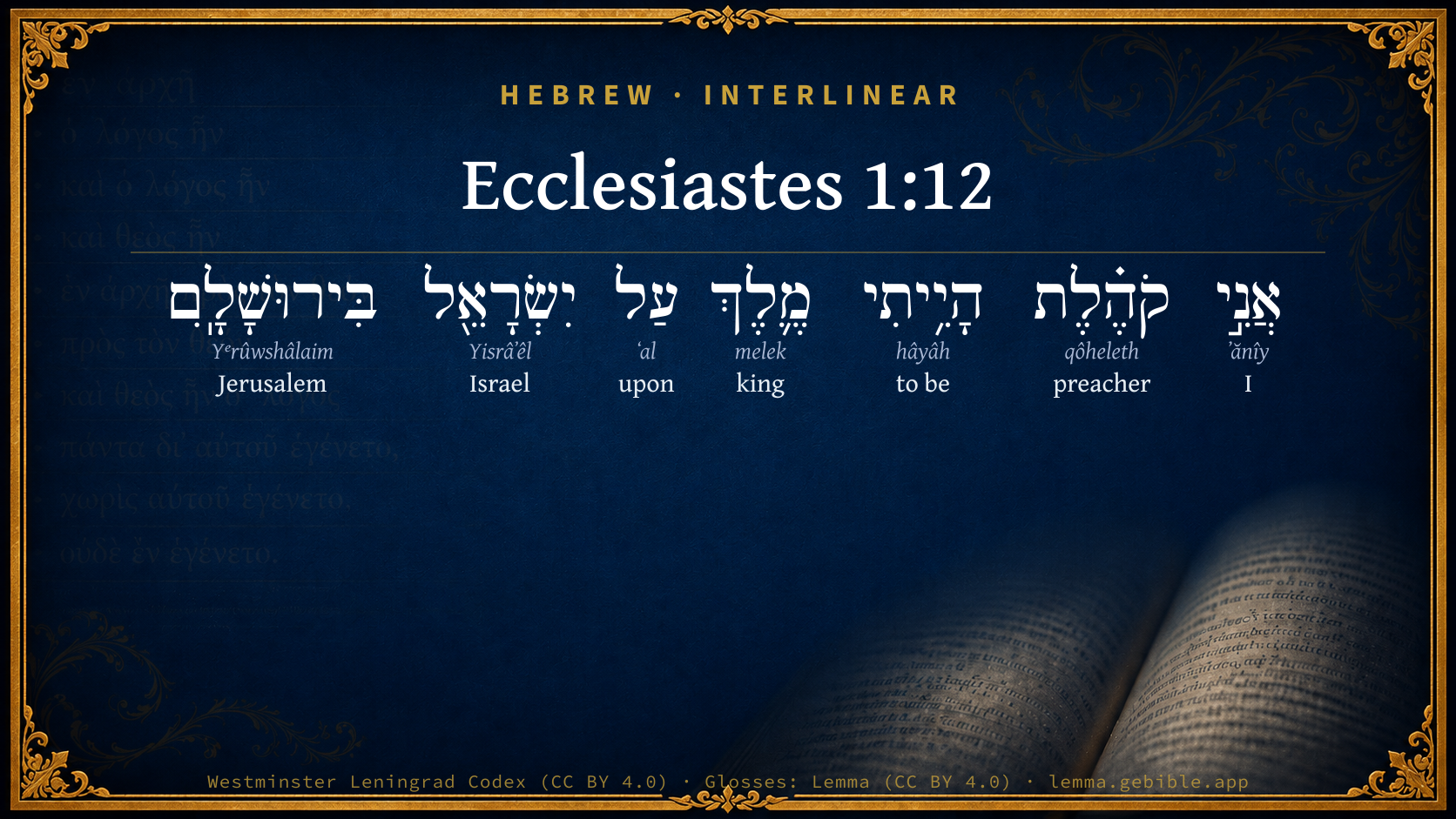
Hebrew (Westminster Leningrad Codex) Ecclesiastes 1:12 appears in the Hebrew Old Testament. The text above is from the Westminster Leningrad Codex. Each word links to its Strong’s number, a concise gloss, and parsing drawn from the Open Scriptures Hebrew Bible morphology. Click any word for its full Brown-Driver-Briggs (BDB) entry.
Download image
Cite this verse

Ecclesiastes 1:12 (World English Bible). Public Domain. Lemma interlinear Bible study tool, https://lemma.gebible.app/v/ecclesiastes/1/12.

Show BibTeX & RIS
BibTeX
RIS
English Translation
I, the Preacher, was king over Israel in Jerusalem.
World English Bible · Public Domain
Download a study sheet

One document with this verse’s original text, its word-by-word gloss line, the meaning frame, cross-references with their text, attributed commentary, and full source and license credits — printable, and it pastes into notes with its structure intact.

This verse Autodidact and up

Study sheet (.html) Plain text (.txt)

A passage Seminary Student

Up to 50 verses in one chapter. A passage sheet keeps up to 6 commentary sources and 12 cross-references per verse, in the order this page ranks them, and says so on the sheet whenever that leaves anything out. Ask for a single verse and you get the Autodidact verse sheet above.

Everything on this page stays free to read, with no account — the sheet is a download of what is already on screen, not access to it.

Want to remove ads? Support Godless Engineer
Compare translations 3

The same verse in 3 English versions, stacked beneath the original-language interlinear above. Click any original word for its lexicon entry.

Each is an independent rendering of the whole verse — the interlinear is not word-aligned to these translations.

Highlighted words mark where these versions differ — a whole-verse word diff, not a word-by-word alignment.

  • World English Bible Public Domain
    I, the Preacher, was king over Israel in Jerusalem.
  • King James Version Public Domain
    I the Preacher was king over Israel in Jerusalem.
  • unfoldingWord Literal Text CC BY-SA 4.0
    I, Qoheleth, was king over Israel in Jerusalem.

unfoldingWord Literal Text — © unfoldingWord, licensed CC BY-SA 4.0. Word-aligned USFM3 via Door43 (git.door43.org/unfoldingWord/en_ult).

Versions to compare (up to 4)

3 of 4 selected

Show all 18 translations

Every available English version of this verse, each an independent rendering of the whole verse.

  • World English Bible Public Domain
    I, the Preacher, was king over Israel in Jerusalem.
  • Berean Standard Bible Public Domain
    I, the Teacher, was king over Israel in Jerusalem.
  • Majority Standard Bible Public Domain
    I, the Teacher, was king over Israel in Jerusalem.
  • King James Version Public Domain
    I the Preacher was king over Israel in Jerusalem.
  • American Standard Version (1901) Public Domain
    I the Preacher was king over Israel in Jerusalem.
  • Revised Version (1885) Public Domain
    I the Preacher was king over Israel in Jerusalem.
  • Geneva Bible (1599) Public Domain
    I the Preacher haue bene King ouer Israel in Ierusalem:
  • Douay-Rheims (1899) Public Domain
    I Ecclesiastes was king over Israel in Jerusalem,
  • Young's Literal Translation Public Domain
    I, a preacher, have been king over Israel in Jerusalem.
  • Literal Standard Version CC BY-SA 4.0
    I, a preacher, have been king over Israel in Jerusalem.
  • Unlocked Literal Bible CC BY-SA 4.0
    I am the Teacher, and I have been king over Israel in Jerusalem.
  • unfoldingWord Literal Text CC BY-SA 4.0
    I, Qoheleth, was king over Israel in Jerusalem.
  • Darby Bible Public Domain
    I, the Preacher, was king over Israel in Jerusalem.
  • World Messianic Bible Public Domain
    I, Kohelet, was king over Israel in Jerusalem.
  • Webster's Bible Public Domain
    I the preacher was king over Israel in Jerusalem.
  • Free Bible Version CC BY-SA 4.0
    I am the Teacher, and I was king over Israel, reigning from Jerusalem.
  • Bible in Basic English Public Domain
    I, the Preacher, was king over Israel in Jerusalem.
  • JPS Tanakh (1917) Public Domain
    I Koheleth have been king over Israel in Jerusalem.

Literal Standard Version (2020), Covenant Press — licensed CC BY-SA 4.0. Text via the HelloAO Bible API (eBible.org). Unlocked Literal Bible (unfoldingWord) — licensed CC BY-SA 4.0. Text via the HelloAO Bible API (eBible.org). unfoldingWord Literal Text — © unfoldingWord, licensed CC BY-SA 4.0. Word-aligned USFM3 via Door43 (git.door43.org/unfoldingWord/en_ult). Free Bible Version, Dr. Jonathan Gallagher — licensed CC BY-SA 4.0. Text via the HelloAO Bible API (eBible.org).

Word by word

More ways to search: Search by grammar → Find every occurrence → Compare this word →

Practice this passage: Drill this verse → Learn its vocabulary →

About this verse

These counts appear in no published source. They are computed here, from the morphology-tagged text and Lemma’s own curated glosses. What Lemma adds →

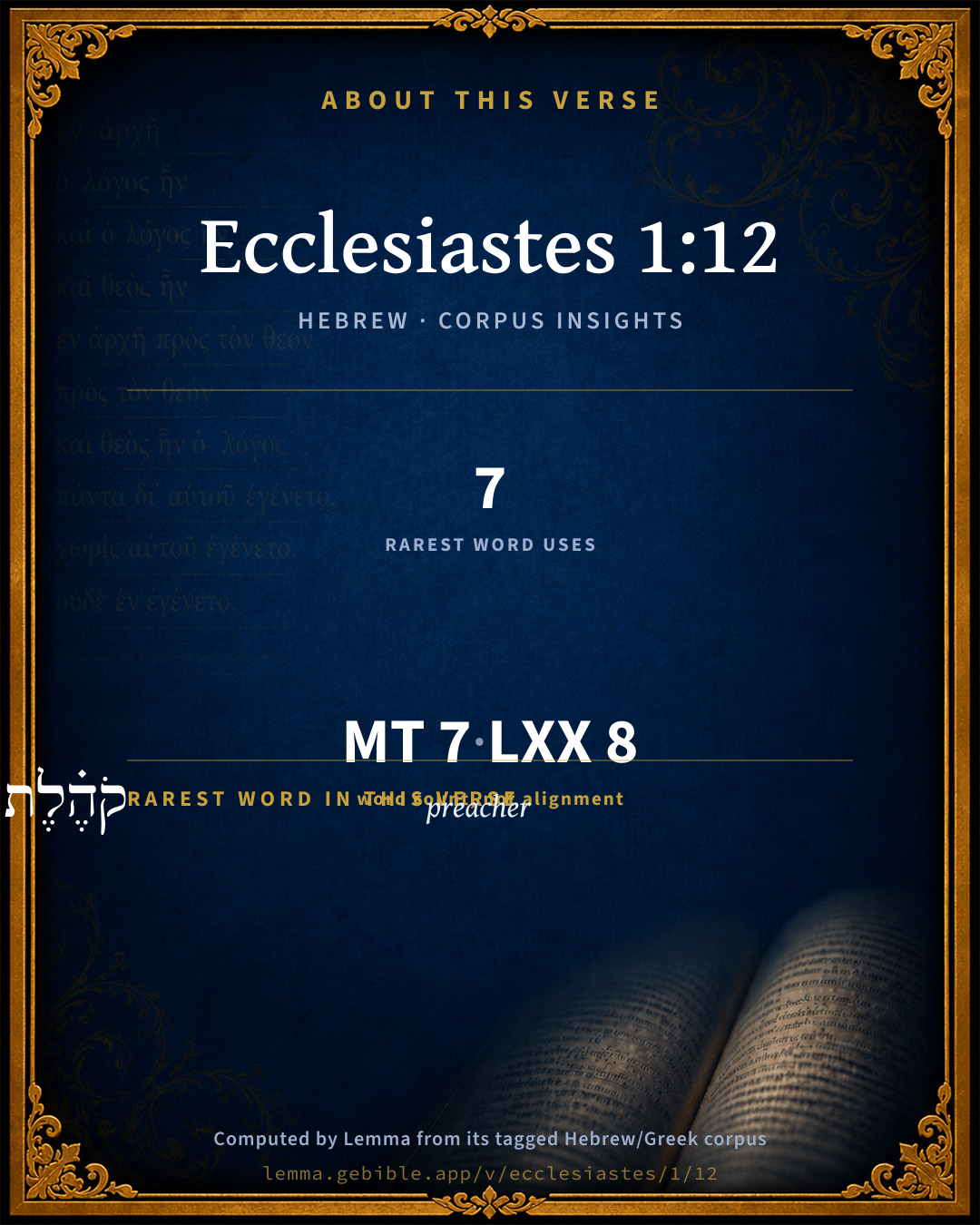
7
words
7
distinct lemmas
Wisdom
section

Notable vocabulary

The rarest word here is קֹהֶ֗לֶת preacher H6953 — appearing just 7 times in the whole Hebrew Bible.

Shared distinctive vocabulary

קֹהֶ֗לֶת preacher H6953 occurs in 7 verses of the Hebrew Bible. Also found in:

Grammatical profile

  • 1 verb
  • 4 nouns
  • 1 pronoun
  • 1 preposition

Verb forms

  • הָיִ֥יתִי Qal · Perfect

Hebrew & Septuagint length

In English translation the verse runs 9 words from the Hebrew and 9 from the Septuagint (LXX English) — the same length.

A rough comparison of the two English renderings, which tokenize alike — not a word-level alignment.

Word counts can differ between the Hebrew and the Greek without any difference in meaning — e.g. the Hebrew direct-object marker אֵת has no separate Greek word, and Greek often adds the article ὁ.

In the original languages it is 7 Hebrew tokens and 8 Greek tokens — but the two are counted differently (Hebrew bundles its prefixes and suffixes into one token; the Greek is in lemma form), so that isn’t a like-for-like length.

Cross-references

2

Topical passages linked to Ecclesiastes 1:12 in the Treasury of Scripture Knowledge — connected by theme and wording, ordered by reader-vote popularity; previews shown in the World English Bible.

Cross-references courtesy of OpenBible.info (CC BY 4.0).

Hebrew and Greek witnesses Masoretic Hebrew ↔ Greek Septuagint

The same verse in the two great witnesses to the Old Testament, shown verse-for-verse.

These are two independent witnesses, not word-aligned to each other, and the Septuagint is shown in lemma (dictionary) form.

Hebrew Ecclesiastes 1:12 Masoretic · Westminster Leningrad Codex

אֲנִ֣י קֹהֶ֗לֶת הָיִ֥יתִי מֶ֛לֶךְ עַל יִשְׂרָאֵ֖ל בִּירוּשָׁלִָֽם

I, the Preacher, was king over Israel in Jerusalem.

World English Bible · Public Domain

Greek LXX Ecclesiastes 1:12 Septuagint · lemma form

ἐγώ ἐκκλησιαστής γίγνομαι βασιλεύς ἐπί ἰσραήλ ἐν ἰερουσαλήμ

I the Preacher was king over Israel in Jerusalem.

LXX2012 (modern English Septuagint) · Public Domain

On this verse, Keil & Delitzsch discusses the Septuagint’s reading. Read the note in Commentary ↓

Hebrew: Westminster Leningrad Codex (CC BY 4.0). Greek: Septuagint (public domain); English from LXX2012 (modern English Septuagint) (Public Domain). How the Septuagint differs from the Hebrew →

Commentary

Notes on Ecclesiastes 1:12 from classic Christian and Jewish commentators (each source and its license shown beneath its notes). The classic Christian expositions comment on the surrounding passage and are grouped to its opening verse, so a note may address several verses; the Jewish commentaries on the Tanakh (Rashi and others) are per-verse, so they appear only where the commentator wrote on this verse.

Lemma curates 59 commentaries, every one of them public domain or Creative Commons licensed, each selected and text-cleaned for this edition rather than reprinted as found. About our sources →

Matthew Henry's Commentary

Solomon, having asserted in general that all is vanity, and having given some general proofs of it, now takes the most effectual method to evince the truth of it, 1. By his own experience; he tried them all, and found them vanity. 2. By an induction of particulars; and here he begins with that which bids fairest of all to be the happiness of a reasonable creature, and that is knowledge and learning; if this be vanity, every thing else must needs be so. Now as to this,

I. Solomon tells us here what trial he had made of it, and that with such advantages that, if true satisfaction could have been found in it, he would have found it. 1. His high station gave him an opportunity of improving himself in all parts of learning, and particularly in politics and the conduct of human affairs, Ecc 1:12. He that is the preacher of this doctrine was king over Israel, whom all their neighbours admired as a wise and understanding people, Deu 4:6. He had his royal seat in Jerusalem, which then deserved, better than Athens ever did, to be called the eye of the world. The heart of a king is unsearchable; he has reaches of his own, and a divine sentence is often in his lips. It is his honour, it is his business, to search out every matter. Solomon's great wealth and honour put him into a capacity of making his court the centre of learning and the rendezvous of learned men, of furnishing himself with the best of books, and either conversing or corresponding with all the wise and knowing part of mankind then in being, who made application to him to learn of him, by which he could not but improve himself; for it is in knowledge as it is in trade, all the profit is by barter and exchange; if we have that to say which will instruct others, they will have that to say which will instruct us. Some observe how slightly Solomon speaks of his dignity and honour. He does not say, I the preacher am king, but I was king, no matter what I am. He speaks of it as a thing past, because worldly honours are transitory. 2. He applied himself to the improvement of these advantages, and the opportunities he had of getting wisdom, which, though ever so great, will not make a man wise unless he give his mind to it. Solomon gave his heart to seek and search out all things to be known by wisdom, Ecc 1:13. He made it his business to acquaint himself with all the things that are done under the sun, that are done by the providence of God or by the art and prudence of man. He set himself to get all the insight he could into philosophy and mathematics, into husbandry and trade, merchandise and mechanics, into the history of former ages and the present state of other kingdoms, their laws, customs, and policies, into men's different tempers, capacities, and projects, and the methods of managing them; he set himself not only to seek, but to search, to pry into, that which is most intricate, and which requires the closes application of mind and the most vigorous and constant prosecution. Though he was a prince, he made himself a drudge to learning, was not discouraged by its knots, nor took up short of its depths. And this he did, not merely to gratify his own genius, but to qualify himself for the service of God, and his generation, and to make an experiment how far the enlargement of the knowledge would go towards the settlement and repose of the mind. 3. He made a very great progress in his studies, wonderfully improved all the parts of learning, and carried his discoveries much further than any that had been before him. He did not condemn learning, as many do, because they cannot conquer it and will not be at the pains to make themselves masters of it; no, what he aimed at he compassed; he saw all the works that were done under the sun (Ecc 1:14), works of nature in the upper and lower world, all within this vortex (to use the modern gibberish) which has the sun for its centre, works of art, the product of men's wit, in a personal or social capacity. he had as much satisfaction in the success of his searches as ever any man had; he communed with his own heart concerning his attainments in knowledge, with as much pleasure as ever any rich merchant had in taking account of his stock. He could say, "Lo, I have magnified and increased wisdom, have not only gotten more of it myself, but have done more to propagate it and bring it into reputation, than any, than all that have been before me in Jerusalem." Note, It becomes great men to be studious, and delight themselves most in intellectual pleasures. Where God gives great advantages of getting knowledge he expects improvements accordingly. It is happy with a people when their princes and noblemen study to excel others as much in wisdom and useful knowledge as they do in honour and estate; and they may do that service to the commonwealth of learning by applying themselves to the studies that are proper for them which meaner persons cannot do. Solomon must be acknowledged as competent judge of this matter, for he had not only got his head full of notions, but his heart had great experience of wisdom and knowledge, of the power and benefit of knowledge, as well as the amusement and entertainment of it; what he knew he had digested, and knew how to make use of. Wisdom entered into his heart, and so became pleasant to his soul, Pro 2:10, Pro 2:11; Pro 22:18. 4. He applied his studies especially to that part of learning which is most serviceable to the conduct of human life, and consequently is the most valuable (Ecc 1:17): "I gave my heart to know the rules and dictates of wisdom, and how I might obtain it; and to know madness and folly, how I might prevent and cure it, to know the snares and insinuations of it, that I might avoid them, and guard against them, and discover its fallacies." So industrious was Solomon to improve himself in knowledge that he gained instruction both by the wisdom of prudent men and by the madness of foolish men, by the field of the slothful, as well as of the diligent.

II. He tells us what was the result of this trial, to confirm what he had said, that all is vanity.

1. He found that his searches after knowledge were very toilsome, and a weariness not only to the flesh, but to the mind (Ecc 1:13): This sore travail, this difficulty that there is in searching after truth and finding it, God has given to the sons of men to be afflicted therewith, as a punishment for our first parents' coveting forbidden knowledge. As bread for the body, so that for the soul, must be got and eaten in the sweat of our face, whereas both would have been had without labour if Adam had not sinned.

2. He found that the more he saw of the works done under the sun the more he saw of their vanity; nay, and the sight often occasioned him vexation of spirit (Ecc 1:14): "I have seen all the works of a world full of business, have observed what the children of men are doing; and behold, whatever men think of their own works, I see all is vanity and vexation of spirit." He had before pronounced all vanity (Ecc 1:2), needless and unprofitable, and that which does us no good; here he adds, It is all vexation of spirit, troublesome and prejudicial, and that which does us hurt. It is feeding upon wind; so some read it, Hos 12:1. (1.) The works themselves which we see done are vanity and vexation to those that are employed in them. There is so much care in the contrivance of our worldly business, so much toil in the prosecution of it, and so much trouble in the disappointments we meet with in it, that we may well say, It is vexation of spirit. (2.) The sight of them is vanity and vexation of spirit to the wise observer of them. The more we see of the world the more we see to make us uneasy, and, with Heraclitus, to look upon all with weeping eyes. Solomon especially perceived that the knowledge of wisdom and folly was vexation of spirit, Ecc 1:17. It vexed him to see many that had wisdom not use it, and many that had folly not strive against it. It vexed him when he knew wisdom to see how far off it stood from the children of men, and, when he saw folly, to see how fast it was bound in their hearts.

3. He found that when he had got some knowledge he could neither gain that satisfaction to himself nor do that good to others with it which he expected, Ecc 1:15. It would not avail, (1.) To redress the many grievances of human life: "After all, I find that that which is crooked will be crooked still and cannot be made straight." Our knowledge is itself intricate and perplexed; we must go far about and fetch a great compass to come at it. Solomon thought to find out a nearer way to it, but he could not. The paths of learning are as much a labyrinth as ever they were. The minds and manners of men are crooked and perverse. Solomon thought, with his wisdom and power together, thoroughly to reform his kingdom, and make that straight which he found crooked; but he was disappointed. All the philosophy and politics in the world will not restore the corrupt nature of man to its primitive rectitude; we find the insufficiency of them both in others and in ourselves. Learning will not alter men's natural tempers, nor cure them of their sinful distempers; nor will it change the constitution of things in this world; a vale of tears it is and so it will be when all is done. (2.) To make up the many deficiencies in the comfort of human life: That which is wanting there cannot be numbered, or counted out to us from the treasures of human learning, but what is wanting will still be so. All our enjoyments here, when we have done our utmost to bring them to perfection, are still lame and defective, and it cannot be helped; as they are, so they are likely to be. That which is wanting in our knowledge is so much that it cannot be numbered. The more we know the more we see of our own ignorance. Who can understand his errors, his defects?

4. Upon the whole, therefore, he concluded that great scholars do but make themselves great mourners; for in much wisdom is much grief, Ecc 1:18. There must be a great deal of pains taken to get it, and a great deal of care not to forget it; the more we know the more we see there is to be known, and consequently we perceive with greater clearness that our work is without end, and the more we see of our former mistakes and blunders, which occasions much grief. The more we see of men's different sentiments and opinions (and it is that which a great deal of our learning is conversant about) the more at a loss we are, it may be, which is in the right. Those that increase knowledge have so much the more quick and sensible perception of the calamities of this world, and for one discovery they make that is pleasing, perhaps, they make ten that are displeasing, and so they increase sorrow. Let us not therefore be driven off from the pursuit of any useful knowledge, but put on patience to break through the sorrow of it; but let us despair of finding true happiness in this knowledge, and expect it only in the knowledge of God and the careful discharge of our duty to him. He that increases in heavenly wisdom, and in an experimental acquaintance with the principles, powers, and pleasures of the spiritual and divine life, increases joy, such as will shortly be consummated in everlasting joy.

Matthew Henry's Commentary on the Whole Bible (1708–1710) — public domain (CC PDM 1.0). Text via the HelloAO Bible API.

Trapp's Complete Commentary

John Trapp

Ecc 1:12 I the Preacher was king over Israel in Jerusalem.

Ver. 12. I, the Preacher, was king over Israel.] And so had all the helps that heart could wish, the benefit of the best books and records that men or money could bring me in, the happiness of holy conference, beside mine own plentiful experience, and therefore you may well give credit to my verdict. Mr. Foxe had a large commission under the great seal to search for all such monuments, manuscripts, registers, ledger books, as might make for his purpose in setting forth that worthy work, the ‘Acts and Monuments of the Church of England.’ And the like had Polydor Virgil for the framing of his history, though with unlike success; for he had the ill hap to write nothing well, saith one, {a} save the life of Henry VII, wherein he had reason to take a little more pains than ordinary, the book being dedicated to Henry VIII, his son. {See Trapp on "Ecc 1:1"}

{a} Peacham.

John Trapp, A Commentary or Exposition upon All the Books of the Old and New Testament (1647–1656) — public domain. Text from a community e-Sword module.

Albert Barnes' Notes on the Bible

Solomon relates his personal experience Eccl. 2; the result of which was “no profit,” and a conviction that all, even God’s gifts of earthly good to good men, in this life are subject to vanity. His trial of God’s first gift, wisdom, is recounted in Ecc 1:12-18.

Was - This tense does not imply that Solomon had ceased to be king when the word was written. See the introduction to Ecclesiastes. He begins with the time of his accession to the throne, when the gifts of wisdom and riches were especially promised to him 1Ki 3:12-13.

Albert Barnes' Notes on the Bible (1834–1885) — public domain. Text from a community e-Sword/MySword module.

Joseph Benson's Commentary

Ecc 1:12. I the Preacher was king — Having asserted the vanity of all things in the general, he now comes to prove his assertion in those particulars wherein men commonly seek, and with the greatest probability expect to find, true happiness. He begins with secular wisdom. And to show how competent a judge he was of this matter, he lays down this character, that he was the Preacher, which implies eminent knowledge; and a king, who therefore had all imaginable opportunities and advantages for the attainment of happiness, and particularly for the getting of wisdom, by consulting all sorts of books and men, by trying all manner of experiments; and no ordinary king, but king over Israel — God’s own people, a wise and a happy people, whose king he was by God’s special appointment, and furnished by God with singular wisdom for that great trust; and whose abode was in Jerusalem — Where were the house of God, and the most wise and learned of the priests attending upon it, and the seats of justice, and colleges, or assemblies of the wisest men of their nation. All these concurring in him, which rarely do in any other man, make the argument, drawn from his experience, more convincing.

Joseph Benson's Commentary on the Old and New Testaments (1811–1818) — public domain. Text from a community e-Sword module.

Keil & Delitzsch

C. F. Keil & F. Delitzsch

"Is there anything whereof it may be said: See, this is new? - it was long ago through the ages (aeons) which have been before us." The Semit. substantive verb ישׁ (Assyr. isu) has here the force of a hypothetical antecedent: supposing that there is a thing of which one might say, etc. The זה, with Makkeph, belongs as subject, as at Ecc 7:27, Ecc 7:29 as object, to that which follows. כּבר (vid., List, p. 193) properly denotes length or greatness of time (as כּברה, length of way). The ל of לע is that of measure: this "long ago" measured (Hitz.) after infinitely long periods of time. מלּ, ante nos, follows the usage of מלּף, Isa 41:26, and lpaa', Jdg 1:10, etc.; the past time is spoken of as that which was before, for it is thought of as the beginning of the succession of time (vid., Orelli, Synon. der Zeit u. Ewigkeit, p. 14f.). The singular היה may also be viewed as pred. of a plur. inhumanus in order; but in connection, Ecc 2:7, Ecc 2:9 (Gesen. 147, An. 2), it is more probable that it is taken as a neut. verb. That which newly appears has already been, but had been forgotten; for generations come and generations go, and the one forgets the other.

Ecclesiastes 1:11

ecc 1:11

"There is no remembrance of ancestors; and also of the later ones who shall come into existence, there will be no remembrance for them with those who shall come into existence after them." With זכּרון (with Kametz) there is also זכרון, the more common form by our author, in accordance with the usage of his age; Gesen., Elst., and others regard it here and at Ecc 2:16 as constr., and thus לרא as virtually object-gen. (Jerome, non est priorum memoria); but such refinements of the old syntaxis ornata are not to be expected in our author: he changes (according to the traditional punctuation) here the initial sound, as at Ecc 1:17 the final sound, to oth and uth. אין ל is the contrast of היה ל: to attribute to one, to become partaker of. The use of the expression, "for them," gives emphasis to the statement. "With those who shall come after," points from the generation that is future to a remoter future, cf. Gen 33:2. The Kametz of the prep. is that of the recompens. art.; cf. Num 2:31, where it denotes "the last" among the four hosts; for there הא is meant of the last in order, as here it is meant of the remotely future time.

Ecclesiastes 1:12

ecc 1:12

"I, Koheleth, have been king over Israel in Jerusalem." That of the two possible interpretations of הייתי, "I have become" and "I have been," not the former (Grtz), but the latter, is to be here adopted, has been already shown. We translate better by "I have been" - for the verb here used is a pure perfect - than by "I was" (Ew., Elst., Hengst., Zck.), with which Bullock (Speaker's Comm., vol. IV, 1873) compares the expression Quand j'tois roi ! which was often used by Louis XIV towards the end of his life. But here the expression is not a cry of complaint, like the "fuimus Troes," but a simple historical statement, by which the Preacher of the vanity of all earthly things here introduces himself, - it is Solomon, resuscitated by the author of the book, who here looks back on his life as king. "Israel" is the whole of Israel, and points to a period before the division of the kingdom; a king over Judah alone would not so describe himself. Instead of "king על (over) Israel," the old form of the language uses frequently simply "king of Israel," although also the former expression is sometimes found; cf. Sa1 15:26; Sa2 19:23; Kg1 11:37. He has been king, - king over a great, peaceful, united people; king in Jerusalem, the celebrated, populous, highly-cultivated city, - and thus placed on an elevation having the widest survey, and having at his disposal whatever can make a man happy; endowed, in particular, with all the means of gaining knowledge, which accorded with the disposition of his heart searching after wisdom (cf. Kg1 3:9-11; Kg1 5:9).

But in his search after worldly knowledge he found no satisfaction.

Ecclesiastes 1:13

ecc 1:13

"And I gave my heart to seek and to hold survey with wisdom over all that is done under the sun: a sore trouble it is which God has given to the children of men to be exercised therewith." The synonyms דּרשׁ(to seek) and תּוּר (to hold survey over) do not represent a lower and a higher degree of search (Zck.), but two kinds of searching: one penetrating in depth, the other going out in extent; for the former of these verbs (from the root-idea of grinding, testing) signifies to investigate an object which one already has in hand, to penetrate into it, to search into it thoroughly; and the latter verb (from the root-idea of moving round about)

(Note: Vid., the investigation of these roots (Assyr. utîr, he brought back) in Eth's Schlafgemach der Phantasie, pp. 86-89.)

signifies to hold a survey, - look round in order to bring that which is unknown, or not comprehensively known, within the sphere of knowledge, and thus has the meaning of bǎkkēsh, one going the rounds. It is the usual word for the exploring of a country, i.e., the acquiring personal knowledge of its as yet unknown condition; the passing over to an intellectual search is peculiar to the Book of Koheleth, as it has the phrase ל לב נתן, animum advertere, or applicare ad aliquid, in common only with Dan 10:12. The beth of bahhochemah is that of the instrument; wisdom must be the means (organon) of knowledge in this searching and inquiry. With על is introduced the sphere into which it extends. Grotius paraphrases: Historiam animalium et satorum diligentissime inquisivi. But נעשׂה does not refer to the world of nature, but to the world of men; only within this can anything be said of actions, only this has a proper history. But that which offers itself for research and observation there, brings neither joy nor contentment. Hitzig refers הוּא to human activity; but it relates to the research which has this activity as its object, and is here, on that account, called "a sore trouble," because the attainment and result gained by the laborious effort are of so unsatisfactory a nature. Regarding ענין, which here goes back to ענה ב, to fatigue oneself, to trouble oneself with anything, and then to be engaged with it. The words ענין רע would mean trouble of an evil nature (vid., at Psa 78:49; Pro 6:24); but better attested is the reading ענין רע "a sore trouble." הוּא is the subj., as at Ecc 2:1 and elsewhere; the author uses it also in expressions where it is pred. And as frequently as he uses asher and שׁ, so also, when form and matter commend it, he uses the scheme of the attributive clause (elliptical relative clause), as here (cf. Ecc 3:16), where certainly, in conformity with the old style, נתנו was to be used.

Ecclesiastes 1:14

ecc 1:14

He adduces proof of the wearisomeness of this work of research: "I saw all the works that are done under the sun; and, behold, all is vanity and striving after the wind." The point of the sentence lies in והנּה = וארא וה, so that thus rathi is the expression of the parallel fact (circumst. perfect). The result of his seeing, and that, as he has said Ecc 1:13, of a by no means superficial and limited seeing, was a discovery of the fleeting, unsubstantial, fruitless nature of all human actions and endeavours. They had, as hevel expresses, not reality in them; and also, as denoted by reuth ruahh (the lxx render well by προαίρεσις πνεύματος), they had no actual consequences, no real issue. Hos 12:1 also says: "Ephraim feedeth on wind," i.e., follows after, as the result of effort obtains, the wind, roěh ruahh; but only in the Book of Koheleth is this sentence transformed into an abstract terminus technicus (vid., under Reth).

Ecclesiastes 1:15

ecc 1:15

The judgment contained in the words, "vanity and a striving after the wind," is confirmed: "That which is crooked cannot become straight; and a deficit cannot be numerable," i.e., cannot be taken into account (thus Theod., after the Syro-Hex.), as if as much were present as is actually wanting; for, according to the proverb, "Where there is nothing, nothing further is to be counted." Hitzig thinks, by that which is crooked and wanting, according to Ecc 7:13, of the divine order of the world: that which is unjust in it, man cannot alter; its wants he cannot complete. But the preceding statement refers only to labour under the sun, and to philosophical research and observation directed thereto. This places before the eyes of the observer irregularities and wants, brings such irregularities and wants to his consciousness, - which are certainly partly brought about and destined by God, but for the most part are due to the transgressions of man himself, - and what avails the observer the discovery and investigation? - he has only lamentation over it, for with all his wisdom he can bring no help. Instead of לתקן (vid., under תקן), לתקן was to be expected. However, the old language also formed intransitive infinitives with transitive modification of the final vowels, e.g., יבשׁ, etc. (cf. ישׁון, Ecc 5:11).

Having now gained such a result in his investigation and research by means of wisdom, he reaches the conclusion that wisdom itself is nothing.

Ecclesiastes 1:16

ecc 1:16

"I have communed with mine own heart, saying: Lo, I have gained great and always greater wisdom above all who were before me over Jerusalem; and my heart hath seen wisdom and knowledge in fulness. And I gave my heart to know what was in wisdom and knowledge, madness and folly - I have perceived that this also is a grasping after the wind." The evidence in which he bears witness to himself that striving after wisdom and knowledge brings with it no true satisfaction, reaches down to the close of Ecc 1:17; ידעתּי is the conclusion which is aimed at. The manner of expression is certainly so far involved, as he speaks of his heart to his heart what it had experienced, and to what he had purposely directed it. The אני leads us to think that a king speaks, for whom it is appropriate to write a capital I, or to multiply it into we; vid., regarding this "I," more pleonastic than emphatic, subordinated to its verb.

It is a question whether עם־לבּי, after the phrase (את) עם דּבּר, is meant of speaking with any one, colloqui, or of the place of speaking, as in "thou shalt consider in thine heart," Deu 8:5, it is used of the place of consciousness; cf. Job 15:9, (עמּדי) עמּי היה = σύνοιδα ἐμαυτῷ, and what is said in my Psychol. p. 134, regarding συνείδησις, consciousness, and συμμαρτυρεῖν. בּלבּי, interchanging with עם־לבּי, Ecc 2:1, Ecc 2:15, commends the latter meaning: in my heart (lxx, Targ., Jerome, Luther); but the cogn. expressions, medabběrěth ǎl-libbah, Sa1 1:13, and ledabbēr ěl-libbi, Gen 24:45, suggest as more natural the former rendering, viz., as of a dialogue, which is expressed by the Gr. Venet. (more distinctly than by Aquila, Symm., and Syr.): διείλεγμαι ἐγὼ ξὺν τῇ καρδίᾳ μου. Also לאמר, occurring only here in the Book of Koheleth, brings it near that the following oratio directa is directed to the heart, as it also directly assumes the form of an address, Ecc 2:1, after בלבי. The expression, הג הך, "to make one's wisdom great," i.e., "to gain great wisdom," is without a parallel; for the words, הג תו, Isa 28:29, quoted by Hitzig, signify to show and attest truly useful (beneficial) knowledge in a noble way. The annexed והו refers to the continued increase made to the great treasure already possessed (cf. Ecc 2:9 and Kg1 10:7). The al connected therewith signifies, "above" (Gen 49:26) all those who were over Jerusalem before me. This is like the sarrâni âlik maḥrija, "the kings who were my predecessors," which was frequently used by the Assyrian kings. The Targumist seeks to accommodate the words to the actual Solomon by thus distorting them: "above all the wise men who have been in Jerusalem before me," as if the word in the text were בירושלם,

(Note: In F. the following note is added: "Several Codd. have, erroneously, birushalam instead of al-jerushalam." Kennicott counts about 60 such Codd. It stands thus also in J; and at first it thus stood in H, but was afterwards corrected to al-yerushalam. Cf. Elias Levita's Masoreth hamasoreth, II 8, at the end.)

as it is indeed found in several Codd., and according to which also the lxx, Syr., Jerome, and the Venet. translate. Rather than think of the wise (הכּימיּא), we are led to think of all those who from of old stood at the head of the Israelitish community. But there must have been well-known great men with whom Solomon measures himself, and these could not be such dissimilarly great men as the Canaanitish kings to the time of Melchizedek; and since the Jebusites, even under Saul, were in possession of Zion, and Jerusalem was for the first time completely subdued by David (Sa2 5:7, cf. Jos 15:63), it is evident that only one predecessor of Solomon in the office of ruler over Jerusalem can be spoken of, and that here an anachronism lies before us, occasioned by the circumstance that the Salomo revivivus, who has behind him the long list of kings whom in truth he had before him, here speaks.

Regarding היה אשׁר, qu'il y uet, for היו אשׁר, qui furent, vid., at Ecc 1:10. The seeing here ascribed to the heart (here = νοῦς, Psychol. p. 249) is meant of intellectual observation and apprehension; for "all perception, whether it be mediated by the organs of sense or not (as prophetic observing and contemplating), comprehends all, from mental discernment down to suffering, which veils itself in unconsciousness, and the Scripture designates it as a seeing" (Psychol. 234); the Book of Koheleth also uses the word ראה of every kind of human experience, bodily or mental, Ecc 2:24; Ecc 5:17; Ecc 6:6; Ecc 9:9. It is commonly translated: "My heart saw much wisdom and knowledge" (thus e.g., Ewald); but that is contrary to the gram. structure of the sentence (Ew. 287c). The adject. harbēh

(Note: Regarding the form הרבה, which occurs once (Jer 42:2), vid., Ew. 240c.)

is always, and by Koheleth also, Ecc 2:7; Ecc 5:6, Ecc 5:16; Ecc 6:11; Ecc 9:18; Ecc 11:8; Ecc 12:9, Ecc 12:12, placed after its subst.; thus it is here adv., as at Ecc 5:19; Ecc 7:16. Rightly the Venet.: ἡ καρδία μου τεθέαται κατὰ πολὺ σοφίαν καί γνῶσιν Chokma signifies, properly, solidity, compactness; and then, like πυκνότης, mental ability, secular wisdom; and, generally, solid knowledge of the true and the right. Dǎǎth is connected with chokma here and at Isa 33:6, as at Rom 11:33, γνῶσις is with σοφία. Baumggarten-Crusius there remarks that σοφία refers to the general ordering of things, γνῶσις to the determination of individual things; and Harless, that σοφία is knowledge which proposes the right aim, and γνῶσις that which finds the right means thereto. In general, we may say that chokma is the fact of a powerful knowledge of the true and the right, and the property which arises out of this intellectual possession; but dǎǎth is knowledge penetrating into the depth of the essence of things, by which wisdom is acquired and in which wisdom establishes itself.

Ecc 1:17

By the consecutive modus ואתּנה (aor. with ah, like Gen 32:6; Gen 41:11, and particularly in more modern writings; vid., p. 198, regarding the rare occurrence of the aorist form in the Book of Koheleth) he bears evidence to himself as to the end which, thus equipped with wisdom and knowledge, he gave his heart to attain unto (cf. 13a), i.e., toward which he directed the concentration of his intellectual strength. He wished to be clear regarding the real worth of wisdom and knowledge in their contrasts; he wished to become conscious of this, and to have joy in knowing what he had in wisdom and knowledge as distinguished from madness and folly. After the statement of the object lādǎǎth, stands vedaath, briefly for ולדעת. Ginsburg wishes to get rid of the words holēloth vesikluth, or at least would read in their stead תּבוּנית ושׂכלוּת (rendering them "intelligence and prudence"); Grtz, after the lxx παραβολὰς καὶ ἐπιστήμην, reads משׁלות ושׂכלות. But the text can remain as it is: the object of Koheleth is, on the one hand, to become acquainted with wisdom and knowledge; and, on the other, with their contraries, and to hold these opposite to each other in their operations and consequences. The lxx, Targ., Venet., and Luther err when they render sikluth here by ἐπιστήμη, etc. As sikluth, insight, intelligence, is in the Aram. written with the letter samek (instead of sin), so here, according to the Masora סכלות, madness is for once written with ס, being everywhere else in the book written with שׂ; the word is an ἐναντιόφωνον,

(Note: Vid., Th. M. Redslob's Die Arab. Wrter, u.s.w. (1873).)

and has, whether written in the one way or in the other, a verb, sakal (שׂכל, סכל), which signifies "to twist together," as its root, and is referred partly to a complication and partly to a confusion of ideas. הללות, from הלל, in the sense of "to cry out," "to rage," always in this book terminates in th, and only at Ecc 10:13 in th; the termination th is that of the abstr. sing.; but th, as we think we have shown at Pro 1:20, is that of a fem. plur., meant intensively, like bogdoth, Zep 2:4; binoth, chokmoth, cf. bogdim, Pro 23:28; hhovlim, Zac 11:7, Zac 11:14; toqim, Pro 11:15 (Bttch. 700g E). Twice vesikluth presents what, speaking to his own heart, he bears testimony to before himself. By yādǎ'ti, which is connected with dibbarti (Ecc 1:16) in the same rank, he shows the facit. זה refers to the striving to become conscious of the superiority of secular wisdom and science to the love of pleasure and to ignorance. He perceived that this striving also was a grasping after the wind; with רעוּת, 14b, is here interchanged רעיון. He proves to himself that nothing showed itself to be real, i.e., firm and enduring, unimpeachable and imperishable. And why not?

Ecc 1:18

"For in much wisdom is much grief; and he that increaseth knowledge increaseth sorrow." The German proverb: "Much wisdom causeth headache," is compared, Ecc 12:12, but not here, where כּעס and מכאוב express not merely bodily suffering, but also mental grief. Spinoza hits one side of the matter in his Ethics, IV 17, where he remarks: "Veram boni et mali cognitionem saepe non satis valere ad cupiditates coercendas, quo facto homo imbecillitatem suam animadvertens cogitur exclamare: Video meliora proboque, deteriora sequor." In every reference, not merely in that which is moral, there is connected with knowledge the shadow of a sorrowful consciousness, in spite of every effort to drive it away. The wise man gains an insight into the thousand-fold woes of the natural world, and of the world of human beings, and this reflects itself in him without his being able to change it; hence the more numerous the observed forms of evil, suffering, and discord, so much greater the sadness (כּעס, R. כס, cogn. הס, perstringere) and the heart-sorrow (מכאוב, crve-cour) which the inutility of knowledge occasions. The form of 18a is like Ecc 5:6, and that of 18b like e.g., Pro 18:22. We change the clause veyosiph daath into an antecedent, but in reality the two clauses stand together as the two members of a comparison: if one increaseth knowledge, he increaseth (at the same time) sorrow. "יוסיף, Isa 29:14; Isa 38:5; Ecc 2:18," says Ewald, 169a, "stands alone as a part. act., from the stem reverting from Hiph. to Kal with י instead of ." But this is not unparalleled; in הן יוסיף the verb יוסף is fin., in the same manner as יסּד, Isa 28:16; תּומיך, Psa 16:5, is Hiph., in the sense of amplificas, from ימך; יפיח, Pro 6:19 (vid., l.c.), is an attribut. clause, qui efflat, used as an adj.; and, at least, we need to suppose in the passage before us the confusion that the ē of kātēl (from kātil, originally kātal), which is only long, has somehow passed over into î. Bttcher's remark to the contrary, "An impersonal fiens thus repeated is elsewhere altogether without a parallel," is set aside by the proverb formed exactly thus: "He that breathes the love of truth says what is right," Pro 12:17.

Next: Ecclesiastes Chapter 2

Keil & Delitzsch — Biblical Commentary on the Old Testament (1861–1891) — public domain (CC PDM 1.0). Text via the HelloAO Bible API. (Old Testament only.)

Kretzmann's Popular Commentary

Paul E. Kretzmann

The Unreliability of Earthly Wisdom

v. 12. I, the Preacher, was king over Israel in Jerusalem, over the entire nation, as Solomon states in looking back over his long reign.

v. 13. And I gave my heart to seek and search out by wisdom, applying the wisdom given him by the Lord with all zeal, concerning all things that are done under heaven, the motives, acts, and lives of men everywhere; this sore travail, namely, the zealous searching, the steady and ceaseless endeavor to inquire into the works of men, hath God given to the sons of man to be exercised therewith, it is a part of the labor laid upon mankind by the Lord, the acquiring of knowledge is a difficult task. Now Solomon states the result of his studies;

v. 14. I have seen all the works that are done under the sun, in a careful observation of the ways of men; and, behold, all is vanity and vexation of spirit, efforts which bring about no lasting good, for all the affliction of mind with which men strive to go forward cannot bring them lasting good fortune and true happiness. What this world only has to offer will always fall short of the mark.

v. 15. That which is crooked cannot be made straight, human beings cannot alter what has been determined by God, even as they cannot, by their own reason and strength, change their sinful hearts to such as are well-pleasing to God; and that which is wanting cannot be numbered, if it is missing, it cannot be accounted for, what is wholly defective cannot be supplied.

v. 16. I communed with mine own heart, in a careful contemplation or consideration of the difficulty presented, saying, Lo, I am come to great estate, being possessed of incalculable wealth, and have gotten more wisdom than all they that have been before me in Jerusalem, for the Lord had conferred upon Solomon a most extraordinary amount of wisdom, 2Ch 1:12; yea, my heart had great experience of wisdom and knowledge, he not only possessed a great measure of wisdom from the beginning, but he also grew in circumspection and caution from day to day and from year to year.

v. 17. And I gave my heart to know wisdom, on its positive side, and to know madness and folly, the error and foolishness of men, to estimate it properly; I perceived that this also, namely, the activity of striving after such knowledge, is vexation of spirit, a miserable and troublesome exertion.

v. 18. For in much wisdom is much grief, lack of knowledge or deliberate ignorance saving a person many a disagreeable meditation on the weakness and meanness of human nature; and he that increaseth knowledge increaseth sorrow, for he will have an understanding of conditions as they actually exist, he will be able to judge things as they are, and the realities of this world, due to sin, are always disagreeable and vexatious. It takes much trust in the Lord to overcome the offense of this world.

Paul E. Kretzmann, Popular Commentary of the Bible (1921–1924) — public domain. Text from a community e-Sword module.

The Expositor's Bible

FIRST SECTION

The Quest Of The Chief Good In Wisdom And In Pleasure

Ecc_1:12-18; Ecc_2:1-26

OPPRESSED by his profound sense of the vanity of the life which man lives amid the play of permanent natural forces, Coheleth sets out on the search for that true and supreme Good which it will be well for the sons of men to pursue through their brief day; the good which will sustain them under all their toils, and be "a portion" so large, and enduring as to satisfy even their vast desires.

The Quest in Wisdom. Ecc_1:12-18

1. And, as was natural in so wise a man, he turns first to Wisdom. He gives himself diligently to inquire into all the actions and toils of men. He will ascertain whether a larger acquaintance with their conditions, a deeper insight into the facts, a more just and complete estimate of their lot, will remove the depression which weighs upon his heart. He devotes himself earnestly to this Quest, and acquires a "greater wisdom than all who were before him."

This wisdom, however, is not a scientific knowledge of facts or of social and political laws, nor is it the result of philosophical speculations on "the first good or the first fair," or on the nature and constitution of man. It is the wisdom that is born of wide and varied experience, not of abstract study. He acquaints himself with the facts of human life, with the circumstances, thoughts, feelings, hopes, and aims of all sorts and conditions of men. He is fain to know "all that men do under the sun," "all that is done under heaven." Like the Arabian Caliph, "the good Haroun Alraschid," we may suppose that Coheleth goes forth in disguise to visit all quarters of the city; to talk with barbers, druggists, calenders, porters, with merchants and mariners, husbandmen and tradesmen, mechanics and artisans; to try conclusions with travellers and with the blunt wits of home keeping men. He will look with his own eyes and learn for himself what their lives are like, how they conceive of the human lot, and what, if any, are the mysteries which sadden and perplex them. He will ascertain whether they have any key that will unlock his perplexities, any wisdom that will solve his problems or help him to bear his burden with a more cheerful heart. Because his depression was fed by every fresh contemplation of the order of the universe, he turns from nature to "the proper study of mankind."

But this also he finds a heavy and disappointing task. After a wide and dispassionate scrutiny, when he has "seen much wisdom and knowledge," he concludes that man has no fair reward "for all his labour that he laboureth under the sun," that no wisdom avails to set straight that which is crooked in human affairs, or to supply that which is lacking in them. The sense of vanity bred by his contemplation of the steadfast round of nature only grows more profound and more painful as he reflects on the numberless and manifold disorders which afflict humanity. And hence, before he ventures on a new experiment, he makes a pathetic appeal to the heart which he had so earnestly applied to the search, and in which he had stored up so large and various a knowledge, and confesses that "even this is vexation of spirit," that "in much wisdom is much sadness," and that "to multiply knowledge is to multiply sorrow."

And whether we consider the nature of the case or the conditions of the time in which this Book was written, we shall not be surprised at the mournful conclusion to which he comes. For the time was full of cruel oppressions and wrongs. Life was insecure. To acquire property was to court extortion. The Hebrews, and even the conquering race which ruled them, were slaves to the caprice of satraps and magistrates whose days were wasted in revelry and in the unbridled indulgence of their lusts. And to go among the various conditions of men groaning under a despotism like that of the Turk, whose foot strikes with barrenness every spot on which it treads; to see all the fair rewards of honest toil withheld, the noble degraded and the foolish exalted, the righteous trodden down by the feet of the wicked; all this was not likely to quicken cheerful thoughts in a wise mans heart: instead of solving, it could but complicate and darken the problems over which he was already brooding in despair.

And, apart from the special wrongs and oppressions of the time, it is inevitable that the thoughtful student of men and manners should become a sadder as he becomes a wiser man. To multiply knowledge, at least of this kind, is to multiply sorrow. We need not be cynics and leave our tub only to reflect on the dishonesty of our neighbours, we need only go through the world with open and observant eyes in order to learn that "in much wisdom is much sadness." Recall the wisest of modern times, those who have had the most intimate acquaintance with man and men, Goethe and Carlyle for example; are they not all touched with a profound sadness? Do they not look with some scorn on the common life of the mass of men, with its base passions and pleasures, struggles and rewards? and, in proportion as they have the spirit of Christ, is not their very scorn kindly, springing from a pity which lies deeper than itself? Did not even the Master Himself, though full of truth and grace, share their feeling as He saw publicans growing rich by extortion, hypocrites mounting to Moses chair, subtle, cruel foxes couched on thrones, scribes hiding the key of knowledge, and the blind multitude following their blind leaders into the ditch?

Nay, if we look out on the world of today, can we say that even the majority of men are wise and pure? Is it always the swift who win the race, and the strong who carry off the honours of the battle? Do none of our "intelligent lack bread," nor any of the learned favour? Are there no fools lifted to high places to show with how little wisdom the world is governed, and no brave and noble breasts dinted by the blows of hostile circumstances or wounded by "the slings and arrows of outrageous fortune"? Are all our workmen diligent, and all our masters fair? Are no false measures and balances known in our markets, and no frauds on our exchanges? Are none of our homes dungeons, with fathers and husbands for jailors? Do we never hear, as we stand without, the sound of cruel blows and the shrieks of tortured captives? Are there no hypocrites in our churches "that with devotions visage sugar oer" a corrupt heart? And do the best men always gain the highest place and honour? Are there none in our midst who have to bear-

"The whips and scorns of time,

The oppressors wrong the proud mans contumely,

The pangs of despised love, the laws delay,

The insolence of office and the spurns

That patient merit of the unworthy takes"?

Alas, if we think to find the true good in a wide and varied knowledge of the conditions of men, their hopes and fears, their struggles and successes, their loves and hates, their rights and wrongs, their pleasures and their pains, we shall but share the defeat of the Preacher, and repeat his bitter cry, "Vanity of vanities, vanity of vanities, all is vanity!" For, as he himself implies at the very outset (Ecc_1:13), "this sore task," this eternal quest of a wisdom which will solve the problems and remove the inequalities of human life, is Gods gift to the children of men, -this search for a solution they never reach. Age after age, unwarned by the failure of those who took this road before them, they renew the hopeless quest.

The Quest in Pleasure. Ecc_2:1-11

2. But if we cannot reach the object of our Quest in Wisdom, we may, perchance, find it in Pleasure. This experiment also the Preacher has tried, tried on the largest scale and under the most auspicious conditions. Wisdom failing to satisfy the large desires of his soul, or even to lift it from its depression, he turns to mirth. Once more, as he forthwith announces, he is disappointed in the result. He pronounces mirth a brief madness; in itself, like wisdom, a good, it is not the Chief Good; to make it supreme is to rob it of its natural charm.

Not content with this general verdict, however, he recounts the details of his experiment, that he may deter us from repeating it. Speaking in the person of Solomon and utilising the facts of his experience, Coheleth claims to have started in the quest with the greatest advantages; for "what can he do who cometh after the king whom they made king long ago?" He surrounded himself with all the luxuries of an Oriental prince, not out of any vulgar love of show and ostentation, nor out of any strong sensual addictions, but that he might discover wherein the secret and fascination of pleasure lay, and what it could do for a man who pursued it wisely. He built himself new, costly palaces, as the Sultan of Turkey used to do almost every year. He laid out paradises, planted them with vines and fruit trees of every sort, and large shady groves to screen off and to temper the heat of the sun. He dug great tanks and reservoirs of water, and cut channels which carried the cool vital stream through the gardens and to the roots of the trees. He bought men and maids, and surrounded himself with the retinue of servants and slaves requisite to keep his palaces and paradises in order, to serve his sumptuous tables, to swell his pomp: i.e., he gathered together such a train of ministers, attendants, domestics, indoor and outdoor slaves, as is still thought necessary to the dignity of an Oriental "lord." His herds of flocks, a main source of Oriental wealth, were of finer strain and larger in number than had been known before. He amassed enormous treasures of silver and gold, the common Oriental hoard. He collected the peculiar treasures "of kings and of the kingdoms"; whatever special commodity was yielded by any foreign land was caught up for his use by his officers or presented to him by his allies. He hired famous musicians and singers, and gave himself to those delights of harmony which have had a peculiar charm for the Hebrews of all ages. He crowded his harem with the beauties both of his own and of foreign lands. He withheld nothing from them that his eyes desired, and kept not his heart from any pleasure. He set himself seriously and intelligently to make happiness his portion; and, while cherishing or cheering his body with pleasures, he did not rush into them with the blind eagerness "whose violent property fore does itself" and defeats its own ends. His "mind guided him wisely" amid his delights; his "wisdom helped him" to select, and combine, and vary them, to enhance and prolong, their sweetness by a certain art and temperance in the enjoyment of them.

"He built his soul a lordly pleasure house,

Wherein at ease for aye to dwell:

He said Oh, Soul, make merry and carouse,

Dear Soul, for all is well!"

Alas, all was not well, though he took much pains to make and think it well. Even his choice delights soon palled upon his taste, and brought on conclusions of disgust. Even in his lordly pleasure house he was haunted by the grim, menacing spectres which troubled him before it was built. In the harem, in the paradise he had planted, under the groves, beside the fountains, at the sumptuous banquet, -a bursting bubble, a falling leaf, an empty wine cup, a passing blush, sufficed to bring back the thought of the brevity and the emptiness of life. When he had run the full career of pleasure, and turned to contemplate his delights and the labour they had cost him, he found that these also were vanity and vexation of spirit, that there was no "profit" in them, that they could not satisfy the deep, incessant craving of the soul for a true and lasting Good.

Is not his sad verdict as true as it is sad? We have not his wealth of resources. Nevertheless there may have been a time when our hearts were as intent on pleasure as was his. We may have pursued whatever sensuous, intellectual, or aesthetic excitements were open to us with a growing eagerness till we have lived in a whirl of craving and stimulating desire and indulgence, in which the claims of duty have been neglected and the rebukes of conscience unheeded. And if we have passed through this experience, if we have been carried for a time into this giddying round, have we not come out of it jaded, exhausted, despising ourselves for our folly, disgusted with what once seemed the very top and crown of delight? Do we not mourn, our after life through, over energies wasted and opportunities lost? Are we not sadder, if wiser, men for our brief frenzy? As we return to the sober duties and simple joys of life, do not we say to Mirth, "Thou art mad!" and to Pleasure, "What canst thou do for us?" Yes, our verdict is that of the Preacher, "Lo, this too is vanity!" Non enim hilaritate, nec lascivia, nec visu, aut joco, comite levitatis, sed soepe etiam tristes firmitate, et constantia sunt beati.

Wisdom and Mirth compared. Ecc_2:12-23

It is characteristic of the philosophic temper of our author, I think, that, after pronouncing Wisdom and Mirth vanities in which the true Good is not to be found, he does not at once proceed to try a new experiment, but pauses to compare these two "vanities," and to reason out his preference of one over the other. His vanity is wisdom. For it is only in one respect that he puts mirth and wisdom on an equality, viz., that they neither of them are, or lead up to, the supreme Good. In all other respects he affirms wisdom to be as much better than pleasure as light is better than darkness, as much better as it is to have eyes that see the light than to be blind and walk in a constant gloom (Ecc_2:12-14). It is because wisdom is a light and enables men to see that he accords it his preference. It is by the light of wisdom that he has learned the vanity of mirth, nay, the insufficiency of wisdom itself. But for that light he might still be pursuing pleasures which could not satisfy, or laboriously acquiring a knowledge which would only deepen his sadness. Wisdom had opened his eyes to see that he must seek the Good which gives rest and peace in other regions. He no longer goes on his quest in utter blindness, with all the world before him where to choose, but with no indication of the course he should, or should not, take. He has already learned that two large provinces of human life will not yield him what he seeks, that he must expend no more of his brief day and failing energies on these.

Therefore wisdom is better than mirth. Nevertheless it is not best, nor can it remove the dejections of a thoughtful heart. Somewhere there is, there must be, that which is better still. For wisdom cannot explain to him why the same fate should befall both the sage and the fool (Ecc_2:15), nor can it abate the anger that burns within him against an injustice so obvious and flagrant. Wisdom cannot even explain why, even if the sage must die no less than the fool, both must be forgotten wellnigh as soon as they are gone (Ecc_2:16-17); nor can it soften the hatred of life and its labours which this lesser yet patent injustice has kindled in his heart. Nay, wisdom, for all so brightly as it shines, throws no light on an injustice which, if of lower degree, frets and perplexes his mind, -why a man who has laboured prudently and dexterously and has acquired great gains should, when he dies, leave all to one who has not laboured therein, without even the poor consolation of knowing whether he will be a wise man or an idiot (Ecc_2:19-21). In short, the whole skein of life is in a dismal tangle which wisdom itself, dearly as he loves it, cannot unravel; and the tangle is that man has no fair "profit" from his labours, "since his task grieveth and vexeth him all his days, and even at night his heart hath no rest"; and when he dies he loses all his gains, such as they are, forever, and cannot so much as be sure that his heir will be any the better for them. "This also is vanity" (Ecc_2:22-23).

The Conclusion. Ecc_2:24-26

And yet, good things are surely good, and there is a wise and gracious enjoyment of earthly delights. It is right that a man should eat and drink, and take a natural pleasure in his toils and gains. Who, indeed, has a stronger claim than the labourer himself to eat and enjoy the fruit of his labours? Still, even this natural enjoyment is the gift of God; apart from His blessing the heaviest toils will produce but a scanty harvest, and the faculty of enjoying that harvest may be lacking. It is lacking to the sinner; his task is to heap up gains which the good will inherit. But he that is good before God will have the gains of the sinner added to his own, with wisdom to enjoy both. This, whatever appearances may sometimes suggest, is the law of Gods giving: that the good shall have abundance, while the bad lack; that more shall be given to him who has wisdom to use what he has aright, while from him who is destitute of this wisdom, even that which he hath shall be taken away. Nevertheless even this wise use and enjoyment of temporal good does not and cannot satisfy the craving heart of man; even this, when it is made the ruling aim and chief good of life, is vexation of spirit.

Thus the First Act of the Drama closes with a negative. The moral problem is as far from being solved as at the outset. All we have learned is that one or two avenues along which we urge the quest will not lead us to the end we seek. As yet the Preacher has only the ad interim conclusion to offer us, that both Wisdom and Mirth are good, though neither, nor both combined, is the supreme Good; that we are therefore to acquire wisdom and knowledge, and to blend pleasure with our toils; that we are to believe pleasure and wisdom to be the gifts of God, to believe also that they are bestowed, not in caprice, but according to a law which deals out good to the good and evil to the evil. We shall have other opportunities of weighing and appraising his counsel-it is often repeated-and of seeing how it works into and forms part of Coheleths final solution of the painful riddle of the earth, the baffling mystery of life.

William Robertson Nicoll, ed., The Expositor's Bible (London: Hodder & Stoughton, 1887–1910) — public domain. 65 of 66 books (1 Corinthians is not separately keyed, as that volume carries no machine-parseable verse references); section-level commentary keyed to the opening verse. Introductory and overview sections not keyed to a specific passage are excluded.

Tyndale Open Study Notes

Tyndale Open Resources

1:12–2:26 The Teacher explores the relationships among wisdom, work, and pleasure.

Tyndale Open Study Notes — © Tyndale Open Resources, licensed CC BY-SA 4.0. Text via the HelloAO Bible API.

Geneva Bible (1599)

Geneva Bible translators

He proveth that if any could have attained to felicity in this world by labor, and study, he chiefly should have obtained it, because he had gifts and aids of God thereunto above all others.

Geneva Bible (1599) marginal notes — public domain. Text via Bolls.life.

Jamieson, Fausset & Brown

Robert Jamieson, A. R. Fausset & David Brown

Resumption of Ecc 1:1, the intermediate verses being the introductory statement of his thesis. Therefore, "the Preacher" (Koheleth) is repeated.

was king--instead of "am," because he is about to give the results of his past experience during his long reign.

in Jerusalem--specified, as opposed to David, who reigned both in Hebron and Jerusalem; whereas Solomon reigned only in Jerusalem. "King of Israel in Jerusalem," implies that he reigned over Israel and Judah combined; whereas David, at Hebron, reigned only over Judah, and not, until he was settled in Jerusalem, over both Israel and Judah.

Jamieson, Fausset & Brown — Commentary Critical and Explanatory on the Whole Bible (1871) — public domain (CC PDM 1.0). Text via the HelloAO Bible API.

Adam Clarke's Commentary

Verse 12. I the Preacher was king] This is a strange verse, and does not admit of an easy solution. It is literally, "I, Choheleth, have been king over Israel, in Jerusalem." This book, as we have already seen, has been conjectured by some to have been written about the time that Ptolemy Philadelphus formed his great library at Alexandria, about two hundred and eighty-five years before our Lard; and from the multitude of Jews that dwelt there, and resorted to that city for the sake of commerce, it was said there was an Israel in Alexandria. See the introduction. See Clarke on Ec 1:1.

It has also been conjectured from this, that if the book were written by Solomon, it was intended to be a posthumous publication. "I that was king, still continue to preach and instruct you." Those who suppose the book to have been written after Solomon's fall, think that he speaks thus through humility. "I was once worthy of the name of king: but I fell into all evil; and, though recovered, I am no longer worthy of the name." I am afraid this is not solid.

Adam Clarke's Commentary on the Bible (1810–1826) — public domain. Text from a community e-Sword/MySword module.

Ellicott's Commentary for English Readers

KOHELETH RELATES HIS OWN EXPERIENCE.

(12) Having in the introductory verses stated the argument of the treatise, the writer proceeds to prove what he has asserted as to the vanity of earthly pursuits, by relating the failures of one who might be expected, if any one could, to bring such pursuits to a satisfactory result. Solomon, in this book called Kohéleth, pre-eminent among Jewish sovereigns as well for wisdom as for temporal prosperity, speaking in the first person, tells how, with all his advantages, he could secure in this life no lasting or satisfying happiness. He relates first how he found no satisfaction from an enlightened survey of human life. He found (Ecc_1:14) that it presented a scene of laborious exertion empty of profitable results. His researches (Ecc_1:15) only brought to light errors and defects which it was impossible to remedy; so that (Ecc_1:18) the more thought a man bestowed on the subject, the greater his grief. On the name Kohéleth, and the phrase “was king,” see Introduction.

Over Israel.—King of Israel is the usual phrase in the earlier books, but there are examples of that here employed (1Sa_15:26; 2Sa_19:23; 1Ki_11:37).

A Bible Commentary for English Readers, edited by Charles John Ellicott (1878–1897) — public domain. Text from a community e-Sword module.

The Cambridge Bible for Schools and Colleges

gen. ed. J. J. S. Perowne

12. I the Preacher was king over Israel] Better, “I … have been king.” It would, perhaps, be too much to say that this mode of introducing himself, is so artificial as to exclude, as some have thought, the authorship of the historical Solomon. Louis XIV.’s way of speaking of himself “Quand ĵ etois roi” may well have had its parallel, as Mr Bullock suggests in the Speaker’s Commentary, in the old age of another king weary of the trappings and the garb of Majesty. As little, however, can they be held to prove that authorship. A writer aiming at a dramatic impersonation of his idea of Solomon would naturally adopt some such form as this and might, perhaps, adopt it in order to indicate that it was an impersonation. The manner in which the son of David appears in Wis_7:1-15 presents at once a parallel and a contrast.

The Cambridge Bible for Schools and Colleges (gen. ed. J. J. S. Perowne; Cambridge University Press, 1878–1918) — public domain. Text from a community e-Sword module.

John Gill's Exposition

I the preacher was king over Israel in Jerusalem. Solomon having given a general proof of the vanity of all things here below, and of the insufficiency of them to make men happy, proceeds to particular instances, and begins with human wisdom and knowledge, which of all things might be thought to be most conducive to true happiness; and yet it falls short of it: he instances in himself for proof of it; and he could not have pitched on anyone more proper and pertinent to the purpose, who had all the advantages of obtaining wisdom, was assiduous in his pursuit of it, and made a proficiency in it above all mankind; wherefore he must be owned to be a proper judge, and whatever is concluded by him may be taken for granted as certain; and this is the sum of the following verses to the end of the chapter. Now let it be observed, that he was a "preacher", not a private person, and must have a good share of knowledge to qualify him for teaching and instructing others; and, more than this, he was a king, and did not want money to purchase books, and procure masters to instruct him in all the branches of literature; and when he entered upon the more profound study of wisdom, and especially when he said this, it was not in his infancy or childhood, or before he came to the throne, but after; even after he had asked, wisdom of God to govern, and it had been given him; yea, after he had been a long time king, as he now was; though the Jewish writers, as the Targum, Jarchi, and others, conclude from hence that he was not now a king, but become a private person, deposed or driven from his throne, which does not appear: moreover, he was king of Israel, not over a barbarous people, where darkness and ignorance reigned, but over a "wise and understanding people", as they are called Deu 4:6; and he was king over them in Jerusalem too, the metropolis of the nation; there he had his royal palace, where were not only the temple, the place of divine worship, but a college of prophets, and a multitude of priests, and an abundance of wise and knowing men, whom he had opportunity of conversing with frequently; to which may be added, his large correspondence abroad; persons from all kings and kingdoms came to hear his wisdom, as the queen of Sheba; and by putting questions to him, and so exercising his talents, not a little contributed to the improvement of them. Now a person so qualified must be a judge of wisdom, and what he says deserves attention; and it may be observed, that what he says, as follows, is "in verbo regis et sacerdotis", on the word of a king and preacher, who would never risk his honour, or forfeit his character, by saying an untruth.

; and he was king over them in Jerusalem too, the metropolis of the nation; there he had his royal palace, where were not only the temple, the place of divine worship, but a college of prophets, and a multitude of priests, and an abundance of wise and knowing men, whom he had opportunity of conversing with frequently; to which may be added, his large correspondence abroad; persons from all kings and kingdoms came to hear his wisdom, as the queen of Sheba; and by putting questions to him, and so exercising his talents, not a little contributed to the improvement of them. Now a person so qualified must be a judge of wisdom, and what he says deserves attention; and it may be observed, that what he says, as follows, is "in verbo regis et sacerdotis", on the word of a king and preacher, who would never risk his honour, or forfeit his character, by saying an untruth.

Ecclesiastes 1:13

ecc 1:13

ecc 1:13

ecc 1:13And I gave my heart to seek and search out by wisdom,.... As he had all advantages and opportunities, so he did not want for industry and application to obtain knowledge; he gave his mind to it; he took up a resolution not to be discouraged by any difficulties, but to break through them, if possible; he set about the work with great readiness and cheerfulness; he had a price in his hand to get wisdom, and he had a heart unto it; see Pro 17:16; and he pursued it with all diligence, with all his might and main: nor did he content himself with a superficial knowledge of things; but "searched" after the most recondite and abstruse learning, and penetrated into the utmost recesses of it, to find out all that was to be known; and this he did "by" using all the "wisdom" and sagacity, the light and strength of reason, and all those bright natural parts, which God had given him in a very extraordinary manner. And his inquiry was very extensive; it was

concerning all things that are done under heaven; into the nature of all things, animate and inanimate; trees, herbs, plants, fossils, minerals, and metals; beasts, birds, fish, and all creeping things; see Kg1 4:33; with everything else in nature: he sought to make himself master of all arts and sciences; to get knowledge of all trades and manufactures; to understand everything in politics, relating to kingdoms and states, and the government of them; to observe all the actions of men, wise and foolish, that he might know the difference, and be a judge of what was right and wrong. And his observation upon the whole is,

this sore travail hath God given to the sons of men, to be exercised therewith: he found by experience it was a heavy task, which God had put upon the children of men, to get wisdom and knowledge in the way it was to be gotten; which was very burdensome and wearisome to the flesh; nay, he found it was an (l) "evil business", as it may be rendered; or there was something sinful and criminal, which God suffered men in their pursuit after knowledge to fall into, and which their studies exposed them to; as to indulge a vain and sinful curiosity, to pry into things unlawful, and to be wise above what is written; or to be too anxious in attaining natural knowledge, to the neglect of things of great importance; or to abuse or trust in knowledge attained unto, or be vainly elated and puffed up with it. Or this may be understood of the evil of punishment, which God inflicts on men for the sin of eating of the tree of knowledge; and that as he is doomed to get his bread, so his knowledge, with the sweat of his brow, that is, with great pains and labour; which otherwise would have been more easily obtained: but this God has done to "afflict" or "humble" (m) men, as the word may be rendered; to afflict or punish them for sin; and to humble them by showing them how weak are the powers and faculties of their minds, that so much pains must be taken to get a small share of knowledge. The Targum is,

"and I saw all the works of the children of men obnoxious to an evil business; the Lord gave to the children of men, to be afflicted with it.''

(l) "occupationem malam", Junius & Tremellius, Piscator, Drusius, Amama, Gejerus. (m) "ad affligendum", Montanus, Gejerus; "ut affligent se in ea", Vatablus, Rambachius; "ut ea humlies redderet", Tigurine version.

John Gill's Exposition of the Whole Bible (1746–1763) — public domain (CC PDM 1.0). Text via the HelloAO Bible API.

Haydock's Catholic Bible Commentary

Israel. This was the case with none of Solomon’s descendants. (Calmet)

George Leo Haydock (1774–1849), Haydock's Catholic Family Bible and Commentary, 1859 edition — public domain. Excludes Psalms (Douay-Rheims chapter numbering differs from Protestant) and Deuterocanonical books (Catholic canon only).

Matthew Poole's English Annotations

This verse is a preface to the following discourse, that by the consideration of the quality of the speaker they might be induced to give more attention and respect to his words. Having asserted the vanity of all things in the general, he now comes to prove his assertion in all those particulars wherein men commonly seek, and with greatest probability expect to find true happiness. He begins with secular wisdom. And to show how competent a judge he was of this matter, he lays down his character, that he was the

Preacher, which implies eminent knowledge and ability to teach others; or, the convert, who had learned by dear-bought experience what he now taught them; and a king, who therefore had all imaginable opportunities and advantages for the attainment of happiness, and particularly for the getting of wisdom, by consulting all sorts of books and men, by trying all manner of experiments, and many other ways; and no ordinary king, but

king over Israel, God’s own and only beloved people, a wise and a happy people, Deu 4:6,7; 33:29, whose king he was by God’s special and gracious appointment, and furnished by God with singular wisdom for the discharge of that great trust; and whose royal palace and abode was in Jerusalem, where were the house of God, and the most wise and learned of the priests attending upon it, and the seats of justice, and colleges or assemblies of the wisest men of their nation; of which see 2Ki 22:14; 1Ch 25:8, &c.; Psa 122:5; all which helps concurring together in him, which very rarely do in any other men, makes the argument drawn from his experience more convincing and undeniable.

Matthew Poole's English Annotations on the Holy Bible (1683–1685) — public domain. Text from a community e-Sword/MySword module.

Whedon's Commentary on the Bible

Daniel D. Whedon

12. I the Preacher was king — All scholars agree that was implies am not now, and to fit this word to the historic Solomon many an ingenious fiction has been devised. The Chaldee exposition says, that he was dethroned by Ashmodai, king of the demons. Others think that he wrote in old age, and here referred to his previous lifetime. But in Hebrew, the “was” is emphatic, and no man would use it in speaking of what still continued, and in speaking also to his contemporaries. [But, says Bullock, (Speaker’s Commentary): “This tense does not imply that Solomon had ceased to be king when the word was written. ‘The preterite is frequently used in describing a past which reaches forward into the present.’” — Hengstenberg.] 13. I gave my heart — The heart is often used to express the sum of thought and feeling, and this phrase is equal to, “I devoted myself wholly.” Seek and search out are intensive of each other, and mean “seek diligently.”

By wisdom — Hebrew, into wisdom. which here means a philosophical view — just, acute, and comprehensive. A complete expression for the guidance of life.

Sore travail — Plainer, sad task; that of wide observation of human conduct and fortune. One sees much that is painful to see, and one’s inferences must be so often gloomy! Koheleth sets himself to the task as moved by a call from God. Not all “children of men” have taste or faculty for philosophic research. He alludes to himself as belonging to a class to whom this special work is assigned. He feels his calling to be real though peculiar.

Daniel D. Whedon (gen. ed.), Commentary on the Old and New Testaments (1874–1909) — public domain. Text from a community e-Sword module.

The Pulpit Commentary

Ecc_6:12. Division. I PROOF OF THE VANITY OF EARTHLY THINGS FROM PERSONAL EXPERIENCE AND GENERAL OBSERVATION.

Vers. 12-18. Section 1. Vanity of striving for wisdom and knowledge.

I the Preacher was king over Israel in Jerusalem. Koheleth relates his own experience as king, in accordance with his assumption of the person of Solomon. The use of the past tense in this verse is regarded by many as strong evidence against the Solomonic authorship of the book. "I have been king" (not "I have become king," as Gratz would translate) is a statement introducing the supposed speaker, not as a reigning monarch, but as one who, in time past, exercised sovereignty. Solomon is represented as speaking from the grave, and recalling the past for the instruction of his auditors. In a similar manner, the author of the Book of Wisdom (8:1-13) speaks in his impersonation of Solomon. That king himself, who reigned without interruption to his death, could not have spoken of himself in the terms used here. He lost neither his throne nor his power; and, therefore, the expression cannot be paralleled (as Mr. Bullock suggests) by the complaint of Louis XIV, unsuccessful in war and weary of rule, "When I was king." Solomon redivivus is introduced to give weight to the succeeding experiences. Here is one who had every and the most favorable opportunity of seeing the best side of things; and yet his testimony is that all is vanity. In the acquisition of wisdom, the contrast between the advantage of learned leisure and the interruptions of a laborious life is set forth in Ecc 38:24, etc. King over Israel. The expression indicates a time before the division of the kingdom. We have it 1Sa_15:26, and occasionally elsewhere. The usual phrase is "King of Israel." (For in Jerusalem, see on ver. 1.)

Vers. 12-18.

The vanity of human wisdom.

Solomon was one of the great, magnificent, and famous kings of the East, and was eminent both for possessions and abilities. The splendor of his court and capital may have impressed the popular mind more profoundly than anything else attaching to him. But his wisdom was his most distinctive and honorable peculiarity. At the beginning of his reign he had sought this from God as his supreme gift, and the gift had been bestowed upon him and continued to him. Its evidences were striking and universally acknowledged. As a king, a judge, an administrator, a writer, a religious teacher, Solomon was pre-eminently wise. It must be admitted that he did not always make the best use of the marvelous talents entrusted to him. But he was well able to speak from his own experience of the gift of wisdom; and none was ever better able to speak of its vanity.

I THE POSSESSION AND EXERCISE OF WISDOM.

1. This implies natural ability, as a foundation; and, if this be absent, eminence is impossible.

2. It implies also good opportunities. There are doubtless many endowed with native powers, to whom are denied the means of calling forth and training those powers, which accordingly lie dormant throughout the whole of life.

3. It implies the diligent cultivation of natural powers, and the diligent use of precious opportunities.

4. It implies prolonged experience that bring the philosophic mind.

II THE LIMITATION OF HUMAN WISDOM. To the view of the uncultivated and inexperienced, the knowledge of the accomplished student seems boundless, and the wisdom of the sage almost Divine. But the wise man knows himself too well to be thus deluded. The wisest man is aware that there are

(1) problems he cannot solve;

(2) errors he cannot correct;

(3) evils he cannot remedy.

On every side he is reminded how limited are his speculative and his practical powers. He is often all but helpless in the presence of questions that baffle his ingenuity, of difficulties that defy his endeavors and his patience.

III THE DISAPPOINTMENT AND DISTRESS OF WISDOM.

1. One erroneous inference from the considerations adduced must be carefully guarded against, viz. the inference that folly is better than wisdom. The wise man may not always come to a just conclusion as to belief and practice, but the fool will usually he misled by his folly.

2. The wise man is gradually disillusioned regarding himself. He may start in life with the persuasion of his power and commanding superiority; but his confidence is perhaps by slow degrees undermined, and he may end by forming a habit of self-distrust.

3. At the same time, the wise man becomes painfully conscious that he does not deserve the reputation which he enjoys among his fellow-men.

4. But, above all, he feels that his wisdom is folly in the presence of the all-wise God, to whose omniscience all things are clear, and from whose judgment there is no appeal.

5. Hence the wise man acquires the most valuable lesson of modesty and humility qualities which give a crowning grace to true wisdom. The wise man assuredly would not exchange with the fool, but he would fain be wiser than he is; and he cherishes the conviction that whatever light illumines him is but a ray from the central and eternal Sun. T.

Vers. 12-18.

Speculative study of the world.

Solomon has made serious allegations concerning human life, and he now proceeds to substantiate them. He has declared that it yields no permanent results, that it is tedious beyond expression, and that it is soon overtaken by oblivion. "Vanity of vanities; all is vanity!" The monotony of things in the natural world the permanence of the earth in contrast with the changes in human life, the mechanical routine of sunrise and sunset, the ceaseless agitation of the atmosphere, the constant course of rivers to the sea, and so on had not been the sole ground for his conclusions. He had considered also "all the works that are done under the sun," the whole range of human action, and found in them evidence justifying his allegations. Both in natural phenomena and in human efforts and attainments he found that all was vanity and vexation of spirit. He had, he tells us (ver. 12), all the resources of a great monarch at his command riches, authority, capacity, and leisure; and he applied himself, he gave his heart to discover, by the aid of wisdom, the nature of earthly pursuits, and found that they were fruitless. He concentrated all his mental energy upon the course of investigation, and continued in it until the conclusion was forced upon him that "in much wisdom is much grief, and he that increaseth knowledge increaseth sorrow." So different is the estimate of wisdom and knowledge formed by the Jewish king from that held by other great philosophers and sages, that it is worth while to inquire into the cause of the difference. The explanation is to be found in ver. 15, "That which is crooked cannot be made straight: and that which is wanting cannot be numbered." It was a practical end that Solomon had in view to remedy evils and to supply deficiencies. He did not engage in the pursuit of wisdom and knowledge for the sake of the pleasure yielded by intellectual activity. In the case of ordinary philosophers and scientists the aim is a different one. "A truth, once known, falls into comparative insignificance. It is now prized, less on its own account than as opening up new ways to new activity, new suspense, new hopes, new discoveries, new self-gratulation it is not knowledge, it is not truth, that the votary of science principallyseeks; he seeks the exercise of his faculties and feelings. Absolute certainty and absolute completion would be the paralysis of any study; and the last worst calamity that could befall man, as he is at present constituted, would be that full and final possession of speculative truth which he now vainly anticipates as the consummation of his intellectual happiness. And what is true of science is true, indeed, of all human activity. It is ever the contest that pleases us, and not the victory. Thus it is in play; thus it is in hunting; thus it is in the search of truth; thus it is in life. The past does not interest, the present does not satisfy; the future alone is the object which engages us. "It is not the goal, but the course, that makes us happy," says Richter" (Hamilton, "Metaphysics"). But in the case before us we find that the pleasure afforded by intellectual activity is not regarded by the Preacher as an end sufficient in itself to engage his energies. It is a practical end he has in view; and when he finds that earthly pursuits cannot alter destinies, cannot change the conditions under which we live, cannot set right that which is wrong, or supply that which is wanting for human happiness, he loathes them altogether. The very wisdom and knowledge which he had acquired in his investigations seem to him useless lumber. He wanted to find in life an adequate aim and end, something in which man could find repose. He found it not. "The light which the wisdom he had learned cast on human destiny only exhibited to him the illusions of life, but did not show him one perfect object on which he might rest as a final aim of existence. And therefore he says that "he that increaseth knowledge increaseth sorrow," since he only thus perceives more and more illusions, whilst nothing is the result, and nihilism is only sorrow of heart" (vide Martensen, "Christian Ethics"). The Preacher then says about the pursuit of wisdom, that though it is implanted by God in the heart of man (ver. 13), it is

(1) a severe and laborious task, and

(2) the results it yields are grief and sorrow.

I In the first place, then, HE DESCRIBES THE PURSUIT OF WISDOM AS A SEVERE AND LABORIOUS TASK. He looks back upon the course of inquiry he had followed, and declares that it has been a rugged, thorny road. "This sore travail hath God given to the sons of man to be exercised therewith." And it is quite in harmony with the spirit of the book that the name of God, which occurs here for the first time, should be coupled with the thought of his laying heavy burdens upon men, since it was by him that this profitless search had been appointed. He remembers all the labors of the way by which he had come the weariness of brain, the laborious days, the sleepless nights, the frustrated hopes, the disappointments he had experienced; and he counts the pursuit of wisdom but another of the vanities of life. The common run of men, who have no high aims, no desires after a wisdom more than that needed for procuring a livelihood, who are undisturbed by the great problems of life, are spared this painful discipline. It is those who rise above their fellows, that are called to spend their strength and resources, to deny themselves pleasures, and to separate themselves from much of that in which mankind delight and find solace, only to find keener sorrows than those known to their fellows. They do indeed hear and obey the voice of God, but it calls them to suffering and to self-sacrifice. In these days, when the sciences open up before men vast fields for research, there must be many who can verify from their own experience what Solomon says about the laboriousness of the methods used. The infinite patience needed, the observation and cataloguing of multitudinous facts, the inventing of fresh mechanical appliances for facilitating research, the varied experiments, the careful examination of evidence, and the construction and testing of new theories and hypotheses, are the "sore travail" here spoken of.

II In the second place, THE WISDOM AND KNOWLEDGE SO LABORIOUSLY GAINED ONLY MEAN INCREASE OF GRIEG AND SORROW. (Ver. 18.) There is abundant evidence of the truth of this statement in the experience of those who have made great attainments in intellectual wisdom. For progress in knowledge only convinces man of the little he knows, as compared with the vast universe of being that lies undiscovered. He is convinced of the weakness of his powers, the shortness of the time at his disposal, and the infinite extent of the field, which he desires, but can never hope to take possession of. This thought is expressed in the well-known words of Sir Isaac Newton: "I seem to have been only like a boy playing on the seashore, and diverting myself now and then with a smoother pebble or a prettier shell than ordinary, while the ocean of truth lay undiscovered before me." With increase of intellectual knowledge, with enlarged acquaintance with the thoughts of men, and the various theories of the universe that have been held, and the various solutions of difficulties that have been given, there often comes, too, unwillingess or inability to rest content with any theory or any solution. Doubts, which frequently settle down into definite agnosticism, beset the man who is given to great intellectual activity. And then, too, the fact remains that we cannot by sheer reasoning come to any definite conclusions as to any of the great questions which most concern our happiness. No one can by searching find out God reach definite knowledge concerning him, his existence, nature, and character; or be assured of the fact of there being an overruling Providence, of the efficacy of prayer, of a life beyond the grave, or of the immortality of the soul. Probable or plausible opinions may be formed, but certainty comes only by revelation and faith. Hence it is that Milton describes some of the fallen angels as wandering hopelessly through these labyrinths of thought and conjecture, and finding in so doing intellectual occupation, but neither solace nor rest.

Others apart sat on a hill retired, In thoughts more elevate, and reason"d high Of providence, foreknowledge, will, and late; Fix"d fate, free-will, foreknowledge absolute, And found no end, in wandering mazes lost. Of good and evil much they argued then, Of happiness and final misery, Passion and apathy, and glory and shame, Vain wisdom all, and false philosophy.

And it has been said that one of the attractions which this Book of Ecclesiastes has for the present age is in its skeptical questioning, and restless, fluctuating uncertainty. The age can adopt as its own its somber declarations. "Science beasts vaingloriously of her progress, yet mocks us with her grand discovery of progress through pain, telling of small advantages for the few purchased by enormous waste of life, by internecine conflict and competition, and by a deadly struggle with Nature herself, "red in tooth and claw with ravin," greedy to feed on the offspring of her own redundant fertility. The revelations of geology and astronomy deepen our depression. The littleness of our lives and the insignificance of our concerns become more conspicuous in comparison with the long and slow procession of the aeons which have gone before, and with the vast ocean of being around us, driven and tossed by enormous, complicated, and unresting forces. A new significance is thus given to the words, "In much wisdom is much grief: and he that increaseth knowledge increaseth sorrow (Tyler). In his celebrated engraving of "Melaucolia," Albert Direr has with wonderful skill depicted this mood of intellectual depression. He represents a winged figure, that of a woman seated by the seashore and looking intently into the distance, with bent brows and proud, pensive demeanor. Her thoughts are absorbed in somber meditation, and her wings are folded. A closed book is in her lap. Near her stands a dial-plate, and above it a bell, that strikes the hours as they pass. The sun is rapidly nearing the horizon-line, and darkness will soon enshroud the earth. In her right hand she holds a compass and a circle, emblematic of that infinity of time and space upon which she is meditating. Around her are scattered the various implements of art, and the numerous appliances of science. They have served her purpose, and she now casts them aside, and listlessly ponders on the vanity of all human calculations. Above her is an hourglass, in which the sands are running low, emblematic of the shortness of the time yet left for fresh schemes and efforts. In like manner the Preacher found that on the moral side increase of knowledge meant increase of sorrow. Knowledge of the true ideal only made him the more conscious of the distance we are from it, and of the hopelessness of our efforts to reach it. The further the research is carried, the more abundant is the evidence discoverable of our moral nature being in a condition of disorder. We find that conscience too often reigns without governing, that natural appetites and desires refuse to submit to her rule, that often motives and feelings which she distinctly condemns, such as pride, envy, selfishness, and cruelty, direct and animate our conduct. All schools of philosophy have recognized the fact of moral disorder in our nature. It is, indeed, unfortunately too evident to be denied or explained away. Aristotle says, "We are more naturally disposed towards those things which are wrong, and more easily carried away to excess than to propriety of conduct." And Hume, "We naturally desire what is forbidden, and often take a pleasure in performing actions merely because they are unlawful. The notion of duty when opposite to the passions is not always able to overcome them; and when it fails of that effect, is apt rather to increase and irritate them, by producing an opposition in our motives and principles." But it is not necessary to multiply Testimony to a fact so generally acknowledged. How this moral disorder originated in human nature is a problem which philosophy is unable to solve, just as it is lacking in ability to correct it. It can discern the symptoms and character of the disease, and describe the course it takes, but cannot cure it. And so the existence of disturbing and lawless forces in our moral nature, the power of evil habit, the social inequalities and disorders which result from the perversity of the individuals of whom society is made up, and the varying codes of morals which exist in the world, are all calculated to distress and perplex him who seeks to make that straight which is crooked, and to supplement that which is defective. Increase of knowledge brings increase of sorrow. J.W.

The Pulpit Commentary (1880–1919), ed. H.D.M. Spence-Jones & Joseph S. Exell — public domain. Text from a community e-Sword module.

John Wesley's Explanatory Notes

I was king - Having asserted the vanity of all things in the general, he now comes to prove his assertion in those particulars wherein men commonly seek, and with greatest probability expect to find, true happiness. He begins with secular wisdom. And to shew how competent a judge he was of this matter, he lays down this character, That he was the preacher, which implies eminent knowledge; and a king, who therefore had all imaginable opportunities and advantages for the attainment of happiness, and particularly for the getting of wisdom, by consulting all sorts of books and men, by trying all manner of experiments; and no ordinary king, but king over Israel, God's own people, a wise and an happy people, whose king he was by God's special appointment and furnished by God, with singular wisdom for that great trust; and whose abode was in Jerusalem where were the house of God and the most wise and learned of the priests attending upon it, and the seats of justice, and colleges or assemblies of the wisest men of their nation. All these concurring in him, which rarely do in any other men, make the argument drawn from his experience more convincing.

John Wesley, Explanatory Notes Upon the Whole Bible (1754–1765) — public domain. Text via the GEBible commentary corpus.

unfoldingWord translationNotes

Door43 World Missions Community

I applied my mind

Here the author refers to himself by his "mind" to emphasize his thoughts. AT: "I determined" or "I applied myself" (See: Synecdoche)

to study and to search out

These two phrases mean the same thing and emphasize how diligently he studied. (See: Doublet)

under heaven

This refers to things that are done on earth. AT: "on the earth" (See: Assumed Knowledge and Implicit Information)

children of mankind

"human beings"

all the deeds that are done

This can be stated in active form. AT: "everything that people do" (See: Active or Passive)

under the sun

This refers to things that are done on earth. See how you translated this in Ecclesiastes 1:3. AT: "on the earth" (See: Idiom)

look

The author uses this word to draw attention to what he says next. AT: "indeed" or "really" (See: Idiom)

amount to vapor ... chasing the wind

These two phrases are both metaphors that emphasize the idea of things being useless and futile. (See: Parallelism)

amount to vapor

"are only mist." The author speaks of useless and meaningless things as if they were "vapor." Just as vapor disappears and does not last, things have no lasting value. AT: "are as useless as vapor" or "are meaningless" (See: Metaphor)

chasing the wind

The author says that everything that people do is as useless as if they were trying to control the wind. AT: "are as useless as trying to control the wind" (See: Metaphor)

The twisted cannot be straightened! The missing cannot be counted

This can be stated in active form. AT: "People cannot straighten things that are twisted! They cannot count what is not there" (See: Active or Passive)

translationWords

teacher

king

Israel

Jerusalem

mind

wise

heaven

burden

God

works

unfoldingWord translationNotes — © Distant Shores Media and the Door43 World Missions Community, licensed CC BY-SA 4.0. Source: git.door43.org/Door43/en_tn.

Rashi

Rabbi Shlomo Yitzchaki (Rashi)

I am Koheleth; I was king over the whole world, and later, over Israel, and then, over Jerusalem alone, and finally, [only] over my staff, for it says: “I was king in Jerusalem,” but now, I am no longer king.

Rashi on the Tanakh — English translations: “The Judaica Press complete Tanach with Rashi, translated by A. J. Rosenberg” (CC BY 4.0); “Pentateuch with Rashi's commentary by M. Rosenbaum and A.M. Silbermann, 1929-1934” (public domain); “The Metsudah Tanach series, Lakewood, N.J” (CC BY 4.0); and “The Book of Joshua, Metsudah Publications, 1997” (CC BY 4.0). Text via Sefaria.

Lesson kit

Teaching starters — assembled from the data on this page, not authored interpretation. Every prompt links to the verse data it draws on. Edit before teaching.

Ecclesiastes, in the Wisdom, opens this verse with 7 words (7 distinct Hebrew lemmas). Its most distinctive word is qôheleth (“preacher”). A historical commentator’s framing appears above. Read the whole chapter for the surrounding context.

Discussion questions

  1. The word qôheleth carries the sense “preacher.” How does it shape the verse?
  2. Ecclesiastes 1:1 shares the word «preacher» with this verse. How do the two illuminate each other?
  3. These translations render this verse differently; the difference is in the English rendering, not the original. What questions does that raise?
  4. The verb «הָיִ֥יתִי» is Qal Perfect. How does its form color the action?
  5. Reading how Matthew Henry's Commentary and Trapp's Complete Commentary read this verse, where do the two commentators agree and where do they part?

Things to notice

Reading settings

Reading text

Shown beneath each verse's original-language words.

Old Testament
Old Testament edition

Read the OT as the Masoretic Hebrew (MT) or the Greek Septuagint (LXX).

English shown for the Greek Septuagint (in the Hebrew ↔ Greek comparison).

Comparing translations? Open the Compare panel on any verse page to stack up to four side by side.