
2 Chronicles 28:10

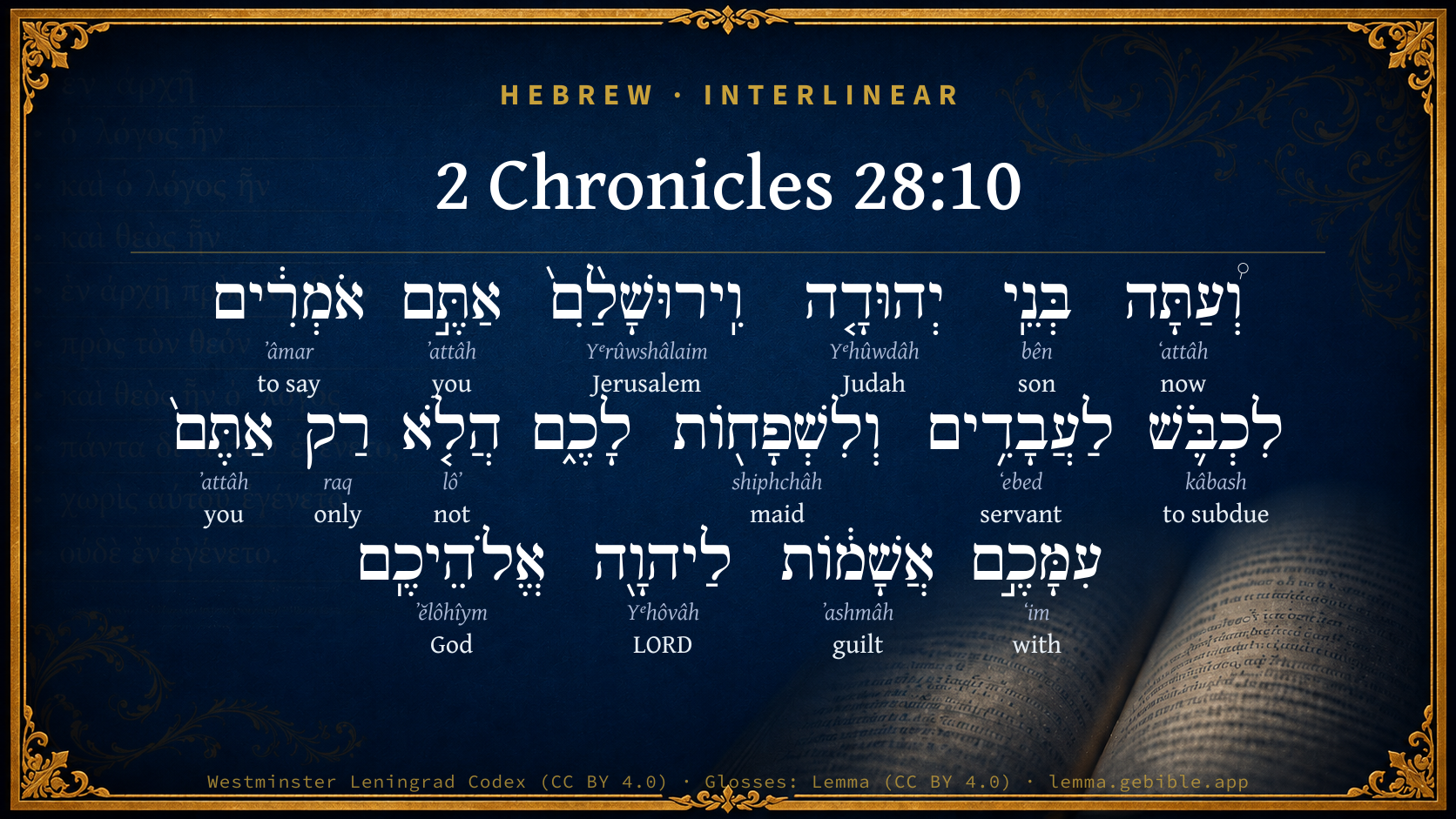
Hebrew (Westminster Leningrad Codex) 2 Chronicles 28:10 appears in the Hebrew Old Testament. The text above is from the Westminster Leningrad Codex. Each word links to its Strong’s number, a concise gloss, and parsing drawn from the Open Scriptures Hebrew Bible morphology. Click any word for its full Brown-Driver-Briggs (BDB) entry.
Download image
Cite this verse

2 Chronicles 28:10 (World English Bible). Public Domain. Lemma interlinear Bible study tool, https://lemma.gebible.app/v/2-chronicles/28/10.

Show BibTeX & RIS
BibTeX
RIS
English Translation
Now you purpose to keep under the children of Judah and Jerusalem for bondservants and bondmaids to you: [but] aren't there even with you trespasses of your own against Yahweh your God?
World English Bible · Public Domain
Download a study sheet

One document with this verse’s original text, its word-by-word gloss line, the meaning frame, cross-references with their text, attributed commentary, and full source and license credits — printable, and it pastes into notes with its structure intact.

This verse Autodidact and up

Study sheet (.html) Plain text (.txt)

A passage Seminary Student

Up to 50 verses in one chapter. A passage sheet keeps up to 6 commentary sources and 12 cross-references per verse, in the order this page ranks them, and says so on the sheet whenever that leaves anything out. Ask for a single verse and you get the Autodidact verse sheet above.

Everything on this page stays free to read, with no account — the sheet is a download of what is already on screen, not access to it.

Want to remove ads? Support Godless Engineer
Compare translations 3

The same verse in 3 English versions, stacked beneath the original-language interlinear above. Click any original word for its lexicon entry.

Each is an independent rendering of the whole verse — the interlinear is not word-aligned to these translations.

Highlighted words mark where these versions differ — a whole-verse word diff, not a word-by-word alignment.

  • World English Bible Public Domain
    Now you purpose to keep under the children of Judah and Jerusalem for bondservants and bondmaids to you: [but] aren't there even with you trespasses of your own against Yahweh your God?
  • King James Version Public Domain
    And now ye purpose to keep under the children of Judah and Jerusalem for bondmen and bondwomen unto you: but are there not with you, even with you, sins against the LORD your God?
  • unfoldingWord Literal Text CC BY-SA 4.0
    And now the sons of Judah and Jerusalem you all are saying to subjugate as male slaves and as female slaves for yourselves. Are you surely not with wrongdoings of your own against Yahweh your God?

unfoldingWord Literal Text — © unfoldingWord, licensed CC BY-SA 4.0. Word-aligned USFM3 via Door43 (git.door43.org/unfoldingWord/en_ult).

Versions to compare (up to 4)

3 of 4 selected

Show all 18 translations

Every available English version of this verse, each an independent rendering of the whole verse.

  • World English Bible Public Domain
    Now you purpose to keep under the children of Judah and Jerusalem for bondservants and bondmaids to you: [but] aren't there even with you trespasses of your own against Yahweh your God?
  • Berean Standard Bible Public Domain
    And now you intend to reduce to slavery the men and women of Judah and Jerusalem. But are you not also guilty before the LORD your God?
  • Majority Standard Bible Public Domain
    And now you intend to reduce to slavery the men and women of Judah and Jerusalem. But are you not also guilty before the LORD your God?
  • King James Version Public Domain
    And now ye purpose to keep under the children of Judah and Jerusalem for bondmen and bondwomen unto you: but are there not with you, even with you, sins against the LORD your God?
  • American Standard Version (1901) Public Domain
    And now ye purpose to keep under the children of Judah and Jerusalem for bondmen and bondwomen unto you: `but' are there not even with you trespasses of your own against Jehovah your God?
  • Revised Version (1885) Public Domain
    And now ye purpose to keep under the children of Judah and Jerusalem for bondmen and bondwomen unto you: but are there not even with you trespasses of your own against the LORD your God?
  • Geneva Bible (1599) Public Domain
    And nowe ye purpose to keepe vnder the children of Iudah and Ierusalem, as seruants and handmaides vnto you: but are not you such, that sinnes are with you before the Lord your God?
  • Douay-Rheims (1899) Public Domain
    Moreover you have a mind to keep under the children of Juda and Jerusalem for your bondmen and bondwomen, which ought not to be done: for you have sinned in this against the Lord your God.
  • Young's Literal Translation Public Domain
    and now, sons of Judah and Jerusalem ye are saying to subdue for men-servants and for maid-servants to you; but are there not with you causes of guilt before Jehovah your God?
  • Literal Standard Version CC BY-SA 4.0
    and now you are saying to subdue sons of Judah and Jerusalem for menservants and for maidservants for yourselves; but are there not causes of guilt with you before your God YHWH?
  • Unlocked Literal Bible CC BY-SA 4.0
    Now you intend to keep the men and women of Judah and Jerusalem as your slaves. But are you not guilty of sins of your own against Yahweh your God?
  • unfoldingWord Literal Text CC BY-SA 4.0
    And now the sons of Judah and Jerusalem you all are saying to subjugate as male slaves and as female slaves for yourselves. Are you surely not with wrongdoings of your own against Yahweh your God?
  • Darby Bible Public Domain
    And now ye think to subjugate the children of Judah and Jerusalem as your bondmen and bondwomen. Are there not with you, even with you, trespasses against Jehovah your God?
  • World Messianic Bible Public Domain
    Now you intend to degrade the children of Judah and Jerusalem as male and female slaves for yourselves. Aren’t there even with you trespasses of your own against the LORD your God?
  • Webster's Bible Public Domain
    And now ye purpose to keep under the children of Judah and Jerusalem for bond-men and bond-women to you: but are there not with you, even with you, sins against the LORD your God?
  • Free Bible Version CC BY-SA 4.0
    Now you're planning to turn these people from Judah and Jerusalem into slaves. But aren't you also guilty of sinning against the Lord your God?
  • Bible in Basic English Public Domain
    And now your purpose is to keep the children of Judah and Jerusalem as men-servants and women-servants under your yoke: but are there no sins against the Lord your God to be seen among yourselves?
  • JPS Tanakh (1917) Public Domain
    And now ye purpose to bring the children of Judah and Jerusalem into subjection for bondmen and bondwomen unto you; but are there not even with you acts of guilt of your own against the LORD your God?

Literal Standard Version (2020), Covenant Press — licensed CC BY-SA 4.0. Text via the HelloAO Bible API (eBible.org). Unlocked Literal Bible (unfoldingWord) — licensed CC BY-SA 4.0. Text via the HelloAO Bible API (eBible.org). unfoldingWord Literal Text — © unfoldingWord, licensed CC BY-SA 4.0. Word-aligned USFM3 via Door43 (git.door43.org/unfoldingWord/en_ult). Free Bible Version, Dr. Jonathan Gallagher — licensed CC BY-SA 4.0. Text via the HelloAO Bible API (eBible.org).

Word by word

More ways to search: Search by grammar → Find every occurrence → Compare this word →

Practice this passage: Drill this verse → Learn its vocabulary →

לִכְבֹּ֛שׁ
kâbash
H3533
“to subdue”
Preposition + Verb, Qal, Infinitive Construct
Part of Speech
Preposition + Verb
Stem
Qal
Form
Infinitive Construct
Full BDB Definition

Origin: a primitive root

TWOT: 951

to subject, subdue, force, keep under, bring into bondage - (Qal) - to bring into bondage, make subservient - to subdue, force, violate - to subdue, dominate, tread down - (Niphal) to be subdued - (Piel) to subdue - (Hiphil) to bring into bondage
  1. וְ֠עַתָּה ʻattâh H6258 “and · now” Conjunction + Adverb
  2. בְּנֵֽי bên H1121 “sons of” Noun, Common, Masculine, Plural, Construct
  3. יְהוּדָ֤ה Yᵉhûwdâh H3063 “Judah” Noun, Proper
  4. וִֽירוּשָׁלִַ֨ם֙ Yᵉrûwshâlaim H3389 “and · Jerusalem” Conjunction + Noun, Proper
  5. אַתֶּ֣ם ʼattâh H859 “you” Pronoun, Personal, 2nd Person, Masculine, Plural
  6. אֹמְרִ֔ים ʼâmar H559 “saying” Verb, Qal, Participle Active, Masculine, Plural, Absolute
  7. לַעֲבָדִ֥ים ʻebed H5650 “to/for · servants” Preposition + Noun, Common, Masculine, Plural, Absolute
  8. וְלִשְׁפָח֖וֹת shiphchâh H8198 “and · to/for · maids” Conjunction + Preposition + Noun, Common, Feminine, Plural, Absolute
  9. הֲלֹ֤א lôʼ H3808 “not” Particle, Interrogative + Particle, Negative
  10. רַק raq H7535 “only” Particle, Accusative
  11. אַתֶּם֙ ʼattâh H859 “you” Pronoun, Personal, 2nd Person, Masculine, Plural
  12. עִמָּכֶ֣ם ʻim H5973 “with · you” Preposition + Suffix, Personal, 2nd Person, Masculine, Plural
  13. אֲשָׁמ֔וֹת ʼashmâh H819 “guilty acts” Noun, Common, Feminine, Plural, Absolute
  14. לַיהוָ֖ה Yᵉhôvâh H3068 “to/for · LORD” Preposition + Noun, Proper
  15. אֱלֹהֵיכֶֽם ʼĕlôhîym H430 “God(s) · your” Noun, Common, Masculine, Plural, Construct + Suffix, Personal, 2nd Person, Masculine, Plural

About this verse

These counts appear in no published source. They are computed here, from the morphology-tagged text and Lemma’s own curated glosses. What Lemma adds →

17
words
15
distinct lemmas
Historical
section

Notable vocabulary

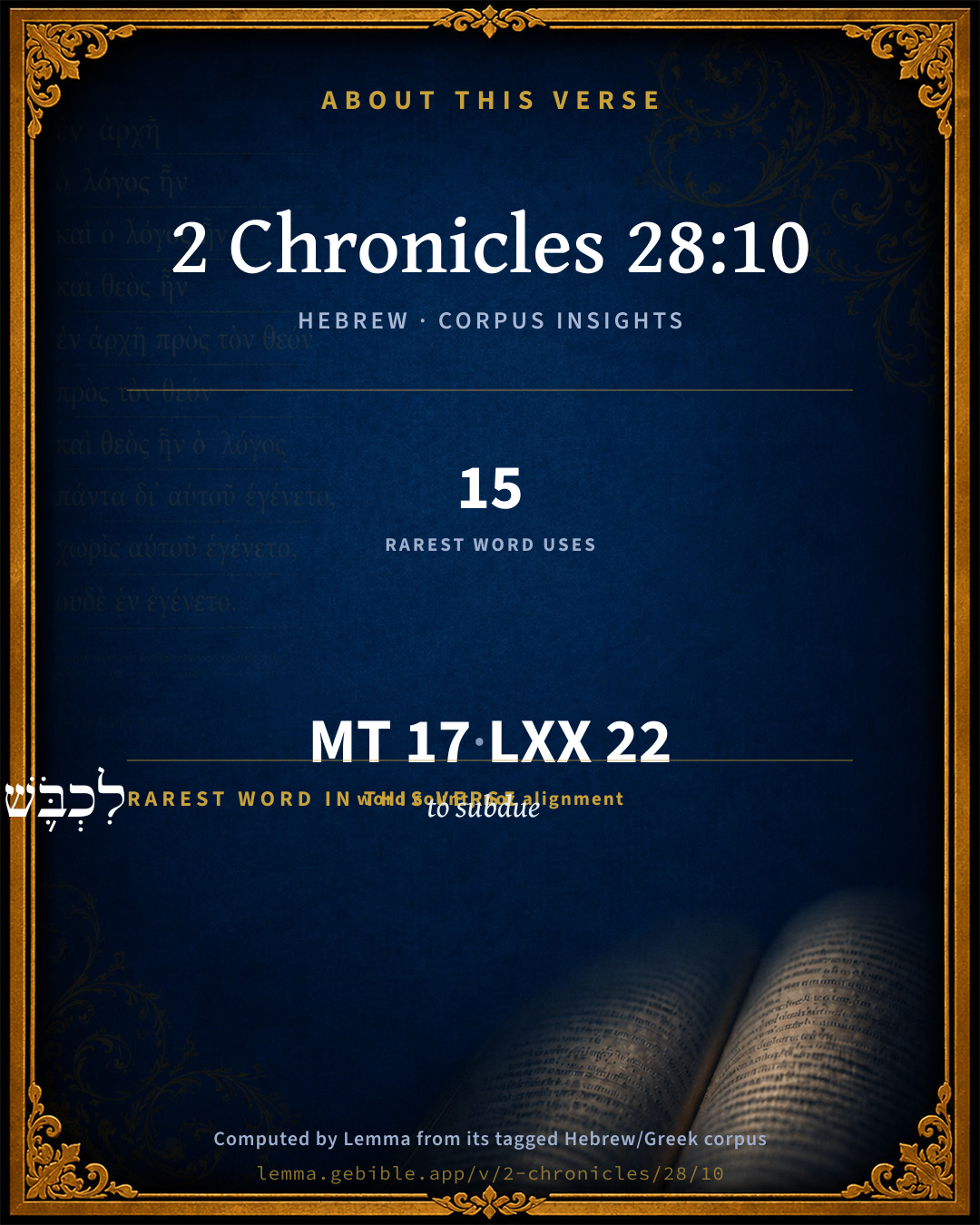
The rarest word here is לִכְבֹּ֛שׁ to subdue H3533 — appearing just 15 times in the whole Hebrew Bible.

Shared distinctive vocabulary

לִכְבֹּ֛שׁ to subdue H3533 occurs in 13 verses of the Hebrew Bible. Also found in:

Grammatical profile

  • 2 verbs
  • 8 nouns
  • 2 pronouns
  • 2 prepositions
  • 1 adverb
  • 2 particles

Verb forms

  • אֹמְרִ֔ים Qal · Participle Active
  • לִכְבֹּ֛שׁ Qal · Infinitive Construct

Repetition

A word recurs within this verse — often emphatic in Hebrew:

  • אַתֶּ֣ם you H859 ×2

Hebrew & Septuagint length

In English translation the verse runs 32 words from the Hebrew and 29 from the Septuagint (LXX English) — closely comparable.

A rough comparison of the two English renderings, which tokenize alike — not a word-level alignment.

Word counts can differ between the Hebrew and the Greek without any difference in meaning — e.g. the Hebrew direct-object marker אֵת has no separate Greek word, and Greek often adds the article ὁ.

In the original languages it is 17 Hebrew tokens and 22 Greek tokens — but the two are counted differently (Hebrew bundles its prefixes and suffixes into one token; the Greek is in lemma form), so that isn’t a like-for-like length.

Cross-references

5

Topical passages linked to 2 Chronicles 28:10 in the Treasury of Scripture Knowledge — connected by theme and wording, ordered by reader-vote popularity; previews shown in the World English Bible.

  • Leviticus 25:39–46 "'If your brother has grown poor among you, and sells himself to you; you shall not make him to serve as a slave.
  • Jeremiah 25:29 For, behold, I begin to work evil at the city which is called by my name; and should you be utterly unpunished? You shall not be unpunished; for I will call for a sword on all the inhabitants of the earth, says Yahweh of Hosts.
  • Matthew 7:2–4 For with whatever judgment you judge, you will be judged; and with whatever measure you measure, it will be measured to you.
  • Romans 12:20–21 Therefore "If your enemy is hungry, feed him. If he is thirsty, give him a drink. For in doing so, you will heap coals of fire on his head."
  • 1 Peter 4:17–18 For the time has come for judgment to begin at the house of God. If it begins first with us, what will happen to those who don't obey the Gospel of God?

Cross-references courtesy of OpenBible.info (CC BY 4.0).

Hebrew and Greek witnesses Masoretic Hebrew ↔ Greek Septuagint

The same verse in the two great witnesses to the Old Testament, shown verse-for-verse.

These are two independent witnesses, not word-aligned to each other, and the Septuagint is shown in lemma (dictionary) form.

Hebrew 2 Chronicles 28:10 Masoretic · Westminster Leningrad Codex

וְ֠עַתָּה בְּנֵֽי יְהוּדָ֤ה וִֽירוּשָׁלִַ֨ם֙ אַתֶּ֣ם אֹמְרִ֔ים לִכְבֹּ֛שׁ לַעֲבָדִ֥ים וְלִשְׁפָח֖וֹת לָכֶ֑ם הֲלֹ֤א רַק אַתֶּם֙ עִמָּכֶ֣ם אֲשָׁמ֔וֹת לַיהוָ֖ה אֱלֹהֵיכֶֽם

Now you purpose to keep under the children of Judah and Jerusalem for bondservants and bondmaids to you: [but] aren't there even with you trespasses of your own against Yahweh your God?

World English Bible · Public Domain

Greek LXX 2 Chronicles 28:10 Septuagint · lemma form

καί νῦν υἱός ἰουδά καί ἰερουσαλήμ σύ λέγω κατακτάομαι εἰς δοῦλος καί δούλη οὐ ἰδού εἰμί μετά σύ μαρτυρέω κύριος θεός σύ

And now you⌃ talk of keeping the children of Juda and Jerusalem for servants and handmaidens. Behold, am I not with you to testify for the Lord your God?

LXX2012 (modern English Septuagint) · Public Domain

Hebrew: Westminster Leningrad Codex (CC BY 4.0). Greek: Septuagint (public domain); English from LXX2012 (modern English Septuagint) (Public Domain). How the Septuagint differs from the Hebrew →

Commentary

Notes on 2 Chronicles 28:10 from classic Christian and Jewish commentators (each source and its license shown beneath its notes). The classic Christian expositions comment on the surrounding passage and are grouped to its opening verse, so a note may address several verses; the Jewish commentaries on the Tanakh (Rashi and others) are per-verse, so they appear only where the commentator wrote on this verse.

Lemma curates 59 commentaries, every one of them public domain or Creative Commons licensed, each selected and text-cleaned for this edition rather than reprinted as found. About our sources →

Trapp's Complete Commentary

John Trapp

2Ch 28:10 And now ye purpose to keep under the children of Judah and Jerusalem for bondmen and bondwomen unto you: [but are there] not with you, even with you, sins against the LORD your God?

Ver. 10. But are there not with you, even with you, sins against the Lord?] At the loss of Calais, when a proud Frenchman asked an English captain, When will you fetch Calais again? he gravely answered, When your sins shall weigh down ours.

John Trapp, A Commentary or Exposition upon All the Books of the Old and New Testament (1647–1656) — public domain. Text from a community e-Sword module.

The Biblical Illustrator

Joseph S. Exell

2Ch_28:10

But are there not with you, even with you, sins against the Lord your God?

A home question

This question is pertinent to--

1. Nations.

2. Sects.

3. Classes.

4. Individuals. I shall--

I. Put a home question to--

1. The moralist.

2. The accuser of the brethren.

3. The outwardly religious.

4. Those who make no profession of religion.

5. Other classes I may have omitted. Are there not with you, sins against the Lord your God?

II. Put a common-sense question: Who are you that you think to escape the punishment of sin?

III. Give a little advice.

1. Leave other people alone with regard to finding fault.

2. Treat yourselves as you have been accustomed to treat others.

3. Look to the eternal interests of your own souls. (C. H. Spurgeon.)

Home sins

An object may be placed in such close proximity to the eye as to escape all distinct perception. It may be brought into such near contact with the organs of vision as to become wholly invisible. Analogous to this natural difficulty of a close self-inspection is the general inability or indisposition of men to form a correct estimate of their own moral and spiritual character. Consider--

I. Some of our distinguishing privileges and advantages.

II. The solemn and awful question, as it relates--

1. To public, national, legalised transgressions.

(1) Want of deference to Gods supreme authority.

(2) Sabbath profanation, its diversion from its appropriate objects upon a gigantic scale, as exemplified on our railways, in our public-houses, and in various departments of industrial occupation.

2. To social and individual sins.

(1) Drunkenness.

(2) Impurity.

(3) Blasphemy and profaneness.

(4) Covetousness, intense and unscrupulous competition of interests.

(5) Vague scepticism and decided infidelity. (J. Davies, D. D.)

A home sin

At a meeting of the Mission to Foreigners in London, Lord Shaftesbury said he remembered taking tea with a notorious German Socialist who propounded the most destructive theories about society. His lordship mentioned to this German a nobleman who was one of the richest men in the world. The Socialist boiled over with indignation, and said that the possession of such wealth was a degradation and a scandalous robbery. Perceiving that he wore a brilliant diamond breast-pin in his shirt-front, probably worth £50, his lordship said to him, You have a diamond, I see; now if you will accompany me to-night to my ragged school, I will show you ragged, shoeless children, and if I were to say, Here is a diamond worth £50 that this gentleman wears in his shirt, they too might boil over with indignation, and declare it was iniquitous, scandalous, and a crime. He replied, Well, my lord, you have me this time.

The Biblical Illustrator, edited by Joseph S. Exell (c. 1880s–1900s) — public domain. Text from a community e-Sword module.

Joseph Benson's Commentary

2Ch 28:10. Ye purpose to keep the children of Judah for bond-men and bond-women — To use them, or sell them as slaves, though they are your brethren, and free-born Israelites. God takes notice of what men purpose, as well as of what they say and do. But are there not with you, even with you, sins against the Lord your God? — Which, if not repented of, may bring down the divine vengeance upon your own heads. He appeals to their own consciences, and to the notorious evidence of the fact. As if he had said, It ill becomes sinners to be cruel. Show mercy to them, for you are undone if God do not show mercy to you.

Joseph Benson's Commentary on the Old and New Testaments (1811–1818) — public domain. Text from a community e-Sword module.

Geneva Bible (1599)

Geneva Bible translators

May not God as well punish you for your sins as he hath done these men for theirs, seeing yours are greater?

Geneva Bible (1599) marginal notes — public domain. Text via Bolls.life.

Ellicott's Commentary for English Readers

(10) Ye purpose.—Literally, Ye are saying or proposing (2ch. 1:18).

To keep under.—Subdue, or reduce to bondmen, Gen_1:28 (kabash).

Unto you.—Yourselves.

But are there not with you.—An abrupt question: Are there no trespasses at all with you yourselves? i.e., “Are you yourselves wholly guiltless, that your indignation was so hot against your brethren? (Gen_20:11). Or, “Are there no trespasses with you only?” . . . Are you the only guiltless people, so that you are justified in these severities?” (Job_1:15). The reference in either case may be to the calves of Bethel and Dan.

A Bible Commentary for English Readers, edited by Charles John Ellicott (1878–1897) — public domain. Text from a community e-Sword module.

The Cambridge Bible for Schools and Colleges

gen. ed. J. J. S. Perowne

10. keep under] In Neh_5:5, the same Heb. word is translated, “bring into bondage”; cp. Ryle’s note on Hebrew slavery in loco. One Hebrew might hold another Hebrew as a slave for a limited period, but in the present passage the case is of one part of the people taking advantage of the fortune of war to reduce to slavery thousands of their fellow-countrymen.

with you, even with you, sins] R.V. even with you trespasses (“guiltinesses” Heb., cp. 2Ch_24:18) of your own.

The Cambridge Bible for Schools and Colleges (gen. ed. J. J. S. Perowne; Cambridge University Press, 1878–1918) — public domain. Text from a community e-Sword module.

John Gill's Exposition

And now ye purpose to keep under the children of Judah and Jerusalem for bondmen and bondwomen unto you,.... As seemed by taking and bringing captive such a number of them, contrary to the law, Lev 25:39.

but are there not with you, even with you, sins against the Lord your God? for which they deserved to be chastised as well as their brethren the men of Judah, and might expect it, and especially if they used them in a barbarous manner, and contrary to the will of God.

John Gill's Exposition of the Whole Bible (1746–1763) — public domain (CC PDM 1.0). Text via the HelloAO Bible API.

Albert Barnes' Notes on the Bible

Are there not with you ... sins against the Lord? - The ten tribes had fallen away from the true faith far more completely and more hopelessly than the two. It was not for them to press hard against their erring brothers, and aggravate their punishment.

Albert Barnes' Notes on the Bible (1834–1885) — public domain. Text from a community e-Sword/MySword module.

Haydock's Catholic Bible Commentary

God, who forbids this, Lev. xxv. 43., and Micheas ii. 8, 9. Heb. "are there not with you, yea, with you, sins against?" &c. If Juda have deserved punishment, reflect if you also be not guilty, v. 13. Sept. "Behold, am I not here with you to bear witness to the Lord?"

George Leo Haydock (1774–1849), Haydock's Catholic Family Bible and Commentary, 1859 edition — public domain. Excludes Psalms (Douay-Rheims chapter numbering differs from Protestant) and Deuterocanonical books (Catholic canon only).

Matthew Poole's English Annotations

Which, if not repented of, may bring down the like vengeance upon your own heads.

Matthew Poole's English Annotations on the Holy Bible (1683–1685) — public domain. Text from a community e-Sword/MySword module.

The Pulpit Commentary

For bondmen and bondwomen unto you. The denunciation Deu_28:68 may be instructively compared with the emphatic prohibition of Lev_25:46. The moral thread of ordinance that runs everywhere through the divinely established economy of the Old Testament Judaism should be devoutly observed. The verse, in the position of its words, furnishes an example of almost classical pattern: And now persons who are children of Judah and Jerusalem, ye are resolving within yourselves (literally, saying) to subdue into bondmen and bondwomen for yourselves.

The Pulpit Commentary (1880–1919), ed. H.D.M. Spence-Jones & Joseph S. Exell — public domain. Text from a community e-Sword module.

John Wesley's Explanatory Notes

To keep under - It ill becomes sinners to be cruel. Shew mercy to them, for you are undone, unless God shew you mercy.

John Wesley, Explanatory Notes Upon the Whole Bible (1754–1765) — public domain. Text via the GEBible commentary corpus.

Lesson kit

Teaching starters — assembled from the data on this page, not authored interpretation. Every prompt links to the verse data it draws on. Edit before teaching.

2 Chronicles, in the Historical, opens this verse with 17 words (15 distinct Hebrew lemmas). Its most distinctive word is kâbash (“to subdue”). A historical commentator’s framing appears above. Read the whole chapter for the surrounding context.

Discussion questions

  1. The word kâbash carries the sense “to subdue.” How does it shape the verse?
  2. How does Genesis 1:28, which shares the word «to subdue», read alongside this verse?
  3. What does the repetition of “you” (2× in this one verse) do in this verse?
  4. These translations render this verse differently; the difference is in the English rendering, not the original. What questions does that raise?
  5. «אֹמְרִ֔ים» is a Qal Participle Active verb. How does that grammatical form shape the action described?
  6. Compare how Trapp's Complete Commentary and The Biblical Illustrator read this verse. Where do they agree or differ?

Things to notice

Reading settings

Reading text

Shown beneath each verse's original-language words.

Old Testament
Old Testament edition

Read the OT as the Masoretic Hebrew (MT) or the Greek Septuagint (LXX).

English shown for the Greek Septuagint (in the Hebrew ↔ Greek comparison).

Comparing translations? Open the Compare panel on any verse page to stack up to four side by side.