
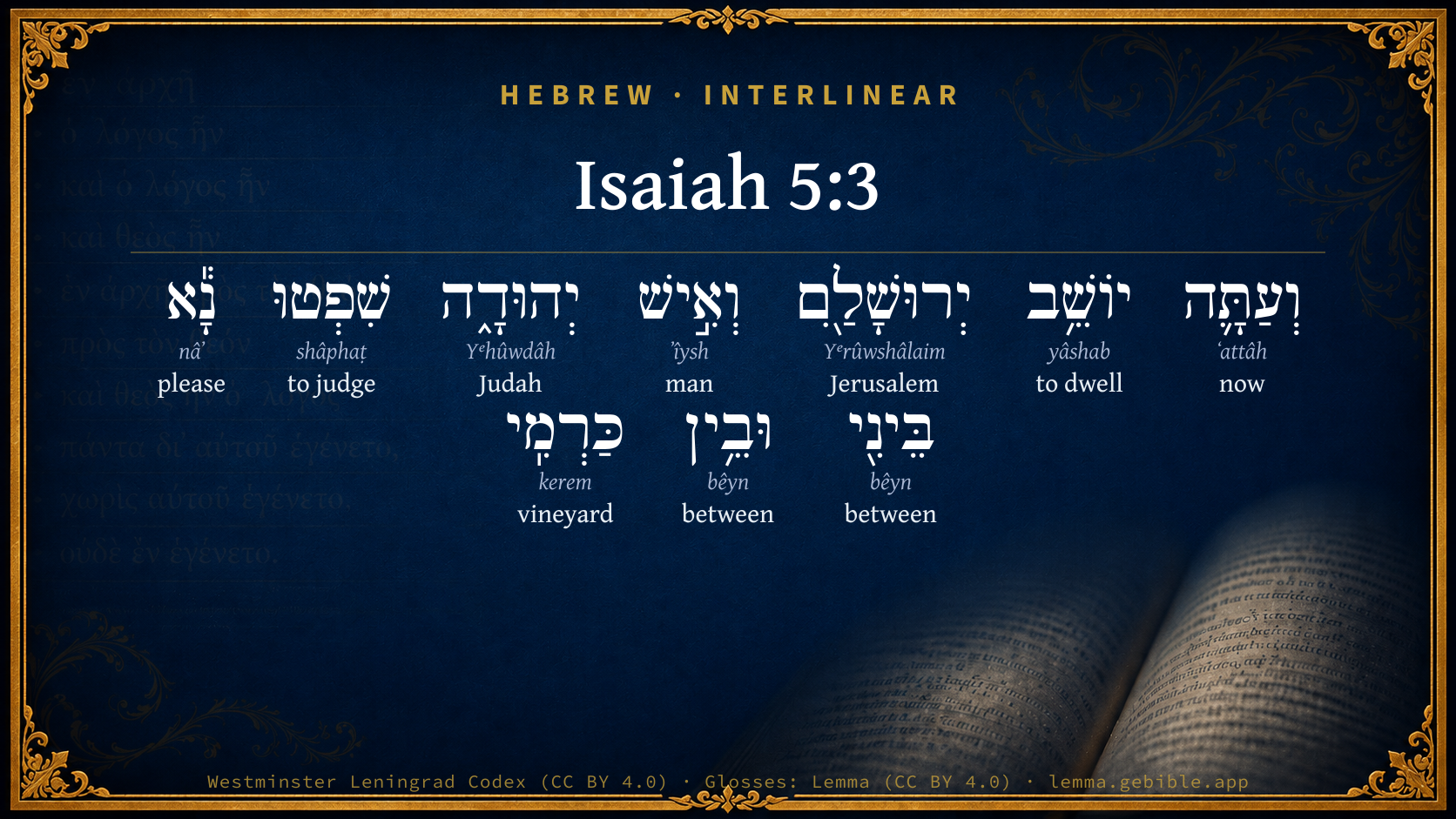
Isaiah 5:3

Hebrew (Westminster Leningrad Codex) Isaiah 5:3 appears in the Hebrew Old Testament. The text above is from the Westminster Leningrad Codex. Each word links to its Strong’s number, a concise gloss, and parsing drawn from the Open Scriptures Hebrew Bible morphology. Click any word for its full Brown-Driver-Briggs (BDB) entry.
Download image
Cite this verse

Isaiah 5:3 (World English Bible). Public Domain. Lemma interlinear Bible study tool, https://lemma.gebible.app/v/isaiah/5/3.

Show BibTeX & RIS
BibTeX
RIS
English Translation
"Now, inhabitants of Jerusalem and men of Judah, Please judge between me and my vineyard.
World English Bible · Public Domain
Download a study sheet

One document with this verse’s original text, its word-by-word gloss line, the meaning frame, cross-references with their text, attributed commentary, and full source and license credits — printable, and it pastes into notes with its structure intact.

This verse Autodidact and up

Study sheet (.html) Plain text (.txt)

A passage Seminary Student

Up to 50 verses in one chapter. A passage sheet keeps up to 6 commentary sources and 12 cross-references per verse, in the order this page ranks them, and says so on the sheet whenever that leaves anything out. Ask for a single verse and you get the Autodidact verse sheet above.

Everything on this page stays free to read, with no account — the sheet is a download of what is already on screen, not access to it.

Want to remove ads? Support Godless Engineer
Compare translations 3

The same verse in 3 English versions, stacked beneath the original-language interlinear above. Click any original word for its lexicon entry.

Each is an independent rendering of the whole verse — the interlinear is not word-aligned to these translations.

Highlighted words mark where these versions differ — a whole-verse word diff, not a word-by-word alignment.

  • World English Bible Public Domain
    "Now, inhabitants of Jerusalem and men of Judah, Please judge between me and my vineyard.
  • King James Version Public Domain
    And now, O inhabitants of Jerusalem, and men of Judah, judge, I pray you, betwixt me and my vineyard.
  • unfoldingWord Literal Text CC BY-SA 4.0
    “And now, dweller of Jerusalem and man of Judah, please judge between me and between my vineyard.

unfoldingWord Literal Text — © unfoldingWord, licensed CC BY-SA 4.0. Word-aligned USFM3 via Door43 (git.door43.org/unfoldingWord/en_ult).

Versions to compare (up to 4)

3 of 4 selected

Show all 17 translations

Every available English version of this verse, each an independent rendering of the whole verse.

  • World English Bible Public Domain
    "Now, inhabitants of Jerusalem and men of Judah, Please judge between me and my vineyard.
  • Berean Standard Bible Public Domain
    “And now, O dwellers of Jerusalem and men of Judah, I exhort you to judge between Me and My vineyard.
  • Majority Standard Bible Public Domain
    “And now, O dwellers of Jerusalem and men of Judah, I exhort you to judge between Me and My vineyard.
  • King James Version Public Domain
    And now, O inhabitants of Jerusalem, and men of Judah, judge, I pray you, betwixt me and my vineyard.
  • American Standard Version (1901) Public Domain
    And now, O inhabitants of Jerusalem and men of Judah, judge, I pray you, betwixt me and my vineyard.
  • Revised Version (1885) Public Domain
    And now, O inhabitants of Jerusalem and men of Judah, judge, I pray you, betwixt me and my vineyard.
  • Geneva Bible (1599) Public Domain
    Now therefore, O inhabitants of Ierusalem and men of Iudah, iudge, I pray you, betweene me, and my vineyarde.
  • Young's Literal Translation Public Domain
    And now, O inhabitant of Jerusalem, and man of Judah, Judge, I pray you, between me and my vineyard.
  • Literal Standard Version CC BY-SA 4.0
    And now, O inhabitant of Jerusalem and man of Judah, || Please judge between Me and My vineyard.
  • Unlocked Literal Bible CC BY-SA 4.0
    So now, inhabitant of Jerusalem and man of Judah, judge between me and my vineyard.
  • unfoldingWord Literal Text CC BY-SA 4.0
    “And now, dweller of Jerusalem and man of Judah, please judge between me and between my vineyard.
  • Darby Bible Public Domain
    And now, inhabitants of Jerusalem and men of Judah, judge, I pray you, between me and my vineyard.
  • World Messianic Bible Public Domain
    “Now, inhabitants of Jerusalem and men of Judah, please judge between me and my vineyard.
  • Webster's Bible Public Domain
    And now, O inhabitants of Jerusalem, and men of Judah, judge, I pray you, betwixt me and my vineyard.
  • Free Bible Version CC BY-SA 4.0
    “Now, you people who live in Jerusalem and Judah, please judge between me and my vineyard.
  • Bible in Basic English Public Domain
    And now, you people of Jerusalem and you men of Judah, be the judges between me and my vine-garden.
  • JPS Tanakh (1917) Public Domain
    And now, O inhabitants of Jerusalem and men of Judah, judge, I pray you, betwixt me and my vineyard.

Literal Standard Version (2020), Covenant Press — licensed CC BY-SA 4.0. Text via the HelloAO Bible API (eBible.org). Unlocked Literal Bible (unfoldingWord) — licensed CC BY-SA 4.0. Text via the HelloAO Bible API (eBible.org). unfoldingWord Literal Text — © unfoldingWord, licensed CC BY-SA 4.0. Word-aligned USFM3 via Door43 (git.door43.org/unfoldingWord/en_ult). Free Bible Version, Dr. Jonathan Gallagher — licensed CC BY-SA 4.0. Text via the HelloAO Bible API (eBible.org).

Word by word

More ways to search: Search by grammar → Find every occurrence → Compare this word →

Practice this passage: Drill this verse → Learn its vocabulary →

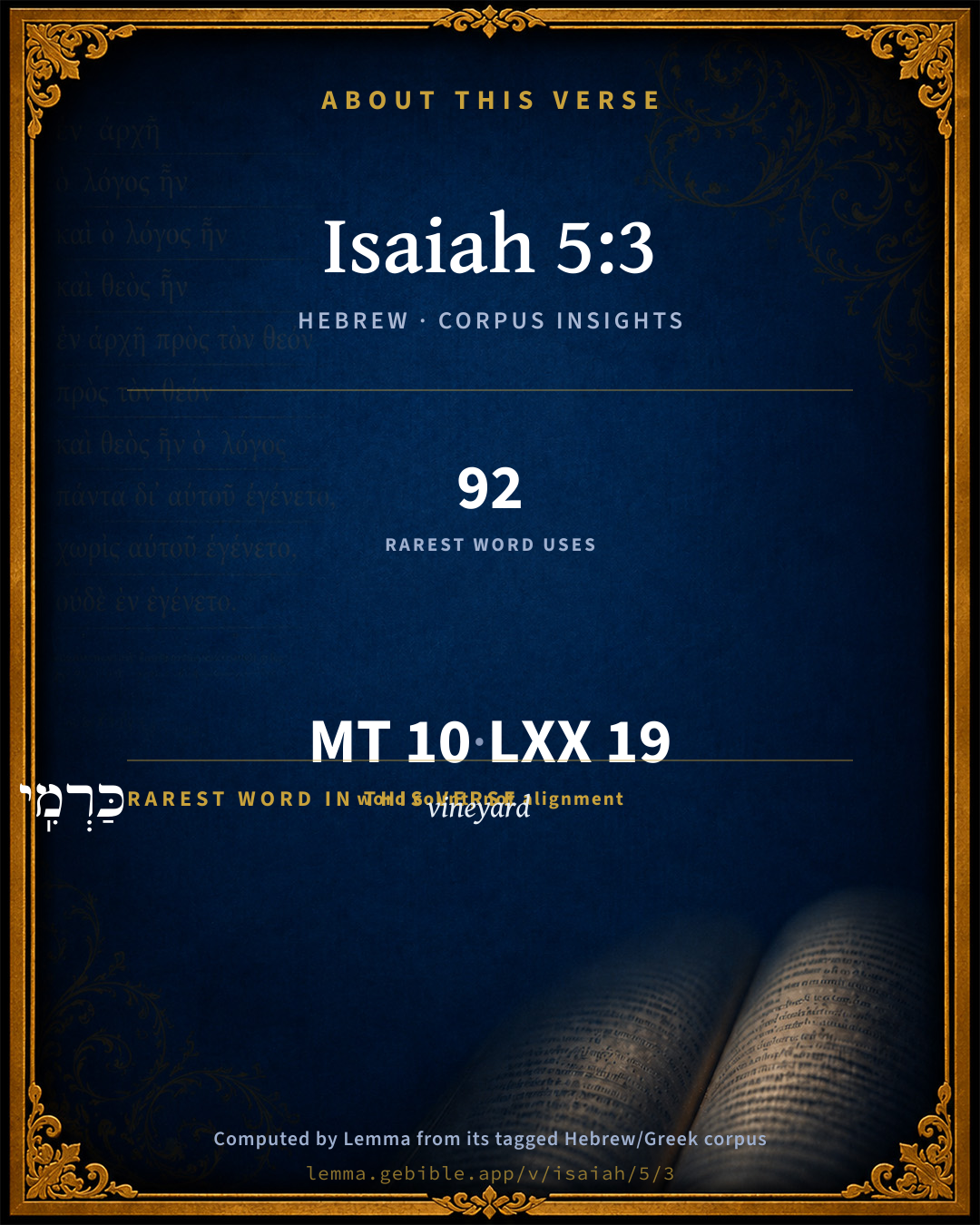
About this verse

These counts appear in no published source. They are computed here, from the morphology-tagged text and Lemma’s own curated glosses. What Lemma adds →

10
words
9
distinct lemmas
Prophets
section

Grammatical profile

  • 2 verbs
  • 4 nouns
  • 2 prepositions
  • 1 adverb
  • 1 particle

Verb forms

  • יוֹשֵׁ֥ב Qal · Participle Active
  • שִׁפְטוּ Qal · Imperative

Repetition

A word recurs within this verse — often emphatic in Hebrew:

  • בֵּינִ֖י between H996 ×2

Hebrew & Septuagint length

In English translation the verse runs 15 words from the Hebrew and 17 from the Septuagint (LXX English) — closely comparable.

A rough comparison of the two English renderings, which tokenize alike — not a word-level alignment.

Word counts can differ between the Hebrew and the Greek without any difference in meaning — e.g. the Hebrew direct-object marker אֵת has no separate Greek word, and Greek often adds the article ὁ.

In the original languages it is 10 Hebrew tokens and 19 Greek tokens — but the two are counted differently (Hebrew bundles its prefixes and suffixes into one token; the Greek is in lemma form), so that isn’t a like-for-like length.

Cross-references

9

Topical passages linked to Isaiah 5:3 in the Treasury of Scripture Knowledge — connected by theme and wording, ordered by reader-vote popularity; previews shown in the World English Bible.

  • Psalms 50:4–6 He calls to the heavens above, To the earth, that he may judge his people:
  • Psalms 51:4 Against you, and you only, have I sinned, And done that which is evil in your sight; That you may be proved right when you speak, And justified when you judge.
  • Jeremiah 2:4–5 Hear you the word of Yahweh, O house of Jacob, and all the families of the house of Israel:
  • Micah 6:2–3 Hear, you mountains, Yahweh's controversy, And you enduring foundations of the earth; For Yahweh has a controversy with his people, And he will contend with Israel.
  • Matthew 21:40–41 When therefore the lord of the vineyard comes, what will he do to those farmers?"
  • Mark 12:9–12 What therefore will the lord of the vineyard do? He will come and destroy the farmers, and will give the vineyard to others.
  • Luke 20:15–16 They threw him out of the vineyard, and killed him. What therefore will the lord of the vineyard do to them?
  • Romans 2:5 But according to your hardness and unrepentant heart you are treasuring up for yourself wrath in the day of wrath, revelation, and of the righteous judgment of God;
  • Romans 3:4 May it never be! Yes, let God be found true, but every man a liar. As it is written, "That you might be justified in your words, And might prevail when you come into judgment."

Cross-references courtesy of OpenBible.info (CC BY 4.0).

Hebrew and Greek witnesses Masoretic Hebrew ↔ Greek Septuagint

The same verse in the two great witnesses to the Old Testament, shown verse-for-verse.

These are two independent witnesses, not word-aligned to each other, and the Septuagint is shown in lemma (dictionary) form.

Hebrew Isaiah 5:3 Masoretic · Westminster Leningrad Codex

וְעַתָּ֛ה יוֹשֵׁ֥ב יְרוּשָׁלִַ֖ם וְאִ֣ישׁ יְהוּדָ֑ה שִׁפְטוּ נָ֕א בֵּינִ֖י וּבֵ֥ין כַּרְמִֽי

"Now, inhabitants of Jerusalem and men of Judah, Please judge between me and my vineyard.

World English Bible · Public Domain

Greek LXX Isaiah 5:3 Septuagint · lemma form

καί νῦν ἄνθρωπος ὁ ιουδα καί ὁ ἐνοἰκέω ἐν ἰερουσαλήμ κρίνω ἐν ἐγώ καί ἀνά μέσος ὁ ἀμπελών ἐγώ

And now, you⌃ dwellers in Jerusalem, and every man of Juda, judge between me and my vineyard.

LXX2012 (modern English Septuagint) · Public Domain

On this verse, Adam Clarke's Commentary discusses the Septuagint’s reading. Read the note in Commentary ↓

Hebrew: Westminster Leningrad Codex (CC BY 4.0). Greek: Septuagint (public domain); English from LXX2012 (modern English Septuagint) (Public Domain). How the Septuagint differs from the Hebrew →

Targum (Aramaic paraphrase)

1

The Targum is the ancient Jewish Aramaic paraphrase of the Hebrew Scriptures — an interpretive translation, not the Hebrew text itself. Onkelos (literal) and Pseudo-Jonathan (expansive) render the Torah, and Jonathan the Prophets. Coverage is partial: where no permissively-licensed English translation exists for a verse, only the Aramaic is shown. This is verse-level text, not a word-by-word alignment to the Hebrew.

  1. Targum Jonathan Prophets (Joshua–Malachi)
    נְבִיָא אֲמַר לְהוֹן הָא בֵית יִשְׂרָאֵל מְרָדוּ מִן אוֹרַיְתָא וְלָא צָבָן לְמֵיתַב כְּעַן יַתְבֵי יְרוּשְׁלֵם וֶאֱנַשׁ יְהוּדָה דִינוּ כְעַן דִינָא קֳדָמַי מִן עַמִי:

    The prophet said unto them: They have revolted from the law, and are not willing to return. Now, 0 inhabitants of Jerusalem, and men of Judah, judge now a judgment between me and my people.

    Targum Jonathan — Aramaic: “Mikraot Gedolot” (public domain). English: “Sefaria Community Translation” (CC0 1.0 (public-domain dedication)); “London "Chaldee Paraphrase," 1871” (public domain). Text via Sefaria.

Commentary

Notes on Isaiah 5:3 from classic Christian and Jewish commentators (each source and its license shown beneath its notes). The classic Christian expositions comment on the surrounding passage and are grouped to its opening verse, so a note may address several verses; the Jewish commentaries on the Tanakh (Rashi and others) are per-verse, so they appear only where the commentator wrote on this verse.

Lemma curates 59 commentaries, every one of them public domain or Creative Commons licensed, each selected and text-cleaned for this edition rather than reprinted as found. About our sources →

Trapp's Complete Commentary

John Trapp

Isa 5:3 And now, O inhabitants of Jerusalem, and men of Judah, judge, I pray you, betwixt me and my vineyard.

Ver. 3. And now, O ye inhabitants of Jerusalem.] Here we have God’s plea before his sentence, and therein his appeal to them, and his indictment against them. First he appealeth to the Jews themselves, and maketh them judges in their own cause. So Nathan dealt by David, and Jesus by the wicked Jews of his time. {Mat 21:40} Iudicate, quaeso, only "judge a righteous judgment," {Joh 7:24} and then I dare report me to the conscience of any one among you, and will therehence fetch witness.

Between me and my vineyard.] With which I am now at variance. Sin is that hell-hag, {a diabolical or vile woman} makebait, {breeder of strive} trouble town, that sets odds between God and his greatest favourites.

John Trapp, A Commentary or Exposition upon All the Books of the Old and New Testament (1647–1656) — public domain. Text from a community e-Sword module.

The Biblical Illustrator

Joseph S. Exell

Isa_5:3

Judge, I pray you, betwixt Me and My vineyard

The unfruitful vineyard

I.

The way in which the inspired penman is guided to put the question in the text seems to lead us to ONE OF WE SUBTLEST WEAKNESSES OF HUMAN NATURE,--I mean the power which men possess of perceiving general truth without at the same time perceiving its particular bearing on themselves. Often and often are we, all unconsciously, judging between God and His vineyard, and we know it not. There is no general denunciation of the Bible which does not meet with our full assent; but we are too often unable to see that we ourselves come under its terms. And this is one of the dangers attendant on listening to preaching.

II. The portion of Scripture under consideration has A MOST DIRECT REFERENCE TO OUR OWN PROBATION.

1. As members of the Church.

2. As individual souls. (W. Alexander.)

The Biblical Illustrator, edited by Joseph S. Exell (c. 1880s–1900s) — public domain. Text from a community e-Sword module.

Joseph Benson's Commentary

Isa 5:3-4. And now, O inhabitants of Jerusalem, &c. — God is here introduced as calling upon the guilty themselves to pass sentence, or judgment, in the case, and leaving it to them; because, without downright madness, they could do no other than condemn themselves; who, when they had received so many benefits from God, had been so ungrateful to him. What could have been done, &c. — What work is there belonging to the office of an owner or keeper of a vineyard, which I have neglected? Wherefore — brought it forth wild grapes — How unworthy a conduct and inexcusable a crime is it, that you not only have been unfruitful in good works, but have brought forth, in abundance, the fruits of wickedness!

Who can read these words without being moved at the justness as well as the tenderness of the reproach; which is equally applicable now to professing Christians in general, as it was to the Jews at that time? What is it that God has not done for us? What good thing has he withheld from us? How many invaluable blessings has he bestowed upon us in our creation and preservation! And how many still more inestimable in our redemption!

What more could have been done for us than he has done? Wherefore then, when he looketh for grapes, does he only find wild grapes, or rather poisonous berries? When he looketh for a tribute of grateful praise, does he find ingratitude, forgetfulness of his mercies, and disobedience to his commands?

Joseph Benson's Commentary on the Old and New Testaments (1811–1818) — public domain. Text from a community e-Sword module.

Keil & Delitzsch

C. F. Keil & F. Delitzsch

The song of the beloved who was so sorely deceived terminates here. The prophet recited it, not his beloved himself; but as they were both of one heart and one soul, the prophet proceeds thus in Isa 5:3 and Isa 5:4 : "And now, O inhabitants of Jerusalem and men of Judah, judge, I pray you, between me and my vineyard! What could have been done more to my vineyard that I have not done in it? Wherefore did I hope that it would bring forth grapes, and it brought forth wild grapes?" The fact that the prophet speaks as if he were the beloved himself, shows at once who the beloved must be. The beloved of the prophet and the lover of the prophet (yâdid and dōd) were Jehovah, with whom he was so united by a union mystica exalted above all earthly love, that, like the angel of Jehovah in the early histories, he could speak as if he were Jehovah Himself (see especially Zac 2:12-13). To any one with spiritual intuition, therefore, the parabolical meaning and object of the song would be at once apparent; and even the inhabitants of Jerusalem and the men of Judah (yoosheeb and iish are used collectively, as in Isa 8:14; Isa 9:8; Isa 22:21, cf., Isa 20:6) were not so stupefied by sin, that they could not perceive to what the prophet was leading. It was for them to decide where the guilt of this unnatural issue lay - that is to say, of this thorough contradiction between the "doing" of the vineyard and the "doing" of the Lord; that instead of the grapes he hoped for, it brought forth wild grapes. (On the expression "what could have been done," quid faciendum est, mah-la'asoth, see at Hab 1:17, Ges. 132, Anm. 1.) Instead of למה (למּה) we have the more suitable term מדּוּע, the latter being used in relation to the actual cause (Causa efficiens), the former in relation to the object (Causa finalis). The parallel to the second part, viz., Isa 50:2, resembles the passage before us, not only in the use of this particular word, but also in the fact that there, as well as here, it relates to both clauses, and more especially to the latter of the two. We find the same paratactic construction in connection with other conjunctions (cf., Isa 12:1; Isa 65:12). They were called upon to decide and answer as to this what and wherefore; but they were silent, just because they could clearly see that they would have to condemn themselves (as David condemned himself in connection with Nathan's parable, Sa2 12:5). The Lord of the vineyard, therefore, begins to speak. He, its accuser, will now also be its judge.

Keil & Delitzsch — Biblical Commentary on the Old Testament (1861–1891) — public domain (CC PDM 1.0). Text via the HelloAO Bible API. (Old Testament only.)

Tyndale Open Study Notes

Tyndale Open Resources

5:3-4 Clearly, the Lord had graciously done everything possible for the vineyard. He was not to blame for the bitter grapes. • you judge: Isaiah wanted the audience to condemn the vineyard before he revealed that in fact they were the vineyard (5:7). This rhetorical tactic is similar to the one Nathan used to confront David (2 Sam 12:1-5).

Tyndale Open Study Notes — © Tyndale Open Resources, licensed CC BY-SA 4.0. Text via the HelloAO Bible API.

Geneva Bible (1599)

Geneva Bible translators

He maketh them judges in their own cause, forasmuch as it was evident that they were the cause of their own ruin.

Geneva Bible (1599) marginal notes — public domain. Text via Bolls.life.

Jamieson, Fausset & Brown

Robert Jamieson, A. R. Fausset & David Brown

And now, &c.--appeal of God to themselves, as in Isa 1:18; Mic 6:3. So Jesus Christ, in Mat 21:40-41, alluding in the very form of expression to this, makes them pass sentence on themselves. God condemns sinners "out of their own mouth" (Deu 32:6; Job 15:6; Luk 19:22; Rom 3:4).

Jamieson, Fausset & Brown — Commentary Critical and Explanatory on the Whole Bible (1871) — public domain (CC PDM 1.0). Text via the HelloAO Bible API.

Adam Clarke's Commentary

Verse 3. Inhabitants] ישבי yoshebey, in the plural number; three MSS., (two ancient,) and so likewise the Septuagint and Vulgate.

Adam Clarke's Commentary on the Bible (1810–1826) — public domain. Text from a community e-Sword/MySword module.

Ellicott's Commentary for English Readers

(3) And now, O inhabitants of Jerusalem.—“The song of the vineyard” comes to an end and becomes the text of a discourse in which Jehovah, as the “Beloved” of the song, speaks through the prophet. Those to whom the parable applies are invited, as David was by Nathan, to pass an unconscious judgment on themselves. (Comp. Mat_21:40-41, as an instance of the same method.)

A Bible Commentary for English Readers, edited by Charles John Ellicott (1878–1897) — public domain. Text from a community e-Sword module.

The Cambridge Bible for Schools and Colleges

gen. ed. J. J. S. Perowne

3. (Four lines.) The beginning of a new stanza is marked by the “And now” as in Isa_5:5.

betwixt me and my vineyard] The change of person here is the first hint of a deeper meaning under the words of the song.

The Cambridge Bible for Schools and Colleges (gen. ed. J. J. S. Perowne; Cambridge University Press, 1878–1918) — public domain. Text from a community e-Sword module.

John Gill's Exposition

And now, O inhabitants of Jerusalem, and men of Judah,.... All and everyone of them, who were parties concerned in this matter, and are designed by the vineyard, for whom so much had been done, and so little fruit brought forth by them, or rather so much bad fruit:

judge, I pray you, between me and my vineyard; between God and themselves; they are made judges in their own cause; the case was so clear and evident, that God is as it were willing the affair should be decided by their own judgment and verdict: so the Targum,

"judge now judgment between me and my people.''

John Gill's Exposition of the Whole Bible (1746–1763) — public domain (CC PDM 1.0). Text via the HelloAO Bible API.

Albert Barnes' Notes on the Bible

And now ... - This is an appeal which God makes to the Jews themselves, in regard to the justice and propriety of what he was about to do. A similar appeal he makes in Mic 6:3 : ‘O my people, what have I done unto thee? and wherein have I wearied thee? Testify against me.’ He intended to “punish” them Isa 5:5-6, and he appeals to them for the justice of it. He would do to them as they would do to a vineyard that had been carefully prepared and guarded, and which yet was valueless. A similar appeal he makes in Isa 1:18; and our Saviour made an application remarkably similar in his parable of the vineyard, Mat 21:40-43. It is not improbable that he had his eye on this very place in Isaiah; and it is, therefore, the more remarkable that the Jews did not understand the bearing of his discourse.

Albert Barnes' Notes on the Bible (1834–1885) — public domain. Text from a community e-Sword/MySword module.

Haydock's Catholic Bible Commentary

Judge. God condescends to have his conduct scrutinized, chap. xli. 1.

George Leo Haydock (1774–1849), Haydock's Catholic Family Bible and Commentary, 1859 edition — public domain. Excludes Psalms (Douay-Rheims chapter numbering differs from Protestant) and Deuterocanonical books (Catholic canon only).

Matthew Poole's English Annotations

I dare make you judges in your own cause, it is so plain and reasonable.

Matthew Poole's English Annotations on the Holy Bible (1683–1685) — public domain. Text from a community e-Sword/MySword module.

Whedon's Commentary on the Bible

Daniel D. Whedon

3-7. So far the parable is left unexplained to the prophet’s hearers. And to them the appeal is, “What is to be done?” Then the explanation begins, but still in a parable. The inquirer answers his own questions.

Will take away… hedge thereof — An Eastern “hedge” is composed of thorny plants, which, densely placed in rows around a ground, forms a strong protection against intruders.

The answer in Isa_5:4 is in bitter irony. It implies that more would be done if possible, but from the rebellious conduct of Israel that is impossible. It is also God’s divine self-justification. He had done all the best vintner could do for the vineyard, but it would be obstinately bad. Waste and desolation will now ensue, and tempests and war shall at times sweep over it with fury. Rains will be withheld, and famines and general depopulation will follow. In plain words, this “vineyard” of the Lord — of the prophet’s “beloved” — is the house of Israel, and the men of Judah his pleasant plant.

Thence follows the announcement of a series of disciplinary woes, with an enumeration of the popular vices that cause them.

Daniel D. Whedon (gen. ed.), Commentary on the Old and New Testaments (1874–1909) — public domain. Text from a community e-Sword module.

The Pulpit Commentary

The prophet"s "song" here ends, and Jehovah himself takes the word. As if the story told in the parable had been a fact, he calls on the men of Judah and Jerusalem to "judge between him and his vineyard." Compare Nathan"s appeal to David by the parable of the ewe lamb. (2Sa_12:1-4)

The Pulpit Commentary (1880–1919), ed. H.D.M. Spence-Jones & Joseph S. Exell — public domain. Text from a community e-Sword module.

J. A. Alexander on Isaiah

Joseph Addison Alexander

Having described the advantageous situation, soil, and culture of the vineyard, and its failure to produce good fruit, he submits the case to the decision of his hearers. “And now,” not merely in a temporal but a logical sense, this being the case, “Oh inhabitant of Jerusalem and man of Judah,” the singular form adding greatly to the individuality and life of the expression, “judge I pray you,” pray decide or act as arbiters, “between me and my vineyard.” The people are here called upon to judge between a stranger and his vineyard, simply as such, unaware that they are thereby passing judgment on themselves. The meaning and design of the appeal are perfectly illustrated by that which Christ makes (Mat 21:40) in a parable analogous to this and founded on it. There as here the audience are called upon to judge in a case which they regard as foreign to their own, if not fictitious, and it is only after their decision that they are made to see its bearing on themselves. So too in Nathan’s parable to David, (2Sa 12:1) it was not until "David’s anger was greatly kindled against the man," (i.e., the stranger of whom he understood the Prophet to be speaking), that "Nathan said to David, Thou art the man." A disregard of these analogies impairs both the moral force and the poetical unity and beauty of the apologue. The same thing may be said of the attempt to put a specific figurative sense on each part of the parable, the wall, the tower, the hedge, etc., which is not more reasonable here than it would be in explaining Aesop’s fables. The parable, as a whole, corresponds to its subject as a whole, but all the particulars included in the one are not separately intended to denote particulars included in the other. A lion may be a striking emblem of a hero, but it does not follow that the mane, claws, etc. of the beast must all be significant of something in the man. Nay, they cannot even be supposed to be so, without sensibly detracting from the force and beauty of the image as a whole.

Joseph Addison Alexander, The Prophecies of Isaiah (1846–1847; New York: Scribner, 1870–1878) — public domain. Text from a community e-Sword module.

unfoldingWord translationNotes

Door43 World Missions Community

General Information:

In Isaiah's parable of the vineyard, the owner of the vineyard, who represents God, speaks to the people of Jerusalem and Judah about his vineyard. (See: Parables)

inhabitant of Jerusalem and man of Judah

These expressions refer in general to all people living in Jerusalem and Judah, so they can be translated with plural nouns. AT: "all of you who live in Jerusalem and Judah" (See: Generic Noun Phrases)

Jerusalem ... Judah

"Judah" was the name of the southern kingdom of Israelites, and Jerusalem was the capital city.

judge between me and my vineyard

The idea of a space separating two things is often used to express the idea of choosing one or the other of those things. AT: "decide who has acted right, I or my vineyard" (See: Metaphor)

What more could have been done for my vineyard, that I have not done for it?

The owner uses this question to make a statement about his vineyard. This rhetorical questions can be translated as a stataement. AT: "I have done all that I could do for my vineyard!" (See: Rhetorical Question)

When I looked for it to produce grapes, why did it produce wild grapes?

The owner uses a question to say that his vineyard should have produced good grapes. This rhetorical question can be translated as a statement. AT: "I wanted it to make good grapes, but it only produced worthless grapes" (See: Rhetorical Question)

translationWords

Jerusalem

Judah

judge

vineyard

grape

unfoldingWord translationNotes — © Distant Shores Media and the Door43 World Missions Community, licensed CC BY-SA 4.0. Source: git.door43.org/Door43/en_tn.

Ibn Ezra

Rabbi Abraham ibn Ezra

And men of Judah. And every man of Judah round about Jerusalem.

Ibn Ezra on the Tanakh — English translations: “Sefaria Community Translation” (CC0 1.0 (public-domain dedication)); “Yalkut, Sifsei Chachomim Chumash, Metsudah Publications, 2009” (CC BY 4.0); and “Commentary of Ibn Ezra on Isaiah - trans. by M. Friedlander, 1873” (public domain). Text via Sefaria.

Lesson kit

Teaching starters — assembled from the data on this page, not authored interpretation. Every prompt links to the verse data it draws on. Edit before teaching.

Isaiah, in the Prophets, opens this verse with 10 words (9 distinct Hebrew lemmas). Its most distinctive word is kerem (“vineyard”). A historical commentator’s framing appears above. Read the whole chapter for the surrounding context.

Discussion questions

  1. How does “vineyard” (kerem) shape what this verse is saying?
  2. How does Psalms 50:4–6, which shares this passage’s theme, read alongside this verse?
  3. What does the repetition of “between” (2× in this one verse) do in this verse?
  4. The translations on this page render this verse differently — a whole-verse word diff, not a word-by-word alignment. What might account for the different wordings?
  5. «יוֹשֵׁ֥ב» is a Qal Participle Active verb. How does that grammatical form shape the action described?
  6. Compare how Trapp's Complete Commentary and The Biblical Illustrator read this verse. Where do they agree or differ?

Things to notice

Reading settings

Reading text

Shown beneath each verse's original-language words.

Old Testament
Old Testament edition

Read the OT as the Masoretic Hebrew (MT) or the Greek Septuagint (LXX).

English shown for the Greek Septuagint (in the Hebrew ↔ Greek comparison).

Comparing translations? Open the Compare panel on any verse page to stack up to four side by side.