Nehemiah 3:12

Hebrew (Westminster Leningrad Codex) Nehemiah 3:12 appears in the Hebrew Old Testament. The text above is from the Westminster Leningrad Codex. Each word links to its Strong’s number, a concise gloss, and parsing drawn from the Open Scriptures Hebrew Bible morphology. Click any word for its full Brown-Driver-Briggs (BDB) entry.
Download image
Cite this verse

Nehemiah 3:12 (World English Bible). Public Domain. Lemma interlinear Bible study tool, https://lemma.gebible.app/v/nehemiah/3/12.

Show BibTeX & RIS
BibTeX
RIS
English Translation
Next to him repaired Shallum the son of Hallohesh, the ruler of half the district of Jerusalem, he and his daughters.
World English Bible · Public Domain
Highlights
  • 1 first appearance in the Hebrew Bible
Full analysis ↓
Download a study sheet

One document with this verse’s original text, its word-by-word gloss line, the meaning frame, cross-references with their text, attributed commentary, and full source and license credits — printable, and it pastes into notes with its structure intact.

This verse Autodidact and up

Study sheet (.html) Plain text (.txt)

A passage Seminary Student

Up to 50 verses in one chapter. A passage sheet keeps up to 6 commentary sources and 12 cross-references per verse, in the order this page ranks them, and says so on the sheet whenever that leaves anything out. Ask for a single verse and you get the Autodidact verse sheet above.

Everything on this page stays free to read, with no account — the sheet is a download of what is already on screen, not access to it.

Want to remove ads? Support Godless Engineer
Compare translations 3

The same verse in 3 English versions, stacked beneath the original-language interlinear above. Click any original word for its lexicon entry.

Each is an independent rendering of the whole verse — the interlinear is not word-aligned to these translations.

Highlighted words mark where these versions differ — a whole-verse word diff, not a word-by-word alignment.

  • World English Bible Public Domain
    Next to him repaired Shallum the son of Hallohesh, the ruler of half the district of Jerusalem, he and his daughters.
  • King James Version Public Domain
    And next unto him repaired Shallum the son of Halohesh, the ruler of the half part of Jerusalem, he and his daughters.
  • unfoldingWord Literal Text CC BY-SA 4.0
    And Shallum, the son of Hallohesh, the administrator for half of the district of Jerusalem, strengthened at his hand, he and his daughters.

unfoldingWord Literal Text — © unfoldingWord, licensed CC BY-SA 4.0. Word-aligned USFM3 via Door43 (git.door43.org/unfoldingWord/en_ult).

Versions to compare (up to 4)

3 of 4 selected

Show all 18 translations

Every available English version of this verse, each an independent rendering of the whole verse.

  • World English Bible Public Domain
    Next to him repaired Shallum the son of Hallohesh, the ruler of half the district of Jerusalem, he and his daughters.
  • Berean Standard Bible Public Domain
    And next to them, Shallum son of Hallohesh, ruler of the other half-district of Jerusalem, made repairs, with the help of his daughters.
  • Majority Standard Bible Public Domain
    And next to them, Shallum son of Hallohesh, ruler of the other half-district of Jerusalem, made repairs, with the help of his daughters.
  • King James Version Public Domain
    And next unto him repaired Shallum the son of Halohesh, the ruler of the half part of Jerusalem, he and his daughters.
  • American Standard Version (1901) Public Domain
    And next unto him repaired Shallum the son of Hallohesh, the ruler of half the district of Jerusalem, he and his daughters.
  • Revised Version (1885) Public Domain
    And next unto him repaired Shallum the son of Hallohesh, the ruler of half the district of Jerusalem, he and his daughters.
  • Geneva Bible (1599) Public Domain
    Next vnto him also fortified Shallum, the sonne of Halloesh, the ruler of the halfe part of Ierusalem, he, and his daughters.
  • Douay-Rheims (1899) Public Domain
    And next to him built Sellum the son of Alohes, lord of half the street of Jerusalem, he and his daughters.
  • Young's Literal Translation Public Domain
    And by his hand hath Shallum son of Halohesh, head of the half of the district of Jerusalem, strengthened, he and his daughters.
  • Literal Standard Version CC BY-SA 4.0
    And by his hand Shallum son of Halohesh, head of the half of the district of Jerusalem, has strengthened, he and his daughters.
  • Unlocked Literal Bible CC BY-SA 4.0
    Next to them Shallum son of Hallohesh, the ruler of half the district of Jerusalem, repaired, along with his daughters.
  • unfoldingWord Literal Text CC BY-SA 4.0
    And Shallum, the son of Hallohesh, the administrator for half of the district of Jerusalem, strengthened at his hand, he and his daughters.
  • Darby Bible Public Domain
    And next to them repaired Shallum the son of Hallohesh, the ruler of the half part of Jerusalem, he and his daughters.
  • World Messianic Bible Public Domain
    Next to him, Shallum the son of Hallohesh, the ruler of half the district of Jerusalem, he and his daughters made repairs.
  • Webster's Bible Public Domain
    And next to him repaired Shallum the son of Halohesh, the ruler of the half part of Jerusalem, he and his daughters.
  • Free Bible Version CC BY-SA 4.0
    Next was Shallum, son of Hallohesh, ruler of a Jerusalem half-district, helped by his daughters.
  • Bible in Basic English Public Domain
    Near them was Shallum, the son of Hallohesh, the ruler of half Jerusalem, with his daughters.
  • JPS Tanakh (1917) Public Domain
    And next unto him repaired Shallum the son of Hallohesh, the ruler of half the district of Jerusalem, he and his daughters.

Literal Standard Version (2020), Covenant Press — licensed CC BY-SA 4.0. Text via the HelloAO Bible API (eBible.org). Unlocked Literal Bible (unfoldingWord) — licensed CC BY-SA 4.0. Text via the HelloAO Bible API (eBible.org). unfoldingWord Literal Text — © unfoldingWord, licensed CC BY-SA 4.0. Word-aligned USFM3 via Door43 (git.door43.org/unfoldingWord/en_ult). Free Bible Version, Dr. Jonathan Gallagher — licensed CC BY-SA 4.0. Text via the HelloAO Bible API (eBible.org).

Word by word

More ways to search: Search by grammar → Find every occurrence → Compare this word →

Practice this passage: Drill this verse → Learn its vocabulary →

הַלּוֹחֵ֔שׁ
Lôwchêsh
H3873
“Hallohesh”
Noun, Proper
Part of Speech
Noun
Type
Proper
Full BDB Definition

Origin: active participle of H3907

TWOT: None

Hallohesh = "whisperer" - father of a chief of Jerusalem after the exile who sealed the covenant with Nehemiah
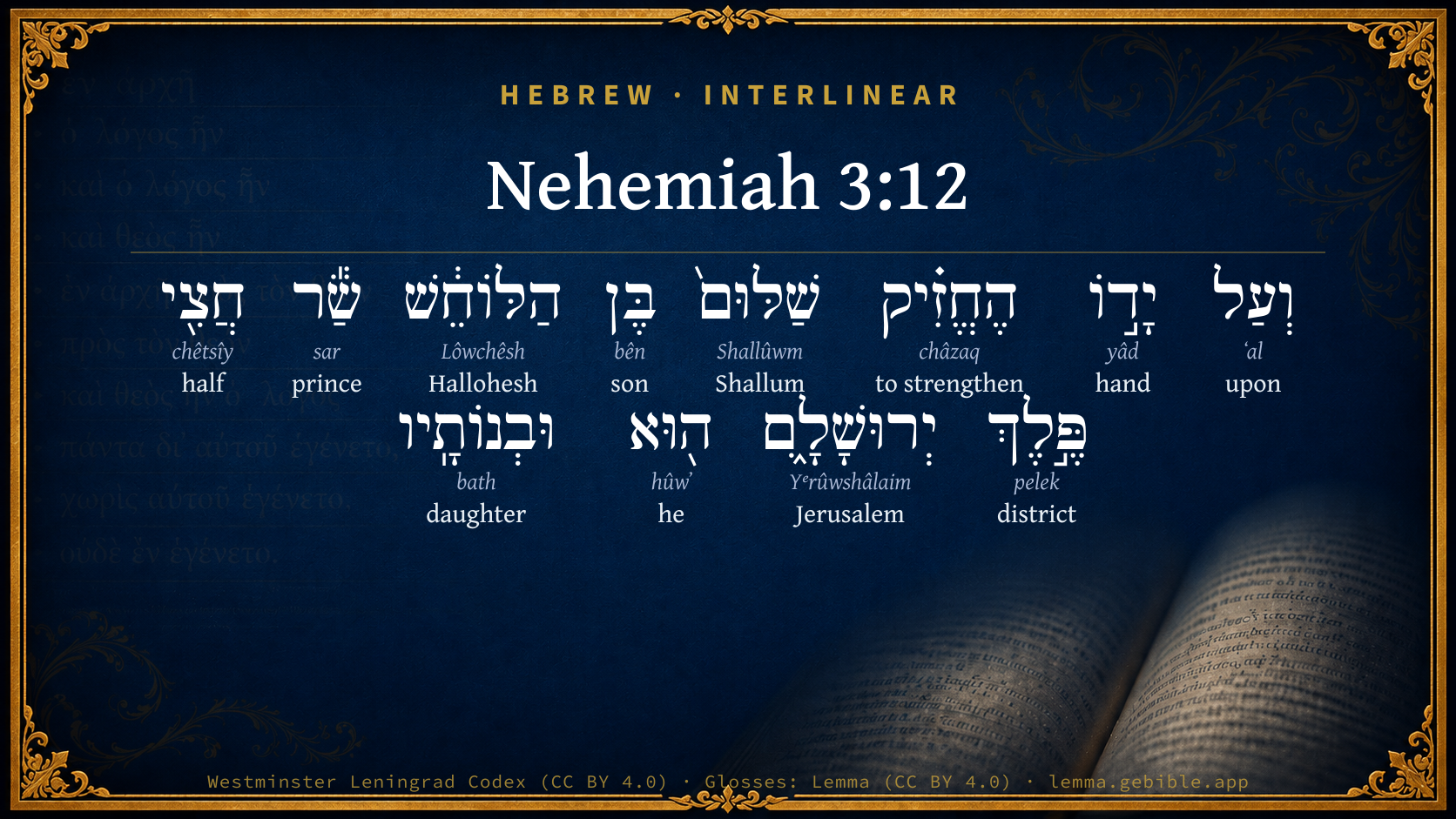
  1. וְעַל ʻal H5921 “and · upon” Conjunction + Preposition
  2. יָד֣וֹ yâd H3027 “hand · his” Noun, Common, Both, Singular, Construct + Suffix, Personal, 3rd Person, Masculine, Singular
  3. הֶחֱזִ֗יק châzaq H2388 “to strengthen” Verb, Hiphil, Perfect, 3rd Person, Masculine, Singular
  4. שַׁלּוּם֙ Shallûwm H7967 “Shallum” Noun, Proper
  5. בֶּן bên H1121 “son of” Noun, Common, Masculine, Singular, Construct
  6. שַׂ֕ר sar H8269 “prince of” Noun, Common, Masculine, Singular, Construct
  7. חֲצִ֖י chêtsîy H2677 “half of” Noun, Common, Masculine, Singular, Construct
  8. פֶּ֣לֶךְ pelek H6418 “district of” Noun, Common, Masculine, Singular, Construct
  9. יְרוּשָׁלִָ֑ם Yᵉrûwshâlaim H3389 “Jerusalem” Noun, Proper
  10. ה֖וּא hûwʼ H1931 “he” Pronoun, Personal, 3rd Person, Masculine, Singular
  11. וּבְנוֹתָֽיו bath H1323 “and · daughters · his” Conjunction + Noun, Common, Feminine, Plural, Construct + Suffix, Personal, 3rd Person, Masculine, Singular

About this verse

These counts appear in no published source. They are computed here, from the morphology-tagged text and Lemma’s own curated glosses. What Lemma adds →

12
words
12
distinct lemmas
Historical
section

Notable vocabulary

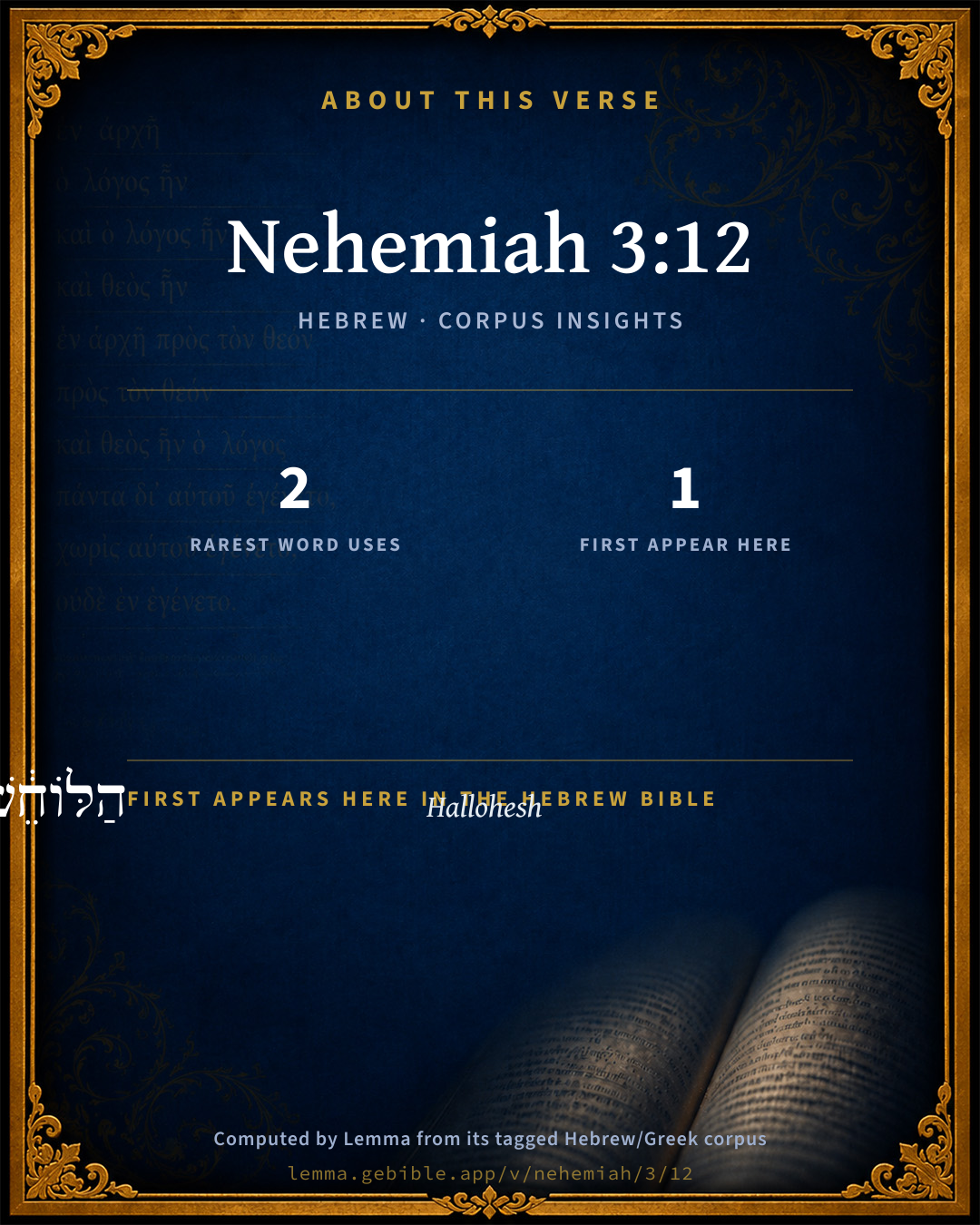
The rarest word here is הַלּוֹחֵ֔שׁ Hallohesh H3873 — appearing just 2 times in the whole Hebrew Bible.

First appearance in Scripture

This word makes its first canonical appearance in the Hebrew Bible here:

  • הַלּוֹחֵ֔שׁ Hallohesh H3873

Shared distinctive vocabulary

הַלּוֹחֵ֔שׁ Hallohesh H3873 occurs in 2 verses of the Hebrew Bible. Also found in:

Grammatical profile

  • 1 verb
  • 9 nouns
  • 1 pronoun
  • 1 preposition

Verb forms

  • הֶחֱזִ֗יק Hiphil · Perfect

Cross-references

5

Topical passages linked to Nehemiah 3:12 in the Treasury of Scripture Knowledge — connected by theme and wording, ordered by reader-vote popularity; previews shown in the World English Bible.

  • Nehemiah 3:9 Next to them repaired Rephaiah the son of Hur, the ruler of half the district of Jerusalem.
  • Exodus 35:25 All the women who were wise-hearted spun with their hands, and brought that which they had spun, the blue, the purple, the scarlet, and the fine linen.
  • Acts 21:8–9 On the next day, we, who were Paul's companions, departed, and came to Caesarea. We entered into the house of Philip the evangelist, who was one of the seven, and stayed with him.
  • Philippians 4:3 Yes, I beg you also, true yoke-fellow, help these women, for they labored with me in the Gospel, with Clement also, and the rest of my fellow workers, whose names are in the book of life.
  • Nehemiah 3:14–18 The dung gate repaired Malchijah the son of Rechab, the ruler of the district of Beth Haccherem; he built it, and set up the doors of it, the bolts of it, and the bars of it.

Cross-references courtesy of OpenBible.info (CC BY 4.0).

Hebrew and Greek witnesses Masoretic Hebrew ↔ Greek Septuagint

The same verse in the two great witnesses to the Old Testament, shown verse-for-verse.

These are two independent witnesses, not word-aligned to each other, and the Septuagint is shown in lemma (dictionary) form.

Hebrew Nehemiah 3:12 Masoretic · Westminster Leningrad Codex

וְעַל יָד֣וֹ הֶחֱזִ֗יק שַׁלּוּם֙ בֶּן הַלּוֹחֵ֔שׁ שַׂ֕ר חֲצִ֖י פֶּ֣לֶךְ יְרוּשָׁלִָ֑ם ה֖וּא וּבְנוֹתָֽיו

Next to him repaired Shallum the son of Hallohesh, the ruler of half the district of Jerusalem, he and his daughters.

World English Bible · Public Domain

Greek LXX Structure differs

The Septuagint has no separate book of Nehemiah. Its Greek text is the second half of Esdras B (2 Esdras), chapters 11–23; Ezra is the first half (1–10).

A verse-for-verse comparison isn’t shown here because the chapters and verses don’t line up. Switch to the LXX edition with the MT / LXX toggle above to read the Greek directly.

Hebrew: Westminster Leningrad Codex (CC BY 4.0). Greek: Septuagint (public domain); English from a public-domain English Septuagint. How the Septuagint differs from the Hebrew →

Commentary

Notes on Nehemiah 3:12 from classic Christian and Jewish commentators (each source and its license shown beneath its notes). The classic Christian expositions comment on the surrounding passage and are grouped to its opening verse, so a note may address several verses; the Jewish commentaries on the Tanakh (Rashi and others) are per-verse, so they appear only where the commentator wrote on this verse.

Lemma curates 59 commentaries, every one of them public domain or Creative Commons licensed, each selected and text-cleaned for this edition rather than reprinted as found. About our sources →

Trapp's Complete Commentary

John Trapp

Neh 3:12 And next unto him repaired Shallum the son of Halohesh, the ruler of the half part of Jerusalem, he and his daughters.

Ver. 12. Shallum the son of Halohesh] Some read it, the son of an enchanter, or conjurer; and tells us that conjuring was a common thing among the Jews, as, Act 13:8 Elymas, and elsewhere the sons of Sceva, &c. But Shallum (if ever any such) forsook that science (as did afterwards also Cyprian) to become a Christian.

He and his daughters] Either finishing what their father (now dead) had begun; or parting with their portions toward the repair of the wall; and haply laying their own hands to the Lord’s work.

John Trapp, A Commentary or Exposition upon All the Books of the Old and New Testament (1647–1656) — public domain. Text from a community e-Sword module.

The Biblical Illustrator

Joseph S. Exell

Neh_3:12

He and his daughters.

Worthy women

We know not how these ladles wrought; probably it was not in a way of manual labour, but rather by words of kindness and acts of consideration towards the builders. We need not tarry to show how worthily the women of England fulfil their mission in the sweet offices of charity. Some of them make the noblest sacrifices from love to their Redeemer. A poor woman sought admission to one of our great missionary meetings in Exeter Hall. The young man who acted as porter demanded her ticket. I have none, was the reply; I cannot afford to subscribe. You cannot enter without a ticket, was the curt rejoinder. I think, sir, said the widow, that I have given more than ever you have to the society; I have given an only son, and he is now labouring for your society in India. The widow was cheerfully admitted on this statement. (J. M. Randall.)

Family zeal

I. Notable women.

1. Within the circle of Biblical story.

2. In history.

II. Womans influence.

1. For evil. Jezebel; Solomons wives; devotees of fashion, etc.

2. For good. (Homiletic Commentary.)

The Biblical Illustrator, edited by Joseph S. Exell (c. 1880s–1900s) — public domain. Text from a community e-Sword module.

Joseph Benson's Commentary

Neh 3:12. Shallum, the ruler of the half part, &c. — That is, of the other half of Jerusalem: see on Neh 3:9. He and his daughters — Who were either heiresses or rich widows, and caused part to be done at their charges.

Joseph Benson's Commentary on the Old and New Testaments (1811–1818) — public domain. Text from a community e-Sword module.

Jamieson, Fausset & Brown

Robert Jamieson, A. R. Fausset & David Brown

Shallum . . . he and his daughters--who were either heiresses or rich widows. They undertook to defray the expenses of a part of the wall next them.

Jamieson, Fausset & Brown — Commentary Critical and Explanatory on the Whole Bible (1871) — public domain (CC PDM 1.0). Text via the HelloAO Bible API.

Adam Clarke's Commentary

Verse 12. The son of Halohesh] Or, the son of the Enchanter: conjectured to be thus named from having the art to charm serpents.

The ruler of the half part] See on Ne 3:9.

Adam Clarke's Commentary on the Bible (1810–1826) — public domain. Text from a community e-Sword/MySword module.

Ellicott's Commentary for English Readers

(12) He and his daughters.—Shallum was governor of the second half-district around Jerusalem; and it has been thought that the “daughters” here are the villages of the district. But needlessly: the women of Jerusalem might do voluntarily what as females they were not pressed to do.

A Bible Commentary for English Readers, edited by Charles John Ellicott (1878–1897) — public domain. Text from a community e-Sword module.

The Cambridge Bible for Schools and Colleges

gen. ed. J. J. S. Perowne

12. the ruler of the half part of Jerusalem] R.V. the ruler of half the district of Jerusalem. See note on Neh_3:9. This was the ‘Zion’ half of the city.

he and his daughters] The mention of ‘his daughters’ is strange. Some consider that the word ‘daughters’ is here used in its technical sense of ‘villages’ and ‘country towns’ (cf. Neh_11:25; Neh_11:27), the inhabitants of which placed workers under the command of the ruler of the whole district. Others again accepting this rendering of ‘daughters’ = ‘villages,’ refer the pronoun ‘he’ to ‘the district,’ i.e. ‘the district and the villages adjacent to that quarter of Jerusalem.’

But the most simple and literal explanation is probably the best. The whole chronicle of the restoration of the walls is a register of personal effort. The exceptional mention of women does not justify us in excluding the possibility of their useful cooperation, not only by sympathy and exhortation, but also by gifts of money, by contributions of food, and by the labour of their servants and retainers.

The Cambridge Bible for Schools and Colleges (gen. ed. J. J. S. Perowne; Cambridge University Press, 1878–1918) — public domain. Text from a community e-Sword module.

John Gill's Exposition

The valley gate repaired Hanun,.... Of which see Neh 2:13,

and the inhabitants of Zanoah; a city in the tribe of Judah, Jos 15:34,

they built it, and set up the doors thereof, &c. see Neh 3:3,

and a thousand cubits on the wall to the dung gate; that is, they repaired the wall to such a length from the valley gate to the dung gate; see Neh 2:13.

John Gill's Exposition of the Whole Bible (1746–1763) — public domain (CC PDM 1.0). Text via the HelloAO Bible API.

Haydock's Catholic Bible Commentary

Alohes, "the enchanter," (Calmet) as he could perhaps enchant serpents. (Grotius) --- Daughters, who forwarded the work, as they had no brothers. (Menochius)

George Leo Haydock (1774–1849), Haydock's Catholic Family Bible and Commentary, 1859 edition — public domain. Excludes Psalms (Douay-Rheims chapter numbering differs from Protestant) and Deuterocanonical books (Catholic canon only).

Matthew Poole's English Annotations

Of the half part of Jerusalem, i.e. of the other half, &c.: See Poole "Neh 3:9".

He and his daughters; who were either heiresses, or rich widows, and caused part to be done at their charges.

Matthew Poole's English Annotations on the Holy Bible (1683–1685) — public domain. Text from a community e-Sword/MySword module.

Whedon's Commentary on the Bible

Daniel D. Whedon

12. Ruler of the half — Compare Neh_3:9, note.

He and his daughters — These words may be understood in two ways: 1) of Shallum and his daughters, who assisted their father in the work; or, 2) of the half part of Jerusalem, and its towns, or villages — such dependent villages often being called the daughters of more princely cities. Compare the Hebrew of Neh_11:25; Neh_11:27, where the word rendered villages is daughters. This latter view we adopt. The pronoun he refers to part, which is masculine; but in English the sense would be clearer if rendered, it and its villages. That is, Shallum was ruler of the half part of Jerusalem, both it and its dependent villages.

Daniel D. Whedon (gen. ed.), Commentary on the Old and New Testaments (1874–1909) — public domain. Text from a community e-Sword module.

The Pulpit Commentary

He and his daughters. It seems to be almost impossible that women were pressed into the service, especially when it was one of so much danger. (Neh_4:13-21) By "daughters" we must therefore understand the villages contained in Shallum"s district, which is agreeable to the use of the term in Neh_11:25, Neh_11:27, Neh_11:28.

Family zeal in good work.

"He and his daughters." Some take "daughters" here in the sense which it bears in Neh_11:25, Neh_11:27, viz., "villages (regarded as the daughters of the town or district to which they belong), and would read, "it" (i.e. the half-part, or district, of Jerusalem) "and its villages." If, however, we take the word "daughters" in the sense of women, they present us an instance of a father and his daughters uniting in a good work. Probably the daughters had independent means. They remind us of the numerous instances in which piety and public spirit animate families parents and their sons and daughters uniting in works of Christian usefulness. Such families are the strength of congregations. Union of a family in Christian work

I INDICATES GOOD AND EFFECTUAL EDUCATION. It shows that the parents have trained their children in piety and zeal, taught them to take an interest in the work of the Lord: and set them the example; and that the children have yielded to the influence thus exerted, imbibing the spirit of their parents, and imitating their deeds. Parents should early associate their children with them in good works, teaching and enabling them to give to the cause of Christ and to the poor, etc. Young people, who have if only a small income of their own, should devote part of it to the good of others, and should employ part of their time in doing good.

II FORMS A SACRED FAMILY BOND. Sanctifies the natural ties; binds parents and children in a holy fellowship.

III ELEVATES FAMILY LIFE. Supplying objects of common interest, topics for conversation, subjects for prayer, employments, occasions of mutual encourage-merit and help, all tending to uplift the thought% affections, motives, and aims above the region of self-interest, worldliness, and vanity: and thus form noble characters.

IV INCREASES AND EXALTS FAMILY HAPPINESS. NO other pursuits in common, however innocent or laudable, can supply pleasures equal to those which spring from common consecration to the service of God and man.

V PREPARES YOUNG PEOPLE FOR HIGHER AND LARGER SERVICE. Thus supplying the Church with a succession of well-qualified workers. Such families are the best nurseries, not only for the Church, but for the ministry and the missionary work.

VI AIDS IN INSURING AND PREPARING FOR FAMILY REUNION IN THE HEAVENLY HOME. Let parents then resolve with Joshua, "As for me and my house, we will serve the Lord." Let sons and daughters heartily co-operate with fathers and mothers in executing this resolution.

The Pulpit Commentary (1880–1919), ed. H.D.M. Spence-Jones & Joseph S. Exell — public domain. Text from a community e-Sword module.

John Wesley's Explanatory Notes

His daughters - Who were either heiresses or rich widows, and caused part to be done at their charges.

John Wesley, Explanatory Notes Upon the Whole Bible (1754–1765) — public domain. Text via the GEBible commentary corpus.

Rashi

Rabbi Shlomo Yitzchaki (Rashi)

he and his daughters Shallum and his daughters repaired the building of the structure.

Rashi on the Tanakh — English translations: “The Judaica Press complete Tanach with Rashi, translated by A. J. Rosenberg” (CC BY 4.0); “Pentateuch with Rashi's commentary by M. Rosenbaum and A.M. Silbermann, 1929-1934” (public domain); “The Metsudah Tanach series, Lakewood, N.J” (CC BY 4.0); and “The Book of Joshua, Metsudah Publications, 1997” (CC BY 4.0). Text via Sefaria.

Lesson kit

Teaching starters — assembled from the data on this page, not authored interpretation. Every prompt links to the verse data it draws on. Edit before teaching.

Nehemiah, in the Historical, opens this verse with 12 words (12 distinct Hebrew lemmas). Its most distinctive word is Lôwchêsh (“Hallohesh”). A historical commentator’s framing appears above. Read the whole chapter for the surrounding context.

Discussion questions

  1. The word Lôwchêsh carries the sense “Hallohesh.” How does it shape the verse?
  2. This is the first place “Hallohesh” appears in Scripture (first appears here). What does its debut here establish?
  3. How does Nehemiah 10:24, which shares the word «Hallohesh», read alongside this verse?
  4. These translations render this verse differently. What is at stake in choosing one wording over another?
  5. «הֶחֱזִ֗יק» is a Hiphil Perfect verb. How does that grammatical form shape the action described?
  6. Compare how Trapp's Complete Commentary and The Biblical Illustrator read this verse. Where do they agree or differ?

Things to notice

Reading settings

Reading text

Shown beneath each verse's original-language words.

Old Testament
Old Testament edition

Read the OT as the Masoretic Hebrew (MT) or the Greek Septuagint (LXX).

English shown for the Greek Septuagint (in the Hebrew ↔ Greek comparison).

Comparing translations? Open the Compare panel on any verse page to stack up to four side by side.