
2 Chronicles 32:18

Hebrew (Westminster Leningrad Codex) 2 Chronicles 32:18 appears in the Hebrew Old Testament. The text above is from the Westminster Leningrad Codex. Each word links to its Strong’s number, a concise gloss, and parsing drawn from the Open Scriptures Hebrew Bible morphology. Click any word for its full Brown-Driver-Briggs (BDB) entry.
Download image
Cite this verse

2 Chronicles 32:18 (World English Bible). Public Domain. Lemma interlinear Bible study tool, https://lemma.gebible.app/v/2-chronicles/32/18.

Show BibTeX & RIS
BibTeX
RIS
English Translation
They cried with a loud voice in the Jews' language to the people of Jerusalem who were on the wall, to frighten them, and to trouble them; that they might take the city.
World English Bible · Public Domain
Download a study sheet

One document with this verse’s original text, its word-by-word gloss line, the meaning frame, cross-references with their text, attributed commentary, and full source and license credits — printable, and it pastes into notes with its structure intact.

This verse Autodidact and up

Study sheet (.html) Plain text (.txt)

A passage Seminary Student

Up to 50 verses in one chapter. A passage sheet keeps up to 6 commentary sources and 12 cross-references per verse, in the order this page ranks them, and says so on the sheet whenever that leaves anything out. Ask for a single verse and you get the Autodidact verse sheet above.

Everything on this page stays free to read, with no account — the sheet is a download of what is already on screen, not access to it.

Want to remove ads? Support Godless Engineer
Compare translations 3

The same verse in 3 English versions, stacked beneath the original-language interlinear above. Click any original word for its lexicon entry.

Each is an independent rendering of the whole verse — the interlinear is not word-aligned to these translations.

Highlighted words mark where these versions differ — a whole-verse word diff, not a word-by-word alignment.

  • World English Bible Public Domain
    They cried with a loud voice in the Jews' language to the people of Jerusalem who were on the wall, to frighten them, and to trouble them; that they might take the city.
  • King James Version Public Domain
    Then they cried with a loud voice in the Jews' speech unto the people of Jerusalem that were on the wall, to affright them, and to trouble them; that they might take the city.
  • unfoldingWord Literal Text CC BY-SA 4.0
    And they called in a great voice in Judean against the people of Jerusalem who were on the wall, to frighten them and to dismay them, in order that they might capture the city.

unfoldingWord Literal Text — © unfoldingWord, licensed CC BY-SA 4.0. Word-aligned USFM3 via Door43 (git.door43.org/unfoldingWord/en_ult).

Versions to compare (up to 4)

3 of 4 selected

Show all 18 translations

Every available English version of this verse, each an independent rendering of the whole verse.

  • World English Bible Public Domain
    They cried with a loud voice in the Jews' language to the people of Jerusalem who were on the wall, to frighten them, and to trouble them; that they might take the city.
  • Berean Standard Bible Public Domain
    Then the Assyrians called out loudly in Hebrew to the people of Jerusalem who were on the wall, to frighten and terrify them in order to capture the city.
  • Majority Standard Bible Public Domain
    Then the Assyrians called out loudly in Hebrew to the people of Jerusalem who were on the wall, to frighten and terrify them in order to capture the city.
  • King James Version Public Domain
    Then they cried with a loud voice in the Jews' speech unto the people of Jerusalem that were on the wall, to affright them, and to trouble them; that they might take the city.
  • American Standard Version (1901) Public Domain
    And they cried with a loud voice in the Jews' language unto the people of Jerusalem that were on the wall, to affright them, and to trouble them; that they might take the city.
  • Revised Version (1885) Public Domain
    And they cried with a loud voice in the Jews’ language unto the people of Jerusalem that were on the wall, to affright them, and to trouble them; that they might take the city.
  • Geneva Bible (1599) Public Domain
    Then they cryed with a loude voyce in the Iewes speach vnto the people of Ierusalem that were on the wall, to feare them and to astonish them, that they might take the citie.
  • Douay-Rheims (1899) Public Domain
    Moreover he cried out with a loud voice, in the Jews' tongue, to the people that sat on the walls of Jerusalem, that he might frighten them, and take the city.
  • Young's Literal Translation Public Domain
    And they call with a great voice `in' Jewish, against the people of Jerusalem who `are' on the wall, to frighten them, and to trouble them, that they may capture the city,
  • Literal Standard Version CC BY-SA 4.0
    And they call with a great voice [in] Jewish against the people of Jerusalem who [are] on the wall, to frighten them and to trouble them, that they may capture the city,
  • Unlocked Literal Bible CC BY-SA 4.0
    They cried out in the language of the Jews to the people of Jerusalem who were on the wall, to frighten them and trouble them, in order that they might capture the city.
  • unfoldingWord Literal Text CC BY-SA 4.0
    And they called in a great voice in Judean against the people of Jerusalem who were on the wall, to frighten them and to dismay them, in order that they might capture the city.
  • Darby Bible Public Domain
    And they cried with a loud voice in the Jewish [language] to the people of Jerusalem that were on the wall, to frighten them and to trouble them; that they might take the city.
  • World Messianic Bible Public Domain
    They called out with a loud voice in the Jews’ language to the people of Jerusalem who were on the wall, to frighten them and to trouble them, that they might take the city.
  • Webster's Bible Public Domain
    Then they cried with a loud voice in the Jews' speech to the people of Jerusalem that were on the wall, to affright them, and to fill them with consternation; that they might take the city.
  • Free Bible Version CC BY-SA 4.0
    The Assyrians also shouted this out in Hebrew to the people of Jerusalem standing on the wall to frighten and to terrify them so that the city would be surrendered.
  • Bible in Basic English Public Domain
    These things they said, crying out with a loud voice in the Jews' language, to the people of Jerusalem who were on the wall, with the purpose of troubling them and putting fear into them, so that they might take the town;
  • JPS Tanakh (1917) Public Domain
    And they cried with a loud voice in the Jews' language unto the people of Jerusalem that were on the wall, to terrify them, and to affright them; that they might take the city.

Literal Standard Version (2020), Covenant Press — licensed CC BY-SA 4.0. Text via the HelloAO Bible API (eBible.org). Unlocked Literal Bible (unfoldingWord) — licensed CC BY-SA 4.0. Text via the HelloAO Bible API (eBible.org). unfoldingWord Literal Text — © unfoldingWord, licensed CC BY-SA 4.0. Word-aligned USFM3 via Door43 (git.door43.org/unfoldingWord/en_ult). Free Bible Version, Dr. Jonathan Gallagher — licensed CC BY-SA 4.0. Text via the HelloAO Bible API (eBible.org).

Word by word

More ways to search: Search by grammar → Find every occurrence → Compare this word →

Practice this passage: Drill this verse → Learn its vocabulary →

יְהוּדִ֗ית
Yᵉhûwdîyth
H3066
“Hebrew”
Noun, Gentilic, Feminine, Singular, Absolute
Part of Speech
Noun
Type
Gentilic
Gender
Feminine
Number
Singular
State
Absolute
Full BDB Definition

Origin: from H3064

TWOT: 850b

in the Jewish language, in Hebrew
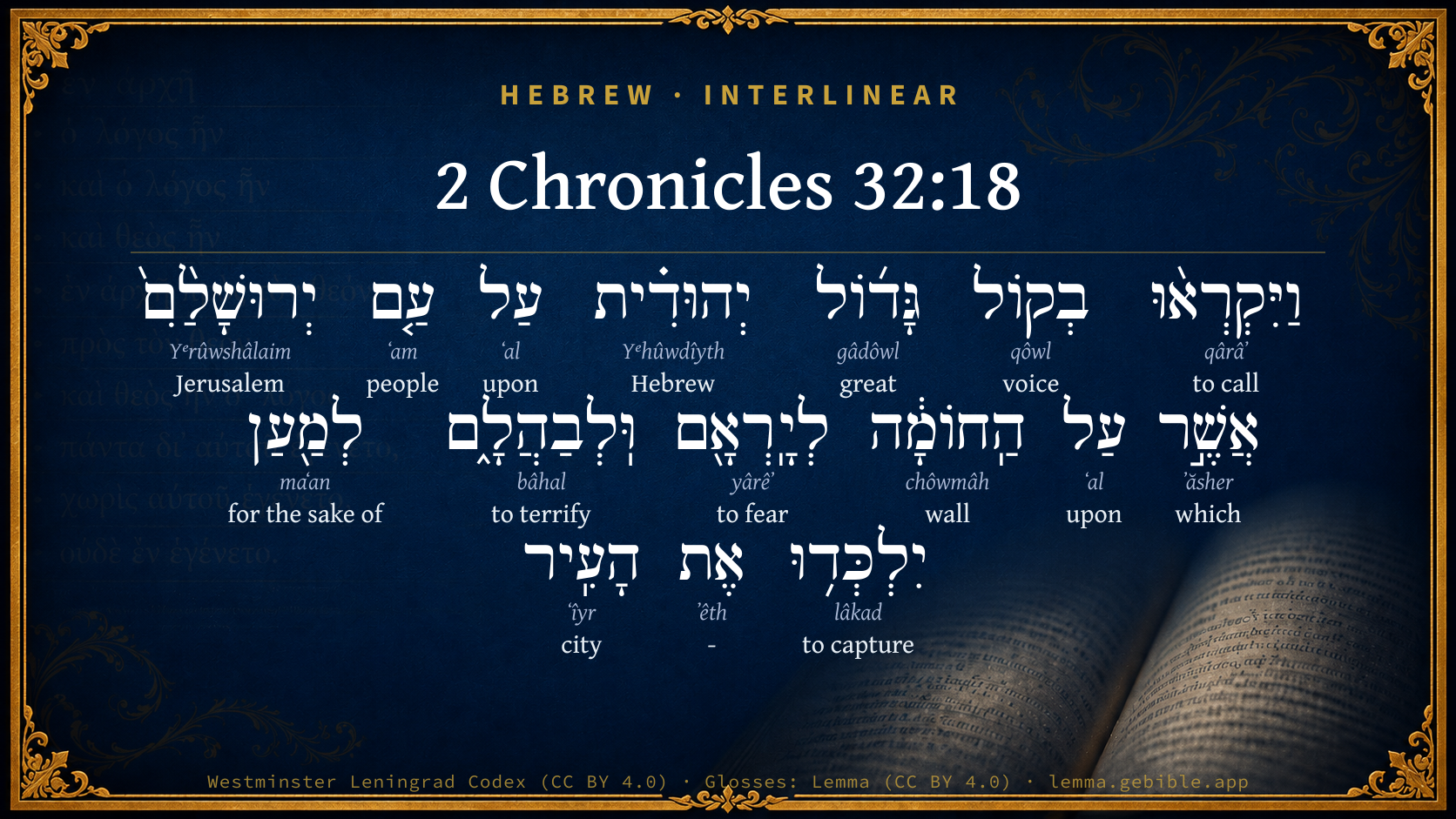
  1. וַיִּקְרְא֨וּ qârâʼ H7121 “and · to call” Conjunction + Verb, Qal, Sequential Imperfect, 3rd Person, Masculine, Plural
  2. בְקוֹל qôwl H6963 “in/at · voice” Preposition + Noun, Common, Masculine, Singular, Absolute
  3. גָּד֜וֹל gâdôwl H1419 “great” Adjective, Adjective, Masculine, Singular, Absolute
  4. עַל ʻal H5921 “upon” Preposition
  5. עַ֤ם ʻam H5971 “people of” Noun, Common, Masculine, Singular, Construct
  6. יְרוּשָׁלִַ֨ם֙ Yᵉrûwshâlaim H3389 “Jerusalem” Noun, Proper
  7. אֲשֶׁ֣ר ʼăsher H834 “which” Particle, Relative
  8. עַל ʻal H5921 “upon” Preposition
  9. הַֽחוֹמָ֔ה chôwmâh H2346 “the · wall” Particle, Definite Article + Noun, Common, Feminine, Singular, Absolute
  10. לְיָֽרְאָ֖ם yârêʼ H3372 “to fear · them” Preposition + Verb, Piel, Infinitive Construct + Suffix, Personal, 3rd Person, Masculine, Plural
  11. וּֽלְבַהֲלָ֑ם bâhal H926 “and · to terrify · them” Conjunction + Preposition + Verb, Piel, Infinitive Construct + Suffix, Personal, 3rd Person, Masculine, Plural
  12. לְמַ֖עַן maʻan H4616 “for the sake of” Preposition
  13. יִלְכְּד֥וּ lâkad H3920 “to capture” Verb, Qal, Imperfect, 3rd Person, Masculine, Plural
  14. אֶת ʼêth H853 “-” Particle, Direct Object
  15. הָעִֽיר ʻîyr H5892 “the · city” Particle, Definite Article + Noun, Common, Feminine, Singular, Absolute

About this verse

These counts appear in no published source. They are computed here, from the morphology-tagged text and Lemma’s own curated glosses. What Lemma adds →

16
words
15
distinct lemmas
Historical
section

Notable vocabulary

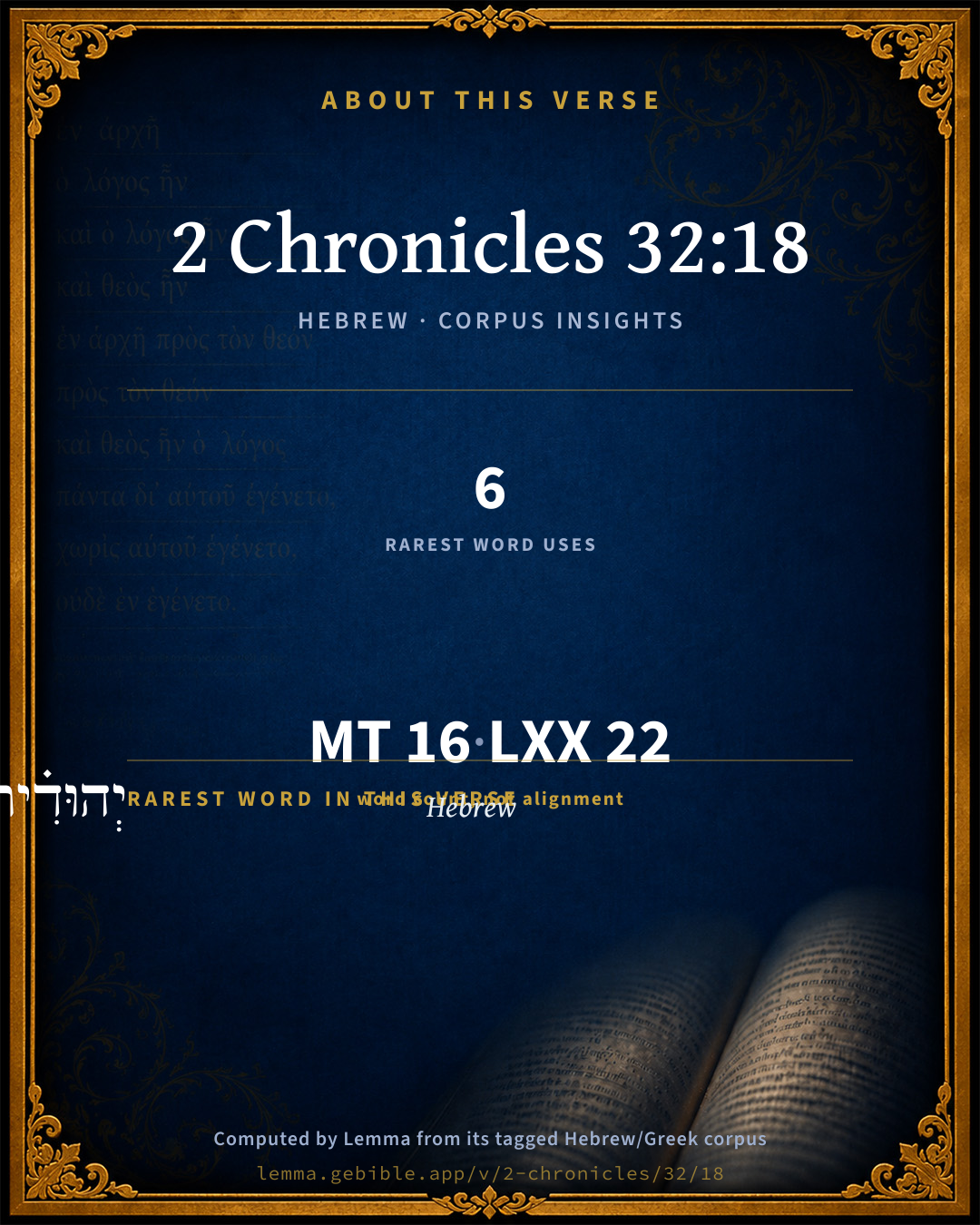
The rarest word here is יְהוּדִ֗ית Hebrew H3066 — appearing just 6 times in the whole Hebrew Bible.

Shared distinctive vocabulary

יְהוּדִ֗ית Hebrew H3066 occurs in 6 verses of the Hebrew Bible. Also found in:

Grammatical profile

  • 4 verbs
  • 6 nouns
  • 1 adjective
  • 3 prepositions
  • 2 particles

Verb forms

  • וַיִּקְרְא֨וּ Qal · Sequential Imperfect
  • לְיָֽרְאָ֖ם Piel · Infinitive Construct
  • וּֽלְבַהֲלָ֑ם Piel · Infinitive Construct
  • יִלְכְּד֥וּ Qal · Imperfect

Repetition

A word recurs within this verse — often emphatic in Hebrew:

Hebrew & Septuagint length

In English translation the verse runs 33 words from the Hebrew and 35 from the Septuagint (LXX English) — closely comparable.

A rough comparison of the two English renderings, which tokenize alike — not a word-level alignment.

Word counts can differ between the Hebrew and the Greek without any difference in meaning — e.g. the Hebrew direct-object marker אֵת has no separate Greek word, and Greek often adds the article ὁ.

In the original languages it is 16 Hebrew tokens and 22 Greek tokens — but the two are counted differently (Hebrew bundles its prefixes and suffixes into one token; the Greek is in lemma form), so that isn’t a like-for-like length.

Cross-references

5

Topical passages linked to 2 Chronicles 32:18 in the Treasury of Scripture Knowledge — connected by theme and wording, ordered by reader-vote popularity; previews shown in the World English Bible.

  • 1 Samuel 17:10 The Philistine said, I defy the armies of Israel this day; give me a man, that we may fight together.
  • 1 Samuel 17:26 David spoke to the men who stood by him, saying, What shall be done to the man who kills this Philistine, and takes away the reproach from Israel? for who is this uncircumcised Philistine, that he should defy the armies of the living God?
  • 2 Kings 18:26–28 Then said Eliakim the son of Hilkiah, and Shebnah, and Joah, to Rabshakeh, Please speak to your servants in the Syrian language; for we understand it: and don't speak with us in the Jews' language, in the ears of the people who are on the wall.
  • Nehemiah 6:9 For they all would have made us afraid, saying, Their hands shall be weakened from the work, that it not be done. But now, [God], strengthen you my hands.
  • Isaiah 36:13 Then Rabshakeh stood, and cried with a loud voice in the Jews' language, and said, Hear you the words of the great king, the king of Assyria.

Cross-references courtesy of OpenBible.info (CC BY 4.0).

Hebrew and Greek witnesses Masoretic Hebrew ↔ Greek Septuagint

The same verse in the two great witnesses to the Old Testament, shown verse-for-verse.

These are two independent witnesses, not word-aligned to each other, and the Septuagint is shown in lemma (dictionary) form.

Hebrew 2 Chronicles 32:18 Masoretic · Westminster Leningrad Codex

וַיִּקְרְא֨וּ בְקוֹל גָּד֜וֹל יְהוּדִ֗ית עַל עַ֤ם יְרוּשָׁלִַ֨ם֙ אֲשֶׁ֣ר עַל הַֽחוֹמָ֔ה לְיָֽרְאָ֖ם וּֽלְבַהֲלָ֑ם לְמַ֖עַן יִלְכְּד֥וּ אֶת הָעִֽיר

They cried with a loud voice in the Jews' language to the people of Jerusalem who were on the wall, to frighten them, and to trouble them; that they might take the city.

World English Bible · Public Domain

Greek LXX 2 Chronicles 32:18 Septuagint · lemma form

καί βοάω φωνή μέγας ἰουδαϊστί ἐπί λαός ἰερουσαλήμ ὁ ἐπί ὁ τεῖχος ὁ φοβέω αὐτός καί κατασπάω ὅπως προ καταλαμβάνω ὁ πόλις

And he cried with a loud voice in the Jews' language to the people of Jerusalem on the wall, calling them to assist them, and pull down the walls, that they might take the city.

LXX2012 (modern English Septuagint) · Public Domain

On this verse, Ellicott's Commentary for English Readers discusses the Septuagint’s reading. Read the note in Commentary ↓

Hebrew: Westminster Leningrad Codex (CC BY 4.0). Greek: Septuagint (public domain); English from LXX2012 (modern English Septuagint) (Public Domain). How the Septuagint differs from the Hebrew →

Commentary

Notes on 2 Chronicles 32:18 from classic Christian and Jewish commentators (each source and its license shown beneath its notes). The classic Christian expositions comment on the surrounding passage and are grouped to its opening verse, so a note may address several verses; the Jewish commentaries on the Tanakh (Rashi and others) are per-verse, so they appear only where the commentator wrote on this verse.

Lemma curates 59 commentaries, every one of them public domain or Creative Commons licensed, each selected and text-cleaned for this edition rather than reprinted as found. About our sources →

Trapp's Complete Commentary

John Trapp

2Ch 32:18 Then they cried with a loud voice in the Jews’ speech unto the people of Jerusalem that [were] on the wall, to affright them, and to trouble them; that they might take the city.

Ver. 18. Then they cried … in the Jews’ speech] See 2Ki 18:28.

To affright them, and to trouble them.] To sow the seeds of sedition amongst them, to make division, and thereby get dominion.

John Trapp, A Commentary or Exposition upon All the Books of the Old and New Testament (1647–1656) — public domain. Text from a community e-Sword module.

Joseph Benson's Commentary

2Ch 32:18-19. That they might take the city — By a surrender of it into their hands. They spake against the God of Jerusalem, as against the gods of the people — They set the God of Israel, the Creator of heaven and earth, upon the same footing with the idols of the heathen.

Joseph Benson's Commentary on the Old and New Testaments (1811–1818) — public domain. Text from a community e-Sword module.

Geneva Bible (1599)

Geneva Bible translators

Their words are written, 2 Kings 18:19.

Geneva Bible (1599) marginal notes — public domain. Text via Bolls.life.

Jamieson, Fausset & Brown

Robert Jamieson, A. R. Fausset & David Brown

they cried with a loud voice . . . unto the people of Jerusalem . . . on the wall--It appears that the wall on the west side of the city reached as far to the side of the uppermost pool of Gihon at that time as it does now, if not farther; and the wall was so close to that pool that those sent to negotiate with the Assyrian general answered him in their own tongue (see on Kg2 18:27).

Jamieson, Fausset & Brown — Commentary Critical and Explanatory on the Whole Bible (1871) — public domain (CC PDM 1.0). Text via the HelloAO Bible API.

Ellicott's Commentary for English Readers

(18) They cried . . . on the wall.—LXX. and Vulg., “he cried” (i.e., the Rab-sak). (See 2Ki_18:26-28.)

To affright them, and to trouble (terrify, scare) them; that they might take the city.—This is the chronicler’s own statement of the purpose of the words of the Rab-sak reported in 2Ki_18:28-35.

To affright.—The pi‘el of yârç, “to fear,” occurs besides, thrice in Neh_6:9; Neh_6:14; Neh_6:19; and once in 2Sa_14:15.

A Bible Commentary for English Readers, edited by Charles John Ellicott (1878–1897) — public domain. Text from a community e-Sword module.

The Cambridge Bible for Schools and Colleges

gen. ed. J. J. S. Perowne

18. in the Jews’ speech] R.V. in the Jews’ language. Cp. 2Ki_18:28 ff. The Rab-shakeh shewed clearly that his object was not to treat with Hezekiah, but to excite a revolt among the Jews against Hezekiah and so gain possession of the city.

The Cambridge Bible for Schools and Colleges (gen. ed. J. J. S. Perowne; Cambridge University Press, 1878–1918) — public domain. Text from a community e-Sword module.

John Gill's Exposition

Thus the Lord saved Hezekiah, and the inhabitants of Jerusalem, from the hand of Sennacherib the king of Assyria,.... As most clearly appeared; for no stroke was struck but by him:

and from the hand of all other; the Arabic version adds,"who were round about them;''who by this defeat were deterred from attacking them:

and guided them on every side: and guarded them all around, as a shepherd leads his flock, where they may be secure from all dangers.

John Gill's Exposition of the Whole Bible (1746–1763) — public domain (CC PDM 1.0). Text via the HelloAO Bible API.

The Pulpit Commentary

In the Jews" speech. (see again 2Ki_18:26, 2Ki_18:27) The last three clauses of this verse are additional matter to that contained in the parallel.

The Pulpit Commentary (1880–1919), ed. H.D.M. Spence-Jones & Joseph S. Exell — public domain. Text from a community e-Sword module.

unfoldingWord translationNotes

Door43 World Missions Community

They cried out

"Sennacherib's servants shouted loudly"

to frighten them and trouble them

These two phrases mean basically the same thing and emphasize the intensity of fear. AT: "to make them very afraid" (See: Doublet)

they might capture

"the Assyrian army might capture"

They spoke of the God of Jerusalem as they had spoken of the gods of the other peoples of the earth

"They mocked the God of Jerusalem as they had mocked the gods of the other peoples of the earth"

which are merely the work of men's hands

This emphasizes that humans made these idols with their own hands and are therefore worthless. AT: "which are merely idols that men have made" (See: Metonymy)

translationWords

Jew

Jerusalem

trouble

people group

earth

works

unfoldingWord translationNotes — © Distant Shores Media and the Door43 World Missions Community, licensed CC BY-SA 4.0. Source: git.door43.org/Door43/en_tn.

Rashi

Rabbi Shlomo Yitzchaki (Rashi)

with a loud voice in Judean, etc. to frighten them and to terrify them Here he relates the matter in generalities, but in II Kings (19) and in Isaiah (37) it is thoroughly elaborated upon.

Rashi on the Tanakh — English translations: “The Judaica Press complete Tanach with Rashi, translated by A. J. Rosenberg” (CC BY 4.0); “Pentateuch with Rashi's commentary by M. Rosenbaum and A.M. Silbermann, 1929-1934” (public domain); “The Metsudah Tanach series, Lakewood, N.J” (CC BY 4.0); and “The Book of Joshua, Metsudah Publications, 1997” (CC BY 4.0). Text via Sefaria.

Lesson kit

Teaching starters — assembled from the data on this page, not authored interpretation. Every prompt links to the verse data it draws on. Edit before teaching.

2 Chronicles, in the Historical, opens this verse with 16 words (15 distinct Hebrew lemmas). Its most distinctive word is Yᵉhûwdîyth (“Hebrew”). A historical commentator’s framing appears above. Read the whole chapter for the surrounding context.

Discussion questions

  1. The word Yᵉhûwdîyth carries the sense “Hebrew.” How does it shape the verse?
  2. 2 Kings 18:26 shares the word «Hebrew» with this verse. How do the two illuminate each other?
  3. “upon” occurs 2× in this one verse. What is the effect of the repetition?
  4. These translations render this verse differently. What is at stake in choosing one wording over another?
  5. The verb «וַיִּקְרְא֨וּ» is Qal Sequential Imperfect. How does its form color the action?
  6. Reading how Trapp's Complete Commentary and Joseph Benson's Commentary read this verse, where do the two commentators agree and where do they part?

Things to notice

Reading settings

Reading text

Shown beneath each verse's original-language words.

Old Testament
Old Testament edition

Read the OT as the Masoretic Hebrew (MT) or the Greek Septuagint (LXX).

English shown for the Greek Septuagint (in the Hebrew ↔ Greek comparison).

Comparing translations? Open the Compare panel on any verse page to stack up to four side by side.