
2 Chronicles 28:24

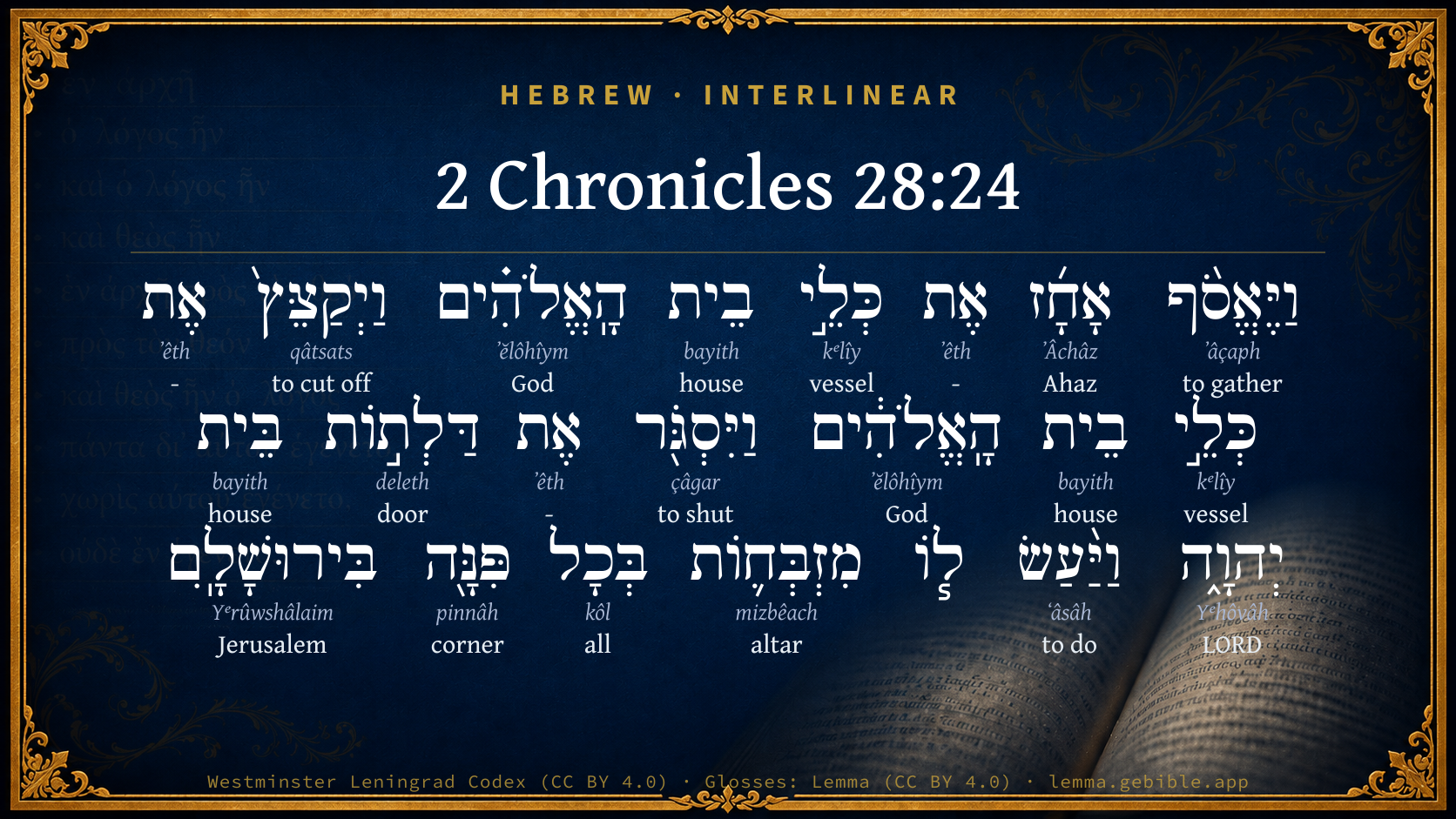
Hebrew (Westminster Leningrad Codex) 2 Chronicles 28:24 appears in the Hebrew Old Testament. The text above is from the Westminster Leningrad Codex. Each word links to its Strong’s number, a concise gloss, and parsing drawn from the Open Scriptures Hebrew Bible morphology. Click any word for its full Brown-Driver-Briggs (BDB) entry.
Download image
Cite this verse

2 Chronicles 28:24 (World English Bible). Public Domain. Lemma interlinear Bible study tool, https://lemma.gebible.app/v/2-chronicles/28/24.

Show BibTeX & RIS
BibTeX
RIS
English Translation
Ahaz gathered together the vessels of the house of God, and cut in pieces the vessels of the house of God, and shut up the doors of the house of Yahweh; and he made him altars in every corner of Jerusalem.
World English Bible · Public Domain
Download a study sheet

One document with this verse’s original text, its word-by-word gloss line, the meaning frame, cross-references with their text, attributed commentary, and full source and license credits — printable, and it pastes into notes with its structure intact.

This verse Autodidact and up

Study sheet (.html) Plain text (.txt)

A passage Seminary Student

Up to 50 verses in one chapter. A passage sheet keeps up to 6 commentary sources and 12 cross-references per verse, in the order this page ranks them, and says so on the sheet whenever that leaves anything out. Ask for a single verse and you get the Autodidact verse sheet above.

Everything on this page stays free to read, with no account — the sheet is a download of what is already on screen, not access to it.

Want to remove ads? Support Godless Engineer
Compare translations 3

The same verse in 3 English versions, stacked beneath the original-language interlinear above. Click any original word for its lexicon entry.

Each is an independent rendering of the whole verse — the interlinear is not word-aligned to these translations.

Highlighted words mark where these versions differ — a whole-verse word diff, not a word-by-word alignment.

  • World English Bible Public Domain
    Ahaz gathered together the vessels of the house of God, and cut in pieces the vessels of the house of God, and shut up the doors of the house of Yahweh; and he made him altars in every corner of Jerusalem.
  • King James Version Public Domain
    And Ahaz gathered together the vessels of the house of God, and cut in pieces the vessels of the house of God, and shut up the doors of the house of the LORD, and he made him altars in every corner of Jerusalem.
  • unfoldingWord Literal Text CC BY-SA 4.0
    And Ahaz gathered the items of the house of God and cut up the items of the house of God. And he shut the doors of the house of Yahweh. And he made for himself altars in every corner in Jerusalem.

unfoldingWord Literal Text — © unfoldingWord, licensed CC BY-SA 4.0. Word-aligned USFM3 via Door43 (git.door43.org/unfoldingWord/en_ult).

Versions to compare (up to 4)

3 of 4 selected

Show all 18 translations

Every available English version of this verse, each an independent rendering of the whole verse.

  • World English Bible Public Domain
    Ahaz gathered together the vessels of the house of God, and cut in pieces the vessels of the house of God, and shut up the doors of the house of Yahweh; and he made him altars in every corner of Jerusalem.
  • Berean Standard Bible Public Domain
    Then Ahaz gathered up the articles of the house of God, cut them into pieces, shut the doors of the house of the LORD, and set up altars of his own on every street corner in Jerusalem.
  • Majority Standard Bible Public Domain
    Then Ahaz gathered up the articles of the house of God, cut them into pieces, shut the doors of the house of the LORD, and set up altars of his own on every street corner in Jerusalem.
  • King James Version Public Domain
    And Ahaz gathered together the vessels of the house of God, and cut in pieces the vessels of the house of God, and shut up the doors of the house of the LORD, and he made him altars in every corner of Jerusalem.
  • American Standard Version (1901) Public Domain
    And Ahaz gathered together the vessels of the house of God, and cut in pieces the vessels of the house of God, and shut up the doors of the house of Jehovah; and he made him altars in every corner of Jerusalem.
  • Revised Version (1885) Public Domain
    And Ahaz gathered together the vessels of the house of God, and cut in pieces the vessels of the house of God, and shut up the doors of the house of the LORD; and he made him altars in every corner of Jerusalem.
  • Geneva Bible (1599) Public Domain
    And Ahaz gathered the vessels of ye house of God, and brake the vessels of the house of God, and shut vp the doores of the house of the Lord, and made him altars in euery corner of Ierusalem.
  • Douay-Rheims (1899) Public Domain
    Then Achaz having taken away all the vessels of the house of God, and broken them, shut up the doors of the temple of God, and made himself altars in all the corners of Jerusalem.
  • Young's Literal Translation Public Domain
    And Ahaz gathereth the vessels of the house of God, and cutteth in pieces the vessels of the house of God, and shutteth the doors of the house of Jehovah, and maketh to himself altars in every corner in Jerusalem.
  • Literal Standard Version CC BY-SA 4.0
    And Ahaz gathers the vessels of the house of God, and cuts in pieces the vessels of the house of God, and shuts the doors of the house of YHWH, and makes altars for himself in every corner in Jerusalem.
  • Unlocked Literal Bible CC BY-SA 4.0
    Ahaz gathered together the furnishings of the house of God and cut them to pieces. He shut the doors of the house of Yahweh and he made for himself altars in every corner of Jerusalem.
  • unfoldingWord Literal Text CC BY-SA 4.0
    And Ahaz gathered the items of the house of God and cut up the items of the house of God. And he shut the doors of the house of Yahweh. And he made for himself altars in every corner in Jerusalem.
  • Darby Bible Public Domain
    And Ahaz gathered the vessels of the house of God, and cut in pieces the vessels of the house of God, and closed the doors of the house of Jehovah, and he made for himself altars in every corner of Jerusalem.
  • World Messianic Bible Public Domain
    Ahaz gathered together the vessels of God’s house, cut the vessels of God’s house in pieces, and shut up the doors of the LORD’s house; and he made himself altars in every corner of Jerusalem.
  • Webster's Bible Public Domain
    And Ahaz collected the vessels of the house of God, and cut in pieces the vessels of the house of God, and shut up the doors of the house of the LORD, and he made for himself altars in every corner of Jerusalem.
  • Free Bible Version CC BY-SA 4.0
    Ahaz took the sacred items from the Lord's Temple and smashed them to pieces. He barred the doors of the Lord's Temple and set up pagan altars on every corner in Jerusalem.
  • Bible in Basic English Public Domain
    And Ahaz got together the vessels of the house of God, cutting up all the vessels of the house of God, and shutting the doors of the Lord's house; and he made altars in every part of Jerusalem.
  • JPS Tanakh (1917) Public Domain
    And Ahaz gathered together the vessels of the house of God, and cut in pieces the vessels of the house of God, and shut up the doors of the house of the LORD; and he made him altars in every corner of Jerusalem.

Literal Standard Version (2020), Covenant Press — licensed CC BY-SA 4.0. Text via the HelloAO Bible API (eBible.org). Unlocked Literal Bible (unfoldingWord) — licensed CC BY-SA 4.0. Text via the HelloAO Bible API (eBible.org). unfoldingWord Literal Text — © unfoldingWord, licensed CC BY-SA 4.0. Word-aligned USFM3 via Door43 (git.door43.org/unfoldingWord/en_ult). Free Bible Version, Dr. Jonathan Gallagher — licensed CC BY-SA 4.0. Text via the HelloAO Bible API (eBible.org).

Word by word

More ways to search: Search by grammar → Find every occurrence → Compare this word →

Practice this passage: Drill this verse → Learn its vocabulary →

וַיְקַצֵּץ֙
qâtsats
H7112
“and · to cut off”
Conjunction + Verb, Piel, Sequential Imperfect, 3rd Person, Masculine, Singular
Part of Speech
Conjunction + Verb
Stem
Piel
Form
Sequential Imperfect
Person
3rd Person
Gender
Masculine
Number
Singular
Full BDB Definition

Origin: a primitive root

TWOT: 2060

to cut off - (Qal) to cut off - (Piel) to cut or hew off, cut in two, cut in pieces - (Pual) to be cut or hewn off
  1. וַיֶּאֱסֹ֨ף ʼâçaph H622 “and · to gather” Conjunction + Verb, Qal, Sequential Imperfect, 3rd Person, Masculine, Singular
  2. אָחָ֜ז ʼÂchâz H271 “Ahaz” Noun, Proper
  3. אֶת ʼêth H853 “-” Particle, Direct Object
  4. כְּלֵ֣י kᵉlîy H3627 “vessels of” Noun, Common, Masculine, Plural, Construct
  5. בֵית bayith H1004 “house of” Noun, Common, Masculine, Singular, Construct
  6. הָֽאֱלֹהִ֗ים ʼĕlôhîym H430 “the · God(s)” Particle, Definite Article + Noun, Common, Masculine, Plural, Absolute
  7. אֶת ʼêth H853 “-” Particle, Direct Object
  8. כְּלֵ֣י kᵉlîy H3627 “vessels of” Noun, Common, Masculine, Plural, Construct
  9. בֵית bayith H1004 “house of” Noun, Common, Masculine, Singular, Construct
  10. הָֽאֱלֹהִ֔ים ʼĕlôhîym H430 “the · God(s)” Particle, Definite Article + Noun, Common, Masculine, Plural, Absolute
  11. וַיִּסְגֹּ֖ר çâgar H5462 “and · to shut” Conjunction + Verb, Qal, Sequential Imperfect, 3rd Person, Masculine, Singular
  12. אֶת ʼêth H853 “-” Particle, Direct Object
  13. דַּלְת֣וֹת deleth H1817 “doors of” Noun, Common, Feminine, Plural, Construct
  14. בֵּית bayith H1004 “house of” Noun, Common, Masculine, Singular, Construct
  15. יְהוָ֑ה Yᵉhôvâh H3068 “LORD” Noun, Proper
  16. וַיַּ֨עַשׂ ʻâsâh H6213 “and · to do” Conjunction + Verb, Qal, Sequential Imperfect, 3rd Person, Masculine, Singular
  17. מִזְבְּח֛וֹת mizbêach H4196 “altars” Noun, Common, Masculine, Plural, Absolute
  18. בְּכָל kôl H3605 “in/at · all of” Preposition + Noun, Common, Masculine, Singular, Construct
  19. פִּנָּ֖ה pinnâh H6438 “corner” Noun, Common, Feminine, Singular, Absolute
  20. בִּירוּשָׁלִָֽם Yᵉrûwshâlaim H3389 “in/at · Jerusalem” Preposition + Noun, Proper

About this verse

These counts appear in no published source. They are computed here, from the morphology-tagged text and Lemma’s own curated glosses. What Lemma adds →

22
words
15
distinct lemmas
Historical
section

Notable vocabulary

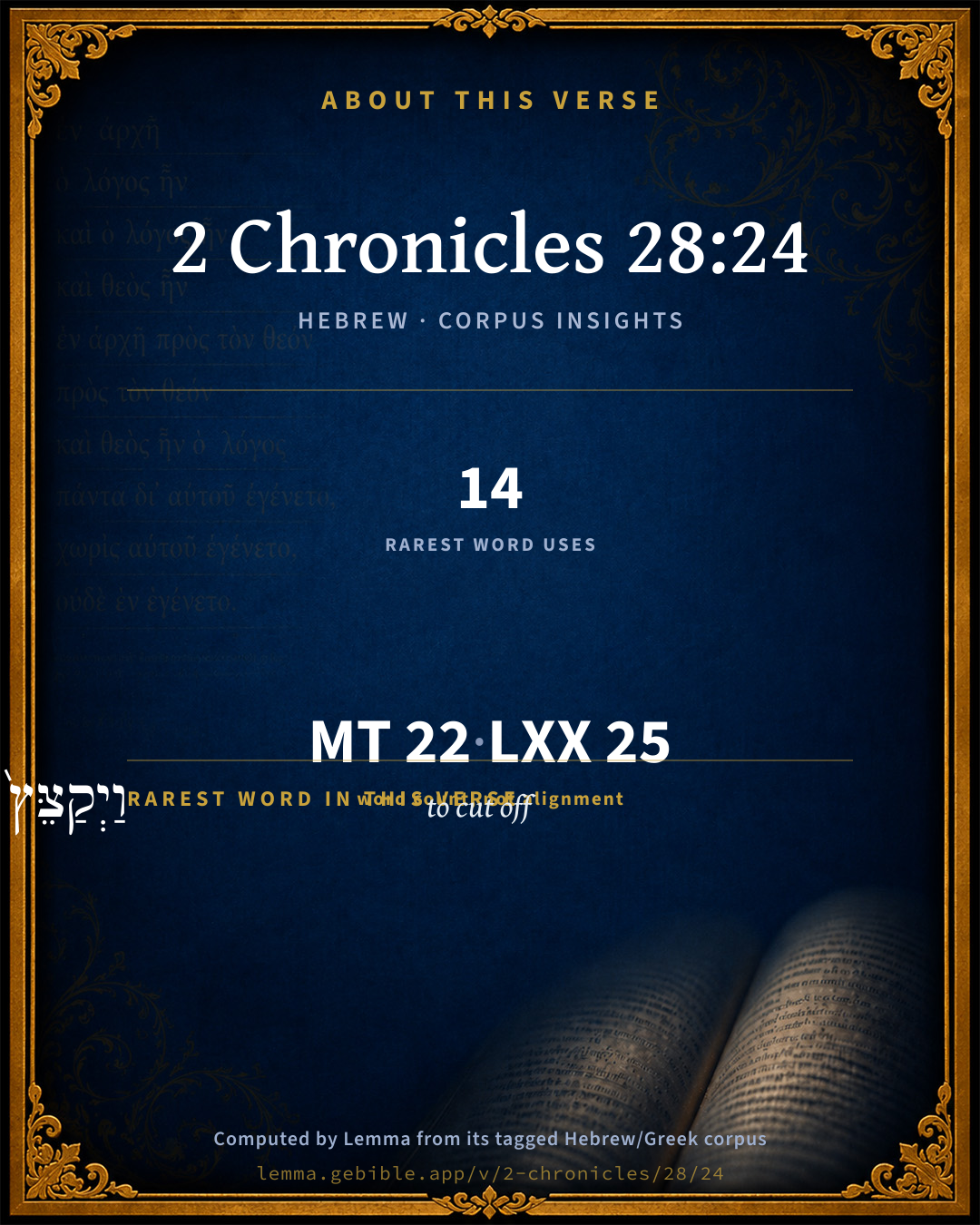
The rarest word here is וַיְקַצֵּץ֙ to cut off H7112 — appearing just 14 times in the whole Hebrew Bible.

Shared distinctive vocabulary

וַיְקַצֵּץ֙ to cut off H7112 occurs in 14 verses of the Hebrew Bible. Also found in:

Grammatical profile

  • 4 verbs
  • 14 nouns
  • 1 preposition
  • 3 particles

Verb forms

  • וַיֶּאֱסֹ֨ף Qal · Sequential Imperfect
  • וַיְקַצֵּץ֙ Piel · Sequential Imperfect
  • וַיִּסְגֹּ֖ר Qal · Sequential Imperfect
  • וַיַּ֨עַשׂ Qal · Sequential Imperfect

Repetition

Words recur within this verse — often emphatic in Hebrew:

  • בֵית house H1004 ×3
  • כְּלֵ֣י vessel H3627 ×2
  • הָֽאֱלֹהִ֗ים God H430 ×2

Hebrew & Septuagint length

In English translation the verse runs 41 words from the Hebrew and 36 from the Septuagint (LXX English) — closely comparable.

A rough comparison of the two English renderings, which tokenize alike — not a word-level alignment.

Word counts can differ between the Hebrew and the Greek without any difference in meaning — e.g. the Hebrew direct-object marker אֵת has no separate Greek word, and Greek often adds the article ὁ.

In the original languages it is 22 Hebrew tokens and 25 Greek tokens — but the two are counted differently (Hebrew bundles its prefixes and suffixes into one token; the Greek is in lemma form), so that isn’t a like-for-like length.

Cross-references

10

Topical passages linked to 2 Chronicles 28:24 in the Treasury of Scripture Knowledge — connected by theme and wording, ordered by reader-vote popularity; previews shown in the World English Bible.

  • 2 Chronicles 29:7 Also they have shut up the doors of the porch, and put out the lamps, and have not burned incense nor offered burnt offerings in the holy place to the God of Israel.
  • 2 Kings 16:17–18 King Ahaz cut off the panels of the bases, and removed the basin from off them, and took down the sea from off the brazen oxen that were under it, and put it on a pavement of stone.
  • 2 Chronicles 30:14 They arose and took away the altars that were in Jerusalem, and all the altars for incense took they away, and cast them into the brook Kidron.
  • 2 Chronicles 33:3–5 For he built again the high places which Hezekiah his father had broken down; and he reared up altars for the Baals, and made Asheroth, and worshiped all the host of the sky, and served them.
  • 2 Kings 25:13–17 The pillars of brass that were in the house of Yahweh, and the bases and the brazen sea that were in the house of Yahweh, did the Chaldeans break in pieces, and carried the brass of them to Babylon.
  • 2 Chronicles 29:3 He in the first year of his reign, in the first month, opened the doors of the house of Yahweh, and repaired them.
  • Jeremiah 2:28 But where are your gods that you have made you? let them arise, if they can save you in the time of your trouble: for according to the number of your cities are your gods, Judah.
  • Hosea 12:11 If Gilead is wicked, Surely they are worthless. In Gilgal they sacrifice bulls. Indeed, their altars are like heaps in the furrows of the field.
  • Acts 17:16 Now while Paul waited for them at Athens, his spirit was provoked within him as he saw the city full of idols.
  • Acts 17:23 For as I passed along, and observed the objects of your worship, I found also an altar with this inscription: 'TO AN UNKNOWN GOD.' What therefore you worship in ignorance, this I announce to you.

Cross-references courtesy of OpenBible.info (CC BY 4.0).

Hebrew and Greek witnesses Masoretic Hebrew ↔ Greek Septuagint

The same verse in the two great witnesses to the Old Testament, shown verse-for-verse.

These are two independent witnesses, not word-aligned to each other, and the Septuagint is shown in lemma (dictionary) form.

Hebrew 2 Chronicles 28:24 Masoretic · Westminster Leningrad Codex

וַיֶּאֱסֹ֨ף אָחָ֜ז אֶת כְּלֵ֣י בֵית הָֽאֱלֹהִ֗ים וַיְקַצֵּץ֙ אֶת כְּלֵ֣י בֵית הָֽאֱלֹהִ֔ים וַיִּסְגֹּ֖ר אֶת דַּלְת֣וֹת בֵּית יְהוָ֑ה וַיַּ֨עַשׂ ל֧וֹ מִזְבְּח֛וֹת בְּכָל פִּנָּ֖ה בִּירוּשָׁלִָֽם

Ahaz gathered together the vessels of the house of God, and cut in pieces the vessels of the house of God, and shut up the doors of the house of Yahweh; and he made him altars in every corner of Jerusalem.

World English Bible · Public Domain

Greek LXX 2 Chronicles 28:24 Septuagint · lemma form

καί ἀποἵστημι αχαζ ὁ σκεῦος οἶκος κύριος καί κατακόπτω αὐτός καί κλείω ὁ θύρα οἶκος κύριος καί ποιέω ἑαυτοῦ θυσιαστήριον ἐν πᾶς γωνία ἐν ἰερουσαλήμ

And Achaz removed the vessels of the house of the Lord, and cut them in pieces, and shut the doors of the house of the Lord, and made to himself altars in every corner in Jerusalem:

LXX2012 (modern English Septuagint) · Public Domain

Hebrew: Westminster Leningrad Codex (CC BY 4.0). Greek: Septuagint (public domain); English from LXX2012 (modern English Septuagint) (Public Domain). How the Septuagint differs from the Hebrew →

Commentary

Notes on 2 Chronicles 28:24 from classic Christian and Jewish commentators (each source and its license shown beneath its notes). The classic Christian expositions comment on the surrounding passage and are grouped to its opening verse, so a note may address several verses; the Jewish commentaries on the Tanakh (Rashi and others) are per-verse, so they appear only where the commentator wrote on this verse.

Lemma curates 59 commentaries, every one of them public domain or Creative Commons licensed, each selected and text-cleaned for this edition rather than reprinted as found. About our sources →

Trapp's Complete Commentary

John Trapp

2Ch 28:24 And Ahaz gathered together the vessels of the house of God, and cut in pieces the vessels of the house of God, and shut up the doors of the house of the LORD, and he made him altars in every corner of Jerusalem.

Ver. 24. And Ahaz gathered together.] See 2Ki 16:8.

And shut up the doors of the house of the Lord.] As Julian shut up the churches of the Christians. Herein Ahaz was worse than Athaliah; who suffered Jehoiada and the priests to execute their offices in the temple, though herself worshipped idols.

John Trapp, A Commentary or Exposition upon All the Books of the Old and New Testament (1647–1656) — public domain. Text from a community e-Sword module.

Tyndale Open Study Notes

Tyndale Open Resources

28:24-25 Judah reached its spiritual nadir—a condition similar to exile—under King Ahaz.

Tyndale Open Study Notes — © Tyndale Open Resources, licensed CC BY-SA 4.0. Text via the HelloAO Bible API.

Adam Clarke's Commentary

Verse 24. Shut up the doors] He caused the Divine worship to be totally suspended; and they continued shut till the beginning of the reign of Hezekiah, one of whose first acts was to reopen them, and thus to restore the Divine worship, 2Ch 29:3.

Adam Clarke's Commentary on the Bible (1810–1826) — public domain. Text from a community e-Sword/MySword module.

Ellicott's Commentary for English Readers

(24) Gathered together the vessels.—According to some MSS. the Syriac, Arabic, Vulg., and Targum, all the vessels.

And cut in pieces the vessels.—Literally, trimmed (qiççaç), i.e., cut off their metal ornaments. The same word is used in 2Ki_16:17, where it is said, “And king Ahaz cut off the plates of the bases, and removed the laver from upon them, and the sea he took down from off the brazen oxen that were under it, and put it on a pavement of stones.”

And shut up the doors of the house of the Lord.—Not in Kings. (Comp. 2Ch_29:3-7.) The doors of the sanctuary itself, not those of the great court, must be understood. (Comp. 2Ki_16:15-16, from which it appears that the new Syrian altar was erected in the inner court near the brazen altar.) By closing the doors Ahaz suspended all rites that could only be duly performed within the Holy Place and the Holy of Holies. (Thenius thinks the verse involves a misunderstanding of 2Ki_16:18.)

In every corner of (in) Jerusalem.—Wanting in Kings.

A Bible Commentary for English Readers, edited by Charles John Ellicott (1878–1897) — public domain. Text from a community e-Sword module.

The Cambridge Bible for Schools and Colleges

gen. ed. J. J. S. Perowne

24. cut in pieces the vessels] Presumably in order to smelt them and put the metal to other uses; cp. 2Ki_24:13. According to 2Ki_16:17 Ahaz merely “cut off the borders (‘panels’ R.V. mg.) of the bases and removed the laver from off them, and took down the sea from off the brasen oxen that were under it, and put it upon a pavement of stone.” In Chron. something more than this is suggested, for “the vessels” would naturally mean such vessels as are mentioned in 2Ki_24:13.

shut up the doors] The Chronicler perhaps misunderstands the difficult passage 2Ki_16:18 (vide A.V. and R.V.). That passage speaks of an alteration carried out by Ahaz on one of the entrances to the Temple, but says nothing of a complete closing of the Temple; indeed it may be gathered from 2Ki_16:14-16 that the daily service went on with one great change, viz. that the king’s new altar was used instead of the brazen altar.

The Cambridge Bible for Schools and Colleges (gen. ed. J. J. S. Perowne; Cambridge University Press, 1878–1918) — public domain. Text from a community e-Sword module.

Albert Barnes' Notes on the Bible

Compare 2Ki 16:17 note. The temple-worship was suspended, the lamps put out, and the doors shut, to prevent the priests from entering. The Jews still celebrate a yearly fast in commemoration of this time of affliction.

Altars - As the one altar for sacrifice, which alone the Law allowed, symbolized the doctrine of one God, so these many altars spoke unmistakeably of the all-embracing polytheism affected by Ahaz.

Albert Barnes' Notes on the Bible (1834–1885) — public domain. Text from a community e-Sword/MySword module.

Haydock's Catholic Bible Commentary

God: first through fear of the Assyrian, (4 K.) but afterwards he permitted it to continue in the same state of irreligion. C. --- So easily do people fall into this abyss, who begin to neglect instruction! H. --- Ezechias took care to open the temple again, C. xxix. 3. C. --- None of the former kings had dared (H.) to prohibit the worship of the true God. T.

George Leo Haydock (1774–1849), Haydock's Catholic Family Bible and Commentary, 1859 edition — public domain. Excludes Psalms (Douay-Rheims chapter numbering differs from Protestant) and Deuterocanonical books (Catholic canon only).

Whedon's Commentary on the Bible

Daniel D. Whedon

24. Shut up… doors of the house of the Lord — This, of course, suspended the temple service, and so matters remained till the first year of Hezekiah, Comp. 2Ch_29:3; 2Ch_29:7. Ahaz seems to have acted on the thought that the erection of altars in every corner of Jerusalem rendered the service of the temple superfluous, and so he closed its doors, put out the sacred lamps, and brought its daily service to an end. So in wickedness and idolatry Ahaz surpassed all his predecessors in Jerusalem. On account of his great wickedness he was not buried in the royal sepulchre.

Daniel D. Whedon (gen. ed.), Commentary on the Old and New Testaments (1874–1909) — public domain. Text from a community e-Sword module.

The Pulpit Commentary

This verse (completed, indeed, by the verse following) heightens to its climax the description of the guilt of Ahaz, which grew to madness. Vers. 17, 18 of the parallel enlarge our view of what Ahaz did in the way of destruction, relating his mutilation of the bases and laver and sea, after also the displacement of the brazen altar in favour of that the pattern of which he had sent from Damascus to Urijah the priest, who must have been a consenting party to the iniquity. Our 2Ch_30:14 speaks of the time that came when these wicked steps of king and priest began to be retraced, and, with the previous verses of same chapter, are the sad but interesting reverse of the present passage. The modern Jews commemorate, by the observance of a fast, this mournful crisis of Judah"s history.

The Pulpit Commentary (1880–1919), ed. H.D.M. Spence-Jones & Joseph S. Exell — public domain. Text from a community e-Sword module.

unfoldingWord translationNotes

Door43 World Missions Community

the house of God ... the house of Yahweh

Here the word "house" represents the temple. AT: "the temple of God ... the temple of Yahweh" (See: Metonymy)

in every corner of Jerusalem

Possible meanings are 1) the word "corner" refers to street corners, or places where streets intersect. AT: "on every street corner in Jerusalem" or 2) the various parts of Jerusalem are spoken of as if they were the corners of the city. AT: "in every part of Jerusalem" (See: Metaphor)

he made for himself altars ... he made high places to burn sacrifices

Since Ahaz was king, he may have had his workers make these high places. AT: "he had his workers make altars for him ... he had his workers make high places to burn sacrifices" (See: Metonymy)

translationWords

house of God

altar

Jerusalem

unfoldingWord translationNotes — © Distant Shores Media and the Door43 World Missions Community, licensed CC BY-SA 4.0. Source: git.door43.org/Door43/en_tn.

Rashi

Rabbi Shlomo Yitzchaki (Rashi)

and he closed the doors of the House of the Lord so that the priests would not go to perform their service in the Tent of Meeting, but come to the altars that he erected on every corner in Jerusalem, and Hezekiah “opened the doors of the House of the Lord,” (below 29:3) because his father had closed the doors of the House of the Lord.

Rashi on the Tanakh — English translations: “The Judaica Press complete Tanach with Rashi, translated by A. J. Rosenberg” (CC BY 4.0); “Pentateuch with Rashi's commentary by M. Rosenbaum and A.M. Silbermann, 1929-1934” (public domain); “The Metsudah Tanach series, Lakewood, N.J” (CC BY 4.0); and “The Book of Joshua, Metsudah Publications, 1997” (CC BY 4.0). Text via Sefaria.

Lesson kit

Teaching starters — assembled from the data on this page, not authored interpretation. Every prompt links to the verse data it draws on. Edit before teaching.

2 Chronicles, in the Historical, opens this verse with 22 words (15 distinct Hebrew lemmas). Its most distinctive word is qâtsats (“to cut off”). A historical commentator’s framing appears above. Read the whole chapter for the surrounding context.

Discussion questions

  1. What does “to cut off” (qâtsats) contribute to the verse as a whole?
  2. Exodus 39:3 shares the word «to cut off» with this verse. How do the two illuminate each other?
  3. “house” occurs 3× in this one verse. What is the effect of the repetition?
  4. These translations render this verse differently; the difference is in the English rendering, not the original. What questions does that raise?
  5. The verb «וַיֶּאֱסֹ֨ף» is Qal Sequential Imperfect. How does its form color the action?
  6. Reading how Trapp's Complete Commentary and Tyndale Open Study Notes read this verse, where do the two commentators agree and where do they part?

Things to notice

Reading settings

Reading text

Shown beneath each verse's original-language words.

Old Testament
Old Testament edition

Read the OT as the Masoretic Hebrew (MT) or the Greek Septuagint (LXX).

English shown for the Greek Septuagint (in the Hebrew ↔ Greek comparison).

Comparing translations? Open the Compare panel on any verse page to stack up to four side by side.