
1 Chronicles 20:1

Hebrew (Westminster Leningrad Codex) 1 Chronicles 20:1 appears in the Hebrew Old Testament. The text above is from the Westminster Leningrad Codex. Each word links to its Strong’s number, a concise gloss, and parsing drawn from the Open Scriptures Hebrew Bible morphology. Click any word for its full Brown-Driver-Briggs (BDB) entry.
Download image
Cite this verse

1 Chronicles 20:1 (World English Bible). Public Domain. Lemma interlinear Bible study tool, https://lemma.gebible.app/v/1-chronicles/20/1.

Show BibTeX & RIS
BibTeX
RIS
English Translation
It happened, at the time of the return of the year, at the time when kings go out [to battle], that Joab led forth the army, and wasted the country of the children of Ammon, and came and besieged Rabbah. But David stayed at Jerusalem. Joab struck Rabbah, and overthrew it.
World English Bible · Public Domain
Download a study sheet

One document with this verse’s original text, its word-by-word gloss line, the meaning frame, cross-references with their text, attributed commentary, and full source and license credits — printable, and it pastes into notes with its structure intact.

This verse Autodidact and up

Study sheet (.html) Plain text (.txt)

A passage Seminary Student

Up to 50 verses in one chapter. A passage sheet keeps up to 6 commentary sources and 12 cross-references per verse, in the order this page ranks them, and says so on the sheet whenever that leaves anything out. Ask for a single verse and you get the Autodidact verse sheet above.

Everything on this page stays free to read, with no account — the sheet is a download of what is already on screen, not access to it.

Want to remove ads? Support Godless Engineer
Compare translations 3

The same verse in 3 English versions, stacked beneath the original-language interlinear above. Click any original word for its lexicon entry.

Each is an independent rendering of the whole verse — the interlinear is not word-aligned to these translations.

Highlighted words mark where these versions differ — a whole-verse word diff, not a word-by-word alignment.

  • World English Bible Public Domain
    It happened, at the time of the return of the year, at the time when kings go out [to battle], that Joab led forth the army, and wasted the country of the children of Ammon, and came and besieged Rabbah. But David stayed at Jerusalem. Joab struck Rabbah, and overthrew it.
  • King James Version Public Domain
    And it came to pass, that after the year was expired, at the time that kings go out to battle, Joab led forth the power of the army, and wasted the country of the children of Ammon, and came and besieged Rabbah. But David tarried at Jerusalem. And Joab smote Rabbah, and destroyed it.
  • unfoldingWord Literal Text CC BY-SA 4.0
    And it happened at the time of the return of the year, the time of the going out of kings, that Joab led the might of the army, and he destroyed the land of the sons of Ammon, and he came and besieged against Rabbah. But David stayed in Jerusalem. And Joab struck Rabbah, and he tore it down.

unfoldingWord Literal Text — © unfoldingWord, licensed CC BY-SA 4.0. Word-aligned USFM3 via Door43 (git.door43.org/unfoldingWord/en_ult).

Versions to compare (up to 4)

3 of 4 selected

Show all 18 translations

Every available English version of this verse, each an independent rendering of the whole verse.

  • World English Bible Public Domain
    It happened, at the time of the return of the year, at the time when kings go out [to battle], that Joab led forth the army, and wasted the country of the children of Ammon, and came and besieged Rabbah. But David stayed at Jerusalem. Joab struck Rabbah, and overthrew it.
  • Berean Standard Bible Public Domain
    In the spring, at the time when kings march out to war, Joab led out the army and ravaged the land of the Ammonites. He came to Rabbah and besieged it, but David remained in Jerusalem. And Joab attacked Rabbah and demolished it.
  • Majority Standard Bible Public Domain
    In the spring, at the time when kings march out to war, Joab led out the army and ravaged the land of the Ammonites. He came to Rabbah and besieged it, but David remained in Jerusalem. And Joab attacked Rabbah and demolished it.
  • King James Version Public Domain
    And it came to pass, that after the year was expired, at the time that kings go out to battle, Joab led forth the power of the army, and wasted the country of the children of Ammon, and came and besieged Rabbah. But David tarried at Jerusalem. And Joab smote Rabbah, and destroyed it.
  • American Standard Version (1901) Public Domain
    And it came to pass, at the time of the return of the year, at the time when kings go out `to battle', that Joab led forth the army, and wasted the country of the children of Ammon, and came and besieged Rabbah. But David tarried at Jerusalem. And Joab smote Rabbah, and overthrew it.
  • Revised Version (1885) Public Domain
    And it came to pass, at the time of the return of the year, at the time when kings go out to battle, that Joab led forth the power of the army, and wasted the country of the children of Ammon, and came and besieged Rabbah. But David tarried at Jerusalem. And Joab smote Rabbah, and overthrew it.
  • Geneva Bible (1599) Public Domain
    And when the yere was expired, in the time that Kings goe out a warfare, Ioab caryed out the strength of the armie, and destroyed the countrey of the children of Ammon, and came and besieged Rabbah (but Dauid taryed at Ierusalem) and Ioab smote Rabbah and destroyed it.
  • Douay-Rheims (1899) Public Domain
    And it came to pass after the course of a year, at the time that kings go out to battle, Joab gathered together an army and the strength of the troops, and wasted the land of the children of Ammon: and went and besieged Rabba. But David stayed at Jerusalem, when Joab smote Rabba, and destroyed it.
  • Young's Literal Translation Public Domain
    And it cometh to pass, at the time of the turn of the year -- at the time of the going out of the messengers -- that Joab leadeth out the force of the host, and destroyeth the land of the sons of Ammon, and cometh in and beseigeth Rabbah -- David is abiding in Jerusalem -- and Joab smiteth Rabbah, and breaketh it down.
  • Literal Standard Version CC BY-SA 4.0
    And it comes to pass, at the time of the turn of the year—at the time of the going out of the messengers—that Joab leads out the force of the host, and destroys the land of the sons of Ammon, and comes in and besieges Rabbah—David is abiding in Jerusalem—and Joab strikes Rabbah, and breaks it down.
  • Unlocked Literal Bible CC BY-SA 4.0
    It came about in the springtime, at the time when kings normally go to war, that Joab led the army into battle and devastated the land of the Ammonites. He went and besieged Rabbah. David remained in Jerusalem. Joab attacked Rabbah and defeated it.
  • unfoldingWord Literal Text CC BY-SA 4.0
    And it happened at the time of the return of the year, the time of the going out of kings, that Joab led the might of the army, and he destroyed the land of the sons of Ammon, and he came and besieged against Rabbah. But David stayed in Jerusalem. And Joab struck Rabbah, and he tore it down.
  • Darby Bible Public Domain
    And it came to pass at the time of the return of the year, at the time when kings go forth, that Joab led forth the power of the army, and laid waste the land of the children of Ammon, and came and besieged Rabbah. But David abode at Jerusalem. And Joab smote Rabbah, and overthrew it.
  • World Messianic Bible Public Domain
    At the time of the return of the year, at the time when kings go out, Joab led out the army and wasted the country of the children of Ammon, and came and besieged Rabbah. But David stayed at Jerusalem. Joab struck Rabbah, and overthrew it.
  • Webster's Bible Public Domain
    And it came to pass, that after the year had expired, at the time that kings go out to battle, Joab led forth the power of the army, and wasted the country of the children of Ammon, and came and besieged Rabbah. But David tarried at Jerusalem. And Joab smote Rabbah, and destroyed it.
  • Free Bible Version CC BY-SA 4.0
    In spring, at the time of year when kings go out to make war, Joab led the Israelite army in attacks against the country of the Ammonites, also besieging Rabbah. However, David remained behind in Jerusalem. Joab attacked Rabbah and destroyed it.
  • Bible in Basic English Public Domain
    Now in the spring, at the time when kings go out to war, Joab went out at the head of the armed forces and made waste all the land of the Ammonites and put his men in position before Rabbah, shutting it in. But David was still at Jerusalem. And Joab took Rabbah and made it waste.
  • JPS Tanakh (1917) Public Domain
    And it came to pass, at the time of the return of the year, at the time when kings go out to battle, that Joab led forth the power of the army, and wasted the country of the children of Ammon, and came and besieged Rabbah. But David tarried at Jerusalem. And Joab smote Rabbah, and overthrew it.

Literal Standard Version (2020), Covenant Press — licensed CC BY-SA 4.0. Text via the HelloAO Bible API (eBible.org). Unlocked Literal Bible (unfoldingWord) — licensed CC BY-SA 4.0. Text via the HelloAO Bible API (eBible.org). unfoldingWord Literal Text — © unfoldingWord, licensed CC BY-SA 4.0. Word-aligned USFM3 via Door43 (git.door43.org/unfoldingWord/en_ult). Free Bible Version, Dr. Jonathan Gallagher — licensed CC BY-SA 4.0. Text via the HelloAO Bible API (eBible.org).

Word by word

More ways to search: Search by grammar → Find every occurrence → Compare this word →

Practice this passage: Drill this verse → Learn its vocabulary →

תְּשׁוּבַ֨ת
tᵉshûwbâh
H8666
“answer of”
Noun, Common, Feminine, Singular, Construct
Part of Speech
Noun
Type
Common
Gender
Feminine
Number
Singular
State
Construct
Full BDB Definition

Origin: from H7725

TWOT: 2340f

a recurrence, an answer, return - return - completion of a year, return of a year - at the return (construct) - answer, reply
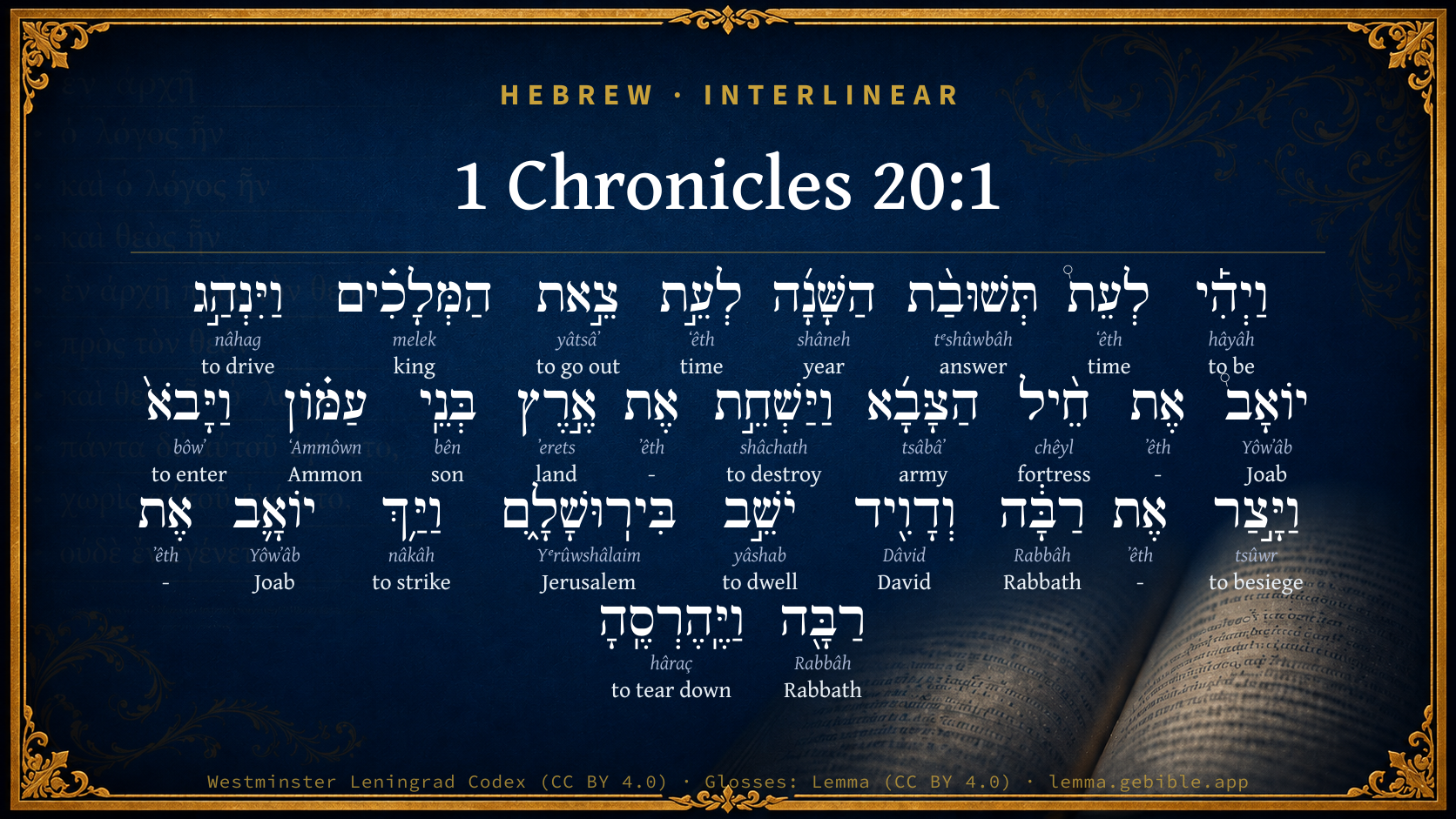
  1. וַיְהִ֡י hâyâh H1961 “and · to be” Conjunction + Verb, Qal, Sequential Imperfect, 3rd Person, Masculine, Singular
  2. לְעֵת֩ ʻêth H6256 “to/for · time of” Preposition + Noun, Common, Both, Singular, Construct
  3. הַשָּׁנָ֜ה shâneh H8141 “the · year” Particle, Definite Article + Noun, Common, Feminine, Singular, Absolute
  4. לְעֵ֣ת ʻêth H6256 “to/for · time of” Preposition + Noun, Common, Both, Singular, Construct
  5. צֵ֣את yâtsâʼ H3318 “to go out” Verb, Qal, Infinitive Construct
  6. הַמְּלָכִ֗ים melek H4428 “the · kings” Particle, Definite Article + Noun, Common, Masculine, Plural, Absolute
  7. וַיִּנְהַ֣ג nâhag H5090 “and · to drive” Conjunction + Verb, Qal, Sequential Imperfect, 3rd Person, Masculine, Singular
  8. יוֹאָב֩ Yôwʼâb H3097 “Joab” Noun, Proper
  9. אֶת ʼêth H853 “-” Particle, Direct Object
  10. חֵ֨יל chêyl H2426 “fortress of” Noun, Common, Masculine, Singular, Construct
  11. הַצָּבָ֜א tsâbâʼ H6635 “the · army” Particle, Definite Article + Noun, Common, Both, Singular, Absolute
  12. וַיַּשְׁחֵ֣ת shâchath H7843 “and · to destroy” Conjunction + Verb, Hiphil, Sequential Imperfect, 3rd Person, Masculine, Singular
  13. אֶת ʼêth H853 “-” Particle, Direct Object
  14. אֶ֣רֶץ ʼerets H776 “land of” Noun, Common, Both, Singular, Construct
  15. בְּנֵֽי bên H1121 “sons of” Noun, Common, Masculine, Plural, Construct
  16. עַמּ֗וֹן ʻAmmôwn H5983 “Ammon” Noun, Proper
  17. וַיָּבֹא֙ bôwʼ H935 “and · to enter” Conjunction + Verb, Qal, Sequential Imperfect, 3rd Person, Masculine, Singular
  18. וַיָּ֣צַר tsûwr H6696 “and · to besiege” Conjunction + Verb, Qal, Sequential Imperfect, 3rd Person, Masculine, Singular
  19. אֶת ʼêth H853 “-” Particle, Direct Object
  20. רַבָּ֔ה Rabbâh H7237 “Rabbath” Noun, Proper
  21. וְדָוִ֖יד Dâvid H1732 “and · David” Conjunction + Noun, Proper
  22. יֹשֵׁ֣ב yâshab H3427 “dwelling” Verb, Qal, Participle Active, Masculine, Singular, Absolute
  23. בִּירֽוּשָׁלִָ֑ם Yᵉrûwshâlaim H3389 “in/at · Jerusalem” Preposition + Noun, Proper
  24. וַיַּ֥ךְ nâkâh H5221 “and · to strike” Conjunction + Verb, Hiphil, Sequential Imperfect, 3rd Person, Masculine, Singular
  25. יוֹאָ֛ב Yôwʼâb H3097 “Joab” Noun, Proper
  26. אֶת ʼêth H853 “-” Particle, Direct Object
  27. רַבָּ֖ה Rabbâh H7237 “Rabbath” Noun, Proper
  28. וַיֶּֽהֶרְסֶֽהָ hâraç H2040 “and · to tear down · her” Conjunction + Verb, Qal, Sequential Imperfect, 3rd Person, Masculine, Singular + Suffix, Personal, 3rd Person, Feminine, Singular

About this verse

These counts appear in no published source. They are computed here, from the morphology-tagged text and Lemma’s own curated glosses. What Lemma adds →

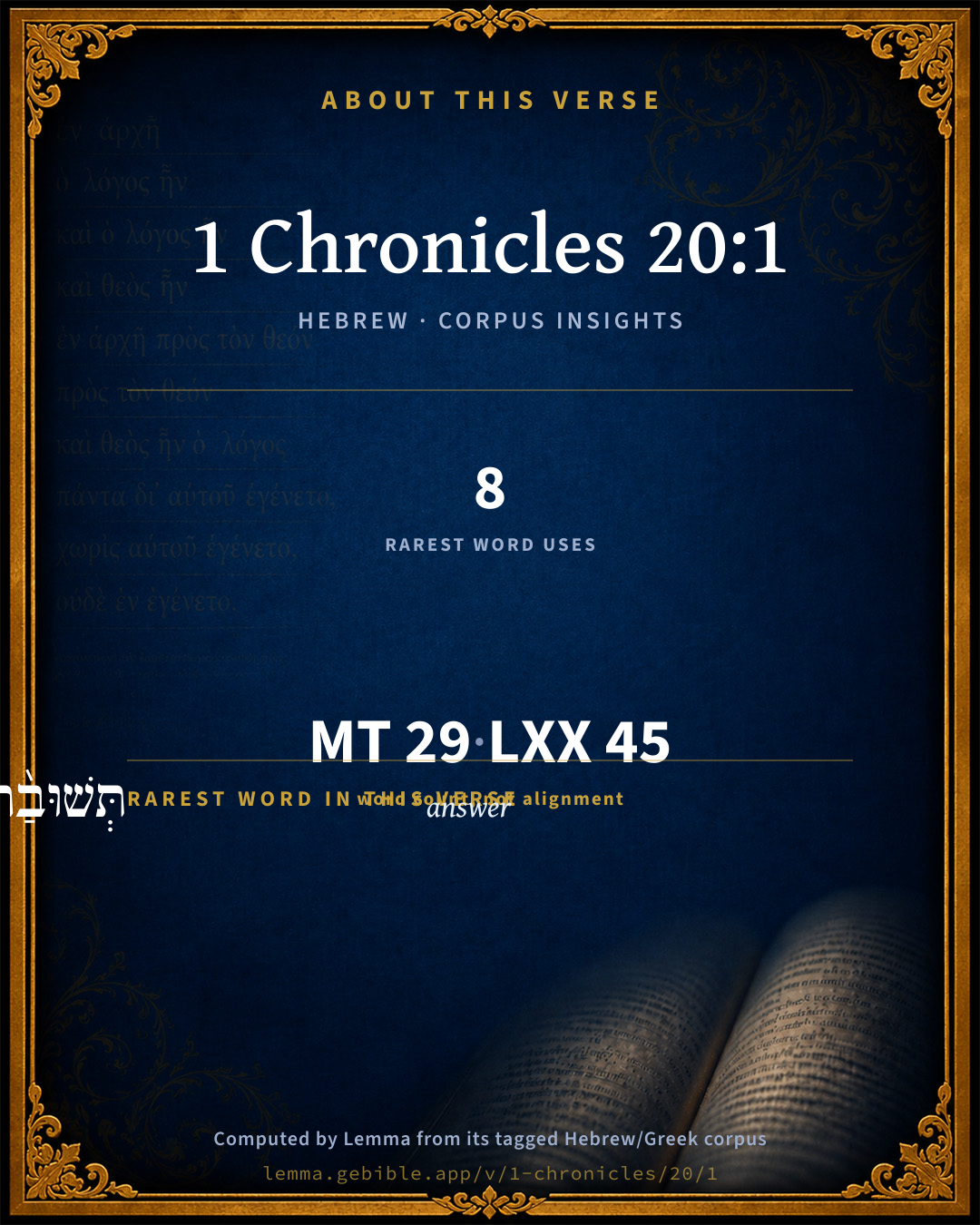
29
words
23
distinct lemmas
Historical
section

Notable vocabulary

The rarest word here is תְּשׁוּבַ֨ת answer H8666 — appearing just 8 times in the whole Hebrew Bible.

Shared distinctive vocabulary

תְּשׁוּבַ֨ת answer H8666 occurs in 8 verses of the Hebrew Bible. Also found in:

Grammatical profile

  • 9 verbs
  • 16 nouns
  • 4 particles

Verb forms

  • וַיְהִ֡י Qal · Sequential Imperfect
  • צֵ֣את Qal · Infinitive Construct
  • וַיִּנְהַ֣ג Qal · Sequential Imperfect
  • וַיַּשְׁחֵ֣ת Hiphil · Sequential Imperfect
  • וַיָּבֹא֙ Qal · Sequential Imperfect
  • וַיָּ֣צַר Qal · Sequential Imperfect
  • יֹשֵׁ֣ב Qal · Participle Active
  • וַיַּ֥ךְ Hiphil · Sequential Imperfect
  • וַיֶּֽהֶרְסֶֽהָ Qal · Sequential Imperfect

Repetition

Words recur within this verse — often emphatic in Hebrew:

  • לְעֵת֩ time H6256 ×2
  • יוֹאָב֩ Joab H3097 ×2
  • רַבָּ֔ה Rabbath H7237 ×2

Hebrew & Septuagint length

In English translation the verse runs 51 words from the Hebrew and 59 from the Septuagint (LXX English) — closely comparable.

A rough comparison of the two English renderings, which tokenize alike — not a word-level alignment.

Word counts can differ between the Hebrew and the Greek without any difference in meaning — e.g. the Hebrew direct-object marker אֵת has no separate Greek word, and Greek often adds the article ὁ.

In the original languages it is 29 Hebrew tokens and 45 Greek tokens — but the two are counted differently (Hebrew bundles its prefixes and suffixes into one token; the Greek is in lemma form), so that isn’t a like-for-like length.

Cross-references

14

Topical passages linked to 1 Chronicles 20:1 in the Treasury of Scripture Knowledge — connected by theme and wording, ordered by reader-vote popularity; previews shown in the World English Bible.

  • 2 Samuel 11:1 It happened, at the return of the year, at the time when kings go out [to battle], that David sent Joab, and his servants with him, and all Israel; and they destroyed the children of Ammon, and besieged Rabbah. But David stayed at Jerusalem.
  • 2 Samuel 12:26–31 Now Joab fought against Rabbah of the children of Ammon, and took the royal city.
  • Deuteronomy 3:11 (For only Og king of Bashan remained of the remnant of the Rephaim; behold, his bedstead was a bedstead of iron; isn't it in Rabbah of the children of Ammon? nine cubits was the length of it, and four cubits the breadth of it, after the cubit of a man.)
  • Jeremiah 49:2–3 Therefore, behold, the days come, says Yahweh, that I will cause an alarm of war to be heard against Rabbah of the children of Ammon; and it shall become a desolate heap, and her daughters shall be burned with fire: then shall Israel possess those who did possess him, says Yahweh.
  • Amos 1:14 But I will kindle a fire in the wall of Rabbah, And it will devour its palaces, With shouting in the day of battle, With a tempest in the day of the whirlwind;
  • 2 Samuel 11:16–25 It happened, when Joab kept watch on the city, that he assigned Uriah to the place where he knew that valiant men were.
  • 2 Samuel 17:27 It happened, when David was come to Mahanaim, that Shobi the son of Nahash of Rabbah of the children of Ammon, and Machir the son of Ammiel of Lodebar, and Barzillai the Gileadite of Rogelim,
  • 1 Kings 20:22 The prophet came near to the king of Israel, and said to him, Go, strengthen yourself, and mark, and see what you do; for at the return of the year the king of Syria will come up against you.
  • 1 Kings 20:26 It happened at the return of the year, that Ben Hadad mustered the Syrians, and went up to Aphek, to fight against Israel.
  • 2 Kings 13:20 Elisha died, and they buried him. Now the bands of the Moabites invaded the land at the coming in of the year.
  • Isaiah 6:11 Then I said, "Lord, how long?" He answered, "Until cities are waste without inhabitant, And houses without man, And the land becomes utterly waste,
  • Isaiah 54:16 Behold, I have created the smith who blows the fire of coals, and brings forth a weapon for his work; and I have created the waster to destroy.
  • Ezekiel 21:20 You shall appoint a way for the sword to come to Rabbah of the children of Ammon, and to Judah in Jerusalem the fortified.
  • Ezekiel 25:5 I will make Rabbah a stable for camels, and the children of Ammon a couching-place for flocks: and you shall know that I am Yahweh.

Cross-references courtesy of OpenBible.info (CC BY 4.0).

Hebrew and Greek witnesses Masoretic Hebrew ↔ Greek Septuagint

The same verse in the two great witnesses to the Old Testament, shown verse-for-verse.

These are two independent witnesses, not word-aligned to each other, and the Septuagint is shown in lemma (dictionary) form.

Hebrew 1 Chronicles 20:1 Masoretic · Westminster Leningrad Codex

וַיְהִ֡י לְעֵת֩ תְּשׁוּבַ֨ת הַשָּׁנָ֜ה לְעֵ֣ת צֵ֣את הַמְּלָכִ֗ים וַיִּנְהַ֣ג יוֹאָב֩ אֶת חֵ֨יל הַצָּבָ֜א וַיַּשְׁחֵ֣ת אֶת אֶ֣רֶץ בְּנֵֽי עַמּ֗וֹן וַיָּבֹא֙ וַיָּ֣צַר אֶת רַבָּ֔ה וְדָוִ֖יד יֹשֵׁ֣ב בִּירֽוּשָׁלִָ֑ם וַיַּ֥ךְ יוֹאָ֛ב אֶת רַבָּ֖ה וַיֶּֽהֶרְסֶֽהָ

It happened, at the time of the return of the year, at the time when kings go out [to battle], that Joab led forth the army, and wasted the country of the children of Ammon, and came and besieged Rabbah. But David stayed at Jerusalem. Joab struck Rabbah, and overthrew it.

World English Bible · Public Domain

Greek LXX 1 Chronicles 20:1 Septuagint · lemma form

καί γίγνομαι ἐν ὁ ἐπιεἶμι ἔτος ἐν ὁ ἔξοδος ὁ βασιλεύς καί ἄγω ιωαβ πᾶς ὁ δύναμις ὁ στρατιά καί φθείρω ὁ χώρα υἱός αμμων καί ἔρχομαι καί περι καταἵζω ὁ ραββα καί δαυίδ καταἧμαι ἐν ἰερουσαλήμ καί πατάσσω ιωαβ ὁ ραββα καί κατασκάπτω αὐτός

And it came to pass at the return of the year, at the time of the going forth of kings to war, that Joab gathered the whole force of the army, and they ravaged the land of the children of Ammon; and he came and besieged Rabba. But David abode in Jerusalem. And Joab struck Rabba and destroyed it.

LXX2012 (modern English Septuagint) · Public Domain

Hebrew: Westminster Leningrad Codex (CC BY 4.0). Greek: Septuagint (public domain); English from LXX2012 (modern English Septuagint) (Public Domain). How the Septuagint differs from the Hebrew →

Commentary

Notes on 1 Chronicles 20:1 from classic Christian and Jewish commentators (each source and its license shown beneath its notes). The classic Christian expositions comment on the surrounding passage and are grouped to its opening verse, so a note may address several verses; the Jewish commentaries on the Tanakh (Rashi and others) are per-verse, so they appear only where the commentator wrote on this verse.

Lemma curates 59 commentaries, every one of them public domain or Creative Commons licensed, each selected and text-cleaned for this edition rather than reprinted as found. About our sources →

Matthew Henry's Commentary

How the army of the Ammonites and their allies was routed in the field we read in the foregoing chapters. Here we have the destruction of Rabbah, the metropolis of their kingdom (Ch1 20:1), the putting of their king's crown upon David's head (Ch1 20:2), and the great severity that was used towards the people, Ch1 20:3. Of this we had a more full account in 2 Sa. 11, 12, and cannot but remember it by this sad token, that while Joab was besieging Rabbah David fell into that great sin in the matter of Uriah. But it is observable that, though the rest of the story is repeated, that is not: a hint only is given of it, in those words which lie here in a parenthesis - But David tarried at Jerusalem. If he had been abroad with his army, he would have been out of the way of that temptation; but, indulging his ease, he fell into uncleanness. Now, as the relating of the sin David fell into is an instance of the impartiality and fidelity of the sacred writers, so the avoiding of the repetition of it here, when there was a fair occasion given to speak of it again, is designed to teach us that, though there may be a just occasion to speak of the faults and miscarriages of others, yet we should not take delight in the repetition of them. That should always be looked upon as an unpleasing subject which, though sometimes one cannot help falling upon, yet one would not choose to dwell upon, any more than we should love to rake in a dunghill. The persons, or actions, we can say no good of, we had best say nothing of.

Matthew Henry's Commentary on the Whole Bible (1708–1710) — public domain (CC PDM 1.0). Text via the HelloAO Bible API.

The Cambridge Bible for Schools and Colleges

gen. ed. J. J. S. Perowne

1. after the year was expired] R.V. at the time of the return of the year, i.e. in the spring, 2Sa_11:1; 1Ki_20:22.

the power of the army] The Heb. phrase is quite general in meaning: the host of war, the military forces.

Rabbah] the capital of the Ammonites; Jer_49:2; Eze_21:20 (25, Heb). Its site, now called ‘Ammân, is covered with important ruins of the Roman and Byzantine periods. The town lies in a fertile basin, its citadel on a hill on the north side. Bädeker, pp. 185 ff.

David tarried at Jerusalem] In 2 Sam. these words introduce the story of David’s adultery with Bath-sheba, which is omitted from Chron.

Joab smote Rabbah] In 2Sa_12:27 Joab reports to David the capture of the city of waters (i.e. the lower city), and invites him to come and complete the conquest (presumably by capturing the citadel) in person. Probably the citadel was dependent for water on the river which lows through the town.

Ch. 1Ch_20:1-3 (= 2Sa_11:1; 2Sa_12:26-31). The Subjugation of Ammon

The account of the siege of Rabbah is given more shortly in Chron. than in 2 Sam. From the latter we learn that the Ark was in the besiegers’ camp (1Ch_11:11), that the city was defended with spirit (1Ch_11:17), and finally taken piecemeal (1Ch_12:26-29).

The Cambridge Bible for Schools and Colleges (gen. ed. J. J. S. Perowne; Cambridge University Press, 1878–1918) — public domain. Text from a community e-Sword module.

John Gill's Exposition

See Gill on Ch1 20:1, Sa2 11:1, Ch1 20:2, Sa2 12:30, Sa2 21:15, and Ch1 21:1.

Next: 1 Chronicles Chapter 21

John Gill's Exposition of the Whole Bible (1746–1763) — public domain (CC PDM 1.0). Text via the HelloAO Bible API.

Trapp's Complete Commentary

John Trapp

1Ch 20:1 And it came to pass, that after the year was expired, at the time that kings go out [to battle], Joab led forth the power of the army, and wasted the country of the children of Ammon, and came and besieged Rabbah. But David tarried at Jerusalem. And Joab smote Rabbah, and destroyed it.

Ver. 1. And it came to pass.] See 2Sa 11:1, {See Trapp on "2Sa 11:1"}

But David tarried at Jerusalem.] And there committed adultery with Bathsheba; {2Sa 11:1-5} but the author of those two books speaks sparingly, as was before noted, of David’s and his son Solomon’s faults and failings.

John Trapp, A Commentary or Exposition upon All the Books of the Old and New Testament (1647–1656) — public domain. Text from a community e-Sword module.

The Biblical Illustrator

Joseph S. Exell

1Ch_20:1-8

And it came to pass, that after the year was expired.

The capture of Rabbah

From its capture and punishment of its people we learn--

I. That in spiritual warfare there must be no cessation. Rest gives advantage to the enemy, and may delay or frustrate the end in view. Forwards, children, forwards! urged Blucher, in meeting Wellington at Waterloo.

1. Make needful preparation.

2. Be ready for every advantage. The time to go out must be discovered and seized.

II. That in conducting spiritual warfare opportunity is given for the display of virtuous qualities (2Sa_12:26-29). We must, transfer the glory of our conquests to our gracious Commander and Leader.

III. That all things in spiritual warfare will be subdued under Gods power. (J. Wolfendale.)

And David took the crown of their king from off his head.

The loss of a crown

The loss of a crown is much or nothing. The crown itself is a mere bauble, but it is full of significance as a token. Every office points in the direction of supremacy. The doorkeeper is on the road to the highest seat. Do not have a crown that any one can take from you. Men may steal your clothes, but they cannot steal your character. Start your son with fifty thousand golden, pounds, and he may lose it all, and want fifty thousand more; start him with a fine sense of honour, with a sound practical education, with a love of wisdom, with a knowledge of things real, simple, practical, and of daily occurrence, and he will, be rich all the time. Let no man take thy crown. When Carlyle was so poor as hardly to have a loaf, he was walking by the popular side of Hyde Park, and looking upon all that gay tumult he said to himself, with what in another man might have been conceit, but what in him was heroic audacity: I am doing what none of you could do; that is to say, he was writing one of his profoundest and most useful books. There he was rich. Have ideas, convictions, resolutions, ideals, and be faithful as a steward ought to be faithful, and it will never be written of thee that any man took thy crown. A man may throw away such a crown, a man may play the fool in old age; but the truth now to be inculcated is this, that no man, or combination of men, can take away the moral crown, the spiritual diadem, without the mans own consent. (J. Parker, D. D.)

The Biblical Illustrator, edited by Joseph S. Exell (c. 1880s–1900s) — public domain. Text from a community e-Sword module.

Joseph Benson's Commentary

A.M. 2969. — B.C. 1035.

A repetition of David’s wars with the Ammonites, and the taking of Rabbah, 1Ch 20:1-3; with the giants of the Philistines, 1Ch 20:4-8.

NOTES ON CHAPTER 20.

1Ch 20:1. Joab led forth the army, and wasted, &c. — For this verse, see note on 2Sa 11:1; for 1Ch 20:2-3, on 2Sa 12:30-31; and for the rest of the chapter, on 2Sa 21:15, &c. And came and besieged Rabbah — It was at this time, while Joab was besieging Rabbah, that David fell into that great sin in the matter of Uriah. And it is observable, that though the rest of the story be repeated here, that is not. The sacred writer, however, seems to have intended to give a hint of it, when he says, But David tarried at Jerusalem — This gave occasion to his sin. If he had been abroad with his army, he would have been out of the way of that temptation; but indulging his ease he fell into sin, and involved himself in many and great calamities, brought upon him and his house by a just and holy God. Now as the recording of his fall, and the circumstances of it in the former history, is an instance of the impartiality and fidelity of the sacred writers; so the avoiding the repetition of it here, when there was a fair occasion to speak of it again, is designed to teach us, that though there may be a just occasion to speak of the faults and miscarriages of others, yet we should not take delight in the repetition of them. Of those persons or actions of which we can say no good, we had best say nothing.

1Ch 20:7. When he defied Israel, Jonathan the son of Shimea slew him — None are more visibly marked for ruin than those that reproach God and his Israel. God will do great things rather than suffer the enemy to behave themselves proudly, Deu 32:27.

1Ch 20:8. They fell by the hand of David, and of his servants — The servants of David were quite too hard for the giants of Gath in every encounter, because they had God on their side, who takes pleasure in abasing the lofty looks, and humbling the pride and haughtiness of the giants of the earth. Never let the church’s friends be disheartened by the power and pride of the church’s enemies. We need not fear great men against us, while we have the great God for us. But let it be observed that, as David’s victories, so those of the Son of David, are gradual. We do not yet see all things put under him; but we shall see this shortly, and death itself, the last enemy, like these giants, shall be subdued and triumphed over.

Joseph Benson's Commentary on the Old and New Testaments (1811–1818) — public domain. Text from a community e-Sword module.

The Preacher's Complete Homiletical Commentary

Joseph S. Exell (gen. ed.)

CRITICAL NOTES.] This extract from the ancient records tells of Rabbah taken (1Ch_20:1-3); and three sons of the giant of Gath slain (1Ch_20:4-8). It covers 2 Samuel 11-21. [Murphy].

1Ch_20:1-3.—Rabbah taken. Year, at the return or beginning of the year, setting in of spring. Time, when kings of Israel were accustomed, after winter season, to go out to war. Rabbah besieged to complete chastisement of Ammon for insult to David’s messengers. Tarried, his presence not required in the war, more needful in seat of government (cf. 2Sa_12:26-31). Crown. When citadel was taken, the king captured or killed; David took the crown from his head and set it upon his own, to represent himself lord of the Ammonite territory. Cut (1Ch_20:3, cf. margin, made them sawers of stone, diggers of iron, and cutters of wood, i.e., condemned them to forced labour; cf. 2Sa_12:30-31).

1Ch_20:4-8.—Giants slain. Gezer, Gob (2Sa_21:19). Sibb. (chap. 1Ch_11:29). Sippai, Saph. They, the Philistines. Elh. (2Sa_21:19; 1Ch_11:26). Gath (1Ch_20:6; Jos_11:22). Man (2Sa_20:6-7). Fell (1Ch_20:8, cf. 2Sa_20:22, where an account of a conflict between David and a son of Rapha is given).

HOMILETICS

THE CAPTURE OF RABBAH.—1Ch_20:1-3

Punishment of Ammon for treatment of embassy of condolence, hindered by inclement season, now to be completed. The chief city taken, and its fall the crowning act of David’s conquests. From the manner of its capture and the punishment of its people we learn—

I. That in spiritual warfare there must be no cessation. Rest gives advantage to the enemy, and may delay or frustrate the end in view. “Forwards, children, forwards!” urged Blucher, in meeting Wellington at Waterloo.

1. Make needful preparation. Count cost, and fail not through lack of forethought and preparation. Enterprises break down, plans wrecked in every department of labour, through neglect of this principle. “What king going to make war against another king, sitteth not down first, and consulteth whether he be able with ten thousand to meet him that cometh against him with twenty thousand?”

2. Be ready for every advantage. “The time to go out” must be discovered and seized. Many such seasons given to a watchful Christian. “Take the instant by the forward step.” “To everything there is a season, and a time to every purpose under heaven.”

II. That in conducting spiritual warfare opportunity is given for the display of virtuous qualities. Joab had besieged the capital, taken lower part of town, or “city of waters,” and knowing that it would soon fall, sent for the king to come in person and have the honour of taking it himself (cf. 2Sa_12:26). Taking this act as that of an adroit courtier, unwilling to run the risk of exciting the king’s envy by his success, it was wise. But the act of a devoted servant, denying himself, honouring his master, and shielding him from popular disfavour (through his conduct with Bathsheba). Room for us to help the weak, admire the successful, and, above all, to transfer the glory of our conquests to our gracious “Commander and Leader.”

III. That all things in spiritual warfare will be subdued under God’s power. The city was taken, and the people subdued. In Christian warfare, every evil thought in heart, every besetting sin, and every vicious principle in life, overcome by grace; every stronghold of Satan, and every enemy to Christ eventually subdued. “He must reign till he hath put all enemies under his feet.” Great the punishment of those who resist. Ammonites suffered severely, but “woe to the wicked; it shall be ill with him.”

THE HEROES AND THE GIANTS.—1Ch_20:4-8

Individual exploits here given marvellous. Sibbechai, Elhan, and Jonathan slew their men, sons of Rapha, descendants of the race of Raphaim at Gath, remains of pre-Canaanitish inhabitants, distinguished by their gigantic size (cf. 2Sa_21:15-22). Learn—

I. The enemies of God’s people are most powerful. Giants in appearance and reality.

1. Splendid in equipment. Armed with shields and spears, mighty in stature, and conspicuous among their fellows. Our enemies often powerful in material advantages, learning, and all appliances of modern science.

2. Defiant in attitude. “He defied Israel” (1Ch_20:7). Thinking much of themselves, highly esteemed, perhaps, by contemporaries; men of “a high look and a proud heart.” “The lofty looks of man shall be humbled,” &c.

II. God’s people are ever victorious in God’s strength. Inferior in number and unequal in outward equipment, yet a match for giants of ignorance, vice, and sin. Shepherd boys have overthrown kingdoms, and striplings slain giants of evil. Men of faith, with “lamps and pitchers.” with “the jawbone of an ass,” with the meanest instruments, have overcome men of might and stature. “Never let the church’s friends be disheartened by the power and pride of the church’s enemies. We need not fear great men against us while we have the great God for us. What will a finger more on each hand do, or a toe more on each foot, in contest with Omnipotence?”

HOMILETIC HINTS AND SUGGESTIONS

1Ch_20:1. David tarried at Jerusalem. Out of the way of temptation if he had gone with the army in active duty. Temporary rest from work and fight leads often to (a) moral indolence or spiritual sloth; (b) carelessness in office, or unfaithfulness in calling; (c) temptation and disgrace. “Idle hours bring forth idle thoughts, and idle thoughts are nothing but dry, kindling wood, that waits only for a spark to be suddenly a blaze. All have had painful experience that our sins often have their roots in indolence and unfaithfulness in our calling. As long as we walk and work in our office, we are encompassed with a wall; as soon as we fall out of our office, we fall away from our fortunes, and become a prey to the enemy” [Disselhoff].

1Ch_20:2. Crown from off his head.

1. Earthly crowns and kingdoms may be lost and transferred to others. By war, wickedness, and death. When Richard II. was deposed, he was brought forth, says the historian, in a royal robe, and a crown upon his head. Never was a prince so gorgeous with less glory and more grief.

2. Heavenly crowns may be gained. David set store on this crown from the King of Ammon. Better far the crown of God’s favour, the crown of righteousness, the crown of glory. These untarnished by blood and severities, real ornaments to character, and unfading with time, &c.

1Ch_20:4-8. The conflict of the world-power against God’s kingdom is

(1) a continual conflict ever again renewed (There was war again, 1Ch_20:5);

(2) a conflict carried on with malicious cunning, frightful power, and mighty weapons (1Ch_20:5);

(3) a conflict perilous to the people of God, demanding all the power given them by the Lord, and their utmost bravery;

(4) a conflict that by God’s help at last ends in the victory of his kingdom [Lange].

ILLUSTRATIONS TO CHAPTER 20

1Ch_20:2. An incorruptible crown. A French officer, a prisoner on parol at Reading, met with a Bible; he read it, was so impressed with its contents that he was convinced of the folly of sceptical principles and of the truth of Christianity, and resolved to become a Protestant. When rallied by gay associates for taking so serious a turn, he said in vindication, “I have done no more than my old schoolfellow Bernadotte, who has become a Lutheran.” “Yes, but he became so,” said his associates, “to obtain a crown.” “My motive,” said the Christian officer, “is the same; we only differ as to the place. The object of Bernadotte is to obtain a crown in Sweden; mine is to obtain a crown in heaven” [Bib. Museum].

1Ch_20:3. A lesson to conquerors. When Edward the Confessor had entered England from Normandy to recover the kingdom, and was ready to give the Danes battle, one of his captains assured him of victory, adding, “We will not leave one Dane alive.” To which Edward replied, “God forbid that the kingdom should be recovered for me, who am but one man, by the death of thousands. No; I will rather lead a private life, unstained by the blood of my fellow-men, than be a king by such a sacrifice.” Upon which he broke up his camp, and again retired to Normandy, until he was restored to his throne without bloodshed [Percy Anecdotes].

The Preacher's Complete Homiletical Commentary (gen. ed. Joseph S. Exell; Funk & Wagnalls, c. 1892) — public domain (pre-1929). A full-Bible homiletical/sermon-outline anthology covering 65 of 66 books (2 John is absent from the source module). Text from a community e-Sword module.

Keil & Delitzsch

C. F. Keil & F. Delitzsch

See Gill on Ch1 20:1, Sa2 11:1, Ch1 20:2, Sa2 12:30, Sa2 21:15, and Ch1 21:1.

Next: 1 Chronicles Chapter 21

Keil & Delitzsch — Biblical Commentary on the Old Testament (1861–1891) — public domain (CC PDM 1.0). Text via the HelloAO Bible API. (Old Testament only.)

The Annotated Bible

Arno C. Gaebelein

CHAPTER 20 Joab and David take Rabbah

1. Rabbah destroyed (1Ch 20:1-3)

2. The Philistine giants slain (1Ch 20:4-8)

Rabbah was the capital of Ammon (Deu 3:11; Jos 13:25) and was taken by Joab. David tarried in Jerusalem (so fatal to him, 2Sa 11:1) and Joab smote Rabbah and destroyed it. Then David appeared also upon the scene. Joab had summoned David to help in the overthrow of the city (2Sa 12:27, etc). The crown mentioned was probably the crown of Milcom, their idol-king. It was of solid gold set with precious stones. David received the crown and precious stones, even as our Lord Jesus receives the glory and will appear crowned with many crowns (Rev 19:12). On verse 3 see annotations 2Sa 2:31. The overthrow of the giants followed. First Sibbechai slew Sippai of the children of the giants; in 2 Sam. 21 his name is given as Saph. Elhanan slew Lahmi of Goliath. (The words “the brother of” are in italics and must be omitted. It was another giant who had the same name as the giant of 1 Sam. 17.) Then David’s nephew Jonathan, the son of Shimea, David’s brother, slew the last of the giants. He had six fingers on each hand and six toes on each foot and was of great stature. These giants were the special instruments of the power of darkness. They have a typical significance.

The notion of a giant in Scripture is always connected with evil, the lifting up of man against God, the symbol of pride and self-sufficiency, as well as of oppressive power. He is the opposite of the little and the lowly, the humble in heart, with whom God delights to dwell; but thus may stand for the tyranny of a lust, as in the case of Og, or of a Satanic delusion, as with Goliath himself. In those before us we must see, what we have seen in their kinsman, the monstrous delusions which abide in a system of error such as Philistinism depicts, the ecclesiastical “mystery of lawlessness” of Christian times (Numerical Bible).

And in the last one overcome by Jonathan (gift of the LORD), we see a type of the final ecclesiastical leader of the apostasy, the man of sin. The number “six” points to this (Rev 13:11-18).

Arno C. Gaebelein, The Annotated Bible (1913–1922) — public domain. Text from a community e-Sword module.

Tyndale Open Study Notes

Tyndale Open Resources

20:1-3 This war against the Ammonites was the context of David’s sin with Bathsheba (2 Sam 11:2–12:25), which the Chronicler omits.

Tyndale Open Study Notes — © Tyndale Open Resources, licensed CC BY-SA 4.0. Text via the HelloAO Bible API.

Geneva Bible (1599)

Geneva Bible translators

Which was the chief city of the Ammonites.

Geneva Bible (1599) marginal notes — public domain. Text via Bolls.life.

Adam Clarke's Commentary

CHAPTER XX

Joab smites the city of Rabbah; and David puts the crown of its

king upon his own head, and treats the people of the city with

great rigour, 1-3.

First battle with the Philistines, 4.

Second battle with the Philistines, 5.

Third battle with the Philistines, 6, 7.

In these battles three giants are slain, 8.

NOTES ON CHAP. XX

Verse 1. After the year was expired, at the time that kings go out to battle] About the spring of the year; 2Sa 11:1.

After this verse the parallel place in Samuel relates the whole story of David and Bath-sheba, and the murder of Uriah, which the compiler of these books passes over as he designedly does almost every thing prejudicial to the character of David. All he states is, but David tarried at Jerusalem; and, while he thus tarried, and Joab conducted the war against the Ammonites, the awful transactions above referred to took place.

Adam Clarke's Commentary on the Bible (1810–1826) — public domain. Text from a community e-Sword/MySword module.

Ellicott's Commentary for English Readers

(1) After the year was expired.—Heb., at the time of the return of the year: i.e., in spring. (See 1Ki_20:22; 1Ki_20:26.)

At the time that kings go out.—See 1Ki_20:16. Military operations were commonly suspended during winter. The Assyrian kings have chronicled their habit of making yearly expeditions of conquest and plunder. It was exceptional for the king to “remain in the country.”

Joab led forth the power of the army.—Samuel gives details: “David sent Joab and his servants (? the contingents of tributaries, 1Ch_19:19), and all Israel” (i.e., the entire national array).

Wasted the country.—An explanation of Samuel: “wasted the sons of Ammon.”

Rabbah, or Rabbath Ammon, the capital. (See 2Sa_11:1; Amo_1:14; Jer_49:2-3.)

But David tarried (Heb., was tarrying) at Jerusalem.—While Joab’s campaign was in progress-In 2Sa_11:1 this remark prepares the way for the account which there follows of David’s temptation and fall.

And Joab smote Rabbah, and destroyed it.—A brief statement, summarizing the events related in 2Sa_11:27-27. From that passage we learn that, after an assault which doubtless reduced the defenders to the last stage of weakness, Joab sent a message to David at Jerusalem to come and appropriate the honours of the capture. Our 1Ch_20:2, which abruptly introduces David himself as present at Rabbah, obviously implies a knowledge of the narrative as it is told in Samuel, and would hardly be intelligible without it. Whether the chronicler here and elsewhere borrows directly from Samuel, or from another document depending ultimately on the same original as Samuel, cannot certainly be decided.

A Bible Commentary for English Readers, edited by Charles John Ellicott (1878–1897) — public domain. Text from a community e-Sword module.

Albert Barnes' Notes on the Bible

This chapter, containing such other warlike exploits belonging to David’s reign as the writer of Chronicles thinks it important to put on record, is to be compared with the passages of Samuel noted in the marginal references.

Albert Barnes' Notes on the Bible (1834–1885) — public domain. Text from a community e-Sword/MySword module.

Haydock's Catholic Bible Commentary

Year. Hebrew, "at the return of the year," in spring. (Calmet)

George Leo Haydock (1774–1849), Haydock's Catholic Family Bible and Commentary, 1859 edition — public domain. Excludes Psalms (Douay-Rheims chapter numbering differs from Protestant) and Deuterocanonical books (Catholic canon only).

Matthew Poole's English Annotations

Of this first verse, see my notes on 2Sa 11:1; and of 1Ch 20:2,3, on 2Sa 12:30,31; and of the rest of this chapter, on 2Sa 21:15, &c., where also an account is given of the seeming differences between this and that relation.

Matthew Poole's English Annotations on the Holy Bible (1683–1685) — public domain. Text from a community e-Sword/MySword module.

Dummelow's Commentary on the Holy Bible

J. R. Dummelow

The Siege of Rabbah. The Slaughter of three Philistine Giants

This chapter corresponds, with some unimportant differences, to several distinct sections in 2 S, viz. 2Sa_11:1; 2Sa_12:26-31; 2Sa_21:18-22.

2. David took, etc.] This implies David's presence at Rabbah, and as it stands here is inconsistent with the previous verse. In 2 Samuel 12 the discrepancy is explained by a passage which Chronicles omits, relating that Joab summoned David to Rabbah and that the king went thither.

5. Elhanan the son of Jair, etc.] Both this passage and the parallel in 2Sa_21:19 have undergone corruption, and the true text probably had 'Elhanan the son of Jair, a Bethlehemite, slew Goliath the Gittite.' As Goliath is said in 2 Samuel 17 to have been killed by David, there seems to have been variant accounts of his death, unless there were two giants of the same name.

J. R. Dummelow, A Commentary on the Holy Bible (Macmillan, 1909) — public domain. Text from a community e-Sword module.

The Pulpit Commentary

The contents of this chapter are all to be found in the work of Samuel, but woven in, in very different places. The cause of the first considerable difference of this kind is in connection with the occurrence of what would have seemed a mere casual detail of expression in our first verse, "But David tarried at Jerusalem," at which same statement, however, the writer of Samuel halts, to append all that then happened with David in the disastrous matter of Bathsheba and Uriah, occupying nearly two whole chapters (2Sa_11:2-27; 2Sa_12:1-25) a history not recorded at all by the Chronicle compiler. Why David tarried at Jerusalem, and how far he did so legitimately and in harmony with the necessities of government, we know not, but certain it is, he was tempted to make the unhappiest use of his "tarrying at Jerusalem.

The fifteenth verse of the previous chapter stated that the discomfited Ammonites "fled and entered into the city," i.e. into Rabbah. Hither we now learn that, by the command of David, (2Sa_11:1) Joab, at the "return of the year," i.e. probably at the return of spring, (Exo_23:16 Exo_34:22) brings the power of the army, and, after ravaging the country surrounding it, sits down to besiege Rabbah itself. The series of feasts, beginning in spring and ending in autumn, regulated the year. The sacred year began with the new moon that became full next after the spring equinox; but the civil year at the seventh new moon. This one verse illustrates in four several instances at fewest the advantage of having two versions of the same events, even though in this case in comparatively immaterial respects.

1. We here read that Joab wasted the country of the children of Ammon and besieged Rabbah, in place of the less consistent reading of 2Sa_11:1, "destroyed the children of Ammon, and besieged Rabbah.

2. We have here in the Hebrew the right word for "kings" ( M]j"), instead of the word for "angels" ( m]j), as in the parallel place.

3. While we read here that Joab smote Rabbah, and destroyed it, the parallel place, now shifted to, 2Sa_12:27-29, tells of Joab"s generosity (if it were this, and not fear or possibly somewhat tardy obedience to strict commands given on his commission) in his message to David, to repair to the spot immediately and share the glory of the reduction of the city, or be its nominal captor.

4. And, once more, while we read here that Joab smote Rabbah, and destroyed it, and yet read in the parallel place of the delay and the visit of David (with which the very first clause of our ver. 2, "And David took," etc., is in perfect accord) and of David"s nominal taking of the city, we find probably the just and inartificial explanation of all this in, 2Sa_12:26-29. There we read more particularly that Joab sent word he had taken the "city of waters," i.e. tie lower part of the city (where a stream had its source, and no doubt supplied the city with water) which was very likely the key of the whole position,and called upon David to come up and "encamp against the city and take it," i.e. the city, or citadel, which stood upon the heights north of the stream. Glimpses of this kind may suffice to convince us how rapidly a text, really correct, would melt away for us a very large proportion of the whole number of the lesser obstacles which often impede our path in the historical books of the Old Testament. At the time that kings go out. It was no doubt the case that, even in Palestine, the winter was often a period of enforced inactivity. Rabbah. Tim punishment of Ammou for the treatment of David"s well-intended embassy of condolence is now about to be completed. The familiar root of Rabbah signifies multitudinous number, and, resulting thence, the greatness of importance. It was the chief city of the Ammonites, if not their only city of importance enough for mention. In five passages its connection with Ammon is coupled with its name (Deu_3:11; 2Sa_12:26 2Sa_17:27; Jer_49:2; Eze_21:20) "Rabbah of the children of Ammon." It has been conjectured to be the Ham of the Zuzim, or the Ashteroth Karnaim of the Rephaim, (Gen_14:5) of which latter theory there is some interesting evidence of a corroborating tendency at all events (see Smith"s "Bible Dictionary," 2:985). Rabbah is the proper spelling of the word, except when in a constructive state, as in the above phrase. The relations of Moab and Ammon with Israel are full of interest. After the overthrow of Og, King of Bashan, (Num_21:33) "Moab and Ammon still remained independent allies south and cast of the Israelite settlements. Both fell before David Moab, evidently the weaker, first; Ammon not without a long resistance, which made the siege and fall of its capital, Rabbah-ammon, the crowning act of David"s conquests. The ruins which now adorn the "royal city" are of a later Roman date; but the commanding position of the citadel remains; and the unusual sight of a living stream abounding in fish (2Sa_12:27; Isa_16:2) marks the significance of Joab"s song of victory, "I have fought against Rabbah, and have taken the city of waters (Stanley"s "Sinai and Palestine," 323, edit. 1866).

Ver. 1.

On the wars of the Israelites, and on war generally.

the time that kings," etc. This chapter also seems to contain little of homiletic interest. Nevertheless it offers abundantly the opportunity of some consideration of the subject of the wars undertaken by the separated people, and thence of the subject of war since and generally. This chapter repeats the word war" three times in vers. 4-6. But yet rather the very turn of the expression in ver. 1, "At the time that kings go out to battle," far surpasses any suggestiveness that might arise merely from the repetition of a word. At the outset of any consideration of this subject as it arises in connection with Scripture, attention is arrested, and it may be said universally arrested, by certain patent facts. They are facts from which we cannot run away, and which, however they may suffer explanation in themselves, will soon show that they refuse to be explained away. The more necessary is it to treat them accordingly, and to face them steadily. The facts alluded to are such as these:

1. That a very large part of the whole bulk of Old Testament history isconcerned with the recital of matters of war.

2. That war manifestly played a large part in the education and formationof character of the people Israel.

3. That it was by no means entirely or even principally owing to any Just ofstrife or even of conquest which might have possessed the people that they warred so much, but this was assigned to them as a very part of their duty and part of their mission.

4. That with a directness that cannot be mistaken, war is not onlyprescribed, and that again and again, by God to his people, but he represents himself as Leader of armies, Captain of hosts, and as "going forth" with men to battle, the impersonation of a mighty warrior. The sovereign right of death, as of life, belongs, no doubt, to God his to destroy, as his to create. But the observable thing in war, so far as those of the Old Testament Scriptures are concerned, lies in the fact which would seem infinitely more enormous and astounding than, through our familiarity with it, it now does that God destroys human beings by the agency of other human beings. The sweeping away of vast populations by plague and famine, by fire, and by what we call the accident of sea or land, would not present a tithe of the difficulty that lies before our feet when the one element is produced of the sword and weapon of warfare wielded consciously, deliberately, determinedly, by men on the battle-field for the destruction of fellow-men. Yet we must renounce the credibility of the Old Testament Scriptures, or must acknowledge that the destruction of human life was abundantly effected by war, undertaken and carried through to the hitter end by Divine sanction and ordinance. Nothing can be more natural than to ask how this is, and, the facts being indisputable, what account can be given of them. It seems likely enough that we may not be able to feel that we have found under any circumstances a complete solution of the problem before us. It may rest upon deeper reason than we can fathom, be part of a larger justice than we can mete, belong to a wider circle or range of analogy than all we have yet caught sight of. But there can be no question that it is as usual open to us to approach in the direction of the desired result, though we may stop short of the goal. And

I OF THE DIVINELY COMMANDED WARS AND BATTLES OF ISRAEL. Here the subject of war is relieved at once of one of its greatest difficulties. For in this case we need not stop to debate respecting the abstract possibility of justification of war. Its justification in these cases is for us of the kind called positive. And of war thus conditioned we must remark:

1. That its motive does not come into the question, and cannot be challenged.

2. That its object must be held to have been for the universal benefit.

3. That the fact of its being a method of chastisement and of destruction ofhuman life by the agency of human beings must be held to be the one difficult question at issue. Can there be found compensating and justifying considerations, and these not of such a nature as absolutely to refuse to be reconciled with our moral sense? The following considerations may, at all events, be helpful to those who would not impugn, not even for a moment impugn, the right of God to take human lives, in whatever number, unquestioned, by some method. With others, as matter of course, they could have little weight. For the destruction of human life in battle, on the part of a people constituted and set apart like Israel, at the command of God was

(1) equivalent to a consenting adoption by them of the sovereignty of God. Now, the unity, the absolute soleness, and the sovereignty were the three greatest and most fundamental attributes of Deity, which it was the special business of the Israelites to learn. These their education was to master well.

(2) It was a vital protection for them against both a superstitious and a supine trust of the invisible, superior power. Had the invisible God always swept their enemies, for instance, from before them without their own instrumentality and co-operation, it is not difficult to calculate something of what sort of expectance and what sort of trust would have been engendered in them. But now, though the battle is of the Lord, and the strength is "of him, and the victory his, with most strenuous effort must the people do the work, gird themselves for the fight, and suffer much while they win.

(3) Next to those who suffered the infliction of the Divine purpose and justice, it was to those who executed them the most impressive possible manifestation of all that death and slaughter have it in them to brand upon human minds and fasten in human convictions and light up to human imagination. The terrible assertion of the final power to control, to punish, to avenge, was often needed, is often needed, to "sum up the whole matter," and to be the unchallengeable "conclusion of the whole matter.

(4) It was the beginning and germ of that constitution of human society which now peremptorily devolves for a while upon men the entire actual visible conduct of the affairs of men. The Ruler, the King, "the Lord of those men," is gone away awhile into a far distant country, and the Word of the Lord is precious," and "there is no vision nor dream." The day of reckoning and account is assuredly to come, and all are forewarned of it; but as assuredly it is not yet. And this one fact constitutes the most awful view of human responsibility, whether in war or in peace.

II OF WAR IN GENERAL, AND NOT THOSE CASES OF IT ALONE WHICH WERE OF DIVINE COMMAND.

1. War, horror and scourge that it is, yet snatches its occasion in one of themost necessary and ultimate forms of association of human kind, viz. the nation. Men are associated together in nations by necessity. They are brought together by geographical position. They are held together by community of race The necessity is a natural one, the consequences are full of significance, the advantages are of a high, beneficent, and far-reaching kind. But the final risk involved in war produces a phenomenon, and more than merely a phenomenon, in some aspects among the most terrible, nay, incomparably the most terrible, to be witnessed beneath the sun. There are ever ascending and broadening forms of strife, as of philanthropy among mankind. The strife so familiar, as it shows itself between individuals, is passed, by that of families, and of cliques, and of many and various an association of multitudes of almost every description. The strife that so often appears between such units as these is passed again, by that between Churches, and this finally by that between nations, and nations which even league together in order to prosecute their strife more successfully and on larger scale. Now, for all these forms and occasions of strife there is some.sort of judge, arbiter, or external authority to end it, except for that between nations. Hence the principle of resistance shows itself in its own unqualified hideousness, in its own repulsive malignity of essence. It culminates in war, which is another word for the slaughter in systematic form of numbers of human beings by others animated by no personal ill will, and to whom they are personally unknown.

1. War cannot profess to anything more, anything deeper, than a trial offorce against force. The stronger force has to be accepted pro tem. , even though the time be prolonged. Nor is it in this respect out of analogy with the decisions of courts of justice in the internal life and administration of a nation. These decisions are respected by those against whom they are given by the judge, not because they are believed to be right, yet less because they are felt to be right, nor even because in all cases they are

2. right, but because they are supported by the overwhelming power of the strong arm of the law, with all which that phrase means. The order of society is pitted against the passion, the misapprehension, or sometimes even the right of the individual in his solitary plaint.

3. Though war can pretend to nothing but the determination of who is thestronger, yet right is presumably one of the combatants. That right sharing the constant present fate of right is often enough overpowered, defeated, the loser. Yet it has had the opportunity of asserting itself. It has asserted itself. It has insisted in a very practical manner on making its voice heard. It has insisted on its presence and its force counting for something. And then again, though stricken and bleeding afresh from many a new-made wound, it is sent back to take its patient though oppressed station yet awhile and to bide its time.

1. The real measure of the condemnableness of war depends on its motives, on the real causes, hidden or proclaimed, which occasion it. But then it is to be observed that the greater and more decisive the condemnation that may be shown on the one hand, the more the defensibleness conceded to the other side, which resists even unto blood. The proportion that greed, vanity, passion, mere pique, or absolute lust of conquest bear in the production of war wilt be the real measure whoever is in the position to assign it of the guilt of the guilty and of the defence of the innocent.

2. A just estimate of the real nature of war demands that the physicaluntold misery of it be kept separate in our minds from the moral aspects and results of it. War has offered to view some of the highest possibilities of human nature in its self-devotion, in its sentiment disentangled of individual hostility or animosity, in its obedience of the individual to the principle of the community"s necessity or weal.

3. The long-looked-for time, the long-prayed-for era, when war shall cease,is the goal to be reached only by the purified and heightened moral sense and goodness of the individuals of all nations. This is equivalent to saying, the goal can only be reached by Christianity, in its spread universal, in its diffusion impartial, in its penetratingness individual, in its efficaciousness sovereign. No policy, no wisdom, no external authority seems imaginable that should subdue it, and put it under the feet of men, a destroyed thing. Only the victory of all victories can be looked forward to to lead captive this captivity, and accomplish its end. The clear and sure destruction of this at the same time most barbarous and keenest destroyer of men will be among the last, the grandest, the crowning achievements of Christ, Prince of peace, the promise of "peace on earth," the expression of "good will to men

One cunning bosom sin.

David tarried at Jerusalem." There is not so much as the suggestion of any evidence from which we could justify the inference that David, in thus "tarrying at Jerusalem," was actuated by any wrong design, or was laying himself open to the charge of neglect of duty, indifference to his high responsibilities or inactivity. It is more probable that duty to his people in the central seat of authority found him more in his place at Jerusalem than in the field of battle. That which reads confessedly as a rather peremptory style of summons on the part of Joab, in the fuller account of 2Sa_12:28, cannot be relied upon as any sufficient indication to the disadvantage of David in such a direction. It is more naturally explainable in other ways. Joab"s message at the crisis which affairs had somewhat suddenly reached may have been either an act of obedience to strict orders of imperial sort, or in yet nobler obedience to the instincts of strict loyalty. The "tarrying at Jerusalem," however, boded anything but good. (2Sa_11:1, 2Sa_11:2) The words of simplicity in which the mere historical fact is announced, provoke inevitably the memory of other words, where it is written on page yet more sacred, of the "greater Son" of David on a certain occasion, "And the child Jesus tarried behind at Jerusalem." But beyond the irresistible suggestion of the words, thought declinesto go. There is no room for comparison. The case is one the opposite of analogy. And even contrast should seem too gratuitous, and to threaten dishonour to the latter occasion, breathing upon it with an unholy breath, and not with the breath of the Spirit most holy. To this interval, anyway, belonged the greatest blots on all the life of David, the sorest stains on his "scutcheon, and wounds that went direct and deep to the soul. And we are taught here something in general of the uncertainty, the untractableness of human nature; but may rather take the instruction of the passage in this more particular form the strength and blinded headstrong way that "one cunning bosom sin" has with it.

I THE INTERVAL OF REST IS SET AT NOUGHT BY IT. Granted that David did not stay behind at Jerusalem in order to escape all work and elude the activity of duty; granted that business of government, the government of his city and his nation, occupied him; yet the very change of occupation, and the fact that it was at home, was a rest. It was very different from camp life and military superintendence. The hand that holds the pen knows how great the change is, after it has been rather holding the sword and wielding the sword for months, ay, for years past. The greatest warrior, the most successful general, the bravest soldier must surely awhile feel the repose sacred and delicious which permits him to sheathe the sword, forsake the field, and do the works of peace rather than of war. Yet this privilege as soon as enjoyed is abused; this interval as soon as given becomes the mournful and miserable occasion of indelible disgrace and shame.

II THE SANCTITIES OF HOME ARE SET AT NOUGHT BY IT. Nothing will ever divest home of its sacred claims. They dwell in it, they haunt its retreats, they pervade its air. Not truer that "the heart knoweth his own bitterness," than that home knoweth its own ineffable sweetness. The nursery of purest affections, the school of sound instruction, the point of departure for young ambition, the beacon of good principle to the ends of the earth, the incentive to honourable effort and noble exploit, and anon as age grows, the realm and very throne of most benign authority, it is this home which the cunning bosom sin of passion discredits, dishonours, disgraces. David knew what the blessing of home was. He often shows it by the way he speaks directly and indirectly of home and of "father and mother." But he knew the blessing yet more certainly by evidence of the too reliable aphorism that we then first best know our blessing when it is taken from us. And for years the blessing had been a lost one to David. How he hungered and thirsted and craved for it! And now he has it, fearfully to desecrate it, because he is led captive, blinded by what he saw, headstrong by what he felt reason and goodness and conscience all dragged in chains behind the triumph of passion!

III THE INSPIRATION OF THE ASSOCIATIONS OF JERUSALEM IS SMOTHERED BY IT. It is the metropolis of the country, but sacred beyond the sacredness of any other metropolis, and to David beyond what it was to any other king. How he thought of Jerusalem! How he spoke and sang of it, with the joy that was growing brighter and brighter to perfect day, and long before those strains which others sang to minor key, plaintive wail, and exquisitely saddened memories! How much he had lately joyed in it! What honour had been his to bring to it the ark! What glorious heart-stirring festival of the whole kingdom had centred within its walls thereupon I Place has ever bad its quantum of influence. The hardest heart and most callous insensibility will be touched by it. The tender heart and sensitive nature will be responsive to it as to but a lower grade of inspiration And now, almost for the firs/; time, David has the opportunity of surrendering himself to the religion of the place, of giving undivided thanks and grateful praise in the place, and enjoying in it some earnest of the Jerusalem above. But no; lust smears the sight of his eye, which sees no longer even the Jerusalem that is below, its fame and glory and pride.

IV THE IMPERIAL CLAIMS OF DUTY, CONSCIENCE, OF RELIGION AND HUMANITY, ARE SET AT NOUGHT BY IT. To the hot fire of passion these are but as straws. They resist nothing at all. They do serve to bystanders to increase the show of the disastrous, destructive fire. The pride of imperial position and the throne stoop for the time without a struggle, and come down from their exaltation to do homage to creature-lust. So much, then, human nature has to say of itself, and so little! So much we are taught do we ever need watchfulness and prayer! The high plateau of honour, glorious opportunity, religion, restfulness, and home enjoyment may be the accursed ground of our own worst dereliction of duty, devotion, and even decency. Unsafe when we are left to self, we are not more safe when we are left by ourselves. "Let him alone" is the darkest doom that even Divine judgment and justice can decree. But when left alone (and that our wish and petition) only for an hour, we shall not be safe, however secure, unless we can take back the words as Jesus on so signal an occasion did, and say, "And yet I am not alone, for the Father is with me.

HOMILIES BY W. CLARKSON

Vers. 1-3.

Further consequences of folly, etc.

We learn these five lessons

I THE LONG TRAIN OF THE CONSEQUENCES OF FOLLY. It is long before the whole penalty of a great mistake is paid. Hanun and his foolish princes (1Ch_19:3) doubtless felt crestfallen enough when they were miserably defeated in battle, but they probably comforted themselves with the consideration that they had borne their punishment, and would have no more bitter fruits to swallow. If so, they were mistaken. In the next chapter we meet with more consequences of their folly. The next spring, they had to encounter another army in the field (ver. 1). Often, when we think we have escaped from the wretched results of our thoughtlessness or our sin, we find that we have not: there they are again, walking at our side, or meeting us sword in hand. Let us earnestly pray and vigilantly watch, that we may not be surprised into folly, may not fall into the power of temptation, so that our life may not be darkened by the appearance and reappearance of the penalties of wrong-doing.

II THE EVIL OF ABSOLUTISM. No doubt this little kingdom of Ammon was autocratic. It is true, indeed, that the princes advised, but the king decided. And what terrible penalties his poor people paid for his decision! The city of Rabbah was sacked (ver. 2), and its inhabitants not only lost their property but were subjected to cruel tortures; and "even so dealt David with all the cities," etc. (ver. 3). Our heart is touched with sorrow and indignation as we think how one man"s (or how a few men"s) incensate folly brought down upon thousands of the innocent such a wretched fate. Let us thank God that public policy is largely taken out of the hands of one man who may be shamelessly selfish or utterly incapable, and is deposited with the many who consult the large and general interests of the nation.

III THE PERILS OF POWER. One may well believe that Hanun had little happiness, if any at all, in the subsequent years of his reign. Surely the cries that came from these mutilated subjects and from these bereaved homes must have rung in his ears, and made discord of every other sound that greeted him. Men covet power, but it is a perilous thing to possess.

One great mistake, and we involve numbers of our fellow-men in suffering and sorrow.

1. How should they who wield it be solicitous and prayerful that they maybe preserved from abusing it!

2. How well may those who are denied it be content to take the lowerplace, and be secure from such solemn and weighty responsibilities as they would otherwise incur!

IV THE NEED FOR REFLECTION IN THE HOUR OF ANGER. It would be altogether unjust to judge David by the humane and merciful standards of our own age; yet we cannot but regret that he inflicted such cruelties on the children of Ammon (ver. 8). We should have liked it (and him) better if he had entertained and acted upon the thought which, on another occasion, he admitted to his mind, "These sheep, what have they done?". (2Sa_24:17) He had been greatly provoked, but he carried his indignation further than he was obliged to do, and beyond the point at which a large-minded, God-taught man should surely have stopped. In anger we should pause and think, for we are in great danger of speaking too harshly and striking too hard. (Rom_12:19)

V THE BEST CROWN TO WIN AND WEAR. (Ver. 2.) David seems to have set much store on this crown, which was taken from the King of Ammon and placed on his head. (Psa_21:3) Better far the crown of God"s favour, the crown of righteousness, the crown of grateful love, the crown of glory. These are

(1) untarnished with severities;

(2) adornments of our true selves (our souls);

(3) unfading with time. C.

HOMILIES BY F. WHITFIELD

Vers. 1-8.

The wasting of the Ammonites, and David"s wars with the giants.

The outrage inflicted on the Hebrew ambassadors was still further to be avenged by David. Joab was sent out with the power of the army to waste the country of the Ammonites. The former campaign had been disastrous because of the hired auxiliaries of the Ammonites. Now the full strength of David"s army was to be led forth to complete the ruin both of the people and their land. "At the time that kings go out to battle," i.e. spring-time, the expedition set out. Having besieged the capital, Rabbah, and having after a protracted siege taken the lower town, or "city of waters," and knowing that the royal city would soon fall, Joab invited King David to come in person and have the honour of taking it himself. (see 2Sa_12:26) We are thus enabled to reconcile the two statements, that "David tarried at Jerusalem" (ver. 1), and "David and all the people returned to Jerusalem" (ver. 3). David took the king"s crown, and it was set on David"s head. This crown weighed a talent, or one hundred and fourteen pounds" weight of gold. The crowns of Eastern kings were not usually worn on the head (and could not have been in this case), but were suspended by chains of gold over the throne. We again notice the cruelties of war and especially of that time (ver. 3). These are recorded, not for example, but to deepen our sense of gratitude for the blessings which Christianity has brought in introducing a humane mode of warfare. It may also make us long for the time when "nations shall learn war no more," and when "righteousness shall cover the earth as the waters cover the sea." We see here David"s victories over the giants. The "stripling" in God"s hand has overthrown kingdoms and slain the giants of wickedness. In God"s hand "the worm Jacob shall thresh the mountains." As we review David"s rise from the "stripling" of the wilderness to the highest place in the land, we may say, "What hath God wrought!" "Not by might, nor by power, but by my Spirit, saith the Lord of hosts." To the outward eye of sense a man may be a "stripling," and in his own eyes "a dead dog" and "a flea;" but it is such instruments God ever uses to accomplish his mighty works and to advance his kingdom in the world. Gideon"s "lamps and pitchers," Naaman"s "little maid," the widow"s "pot of oil," Jonah"s "worm" and "gourd," and Samson"s "jawbone of an ass, these God uses for in these he can be glorified. Man"s might and power is passed by, for there is no room in them for God to be glorified. If we are only low enough, only little enough, only nothing before him, he can and will use us; and the reason he has so often to pass by the "vessel" is, that it is too full and not "fit for the Master"s use." "God hath chosen the foolish things of the world to confound the wise; and the weak things of the world to confound the things that are mighty; and base things of the world, and things which are despised, hath God chosen, yea, and things which are not too contemptible to be named, to bring to nought things that are: that no flesh should glory in his presence". W. (1Co_1:27-29)

The Pulpit Commentary (1880–1919), ed. H.D.M. Spence-Jones & Joseph S. Exell — public domain. Text from a community e-Sword module.

John Wesley's Explanatory Notes

Rabbah is taken, ver. 1-3. The Philistine giants are slain, ver. 4-8.

John Wesley, Explanatory Notes Upon the Whole Bible (1754–1765) — public domain. Text via the GEBible commentary corpus.

Scofield Reference Notes

C. I. Scofield

David

Here should be read 2Sa 11:2 to 2Sa 12:25; Psa 51:1-19.

The Scofield Reference Bible (1917 edition), notes by C. I. Scofield — public domain. Text from a community e-Sword module.

Kretzmann's Popular Commentary

Paul E. Kretzmann

The City of Rabbah Taken

v. 1. And it came to pass that after the year was expired, at the season when warlike operations were usually resumed, at the time that kings go out to battle, Joab led forth the power of the army, the flower of his veteran troops, and wasted the country of the children of Ammon, thus chastising the Ammonites for their willful outrage on the Hebrew ambassadors, and came and besieged Rabbah, the most powerful fortress in the country. But David tarried at Jerusalem, coming over only after Joab had taken the lower town, and himself directing the storming of the citadel, 2Sa 12:26. And Joab smote Rabbah and destroyed it, David being present only in the last part of the campaign.

v. 2. And David took the crown of their king from off his head, and found it to weigh a talent of gold (roughly, equal to one hundred and twenty-five pounds); and there were precious stones in it; and it was set upon David’s head. not permanently, but only to signify the subjection of the Ammonites. And he brought also exceeding much spoil out of the city.

v. 3. And he brought out the people that were in it, and cut them with saws and with harrows of iron, threshing carts, and with axes, probably scythelike cutting instruments. The method of dealing with vanquished foes seems barbarous at this time, but was undoubtedly well deserved. Even so dealt David with all the cities of the children of Ammon, his purpose being a complete overthrow of these ancient enemies of Israel. And David and all the people returned to Jerusalem. What the Ammonites experienced has happened time and again in the course of history, namely, that people brought only misfortune upon themselves, especially in attempting to battle against the Lord and His Church.

Paul E. Kretzmann, Popular Commentary of the Bible (1921–1924) — public domain. Text from a community e-Sword module.

unfoldingWord translationNotes

Door43 World Missions Community

It came about

This phrase is used here to mark the beginning of a new part of the story. If your language has a way for doing this, you could consider using it here.

at the time when kings normally go to war

This is background information from the author. It was harder to fight wars in the cold winter, so kings normally waited for spring to attack their enemies. (See: Background Information)

kings normally go to war ... Joab led the army into battle

Here "kings" is a metonym that means the kings sent their armies into battle. Joab was the commander of David's army. AT: "kings normally send their armies to war ... Joab led David's army into battle" (See: Metonymy)

devastated the land

"destroyed the land." This refers to when an army will ruin the land where their enemies grow food.

He went and besieged Rabbah

"He" refers to the soldiers as well as Joab. AT: "Joab and his soldiers surrounded Rabbah" (See: Metonymy)

translationWords

king

Joab

Ammon

siege

Rabbah

David

Jerusalem

unfoldingWord translationNotes — © Distant Shores Media and the Door43 World Missions Community, licensed CC BY-SA 4.0. Source: git.door43.org/Door43/en_tn.

Rashi

Rabbi Shlomo Yitzchaki (Rashi)

Now it came to pass at the time of the return of the year when there are grasses in the field to feed the horses.

Rashi on the Tanakh — English translations: “The Judaica Press complete Tanach with Rashi, translated by A. J. Rosenberg” (CC BY 4.0); “Pentateuch with Rashi's commentary by M. Rosenbaum and A.M. Silbermann, 1929-1934” (public domain); “The Metsudah Tanach series, Lakewood, N.J” (CC BY 4.0); and “The Book of Joshua, Metsudah Publications, 1997” (CC BY 4.0). Text via Sefaria.

Lesson kit

Teaching starters — assembled from the data on this page, not authored interpretation. Every prompt links to the verse data it draws on. Edit before teaching.

1 Chronicles, in the Historical, opens this verse with 29 words (23 distinct Hebrew lemmas). Its most distinctive word is tᵉshûwbâh (“answer”). A historical commentator’s framing appears above. Read the whole chapter for the surrounding context.

Discussion questions

  1. What does “answer” (tᵉshûwbâh) contribute to the verse as a whole?
  2. 1 Samuel 7:17 shares the word «answer» with this verse. How do the two illuminate each other?
  3. “time” occurs 2× in this one verse. What is the effect of the repetition?
  4. These translations render this verse differently. What is at stake in choosing one wording over another?
  5. The verb «וַיְהִ֡י» is Qal Sequential Imperfect. How does its form color the action?
  6. Reading how Matthew Henry's Commentary and The Cambridge Bible for Schools and Colleges read this verse, where do the two commentators agree and where do they part?

Things to notice

Reading settings

Reading text

Shown beneath each verse's original-language words.

Old Testament
Old Testament edition

Read the OT as the Masoretic Hebrew (MT) or the Greek Septuagint (LXX).

English shown for the Greek Septuagint (in the Hebrew ↔ Greek comparison).

Comparing translations? Open the Compare panel on any verse page to stack up to four side by side.