
Ezra 1:7

Hebrew (Westminster Leningrad Codex) Ezra 1:7 appears in the Hebrew Old Testament. The text above is from the Westminster Leningrad Codex. Each word links to its Strong’s number, a concise gloss, and parsing drawn from the Open Scriptures Hebrew Bible morphology. Click any word for its full Brown-Driver-Briggs (BDB) entry.
Download image
Cite this verse

Ezra 1:7 (World English Bible). Public Domain. Lemma interlinear Bible study tool, https://lemma.gebible.app/v/ezra/1/7.

Show BibTeX & RIS
BibTeX
RIS
English Translation
Also Cyrus the king brought forth the vessels of the house of Yahweh, which Nebuchadnezzar had brought forth out of Jerusalem, and had put in the house of his gods;
World English Bible · Public Domain
Download a study sheet

One document with this verse’s original text, its word-by-word gloss line, the meaning frame, cross-references with their text, attributed commentary, and full source and license credits — printable, and it pastes into notes with its structure intact.

This verse Autodidact and up

Study sheet (.html) Plain text (.txt)

A passage Seminary Student

Up to 50 verses in one chapter. A passage sheet keeps up to 6 commentary sources and 12 cross-references per verse, in the order this page ranks them, and says so on the sheet whenever that leaves anything out. Ask for a single verse and you get the Autodidact verse sheet above.

Everything on this page stays free to read, with no account — the sheet is a download of what is already on screen, not access to it.

Want to remove ads? Support Godless Engineer
Compare translations 3

The same verse in 3 English versions, stacked beneath the original-language interlinear above. Click any original word for its lexicon entry.

Each is an independent rendering of the whole verse — the interlinear is not word-aligned to these translations.

Highlighted words mark where these versions differ — a whole-verse word diff, not a word-by-word alignment.

  • World English Bible Public Domain
    Also Cyrus the king brought forth the vessels of the house of Yahweh, which Nebuchadnezzar had brought forth out of Jerusalem, and had put in the house of his gods;
  • King James Version Public Domain
    Also Cyrus the king brought forth the vessels of the house of the LORD, which Nebuchadnezzar had brought forth out of Jerusalem, and had put them in the house of his gods;
  • unfoldingWord Literal Text CC BY-SA 4.0
    And the king Cyrus brought out the vessels of the house of Yahweh that Nebuchadnezzar had brought out from Jerusalem and had put in the house of his gods.

unfoldingWord Literal Text — © unfoldingWord, licensed CC BY-SA 4.0. Word-aligned USFM3 via Door43 (git.door43.org/unfoldingWord/en_ult).

Versions to compare (up to 4)

3 of 4 selected

Show all 18 translations

Every available English version of this verse, each an independent rendering of the whole verse.

  • World English Bible Public Domain
    Also Cyrus the king brought forth the vessels of the house of Yahweh, which Nebuchadnezzar had brought forth out of Jerusalem, and had put in the house of his gods;
  • Berean Standard Bible Public Domain
    King Cyrus also brought out the articles belonging to the house of the LORD that Nebuchadnezzar had carried away from Jerusalem and placed in the temple of his gods.
  • Majority Standard Bible Public Domain
    King Cyrus also brought out the articles belonging to the house of the LORD that Nebuchadnezzar had carried away from Jerusalem and placed in the temple of his gods.
  • King James Version Public Domain
    Also Cyrus the king brought forth the vessels of the house of the LORD, which Nebuchadnezzar had brought forth out of Jerusalem, and had put them in the house of his gods;
  • American Standard Version (1901) Public Domain
    Also Cyrus the king brought forth the vessels of the house of Jehovah, which Nebuchadnezzar had brought forth out of Jerusalem, and had put in the house of his gods;
  • Revised Version (1885) Public Domain
    Also Cyrus the king brought forth the vessels of the house of the LORD, which Nebuchadnezzar had brought forth out of Jerusalem, and had put them in the house of his gods;
  • Geneva Bible (1599) Public Domain
    Also the King Cyrus brought forth the vessels of the house of the Lord, which Nebuchadnezzar had taken out of Ierusalem, and had put them in the house of his god.
  • Douay-Rheims (1899) Public Domain
    And king Cyrus brought forth the vessels of the temple of the Lord, which Nabuchodonosor had taken from Jerusalem, and had put them in the temple of his god.
  • Young's Literal Translation Public Domain
    And the king Cyrus hath brought out the vessels of the house of Jehovah that Nebuchadnezzar hath brought out of Jerusalem, and putteth them in the house of his gods;
  • Literal Standard Version CC BY-SA 4.0
    And King Cyrus has brought out the vessels of the house of YHWH that Nebuchadnezzar has brought out of Jerusalem, and puts them in the house of his gods;
  • Unlocked Literal Bible CC BY-SA 4.0
    Cyrus king of Persia also released the objects belonging to Yahweh's house that Nebuchadnezzar had brought from Jerusalem and put in his own gods' houses.
  • unfoldingWord Literal Text CC BY-SA 4.0
    And the king Cyrus brought out the vessels of the house of Yahweh that Nebuchadnezzar had brought out from Jerusalem and had put in the house of his gods.
  • Darby Bible Public Domain
    And king Cyrus brought forth the vessels of the house of Jehovah, which Nebuchadnezzar had brought forth out of Jerusalem and had put in the house of his god.
  • World Messianic Bible Public Domain
    Also Cyrus the king brought out the vessels of the LORD’s house, which Nebuchadnezzar had brought out of Jerusalem, and had put in the house of his gods;
  • Webster's Bible Public Domain
    Also Cyrus the king brought forth the vessels of the house of the LORD, which Nebuchadnezzar had brought from Jerusalem, and had put them in the house of his gods;
  • Free Bible Version CC BY-SA 4.0
    King Cyrus also retrieved the items belonging to the Lord's Temple that Nebuchadnezzar had taken from Jerusalem and placed in the temple of his god.
  • Bible in Basic English Public Domain
    And Cyrus the king got out the vessels of the house of the Lord which Nebuchadnezzar had taken from Jerusalem and put in the house of his gods;
  • JPS Tanakh (1917) Public Domain
    Also Cyrus the king brought forth the vessels of the house of the LORD, which Nebuchadnezzar had brought forth out of Jerusalem, and had put them in the house of his gods;

Literal Standard Version (2020), Covenant Press — licensed CC BY-SA 4.0. Text via the HelloAO Bible API (eBible.org). Unlocked Literal Bible (unfoldingWord) — licensed CC BY-SA 4.0. Text via the HelloAO Bible API (eBible.org). unfoldingWord Literal Text — © unfoldingWord, licensed CC BY-SA 4.0. Word-aligned USFM3 via Door43 (git.door43.org/unfoldingWord/en_ult). Free Bible Version, Dr. Jonathan Gallagher — licensed CC BY-SA 4.0. Text via the HelloAO Bible API (eBible.org).

Word by word

More ways to search: Search by grammar → Find every occurrence → Compare this word →

Practice this passage: Drill this verse → Learn its vocabulary →

כּ֔וֹרֶשׁ
Kôwresh
H3566
“Cyrus”
Noun, Proper
Part of Speech
Noun
Type
Proper
Full BDB Definition

Origin: from the Persians

TWOT: None

Cyrus = "posses thou the furnace" - the king of Persia and conqueror of Babylon; first ruler of Persia to make a decree allowing the Israelite exiles to return to Jerusalem
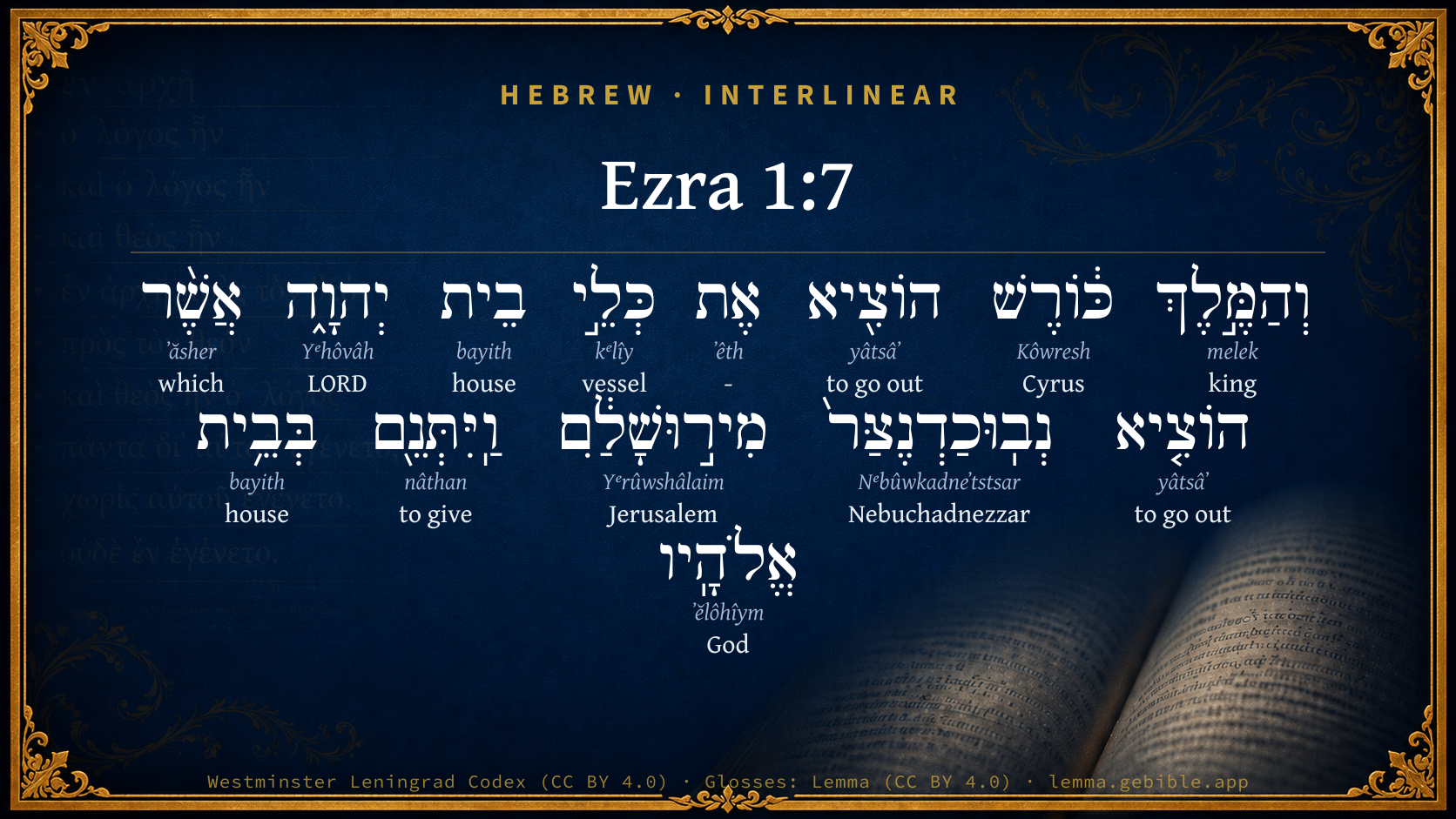
  1. וְהַמֶּ֣לֶךְ melek H4428 “and · the · king” Conjunction + Particle, Definite Article + Noun, Common, Masculine, Singular, Absolute
  2. הוֹצִ֖יא yâtsâʼ H3318 “to go out” Verb, Hiphil, Perfect, 3rd Person, Masculine, Singular
  3. אֶת ʼêth H853 “-” Particle, Direct Object
  4. כְּלֵ֣י kᵉlîy H3627 “vessels of” Noun, Common, Masculine, Plural, Construct
  5. בֵית bayith H1004 “house of” Noun, Common, Masculine, Singular, Construct
  6. יְהוָ֑ה Yᵉhôvâh H3068 “LORD” Noun, Proper
  7. אֲשֶׁ֨ר ʼăsher H834 “which” Particle, Relative
  8. הוֹצִ֤יא yâtsâʼ H3318 “to go out” Verb, Hiphil, Perfect, 3rd Person, Masculine, Singular
  9. נְבֽוּכַדְנֶצַּר֙ Nᵉbûwkadneʼtstsar H5019 “Nebuchadnezzar” Noun, Proper
  10. מִיר֣וּשָׁלִַ֔ם Yᵉrûwshâlaim H3389 “from · Jerusalem” Preposition + Noun, Proper
  11. וַֽיִּתְּנֵ֖ם nâthan H5414 “and · to give · them” Conjunction + Verb, Qal, Sequential Imperfect, 3rd Person, Masculine, Singular + Suffix, Personal, 3rd Person, Masculine, Plural
  12. בְּבֵ֥ית bayith H1004 “in/at · house of” Preposition + Noun, Common, Masculine, Singular, Construct
  13. אֱלֹהָֽיו ʼĕlôhîym H430 “God(s) · his” Noun, Common, Masculine, Plural, Construct + Suffix, Personal, 3rd Person, Masculine, Singular

About this verse

These counts appear in no published source. They are computed here, from the morphology-tagged text and Lemma’s own curated glosses. What Lemma adds →

14
words
12
distinct lemmas
Historical
section

Notable vocabulary

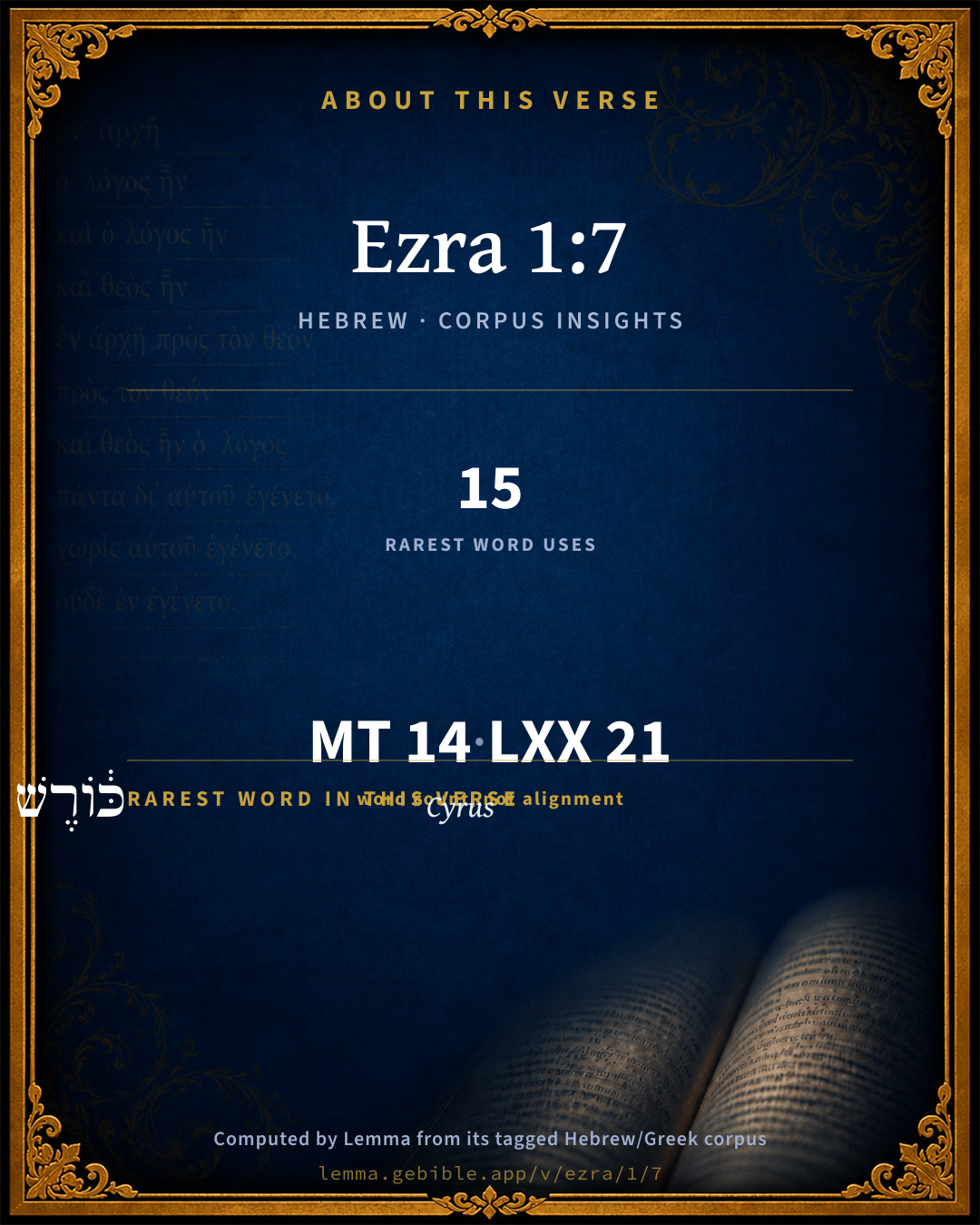
The rarest word here is כּ֔וֹרֶשׁ Cyrus H3566 — appearing just 15 times in the whole Hebrew Bible.

Shared distinctive vocabulary

כּ֔וֹרֶשׁ Cyrus H3566 occurs in 13 verses of the Hebrew Bible. Also found in:

Grammatical profile

  • 3 verbs
  • 9 nouns
  • 2 particles

Verb forms

  • הוֹצִ֖יא Hiphil · Perfect
  • הוֹצִ֤יא Hiphil · Perfect
  • וַֽיִּתְּנֵ֖ם Qal · Sequential Imperfect

Repetition

Words recur within this verse — often emphatic in Hebrew:

  • הוֹצִ֖יא to go out H3318 ×2
  • בֵית house H1004 ×2

Hebrew & Septuagint length

In English translation the verse runs 30 words from the Hebrew and 27 from the Septuagint (LXX English) — closely comparable.

A rough comparison of the two English renderings, which tokenize alike — not a word-level alignment.

Word counts can differ between the Hebrew and the Greek without any difference in meaning — e.g. the Hebrew direct-object marker אֵת has no separate Greek word, and Greek often adds the article ὁ.

In the original languages it is 14 Hebrew tokens and 21 Greek tokens — but the two are counted differently (Hebrew bundles its prefixes and suffixes into one token; the Greek is in lemma form), so that isn’t a like-for-like length.

Cross-references

12

Topical passages linked to Ezra 1:7 in the Treasury of Scripture Knowledge — connected by theme and wording, ordered by reader-vote popularity; previews shown in the World English Bible.

  • 2 Chronicles 36:7 Nebuchadnezzar also carried of the vessels of the house of Yahweh to Babylon, and put them in his temple at Babylon.
  • 2 Kings 24:13 He carried out there all the treasures of the house of Yahweh, and the treasures of the king's house, and cut in pieces all the vessels of gold, which Solomon king of Israel had made in the temple of Yahweh, as Yahweh had said.
  • Ezra 5:14 The gold and silver vessels also of the house of God, which Nebuchadnezzar took out of the temple that was in Jerusalem, and brought into the temple of Babylon, those did Cyrus the king take out of the temple of Babylon, and they were delivered to one whose name was Sheshbazzar, whom he had made governor;
  • Ezra 6:5 Also let the gold and silver vessels of the house of God, which Nebuchadnezzar took forth out of the temple which is at Jerusalem, and brought to Babylon, be restored, and brought again to the temple which is at Jerusalem, everyone to its place; and you shall put them in the house of God.
  • 2 Chronicles 36:10 At the return of the year king Nebuchadnezzar sent, and brought him to Babylon, with the goodly vessels of the house of Yahweh, and made Zedekiah his brother king over Judah and Jerusalem.
  • 2 Kings 25:13–16 The pillars of brass that were in the house of Yahweh, and the bases and the brazen sea that were in the house of Yahweh, did the Chaldeans break in pieces, and carried the brass of them to Babylon.
  • 2 Chronicles 36:18 All the vessels of the house of God, great and small, and the treasures of the house of Yahweh, and the treasures of the king, and of his princes, all these he brought to Babylon.
  • Jeremiah 27:21–22 yes, thus says Yahweh of Hosts, the God of Israel, concerning the vessels that are left in the house of Yahweh, and in the house of the king of Judah, and at Jerusalem:
  • Jeremiah 28:3–6 Within two full years will I bring again into this place all the vessels of Yahweh's house, that Nebuchadnezzar king of Babylon took away from this place, and carried to Babylon:
  • Daniel 1:2 The Lord gave Jehoiakim king of Judah into his hand, with part of the vessels of the house of God; and he carried them into the land of Shinar to the house of his god: and he brought the vessels into the treasure-house of his god.
  • Daniel 5:2–3 Belshazzar, while he tasted the wine, commanded to bring the golden and silver vessels which Nebuchadnezzar his father had taken out of the temple which was in Jerusalem; that the king and his lords, his wives and his concubines, might drink from it.
  • Daniel 5:23 but have lifted up yourself against the Lord of heaven; and they have brought the vessels of his house before you, and you and your lords, your wives and your concubines, have drunk wine from them; and you have praised the gods of silver and gold, of brass, iron, wood, and stone, which don't see, nor hear, nor know; and the God in whose hand your breath is, and whose are all your ways, you have not glorified.

Cross-references courtesy of OpenBible.info (CC BY 4.0).

Hebrew and Greek witnesses Masoretic Hebrew ↔ Greek Septuagint

The same verse in the two great witnesses to the Old Testament, shown verse-for-verse.

These are two independent witnesses, not word-aligned to each other, and the Septuagint is shown in lemma (dictionary) form.

Hebrew Ezra 1:7 Masoretic · Westminster Leningrad Codex

וְהַמֶּ֣לֶךְ כּ֔וֹרֶשׁ הוֹצִ֖יא אֶת כְּלֵ֣י בֵית יְהוָ֑ה אֲשֶׁ֨ר הוֹצִ֤יא נְבֽוּכַדְנֶצַּר֙ מִיר֣וּשָׁלִַ֔ם וַֽיִּתְּנֵ֖ם בְּבֵ֥ית אֱלֹהָֽיו

Also Cyrus the king brought forth the vessels of the house of Yahweh, which Nebuchadnezzar had brought forth out of Jerusalem, and had put in the house of his gods;

World English Bible · Public Domain

Greek LXX Ezra 1:7 Septuagint · lemma form

καί ὁ βασιλεύς κῦρος ἐκφέρω ὁ σκεῦος οἶκος κύριος ὅς λαμβάνω ναβουχοδονοσορ ἀπό ἰερουσαλήμ καί δίδωμι αὐτός ἐν οἶκος θεός αὐτός

And king Cyrus brought out the vessels of the house of the Lord, which Nabuchodonosor had brought from Jerusalem, and put in the house of his god.

LXX2012 (modern English Septuagint) · Public Domain

In the Septuagint this is one book — Esdras B (2 Esdras): Ezra is chapters 1–10, Nehemiah 11–23.

On this verse, Keil & Delitzsch discusses the Septuagint’s reading. Read the note in Commentary ↓

Hebrew: Westminster Leningrad Codex (CC BY 4.0). Greek: Septuagint (public domain); English from LXX2012 (modern English Septuagint) (Public Domain). How the Septuagint differs from the Hebrew →

Commentary

Notes on Ezra 1:7 from classic Christian and Jewish commentators (each source and its license shown beneath its notes). The classic Christian expositions comment on the surrounding passage and are grouped to its opening verse, so a note may address several verses; the Jewish commentaries on the Tanakh (Rashi and others) are per-verse, so they appear only where the commentator wrote on this verse.

Lemma curates 59 commentaries, every one of them public domain or Creative Commons licensed, each selected and text-cleaned for this edition rather than reprinted as found. About our sources →

Jamieson, Fausset & Brown

Robert Jamieson, A. R. Fausset & David Brown

CYRUS RESTORES THE VESSELS. (Ezr 1:7-11)

Cyrus . . . brought forth the vessels of the house of the Lord--Though it is said (Kg2 24:13) that these were cut in pieces, that would not be done to the large and magnificent vases; and, if they had been divided, the parts could be reunited. But it may be doubted whether the Hebrew word rendered cut in pieces, does not signify merely cut off, that is, from further use in the temple.

Jamieson, Fausset & Brown — Commentary Critical and Explanatory on the Whole Bible (1871) — public domain (CC PDM 1.0). Text via the HelloAO Bible API.

Trapp's Complete Commentary

John Trapp

Ezr 1:7 Also Cyrus the king brought forth the vessels of the house of the LORD, which Nebuchadnezzar had brought forth out of Jerusalem, and had put them in the house of his gods;

Ver. 7. Also Cyrus the king brought forth the vessels] For example to others, et iussit, et gessit, he did himself what he commanded to be done, and so became a living law, a walking statute. So Justinian would not put the vessels of the Temple (taken by Titus, and recovered from Gensericus) into the public treasury, but restored them.

Which Nebuchadnezzar had brought forth] With profane and sacrilegious hands some of these sacred vessels and utensils of the Temple he had cut in pieces, 2Ki 24:13, and others he carried away, 2Ch 36:7, whole and entire. This he did out of covetousness (that auri sacra fames) and in scorn of all religion (rather than hatred of the Jewish superstition, or to avenge the quarrel of God’s covenant), like as for the same reason his successor Cambyses destroyed the Egyptian idols, Isa 10:26.

And had put them] There was a sweet providence in that; to the end that being there reserved, they might in due time be restored (as here they are) to the house of God at Jerusalem. And although that was a most unfit place to keep them in (for "what agreement hath the temple of God with idols?" 2Co 6:16), and Belshazzar most profanely abused them, Dan 5:2, in that drunken feast of his (hence he is called the festival king, Eze 21:5-6), yet being sanctified again, and dedicated to the true and first owner, the God of Israel, they might lawfully be made use of. Not only things indifferent abused may yet be used in the service of God (as those six waterpots were by our Saviour Joh 2:6-7, though they had been superstitiously abused for private purification), but also idolatrous things and places. As Gideon took the bullock appointed for Baal and the grove, and offered the bullock with that wood in sacrifice to the Lord, Jdg 6:26. The like the Bethshemites did by the Philistines’ cart and kine. The Mount of Olives was shamefully abused to idolatry by Solomon and others, so that it was called the mount of corruption, 2Ki 23:13, and yet was it our Saviour’s usual oratory or place of prayer.

In the house of his gods] Bel and Nebo, Isa 46:1. These were Babylon’s chief gods. The original of Bel is said to be this: Ninus having made an image of his father Belus, all that came to see it were pardoned for all their offences; whence in time that image came to be worshipped, and then afterwards a multitude more; insomuch as that in Hesiod’s time the number of heathenish gods was grown to thirty thousand, πρις γαρ μυριοι εισιν. And in China at this day some tell us that there are no fewer than a hundred thousand idols.

“ O curas hominum! O quantum est in rebus inane! ”

Gods these idols are called here, not because they were so (for there is one God only, said Pythagoras, and other heathens, Eις μονος εστι θεος, &c.), but because Nebuchadnezzar falsely held them so. Like as elsewhere the gods of Damascus are said to have smitten Ahaz, who therefore sacrificed to them, 2Ch 28:23, not as if those idols were anything in the world, or could do anything at all to him, Jer 10:5 1Co 8:4; but only that he conceited so, and that the devil (who is ειδωλοχαρης, as Synesius truly saith) abused his credulity.

John Trapp, A Commentary or Exposition upon All the Books of the Old and New Testament (1647–1656) — public domain. Text from a community e-Sword module.

The Biblical Illustrator

Joseph S. Exell

Ezr_1:7-11

Also Cyrus the king brought forth the vessels of the house of the Lord.

The restoration of the sacred vessels

I. The preservation of the sacred vessels (Ezr_1:7-8). These are the vessels which are mentioned in 2Ch_36:7 and Dan_1:2. In the providence of God most of these vessels were remarkably preserved, to be in due time restored to their original place and uses. Learn: Since God is so careful of the mere vessels consecrated to His service, may we not rest assured that He will much more preserve His consecrated people?

II. The numeration of the sacred vessels. This numbering indicates--

1. The reverent care of Cyrus for these sacred vessels.

2. The grave responsibility of Sheshbazzar for these sacred vessels.

Learn: That persons, places, and things which are devoted to religious uses should be reverently regarded by us.

III. The restoration of the sacred vessels (verse 11).

1. This was a fulfilment of prophecy (Jer_27:22).

2. This is an illustration of the restoration of perverted things to their true uses.

The Lord Jesus Christ is the great restorer of the violated order and the broken harmony of the universe of God. (William Jones.)

The restitution of the stolen vessels

This appears to be more than an act of generosity or justice. A certain religious import belongs to it. It put an end to an ancient insult offered by Babylon to the God of Israel, and it might be taken as an act of homage offered to Jehovah by Cyrus. Yet it was only a restitution, a return of what was Gods before, and so a type of every gift man makes to God. (Walter F. Adeney, M. D.)

Mithredath

It is not without significance that the treasurer who handed over their temple prosperity to the Jews was named Mithredath--a word that means given by Mithra, or devoted to Mithra. This suggests that the Persian sun-god was honoured among the servants of Cyrus, and yet that one who by name at least was especially associated with this divinity was constrained to honour the God of Israel. Next to Judaism and Christianity, the worship of Mithra showed the greatest vitality of all religions in Western Asia, and later even in Europe. So vigorous was it as recently as the commencement of the Christian era, that M. Renan has remarked that if the Roman world had not become Christian it would have become Mithrastic. In the homage paid by Mithredath to the God of Israel may we not see an image of the recognition of the claims of the Supreme by our priests of the sun--Kepler, Newton, Faraday? (Walter F. Adeney, M. D.)

A restoration of misappropriated property

There was a great restoration of misappropriated property. What a restoration there will one day be. What have men taken away from Gods Church? Nearly everything they could lay hands on. They have taken away gold, art, music, miracles, inspiration, rationalism, morality, science, and they have left God a very bare house. When the period of spiritual revival has come, and the holy issue is wrought out in all its meaning, all these things will be brought back again. Art will come with her brush and pencil, and say, I will beautify the house of Gods revelation. Music will bring back her harp and her instrument of ten strings, and her cymbals and organs, and say, Make me a handmaid in Gods house, for all I have and am must belong to Him; and Reason--exiled, expatriated Reason shall return, saying They have kept me in vile servitude; admit me to my Fathers house. And Science will come and pray; and Morality will say, They have been trying to divorce me from theology, from right religious motive and impulse, and I have died like a flower that has been plucked; restore me to my vital relations, and I will once more bloom in the house of God. (J. Parker, D. D)

.

The Biblical Illustrator, edited by Joseph S. Exell (c. 1880s–1900s) — public domain. Text from a community e-Sword module.

Keil & Delitzsch

C. F. Keil & F. Delitzsch

King Cyrus, moreover, caused those sacred vessels of the temple which had been carried away by Nebuchadnezzar to be brought forth, and delivered them by the hand of his treasurer to Sheshbazzar, the prince of Judah, for the use of the house of God which was about to be built. הוציא, to fetch out from the royal treasury. The "vessels of the house of Jahve" are the gold and silver vessels of the temple which Nebuchadnezzar, at the first taking of Jerusalem in the reign of Jehoiakim, carried away to Babylon, and lodged in the treasure-house of his god (Ch2 36:7 and Dan 1:2). For those which he took at its second conquest were broken up (Kg2 24:13); and the other gold and silver goods which, as well as the large brazen implements, were taken at the third conquest, and the destruction of the temple (Kg2 25:14.; Jer 52:18.), would hardly have been preserved by the Chaldeans, but rather made use of as valuable booty.

Ezr 1:8

Cyrus delivered these vessels יד על, into the hand of the treasurer, to whose care they were entrusted; i.e., placed them under his inspection, that they might be faithfully restored. ממרדת is Mithridates. נּזבּר, answering to the Zend gazabara, means treasurer (see comm. on Dan. p. 514, note 4). This officer counted them out to the prince of Judah Sheshbazzar, undoubtedly the Chaldee name of Zerubbabel. For, according to Ezr 5:14, Ezr 5:16, שׁשׁבּצּר was the governor (פּחה) placed by Cyrus over the new community in Judah and Jerusalem, and who, according to Ezr 1:11 of the present chapter, returned to Jerusalem at the head of those who departed from Babylon; while we are informed (Ezr 2:2; Ezr 3:1, Ezr 3:8, and Ezr 4:3; Ezr 5:2) that Zerubbabel was not only at the head of the returning Jews, but also presided as secular ruler over the settlement of the community in Judah and Jerusalem. The identity of Sheshbazzar with Zerubbabel, which has been objected to by Schrader and Nldeke, is placed beyond a doubt by a comparison of Ezr 5:16 with Ezr 3:8, etc., Ezr 5:2 : for in Ezr 5:16 Sheshbazzar is named as he who laid the foundation of the new temple in Jerusalem; and this, according to Ezr 5:2 and Ezr 3:8, was done by Zerubbabel. The view, too, that Zerubbabel, besides this his Hebrew name, had, as the official of the Persian king, also a Chaldee name, is in complete analogy with the case of Daniel and his three companions, who, on being taken into the service of the Babylonian king, received Chaldee names (Dan 1:7). Zerubbabel, moreover, seems, even before his appointment of פּחה to the Jewish community in Judah, to have held some office in either the Babylonian or Persian Court or State; for Cyrus would hardly have entrusted this office to any private individual among the Jews. The meaning of the word שׁשׁבּצּר is not yet ascertained: in the lxx it is written Σασαβασάρ, Σαβαχασάρ, and Σαναβάσσαρος; 1 Esdras has Σαμανασσάρ, or, according to better MSS, Σαναβασσάρ; and Josephus, l.c., Ἀβασσάρ.

Ezr 1:9-10

The enumeration of the vessels: 1. אגרטלים of gold 30, and of silver 1000. The word occurs only here, and is translated in the Septuagint ψυκτῆρες; in 1 Esdr. 2:11, σπονδεῖα. The Talmudic explanation of Aben Ezra, "vessels for collecting the blood of the sacrificed lambs," is derived from אגר, to collect, and טלה, a lamb, but is certainly untenable. עגרטל is probably connected with Arab. qarṭallah, the rabbinical קרטיל, the Syriac karṭālā', the Greek κάρταλλος or κάρταλος, a basket (according to Suidas), κάρταλος having no etymology in Greek; but can hardly be derived, as by Meier, hebr. Wurzelwrterbuch, p. 683, from the Syriac ‛rṭl, nudavit, to make bare, the Arabic ‛arṭala, to make empty, to hollow, with the sense of hollow basins. 2. מחלפים 29. This word also occurs only here. The Sept. has παρηλλαγμένα (interpreting etymologically after חלף), 1 Esdr. θυΐ́σκαι, the Vulg. cultri, sacrificial knives, according to the rabbinical interpretation, which is based upon חלף, in the sense of to pierce, to cut through (Jdg 5:26; Job 20:24). This meaning is, however, certainly incorrect, being based linguistically upon a mere conjecture, and not even offering an appropriate sense, since we do not expect to find knives between vessels and dishes. Ewald (Gesch. iv. p. 88), from the analogy of מחלפות (Jdg 16:13, Jdg 16:19), plaits, supposes vessels ornamented with plaited or net work; and Bertheau, vessels bored after the manner of a grating for censing, closed fire-pans with holes and slits. All is, however, uncertain. 3. כּפורים, goblets (goblets with covers; comp. Ch1 15:18) of gold, 30; and of silver, 410. The word משׁנים is obscure; connected with כּסף כּפורי כּס it can only mean goblets of a second order (comp. Ch1 15:18). Such an addition appears, however, superfluous; the notion of a second order or class being already involved in their being of silver, when compared with the golden goblets. Hence Bertheau supposes משׁנים to be a numeral corrupted by a false reading; and the more so, because the sum-total given in Ezr 1:11 seems to require a larger number than 410. These reasons, however, are not insuperable. The notion of a second order of vessels need not lie in their being composed of a less valuable metal, but may also be used to define the sort of implement; and the difference between the separate numbers and the sum-total is not perfectly reconciled by altering משׁנים into אלפים, 2000. 4. 1000 other vessels or implements.

Keil & Delitzsch — Biblical Commentary on the Old Testament (1861–1891) — public domain (CC PDM 1.0). Text via the HelloAO Bible API. (Old Testament only.)

Tyndale Open Study Notes

Tyndale Open Resources

1:7 Many articles . . . from the Lord’s Temple had been taken to Babylon (see 2 Chr 36:7; Dan 1:2). By putting these items in his pagan temple, Nebuchadnezzar had attempted to show his god’s power over the Hebrew God. However, God had promised the return of all the stolen items (see Jer 27:16-22). The items from the Temple were holy utensils, acceptable to God for worship and very valuable to the returning worshipers.

Tyndale Open Study Notes — © Tyndale Open Resources, licensed CC BY-SA 4.0. Text via the HelloAO Bible API.

Adam Clarke's Commentary

Verse 7. The king brought forth the vessels] See on Ezr 1:9-11.

Adam Clarke's Commentary on the Bible (1810–1826) — public domain. Text from a community e-Sword/MySword module.

The Cambridge Bible for Schools and Colleges

gen. ed. J. J. S. Perowne

7. Also Cyrus the king] i.e. the Jews were assisted not only by private individuals their neighbours, but by the example of the king himself.

the vessels of the house of the Lord, which Nebuchadnezzar had brought forth &c.] This refers especially to the capture of Jerusalem in 598, when Jehoiachin, his household and 10,000 of the better classes were carried off to Babylon. 2Ki_24:13 ‘And he (i.e. Nebuchadnezzar) carried out thence (i.e. from Jerusalem) all the treasures of the house of the Lord, and the treasures of the king’s house, and cut in pieces all the vessels of gold which Solomon king of Israel had made in the temple of the Lord’. It may be noticed that in the original the expression ‘carried out’ in the passage just cited and so translated in A.V. and R.V. is identical with the ‘brought forth’ in this verse.

At the final destruction of Jerusalem (586) eleven or twelve years later, by Nebuzaradan, Nebuchadnezzar’s general, the remainder of the valuables contained in the house of the Lord were ‘taken away’ to Babylon, 2Ki_25:14-15.

The passage in Dan_1:1-2, which attributes to the third year (606) of Jehoiakim’s reign a siege of Jerusalem by Nebuchadnezzar, the capture of Jehoiakim, and the removal to Babylon of some of the sacred vessels, is chronologically incorrect. (1) The victory of Carchemish on the Euphrates was not won by Nebuchadnezzar till the fourth year of Jehoiakim (605). (2) According to 2Ki_24:1 Jehoiakim, who had been tributary to the king of Egypt, did not become tributary to Nebuchadnezzar until after that battle, and, having remained so for three years only, then rebelled. This rebellion led to Nebuchadnezzar’s siege and capture of Jerusalem in Jehoiachin’s brief reign of three months. All that can be said is that we have in Dan_1:1-2, a certain chronological error, but that it is conceivable that when Nebuchadnezzar ‘came up’ (2Ki_24:1) and Jehoiakim submitted, a siege may have preceded capitulation, and a carrying off to Babylon both of prisoners and of some vessels of the Lord may have taken place in 602 or 601. Of this we have no certain confirmation, and it is more probable that the passage in Dan_1:1 may be a heading containing inaccurate historical statements or late tradition prefixed by a scribe to the narrative of Daniel.

in the house of his gods] So A.V. and R.V. The original is ‘in the house of his Elohim’. ‘Elohim’ may be rendered either as ‘God’ or ‘gods’ according as the context requires. The student will observe that in Dan_1:2 the same phrase ‘the house of his Elohim’ is rendered both by A.V. and R.V. ‘the house of his god’. Nebuchadnezzar was a polytheist. But had the stress here rested upon the plurality of his gods, we should have expected ‘in the houses of his gods’. The rendering ‘in the house of his god’ appears preferable, both on account of the singular ‘house’ and, especially, on account of Nebuchadnezzar’s devotion to one god, Merodach, to whom he paid greater honour than to any of the other deities of the Babylonian pantheon. The Temple of E-sagila in honour of Merodach was restored by Nebuchadnezzar with unrivalled splendour. The passage in 2Ch_36:7 ‘Nebuchadnezzar also carried of the vessels of the house of the Lord to Babylon and put them in his temple at Babylon’, helps to confirm the rendering ‘in the house of his god’. The other passages relating to the sacred vessels are Jer_27:16; Jer_28:6; Jer_52:18; Dan_5:23; Bar_1:8.

The Cambridge Bible for Schools and Colleges (gen. ed. J. J. S. Perowne; Cambridge University Press, 1878–1918) — public domain. Text from a community e-Sword module.

John Gill's Exposition

And Cyrus brought forth the vessels of the house of the Lord,.... Or ordered them to be brought forth:

which Nebuchadnezzar had brought forth out of Jerusalem; out of the temple there, when he took it and burnt it:

and had put them in the house of his gods; in the temple of Belus at Babylon, see Ch2 36:7, by which means they were providentially preserved.

John Gill's Exposition of the Whole Bible (1746–1763) — public domain (CC PDM 1.0). Text via the HelloAO Bible API.

Albert Barnes' Notes on the Bible

The house of his gods - Rather, “of his god” Dan 1:2, i. e., Merodach, “his lord” (see 2Ch 36:7 note).

Albert Barnes' Notes on the Bible (1834–1885) — public domain. Text from a community e-Sword/MySword module.

Matthew Poole's English Annotations

Object. These are said to have been cut in pieces, 2Ki 24:13; how then are they here returned?

Answ. That Hebrew word used 2Ki 24:13, signifies not so properly to

cut in pieces as to

cut off, as from the use of the word, Deu 25:12; 2Sa 4:12; 2Ki 18:16; Jer 9:26. And these vessels, when they were taken away from the temple, might very well be said to be cut off from it, because they had for so long time been so constantly, and as it were inseparably, united to it, and kept in it. In like manner,

the meat-offering and drink-offering are said to be cut off from the house of the Lord, Joe 1:9. And it is very improbable that they should deface and cut in pieces these magnificent vessels, which they could so easily transport whole to Babylon. Although, if some of the larger of them had been cut into two or more parts, yet the parts of them might be delivered to the Jews, who could, without great difficulty, restore them to their former unity and form.

Matthew Poole's English Annotations on the Holy Bible (1683–1685) — public domain. Text from a community e-Sword/MySword module.

Whedon's Commentary on the Bible

Daniel D. Whedon

7. The king brought forth the vessels — He not only ordered others to give, but set the example by himself giving from the treasures of the kingdom.

Nebuchadnezzar had brought — See 2Ki_24:13; 2Ch_36:7; Dan_1:2. Some of these vessels had been sacrilegiously used by Belshazzar and his lords on that night of revelry when Babylon was taken, and Belshazzar slain. Dan_5:2-3.

Daniel D. Whedon (gen. ed.), Commentary on the Old and New Testaments (1874–1909) — public domain. Text from a community e-Sword module.

The Pulpit Commentary

The vessels. Probably all that he could find, yet scarcely all that had been taken away, since many of these were of bronze, (2Ki_25:14) and the restored vessels seem to have been, all of them, either of gold or silver (see ver. 11). Which Nebuchadnezzar had brought forth. The carrying off of sacred vessels, as well as images, from temples is often represented in the Assyrian sculptures. It was a practice even of the Romans, and is commemorated on the Pillar of Titus, where the seven-branched candlestick of the Jewish temple is represented as borne in triumph by Roman soldiers. And had put them in the house of his gods. Elohayv, which is the form used in the text, can only mean "his god," not "his gods." Nebuchadnezzar represents himself, in his inscriptions generally, as a special devotee of a single Babylonian god, Merodach, whose temple, called by the Greeks that of Bel, is no doubt here intended. (Dan_1:2)

The Pulpit Commentary (1880–1919), ed. H.D.M. Spence-Jones & Joseph S. Exell — public domain. Text from a community e-Sword module.

unfoldingWord translationNotes

Door43 World Missions Community

Mithredath ... Sheshbazzar

These are men's names. (See: How to Translate Names)

put them into the hand of Mithredath the treasurer

Putting an object into someone's hand is a metaphor for allowing that person to do what he wants with that object. Here the reader should understand that Cyrus expected Mithredath to do what Cyrus wanted him to do. AT: "put Mithredath the treasurer in charge of them" or "made Mithredath the treasurer responsible for them" (See: Metaphor)

treasurer

official in charge of money

translationWords

king

Cyrus

Nebuchadnezzar

Judea

unfoldingWord translationNotes — © Distant Shores Media and the Door43 World Missions Community, licensed CC BY-SA 4.0. Source: git.door43.org/Door43/en_tn.

Rashi

Rabbi Shlomo Yitzchaki (Rashi)

and had placed them in the temple of his god that Nebuchadnezzar had placed in the temple of his pagan deity.

Rashi on the Tanakh — English translations: “The Judaica Press complete Tanach with Rashi, translated by A. J. Rosenberg” (CC BY 4.0); “Pentateuch with Rashi's commentary by M. Rosenbaum and A.M. Silbermann, 1929-1934” (public domain); “The Metsudah Tanach series, Lakewood, N.J” (CC BY 4.0); and “The Book of Joshua, Metsudah Publications, 1997” (CC BY 4.0). Text via Sefaria.

Lesson kit

Teaching starters — assembled from the data on this page, not authored interpretation. Every prompt links to the verse data it draws on. Edit before teaching.

Ezra, in the Historical, opens this verse with 14 words (12 distinct Hebrew lemmas). Its most distinctive word is Kôwresh (“Cyrus”). A historical commentator’s framing appears above. Read the whole chapter for the surrounding context.

Discussion questions

  1. The word Kôwresh carries the sense “Cyrus.” How does it shape the verse?
  2. 2 Chronicles 36:22 shares the word «Cyrus» with this verse. How do the two illuminate each other?
  3. “to go out” occurs 2× in this one verse. What is the effect of the repetition?
  4. These translations render this verse differently. What is at stake in choosing one wording over another?
  5. The verb «הוֹצִ֖יא» is Hiphil Perfect. How does its form color the action?
  6. Reading how Jamieson, Fausset & Brown and Trapp's Complete Commentary read this verse, where do the two commentators agree and where do they part?

Things to notice

Reading settings

Reading text

Shown beneath each verse's original-language words.

Old Testament
Old Testament edition

Read the OT as the Masoretic Hebrew (MT) or the Greek Septuagint (LXX).

English shown for the Greek Septuagint (in the Hebrew ↔ Greek comparison).

Comparing translations? Open the Compare panel on any verse page to stack up to four side by side.