
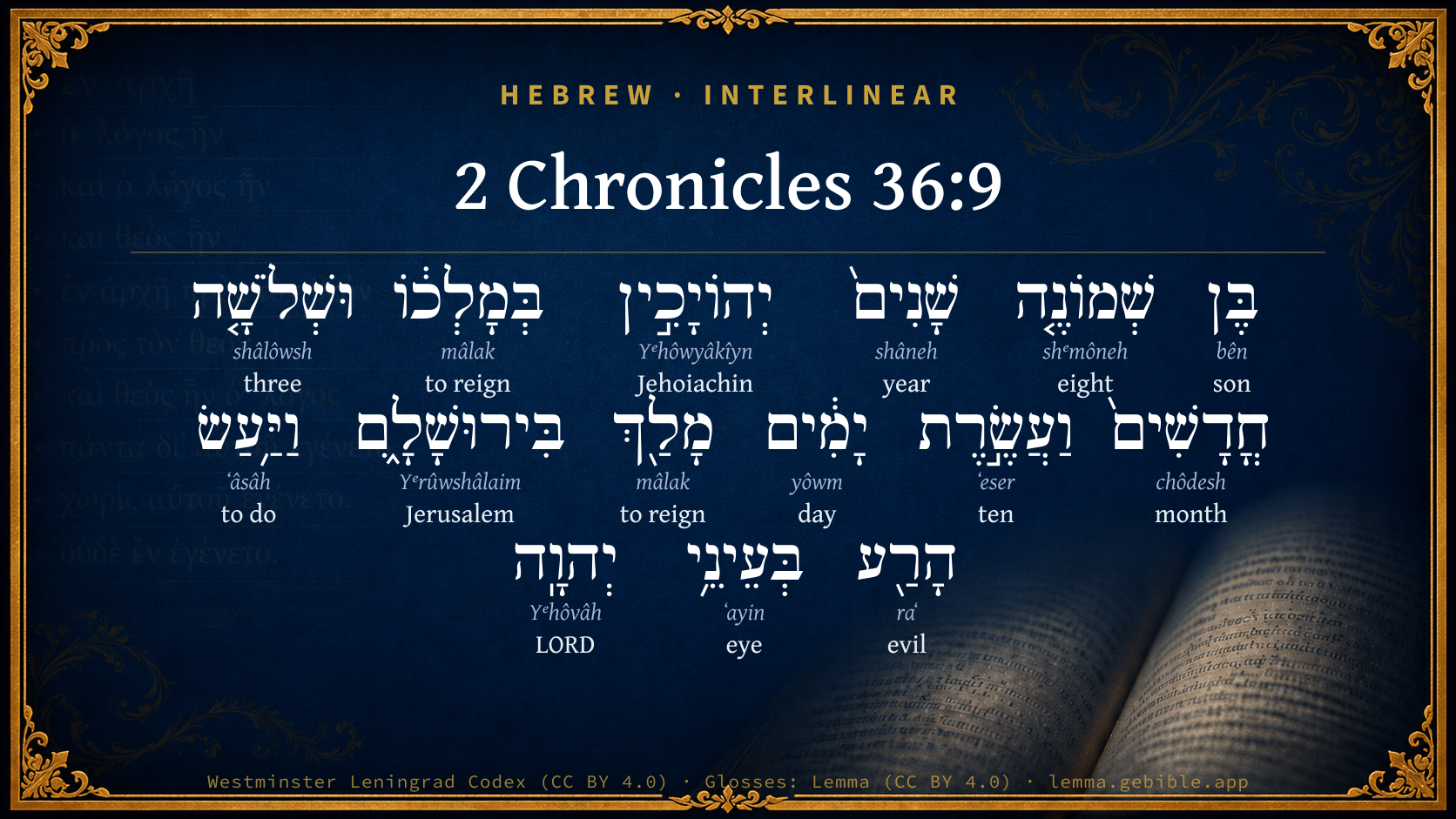
2 Chronicles 36:9

Hebrew (Westminster Leningrad Codex) 2 Chronicles 36:9 appears in the Hebrew Old Testament. The text above is from the Westminster Leningrad Codex. Each word links to its Strong’s number, a concise gloss, and parsing drawn from the Open Scriptures Hebrew Bible morphology. Click any word for its full Brown-Driver-Briggs (BDB) entry.
Download image
Cite this verse

2 Chronicles 36:9 (World English Bible). Public Domain. Lemma interlinear Bible study tool, https://lemma.gebible.app/v/2-chronicles/36/9.

Show BibTeX & RIS
BibTeX
RIS
English Translation
Jehoiachin was eight years old when he began to reign; and he reigned three months and ten days in Jerusalem: and he did that which was evil in the sight of Yahweh.
World English Bible · Public Domain
Download a study sheet

One document with this verse’s original text, its word-by-word gloss line, the meaning frame, cross-references with their text, attributed commentary, and full source and license credits — printable, and it pastes into notes with its structure intact.

This verse Autodidact and up

Study sheet (.html) Plain text (.txt)

A passage Seminary Student

Up to 50 verses in one chapter. A passage sheet keeps up to 6 commentary sources and 12 cross-references per verse, in the order this page ranks them, and says so on the sheet whenever that leaves anything out. Ask for a single verse and you get the Autodidact verse sheet above.

Everything on this page stays free to read, with no account — the sheet is a download of what is already on screen, not access to it.

Want to remove ads? Support Godless Engineer
Compare translations 3

The same verse in 3 English versions, stacked beneath the original-language interlinear above. Click any original word for its lexicon entry.

Each is an independent rendering of the whole verse — the interlinear is not word-aligned to these translations.

Highlighted words mark where these versions differ — a whole-verse word diff, not a word-by-word alignment.

  • World English Bible Public Domain
    Jehoiachin was eight years old when he began to reign; and he reigned three months and ten days in Jerusalem: and he did that which was evil in the sight of Yahweh.
  • King James Version Public Domain
    Jehoiachin was eight years old when he began to reign, and he reigned three months and ten days in Jerusalem: and he did that which was evil in the sight of the LORD.
  • unfoldingWord Literal Text CC BY-SA 4.0
    A son of eight years was Jehoiachin when he became king; and three months and ten days he reigned in Jerusalem. And he did what was evil in the eyes of Yahweh.

unfoldingWord Literal Text — © unfoldingWord, licensed CC BY-SA 4.0. Word-aligned USFM3 via Door43 (git.door43.org/unfoldingWord/en_ult).

Versions to compare (up to 4)

3 of 4 selected

Show all 18 translations

Every available English version of this verse, each an independent rendering of the whole verse.

  • World English Bible Public Domain
    Jehoiachin was eight years old when he began to reign; and he reigned three months and ten days in Jerusalem: and he did that which was evil in the sight of Yahweh.
  • Berean Standard Bible Public Domain
    Jehoiachin was eighteen years old when he became king, and he reigned in Jerusalem three months and ten days. And he did evil in the sight of the LORD.
  • Majority Standard Bible Public Domain
    Jehoiachin was eighteen years old when he became king, and he reigned in Jerusalem three months and ten days. And he did evil in the sight of the LORD.
  • King James Version Public Domain
    Jehoiachin was eight years old when he began to reign, and he reigned three months and ten days in Jerusalem: and he did that which was evil in the sight of the LORD.
  • American Standard Version (1901) Public Domain
    Jehoiachin was eight years old when he began to reign; and he reigned three months and ten days in Jerusalem: and he did that which was evil in the sight of Jehovah.
  • Revised Version (1885) Public Domain
    Jehoiachin was eight years old when he began to reign; and he reigned three months and ten days in Jerusalem: and he did that which was evil in the sight of the LORD.
  • Geneva Bible (1599) Public Domain
    Iehoiachin was eight yeere olde when he beganne to reigne, and he reigned three moneths and ten dayes in Ierusalem, and did euill in the sight of the Lord.
  • Douay-Rheims (1899) Public Domain
    Joachin was eight years old when he began to reign, and he reigned three months and ten days in Jerusalem, and he did evil in the sight of the Lord.
  • Young's Literal Translation Public Domain
    A son of eight years is Jehoiachin in his reigning, and three months and ten days he hath reigned in Jerusalem, and he doth the evil thing in the eyes of Jehovah;
  • Literal Standard Version CC BY-SA 4.0
    Jehoiachin [is] a son of eight years in his reigning, and he has reigned three months and ten days in Jerusalem, and he does evil in the eyes of YHWH;
  • Unlocked Literal Bible CC BY-SA 4.0
    Jehoiachin was eight years old when he began to reign; he reigned three months and ten days in Jerusalem. He did what was evil in the sight of Yahweh.
  • unfoldingWord Literal Text CC BY-SA 4.0
    A son of eight years was Jehoiachin when he became king; and three months and ten days he reigned in Jerusalem. And he did what was evil in the eyes of Yahweh.
  • Darby Bible Public Domain
    Jehoiachin was eighteen years old when he began to reign; and he reigned three months and ten days in Jerusalem; and he did evil in the sight of Jehovah.
  • World Messianic Bible Public Domain
    Jehoiachin was eight years old when he began to reign, and he reigned three months and ten days in Jerusalem. He did that which was evil in the LORD’s sight.
  • Webster's Bible Public Domain
    Jehoiachin was eight years old when he began to reign, and he reigned three months and ten days in Jerusalem: and he did that which was evil in the sight of the LORD.
  • Free Bible Version CC BY-SA 4.0
    Jehoiachin was eighteen when he became king, and he reigned in Jerusalem for three months and ten days. He did evil in the Lord's sight.
  • Bible in Basic English Public Domain
    Jehoiachin was eighteen years old when he became king; he was ruling in Jerusalem for three months and ten days, and he did evil in the eyes of the Lord.
  • JPS Tanakh (1917) Public Domain
    Jehoiachin was eight years old when he began to reign; and he reigned three months and ten days in Jerusalem; and he did that which was evil in the sight of the LORD.

Literal Standard Version (2020), Covenant Press — licensed CC BY-SA 4.0. Text via the HelloAO Bible API (eBible.org). Unlocked Literal Bible (unfoldingWord) — licensed CC BY-SA 4.0. Text via the HelloAO Bible API (eBible.org). unfoldingWord Literal Text — © unfoldingWord, licensed CC BY-SA 4.0. Word-aligned USFM3 via Door43 (git.door43.org/unfoldingWord/en_ult). Free Bible Version, Dr. Jonathan Gallagher — licensed CC BY-SA 4.0. Text via the HelloAO Bible API (eBible.org).

Word by word

More ways to search: Search by grammar → Find every occurrence → Compare this word →

Practice this passage: Drill this verse → Learn its vocabulary →

יְהוֹיָכִ֣ין
Yᵉhôwyâkîyn
H3078
“Jehoiachin”
Noun, Proper
Part of Speech
Noun
Type
Proper
Full BDB Definition

Origin: from H3068 and H3559

TWOT: None

Jehoiachin = "Jehovah establishes" - king of Judah, son of Jehoiakim, and the next to last king of Judah before the Babylonian captivity; kingship lasted for 3 months and 10 days before he surrendered to Nebuchadnezzar who took him to Babylon and imprisoned him for 36 years when he was finally released
  1. בֶּן bên H1121 “son of” Noun, Common, Masculine, Singular, Construct
  2. שְׁמוֹנֶ֤ה shᵉmôneh H8083 “eight” Adjective, Cardinal number, Feminine, Singular, Absolute
  3. שָׁנִים֙ shâneh H8141 “years” Noun, Common, Feminine, Plural, Absolute
  4. בְּמָלְכ֔וֹ mâlak H4427 “in/at · to reign · him” Preposition + Verb, Qal, Infinitive Construct + Suffix, Personal, 3rd Person, Masculine, Singular
  5. וּשְׁלֹשָׁ֤ה shâlôwsh H7969 “and · three” Conjunction + Adjective, Cardinal number, Masculine, Singular, Absolute
  6. חֳדָשִׁים֙ chôdesh H2320 “months” Noun, Common, Masculine, Plural, Absolute
  7. וַעֲשֶׂ֣רֶת ʻeser H6235 “and · ten” Conjunction + Adjective, Cardinal number, Masculine, Singular, Construct
  8. יָמִ֔ים yôwm H3117 “days” Noun, Common, Masculine, Plural, Absolute
  9. מָלַ֖ךְ mâlak H4427 “to reign” Verb, Qal, Perfect, 3rd Person, Masculine, Singular
  10. בִּירוּשָׁלִָ֑ם Yᵉrûwshâlaim H3389 “in/at · Jerusalem” Preposition + Noun, Proper
  11. וַיַּ֥עַשׂ ʻâsâh H6213 “and · to do” Conjunction + Verb, Qal, Sequential Imperfect, 3rd Person, Masculine, Singular
  12. הָרַ֖ע raʻ H7451 “the · evil” Particle, Definite Article + Adjective, Adjective, Masculine, Singular, Absolute
  13. בְּעֵינֵ֥י ʻayin H5869 “in/at · eyes of” Preposition + Noun, Common, Both, Dual, Construct
  14. יְהוָֽה Yᵉhôvâh H3068 “LORD” Noun, Proper

About this verse

These counts appear in no published source. They are computed here, from the morphology-tagged text and Lemma’s own curated glosses. What Lemma adds →

15
words
14
distinct lemmas
Historical
section

Notable vocabulary

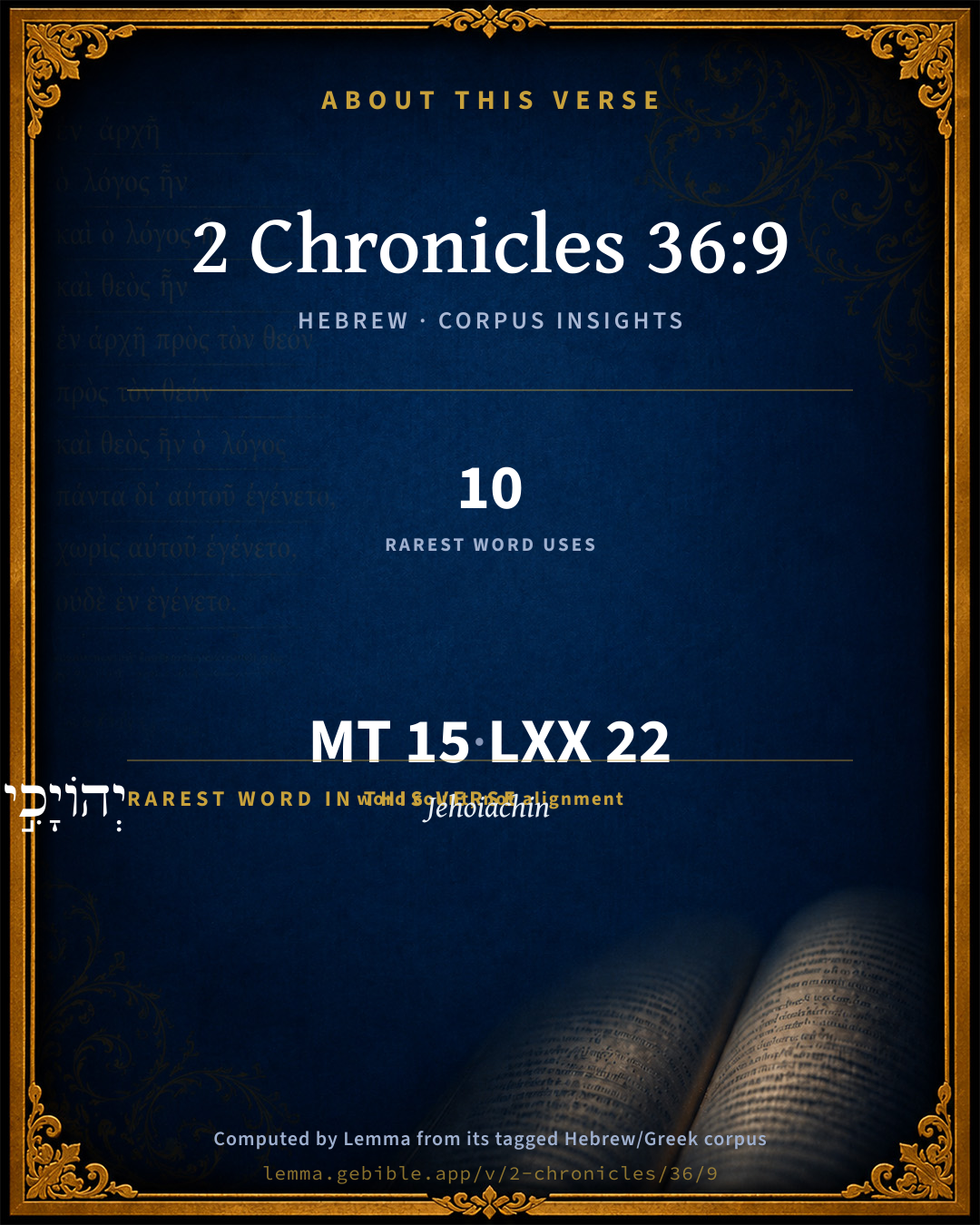
The rarest word here is יְהוֹיָכִ֣ין Jehoiachin H3078 — appearing just 10 times in the whole Hebrew Bible.

Shared distinctive vocabulary

יְהוֹיָכִ֣ין Jehoiachin H3078 occurs in 8 verses of the Hebrew Bible. Also found in:

Grammatical profile

  • 3 verbs
  • 8 nouns
  • 4 adjectives

Verb forms

  • בְּמָלְכ֔וֹ Qal · Infinitive Construct
  • מָלַ֖ךְ Qal · Perfect
  • וַיַּ֥עַשׂ Qal · Sequential Imperfect

Repetition

A word recurs within this verse — often emphatic in Hebrew:

  • בְּמָלְכ֔וֹ to reign H4427 ×2

Hebrew & Septuagint length

In English translation the verse runs 32 words from the Hebrew and 32 from the Septuagint (LXX English) — the same length.

A rough comparison of the two English renderings, which tokenize alike — not a word-level alignment.

Word counts can differ between the Hebrew and the Greek without any difference in meaning — e.g. the Hebrew direct-object marker אֵת has no separate Greek word, and Greek often adds the article ὁ.

In the original languages it is 15 Hebrew tokens and 22 Greek tokens — but the two are counted differently (Hebrew bundles its prefixes and suffixes into one token; the Greek is in lemma form), so that isn’t a like-for-like length.

Cross-references

1

Topical passages linked to 2 Chronicles 36:9 in the Treasury of Scripture Knowledge — connected by theme and wording, ordered by reader-vote popularity; previews shown in the World English Bible.

  • 2 Kings 24:8–17 Jehoiachin was eighteen years old when he began to reign; and he reigned in Jerusalem three months: and his mother's name was Nehushta the daughter of Elnathan of Jerusalem.

Cross-references courtesy of OpenBible.info (CC BY 4.0).

Hebrew and Greek witnesses Masoretic Hebrew ↔ Greek Septuagint

The same verse in the two great witnesses to the Old Testament, shown verse-for-verse.

These are two independent witnesses, not word-aligned to each other, and the Septuagint is shown in lemma (dictionary) form.

Hebrew 2 Chronicles 36:9 Masoretic · Westminster Leningrad Codex

בֶּן שְׁמוֹנֶ֤ה שָׁנִים֙ יְהוֹיָכִ֣ין בְּמָלְכ֔וֹ וּשְׁלֹשָׁ֤ה חֳדָשִׁים֙ וַעֲשֶׂ֣רֶת יָמִ֔ים מָלַ֖ךְ בִּירוּשָׁלִָ֑ם וַיַּ֥עַשׂ הָרַ֖ע בְּעֵינֵ֥י יְהוָֽה

Jehoiachin was eight years old when he began to reign; and he reigned three months and ten days in Jerusalem: and he did that which was evil in the sight of Yahweh.

World English Bible · Public Domain

Greek LXX 2 Chronicles 36:9 Septuagint · lemma form

υἱός ὀκτωκαίδεκα ἔτος ιεχονιας ἐν ὁ βασιλεύω αὐτός καί τριμήνος καί δέκα ἡμέρα βασιλεύω ἐν ἰερουσαλήμ καί ποιέω ὁ πονηρός ἐνώπιον κύριος

Jechonias was eight years old when he began to reign, and he reigned three months and ten days in Jerusalem, and did that which was evil in the sight of the Lord.

LXX2012 (modern English Septuagint) · Public Domain

On this verse, Ellicott's Commentary for English Readers discusses the Septuagint’s reading. Read the note in Commentary ↓

Hebrew: Westminster Leningrad Codex (CC BY 4.0). Greek: Septuagint (public domain); English from LXX2012 (modern English Septuagint) (Public Domain). How the Septuagint differs from the Hebrew →

Commentary

Notes on 2 Chronicles 36:9 from classic Christian and Jewish commentators (each source and its license shown beneath its notes). The classic Christian expositions comment on the surrounding passage and are grouped to its opening verse, so a note may address several verses; the Jewish commentaries on the Tanakh (Rashi and others) are per-verse, so they appear only where the commentator wrote on this verse.

Lemma curates 59 commentaries, every one of them public domain or Creative Commons licensed, each selected and text-cleaned for this edition rather than reprinted as found. About our sources →

Trapp's Complete Commentary

John Trapp

2Ch 36:9 Jehoiachin [was] eight years old when he began to reign, and he reigned three months and ten days in Jerusalem: and he did [that which was] evil in the sight of the LORD.

Ver. 9. Jehoiachin was eight years old when he began to reign,] i.e., When his father Jehoiakim began to reign, for when himself began, he was eighteen. {2Ki 24:8} For another solution {See Trapp on "2Ki 24:8"} The like relative sense may that speech admit. {2Ki 16:2}

John Trapp, A Commentary or Exposition upon All the Books of the Old and New Testament (1647–1656) — public domain. Text from a community e-Sword module.

Joseph Benson's Commentary

2Ch 36:9. Jehoiachin was eight years old — See the note on 2Ki 24:8, in which it is said that he was eighteen years old when he began to reign, which is probably the right reading.

Joseph Benson's Commentary on the Old and New Testaments (1811–1818) — public domain. Text from a community e-Sword module.

Tyndale Open Study Notes

Tyndale Open Resources

36:9-10 The Chronicler limits his record of Jehoiachin’s short reign to his exile and payment of tribute from the Temple instruments. The capture of Jehoiachin is described in the Babylonian Chronicle: “In the seventh year (of Nebuchadnezzar), the month of Kislev, the king of Akkad mustered his troops, marched to [the land west of the Jordan], and encamped against the city of Judah, and on the second day of the month of Adar he seized the city and captured the king.” Jehoiachin was thus taken captive on March 16, 597 BC. He was taken to Babylon about a month later. • Jehoiachin remained a captive in Babylon for thirty-seven years (see 2 Kgs 25:27; Jer 52:31).

Tyndale Open Study Notes — © Tyndale Open Resources, licensed CC BY-SA 4.0. Text via the HelloAO Bible API.

Geneva Bible (1599)

Geneva Bible translators

That is, he began his reign at eight years old, and reigned ten years when his father was alive, and after his father’s death, which was the eighteenth year of his age, he reigned alone three months and ten days.

Geneva Bible (1599) marginal notes — public domain. Text via Bolls.life.

Jamieson, Fausset & Brown

Robert Jamieson, A. R. Fausset & David Brown

Jehoiachin was eight years old--called also Jeconiah or Coniah (Jer 22:24) --"eight" should have been "eighteen," as appears from Kg2 24:8, and also from the full development of his ungodly principles and habits (see Eze 19:5-7). His reign being of so short duration cannot be considered at variance with the prophetic denunciation against his father (Jer 36:30). But his appointment by the people gave umbrage to Nebuchadnezzar, who, "when the year was expired" (Ch2 36:10) --that is, in the spring when campaigns usually began--came in person against Jerusalem, captured the city, and sent Jehoiachin in chains to Babylon, removing at the same time all the nobles and most skilful artisans, and pillaging all the remaining treasures both of the temple and palace (see on Kg2 24:8-17).

Jamieson, Fausset & Brown — Commentary Critical and Explanatory on the Whole Bible (1871) — public domain (CC PDM 1.0). Text via the HelloAO Bible API.

Adam Clarke's Commentary

Verse 9. Jehoiachin was eight] See on 2Kg 24:6-15.

Adam Clarke's Commentary on the Bible (1810–1826) — public domain. Text from a community e-Sword/MySword module.

Ellicott's Commentary for English Readers

(9) Jehoiachin was eight years old.—2Ki_24:8 has correctly “eighteen;” and so some MSS., LXX. (Alex.), Syriac, Arabic. What the prophet Ezekiel says of him could not apply to a boy of eight. (The difference turns on the omission of the smallest Hebrew letter, namely, yod, which as a numeral represents ten.)

Three months and ten days.—Kings, “three months;” Syriac and Arabic here have “one hundred days,” i.e., three months and ten days. Thenius thinks the ten days were added, in order that the catastrophe of Jehoiachin’s reign might fall on a tenth day of the month, like the investment of Jerusalem and the fall of the city under Zedekiah (2Ch_25:1; 2Ch_25:8).

He did that which was evil.—2Ki_24:9. (See also the above-cited passages of Jeremiah and Ezekiel.) According to the latter prophet, Jehoiachin “devoured men, and forced widows, and wasted cities.”

A Bible Commentary for English Readers, edited by Charles John Ellicott (1878–1897) — public domain. Text from a community e-Sword module.

The Cambridge Bible for Schools and Colleges

gen. ed. J. J. S. Perowne

9. Jehoiachin] Called “Jeconiah,” 1Ch_3:16, where see note.

eight years] So LXX. (B) of Chron. and of Esd., but the number is probably corrupt for eighteen (so LXX. (A) of Chron. and of Esd. and Heb. and LXX. of 2Ki_24:8). It is possible that the clause “and ten days” below is a misplaced fragment of an original reading ben shĕmôneh esreh shanah, i.e. “eighteen years old.”

in Jerusalem] The Chronicler here omits the king’s mother’s name (cp. 2Ch_36:2, note), though she was a person of some influence; cp. 2Ki_24:12; Jer_22:24-26; and perhaps ibid. Jer_13:18 (R.V.).

he did that which was evil] Cp. Jer_22:14; Eze_19:5-9.

9, 10 (= 1Es_1:43-45; cp. 2Ki_24:8-17). The Reign of Jehoiachin

The account given in 2 Kin. contains much that is not given in Chron. and, in particular, many details of the first captivity of Judah.

The Cambridge Bible for Schools and Colleges (gen. ed. J. J. S. Perowne; Cambridge University Press, 1878–1918) — public domain. Text from a community e-Sword module.

Albert Barnes' Notes on the Bible

Eight years old - Rather, eighteen (see the marginal reference). Jehoiachin had several wives and (apparently) at least one child Jer 22:28, when, three months later, he was carried captive to Babylon.

Albert Barnes' Notes on the Bible (1834–1885) — public domain. Text from a community e-Sword/MySword module.

Haydock's Catholic Bible Commentary

Eight years old. He was associated by his father to the kingdom, when he was but eight years old; but after his father’s death, when he reigned alone, he was eighteen years old, 4 K. xxiv. 8. Ch. --- He only enjoyed the throne three months and ten days. T. --- We must however observe, (H.) that the Alexandrian Sept., the Syriac, and Arabic read here, eighteen. C. --- "It is, in my opinion, a pity that the translators have not mended such apparent errata of the scribe of the present Hebrew out of 2 K. xxiv. 8., or out of Sept., or out of common sense." Wall) Kennicott --- These eight years may be dated from the captivity, and not from the king’s birth. Usher) D.

George Leo Haydock (1774–1849), Haydock's Catholic Family Bible and Commentary, 1859 edition — public domain. Excludes Psalms (Douay-Rheims chapter numbering differs from Protestant) and Deuterocanonical books (Catholic canon only).

Matthew Poole's English Annotations

Jehoiachin was eight years old; of which See Poole "2Ki 24:8", where he is said to be eighteen years old.

Matthew Poole's English Annotations on the Holy Bible (1683–1685) — public domain. Text from a community e-Sword/MySword module.

The Pulpit Commentary

Eight years old. Our text, not the writer, is in error, and the parallel furnishes the correction, eighteen years old.

Vers. 9, 10.

Jehoiachin the worthless.

I HIS CORONATION.

1. His title to the throne, He was Jehoiakim"s son, his mother having been Nehushta, "The Brazen," the daughter of El-nathan of Jerusalem (ver. 8; (2Ki_24:6, 2Ki_24:8) one of the princes attached to Jehoiakim"s court. (Jer_26:22 Jer_36:12, Jer_36:25)

2. His regal designation. Jehoiachin, "Jehovah has established," perhaps expressive of the hopes with which he assumed the sceptre. His personal name appears to have been "Couiah", (Jer_22:24, Jer_22:28) or Jeconiah, (1Ch_3:16) also signifying "Jehovah establishes.

1. His age at accession. Eight years (ver. 9), obviously a mistake for eighteen, (2Ki_24:8) since he had wives, (2Ki_24:15) and in Jeremiah is represented as a man, while, if Ezekiel (19:5-9) refers to him rather than Jehoiakim, the language in ver. 7 is hardly suitable as applied to an infant or child of eight.

2. His continuance upon the throne. Three months and ten days ten days longer than his uncle Jehoahaz (ver. 2), and "just as long as Napoleon"s after his landing in March, 1815" (Cheyne). Another illustration of short-lived glory. Vanitas vanitatura!

II HIS CHARACTER.

1. As a man. He was obviously no better than his father, in whose footsteps he walked. His father"s wickedness allured more than his father"s evil fortunes repelled him. Jehovah"s withering scorn of Coniah as "a despised and broken pot," "a vessel wherein is no pleasure", (Jer_22:28; cf. Jer_48:38) significantly intimates the esteem in which he was held by him who tries the hearts and reins alike of kings and common men; while

2. the relentless doom pronounced upon "this man" and "his seed" was a clear certification that the stock from which he sprang was incurably diseased, that the taint of vileness in the family was ineradicable, that he and his descendants were only fit to be cast out and trodden in the mire (Mat_5:13; Luk_14:34)

3. As a king. "He did that which was evil in the sight of the Lord" (ver. 9), He had no power, even had he possessed the inclination, to arrest the downward progress of his nation. By personal preference as well as by official position he was bound neck and heels to the heathen party to which his mother Nehushta belonged, and which sought neither the prosperity nor the safety of their land and kingdom in maintaining the pure worship of Jehovah, but in serving Canaanitish, Phoenician, Egyptian, Assyrian, or Babylonian idols, whichever should at any time be thought most likely to serve their turn.

III HIS CAPTIVITY.

1. The reason. Not stated by either the Chronicler or the author of Kings, this may have been suspicion of Jehoiachin"s fidelity (Rawlinson,. Kings of Israel and Judah," p. 231), or knowledge of Egyptian troops advancing to the aid of Jerusalem (Cheyne, "Jeremiah: his Life and Times," p. 162).

2. The time. At the return of the year (ver. 10), i.e. in springtime, when kings were accustomed to go forth to battle. (2Sa_11:1) The year was the eighth of Nebuchadnezzar"s reign, (2Ki_24:12) or B.C. 597.

3. The manner. (2Ki_24:10-15)

(1) Nebuchadnezzar despatched his generals to besiege Jerusalem.

(2) Afterwards Nebuchadnezzar himself appeared in front of the city.

(3) Jehoiachin, accompanied by his mother, his wives, his servants, his princes, his officers, went out to make submission and surrender the city to Nebuchadnezzar, in the hope doubtless of being permitted, like Jehoiakim, to retain his kingdom as a vassal of Babylon. This, however, was not accorded him.

(4) Nebuchadnezzar made him prisoner and carried him off to Babylon, as Jeremiah (Jer_22:25) had some time before predicted he would do.

(5) In addition, Nebuchadnezzar carried off his mother, his wives, his officers, the chief men of the land, amongst whom was Ezekiel, (Eze_1:1, Eze_1:2) even ten thousand captives, with seven thousand men of might, and a thousand craftsmen and smiths sad mitigation of his lot indeed, but one for which Jehoahaz might have envied him. All that was best and worthiest in the old capital city went with Jehoiachin to Babylon" (Cheyne, "Jeremiah," etc., p. 162).

(6) Only the poorest sort of people were left in the land, with the king"s uncle Mattanias, or Zedekiah, as king.

(7) The temple and palace were on this occasion completely plundered. "The goodly vessels of the house of the Lord" (ver. 10), i.e. the larger articles the smaller ones having been previously taken (ver. 7) were transported to Babylon.

4. The duration. Thirty-seven years. Then, on the twenty-seventh day of the twelfth month of the year, Evil-Merodach (in the inscriptions Avil-Marduk, signifying "Man of Marduk" or "Merodach"), on coming to the throne after Nebuchadnezzar"s death, lifted up his head out of prison. (2Ki_25:27-30)

Learn:

1. The incurable character of sin, at least by any merely human means.

2. The swiftness in some cases of Divine retribution.

3. The misery entailed by sin upon evil-doers and all connected with them.

4. The evil done to religion by the wickedness of those who profess and should adorn it. W.

The Pulpit Commentary (1880–1919), ed. H.D.M. Spence-Jones & Joseph S. Exell — public domain. Text from a community e-Sword module.

Keil & Delitzsch

C. F. Keil & F. Delitzsch

The reign of Jehoiachin. Cf. Kg2 24:8-17. - Jehoiachin's age at his accession is here given as eight years, while in Kg2 24:8 it is eighteen. It is so also in the lxx and Vulg.; but a few Hebr. codd., Syr., and Arab., and many manuscripts of the lxx, have eighteen years in the Chronicle also. The number eight is clearly an orthographical error, as Thenius also acknowledges. Bertheau, on the contrary, regards the eight of our text as the original, and the number eighteen in 2 Kings as an alteration occasioned by the idea that eighteen years appeared a more fitting age for a king than eight years, and gives as his reason, "that the king's mother is named along with him, and manifestly with design, Kg2 24:12, Kg2 24:15, and Jer 22:26, whence we must conclude that she had the guardianship of the young king." A perfectly worthless reason. In the books of Kings the name of the mother is given in the case of all the kings after their accession has been mentioned, without any reference to the age of the kings, because the queen-mother occupied a conspicuous position in the kingdom. It is so in the case of Jehoiakim and Jehoiachin, Kg2 23:36 and Kg2 24:8. On account of her high position, the queen-mother is mentioned in Kg2 24:12 and Kg2 24:15, and in Jeremiah, among those who submitted to Nebuchadnezzar and were carried away to Babylon. The correctness of the number eighteen is, however, placed beyond doubt by Eze 19:5-9, where the prophet portrays Jehoiachin as a young lion, which devoured men, and knew widows, and wasted cities. The knowing of widows cannot apply to a boy of eight, but might well be said of a young man of eighteen. Jehoiachin ruled only three months and ten days in Jerusalem, and did evil in the eyes of Jahve. At the turn of the year, i.e., in spring, when campaigns were usually opened (cf. Kg1 20:22; Sa2 11:1), Nebuchadnezzar sent his generals (Kg2 24:10), and brought him to Babylon, with the goodly vessels of the house of Jahve, and made his (father's) brother Zedekiah king in Judah. In these few words the end of Jehoiachin's short reign is recorded. From Kg2 24:10-16 we learn more as to this second campaign of Nebuchadnezzar against Jerusalem, and its issues for Judah; see the commentary on that passage. Zidkiyah (Zedekiah) was, according to Kg2 24:17, not a brother, but דּוד, uncle or father's brother, of Jehoiachin, and was called Mattaniah, a son of Josiah and Hamutal, like Jehoahaz (Kg2 24:18, cf. Kg2 23:31), and is consequently his full brother, and a step-brother of Jehoiakim. At his appointment to the kingdom by Nebuchadnezzar he received the name Zidkiyah (Zedekiah). אהיו, in Ch2 36:10, is accordingly to be taken in its wider signification of blood-relation.

Keil & Delitzsch — Biblical Commentary on the Old Testament (1861–1891) — public domain (CC PDM 1.0). Text via the HelloAO Bible API. (Old Testament only.)

unfoldingWord translationNotes

Door43 World Missions Community

eight years old ... three months and ten days

"8 years old ... 3 months and 10 days" (See: Numbers)

what was evil in the sight of Yahweh

Here "sight" here represents judgment. Yahweh saw and did not approve of Jehoiachin's actions. AT: "what Yahweh judged to be evil" or "what Yahweh considered to be evil" (See: Metaphor)

brought him to Babylon

"brought Jehoiachin to Babylon"

the house of Yahweh

Here "house" represents the temple. AT: "the temple of Yahweh" (See: Metonymy)

his relative

"Jehoiachin's relative"

translationWords

reign

Zedekiah

unfoldingWord translationNotes — © Distant Shores Media and the Door43 World Missions Community, licensed CC BY-SA 4.0. Source: git.door43.org/Door43/en_tn.

Lesson kit

Teaching starters — assembled from the data on this page, not authored interpretation. Every prompt links to the verse data it draws on. Edit before teaching.

2 Chronicles, in the Historical, opens this verse with 15 words (14 distinct Hebrew lemmas). Its most distinctive word is Yᵉhôwyâkîyn (“Jehoiachin”). A historical commentator’s framing appears above. Read the whole chapter for the surrounding context.

Discussion questions

  1. The word Yᵉhôwyâkîyn carries the sense “Jehoiachin.” How does it shape the verse?
  2. 2 Kings 24:6 shares the word «Jehoiachin» with this verse. How do the two illuminate each other?
  3. “to reign” occurs 2× in this one verse. What is the effect of the repetition?
  4. These translations render this verse differently. What is at stake in choosing one wording over another?
  5. The verb «בְּמָלְכ֔וֹ» is Qal Infinitive Construct. How does its form color the action?
  6. Reading how Trapp's Complete Commentary and Joseph Benson's Commentary read this verse, where do the two commentators agree and where do they part?

Things to notice

Reading settings

Reading text

Shown beneath each verse's original-language words.

Old Testament
Old Testament edition

Read the OT as the Masoretic Hebrew (MT) or the Greek Septuagint (LXX).

English shown for the Greek Septuagint (in the Hebrew ↔ Greek comparison).

Comparing translations? Open the Compare panel on any verse page to stack up to four side by side.