
1 Kings 12:28

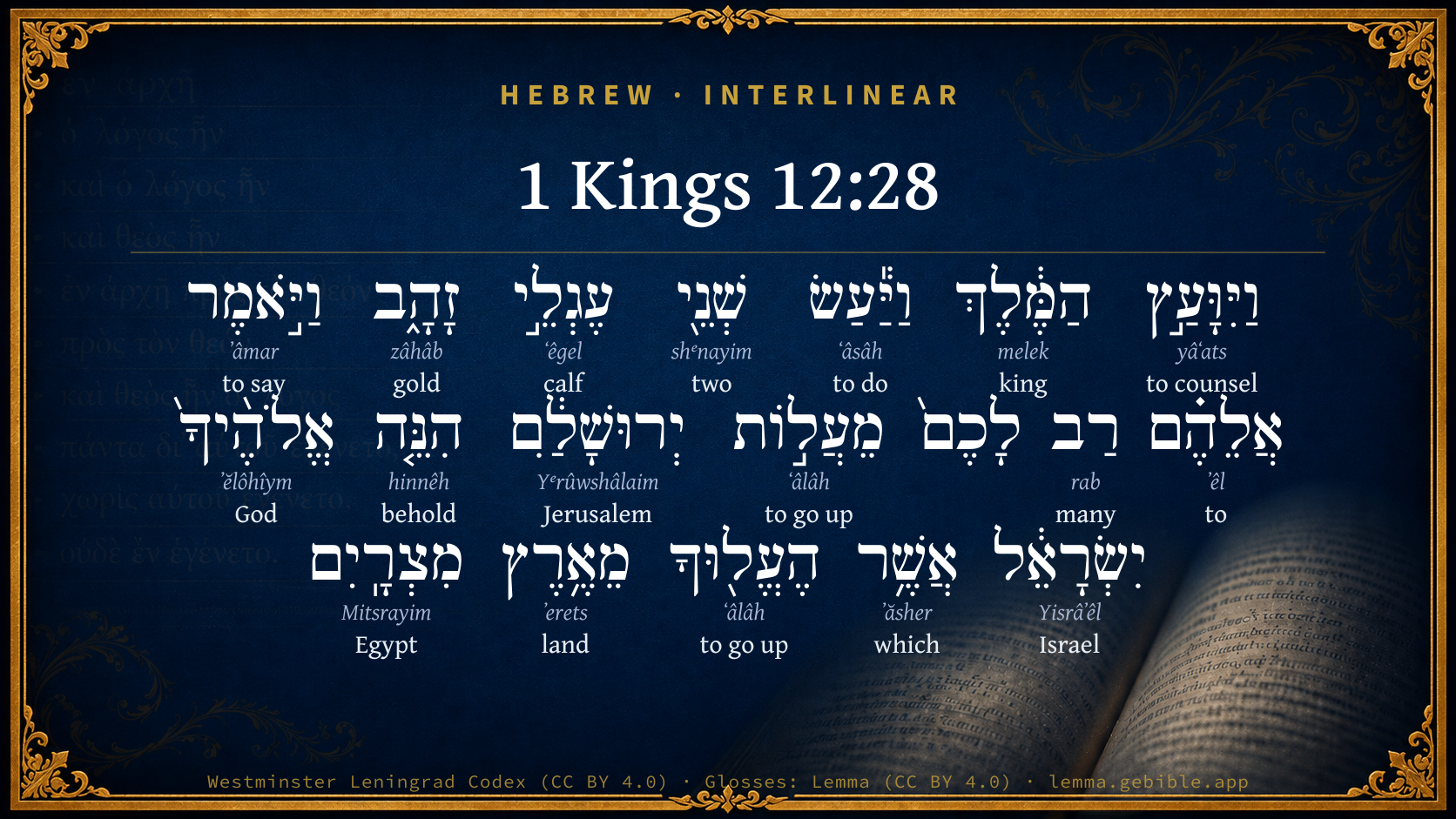
Hebrew (Westminster Leningrad Codex) 1 Kings 12:28 appears in the Hebrew Old Testament. The text above is from the Westminster Leningrad Codex. Each word links to its Strong’s number, a concise gloss, and parsing drawn from the Open Scriptures Hebrew Bible morphology. Click any word for its full Brown-Driver-Briggs (BDB) entry.
Download image
Cite this verse

1 Kings 12:28 (World English Bible). Public Domain. Lemma interlinear Bible study tool, https://lemma.gebible.app/v/1-kings/12/28.

Show BibTeX & RIS
BibTeX
RIS
English Translation
Whereupon the king took counsel, and made two calves of gold; and he said to them, It is too much for you to go up to Jerusalem: see your gods, Israel, which brought you up out of the land of Egypt.
World English Bible · Public Domain
Download a study sheet

One document with this verse’s original text, its word-by-word gloss line, the meaning frame, cross-references with their text, attributed commentary, and full source and license credits — printable, and it pastes into notes with its structure intact.

This verse Autodidact and up

Study sheet (.html) Plain text (.txt)

A passage Seminary Student

Up to 50 verses in one chapter. A passage sheet keeps up to 6 commentary sources and 12 cross-references per verse, in the order this page ranks them, and says so on the sheet whenever that leaves anything out. Ask for a single verse and you get the Autodidact verse sheet above.

Everything on this page stays free to read, with no account — the sheet is a download of what is already on screen, not access to it.

Want to remove ads? Support Godless Engineer
Compare translations 3

The same verse in 3 English versions, stacked beneath the original-language interlinear above. Click any original word for its lexicon entry.

Each is an independent rendering of the whole verse — the interlinear is not word-aligned to these translations.

Highlighted words mark where these versions differ — a whole-verse word diff, not a word-by-word alignment.

  • World English Bible Public Domain
    Whereupon the king took counsel, and made two calves of gold; and he said to them, It is too much for you to go up to Jerusalem: see your gods, Israel, which brought you up out of the land of Egypt.
  • King James Version Public Domain
    Whereupon the king took counsel, and made two calves of gold, and said unto them, It is too much for you to go up to Jerusalem: behold thy gods, O Israel, which brought thee up out of the land of Egypt.
  • unfoldingWord Literal Text CC BY-SA 4.0
    And the king consulted, and he made two calves of gold. And he said to them, “Going up to Jerusalem too much for you. Behold your gods, Israel, who brought you up from the land of Egypt!”

unfoldingWord Literal Text — © unfoldingWord, licensed CC BY-SA 4.0. Word-aligned USFM3 via Door43 (git.door43.org/unfoldingWord/en_ult).

Versions to compare (up to 4)

3 of 4 selected

Show all 18 translations

Every available English version of this verse, each an independent rendering of the whole verse.

  • World English Bible Public Domain
    Whereupon the king took counsel, and made two calves of gold; and he said to them, It is too much for you to go up to Jerusalem: see your gods, Israel, which brought you up out of the land of Egypt.
  • Berean Standard Bible Public Domain
    After seeking advice, the king made two golden calves and said to the people, “Going up to Jerusalem is too much for you. Here, O Israel, are your gods, who brought you up out of the land of Egypt.”
  • Majority Standard Bible Public Domain
    After seeking advice, the king made two golden calves and said to the people, “Going up to Jerusalem is too much for you. Here, O Israel, are your gods, who brought you up out of the land of Egypt.”
  • King James Version Public Domain
    Whereupon the king took counsel, and made two calves of gold, and said unto them, It is too much for you to go up to Jerusalem: behold thy gods, O Israel, which brought thee up out of the land of Egypt.
  • American Standard Version (1901) Public Domain
    Whereupon the king took counsel, and made two calves of gold; and he said unto them, It is too much for you to go up to Jerusalem: behold thy gods, O Israel, which brought thee up out of the land of Egypt.
  • Revised Version (1885) Public Domain
    Whereupon the king took counsel, and made two calves of gold; and he said unto them, It is too much for you to go up to Jerusalem; behold thy gods, O Israel, which brought thee up out of the land of Egypt.
  • Geneva Bible (1599) Public Domain
    Whereupon the King tooke counsell, and made two calues of golde, and saide vnto them, It is too much for you to goe vp to Ierusalem: beholde, O Israel, thy gods, which brought thee vp out of the lande of Egypt.
  • Douay-Rheims (1899) Public Domain
    And finding out a device he made two golden calves, and said to them: Go ye up no more to Jerusalem: Behold thy gods, O Israel, who brought thee out of the land of Egypt.
  • Young's Literal Translation Public Domain
    And the king taketh counsel, and maketh two calves of gold, and saith unto them, `Enough to you of going up to Jerusalem; lo, thy gods, O Israel, which brought thee up out of the land of Egypt.'
  • Literal Standard Version CC BY-SA 4.0
    And the king takes counsel, and makes two calves of gold, and says to them, “Enough of you from going up to Jerusalem; behold, your gods, O Israel, which brought you up out of the land of Egypt.”
  • Unlocked Literal Bible CC BY-SA 4.0
    So King Jeroboam sought advice and made two calves of gold; he said to the people, “It is too much for you to go up to Jerusalem. Look, these are your gods, Israel, who brought you up out of the land of Egypt.”
  • unfoldingWord Literal Text CC BY-SA 4.0
    And the king consulted, and he made two calves of gold. And he said to them, “Going up to Jerusalem too much for you. Behold your gods, Israel, who brought you up from the land of Egypt!”
  • Darby Bible Public Domain
    And the king took counsel, and made two calves of gold. And he said to them, It is too much for you to go up to Jerusalem: behold thy gods, Israel, which brought thee up out of the land of Egypt!
  • World Messianic Bible Public Domain
    So the king took counsel, and made two calves of gold; and he said to them, “It is too much for you to go up to Jerusalem. Look and behold your gods, Israel, which brought you up out of the land of Egypt!”
  • Webster's Bible Public Domain
    Upon which the king took counsel, and made two calves of gold, and said to them, It is too much for you to go up to Jerusalem: behold thy gods, O Israel, which brought thee out of the land of Egypt.
  • Free Bible Version CC BY-SA 4.0
    So after taking advice, the king had two golden calves made, and he told the people, “Don't bother going to Jerusalem any more. Look, Israel, here are your gods who led you out of the land of Egypt.”
  • Bible in Basic English Public Domain
    So after taking thought the king made two oxen of gold; and he said to the people, You have been going up to Jerusalem long enough; see! these are your gods, O Israel, who took you out of the land of Egypt.
  • JPS Tanakh (1917) Public Domain
    Whereupon the king took counsel, and made two calves of gold; and he said unto them: 'Ye have gone up long enough to Jerusalem; behold thy gods, O Israel, which brought thee up out of the land of Egypt.'

Literal Standard Version (2020), Covenant Press — licensed CC BY-SA 4.0. Text via the HelloAO Bible API (eBible.org). Unlocked Literal Bible (unfoldingWord) — licensed CC BY-SA 4.0. Text via the HelloAO Bible API (eBible.org). unfoldingWord Literal Text — © unfoldingWord, licensed CC BY-SA 4.0. Word-aligned USFM3 via Door43 (git.door43.org/unfoldingWord/en_ult). Free Bible Version, Dr. Jonathan Gallagher — licensed CC BY-SA 4.0. Text via the HelloAO Bible API (eBible.org).

Word by word

More ways to search: Search by grammar → Find every occurrence → Compare this word →

Practice this passage: Drill this verse → Learn its vocabulary →

עֶגְלֵ֣י
ʻêgel
H5695
“calves of”
Noun, Common, Masculine, Plural, Construct
Part of Speech
Noun
Type
Common
Gender
Masculine
Number
Plural
State
Construct
Full BDB Definition

Origin: from the same as H5696

TWOT: 1560a

calf, bull-calf
  1. וַיִּוָּעַ֣ץ yâʻats H3289 “and · to counsel” Conjunction + Verb, Niphal, Sequential Imperfect, 3rd Person, Masculine, Singular
  2. הַמֶּ֔לֶךְ melek H4428 “the · king” Particle, Definite Article + Noun, Common, Masculine, Singular, Absolute
  3. וַיַּ֕עַשׂ ʻâsâh H6213 “and · to do” Conjunction + Verb, Qal, Sequential Imperfect, 3rd Person, Masculine, Singular
  4. שְׁנֵ֖י shᵉnayim H8147 “two” Adjective, Cardinal number, Masculine, Dual, Construct
  5. זָהָ֑ב zâhâb H2091 “gold” Noun, Common, Masculine, Singular, Absolute
  6. וַיֹּ֣אמֶר ʼâmar H559 “and · to say” Conjunction + Verb, Qal, Sequential Imperfect, 3rd Person, Masculine, Singular
  7. אֲלֵהֶ֗ם ʼêl H413 “to · them” Preposition + Suffix, Personal, 3rd Person, Masculine, Plural
  8. רַב rab H7227 “many” Adjective, Adjective, Masculine, Singular, Absolute
  9. מֵעֲל֣וֹת ʻâlâh H5927 “from · to go up” Preposition + Verb, Qal, Infinitive Construct
  10. יְרוּשָׁלִַ֔ם Yᵉrûwshâlaim H3389 “Jerusalem” Noun, Proper
  11. הִנֵּ֤ה hinnêh H2009 “behold” Particle, Demonstrative
  12. אֱלֹהֶ֨יךָ֙ ʼĕlôhîym H430 “God(s) · your” Noun, Common, Masculine, Plural, Construct + Suffix, Personal, 2nd Person, Masculine, Singular
  13. יִשְׂרָאֵ֔ל Yisrâʼêl H3478 “Israel” Noun, Proper
  14. אֲשֶׁ֥ר ʼăsher H834 “which” Particle, Relative
  15. הֶעֱל֖וּךָ ʻâlâh H5927 “to go up · you” Verb, Hiphil, Perfect, 3rd Person, Common, Plural + Suffix, Personal, 2nd Person, Masculine, Singular
  16. מֵאֶ֥רֶץ ʼerets H776 “from · land of” Preposition + Noun, Common, Both, Singular, Construct
  17. מִצְרָֽיִם Mitsrayim H4714 “Egypt” Noun, Proper

About this verse

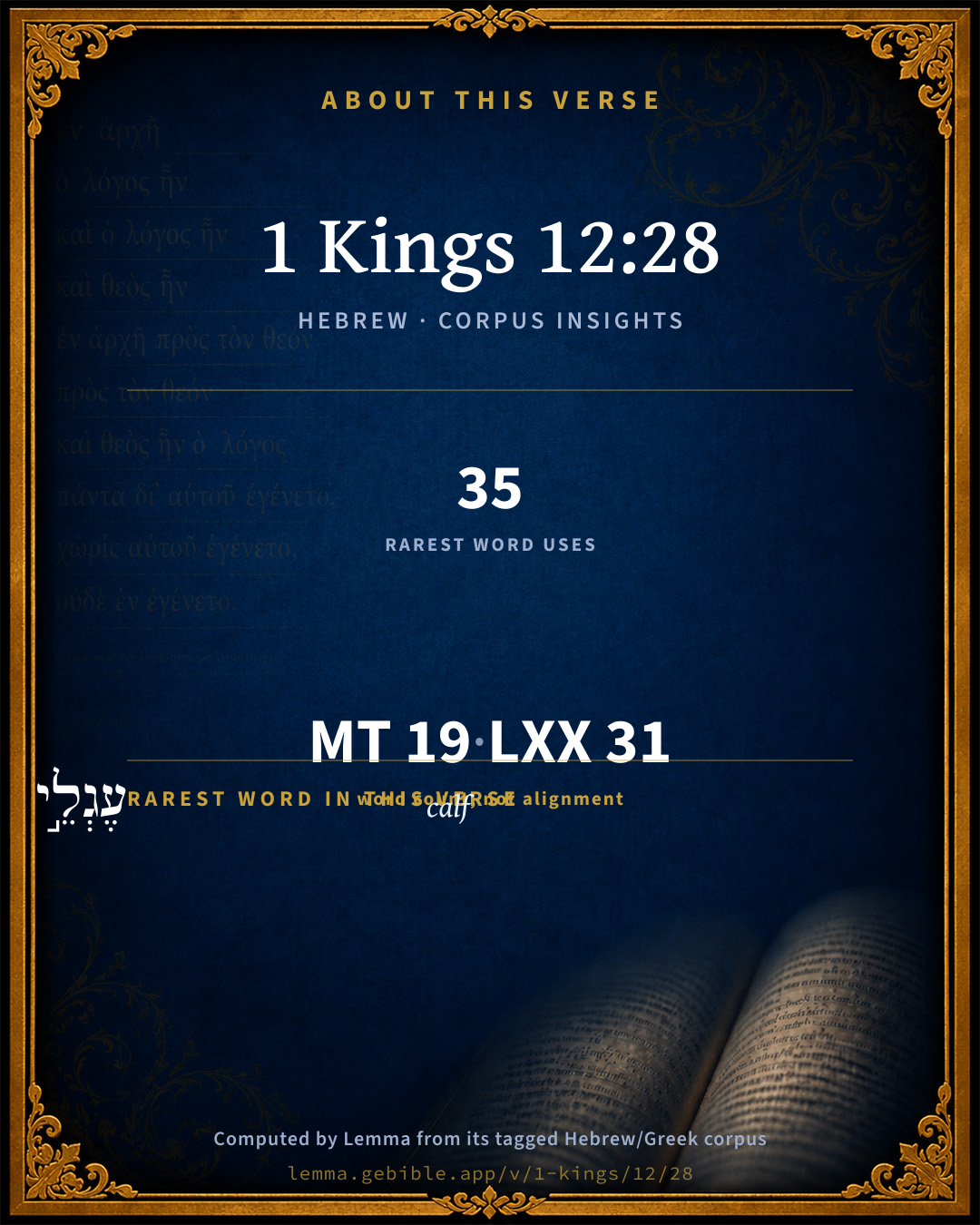
These counts appear in no published source. They are computed here, from the morphology-tagged text and Lemma’s own curated glosses. What Lemma adds →

19
words
17
distinct lemmas
Historical
section

Shared distinctive vocabulary

עֶגְלֵ֣י calf H5695 occurs in 35 verses of the Hebrew Bible. Also found in:

Grammatical profile

  • 5 verbs
  • 8 nouns
  • 2 adjectives
  • 2 prepositions
  • 2 particles

Verb forms

  • וַיִּוָּעַ֣ץ Niphal · Sequential Imperfect
  • וַיַּ֕עַשׂ Qal · Sequential Imperfect
  • וַיֹּ֣אמֶר Qal · Sequential Imperfect
  • מֵעֲל֣וֹת Qal · Infinitive Construct
  • הֶעֱל֖וּךָ Hiphil · Perfect

Repetition

A word recurs within this verse — often emphatic in Hebrew:

  • מֵעֲל֣וֹת to go up H5927 ×2

Hebrew & Septuagint length

In English translation the verse runs 41 words from the Hebrew and 42 from the Septuagint (LXX English) — closely comparable.

A rough comparison of the two English renderings, which tokenize alike — not a word-level alignment.

Word counts can differ between the Hebrew and the Greek without any difference in meaning — e.g. the Hebrew direct-object marker אֵת has no separate Greek word, and Greek often adds the article ὁ.

In the original languages it is 19 Hebrew tokens and 31 Greek tokens — but the two are counted differently (Hebrew bundles its prefixes and suffixes into one token; the Greek is in lemma form), so that isn’t a like-for-like length.

Cross-references

14

Topical passages linked to 1 Kings 12:28 in the Treasury of Scripture Knowledge — connected by theme and wording, ordered by reader-vote popularity; previews shown in the World English Bible.

  • Exodus 32:4 He received what they handed him, and fashioned it with an engraving tool, and made it a molten calf; and they said, "These are your gods, Israel, which brought you up out of the land of Egypt."
  • Exodus 32:8 They have turned aside quickly out of the way which I commanded them. They have made themselves a molten calf, and have worshiped it, and have sacrificed to it, and said, 'These are your gods, Israel, which brought you up out of the land of Egypt.'"
  • 2 Kings 10:29 However from the sins of Jeroboam the son of Nebat, with which he made Israel to sin, Jehu didn't depart from after them, [to wit], the golden calves that were in Bethel, and that were in Dan.
  • 2 Kings 17:16 They forsook all the commandments of Yahweh their God, and made them molten images, even two calves, and made an Asherah, and worshiped all the host of the sky, and served Baal.
  • 2 Chronicles 11:15 and he appointed him priests for the high places, and for the male goats, and for the calves which he had made.
  • Hosea 8:4–7 They have set up kings, but not by me. They have made princes, and I didn't approve. Of their silver and their gold they have made themselves idols, That they may be cut off.
  • Exodus 1:10 Come, let us deal wisely with them, lest they multiply, and it happen that when any war breaks out, they also join themselves to our enemies, and fight against us, and escape out of the land."
  • Exodus 20:4 "You shall not make for yourselves an idol, nor any image of anything that is in the heavens above, or that is in the earth beneath, or that is in the water under the earth:
  • Deuteronomy 4:14–18 Yahweh commanded me at that time to teach you statutes and ordinances, that you might do them in the land where you go over to possess it.
  • 1 Kings 12:8–9 But he forsook the counsel of the old men which they had given him, and took counsel with the young men who had grown up with him, who stood before him.
  • Isaiah 30:1 Woe to the rebellious children, says Yahweh, who take counsel, but not of me; and who make a league, but not of my Spirit, that they may add sin to sin,
  • Isaiah 30:10 who tell the seers, "Don't see;" and to the prophets, "Don't prophesy to us right things, speak to us smooth things, prophesy deceits,
  • Hosea 10:5–6 The inhabitants of Samaria will be in terror for the calves of Beth Aven; For its people will mourn over it, Along with its priests who rejoiced over it, For its glory, because it has departed from it.
  • 2 Peter 2:19 promising them liberty, while they themselves are bondservants of corruption; for by whom a man is overcome, by the same is he also brought into bondage.

Cross-references courtesy of OpenBible.info (CC BY 4.0).

Hebrew and Greek witnesses Masoretic Hebrew ↔ Greek Septuagint

The same verse in the two great witnesses to the Old Testament, shown verse-for-verse.

These are two independent witnesses, not word-aligned to each other, and the Septuagint is shown in lemma (dictionary) form.

Hebrew 1 Kings 12:28 Masoretic · Westminster Leningrad Codex

וַיִּוָּעַ֣ץ הַמֶּ֔לֶךְ וַיַּ֕עַשׂ שְׁנֵ֖י עֶגְלֵ֣י זָהָ֑ב וַיֹּ֣אמֶר אֲלֵהֶ֗ם רַב לָכֶם֙ מֵעֲל֣וֹת יְרוּשָׁלִַ֔ם הִנֵּ֤ה אֱלֹהֶ֨יךָ֙ יִשְׂרָאֵ֔ל אֲשֶׁ֥ר הֶעֱל֖וּךָ מֵאֶ֥רֶץ מִצְרָֽיִם

Whereupon the king took counsel, and made two calves of gold; and he said to them, It is too much for you to go up to Jerusalem: see your gods, Israel, which brought you up out of the land of Egypt.

World English Bible · Public Domain

Greek LXX 1 Kings 12:28 Septuagint · lemma form

καί βουλεύω ὁ βασιλεύς καί πορεύομαι καί ποιέω δύο δάμαλις χρυσοῦς καί εἶπον πρός ὁ λαός ἱκανόω σύ ἀναβαίνω εἰς ἰερουσαλήμ ἰδού θεός σύ ἰσραήλ ὁ ἀναἄγω σύ ἐκ γῆ αἴγυπτος

And the king took counsel, and went, and made two golden heifers, and said to the people, Let it suffice you to have gone hitherto to Jerusalem: behold your gods, O Israel, who brought you up out of the land of Egypt.

LXX2012 (modern English Septuagint) · Public Domain

On this verse, The Cambridge Bible for Schools and Colleges discusses the Septuagint’s reading. Read the note in Commentary ↓

Hebrew: Westminster Leningrad Codex (CC BY 4.0). Greek: Septuagint (public domain); English from LXX2012 (modern English Septuagint) (Public Domain). How the Septuagint differs from the Hebrew →

Targum (Aramaic paraphrase)

1

The Targum is the ancient Jewish Aramaic paraphrase of the Hebrew Scriptures — an interpretive translation, not the Hebrew text itself. Onkelos (literal) and Pseudo-Jonathan (expansive) render the Torah, and Jonathan the Prophets. Coverage is partial: where no permissively-licensed English translation exists for a verse, only the Aramaic is shown. This is verse-level text, not a word-by-word alignment to the Hebrew.

  1. Targum Jonathan Prophets (Joshua–Malachi)
    וְאִתְמְלִיךְ מַלְכָּא וַעֲבַד תְּרֵי עֶגְלִין דְדַהֲבָא וַאֲמַר לְהוֹן סַגִיאָה לְכוֹן אָרְחָא מִלְמֵסַק לִירוּשְׁלֵם הָא אִינוּן דַחֲלָתָךְ יִשְׂרָאֵל דְאַסְקוּךְ מֵאַרְעָא דְמִצְרָיִם:

    (no public-domain English translation for this verse)

    Targum Jonathan — Aramaic: “Mikraot Gedolot” (public domain). English: “Sefaria Community Translation” (CC0 1.0 (public-domain dedication)); “London "Chaldee Paraphrase," 1871” (public domain). Text via Sefaria.

Commentary

Notes on 1 Kings 12:28 from classic Christian and Jewish commentators (each source and its license shown beneath its notes). The classic Christian expositions comment on the surrounding passage and are grouped to its opening verse, so a note may address several verses; the Jewish commentaries on the Tanakh (Rashi and others) are per-verse, so they appear only where the commentator wrote on this verse.

Lemma curates 59 commentaries, every one of them public domain or Creative Commons licensed, each selected and text-cleaned for this edition rather than reprinted as found. About our sources →

Trapp's Complete Commentary

John Trapp

1Ki 12:28 Whereupon the king took counsel, and made two calves [of] gold, and said unto them, It is too much for you to go up to Jerusalem: behold thy gods, O Israel, which brought thee up out of the land of Egypt.

Ver. 28. Whereupon the king took counsel,] viz., Of his politicians, who are none of the best patriots, because they make religion serve policy, which is the way to ruin all, as is to be seen in the histories of Constantius, Heraclius, Michael Paleologus (who first made the Greek Church acknowledge the Pope’s supremacy), Caesar Borgia, our Richard III, Henry IV of France, and many others. Jeroboam graviorem duxit iacturam regionis quam religionis; atque si omnino religio violanda sit, existimat regni causa violandam.

And made two calves.] He had sojourned in Egypt, where he had seen calf worship, in honour of Apis, and haply joined in it to please Shishak, whose daughter he is also said by some to have married, as thinking to strengthen himself against Rehoboam by that affinity. {a}

It is too much for you.] Behold a more compendious way of worship: Colite Deum, ut par est; Religiosum oportet esse, sed non religentem: provide for your own ease and better accommodation.

{a} Ibique uxore accepta ex stirpe regia. - Sulp. Sever.

John Trapp, A Commentary or Exposition upon All the Books of the Old and New Testament (1647–1656) — public domain. Text from a community e-Sword module.

Joseph Benson's Commentary

1Ki 12:28. The king took counsel, and made two calves — In imitation of Aaron’s golden calf, and of the worship of the Egyptians, from whose country he had lately come. These calves were of the same matter with Aaron’s, and made for the same reason: his because Moses, the minister of God and medium of divine communication, was absent, and these because the holy city, where the temple, altar, and priests of God were, was distant, and could not be visited with safety. It is not improbable but, as some learned men have conjectured, it was in imitation of the Egyptians that he made two calves, and was not content with forming one. For they had a couple of oxen which they worshipped, namely, Apis at Memphis, the metropolis of the upper Egypt, and Mnevis at Hierapolis, which was the chief city of the lower. Jeroboam probably the rather presumed to make these images, because he knew the people of Israel were generally prone to idolatry; and that Solomon’s example had exceedingly strengthened those inclinations; and therefore that they were prepared for such an attempt, especially when his proposition tended to their own ease, and safety, and profit, which he knew was much dearer to them, as well as to himself, than their religion. It is too much for you to go to Jerusalem — Too great a trouble and charge, and neither necessary nor safe as things now stand. Behold thy gods, O Israel! — Not as if he thought to persuade the people that these calves were that very God of Israel who brought them out of Egypt: which was so monstrously absurd and ridiculous, that no Israelite in his right senses could have believed it, and to have intimated it would have been so far from satisfying the people, that it would have made him both hateful and contemptible to them; but his meaning was, that these images were visible representations, by which he designed to worship the true God of Israel. This appears, partly from that parallel place, Exo 32:4; partly, because the priests and worshippers of the calves are said to worship Jehovah, and upon that account are distinguished from those belonging to Baal, 1Ki 18:21; 1Ki 22:6-7; and partly, from Jeroboam’s design in this work, which was, to quiet the people’s minds, and remove their scruples about going to Jerusalem to worship their God in that place, as they were commanded. This he endeavoured to do by signifying to them that he did not intend any alteration in the substance of their religion, nor to draw them from the worship of the true God, to the worship of any of those Baals which were set up by Solomon; but to worship that self-same God whom they worshipped in Jerusalem, even the true God who brought them out of Egypt: only to vary a circumstance; and that, as they worshipped God at Jerusalem, before one visible sign, even the ark and the sacred cherubim there, so his subjects should worship God by another visible sign, even that of the calves, in other places. And as for the change of the place, he might suggest to them that God was present in all places, where men with honest minds called upon him; that before the temple was built, the best of kings, and prophets, and people, did pray and sacrifice to God, in divers high places, without any scruple: and that God would dispense with them also in that matter: because going to Jerusalem was dangerous to them at this time, and God would have mercy rather than sacrifice.

Joseph Benson's Commentary on the Old and New Testaments (1811–1818) — public domain. Text from a community e-Sword module.

Tyndale Open Study Notes

Tyndale Open Resources

12:28 Two gold calves would strike a responsive chord regarding Israel’s history (Exod 32; esp. 32:4). Similar religious practices, associated with the Canaanite god Baal-Hadad, also appealed to the remaining Canaanite population in the northern kingdom. Jeroboam’s intentions compromised true worship and caused religious confusion (see 1 Kgs 14:9; Hos 8:6).

Tyndale Open Study Notes — © Tyndale Open Resources, licensed CC BY-SA 4.0. Text via the HelloAO Bible API.

Geneva Bible (1599)

Geneva Bible translators

So crafty are carnal persuasions of princes, when they will make a religion to serve to their appetite.

Geneva Bible (1599) marginal notes — public domain. Text via Bolls.life.

Adam Clarke's Commentary

Verse 28. Made two calves of gold] He invented a political religion, instituted feasts in his own times different from those appointed by the Lord, gave the people certain objects of devotion, and pretended to think it would be both inconvenient and oppressive to them to have to go up to Jerusalem to worship. This was not the last time that religion was made a state engine to serve political purposes. It is strange that in pointing out his calves to the people, he should use the same words that Aaron used when he made the golden calf in the wilderness, when they must have heard what terrible judgments fell upon their forefathers for this idolatry.

Adam Clarke's Commentary on the Bible (1810–1826) — public domain. Text from a community e-Sword/MySword module.

Ellicott's Commentary for English Readers

(28) Calves of gold.—The choice of this symbol of the Divine Nature—turning, as the Psalmist says with indignant scorn, “the glory of God into the similitude of a calf that eateth hay” (Psa_106:20)—was probably due to a combination of causes. First, the very repetition of Aaron’s words (Exo_32:8) indicates that it was a revival of that ancient idolatry in the wilderness. Probably, like it, it was suggested by the animal worship of Egypt, with which Jeroboam had been recently familiar, and which (as is well known) varied from mere symbolism to gross creature worship. Next, the bull, as the emblem of Ephraim, would naturally become a religious cognisance of the new kingdom. Lastly, there is some reason to believe that the figure of the cherubim was that of winged bulls, and the form of the ox was undoubtedly used in the Temple, as for example, under the brazen sea. It has been thought that the “calves” were reproductions of the sacred cherubim,—made, however, symbols, not of the natural powers obeying the Divine word, but of the Deity itself.

It is, of course, to be understood that this idolatry, against which the prohibition of many sanctuaries was meant to guard, was a breach, not of the First Commandment, but of the Second—that making of “a similitude” of the true God, so emphatically forbidden again and again in the Law. (See, for example, Deu_4:15-18.) Like all such veneration of images, it probably degenerated. From looking on the image as a mere symbol it would come to attach to it a local presence of the Deity and an intrinsic sacredness; and so would lead on, perhaps to a veiled polytheism, certainly to a superstitious and carnal conception of the Godhead.

A Bible Commentary for English Readers, edited by Charles John Ellicott (1878–1897) — public domain. Text from a community e-Sword module.

The Cambridge Bible for Schools and Colleges

gen. ed. J. J. S. Perowne

28. two calves of gold] The Israelites in Egypt had been familiarized with the ox as an object of worship, and it would therefore not be unknown among their descendants. Hence their readiness to recognize such an image as a symbol of the divinity when they were in the wilderness (Exo_32:4; Exo_32:8). The sin was the same on this occasion as on that. God had commanded that no image should be made as a symbol of Him. The calves were therefore an abomination, (directly contrary to Exo_20:4), even though when bowing before them the people professed to worship Him who led their fathers out of Egypt.

The LXX says ‘he went and made’ ἐπορεύθν καὶ ἐποίησε, and instead of ‘and said unto them,’ in the next clause, which reads a little awkwardly, gives ‘and said unto the people.’

It is too much for you to go up] The sense intended is probably given in the margin of R.V. ‘Ye have gone up long enough.’ To the mind of the Jew there might be a reason for ceasing altogether to go to Jerusalem, now that the kingdoms were divided, but no excuse from the fatigue of the journey. Jeroboam’s argument was ‘You have chosen a new king, choose also new places for worship.’ Cf. Eze_44:6, where the sense is ‘Have done with your abominations.’

behold thy gods] Words very like those of the people in the wilderness (Exo_32:4) over their golden calf. But the sense is rather: ‘Behold thy God.’ Under this symbol of the young bull, see and recognise thy God, Jehovah. The young bull was the symbol of creative power.

The Cambridge Bible for Schools and Colleges (gen. ed. J. J. S. Perowne; Cambridge University Press, 1878–1918) — public domain. Text from a community e-Sword module.

John Gill's Exposition

And this thing became a sin,.... The cause and occasion of the sin of idolatry; it led them by degrees to leave off the worship of God, and to worship these calves as gods:

for the people went to worship before the one, even unto Dan; which was the furthest off, such was their great zeal for idolatrous worship; or they went thither before that at Bethel was set up; and even they at Bethel would go as far as Dan to worship, such was their veneration for both the calves. Abarbinel is of opinion that these calves were not made by Jeroboam for idolatrous uses, only the altar later mentioned; and that he never worshipped before them, nor sacrificed to them, nor even built the altar before them; but that these were set up as signs, and in memory of his kingdom, like the pillars in Solomon's temple; that he chose the calf or ox as emblems of his family, the family of Joseph, Deu 33:17 two to represent Ephraim and Manasseh; golden ones, to denote the majesty and perpetuity of his kingdom; and he set these, the one at Bethel, at the entrance of it, and the other at Dan, at the further borders of it; and that he did not call those gods, but the only true God, as he that brought Israel out of Egypt; only signified by that expression, that he was everywhere, there as well as at Jerusalem; but that the Israelites, who were taken with sensible objects, on visiting these out of curiosity, it became a snare to them, and they fell into the worship of them; just as Gideon's ephod, and Moses' brasen serpent, were unto them.

John Gill's Exposition of the Whole Bible (1746–1763) — public domain (CC PDM 1.0). Text via the HelloAO Bible API.

Albert Barnes' Notes on the Bible

The “calves of gold” were probably representations of the cherubic form, imitations of the two cherubim which guarded the ark of the covenant in the holy of holies. But being unauthorized copies, set up in places which God had not chosen, and without any divine sanction, the sacred writers call them “calves.” They were not mere human figures with wings, but had at any rate the head of a calf or ox. (Hence, some attribute this calf-worship entirely to Assyrian and Phoenician influence.) Jeroboam, in setting them up, was probably not so much influenced by the Apis-worship of Egypt, as:

(1) by a conviction that the Israelites could not be brought to attach themselves to any worship which did not present them with sensible objects to venerate;

(2) by the circumstance that he did not possess any of the old objects of reverence, which had been concentrated at Jerusalem; and

(3) by the fact that he could plead for his “calves” the authority of so great a name as Aaron (marginal reference).

Albert Barnes' Notes on the Bible (1834–1885) — public domain. Text from a community e-Sword/MySword module.

Haydock's Catholic Bible Commentary

Device. Wicked policy, to make religion subservient to the state. (Worthington) --- Jeroboam was right in judging, (Haydock) that it is one of the strongest foundations of government, (Calmet) and therefore he would have a peculiar religion for his subjects. (Haydock) --- Strange blindness, caused by ambition! As if God could not have maintained him on the throne. The sequel evinces how delusive were his wicked projects. (Calmet) --- Calves. It is likely, by making his gods in this form, he mimicked the Egyptians, among whom he had sojourned, who worshipped their Apis and their Osiris under the form of a bullock. (Challoner) (St. Jerome in Osee iv. 15., and v., &c.) --- The Greeks commonly style these idols, heifers, are more contemptible than bulls: (Tirinus) and some Fathers style them, "calf-heads." (Lactantius iv. 10.) Monceau pretends that they resembled the cherubim, and were intended to represent the true God; thus endeavouring to excuse the Israelites from idolatry, on this occasion, as well as when they came out of Egypt, Exodus xxxii. 4. But his arguments are weak, and Jeroboam is constantly condemned as a most wicked and idolatrous prince, chap. xiv. 9., 4 Kings xxiii. 15., and Osee viii. 5., and x. 5. (Calmet) --- Egypt. The same had been said by Aaron. (Menochius)

George Leo Haydock (1774–1849), Haydock's Catholic Family Bible and Commentary, 1859 edition — public domain. Excludes Psalms (Douay-Rheims chapter numbering differs from Protestant) and Deuterocanonical books (Catholic canon only).

Matthew Poole's English Annotations

Made two calves of gold, in imitation of Aaron’s golden calf, and of the Egyptians, from whom he was lately come. And this he the rather presumed to do, because he knew the people of Israel were generally very prone to superstition and idolatry, as their whole history showeth; and that Solomon’s example and countenance given to false worships had exceedingly strengthened those inclinations; and therefore they were in a great measure prepared for such an attempt; especially when his proposition tended to their own case, and safety, and profit, which he knew was much dearer to them, as well as to himself, than their religion.

It is too much for you; too great a trouble and charge, and neither necessary nor safe for them, as things now stood.

Behold thy gods, O Israel, which brought thee up out of the land of Egypt; not as if he did himself believe, or thought to persuade the people to believe, that these calves were properly and truly that very God of Israel who brought them out of Egypt; (which was so monstrously absurd and ridiculous, that no Israelite in his right wits could believe it;) and had been so far from attaining his end, and satisfying his people, that this would have made him both hateful and contemptible to them: but his meaning was, that these images were visible representations, in and by which he designed to worship the true God of Israel; as appears, partly, from that parallel place, Exo 32:4, See Poole "Exo 32:4"; partly, because the priests and worshippers of the calves are said to worship Jehovah, and, upon that account, are distinguished from those belonging to Baal, 1Ki 18:21; 22:6,7; and partly, from Jeroboam’s design in this work, which was to quiet the people’s minds, and remove their scruples about going to Jerusalem to worship their God in that place, as they were commanded; which he doth, by signifying to them that he did not intend any alteration in the substance of their religion, nor to draw them from the worship of the true God to the worship of Ashtoreth, or Milcom, or any of those Baals which were set up by Solomon; but to worship that selfsame God whom they worshipped in Jerusalem, even the true God, and the God of their fathers, who brought them out of Egypt, but only to vary a circumstance; and that as they worshipped God at Jerusalem by and before one visible sign, even the ark, and the sacred cherubims there; so his subjects should worship God by another visible sign, even that of the calves, in other places: and as for the change of the place, he might suggest to them that God was present in all places where men with honest minds did call upon him; that before the temple was built, the best of kings, and prophets, and people did pray and sacrifice to God in divers high places, without any scruple, notwithstanding that restraint of God to one place, Deu 12:5, &c.; that God would dispense with them also in that matter, because going to Jerusalem was very dangerous to them at this time, and God would have mercy rather than sacrifice; and God had been pleased to dispense with his own ordinances in cases of necessity or great inconvenience, as he did with circumcision for forty years in the wilderness.

Matthew Poole's English Annotations on the Holy Bible (1683–1685) — public domain. Text from a community e-Sword/MySword module.

Whedon's Commentary on the Bible

Daniel D. Whedon

28. Took counsel — But not of God. Compare Isa_30:1.

Two calves of gold — Jeroboam’s residence in Egypt had made him familiar with the calf-worship so largely practised there, and this, doubtless, had much to do with the erection of these golden shrines: besides, the people had already become accustomed to the sight of the figures of oxen in their religions ceremonial by their presence as supporters of the molten sea at the temple of Jerusalem. And as it had now become needful to provide some substitute for the ark and its cherubim, it was natural to adopt the semblance of an animal with whose presence they were already familiarized. These calves were not set up to be worshipped as idols, any more than were the ark and other sacred shrines at Jerusalem, but were designed to be symbols of Jehovah. They were made, like the golden calf at Sinai, of wood or other material overlaid with gold, and probably resembled the Egyptian Mne, or Mnevis, which was worshipped at On, or the bull Apis, whose form was similar.

It is too much for you to go up to Jerusalem — An appeal to the fleshly love of ease. He has nothing against the worship at Jerusalem; that is all right for those that dwell there; but he assumes to show his people an easier and better way. There have never been wanting those who are very ready to take the easiest apparent road to heaven, nor have there been wanting ministers to point it out.

Behold thy gods — Rather, Behold thy God. He would no more establish polytheism than would Aaron. He quotes the very words of Aaron, (see Exo_32:4,) as if to say, This is no new religion, no new system of worship; but was used of old by our fathers under the sanction of Aaron.

Daniel D. Whedon (gen. ed.), Commentary on the Old and New Testaments (1874–1909) — public domain. Text from a community e-Sword module.

The Pulpit Commentary

Whereupon the king took counsel "With his counsellors, or the heads of the nation who had helped him to the throne" (Keil). Bahr understands, "he reflected about it alone" (et excogitato consilio, Vulgate), alleging that so important a circumstance as the concurrence of the heads of the people in changing the system of worship would not have been passed over in silence. But while the text does not perhaps imply any formal deliberation with the elders, it is reasonable to suppose that Jeroboam, who owed his position to popular election, and who was far too sagacious not to follow the example of Rehoboam (vers. 6, 9), would summon others to advise him as to this critical and momentous step. Wordsworth refers to, Isa_30:1, and says that "Jeroboam is the image and pattern of Machiavellian politicians." "Next to Ahithophel, I do not find that Israel yielded a craftier head than Jeroboam"s" (Hall) and made two calves It is generally held that these were in imitation of, or were suggested by, the "golden calf" of Aaron, (Exo_32:2) and the close resemblance of Jeroboam"s words (below), in inaugurating this new cultus, to Aaron"s have been thought to prove it. But surely it has been overlooked that Jeroboam could hardly be so shortsighted and unwise as deliberately to reintroduce a worship which had provoked the "fierce wrath" (ver. 12) of God, and had nearly resulted in the extermination of the Jewish race. For of course neither Jeroboam nor his people could have forgotten the stern condemnation which Aaron"s calf worship had received. The molten image ground to powder, the ashes mixed in the drink of the people, the slaughter of three thousand worshippers, etc., would assuredly have lived in the memories of the nation. A more impolitic step, consequently one more certain to precipitate his ruin, by driving the whole nation into the arms of Judah Jeroboam could not have taken, than to attempt any revival or imitation of the forbidden cultus of the desert. And it is as little likely that the worship of the calves was derived from the worship of Apis, as practised at Memphis, or of "Mnevis, the sacred calf of Heliopolis" (Stanley), though with both of these Jeroboam had recently been in contact. It would have been but a sorry recommendation in the eyes of Israel that the first act of the new king should be to introduce the hateful idolatry of Egypt into the land; and every consideration tends to show that the calf worship was not, and was not intended to be, idolatry, such as the worship of Egypt undoubtedly was. It is always carefully distinguished from idol worship by the historians and prophets. And the idea which Jeroboam wished to give his subjects was clearly this that, so far from introducing new gods or new sanctuaries, he was merely accommodating the old worship to the new state of things. He evidently felt that what he and his house had most to fear was, not the armies of Rehoboam but the ritual and religious associations of Jerusalem. His object, if he were wise, must therefore be to provide a substitute, a counterfeit worship. "I will give you," he virtually says, "at Bethel and Dan, old sanctuaries of our race long before Jerusalem usurped their place, those visible emblems of the heavenly powers such as are now found only in the temple. You too shall possess those mysterious forms which symbolize the Invisible, but you shall have them nearer home and easier of access." There can be little doubt, consequently, that the "calves" were imitations of the colossal cherubim of Solomon"s temple, in which the ox or calf was probably the forma praecipua. (1Ki_6:23) of gold Hardly of solid gold. Possibly of. wood covered with gold plates, i.e., similar to the cherubim; (1Ki_6:23-28) probably of molten brass (1Ki_14:9, and cf., Psa_106:19) overlaid with gold; such images, in fact, (as are described in, Isa_40:19) and said unto them, It is too much for you This translation, pace Keil, cannot be maintained. Nor can it be said that "the exact meaning of the original is doubtful" (Rawlinson), for a study of the passages where this phrase, occurs, (see e.g., Deu_1:6 Deu_2:8 Deu_3:26; and cf. Genesis Exo_9:28; 2Sa_24:16; 1Ki_19:4) will convince the reader that it must be rendered here, "It is enoughi.e. , "you have gone long enough to a city which only owes its present position to the ambition of the tribe of Judah, and which is a standing testimony to your own inferiority; henceforth, desist." We have an exact parallel inusqw Eze_44:6; where the Authorized Version renders, "Let it suffice you." The LXX supports this view by rendering iJkano uJmin throughout. Vulgate, nolite ultra ascendere, etc. to go up to Jerusalem: behold thy gods rather "god," for Jeroboam had no idea of introducing polytheism. It is true he made two calves because of his two sanctuaries, but each was designed to represent the same object the one God of Israel. The word is translated, gods" in Exo_32:1, Exo_32:4, Exo_32:8, Exo_32:23, Exo_32:31; but as the reference is in every case to the one calf, it should be translated "god" there also. In Nehemiah"s citation of the words, (Neh_9:18) the word is unmistakably singular. This is thy god," etc. The words are not exactly the same as the people used when setting up the golden calf" (Bahr). Jeroboam says, Behold ," etc., O Israel, which brought thee up out of the land of Egypt. It is at first sight somewhat difficult to resist the view, which is generally entertained, that Jeroboam, of set purpose, cited the ipsissima verba of the Israelites in the desert. (Exo_32:4) But a little reflection will show that it is much more difficult to believe that a monarch, circumstanced as Jeroboam was, could at the very outset of his career have acted in the teeth of history, and have committed the gross blunder, not to say wanton outrage, of deliberately connecting his new cult with the calf worship of the desert. He can hardly have dared, that is, to say, "This is no new religion, for this very form of worship our fathers used formerly in the desert, under the guidance of Aaron himself" (Seb. Schmidt, followed by Keil, al.) unless both he and his people alike which is inconceivable were ignorant of their nation"s history recorded in Exo_32:19-35. It has been argued by some that this action of Jeroboam and the ready compliance of the ten tribes, prove that the Pentateuch cannot then have been written. But, as Hengstenberg (cited by Wordsworth) rejoins, the same argument would lead to the conclusion that the Bible could not have been written in the dark ages, or, we might add, even at the present day. He can hardly have claimed, that is to say, to be reintroducing the calf worship, which God had so emphatically reprobated, unless he designed an open defiance of the Most High, and wished to shock all the religious instincts and convictions of his people. It is much more natural, consequently, to suppose, considering the very frequent recurrence, though sometimes in slightly different shapes, of the formula "the Lord thy God, which brought thee out of the land of Egypt" (Exo_20:2 Exo_29:45, Exo_29:46; Lev_19:36 Lev_23:43 Lev_25:38 Lev_26:13, Lev_26:45; Num_15:41 Num_16:13 Num_20:16; Deu_5:6, 15 6:12 8:14 9:26; Jos_24:6, Jos_24:17; Jud_1:6:8; 1Sa_8:8; 1Ki_8:21, etc.) that the correspondence is accidental, the more so as Jeroboam does not quote the exact words, and that he has used a phrase which was constantly in their ears, insisting thereby that his calves were emblems of the God of their race, the God whose great glory it was that He had taken their nation out of the midst of another nation, etc., (Deu_4:34) and delivered them from a thraldom with which, perhaps, the tyranny of Rehoboam is indirectly compared. Or it there was any reference to the golden calf, it must have been depreciatory, as if to say," That was rank idolatry, and as such it was punished. That calf was an image of Apis. My calves are cherubic symbols, symbols such as He has Himself appointed, of the Great Deliverer of our race. Behold thy God, which really brought thee up," etc.

Jeroboam"s Calves.

Unbelief is the root of all mischief. Had the king of Israel believed God, he would have obeyed Him; then he would have been under no temptation to set up a spurious religion to the confusion of his family and people. But what did he mean by these calves?

I THEY WERE INTENDED TO BE IMAGES OF THE GOD OF ISRAEL.

1. So he describes them in the text.

(1) "These are thy Elohim, O Israel." Our English Bibles give the word "God" without the capital G, as though the purpose of Jeroboam were to lead the people away from the true God. This, indeed, was the effect, but that it was the design may well be doubted.

(2) He farther identifies the Elohim represented in them as having brought them up out of the land of Egypt. This expression is equivalent to saying that the Elohim he would remind them of in these figures was the same who wrought all the miracles of the Exodus.

(3) We must not be misled by the words, "Behold thy Elohim," or "These airs thy Elohim," as though he wished to impose these calves upon them as the very Elohim who wrought all the wonders of their miraculous history. For this is a Hebraism for similitudes (see Gen_41:27; Daniel. (1Co_10:4) Note: Romanists impose their monstrous transubstantiation upon those who have not discerned this.

2. His error was a reproduction of Aaron"s.

(1) This will be clear from a comparison of the text with Exo_32:4.

(2) Aaron could not, under the very shadow of the Shekinah, and within hearing of the voice of thunder from Sinai, have intended to substitute his calf for the very Elohim.

(3) But that he only intended it as an emblem of the true God is placed very clearly before us in the words following, (Exo_32:5, Exo_32:6) in which the feast celebrated before his calf is called a "feast of Jehovah

3. Yet this was idolatry.

(1) Idolatry may consist of worshipping the creature instead of the Creator. This the Romanist does when he worships the wafer.

(2) Or it may be substituting some imagination of his heart for the God who has miraculously revealed Himself, and whose revelations concerning Himself are written in Holy Scripture. Such were the idealizations of the ancient (and also modern) heathen.

(3) Or it may consist in attempting to worship the true God through unauthorised images. (see Exo_20:4) This was the case with Aaron, also with Jeroboam. It is likewise the case with the Romanist, who uses crucifixes, and images and pictures of the Persons of the Trinity.

II BUT WHY DID HE MAKE CALVES?

1. He had the cherubim in his mind.

(1) These had the visage of a calf. They had, indeed, also the visages of a lion, of a man, and of an eagle. But the whole figure terminated in the foot of a calf. (Eze_1:7)

(2) Jeroboam"s calf probably had also associated with it the other visages of the cherubim; so probably had Aaron"s, for they respectively call their image by the plural name Elohim ( The single image at Bethel is also called calves ( in the plural, which suggests a plurality of visages, though not necessarily visages of calves, for the whole emblem appears to have been designated by this name.

2. But the cherubim were emblems of the Holy Trinity.

(1) The calf or young bull, which by the ancients was taken for an emblem of fire, stood here for the first Person of the Godhead. (See Bato"s "Critica Hebraea," under lg and bwrk; also his learned "Inquiry into the Occasional and Standing Similitudes of the Lord God in the Old and New Testaments.")

(2) The lion was the symbol of light, and stood for the second Person. With the face of the lion that of the man was constantly associated, foreshadowing the assumption of the manhood into the Godhead by that blessed Person.

(3) And the eagle, the emblem of air, stood for the Holy Spirit.

(4) These, therefore, are called the cherubim, or similitudes of the Great Ones, from Great Ones, and k like.

3. Micah"s teraphim were like Jeroboam"s calves.

(1) They were a compound or plural image like the cherubim, and used like them. (see Jud_1:17:5, 18:5)

(2) Michael was a worshipper of the true God, and so was Laban, who also used teraphim, (see Gen_31:19, Gen_31:30, Gen_31:37, Gen_31:49)

(3) Compare also 1Sa_19:13; Eze_21:21; Hos_3:4.

(4) The cerberus of the pagans, with its plurality of heads, was a corruption, and the name of that monster keeps up the sound, of the original Hebrew cherubim. How subtle is the spirit of idolatry! We cannot keep too close to God"s Word. M.

Vers. 28-33.

Jeroboam"s Sin.

The king of Israel, moved by personal ambition instead of zeal for God, fearing lest his people, in going to Jerusalem to worship, should see reason to regret having rent the kingdom, took counsel to prevent this. The result was the development of the policy described in the text. It was cunning

I IN THE KIND OF WORSHIP IMPOSED.

1. As to its objects.

(1) It purported to be the worship of the God of Israel Essentially the same with the worship at Jerusalem. Thus it conciliated favour. Had it been the worship of any god of the nations, opposition would have been provoked.

(2) Yet was it idolatry. So in like manner is much of the worship of modern times which passes under the name of Christianity. Satan does not lose his identity by transforming himself into an angel of light.

2. As to its modes.

(2) Its images were imitations of the cherubim. Such also were the teraphim. And as God was said to dwell in, not "between" (b is to inhabit), the cherubim, so Jeroboam directed his dupes to seek the God of Israel in his calves.

(2) With these were associated altars, for sacrifice and incense, like those in the temple; and the victims would be clean animals proper for sacrifice; the incense also would be similar to that burnt in Jerusalem.

(3) He had a Feast of Tabernacles, which is described in the text as "like unto the feast that is in Judah." Only that he altered the date as well as the place from the fifteenth day of the seventh month to the corresponding day of the month following. It is significantly noted, "which he had devised of his own heart". (see Num_15:8) He was a forerunner of another character who has not hesitated to "change times and laws". (Dan_7:25)

3. As to its ministers.

(1) His priests were Levites, where he could get them. In this he seems to have succeeded at Daniel For the descendants of Jonathan, who was of the family of Aaron, appear to have fallen in with his designs. (see Jud_1:18:30)

(2) But it was different at Bethel. Here the Levites, it is to be hoped, had too much principle to serve his calves. So "he made priests of the lowest of the people.

(3) Amongst these he officiated himself. Morally he was indeed amongst the lowest of the people, notwithstanding his position as king. This, unhappily, was not sufficiently discerned. The wicked do not understand. (Dan_12:10)

II IN THE PLACES CHOSEN FOR THAT WORSHIP.

1. Dan was chosen with sagacity.

(1) This was a city in the north, whose Canaanitish name was Laish, but which, when conquered by the Danites, received the name of their father. (Jud 18:29-31) This would be convenient to the people living so distant from Jerusalem.

(2) Besides, from its founding, this city was sacred to the worship of God through the medium of teraphim. This was about the time of Joshua"s death when Phinehas ministered at the tabernacle at Shiloh. (compare Jud_1:20:27, 28) From these very teraphim, when they were in the house of Micah, God gave responses to Jonathan the priest.

(3) For the teraphim of Micah, which were carved blocks covered with silver Jeroboam substituted one of his calves, which was covered with gold; otherwise there does not appear to have been any material change in the worship there. So the prejudices of the people would not be shocked.

2. Bethel also was chosen with sagacity.

(1) This was in the southern part of the kingdom, to accommodate those who might otherwise go to Jerusalem through convenience of distance. How adroitly do the wicked place their snares!

(2) This place, too, had a memorable history. It was the scene of the vision of the ladder and renewal of the covenant with Jacob, in token of which the patriarch vowed to the Lord, anointed a pillar, and built an altar. (Gen_28:19, 20 31:13 35:1, 7) It was one of the stations of Samuel, and a place to which, in his days, the people were accustomed to go up to worship. (1Sa_7:16 1Sa_10:3)

(3) Here, accordingly, Jeroboam fixed his headquarters, and built a pretentious temple, or "house of high places" (ver. 31).

Thus practically did Jeroboam say, with another purpose in his heart, "It is too much for you to go up to Jerusalem." Beware of religion made easy; it may laud you in perdition. Beware of imitations of Divine things. Keep rigidly to the Word of God. M.

The Pulpit Commentary (1880–1919), ed. H.D.M. Spence-Jones & Joseph S. Exell — public domain. Text from a community e-Sword module.

John Wesley's Explanatory Notes

Calves - In imitation of Aaron's golden calf, and of the Egyptians, from whom he was lately come. And this he the rather presumed to do, because he knew the people of Israel were generally prone to idolatry: and that Solomon's example had exceedingly strengthened those inclinations; and therefore they were prepared for such an attempt; especially, when his proposition tended to their own ease, and safety, and profit, which he knew was much dearer to them, as well as to himself, than their religion. Too much - Too great a trouble and charge, and neither necessary, nor safe for them, as things now stood. Behold thy gods - Not as if he thought to persuade the people, that these calves were that very God of Israel, who brought them out of Egypt: which was so monstrously absurd and ridiculous, that no Israelite in his right wits could believe it, and had been so far from satisfying his people, that this would have made him both hateful, and contemptible to them; but his meaning was, that these Images were visible representations, by which he designed to worship the true God of Israel, as appears, partly from that parallel place, Exod. xxxii, 4, partly, because the priests and worshippers of the calves, are said to worship Jehovah; and upon that account, are distinguished from those belonging to Baal, chap. xviii, 21, xxii, 6, 7, and partly, from Jeroboam's design in this work, which was to quiet the peoples minds, and remove their scruples about going to Jerusalem to worship their God in that place, as they were commanded: which he doth, by signifying to them, that he did not intend any alteration in the substance of their religion; nor to draw them from the worship of the true God, to the worship of any of those Baals, which were set up by Solomon; but to worship that self-same God whom they worshipped in Jerusalem, even the true God, who brought them out of Egypt; only to vary a circumstance: and that as they worshipped God at Jerusalem, before one visible sign, even the ark, and the sacred cherubim there; so his subjects should worship God by another visible sign, even that of the calves, in other places; and as for the change of the place, he might suggest to them, that God was present in all places, where men with honest minds called upon him; that before the temple was built, the best of kings, and prophets, and people, did pray, and sacrifice to God in divers high places, without any scruple. And that God would dispense with them also in that matter; because going to Jerusalem was dangerous to them at this time; and God would have mercy, rather than sacrifice.

John Wesley, Explanatory Notes Upon the Whole Bible (1754–1765) — public domain. Text via the GEBible commentary corpus.

unfoldingWord translationNotes

Door43 World Missions Community

brought you up

"You" here is a metonym for the ancestors of the people. AT: "brought your ancestors up" (See: Metonymy)

translationWords

cow

gold

Jerusalem

false god

Egypt

Bethel

Dan

sin

unfoldingWord translationNotes — © Distant Shores Media and the Door43 World Missions Community, licensed CC BY-SA 4.0. Source: git.door43.org/Door43/en_tn.

Lesson kit

Teaching starters — assembled from the data on this page, not authored interpretation. Every prompt links to the verse data it draws on. Edit before teaching.

1 Kings, in the Historical, opens this verse with 19 words (17 distinct Hebrew lemmas). Its most distinctive word is ʻêgel (“calf”). A historical commentator’s framing appears above. Read the whole chapter for the surrounding context.

Discussion questions

  1. What does “calf” (ʻêgel) contribute to the verse as a whole?
  2. Exodus 32:4 shares the word «calf» with this verse. How do the two illuminate each other?
  3. “to go up” occurs 2× in this one verse. What is the effect of the repetition?
  4. These translations render this verse differently. What is at stake in choosing one wording over another?
  5. The verb «וַיִּוָּעַ֣ץ» is Niphal Sequential Imperfect. How does its form color the action?
  6. Reading how Trapp's Complete Commentary and Joseph Benson's Commentary read this verse, where do the two commentators agree and where do they part?

Things to notice

Reading settings

Reading text

Shown beneath each verse's original-language words.

Old Testament
Old Testament edition

Read the OT as the Masoretic Hebrew (MT) or the Greek Septuagint (LXX).

English shown for the Greek Septuagint (in the Hebrew ↔ Greek comparison).

Comparing translations? Open the Compare panel on any verse page to stack up to four side by side.