
2 Kings 23:24

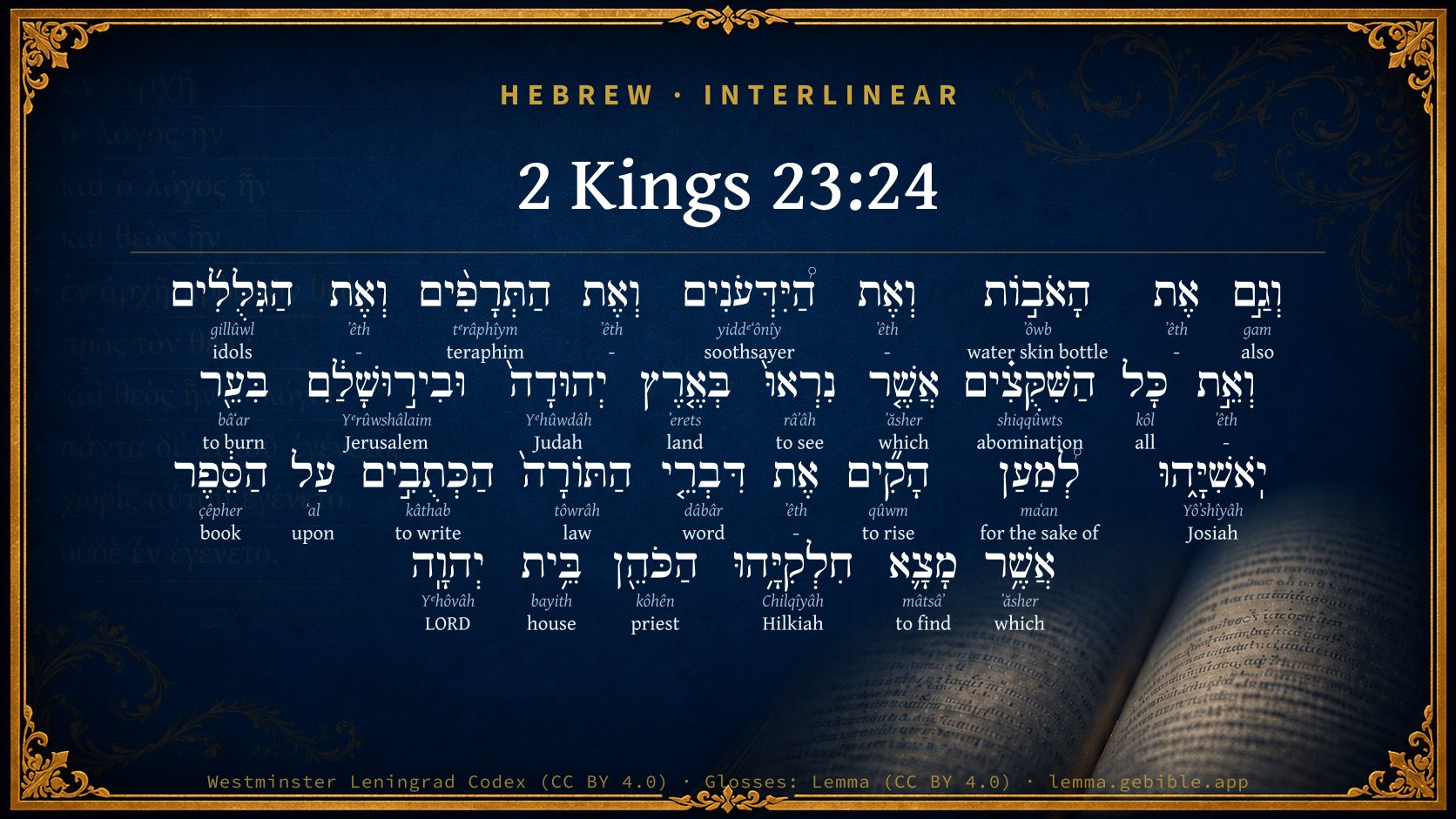
Hebrew (Westminster Leningrad Codex) 2 Kings 23:24 appears in the Hebrew Old Testament. The text above is from the Westminster Leningrad Codex. Each word links to its Strong’s number, a concise gloss, and parsing drawn from the Open Scriptures Hebrew Bible morphology. Click any word for its full Brown-Driver-Briggs (BDB) entry.
Download image
Cite this verse

2 Kings 23:24 (World English Bible). Public Domain. Lemma interlinear Bible study tool, https://lemma.gebible.app/v/2-kings/23/24.

Show BibTeX & RIS
BibTeX
RIS
English Translation
Moreover those who had familiar spirits, and the wizards, and the teraphim, and the idols, and all the abominations that were seen in the land of Judah and in Jerusalem, did Josiah put away, that he might confirm the words of the law which were written in the book that Hilkiah the priest found in the house of Yahweh.
World English Bible · Public Domain
Download a study sheet

One document with this verse’s original text, its word-by-word gloss line, the meaning frame, cross-references with their text, attributed commentary, and full source and license credits — printable, and it pastes into notes with its structure intact.

This verse Autodidact and up

Study sheet (.html) Plain text (.txt)

A passage Seminary Student

Up to 50 verses in one chapter. A passage sheet keeps up to 6 commentary sources and 12 cross-references per verse, in the order this page ranks them, and says so on the sheet whenever that leaves anything out. Ask for a single verse and you get the Autodidact verse sheet above.

Everything on this page stays free to read, with no account — the sheet is a download of what is already on screen, not access to it.

Want to remove ads? Support Godless Engineer
Compare translations 3

The same verse in 3 English versions, stacked beneath the original-language interlinear above. Click any original word for its lexicon entry.

Each is an independent rendering of the whole verse — the interlinear is not word-aligned to these translations.

Highlighted words mark where these versions differ — a whole-verse word diff, not a word-by-word alignment.

  • World English Bible Public Domain
    Moreover those who had familiar spirits, and the wizards, and the teraphim, and the idols, and all the abominations that were seen in the land of Judah and in Jerusalem, did Josiah put away, that he might confirm the words of the law which were written in the book that Hilkiah the priest found in the house of Yahweh.
  • King James Version Public Domain
    Moreover the workers with familiar spirits, and the wizards, and the images, and the idols, and all the abominations that were spied in the land of Judah and in Jerusalem, did Josiah put away, that he might perform the words of the law which were written in the book that Hilkiah the priest found in the house of the LORD.
  • unfoldingWord Literal Text CC BY-SA 4.0
    And Josiah also removed the ritual pits and the familiar spirits and the teraphim and the idols and all of the abominations that were seen in the land of Judah and in Jerusalem, in order to raise up the words of the Law written in the scroll that Hilkiah the priest found in the house of Yahweh.

unfoldingWord Literal Text — © unfoldingWord, licensed CC BY-SA 4.0. Word-aligned USFM3 via Door43 (git.door43.org/unfoldingWord/en_ult).

Versions to compare (up to 4)

3 of 4 selected

Show all 18 translations

Every available English version of this verse, each an independent rendering of the whole verse.

  • World English Bible Public Domain
    Moreover those who had familiar spirits, and the wizards, and the teraphim, and the idols, and all the abominations that were seen in the land of Judah and in Jerusalem, did Josiah put away, that he might confirm the words of the law which were written in the book that Hilkiah the priest found in the house of Yahweh.
  • Berean Standard Bible Public Domain
    Furthermore, Josiah removed the mediums and spiritists, the household gods and idols, and all the abominations that were seen in the land of Judah and in Jerusalem. He did this to carry out the words of the law written in the book that Hilkiah the priest had found in the house of the LORD.
  • Majority Standard Bible Public Domain
    Furthermore, Josiah removed the mediums and spiritists, the household gods and idols, and all the abominations that were seen in the land of Judah and in Jerusalem. He did this to carry out the words of the law written in the book that Hilkiah the priest had found in the house of the LORD.
  • King James Version Public Domain
    Moreover the workers with familiar spirits, and the wizards, and the images, and the idols, and all the abominations that were spied in the land of Judah and in Jerusalem, did Josiah put away, that he might perform the words of the law which were written in the book that Hilkiah the priest found in the house of the LORD.
  • American Standard Version (1901) Public Domain
    Moreover them that had familiar spirits, and the wizards, and the teraphim, and the idols, and all the abominations that were seen in the land of Judah and in Jerusalem, did Josiah put away, that he might confirm the words of the law which were written in the book that Hilkiah the priest found in the house of Jehovah.
  • Revised Version (1885) Public Domain
    Moreover them that had familiar spirits, and the wizards, and the teraphim, and the idols, and all the abominations that were spied in the land of Judah and in Jerusalem, did Josiah put away, that he might confirm the words of the law which were written in the book that Hilkiah the priest found in the house of the LORD.
  • Geneva Bible (1599) Public Domain
    Iosiah also tooke away them that had familiar spirits, and the soothsayers, and the images, and the idoles, and al the abominations that were espied in the lande of Iudah and in Ierusalem, to performe the wordes of the Lawe, which were written in the booke that Hilkiah the Priest found in the house of the Lord.
  • Douay-Rheims (1899) Public Domain
    Moreover the diviners by spirits, and soothsayers, and the figures of idols, and the uncleannesses, and the abominations, that had been in the land of Juda, and Jerusalem, Josias took away: that he might perform the words of the law, that were written in the book which Helcias the priest had found in the temple of the Lord.
  • Young's Literal Translation Public Domain
    And also, those having familiar spirits, and the wizards, and the teraphim, and the idols, and all the abominations that were seen in the land of Judah, and in Jerusalem, hath Josiah put away, in order to establish the words of the law that are written on the book that Hilkiah the priest hath found in the house of Jehovah.
  • Literal Standard Version CC BY-SA 4.0
    And also, those having familiar spirits, and the wizards, and the teraphim, and the idols, and all the abominations that were seen in the land of Judah, and in Jerusalem, Josiah has put away, in order to establish the words of the Law that are written on the scroll that Hilkiah the priest has found in the house of YHWH.
  • Unlocked Literal Bible CC BY-SA 4.0
    Josiah also banished those who talked with the dead or with spirits. He also banished the fetishes, the idols, and all the disgusting things that were seen in the land of Judah and in Jerusalem, so as to confirm the words of the law which were written in the book that Hilkiah the priest had found in the house of Yahweh.
  • unfoldingWord Literal Text CC BY-SA 4.0
    And Josiah also removed the ritual pits and the familiar spirits and the teraphim and the idols and all of the abominations that were seen in the land of Judah and in Jerusalem, in order to raise up the words of the Law written in the scroll that Hilkiah the priest found in the house of Yahweh.
  • Darby Bible Public Domain
    Moreover the necromancers and the soothsayers, and the teraphim and the idols, and all the abominations that were seen in the land of Judah and in Jerusalem, Josiah took away, that he might perform the words of the law which were written in the book that Hilkijah the priest had found in the house of Jehovah.
  • World Messianic Bible Public Domain
    Moreover, Josiah removed those who had familiar spirits, the wizards, and the teraphim, and the idols, and all the abominations that were seen in the land of Judah and in Jerusalem, that he might confirm the words of the law which were written in the book that Hilkiah the priest found in the LORD’s house.
  • Webster's Bible Public Domain
    Moreover the workers with familiar spirits, and the wizards, and the images, and the idols, and all the abominations that were seen in the land of Judah and in Jerusalem, did Josiah put away, that he might perform the words of the law which were written in the book that Hilkiah the priest found in the house of the LORD.
  • Free Bible Version CC BY-SA 4.0
    In addition, Josiah got rid of the mediums and spiritists, the household gods and idols, and all the disgusting practices that were present in the land of Judah and in Jerusalem. He did this to fulfill the words of the law written in the book that Hilkiah the priest had found in the Lord's Temple.
  • Bible in Basic English Public Domain
    And all those who had control of spirits, and the wonder-workers, and the images, and the false gods, and all the disgusting things which were seen in the land of Judah and in Jerusalem, Josiah put away, so that he might give effect to the words of the agreement recorded in the book which Hilkiah the priest made discovery of in the house of the Lord.
  • JPS Tanakh (1917) Public Domain
    Moreover them that divined by a ghost or a familiar spirit, and the teraphim, and the idols, and all the detestable things that were spied in the land of Judah and in Jerusalem, did Josiah put away, that he might confirm the words of the law which were written in the book that Hilkiah the priest found in the house of the LORD.

Literal Standard Version (2020), Covenant Press — licensed CC BY-SA 4.0. Text via the HelloAO Bible API (eBible.org). Unlocked Literal Bible (unfoldingWord) — licensed CC BY-SA 4.0. Text via the HelloAO Bible API (eBible.org). unfoldingWord Literal Text — © unfoldingWord, licensed CC BY-SA 4.0. Word-aligned USFM3 via Door43 (git.door43.org/unfoldingWord/en_ult). Free Bible Version, Dr. Jonathan Gallagher — licensed CC BY-SA 4.0. Text via the HelloAO Bible API (eBible.org).

Word by word

More ways to search: Search by grammar → Find every occurrence → Compare this word →

Practice this passage: Drill this verse → Learn its vocabulary →

הַ֠יִּדְּעֹנִים
yiddᵉʻônîy
H3049
“the · soothsayers”
Particle, Definite Article + Noun, Common, Masculine, Plural, Absolute
Part of Speech
Particle + Noun
Type
Common
Gender
Masculine
Number
Plural
State
Absolute
Full BDB Definition

Origin: from H3045

TWOT: 848d

a knower, one who has a familiar spirit - a familiar spirit, soothsayer, necromancer (metonymy)
  1. וְגַ֣ם gam H1571 “and · also” Conjunction + Particle, Accusative
  2. אֶת ʼêth H853 “-” Particle, Direct Object
  3. הָאֹב֣וֹת ʼôwb H178 “the · water skin bottles” Particle, Definite Article + Noun, Common, Masculine, Plural, Absolute
  4. וְאֶת ʼêth H853 “and · -” Conjunction + Particle, Direct Object
  5. וְאֶת ʼêth H853 “and · -” Conjunction + Particle, Direct Object
  6. הַתְּרָפִ֨ים tᵉrâphîym H8655 “the · teraphim” Particle, Definite Article + Noun, Common, Masculine, Plural, Absolute
  7. וְאֶת ʼêth H853 “and · -” Conjunction + Particle, Direct Object
  8. הַגִּלֻּלִ֜ים gillûwl H1544 “the · idols” Particle, Definite Article + Noun, Common, Masculine, Plural, Absolute
  9. וְאֵ֣ת ʼêth H853 “and · -” Conjunction + Particle, Direct Object
  10. כָּל kôl H3605 “all of” Noun, Common, Masculine, Singular, Construct
  11. הַשִּׁקֻּצִ֗ים shiqqûwts H8251 “the · abominations” Particle, Definite Article + Noun, Common, Masculine, Plural, Absolute
  12. אֲשֶׁ֤ר ʼăsher H834 “which” Particle, Relative
  13. נִרְאוּ֙ râʼâh H7200 “to see” Verb, Niphal, Perfect, 3rd Person, Common, Plural
  14. בְּאֶ֤רֶץ ʼerets H776 “in/at · land of” Preposition + Noun, Common, Both, Singular, Construct
  15. יְהוּדָה֙ Yᵉhûwdâh H3063 “Judah” Noun, Proper
  16. וּבִיר֣וּשָׁלִַ֔ם Yᵉrûwshâlaim H3389 “and · in/at · Jerusalem” Conjunction + Preposition + Noun, Proper
  17. בִּעֵ֖ר bâʻar H1197 “to burn” Verb, Piel, Perfect, 3rd Person, Masculine, Singular
  18. יֹֽאשִׁיָּ֑הוּ Yôʼshîyâh H2977 “Josiah” Noun, Proper
  19. לְ֠מַעַן maʻan H4616 “for the sake of” Preposition
  20. הָקִ֞ים qûwm H6965 “to rise” Verb, Hiphil, Infinitive Construct
  21. אֶת ʼêth H853 “-” Particle, Direct Object
  22. דִּבְרֵ֤י dâbâr H1697 “words of” Noun, Common, Masculine, Plural, Construct
  23. הַתּוֹרָה֙ tôwrâh H8451 “the · law” Particle, Definite Article + Noun, Common, Feminine, Singular, Absolute
  24. הַכְּתֻבִ֣ים kâthab H3789 “the · written” Particle, Definite Article + Verb, Qal, Participle Passive, Masculine, Plural, Absolute
  25. עַל ʻal H5921 “upon” Preposition
  26. הַסֵּ֔פֶר çêpher H5612 “the · book” Particle, Definite Article + Noun, Common, Masculine, Singular, Absolute
  27. אֲשֶׁ֥ר ʼăsher H834 “which” Particle, Relative
  28. מָצָ֛א mâtsâʼ H4672 “to find” Verb, Qal, Perfect, 3rd Person, Masculine, Singular
  29. חִלְקִיָּ֥הוּ Chilqîyâh H2518 “Hilkiah” Noun, Proper
  30. הַכֹּהֵ֖ן kôhên H3548 “the · priest” Particle, Definite Article + Noun, Common, Masculine, Singular, Absolute
  31. בֵּ֥ית bayith H1004 “house of” Noun, Common, Masculine, Singular, Construct
  32. יְהוָֽה Yᵉhôvâh H3068 “LORD” Noun, Proper

About this verse

These counts appear in no published source. They are computed here, from the morphology-tagged text and Lemma’s own curated glosses. What Lemma adds →

33
words
27
distinct lemmas
Historical
section

Notable vocabulary

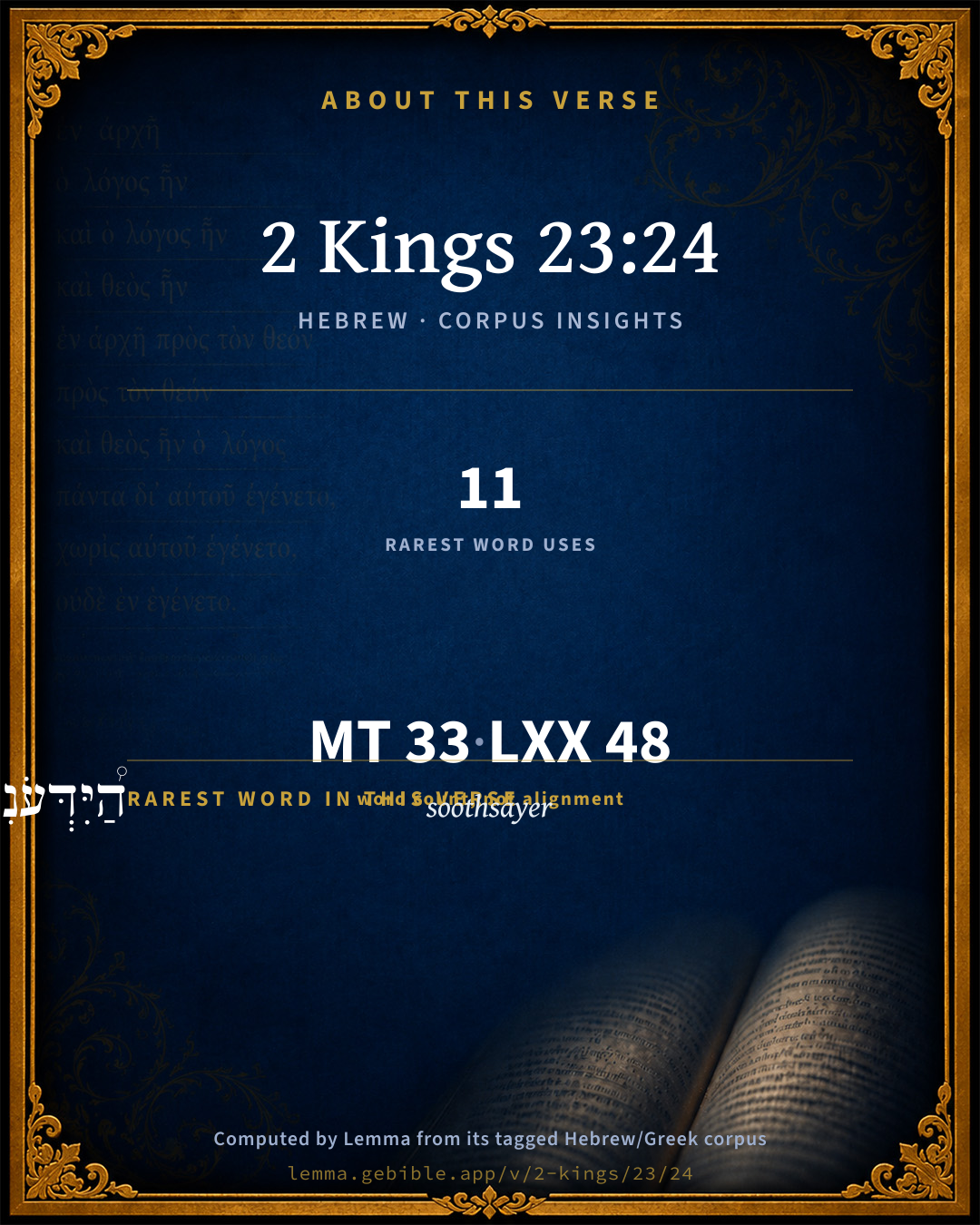
The rarest word here is הַ֠יִּדְּעֹנִים soothsayer H3049 — appearing just 11 times in the whole Hebrew Bible.

Shared distinctive vocabulary

הַ֠יִּדְּעֹנִים soothsayer H3049 occurs in 11 verses of the Hebrew Bible. Also found in:

Grammatical profile

  • 5 verbs
  • 17 nouns
  • 2 prepositions
  • 9 particles

Verb forms

  • נִרְאוּ֙ Niphal · Perfect
  • בִּעֵ֖ר Piel · Perfect
  • הָקִ֞ים Hiphil · Infinitive Construct
  • הַכְּתֻבִ֣ים Qal · Participle Passive
  • מָצָ֛א Qal · Perfect

Repetition

A word recurs within this verse — often emphatic in Hebrew:

  • אֲשֶׁ֤ר which H834 ×2

Hebrew & Septuagint length

In English translation the verse runs 59 words from the Hebrew and 57 from the Septuagint (LXX English) — closely comparable.

A rough comparison of the two English renderings, which tokenize alike — not a word-level alignment.

Word counts can differ between the Hebrew and the Greek without any difference in meaning — e.g. the Hebrew direct-object marker אֵת has no separate Greek word, and Greek often adds the article ὁ.

In the original languages it is 33 Hebrew tokens and 48 Greek tokens — but the two are counted differently (Hebrew bundles its prefixes and suffixes into one token; the Greek is in lemma form), so that isn’t a like-for-like length.

Cross-references

20

Topical passages linked to 2 Kings 23:24 in the Treasury of Scripture Knowledge — connected by theme and wording, ordered by reader-vote popularity; previews shown in the World English Bible.

  • Leviticus 19:31 "'Don't turn to those who are mediums, nor to the wizards. Don't seek them out, to be defiled by them. I am Yahweh your God.
  • Genesis 31:19 Now Laban had gone to shear his sheep: and Rachel stole the teraphim that were her father's.
  • 2 Kings 21:6 He made his son to pass through the fire, and practiced sorcery, and used enchantments, and dealt with those who had familiar spirits, and with wizards: he worked much evil in the sight of Yahweh, to provoke him to anger.
  • Leviticus 20:27 "'A man or a woman that is a medium, or is a wizard, shall surely be put to death: they shall stone them with stones; their blood shall be upon them.'"
  • Deuteronomy 18:10–12 There shall not be found with you anyone who makes his son or his daughter to pass through the fire, one who uses divination, one who practices sorcery, or an enchanter, or a sorcerer,
  • Judges 17:5 The man Micah had a house of gods, and he made an ephod, and teraphim, and consecrated one of his sons, who became his priest.
  • Judges 18:17–18 The five men who went to spy out the land went up, and came in there, and took the engraved image, and the ephod, and the teraphim, and the molten image: and the priest stood by the entrance of the gate with the six hundred men girt with weapons of war.
  • 1 Samuel 28:3–7 Now Samuel was dead, and all Israel had lamented him, and buried him in Ramah, even in his own city. Saul had put away those who had familiar spirits, and the wizards, out of the land.
  • 2 Kings 21:3 For he built again the high places which Hezekiah his father had destroyed; and he reared up altars for Baal, and made an Asherah, as did Ahab king of Israel, and worshiped all the host of the sky, and served them.
  • 2 Kings 21:11 Because Manasseh king of Judah has done these abominations, and has done wickedly above all that the Amorites did, who were before him, and has made Judah also to sin with his idols;
  • 2 Kings 21:21 He walked in all the way that his father walked in, and served the idols that his father served, and worshiped them:
  • 2 Kings 22:8–13 Hilkiah the high priest said to Shaphan the scribe, I have found the book of the law in the house of Yahweh. Hilkiah delivered the book to Shaphan, and he read it.
  • 2 Chronicles 34:14–19 When they brought out the money that was brought into the house of Yahweh, Hilkiah the priest found the book of the law of Yahweh [given] by Moses.
  • Isaiah 8:19–20 When they shall tell you, "Consult with those who have familiar spirits and with the wizards, who chirp and who mutter:" shouldn't a people consult with their God? on behalf of the living [should they consult] with the dead?
  • Isaiah 19:3 The spirit of Egypt shall fail in the midst of it; and I will destroy the counsel of it: and they shall seek to the idols, and to the charmers, and to those who have familiar spirits, and to the wizards.
  • Hosea 3:4 For the children of Israel shall abide many days without king, and without prince, and without sacrifice, and without sacred stone, and without ephod or idols.
  • Acts 16:16–18 It happened, as we were going to prayer, that a certain girl having a spirit of divination met us, who brought her masters much gain by fortune telling.
  • Romans 3:20 Because by the works of the law, no flesh will be justified in his sight. For through the law comes the knowledge of sin.
  • James 1:25 But he who looks into the perfect law, the law of freedom, and continues, not being a hearer who forgets but a doer of the work, this man will be blessed in what he does.
  • Revelation 22:15 Outside are the dogs, the sorcerers, the sexually immoral, the murderers, the idolaters, and everyone who loves and practices falsehood.

Cross-references courtesy of OpenBible.info (CC BY 4.0).

Hebrew and Greek witnesses Masoretic Hebrew ↔ Greek Septuagint

The same verse in the two great witnesses to the Old Testament, shown verse-for-verse.

These are two independent witnesses, not word-aligned to each other, and the Septuagint is shown in lemma (dictionary) form.

Hebrew 2 Kings 23:24 Masoretic · Westminster Leningrad Codex

וְגַ֣ם אֶת הָאֹב֣וֹת וְאֶת הַ֠יִּדְּעֹנִים וְאֶת הַתְּרָפִ֨ים וְאֶת הַגִּלֻּלִ֜ים וְאֵ֣ת כָּל הַשִּׁקֻּצִ֗ים אֲשֶׁ֤ר נִרְאוּ֙ בְּאֶ֤רֶץ יְהוּדָה֙ וּבִיר֣וּשָׁלִַ֔ם בִּעֵ֖ר יֹֽאשִׁיָּ֑הוּ לְ֠מַעַן הָקִ֞ים אֶת דִּבְרֵ֤י הַתּוֹרָה֙ הַכְּתֻבִ֣ים עַל הַסֵּ֔פֶר אֲשֶׁ֥ר מָצָ֛א חִלְקִיָּ֥הוּ הַכֹּהֵ֖ן בֵּ֥ית יְהוָֽה

Moreover those who had familiar spirits, and the wizards, and the teraphim, and the idols, and all the abominations that were seen in the land of Judah and in Jerusalem, did Josiah put away, that he might confirm the words of the law which were written in the book that Hilkiah the priest found in the house of Yahweh.

World English Bible · Public Domain

Greek LXX 2 Kings 23:24 Septuagint · lemma form

καί γέ ὁ θελητής καί ὁ γνωριστής καί ὁ θεραφιν καί ὁ εἴδωλον καί πᾶς ὁ προσόχθισμα ὁ γίγνομαι ἐν γῆ ιουδα καί ἐν ἰερουσαλήμ ἐκαἴρω ὁ βασιλεύς ιωσιας ἵνα ἵστημι ὁ λόγος ὁ νόμος ὁ γράφω ἐπί ὁ βιβλίον ὅς εὑρίσκω χελκιας ὁ ἱερεύς ἐν οἶκος κύριος

Moreover Josias removed the sorcerers, and the wizards, and the theraphin, and the idols, and all the abominations that had been set up in the land of Juda and in Jerusalem, that he might keep the words of the law that were written in the book, which Chelcias the priest found in the house of the Lord.

LXX2012 (modern English Septuagint) · Public Domain

Hebrew: Westminster Leningrad Codex (CC BY 4.0). Greek: Septuagint (public domain); English from LXX2012 (modern English Septuagint) (Public Domain). How the Septuagint differs from the Hebrew →

Targum (Aramaic paraphrase)

1

The Targum is the ancient Jewish Aramaic paraphrase of the Hebrew Scriptures — an interpretive translation, not the Hebrew text itself. Onkelos (literal) and Pseudo-Jonathan (expansive) render the Torah, and Jonathan the Prophets. Coverage is partial: where no permissively-licensed English translation exists for a verse, only the Aramaic is shown. This is verse-level text, not a word-by-word alignment to the Hebrew.

  1. Targum Jonathan Prophets (Joshua–Malachi)
    וְאַף יַת בִּידִין וְיַת זְכוּרוּ וְיַת צַלְמָנַיָא וְיַת טַעֲוָתָא וְיַת כָּל שִׁקוּצַיָא דְאִתְחַזִיאוּ בְאַרְעָא דְבֵית יְהוּדָה וּבִירוּשְׁלֵם פַּלֵי יֹאשִׁיָהוּ בְּדִיל לְקַיָמָא יַת פִּתְגָמֵי אוֹרַיְתָא דִכְתִיבִין עַל סִפְרָא דְאַשְׁכַּח חִלְקִיָה כַהֲנָא בְּבֵית מַקְדְשָׁא דַיָי:

    (no public-domain English translation for this verse)

    Targum Jonathan — Aramaic: “Mikraot Gedolot” (public domain). English: “Sefaria Community Translation” (CC0 1.0 (public-domain dedication)); “London "Chaldee Paraphrase," 1871” (public domain). Text via Sefaria.

Commentary

Notes on 2 Kings 23:24 from classic Christian and Jewish commentators (each source and its license shown beneath its notes). The classic Christian expositions comment on the surrounding passage and are grouped to its opening verse, so a note may address several verses; the Jewish commentaries on the Tanakh (Rashi and others) are per-verse, so they appear only where the commentator wrote on this verse.

Lemma curates 59 commentaries, every one of them public domain or Creative Commons licensed, each selected and text-cleaned for this edition rather than reprinted as found. About our sources →

Trapp's Complete Commentary

John Trapp

2Ki 23:24 Moreover the [workers with] familiar spirits, and the wizards, and the images, and the idols, and all the abominations that were spied in the land of Judah and in Jerusalem, did Josiah put away, that he might perform the words of the law which were written in the book that Hilkiah the priest found in the house of the LORD.

Ver. 24. Moreover the workers with familiar spirits,] q.d., Josiah did all that might be done to prevent that utter devastation of his country foretold by the prophets; but the decree was even "ready to bring forth," and there was no reversing or impeding it. {Zep 2:2} See 2Ki 21:10-15.

And the images.] Heb., Teraphim; these were properly their household gods, saith Vatablus.

That were spied in the land of Judah and Jerusalem.] Here he narrowly spied out everything that was amiss, to reform it, as being his own proper dominion, and his chief charge. Latini videndum dicunt,

“ Aedibus in propriis quae recta aut prava gerantur. ”

John Trapp, A Commentary or Exposition upon All the Books of the Old and New Testament (1647–1656) — public domain. Text from a community e-Sword module.

Joseph Benson's Commentary

2Ki 23:24. Workers with familiar spirits, and wizards — Of which see notes on Deu 18:10-11; Lev 19:31; and Lev 20:27. And the images — Hebrew, the teraphim, images which were very ancient among idolaters. And idols — Other kinds of images. And all the abominations that were spied — All the instruments and monuments of idolatry that were discovered, were destroyed as God had commanded; not only such as were in the place of worship, but such as their priests or zealots had removed, and endeavoured to hide.

Joseph Benson's Commentary on the Old and New Testaments (1811–1818) — public domain. Text from a community e-Sword module.

Tyndale Open Study Notes

Tyndale Open Resources

23:24-25 Josiah’s commitment to the law brought reforms throughout Jerusalem and Judah. His attempts to eradicate every other kind of detestable practice and his strict observance of the Passover made Josiah greatest among the kings in obeying all the laws of Moses.

Tyndale Open Study Notes — © Tyndale Open Resources, licensed CC BY-SA 4.0. Text via the HelloAO Bible API.

Adam Clarke's Commentary

Verse 24. The workers with familiar spirits] See on 2Kg 21:5.

And the images] The teraphim. See Clarke on Ge 31:19.

Adam Clarke's Commentary on the Bible (1810–1826) — public domain. Text from a community e-Sword/MySword module.

Ellicott's Commentary for English Readers

(24) Moreover the workers . . .—After abolishing public idolatry, Josiah attacked the various forms of private superstition.

The workers with familiar spirits.—The necromancers (‘ôbôth; 1Sa_28:3 seq.). (See 2Ki_21:6.)

Images.—See margin; and Gen_31:19; Jdg_17:5; 1Sa_19:13; Zec_10:2.

The idols.—The dunglings. Gresenius prefers to render, idol-blocks; Ewald, doll-images. (See 2Ki_17:12.)

That were spied (seen).—A significant expression. Many idols were, doubtless, concealed by their worshippers.

Put away.—Or, put out, did away with (Deu_13:6; Deu_17:7); strictly, consumed. (See the law in Lev_20:27; Deu_18:9-10.)

A Bible Commentary for English Readers, edited by Charles John Ellicott (1878–1897) — public domain. Text from a community e-Sword module.

The Cambridge Bible for Schools and Colleges

gen. ed. J. J. S. Perowne

24. Moreover the workers with [R.V. them that had] familiar spirits, and the wizards] See note on 2Ki_21:6. Josiah now proceeds to exterminate all the superstitious practices which grow up side by side with idolatry.

and the images] R.V. the teraphim. These were a sort of household gods, and some charm or virtue seems to have been ascribed to the possession of them. Hence Rachel stole the teraphim (Gen_31:19) when she was leaving her father’s home. Micah made teraphim for his house in Mount Ephraim (Jdg_17:5), and it was the teraphim which Michal, Saul’s daughter, hid in the bed, to make believe that David was sick, and thus give him time to escape.

that he might perform (R.V. confirm) the words of the law] The change is as in verse 3. What Josiah desired was not only to carry out on this occasion the prescription of the Law, but so to establish the observance that it should continue and not be lightly modified. There is no mention of the passover held in the nineteenth year and in the succeeding years of Josiah’s reign. It would be rash, however, to conclude from such absence of the record, that the same solemnity was not used every succeeding year of the king’s reign, almost as rash as to decide that the passover had been unobserved since the time of Samuel.

The ordinances for putting down them that had familiar spirits and other like superstitions are found in Lev_19:31; Lev_20:6; Lev_20:27.

The Cambridge Bible for Schools and Colleges (gen. ed. J. J. S. Perowne; Cambridge University Press, 1878–1918) — public domain. Text from a community e-Sword module.

John Gill's Exposition

Notwithstanding, the Lord turned not from the fierceness of his great wrath, wherewith his anger was kindled against Judah,.... Notwithstanding the great reformation wrought among them; for though Josiah was a sincere reformer, and did what he did heartily, as to the Lord, according to his will, and for his glory; yet the people were not sincere in their compliance, they turned to the Lord not with their whole heart, but feignedly, Jer 3:10.

because of all the provocations that Manasseh had provoked him withal; by shedding innocent blood and committing idolatry, which the people consented to and approved of, and even now privately committed idolatry, as the prophecies of Jeremiah and Zephaniah show; and it may easily be concluded that their hearts were after their idols, by their openly returning to them in the days of the sons of Josiah.

John Gill's Exposition of the Whole Bible (1746–1763) — public domain (CC PDM 1.0). Text via the HelloAO Bible API.

Albert Barnes' Notes on the Bible

Perform - Rather, establish. Josiah saw that it was necessary, not only to put down open idolatry, but also to root out the secret practices of a similar character which were sometimes combined with the worship of Yahweh, notwithstanding that the Law forbade them (marginal references), and which probably formed, with many, practically almost the whole of their religion.

Albert Barnes' Notes on the Bible (1834–1885) — public domain. Text from a community e-Sword/MySword module.

Haydock's Catholic Bible Commentary

Spirits. Literally, "the pythons," Deuteronomy xviii. 11., and Numbers xxii. 5. --- Idols. Hebrew Teraphim; Protestants, "images," Genesis xxi. 19. --- Uncleannesses. Hebrew, &c., "idols."

George Leo Haydock (1774–1849), Haydock's Catholic Family Bible and Commentary, 1859 edition — public domain. Excludes Psalms (Douay-Rheims chapter numbering differs from Protestant) and Deuterocanonical books (Catholic canon only).

Matthew Poole's English Annotations

The wizards; of which see on Lev 19:31; 20:27; Num 22:5; Deu 18:11.

The images, and the idols, and all the abominations; three words noting the same thing, to show that till the instruments and monuments of idolatry were destroyed, as God had commanded.

That were spied, i.e. all that were discovered; not only such as were in the place and state of worship, but such as their priests or zealots had removed, and endeavoured to hide and secure.

Matthew Poole's English Annotations on the Holy Bible (1683–1685) — public domain. Text from a community e-Sword/MySword module.

Whedon's Commentary on the Bible

Daniel D. Whedon

24. Workers with familiar spirits… wizards — Who seem especially to have multiplied under the reign of Manasseh. 2Ki_21:6.

Images — Teraphim. See notes on Jos_24:14, and 1Sa_19:13.

Daniel D. Whedon (gen. ed.), Commentary on the Old and New Testaments (1874–1909) — public domain. Text from a community e-Sword module.

The Pulpit Commentary

Moreover the workers with familiar spirits, and the wizards. Persons of these classes had been encouraged by Manasseh, in his earlier reign, (2Ki_21:6) and probably by Amon. (2Ki_21:21) As Josiah designed a thorough reformation, it was necessary for him to put them down. And the images; literally, the teraphim, which are thought to have been small images kept as household gods in many Israelite families from a very ancient date. (see Gen_31:19-35) The superstition was exceedingly persistent. We find it under the judges, (Jud_1:18:14) under Saul, (1Sa_19:13) here under the later kings, and it is still mentioned after the return from the Captivity. (Zec_10:2) The superstition was, apparently, Babylonian, (Eze_21:21) and brought from Ur of the Chaldees by the family of Abraham. Besides being regarded as household gods, the teraphim were used in divination. And the idols, and all the abominations that were spied. The "idols," gillulim, are probably, like the teraphim, of a private nature, figures used as amulets or talismans. Excepting in Ezekiel, the word is an uncommon one. By the "abominations that were spied" are meant secret defilements and superstitious practices in households, which needed to be searched out. (So Thenius and Bahr.) In the land of Judah and in Jerusalem. Not, apparently, in the cities of Samaria, where such a rigid inquisition would perhaps have provoked a stubborn resistance. Did Josiah put away, that he might perform the words of the Law; rather, that he might establish the words of the Law. Laws against such practices as Josiah now put down will be found in Exo_22:18; Lev_19:31 Lev_20:27; Deu_18:10-12. Which were written in the book that Hilkiah the priest found in the house of the Lord. (see 2Ki_22:8)

The Pulpit Commentary (1880–1919), ed. H.D.M. Spence-Jones & Joseph S. Exell — public domain. Text from a community e-Sword module.

John Wesley's Explanatory Notes

Images, &c. - Three words noting the same thing, to shew, That all the instruments and monuments of idolatry were destroyed, as God had commanded. Spied - All that were discovered; not only such as were in the place of worship, but such as their priests or zealots had removed, and endeavoured to hide.

John Wesley, Explanatory Notes Upon the Whole Bible (1754–1765) — public domain. Text via the GEBible commentary corpus.

unfoldingWord translationNotes

Door43 World Missions Community

banished ... spirits

"forced those ... spirits to leave" or "made a law that those ... spirits had to leave"

those who talked with the dead or with spirits

See how you translated "those who talked with the dead and ... those who talked with spirits," in 2 Kings 21:6.

fetishes

things that people wrongly believe have special power

who turned to Yahweh

"who gave himself completely to Yahweh"

Nor did any king like Josiah arise after him

"And since then there has never been a king who was like Josiah"

translationWords

Josiah

die

spirit

false god

confirm

word

law

priest

house of God

turn

heart

soul

might

unfoldingWord translationNotes — © Distant Shores Media and the Door43 World Missions Community, licensed CC BY-SA 4.0. Source: git.door43.org/Door43/en_tn.

Rashi

Rabbi Shlomo Yitzchaki (Rashi)

The teraphim. Images as being made in the likeness of a human figure. that speak through sorcery, and the one who make them must determine a certain time in the year, and a certain year that is appropriate for this.

Rashi on the Tanakh — English translations: “The Judaica Press complete Tanach with Rashi, translated by A. J. Rosenberg” (CC BY 4.0); “Pentateuch with Rashi's commentary by M. Rosenbaum and A.M. Silbermann, 1929-1934” (public domain); “The Metsudah Tanach series, Lakewood, N.J” (CC BY 4.0); and “The Book of Joshua, Metsudah Publications, 1997” (CC BY 4.0). Text via Sefaria.

Lesson kit

Teaching starters — assembled from the data on this page, not authored interpretation. Every prompt links to the verse data it draws on. Edit before teaching.

2 Kings, in the Historical, opens this verse with 33 words (27 distinct Hebrew lemmas). Its most distinctive word is yiddᵉʻônîy (“soothsayer”). A historical commentator’s framing appears above. Read the whole chapter for the surrounding context.

Discussion questions

  1. What does “soothsayer” (yiddᵉʻônîy) contribute to the verse as a whole?
  2. How does Leviticus 19:31, which shares the word «soothsayer», read alongside this verse?
  3. What does the repetition of “which” (2× in this one verse) do in this verse?
  4. These translations render this verse differently. What is at stake in choosing one wording over another?
  5. «נִרְאוּ֙» is a Niphal Perfect verb. How does that grammatical form shape the action described?
  6. Compare how Trapp's Complete Commentary and Joseph Benson's Commentary read this verse. Where do they agree or differ?

Things to notice

Reading settings

Reading text

Shown beneath each verse's original-language words.

Old Testament
Old Testament edition

Read the OT as the Masoretic Hebrew (MT) or the Greek Septuagint (LXX).

English shown for the Greek Septuagint (in the Hebrew ↔ Greek comparison).

Comparing translations? Open the Compare panel on any verse page to stack up to four side by side.