Isaiah 52:2

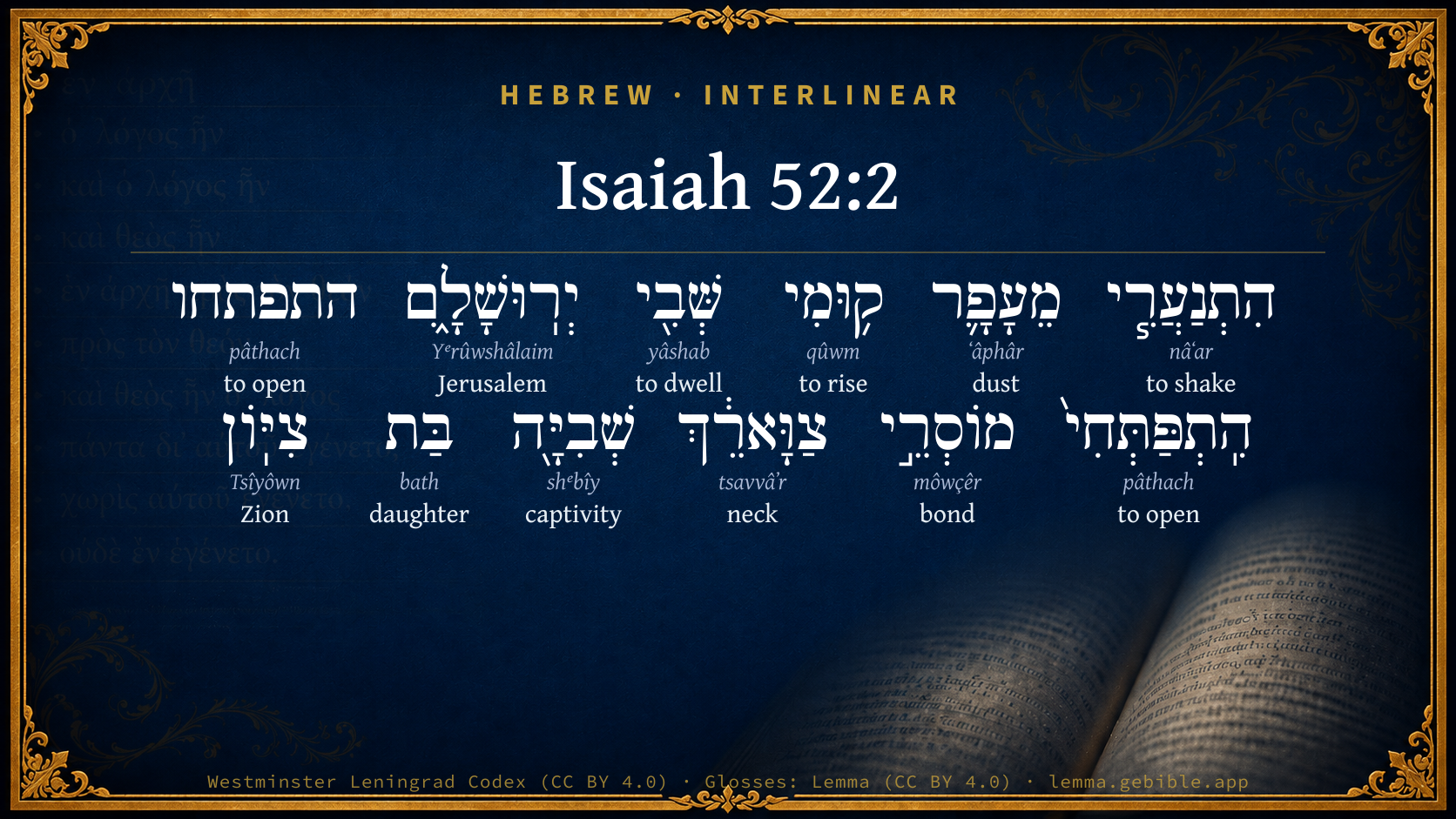
Hebrew (Westminster Leningrad Codex) Isaiah 52:2 appears in the Hebrew Old Testament. The text above is from the Westminster Leningrad Codex. Each word links to its Strong’s number, a concise gloss, and parsing drawn from the Open Scriptures Hebrew Bible morphology. Click any word for its full Brown-Driver-Briggs (BDB) entry.
Download image
Cite this verse

Isaiah 52:2 (World English Bible). Public Domain. Lemma interlinear Bible study tool, https://lemma.gebible.app/v/isaiah/52/2.

Show BibTeX & RIS
BibTeX
RIS
English Translation
Shake yourself from the dust; arise, sit [on your throne], Jerusalem: loose yourself from the bonds of your neck, captive daughter of Zion.
World English Bible · Public Domain
Download a study sheet

One document with this verse’s original text, its word-by-word gloss line, the meaning frame, cross-references with their text, attributed commentary, and full source and license credits — printable, and it pastes into notes with its structure intact.

This verse Autodidact and up

Study sheet (.html) Plain text (.txt)

A passage Seminary Student

Up to 50 verses in one chapter. A passage sheet keeps up to 6 commentary sources and 12 cross-references per verse, in the order this page ranks them, and says so on the sheet whenever that leaves anything out. Ask for a single verse and you get the Autodidact verse sheet above.

Everything on this page stays free to read, with no account — the sheet is a download of what is already on screen, not access to it.

Want to remove ads? Support Godless Engineer
Compare translations 3

The same verse in 3 English versions, stacked beneath the original-language interlinear above. Click any original word for its lexicon entry.

Each is an independent rendering of the whole verse — the interlinear is not word-aligned to these translations.

Highlighted words mark where these versions differ — a whole-verse word diff, not a word-by-word alignment.

  • World English Bible Public Domain
    Shake yourself from the dust; arise, sit [on your throne], Jerusalem: loose yourself from the bonds of your neck, captive daughter of Zion.
  • King James Version Public Domain
    Shake thyself from the dust; arise, and sit down, O Jerusalem: loose thyself from the bands of thy neck, O captive daughter of Zion.
  • unfoldingWord Literal Text CC BY-SA 4.0
    Shake yourself from the dust; arise, sit, Jerusalem. Loosen yourself the bonds of your neck, captive daughter of Zion.

unfoldingWord Literal Text — © unfoldingWord, licensed CC BY-SA 4.0. Word-aligned USFM3 via Door43 (git.door43.org/unfoldingWord/en_ult).

Versions to compare (up to 4)

3 of 4 selected

Show all 18 translations

Every available English version of this verse, each an independent rendering of the whole verse.

  • World English Bible Public Domain
    Shake yourself from the dust; arise, sit [on your throne], Jerusalem: loose yourself from the bonds of your neck, captive daughter of Zion.
  • Berean Standard Bible Public Domain
    Shake off your dust! Rise up and sit on your throne, O Jerusalem. Remove the chains from your neck, O captive Daughter of Zion.
  • Majority Standard Bible Public Domain
    Shake off your dust! Rise up and sit on your throne, O Jerusalem. Remove the chains from your neck, O captive Daughter of Zion.
  • King James Version Public Domain
    Shake thyself from the dust; arise, and sit down, O Jerusalem: loose thyself from the bands of thy neck, O captive daughter of Zion.
  • American Standard Version (1901) Public Domain
    Shake thyself from the dust; arise, sit `on thy throne', O Jerusalem: loose thyself from the bonds of thy neck, O captive daughter of Zion.
  • Revised Version (1885) Public Domain
    Shake thyself from the dust; arise, sit thee down, O Jerusalem: loose thyself from the bands of thy neck, O captive daughter of Zion,
  • Geneva Bible (1599) Public Domain
    Shake thy selfe from the dust: arise, and sit downe, O Ierusalem: loose the bandes of thy necke, O thou captiue daughter, Zion.
  • Douay-Rheims (1899) Public Domain
    Shake thyself from the dust, arise, sit up, O Jerusalem: loose the bonds from off thy neck, O captive daughter of Sion.
  • Young's Literal Translation Public Domain
    Shake thyself from dust, arise, sit, O Jerusalem, Bands of thy neck have loosed themselves, O captive, daughter of Zion.
  • Literal Standard Version CC BY-SA 4.0
    Shake yourself from dust, arise, sit, O Jerusalem, || Bands of your neck have loosed themselves, || O captive daughter of Zion.
  • Unlocked Literal Bible CC BY-SA 4.0
    Shake yourself off from the dust; arise and sit, Jerusalem; take off the chain from your neck, captive, daughter of Zion.
  • unfoldingWord Literal Text CC BY-SA 4.0
    Shake yourself from the dust; arise, sit, Jerusalem. Loosen yourself the bonds of your neck, captive daughter of Zion.
  • Darby Bible Public Domain
    Shake thyself from the dust; arise, sit down, Jerusalem: loose thyself from the bands of thy neck, captive daughter of Zion.
  • World Messianic Bible Public Domain
    Shake yourself from the dust! Arise, sit up, Jerusalem! Release yourself from the bonds of your neck, captive daughter of Zion!
  • Webster's Bible Public Domain
    Shake thyself from the dust; arise, and sit down, O Jerusalem: loose thyself from the bands of thy neck, O captive daughter of Zion.
  • Free Bible Version CC BY-SA 4.0
    Shake yourself free from the dust and get up. Sit on your throne, Jerusalem. Throw off the chains around your neck, captive daughter of Zion.
  • Bible in Basic English Public Domain
    Make yourself clean from the dust; up! and take the seat of your power, O Jerusalem: the bands of your neck are loose, O prisoned daughter of Zion.
  • JPS Tanakh (1917) Public Domain
    Shake thyself from the dust; arise, and sit down, O Jerusalem; loose thyself from the bands of thy neck, O captive daughter of Zion.

Literal Standard Version (2020), Covenant Press — licensed CC BY-SA 4.0. Text via the HelloAO Bible API (eBible.org). Unlocked Literal Bible (unfoldingWord) — licensed CC BY-SA 4.0. Text via the HelloAO Bible API (eBible.org). unfoldingWord Literal Text — © unfoldingWord, licensed CC BY-SA 4.0. Word-aligned USFM3 via Door43 (git.door43.org/unfoldingWord/en_ult). Free Bible Version, Dr. Jonathan Gallagher — licensed CC BY-SA 4.0. Text via the HelloAO Bible API (eBible.org).

Word by word

More ways to search: Search by grammar → Find every occurrence → Compare this word →

Practice this passage: Drill this verse → Learn its vocabulary →

הִתְנַעֲרִ֧י
nâʻar
H5287
“shake”
Verb, Hithpael, Imperative, 2nd Person, Feminine, Singular
Part of Speech
Verb
Stem
Hithpael
Form
Imperative
Person
2nd Person
Gender
Feminine
Number
Singular
Full BDB Definition

Origin: a primitive root [probably identical with H5286 , through the idea of the rustling of mane, which usually accompanies the lion's roar]

TWOT: 1388

to shake, shake out or off - (Qal) to shake out, show emptiness - (Niphal) - to be shaken - to shake oneself - (Piel) to shake off or out - (Hithpael) to shake oneself
  1. מֵעָפָ֛ר ʻâphâr H6083 “from · dust” Preposition + Noun, Common, Masculine, Singular, Absolute
  2. ק֥וּמִי qûwm H6965 “rise” Verb, Qal, Imperative, 2nd Person, Feminine, Singular
  3. שְּׁבִ֖י yâshab H3427 “dwell” Verb, Qal, Imperative, 2nd Person, Feminine, Singular
  4. יְרֽוּשָׁלִָ֑ם Yᵉrûwshâlaim H3389 “Jerusalem” Noun, Proper
  5. התפתחו pâthach H6605 “open” Verb, Hithpael, Imperative, 2nd Person, Masculine, Plural
  6. הִֽתְפַּתְּחִי֙ pâthach H6605 “open” Verb, Hithpael, Imperative, 2nd Person, Feminine, Singular
  7. מוֹסְרֵ֣י môwçêr H4147 “bonds of” Noun, Common, Both, Plural, Construct
  8. צַוָּארֵ֔ךְ tsavvâʼr H6677 “neck · your” Noun, Common, Masculine, Singular, Construct + Suffix, Personal, 2nd Person, Feminine, Singular
  9. שְׁבִיָּ֖ה shᵉbîy H7628 “captivity” Adjective, Adjective, Feminine, Singular, Absolute
  10. בַּת bath H1323 “daughter of” Noun, Common, Feminine, Singular, Construct
  11. צִיּֽוֹן Tsîyôwn H6726 “Zion” Noun, Proper

About this verse

These counts appear in no published source. They are computed here, from the morphology-tagged text and Lemma’s own curated glosses. What Lemma adds →

12
words
11
distinct lemmas
Prophets
section

Notable vocabulary

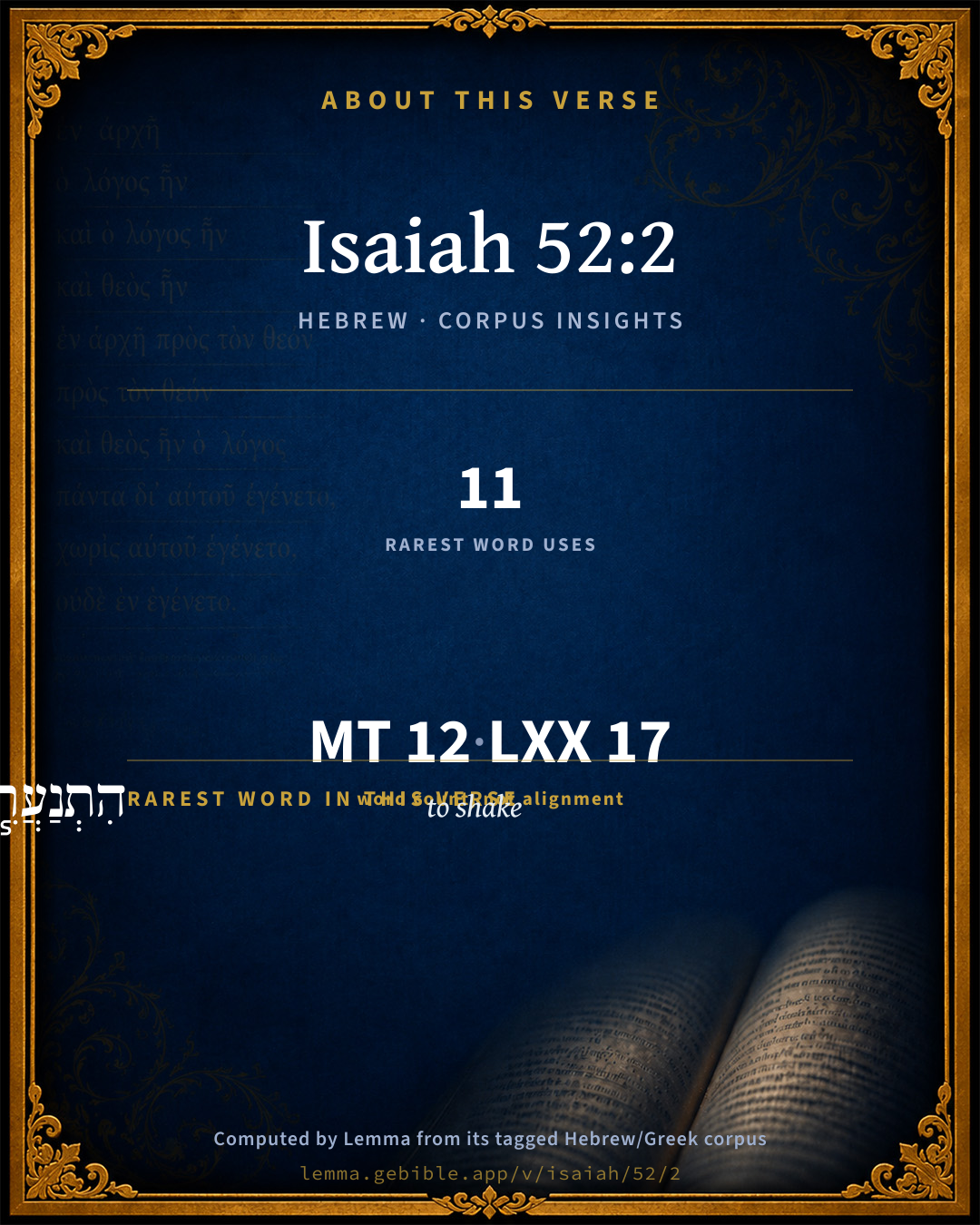
The rarest word here is הִתְנַעֲרִ֧י to shake H5287 — appearing just 11 times in the whole Hebrew Bible.

Shared distinctive vocabulary

הִתְנַעֲרִ֧י to shake H5287 occurs in 9 verses of the Hebrew Bible. Also found in:

Grammatical profile

  • 5 verbs
  • 6 nouns
  • 1 adjective

Verb forms

  • הִתְנַעֲרִ֧י Hithpael · Imperative
  • ק֥וּמִי Qal · Imperative
  • שְּׁבִ֖י Qal · Imperative
  • התפתחו Hithpael · Imperative
  • הִֽתְפַּתְּחִי֙ Hithpael · Imperative

Repetition

A word recurs within this verse — often emphatic in Hebrew:

  • התפתחו to open H6605 ×2

Hebrew & Septuagint length

In English translation the verse runs 23 words from the Hebrew and 20 from the Septuagint (LXX English) — closely comparable.

A rough comparison of the two English renderings, which tokenize alike — not a word-level alignment.

Word counts can differ between the Hebrew and the Greek without any difference in meaning — e.g. the Hebrew direct-object marker אֵת has no separate Greek word, and Greek often adds the article ὁ.

In the original languages it is 12 Hebrew tokens and 17 Greek tokens — but the two are counted differently (Hebrew bundles its prefixes and suffixes into one token; the Greek is in lemma form), so that isn’t a like-for-like length.

Cross-references

12

Topical passages linked to Isaiah 52:2 in the Treasury of Scripture Knowledge — connected by theme and wording, ordered by reader-vote popularity; previews shown in the World English Bible.

  • Isaiah 51:14 The captive exile shall speedily be freed; and he shall not die [and go down] into the pit, neither shall his bread fail.
  • Isaiah 61:1 The Spirit of the Lord Yahweh is on me; because Yahweh has anointed me to preach good news to the humble; he has sent me to bind up the broken-hearted, to proclaim liberty to the captives, and the opening [of the prison] to those who are bound;
  • Jeremiah 51:45 My people, go you out of the midst of her, and save yourselves every man from the fierce anger of Yahweh.
  • Jeremiah 51:50 You who have escaped the sword, go you, don't stand still; remember Yahweh from afar, and let Jerusalem come into your mind.
  • Luke 4:18 "The Spirit of the Lord is on me, Because he has anointed me to preach good news to the poor. He has sent me to heal the brokenhearted, To proclaim release to the captives, Recovering of sight to the blind, To deliver those who are crushed,
  • Revelation 18:4 I heard another voice from heaven, saying, "Come out of her, my people, that you have no participation in her sins, and that you don't receive of her plagues,
  • Zechariah 2:6 Come! Come! Flee from the land of the north,' says Yahweh; 'for I have spread you abroad as the four winds of the sky,' says Yahweh.
  • Isaiah 3:26 Her gates shall lament and mourn; And she shall be desolate and sit on the ground.
  • Isaiah 29:4 You shall be brought down, and shall speak out of the ground, and your speech shall be low out of the dust; and your voice shall be as of one who has a familiar spirit, out of the ground, and your speech shall whisper out of the dust.
  • Luke 21:24 They will fall by the edge of the sword, and will be led captive into all the nations. Jerusalem will be trampled down by the Gentiles, until the times of the Gentiles are fulfilled.
  • Isaiah 49:21 Then shall you say in your heart, Who has conceived these for me, seeing I have been bereaved of my children, and am solitary, an exile, and wandering back and forth? and who has brought up these? Behold, I was left alone; these, where were they?
  • Isaiah 51:23 and I will put it into the hand of those who afflict you, who have said to your soul, Bow down, that we may go over; and you have laid your back as the ground, and as the street, to those who go over.

Cross-references courtesy of OpenBible.info (CC BY 4.0).

Hebrew and Greek witnesses Masoretic Hebrew ↔ Greek Septuagint

The same verse in the two great witnesses to the Old Testament, shown verse-for-verse.

These are two independent witnesses, not word-aligned to each other, and the Septuagint is shown in lemma (dictionary) form.

Hebrew Isaiah 52:2 Masoretic · Westminster Leningrad Codex

הִתְנַעֲרִ֧י מֵעָפָ֛ר ק֥וּמִי שְּׁבִ֖י יְרֽוּשָׁלִָ֑ם התפתחו הִֽתְפַּתְּחִי֙ מוֹסְרֵ֣י צַוָּארֵ֔ךְ שְׁבִיָּ֖ה בַּת צִיּֽוֹן

Shake yourself from the dust; arise, sit [on your throne], Jerusalem: loose yourself from the bonds of your neck, captive daughter of Zion.

World English Bible · Public Domain

Greek LXX Isaiah 52:2 Septuagint · lemma form

ἐκτινάσσω ὁ χοῦς καί ἀναἵστημι καταἵζω ἰερουσαλήμ ἐκδύω ὁ δεσμός ὁ τράχηλος σύ ὁ αἰχμάλωτος θυγάτηρ σιων

Shake off the dust and arise; sit down, Jerusalem: put off the band of your neck, captive daughter of Sion.

LXX2012 (modern English Septuagint) · Public Domain

Hebrew: Westminster Leningrad Codex (CC BY 4.0). Greek: Septuagint (public domain); English from LXX2012 (modern English Septuagint) (Public Domain). How the Septuagint differs from the Hebrew →

Targum (Aramaic paraphrase)

1

The Targum is the ancient Jewish Aramaic paraphrase of the Hebrew Scriptures — an interpretive translation, not the Hebrew text itself. Onkelos (literal) and Pseudo-Jonathan (expansive) render the Torah, and Jonathan the Prophets. Coverage is partial: where no permissively-licensed English translation exists for a verse, only the Aramaic is shown. This is verse-level text, not a word-by-word alignment to the Hebrew.

  1. Targum Jonathan Prophets (Joshua–Malachi)
    אִתְנַפַּצִי מֵעָפְרָא קוּמִי תְבִי עַל כּוּרְסֵי יְקָרָא יְרוּשְׁלֵם אִתְפְּסָקוּ חִנְקֵי צַוְרֵיכוֹן שְׁבִיָא כְּנִשְׁתָּא דְצִיוֹן:

    Shake thyself from the dust; arise, and sit upon the throne of glory, O Jerusalem; the chains of thy neck are broken, O captive congregation of Zion.

    Targum Jonathan — Aramaic: “Mikraot Gedolot” (public domain). English: “Sefaria Community Translation” (CC0 1.0 (public-domain dedication)); “London "Chaldee Paraphrase," 1871” (public domain). Text via Sefaria.

Commentary

Notes on Isaiah 52:2 from classic Christian and Jewish commentators (each source and its license shown beneath its notes). The classic Christian expositions comment on the surrounding passage and are grouped to its opening verse, so a note may address several verses; the Jewish commentaries on the Tanakh (Rashi and others) are per-verse, so they appear only where the commentator wrote on this verse.

Lemma curates 59 commentaries, every one of them public domain or Creative Commons licensed, each selected and text-cleaned for this edition rather than reprinted as found. About our sources →

Trapp's Complete Commentary

John Trapp

Isa 52:2 Shake thyself from the dust; arise, [and] sit down, O Jerusalem: loose thyself from the bands of thy neck, O captive daughter of Zion.

Ver. 2. Shake thyself from the dust.] Wherein thou layest along when trampled on. {Isa 51:23}

Arise, and sit down, O Jerusalem.] Rather, Arise, sit up, O Jerusalem. It hath been noted before, that when Vespasian had subdued Judea, money was stamped with a woman sitting in the dust, with this inscription, Iudaea subacta.

Loose thyself from the bonds of thy neck.] From thy spiritual servitude especially. {as Luk 1:74 Rom 6:19} Shake the devil’s yoke from off thy neck, gestague monilia sponsae et libertatis, and get on the spouse’s ornaments.

John Trapp, A Commentary or Exposition upon All the Books of the Old and New Testament (1647–1656) — public domain. Text from a community e-Sword module.

The Biblical Illustrator

Joseph S. Exell

Isa_52:2

Shake thyself from the dust

Sin as dust

It is very often what we call little sins which mar the beauty of the Church.

They are like dust. Dust comes imperceptibly, it settles down so silently, that not an insect hears it fall; it is caused by our ordinary avocations and not by exceptional events; and if neglected long, becomes thicker and thicker, till all that is fair and beautiful is lost. Shake thyself from the dust, etc. (A. Rowland, LL.B.)

Arise, and sit down, O Jerusalem

Rather, Arise, sit up, O Jerusalem. When Vespasian had subdued Judaea money was stamped with a woman sitting in the dust, with this inscription, Judaea subacta. (J. Trapp.)

The Biblical Illustrator, edited by Joseph S. Exell (c. 1880s–1900s) — public domain. Text from a community e-Sword module.

Geneva Bible (1599)

Geneva Bible translators

Put off the garments of sorrow and heaviness, and put on the apparel of joy and gladness.

Geneva Bible (1599) marginal notes — public domain. Text via Bolls.life.

Jamieson, Fausset & Brown

Robert Jamieson, A. R. Fausset & David Brown

from the dust--the seat of mourners (Job 2:12-13).

arise, and sit--namely, in a more dignified place: on a divan or a throne [LOWTH], after having shaken off the dust gathered up by the flowing dress when seated on the ground; or simply, "Arise, and sit erect" [MAURER].

bands of . . . neck--the yoke of thy captivity.

Jamieson, Fausset & Brown — Commentary Critical and Explanatory on the Whole Bible (1871) — public domain (CC PDM 1.0). Text via the HelloAO Bible API.

Adam Clarke's Commentary

Verse 2. Sit down, O Jerusalem - "Ascend thy lofty seat, O Jerusalem"] The literal rendering here is, according to our English translation, "arise, sit;" on which a very learned person remarks: "So the old versions. But sitting is an expression of mourning in Scripture and the ancients; and doth not well agree with the rising just before." It does not indeed agree, according to our ideas; but, considered in an oriental light, it is perfectly consistent. The common manner of sitting in the eastern countries is upon the ground or the floor with the legs crossed. The people of better condition have the floors of their chambers or divans covered with carpets for this purpose; and round the chamber broad couches, raised a little above the floor, spread with mattresses handsomely covered, which are called sofas. When sitting is spoken of as a posture of more than ordinary state, it is quite of a different kind; and means sitting on high, on a chair of state or throne called the musnud; for which a footstool was necessary, both in order that the person might raise himself up to it, and for supporting the legs when he was placed in it. "Chairs," says Sir John Chardin, "are never used in Persia, but at the coronation of their kings. The king is seated in a chair of gold set with jewels, three feet high. The chairs which are used by the people in the east are always so high as to make a footstool necessary. And this proves the propriety of the style of Scripture, which always joins the footstool to the throne." (Isa 66:1; Ps 110:1.) Voyages, tom. ix. p. 85, 12mo. Besides the six steps to Solomon's throne, there was a footstool of gold fastened to the seat, 2Ch 9:18, which would otherwise have been too high for the king to reach, or to sit on conveniently.

When Thetis comes to wait on Vulcan to request armour for her son, she is received with great respect, and seated on a silver-studded throne, a chair of ceremony, with a footstool: -

Την μεν επειτα καθεισεν επι θρονου αργυροηλου,

Καλου, δαιδαλεου· ὑπο δε θρηνυς ποσιν ηεν.

Iliad xviii. 389.

"High on a throne, with stars of silver graced,

And various artifice, the queen she placed;

A footstool at her feet."

POPE.

Ὁ γαρ θρονος αυτος μονον ελευθεριος εστι καθεδρα συν ὑποποδιῳ. Athenaeus, v. 4.

"A throne is nothing more than a handsome sort of chair with a footstool." - L.

Adam Clarke's Commentary on the Bible (1810–1826) — public domain. Text from a community e-Sword/MySword module.

Ellicott's Commentary for English Readers

(2) Sit down . . .—As Jerusalem has risen from the dust, the “sitting” here implies a throne, and so stands in contrast with that of Babylon in Isa_47:1.

A Bible Commentary for English Readers, edited by Charles John Ellicott (1878–1897) — public domain. Text from a community e-Sword module.

John Gill's Exposition

Shake thyself from the dust,.... Or "the dust from thee" (g), in which she had sat, or rolled herself as a mourner; or where she had been trampled upon by her persecutors and oppressors; but now being delivered from them, as well as from all carnal professors and false teachers, she is called upon to shake herself from the dust of debasement and distress, of false doctrine, superstition, and will worship, in every form and shape, a great deal of which adheres to those churches called reformed.

Arise, and sit down, O Jerusalem; or "sit up", as it may be rendered; arise from thy low estate, from the ground and dust where thou art cast;

"and sit upon the throne of thy glory,''

so the Targum: it denotes the exaltation of the church from a low to a high estate, signified by the ascension of the witnesses to heaven, Rev 11:12. Some render it, "arise, O captivity"; or "captive" (h); so the word is used in Isa 49:24 and agrees with what follows:

loose thyself from the bands of thy neck, O captive daughter of Zion; or loose thou "the bands off thy neck from thee"; which seems to denote the people of God in mystical Babylon, a little before its destruction, who will be called out of it, as they afterwards are in this chapter; and to throw off the Romish yoke, and release themselves from that captivity and bondage they have been brought into by the man of sin, who now himself shall be led captive, Rev 13:10.

(g) "exute pulverem a te", Sanctius, Gataker. (h) "surge captivas", Forerius; so Ben Melech interprets it.

John Gill's Exposition of the Whole Bible (1746–1763) — public domain (CC PDM 1.0). Text via the HelloAO Bible API.

Albert Barnes' Notes on the Bible

Shake thyself from the dust - To sit on the ground, to sit in the dust, is an expression descriptive of mourning Job 2:13. Jerusalem is here called on to arise and shake off the dust, as indicating that the days of her grief were ended, and that she was about to be restored to her former beauty and splendor.

Arise and sit down - There is an incongruity in this expression in our translation, which does not occur in the original. The idea in the Hebrew is not that which seems to be implied in this expression to arise and sit down in the same place, but it means to arise from the dust, and sit in a more elevated, or honorable place. She had been represented as sitting on the earth, where her loose flowing robes would be supposed to become covered with dust. She is here called on to arise from that humble condition, and to occupy the divan, or a chair of dignity and honor. Lowth renders this, ‘Ascend thy lofty seat,’ and supposes it means that she was to occupy a throne, or an elevated seat of honor, and he quotes oriental customs to justify this interpretation. Noyes renders it, ‘Arise and sit erect.’ The Chaldee renders it, ‘Rise, sit upon the throne of thy glory.’ The following quotation, from Jowett’s Christian Researches, will explain the custom which is here alluded to: ‘It is no uncommon thing to see an individual, or group of persons, even when very well dressed, sitting with their feet drawn under them, upon the bare earth, passing whole hours in idle conversation.

Europeans would require a chair, but the natives here prefer the ground. In the heat of summer and autumn, it is pleasant to them to while away their time in this manner, under the shade of a tree. Richly adorned females, as well as men, may often be seen thus amusing themselves. As may naturally be expected, with whatever care they may, at first sitting down, choose their place, yet the flowing dress by degrees gathers up the dust; as this occurs, they, from time to time, arise, adjust themselves, shake off the dust, and then sit down again. The captive daughter of Zion, therefore, brought down to the dust of suffering and oppression, is commanded to arise and shake herself from that dust, and then, with grace, and dignity, and composure, and security, to sit down; to take, as it were, again her seat and her rank, amid the company of the nations of the earth, which had before afflicted her, and trampled her to the earth.’

Loose thyself from the bands of thy neck - Jerusalem had been a captive, and confined as a prisoner. She is now called on to cast off these chains from her neck, and to be again at liberty. In captivity, chains or bands were attached to various parts of the body. They were usually affixed to the wrists or ankles, but it would seem also that sometimes collars were affixed to theneck. The idea is, that the Jews, who had been so long held captive, were about to be released, and restored to their own land.

Albert Barnes' Notes on the Bible (1834–1885) — public domain. Text from a community e-Sword/MySword module.

Matthew Poole's English Annotations

Shake thyself from the dust, in which thou hast lain as a prisoner, or sat as a mourner.

Sit down upon thy throne. Or, sit up, as this word is rendered, Gen 27:19.

Loose thyself from the bands of thy neck; the yoke of thy captivity shall be taken off from thee. It is a metaphor from beasts that have the yoke fastened by bands to their necks.

Matthew Poole's English Annotations on the Holy Bible (1683–1685) — public domain. Text from a community e-Sword/MySword module.

The Pulpit Commentary

Shake thyself from the dust (compare the opposite command given to Babylon, "Come down, sit in the dust". (Isa_47:1) Zion was to arise, shake from her all trace of the dust in which she had been so long lying, and then calmly seat herself upon a seat of dignity. Loose thyself from the bands of thy neck. The Hebrew text has. "The bands of thy neck are unloosened;" i.e. I have caused thy chains to fall from thee thou hast only to "rise," and thou wilt find thyself free. Captives in ancient times were often fastened together by a thong or chain passed round their necks (see Rawlinson, "History of Ancient Egypt," vol. 1 p. 473). Daughter of Zion. The prophet passes, by an easy transition, from the city to the nation, which continues to be the object of address in the remainder of the discourse.

The dignity of the Church. Jerusalem was to arise from the dust of humiliation, and to sit down "with dignity and composure" on a seat of honour, taking her true position among the nations of the earth. The Church of Christ is called to rise from any undignified position into which she may have fallen, and to assume One that is in keeping with her origin and her estate. But the question is, in what the dignity of the Church consists. It is clear that dignity has various applications, according to its subject. The dignity of a sovereign is in one thing; that of a scholar is in another thing; that, again, of a servant is something quite different. It is not found in any particular deportment or in any especial surroundings. The Church that seeks to secure its dignity by attaching to itself those external honours or trappings which worldly kingdoms demand for the maintenance of their honour completely mistakes its position. To be truly dignified is to act in a way that is worthy of our origin and in harmony with our position. The true dignity of the Church is realized by its acting in a way that becomes the offspring of Christ, and that is suited to an institution which exists to illustrate his truth and to extend his reign. It consults its dignity and commends itself to the honour of the wise when

I IT MAKES ITS APPEAL TO THE HUMAN JUDGMENT, and not to superstitious fears.

II IT RELIES ON THE ATTACHMENT OF ITS FRIENDS for the necessities of its existence.

III IT REFUSES TO COUNT IMPOSSIBLE THAT WHICH ITS MASTER CHARGES IT TO ACCOMPLISH, viz. the subjection of the whole world to his sway.

IV IT LISTENS WITHOUT ALARM TO THE PREDICTIONS OF ITS FOES, and goes calmly and energetically on its way of holy service. C.

Vers. 2-9. The liberty of the Church.

"Loose thyself from the bands of thy neck, O captive daughter of Zion.

I THE RIGHT OF THE CHURCH TO LIBERTY. The sight of the daughter of Zion in chains was very pitiable in the prophet"s eye. How much more grievous the spectacle of a Christian Church in bondage, enslaved and oppressed! The Christian Church, being composed of those who have received Jesus Christ as their Lord and Saviour, and being called into existence for the purpose of extending a spiritual kingdom amongst men, cannot possibly submit itself to the rule of the world without abdicating its functions and forfeiting its essential privileges. It has a native, Christ-given right to decide upon its own constitution, to choose its own officers, to worship God according to its own convictions, to act freely upon the world in disseminating its principles. It is oppressed and (more or less) enslaved when authority presumes to dictate, or when rank or wealth claims to direct, in these high, and spiritual matters.

II THE LIMITATIONS OF ITS FREEDOM. The Church is not free to "do what it likes" in all these matters; that is licence, not liberty. Its freedom is limited by the will, and defined by the word, of its Divine Lord. Under all circumstances, it is bound to consider what Christ would have it do. Beyond his will it may not move.

III ITS ATTITUDE UNDER OPPRESSION.

1. A patient submission to the absolutely inevitable. In early Christian times, and under the domination of tyrannical powers since then, the Church has had to accept such share of liberty as was allowed, patiently and devoutly waiting for an extension.

2. A calm, brave assertion of its duty to its Lord; often under censure, hardship, cruel suffering.

3. A seizure of the earliest opportunity to enter upon its right. "Loose thyself," God says to his people. When the bonds can be broken, break them; when the door can be opened, unbar it; when the way is clear to holy liberty, take it without hesitation or delay.

IV ITS EXULTATION IN THE HOUR OF RELEASE. (Vers. 7-10). The prophet foresees the liberation of Israel, and breaks out into a strain of surpassing eloquence and joy. Probably the escape from bondage to freedom is calculated to excite the keenest transports of delight of which the human heart is capable. So has it been in many hundreds of instances of individual release, and so it has been in cases of national and of ecclesiastical deliverance. Speech and song have been far too feeble to utter the rapture of the hour. At such a time the best forms which abounding and overwhelming joy can take are:

1. Gratitude to God, showing itself in praise. It is the Lord whose providence opens the way, whose arm strikes off the shackles (see vers. 3, 6, 10).

2. Recognition of the fact that liberty is useless, and even dangerous, unless t is well employed, and a consequent determination to spend the acquired freedom in holy service. C.

A priceless redemption.

"Ye shall be redeemed without money." This truth is more fully stated in Isa_55:1. Here we only note two senses in which God"s redemption of Israel from the captivity of Babylon, and of us from the captivity of sin, may be called a priceless redemption.

I BECAUSE ITS VALUE IS BEYOND ANY PRICE MAN CAN FIND. A man may hear of a "pearl of great price," and be willing to sell all else that he may have in order to get possession of it. But redemption is a pearl of such price that no man"s all could suffice for its purchase. Illustrate what returning to a regenerate Jerusalem was for the captives. And what had they by which they could buy such a national restoration? What relation would it bear to the matter if they put all their wealth together? And we are not redeemed from sin with "corruptible things, such as silver and gold," so that we could recompense him who gave the silver and gold for us, by giving him our silver and gold; "but with the precious blood of Christ," the value of which no human scales can measure, and which no human wealth could buy. The price of our redemption is "beyond all measure of so much." Compare the poetical estimate of the value of "wisdom," in Job_28:12-19.

II BECAUSE IT IS GIVEN WITHOUT ASKING ANY PRICE AT ALL. We could not pay the price. We should not have it at a price, if we could pay. It cannot be bought. Illustrate how men put a fictitious price on things which they do not wish to sell; and how they refuse to name any price at all when they are determined that the thing shall be a free gift. So God"s redemption is priceless, for he does not want to sell. Nay, it is priceless, for it can only be received as a gift. "God hath given unto us eternal life, and this life is in his Son." How strange that this very "pricelessness" should be our greatest stumbling-block! We have a saying that only nothing worth can be got for nothing;" and we find ourselves applying it to God"s free gift of salvation. To illustrate this very human weakness, a man bought the entire stock of a herring-vendor, and sent him round a district of poor people, to cry, "Herrings for nothing!" and give them away. He was laughed to scorn, and not one person was found willing to receive. It is hard to believe that a priceless redemption is offered to us "without money and without price. R.T.

The Pulpit Commentary (1880–1919), ed. H.D.M. Spence-Jones & Joseph S. Exell — public domain. Text from a community e-Sword module.

John Wesley's Explanatory Notes

The dust - In which thou hast sat as a mourner. The bands - The yoke of thy captivity shall be taken off from thee.

John Wesley, Explanatory Notes Upon the Whole Bible (1754–1765) — public domain. Text via the GEBible commentary corpus.

J. A. Alexander on Isaiah

Joseph Addison Alexander

“Shake thyself from the dust, arise, sit, oh Jerusalem! loose the bands of thy neck, oh captive daughter Zion (or of Zion)!” The dust, from which she is to free herself by shaking it off, is either that in which she had been sitting as a mourner (Isa 3:26; Isa 47:1; Job 2:13) or that which, in token of her grief, she had sprinkled on her head (Job 2:12). The common English version, ‘sit down’, until explained, suggests an idea directly opposite to that intended. Some make it mean ‘sit up’, in opposition to a previous recumbent posture. To this it may be objected, that the verb is elsewhere absolutely used in the sense of sitting down, especially in reference to sitting on the ground as a sign of grief; and also, that the other verb does not merely qualify this, but expresses a distinct idea, not merely that of rising but that of standing up, which is inconsistent with an exhortation to sit up, immediately ensuing. As a whole, the verse is a poetical description of the liberation of a female captive from degrading servitude, designed to represent the complete emancipation of the Church from tyranny and persecution.

Joseph Addison Alexander, The Prophecies of Isaiah (1846–1847; New York: Scribner, 1870–1878) — public domain. Text from a community e-Sword module.

unfoldingWord translationNotes

Door43 World Missions Community

General Information:

Isaiah continues speaking to the people of Israel.

Shake yourself off from the dust; arise and sit, Jerusalem

Here "Jerusalem" represents the people who live there. AT: "People of Jerusalem, sit up and shake the dirt off of yourself" (See: Metonymy)

take off the chain from your neck, captive

It is implied that the people of Jerusalem were wearing chains because they were slaves while exiled in Babylon. The full meaning of this statement can be made clear. (See: Metonymy and Assumed Knowledge and Implicit Information)

daughter of Zion

This is an idiom. The "daughter" of a city means the people of the city. See how you translated this in Isaiah 1:8. AT: "people of Zion" or "people who live in Zion" (See: Idiom)

You were sold for nothing, and you will be redeemed without money

This speaks about Yahweh as if he were the owner of the people of Israel. Since he is the rightful owner he can give them away or take them back whenever he wants. This can be stated in active form. AT: "I sold you for nothing, and I will redeem you without money" (See: Metaphor and Active or Passive)

translationWords

Jerusalem

captive

Zion

Yahweh

redeem

unfoldingWord translationNotes — © Distant Shores Media and the Door43 World Missions Community, licensed CC BY-SA 4.0. Source: git.door43.org/Door43/en_tn.

Rashi

Rabbi Shlomo Yitzchaki (Rashi)

Shake yourself Heb. הִתְנַעֲרִי, escourre in O.F., to shake strongly, like one who shakes out a garment.

arise from the ground, from the decree (supra 3:26), “She shall sit on the ground.”

sit down on a throne.

free yourself Untie yourself [from Jonathan].

bands of Heb. מוֹסְרֵי, cringatro umbriah in O.F., [strap].

captive Heb. שְׁבִיָה, like שְׁבוּיָה, captive.

Rashi on the Tanakh — English translations: “The Judaica Press complete Tanach with Rashi, translated by A. J. Rosenberg” (CC BY 4.0); “Pentateuch with Rashi's commentary by M. Rosenbaum and A.M. Silbermann, 1929-1934” (public domain); “The Metsudah Tanach series, Lakewood, N.J” (CC BY 4.0); and “The Book of Joshua, Metsudah Publications, 1997” (CC BY 4.0). Text via Sefaria.

Ibn Ezra

Rabbi Abraham ibn Ezra

Shake thyself from the dust. It is a figurative expression. The prophet therefore continues, Arise, sit down; for Jerusalem is compared to one that has been lying down in dust.

Loose thyself, etc. Thou wilt be no more under the dominion of another nation.

Ibn Ezra on the Tanakh — English translations: “Sefaria Community Translation” (CC0 1.0 (public-domain dedication)); “Yalkut, Sifsei Chachomim Chumash, Metsudah Publications, 2009” (CC BY 4.0); and “Commentary of Ibn Ezra on Isaiah - trans. by M. Friedlander, 1873” (public domain). Text via Sefaria.

Lesson kit

Teaching starters — assembled from the data on this page, not authored interpretation. Every prompt links to the verse data it draws on. Edit before teaching.

Isaiah, in the Prophets, opens this verse with 12 words (11 distinct Hebrew lemmas). Its most distinctive word is nâʻar (“to shake”). A historical commentator’s framing appears above. Read the whole chapter for the surrounding context.

Discussion questions

  1. What does “to shake” (nâʻar) contribute to the verse as a whole?
  2. Exodus 14:27 shares the word «to shake» with this verse. How do the two illuminate each other?
  3. “to open” occurs 2× in this one verse. What is the effect of the repetition?
  4. These translations render this verse differently. What is at stake in choosing one wording over another?
  5. The verb «הִתְנַעֲרִ֧י» is Hithpael Imperative. How does its form color the action?
  6. Reading how Trapp's Complete Commentary and The Biblical Illustrator read this verse, where do the two commentators agree and where do they part?

Things to notice

Reading settings

Reading text

Shown beneath each verse's original-language words.

Old Testament
Old Testament edition

Read the OT as the Masoretic Hebrew (MT) or the Greek Septuagint (LXX).

English shown for the Greek Septuagint (in the Hebrew ↔ Greek comparison).

Comparing translations? Open the Compare panel on any verse page to stack up to four side by side.