
2 Chronicles 33:7

Hebrew (Westminster Leningrad Codex) 2 Chronicles 33:7 appears in the Hebrew Old Testament. The text above is from the Westminster Leningrad Codex. Each word links to its Strong’s number, a concise gloss, and parsing drawn from the Open Scriptures Hebrew Bible morphology. Click any word for its full Brown-Driver-Briggs (BDB) entry.
Download image
Cite this verse

2 Chronicles 33:7 (World English Bible). Public Domain. Lemma interlinear Bible study tool, https://lemma.gebible.app/v/2-chronicles/33/7.

Show BibTeX & RIS
BibTeX
RIS
English Translation
He set the engraved image of the idol, which he had made, in the house of God, of which God said to David and to Solomon his son, In this house, and in Jerusalem, which I have chosen out of all the tribes of Israel, will I put my name forever:
World English Bible · Public Domain
Highlights
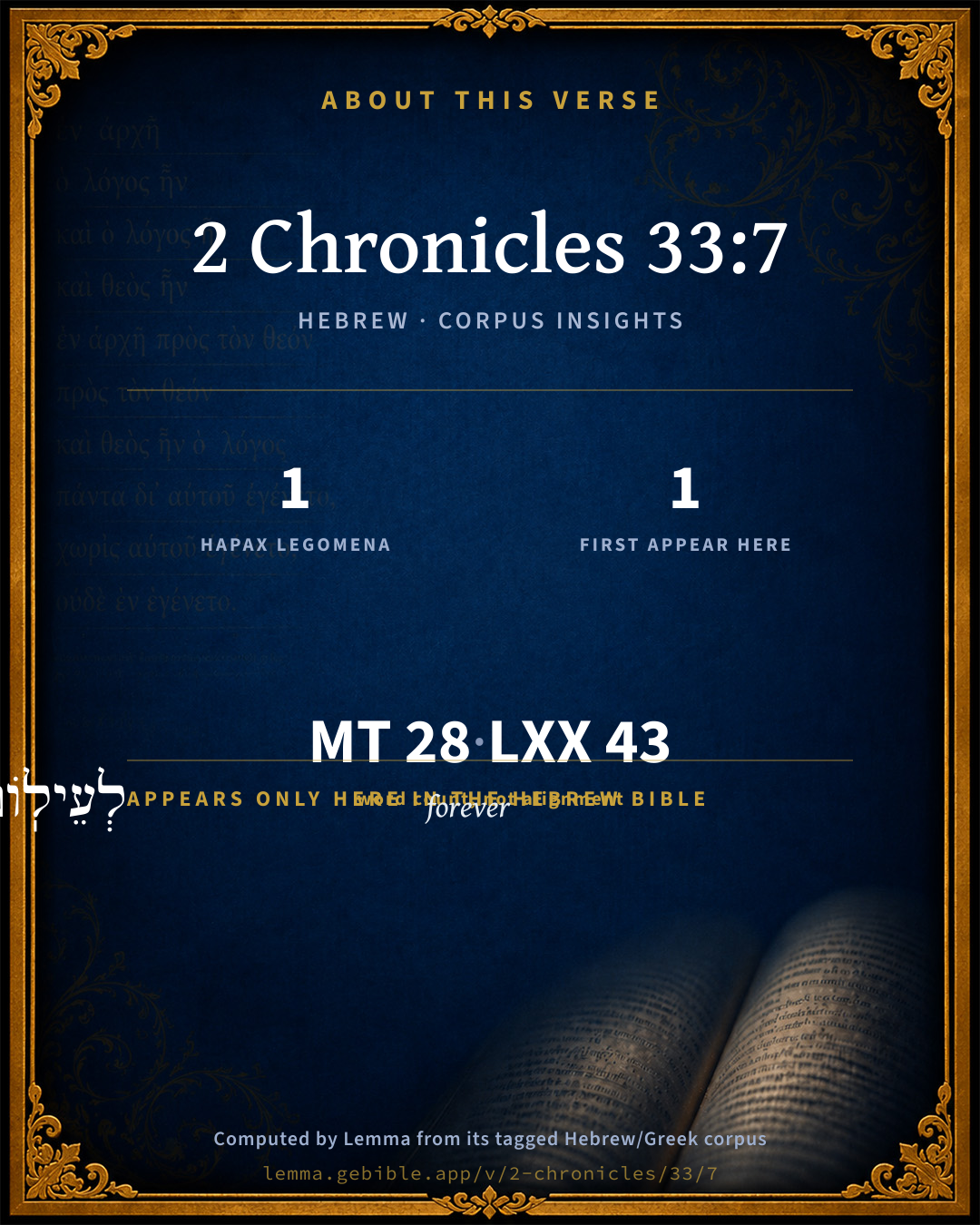
  • 1 hapax legomenon — only here in the Hebrew Bible
  • 1 first appearance in the Hebrew Bible
Full analysis ↓
Download a study sheet

One document with this verse’s original text, its word-by-word gloss line, the meaning frame, cross-references with their text, attributed commentary, and full source and license credits — printable, and it pastes into notes with its structure intact.

This verse Autodidact and up

Study sheet (.html) Plain text (.txt)

A passage Seminary Student

Up to 50 verses in one chapter. A passage sheet keeps up to 6 commentary sources and 12 cross-references per verse, in the order this page ranks them, and says so on the sheet whenever that leaves anything out. Ask for a single verse and you get the Autodidact verse sheet above.

Everything on this page stays free to read, with no account — the sheet is a download of what is already on screen, not access to it.

Want to remove ads? Support Godless Engineer
Compare translations 3

The same verse in 3 English versions, stacked beneath the original-language interlinear above. Click any original word for its lexicon entry.

Each is an independent rendering of the whole verse — the interlinear is not word-aligned to these translations.

Highlighted words mark where these versions differ — a whole-verse word diff, not a word-by-word alignment.

  • World English Bible Public Domain
    He set the engraved image of the idol, which he had made, in the house of God, of which God said to David and to Solomon his son, In this house, and in Jerusalem, which I have chosen out of all the tribes of Israel, will I put my name forever:
  • King James Version Public Domain
    And he set a carved image, the idol which he had made, in the house of God, of which God had said to David and to Solomon his son, In this house, and in Jerusalem, which I have chosen before all the tribes of Israel, will I put my name for ever:
  • unfoldingWord Literal Text CC BY-SA 4.0
    And he put the image of the idol which he made in the house of God of which God said to David and to Solomon his son, “In this house and in Jerusalem which I have chosen from all the tribes of Israel, I will set my name forever.

unfoldingWord Literal Text — © unfoldingWord, licensed CC BY-SA 4.0. Word-aligned USFM3 via Door43 (git.door43.org/unfoldingWord/en_ult).

Versions to compare (up to 4)

3 of 4 selected

Show all 18 translations

Every available English version of this verse, each an independent rendering of the whole verse.

  • World English Bible Public Domain
    He set the engraved image of the idol, which he had made, in the house of God, of which God said to David and to Solomon his son, In this house, and in Jerusalem, which I have chosen out of all the tribes of Israel, will I put my name forever:
  • Berean Standard Bible Public Domain
    Manasseh even took the carved image he had made and set it up in the house of God, of which God had said to David and his son Solomon, “In this temple and in Jerusalem, which I have chosen out of all the tribes of Israel, I will establish My Name forever.
  • Majority Standard Bible Public Domain
    Manasseh even took the carved image he had made and set it up in the house of God, of which God had said to David and his son Solomon, “In this temple and in Jerusalem, which I have chosen out of all the tribes of Israel, I will establish My Name forever.
  • King James Version Public Domain
    And he set a carved image, the idol which he had made, in the house of God, of which God had said to David and to Solomon his son, In this house, and in Jerusalem, which I have chosen before all the tribes of Israel, will I put my name for ever:
  • American Standard Version (1901) Public Domain
    And he set the graven image of the idol, which he had made, in the house of God, of which God said to David and to Solomon his son, In this house, and in Jerusalem, which I have chosen out of all the tribes of Israel, will I put my name for ever:
  • Revised Version (1885) Public Domain
    And he set the graven image of the idol, which he had made in the house of God, of which God said to David and to Solomon his son, In this house, and in Jerusalem, which I have chosen out of all the tribes of Israel, will I put my name for ever:
  • Geneva Bible (1599) Public Domain
    He put also the carued image, which he had made, in the house of God: whereof God had said to Dauid and to Salomon his sonne, In this house and in Ierusalem, which I haue chosen before all the tribes of Israel, will I put my Name for euer,
  • Douay-Rheims (1899) Public Domain
    He set also a graven, and a molten statue in the house of God, of which God had said to David, and to Solomon his son: In this house, and in Jerusalem, which I have chosen out of all the tribes of Israel, will I put my name for ever.
  • Young's Literal Translation Public Domain
    And he placeth the graven image of the idol that he made in the house of God, of which God said unto David, and unto Solomon his son, `In this house, and in Jerusalem that I have chosen out of all the tribes of Israel, I put My name to the age,
  • Literal Standard Version CC BY-SA 4.0
    And he places the carved image of the idol that he made in the house of God, of which God said to David, and to his son Solomon, “In this house, and in Jerusalem that I have chosen out of all the tribes of Israel, I put My Name for all time,
  • Unlocked Literal Bible CC BY-SA 4.0
    The carved figure he had made, he placed it in the house of God. It was about this house that God had spoken to David and Solomon his son; he had said, “It is in this house and in Jerusalem, which I have chosen from all the tribes of Israel, that I will put my name forever.
  • unfoldingWord Literal Text CC BY-SA 4.0
    And he put the image of the idol which he made in the house of God of which God said to David and to Solomon his son, “In this house and in Jerusalem which I have chosen from all the tribes of Israel, I will set my name forever.
  • Darby Bible Public Domain
    And he set the graven image of the idol that he had made, in the house of God, of which God had said to David and to Solomon his son, In this house, and in Jerusalem, which I have chosen out of all the tribes of Israel, will I put my name for ever;
  • World Messianic Bible Public Domain
    He set the engraved image of the idol, which he had made, in God’s house, of which God said to David and to Solomon his son, “In this house, and in Jerusalem, which I have chosen out of all the tribes of Israel, I will put my name forever.
  • Webster's Bible Public Domain
    And he set a carved image, the idol which he had made, in the house of God, of which God had said to David and to Solomon his son, In this house, and in Jerusalem, which I have chosen before all the tribes of Israel, will I put my name for ever:
  • Free Bible Version CC BY-SA 4.0
    He took a pagan idol he had made and set it up in God's Temple, about which God had told David and his son Solomon, “I will be honored forever in this Temple and in Jerusalem, which I have chosen from all the tribes of Israel.
  • Bible in Basic English Public Domain
    And he put the image he had made in the house of God, the house of which God had said to David and to Solomon his son, In this house, and in Jerusalem, the town which I have made mine out of all the tribes of Israel, will I put my name for ever:
  • JPS Tanakh (1917) Public Domain
    And he set the graven image of the idol, which he had made, in the house of God, of which God said to David and to Solomon his son: 'In this house, and in Jerusalem, which I have chosen out of all the tribes of Israel, will I put My name for ever;

Literal Standard Version (2020), Covenant Press — licensed CC BY-SA 4.0. Text via the HelloAO Bible API (eBible.org). Unlocked Literal Bible (unfoldingWord) — licensed CC BY-SA 4.0. Text via the HelloAO Bible API (eBible.org). unfoldingWord Literal Text — © unfoldingWord, licensed CC BY-SA 4.0. Word-aligned USFM3 via Door43 (git.door43.org/unfoldingWord/en_ult). Free Bible Version, Dr. Jonathan Gallagher — licensed CC BY-SA 4.0. Text via the HelloAO Bible API (eBible.org).

Word by word

More ways to search: Search by grammar → Find every occurrence → Compare this word →

Practice this passage: Drill this verse → Learn its vocabulary →

לְעֵילֽוֹם
ʻêylôwm
H5865
“to/for · forever”
Preposition + Noun, Common, Masculine, Singular, Absolute
Part of Speech
Preposition + Noun
Type
Common
Gender
Masculine
Number
Singular
State
Absolute
Full BDB Definition

Origin: for H5769

TWOT: 1631a

for ever, ever, everlasting, evermore, perpetual, old, ancient, world
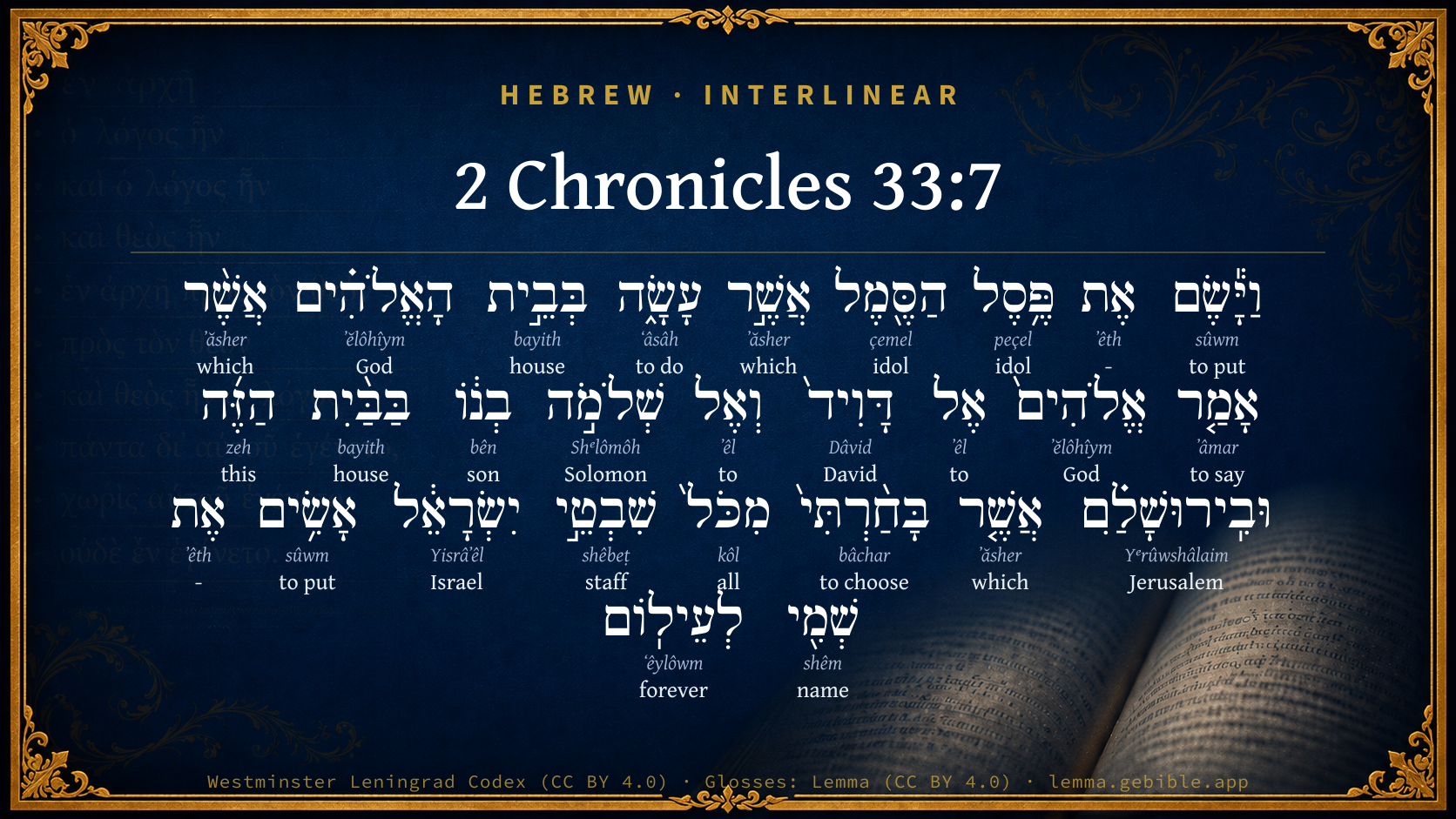
  1. וַיָּ֕שֶׂם sûwm H7760 “and · to put” Conjunction + Verb, Qal, Sequential Imperfect, 3rd Person, Masculine, Singular
  2. אֶת ʼêth H853 “-” Particle, Direct Object
  3. פֶּ֥סֶל peçel H6459 “idol of” Noun, Common, Masculine, Singular, Construct
  4. הַסֶּ֖מֶל çemel H5566 “the · idol” Particle, Definite Article + Noun, Common, Masculine, Singular, Absolute
  5. אֲשֶׁ֣ר ʼăsher H834 “which” Particle, Relative
  6. עָשָׂ֑ה ʻâsâh H6213 “to do” Verb, Qal, Perfect, 3rd Person, Masculine, Singular
  7. בְּבֵ֣ית bayith H1004 “in/at · house of” Preposition + Noun, Common, Masculine, Singular, Construct
  8. הָאֱלֹהִ֗ים ʼĕlôhîym H430 “the · God(s)” Particle, Definite Article + Noun, Common, Masculine, Plural, Absolute
  9. אֲשֶׁ֨ר ʼăsher H834 “which” Particle, Relative
  10. אָמַ֤ר ʼâmar H559 “to say” Verb, Qal, Perfect, 3rd Person, Masculine, Singular
  11. אֱלֹהִים֙ ʼĕlôhîym H430 “God(s)” Noun, Common, Masculine, Plural, Absolute
  12. אֶל ʼêl H413 “to” Preposition
  13. דָּוִיד֙ Dâvid H1732 “David” Noun, Proper
  14. וְאֶל ʼêl H413 “and · to” Conjunction + Preposition
  15. שְׁלֹמֹ֣ה Shᵉlômôh H8010 “Solomon” Noun, Proper
  16. בְנ֔וֹ bên H1121 “son · his” Noun, Common, Masculine, Singular, Construct + Suffix, Personal, 3rd Person, Masculine, Singular
  17. בַּבַּ֨יִת bayith H1004 “in/at the · house” Preposition, Determined + Noun, Common, Masculine, Singular, Absolute
  18. הַזֶּ֜ה zeh H2088 “the · this” Particle, Definite Article + Pronoun, Demonstrative, Masculine, Singular
  19. וּבִֽירוּשָׁלִַ֗ם Yᵉrûwshâlaim H3389 “and · in/at · Jerusalem” Conjunction + Preposition + Noun, Proper
  20. אֲשֶׁ֤ר ʼăsher H834 “which” Particle, Relative
  21. בָּחַ֨רְתִּי֙ bâchar H977 “to choose” Verb, Qal, Perfect, 1st Person, Common, Singular
  22. מִכֹּל֙ kôl H3605 “from · all of” Preposition + Noun, Common, Masculine, Singular, Construct
  23. שִׁבְטֵ֣י shêbeṭ H7626 “staffs of” Noun, Common, Masculine, Plural, Construct
  24. יִשְׂרָאֵ֔ל Yisrâʼêl H3478 “Israel” Noun, Proper
  25. אָשִׂ֥ים sûwm H7760 “to put” Verb, Qal, Imperfect, 1st Person, Common, Singular
  26. אֶת ʼêth H853 “-” Particle, Direct Object
  27. שְׁמִ֖י shêm H8034 “name · my” Noun, Common, Masculine, Singular, Construct + Suffix, Personal, 1st Person, Common, Singular

About this verse

These counts appear in no published source. They are computed here, from the morphology-tagged text and Lemma’s own curated glosses. What Lemma adds →

28
words
21
distinct lemmas
Historical
section

Notable vocabulary

1 hapax legomenon — a word that appears only here in the entire Hebrew Bible:

  • לְעֵילֽוֹם forever H5865

First appearance in Scripture

This word makes its first canonical appearance in the Hebrew Bible here:

  • לְעֵילֽוֹם forever H5865

Shared distinctive vocabulary

הַסֶּ֖מֶל idol H5566 occurs in 5 verses of the Hebrew Bible. Also found in:

Grammatical profile

  • 5 verbs
  • 15 nouns
  • 1 pronoun
  • 2 prepositions
  • 5 particles

Verb forms

  • וַיָּ֕שֶׂם Qal · Sequential Imperfect
  • עָשָׂ֑ה Qal · Perfect
  • אָמַ֤ר Qal · Perfect
  • בָּחַ֨רְתִּי֙ Qal · Perfect
  • אָשִׂ֥ים Qal · Imperfect

Repetition

Words recur within this verse — often emphatic in Hebrew:

  • וַיָּ֕שֶׂם to put H7760 ×2
  • בְּבֵ֣ית house H1004 ×2
  • הָאֱלֹהִ֗ים God H430 ×2
  • אֲשֶׁ֣ר which H834 ×3
  • אֶל to H413 ×2

Hebrew & Septuagint length

In English translation the verse runs 51 words from the Hebrew and 54 from the Septuagint (LXX English) — closely comparable.

A rough comparison of the two English renderings, which tokenize alike — not a word-level alignment.

Word counts can differ between the Hebrew and the Greek without any difference in meaning — e.g. the Hebrew direct-object marker אֵת has no separate Greek word, and Greek often adds the article ὁ.

In the original languages it is 28 Hebrew tokens and 43 Greek tokens — but the two are counted differently (Hebrew bundles its prefixes and suffixes into one token; the Greek is in lemma form), so that isn’t a like-for-like length.

Cross-references

13

Topical passages linked to 2 Chronicles 33:7 in the Treasury of Scripture Knowledge — connected by theme and wording, ordered by reader-vote popularity; previews shown in the World English Bible.

  • 2 Chronicles 33:4 He built altars in the house of Yahweh, of which Yahweh said, In Jerusalem shall my name be forever.
  • 2 Chronicles 7:16 For now have I chosen and made this house holy, that my name may be there forever; and my eyes and my heart shall be there perpetually.
  • 1 Kings 8:29 that your eyes may be open toward this house night and day, even toward the place of which you have said, My name shall be there; to listen to the prayer which your servant shall pray toward this place.
  • 1 Kings 8:44 If your people go out to battle against their enemy, by whatever way you shall send them, and they pray to Yahweh toward the city which you have chosen, and toward the house which I have built for your name;
  • 1 Kings 8:48 if they return to you with all their heart and with all their soul in the land of their enemies, who carried them captive, and pray to you toward their land, which you gave to their fathers, the city which you have chosen, and the house which I have built for your name:
  • 1 Kings 11:13 However I will not tear away all the kingdom; but I will give one tribe to your son, for David my servant's sake, and for Jerusalem's sake which I have chosen.
  • 1 Kings 11:32 (but he shall have one tribe, for my servant David's sake and for Jerusalem's sake, the city which I have chosen out of all the tribes of Israel);
  • 2 Kings 21:7–8 He set the engraved image of Asherah, that he had made, in the house of which Yahweh said to David and to Solomon his son, In this house, and in Jerusalem, which I have chosen out of all the tribes of Israel, will I put my name forever;
  • 2 Kings 23:6 He brought out the Asherah from the house of Yahweh, outside of Jerusalem, to the brook Kidron, and burned it at the brook Kidron, and beat it to dust, and cast the dust of it on the graves of the common people.
  • 2 Chronicles 6:6 but I have chosen Jerusalem, that my name might be there; and have chosen David to be over my people Israel.
  • 2 Chronicles 33:15 He took away the foreign gods, and the idol out of the house of Yahweh, and all the altars that he had built in the mountain of the house of Yahweh, and in Jerusalem, and cast them out of the city.
  • Psalms 78:68 But chose the tribe of Judah, Mount Zion which he loved.
  • Psalms 132:13–14 For Yahweh has chosen Zion. He has desired it for his habitation.

Cross-references courtesy of OpenBible.info (CC BY 4.0).

Hebrew and Greek witnesses Masoretic Hebrew ↔ Greek Septuagint

The same verse in the two great witnesses to the Old Testament, shown verse-for-verse.

These are two independent witnesses, not word-aligned to each other, and the Septuagint is shown in lemma (dictionary) form.

Hebrew 2 Chronicles 33:7 Masoretic · Westminster Leningrad Codex

וַיָּ֕שֶׂם אֶת פֶּ֥סֶל הַסֶּ֖מֶל אֲשֶׁ֣ר עָשָׂ֑ה בְּבֵ֣ית הָאֱלֹהִ֗ים אֲשֶׁ֨ר אָמַ֤ר אֱלֹהִים֙ אֶל דָּוִיד֙ וְאֶל שְׁלֹמֹ֣ה בְנ֔וֹ בַּבַּ֨יִת הַזֶּ֜ה וּבִֽירוּשָׁלִַ֗ם אֲשֶׁ֤ר בָּחַ֨רְתִּי֙ מִכֹּל֙ שִׁבְטֵ֣י יִשְׂרָאֵ֔ל אָשִׂ֥ים אֶת שְׁמִ֖י לְעֵילֽוֹם

He set the engraved image of the idol, which he had made, in the house of God, of which God said to David and to Solomon his son, In this house, and in Jerusalem, which I have chosen out of all the tribes of Israel, will I put my name forever:

World English Bible · Public Domain

Greek LXX 2 Chronicles 33:7 Septuagint · lemma form

καί τίθημι ὁ γλυπτός καί ὁ χωνευτός εἰκών ὅς ποιέω ἐν οἶκος θεός ὅς εἶπον ὁ θεός πρός δαυίδ καί πρός σαλωμών υἱός αὐτός ἐν ὁ οἶκος οὗτος καί ἰερουσαλήμ ὅς ἐκλέγω ἐκ πᾶς φυλή ἰσραήλ τίθημι ὁ ὄνομα ἐγώ εἰς ὁ αἰών

And he set the graven image, the molten statue, the idol which he made, in the house of God, of which God had said to David and to Solomon his son, In this house, and Jerusalem, which I have chosen out of all the tribes of Israel, I will put my name for ever;

LXX2012 (modern English Septuagint) · Public Domain

Hebrew: Westminster Leningrad Codex (CC BY 4.0). Greek: Septuagint (public domain); English from LXX2012 (modern English Septuagint) (Public Domain). How the Septuagint differs from the Hebrew →

Commentary

Notes on 2 Chronicles 33:7 from classic Christian and Jewish commentators (each source and its license shown beneath its notes). The classic Christian expositions comment on the surrounding passage and are grouped to its opening verse, so a note may address several verses; the Jewish commentaries on the Tanakh (Rashi and others) are per-verse, so they appear only where the commentator wrote on this verse.

Lemma curates 59 commentaries, every one of them public domain or Creative Commons licensed, each selected and text-cleaned for this edition rather than reprinted as found. About our sources →

Trapp's Complete Commentary

John Trapp

2Ch 33:7 And he set a carved image, the idol which he had made, in the house of God, of which God had said to David and to Solomon his son, In this house, and in Jerusalem, which I have chosen before all the tribes of Israel, will I put my name for ever:

Ver. 7. The idol which he had made.] This was some special idol worshipped by him in a grove, and now brought into the temple, as it were on purpose to provoke the Lord. {a}

{a} Diod.

John Trapp, A Commentary or Exposition upon All the Books of the Old and New Testament (1647–1656) — public domain. Text from a community e-Sword module.

Tyndale Open Study Notes

Tyndale Open Resources

33:7 The carved idol was an image of Asherah (see 2 Kgs 21:7).

Tyndale Open Study Notes — © Tyndale Open Resources, licensed CC BY-SA 4.0. Text via the HelloAO Bible API.

Geneva Bible (1599)

Geneva Bible translators

1 Kings 8:39; 1 Kings 9:3; 1 Kings 21:7; 1 Kings 23:17

Geneva Bible (1599) marginal notes — public domain. Text via Bolls.life.

Adam Clarke's Commentary

Verse 7. A carved image] "He set up an image, the likeness of himself, in the house of the sanctuary." The Targumist supposes he wished to procure himself Divine honours.

Adam Clarke's Commentary on the Bible (1810–1826) — public domain. Text from a community e-Sword/MySword module.

Ellicott's Commentary for English Readers

(7) And he set . . . had made.—And he set the carven image of the idol which he had made. “Idol” (sèmel) explains “Asherah,” the term used in Kings. Both “carven image “and “idol” (Authorised Version, figure) occur in Deu_4:16.

The house of God.—Chronicles has added, of God, by way of explanation. The Temple proper is meant, as distinct from the courts.

Before all.—Out of all.

For ever.—Le’êlum, a form only found here (equivalent to le’ólâm).

A Bible Commentary for English Readers, edited by Charles John Ellicott (1878–1897) — public domain. Text from a community e-Sword module.

The Cambridge Bible for Schools and Colleges

gen. ed. J. J. S. Perowne

7. a carved image, the idol] R.V. the graven image of the idol. In 2Ki_21:7, R.V. “the graven image of Asherah.” For Asherah cp. 2Ch_15:16 (note).

had said … before all] R.V. said … out of all (as 2 Kin.).

The Cambridge Bible for Schools and Colleges (gen. ed. J. J. S. Perowne; Cambridge University Press, 1878–1918) — public domain. Text from a community e-Sword module.

Albert Barnes' Notes on the Bible

The idol - i. e. the Asherah (2Ki 21:7 note), which receives here (and in Eze 8:3, Eze 8:5) the somewhat unusual name of semel, which some regard as a proper name, and compare with the Greek Σεμέλη Semelē.

Albert Barnes' Notes on the Bible (1834–1885) — public domain. Text from a community e-Sword/MySword module.

Haydock's Catholic Bible Commentary

Graven. Prot. "a carved image (the idol which he had made) in," &c. It seems to have been sacred to the grove, (H.) or a representation of Astarte, 4 K. xxi. 7. The ark was taken away, (chap. xxv. 3.) to make place for this impure deity, which had four (S. Basil) or five faces, (Eusebius; Salien) that people might adore it on all sides.

George Leo Haydock (1774–1849), Haydock's Catholic Family Bible and Commentary, 1859 edition — public domain. Excludes Psalms (Douay-Rheims chapter numbering differs from Protestant) and Deuterocanonical books (Catholic canon only).

The Pulpit Commentary

Vers. 7, 8. (Comp. Psa_132:13, Psa_132:14; 2Sa_7:10)

A carved image, the idol; translate, a carved image of the idol; i.e. the Asherah; for see the parallel. (2Ki_21:7) The idol; Hebrew, lm,s,. This name is found here and in ver. 15; in Deu_4:16, translated (Authorized Version) "figure;" and Eze_8:3, Eze_8:5, translated (Authorized Version) "image."

The Pulpit Commentary (1880–1919), ed. H.D.M. Spence-Jones & Joseph S. Exell — public domain. Text from a community e-Sword module.

unfoldingWord translationNotes

Door43 World Missions Community

he had made

Manasseh probably did not do the work. His servants would have done the work. AT: "Manasseh had ordered his servants to make" (See: Metonymy)

that I will put my name forever

Here God is represented by his "name." AT: "where I want people to worship me forever" (See: Metonymy)

that I assigned to their ancestors

"that I gave to their ancestors"

Judah and the inhabitants of Jerusalem

Here "Jerusalem" is a part of "Judah." AT: "the people of Judah and Jerusalem" (See: Synecdoche)

even more than the nations that Yahweh had destroyed before the people of Israel

Here "nations" refers to the people who had lived in the land of Canaan before the Israelites had arrived. AT: "even more than the people whom Yahweh had destroyed as the people of Israel advanced through the land" (See: Metonymy)

translationWords

image

house of God

David

Solomon

Jerusalem

chosen one

tribe

Israel

eternity

command

law

statute

decree

Moses

unfoldingWord translationNotes — © Distant Shores Media and the Door43 World Missions Community, licensed CC BY-SA 4.0. Source: git.door43.org/Door43/en_tn.

Rashi

Rabbi Shlomo Yitzchaki (Rashi)

forever - Heb. לְעֵילוֹם, [a variant of] לְעוֹלָם.

Rashi on the Tanakh — English translations: “The Judaica Press complete Tanach with Rashi, translated by A. J. Rosenberg” (CC BY 4.0); “Pentateuch with Rashi's commentary by M. Rosenbaum and A.M. Silbermann, 1929-1934” (public domain); “The Metsudah Tanach series, Lakewood, N.J” (CC BY 4.0); and “The Book of Joshua, Metsudah Publications, 1997” (CC BY 4.0). Text via Sefaria.

Lesson kit

Teaching starters — assembled from the data on this page, not authored interpretation. Every prompt links to the verse data it draws on. Edit before teaching.

2 Chronicles, in the Historical, opens this verse with 28 words (21 distinct Hebrew lemmas). Its most distinctive word is ʻêylôwm (“forever”). A historical commentator’s framing appears above. Read the whole chapter for the surrounding context.

Discussion questions

  1. How does “forever” (ʻêylôwm) shape what this verse is saying?
  2. 1 word here appears nowhere else in the Hebrew Bible. Why might the author reach for such rare wording?
  3. This is the first place “forever” appears in Scripture (first appears here). What does its debut here establish?
  4. How does Deuteronomy 4:16, which shares the word «idol», read alongside this verse?
  5. What does the repetition of “to put” (2× in this one verse) do in this verse?
  6. These translations render this verse differently; the difference is in the English rendering, not the original. What questions does that raise?
  7. «וַיָּ֕שֶׂם» is a Qal Sequential Imperfect verb. How does that grammatical form shape the action described?
  8. Compare how Trapp's Complete Commentary and Tyndale Open Study Notes read this verse. Where do they agree or differ?

Things to notice

  • 1 word in this verse appears nowhere else in the Hebrew Bible.
  • 1 word makes its first canonical appearance in Scripture here.
  • This verse counts 28 Hebrew ↔ 43 Greek words.
  • These translations choose different wording for 7 words in this verse.
  • “to put” occurs 2× in this single verse.

Reading settings

Reading text

Shown beneath each verse's original-language words.

Old Testament
Old Testament edition

Read the OT as the Masoretic Hebrew (MT) or the Greek Septuagint (LXX).

English shown for the Greek Septuagint (in the Hebrew ↔ Greek comparison).

Comparing translations? Open the Compare panel on any verse page to stack up to four side by side.