Nehemiah 13:16

Hebrew (Westminster Leningrad Codex) Nehemiah 13:16 appears in the Hebrew Old Testament. The text above is from the Westminster Leningrad Codex. Each word links to its Strong’s number, a concise gloss, and parsing drawn from the Open Scriptures Hebrew Bible morphology. Click any word for its full Brown-Driver-Briggs (BDB) entry.
Download image
Cite this verse

Nehemiah 13:16 (World English Bible). Public Domain. Lemma interlinear Bible study tool, https://lemma.gebible.app/v/nehemiah/13/16.

Show BibTeX & RIS
BibTeX
RIS
English Translation
There lived men of Tyre also therein, who brought in fish, and all manner of wares, and sold on the Sabbath to the children of Judah, and in Jerusalem.
World English Bible · Public Domain
Download a study sheet

One document with this verse’s original text, its word-by-word gloss line, the meaning frame, cross-references with their text, attributed commentary, and full source and license credits — printable, and it pastes into notes with its structure intact.

This verse Autodidact and up

Study sheet (.html) Plain text (.txt)

A passage Seminary Student

Up to 50 verses in one chapter. A passage sheet keeps up to 6 commentary sources and 12 cross-references per verse, in the order this page ranks them, and says so on the sheet whenever that leaves anything out. Ask for a single verse and you get the Autodidact verse sheet above.

Everything on this page stays free to read, with no account — the sheet is a download of what is already on screen, not access to it.

Want to remove ads? Support Godless Engineer
Compare translations 3

The same verse in 3 English versions, stacked beneath the original-language interlinear above. Click any original word for its lexicon entry.

Each is an independent rendering of the whole verse — the interlinear is not word-aligned to these translations.

Highlighted words mark where these versions differ — a whole-verse word diff, not a word-by-word alignment.

  • World English Bible Public Domain
    There lived men of Tyre also therein, who brought in fish, and all manner of wares, and sold on the Sabbath to the children of Judah, and in Jerusalem.
  • King James Version Public Domain
    There dwelt men of Tyre also therein, which brought fish, and all manner of ware, and sold on the sabbath unto the children of Judah, and in Jerusalem.
  • unfoldingWord Literal Text CC BY-SA 4.0
    And the Tyrians who dwelt in it were bringing in fish and all kinds of merchandise and were selling them on the sabbath to the sons of Judah, even in Jerusalem.

unfoldingWord Literal Text — © unfoldingWord, licensed CC BY-SA 4.0. Word-aligned USFM3 via Door43 (git.door43.org/unfoldingWord/en_ult).

Versions to compare (up to 4)

3 of 4 selected

Show all 18 translations

Every available English version of this verse, each an independent rendering of the whole verse.

  • World English Bible Public Domain
    There lived men of Tyre also therein, who brought in fish, and all manner of wares, and sold on the Sabbath to the children of Judah, and in Jerusalem.
  • Berean Standard Bible Public Domain
    Additionally, men of Tyre who lived there were importing fish and all kinds of merchandise and selling them on the Sabbath to the people of Judah in Jerusalem.
  • Majority Standard Bible Public Domain
    Additionally, men of Tyre who lived there were importing fish and all kinds of merchandise and selling them on the Sabbath to the people of Judah in Jerusalem.
  • King James Version Public Domain
    There dwelt men of Tyre also therein, which brought fish, and all manner of ware, and sold on the sabbath unto the children of Judah, and in Jerusalem.
  • American Standard Version (1901) Public Domain
    There dwelt men of Tyre also therein, who brought in fish, and all manner of wares, and sold on the sabbath unto the children of Judah, and in Jerusalem.
  • Revised Version (1885) Public Domain
    There dwelt men of Tyre also therein, which brought in fish, and all manner of ware, and sold on the sabbath unto the children of Judah, and in Jerusalem.
  • Geneva Bible (1599) Public Domain
    There dwelt men of Tyrus also therein, which brought fish and all wares, and solde on the Sabbath vnto the children of Iudah euen in Ierusalem.
  • Douay-Rheims (1899) Public Domain
    Some Tyrians also dwelt there, who brought fish, and all manner of wares: and they sold them on the sabbaths to the children of Juda in Jerusalem.
  • Young's Literal Translation Public Domain
    And the Tyrians have dwelt in it, bringing in fish, and every ware, and selling on sabbath to the sons of Judah and in Jerusalem.
  • Literal Standard Version CC BY-SA 4.0
    And the Tyrians have dwelt in it, bringing in fish, and every ware, and selling on Sabbath to the sons of Judah and in Jerusalem.
  • Unlocked Literal Bible CC BY-SA 4.0
    Men from Tyre living in Jerusalem brought in fish and all kinds of goods, and they sold them on the Sabbath to the people of Judah and in the city!
  • unfoldingWord Literal Text CC BY-SA 4.0
    And the Tyrians who dwelt in it were bringing in fish and all kinds of merchandise and were selling them on the sabbath to the sons of Judah, even in Jerusalem.
  • Darby Bible Public Domain
    Men of Tyre also dwelt therein, who brought fish and all manner of ware, and sold it on the sabbath to the children of Judah, and in Jerusalem.
  • World Messianic Bible Public Domain
    Some men of Tyre also lived there, who brought in fish and all kinds of wares, and sold on the Sabbath to the children of Judah, and in Jerusalem.
  • Webster's Bible Public Domain
    There dwelt men of Tyre also therein, who brought fish, and all manner of wares, and sold on the sabbath to the children of Judah, and in Jerusalem.
  • Free Bible Version CC BY-SA 4.0
    I told them off for selling their produce on that day.
  • Bible in Basic English Public Domain
    And there were men of Tyre there, who came with fish and all sorts of goods, trading with the children of Judah and in Jerusalem on the Sabbath.
  • JPS Tanakh (1917) Public Domain
    There dwelt men of Tyre also therein, who brought in fish, and all manner of ware, and sold on the sabbath unto the children of Judah, and in Jerusalem.

Literal Standard Version (2020), Covenant Press — licensed CC BY-SA 4.0. Text via the HelloAO Bible API (eBible.org). Unlocked Literal Bible (unfoldingWord) — licensed CC BY-SA 4.0. Text via the HelloAO Bible API (eBible.org). unfoldingWord Literal Text — © unfoldingWord, licensed CC BY-SA 4.0. Word-aligned USFM3 via Door43 (git.door43.org/unfoldingWord/en_ult). Free Bible Version, Dr. Jonathan Gallagher — licensed CC BY-SA 4.0. Text via the HelloAO Bible API (eBible.org).

Word by word

More ways to search: Search by grammar → Find every occurrence → Compare this word →

Practice this passage: Drill this verse → Learn its vocabulary →

מֶ֑כֶר
meker
H4377
“price”
Noun, Common, Masculine, Singular, Absolute
Part of Speech
Noun
Type
Common
Gender
Masculine
Number
Singular
State
Absolute
Full BDB Definition

Origin: from H4376

TWOT: 1194a

merchandise, value, price
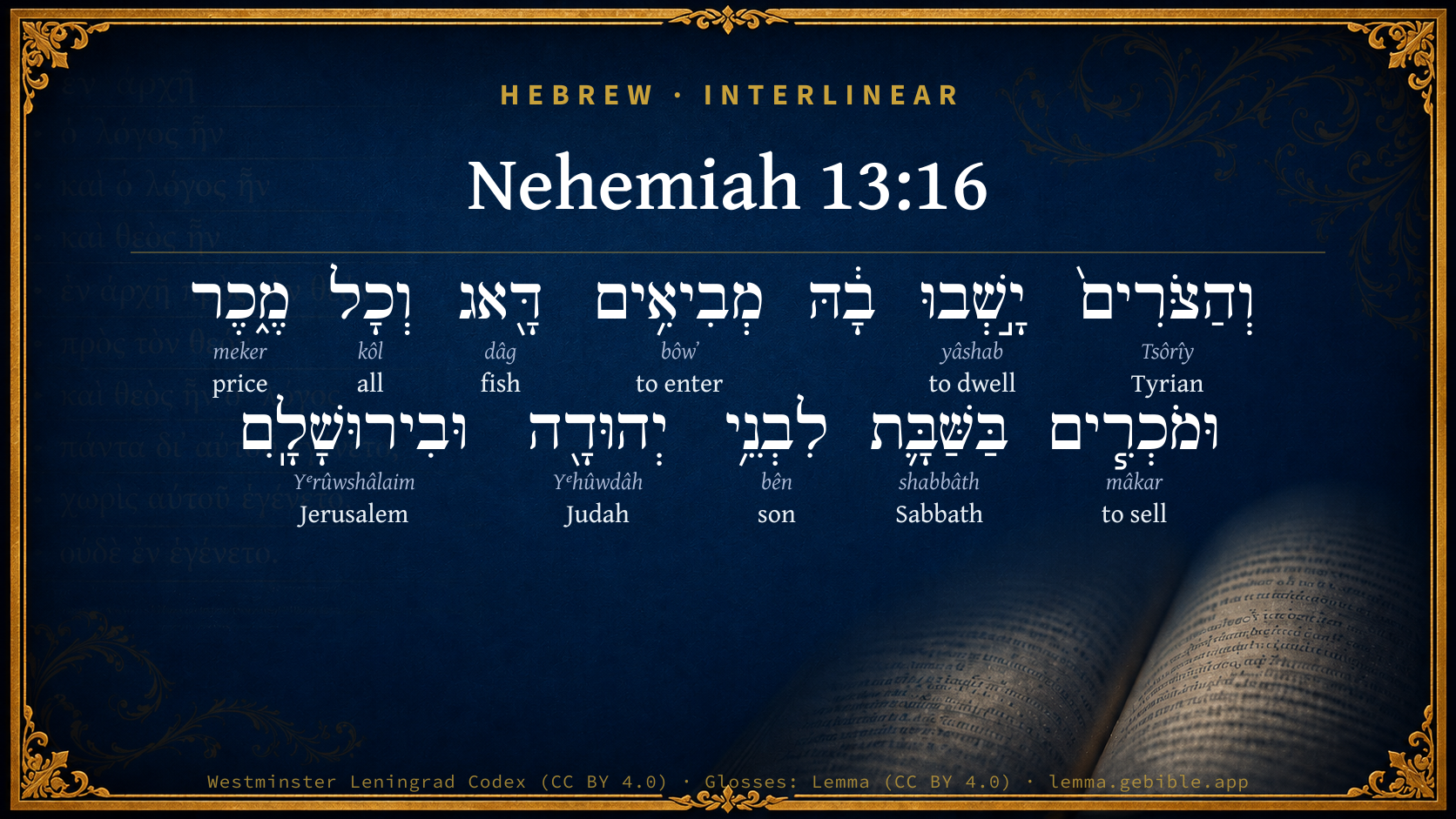
  1. וְהַצֹּרִים֙ Tsôrîy H6876 “and · the · Tyrians” Conjunction + Particle, Definite Article + Noun, Gentilic, Masculine, Plural, Absolute
  2. יָ֣שְׁבוּ yâshab H3427 “to dwell” Verb, Qal, Perfect, 3rd Person, Common, Plural
  3. מְבִיאִ֥ים bôwʼ H935 “entering” Verb, Hiphil, Participle Active, Masculine, Plural, Absolute
  4. דָּ֖אג dâg H1709 “fish” Noun, Common, Masculine, Singular, Absolute
  5. וְכָל kôl H3605 “and · all of” Conjunction + Noun, Common, Masculine, Singular, Construct
  6. וּמֹכְרִ֧ים mâkar H4376 “and · selling” Conjunction + Verb, Qal, Participle Active, Masculine, Plural, Absolute
  7. בַּשַּׁבָּ֛ת shabbâth H7676 “in/at the · Sabbath” Preposition, Determined + Noun, Common, Both, Singular, Absolute
  8. לִבְנֵ֥י bên H1121 “to/for · sons of” Preposition + Noun, Common, Masculine, Plural, Construct
  9. יְהוּדָ֖ה Yᵉhûwdâh H3063 “Judah” Noun, Proper
  10. וּבִירוּשָׁלִָֽם Yᵉrûwshâlaim H3389 “and · in/at · Jerusalem” Conjunction + Preposition + Noun, Proper

About this verse

These counts appear in no published source. They are computed here, from the morphology-tagged text and Lemma’s own curated glosses. What Lemma adds →

12
words
11
distinct lemmas
Historical
section

Notable vocabulary

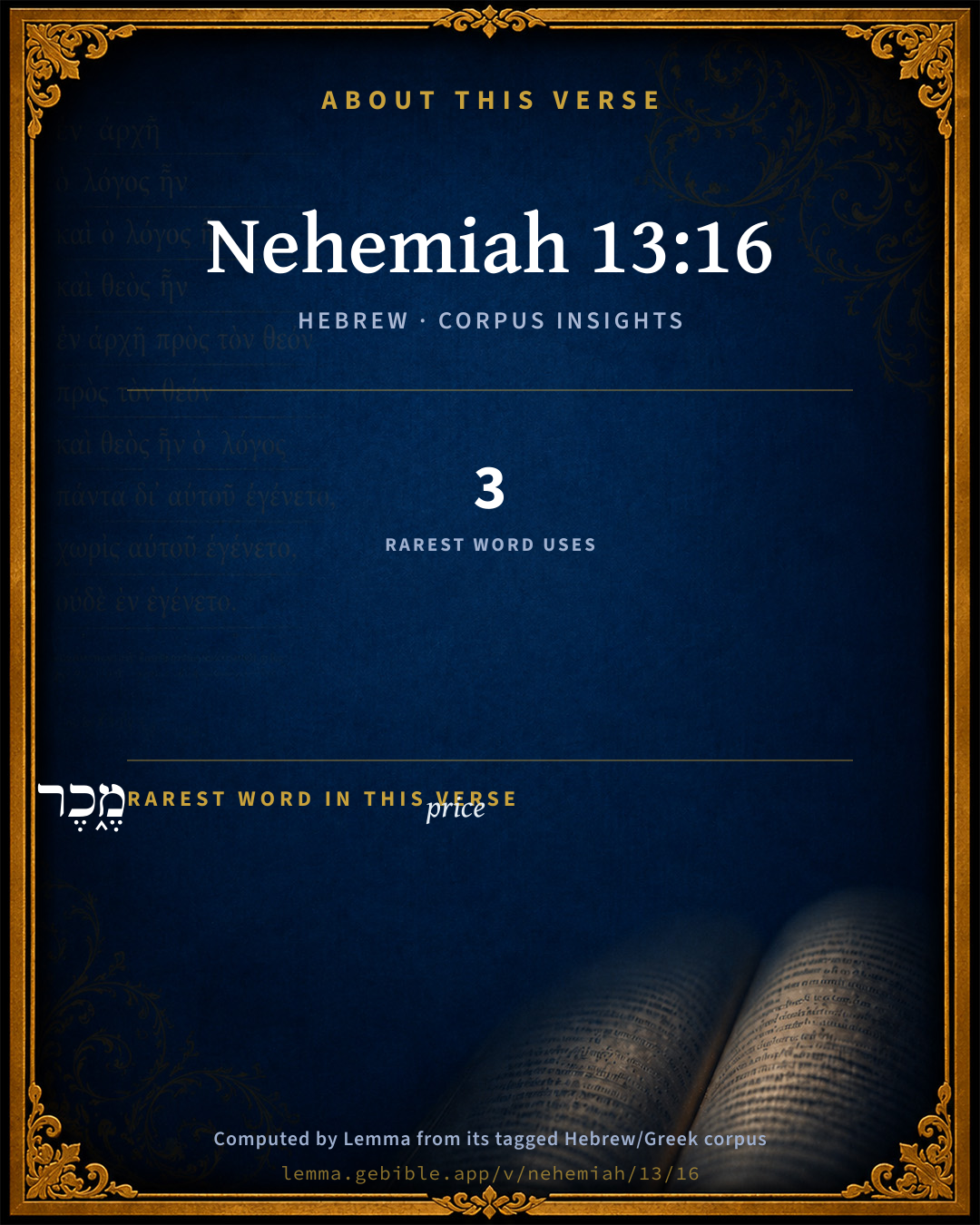
The rarest word here is מֶ֑כֶר price H4377 — appearing just 3 times in the whole Hebrew Bible.

Shared distinctive vocabulary

מֶ֑כֶר price H4377 occurs in 3 verses of the Hebrew Bible. Also found in:

Grammatical profile

  • 3 verbs
  • 8 nouns
  • 1 preposition

Verb forms

  • יָ֣שְׁבוּ Qal · Perfect
  • מְבִיאִ֥ים Hiphil · Participle Active
  • וּמֹכְרִ֧ים Qal · Participle Active

Cross-references

2

Topical passages linked to Nehemiah 13:16 in the Treasury of Scripture Knowledge — connected by theme and wording, ordered by reader-vote popularity; previews shown in the World English Bible.

  • Exodus 23:12 "Six days you shall do your work, and on the seventh day you shall rest, that your ox and your donkey may have rest, and the son of your handmaid, and the alien may be refreshed.
  • Deuteronomy 5:14 but the seventh day is a Sabbath to Yahweh your God: [in it] you shall not do any work, you, nor your son, nor your daughter, nor your man-servant, nor your maid-servant, nor your ox, nor your donkey, nor any of your cattle, nor your stranger who is within your gates; that your man-servant and your maid-servant may rest as well as you.

Cross-references courtesy of OpenBible.info (CC BY 4.0).

Hebrew and Greek witnesses Masoretic Hebrew ↔ Greek Septuagint

The same verse in the two great witnesses to the Old Testament, shown verse-for-verse.

These are two independent witnesses, not word-aligned to each other, and the Septuagint is shown in lemma (dictionary) form.

Hebrew Nehemiah 13:16 Masoretic · Westminster Leningrad Codex

וְהַצֹּרִים֙ יָ֣שְׁבוּ בָ֔הּ מְבִיאִ֥ים דָּ֖אג וְכָל מֶ֑כֶר וּמֹכְרִ֧ים בַּשַּׁבָּ֛ת לִבְנֵ֥י יְהוּדָ֖ה וּבִירוּשָׁלִָֽם

There lived men of Tyre also therein, who brought in fish, and all manner of wares, and sold on the Sabbath to the children of Judah, and in Jerusalem.

World English Bible · Public Domain

Greek LXX Structure differs

The Septuagint has no separate book of Nehemiah. Its Greek text is the second half of Esdras B (2 Esdras), chapters 11–23; Ezra is the first half (1–10).

A verse-for-verse comparison isn’t shown here because the chapters and verses don’t line up. Switch to the LXX edition with the MT / LXX toggle above to read the Greek directly.

Hebrew: Westminster Leningrad Codex (CC BY 4.0). Greek: Septuagint (public domain); English from a public-domain English Septuagint. How the Septuagint differs from the Hebrew →

Commentary

Notes on Nehemiah 13:16 from classic Christian and Jewish commentators (each source and its license shown beneath its notes). The classic Christian expositions comment on the surrounding passage and are grouped to its opening verse, so a note may address several verses; the Jewish commentaries on the Tanakh (Rashi and others) are per-verse, so they appear only where the commentator wrote on this verse.

Lemma curates 59 commentaries, every one of them public domain or Creative Commons licensed, each selected and text-cleaned for this edition rather than reprinted as found. About our sources →

Trapp's Complete Commentary

John Trapp

Neh 13:16 There dwelt men of Tyre also therein, which brought fish, and all manner of ware, and sold on the sabbath unto the children of Judah, and in Jerusalem.

Ver. 16. There dwelt men of Tyre also] Phoenician merchants had their factors in Jerusalem.

And all manner of ware] Merchandise; for Tyre was a great market town, and famous for fishing, Eze 27:1-36

And sold on the sabbath] Which they ought not to have done; for that was God’s market day, and not man’s.

Unto the children of Judah] Who were, therefore, worse than the Tyrians, because they ought to have been better; therefore wrath shall be upon the Jew first, and then upon the Gentile, Rom 2:10

And in Jerusalem] This holy city was become a harlot. Filthiness in a stew is nothing so odious as in a virgin; a nettle in a wilderness is not so unsightly as in a garden. In a land of uprightness to do wickedly is an aggravating circumstance, Isa 26:10.

John Trapp, A Commentary or Exposition upon All the Books of the Old and New Testament (1647–1656) — public domain. Text from a community e-Sword module.

Ellicott's Commentary for English Readers

(16) Men of Tyre.—They brought timber for the building of the Temple, and received food in payment Ezr_3:7). Now they seem to have established themselves as a colony, and supplied fish, especially to the inhabitants. But their offence was the doing this “on the sabbath unto the children of Judah, and in Jerusalem.” The verse closes emphatically.

A Bible Commentary for English Readers, edited by Charles John Ellicott (1878–1897) — public domain. Text from a community e-Sword module.

The Cambridge Bible for Schools and Colleges

gen. ed. J. J. S. Perowne

16. Traffic on the Sabbath.

therein] i.e. in the city.

which brought fish] R.V. which brought in fish. These would be the salted and dried fish from the Mediterranean, cf. Neh_3:3.

ware] i.e. anything offered for sale.

sold on the sabbath unto the children of Judah] The fault lay with the buyers, as is shown in the next verse.

and in Jerusalem] The words are added emphatically, as if Nehemiah had said ‘to think of such a thing being possible in the holy city.’

The Cambridge Bible for Schools and Colleges (gen. ed. J. J. S. Perowne; Cambridge University Press, 1878–1918) — public domain. Text from a community e-Sword module.

John Gill's Exposition

Did not your fathers thus,.... Profane the sabbath in like manner:

and did not our God bring all this evil upon us, and upon our city? suffered them to be carried captive into a strange land, and their city destroyed for their sins, and for this of sabbath breaking among the rest, see Jer 17:21,

yet ye bring more wrath upon Israel by profaning the sabbath; additional judgments to those that had been already upon them for the same evil with others.

John Gill's Exposition of the Whole Bible (1746–1763) — public domain (CC PDM 1.0). Text via the HelloAO Bible API.

Albert Barnes' Notes on the Bible

Friendly relations subsisted between the Phoenicians and the Jews, after the captivity Ezr 3:7. It was, however, a new fact, and one pregnant with evil consequences, that the Tyrians should have established a permanent colony at Jerusalem. Its influence on the other inhabitants weakened the hold of the Law upon men’s consciences, and caused it to be transgressed continually more and more openly.

Albert Barnes' Notes on the Bible (1834–1885) — public domain. Text from a community e-Sword/MySword module.

Haydock's Catholic Bible Commentary

Tyrians. Who had established themselves there, for the sake of commerce, though the chosen people ought to have kept them at a great distance, for fear of seduction. (Calmet)

George Leo Haydock (1774–1849), Haydock's Catholic Family Bible and Commentary, 1859 edition — public domain. Excludes Psalms (Douay-Rheims chapter numbering differs from Protestant) and Deuterocanonical books (Catholic canon only).

Matthew Poole's English Annotations

Which brought fish, which they might take in the sea near Joppa, or bring from Tyre to Joppa by sea, and thence to Jerusalem, which was but a small journey.

In Jerusalem, the holy city, where God’s house and presence was, and where the great judicatories of the nation were. So this is added as an aggravation of their sin, that this was done with manifest contempt both to God and men.

Matthew Poole's English Annotations on the Holy Bible (1683–1685) — public domain. Text from a community e-Sword/MySword module.

Whedon's Commentary on the Bible

Daniel D. Whedon

16. There dwelt men of Tyre — These Tyrians are not to be understood as having permanent abodes in Jerusalem, but dwelling only temporarily there in order to carry on the traffic here mentioned.

Daniel D. Whedon (gen. ed.), Commentary on the Old and New Testaments (1874–1909) — public domain. Text from a community e-Sword module.

The Pulpit Commentary

There dwelt men of Tyre also therein. It was not against the law that foreigners should dwell in Jerusalem. Araunah the Jebusite lived there in the time of David, and Ebed-melech the Ethiopian in the time of Zedekiah. (Jer_38:7) Nehemiah does not object to the Tyrians for being dwellers in Jerusalem, but for offering their wares for sale there on the sabbath, and inducing the Jews to buy of them. Which brought fish . Fish was always a favourite article of food with the Israelites. (Lev_11:9 Num_11:5 Deu_14:9 Isa_19:10 Mat_14:7 Mat_15:34 Luk_24:42, etc.) They derived it chiefly from the Sea of Galilee and the Mediterranean.

The Pulpit Commentary (1880–1919), ed. H.D.M. Spence-Jones & Joseph S. Exell — public domain. Text from a community e-Sword module.

John Wesley's Explanatory Notes

Jerusalem - The holy city, where God's house was; and where the great judicatories of the nation were. So this is added as an aggravation of their sin, that it was done with manifest contempt of God and man.

John Wesley, Explanatory Notes Upon the Whole Bible (1754–1765) — public domain. Text via the GEBible commentary corpus.

unfoldingWord translationNotes

Door43 World Missions Community

Tyre

This is the name of a city. (See: How to Translate Names)

What is this evil thing you are doing, profaning the Sabbath day?

Nehemiah is using a rhetorical question to scold the leaders of Judah. This can be translated as a statement. AT: "You are doing an evil thing by profaning the Sabbath day." or "God will punish you for doing this evil thing, for profaning the Sabbath day." (See: Rhetorical Question)

Did not your fathers do this? Did not our God bring all this evil on us and on this city?

Nehemiah is using these rhetorical questions to scold the leaders of Judah. These questions can be combined and translated as a statement. AT: "You know that your fathers did this, and that is why God brought all this evil on us and on this city." (See: Rhetorical Question)

translationWords

life

Jerusalem

Sabbath

people group

kingdom of Judah

evil

profane

ancestor

God

wrath

Israel

unfoldingWord translationNotes — © Distant Shores Media and the Door43 World Missions Community, licensed CC BY-SA 4.0. Source: git.door43.org/Door43/en_tn.

Rashi

Rabbi Shlomo Yitzchaki (Rashi)

and the Tyrian Merchants of Tyre would bring fish to sell.

Rashi on the Tanakh — English translations: “The Judaica Press complete Tanach with Rashi, translated by A. J. Rosenberg” (CC BY 4.0); “Pentateuch with Rashi's commentary by M. Rosenbaum and A.M. Silbermann, 1929-1934” (public domain); “The Metsudah Tanach series, Lakewood, N.J” (CC BY 4.0); and “The Book of Joshua, Metsudah Publications, 1997” (CC BY 4.0). Text via Sefaria.

Lesson kit

Teaching starters — assembled from the data on this page, not authored interpretation. Every prompt links to the verse data it draws on. Edit before teaching.

Nehemiah, in the Historical, opens this verse with 12 words (11 distinct Hebrew lemmas). Its most distinctive word is meker (“price”). A historical commentator’s framing appears above. Read the whole chapter for the surrounding context.

Discussion questions

  1. What does “price” (meker) contribute to the verse as a whole?
  2. Numbers 20:19 shares the word «price» with this verse. How do the two illuminate each other?
  3. The translations on this page render this verse differently — a whole-verse word diff, not a word-by-word alignment. What might account for the different wordings?
  4. The verb «יָ֣שְׁבוּ» is Qal Perfect. How does its form color the action?
  5. Reading how Trapp's Complete Commentary and Ellicott's Commentary for English Readers read this verse, where do the two commentators agree and where do they part?

Things to notice

Reading settings

Reading text

Shown beneath each verse's original-language words.

Old Testament
Old Testament edition

Read the OT as the Masoretic Hebrew (MT) or the Greek Septuagint (LXX).

English shown for the Greek Septuagint (in the Hebrew ↔ Greek comparison).

Comparing translations? Open the Compare panel on any verse page to stack up to four side by side.