
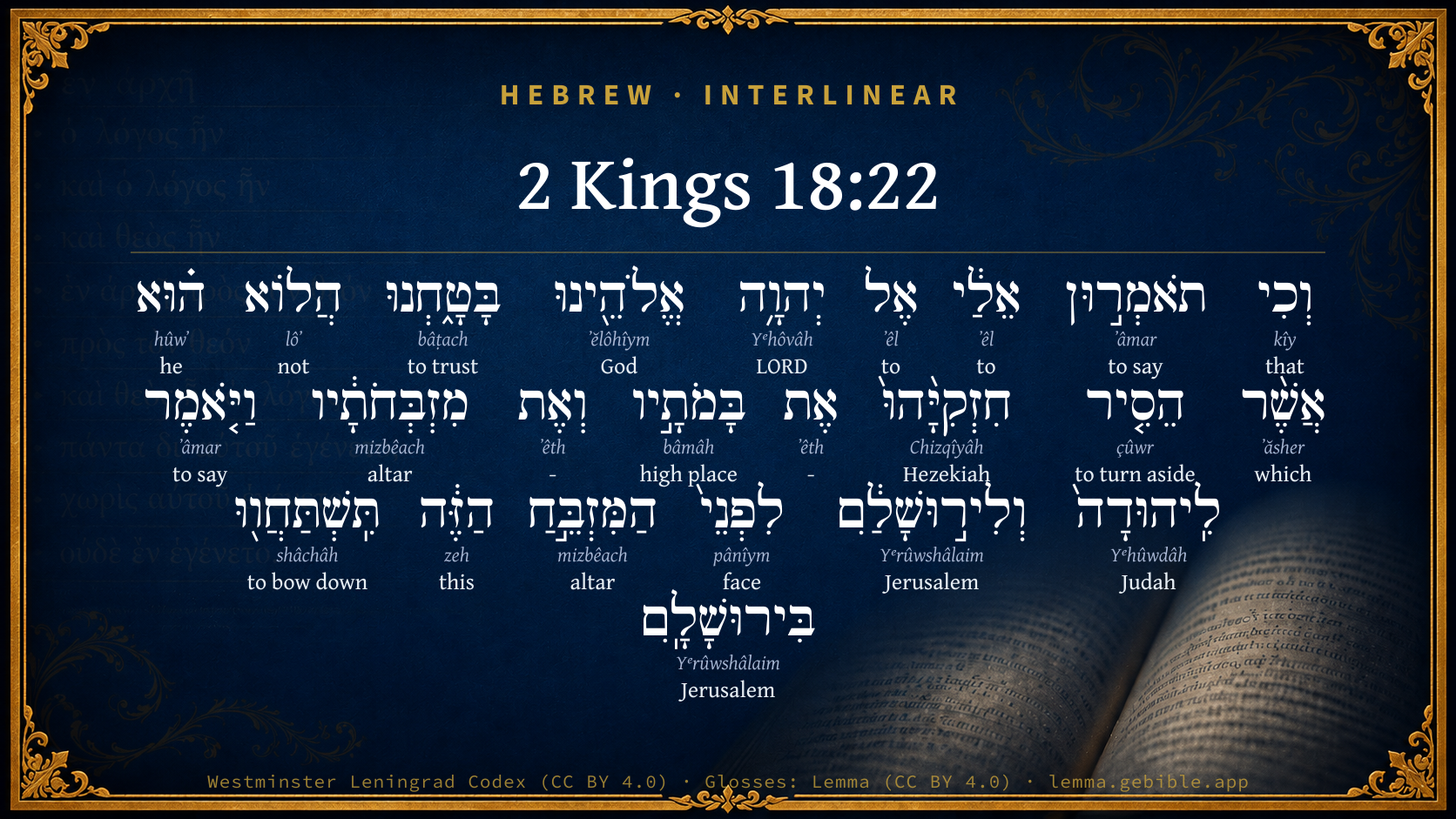
2 Kings 18:22

Hebrew (Westminster Leningrad Codex) 2 Kings 18:22 appears in the Hebrew Old Testament. The text above is from the Westminster Leningrad Codex. Each word links to its Strong’s number, a concise gloss, and parsing drawn from the Open Scriptures Hebrew Bible morphology. Click any word for its full Brown-Driver-Briggs (BDB) entry.
Download image
Cite this verse

2 Kings 18:22 (World English Bible). Public Domain. Lemma interlinear Bible study tool, https://lemma.gebible.app/v/2-kings/18/22.

Show BibTeX & RIS
BibTeX
RIS
English Translation
But if you tell me, We trust in Yahweh our God; isn't that he whose high places and whose altars Hezekiah has taken away, and has said to Judah and to Jerusalem, You shall worship before this altar in Jerusalem?
World English Bible · Public Domain
Download a study sheet

One document with this verse’s original text, its word-by-word gloss line, the meaning frame, cross-references with their text, attributed commentary, and full source and license credits — printable, and it pastes into notes with its structure intact.

This verse Autodidact and up

Study sheet (.html) Plain text (.txt)

A passage Seminary Student

Up to 50 verses in one chapter. A passage sheet keeps up to 6 commentary sources and 12 cross-references per verse, in the order this page ranks them, and says so on the sheet whenever that leaves anything out. Ask for a single verse and you get the Autodidact verse sheet above.

Everything on this page stays free to read, with no account — the sheet is a download of what is already on screen, not access to it.

Want to remove ads? Support Godless Engineer
Compare translations 3

The same verse in 3 English versions, stacked beneath the original-language interlinear above. Click any original word for its lexicon entry.

Each is an independent rendering of the whole verse — the interlinear is not word-aligned to these translations.

Highlighted words mark where these versions differ — a whole-verse word diff, not a word-by-word alignment.

  • World English Bible Public Domain
    But if you tell me, We trust in Yahweh our God; isn't that he whose high places and whose altars Hezekiah has taken away, and has said to Judah and to Jerusalem, You shall worship before this altar in Jerusalem?
  • King James Version Public Domain
    But if ye say unto me, We trust in the LORD our God: is not that he, whose high places and whose altars Hezekiah hath taken away, and hath said to Judah and Jerusalem, Ye shall worship before this altar in Jerusalem?
  • unfoldingWord Literal Text CC BY-SA 4.0
    But if you say to me, ‘We trust in Yahweh our God,’ not he whose high places and altars Hezekiah has removed and said to Judah and to Jerusalem, ‘To the face of this altar in Jerusalem you shall prostrate yourselves’?

unfoldingWord Literal Text — © unfoldingWord, licensed CC BY-SA 4.0. Word-aligned USFM3 via Door43 (git.door43.org/unfoldingWord/en_ult).

Versions to compare (up to 4)

3 of 4 selected

Show all 18 translations

Every available English version of this verse, each an independent rendering of the whole verse.

  • World English Bible Public Domain
    But if you tell me, We trust in Yahweh our God; isn't that he whose high places and whose altars Hezekiah has taken away, and has said to Judah and to Jerusalem, You shall worship before this altar in Jerusalem?
  • Berean Standard Bible Public Domain
    But if you say to me, ‘We trust in the LORD our God,’ is He not the One whose high places and altars Hezekiah has removed, saying to Judah and Jerusalem: ‘You must worship before this altar in Jerusalem’?
  • Majority Standard Bible Public Domain
    But if you say to me, ‘We trust in the LORD our God,’ is He not the One whose high places and altars Hezekiah has removed, saying to Judah and Jerusalem: ‘You must worship before this altar in Jerusalem’?
  • King James Version Public Domain
    But if ye say unto me, We trust in the LORD our God: is not that he, whose high places and whose altars Hezekiah hath taken away, and hath said to Judah and Jerusalem, Ye shall worship before this altar in Jerusalem?
  • American Standard Version (1901) Public Domain
    But if ye say unto me, We trust in Jehovah our God; is not that he, whose high places and whose altars Hezekiah hath taken away, and hath said to Judah and to Jerusalem, Ye shall worship before this altar in Jerusalem?
  • Revised Version (1885) Public Domain
    But if ye say unto me, We trust in the LORD our God: is not that he, whose high places and whose altars Hezekiah hath taken away, and hath said to Judah and to Jerusalem, Ye shall worship before this altar in Jerusalem?
  • Geneva Bible (1599) Public Domain
    But if ye say vnto me, We trust in the Lord our God, is not that he whose hie places, and whose altars Hezekiah hath taken away, and hath sayd to Iudah and Ierusalem, Ye shall worship before this altar in Ierusalem?
  • Douay-Rheims (1899) Public Domain
    But if you say to me: We trust in the Lord our God: is it not he, whose high places and altars Ezechias hath taken away: and hath commanded Juda and Jerusalem: You shall worship before this altar in Jerusalem?
  • Young's Literal Translation Public Domain
    `And when ye say unto me, Unto Jehovah our God we have trusted, is it not He whose high places and whose altars Hezekiah hath turned aside, and saith to Judah and to Jerusalem, Before this altar do ye bow yourselves in Jerusalem?
  • Literal Standard Version CC BY-SA 4.0
    And when you say to me, We have trusted in our God YHWH, is it not He whose high places and whose altars Hezekiah has turned aside, and says to Judah and to Jerusalem, You bow yourselves before this altar in Jerusalem?
  • Unlocked Literal Bible CC BY-SA 4.0
    But if you say to me, 'We are trusting in Yahweh our God,' is not he the one whose high places and altars Hezekiah has taken away, and has said to Judah and to Jerusalem, 'You must worship before this altar in Jerusalem'?
  • unfoldingWord Literal Text CC BY-SA 4.0
    But if you say to me, ‘We trust in Yahweh our God,’ not he whose high places and altars Hezekiah has removed and said to Judah and to Jerusalem, ‘To the face of this altar in Jerusalem you shall prostrate yourselves’?
  • Darby Bible Public Domain
    And if ye say to me, We rely upon Jehovah our God: is it not he whose high places and whose altars Hezekiah has removed, saying to Judah and Jerusalem, Ye shall worship before this altar in Jerusalem?
  • World Messianic Bible Public Domain
    But if you tell me, ‘We trust in the LORD our God,’ isn’t that he whose high places and whose altars Hezekiah has taken away, and has said to Judah and to Jerusalem, ‘You shall worship before this altar in Jerusalem’?
  • Webster's Bible Public Domain
    But if ye say to me, We trust in the LORD our God: is not that he whose high places and whose altars Hezekiah hath taken away, and hath said to Judah and Jerusalem, Ye shall worship before this altar in Jerusalem?
  • Free Bible Version CC BY-SA 4.0
    If you tell me, ‘We're trusting in the Lord our God,’ well didn't Hezekiah remove his high places and his altars, telling Judah and Jerusalem: ‘You have to worship at this altar in Jerusalem’?
  • Bible in Basic English Public Domain
    And if you say to me, Our hope is in the Lord our God: is it not he, whose high places and altars Hezekiah has taken away, saying to Judah and Jerusalem that worship may only be given before this altar in Jerusalem?
  • JPS Tanakh (1917) Public Domain
    But if ye say unto me: We trust in the LORD our God; is not that He, whose high places and whose altars Hezekiah hath taken away, and hath said to Judah and to Jerusalem: Ye shall worship before this altar in Jerusalem?

Literal Standard Version (2020), Covenant Press — licensed CC BY-SA 4.0. Text via the HelloAO Bible API (eBible.org). Unlocked Literal Bible (unfoldingWord) — licensed CC BY-SA 4.0. Text via the HelloAO Bible API (eBible.org). unfoldingWord Literal Text — © unfoldingWord, licensed CC BY-SA 4.0. Word-aligned USFM3 via Door43 (git.door43.org/unfoldingWord/en_ult). Free Bible Version, Dr. Jonathan Gallagher — licensed CC BY-SA 4.0. Text via the HelloAO Bible API (eBible.org).

Word by word

More ways to search: Search by grammar → Find every occurrence → Compare this word →

Practice this passage: Drill this verse → Learn its vocabulary →

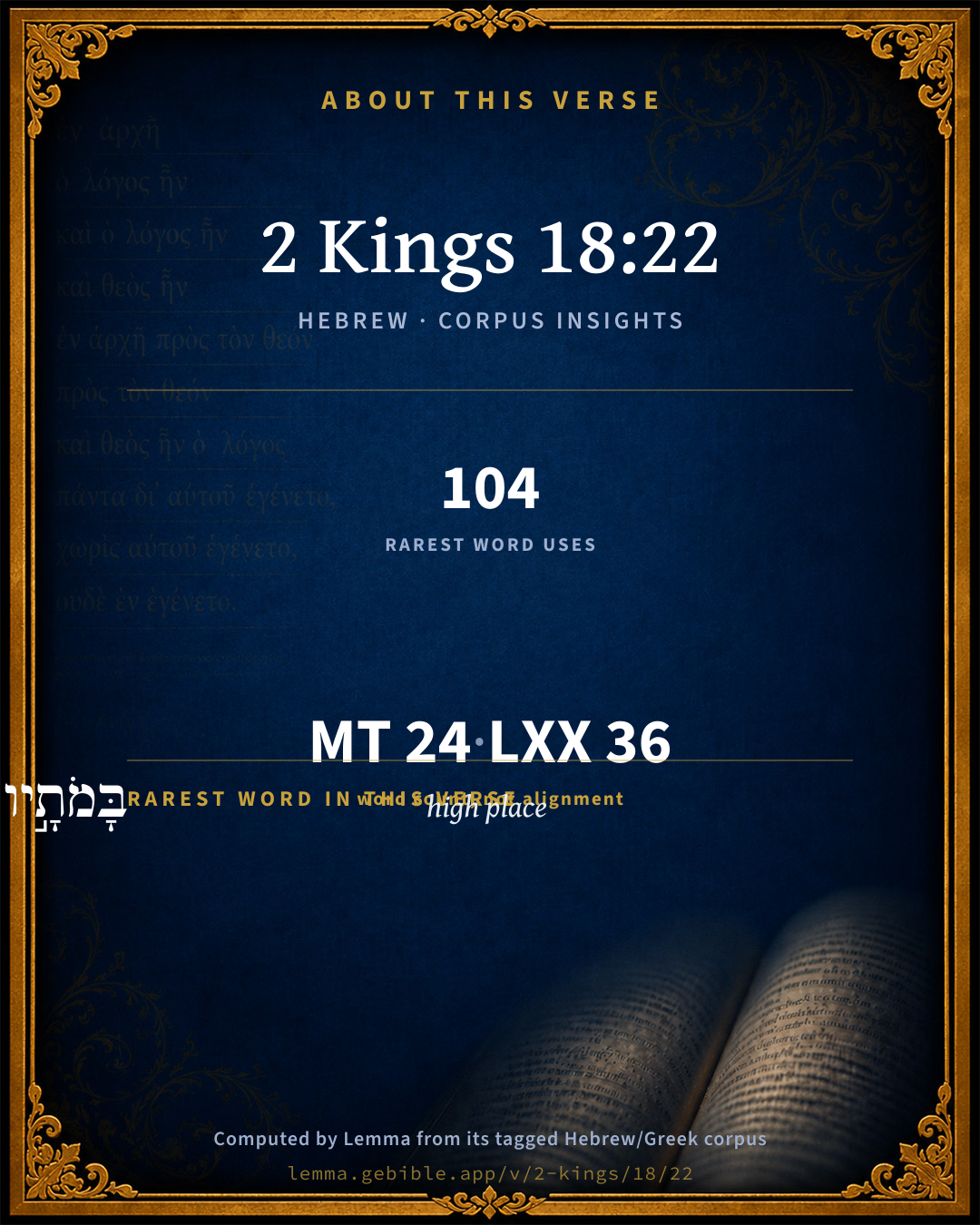
בָּמֹתָ֣יו
bâmâh
H1116
“high places · his”
Noun, Common, Feminine, Plural, Construct + Suffix, Personal, 3rd Person, Masculine, Singular
Part of Speech
Noun
Type
Common
Gender
Feminine
Number
Plural
State
Construct
Full BDB Definition

Origin: from an unused root (meaning to be high)

TWOT: 253

high place, ridge, height, bamah (technical name for cultic platform) - high place, mountain - high places, battlefields - high places (as places of worship) - funeral mound?
  1. וְכִי kîy H3588 “and · that” Conjunction + Conjunction
  2. תֹאמְר֣וּן ʼâmar H559 “to say” Verb, Qal, Imperfect, 2nd Person, Masculine, Plural + Suffix, n
  3. אֵלַ֔י ʼêl H413 “to · me” Preposition + Suffix, Personal, 1st Person, Common, Singular
  4. אֶל ʼêl H413 “to” Preposition
  5. יְהוָ֥ה Yᵉhôvâh H3068 “LORD” Noun, Proper
  6. אֱלֹהֵ֖ינוּ ʼĕlôhîym H430 “God(s) · our” Noun, Common, Masculine, Plural, Construct + Suffix, Personal, 1st Person, Common, Plural
  7. בָּטָ֑חְנוּ bâṭach H982 “to trust” Verb, Qal, Perfect, 1st Person, Common, Plural
  8. הֲלוֹא lôʼ H3808 “not” Particle, Interrogative + Particle, Negative
  9. ה֗וּא hûwʼ H1931 “he” Pronoun, Personal, 3rd Person, Masculine, Singular
  10. אֲשֶׁ֨ר ʼăsher H834 “which” Particle, Relative
  11. הֵסִ֤יר çûwr H5493 “to turn aside” Verb, Hiphil, Perfect, 3rd Person, Masculine, Singular
  12. חִזְקִיָּ֨הוּ֙ Chizqîyâh H2396 “Hezekiah” Noun, Proper
  13. אֶת ʼêth H853 “-” Particle, Direct Object
  14. וְאֶת ʼêth H853 “and · -” Conjunction + Particle, Direct Object
  15. מִזְבְּחֹתָ֔יו mizbêach H4196 “altars · his” Noun, Common, Masculine, Plural, Construct + Suffix, Personal, 3rd Person, Masculine, Singular
  16. וַיֹּ֤אמֶר ʼâmar H559 “and · to say” Conjunction + Verb, Qal, Sequential Imperfect, 3rd Person, Masculine, Singular
  17. לִֽיהוּדָה֙ Yᵉhûwdâh H3063 “to/for · Judah” Preposition + Noun, Proper
  18. וְלִיר֣וּשָׁלִַ֔ם Yᵉrûwshâlaim H3389 “and · to/for · Jerusalem” Conjunction + Preposition + Noun, Proper
  19. לִפְנֵי֙ pânîym H6440 “to/for · face(s) of” Preposition + Noun, Common, Both, Plural, Construct
  20. הַמִּזְבֵּ֣חַ mizbêach H4196 “the · altar” Particle, Definite Article + Noun, Common, Masculine, Singular, Absolute
  21. הַזֶּ֔ה zeh H2088 “the · this” Particle, Definite Article + Pronoun, Demonstrative, Masculine, Singular
  22. תִּֽשְׁתַּחֲו֖וּ shâchâh H7812 “to bow down” Verb, Hishtaphel, Imperfect, 2nd Person, Masculine, Plural
  23. בִּירוּשָׁלִָֽם Yᵉrûwshâlaim H3389 “in/at · Jerusalem” Preposition + Noun, Proper

About this verse

These counts appear in no published source. They are computed here, from the morphology-tagged text and Lemma’s own curated glosses. What Lemma adds →

24
words
19
distinct lemmas
Historical
section

Grammatical profile

  • 5 verbs
  • 10 nouns
  • 2 pronouns
  • 2 prepositions
  • 1 conjunction
  • 4 particles

Verb forms

  • תֹאמְר֣וּן Qal · Imperfect
  • בָּטָ֑חְנוּ Qal · Perfect
  • הֵסִ֤יר Hiphil · Perfect
  • וַיֹּ֤אמֶר Qal · Sequential Imperfect
  • תִּֽשְׁתַּחֲו֖וּ Hishtaphel · Imperfect

Repetition

Words recur within this verse — often emphatic in Hebrew:

  • תֹאמְר֣וּן to say H559 ×2
  • מִזְבְּחֹתָ֔יו altar H4196 ×2
  • וְלִיר֣וּשָׁלִַ֔ם Jerusalem H3389 ×2
  • אֵלַ֔י to H413 ×2

Hebrew & Septuagint length

In English translation the verse runs 40 words from the Hebrew and 40 from the Septuagint (LXX English) — the same length.

A rough comparison of the two English renderings, which tokenize alike — not a word-level alignment.

Word counts can differ between the Hebrew and the Greek without any difference in meaning — e.g. the Hebrew direct-object marker אֵת has no separate Greek word, and Greek often adds the article ὁ.

In the original languages it is 24 Hebrew tokens and 36 Greek tokens — but the two are counted differently (Hebrew bundles its prefixes and suffixes into one token; the Greek is in lemma form), so that isn’t a like-for-like length.

Cross-references

7

Topical passages linked to 2 Kings 18:22 in the Treasury of Scripture Knowledge — connected by theme and wording, ordered by reader-vote popularity; previews shown in the World English Bible.

  • 2 Chronicles 31:1 Now when all this was finished, all Israel who were present went out to the cities of Judah, and broke in pieces the pillars, and hewed down the Asherim, and broke down the high places and the altars out of all Judah and Benjamin, in Ephraim also and Manasseh, until they had destroyed them all. Then all the children of Israel returned, every man to his possession, into their own cities.
  • 2 Kings 18:4–5 He removed the high places, and broke the pillars, and cut down the Asherah: and he broke in pieces the brazen serpent that Moses had made; for to those days the children of Israel did burn incense to it; and he called it Nehushtan.
  • 2 Chronicles 32:12 Has not the same Hezekiah taken away his high places and his altars, and commanded Judah and Jerusalem, saying, You shall worship before one altar, and on it shall you burn incense?
  • Isaiah 36:7 But if you tell me, We trust in Yahweh our God: isn't that he, whose high places and whose altars Hezekiah has taken away, and has said to Judah and to Jerusalem, You shall worship before this altar?
  • Daniel 3:15 Now if you are ready whenever you hear the sound of the horn, flute, zither, lyre, harp, pipe, and all kinds of music to you fall down and worship the image which I have made, [well]: but if you don't worship, you shall be cast the same hour into the midst of a burning fiery furnace; and who is that god that shall deliver you out of my hands?
  • Matthew 27:43 He trusts in God. Let God deliver him now, if he wants him; for he said, 'I am the Son of God.'"
  • 1 Corinthians 2:15 But he who is spiritual discerns all things, and he himself is judged by no one.

Cross-references courtesy of OpenBible.info (CC BY 4.0).

Hebrew and Greek witnesses Masoretic Hebrew ↔ Greek Septuagint

The same verse in the two great witnesses to the Old Testament, shown verse-for-verse.

These are two independent witnesses, not word-aligned to each other, and the Septuagint is shown in lemma (dictionary) form.

Hebrew 2 Kings 18:22 Masoretic · Westminster Leningrad Codex

וְכִי תֹאמְר֣וּן אֵלַ֔י אֶל יְהוָ֥ה אֱלֹהֵ֖ינוּ בָּטָ֑חְנוּ הֲלוֹא ה֗וּא אֲשֶׁ֨ר הֵסִ֤יר חִזְקִיָּ֨הוּ֙ אֶת בָּמֹתָ֣יו וְאֶת מִזְבְּחֹתָ֔יו וַיֹּ֤אמֶר לִֽיהוּדָה֙ וְלִיר֣וּשָׁלִַ֔ם לִפְנֵי֙ הַמִּזְבֵּ֣חַ הַזֶּ֔ה תִּֽשְׁתַּחֲו֖וּ בִּירוּשָׁלִָֽם

But if you tell me, We trust in Yahweh our God; isn't that he whose high places and whose altars Hezekiah has taken away, and has said to Judah and to Jerusalem, You shall worship before this altar in Jerusalem?

World English Bible · Public Domain

Greek LXX 2 Kings 18:22 Septuagint · lemma form

καί ὅτι εἶπον πρός ἐγώ ἐπί κύριος θεός πείθω οὐ αὐτός οὗτος ὅς ἀποἵστημι εζεκιας ὁ ὑψηλός αὐτός καί ὁ θυσιαστήριον αὐτός καί εἶπον ὁ ιουδα καί ὁ ἰερουσαλήμ ἐενώπιον ὁ θυσιαστήριον οὗτος προςκυνέω ἐν ἰερουσαλήμ

And whereas you have said to me, We trust on the Lord God: is not this he, whose high places and altars Ezekias has removed, and has said to Juda and Jerusalem, You⌃ shall worship before this altar in Jerusalem?

LXX2012 (modern English Septuagint) · Public Domain

On this verse, Ellicott's Commentary for English Readers discusses the Septuagint’s reading. Read the note in Commentary ↓

Hebrew: Westminster Leningrad Codex (CC BY 4.0). Greek: Septuagint (public domain); English from LXX2012 (modern English Septuagint) (Public Domain). How the Septuagint differs from the Hebrew →

Targum (Aramaic paraphrase)

1

The Targum is the ancient Jewish Aramaic paraphrase of the Hebrew Scriptures — an interpretive translation, not the Hebrew text itself. Onkelos (literal) and Pseudo-Jonathan (expansive) render the Torah, and Jonathan the Prophets. Coverage is partial: where no permissively-licensed English translation exists for a verse, only the Aramaic is shown. This is verse-level text, not a word-by-word alignment to the Hebrew.

  1. Targum Jonathan Prophets (Joshua–Malachi)
    וַאֲרֵי תֵימְרוּן לִי עַל מֵימְרָא דַייָ אֱלָהָנָא אִתְרְחִיצְנָא הֲלָא הוּא דְאַעֲדֵי חִזְקִיָה יַת בָּמָתוֹהִי וְיַת מַדְבְּחוֹהִי וַאֲמַר לֶאֱנַשׁ יְהוּדָה וּלְיַתְבֵי יְרוּשְׁלֵם קֳדָם מַדְבְּחָא הָדֵין תִּסְגְדוּן בִּירוּשְׁלֵם:

    (no public-domain English translation for this verse)

    Targum Jonathan — Aramaic: “Mikraot Gedolot” (public domain). English: “Sefaria Community Translation” (CC0 1.0 (public-domain dedication)); “London "Chaldee Paraphrase," 1871” (public domain). Text via Sefaria.

Commentary

Notes on 2 Kings 18:22 from classic Christian and Jewish commentators (each source and its license shown beneath its notes). The classic Christian expositions comment on the surrounding passage and are grouped to its opening verse, so a note may address several verses; the Jewish commentaries on the Tanakh (Rashi and others) are per-verse, so they appear only where the commentator wrote on this verse.

Lemma curates 59 commentaries, every one of them public domain or Creative Commons licensed, each selected and text-cleaned for this edition rather than reprinted as found. About our sources →

Trapp's Complete Commentary

John Trapp

2Ki 18:22 But if ye say unto me, We trust in the LORD our God: [is] not that he, whose high places and whose altars Hezekiah hath taken away, and hath said to Judah and Jerusalem, Ye shall worship before this altar in Jerusalem?

Ver. 22. But if ye say unto me, We trust in the Lord our God.] Thus he thinks to beat them off all their holds, that he may bring them to the bent of his bow. Satan doth the like: "whom resist steadfast in the faith."

Is not that he whose high places, &c.?] This Rabshakeh took for sacrilege and impiety: as Papists still do our Reformation, and rejection of their needless ceremonies and endless superstitions. Some infer from this text that Rabshakeh was no Jew; the Rabbis make him to be a renegade Jew, because he spake Hebrew.

John Trapp, A Commentary or Exposition upon All the Books of the Old and New Testament (1647–1656) — public domain. Text from a community e-Sword module.

Joseph Benson's Commentary

2Ki 18:22. But if ye say, We trust in the Lord — His weak arguing here proceeds from his ignorance of that God in whom Hezekiah trusted, and of his law. Is not that he whose high places, &c., Hezekiah hath taken away? — Thereby robbing him of that worship and service which he had in those places. Thus he speaks boldly of those things which he understood not, calling that a crime which was a great virtue, and judging of the great God by their false and petty gods, and of God’s worship according to the vain fancies of the heathen, who measured piety by the multitude of altars.

Joseph Benson's Commentary on the Old and New Testaments (1811–1818) — public domain. Text from a community e-Sword module.

Geneva Bible (1599)

Geneva Bible translators

Thus the idolaters think that God’s religion is destroyed, when superstition and idolatry are reformed.

Geneva Bible (1599) marginal notes — public domain. Text via Bolls.life.

Adam Clarke's Commentary

Verse 22. Whose high places and whose altars Hezekiah hath taken away] This was artfully malicious. Many of the people sacrificed to Jehovah on the high places; Hezekiah had removed them, (2Kg 18:4), because they were incentives to idolatry: Rab-shakeh insinuates that by so doing he had offended Jehovah, deprived the people of their religious rights, and he could neither expect the blessing of God nor the cooperation of the people.

Adam Clarke's Commentary on the Bible (1810–1826) — public domain. Text from a community e-Sword/MySword module.

Ellicott's Commentary for English Readers

(22) But if ye say.—The address seems to turn abruptly from Hezekiah to his ministers, and to the garrison of Jerusalem in general. But the LXX., Syriac, Arabic, and Isa_36:7 have the singular, “But if thou say,” which is probably original. (Hezekiah is presently mentioned in the third person, to avoid ambiguity.)

In the Lord our God.—The emphatic words of the clause.

Whose high places and whose altars Hezekiah hath taken away.—This is just the construction which a heathen would naturally put on Hezekiah’s abolition of the local sanctuaries. (2Ki_18:4; 2Ch_31:1.) The Assyrians would appear to have heard of Hezekiah’s reformation, As he was a vassal of the great king, no doubt his proceedings were watched with jealous interest.

Ye shall worship . . . in Jerusalem?—Literally, Before this altar shall ye worship, at Jerusalem. The great altar of burnt offering was to be the one altar, and Jerusalem the one city, where Jehovah might be worshipped.

A Bible Commentary for English Readers, edited by Charles John Ellicott (1878–1897) — public domain. Text from a community e-Sword module.

The Cambridge Bible for Schools and Colleges

gen. ed. J. J. S. Perowne

22. We trust in the Lord our God] Probably Rab-shakeh knew something about the character of Egypt and her ability and likeliness to help. ‘Rahab that sitteth still’ (Isa_30:7 R.V.) was a name probably not undeserved. But now he enters on a matter which he does not understand. He had heard no doubt of the many altars and high places which Hezekiah had swept away in the beginning of his reign, and he might have been told by some, who murmured at their removal, and urged that Jehovah was really worshipped at them, that the king had put down many altars of the true God, and for a fancy of his own had ordered all his subjects to worship in Jerusalem. But he did not, probably could not, comprehend that the law of Jehovah had long before ordained that when His worship should be brought to its true form among His people, there should be only one temple for the whole land. Hence his argument is ‘How can you expect Jehovah to help you, when you have been breaking down His shrines and limiting His worship to a single spot’?

The Cambridge Bible for Schools and Colleges (gen. ed. J. J. S. Perowne; Cambridge University Press, 1878–1918) — public domain. Text from a community e-Sword module.

Albert Barnes' Notes on the Bible

The destruction of numerous shrines and altars where Yahweh had been worshipped 2Ki 18:4 seemed to the Rab-shakeh conduct calculated not to secure the favor, but to call forth the anger, of the god. At any rate, it was conduct which he knew had been distasteful to many of Hezekiah’s subjects.

Albert Barnes' Notes on the Bible (1834–1885) — public domain. Text from a community e-Sword/MySword module.

Haydock's Catholic Bible Commentary

Jerusalem. Many were perhaps displeased at this injunction, and Rabsaces endeavoured to excite them to revolt, and insinuates (Calmet) that the king had made God his enemy, (Haydock) and must expect punishment from him. (Theodoret, in Isaias xxxvi. 5.) He perhaps was ignorant that these altars were contrary to his law. (Menochius) --- Yet the Jews say that Rabsaces was son of Isaias, (ap. St. Jerome, bib.) or a Samaritan.

George Leo Haydock (1774–1849), Haydock's Catholic Family Bible and Commentary, 1859 edition — public domain. Excludes Psalms (Douay-Rheims chapter numbering differs from Protestant) and Deuterocanonical books (Catholic canon only).

Matthew Poole's English Annotations

Whose high places and whose altars Hezekiah hath taken away; thereby robbing him of that worship and service which he had in those places. Thus boldly he speaks of these things which he understood not, judging of the great God by their false and petty gods; and judging of God’s worship according to the vain fancies of the heathens, who measured piety by the multitude of altars.

Matthew Poole's English Annotations on the Holy Bible (1683–1685) — public domain. Text from a community e-Sword/MySword module.

Whedon's Commentary on the Bible

Daniel D. Whedon

22. If ye say — Here Rab-shakeh addresses more directly the three officers of Hezekiah, as also the other people on the wall. The parallel passage in Isaiah (Isa_36:7) reads, if thou say.

Whose altars Hezekiah hath taken away — Rab-shakeh assumes that the removal of the high places and their altars was an offence to Jehovah, as was also the restricting of his worship to the altar in Jerusalem, and he argues that God would not favour a people whose king was guilty of such sacrilege and impiety. Compare 2Ch_32:12.

Daniel D. Whedon (gen. ed.), Commentary on the Old and New Testaments (1874–1909) — public domain. Text from a community e-Sword module.

The Pulpit Commentary

But if ye say unto me, We trust in the Lord our God. Sennacherib had also heard of this second ground of trust, which Hezekiah had certainly put forward with great openness. (2Ch_32:8) No doubt he thought it purely fantastical and illusory. But he was not unaware that it might inspire a determined resistance. He therefore condescended to argue against reliance on it. Is not that he, whose high places and whose altars Hezekiah hath taken away? His counselors have suggested to Sennacherib a specious argument How can Hezekiah confidently rely on the protection of the God of the land, Jehovah, when he has been employing himself for years in the destruction of this very God"s high places and altars? Surely the God will not favor one who has been pulling down his places of worship! Putting out of sight the special requirements of the Jewish Law, the argument might well seem unanswerable. At any rate, it was calculated to have a certain effect on the minds of those who were attached to the high-place worship, and desired its continuance. And hath said to Judah and Jerusalem, Ye shall worship before this altar in Jerusalem. A weak argument, if addressed to Jews of Jerusalem only, but likely to have weight with the country Jews, if, as is probable, they had crowded into the city when the invasion began.

The Pulpit Commentary (1880–1919), ed. H.D.M. Spence-Jones & Joseph S. Exell — public domain. Text from a community e-Sword module.

John Wesley's Explanatory Notes

Is not, &c. - Thus boldly he speaks of the things which he understood not, judging of the great God, by their petty gods; and of God's worship by the vain fancies of the Heathens, who measured piety by the multitude of altars.

John Wesley, Explanatory Notes Upon the Whole Bible (1754–1765) — public domain. Text via the GEBible commentary corpus.

unfoldingWord translationNotes

Door43 World Missions Community

General Information:

Rabshakeh continues telling the message from the king of Assyria to King Hezekiah's men.

is not he the one whose high places ... Jerusalem'?

This question assumes the listeners know the answer and is used for emphasis. AT: "You need to remember that he is the one whose high places ... Jerusalem'!" (See: Rhetorical Question)

translationWords

Yahweh

God

high place

altar

Hezekiah

kingdom of Judah

worship

lord

horse

unfoldingWord translationNotes — © Distant Shores Media and the Door43 World Missions Community, licensed CC BY-SA 4.0. Source: git.door43.org/Door43/en_tn.

Rashi

Rabbi Shlomo Yitzchaki (Rashi)

Is He not the one Whose high places and altars Chizkiyohu has removed, etc. It can be deduced from here that Ravshokei was an apostate Jew, for he admitted that the Holy One, Blessed Is He, is God, but his desire is to worship idols.

Rashi on the Tanakh — English translations: “The Judaica Press complete Tanach with Rashi, translated by A. J. Rosenberg” (CC BY 4.0); “Pentateuch with Rashi's commentary by M. Rosenbaum and A.M. Silbermann, 1929-1934” (public domain); “The Metsudah Tanach series, Lakewood, N.J” (CC BY 4.0); and “The Book of Joshua, Metsudah Publications, 1997” (CC BY 4.0). Text via Sefaria.

Lesson kit

Teaching starters — assembled from the data on this page, not authored interpretation. Every prompt links to the verse data it draws on. Edit before teaching.

2 Kings, in the Historical, opens this verse with 24 words (19 distinct Hebrew lemmas). Its most distinctive word is bâmâh (“high place”). A historical commentator’s framing appears above. Read the whole chapter for the surrounding context.

Discussion questions

  1. The word bâmâh carries the sense “high place.” How does it shape the verse?
  2. How does 2 Chronicles 31:1, which shares this passage’s theme, read alongside this verse?
  3. What does the repetition of “to say” (2× in this one verse) do in this verse?
  4. These translations render this verse differently; the difference is in the English rendering, not the original. What questions does that raise?
  5. «תֹאמְר֣וּן» is a Qal Imperfect verb. How does that grammatical form shape the action described?
  6. Compare how Trapp's Complete Commentary and Joseph Benson's Commentary read this verse. Where do they agree or differ?

Things to notice

Reading settings

Reading text

Shown beneath each verse's original-language words.

Old Testament
Old Testament edition

Read the OT as the Masoretic Hebrew (MT) or the Greek Septuagint (LXX).

English shown for the Greek Septuagint (in the Hebrew ↔ Greek comparison).

Comparing translations? Open the Compare panel on any verse page to stack up to four side by side.