
Ezra 10:9

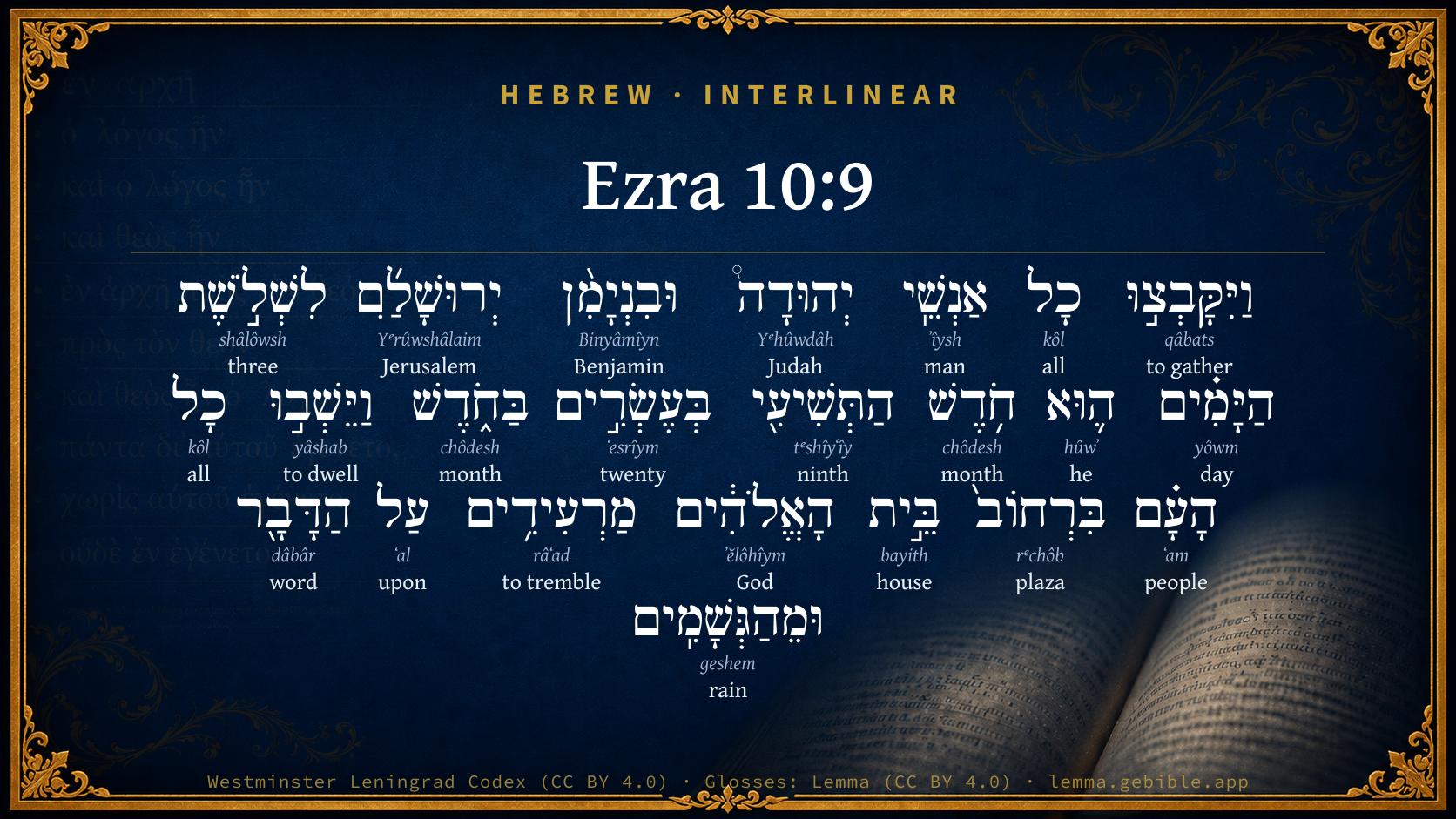
Hebrew (Westminster Leningrad Codex) Ezra 10:9 appears in the Hebrew Old Testament. The text above is from the Westminster Leningrad Codex. Each word links to its Strong’s number, a concise gloss, and parsing drawn from the Open Scriptures Hebrew Bible morphology. Click any word for its full Brown-Driver-Briggs (BDB) entry.
Download image
Cite this verse

Ezra 10:9 (World English Bible). Public Domain. Lemma interlinear Bible study tool, https://lemma.gebible.app/v/ezra/10/9.

Show BibTeX & RIS
BibTeX
RIS
English Translation
Then all the men of Judah and Benjamin gathered themselves together to Jerusalem within the three days; it was the ninth month, on the twentieth [day] of the month: and all the people sat in the broad place before the house of God, trembling because of this matter, and for the great rain.
World English Bible · Public Domain
Highlights
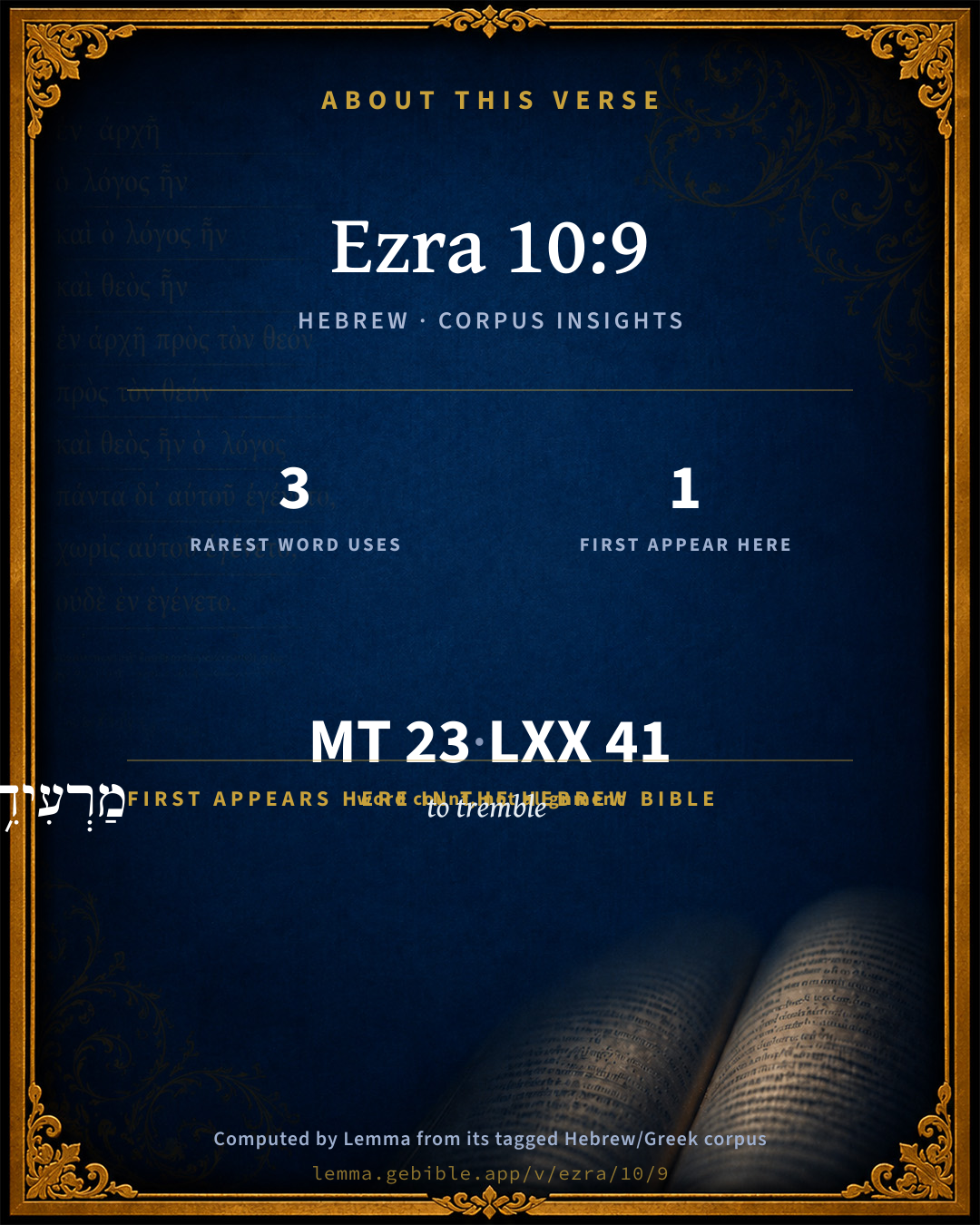
  • 1 first appearance in the Hebrew Bible
Full analysis ↓
Download a study sheet

One document with this verse’s original text, its word-by-word gloss line, the meaning frame, cross-references with their text, attributed commentary, and full source and license credits — printable, and it pastes into notes with its structure intact.

This verse Autodidact and up

Study sheet (.html) Plain text (.txt)

A passage Seminary Student

Up to 50 verses in one chapter. A passage sheet keeps up to 6 commentary sources and 12 cross-references per verse, in the order this page ranks them, and says so on the sheet whenever that leaves anything out. Ask for a single verse and you get the Autodidact verse sheet above.

Everything on this page stays free to read, with no account — the sheet is a download of what is already on screen, not access to it.

Want to remove ads? Support Godless Engineer
Compare translations 3

The same verse in 3 English versions, stacked beneath the original-language interlinear above. Click any original word for its lexicon entry.

Each is an independent rendering of the whole verse — the interlinear is not word-aligned to these translations.

Highlighted words mark where these versions differ — a whole-verse word diff, not a word-by-word alignment.

  • World English Bible Public Domain
    Then all the men of Judah and Benjamin gathered themselves together to Jerusalem within the three days; it was the ninth month, on the twentieth [day] of the month: and all the people sat in the broad place before the house of God, trembling because of this matter, and for the great rain.
  • King James Version Public Domain
    Then all the men of Judah and Benjamin gathered themselves together unto Jerusalem within three days. It was the ninth month, on the twentieth day of the month; and all the people sat in the street of the house of God, trembling because of this matter, and for the great rain.
  • unfoldingWord Literal Text CC BY-SA 4.0
    So all the men of Judah and Benjamin gathered to Jerusalem in three days. It was the ninth month, on 20 in the month. And all the people sat in the open place of the house of God, trembling on account of the matter and because of the rains.

unfoldingWord Literal Text — © unfoldingWord, licensed CC BY-SA 4.0. Word-aligned USFM3 via Door43 (git.door43.org/unfoldingWord/en_ult).

Versions to compare (up to 4)

3 of 4 selected

Show all 18 translations

Every available English version of this verse, each an independent rendering of the whole verse.

  • World English Bible Public Domain
    Then all the men of Judah and Benjamin gathered themselves together to Jerusalem within the three days; it was the ninth month, on the twentieth [day] of the month: and all the people sat in the broad place before the house of God, trembling because of this matter, and for the great rain.
  • Berean Standard Bible Public Domain
    So within the three days, all the men of Judah and Benjamin assembled in Jerusalem, and on the twentieth day of the ninth month, all the people sat in the square at the house of God, trembling regarding this matter and because of the heavy rain.
  • Majority Standard Bible Public Domain
    So within the three days, all the men of Judah and Benjamin assembled in Jerusalem, and on the twentieth day of the ninth month, all the people sat in the square at the house of God, trembling regarding this matter and because of the heavy rain.
  • King James Version Public Domain
    Then all the men of Judah and Benjamin gathered themselves together unto Jerusalem within three days. It was the ninth month, on the twentieth day of the month; and all the people sat in the street of the house of God, trembling because of this matter, and for the great rain.
  • American Standard Version (1901) Public Domain
    Then all the men of Judah and Benjamin gathered themselves together unto Jerusalem within the three days; it was the ninth month, on the twentieth `day' of the month: and all the people sat in the broad place before the house of God, trembling because of this matter, and for the great rain.
  • Revised Version (1885) Public Domain
    Then all the men of Judah and Benjamin gathered themselves together unto Jerusalem within the three days; it was the ninth month, on the twentieth day of the month: and all the people sat in the broad place before the house of God, trembling because of this matter, and for the great rain.
  • Geneva Bible (1599) Public Domain
    Then all the men of Iudah and Beniamin assembled theselues vnto Ierusalem within three dayes, which was the twentieth day of the ninth moneth, and all the people sate in the streete of the house of God, trembling for this matter, and for the raine.
  • Douay-Rheims (1899) Public Domain
    Then all the men of Juda, and Benjamin gathered themselves together to Jerusalem within three days, in the ninth month, the twentieth day of the month: and all the people sat in the street of the house of God, trembling because of the sin, and the rain.
  • Young's Literal Translation Public Domain
    And gathered are all the men of Judah and Benjamin to Jerusalem by the third day, it `is' the ninth month, on the twentieth of the month, and all the people sit in the broad place of the house of God, trembling on account of the matter and of the showers.
  • Literal Standard Version CC BY-SA 4.0
    And all the men of Judah and Benjamin are gathered to Jerusalem by the third day, it [is] the ninth month, on the twentieth of the month, and all the people sit in the broad place of the house of God, trembling on account of the matter and of the showers.
  • Unlocked Literal Bible CC BY-SA 4.0
    So all the men of Judah and Benjamin assembled in Jerusalem in three days. It was the ninth month and the twentieth day of the month. All the people stood in the square before God's house and trembled because of the word and the rain.
  • unfoldingWord Literal Text CC BY-SA 4.0
    So all the men of Judah and Benjamin gathered to Jerusalem in three days. It was the ninth month, on 20 in the month. And all the people sat in the open place of the house of God, trembling on account of the matter and because of the rains.
  • Darby Bible Public Domain
    Then were all the men of Judah and Benjamin gathered together at Jerusalem within three days. It was the ninth month, on the twentieth of the month; and all the people sat in the open space of the house of God, trembling because of the matter, and because of the pouring rain.
  • World Messianic Bible Public Domain
    Then all the men of Judah and Benjamin gathered themselves together to Jerusalem within the three days. It was the ninth month, on the twentieth day of the month; and all the people sat in the wide place in front of God’s house, trembling because of this matter, and because of the great rain.
  • Webster's Bible Public Domain
    Then all the men of Judah and Benjamin assembled at Jerusalem within three days. It was the ninth month, and the twentieth day of the month; and all the people sat in the street of the house of God, trembling because of this matter, and for the great rain.
  • Free Bible Version CC BY-SA 4.0
    Within three days, everyone from Judah and Benjamin assembled in Jerusalem. On the twentieth day of the ninth month, all the people sat in the square beside God's Temple, shivering because of this issue and also because of the heavy rain.
  • Bible in Basic English Public Domain
    Then all the men of Judah and Benjamin came together to Jerusalem before three days were past; it was the ninth month, on the twentieth day of the month; and all the people were seated in the wide square in front of the house of God, shaking with fear because of this business and because of the great rain.
  • JPS Tanakh (1917) Public Domain
    Then all the men of Judah and Benjamin gathered themselves together unto Jerusalem within the three days; it was the ninth month, on the twentieth day of the month; and all the people sat in the broad place before the house of God, trembling because of this matter, and for the great rain.

Literal Standard Version (2020), Covenant Press — licensed CC BY-SA 4.0. Text via the HelloAO Bible API (eBible.org). Unlocked Literal Bible (unfoldingWord) — licensed CC BY-SA 4.0. Text via the HelloAO Bible API (eBible.org). unfoldingWord Literal Text — © unfoldingWord, licensed CC BY-SA 4.0. Word-aligned USFM3 via Door43 (git.door43.org/unfoldingWord/en_ult). Free Bible Version, Dr. Jonathan Gallagher — licensed CC BY-SA 4.0. Text via the HelloAO Bible API (eBible.org).

Word by word

More ways to search: Search by grammar → Find every occurrence → Compare this word →

Practice this passage: Drill this verse → Learn its vocabulary →

מַרְעִידִ֥ים
râʻad
H7460
“trembling”
Verb, Hiphil, Participle Active, Masculine, Plural, Absolute
Part of Speech
Verb
Stem
Hiphil
Form
Participle Active
Gender
Masculine
Number
Plural
State
Absolute
Full BDB Definition

Origin: a primitive root, to shudder (more or less violently)

TWOT: 2184

to tremble, quake - (Qal) - to tremble - (earth)quake - (Hiphil) trembling (participle)
  1. וַיִּקָּבְצ֣וּ qâbats H6908 “and · to gather” Conjunction + Verb, Niphal, Sequential Imperfect, 3rd Person, Masculine, Plural
  2. כָל kôl H3605 “all of” Noun, Common, Masculine, Singular, Construct
  3. אַנְשֵֽׁי ʼîysh H376 “men of” Noun, Common, Masculine, Plural, Construct
  4. יְהוּדָה֩ Yᵉhûwdâh H3063 “Judah” Noun, Proper
  5. וּבִנְיָמִ֨ן Binyâmîyn H1144 “and · Benjamin” Conjunction + Noun, Proper
  6. יְרוּשָׁלִַ֜ם Yᵉrûwshâlaim H3389 “Jerusalem” Noun, Proper
  7. לִשְׁלֹ֣שֶׁת shâlôwsh H7969 “to/for · three” Preposition + Adjective, Cardinal number, Masculine, Singular, Construct
  8. הַיָּמִ֗ים yôwm H3117 “the · days” Particle, Definite Article + Noun, Common, Masculine, Plural, Absolute
  9. ה֛וּא hûwʼ H1931 “he” Pronoun, Personal, 3rd Person, Masculine, Singular
  10. חֹ֥דֶשׁ chôdesh H2320 “month of” Noun, Common, Masculine, Singular, Construct
  11. הַתְּשִׁיעִ֖י tᵉshîyʻîy H8671 “the · ninth” Particle, Definite Article + Adjective, Ordinal number, Masculine, Singular, Absolute
  12. בְּעֶשְׂרִ֣ים ʻesrîym H6242 “in/at · twenty” Preposition + Adjective, Cardinal number, Both, Plural, Absolute
  13. בַּחֹ֑דֶשׁ chôdesh H2320 “in/at the · month” Preposition, Determined + Noun, Common, Masculine, Singular, Absolute
  14. וַיֵּשְׁב֣וּ yâshab H3427 “and · to dwell” Conjunction + Verb, Qal, Sequential Imperfect, 3rd Person, Masculine, Plural
  15. כָל kôl H3605 “all of” Noun, Common, Masculine, Singular, Construct
  16. הָעָ֗ם ʻam H5971 “the · people” Particle, Definite Article + Noun, Common, Masculine, Singular, Absolute
  17. בִּרְחוֹב֙ rᵉchôb H7339 “in/at · plaza of” Preposition + Noun, Common, Feminine, Singular, Construct
  18. בֵּ֣ית bayith H1004 “house of” Noun, Common, Masculine, Singular, Construct
  19. הָאֱלֹהִ֔ים ʼĕlôhîym H430 “the · God(s)” Particle, Definite Article + Noun, Common, Masculine, Plural, Absolute
  20. עַל ʻal H5921 “upon” Preposition
  21. הַדָּבָ֖ר dâbâr H1697 “the · word” Particle, Definite Article + Noun, Common, Masculine, Singular, Absolute
  22. וּמֵהַגְּשָׁמִֽים geshem H1653 “and · from · the · rains” Conjunction + Preposition + Particle, Definite Article + Noun, Common, Masculine, Plural, Absolute

About this verse

These counts appear in no published source. They are computed here, from the morphology-tagged text and Lemma’s own curated glosses. What Lemma adds →

23
words
21
distinct lemmas
Historical
section

Notable vocabulary

The rarest word here is מַרְעִידִ֥ים to tremble H7460 — appearing just 3 times in the whole Hebrew Bible.

First appearance in Scripture

This word makes its first canonical appearance in the Hebrew Bible here:

  • מַרְעִידִ֥ים to tremble H7460

Shared distinctive vocabulary

מַרְעִידִ֥ים to tremble H7460 occurs in 3 verses of the Hebrew Bible. Also found in:

Grammatical profile

  • 3 verbs
  • 15 nouns
  • 3 adjectives
  • 1 pronoun
  • 1 preposition

Verb forms

  • וַיִּקָּבְצ֣וּ Niphal · Sequential Imperfect
  • וַיֵּשְׁב֣וּ Qal · Sequential Imperfect
  • מַרְעִידִ֥ים Hiphil · Participle Active

Repetition

Words recur within this verse — often emphatic in Hebrew:

  • כָל all H3605 ×2
  • חֹ֥דֶשׁ month H2320 ×2

Hebrew & Septuagint length

In English translation the verse runs 53 words from the Hebrew and 53 from the Septuagint (LXX English) — the same length.

A rough comparison of the two English renderings, which tokenize alike — not a word-level alignment.

Word counts can differ between the Hebrew and the Greek without any difference in meaning — e.g. the Hebrew direct-object marker אֵת has no separate Greek word, and Greek often adds the article ὁ.

In the original languages it is 23 Hebrew tokens and 41 Greek tokens — but the two are counted differently (Hebrew bundles its prefixes and suffixes into one token; the Greek is in lemma form), so that isn’t a like-for-like length.

Cross-references

5

Topical passages linked to Ezra 10:9 in the Treasury of Scripture Knowledge — connected by theme and wording, ordered by reader-vote popularity; previews shown in the World English Bible.

  • 1 Samuel 12:17–18 Isn't it wheat harvest today? I will call to Yahweh, that he may send thunder and rain; and you shall know and see that your wickedness is great, which you have done in the sight of Yahweh, in asking you a king.
  • Ezra 7:8–9 He came to Jerusalem in the fifth month, which was in the seventh year of the king.
  • Esther 2:16 So Esther was taken to king Ahasuerus into his house royal in the tenth month, which is the month Tebeth, in the seventh year of his reign.
  • Jeremiah 10:10 But Yahweh is the true God; he is the living God, and an everlasting King: at his wrath the earth trembles, and the nations are not able to abide his indignation.
  • Jeremiah 10:13 when he utters his voice, there is a tumult of waters in the heavens, and he causes the vapors to ascend from the ends of the earth; he makes lightnings for the rain, and brings forth the wind out of his treasuries.

Cross-references courtesy of OpenBible.info (CC BY 4.0).

Hebrew and Greek witnesses Masoretic Hebrew ↔ Greek Septuagint

The same verse in the two great witnesses to the Old Testament, shown verse-for-verse.

These are two independent witnesses, not word-aligned to each other, and the Septuagint is shown in lemma (dictionary) form.

Hebrew Ezra 10:9 Masoretic · Westminster Leningrad Codex

וַיִּקָּבְצ֣וּ כָל אַנְשֵֽׁי יְהוּדָה֩ וּבִנְיָמִ֨ן יְרוּשָׁלִַ֜ם לִשְׁלֹ֣שֶׁת הַיָּמִ֗ים ה֛וּא חֹ֥דֶשׁ הַתְּשִׁיעִ֖י בְּעֶשְׂרִ֣ים בַּחֹ֑דֶשׁ וַיֵּשְׁב֣וּ כָל הָעָ֗ם בִּרְחוֹב֙ בֵּ֣ית הָאֱלֹהִ֔ים מַרְעִידִ֥ים עַל הַדָּבָ֖ר וּמֵהַגְּשָׁמִֽים

Then all the men of Judah and Benjamin gathered themselves together to Jerusalem within the three days; it was the ninth month, on the twentieth [day] of the month: and all the people sat in the broad place before the house of God, trembling because of this matter, and for the great rain.

World English Bible · Public Domain

Greek LXX Ezra 10:9 Septuagint · lemma form

καί συνἄγω πᾶς ἀνήρ ἰουδά καί βενιαμίν εἰς ἰερουσαλήμ εἰς ὁ τρεῖς ἡμέρα οὗτος ὁ μήν ὁ ἔνατος ἐν εἰκάς ὁ μήν καταἵζω πᾶς ὁ λαός ἐν πλατύς οἶκος ὁ θεός ἀπό θόρυβος αὐτός περί ὁ ῥῆμα καί ἀπό ὁ χειμών

So all the men of Juda and Benjamin assembled at Jerusalem within the three days. This was the ninth month: on the twentieth day of the month all the people sat down in the street of the house of the Lord, because of their alarm concerning the word, and because of the storm.

LXX2012 (modern English Septuagint) · Public Domain

In the Septuagint this is one book — Esdras B (2 Esdras): Ezra is chapters 1–10, Nehemiah 11–23.

On this verse, Joseph Benson's Commentary discusses the Septuagint’s reading. Read the note in Commentary ↓

Hebrew: Westminster Leningrad Codex (CC BY 4.0). Greek: Septuagint (public domain); English from LXX2012 (modern English Septuagint) (Public Domain). How the Septuagint differs from the Hebrew →

Commentary

Notes on Ezra 10:9 from classic Christian and Jewish commentators (each source and its license shown beneath its notes). The classic Christian expositions comment on the surrounding passage and are grouped to its opening verse, so a note may address several verses; the Jewish commentaries on the Tanakh (Rashi and others) are per-verse, so they appear only where the commentator wrote on this verse.

Lemma curates 59 commentaries, every one of them public domain or Creative Commons licensed, each selected and text-cleaned for this edition rather than reprinted as found. About our sources →

Trapp's Complete Commentary

John Trapp

Ezr 10:9 Then all the men of Judah and Benjamin gathered themselves together unto Jerusalem within three days. It [was] the ninth month, on the twentieth [day] of the month; and all the people sat in the street of the house of God, trembling because of [this] matter, and for the great rain.

Ver. 9. Within three days] They durst not outstand their time, because their estates were at stake. Why is there not the like care taken and speed used to make peace with God, since for aught we know it is now or never, today or not at all? Is it nothing to lose an immortal soul? why, then, cry we, Cras, Domine? Tomorrow, Lord? why stand we trifling and baffling from day to day, till it be all too late? Remember the foolish virgins, and be wiser.

It was the ninth month] Which was the month of May, saith Diodati; counting September for the first, after the manner of the Persians, Est 2:16; and this great rain, being out of the accustomed season, was somewhat prodigious, and seemed to portend God’s wrath, as 1Sa 12:17. Others make it to be in December, the deep of winter; which, though it be an ordinary time of rain (whence in Greek also it hath its name χειμα, and in Latin hyems), yet these showers were extraordinary, more like spouts than showers; and thence the people’s fear much increased by their guilt; for as no body is without its shadow, so is no sin without its fear, quia nec sine conscientia sui, because it cannot shake off conscience (Tertul.).

John Trapp, A Commentary or Exposition upon All the Books of the Old and New Testament (1647–1656) — public domain. Text from a community e-Sword module.

The Biblical Illustrator

Joseph S. Exell

Ezr_10:9

Then all the men of Judah and Benjamin.

A great and troubled assembly

The text teaches--

I. That it is the tendency of sin to produce sorrow and consternation of soul. There is a scorpion sin in remembered guilt when outward troubles and inward fears meet together (Gen_42:21).

II. That God mares with peculiar interest the time if which repentance unto life begins in the sow. Iii. That repentance when it is real will bring forth its appropriate fruits.

IV. That the names and persons of genuine penitents are for ever precious to God and recorded in his book. (Samuel Thodey.)

The Biblical Illustrator, edited by Joseph S. Exell (c. 1880s–1900s) — public domain. Text from a community e-Sword module.

Joseph Benson's Commentary

Ezr 10:9. Then all the men of Judah and Benjamin, &c. — Not only of these two tribes, as appears from the following catalogue, in which there are priests and Levites; but all the Israelites, (Ezr 10:25,) who are thus described, because the greatest part of them were of these tribes, though others were mixed with them: and because they all now dwelt in that land, which formerly was appropriated to those tribes. All the people sat in the street — Hebrew, ברחוב, birchob, LXX., εν πλατεια, in a broad, open place, of the house of God. Houbigant renders it, the court, namely, that in which the people stood when they worshipped. This, lying open, and not being yet enclosed by a wall, as may be conjectured from Neh 2:8, is called in the original an open place, or street, and not חצר, chatser, the name usually given to the court. Here the people were not only within view of the temple, but in a place adjoining to it, that so they might be as in God’s presence, and be thereby awed to a more faithful and vigorous prosecution of their work. Trembling because of this matter — The offence they had committed against God, and the consequences thereof; and for the great rain — Hebrew, םiהגשׁמי, haggeshamim, the rains, or showers. It was now the depth of winter, when the rains in Judea are extremely cold; and the people seem to have taken the heavy rains on this occasion as a token of God’s displeasure.

Joseph Benson's Commentary on the Old and New Testaments (1811–1818) — public domain. Text from a community e-Sword module.

Tyndale Open Study Notes

Tyndale Open Resources

10:9 on December 19 . . . it was raining: The cold and wet weather made an outdoor meeting uncomfortable.

Tyndale Open Study Notes — © Tyndale Open Resources, licensed CC BY-SA 4.0. Text via the HelloAO Bible API.

Geneva Bible (1599)

Geneva Bible translators

For the season was given to rain and so the weather was more sharp and cold, and also their conscience touched them.

Which contained part of November and part of December.

Geneva Bible (1599) marginal notes — public domain. Text via Bolls.life.

Jamieson, Fausset & Brown

Robert Jamieson, A. R. Fausset & David Brown

Then all the men of Judah and Benjamin--The returned captives belonged chiefly to these tribes; but other Israelites are also included under these names, as they all were then occupying the territory formerly assigned to those two tribes.

It was the ninth month--that is, between the end of December and the beginning of January, which is the coldest and most rainy season of the year in Palestine.

all the people sat in the street--that is, the court.

Jamieson, Fausset & Brown — Commentary Critical and Explanatory on the Whole Bible (1871) — public domain (CC PDM 1.0). Text via the HelloAO Bible API.

Adam Clarke's Commentary

Verse 9. Ninth month] Answering to a part of our December.

Trembling because of - the great rain.] Απο του χειμωνος, Because of the winter, Septuagint; it was now December, the coldest and most rainy part of the year in Palestine.

Adam Clarke's Commentary on the Bible (1810–1826) — public domain. Text from a community e-Sword/MySword module.

The Cambridge Bible for Schools and Colleges

gen. ed. J. J. S. Perowne

9. all the men of Judah and Benjamin] All the male population capable of attending. ‘Men of Judah and Benjamin’, cf. Ezr_1:5, Ezr_4:1.

It was the ninth month] R.V. it was the ninth month—not a fresh sentence. The ‘ninth month’ was Chislev, corresponding nearly to our December. The Assyrian month Ki-shilivu is the same name. The month is mentioned in Neh_1:1; Zec_7:1. On the 15th of this month 168 b.c. the Temple was profaned and the altar polluted by Antiochus Epiphanes; on the 25th of this month, three years later, 165 b.c., Judas the Maccabee and his companions celebrated ‘the Dedication’ or Purification of the Temple, which was afterwards observed as an annual festival (cf. Joh_10:22). See 1Ma_1:54; 1Ma_4:59. The general assembly was therefore summoned only four months after Ezra’s arrival (see Ezr_7:8).

sat in the street of the house of God] R.V. sat in the broad place before the house of God. Literally ‘in the broad place of the house of God’. Cf. Neh_8:1 ‘And all the people gathered themselves together as one man into the broad place (A.V. street) that was before the water gate’, and 3. An area belonging to ‘the house of God’ in which the whole assembly could collect, must have been a large open court. See the same word in Deu_13:16 and 2Sa_21:12, where an open place or square in the middle of a town gives a truer sense than the word ‘street’. The idea of the word in the original is width, not narrowness.

trembling because of this matter] The popular apprehension was aroused to the utmost, partly by the penalty for non-attendance at the assembly (Ezr_10:8), partly by the rumours of the action proposed by Shecaniah and approved by the princes, partly by dread of Divine wrath at the national transgression. The verb used here for ‘trembling’ occurs elsewhere in the O. T. only in Dan_10:11 and Psa_104:32.

and for the great rain] R.V. marg. Heb. the rains. We must suppose that the rains, which prevail during December in Palestine, were on this occasion exceptionally ‘heavy’ and seemed to the people to denote the Divine displeasure (cf. 1Sa_12:18), besides adding to the discomfort of gathering to Jerusalem. This was ‘the early rain’ following after seed-time (cf. Deu_11:14; Jer_5:24; Joe_2:23) as distinguished from ‘the latter rain’ of spring-time.

The Cambridge Bible for Schools and Colleges (gen. ed. J. J. S. Perowne; Cambridge University Press, 1878–1918) — public domain. Text from a community e-Sword module.

John Gill's Exposition

Then all the men of Judah and Benjamin,.... And such of the ten tribes that returned and dwelt among them:

gathered themselves together unto Jerusalem within three days; the time fixed: which they were the more careful to observe, since it was enjoined by the authority of princes and elders, and the punishment in case of disobedience very severe:

it was the ninth month, on the twentieth day of the month; the month Chisleu, which answers to part of November and part of December, so that the twentieth day must be in the beginning of December; this was almost five months after Ezra came to Jerusalem:

and all the people sat in the street of the house of God: the street which led to the temple, the east street, Ch2 29:4 though some think this was the court of the people, called a street, because it lay open, not yet walled in; and, according to Josephus (q), it was in an upper room of the temple in which Ezra was, perhaps the same with the chamber of Johanan, Ezr 10:6,

trembling because of this matter; they were met about; some that were guilty, not knowing what punishment would be inflicted on them, and others that were not, yet dreaded the wrath of God, lest that should break out upon the whole congregation for it:

and for the great rain; which now fell, and which they interpreted as a token of the divine displeasure: for though it was in winter time, yet not with them a time of rain, for the former rain had fallen a month before; so that this being unusual and unexpected, they understood it as betokening evil to them.

(q) Antiqu. l. 11. c. 5. sect. 4.

John Gill's Exposition of the Whole Bible (1746–1763) — public domain (CC PDM 1.0). Text via the HelloAO Bible API.

Albert Barnes' Notes on the Bible

It was the ninth month - Or, our December, a time when rain fails heavily in Palestine: four months, therefore, after Ezra’s arrival in Jerusalem (compare Ezr 7:9).

The street - Rather, “the court,” the “broad,” “spacious, place” (compare the 2Ch 29:4 note).

Albert Barnes' Notes on the Bible (1834–1885) — public domain. Text from a community e-Sword/MySword module.

Haydock's Catholic Bible Commentary

Ninth. Casleu, (Zacharias vii. 1.) which corresponds with our November and December. (Menochius) --- Street. Court, which afforded as yet no shelter from the rain. (Calmet) --- This would tend to punish them for their sin, and to make them more sensible to it. (Worthington)

George Leo Haydock (1774–1849), Haydock's Catholic Family Bible and Commentary, 1859 edition — public domain. Excludes Psalms (Douay-Rheims chapter numbering differs from Protestant) and Deuterocanonical books (Catholic canon only).

Matthew Poole's English Annotations

All the men of Judah and Benjamin not only of these two tribes, as appears from the following catalogue, where there are priests and Levites; but all the Israelites, Ezr 10:25, who are thus described, partly because the greatest part of them were of these tribes, though others were mixed with them; and partly because they all now dwelt in that land which formerly was appropriated to those tribes.

In the street of the house of God; in that street of the city which was next to the temple, and within the view of it, that so they might be as in God’s presence, whereby they might be awed to a more faithful and vigorous prosecution of their work. And this place they might choose rather than the court of the people, because they thought it might be polluted by the delinquents, who were all to come thither.

For the great rain, which they took for a token of God’s displeasure against them.

Matthew Poole's English Annotations on the Holy Bible (1683–1685) — public domain. Text from a community e-Sword/MySword module.

Whedon's Commentary on the Bible

Daniel D. Whedon

9. The ninth month — Chisleu, corresponding with December, the rainy season of Palestine, and hence the great rain mentioned in this verse.

In the street of the house of God — In the open broad place before the temple; in the court.

Daniel D. Whedon (gen. ed.), Commentary on the Old and New Testaments (1874–1909) — public domain. Text from a community e-Sword module.

The Pulpit Commentary

All the men of Judah and Benjamin gathered themselves together unto Jerusalem. This is of course to be understood with certain necessary or natural exceptions, as of the sick, the aged and infirm, and the youths under full age. Still it would be a vast gathering, doubling probably for the time the population of the city. It was the ninth month. The month Chisleu, corresponding nearly to our December. All the people sat in the street of the house of God. The word translated "street" means any broad open space, and is probably used here to designate the great court of the temple (Patrick). By "all the people" we must understand as many as the court would conveniently hold. If the court had the dimensions given it by Hecataeus of Abdera, it may have accommodated the whole body of the country Jews. The great rain. December is a rainy month in Palestine; and the incidental mention of "the great rain" is one of those small touches which stamp the writer as an eyewitness.

HOMILIES BY W. CLARKSON Vers. 9-44.

Sin and repentance.

A very memorable scene was witnessed that day, the twentieth of the ninth month, in the year of Ezra"s return. All the Israelites of Judah and Benjamin assembled together in the courts of the temple, shaken, troubled, trembling for fear of the anger of an offended God, ready to yield to the demands of his faithful servant who spoke in his name, even to the breaking up of their domestic ties; it was an hour when sin was coming out into the light, and was to be sternly cast out from the midst of them. We look at

I THE CHARACTER OF THEIR SIN, AND OF ALL SIN. It was

(a) widespread (vers. 18, 23, 24), not touching the top only, or only sinking to the bottom of their society. It went quite through the whole mass. Among them that had taken strange wives were "sons of the priests "(ver. 18); "also of the Levites" (ver. 23); "of the singers also, and of the porters" (vers. 23, 24). No class or grade was free from its infection. It was something

(b) that struck home; it was not a mere political offence; it invaded their family life; it was under their roof; it concerned their dearest affections, their tenderest ties, their brightest hopes; it was a matter with which their own wives and their children had closely to do. Moreover, it was

(c) a radical fault. They existed, as a nation, on purpose that, being separated from the surrounding people by very distinct lines drawn by the hand of the Supreme, they might bear witness to certain great truths in the preservation of which lay the one hope of the race. But by this step they were becoming mixed up with the heathen world; their one characteristic was being lost; their virtue was being assailed; their very life was at stake. Their separateness gone, everything for which they existed would be gone too; they might perish, for they answered no end. The salt would have lost its savour; let it be cast out and trodden underfoot of men. This is the character of all sin.

(a) It is widespread. As the leprosy, which was the chosen picture and type of it, spreads over the whole body, so sin spreads over all the nature, poisoning every faculty and instinct of the soul; communicating itself from one member of society to another, till the whole social body is covered with its loathsome and deathful malady.

(b) It is something that strikes home; it works discord in the family circle; it introduces strife and contest into the sanctuary of a man"s spirit, making it the arena on which conscience and passion, heavenly wisdom and worldly ambition, voices of good and voices of evil, continually and fiercely battle. Moreover,

(c) it is a radical fault. It is the soul turning away from the purpose for which it was created, failing to be and to do that for which its Creator brought it into being.

II THE CHARACTER OF THEIR REPENTANCE, AND OF ALL REPENTANCE. It included (a) contrition are many that have transgressed" (ver. 13); and (b) amendment gave their hands that they would put away their wives" (ver 19). The Jews who had offended saw that they were guilty; they freely acknowledged their fault, and, what was the best sign and proof of their shame, they resolved to put away the evil; they set about it vigorously and methodically, as men that seriously meant to do that to which they "gave their hands," to which they solemnly pledged themselves (vers. 13, 14, 19). All repentance is of this character. Its essentials are

(a) Contrition. There must be a real recognition by the soul of the evil of sin. Something" more than mere catching up and repeating the formulae of repentance; the falling into the ruts of expression made by those who have gone before us. Not, necessarily, the violent, pungent, overwhelming feelings which have shaken some souls, and found vent in agonising utterances; but a genuine and deep regret and shame, more or less agitating, under a sense of wrong-doing in the past life and of sin within the soul.

(b) Confession and amendment. There must be a solid and living determination to "put away the evil thing," whatever it may be; to surrender the long-cherished and perhaps much-loved habit which is hurtful and injurious; to turn from selfishness and from worldliness and from pride; to separate the soul from all that offends God, that corrupts the nature, that works mischief; and to walk in purity of heart and blamelessness of life before God, the heavenly Father; unto Christ, the Divine Redeemer; by help of the Holy Spirit, the Sanctifier. C.

The Pulpit Commentary (1880–1919), ed. H.D.M. Spence-Jones & Joseph S. Exell — public domain. Text from a community e-Sword module.

John Wesley's Explanatory Notes

Of Judah - Not only of these two tribes, as appears from the following catalogue, where there are priests and Levites; but all the Israelites, ver. 25, who are thus described, because the greatest part of them were of these tribes, though others were mixed with them: and because they all now dwelt in that land, which formerly was appropriated to those tribes. The street - In that street of the city, which was next the temple, and within the view of it, that so they might be as in God's presence, whereby they might be awed to a more faithful and vigourous prosecution of their work. And this place they might chuse rather than the court of the people, because they thought it might be polluted by the delinquents, who were all to come thither. Great rain - Which they took for a token of God's displeasure against them.

John Wesley, Explanatory Notes Upon the Whole Bible (1754–1765) — public domain. Text via the GEBible commentary corpus.

Keil & Delitzsch

C. F. Keil & F. Delitzsch

After three days all the men of Judah and Benjamin assembled at Jerusalem. This took place on the twentieth day of the ninth month. On this statement of time, see the remark in Ezr 9:1. The assembled multitude sat there on the open space of the house of God, i.e., probably the open space (הרחוב) in front of the water-gate, Neh 8:1, Neh 8:3, Neh 8:16, at the eastern or south-eastern side, before the temple court; see remarks on Neh 8:1. "Trembling" because of this matter, the seriousness of which they might perceive from the heavy penalty attached to their non-appearance within three days, and "because of the rain." The ninth month, corresponding with our December, is in the cold rainy time of the year (comp. Ezr 10:13), "when the rain usually falls in torrents" (Robinson, Phys. Geog. p. 287).

Keil & Delitzsch — Biblical Commentary on the Old Testament (1861–1891) — public domain (CC PDM 1.0). Text via the HelloAO Bible API. (Old Testament only.)

Scofield Reference Notes

C. I. Scofield

ninth month

i.e. December.

The Scofield Reference Bible (1917 edition), notes by C. I. Scofield — public domain. Text from a community e-Sword module.

unfoldingWord translationNotes

Door43 World Missions Community

in three days

"three days later"

ninth month and the twentieth day of the month

This is the ninth month of the Hebrew calendar. The twentieth day is near the middle of December on Western calendars. (See: Hebrew Months and Ordinal Numbers)

in the square

a large open courtyard in front of the temple

committed treason

The abstract noun "treason" can be translated as a verb. AT: "helped the enemies of your people" (See: Abstract Nouns)

so as to increase Israel's guilt

"and now God considers us guilty of worse sin than before"

translationWords

Judah

Benjamin

day

people group

Ezra

priest

alien

unfoldingWord translationNotes — © Distant Shores Media and the Door43 World Missions Community, licensed CC BY-SA 4.0. Source: git.door43.org/Door43/en_tn.

Rashi

Rabbi Shlomo Yitzchaki (Rashi)

the ninth month That is the month of Kislev.

quaking over the matter They were afraid over the matter. They were afraid of the stumbling block of this transgression.

and because of the rains And because of the rains that were falling upon them there, they were shivering and miserable.

Rashi on the Tanakh — English translations: “The Judaica Press complete Tanach with Rashi, translated by A. J. Rosenberg” (CC BY 4.0); “Pentateuch with Rashi's commentary by M. Rosenbaum and A.M. Silbermann, 1929-1934” (public domain); “The Metsudah Tanach series, Lakewood, N.J” (CC BY 4.0); and “The Book of Joshua, Metsudah Publications, 1997” (CC BY 4.0). Text via Sefaria.

Lesson kit

Teaching starters — assembled from the data on this page, not authored interpretation. Every prompt links to the verse data it draws on. Edit before teaching.

Ezra, in the Historical, opens this verse with 23 words (21 distinct Hebrew lemmas). Its most distinctive word is râʻad (“to tremble”). A historical commentator’s framing appears above. Read the whole chapter for the surrounding context.

Discussion questions

  1. How does “to tremble” (râʻad) shape what this verse is saying?
  2. The word “to tremble” first appears here in Scripture. What is being introduced at this debut?
  3. Psalms 104:32 shares the word «to tremble» with this verse. How do the two illuminate each other?
  4. “all” occurs 2× in this one verse. What is the effect of the repetition?
  5. These translations render this verse differently. What is at stake in choosing one wording over another?
  6. The verb «וַיִּקָּבְצ֣וּ» is Niphal Sequential Imperfect. How does its form color the action?
  7. Reading how Trapp's Complete Commentary and The Biblical Illustrator read this verse, where do the two commentators agree and where do they part?

Things to notice

Reading settings

Reading text

Shown beneath each verse's original-language words.

Old Testament
Old Testament edition

Read the OT as the Masoretic Hebrew (MT) or the Greek Septuagint (LXX).

English shown for the Greek Septuagint (in the Hebrew ↔ Greek comparison).

Comparing translations? Open the Compare panel on any verse page to stack up to four side by side.