
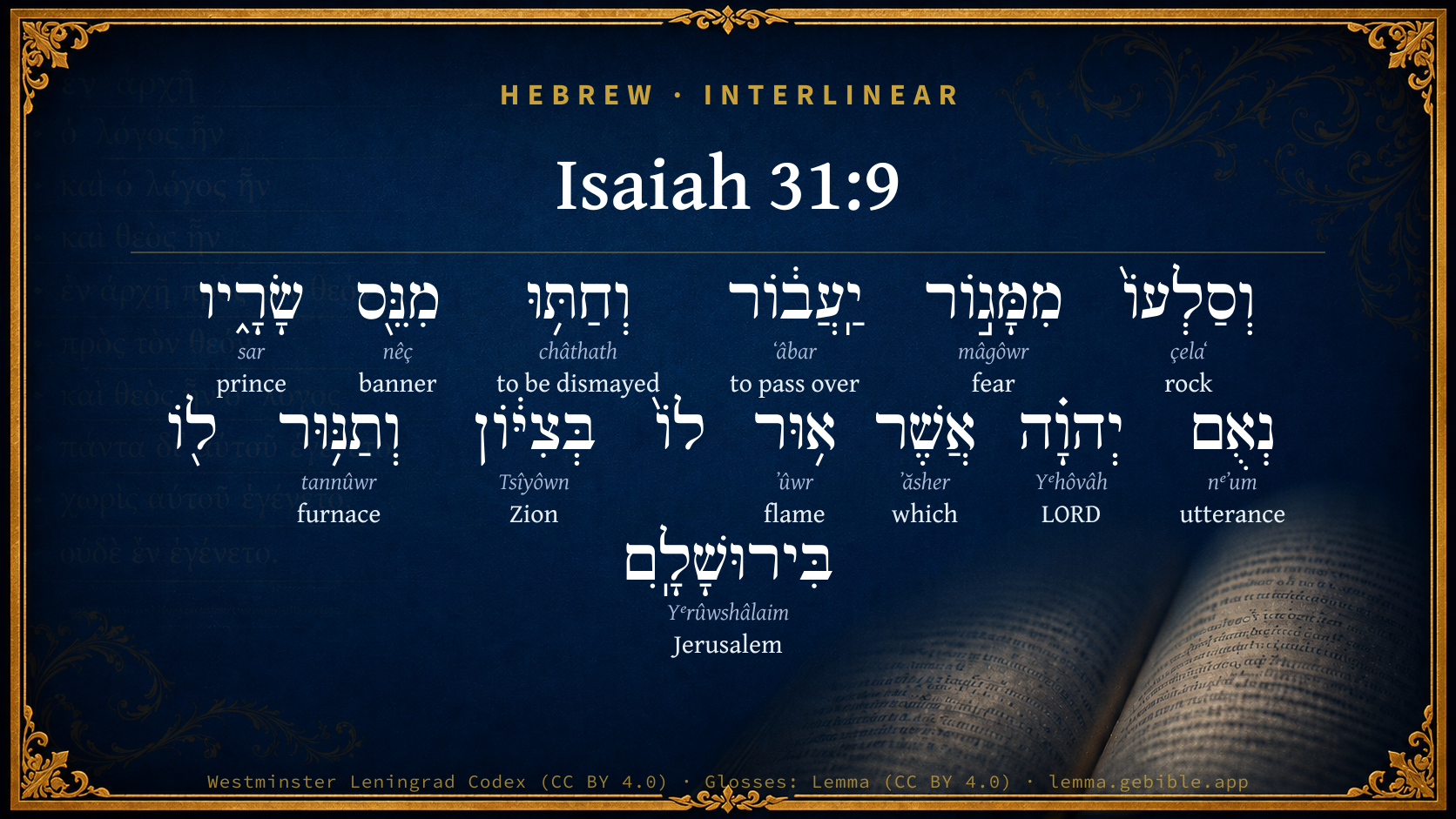
Isaiah 31:9

Hebrew (Westminster Leningrad Codex) Isaiah 31:9 appears in the Hebrew Old Testament. The text above is from the Westminster Leningrad Codex. Each word links to its Strong’s number, a concise gloss, and parsing drawn from the Open Scriptures Hebrew Bible morphology. Click any word for its full Brown-Driver-Briggs (BDB) entry.
Download image
Cite this verse

Isaiah 31:9 (World English Bible). Public Domain. Lemma interlinear Bible study tool, https://lemma.gebible.app/v/isaiah/31/9.

Show BibTeX & RIS
BibTeX
RIS
English Translation
His rock shall pass away by reason of terror, and his princes shall be dismayed at the ensign, says Yahweh, whose fire is in Zion, and his furnace in Jerusalem.
World English Bible · Public Domain
Download a study sheet

One document with this verse’s original text, its word-by-word gloss line, the meaning frame, cross-references with their text, attributed commentary, and full source and license credits — printable, and it pastes into notes with its structure intact.

This verse Autodidact and up

Study sheet (.html) Plain text (.txt)

A passage Seminary Student

Up to 50 verses in one chapter. A passage sheet keeps up to 6 commentary sources and 12 cross-references per verse, in the order this page ranks them, and says so on the sheet whenever that leaves anything out. Ask for a single verse and you get the Autodidact verse sheet above.

Everything on this page stays free to read, with no account — the sheet is a download of what is already on screen, not access to it.

Want to remove ads? Support Godless Engineer
Compare translations 3

The same verse in 3 English versions, stacked beneath the original-language interlinear above. Click any original word for its lexicon entry.

Each is an independent rendering of the whole verse — the interlinear is not word-aligned to these translations.

Highlighted words mark where these versions differ — a whole-verse word diff, not a word-by-word alignment.

  • World English Bible Public Domain
    His rock shall pass away by reason of terror, and his princes shall be dismayed at the ensign, says Yahweh, whose fire is in Zion, and his furnace in Jerusalem.
  • King James Version Public Domain
    And he shall pass over to his strong hold for fear, and his princes shall be afraid of the ensign, saith the LORD, whose fire is in Zion, and his furnace in Jerusalem.
  • unfoldingWord Literal Text CC BY-SA 4.0
    And his rock will pass away from the terror, and his princes will fear from the banner” —the declaration of Yahweh, whose fire in Zion and a furnace to him in Jerusalem.

unfoldingWord Literal Text — © unfoldingWord, licensed CC BY-SA 4.0. Word-aligned USFM3 via Door43 (git.door43.org/unfoldingWord/en_ult).

Versions to compare (up to 4)

3 of 4 selected

Show all 18 translations

Every available English version of this verse, each an independent rendering of the whole verse.

  • World English Bible Public Domain
    His rock shall pass away by reason of terror, and his princes shall be dismayed at the ensign, says Yahweh, whose fire is in Zion, and his furnace in Jerusalem.
  • Berean Standard Bible Public Domain
    Their rock will pass away for fear, and their princes will panic at the sight of the battle standard,” declares the LORD, whose fire is in Zion, whose furnace is in Jerusalem.
  • Majority Standard Bible Public Domain
    Their rock will pass away for fear, and their princes will panic at the sight of the battle standard,” declares the LORD, whose fire is in Zion, whose furnace is in Jerusalem.
  • King James Version Public Domain
    And he shall pass over to his strong hold for fear, and his princes shall be afraid of the ensign, saith the LORD, whose fire is in Zion, and his furnace in Jerusalem.
  • American Standard Version (1901) Public Domain
    And his rock shall pass away by reason of terror, and his princes shall be dismayed at the ensign, saith Jehovah, whose fire is in Zion, and his furnace in Jerusalem.
  • Revised Version (1885) Public Domain
    And his rock shall pass away by reason of terror, and his princes shall be dismayed at the ensign, saith the LORD, whose fire is in Zion, and his furnace in Jerusalem.
  • Geneva Bible (1599) Public Domain
    And he shall go for feare to his towre, and his princes shall be afraide of the standart, sayeth the Lord, whose fire is in Zion, and his fornace in Ierusalem.
  • Douay-Rheims (1899) Public Domain
    And his strength shall pass away with dread, and his princes fleeing shall be afraid: the Lord hath said it, whose die is in Sion, and his furnace in Jerusalem.
  • Young's Literal Translation Public Domain
    And `to' his rock from fear he passeth on, And affrighted by the ensign have been his princes -- an affirmation of Jehovah, Who hath a light in Zion, And who hath a furnace in Jerusalem!
  • Literal Standard Version CC BY-SA 4.0
    And he passes on [to] his rock from fear, || And his princes have been frightened by the ensign—a declaration of YHWH, || Who has a light in Zion, || And who has a furnace in Jerusalem!
  • Unlocked Literal Bible CC BY-SA 4.0
    They will lose all confidence because of terror, and his princes will be afraid at the sight of Yahweh's battle flag— this is Yahweh's declaration—whose fire is in Zion and whose firepot is in Jerusalem.”
  • unfoldingWord Literal Text CC BY-SA 4.0
    And his rock will pass away from the terror, and his princes will fear from the banner” —the declaration of Yahweh, whose fire in Zion and a furnace to him in Jerusalem.
  • Darby Bible Public Domain
    and for fear, he shall pass over to his rock, and his princes shall be afraid of the banner, saith Jehovah, whose fire is in Zion, and his furnace in Jerusalem.
  • World Messianic Bible Public Domain
    His rock will pass away by reason of terror, and his princes will be afraid of the banner,” says the LORD, whose fire is in Zion, and his furnace in Jerusalem.
  • Webster's Bible Public Domain
    And he shall pass over to his strong hold for fear, and his princes shall be afraid of the ensign, saith the LORD, whose fire is in Zion, and his furnace in Jerusalem.
  • Free Bible Version CC BY-SA 4.0
    Their “rock” will be scared to death, and their officers will be terrified and in panic at the sight of the battle flag, declares the Lord, who has his fire in Zion, and his furnace in Jerusalem.
  • Bible in Basic English Public Domain
    And his rock will come to nothing because of fear, and his chiefs will go in flight from the flag, says the Lord, whose fire is in Zion, and his altar in Jerusalem.
  • JPS Tanakh (1917) Public Domain
    And his rock shall pass away by reason of terror, and his princes shall be dismayed at the ensign, saith the LORD, whose fire is in Zion, and His furnace in Jerusalem.

Literal Standard Version (2020), Covenant Press — licensed CC BY-SA 4.0. Text via the HelloAO Bible API (eBible.org). Unlocked Literal Bible (unfoldingWord) — licensed CC BY-SA 4.0. Text via the HelloAO Bible API (eBible.org). unfoldingWord Literal Text — © unfoldingWord, licensed CC BY-SA 4.0. Word-aligned USFM3 via Door43 (git.door43.org/unfoldingWord/en_ult). Free Bible Version, Dr. Jonathan Gallagher — licensed CC BY-SA 4.0. Text via the HelloAO Bible API (eBible.org).

Word by word

More ways to search: Search by grammar → Find every occurrence → Compare this word →

Practice this passage: Drill this verse → Learn its vocabulary →

א֥וּר
ʼûwr
H217
“flame”
Noun, Common, Masculine, Singular, Absolute
Part of Speech
Noun
Type
Common
Gender
Masculine
Number
Singular
State
Absolute
Full BDB Definition

Origin: from H215

TWOT: 52d

flame, light of fire
  1. וְסַלְעוֹ֙ çelaʻ H5553 “and · rock · his” Conjunction + Noun, Common, Masculine, Singular, Construct + Suffix, Personal, 3rd Person, Masculine, Singular
  2. מִמָּג֣וֹר mâgôwr H4032 “from · fear” Preposition + Noun, Common, Masculine, Singular, Absolute
  3. יַֽעֲב֔וֹר ʻâbar H5674 “to pass over” Verb, Qal, Imperfect, 3rd Person, Masculine, Singular
  4. וְחַתּ֥וּ châthath H2865 “and · to be dismayed” Conjunction + Verb, Qal, Sequential Perfect, 3rd Person, Common, Plural
  5. מִנֵּ֖ס nêç H5251 “from · banner” Preposition + Noun, Common, Masculine, Singular, Absolute
  6. שָׂרָ֑יו sar H8269 “princes · his” Noun, Common, Masculine, Plural, Construct + Suffix, Personal, 3rd Person, Masculine, Singular
  7. נְאֻם nᵉʼum H5002 “utterance of” Noun, Common, Masculine, Singular, Construct
  8. יְהוָ֗ה Yᵉhôvâh H3068 “LORD” Noun, Proper
  9. אֲשֶׁר ʼăsher H834 “which” Particle, Relative
  10. בְּצִיּ֔וֹן Tsîyôwn H6726 “in/at · Zion” Preposition + Noun, Proper
  11. וְתַנּ֥וּר tannûwr H8574 “and · furnace” Conjunction + Noun, Common, Masculine, Singular, Absolute
  12. בִּירוּשָׁלִָֽם Yᵉrûwshâlaim H3389 “in/at · Jerusalem” Preposition + Noun, Proper

About this verse

These counts appear in no published source. They are computed here, from the morphology-tagged text and Lemma’s own curated glosses. What Lemma adds →

15
words
13
distinct lemmas
Prophets
section

Notable vocabulary

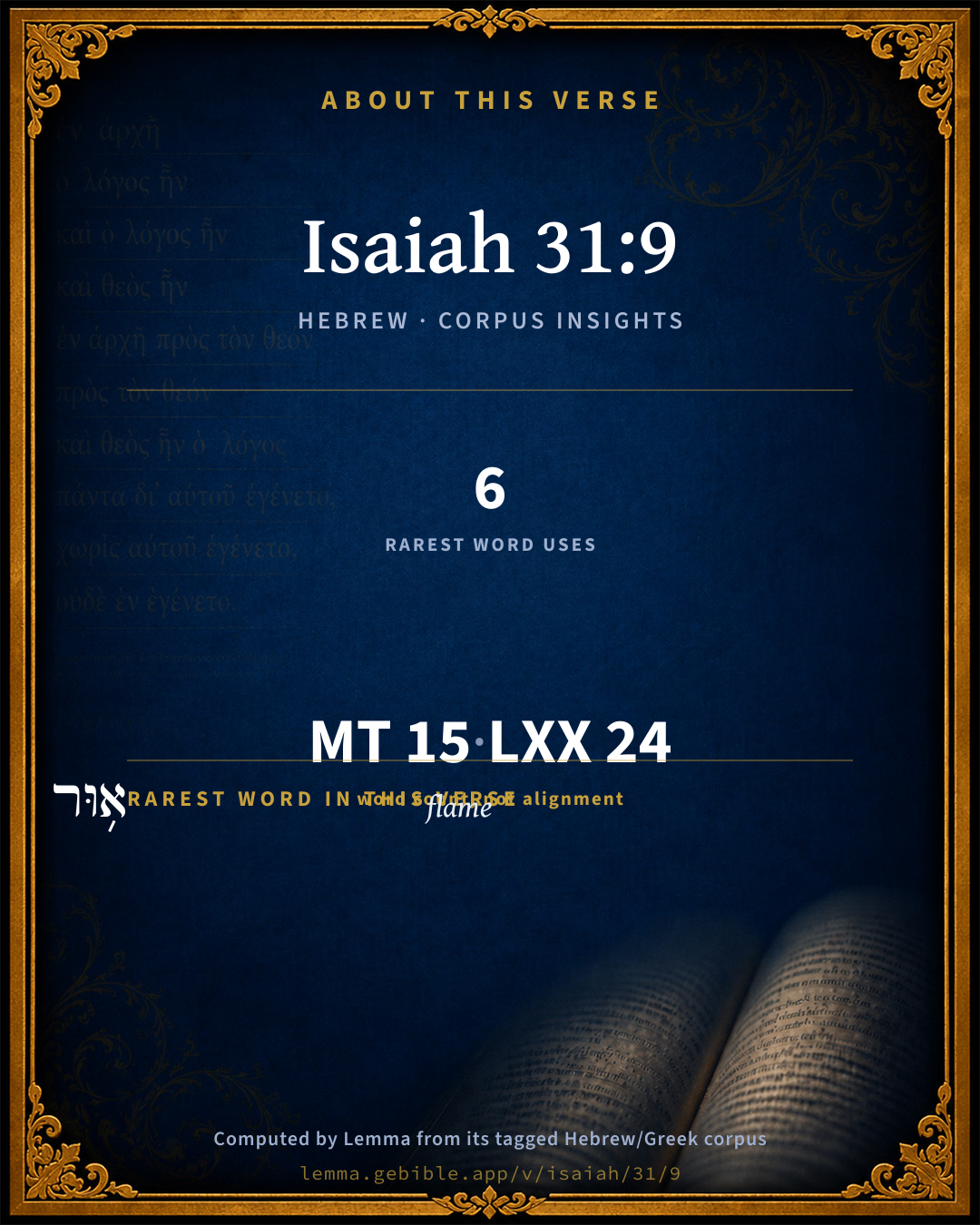
The rarest word here is א֥וּר flame H217 — appearing just 6 times in the whole Hebrew Bible.

Shared distinctive vocabulary

א֥וּר flame H217 occurs in 6 verses of the Hebrew Bible. Also found in:

Grammatical profile

  • 2 verbs
  • 10 nouns
  • 2 prepositions
  • 1 particle

Verb forms

  • יַֽעֲב֔וֹר Qal · Imperfect
  • וְחַתּ֥וּ Qal · Sequential Perfect

Hebrew & Septuagint length

In English translation the verse runs 30 words from the Hebrew and 40 from the Septuagint (LXX English) — closely comparable.

A rough comparison of the two English renderings, which tokenize alike — not a word-level alignment.

Word counts can differ between the Hebrew and the Greek without any difference in meaning — e.g. the Hebrew direct-object marker אֵת has no separate Greek word, and Greek often adds the article ὁ.

In the original languages it is 15 Hebrew tokens and 24 Greek tokens — but the two are counted differently (Hebrew bundles its prefixes and suffixes into one token; the Greek is in lemma form), so that isn’t a like-for-like length.

Cross-references

11

Topical passages linked to Isaiah 31:9 in the Treasury of Scripture Knowledge — connected by theme and wording, ordered by reader-vote popularity; previews shown in the World English Bible.

  • Isaiah 29:6 She shall be visited of Yahweh of Hosts with thunder, and with earthquake, and great noise, with whirlwind and tempest, and the flame of a devouring fire.
  • Malachi 4:1 "For, behold, the day comes, it burns as a furnace; and all the proud, and all who work wickedness, will be stubble; and the day that comes will burn them up," says Yahweh of Hosts, "that it shall leave them neither root nor branch.
  • Leviticus 6:13 Fire shall be kept burning on the altar continually; it shall not go out.
  • Deuteronomy 32:37 He will say, Where are their gods, The rock in which they took refuge;
  • Isaiah 4:4 when the Lord shall have washed away the filth of the daughters of Zion, and shall have purged the blood of Jerusalem from its midst, by the spirit of justice, and by the spirit of burning.
  • Isaiah 10:17 The light of Israel will be for a fire, and his Holy One for a flame; and it will burn and devour his thorns and his briers in one day.
  • Isaiah 18:3 All you inhabitants of the world, and you dwellers on the earth, when an ensign is lifted up on the mountains, look; and when the trumpet is blown, listen.
  • Zechariah 2:5 For I,' says Yahweh, 'will be to her a wall of fire around it, and I will be the glory in the midst of her.
  • Isaiah 11:10 It shall happen in that day, that the root of Jesse, who stands for an ensign of the peoples, to him shall the nations seek; and his resting-place shall be glorious.
  • Isaiah 30:33 For a Topheth is prepared of old; yes, for the king it is made ready; he has made it deep and large; the pile of it is fire and much wood; the breath of Yahweh, like a stream of sulfur, does kindle it.
  • Deuteronomy 32:31 For their rock is not as our Rock, Even our enemies themselves being judges.

Cross-references courtesy of OpenBible.info (CC BY 4.0).

Hebrew and Greek witnesses Masoretic Hebrew ↔ Greek Septuagint

The same verse in the two great witnesses to the Old Testament, shown verse-for-verse.

These are two independent witnesses, not word-aligned to each other, and the Septuagint is shown in lemma (dictionary) form.

Hebrew Isaiah 31:9 Masoretic · Westminster Leningrad Codex

וְסַלְעוֹ֙ מִמָּג֣וֹר יַֽעֲב֔וֹר וְחַתּ֥וּ מִנֵּ֖ס שָׂרָ֑יו נְאֻם יְהוָ֗ה אֲשֶׁר א֥וּר לוֹ֙ בְּצִיּ֔וֹן וְתַנּ֥וּר ל֖וֹ בִּירוּשָׁלִָֽם

His rock shall pass away by reason of terror, and his princes shall be dismayed at the ensign, says Yahweh, whose fire is in Zion, and his furnace in Jerusalem.

World English Bible · Public Domain

Greek LXX Isaiah 31:9 Septuagint · lemma form

πέτρα γάρ περιλαμβάνω ὡς χάραξ καί ἡττάω ὁ δέ φεύγω ἁλίσκω ὅδε λέγω κύριος μακάριος ὅς ἔχω ἐν σιων σπέρμα καί οἰκεῖος ἐν ἰερουσαλήμ

for they shall be compassed with rocks as with a trench, and shall be worsted; and he that flees shall be taken. Thus says the Lord, Blessed is he that has a seed in Sion, and household friends in Jerusalem.

LXX2012 (modern English Septuagint) · Public Domain

Hebrew: Westminster Leningrad Codex (CC BY 4.0). Greek: Septuagint (public domain); English from LXX2012 (modern English Septuagint) (Public Domain). How the Septuagint differs from the Hebrew →

Targum (Aramaic paraphrase)

1

The Targum is the ancient Jewish Aramaic paraphrase of the Hebrew Scriptures — an interpretive translation, not the Hebrew text itself. Onkelos (literal) and Pseudo-Jonathan (expansive) render the Torah, and Jonathan the Prophets. Coverage is partial: where no permissively-licensed English translation exists for a verse, only the Aramaic is shown. This is verse-level text, not a word-by-word alignment to the Hebrew.

  1. Targum Jonathan Prophets (Joshua–Malachi)
    וְשִׁלְטוֹנוֹהִי מִן קֳדָם דַחֲלָא יֶעְדוּן וִיתַּבְרוּן מִן קֳדָם נִיסָא רַבְרְבוֹהִי אֲמַר יְיָ דְזֵיהוֹר לֵיהּ בְּצִיוֹן לְעָבְדֵי אוֹרַיְתָא וְתַנוּר בָּעֵיר לֵיהּ דְאֶשָׁא בִירוּשְׁלֵם לִדְעֲבָרוּ עַל מֵימְרֵהּ:

    And his princes shall flee through fear, they shall move away; and his princes shall be broken on account of the miracle, saith the Lord, whose splendour is in Zion to them who obey the law, and whose burning furnace of fire is in Jerusalem for them who transgress His word.

    Targum Jonathan — Aramaic: “Mikraot Gedolot” (public domain). English: “Sefaria Community Translation” (CC0 1.0 (public-domain dedication)); “London "Chaldee Paraphrase," 1871” (public domain). Text via Sefaria.

Commentary

Notes on Isaiah 31:9 from classic Christian and Jewish commentators (each source and its license shown beneath its notes). The classic Christian expositions comment on the surrounding passage and are grouped to its opening verse, so a note may address several verses; the Jewish commentaries on the Tanakh (Rashi and others) are per-verse, so they appear only where the commentator wrote on this verse.

Lemma curates 59 commentaries, every one of them public domain or Creative Commons licensed, each selected and text-cleaned for this edition rather than reprinted as found. About our sources →

Trapp's Complete Commentary

John Trapp

Isa 31:9 And he shall pass over to his strong hold for fear, and his princes shall be afraid of the ensign, saith the LORD, whose fire [is] in Zion, and his furnace in Jerusalem.

Ver. 9. And he shall pass over to his stronghold.] To Nineveh, never thinking himself safe till he come thither.

And his princes shall be afraid of the ensign.] Lifted up by God’s angels in the slaughter of their fellows.

Whose fire is in Zion.] Who keeps house there, sumpta metaphora a re oeconomica. An exact metaphore from domestic affairs. There he had his fire and his chimney, sc., in the temple, from whence also came this destruction to the enemy. {Psa 76:2-3} {See Trapp on "Psa 76:2"} {See Trapp on "Psa 76:3"}

John Trapp, A Commentary or Exposition upon All the Books of the Old and New Testament (1647–1656) — public domain. Text from a community e-Sword module.

The Biblical Illustrator

Joseph S. Exell

Isa_31:9

The Lord, whose fire is in Zion

The Lords furnace

This very remarkable designation of God stands ere as a kind of seal set upon the preceding prophecy.

It is the reason why that shall certainly be fulfilled. And what precedes is mainly a promise of a deliverance for Israel, which was to be a destruction for Israels enemies. We shall not understand these great words if we regard them as only a revelation of destructive and terrible power. It is the very beauty and completeness of this emblem that it has a double aspect and is to less rich in joy and blessing than pregnant with warning and terror.

I. IN THE CHURCH GOD IS PRESENT AS A GREAT RESERVOIR OF FERVID LOVE. Every language has taken fire as the symbol of love and emotion. He dwells in His Church, a storehouse of blazing love, heated seventy times seven hotter than any creatural love, and pouring out its ardours for the quickening and gladdening of all who walk in the light of that fire and thaw their coldness at its blaze. Then, how comes it that so many Christian Churches are ice-houses instead of furnaces? If Gods blazing furnace is in Jerusalem, it should send the thermometer up in all the houses of the city. But what a strange contradiction it is for men to be in Gods Church, the very focus and centre of His burning love, and themselves to be almost down below zero in their temperature! A fiery furnace with its doors hung with icicles is no greater a contradiction and anomaly than a Christian Church or a single soul which professes to have been touched by the infinite lovingkindness of God, and yet lives as cold and unmoved as we do. There is no religion worth calling so which has not warmth in it. We hear a great deal about the danger of an emotional Christianity. Agreed, if by that they mean a Christianity which has no foundation for its emotion in principle and intelligence; but not agreed, if they mean to recommend a Christianity which professes to accept truths that might kindle a soul beneath the ribs of death and make the dumb sing, and yet is never moved one hairs-breadth from its quiet phlegmaticism. If there is no fire, what is there? Cold is death. We want no flimsy, transitory, noisy, ignorant, hysterical agitation. Smoke is not fire. If the temperature were higher, and the fire more wisely fed, there would not be any. But we do want a more obvious and powerful effect of our solemn, glorious, and heart-melting beliefs on the affections and emotions of professing Christians, and that they may be more mightily moved by love to heroisms of service and enthusiasms of consecration which shall in some measure answer to the glowing heat of that fire of God which flames in Zion.

II. GODS REVELATION OF HIMSELF, AND PRESENCE IN HIS CHURCH, ARE AN INSTRUMENT OF CLEANSING. Fire purifies. In our great cities now there are disinfecting ovens, where infected articles are taken, and exposed to a high temperature which kills the germs of disease, so that tainted things come out sweet and clean. That is what Gods furnace in Zion is meant to do for us. The true way of purifying is by fire. To purify by water, as John the Baptist saw and said, is but a poor cold way of getting outward cleanliness. Water cleanses the surface, and becomes dirty in the process. Fire cleanses within and throughout, and is not tainted thereby. The Hebrew captives were flung into the fiery furnace; what did it burn? Only their bonds. They themselves lived, and rejoiced, in the intense heat. So, if we have any real possession of that Divine flame, it will burn off our wrists the bands and chains of our old vices, and we shall stand pure and clear, emancipated by the fire which will burn up only our sins, and be for our true selves as our native home, where we walk at liberty and expatiate in the genial warmth.

III. GOD, IN HIS GREAT REVELATION OF HIMSELF BY WHICH HE DWELLS IN HIS CHURCH, IS A POWER OF TRANSFORMATION. Fire turns all which it seizes into fire. And so God, coming to us in His Spirit of burning, turns us into His own likeness, and makes us possessors of some spark of Himself.

IV. This figure teaches that THE SAME DIVINE FIRE MAY BECOME DESTRUCTIVE. The emblem of fire suggests a double operation, and the very felicity of it as an emblem is that it has these two sides, and with equal naturalness may stand for a power which quickens and for one which destroys. The difference in the effects springs not from differences in the cause, but in the objects on which the fire plays. We may make the furnace of God our blessedness and the reservoir of a far more joyful and noble life than ever we could have lived in our coldness; or we may make it terror and destruction. (A. Maclaren, D. D.)

The fiery ordeal of the Church

I. Let us endeavour to understand THE NAMES BY WHICH GODS CHURCH IS DESIGNATED, particularly under the Old Testament--Zion and Jerusalem. They are very significant. Some tell us that the word Zion simply signifies a monument or heap of stones in memorial. Nothing could be more significant with reference to the Church of God--a chosen monument of grace, constituted of a heap of stones. Jerusalem. It is very evident from the termination of it--Salem--that it signifies peace; and it is conjectured by some to have been the capital of Melchizedec; but one thing is certain, it was the organised city of the great King, the King of peace, and so is the Church of the living God. No city on the face of the earth was ever so warred against as Jerusalem. And, in this respect, Jerusalem was exactly the picture of the Church of God. What was her paramount glory? Not her extent; she never was a large city. Not the tractableness and teachableness of her sons, for they were very rebellious against even the Lord their God. What then was the glory of her city? The name and presence of her God there. This is our stay, this is our confidence, this is our joy, this is our constant expectation. His presence must be sensibly enjoyed, in order to know that He is here.

II. THE ORDEAL THROUGH WHICH THE CHURCH OF GOD MUST PASS. His fire in Zion, and His furnace in Jerusalem. The saints of the living God may expect, and whether they expect or no, they are sure to meet a succession of trials, both in a temporal and a spiritual sense. I would take another view of the subject: if there were no fire in Zion, and no furnace in Jerusalem, there would be no sacrifice, no burnt-offering, no clouds of incense; and therefore God says, it shall ever be burning. In this sense, it is the emblem of life Divine, the Holy Spirits work. I would name three things which God is doing with the furnace.

(1) He is melting;

(2)He is manifesting;

(3) He is making useful. These are the main purposes for which a furnace is used.

III. THE TENDENCY AND THE TERMINATION OF THIS PROCESS. The tendency is the exercising of all the graces in personal religion; the termination is to demonstrate Divine love and faithfulness in the deliverance and ultimate glorification of His saints. (J. Irons.)

.

The Biblical Illustrator, edited by Joseph S. Exell (c. 1880s–1900s) — public domain. Text from a community e-Sword module.

The Preacher's Complete Homiletical Commentary

Joseph S. Exell (gen. ed.)

THE FIERY ORDEAL OF THE CHURCH

Isa_31:9. The Lord, whose fire is in Zion, and whose furnace is in Jerusalem.

There is a variety of purposes for which fire is used. One of them was of old for the sacrifice, the burnt-offering; another was for incense, to keep it always smoking. Furnaces were used by the workers in metals.

I. THE FIRE. “Whose fire is in Zion.” Without the sacred fire there would have been no burnt-offering, no clouds of incense; and therefore God commanded that it should be kept ever burning. In this sense, the fire is the emblem of life divine, the Holy Spirit’s work. May it be for ever burning! Where it burns strongly, what clouds of incense of praise and prayer ascend to heaven!

II. THE FURNACE. “Whose furnace is in Jerusalem.” It is there for the purpose of accomplishing God’s designs with regard to His people. A furnace is nothing without fuel, and the fuel may be of various kinds. God heats His furnace with different kinds of fuel—sometimes with bodily afflictions, sometimes with losses of various kinds, sometimes with bereavements, sometimes with persecutions, sometimes with all these combined. Oh, the vast importance of viewing every trial of a temporal kind as sent on purpose to constitute a little fuel for God’s furnace! God is doing three things with His furnace. He is melting, He is manifesting, He is making useful.

1. He is melting. We are so hard and stubborn, so full of dross, that nothing less than the fire will serve (Isa_1:25).

2. He is manifesting. The fire tests both us [1159] and our work (1Co_3:13). In this way God manifests the difference between His people and the false professor, and shows who are His own (Zec_13:9).

3. He is making useful. Take a lesson from the very vessels you use at table every day; they would have been of no use at all, had they not passed through the fire.

[1159] Upon one occasion, like the prophet Jeremiah, I visited the potter’s house. I admired his ingenuity and the beauty of his work on the wheels. But after a little while, I found there was really no reliance to be put on the results of his labour and ingenuity. When put into the furnace, some of the vessels were marred and rendered good for nothing; they cracked and went to pieces. Did not the potter shape them aright? Did he not make them of the same clay? Did he not take the same pains with them? Then what was the defect? They would not stand fire.—Irons.

Conclusion. The trials of God’s people tend

(1) to exercise and develop their spiritual excellence;

(2.) To demonstrate the Divine love and faithfulness;

(3.) To prepare them for the enjoyment of Himself at last [1162]Joseph Irons: Thursday Penny Pulpit, vol. 7:109–120.

[1162] H. E. I., 116–142.

The Preacher's Complete Homiletical Commentary (gen. ed. Joseph S. Exell; Funk & Wagnalls, c. 1892) — public domain (pre-1929). A full-Bible homiletical/sermon-outline anthology covering 65 of 66 books (2 John is absent from the source module). Text from a community e-Sword module.

MacLaren's Expositions of Holy Scripture

Alexander MacLaren

Isaiah

THE LORD’S FURNACE

Isa 31:9.

This very remarkable characterisation of God stands here as a kind of seal, set upon the preceding prophecy. It is the reason why that will certainly be fulfilled. And what precedes is mainly a promise of a deliverance for Israel, which was to be a destruction for Israel’s enemies. It is put in very graphic and remarkable metaphors: ‘Like as a lion roareth on his prey when a multitude of shepherds is called forth against him, he will not be afraid of their voice, nor abase himself for the noise of them: so shall the Lord of hosts come down to fight for Mount Zion.’ The enemies of Israel are picturesquely and poetically represented as a crowd of shepherds vainly trying to scare a lion by their shouts. He stands undaunted, with his strong paw on his prey, and the boldest of them durst not venture to drag it from beneath his claws. So, says Isaiah, with singularly daring imagery, God will put all His strength into keeping fast hold of Israel, and no one can pluck His people from His hands.

Then, with a sudden and striking change of metaphor, the prophet passes from a picture of the extreme of fierceness to one of the extreme of tenderness. ‘As birds flying’-mother birds fluttering over their nests-’so will the Lord of hosts defend Jerusalem,’ hovering over it and going from side to side to defend with His broad pinions, ‘passing over, He will preserve it.’ These figures are next translated into the plain promise of utter discomfiture and destruction, panic and flight as the portion of the enemies of Israel, and the whole has this broad seal set to it, that He who promises is ‘the Lord, whose fire is in Zion, and His furnace in Jerusalem.’

We shall not understand these great words if we regard them as only a revelation of destructive and terrible power. They are that indeed, but they are far more than that. It is the very beauty and completeness of this emblem that has a double aspect, and is no less rich in joy and blessing than pregnant with warning and terror. As Isaiah says in another place, Jerusalem is ‘Ariel,’ which probably means ‘the hearth of God.’ His presence in the city is as a fire for the comfort and defence of the happy inhabitants, and at the same time for the destruction of all evil and enemies. Far more truly than He dwelt in the city of David does God dwell in the Church, and His presence is its security. What, then, of instruction and hope may we gather from this wonderful emblem?

I. In the Church, God is present as a great reservoir of fervid love.

Every language has taken fire as the symbol of love and emotion. We speak so naturally of warm love, fervent feeling, glowing earnestness, ardent enthusiasm and the like, that we are scarcely aware of using figurative language. We do not usually ascribe emotion to God, but surely the deepest and most sacred of the senses in which it is true that fire is His emblem, is that He is love. His fire is in Zion. He dwells in His Church, a storehouse of blazing love, heated seventy times seven hotter than any creatural love, and pouring out its ardours for the quickening and gladdening of all who walk in the light of that fire, and thaw their coldness at its blaze.

Then, if so, how comes it that so many Christian Churches are ice-houses instead of furnaces? How comes it that they who profess to live in the Zion where this fire flames are themselves so cold? If God’s blazing furnace is in Jerusalem, it should send the thermometer up in all the houses of the city. But what a strange contradiction it is for men to be in God’s Church, the very focus and centre of His burning love, and themselves to be almost down below zero in their temperature! The Christian Church ought to be all aflame in all its members, with the fire of love kindled and alight from God Himself. Every community of Christian people ought to radiate warmth and light which it has absorbed from its present God. Our love ought to answer His, and, being caught and kindled from that mighty fire, should throw back to its source some of the heat received, in fervours of reflected love, and should pour the rest beneficently on all around. Love to God and love to man are regarded in Christian morals as beams of the same fire, only travelling in different directions. But what a miserable contrast to such an ideal the reality in so many of our churches is! A fiery furnace with its doors hung with icicles is no greater a contradiction and anomaly than a Christian Church or a single soul, which professes to have been touched by the infinite loving kindness of God, and yet lives as cold and unmoved as we do. The ‘Lord’s fire is in Zion.’ Are there any tokens of that fire amongst us, in our own hearts and in our collective temperature as Christian Churches?

There is no religion worth calling so which has not warmth in it. We hear a great deal from people against whom I do not wish to say a word, about the danger of an ‘emotional Christianity.’ Agreed, if by that they mean a Christianity which has no foundation for its emotion in principle and intelligence; but not agreed if they mean to recommend a Christianity which professes to accept truths that might kindle a soul beneath the ribs of death and make the dumb sing, and yet is never moved one hair’s-breadth from its quiet phlegmaticism. There is no religion without emotion. Of course it must be intelligent emotion, built upon the acceptance of divine truth, and regulated and guided by that, and so consolidated into principle, and it must be emotion which works for its living, and impels to Christian conduct. These two provisoes being attended to, then we can safely say that warmth is the test of life, and the readings of the thermometer, which measure the fervour, measure also the reality of our religion. A cold Christian is a contradiction in terms. If the adjective is certainly applicable, I am afraid the applicability of the noun is extremely doubtful. If there is no fire, what is there? Cold is death.

We want no flimsy, transitory, noisy, ignorant, hysterical agitation. Smoke is not fire. If the temperature were higher, and the fire more wisely fed, there would not be any. But we do want a more obvious and powerful effect of their solemn, glorious, and heart-melting beliefs on the affections and emotions of professing Christians, and that they may be more mightily moved by love, to all heroisms and service and enthusiasms and to consecration which shall in some measure answer to the glowing heart of that fire of God which flames in Zion.

II. God’s revelation of Himself, and presence in His Church, are an instrument of cleansing.

Fire purifies. In our great cities now there are ‘disinfecting ovens,’ where infected articles are taken, and exposed to a high temperature which kills the germs of disease, so that tainted things come out sweet and clean. That is what God’s furnace in Zion is meant to do for us. The true way of purifying is by fire. To purify by water, as John the Baptist saw and said, is but a poor, cold way of getting outward cleanliness. Water cleanses the surface, and becomes dirty in the process. Fire cleanses within and throughout, and is not tainted thereby. You plunge some foul thing into the flame, and, as you look, the specks and spots melt out of it. Raise the temperature, and you kill the poison germs. That is the way that God cleanses His people; not by external application, but by getting up the heat. The fire of His love, the fire of His spirit, is, as St. Bernard says, a blessed fire, which ‘consumes indeed, but does not hurt; which sweetly burns and blessedly lays waste, and so puts forth the force and fire against our vices, as to display the operation of the anointing oil upon our souls.’ The Hebrew captives were flung into the fiery furnace. What did it burn? Only their bonds. They themselves lived and rejoiced in the intense heat. So, if we have any real possession of the divine flame, it will burn off our wrists the bands and chains of our old vices, and we shall stand pure and clean, emancipated by the fire which will consume only our sins, and be for our true selves as our native home, where we walk at liberty and expatiate in the genial warmth. That is the blessed and effectual way of purifying, which slays only the death that we carry about with us in our sin, and makes us the more truly living for its death. Cleansing is only possible if we are immersed in the Holy Ghost and in fire, as some piece of foul clay, plunged into the furnace, has all the stains melted out of it. For all sinful souls seeking after cleansing, and finding that the ‘damned spot’ will not ‘out’ for all their washing, it is surely good news and tidings of great joy that the Lord has His fire in Zion, and that its purifying power will burn out all their sin.

III. Further, there is suggested another thought: that God, in His great revelation of Himself, by which He dwells in His Church, is a power of transformation.

Fire turns all which it seizes into fire. ‘Behold how much wood is kindled by how small a fire’ {R.V.}. The heap of green wood with the sap in it needs but a tiny light pushed into the middle, and soon it is all ablaze, transformed into ruddy brightness, and leaping heavenwards. However heavy, wet, and obstinate may be the fuel, the fire can change it into aspiring and brilliant flame.

And so God, coming to us in His ‘Spirit of burning,’ turns us into His own likeness, and makes us possessors of some spark of Himself. Therefore it is a great promise, ‘He shall baptize you in the Holy Ghost, and in fire.’ He shall plunge you into the life-giving furnace, and so ‘make His ministers like a flame of fire,’ like the Lord whom they serve. The seraphim who stand round the throne are ‘burning’ spirits, and the purity which shines, the love which glows, the swift life which flames in them, are all derived from that unkindled and all-animating Fire who is their and our God. The transformation of all the dwellers in Zion into miniature likenesses of this fire is the very highest hope that springs from the solemn and blessed truth that the Lord has His fire in Zion, and His furnace in Jerusalem.

IV. But, further, this figure teaches that the same divine fire may become destructive.

The emblem of fire suggests a double operation, and the very felicity of it as an emblem is that it has these two sides, and with equal naturalness may stand for a power which quickens, and for one which destroys. The difference in the effects springs not from differences in the cause, but in the objects with which the fire plays. The same God is the fire of life, the fire of love, of purifying and transformation and glad energy to whosoever will put his trust in Him, and a fire of destruction and anger unto whosoever resists Him. The alternative stands before every soul of man, to be quickened by fire or consumed by it. We may make the furnace of God our blessedness and the reservoir of a far more joyful and noble life than ever we could have lived in our coldness; or we may make it terror and destruction. There lie the two possibilities before every one of us. We cannot stand apart from Him; we have relations with Him, whether we will or no; He is something to us. He is, and must be for all, a flaming fire. We can settle whether it shall be a fire which is life-giving unto life, or a fire which is death-giving unto death.

Here are two buildings: the one the life of the man that lives apart from God, and therefore has built only with wood, hay, and stubble; the other the life of the man that lives with God and for Him, and so has built with gold, silver, and precious stones. The day and the fire come; and the fates of these two are opposite effects of the same cause. The licking tongues surround the wretched hut, built of combustibles, and up go wood and hay and stubble, in a smoking flare, and disappear. The flames play round the gold and silver and precious stones, and every leap of their light is answered by some facet of the gems that flash in their brilliancy, and give back the radiance.

You can settle which of these two is to be your fate. ‘The Lord’s fire is in Zion, and His furnace in Jerusalem.’ To those who, by faith in that dear Lord who came to cast fire on earth,’ have opened their hearts, to the entrance of that searching, cleansing flame, and who therefore burn with kindred and answering fervours, it is joy to know that their ‘God is a consuming fire,’ for therein lies their hope of daily purifying and ultimate assimilation. To those, on the other hand, who have closed their hearts to the warmth of His redeeming love in Christ, and the quickening of His baptism by fire, what can the knowledge be but terror, what can contact with God in judgment be but destruction? ‘The day cometh, it burneth as a furnace; and all the proud, and all that work wickedness, shall be as stubble, and the day that cometh shall burn them up.’ What will that day do for you?

Alexander MacLaren, Expositions of Holy Scripture (1904–1910) — public domain. Text from a community e-Sword module.

Tyndale Open Study Notes

Tyndale Open Resources

31:9 princes will flee: This was fulfilled when Sennacherib fled to Nineveh after God destroyed 185,000 troops (see 37:36-37). • God himself was the fire or flame that would devour Assyria.

Tyndale Open Study Notes — © Tyndale Open Resources, licensed CC BY-SA 4.0. Text via the HelloAO Bible API.

Geneva Bible (1599)

Geneva Bible translators

To destroy his enemies.

This was accomplished soon after when Sennacherib’s army was discomfited, and he fled to his castle in Nineveh for succor.

Geneva Bible (1599) marginal notes — public domain. Text via Bolls.life.

Jamieson, Fausset & Brown

Robert Jamieson, A. R. Fausset & David Brown

Rather, "shall pass beyond his strongholds"; he Shall not stop to take refuge in it through fear (Jdg 20:47; Jer 48:28) [GESENIUS].

ensign--the banner of Jehovah protecting the Jews [MAURER].

fire . . . furnace--"light" and "fire," namely, of Jehovah's altar at Jerusalem (Isa 29:1). Perhaps "furnace," as distinguished from "fire," may mean that His dwelling-place (His hearth) was at Jerusalem (compare Isa 4:5); or else the fiery furnace awaiting all the enemies who should attack Jerusalem.

The times of purity and happiness which shall follow the defeat of the enemies of Jehovah's people (Isa 32:1-8). The period of wrath before that happy state (Isa 32:9-14). The assurance of the final prosperity of the Church is repeated (Isa 32:15-20).

Next: Isaiah Chapter 32

Jamieson, Fausset & Brown — Commentary Critical and Explanatory on the Whole Bible (1871) — public domain (CC PDM 1.0). Text via the HelloAO Bible API.

Ellicott's Commentary for English Readers

(9) He shall pass over to his strong hold for fear.—Most recent critics translate, His rock will pass away for terror, the “rock” (not the same word, however, as that elsewhere, e.g., Deu_32:31, used for God) being the symbol of Assyria’s strength. The laws of parallelism point to our taking the noun as the subject of the sentence, corresponding to “princes” in the next clause, and so exclude the Authorised version.

Whose fire is in Zion.—Fire, as the symbol of the Divine glory, giving light and warmth to the faithful, and burning up the evil. (Comp. Isa_10:16-17.)

A Bible Commentary for English Readers, edited by Charles John Ellicott (1878–1897) — public domain. Text from a community e-Sword module.

The Cambridge Bible for Schools and Colleges

gen. ed. J. J. S. Perowne

9. he shall pass over to his strong hold] The clause is difficult. R.V. and A.V. marg. take “his Rock” as subj., “Rock” being a figurative designation either of the king of Assyria or its national deity. This view has nothing to commend it. The A.V. gives a good sense, but a better translation perhaps is: “he shall overpass his rock(-refuge) from terror,” the image being that of a hunted animal, which misses its accustomed hiding-place in its fright.

his princes shall be afraid of the ensign] This rendering might be explained by ch. Isa_18:3 : the Assyrian officers shall be affrighted at the signal which Jehovah sets up. A better rendering, however, is: his officers shall be frighted away from the standard, i.e. “even the officers shall desert the standard in panic” (a pregnant construction).

whose fire is … Jerusalem] Better: who hath a fire in Zion and a furnace (lit. “oven”) in Jerusalem. There is perhaps an allusion here to the meaning of “Ariel” in ch. Isa_29:1 ff. The expressions symbolise the two aspects of Jehovah’s presence in Zion, light to His friends and destruction to His enemies (as Exo_14:20). The “oven” is an emblem of the Divine anger in Psa_21:9; perhaps also in Gen_15:17.

The Cambridge Bible for Schools and Colleges (gen. ed. J. J. S. Perowne; Cambridge University Press, 1878–1918) — public domain. Text from a community e-Sword module.

John Gill's Exposition

And he shall pass over to his strong hold for fear,.... This is said of the king of Assyria, departing in haste from the siege of Jerusalem, to some strong hold in his own country, particularly his strong city Nineveh, for fear of the angel, and destruction following him; nor could he think himself safe, until he had got there. Some render it (and the original will bear it), "and his rock shall pass over for fear" (a); his mighty men, his men of valour, in whom he trusted, and put his confidence, who were his strength, on which he depended; these, as many as were left of them, fled away. So the Targum,

"his princes shall flee for fear;''

though these are expressed in the next clause:

and his princes shall be afraid of the ensign; any ensign or standard they saw, supposing it to be a detachment of the Jews in pursuit of them; or not daring afterwards to face any enemy with their banners displayed: or rather were terrified at the sight of the standard erected by the angel in the air, and at the slaughter of their companies under them in the camp:

saith the Lord, whose fire is in Zion, and his furnace in Jerusalem; who keeps house there, and therefore will defend it. Some, as Aben Ezra and others, think reference is had to the altar of the Lord, where the fire was kept continually burning, and sacrifices were offered up to him, and therefore being the place of his worship, he would take care of it; but rather it seems to denote the fire of God's wrath, to defend his people, and destroy his enemies, Zac 2:5. The Targum is,

"whose lustre is in Zion to them that do the law, and a burning furnace of fire to them that transgress his word.''

The Jews, in their Talmud (b), interpret the "fire" of hell, and the "furnace" of the gate of hell.

(a) "et rupes ejus prae pavoro transibit", Forerius. So Cocceius and Ben Melech; with which the version of Junius and Tremellius agrees. (b) T. Bab. Erubim, fol. 19. 1.

Next: Isaiah Chapter 32

John Gill's Exposition of the Whole Bible (1746–1763) — public domain (CC PDM 1.0). Text via the HelloAO Bible API.

Albert Barnes' Notes on the Bible

And he shall pass over - Margin, ‘His rock shall pass away for fear.’ The Hebrew would bear this, but it does not convey a clear idea. The sense seems to be this. The word rendered ‘stronghold’ (Hebrew, ‘His rock’) denotes his fortifications, or the places of strength in which he trusted. Probably the Assyrian monarch had many such places which he regarded as perfectly secure, both in the limits of his own kingdom, and on the line of his march toward Judea. Those places would naturally be made strong, in order to afford a refuge in case of a defeat. The idea here is, that so great would be his alarm at the sudden destruction of his army and the failure of his plans, that in his flight he would “pass over” or “beyond” these strong places; he would not even stop to take refuge there and reorganize his scattered forces, but would flee with alarm “beyond” them, and make his way to his own capital. This appears to have been most strikingly fulfilled (see Isa 37:37).

And his princes - Those, perhaps, that ruled over his dependent provinces.

Shall be afraid of the ensign - That is, of any standard or banner that they saw. They would suppose that it was the standard of an enemy. This denotes a state of great consternation, when all the princes and nobles under the command of the Assyrian would be completely dismayed.

Whose fire is in Zion ... - That is, whose altar is there, and always burns there. That was the place where he was worshipped, and it was a place, therefore, which he would defend. The meaning is, that they would be as certainly destroyed as the God whose altar was in Jerusalem was a God of truth, and would defend the place where he was worshipped.

And his furnace ... - (see the note at Isa 29:1). Where his altar continually burns. The word rendered ‘furnace’ (תנור tannûr) means properly a baking oven Exo 8:3; Lev 2:4; Lev 7:9; Lev 11:35. This was either a large conical pot which was heated, in which the cakes were baked at the sides; or an excavation made in the earth which was heated by putting wood in it, and when that was removed, the dough was put in it. Perhaps the whole idea here is, that Yahweh had a home in Jerusalem, with the usual appendages of a house; that his fire and his oven were there, an expression descriptive of a dwelling-place. If so, then the meaning is, that he would defend his own home, and that the Assyrian could not expect to prevail against it.

Albert Barnes' Notes on the Bible (1834–1885) — public domain. Text from a community e-Sword/MySword module.

Haydock's Catholic Bible Commentary

Strength. Hebrew, "rock," the king. --- Jerusalem, to protect it, (Calmet) and punish the guilty. (Chaldean)

George Leo Haydock (1774–1849), Haydock's Catholic Family Bible and Commentary, 1859 edition — public domain. Excludes Psalms (Douay-Rheims chapter numbering differs from Protestant) and Deuterocanonical books (Catholic canon only).

Matthew Poole's English Annotations

He shall pass over to his strong hold; Sennacherib shall flee away, with all speed, from Jerusalem, to his strong city of Nineveh, Isa 37:37. Or, as it is in the margin, and as the words lie in the Hebrew text, his rock (i.e. his strength, the greatest champions of his army, to whom he trusted) shall pass away (shall flee with all speed from Jerusalem)

for fear, lest the sword of the destroying angel should overtake them.

Of the ensign; either,

1. Of any ensign. This dreadful judgment shall strike them with such a terror, that they shall not dare to look any enemy in the face. Or,

2. Of the Lord’s ensign, which he hath lifted up against them.

Whose fire is in Zion: so the sense is either,

1. Whose fire is continually burning upon the altar in Zion; which signifies his presence and residence there. Or rather,

2. Who is and will appear to be in Zion, like a fire, to defend his people, and to consume their enemies; for which end God promiseth that he would be unto Jerusalem a wall of fire round about, Zec 2:5, &c.; and that he would make the governor of Judah like a hearth of fire among the wood, and like a torch of fire in a sheaf; and that they should devour all the people round about. Possibly these and the following words may be thus rendered, and that very agreeably to the Hebrew words, who will be a fire (to wit, a consuming fire) to him (to the king of Assyria, of whom he is here speaking) in Zion, (from whence he will send forth that fire which shall consume his army: or, for Zion; for Zion’s sake; for the prefix here rendered in frequently signifies for, as hath been proved,) and a furnace to him in or for Jerusalem. But this I only propose, leaving it to the judgment of the intelligent reader. His furnace in Jerusalem; the same thing repeated in other words.

Matthew Poole's English Annotations on the Holy Bible (1683–1685) — public domain. Text from a community e-Sword/MySword module.

Whedon's Commentary on the Bible

Daniel D. Whedon

9. His strong hold — Sennacherib, as some commentators hold, but better, the historic absolute power of Assyria concreted in all her great kings. This is a powerless refuge if Jehovah should rise upon it, as he surely will. The consuming fire of God’s presence in Zion, the burning heat from the great altar-hearth in Jerusalem, shall certainly devour that old boasting foe of Jehovah. God proves himself the only one in whom to trust. He is the only great conqueror. The sword of no mighty man shall subdue Assyria. Jehovah has means for victory which mortal man’s hand cannot command, nor wield if he could.

Daniel D. Whedon (gen. ed.), Commentary on the Old and New Testaments (1874–1909) — public domain. Text from a community e-Sword module.

The Pulpit Commentary

And he shall pass over to his strong hold for fear; rather, and his Rock shall pass away for fear (marginal rendering). It is generally agreed by recent commentators (Kay, Delitzsch, Cheyne), that the rock intended, which is contrasted with the "princes" of the next clause, is Assyria"s king. (see the contrast of the king, who is "a great rock," and his princes, in Isa_32:1, Isa_32:2) (On the hurried flight of Sennacherib to Nineveh, see below, Isa_37:37) His princes shall be afraid of the ensign. The word nes, ensign, seems to be here used collectively. The Assyrian princes would tremble at every signal that they saw displayed along their line of route, expecting some enemy to fall upon them. His furnace. Jehovah was at once a Light to his people, and "a consuming (Heb_12:29) to his enemies. His presence, indicated by the Shechinah in the holy of holies, was at once for blessing and for burning.

The rock of Assyria and the Rock of Israel.

In each case the "rock" was

(1) the refuge, stronghold, and main reliance of the people;

(2) a person, not an inaccessible height or a fortress;

(3) the recognized monarch and master of the nation.

But in all other respects the contrast between the two was extreme, the difference immeasurable.

I ASSYRIA"S ROCK SENNACHERIB. A man, a weak, fallible, ephemeral man the creature of an hour mortal, soon wearied, needing rest and sleep, liable to sickness, daily losing strength, approaching nearer and nearer to the grave. And not only a man, but a wicked man proud, cruel, contemptuous of his foes, blasphemous towards God, merciless, pitiless! What a poor object on which to place reliance, trust, dependence! No doubt to the Assyrians he seemed a grand figure, seated on his throne of carved cedar and ivory, receiving tribute from kings and princes, and surrounded by his army of perhaps two hundred thousand men. But of what avail was his grandeur? He could not save a single soldier out of the two hundred thousand from an ache or a pain, if God sent them no, nor from death itself, if their lives were required by the Most High. To-night Sennacherib lies down to rest, confident of victory, his camp guarded on every side by nigh a quarter of a million of strong warriors. Tomorrow he is woke up by a sound of universal wailing. More than a hundred and eighty thousand of his soldiers are dead in their tents. His chances of victory are clean gone; and in half an hour he is an alarmed and trembling fugitive.

II ISRAEL"S ROCK JEHOVAH. God, and not man the Strong One, everlasting, he that "inhabiteth eternity", (Isa_57:15) that is never wearied, that needs not to slumber or sleep, that knows no sickness, that never loses strength, that has "neither beginning of days nor end of Heb_7:3. And One who to all this might adds tenderness, and the deepest love of his own, and the gentlest care of them. A Rock, but not hard or rugged a Refuge from all foes, a Shadow from the heat, a Refreshment to the weary, a Help to those in need. God is able to save all men, not only from death, but from all suffering or unhappiness. There is no foe that can daunt him, none from whom he will have to flee. And he is willing to save all only let them "return to him" (ver. 6), "cry to him", (Isa_30:19) trust in him, wait on him. He is indeed a "great Rock", (Isa_32:2) a "strong Rock", (Psa_31:2) even "the Rock of our salvation". (Psa_89:26)

The Pulpit Commentary (1880–1919), ed. H.D.M. Spence-Jones & Joseph S. Exell — public domain. Text from a community e-Sword module.

John Wesley's Explanatory Notes

He - Sennacherib shall flee away, from Jerusalem, to his strong city of Nineveh. The ensign - Of the Lord's ensign, which he hath lifted up against them. Whose fire - Who is, and will appear to be in Zion, like a fire to defend his people, and to consume their enemies.

John Wesley, Explanatory Notes Upon the Whole Bible (1754–1765) — public domain. Text via the GEBible commentary corpus.

J. A. Alexander on Isaiah

Joseph Addison Alexander

“And his rock (i.e., his strength) from fear shall pass away, and his chiefs shall be afraid of a standard (or signal, as denoting the presence of the enemy), saith Jehovah, to whom there is a fire in Zion and a furnace in Jerusalem.” The true explanation of the last clause seems to be that which supposes an allusion both to the sacred fire on the altar and to the consuming fire of God’s presence, whose altar flames in Zion and whose wrath shall thence flame to destroy His enemies. Compare the explanation of the mystical name Ariel in the note on Isa 29:1.

Joseph Addison Alexander, The Prophecies of Isaiah (1846–1847; New York: Scribner, 1870–1878) — public domain. Text from a community e-Sword module.

Rashi

Rabbi Shlomo Yitzchaki (Rashi)

And his rock shall pass from fear And his strength shall be weakened from great fear.

shall be dismayed at the miracle Because of the great miracles that the Holy One, blessed be He, performs for Israel.

whose fire is in Zion There the fire will be prepared to burn them.

Rashi on the Tanakh — English translations: “The Judaica Press complete Tanach with Rashi, translated by A. J. Rosenberg” (CC BY 4.0); “Pentateuch with Rashi's commentary by M. Rosenbaum and A.M. Silbermann, 1929-1934” (public domain); “The Metsudah Tanach series, Lakewood, N.J” (CC BY 4.0); and “The Book of Joshua, Metsudah Publications, 1997” (CC BY 4.0). Text via Sefaria.

Ibn Ezra

Rabbi Abraham ibn Ezra

And he shall pass by his stronghold, etc. He will go beyond his stronghold at the border of his kingdom, for his great fear; he will flee, and not rely on his strongholds. And his princes, etc. His princes that will have escaped, or will remain in the land, will be afraid of every ensign which they will see.

Fire, furnace. By these names the altar in Jerusalem is meant; or they are used figuratively, like And the flame of consuming fire (29:6).

Ibn Ezra on the Tanakh — English translations: “Sefaria Community Translation” (CC0 1.0 (public-domain dedication)); “Yalkut, Sifsei Chachomim Chumash, Metsudah Publications, 2009” (CC BY 4.0); and “Commentary of Ibn Ezra on Isaiah - trans. by M. Friedlander, 1873” (public domain). Text via Sefaria.

Lesson kit

Teaching starters — assembled from the data on this page, not authored interpretation. Every prompt links to the verse data it draws on. Edit before teaching.

Isaiah, in the Prophets, opens this verse with 15 words (13 distinct Hebrew lemmas). Its most distinctive word is ʼûwr (“flame”). A historical commentator’s framing appears above. Read the whole chapter for the surrounding context.

Discussion questions

  1. How does “flame” (ʼûwr) shape what this verse is saying?
  2. Isaiah 24:15 shares the word «flame» with this verse. How do the two illuminate each other?
  3. These translations render this verse differently. What is at stake in choosing one wording over another?
  4. The verb «יַֽעֲב֔וֹר» is Qal Imperfect. How does its form color the action?
  5. Reading how Trapp's Complete Commentary and The Biblical Illustrator read this verse, where do the two commentators agree and where do they part?

Things to notice

Reading settings

Reading text

Shown beneath each verse's original-language words.

Old Testament
Old Testament edition

Read the OT as the Masoretic Hebrew (MT) or the Greek Septuagint (LXX).

English shown for the Greek Septuagint (in the Hebrew ↔ Greek comparison).

Comparing translations? Open the Compare panel on any verse page to stack up to four side by side.