1 Chronicles 3:4

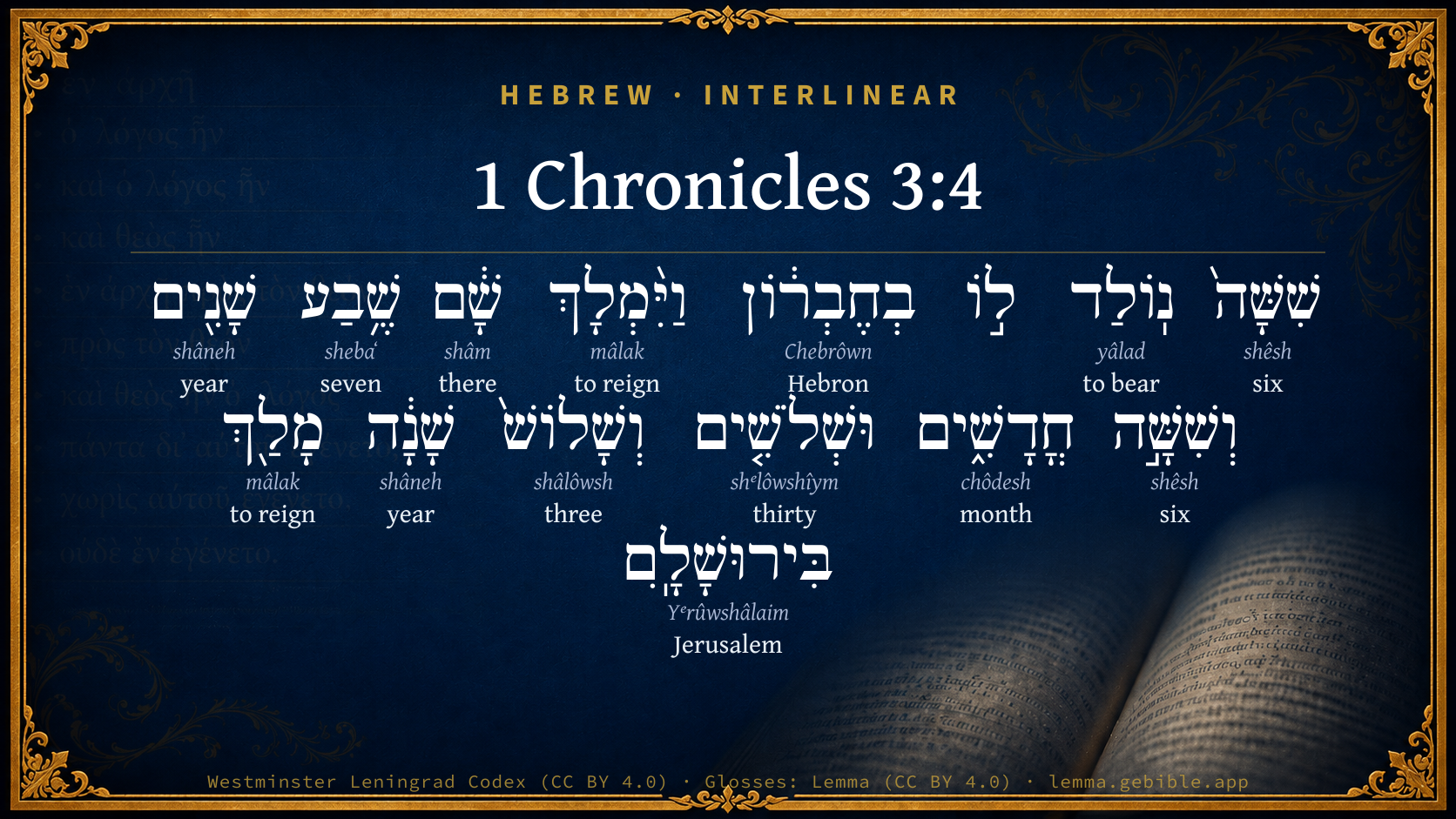
Hebrew (Westminster Leningrad Codex) 1 Chronicles 3:4 appears in the Hebrew Old Testament. The text above is from the Westminster Leningrad Codex. Each word links to its Strong’s number, a concise gloss, and parsing drawn from the Open Scriptures Hebrew Bible morphology. Click any word for its full Brown-Driver-Briggs (BDB) entry.
Download image
Cite this verse

1 Chronicles 3:4 (World English Bible). Public Domain. Lemma interlinear Bible study tool, https://lemma.gebible.app/v/1-chronicles/3/4.

Show BibTeX & RIS
BibTeX
RIS
English Translation
six were born to him in Hebron; and there he reigned seven years and six months. In Jerusalem he reigned thirty-three years;
World English Bible · Public Domain
Download a study sheet

One document with this verse’s original text, its word-by-word gloss line, the meaning frame, cross-references with their text, attributed commentary, and full source and license credits — printable, and it pastes into notes with its structure intact.

This verse Autodidact and up

Study sheet (.html) Plain text (.txt)

A passage Seminary Student

Up to 50 verses in one chapter. A passage sheet keeps up to 6 commentary sources and 12 cross-references per verse, in the order this page ranks them, and says so on the sheet whenever that leaves anything out. Ask for a single verse and you get the Autodidact verse sheet above.

Everything on this page stays free to read, with no account — the sheet is a download of what is already on screen, not access to it.

Want to remove ads? Support Godless Engineer
Compare translations 3

The same verse in 3 English versions, stacked beneath the original-language interlinear above. Click any original word for its lexicon entry.

Each is an independent rendering of the whole verse — the interlinear is not word-aligned to these translations.

Highlighted words mark where these versions differ — a whole-verse word diff, not a word-by-word alignment.

  • World English Bible Public Domain
    six were born to him in Hebron; and there he reigned seven years and six months. In Jerusalem he reigned thirty-three years;
  • King James Version Public Domain
    These six were born unto him in Hebron; and there he reigned seven years and six months: and in Jerusalem he reigned thirty and three years.
  • unfoldingWord Literal Text CC BY-SA 4.0
    Six were born to him in Hebron, and he reigned there seven years and six months. Then he reigned 33 years in Jerusalem.

unfoldingWord Literal Text — © unfoldingWord, licensed CC BY-SA 4.0. Word-aligned USFM3 via Door43 (git.door43.org/unfoldingWord/en_ult).

Versions to compare (up to 4)

3 of 4 selected

Show all 18 translations

Every available English version of this verse, each an independent rendering of the whole verse.

  • World English Bible Public Domain
    six were born to him in Hebron; and there he reigned seven years and six months. In Jerusalem he reigned thirty-three years;
  • Berean Standard Bible Public Domain
    These six sons were born to David in Hebron, where he reigned seven years and six months. And David reigned in Jerusalem thirty-three years,
  • Majority Standard Bible Public Domain
    These six sons were born to David in Hebron, where he reigned seven years and six months. And David reigned in Jerusalem thirty-three years,
  • King James Version Public Domain
    These six were born unto him in Hebron; and there he reigned seven years and six months: and in Jerusalem he reigned thirty and three years.
  • American Standard Version (1901) Public Domain
    six were born unto him in Hebron; and there he reigned seven years and six months. And in Jerusalem he reigned thirty and three years;
  • Revised Version (1885) Public Domain
    six were born unto him in Hebron; and there he reigned seven years and six months: and in Jerusalem he reigned thirty and three years.
  • Geneva Bible (1599) Public Domain
    These sixe were borne vnto him in Hebron: and there hee reigned seuen yeere and sixe moneths: and in Ierusalem he reigned three and thirtie yeere.
  • Douay-Rheims (1899) Public Domain
    So six sons were born to him in Hebron, where he reigned seven years and six months. And in Jerusalem he reigned three and thirty years.
  • Young's Literal Translation Public Domain
    Six have been borne to him in Hebron, and he reigneth there seven years and six months, and thirty and three years he hath reigned in Jerusalem.
  • Literal Standard Version CC BY-SA 4.0
    Six have been borne to him in Hebron, and he reigns seven years and six months there, and he has reigned thirty-three years in Jerusalem.
  • Unlocked Literal Bible CC BY-SA 4.0
    These six were born to David in Hebron, where he reigned seven years and six months. He then ruled thirty-three years in Jerusalem.
  • unfoldingWord Literal Text CC BY-SA 4.0
    Six were born to him in Hebron, and he reigned there seven years and six months. Then he reigned 33 years in Jerusalem.
  • Darby Bible Public Domain
    six were born to him in Hebron. And there he reigned seven years and six months. And in Jerusalem he reigned thirty-three years.
  • World Messianic Bible Public Domain
    six were born to him in Hebron; and he reigned there seven years and six months. He reigned thirty-three years in Jerusalem;
  • Webster's Bible Public Domain
    These six were born to him in Hebron; and there he reigned seven years and six months: and in Jerusalem he reigned thirty and three years.
  • Free Bible Version CC BY-SA 4.0
    These were the six sons born to David in Hebron, where he reigned seven years and six months. David reigned in Jerusalem thirty-three more years,
  • Bible in Basic English Public Domain
    He had six sons in Hebron; he was ruling there for seven years and six months, and in Jerusalem for thirty-three years.
  • JPS Tanakh (1917) Public Domain
    Six were born unto him in Hebron; and there he reigned seven years and six months; and in Jerusalem he reigned thirty and three years.

Literal Standard Version (2020), Covenant Press — licensed CC BY-SA 4.0. Text via the HelloAO Bible API (eBible.org). Unlocked Literal Bible (unfoldingWord) — licensed CC BY-SA 4.0. Text via the HelloAO Bible API (eBible.org). unfoldingWord Literal Text — © unfoldingWord, licensed CC BY-SA 4.0. Word-aligned USFM3 via Door43 (git.door43.org/unfoldingWord/en_ult). Free Bible Version, Dr. Jonathan Gallagher — licensed CC BY-SA 4.0. Text via the HelloAO Bible API (eBible.org).

Word by word

More ways to search: Search by grammar → Find every occurrence → Compare this word →

Practice this passage: Drill this verse → Learn its vocabulary →

בְחֶבְר֔וֹן
Chebrôwn
H2275
“in/at · Hebron”
Preposition + Noun, Proper
Part of Speech
Preposition + Noun
Type
Proper
Full BDB Definition

Origin: from H2267

TWOT: 598i

Hebron = "association" - a city in south Judah approx 20 south of Jerusalem and approx 20 miles (30 kilometers) north of Beersheba and near where Abraham built an altar (noun proper locative) - the 3rd son of Kohath and grandson of Levi (noun proper masculine) - a descendant of Caleb (noun proper masculine)
  1. שִׁשָּׁה֙ shêsh H8337 “six” Adjective, Cardinal number, Masculine, Singular, Absolute
  2. נֽוֹלַד yâlad H3205 “to bear” Verb, Niphal, Perfect, 3rd Person, Masculine, Singular
  3. וַיִּ֨מְלָךְ mâlak H4427 “and · to reign” Conjunction + Verb, Qal, Sequential Imperfect, 3rd Person, Masculine, Singular
  4. שָׁ֔ם shâm H8033 “there” Adverb
  5. שֶׁ֥בַע shebaʻ H7651 “seven” Adjective, Cardinal number, Feminine, Singular, Absolute
  6. שָׁנִ֖ים shâneh H8141 “years” Noun, Common, Feminine, Plural, Absolute
  7. וְשִׁשָּׁ֣ה shêsh H8337 “and · six” Conjunction + Adjective, Cardinal number, Masculine, Singular, Absolute
  8. חֳדָשִׁ֑ים chôdesh H2320 “months” Noun, Common, Masculine, Plural, Absolute
  9. וּשְׁלֹשִׁ֤ים shᵉlôwshîym H7970 “and · thirty” Conjunction + Adjective, Cardinal number, Both, Plural, Absolute
  10. וְשָׁלוֹשׁ֙ shâlôwsh H7969 “and · three” Conjunction + Adjective, Cardinal number, Feminine, Singular, Absolute
  11. שָׁנָ֔ה shâneh H8141 “year” Noun, Common, Feminine, Singular, Absolute
  12. מָלַ֖ךְ mâlak H4427 “to reign” Verb, Qal, Perfect, 3rd Person, Masculine, Singular
  13. בִּירוּשָׁלִָֽם Yᵉrûwshâlaim H3389 “in/at · Jerusalem” Preposition + Noun, Proper

About this verse

These counts appear in no published source. They are computed here, from the morphology-tagged text and Lemma’s own curated glosses. What Lemma adds →

15
words
11
distinct lemmas
Historical
section

Grammatical profile

  • 3 verbs
  • 5 nouns
  • 5 adjectives
  • 1 preposition
  • 1 adverb

Verb forms

  • נֽוֹלַד Niphal · Perfect
  • וַיִּ֨מְלָךְ Qal · Sequential Imperfect
  • מָלַ֖ךְ Qal · Perfect

Repetition

Words recur within this verse — often emphatic in Hebrew:

  • שִׁשָּׁה֙ six H8337 ×2
  • וַיִּ֨מְלָךְ to reign H4427 ×2
  • שָׁנִ֖ים year H8141 ×2

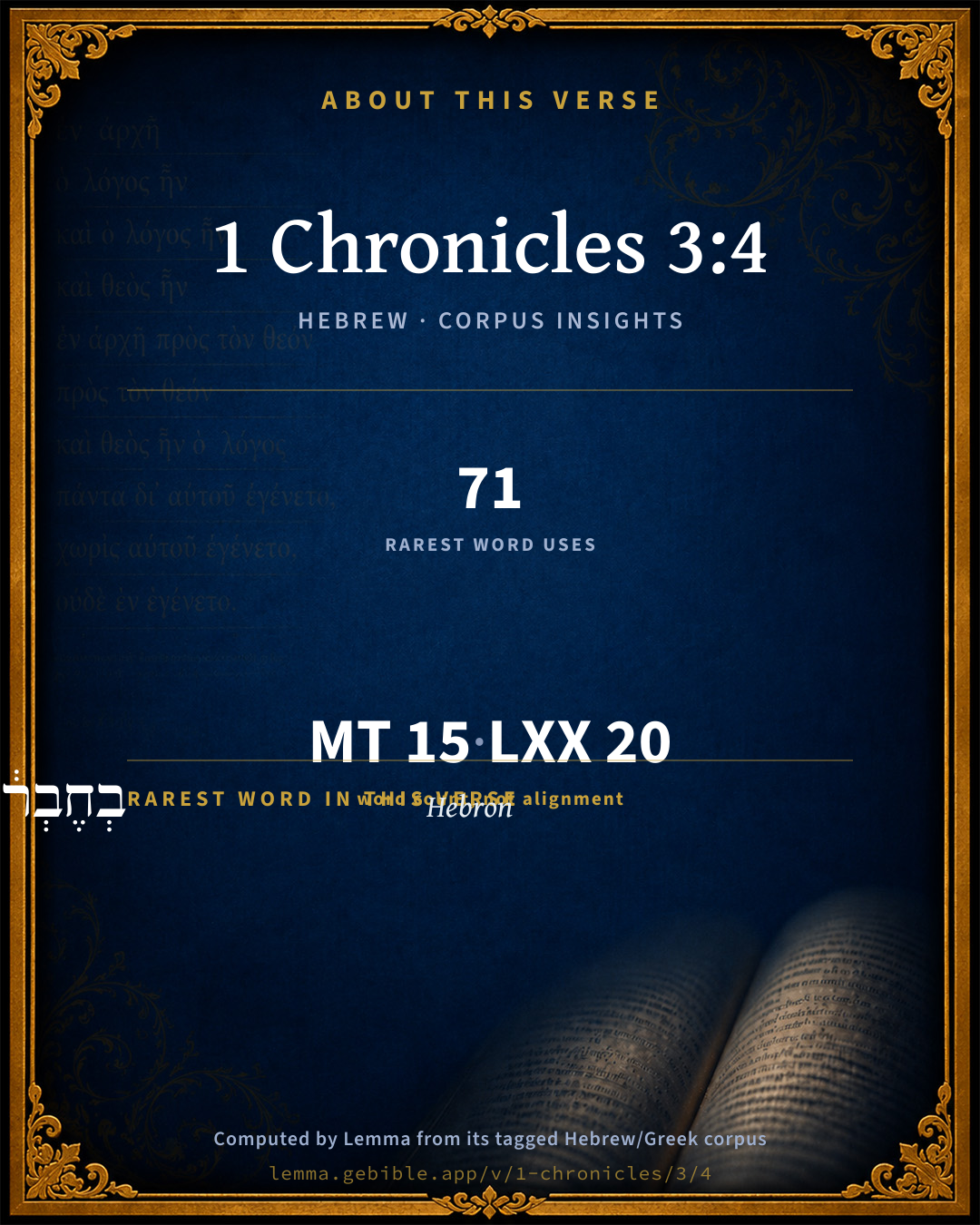
Hebrew & Septuagint length

In English translation the verse runs 22 words from the Hebrew and 23 from the Septuagint (LXX English) — closely comparable.

A rough comparison of the two English renderings, which tokenize alike — not a word-level alignment.

Word counts can differ between the Hebrew and the Greek without any difference in meaning — e.g. the Hebrew direct-object marker אֵת has no separate Greek word, and Greek often adds the article ὁ.

In the original languages it is 15 Hebrew tokens and 20 Greek tokens — but the two are counted differently (Hebrew bundles its prefixes and suffixes into one token; the Greek is in lemma form), so that isn’t a like-for-like length.

Cross-references

5

Topical passages linked to 1 Chronicles 3:4 in the Treasury of Scripture Knowledge — connected by theme and wording, ordered by reader-vote popularity; previews shown in the World English Bible.

  • 2 Samuel 2:11 The time that David was king in Hebron over the house of Judah was seven years and six months.
  • 2 Samuel 5:4–5 David was thirty years old when he began to reign, and he reigned forty years.
  • 1 Kings 2:11 The days that David reigned over Israel were forty years; seven years reigned he in Hebron, and thirty-three years reigned he in Jerusalem.
  • 2 Samuel 5:14–16 These are the names of those who were born to him in Jerusalem: Shammua, and Shobab, and Nathan, and Solomon,
  • 1 Chronicles 29:27 The time that he reigned over Israel was forty years; he reigned seven years in Hebron, and thirty-three [years] reigned he in Jerusalem.

Cross-references courtesy of OpenBible.info (CC BY 4.0).

Hebrew and Greek witnesses Masoretic Hebrew ↔ Greek Septuagint

The same verse in the two great witnesses to the Old Testament, shown verse-for-verse.

These are two independent witnesses, not word-aligned to each other, and the Septuagint is shown in lemma (dictionary) form.

Hebrew 1 Chronicles 3:4 Masoretic · Westminster Leningrad Codex

שִׁשָּׁה֙ נֽוֹלַד ל֣וֹ בְחֶבְר֔וֹן וַיִּ֨מְלָךְ שָׁ֔ם שֶׁ֥בַע שָׁנִ֖ים וְשִׁשָּׁ֣ה חֳדָשִׁ֑ים וּשְׁלֹשִׁ֤ים וְשָׁלוֹשׁ֙ שָׁנָ֔ה מָלַ֖ךְ בִּירוּשָׁלִָֽם

six were born to him in Hebron; and there he reigned seven years and six months. In Jerusalem he reigned thirty-three years;

World English Bible · Public Domain

Greek LXX 1 Chronicles 3:4 Septuagint · lemma form

ἕξ γεννάω αὐτός ἐν χεβρων καί βασιλεύω ἐκεῖ ἑπτά ἔτος καί ἑξάμηνος καί τριάκοντα καί τρεῖς ἔτος βασιλεύω ἐν ἰερουσαλήμ

Six were born to him in Chebron; and he reigned there seven years and six months: and he reigned thirty-three years in Jerusalem.

LXX2012 (modern English Septuagint) · Public Domain

Hebrew: Westminster Leningrad Codex (CC BY 4.0). Greek: Septuagint (public domain); English from LXX2012 (modern English Septuagint) (Public Domain). How the Septuagint differs from the Hebrew →

Commentary

Notes on 1 Chronicles 3:4 from classic Christian and Jewish commentators (each source and its license shown beneath its notes). The classic Christian expositions comment on the surrounding passage and are grouped to its opening verse, so a note may address several verses; the Jewish commentaries on the Tanakh (Rashi and others) are per-verse, so they appear only where the commentator wrote on this verse.

Lemma curates 59 commentaries, every one of them public domain or Creative Commons licensed, each selected and text-cleaned for this edition rather than reprinted as found. About our sources →

Ellicott's Commentary for English Readers

(4) These six were born unto him in Hebron.—Literally, Six were born. 2Sa_3:5 : “These were born.”

And there he reigned seven years.—This notice of the time David reigned first in Hebron, the Judean capital, and then in Jerusalem over all Israel, is not read in the parallel section of Samuel; but see 2Sa_2:11; 2Sa_5:5 for the same statements.

A Bible Commentary for English Readers, edited by Charles John Ellicott (1878–1897) — public domain. Text from a community e-Sword module.

The Pulpit Commentary

HOMILIES BY R. TUCK Ver. 4.

David"s double reign.

The important fact is recalled to mind that David"s reign was divided into two parts: for some seven years and a half he reigned over a portion of the nation, and then for three and thirty years over the whole. His capital during the first part of his reign was Hebron; and during the second part, Jerusalem. It is evidently a point of interest and instruction that, though designed for the throne, and anointed in his early life, David only attained the throne by gradual stages and steps, and there was a long series of remarkable providences ever tending towards, and at last fully realizing the Divine purpose. From David"s story we learn that there may be even prolonged delay in the fulfilment of the Divine promise, but that very delay is used in the ultimate and the more perfect fulfilment of the promise. This may be fully illustrated in the details of David"s early history. If God"s promise seems "to tarry, wait for it; it will surely come, it will not tarry." Immediately on receiving news of the death of Saul, David took action. As long as the anointed of the Lord lived, it was his duty to wait patiently, not to strive, not to assert his pretensions to the throne, not to rebel in any way against the lawful authority. But Saul being removed, no claims remained; he might assert at once his right to the throne. Here, however, the truly religious character of David is seen. The way seemed plain before him, but he would not take a step without inquiry of the Lord. He asks both the when, the how, and the where, desiring simply to follow the Divine lead. And he is directed to Hebron, the sacred city of the tribe of Judah. His removal to that city was the signal for the union of the tribe of Judah under his rule. His ultimately securing the allegiance of the entire people, and removing his capital to Jerusalem, was the result of a train of providential circumstances, which indicated the Divine will as plainly as if words of command had been uttered. Many men sin by trying to force God"s will into conformity with their own, and deceiving themselves with the idea that they are doing God"s will. Happy are they who, in all simplicity, follow God"s lead, and are quite willing to wait for God"s time and God"s way. The point in David"s story recalled by these verses shows us

I DELAY AND PARTIAL FULFILMENT TRYING DAVID"S FAITH. Years passed, and the promise of his youth seemed ever further off from fulfilment; and even when the fulfilment came, it was far below his hopes, scarcely worth so many years of waiting and bearing. Yet David fully maintained his trust. He never failed; he would not be persuaded to make his own way, by cutting off Saul"s life when the king was in his power. David never lost hope. God"s way might be in the sea, but God can make pathways even through seas. And delay has ever been, and still is, one of the most effective agencies for testing faith. So long as we can do something, we can keep trust alive; but it is so hard to "flesh and blood" to be still and wait.

II DELAY AND PARTIAL FULFILMENT CULTURING DAVID"S FITNESSES. It is always more important that we should be fit for a position than that we should gain it; and so the long years of preparatory waiting and experience in lesser spheres are never wasted years. David in the court, David in the cave, and David in Hebron, was being fitted for full royalty at Jerusalem. Life is, for us all, in stages, each with a view to the next in advance. We want to leap to the best at once. God will not let us, save in judgment. He brings through the lesser trusts slowly to the greater ones. This gives us one of our best assurances of immortality. We are so evidently in this delay-time of earth being fitted for something more and higher. Gain what we may here on earth, we cannot exhaust our spiritual capacities. R.T.

The Pulpit Commentary (1880–1919), ed. H.D.M. Spence-Jones & Joseph S. Exell — public domain. Text from a community e-Sword module.

unfoldingWord translationNotes

Door43 World Missions Community

where he reigned seven years and six months

This can also be translated as a separate sentence. AT: "David reigned there seven years and six months"

thirty-three years

"33 years" (See: Numbers)

Ammiel ... Shammua ... Shobab ... Nathan

These are names of men. (See: How to Translate Names)

translationWords

reign

rule

Jerusalem

Bathsheba

Solomon

unfoldingWord translationNotes — © Distant Shores Media and the Door43 World Missions Community, licensed CC BY-SA 4.0. Source: git.door43.org/Door43/en_tn.

Lesson kit

Teaching starters — assembled from the data on this page, not authored interpretation. Every prompt links to the verse data it draws on. Edit before teaching.

1 Chronicles, in the Historical, opens this verse with 15 words (11 distinct Hebrew lemmas). Its most distinctive word is Chebrôwn (“Hebron”). A historical commentator’s framing appears above. Read the whole chapter for the surrounding context.

Discussion questions

  1. The word Chebrôwn carries the sense “Hebron.” How does it shape the verse?
  2. 2 Samuel 2:11 shares this passage’s theme. How do the two illuminate each other?
  3. “six” occurs 2× in this one verse. What is the effect of the repetition?
  4. The translations on this page render this verse differently — a whole-verse word diff, not a word-by-word alignment. What might account for the different wordings?
  5. The verb «נֽוֹלַד» is Niphal Perfect. How does its form color the action?
  6. Reading how Ellicott's Commentary for English Readers and The Pulpit Commentary read this verse, where do the two commentators agree and where do they part?

Things to notice

Reading settings

Reading text

Shown beneath each verse's original-language words.

Old Testament
Old Testament edition

Read the OT as the Masoretic Hebrew (MT) or the Greek Septuagint (LXX).

English shown for the Greek Septuagint (in the Hebrew ↔ Greek comparison).

Comparing translations? Open the Compare panel on any verse page to stack up to four side by side.