
Ecclesiastes 2:7

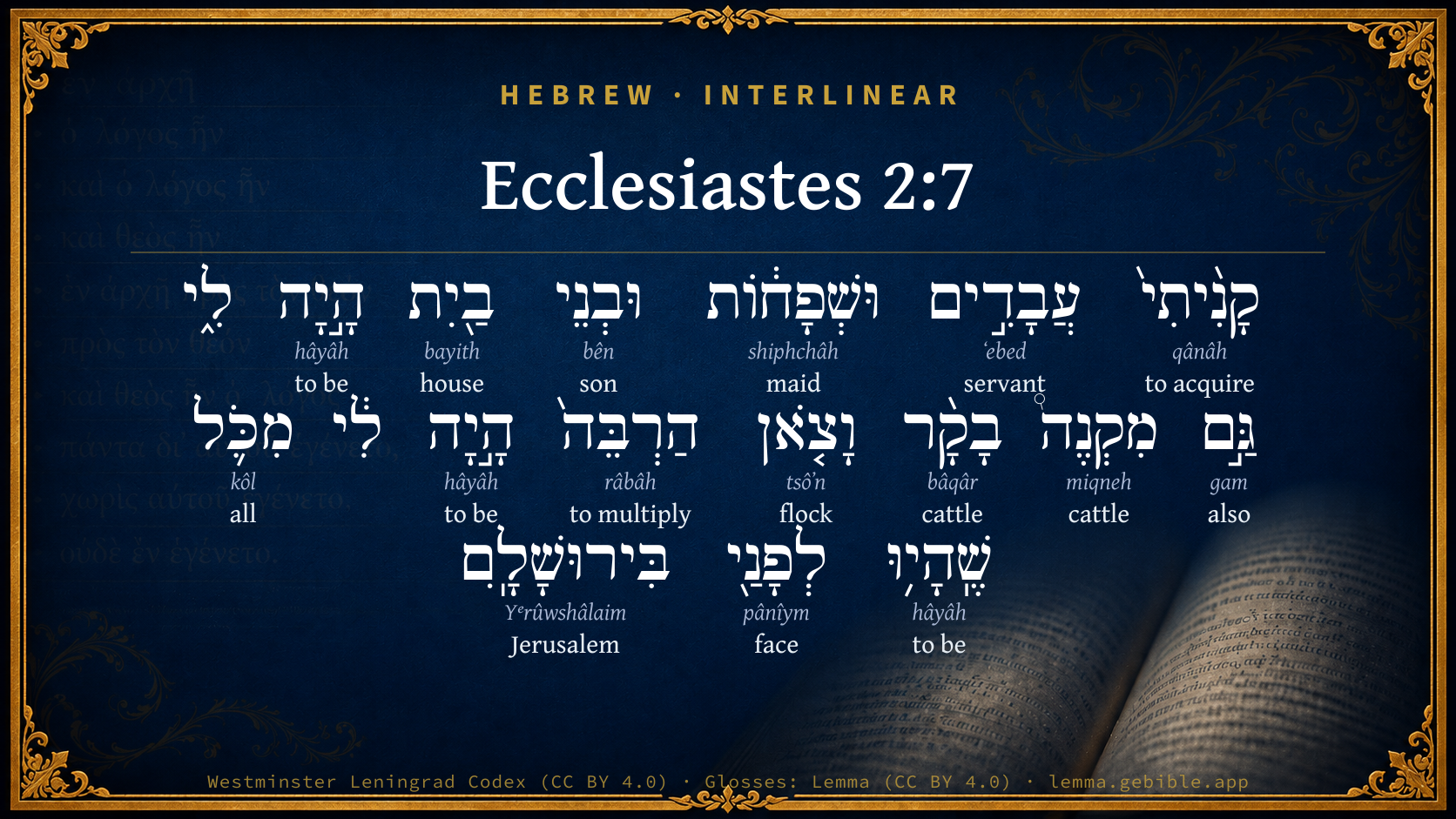
Hebrew (Westminster Leningrad Codex) Ecclesiastes 2:7 appears in the Hebrew Old Testament. The text above is from the Westminster Leningrad Codex. Each word links to its Strong’s number, a concise gloss, and parsing drawn from the Open Scriptures Hebrew Bible morphology. Click any word for its full Brown-Driver-Briggs (BDB) entry.
Download image
Cite this verse

Ecclesiastes 2:7 (World English Bible). Public Domain. Lemma interlinear Bible study tool, https://lemma.gebible.app/v/ecclesiastes/2/7.

Show BibTeX & RIS
BibTeX
RIS
English Translation
I bought men-servants and maid-servants, and had servants born in my house. I also had great possessions of herds and flocks, above all who were before me in Jerusalem;
World English Bible · Public Domain
Download a study sheet

One document with this verse’s original text, its word-by-word gloss line, the meaning frame, cross-references with their text, attributed commentary, and full source and license credits — printable, and it pastes into notes with its structure intact.

This verse Autodidact and up

Study sheet (.html) Plain text (.txt)

A passage Seminary Student

Up to 50 verses in one chapter. A passage sheet keeps up to 6 commentary sources and 12 cross-references per verse, in the order this page ranks them, and says so on the sheet whenever that leaves anything out. Ask for a single verse and you get the Autodidact verse sheet above.

Everything on this page stays free to read, with no account — the sheet is a download of what is already on screen, not access to it.

Want to remove ads? Support Godless Engineer
Compare translations 3

The same verse in 3 English versions, stacked beneath the original-language interlinear above. Click any original word for its lexicon entry.

Each is an independent rendering of the whole verse — the interlinear is not word-aligned to these translations.

Highlighted words mark where these versions differ — a whole-verse word diff, not a word-by-word alignment.

  • World English Bible Public Domain
    I bought men-servants and maid-servants, and had servants born in my house. I also had great possessions of herds and flocks, above all who were before me in Jerusalem;
  • King James Version Public Domain
    I got me servants and maidens, and had servants born in my house; also I had great possessions of great and small cattle above all that were in Jerusalem before me:
  • unfoldingWord Literal Text CC BY-SA 4.0
    I acquired male servants and female servants and sons of the house belonged to me. Also, much property of cattle and sheep belonged to me, more than all who were to my face in Jerusalem.

unfoldingWord Literal Text — © unfoldingWord, licensed CC BY-SA 4.0. Word-aligned USFM3 via Door43 (git.door43.org/unfoldingWord/en_ult).

Versions to compare (up to 4)

3 of 4 selected

Show all 18 translations

Every available English version of this verse, each an independent rendering of the whole verse.

  • World English Bible Public Domain
    I bought men-servants and maid-servants, and had servants born in my house. I also had great possessions of herds and flocks, above all who were before me in Jerusalem;
  • Berean Standard Bible Public Domain
    I acquired menservants and maidservants, and servants were born in my house. I also owned more herds and flocks than anyone in Jerusalem before me,
  • Majority Standard Bible Public Domain
    I acquired menservants and maidservants, and servants were born in my house. I also owned more herds and flocks than anyone in Jerusalem before me,
  • King James Version Public Domain
    I got me servants and maidens, and had servants born in my house; also I had great possessions of great and small cattle above all that were in Jerusalem before me:
  • American Standard Version (1901) Public Domain
    I bought men-servants and maid-servants, and had servants born in my house; also I had great possessions of herds and flocks, above all that were before me in Jerusalem;
  • Revised Version (1885) Public Domain
    I bought menservants and maidens, and had servants born in my house; also I had great possessions of herds and flocks, above all that were before me in Jerusalem:
  • Geneva Bible (1599) Public Domain
    I haue gotten seruants and maides, and had children borne in the house: also I had great possession of beeues and sheepe aboue all that were before me in Ierusalem.
  • Douay-Rheims (1899) Public Domain
    I got me menservants, and maidservants, and had a great family: and herds of oxen, and great flocks of sheep, above all that were before me in Jerusalem:
  • Young's Literal Translation Public Domain
    I got men-servants, and maid-servants, and sons of the house were to me; also, I had much substance -- herd and flock -- above all who had been before me in Jerusalem.
  • Literal Standard Version CC BY-SA 4.0
    I acquired menservants, and maidservants, and sons of the house were to me; also, I had much substance—herd and flock—above all who had been before me in Jerusalem.
  • Unlocked Literal Bible CC BY-SA 4.0
    I purchased male slaves and female slaves; I had slaves born in my palace. I also had large herds and flocks of livestock, much more than any king who ruled before me in Jerusalem.
  • unfoldingWord Literal Text CC BY-SA 4.0
    I acquired male servants and female servants and sons of the house belonged to me. Also, much property of cattle and sheep belonged to me, more than all who were to my face in Jerusalem.
  • Darby Bible Public Domain
    I acquired servants and maidens, and had servants born in my house; also I had great possessions of herds and flocks, above all that had been in Jerusalem before me.
  • World Messianic Bible Public Domain
    I bought male servants and female servants, and had servants born in my house. I also had great possessions of herds and flocks, above all who were before me in Jerusalem.
  • Webster's Bible Public Domain
    I procured me servants and maidens, and had servants born in my house; also I had great possessions of great and small cattle above all that were in Jerusalem before me:
  • Free Bible Version CC BY-SA 4.0
    I bought male and female slaves, and their children also belonged to me. I also owned many herds and flocks, more than anyone in Jerusalem before me.
  • Bible in Basic English Public Domain
    I got men-servants and women-servants, and they gave birth to sons and daughters in my house. I had great wealth of herds and flocks, more than all who were in Jerusalem before me.
  • JPS Tanakh (1917) Public Domain
    I acquired men-servants and maid-servants, and had servants born in my house; also I had great possessions of herds and flocks, above all that were before me in Jerusalem;

Literal Standard Version (2020), Covenant Press — licensed CC BY-SA 4.0. Text via the HelloAO Bible API (eBible.org). Unlocked Literal Bible (unfoldingWord) — licensed CC BY-SA 4.0. Text via the HelloAO Bible API (eBible.org). unfoldingWord Literal Text — © unfoldingWord, licensed CC BY-SA 4.0. Word-aligned USFM3 via Door43 (git.door43.org/unfoldingWord/en_ult). Free Bible Version, Dr. Jonathan Gallagher — licensed CC BY-SA 4.0. Text via the HelloAO Bible API (eBible.org).

Word by word

More ways to search: Search by grammar → Find every occurrence → Compare this word →

Practice this passage: Drill this verse → Learn its vocabulary →

וּשְׁפָח֔וֹת
shiphchâh
H8198
“and · maids”
Conjunction + Noun, Common, Feminine, Plural, Absolute
Part of Speech
Conjunction + Noun
Type
Common
Gender
Feminine
Number
Plural
State
Absolute
Full BDB Definition

Origin: from the same as H8207 ">H8207 )

TWOT: None

maid, maid-servant, slavegirl - maid, maid-servant (as belonging to a mistress) - of address, speaker, humility (figuratively)
  1. קָנִ֨יתִי֙ qânâh H7069 “to acquire” Verb, Qal, Perfect, 1st Person, Common, Singular
  2. עֲבָדִ֣ים ʻebed H5650 “servants” Noun, Common, Masculine, Plural, Absolute
  3. וּבְנֵי bên H1121 “and · sons of” Conjunction + Noun, Common, Masculine, Plural, Construct
  4. בַ֖יִת bayith H1004 “house” Noun, Common, Masculine, Singular, Absolute
  5. הָ֣יָה hâyâh H1961 “to be” Verb, Qal, Perfect, 3rd Person, Masculine, Singular
  6. גַּ֣ם gam H1571 “also” Particle, Accusative
  7. מִקְנֶה֩ miqneh H4735 “cattle” Noun, Common, Masculine, Singular, Absolute
  8. בָקָ֨ר bâqâr H1241 “cattle” Noun, Common, Both, Singular, Absolute
  9. וָצֹ֤אן tsôʼn H6629 “and · flock” Conjunction + Noun, Common, Both, Singular, Absolute
  10. הַרְבֵּה֙ râbâh H7235 “to multiply” Verb, Hiphil, Infinitive Absolute
  11. הָ֣יָה hâyâh H1961 “to be” Verb, Qal, Perfect, 3rd Person, Masculine, Singular
  12. מִכֹּ֛ל kôl H3605 “from · all of” Preposition + Noun, Common, Masculine, Singular, Construct
  13. שֶֽׁהָי֥וּ hâyâh H1961 “who/which · to be” Particle, Relative + Verb, Qal, Perfect, 3rd Person, Common, Plural
  14. לְפָנַ֖י pânîym H6440 “to/for · face(s) · my” Preposition + Noun, Common, Both, Plural, Construct + Suffix, Personal, 1st Person, Common, Singular
  15. בִּירוּשָׁלִָֽם Yᵉrûwshâlaim H3389 “in/at · Jerusalem” Preposition + Noun, Proper

About this verse

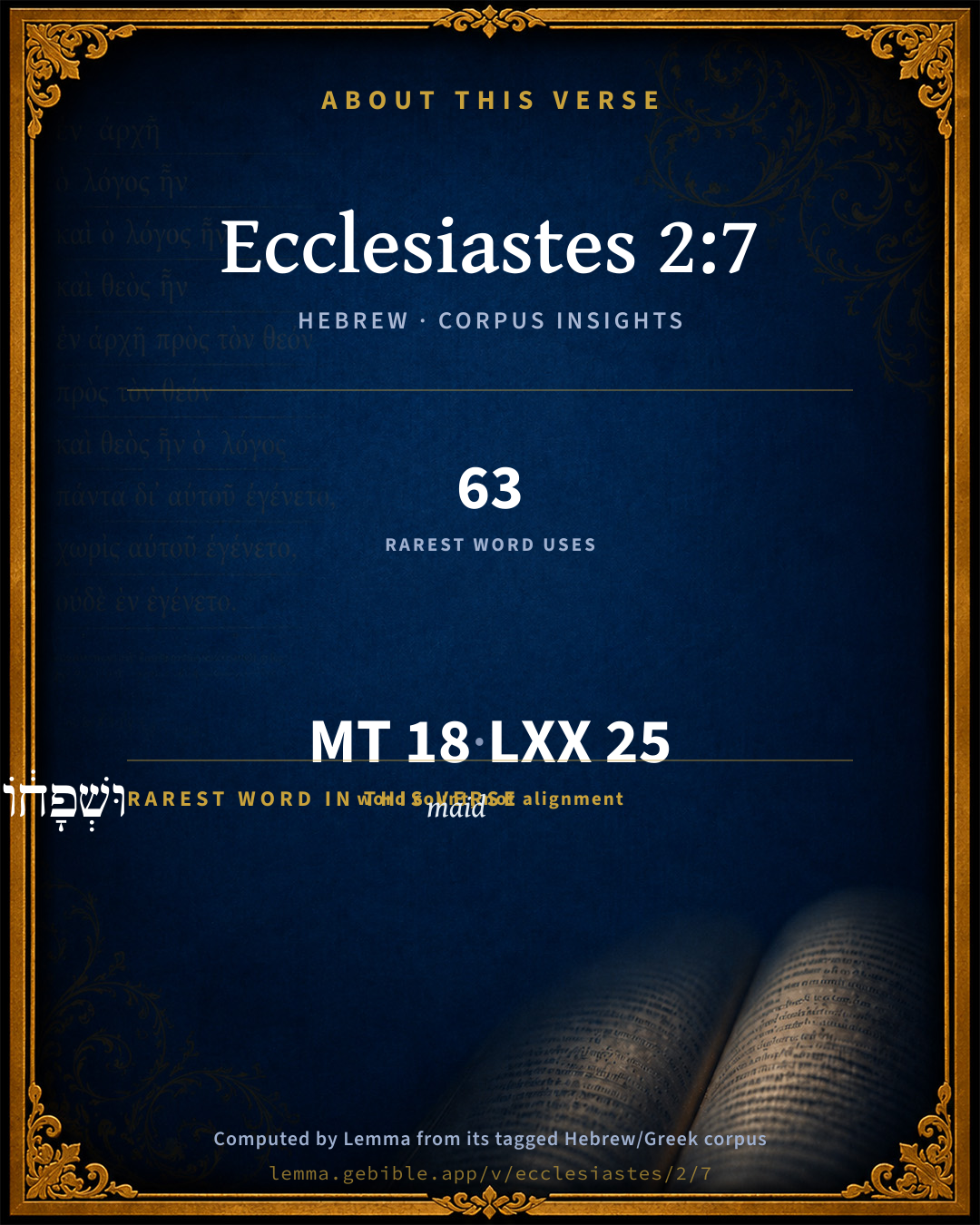
These counts appear in no published source. They are computed here, from the morphology-tagged text and Lemma’s own curated glosses. What Lemma adds →

18
words
14
distinct lemmas
Wisdom
section

Grammatical profile

  • 5 verbs
  • 10 nouns
  • 2 prepositions
  • 1 particle

Verb forms

  • קָנִ֨יתִי֙ Qal · Perfect
  • הָ֣יָה Qal · Perfect
  • הַרְבֵּה֙ Hiphil · Infinitive Absolute
  • הָ֣יָה Qal · Perfect
  • שֶֽׁהָי֥וּ Qal · Perfect

Repetition

A word recurs within this verse — often emphatic in Hebrew:

  • הָ֣יָה to be H1961 ×3

Hebrew & Septuagint length

In English translation the verse runs 29 words from the Hebrew and 31 from the Septuagint (LXX English) — closely comparable.

A rough comparison of the two English renderings, which tokenize alike — not a word-level alignment.

Word counts can differ between the Hebrew and the Greek without any difference in meaning — e.g. the Hebrew direct-object marker אֵת has no separate Greek word, and Greek often adds the article ὁ.

In the original languages it is 18 Hebrew tokens and 25 Greek tokens — but the two are counted differently (Hebrew bundles its prefixes and suffixes into one token; the Greek is in lemma form), so that isn’t a like-for-like length.

Cross-references

14

Topical passages linked to Ecclesiastes 2:7 in the Treasury of Scripture Knowledge — connected by theme and wording, ordered by reader-vote popularity; previews shown in the World English Bible.

  • Genesis 13:2 Abram was very rich in cattle, in silver, and in gold.
  • Genesis 14:14 When Abram heard that his relative was taken captive, he led forth his trained men, born in his house, three hundred and eighteen, and pursued as far as Dan.
  • Genesis 15:3 Abram said, "Behold, to me you have given no seed: and, behold, one born in my house is my heir."
  • Genesis 17:12–13 He who is eight days old will be circumcised among you, every male throughout your generations, he who is born in the house, or bought with money of any foreigner who is not of your seed.
  • 1 Kings 4:23 ten fat oxen, and twenty oxen out of the pastures, and one hundred sheep, besides harts, and gazelles, and roebucks, and fattened fowl.
  • 1 Kings 9:20–22 As for all the people who were left of the Amorites, the Hittites, the Perizzites, the Hivites, and the Jebusites, who were not of the children of Israel;
  • 2 Kings 3:4 Now Mesha king of Moab was a sheep-master; and he rendered to the king of Israel the wool of one hundred thousand lambs, and of one hundred thousand rams.
  • 1 Chronicles 27:29–31 and over the herds that fed in Sharon was Shitrai the Sharonite: and over the herds that were in the valleys was Shaphat the son of Adlai:
  • 2 Chronicles 26:10 He built towers in the wilderness, and hewed out many cisterns, for he had much cattle; in the lowland also, and in the plain: [and he had] farmers and vineyard keepers in the mountains and in the fruitful fields; for he loved farming.
  • 2 Chronicles 32:27–29 Hezekiah had exceeding much riches and honor: and he provided him treasuries for silver, and for gold, and for precious stones, and for spices, and for shields, and for all manner of goodly vessels;
  • Ezra 2:58 All the Nethinim, and the children of Solomon's servants, were three hundred ninety-two.
  • Nehemiah 7:57 The children of Solomon's servants: the children of Sotai, the children of Sophereth, the children of Perida,
  • Job 1:3 His possessions also were seven thousand sheep, three thousand camels, five hundred yoke of oxen, five hundred she-donkeys, and a very great household; so that this man was the greatest of all the children of the east.
  • Job 42:12 So Yahweh blessed the latter end of Job more than his beginning. He had fourteen thousand sheep, six thousand camels, one thousand yoke of oxen, and a thousand female donkeys.

Cross-references courtesy of OpenBible.info (CC BY 4.0).

Hebrew and Greek witnesses Masoretic Hebrew ↔ Greek Septuagint

The same verse in the two great witnesses to the Old Testament, shown verse-for-verse.

These are two independent witnesses, not word-aligned to each other, and the Septuagint is shown in lemma (dictionary) form.

Hebrew Ecclesiastes 2:7 Masoretic · Westminster Leningrad Codex

קָנִ֨יתִי֙ עֲבָדִ֣ים וּשְׁפָח֔וֹת וּבְנֵי בַ֖יִת הָ֣יָה לִ֑י גַּ֣ם מִקְנֶה֩ בָקָ֨ר וָצֹ֤אן הַרְבֵּה֙ הָ֣יָה לִ֔י מִכֹּ֛ל שֶֽׁהָי֥וּ לְפָנַ֖י בִּירוּשָׁלִָֽם

I bought men-servants and maid-servants, and had servants born in my house. I also had great possessions of herds and flocks, above all who were before me in Jerusalem;

World English Bible · Public Domain

Greek LXX Ecclesiastes 2:7 Septuagint · lemma form

κτάομαι δοῦλος καί παιδίσκη καί οἰκογενής γίγνομαι ἐγώ καί γέ κτῆσις βουλόλιον καί ποίμνιον πολύς γίγνομαι ἐγώ ὑπέρ πᾶς ὁ γίγνομαι ἔμπροσθεν ἐγώ ἐν ἰερουσαλήμ

I got servants and maidens, and servants were born to me in the house: also I had abundant possession of flocks and herds, beyond all who were before me in Jerusalem.

LXX2012 (modern English Septuagint) · Public Domain

On this verse, The Pulpit Commentary discusses the Septuagint’s reading. Read the note in Commentary ↓

Hebrew: Westminster Leningrad Codex (CC BY 4.0). Greek: Septuagint (public domain); English from LXX2012 (modern English Septuagint) (Public Domain). How the Septuagint differs from the Hebrew →

Commentary

Notes on Ecclesiastes 2:7 from classic Christian and Jewish commentators (each source and its license shown beneath its notes). The classic Christian expositions comment on the surrounding passage and are grouped to its opening verse, so a note may address several verses; the Jewish commentaries on the Tanakh (Rashi and others) are per-verse, so they appear only where the commentator wrote on this verse.

Lemma curates 59 commentaries, every one of them public domain or Creative Commons licensed, each selected and text-cleaned for this edition rather than reprinted as found. About our sources →

Trapp's Complete Commentary

John Trapp

Ecc 2:7 I got [me] servants and maidens, and had servants born in my house; also I had great possessions of great and small cattle above all that were in Jerusalem before me:

Ver. 7. I got me servants, &c.] Too many by one, viz., Jeroboam, who rent ten tribes from his son. It is well observed by an interpreter, that Solomon, among all his delights, got him not a fool or jester, which some princes cannot be without, no, not when they should be most serious. It is recorded of Henry III, king of France, that in a solemn procession at Paris, he could not be without his jester, who, walking between the king and the cardinal, made mirth to them both. {a} There was sweet devotion the while.

I had great possessions of great and small cattle.] Mηλα, {b} pecudes, et postea synechdochicos, opes significant: sic pecunia a pecude. So chesita signifies in Hebrew both money and a lamb.

{a} Epit. Hist. Gallica.

{b} Melanch., in Hesiod.

John Trapp, A Commentary or Exposition upon All the Books of the Old and New Testament (1647–1656) — public domain. Text from a community e-Sword module.

Keil & Delitzsch

C. F. Keil & F. Delitzsch

"I procured servants and maidens, and also I obtained servants born in the house; also the possession of flocks; I obtained many horned and small cattle before all who were in Jerusalem before me." The obtaining of these possessions is, according to Gen 17:12., to be understood of purchase. There is a distinction between the slaves, male and female (mancipia), obtained by purchase, and those who were home-born (vernae), the בּית (ילידי) בּני, who were regarded as the chief support of the house (Gen 14:14), on account of their attachment to it, and to this day are called (Arab.) fada wayyt, as those who offer themselves a sacrifice for it, if need be. Regarding לי היה, in the sense of increasing possession; and regarding היה for היוּ, vid., at Ecc 1:10, Ecc 1:16; at all events, the sing. of the pred. may be explained from this, that the persons and things named are thought of in the mass, as at Zac 11:5; Joe 1:20 (although the idea there may be also individualizing); but in the use of the pass., as at Gen 35:26; Dan 9:24, the Semite custom is different, inasmuch as for it the passive has the force of an active without a definite subject, and thus with the most general subject; and as to the case lying before us in Ecc 2:7, we see from Exo 12:49, cf. Gen 15:17, that היה (יהיה) in such instances is thought of as neut. According to Gen 26:14 and the passage before us, מקנה lay nearer than מקנה, but the primary form instead of the connecting form is here the traditional reading; we have thus apposition (Nebenordnung) instead of subordination (Annexion), as in zevahim shelamim, Exo 24:5, and in habbaqar hannehhosheth, Kg2 16:17, although vaqar vatson may also be interpreted as the accus. of the more accurate definition: the possession of flocks consisting in cattle and sheep. But this manner of construction is, for a book of so late an origin, too artificial. What it represents Solomon as saying is consistent with historical fact; at the consecration of the temple he sacrificed hecatombs, Kg1 8:63; and the daily supply for the royal kitchen, which will at the same time serve to show the extent of the royal household, was, according to Kg1 5:2., enormous.

There now follows the enumeration of riches and jewels which were a delight to the eye; and finally, the large provision made for revelling in the pleasures of music and of sensual love.

Keil & Delitzsch — Biblical Commentary on the Old Testament (1861–1891) — public domain (CC PDM 1.0). Text via the HelloAO Bible API. (Old Testament only.)

Tyndale Open Study Notes

Tyndale Open Resources

2:7 Solomon’s slaves, . . . large herds, and flocks were numerous, and caring for them consumed vast resources (1 Kgs 4:22-23; 9:20-21).

Tyndale Open Study Notes — © Tyndale Open Resources, licensed CC BY-SA 4.0. Text via the HelloAO Bible API.

Geneva Bible (1599)

Geneva Bible translators

Meaning, of the servants or slaves, which he had bought: so the children born in their servitude, were the masters.

Geneva Bible (1599) marginal notes — public domain. Text via Bolls.life.

Jamieson, Fausset & Brown

Robert Jamieson, A. R. Fausset & David Brown

born in my house--These were esteemed more trustworthy servants than those bought (Gen 14:14; Gen 15:2-3; Gen 17:12-13, Gen 17:27; Jer 2:14), called "songs of one's handmaid" (Exo 23:12; compare Gen 12:16; Job 1:3).

Jamieson, Fausset & Brown — Commentary Critical and Explanatory on the Whole Bible (1871) — public domain (CC PDM 1.0). Text via the HelloAO Bible API.

Adam Clarke's Commentary

Verse 7. Servants and maidens] For my works, fields, folds, and various domestic labors.

Servants born in any house] Besides those hired from without, he had married couples in the precincts of his grounds, palaces, etc., who, when their children grew up, got them employment with themselves.

Great and small cattle] Oxen, neat, horses, asses, mules, camels, and such like; with sheep and goats. And multitudes of most of these he needed, when we are told that his household consumed daily ten stall-fed oxen, with twenty from the pasture, with a hundred sheep; besides harts, roebucks, fallow deer, fatted fowls, and other kinds of provision. Probably, such another court for splendor and expense was not in the universe.

Adam Clarke's Commentary on the Bible (1810–1826) — public domain. Text from a community e-Sword/MySword module.

Ellicott's Commentary for English Readers

(7) Got me.—The servants acquired by purchase are distinguished from those born in the house. (Concerning the number of Solomon’s servants, see 1Ki_4:27; 1Ki_10:5; and of his cattle, 1Ki_4:23, 1Ki_8:63.)

A Bible Commentary for English Readers, edited by Charles John Ellicott (1878–1897) — public domain. Text from a community e-Sword module.

The Cambridge Bible for Schools and Colleges

gen. ed. J. J. S. Perowne

7. I got me servants and maidens] Better, I bought. The picture of Oriental state was incomplete without this element, and the slave trade, of which the Midianites were the chief representatives in the patriarchal history. (Gen_37:28), had probably been carried on without intermission, and supplied both the household and the harem of Solomon. In the Cushi of 2Sa_18:21, in his namesake of Jer_36:14, in Ebedmelech, the Cushite, or Ethiopian, of Jer_38:7, we have instances of the presence of such slaves in the royal households. The history of every ancient nation shews the universality of the traffic. Of these slaves each great household had two classes: (1) those “bought with money,” men of other races, captives in war, often, probably, negroes (Jer_38:7) who were employed in the more menial offices (Gen_11:11-12; Gen_11:23), and (2) those born in the house (Gen_14:14; Gen_15:3; Jer_2:14), the ‘sons of the handmaids’ (Exo_23:12), who rose into more confidential service, the οἰκογενεῖς of the Greeks, the vernae of the Latins. On the assumption that the book was written under the Ptolemies, their court would present the same features in an even more conspicuous manner.

great and small cattle] Better, oxen and sheep. The daily provision for Solomon’s household (1Ki_4:22) gives some idea of the magnitude of his flocks and herds. See also 1Ch_27:29; 1Ki_5:3.

The Cambridge Bible for Schools and Colleges (gen. ed. J. J. S. Perowne; Cambridge University Press, 1878–1918) — public domain. Text from a community e-Sword module.

John Gill's Exposition

I got me servants and maidens,.... Menservants, and maidservants; the Targum adds,

"of the children of Ham, and of the rest of the strange people;''

these were such as he hired, or bought with his money;

and had servants born in my house; and these were all employed by him; either as his retinue and equipage, his attendants and bodyguards; or to take care of his household, his gardens, and pools; or for his horses and chariots, and for various offices; see Kg1 4:26, Ezr 2:58. Villalpandus computes the number of his servants to be forty eight thousand; if there were any pleasure and happiness in such a numerous attendance, Solomon had it;

also I had great possessions of great and small cattle above all that were in Jerusalem before me; oxen, cows, horses, asses, camels, mules, &c. also sheep and goats; which, as they were profitable, so it was pleasant to see them grazing on the hills and valleys, in the fields, mountains, and meadows.

John Gill's Exposition of the Whole Bible (1746–1763) — public domain (CC PDM 1.0). Text via the HelloAO Bible API.

Albert Barnes' Notes on the Bible

I got - Rather, I bought, in distinction from those born in the house. The “children of Solomon’s servants” (compare Ezr 2:55, Ezr 2:58) were more probably of Canaanite origin 1Ki 9:20-21; 1Ki 5:15 than Hebrews 1Ki 9:22.

Possessions of great and small cattle - Rather, herds of oxen and sheep.

All ... before me - King David’s herds and flocks are mentioned in 1Ch 27:29, 1Ch 27:31 : but we have no specific account of the wealth of other Canaanite or Hebrew inhabitants of Jerusalem before Solomon.

Albert Barnes' Notes on the Bible (1834–1885) — public domain. Text from a community e-Sword/MySword module.

Haydock's Catholic Bible Commentary

Family of slaves, "born in my house," (Protestants) distinct from those whom I got for money. (Haydock) --- There were generally procured from foreign nations, as the Hebrews obtained their liberty on the sabbatic year. --- Sheep. David had the like; but Solomon had also horses, 3 Kings x. 21.

George Leo Haydock (1774–1849), Haydock's Catholic Family Bible and Commentary, 1859 edition — public domain. Excludes Psalms (Douay-Rheims chapter numbering differs from Protestant) and Deuterocanonical books (Catholic canon only).

Matthew Poole's English Annotations

Born in my house, of my bond-servants, which therefore were a part of my possessions: see 1Ki 10:8; Ezr 2:55.

Matthew Poole's English Annotations on the Holy Bible (1683–1685) — public domain. Text from a community e-Sword/MySword module.

Whedon's Commentary on the Bible

Daniel D. Whedon

7. Solomon had need of a vast amount of labour.

Got me servants — Hebrew, bought. He who studies the laws of Moses will see that such provision was made for servants that their condition was not one of slavery in its more objectionable sense. In fact, there is no Hebrew word for slave. The Hebrew bondman lost no right but that of the recompense of his own labour. If he was maimed by his master he became free. If he was killed by him, his master was slain by the sword. Greek, Roman, and American slavery was very different from this. The slave was, also, taught in the law; could not be delivered up if he ran away; could marry a daughter of his master; and a maidservant could be the lawful wife of her master or her master’s son. Servants, then, either purchased or born on the place, were not what we call slaves.

Great and small cattle — Hebrew, oxen and sheep. See the sacrifices at the dedication of the temple. 1Ki_8:63. Above all that were… before me — See remarks on Ecc_1:16.

Daniel D. Whedon (gen. ed.), Commentary on the Old and New Testaments (1874–1909) — public domain. Text from a community e-Sword module.

The Pulpit Commentary

I got me I bought, procuredservants and maidens. These are distinct from those mentioned immediately afterwards, servants born in my house; Septuagint, oijkogeneiv: called in the Hebrew, "sons of the house". (Gen_15:3) They were much more esteemed by their masters, and showed a much closer attachment to the family than the bought slaves or the conquered aboriginals, who were often reduced to this. (1Ki_9:20, 1Ki_9:21) The number of Solomon"s attendants excited the wonder of the Queen of Sheba, (1Ki_4:26, etc.; 1Ki_10:5) and with good reason, if Josephus"s account is to be believed. This writer asserts that the king had some thousand or more chariots, and twenty thousand horses. The drivers and riders were young men of comely aspect, tall and well-made; they had long flowing hair, and wore tunics of Tyrian purple, and powdered their hair with gold dust, which glittered in the rays of the sun ("Ant.," 8:7. 3). Attended by a cavalcade thus arrayed, Solomon used to betake himself to his "paradise" at Etham, to enjoy the refreshing coolness of its trees and pools. Great and small cattle; oxen and sheep. The enormous amount of Solomon"s herds and flocks is proved by the extraordinary multitude of the sacrifices at the consecration of the temple, (1Ki_8:63) and the lavish provision made daily for the wants of his. (1Ki_4:22, 1Ki_4:23) The cattle of David were very numerous, and required special overlookers. (1Ch_27:29-31) Job (Job_1:3) had, before his troubles, seven thousand sheep, three thousand camels, five hundred yoke of oxen, and five hundred she-asses, and these items were all doubled at the return of his prosperity. Among Solomon"s possessions, horses are not here mentioned, though they formed no inconsiderable portion of his live stock, and added greatly to his magnificence. Koheleth, perhaps, avoided boasting of this extravagance in consideration of the religious sentiment which was strongly opposed to such a feature. That were in Jerusalem before me. (so ver. 9; see Ecc_1:16) But the reference here may not necessarily be to kings, but to chieftains and rich men, who were celebrated for the extent of their possessions.

The Pulpit Commentary (1880–1919), ed. H.D.M. Spence-Jones & Joseph S. Exell — public domain. Text from a community e-Sword module.

unfoldingWord translationNotes

Door43 World Missions Community

I had slaves born in my palace

"I had slaves that were born in my palace" or "My slaves bore children and they also were my slaves"

much more than any king

The understood verb may be supplied. AT: "much more than any other king had" (See: Ellipsis)

the treasures of kings and provinces

This refers to the gold and other wealth that neighboring countries were forced to pay to the king of Israel. AT: "that I acquired from the treasures of kings and the rulers of provinces" (See: Assumed Knowledge and Implicit Information)

provinces

Here "provinces" represents the rulers of the provinces. AT: "the rulers of provinces" (See: Metonymy)

the delights of the children of humanity—and many concubines

This means that he had many concubines that he enjoyed sleeping with, as any man enjoys sleeping with women. AT: "I greatly enjoyed many concubines, as would delight any man" (See: Assumed Knowledge and Implicit Information)

translationWords

servant

palace

flocks

livestock

king

rule

Jerusalem

silver

gold

province

concubine

unfoldingWord translationNotes — © Distant Shores Media and the Door43 World Missions Community, licensed CC BY-SA 4.0. Source: git.door43.org/Door43/en_tn.

Lesson kit

Teaching starters — assembled from the data on this page, not authored interpretation. Every prompt links to the verse data it draws on. Edit before teaching.

Ecclesiastes, in the Wisdom, opens this verse with 18 words (14 distinct Hebrew lemmas). Its most distinctive word is shiphchâh (“maid”). A historical commentator’s framing appears above. Read the whole chapter for the surrounding context.

Discussion questions

  1. The word shiphchâh carries the sense “maid.” How does it shape the verse?
  2. How does Genesis 13:2, which shares this passage’s theme, read alongside this verse?
  3. What does the repetition of “to be” (3× in this one verse) do in this verse?
  4. These translations render this verse differently; the difference is in the English rendering, not the original. What questions does that raise?
  5. «קָנִ֨יתִי֙» is a Qal Perfect verb. How does that grammatical form shape the action described?
  6. Compare how Trapp's Complete Commentary and Keil & Delitzsch read this verse. Where do they agree or differ?

Things to notice

Reading settings

Reading text

Shown beneath each verse's original-language words.

Old Testament
Old Testament edition

Read the OT as the Masoretic Hebrew (MT) or the Greek Septuagint (LXX).

English shown for the Greek Septuagint (in the Hebrew ↔ Greek comparison).

Comparing translations? Open the Compare panel on any verse page to stack up to four side by side.