
Ezra 8:29

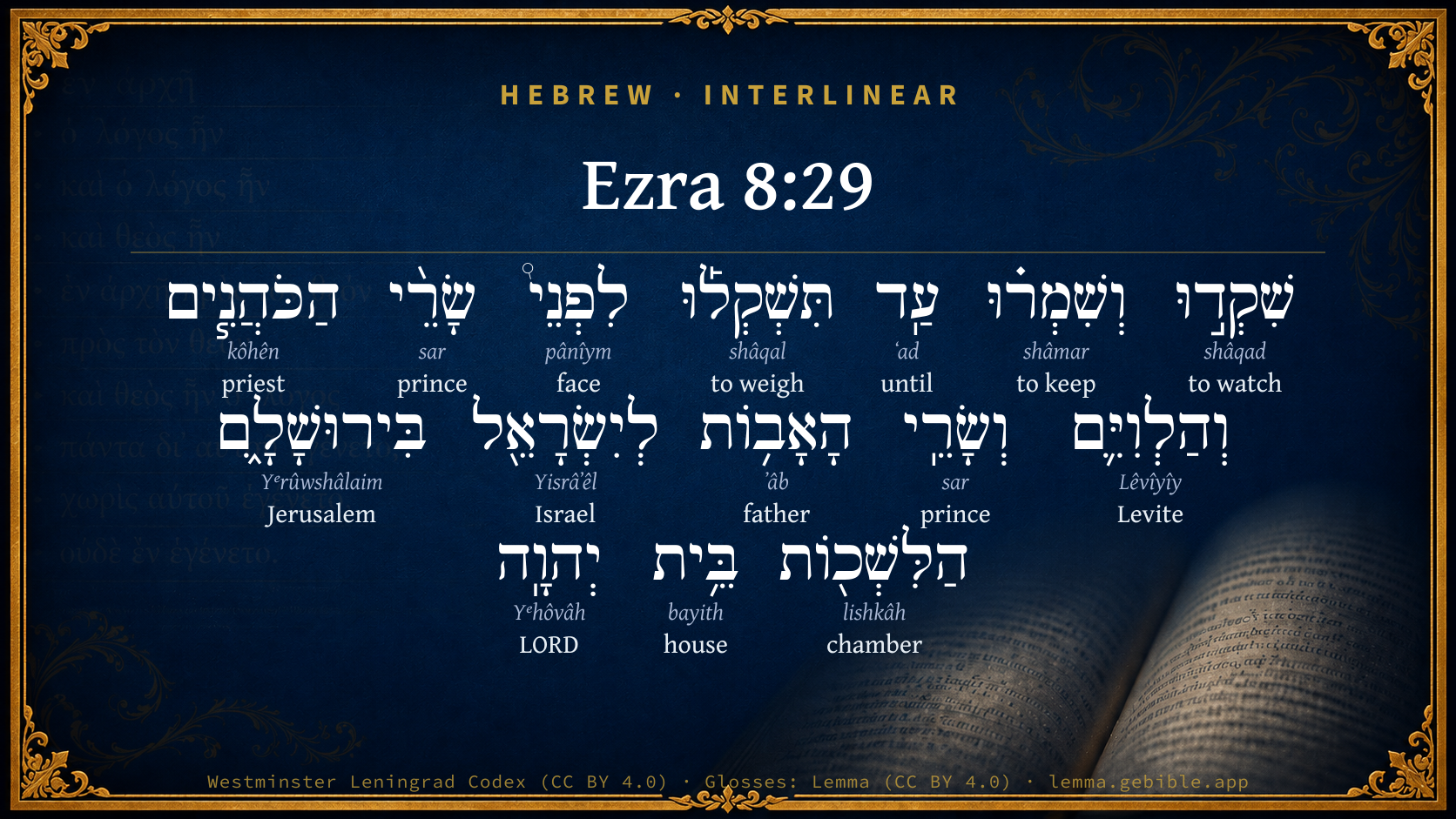
Hebrew (Westminster Leningrad Codex) Ezra 8:29 appears in the Hebrew Old Testament. The text above is from the Westminster Leningrad Codex. Each word links to its Strong’s number, a concise gloss, and parsing drawn from the Open Scriptures Hebrew Bible morphology. Click any word for its full Brown-Driver-Briggs (BDB) entry.
Download image
Cite this verse

Ezra 8:29 (World English Bible). Public Domain. Lemma interlinear Bible study tool, https://lemma.gebible.app/v/ezra/8/29.

Show BibTeX & RIS
BibTeX
RIS
English Translation
Watch you, and keep them, until you weigh them before the chiefs of the priests and the Levites, and the princes of the fathers' [houses] of Israel, at Jerusalem, in the chambers of the house of Yahweh.
World English Bible · Public Domain
Highlights
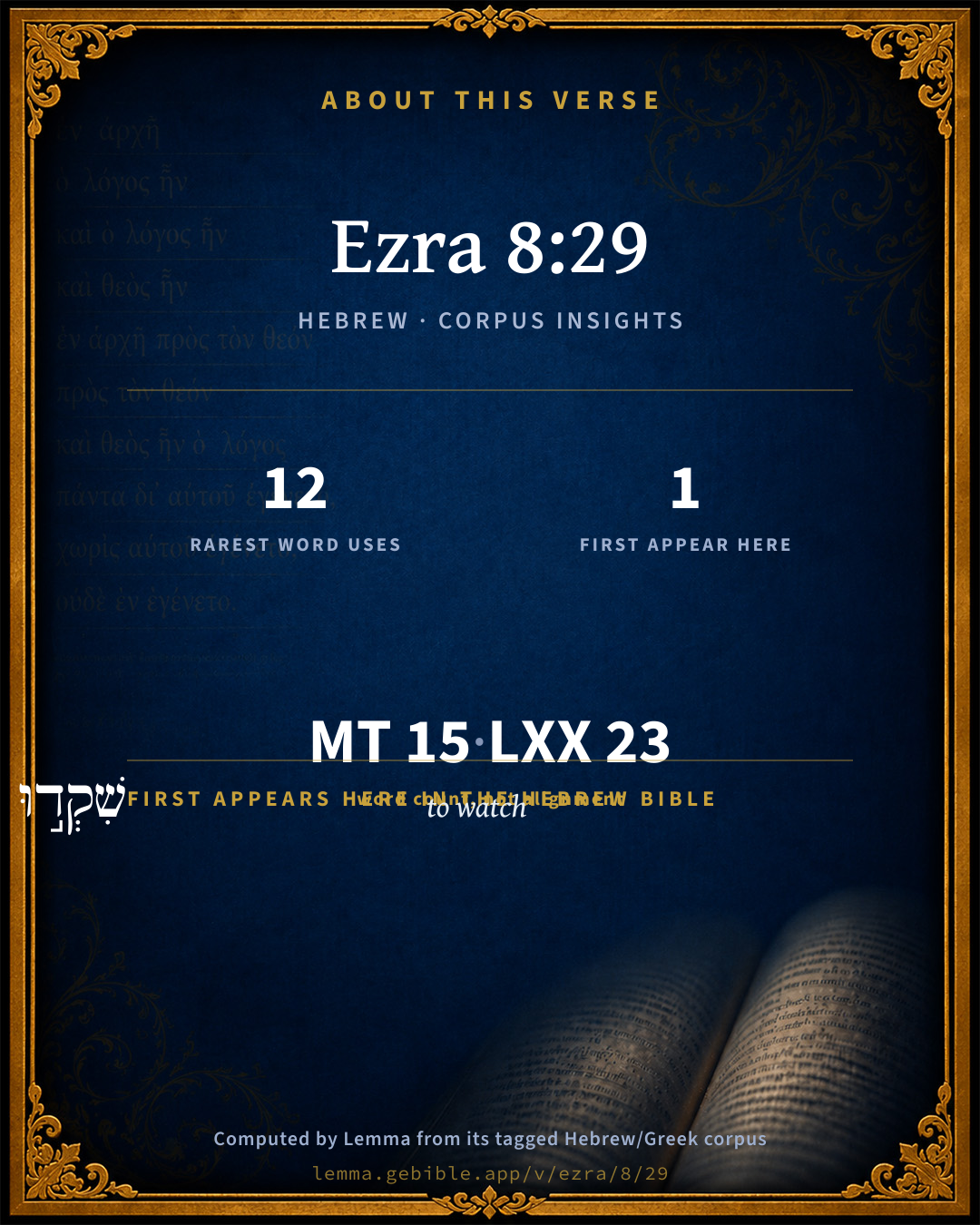
  • 1 first appearance in the Hebrew Bible
Full analysis ↓
Download a study sheet

One document with this verse’s original text, its word-by-word gloss line, the meaning frame, cross-references with their text, attributed commentary, and full source and license credits — printable, and it pastes into notes with its structure intact.

This verse Autodidact and up

Study sheet (.html) Plain text (.txt)

A passage Seminary Student

Up to 50 verses in one chapter. A passage sheet keeps up to 6 commentary sources and 12 cross-references per verse, in the order this page ranks them, and says so on the sheet whenever that leaves anything out. Ask for a single verse and you get the Autodidact verse sheet above.

Everything on this page stays free to read, with no account — the sheet is a download of what is already on screen, not access to it.

Want to remove ads? Support Godless Engineer
Compare translations 3

The same verse in 3 English versions, stacked beneath the original-language interlinear above. Click any original word for its lexicon entry.

Each is an independent rendering of the whole verse — the interlinear is not word-aligned to these translations.

Highlighted words mark where these versions differ — a whole-verse word diff, not a word-by-word alignment.

  • World English Bible Public Domain
    Watch you, and keep them, until you weigh them before the chiefs of the priests and the Levites, and the princes of the fathers' [houses] of Israel, at Jerusalem, in the chambers of the house of Yahweh.
  • King James Version Public Domain
    Watch ye, and keep them, until ye weigh them before the chief of the priests and the Levites, and chief of the fathers of Israel, at Jerusalem, in the chambers of the house of the LORD.
  • unfoldingWord Literal Text CC BY-SA 4.0
    Watch and keep until you weigh them out before the face of the leaders of the priests and the Levites and the leaders of the fathers of Israel, at Jerusalem, in the chambers of the house of Yahweh.”

unfoldingWord Literal Text — © unfoldingWord, licensed CC BY-SA 4.0. Word-aligned USFM3 via Door43 (git.door43.org/unfoldingWord/en_ult).

Versions to compare (up to 4)

3 of 4 selected

Show all 18 translations

Every available English version of this verse, each an independent rendering of the whole verse.

  • World English Bible Public Domain
    Watch you, and keep them, until you weigh them before the chiefs of the priests and the Levites, and the princes of the fathers' [houses] of Israel, at Jerusalem, in the chambers of the house of Yahweh.
  • Berean Standard Bible Public Domain
    Guard them carefully until you weigh them out in the chambers of the house of the LORD in Jerusalem before the leading priests, Levites, and heads of the Israelite families.”
  • Majority Standard Bible Public Domain
    Guard them carefully until you weigh them out in the chambers of the house of the LORD in Jerusalem before the leading priests, Levites, and heads of the Israelite families.”
  • King James Version Public Domain
    Watch ye, and keep them, until ye weigh them before the chief of the priests and the Levites, and chief of the fathers of Israel, at Jerusalem, in the chambers of the house of the LORD.
  • American Standard Version (1901) Public Domain
    Watch ye, and keep them, until ye weigh them before the chiefs of the priests and the Levites, and the princes of the fathers' `houses' of Israel, at Jerusalem, in the chambers of the house of Jehovah.
  • Revised Version (1885) Public Domain
    Watch ye, and keep them, until ye weigh them before the chiefs of the priests and the Levites, and the princes of the fathers’ houses of Israel, at Jerusalem, in the chambers of the house of the LORD.
  • Geneva Bible (1599) Public Domain
    Watch ye, and keepe them vntill ye weigh them before the chiefe Priestes and the Leuites, and the chiefe fathers of Israel in Ierusalem in the chambers of the house of the Lord.
  • Douay-Rheims (1899) Public Domain
    Watch ye and beep them, till you deliver them by weight before the chief of the priests, and of the Levites, and the heads of the families of Israel in Jerusalem, into the treasure of the house of the Lord.
  • Young's Literal Translation Public Domain
    watch, and keep, till ye weigh before the heads of the priests, and of the Levites, and the heads of the fathers of Israel, in Jerusalem, in the chambers of the house of Jehovah.'
  • Literal Standard Version CC BY-SA 4.0
    watch, and keep, until you weigh before the heads of the priests, and of the Levites, and the heads of the fathers of Israel, in Jerusalem, in the chambers of the house of YHWH.”
  • Unlocked Literal Bible CC BY-SA 4.0
    Watch over them and keep them until you weigh them out before the priestly officials, Levites, and leaders of the ancestors' clans of Israel in Jerusalem in the rooms of God's house.”
  • unfoldingWord Literal Text CC BY-SA 4.0
    Watch and keep until you weigh them out before the face of the leaders of the priests and the Levites and the leaders of the fathers of Israel, at Jerusalem, in the chambers of the house of Yahweh.”
  • Darby Bible Public Domain
    Watch and keep [them] until ye weigh them before the chiefs of the priests and the Levites, and the chiefs of the fathers of Israel, at Jerusalem, in the chambers of the house of Jehovah.
  • World Messianic Bible Public Domain
    Watch and keep them until you weigh them before the chiefs of the priests, the Levites, and the princes of the fathers’ households of Israel at Jerusalem, in the rooms of the LORD’s house.”
  • Webster's Bible Public Domain
    Watch ye, and keep them, until ye weigh them, before the chief of the priests and the Levites, and chief of the fathers of Israel, at Jerusalem, in the chambers of the house of the LORD.
  • Free Bible Version CC BY-SA 4.0
    You are to guard them and keep them safe until you hand them over, weighing them before the high priests, the Levites and the family leaders in Israel at Jerusalem, in the treasury rooms within the Lord's Temple.”
  • Bible in Basic English Public Domain
    Take care of them and keep them, till you put them on the scales before the chiefs of the priests and the Levites and the chiefs of the families of Israel, in Jerusalem, in the rooms of the house of the Lord.
  • JPS Tanakh (1917) Public Domain
    Watch ye, and keep them, until ye weigh them before the chiefs of the priests and the Levites, and the princes of the fathers' houses of Israel, at Jerusalem, in the chambers of the house of the LORD.'

Literal Standard Version (2020), Covenant Press — licensed CC BY-SA 4.0. Text via the HelloAO Bible API (eBible.org). Unlocked Literal Bible (unfoldingWord) — licensed CC BY-SA 4.0. Text via the HelloAO Bible API (eBible.org). unfoldingWord Literal Text — © unfoldingWord, licensed CC BY-SA 4.0. Word-aligned USFM3 via Door43 (git.door43.org/unfoldingWord/en_ult). Free Bible Version, Dr. Jonathan Gallagher — licensed CC BY-SA 4.0. Text via the HelloAO Bible API (eBible.org).

Word by word

More ways to search: Search by grammar → Find every occurrence → Compare this word →

Practice this passage: Drill this verse → Learn its vocabulary →

שִׁקְד֣וּ
shâqad
H8245
“watch”
Verb, Qal, Imperative, 2nd Person, Masculine, Plural
Part of Speech
Verb
Stem
Qal
Form
Imperative
Person
2nd Person
Gender
Masculine
Number
Plural
Full BDB Definition

Origin: a primitive root

TWOT: 2451

to wake, watch, awake, be alert - (Qal) - to keep watch of, be wakeful over - to be wakeful, wake (as mourner or sufferer)
  1. וְשִׁמְר֗וּ shâmar H8104 “and · keep” Conjunction + Verb, Qal, Imperative, 2nd Person, Masculine, Plural
  2. עַֽד ʻad H5704 “until” Preposition
  3. תִּשְׁקְל֡וּ shâqal H8254 “to weigh” Verb, Qal, Imperfect, 2nd Person, Masculine, Plural
  4. לִפְנֵי֩ pânîym H6440 “to/for · face(s) of” Preposition + Noun, Common, Both, Plural, Construct
  5. שָׂרֵ֨י sar H8269 “princes of” Noun, Common, Masculine, Plural, Construct
  6. הַכֹּהֲנִ֧ים kôhên H3548 “the · priests” Particle, Definite Article + Noun, Common, Masculine, Plural, Absolute
  7. וְהַלְוִיִּ֛ם Lêvîyîy H3881 “and · the · Levites” Conjunction + Particle, Definite Article + Noun, Gentilic, Masculine, Plural, Absolute
  8. וְשָׂרֵֽי sar H8269 “and · princes of” Conjunction + Noun, Common, Masculine, Plural, Construct
  9. הָאָב֥וֹת ʼâb H1 “the · fathers” Particle, Definite Article + Noun, Common, Masculine, Plural, Absolute
  10. לְיִשְׂרָאֵ֖ל Yisrâʼêl H3478 “to/for · Israel” Preposition + Noun, Proper
  11. בִּירוּשָׁלִָ֑ם Yᵉrûwshâlaim H3389 “in/at · Jerusalem” Preposition + Noun, Proper
  12. הַלִּשְׁכ֖וֹת lishkâh H3957 “the · chambers of” Particle, Definite Article + Noun, Common, Feminine, Plural, Construct
  13. בֵּ֥ית bayith H1004 “house of” Noun, Common, Masculine, Singular, Construct
  14. יְהוָֽה Yᵉhôvâh H3068 “LORD” Noun, Proper

About this verse

These counts appear in no published source. They are computed here, from the morphology-tagged text and Lemma’s own curated glosses. What Lemma adds →

15
words
14
distinct lemmas
Historical
section

Notable vocabulary

The rarest word here is שִׁקְד֣וּ to watch H8245 — appearing just 12 times in the whole Hebrew Bible.

First appearance in Scripture

This word makes its first canonical appearance in the Hebrew Bible here:

  • שִׁקְד֣וּ to watch H8245

Shared distinctive vocabulary

שִׁקְד֣וּ to watch H8245 occurs in 11 verses of the Hebrew Bible. Also found in:

Grammatical profile

  • 3 verbs
  • 11 nouns
  • 1 preposition

Verb forms

  • שִׁקְד֣וּ Qal · Imperative
  • וְשִׁמְר֗וּ Qal · Imperative
  • תִּשְׁקְל֡וּ Qal · Imperfect

Repetition

A word recurs within this verse — often emphatic in Hebrew:

  • שָׂרֵ֨י prince H8269 ×2

Hebrew & Septuagint length

In English translation the verse runs 37 words from the Hebrew and 32 from the Septuagint (LXX English) — closely comparable.

A rough comparison of the two English renderings, which tokenize alike — not a word-level alignment.

Word counts can differ between the Hebrew and the Greek without any difference in meaning — e.g. the Hebrew direct-object marker אֵת has no separate Greek word, and Greek often adds the article ὁ.

In the original languages it is 15 Hebrew tokens and 23 Greek tokens — but the two are counted differently (Hebrew bundles its prefixes and suffixes into one token; the Greek is in lemma form), so that isn’t a like-for-like length.

Cross-references

5

Topical passages linked to Ezra 8:29 in the Treasury of Scripture Knowledge — connected by theme and wording, ordered by reader-vote popularity; previews shown in the World English Bible.

  • Ezra 8:33–34 On the fourth day the silver and the gold and the vessels were weighed in the house of our God into the hand of Meremoth the son of Uriah the priest; and with him was Eleazar the son of Phinehas; and with them was Jozabad the son of Jeshua, and Noadiah the son of Binnui, the Levite;
  • 1 Chronicles 26:20–26 Of the Levites, Ahijah was over the treasures of the house of God, and over the treasures of the dedicated things.
  • Mark 13:34–35 "It is like a man, traveling to another country, having left his house, and given authority to his servants, and to each one his work, and also commanded the doorkeeper to keep watch.
  • Acts 20:31 Therefore watch, remembering that for a period of three years I didn't cease to admonish everyone night and day with tears.
  • 2 Timothy 4:5 But you be sober in all things, suffer hardship, do the work of an evangelist, and fulfill your ministry.

Cross-references courtesy of OpenBible.info (CC BY 4.0).

Hebrew and Greek witnesses Masoretic Hebrew ↔ Greek Septuagint

The same verse in the two great witnesses to the Old Testament, shown verse-for-verse.

These are two independent witnesses, not word-aligned to each other, and the Septuagint is shown in lemma (dictionary) form.

Hebrew Ezra 8:29 Masoretic · Westminster Leningrad Codex

שִׁקְד֣וּ וְשִׁמְר֗וּ עַֽד תִּשְׁקְל֡וּ לִפְנֵי֩ שָׂרֵ֨י הַכֹּהֲנִ֧ים וְהַלְוִיִּ֛ם וְשָׂרֵֽי הָאָב֥וֹת לְיִשְׂרָאֵ֖ל בִּירוּשָׁלִָ֑ם הַלִּשְׁכ֖וֹת בֵּ֥ית יְהוָֽה

Watch you, and keep them, until you weigh them before the chiefs of the priests and the Levites, and the princes of the fathers' [houses] of Israel, at Jerusalem, in the chambers of the house of Yahweh.

World English Bible · Public Domain

Greek LXX Ezra 8:29 Septuagint · lemma form

ἀγρυπνέω καί τηρέω ἕως ἵστημι ἐνώπιον ἄρχων ὁ ἱερεύς καί ὁ λευείτης καί ὁ ἄρχων ὁ πατριά ἐν ἰερουσαλήμ εἰς σκηνή οἶκος κύριος

Be watchful and keep them, until you⌃ weigh them before the chief priests and the Levites, and the chiefs of families in Jerusalem, at the chambers of the house of the Lord.

LXX2012 (modern English Septuagint) · Public Domain

In the Septuagint this is one book — Esdras B (2 Esdras): Ezra is chapters 1–10, Nehemiah 11–23.

On this verse, The Cambridge Bible for Schools and Colleges discusses the Septuagint’s reading. Read the note in Commentary ↓

Hebrew: Westminster Leningrad Codex (CC BY 4.0). Greek: Septuagint (public domain); English from LXX2012 (modern English Septuagint) (Public Domain). How the Septuagint differs from the Hebrew →

Commentary

Notes on Ezra 8:29 from classic Christian and Jewish commentators (each source and its license shown beneath its notes). The classic Christian expositions comment on the surrounding passage and are grouped to its opening verse, so a note may address several verses; the Jewish commentaries on the Tanakh (Rashi and others) are per-verse, so they appear only where the commentator wrote on this verse.

Lemma curates 59 commentaries, every one of them public domain or Creative Commons licensed, each selected and text-cleaned for this edition rather than reprinted as found. About our sources →

Trapp's Complete Commentary

John Trapp

Ezr 8:29 Watch ye, and keep [them], until ye weigh [them] before the chief of the priests and the Levites, and chief of the fathers of Israel, at Jerusalem, in the chambers of the house of the LORD.

Ver. 29. Watch ye] With utmost care and solicitude, as the word signifieth. How much more should we watch and treble watch, {as Luk 12:37-38; Luk 12:43} to keep our vessels (bodies) in sanctification and honour, not in the lust of concupiscence, &c.! especially since Adversus maiora vigilantibus quaedam incautis minutiora surrepant, and Satan worketh strongest on the fancy when the soul is sleepy, or a little drowsy (Aug.). Watch ye therefore and keep. This lesson had need to be often rung in our ears.

John Trapp, A Commentary or Exposition upon All the Books of the Old and New Testament (1647–1656) — public domain. Text from a community e-Sword module.

MacLaren's Expositions of Holy Scripture

Alexander MacLaren

Ezra

THE CHARGE OF THE PILGRIM PRIESTS

Ezr 8:29.

The little band of Jews, seventeen hundred in number, returning from Babylon, had just started on that long pilgrimage, and made a brief halt in order to get everything in order for their transit across the desert; when their leader Ezra, taking count of his men, discovers that amongst them there are none of the priests or Levites. He then takes measures to reinforce his little army with a contingent of these, and entrusts to their special care a very valuable treasure in gold, and silver, and sacred vessels, which had been given to them for use in the house of the Lord. The words which I have taken as text are a portion of the charge which he gave to those twelve priestly guardians of the precious things, that were to be used in worship when they got back to the Temple. ‘Watch and keep them, until ye weigh them in the chambers of the house of the Lord.’

So I think I may venture, without being unduly fanciful, to take these words as a type of the injunctions which are given to us Christian people; and to see in them a striking and picturesque representation of the duties that devolve upon us in the course of our journey across the desert to the Temple-Home above.

And to begin with, let me remind you, for a moment or two, what the precious treasure is which is thus entrusted to our keeping and care. We can scarcely, in such a connection and with such a metaphor, forget the words of our Lord about a certain king that went to receive his kingdom, and to return; who called together his servants, and gave to each of them according to their several ability, with the injunction to trade upon that until he came. The same metaphor which our Master employed lies in this story before us-in the one case, sacrificial vessels and sacred treasures; in the other case, the talents out of the rich possessions of the departing king.

Nor can we forget either the other phase of the same figure which the Apostle employs when he says to his ‘own son’ and substitute, Timothy: ‘That good thing which was committed unto thee, keep by the Holy Ghost which dwelleth in us,’ nor that other word to the same Timothy, which says: ‘O Timothy! keep that which was committed to thy trust, and avoid profane and vain babblings, and oppositions of science, falsely so called.’ In these quotations, the treasure, and the rich deposit, is the faith once delivered to the saints; the solemn message of love and peace in Jesus Christ, which was entrusted, first of all to those preachers, but as truly to every one of Christ’s disciples.

So, then, the metaphor is capable of two applications. The first is to the rich treasure and solemn trust of our own nature, of our own souls; the faculties and capacities, precious beyond all count, rich beyond all else that a man has ever received. Nothing that you have is half so much as that which you are. The possession of a soul that knows and loves, and can obey; that trusts and desires; that can yearn and reach out to Jesus Christ, and to God in Christ; of a conscience that can yield to His command; and faculties of comprehending and understanding what comes to them from Jesus Christ-that is more than any other possession, treasure, or trust. That which you and I carry with us-the infinite possibilities of these awful spirits of ours-the tremendous faculties which are given to every human soul, and which, like a candle plunged into oxygen, are meant to burn far more brightly under the stimulus of Christian faith and the possession of God’s truth, are the rich deposit committed to our charge. You priests of the living God, you men and women, you say that you are Christ’ s, and therefore are consecrated to a nobler priesthood than any other-to you is given this solemn charge: ‘That good thing which is committed unto thee, keep by the Holy Ghost that dwelleth in you.’ The precious treasure of your own natures, your own hearts, your own understandings, wills, consciences, desires-keep these, until they are weighed in the house of the Lord in Jerusalem.

And in like manner, taking the other aspect of the metaphor-we have given to us, in order that we may do something with it, that great deposit and treasure of truth, which is all embodied and incarnated in Jesus Christ our Lord. It is bestowed upon us that we may use it for ourselves, and in order that we may carry it triumphantly all through the world. Possession involves responsibility always. The word of salvation is given to us. If we go tampering with it, by erroneous apprehension, by unfair usage, by failing to apply it to our own daily life; then it will fade and disappear from our grasp. It is given to us in order that we may keep it safe, and carry it high up across the desert, as becomes the priests of the most high God.

The treasure is first-our own selves-with all that we are and may be, under the stimulating and quickening influence of His grace and Spirit. The treasure is next-His great word of salvation, once delivered unto the saints, and to be handed on, without diminution or alteration in its fair perspective and manifold harmonies, to the generations that are to come. So, think of yourselves as the priests of God, journeying through the wilderness, with the treasures of the Temple and the vessels of the sacrifice for your special deposit and charge.

Further, I touch on the command, the guardianship that is here set forth. ‘Watch ye, and keep them.’ That is to say, I suppose, according to the ordinary idiom of the Old Testament, ‘Watch, in order that you may keep.’ Or to translate it into other words: The treasure which is given into our hands requires, for its safe preservation, unceasing vigilance. Take the picture of my text: These Jews were four months, according to the narrative, in travelling from their first station upon their journey to Jerusalem across the desert. There were enemies lying in wait for them by the way. With noble self-restraint and grand chivalry, the leader of the little band says: ‘I was ashamed to require of the king a band of soldiers and horsemen, to help us against the enemy in the way; because we had spoken unto the king, saying, The hand of our God is upon all them for good that seek Him; but His power and His wrath is against all that forsake Him.’ And so they would not go to him, cap in hand, and ask him to give them a guard to take care of them; but ‘We fasted and besought our God for this; and He was intreated of us.’

Thus the little company, without arms, without protection, with nothing but a prayer and a trust to make them strong, flung themselves into the pathless desert with all those precious things in their possession; and all the precaution which Ezra took was to lay hold of the priests in the little party, and to say: ‘Here! all through the march do you stick by these precious things. Whoever sleeps, do you watch. Whoever is careless, be you vigilant. Take these for your charge, and remember I weigh them here before we start, and they will be all weighed again when we get there. So be alert.’

And is not that exactly what Christ says to us? ‘Watch; keep them; be vigilant, that ye may keep; and keep them, because they will be weighed and registered when you arrive there.’

I cannot do more than touch upon two or three of the ways in which this charge may be worked out, in its application for ourselves, beginning with that first one which is implied in the words of the text-unslumbering vigilance; then trust, like the trust which is glorified in the context, depending only on ‘the good hand of our God upon us’; then purity, because, as Ezra said, ‘Ye are holy unto the Lord. The vessels are holy also’; and therefore ye are the fit persons to guard them. And besides these, there is, in our keeping our trust, a method which does not apply to the incident before us; namely, use, in order to their preservation.

That is to say, first of all, no slumber; not a moment’s relaxation; or some of those who lie in wait for us on the way will be down upon us, and some of the precious things will go. While all the rest of the wearied camp slept, the guardians of the treasure had to outwatch the stars. While others might straggle on the march, lingering here or there, or resting on some patch of green, they had to close up round their precious charge; others might let their eyes wander from the path, they had ever to look to their charge. For them the journey had a double burden, and unslumbering vigilance was their constant duty.

We likewise have unslumberingly and ceaselessly to watch over that which is committed to our charge. For, depend upon it, if for an instant we turn away our heads, the thievish birds that flutter over us will be down upon the precious seed that is in our basket, or that we have sown in the furrows, and it will be gone. Watch, that ye may keep.

And then, still further, see how in this story before us there are brought out very picturesquely, and very simply, deeper lessons still. It is not enough that a man shall be for ever keeping his eye upon his own character and his own faculties, and seeking sedulously to cultivate and improve them, as he that must give an account. There must be another look than that. Ezra said, in effect, ‘Not all the cohorts of Babylon can help us; and we do not want them. We have one strong hand that will keep us safe’; and so he, and his men, with all this mass of wealth, so tempting to the wild robbers that haunted the road, flung themselves into the desert, knowing that all along it there were, as he says, ‘such as lay in wait for them.’ His confidence was: ‘God will bring us all safe out to the end there; and we shall carry every glittering piece of the precious things that we brought out of Babylon right into the Temple of Jerusalem.’ Yet he says, ‘Watch ye and keep them.’

What does that come to in reference to our religious experience? Why this: ‘Work out your own salvation with fear and trembling; for it is God that worketh in you, both to will and to do of His own good pleasure.’ You do not need these external helps. Fling yourself wholly upon His keeping hand, and also watch and keep yourselves. ‘I know in whom I have believed, and that He is able to keep that which I have committed unto Him against that day,’ is the complement of the other words, ‘That good thing which was committed unto thee, keep by the Holy Ghost.’

So guardianship is, first, unceasing vigilance; and then it is lowly trust. And besides that, it is punctilious purity. ‘I said unto them, Ye are holy unto the Lord; the vessels are holy unto the Lord. Watch ye, and keep them.’

It was fitting that priests should carry the things that belonged to the Temple. No other hands but consecrated hands had a right to touch them. To none other guardianship but the guardianship of the possessors of a symbolic and ceremonial purity, could the vessels of a symbolic and ceremonial worship be entrusted; and to none others but the possessors of real and spiritual holiness can the treasures of the true Temple, of an inward and spiritual worship, be entrusted. ‘Be ye clean that bear the vessels of the Lord,’ said Isaiah using a kindred metaphor. The only way to keep our treasure undiminished and untarnished, is to keep ourselves pure and clean.

And, lastly, we have to exercise a guardianship which not only means unslumbering vigilance, lowly trust, punctilious purity, but also requires the constant use of the treasure.

‘Watch ye, and keep them.’ Although the vessels which those priests bore through the desert were used for no service during all the weary march, they weighed just the same when they got to the end as at the beginning; though, no doubt, even their fine gold had become dim and tarnished through disuse. But if we do not use the vessels that are entrusted to our care, they will not weigh the same. The man that wrapped up his talent in the napkin, and said, ‘Lo, there thou hast that is thine,’ was too sanguine. There was never an unused talent rolled up in a handkerchief yet, but when it was taken out and put into the scales it was lighter than when it was committed to the keeping of the earth. Gifts that are used fructify. Capacities that are strained to the uttermost increase. Service strengthens the power for service; and just as the reward for work is more work, the way for making ourselves fit for bigger things is to do the things that are lying by us. The blacksmith’s arm, the sailor’s eye, the organs of any piece of handicraft, as we all know, are strengthened by exercise; and so it is in this higher region.

And so, dear brethren, take these four words-vigilance, trust, purity, exercise. ‘Watch ye, and keep them, until they are weighed in the chambers of the House of the Lord.’

And, lastly, think of that weighing in the House of the Lord. Cannot you see the picture of the little band when they finally reach the goal of their pilgrimage; and three days after they arrived, as the narrative tells us, went up into the Temple, and there, by number and by weight, rendered up their charge, and were clear of their responsibility? ‘And the first came and said, Lord, thy pound hath gained ten pounds. And he said, Well, thou good servant, because thou hast been faithful in a very little, have thou authority over ten cities.’

Oh! how that thought of the day when they would empty out the rich treasure upon the marble pavement, and clash the golden vessels into the scales, must have filled their hearts with vigilance during all the weary watches, when desert stars looked down upon the slumbering encampment, and they paced wakeful all the night. And how the thought, too, must have filled their hearts with joy, when they tried to picture to themselves the sigh of satisfaction, and the sense of relief with which, after all the perils, their ‘feet would stand within thy gates, O Jerusalem,’ and they would be able to say, ‘That which thou hast given us, we have kept, and nothing of it is lost.’

A lifetime would be a small expenditure to secure that; and though it cannot be that you and I will meet the trial and the weighing of that great day without many failures and much loss, yet we may say: ‘I know in whom I have believed, and that He is able to keep my deposit-whether it be in the sense of that which I have committed unto Him, or in the sense of that which He has committed unto me-against that day.’ We may hope that, by His gracious help and His pitying acceptance, even such careless stewards and negligent watchers as we are, may lay ourselves down in peace at the last, saying, ‘I have kept the faith,’ and may be awakened by the word, ‘Well done! good and faithful servant.’

Alexander MacLaren, Expositions of Holy Scripture (1904–1910) — public domain. Text from a community e-Sword module.

The Cambridge Bible for Schools and Colleges

gen. ed. J. J. S. Perowne

29. Watch ye] A word denoting vigilance and wakefulness (LXX. ἀγρυπνεῖτε): cf. Psa_127:1, ‘The watchman waketh but in vain’: generally metaphorically Psa_102:7, ‘I watch and am become like a sparrow’. Cf. Jer_1:12; Jer_5:6.

the chief of the priests] R.V. the chiefs of the priests. See note on Ezr_8:24.

and chief of the fathers of Israel] R.V. and the princes of the fathers’ houses in Israel. In Ezr_1:5, Ezr_3:12 we have ‘heads of the fathers’ houses’. Possibly the word ‘sarê’ (princes) is here an error for ‘rashe’ (heads).

in the chambers, &c.] Such chambers are described in 1Ki_6:5; 1Ch_28:12. They served as store-rooms and as places of meeting for the priests. The chambers here referred to probably belonged to the outer buildings of the Temple. Cf. 1Ch_23:28; Jer_35:2; Jer_36:10; Neh_10:39; Neh_13:4; Neh_13:7-9.

The Cambridge Bible for Schools and Colleges (gen. ed. J. J. S. Perowne; Cambridge University Press, 1878–1918) — public domain. Text from a community e-Sword module.

John Gill's Exposition

So took the priests and the Levites,.... The twelve priests and twelve Levites, mentioned in Ezr 8:24,

the weight of the silver and the gold, and the vessels, to bring them to Jerusalem unto the house of our God; this they undertook to do, and did.

John Gill's Exposition of the Whole Bible (1746–1763) — public domain (CC PDM 1.0). Text via the HelloAO Bible API.

Whedon's Commentary on the Bible

Daniel D. Whedon

29. Watch ye, and keep them — Treasures of such great value were in danger of being stolen. Hence the care to weigh them at the beginning and at the end of the journey.

Daniel D. Whedon (gen. ed.), Commentary on the Old and New Testaments (1874–1909) — public domain. Text from a community e-Sword module.

The Pulpit Commentary

The chambers of the house of the Lord are the rooms placed on either side of the main building, (see 1Ki_6:5) partly as chambers for the priests, partly as store-rooms. (see Neh_13:5)

The Pulpit Commentary (1880–1919), ed. H.D.M. Spence-Jones & Joseph S. Exell — public domain. Text from a community e-Sword module.

Rashi

Rabbi Shlomo Yitzchaki (Rashi)

the chambers of the House of the Lord in order to deposit them in the chambers of the Temple.

Rashi on the Tanakh — English translations: “The Judaica Press complete Tanach with Rashi, translated by A. J. Rosenberg” (CC BY 4.0); “Pentateuch with Rashi's commentary by M. Rosenbaum and A.M. Silbermann, 1929-1934” (public domain); “The Metsudah Tanach series, Lakewood, N.J” (CC BY 4.0); and “The Book of Joshua, Metsudah Publications, 1997” (CC BY 4.0). Text via Sefaria.

Lesson kit

Teaching starters — assembled from the data on this page, not authored interpretation. Every prompt links to the verse data it draws on. Edit before teaching.

Ezra, in the Historical, opens this verse with 15 words (14 distinct Hebrew lemmas). Its most distinctive word is shâqad (“to watch”). A historical commentator’s framing appears above. Read the whole chapter for the surrounding context.

Discussion questions

  1. The word shâqad carries the sense “to watch.” How does it shape the verse?
  2. This is the first place “to watch” appears in Scripture (first appears here). What does its debut here establish?
  3. How does Job 21:32, which shares the word «to watch», read alongside this verse?
  4. What does the repetition of “prince” (2× in this one verse) do in this verse?
  5. These translations render this verse differently; the difference is in the English rendering, not the original. What questions does that raise?
  6. «שִׁקְד֣וּ» is a Qal Imperative verb. How does that grammatical form shape the action described?
  7. Compare how Trapp's Complete Commentary and MacLaren's Expositions of Holy Scripture read this verse. Where do they agree or differ?

Things to notice

Reading settings

Reading text

Shown beneath each verse's original-language words.

Old Testament
Old Testament edition

Read the OT as the Masoretic Hebrew (MT) or the Greek Septuagint (LXX).

English shown for the Greek Septuagint (in the Hebrew ↔ Greek comparison).

Comparing translations? Open the Compare panel on any verse page to stack up to four side by side.