
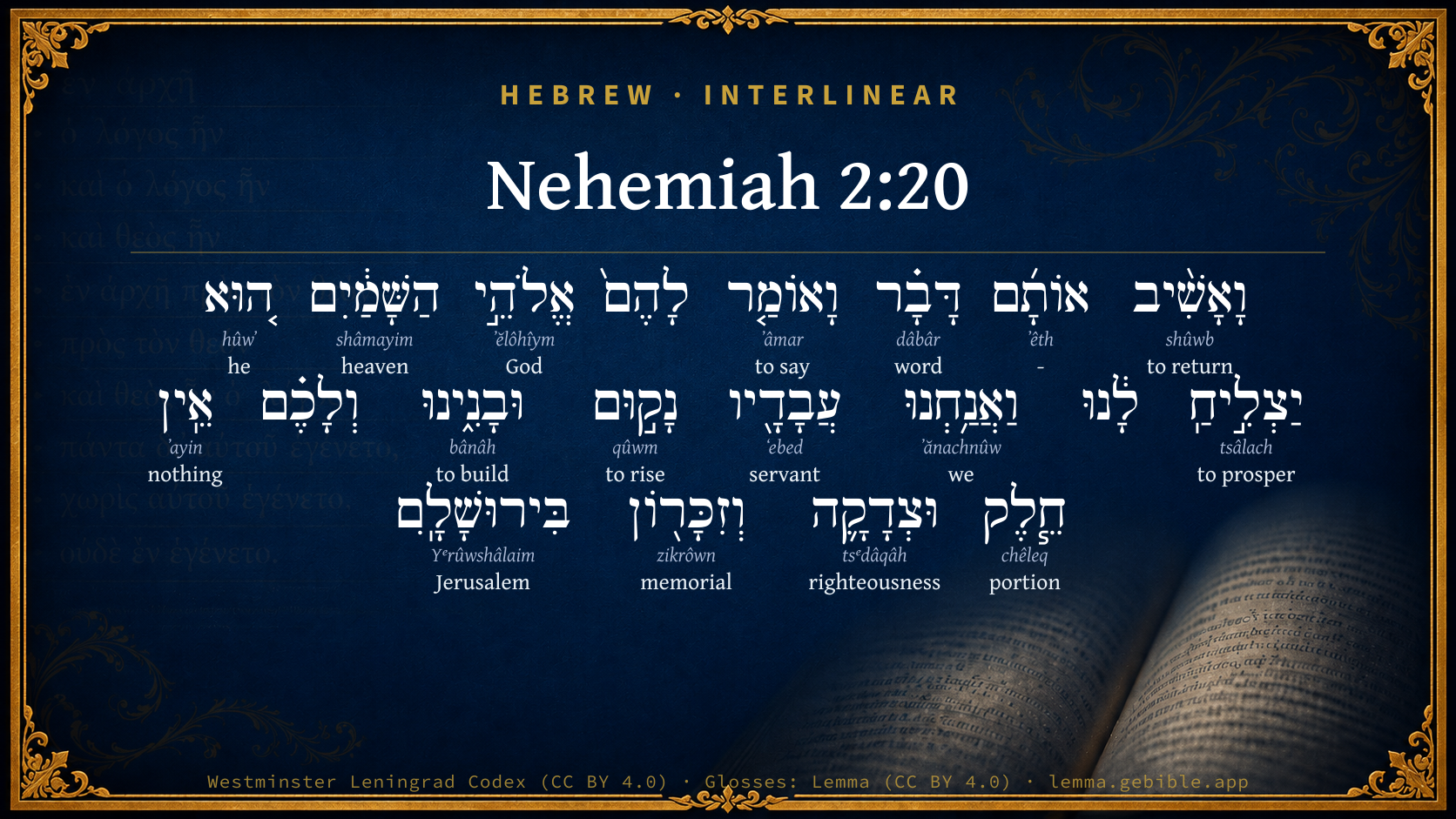
Nehemiah 2:20

Hebrew (Westminster Leningrad Codex) Nehemiah 2:20 appears in the Hebrew Old Testament. The text above is from the Westminster Leningrad Codex. Each word links to its Strong’s number, a concise gloss, and parsing drawn from the Open Scriptures Hebrew Bible morphology. Click any word for its full Brown-Driver-Briggs (BDB) entry.
Download image
Cite this verse

Nehemiah 2:20 (World English Bible). Public Domain. Lemma interlinear Bible study tool, https://lemma.gebible.app/v/nehemiah/2/20.

Show BibTeX & RIS
BibTeX
RIS
English Translation
Then answered I them, and said to them, The God of heaven, he will prosper us; therefore we his servants will arise and build: but you have no portion, nor right, nor memorial, in Jerusalem.
World English Bible · Public Domain
Download a study sheet

One document with this verse’s original text, its word-by-word gloss line, the meaning frame, cross-references with their text, attributed commentary, and full source and license credits — printable, and it pastes into notes with its structure intact.

This verse Autodidact and up

Study sheet (.html) Plain text (.txt)

A passage Seminary Student

Up to 50 verses in one chapter. A passage sheet keeps up to 6 commentary sources and 12 cross-references per verse, in the order this page ranks them, and says so on the sheet whenever that leaves anything out. Ask for a single verse and you get the Autodidact verse sheet above.

Everything on this page stays free to read, with no account — the sheet is a download of what is already on screen, not access to it.

Want to remove ads? Support Godless Engineer
Compare translations 3

The same verse in 3 English versions, stacked beneath the original-language interlinear above. Click any original word for its lexicon entry.

Each is an independent rendering of the whole verse — the interlinear is not word-aligned to these translations.

Highlighted words mark where these versions differ — a whole-verse word diff, not a word-by-word alignment.

  • World English Bible Public Domain
    Then answered I them, and said to them, The God of heaven, he will prosper us; therefore we his servants will arise and build: but you have no portion, nor right, nor memorial, in Jerusalem.
  • King James Version Public Domain
    Then answered I them, and said unto them, The God of heaven, he will prosper us; therefore we his servants will arise and build: but ye have no portion, nor right, nor memorial, in Jerusalem.
  • unfoldingWord Literal Text CC BY-SA 4.0
    And I returned them a word, and I said to them: “The God of heaven, he will cause us to succeed, and we ourselves, his servants, will rise up and build. But for you there is neither share nor right nor memorial in Jerusalem.”

unfoldingWord Literal Text — © unfoldingWord, licensed CC BY-SA 4.0. Word-aligned USFM3 via Door43 (git.door43.org/unfoldingWord/en_ult).

Versions to compare (up to 4)

3 of 4 selected

Show all 18 translations

Every available English version of this verse, each an independent rendering of the whole verse.

  • World English Bible Public Domain
    Then answered I them, and said to them, The God of heaven, he will prosper us; therefore we his servants will arise and build: but you have no portion, nor right, nor memorial, in Jerusalem.
  • Berean Standard Bible Public Domain
    So I answered them and said, “The God of heaven is the One who will grant us success. We, His servants, will start rebuilding, but you have no portion, right, or claim in Jerusalem.”
  • Majority Standard Bible Public Domain
    So I answered them and said, “The God of heaven is the One who will grant us success. We, His servants, will start rebuilding, but you have no portion, right, or claim in Jerusalem.”
  • King James Version Public Domain
    Then answered I them, and said unto them, The God of heaven, he will prosper us; therefore we his servants will arise and build: but ye have no portion, nor right, nor memorial, in Jerusalem.
  • American Standard Version (1901) Public Domain
    Then answered I them, and said unto them, The God of heaven, he will prosper us; therefore we his servants will arise and build: but ye have no portion, nor right, nor memorial, in Jerusalem.
  • Revised Version (1885) Public Domain
    Then answered I them, and said unto them, The God of heaven, he will prosper us; therefore we his servants will arise and build: but ye have no portion, nor right, nor memorial in Jerusalem.
  • Geneva Bible (1599) Public Domain
    Then answered I them, and sayd to them, The God of heauen, he will prosper vs, and we his seruants will rise vp and buylde: but as for you, ye haue no portion nor right, nor memoriall in Ierusalem.
  • Douay-Rheims (1899) Public Domain
    And I answered them, and said to them: The God of heaven he helpeth us, and we are his servants: let us rise up and build: but you have no part, nor justice, nor remembrance in Jerusalem.
  • Young's Literal Translation Public Domain
    And I return them word, and say to them, `The God of the heavens -- He doth give prosperity to us, and we His servants rise and have built; and to you there is no portion, and right, and memorial in Jerusalem.'
  • Literal Standard Version CC BY-SA 4.0
    And I return them word, and say to them, “The God of the heavens—He gives prosperity to us, and we His servants rise and have built; and to you there is no portion, and right, and memorial in Jerusalem.”
  • Unlocked Literal Bible CC BY-SA 4.0
    Then I answered them, “The God of heaven will give us success. We are his servants and we will arise and build. But you have no share, no right, and no historic claim in Jerusalem.”
  • unfoldingWord Literal Text CC BY-SA 4.0
    And I returned them a word, and I said to them: “The God of heaven, he will cause us to succeed, and we ourselves, his servants, will rise up and build. But for you there is neither share nor right nor memorial in Jerusalem.”
  • Darby Bible Public Domain
    And I answered them, and said to them, The God of the heavens, he will prosper us, and we his servants will arise and build; but ye have no portion, nor right, nor memorial in Jerusalem.
  • World Messianic Bible Public Domain
    Then I answered them, and said to them, “The God of heaven will prosper us. Therefore we, his servants, will arise and build; but you have no portion, nor right, nor memorial in Jerusalem.”
  • Webster's Bible Public Domain
    Then I answered them, and said to them, The God of heaven, he will prosper us; therefore we his servants will arise and build: but ye have no portion, nor right, nor memorial, in Jerusalem.
  • Free Bible Version CC BY-SA 4.0
    But I replied, telling them, “The God of heaven, he will make sure we're successful. We, his servants, will begin rebuilding, but Jerusalem doesn't belong to you, and you have no authority over it or claim to it.”
  • Bible in Basic English Public Domain
    Then answering them I said, The God of heaven, he will be our help; so we his servants will go on with our building: but you have no part or right or any name in Jerusalem.
  • JPS Tanakh (1917) Public Domain
    Then answered I them, and said unto them: 'The God of heaven, He will prosper us; therefore we His servants will arise and build; but ye have no portion, nor right, nor memorial, in Jerusalem.'

Literal Standard Version (2020), Covenant Press — licensed CC BY-SA 4.0. Text via the HelloAO Bible API (eBible.org). Unlocked Literal Bible (unfoldingWord) — licensed CC BY-SA 4.0. Text via the HelloAO Bible API (eBible.org). unfoldingWord Literal Text — © unfoldingWord, licensed CC BY-SA 4.0. Word-aligned USFM3 via Door43 (git.door43.org/unfoldingWord/en_ult). Free Bible Version, Dr. Jonathan Gallagher — licensed CC BY-SA 4.0. Text via the HelloAO Bible API (eBible.org).

Word by word

More ways to search: Search by grammar → Find every occurrence → Compare this word →

Practice this passage: Drill this verse → Learn its vocabulary →

וְזִכָּר֖וֹן
zikrôwn
H2146
“and · memorial”
Conjunction + Noun, Common, Masculine, Singular, Absolute
Part of Speech
Conjunction + Noun
Type
Common
Gender
Masculine
Number
Singular
State
Absolute
Full BDB Definition

Origin: from H2142

TWOT: 551b

memorial, reminder, remembrance
  1. וָאָשִׁ֨יב shûwb H7725 “and · to return” Conjunction + Verb, Hiphil, Sequential Imperfect, 1st Person, Common, Singular
  2. אוֹתָ֜ם ʼêth H853 “- · them” Particle, Direct Object + Suffix, Personal, 3rd Person, Masculine, Plural
  3. דָּבָ֗ר dâbâr H1697 “word” Noun, Common, Masculine, Singular, Absolute
  4. וָאוֹמַ֤ר ʼâmar H559 “and · to say” Conjunction + Verb, Qal, Sequential Imperfect, 1st Person, Common, Singular
  5. אֱלֹהֵ֣י ʼĕlôhîym H430 “God(s) of” Noun, Common, Masculine, Plural, Construct
  6. הַשָּׁמַ֔יִם shâmayim H8064 “the · heaven(s)” Particle, Definite Article + Noun, Common, Masculine, Plural, Absolute
  7. ה֚וּא hûwʼ H1931 “he” Pronoun, Personal, 3rd Person, Masculine, Singular
  8. יַצְלִ֣יחַֽ tsâlach H6743 “to prosper” Verb, Hiphil, Imperfect, 3rd Person, Masculine, Singular
  9. וַאֲנַ֥חְנוּ ʼănachnûw H587 “and · we” Conjunction + Pronoun, Personal, 1st Person, Common, Plural
  10. עֲבָדָ֖יו ʻebed H5650 “servants · his” Noun, Common, Masculine, Plural, Construct + Suffix, Personal, 3rd Person, Masculine, Singular
  11. נָק֣וּם qûwm H6965 “to rise” Verb, Qal, Imperfect, 1st Person, Common, Plural
  12. וּבָנִ֑ינוּ bânâh H1129 “and · to build” Conjunction + Verb, Qal, Sequential Perfect, 1st Person, Common, Plural
  13. אֵֽין ʼayin H369 “nothing” Particle, Negative
  14. חֵ֧לֶק chêleq H2506 “portion” Noun, Common, Masculine, Singular, Absolute
  15. וּצְדָקָ֛ה tsᵉdâqâh H6666 “and · righteousness” Conjunction + Noun, Common, Feminine, Singular, Absolute
  16. בִּירוּשָׁלִָֽם Yᵉrûwshâlaim H3389 “in/at · Jerusalem” Preposition + Noun, Proper

About this verse

These counts appear in no published source. They are computed here, from the morphology-tagged text and Lemma’s own curated glosses. What Lemma adds →

20
words
17
distinct lemmas
Historical
section

Notable vocabulary

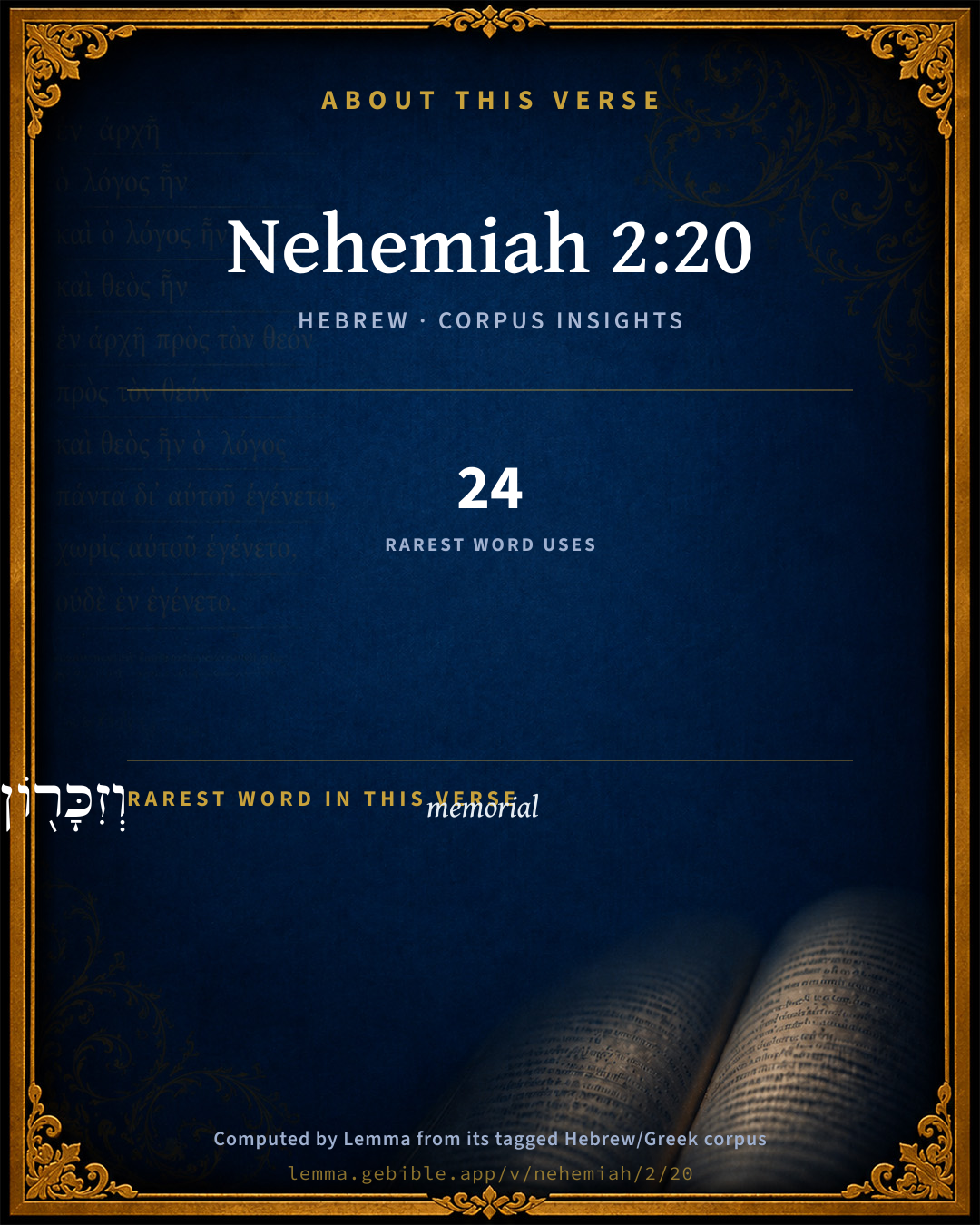
The rarest word here is וְזִכָּר֖וֹן memorial H2146 — appearing just 24 times in the whole Hebrew Bible.

Shared distinctive vocabulary

וְזִכָּר֖וֹן memorial H2146 occurs in 22 verses of the Hebrew Bible. Also found in:

Grammatical profile

  • 5 verbs
  • 8 nouns
  • 2 pronouns
  • 3 prepositions
  • 2 particles

Verb forms

  • וָאָשִׁ֨יב Hiphil · Sequential Imperfect
  • וָאוֹמַ֤ר Qal · Sequential Imperfect
  • יַצְלִ֣יחַֽ Hiphil · Imperfect
  • נָק֣וּם Qal · Imperfect
  • וּבָנִ֑ינוּ Qal · Sequential Perfect

Cross-references

19

Topical passages linked to Nehemiah 2:20 in the Treasury of Scripture Knowledge — connected by theme and wording, ordered by reader-vote popularity; previews shown in the World English Bible.

  • Ezra 4:3 But Zerubbabel, and Jeshua, and the rest of the heads of fathers' [houses] of Israel, said to them, You have nothing to do with us in building a house to our God; but we ourselves together will build to Yahweh, the God of Israel, as king Cyrus the king of Persia has commanded us.
  • Acts 8:21 You have neither part nor lot in this matter, for your heart isn't right before God.
  • Nehemiah 2:4 Then the king said to me, For what do you make request? So I prayed to the God of heaven.
  • Isaiah 56:5 To them will I give in my house and within my walls a memorial and a name better than of sons and of daughters; I will give them an everlasting name, that shall not be cut off.
  • Acts 10:31 and said, 'Cornelius, your prayer is heard, and your gifts to the needy are remembered in the sight of God.
  • Psalms 35:27 Let them shout for joy and be glad, who favor my righteous cause. Yes, let them say continually, "Yahweh be magnified, Who has pleasure in the prosperity of his servant!"
  • Ecclesiastes 7:18 It is good that you should take hold of this. Yes, also from that don't withdraw your hand; for he who fears God will come forth from them all.
  • Psalms 20:5 We will triumph in your salvation. In the name of our God we will set up our banners: May Yahweh grant all your requests.
  • Psalms 51:18 Do well in your good pleasure to Zion. Build the walls of Jerusalem.
  • Zechariah 6:14 The crowns shall be to Helem, and to Tobijah, and to Jedaiah, and to Hen the son of Zephaniah, for a memorial in the temple of Yahweh.
  • 2 Chronicles 26:5 He set himself to seek God in the days of Zechariah, who had understanding in the vision of God: and as long as he sought Yahweh, God made him to prosper.
  • Psalms 122:6 Pray for the peace of Jerusalem. Those who love you will prosper.
  • Acts 10:4 He, fastening his eyes on him, and being frightened, said, "What is it, Lord?" He said to him, "Your prayers and your gifts to the needy have gone up for a memorial before God.
  • Numbers 10:10 Also in the day of your gladness, and in your set feasts, and in the beginnings of your months, you shall blow the trumpets over your burnt offerings, and over the sacrifices of your peace-offerings; and they shall be to you for a memorial before your God: I am Yahweh your God.
  • Esther 4:11 All the king's servants, and the people of the king's provinces, do know, that whoever, whether man or woman, shall come to the king into the inner court, who is not called, there is one law for him, that he be put to death, except those to whom the king shall hold out the golden scepter, that he may live: but I have not been called to come in to the king these thirty days.
  • Psalms 102:13–14 You will arise and have mercy on Zion; For it is time to have pity on her. Yes, the set time has come.
  • Exodus 28:29 Aaron shall bear the names of the children of Israel in the breastplate of judgment on his heart, when he goes in to the holy place, for a memorial before Yahweh continually.
  • Leviticus 2:2 He shall bring it to Aaron's sons the priests; and he shall take his handful of its fine flour, and of its oil, with all its frankincense; and the priest shall burn the memorial of it on the altar, an offering made by fire, of a sweet savor to Yahweh.
  • Leviticus 24:7 You shall put pure frankincense on each row, that it may be to the bread for a memorial, even an offering made by fire to Yahweh.

Cross-references courtesy of OpenBible.info (CC BY 4.0).

Hebrew and Greek witnesses Masoretic Hebrew ↔ Greek Septuagint

The same verse in the two great witnesses to the Old Testament, shown verse-for-verse.

These are two independent witnesses, not word-aligned to each other, and the Septuagint is shown in lemma (dictionary) form.

Hebrew Nehemiah 2:20 Masoretic · Westminster Leningrad Codex

וָאָשִׁ֨יב אוֹתָ֜ם דָּבָ֗ר וָאוֹמַ֤ר לָהֶם֙ אֱלֹהֵ֣י הַשָּׁמַ֔יִם ה֚וּא יַצְלִ֣יחַֽ לָ֔נוּ וַאֲנַ֥חְנוּ עֲבָדָ֖יו נָק֣וּם וּבָנִ֑ינוּ וְלָכֶ֗ם אֵֽין חֵ֧לֶק וּצְדָקָ֛ה וְזִכָּר֖וֹן בִּירוּשָׁלִָֽם

Then answered I them, and said to them, The God of heaven, he will prosper us; therefore we his servants will arise and build: but you have no portion, nor right, nor memorial, in Jerusalem.

World English Bible · Public Domain

Greek LXX Structure differs

The Septuagint has no separate book of Nehemiah. Its Greek text is the second half of Esdras B (2 Esdras), chapters 11–23; Ezra is the first half (1–10).

A verse-for-verse comparison isn’t shown here because the chapters and verses don’t line up. Switch to the LXX edition with the MT / LXX toggle above to read the Greek directly.

On this verse, The Cambridge Bible for Schools and Colleges discusses the Septuagint’s reading. Read the note in Commentary ↓

Hebrew: Westminster Leningrad Codex (CC BY 4.0). Greek: Septuagint (public domain); English from a public-domain English Septuagint. How the Septuagint differs from the Hebrew →

Commentary

Notes on Nehemiah 2:20 from classic Christian and Jewish commentators (each source and its license shown beneath its notes). The classic Christian expositions comment on the surrounding passage and are grouped to its opening verse, so a note may address several verses; the Jewish commentaries on the Tanakh (Rashi and others) are per-verse, so they appear only where the commentator wrote on this verse.

Lemma curates 59 commentaries, every one of them public domain or Creative Commons licensed, each selected and text-cleaned for this edition rather than reprinted as found. About our sources →

Trapp's Complete Commentary

John Trapp

Neh 2:20 Then answered I them, and said unto them, The God of heaven, he will prosper us; therefore we his servants will arise and build: but ye have no portion, nor right, nor memorial, in Jerusalem.

Ver. 20. Then answered I them, and said unto them] He would not honour them so far as to tell them of the king’s licence; but shapes them a sharp answer, and shakes them up as having nothing there to do. This was true Christian courage; this was right, and much better than railing for railing; for that were but lutum lute purgare, to wash off one dirt with another.

The God of heaven] Who does whatsoever he pleases in heaven and earth; who looks and laughs at your malice.

He will prosper us] He will break his heavens, and come down amongst us, and give good success. Oh the force of a heroic faith! Though Sense says, It will not be, Reason, it cannot be; yet Faith gets above and says, It shall be; God will prosper us. It eats its way through the alps of whatsoever difficulties.

But ye have no portion] Nothing to do here, neither ought you to interpose in aliena republica, in a foreign land, as busy braggers and quarrellers; meddle where you have command.

Nor right] sc. Of interest or any good desert.

Nor memorial] Or enrolment there, as free denizens; therefore we neither accept you as friends nor fear you as enemies, &c.

John Trapp, A Commentary or Exposition upon All the Books of the Old and New Testament (1647–1656) — public domain. Text from a community e-Sword module.

Tyndale Open Study Notes

Tyndale Open Resources

2:20 The title God of heaven communicated to Persian audiences that Israel’s true God was not a minor local deity. Nehemiah remained focused on obeying his sovereign by building the walls.

Tyndale Open Study Notes — © Tyndale Open Resources, licensed CC BY-SA 4.0. Text via the HelloAO Bible API.

Geneva Bible (1599)

Geneva Bible translators

Neither are ye of the number of the children of God (to whom he hath appointed this city only) neither did any of your predecessors ever fear God.

Geneva Bible (1599) marginal notes — public domain. Text via Bolls.life.

Adam Clarke's Commentary

Verse 20. Ye have no portion, nor right] To be a citizen of Jerusalem was a high honour; and they would not permit those who did not belong to the tribes of Israel to dwell there. Zerubbabel gave the same answer to the Samaritans, Ezr 4:3.

Adam Clarke's Commentary on the Bible (1810–1826) — public domain. Text from a community e-Sword/MySword module.

Ellicott's Commentary for English Readers

(20) He will prosper us.—The reply is a defiance in the name of the God of heaven. The closing words imply that, as in the days of Zerubbabel, the Samaritan enemies desired really to have their share in the undertaking. Nehemiah makes Zerubbabel’s answer, but strengthens it; they had nothing in common with Jerusalem, not even a place in its memorials, save one of shame.

A Bible Commentary for English Readers, edited by Charles John Ellicott (1878–1897) — public domain. Text from a community e-Sword module.

The Cambridge Bible for Schools and Colleges

gen. ed. J. J. S. Perowne

20. The God of heaven] see on Neh_1:4.

will prosper us] See Neh_1:11. The Vulgate ‘juvat nos,’ the present tense corresponding to the following clause ‘we are his servants,’ is quite permissible: but is not so suitable to the occasion of Nehemiah’s reply.

we his servants] as in Neh_1:6; Neh_1:10.

arise and build] Neh_2:18. The LXX. by a strange error renders δοῦλοι αὐτοῦ καθαροί‚ καὶ οἰκοδομήσομεν, reading ‘n’qiyyim’ for ‘naqûm.’

no portion, nor right, nor memorial] These words closely resemble the declaration in Ezr_4:3, and imply some sort of claim on the part of these adversaries to a share in the fortunes of Jerusalem. If so, the adversaries must be regarded as mainly consisting of the Samaritan community. Nehemiah renouncing connexion with the Samaritans, affirms that they have no share in the present community, no ground for claiming it in the future, no memorial or justification of such claim in the past.

no portion] Cf. 2Sa_20:1.

nor right] The word here used has generally the sense of righteousness. Here it means ‘right,’ ‘just claim;’ so in 2Sa_19:28 ‘What right therefore have I, &c.;’ and Joe_2:23, ‘he giveth you the former rain in just measure’ (marg. ‘Or in (or for) righteousness’).

nor memorial] i.e. the Samaritans had no memorial nor proof of their past connexion with Jerusalem. The word is rendered ‘remembrance’ in Ecc_1:11; Ecc_2:16; ‘memorial,’ Num_16:40; Num_31:54. Cf. ‘write this for a memorial in a book’ (Exo_17:14); ‘a book of remembrance’ (Mal_3:16).

The Cambridge Bible for Schools and Colleges (gen. ed. J. J. S. Perowne; Cambridge University Press, 1878–1918) — public domain. Text from a community e-Sword module.

Haydock's Catholic Bible Commentary

Answered. Septuagint, "returned them an account (Greek: logon) ....we are his pure servants, and we will build." (Haydock) --- Part, or business, 1 Esdras iv. 4. --- Justice, or right to the city. (Calmet) --- You may mind your own affairs. (Tirinus) --- Remembrance. It was esteemed a high honour to be a citizen of Jerusalem, Psalm lxxxvi. 5.

George Leo Haydock (1774–1849), Haydock's Catholic Family Bible and Commentary, 1859 edition — public domain. Excludes Psalms (Douay-Rheims chapter numbering differs from Protestant) and Deuterocanonical books (Catholic canon only).

Matthew Poole's English Annotations

Ye have no portion nor right; you have no authority over us, nor interest in our church, or state, or city, but are mere aliens from the commonwealth of Israel. We disown and detest that mongrel worship and religion which you have set up. We desire not your favour, or friendship, or help in this matter. And you have nothing to do to inquire into or meddle with our concerns, or to hinder us in our present undertaking.

Nor memorial; no testimony, or monument, either of your relation to us by birth or religion, or of your kindness to us or to this place. But we have many memorials of your malice and enmity against us.

Matthew Poole's English Annotations on the Holy Bible (1683–1685) — public domain. Text from a community e-Sword/MySword module.

Whedon's Commentary on the Bible

Daniel D. Whedon

20. Ye have no portion — Compare Ezr_4:2, note.

Daniel D. Whedon (gen. ed.), Commentary on the Old and New Testaments (1874–1909) — public domain. Text from a community e-Sword module.

The Pulpit Commentary

Then answered I. It is remarkable that Nehemiah takes no notice of the serious charge brought against him, does not say that he had the king"s permission, but rather leaves the adversaries" to suppose that he had not. Perhaps he thought that to reveal the truth would drive them to some desperate attempt, and therefore suppressed it. The God of heaven, he will prosper us. Instead of a human, Nehemiah claims a Divine sanction for his proceedings. He and his brethren will build as servants of the God of heaven. Compare the answer made to Tatnai in Zerubbabel"s time are the servants of the God of heaven and earth, and build the house that was builded these many years ago". (Ezr_5:11) Ye have no portion, nor right, nor memorial, in Jerusalem. As the claim of the Samaritans to interfere in the affairs of the Jews had been disallowed when they came with an offer of aid, (Ezr_4:2, Ezr_4:3) so now, when their interference is hostile in character, it is still more fiercely and indignantly rejected. They are told that they have no part in Jerusalem, no right, not even so much as a place in the recollections of the inhabitants. Their interference is officious, impertinent what have they to do with Nehemiah, or the Israelites, or Jerusalem? Let them be content to manage the affairs of their own idolatrous community, and not trouble the worshippers of the true God. Nehemiah avoids opposition by concealment as long as he can; but when opposition nevertheless appears, he meets it with defiance.

Assurance of Divine co-operation.

"The God of heaven, he will prosper us," etc. Nehemiah"s reply to opponents who wished to deter him from the work he was undertaking.

I WHEN WE MAY CHERISH THE ASSURANCE OF DIVINE AID AND BLESSING IN OUR ENDEAVOURS. In general when our endeavours are in accordance with the will of God in the line of his plans and purposes. And this is the case when

1. The work is good.

2. The Divine call to it is clear. This is ascertainable from

(1) the word of God, its revelations, commands, promises.

(2) The grace of God, producing desire and willingness in our hearts; or in some cases placing us in such relation to his Church as gives us the right to act.

(3) The providence of God, giving ability, opportunity, and facilities.

1. Our motives are pure and Christian.

2. Our methods right. Being according to the directions and in harmony with the spirit of Christ.

3. The blessing of God is relied upon and earnestly sought.

II THE EFFECTS WHICH SUCH ASSURANCE WILL PRODUCE.

1. Confidence of success. Notwithstanding difficulties, misrepresentation, contempt, opposition (see ver. 19), and occasional desponding thoughts.

2. Strenuous exertion. Therefore," etc., not, "Therefore we need not work, or may be lax in our endeavours." Confidence which thus operates is presumption. God will do most when men do their best.

3. Rejection of alien interference. This took the form of opposition in the case of Sanballat, etc. Yet Nehemiah"s language seems to imply that these objectors would have co-operated, if allowed to do so, on terms acceptable to them. "We his servants will arise and build; but ye have no portion," etc. So it was at least as to the erection of the temple. (Ezr_4:1-3) And in our day many who are "of the world" arc willing to unite with the Church in her works. The peril is that in welcoming their aid the Church should imbibe their spirit, and so lose her own proper strength. We cannot, it is true, draw as sharp a line between the Church and the world as Nehemiah between Jews, and non-Jews. But we have great need to be on our guard against the insidious influence of the worldly spirit, and the adoption of worldly means of doing what professes to be, but then ceases to be, Christ"s work. We may not be justified in rejecting the material aid of worldly men when proffered without conditions (Nehemiah had accepted that of Artaxerxes), but we must never accept their counsels. The world is more dangerous within the Church than in open opposition. Faith in Divine aid will preserve from such a policy. Cherishing this, we shall feel that whether the world smile or frown we shall succeed in the end; but that if God were to withdraw his help we must fail (however we may for a time appear to succeed); and that he is likely to abandon us if we so rely on others as to be unfaithful and disobedient to him, by surrendering our distinctiveness as the disciples of Christ.

The Pulpit Commentary (1880–1919), ed. H.D.M. Spence-Jones & Joseph S. Exell — public domain. Text from a community e-Sword module.

John Wesley's Explanatory Notes

No portion - You have no authority over us, nor interest in our church and state, but are aliens from the common-wealth of Israel. Memorial - No testimony, or monument, either of your relation to us by birth or religion, or of your kindness to us, or to this place.

John Wesley, Explanatory Notes Upon the Whole Bible (1754–1765) — public domain. Text via the GEBible commentary corpus.

Rashi

Rabbi Shlomo Yitzchaki (Rashi)

but you have no share What do you have in the building of the wall of this city, for you have no share in it.

Rashi on the Tanakh — English translations: “The Judaica Press complete Tanach with Rashi, translated by A. J. Rosenberg” (CC BY 4.0); “Pentateuch with Rashi's commentary by M. Rosenbaum and A.M. Silbermann, 1929-1934” (public domain); “The Metsudah Tanach series, Lakewood, N.J” (CC BY 4.0); and “The Book of Joshua, Metsudah Publications, 1997” (CC BY 4.0). Text via Sefaria.

Lesson kit

Teaching starters — assembled from the data on this page, not authored interpretation. Every prompt links to the verse data it draws on. Edit before teaching.

Nehemiah, in the Historical, opens this verse with 20 words (17 distinct Hebrew lemmas). Its most distinctive word is zikrôwn (“memorial”). A historical commentator’s framing appears above. Read the whole chapter for the surrounding context.

Discussion questions

  1. What does “memorial” (zikrôwn) contribute to the verse as a whole?
  2. How does Exodus 12:14, which shares the word «memorial», read alongside this verse?
  3. These translations render this verse differently; the difference is in the English rendering, not the original. What questions does that raise?
  4. «וָאָשִׁ֨יב» is a Hiphil Sequential Imperfect verb. How does that grammatical form shape the action described?
  5. Compare how Trapp's Complete Commentary and Tyndale Open Study Notes read this verse. Where do they agree or differ?

Things to notice

Reading settings

Reading text

Shown beneath each verse's original-language words.

Old Testament
Old Testament edition

Read the OT as the Masoretic Hebrew (MT) or the Greek Septuagint (LXX).

English shown for the Greek Septuagint (in the Hebrew ↔ Greek comparison).

Comparing translations? Open the Compare panel on any verse page to stack up to four side by side.