Isaiah 37:32

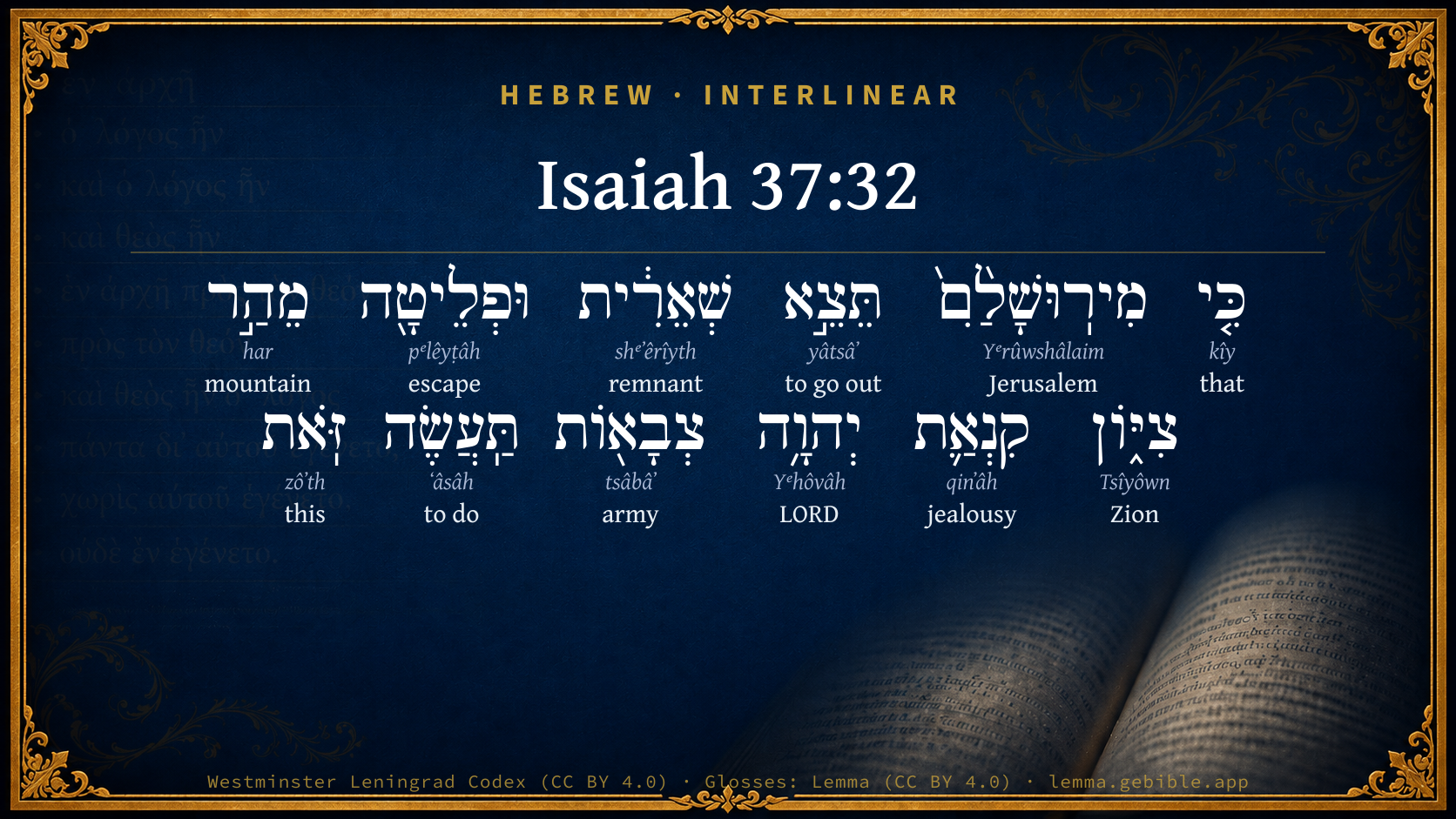
Hebrew (Westminster Leningrad Codex) Isaiah 37:32 appears in the Hebrew Old Testament. The text above is from the Westminster Leningrad Codex. Each word links to its Strong’s number, a concise gloss, and parsing drawn from the Open Scriptures Hebrew Bible morphology. Click any word for its full Brown-Driver-Briggs (BDB) entry.
Download image
Cite this verse

Isaiah 37:32 (World English Bible). Public Domain. Lemma interlinear Bible study tool, https://lemma.gebible.app/v/isaiah/37/32.

Show BibTeX & RIS
BibTeX
RIS
English Translation
For out of Jerusalem shall go forth a remnant, and out of Mount Zion those who shall escape. The zeal of Yahweh of Hosts will perform this.
World English Bible · Public Domain
Download a study sheet

One document with this verse’s original text, its word-by-word gloss line, the meaning frame, cross-references with their text, attributed commentary, and full source and license credits — printable, and it pastes into notes with its structure intact.

This verse Autodidact and up

Study sheet (.html) Plain text (.txt)

A passage Seminary Student

Up to 50 verses in one chapter. A passage sheet keeps up to 6 commentary sources and 12 cross-references per verse, in the order this page ranks them, and says so on the sheet whenever that leaves anything out. Ask for a single verse and you get the Autodidact verse sheet above.

Everything on this page stays free to read, with no account — the sheet is a download of what is already on screen, not access to it.

Want to remove ads? Support Godless Engineer
Compare translations 3

The same verse in 3 English versions, stacked beneath the original-language interlinear above. Click any original word for its lexicon entry.

Each is an independent rendering of the whole verse — the interlinear is not word-aligned to these translations.

Highlighted words mark where these versions differ — a whole-verse word diff, not a word-by-word alignment.

  • World English Bible Public Domain
    For out of Jerusalem shall go forth a remnant, and out of Mount Zion those who shall escape. The zeal of Yahweh of Hosts will perform this.
  • King James Version Public Domain
    For out of Jerusalem shall go forth a remnant, and they that escape out of mount Zion: the zeal of the LORD of hosts shall do this.
  • unfoldingWord Literal Text CC BY-SA 4.0
    For a remnant will come out from Jerusalem, and a survival from Mount Zion. The zeal of Yahweh of Armies will do this.

unfoldingWord Literal Text — © unfoldingWord, licensed CC BY-SA 4.0. Word-aligned USFM3 via Door43 (git.door43.org/unfoldingWord/en_ult).

Versions to compare (up to 4)

3 of 4 selected

Show all 18 translations

Every available English version of this verse, each an independent rendering of the whole verse.

  • World English Bible Public Domain
    For out of Jerusalem shall go forth a remnant, and out of Mount Zion those who shall escape. The zeal of Yahweh of Hosts will perform this.
  • Berean Standard Bible Public Domain
    For a remnant will go forth from Jerusalem, and survivors from Mount Zion. The zeal of the LORD of Hosts will accomplish this.
  • Majority Standard Bible Public Domain
    For a remnant will go forth from Jerusalem, and survivors from Mount Zion. The zeal of the LORD of Hosts will accomplish this.
  • King James Version Public Domain
    For out of Jerusalem shall go forth a remnant, and they that escape out of mount Zion: the zeal of the LORD of hosts shall do this.
  • American Standard Version (1901) Public Domain
    For out of Jerusalem shall go forth a remnant, and out of mount Zion they that shall escape. The zeal of Jehovah of hosts will perform this.
  • Revised Version (1885) Public Domain
    For out of Jerusalem shall go forth a remnant, and out of mount Zion they that shall escape: the zeal of the LORD of hosts shall perform this.
  • Geneva Bible (1599) Public Domain
    For out of Ierusalem shall goe a remnant, and they that escape out of mount Zion: the zeale of the Lord of hostes shall doe this.
  • Douay-Rheims (1899) Public Domain
    For out of Jerusalem shall go forth a, remnant, and salvation from mount Sion: the zeal of the Lord of hosts shall do this.
  • Young's Literal Translation Public Domain
    For from Jerusalem goeth forth a remnant, And an escape from mount Zion, The zeal of Jehovah of Hosts doth this.
  • Literal Standard Version CC BY-SA 4.0
    For a remnant goes forth from Jerusalem, || And an escape from Mount Zion, || The zeal of YHWH of Hosts does this.
  • Unlocked Literal Bible CC BY-SA 4.0
    For from Jerusalem a remnant will come out; from Mount Zion survivors will come. The zeal of Yahweh of hosts will do this.'”
  • unfoldingWord Literal Text CC BY-SA 4.0
    For a remnant will come out from Jerusalem, and a survival from Mount Zion. The zeal of Yahweh of Armies will do this.
  • Darby Bible Public Domain
    for out of Jerusalem shall go forth a remnant, and out of mount Zion they that escape: the zeal of Jehovah of hosts shall do this.
  • World Messianic Bible Public Domain
    For out of Jerusalem a remnant will go out, and survivors will escape from Mount Zion. The zeal of the LORD of Hosts will perform this.’
  • Webster's Bible Public Domain
    For out of Jerusalem shall go forth a remnant, and they that escape from mount Zion: the zeal of the LORD of hosts will do this.
  • Free Bible Version CC BY-SA 4.0
    For a remnant will come out of Jerusalem, and survivors will come from Mount Zion. The intense determination of the Lord will make sure this happens.
  • Bible in Basic English Public Domain
    For from Jerusalem those who have been kept safe will go out, and those who are still living will go out of Mount Zion: by the fixed purpose of the Lord of armies this will be done.
  • JPS Tanakh (1917) Public Domain
    For out of Jerusalem shall go forth a remnant, and out of mount Zion they that shall escape; the zeal of the LORD of hosts shall perform this.

Literal Standard Version (2020), Covenant Press — licensed CC BY-SA 4.0. Text via the HelloAO Bible API (eBible.org). Unlocked Literal Bible (unfoldingWord) — licensed CC BY-SA 4.0. Text via the HelloAO Bible API (eBible.org). unfoldingWord Literal Text — © unfoldingWord, licensed CC BY-SA 4.0. Word-aligned USFM3 via Door43 (git.door43.org/unfoldingWord/en_ult). Free Bible Version, Dr. Jonathan Gallagher — licensed CC BY-SA 4.0. Text via the HelloAO Bible API (eBible.org).

Word by word

More ways to search: Search by grammar → Find every occurrence → Compare this word →

Practice this passage: Drill this verse → Learn its vocabulary →

וּפְלֵיטָ֖ה
pᵉlêyṭâh
H6413
“and · escape”
Conjunction + Noun, Common, Feminine, Singular, Absolute
Part of Speech
Conjunction + Noun
Type
Common
Gender
Feminine
Number
Singular
State
Absolute
Full BDB Definition

Origin: from H6412

TWOT: 1774d

escape, deliverance - escape, deliverance - escaped remnant
  1. כִּ֤י kîy H3588 “that” Conjunction
  2. מִירֽוּשָׁלִַ֨ם֙ Yᵉrûwshâlaim H3389 “from · Jerusalem” Preposition + Noun, Proper
  3. תֵּצֵ֣א yâtsâʼ H3318 “to go out” Verb, Qal, Imperfect, 3rd Person, Feminine, Singular
  4. שְׁאֵרִ֔ית shᵉʼêrîyth H7611 “remnant” Noun, Common, Feminine, Singular, Absolute
  5. מֵהַ֣ר har H2022 “from · mountain of” Preposition + Noun, Common, Masculine, Singular, Construct
  6. צִיּ֑וֹן Tsîyôwn H6726 “Zion” Noun, Proper
  7. קִנְאַ֛ת qinʼâh H7068 “jealousy of” Noun, Common, Feminine, Singular, Construct
  8. יְהוָ֥ה Yᵉhôvâh H3068 “LORD” Noun, Proper
  9. צְבָא֖וֹת tsâbâʼ H6635 “armies” Noun, Common, Both, Plural, Absolute
  10. תַּֽעֲשֶׂה ʻâsâh H6213 “to do” Verb, Qal, Imperfect, 3rd Person, Feminine, Singular
  11. זֹּֽאת zôʼth H2063 “this” Pronoun, Demonstrative, Feminine, Singular

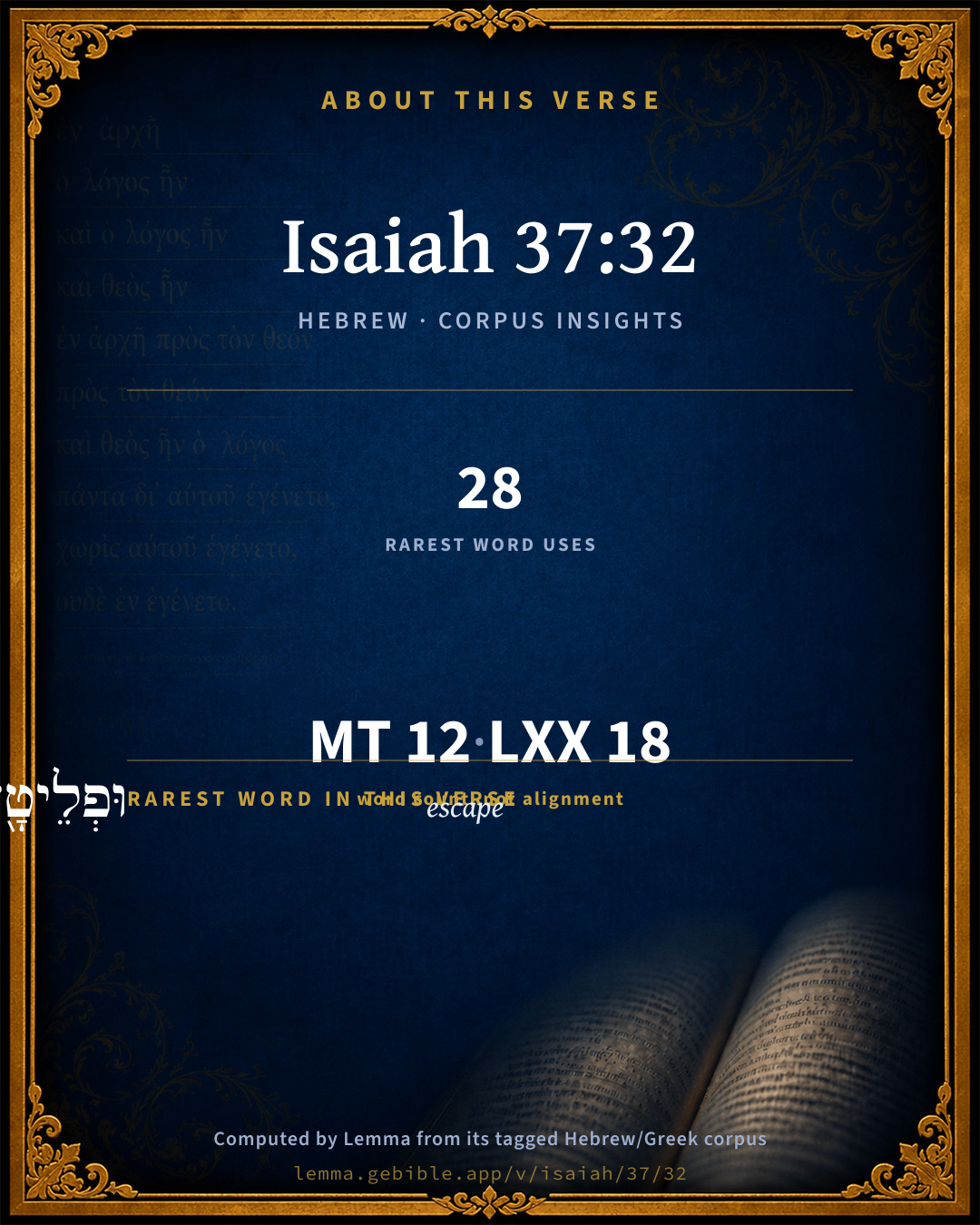
About this verse

These counts appear in no published source. They are computed here, from the morphology-tagged text and Lemma’s own curated glosses. What Lemma adds →

12
words
12
distinct lemmas
Prophets
section

Shared distinctive vocabulary

וּפְלֵיטָ֖ה escape H6413 occurs in 28 verses of the Hebrew Bible. Also found in:

Grammatical profile

  • 2 verbs
  • 8 nouns
  • 1 pronoun
  • 1 conjunction

Verb forms

  • תֵּצֵ֣א Qal · Imperfect
  • תַּֽעֲשֶׂה Qal · Imperfect

Hebrew & Septuagint length

In English translation the verse runs 27 words from the Hebrew and 27 from the Septuagint (LXX English) — the same length.

A rough comparison of the two English renderings, which tokenize alike — not a word-level alignment.

Word counts can differ between the Hebrew and the Greek without any difference in meaning — e.g. the Hebrew direct-object marker אֵת has no separate Greek word, and Greek often adds the article ὁ.

In the original languages it is 12 Hebrew tokens and 18 Greek tokens — but the two are counted differently (Hebrew bundles its prefixes and suffixes into one token; the Greek is in lemma form), so that isn’t a like-for-like length.

Cross-references

6

Topical passages linked to Isaiah 37:32 in the Treasury of Scripture Knowledge — connected by theme and wording, ordered by reader-vote popularity; previews shown in the World English Bible.

  • Isaiah 9:7 Of the increase of his government and of peace there shall be no end, on the throne of David, and on his kingdom, to establish it, and to uphold it with justice and with righteousness from henceforth even forever. The zeal of Yahweh of Hosts will perform this.
  • 2 Kings 19:31 For out of Jerusalem shall go forth a remnant, and out of Mount Zion those who shall escape: the zeal of Yahweh shall perform this.
  • Isaiah 59:17 He put on righteousness as a breastplate, and a helmet of salvation on his head; and he put on garments of vengeance for clothing, and was clad with zeal as a mantle.
  • Joel 2:18 Then Yahweh was jealous for his land, And had pity on his people.
  • Zechariah 1:14 So the angel who talked with me said to me, "Proclaim, saying, 'Thus says Yahweh of Hosts: "I am jealous for Jerusalem and for Zion with a great jealousy.
  • Isaiah 37:20 Now therefore, Yahweh our God, save us from his hand, that all the kingdoms of the earth may know that you are Yahweh, even you only.

Cross-references courtesy of OpenBible.info (CC BY 4.0).

Hebrew and Greek witnesses Masoretic Hebrew ↔ Greek Septuagint

The same verse in the two great witnesses to the Old Testament, shown verse-for-verse.

These are two independent witnesses, not word-aligned to each other, and the Septuagint is shown in lemma (dictionary) form.

Hebrew Isaiah 37:32 Masoretic · Westminster Leningrad Codex

כִּ֤י מִירֽוּשָׁלִַ֨ם֙ תֵּצֵ֣א שְׁאֵרִ֔ית וּפְלֵיטָ֖ה מֵהַ֣ר צִיּ֑וֹן קִנְאַ֛ת יְהוָ֥ה צְבָא֖וֹת תַּֽעֲשֶׂה זֹּֽאת

For out of Jerusalem shall go forth a remnant, and out of Mount Zion those who shall escape. The zeal of Yahweh of Hosts will perform this.

World English Bible · Public Domain

Greek LXX Isaiah 37:32 Septuagint · lemma form

ὅτι ἐκ ἰερουσαλήμ ἐκἔρχομαι ὁ καταλείπω καί ὁ σώζω ἐκ ὄρος σιων ὁ ζῆλος κύριος σαβαωθ ποιέω οὗτος

for out of Jerusalem there shall be a remnant, and the saved ones out of mount Sion: the zeal of the Lord of hosts shall perform this.

LXX2012 (modern English Septuagint) · Public Domain

Hebrew: Westminster Leningrad Codex (CC BY 4.0). Greek: Septuagint (public domain); English from LXX2012 (modern English Septuagint) (Public Domain). How the Septuagint differs from the Hebrew →

Targum (Aramaic paraphrase)

1

The Targum is the ancient Jewish Aramaic paraphrase of the Hebrew Scriptures — an interpretive translation, not the Hebrew text itself. Onkelos (literal) and Pseudo-Jonathan (expansive) render the Torah, and Jonathan the Prophets. Coverage is partial: where no permissively-licensed English translation exists for a verse, only the Aramaic is shown. This is verse-level text, not a word-by-word alignment to the Hebrew.

  1. Targum Jonathan Prophets (Joshua–Malachi)
    אֲרֵי מִירוּשְׁלֵם יִפְקוּן שְׁאָר צַדִיקַיָא וְשֵׁיזְבַת מְקִימֵי אוֹרַיְתָא מִטוּרָא דְצִיוֹן בְּמֵימְרָא דַייָ צְבָאוֹת תִּתְעֲבֵיד דָא:

    For the remnant of the righteous shall go forth from Jerusalem, and the escaped of them that establish the law from mount Zion: by the WORD of the Lord of hosts shall this be done.

    Targum Jonathan — Aramaic: “Mikraot Gedolot” (public domain). English: “Sefaria Community Translation” (CC0 1.0 (public-domain dedication)); “London "Chaldee Paraphrase," 1871” (public domain). Text via Sefaria.

Commentary

Notes on Isaiah 37:32 from classic Christian and Jewish commentators (each source and its license shown beneath its notes). The classic Christian expositions comment on the surrounding passage and are grouped to its opening verse, so a note may address several verses; the Jewish commentaries on the Tanakh (Rashi and others) are per-verse, so they appear only where the commentator wrote on this verse.

Lemma curates 59 commentaries, every one of them public domain or Creative Commons licensed, each selected and text-cleaned for this edition rather than reprinted as found. About our sources →

Tyndale Open Study Notes

Tyndale Open Resources

37:32 The passionate commitment of God includes his energetic zeal to keep his promise, the best guarantee his people could ever have (see also 9:7).

Tyndale Open Study Notes — © Tyndale Open Resources, licensed CC BY-SA 4.0. Text via the HelloAO Bible API.

Ellicott's Commentary for English Readers

(32) The zeal of the Lord of hosts shall do this.—Here, again, the prophet returns in his old age to the formula of the earlier days of Isa_9:7, with an implied reference to the grand promise with which it had then been associated.

A Bible Commentary for English Readers, edited by Charles John Ellicott (1878–1897) — public domain. Text from a community e-Sword module.

The Cambridge Bible for Schools and Colleges

gen. ed. J. J. S. Perowne

32. the zeal of the Lord … this] From ch. Isa_9:7.

The Cambridge Bible for Schools and Colleges (gen. ed. J. J. S. Perowne; Cambridge University Press, 1878–1918) — public domain. Text from a community e-Sword module.

John Gill's Exposition

By the way that he came, by the same shall he return,.... Without executing his designs on Jerusalem, or other places; he shall lose his labour, and make the best of his way to his own country, without turning to the right or left, in order to disturb other nations, and enlarge his kingdom, being quite dispirited and confounded by what he shall meet with:

and shall not come into this city, saith the Lord; or, unto this city, as before; which is repeated to confirm it, and to show the certainty of it.

John Gill's Exposition of the Whole Bible (1746–1763) — public domain (CC PDM 1.0). Text via the HelloAO Bible API.

Albert Barnes' Notes on the Bible

Shall go forth a remnant - The word ‘remnant’ means that which is left; and does not of necessity imply that it should be a small portion. No doubt a part of the Jews were destroyed in the invasion of Sennacherib, but the assurance is here given that a portion of them would remain in safety, and that they would constitute that from which the future prosperity of the state would arise.

And they that escape - Margin, ‘The escaping,’ that is, the remnant.

The zeal - (See the note at Isa 9:7).

Albert Barnes' Notes on the Bible (1834–1885) — public domain. Text from a community e-Sword/MySword module.

The Pulpit Commentary

The zeal, etc. (comp. Isa_9:7) The phrase is very emphatic, marking the greatness of the thing to be done, and at the same time bringing the strophe to an end with an asseveration beyond which nothing could go.

"The zeal of the Lord.

Cheyne renders, "The jealousy of Jehovah-Sabaoth shall perform this;" and he suggestively says, being the affectional manifestation of the Divine holiness, is a "two-edged word," implying the destruction of all that opposes the Divine covenant, and the furtherance of all that promotes it." Zeal also expresses "earnest desire," and that vigorous and persistent activity in which such desire finds expression. In this sense we may treat Jehu"s boast of his "zeal for the Lord." This word seems a favorite one with Isaiah, as applied to Jehovah. He employs it in Isa_9:7 Isa_59:17 Isa_63:15. (see also Eze_5:13) The two sides of it may be illustrated from the narrative of the chapter.

I THE ZEAL OF THE LORD REGARDED AS A SACRED JEALOUSY OF THE DIVINE NAME. AND HONOUR.

II THE ZEAL OF THE LORD REGARDED AS AN EARNESTNESS OF PURPOSE AND ENDEAVOUR, WHICH ASSURES THE DISCOMFITURE OF THE ENEMIES OF HIS PEOPLE.

It is an incentive to trust that we are thus assured that our God wants no rousing to action on our behalf, as does the heathen Baal on Mount Carmel This is our confidence he is jealous for himself and his Word, and therefore is ever working for us. R.T.

The Pulpit Commentary (1880–1919), ed. H.D.M. Spence-Jones & Joseph S. Exell — public domain. Text from a community e-Sword module.

J. A. Alexander on Isaiah

Joseph Addison Alexander

“For out of Jerusalem shalt go with a remnant, and an escape from Mount Zion; the zeal of Jehovah of Hosts shall do this.” For the meaning of the last clause, see the commentary on Isa 9:7. The first clause is an explanation of the use of the words escape and left in the foregoing verse. The verse denotes simply that some in Jerusalem or Zion shall be saved.

Joseph Addison Alexander, The Prophecies of Isaiah (1846–1847; New York: Scribner, 1870–1878) — public domain. Text from a community e-Sword module.

Rashi

Rabbi Shlomo Yitzchaki (Rashi)

the zeal of the Lord of Hosts that He will be zealous for His Name and not because of the merit you possess. We learn that the merit of the Patriarchs has been depleted.

Rashi on the Tanakh — English translations: “The Judaica Press complete Tanach with Rashi, translated by A. J. Rosenberg” (CC BY 4.0); “Pentateuch with Rashi's commentary by M. Rosenbaum and A.M. Silbermann, 1929-1934” (public domain); “The Metsudah Tanach series, Lakewood, N.J” (CC BY 4.0); and “The Book of Joshua, Metsudah Publications, 1997” (CC BY 4.0). Text via Sefaria.

Lesson kit

Teaching starters — assembled from the data on this page, not authored interpretation. Every prompt links to the verse data it draws on. Edit before teaching.

Isaiah, in the Prophets, opens this verse with 12 words (12 distinct Hebrew lemmas). Its most distinctive word is pᵉlêyṭâh (“escape”). A historical commentator’s framing appears above. Read the whole chapter for the surrounding context.

Discussion questions

  1. How does “escape” (pᵉlêyṭâh) shape what this verse is saying?
  2. Genesis 32:8 shares the word «escape» with this verse. How do the two illuminate each other?
  3. The translations on this page render this verse differently — a whole-verse word diff, not a word-by-word alignment. What might account for the different wordings?
  4. The verb «תֵּצֵ֣א» is Qal Imperfect. How does its form color the action?
  5. Reading how Tyndale Open Study Notes and Ellicott's Commentary for English Readers read this verse, where do the two commentators agree and where do they part?

Things to notice

Reading settings

Reading text

Shown beneath each verse's original-language words.

Old Testament
Old Testament edition

Read the OT as the Masoretic Hebrew (MT) or the Greek Septuagint (LXX).

English shown for the Greek Septuagint (in the Hebrew ↔ Greek comparison).

Comparing translations? Open the Compare panel on any verse page to stack up to four side by side.