2 Kings 8:17

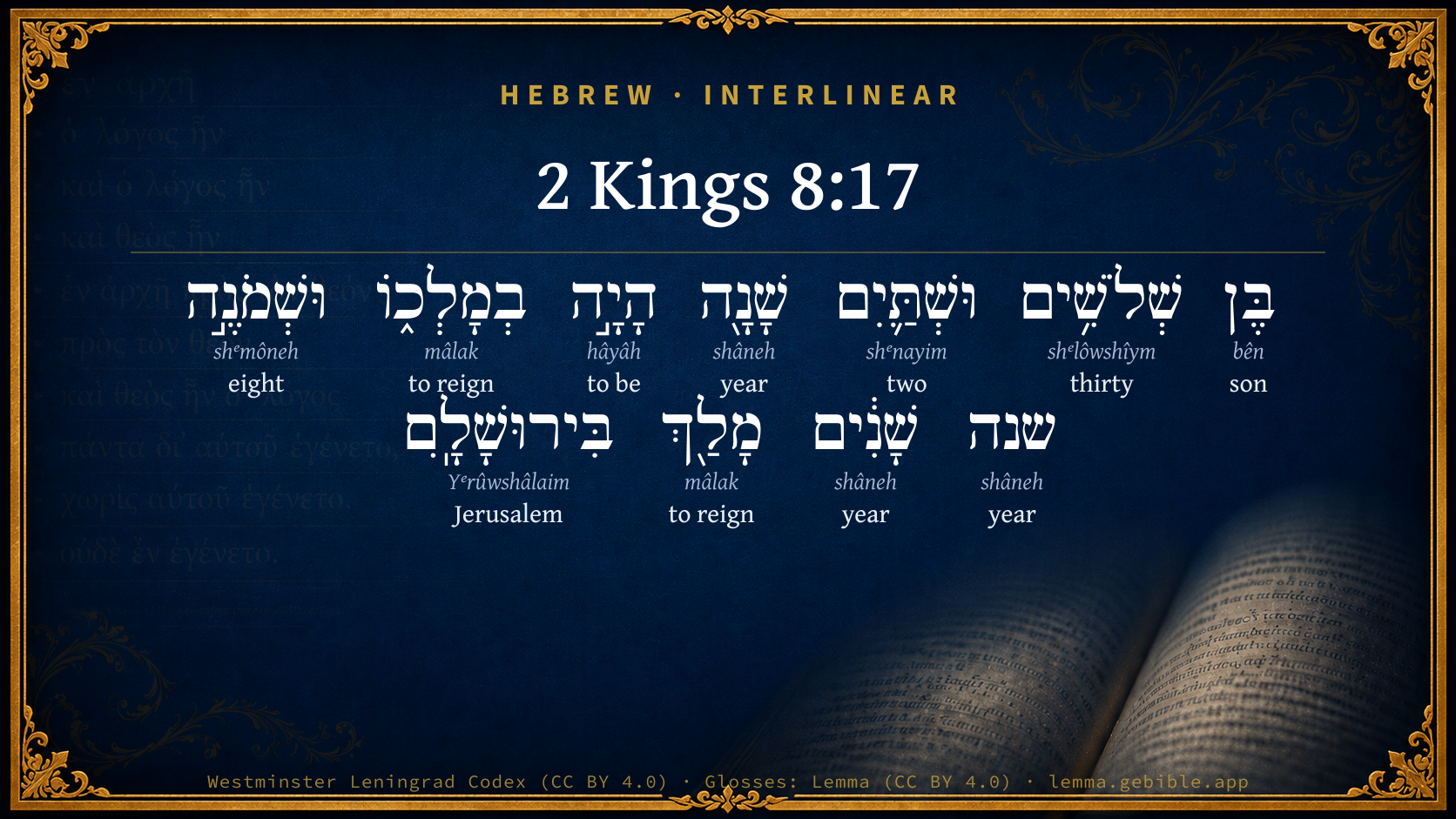
Hebrew (Westminster Leningrad Codex) 2 Kings 8:17 appears in the Hebrew Old Testament. The text above is from the Westminster Leningrad Codex. Each word links to its Strong’s number, a concise gloss, and parsing drawn from the Open Scriptures Hebrew Bible morphology. Click any word for its full Brown-Driver-Briggs (BDB) entry.
Download image
Cite this verse

2 Kings 8:17 (World English Bible). Public Domain. Lemma interlinear Bible study tool, https://lemma.gebible.app/v/2-kings/8/17.

Show BibTeX & RIS
BibTeX
RIS
English Translation
Thirty-two years old was he when he began to reign; and he reigned eight years in Jerusalem.
World English Bible · Public Domain
Download a study sheet

One document with this verse’s original text, its word-by-word gloss line, the meaning frame, cross-references with their text, attributed commentary, and full source and license credits — printable, and it pastes into notes with its structure intact.

This verse Autodidact and up

Study sheet (.html) Plain text (.txt)

A passage Seminary Student

Up to 50 verses in one chapter. A passage sheet keeps up to 6 commentary sources and 12 cross-references per verse, in the order this page ranks them, and says so on the sheet whenever that leaves anything out. Ask for a single verse and you get the Autodidact verse sheet above.

Everything on this page stays free to read, with no account — the sheet is a download of what is already on screen, not access to it.

Want to remove ads? Support Godless Engineer
Compare translations 3

The same verse in 3 English versions, stacked beneath the original-language interlinear above. Click any original word for its lexicon entry.

Each is an independent rendering of the whole verse — the interlinear is not word-aligned to these translations.

Highlighted words mark where these versions differ — a whole-verse word diff, not a word-by-word alignment.

  • World English Bible Public Domain
    Thirty-two years old was he when he began to reign; and he reigned eight years in Jerusalem.
  • King James Version Public Domain
    Thirty and two years old was he when he began to reign; and he reigned eight years in Jerusalem.
  • unfoldingWord Literal Text CC BY-SA 4.0
    He was a son of 32 years when he reigned, and he reigned 8 years in Jerusalem.

unfoldingWord Literal Text — © unfoldingWord, licensed CC BY-SA 4.0. Word-aligned USFM3 via Door43 (git.door43.org/unfoldingWord/en_ult).

Versions to compare (up to 4)

3 of 4 selected

Show all 18 translations

Every available English version of this verse, each an independent rendering of the whole verse.

  • World English Bible Public Domain
    Thirty-two years old was he when he began to reign; and he reigned eight years in Jerusalem.
  • Berean Standard Bible Public Domain
    Jehoram was thirty-two years old when he became king, and he reigned in Jerusalem eight years.
  • Majority Standard Bible Public Domain
    Jehoram was thirty-two years old when he became king, and he reigned in Jerusalem eight years.
  • King James Version Public Domain
    Thirty and two years old was he when he began to reign; and he reigned eight years in Jerusalem.
  • American Standard Version (1901) Public Domain
    Thirty and two years old was he when he began to reign; and he reigned eight years in Jerusalem.
  • Revised Version (1885) Public Domain
    Thirty and two years old was he when he began to reign; and he reigned eight years in Jerusalem.
  • Geneva Bible (1599) Public Domain
    He was two and thirtie yere olde, when he began to reigne: and hee reigned eight yeere in Ierusalem.
  • Douay-Rheims (1899) Public Domain
    He was two and thirty years old when he began to reign, and he reigned eight years in Jerusalem.
  • Young's Literal Translation Public Domain
    a son of thirty and two years was he in his reigning, and eight years he hath reigned in Jerusalem.
  • Literal Standard Version CC BY-SA 4.0
    he was a son of thirty-two years in his reigning, and he has reigned eight years in Jerusalem.
  • Unlocked Literal Bible CC BY-SA 4.0
    Jehoram was thirty-two years old when he began to reign, and he reigned for eight years in Jerusalem.
  • unfoldingWord Literal Text CC BY-SA 4.0
    He was a son of 32 years when he reigned, and he reigned 8 years in Jerusalem.
  • Darby Bible Public Domain
    He was thirty-two years old when he began to reign; and he reigned eight years in Jerusalem.
  • World Messianic Bible Public Domain
    He was thirty-two years old when he began to reign. He reigned eight years in Jerusalem.
  • Webster's Bible Public Domain
    Thirty and two years old was he when he began to reign; and he reigned eight years in Jerusalem.
  • Free Bible Version CC BY-SA 4.0
    He was thirty-two when he became king, and he reigned in Jerusalem for eight years.
  • Bible in Basic English Public Domain
    He was thirty-two years old when he became king; and he was ruling in Jerusalem for eight years.
  • JPS Tanakh (1917) Public Domain
    Thirty and two years old was he when he began to reign; and he reigned eight years in Jerusalem.

Literal Standard Version (2020), Covenant Press — licensed CC BY-SA 4.0. Text via the HelloAO Bible API (eBible.org). Unlocked Literal Bible (unfoldingWord) — licensed CC BY-SA 4.0. Text via the HelloAO Bible API (eBible.org). unfoldingWord Literal Text — © unfoldingWord, licensed CC BY-SA 4.0. Word-aligned USFM3 via Door43 (git.door43.org/unfoldingWord/en_ult). Free Bible Version, Dr. Jonathan Gallagher — licensed CC BY-SA 4.0. Text via the HelloAO Bible API (eBible.org).

Word by word

More ways to search: Search by grammar → Find every occurrence → Compare this word →

Practice this passage: Drill this verse → Learn its vocabulary →

וּשְׁמֹנֶ֣ה
shᵉmôneh
H8083
“and · eight”
Conjunction + Adjective, Cardinal number, Feminine, Singular, Absolute
Part of Speech
Conjunction + Adjective
Type
Cardinal number
Gender
Feminine
Number
Singular
State
Absolute
Full BDB Definition

Origin: apparently from H8082 through the idea of plumpness

TWOT: 2411a

eight, eighth - eight (as cardinal number) - eighth (as ordinal number) - in combination with other numbers
  1. בֶּן bên H1121 “son of” Noun, Common, Masculine, Singular, Construct
  2. שְׁלֹשִׁ֥ים shᵉlôwshîym H7970 “thirty” Adjective, Cardinal number, Both, Plural, Absolute
  3. וּשְׁתַּ֛יִם shᵉnayim H8147 “and · two” Conjunction + Adjective, Cardinal number, Feminine, Dual, Absolute
  4. שָׁנָ֖ה shâneh H8141 “year” Noun, Common, Feminine, Singular, Absolute
  5. הָיָ֣ה hâyâh H1961 “to be” Verb, Qal, Perfect, 3rd Person, Masculine, Singular
  6. בְמָלְכ֑וֹ mâlak H4427 “in/at · to reign · him” Preposition + Verb, Qal, Infinitive Construct + Suffix, Personal, 3rd Person, Masculine, Singular
  7. שנה shâneh H8141 “year” Noun, Common, Feminine, Singular, Absolute
  8. שָׁנִ֔ים shâneh H8141 “years” Noun, Common, Feminine, Plural, Absolute
  9. מָלַ֖ךְ mâlak H4427 “to reign” Verb, Qal, Perfect, 3rd Person, Masculine, Singular
  10. בִּירוּשָׁלִָֽם Yᵉrûwshâlaim H3389 “in/at · Jerusalem” Preposition + Noun, Proper

About this verse

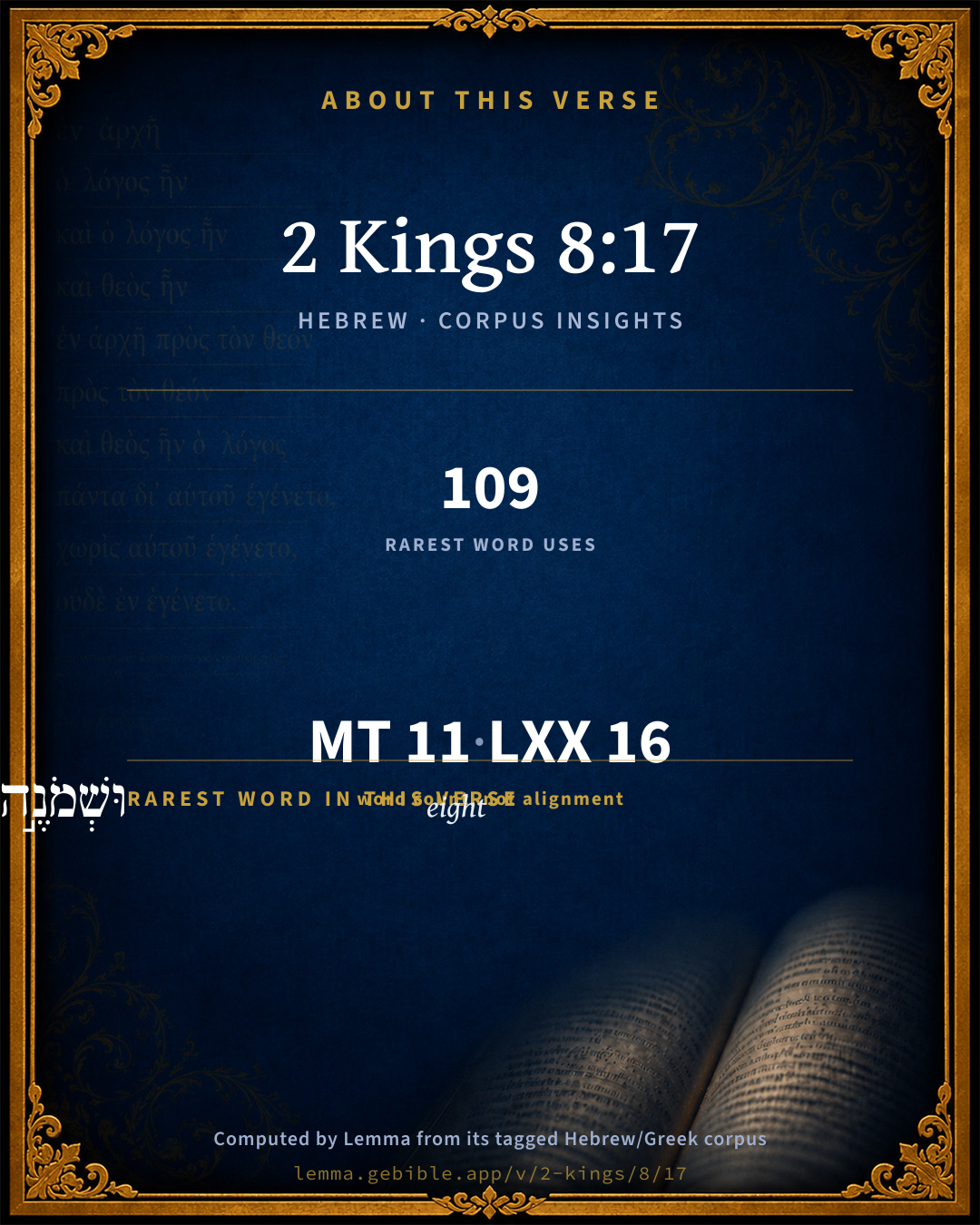
These counts appear in no published source. They are computed here, from the morphology-tagged text and Lemma’s own curated glosses. What Lemma adds →

11
words
8
distinct lemmas
Historical
section

Grammatical profile

  • 3 verbs
  • 5 nouns
  • 3 adjectives

Verb forms

  • הָיָ֣ה Qal · Perfect
  • בְמָלְכ֑וֹ Qal · Infinitive Construct
  • מָלַ֖ךְ Qal · Perfect

Repetition

Words recur within this verse — often emphatic in Hebrew:

  • שָׁנָ֖ה year H8141 ×3
  • בְמָלְכ֑וֹ to reign H4427 ×2

Hebrew & Septuagint length

In English translation the verse runs 17 words from the Hebrew and 19 from the Septuagint (LXX English) — closely comparable.

A rough comparison of the two English renderings, which tokenize alike — not a word-level alignment.

Word counts can differ between the Hebrew and the Greek without any difference in meaning — e.g. the Hebrew direct-object marker אֵת has no separate Greek word, and Greek often adds the article ὁ.

In the original languages it is 11 Hebrew tokens and 16 Greek tokens — but the two are counted differently (Hebrew bundles its prefixes and suffixes into one token; the Greek is in lemma form), so that isn’t a like-for-like length.

Cross-references

1

Topical passages linked to 2 Kings 8:17 in the Treasury of Scripture Knowledge — connected by theme and wording, ordered by reader-vote popularity; previews shown in the World English Bible.

  • 2 Chronicles 21:5–10 Jehoram was thirty-two years old when he began to reign; and he reigned eight years in Jerusalem.

Cross-references courtesy of OpenBible.info (CC BY 4.0).

Hebrew and Greek witnesses Masoretic Hebrew ↔ Greek Septuagint

The same verse in the two great witnesses to the Old Testament, shown verse-for-verse.

These are two independent witnesses, not word-aligned to each other, and the Septuagint is shown in lemma (dictionary) form.

Hebrew 2 Kings 8:17 Masoretic · Westminster Leningrad Codex

בֶּן שְׁלֹשִׁ֥ים וּשְׁתַּ֛יִם שָׁנָ֖ה הָיָ֣ה בְמָלְכ֑וֹ וּשְׁמֹנֶ֣ה שנה שָׁנִ֔ים מָלַ֖ךְ בִּירוּשָׁלִָֽם

Thirty-two years old was he when he began to reign; and he reigned eight years in Jerusalem.

World English Bible · Public Domain

Greek LXX 2 Kings 8:17 Septuagint · lemma form

υἱός τριάκοντα καί δύο ἔτος εἰμί ἐν ὁ βασιλεύω αὐτός καί ὀκτώ ἔτος βασιλεύω ἐν ἰερουσαλήμ

Thirty and two years old was he when he began to reign, and he reigned eight years in Jerusalem.

LXX2012 (modern English Septuagint) · Public Domain

Hebrew: Westminster Leningrad Codex (CC BY 4.0). Greek: Septuagint (public domain); English from LXX2012 (modern English Septuagint) (Public Domain). How the Septuagint differs from the Hebrew →

Targum (Aramaic paraphrase)

1

The Targum is the ancient Jewish Aramaic paraphrase of the Hebrew Scriptures — an interpretive translation, not the Hebrew text itself. Onkelos (literal) and Pseudo-Jonathan (expansive) render the Torah, and Jonathan the Prophets. Coverage is partial: where no permissively-licensed English translation exists for a verse, only the Aramaic is shown. This is verse-level text, not a word-by-word alignment to the Hebrew.

  1. Targum Jonathan Prophets (Joshua–Malachi)
    בַּר תְּלָתִין וְתַרְתֵּין שְׁנִין הֲוָה כַּד מְלַךְ וְתַמְנֵי שְׁנִין מְלַךְ בִּירוּשְׁלֵם:

    (no public-domain English translation for this verse)

    Targum Jonathan — Aramaic: “Mikraot Gedolot” (public domain). English: “Sefaria Community Translation” (CC0 1.0 (public-domain dedication)); “London "Chaldee Paraphrase," 1871” (public domain). Text via Sefaria.

Commentary

Notes on 2 Kings 8:17 from classic Christian and Jewish commentators (each source and its license shown beneath its notes). The classic Christian expositions comment on the surrounding passage and are grouped to its opening verse, so a note may address several verses; the Jewish commentaries on the Tanakh (Rashi and others) are per-verse, so they appear only where the commentator wrote on this verse.

Lemma curates 59 commentaries, every one of them public domain or Creative Commons licensed, each selected and text-cleaned for this edition rather than reprinted as found. About our sources →

Trapp's Complete Commentary

John Trapp

2Ki 8:17 Thirty and two years old was he when he began to reign; and he reigned eight years in Jerusalem.

Ver. 17. And he reigned eight years.] Six years he reigned with his father, and eight years after him. See Ussher’s Annals of the World.

John Trapp, A Commentary or Exposition upon All the Books of the Old and New Testament (1647–1656) — public domain. Text from a community e-Sword module.

The Biblical Illustrator

Joseph S. Exell

2Ki_8:17-24

Jehoram--began to reign.

Lessons from the life of Jehoram

This is a short fragment of a kings history, the history of Jehoram. Brief as it is, it contains many practical truths.

I. That piety is not necessarily hereditary. Parents, as a rule, transmit their physical and intellectual qualities to their children, but not their moral characters. Jehoram was a bad man and a wicked king, but he was the son of Jehoshaphat, who was a man of distinguished piety, and reigned wisely and beneficently over Israel for twenty-five years. Of him it was said that the more his riches and honour increased the more his heart was lifted up in the ways of the Lord (2Ch_17:5-6). But how different was his son! One of the first acts of his government was to put to death his six brothers, and several of the leading men of the empire. But whilst piety is not necessarily hereditary, because children are moral agents: what then? Are parents to do nothing to impart all that is good in their character to their children? Undoubtedly no! They are commanded to train up a child in the way it should go when it is young. Where the children of godly parents turn out to be profligate and corrupt, as a rule some defect may be traced to parental conduct. Even in the life of Jehoshaphat, we detect at [east two parental defects.

1. In permitting his son to form unholy alliances.

2. In granting his son too great an indulgence. He raised him to the throne during his own lifetime. He took him into royal partnership too soon, and thus supplied him with abundant means to foster his vanity and ambition.

II. That immoral kings are national curses. What evils this man brought upon his country! Through him the kingdom of Judah lost Edom (which had been its tributary for one hundred and fifty years), which revolted and became the determined enemy of Judah ever afterwards (Psa_137:7). Libnah, too, revolted at the same time. This was a city in the south-western part of Judah assigned to the priests, and a city of refuge. It has always been so. Wicked kings, in all ages, have been the greatest curses that have afflicted the race. Another practical truth is--

III. That death is no respecter of persons.

1. Death does not respect a mans position, however high.

2. Death does not respect a mans character however vile. Jehoram was a bad man, and utterly unfit to die: but death waits not for moral preparation. (David Thomas, D. D.)

Baneful influence of a wicked wife

Jehoram, the son of good Jehoshaphat, walked in the evil ways of the kings of Israel, and he wrought that which was evil in the sight of the Lord. For--mark the reason given by the inspired historian-jehoram did that which was evil in the eyes of the Lord, for He had the daughter of Ahab to wife! What secrets were indicated by that one reason! What a whole volume of tragedy is wrapped up in that brief sentence! The responsibility seems to a large extent transferred from him and placed upon his wife, who was a subtler thinker, a more desperate character, with a larger brain and a firmer will, with more accent and force of personality. Be not unequally yoked together: do not look upon marriage lightly; do not suppose that it is a game for the passing day, a flash and gone, a hilarious excitement, a wine-bibbing, a passing round of kind salutations, then dying away like a trembling echo. Beware what connections you form, and do not suppose that the laws of God can be set aside with impunity. Our family life explains our public attitude and influence. What we are at home we are really abroad. Wives, do not destroy your husbands: when they would do good, help them; when they propose to give to the cause of charity, suggest that the donation be doubled, not divided; when they would help in any good and noble work, give them sympathy, and prayer, and blessing. We never knew a man yet of any enduring public power that was not made by his wife, and we never knew a public yet that fully appreciated the value of that ministry. It is secret; it is at home; it does not show, it is not chalked on a black-board, it is not gilded on a high ceiling, it is silent--but vital. We have seen a man go down in his church life, and we have wondered why, and it was his wife, the daughter of Ahab, who was degrading him, narrowing him and dwarfing him in his thinking and sympathy. We have seen a man go up in his public influence, and we have found that it was his wife who was encouraging him, helping him, telling him that he was on the right way, and wishing him good luck in the name of the Lord. See to it that your home is right: have a beautiful home--morally and religiously; a sacred house, a sanctuary where joy is the singing angel, and then, when you come abroad into the market-place, into the pulpit or into parliament, or into trading and commerce, or into any of the social relations of life, you will bring with you all the inspiration that comes from a home that blooms like a garden or glows like a summer sun. (J. Parker, D. D.)

The Biblical Illustrator, edited by Joseph S. Exell (c. 1880s–1900s) — public domain. Text from a community e-Sword module.

Tyndale Open Study Notes

Tyndale Open Resources

8:17 Jehoram reigned from 853 to 841 BC, including a five-year co-regency with his father, Jehoshaphat.

Tyndale Open Study Notes — © Tyndale Open Resources, licensed CC BY-SA 4.0. Text via the HelloAO Bible API.

Adam Clarke's Commentary

Verse 17. He reigned eight years in Jerusalem.] Beginning with the fifth year of Joram, king of Israel. He reigned three years with Jehoshaphat his father, and five years alone; i.e., from A.M. 3112 to 3119, according to Archbishop Usher.

Adam Clarke's Commentary on the Bible (1810–1826) — public domain. Text from a community e-Sword/MySword module.

Ellicott's Commentary for English Readers

(17) Thirty and two years old . . . in Jerusalem.—Comp. the similar notices in 2 Kings 12 and the succeeding chapters. How different are these short annalistic summaries, the work of the Judæan compiler, from the rich and flowing narratives about Elijah and Elisha!

A Bible Commentary for English Readers, edited by Charles John Ellicott (1878–1897) — public domain. Text from a community e-Sword module.

The Cambridge Bible for Schools and Colleges

gen. ed. J. J. S. Perowne

17. when he began to reign] The narrative of the Chronicler (2Ch_21:2-4) tells how at the commencement of his reign Jehoram slew his seven brothers as well as some of the princes of Israel. Thus he proved himself of a like character with Athaliah, whom he married.

The Cambridge Bible for Schools and Colleges (gen. ed. J. J. S. Perowne; Cambridge University Press, 1878–1918) — public domain. Text from a community e-Sword module.

John Gill's Exposition

Thirty and two years old was he when he began to reign,.... The second time, in the lifetime of his father:

and he reigned eight years in Jerusalem; which ended in the twelfth year of Joram king of Israel, Kg2 8:25.

John Gill's Exposition of the Whole Bible (1746–1763) — public domain (CC PDM 1.0). Text via the HelloAO Bible API.

Haydock's Catholic Bible Commentary

CHAPTER VIII.

George Leo Haydock (1774–1849), Haydock's Catholic Family Bible and Commentary, 1859 edition — public domain. Excludes Psalms (Douay-Rheims chapter numbering differs from Protestant) and Deuterocanonical books (Catholic canon only).

Matthew Poole's English Annotations

Part with his father, and part by himself alone.

Matthew Poole's English Annotations on the Holy Bible (1683–1685) — public domain. Text from a community e-Sword/MySword module.

The Pulpit Commentary

Thirty and two years old was he when he began to reign; and he reigned eight years in Jerusalem. The eight years seem to be counted from his association in the kingdom by his father in his twenty-third year. He reigned as sole king only six years.

Vers. 17-24. Lessons from the life of Jehoram.

and two years old was he Jehoram when he began to reign," etc. This is a short fragment of a king"s history the history of Jehoram. Brief as it is, it contains many practical truths.

I THAT PIETY IS NOT NECESSARILY HEREDITARY. Parents, as a rule, transmit their physical and intellectual qualities to their children, but not their moral characters. Jehoram was a bad man and a wicked king, but he was the son of Jehoshaphat, who was a man of distinguished piety, and reigned wisely and beneficently over Israel for twenty-five years. Of him it was said that "the more his riches and honor increased the more his heart was lifted up in the ways of the Lord". (2Ch_17:5, 2Ch_17:6) He caused the altars and places of idolatry to be destroyed, and the knowledge of the Lord to be diffused throughout the kingdom, and the places of ecclesiastical and judicial authority to be well rifled. (2Ch_17:9) But how different was his son! One of the first acts of his government was to put to death his six brothers, and several of the leading men of the empire. It is here said that "he walked in the way of the kings of Israel, as din the house of Ahab: He regulated his conduct by the infamous "house of Ahab," and not by the religions house of his father. He was in truth a murderer, an idolater, and a persecutor. But whilst piety is not necessarily hereditary not necessarily, because children are moral agents what then? Are parents to do nothing to impart all that is good in their character to their children? Undoubtedly, no! They are commanded to "train up a child in the way it should go" when it is young. And where their power is rightly employed, there is, if not invariable, yet general, success. Where the children of godly parents turn out to be profligate and corrupt, as a rule some defect may be found in the parental conduct. How often eminent ministers of the gospel, and in the main good men, are guilty of neglecting, to a greater or less extent, the parental oversight and religions training of their children. Even in the life of Jehoshaphat we detect at least two parental defects.

1. In permitting his son to form unholy alliances. This good man, Jehoshaphat, formed a league with Ahab against Syria, contrary to the counsel of Micaiah. (2Ch 18) For this the Prophet Jehu censured him severely. In consequence of this alliance his son married the daughter of this infamous Ahab, and the matrimonial connection with such a woman, idolatrous, corrupt, and the daughter of Jezebel, had, no doubt, a powerful influence in deteriorating his moral character.

2. In granting his son too great an indulgence. He raised him to the throne during his own lifetime. He took him into royal partnership too soon, and thus supplied him with abundant means to foster his vanity and ambition. Ah, me! how many parents ruin their children forever by over indulgence!

II THAT IMMORAL KINGS ARE NATIONAL CURSES. What evils this man brought upon his country. It is said that "in his days Edom revolted from under the hand of Judah, and made a king over themselves. So Joram went over to Zair, and all the chariots with him: and he rose by night, and smote the Edomites which compassed him about, and the captains of the chariots: and the people fled into their tents," etc. Through him the kingdom of Judah lost Edom, which "revolted" and became the determined enemy of Judah ever afterwards, (Psa_137:7) Libnah, too, "revolted at the same time," This was a city in the south-western part of Judah assigned to the priests, and a city of refuge. But these revolts are but specimens of the tremendous evils that this immoral man Brought upon the kingdom. It has always been so. Wicked kings, in all ages, have been the greatest curses that have afflicted the human race. God said to Israel of old, "I gave thee a king in mine anger". (Hos_13:11) And the gift, on the whole, it must be confessed, has been a curse to mankind; and that because few men who have attained the position have been divinely royal in intellect, in heart, in thoughts, in aims, in sympathies. What does Heaven say of wicked kings? "As a roaring lion, and a raging bear; so is a wicked ruler over the poor people." When will the world have true kings? such a king as is described in the Book of Proverbs, as one "that sitteth in the throne of judgment," and who "scattereth away all evil with his eyes"? He is one who sees justice done. He does not rule for the interest of a class, but for the good of all. His laws are equitable. Partialities and predilections which govern plebeian souls have no sway over him,

He"s a king, A true right king, that dare do aught save wrong, Fears nothing mortal but to be unjust; Who is not blown up with the flattering puffs Of spongy sycophants; who stands unmoved, Despite the jostling of opinion.

III THAT DEATH IS NO RESPECTER OF PERSONS.

1. Death does not respect a man"s position, however high. "And Jehoram slept with his fathers, and was buried." Jehoram was a king, yet death struck him down, and he was buried with his fathers. Palaces are as accessible to death as paupers" huts. Attempted resistance in the former, however skillfully organized, would be as futile as in the latter. Death cares nothing for kings; crowns, diadems, scepters, courtiers, and pompous pageantries are only as dust in his icy glance.

2. Death does not respect a mans character, however vile. Jehoram was a bad man, and utterly unfit to die; but death waits not for moral preparation. When we remember what evils wicked men, especially wicked kings, work in the world, death must be regarded as a beneficent messenger. The psalmist saw mercy in the destruction of despots. He "overthrew Pharaoh and his host in the Red Sea: for his mercy endureth forever." "To him which smote great kings, and slew famous kings: for his mercy endureth forever". (Ps 136) There is mercy for the race in their destruction. When such demons in human flesh are cut down, the world breathes more freely, a load is rolled from its heart, obstacles are swept from its path of progress. When the Pharaohs are overwhelmed, the human Israel can march on to promised lands.

CONCLUSION. Parents, cultivate personal religion, and endeavor with all earnestness to transmit it to your children. Kings, seek to understand and to embody the ideal of true kingship, be royal in moral character. All, stand in readiness for the approach of death. D.T.

The Pulpit Commentary (1880–1919), ed. H.D.M. Spence-Jones & Joseph S. Exell — public domain. Text from a community e-Sword module.

Lesson kit

Teaching starters — assembled from the data on this page, not authored interpretation. Every prompt links to the verse data it draws on. Edit before teaching.

2 Kings, in the Historical, opens this verse with 11 words (8 distinct Hebrew lemmas). Its most distinctive word is shᵉmôneh (“eight”). A historical commentator’s framing appears above. Read the whole chapter for the surrounding context.

Discussion questions

  1. The word shᵉmôneh carries the sense “eight.” How does it shape the verse?
  2. 2 Chronicles 21:5–10 shares this passage’s theme. How do the two illuminate each other?
  3. “year” occurs 3× in this one verse. What is the effect of the repetition?
  4. These translations render this verse differently. What is at stake in choosing one wording over another?
  5. The verb «הָיָ֣ה» is Qal Perfect. How does its form color the action?
  6. Reading how Trapp's Complete Commentary and The Biblical Illustrator read this verse, where do the two commentators agree and where do they part?

Things to notice

Reading settings

Reading text

Shown beneath each verse's original-language words.

Old Testament
Old Testament edition

Read the OT as the Masoretic Hebrew (MT) or the Greek Septuagint (LXX).

English shown for the Greek Septuagint (in the Hebrew ↔ Greek comparison).

Comparing translations? Open the Compare panel on any verse page to stack up to four side by side.