Nehemiah 12:28

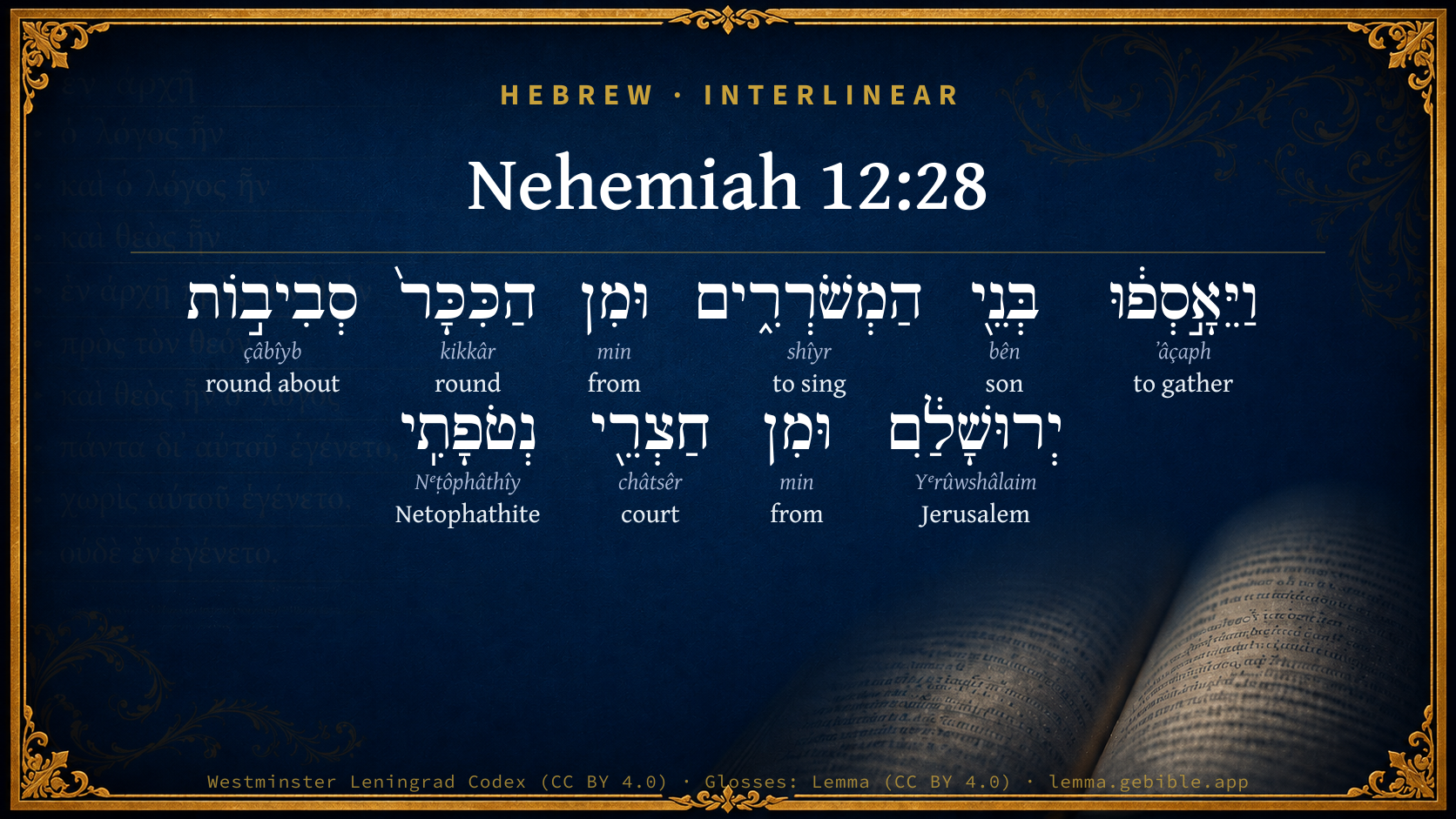
Hebrew (Westminster Leningrad Codex) Nehemiah 12:28 appears in the Hebrew Old Testament. The text above is from the Westminster Leningrad Codex. Each word links to its Strong’s number, a concise gloss, and parsing drawn from the Open Scriptures Hebrew Bible morphology. Click any word for its full Brown-Driver-Briggs (BDB) entry.
Download image
Cite this verse

Nehemiah 12:28 (World English Bible). Public Domain. Lemma interlinear Bible study tool, https://lemma.gebible.app/v/nehemiah/12/28.

Show BibTeX & RIS
BibTeX
RIS
English Translation
The sons of the singers gathered themselves together, both out of the plain round about Jerusalem, and from the villages of the Netophathites;
World English Bible · Public Domain
Download a study sheet

One document with this verse’s original text, its word-by-word gloss line, the meaning frame, cross-references with their text, attributed commentary, and full source and license credits — printable, and it pastes into notes with its structure intact.

This verse Autodidact and up

Study sheet (.html) Plain text (.txt)

A passage Seminary Student

Up to 50 verses in one chapter. A passage sheet keeps up to 6 commentary sources and 12 cross-references per verse, in the order this page ranks them, and says so on the sheet whenever that leaves anything out. Ask for a single verse and you get the Autodidact verse sheet above.

Everything on this page stays free to read, with no account — the sheet is a download of what is already on screen, not access to it.

Want to remove ads? Support Godless Engineer
Compare translations 3

The same verse in 3 English versions, stacked beneath the original-language interlinear above. Click any original word for its lexicon entry.

Each is an independent rendering of the whole verse — the interlinear is not word-aligned to these translations.

Highlighted words mark where these versions differ — a whole-verse word diff, not a word-by-word alignment.

  • World English Bible Public Domain
    The sons of the singers gathered themselves together, both out of the plain round about Jerusalem, and from the villages of the Netophathites;
  • King James Version Public Domain
    And the sons of the singers gathered themselves together, both out of the plain country round about Jerusalem, and from the villages of Netophathi;
  • unfoldingWord Literal Text CC BY-SA 4.0
    And the sons of the ones who sang gathered themselves, both from the circle around Jerusalem and from the villages of the Netophatites,

unfoldingWord Literal Text — © unfoldingWord, licensed CC BY-SA 4.0. Word-aligned USFM3 via Door43 (git.door43.org/unfoldingWord/en_ult).

Versions to compare (up to 4)

3 of 4 selected

Show all 18 translations

Every available English version of this verse, each an independent rendering of the whole verse.

  • World English Bible Public Domain
    The sons of the singers gathered themselves together, both out of the plain round about Jerusalem, and from the villages of the Netophathites;
  • Berean Standard Bible Public Domain
    The singers were also assembled from the region around Jerusalem, from the villages of the Netophathites,
  • Majority Standard Bible Public Domain
    The singers were also assembled from the region around Jerusalem, from the villages of the Netophathites,
  • King James Version Public Domain
    And the sons of the singers gathered themselves together, both out of the plain country round about Jerusalem, and from the villages of Netophathi;
  • American Standard Version (1901) Public Domain
    And the sons of the singers gathered themselves together, both out of the plain round about Jerusalem, and from the villages of the Netophathites;
  • Revised Version (1885) Public Domain
    And the sons of the singers gathered themselves together, both out of the plain round about Jerusalem, and from the villages of the Netophathites;
  • Geneva Bible (1599) Public Domain
    Then the singers gathered themselues together both from the plaine countrey about Ierusalem, and from the villages of Netophathi,
  • Douay-Rheims (1899) Public Domain
    And the sons of the singing men were gathered together out of the plain country about Jerusalem, and out of the villages of Nethuphati,
  • Young's Literal Translation Public Domain
    and sons of the singers are gathered together even from the circuit round about Jerusalem, and from the villages of Netophathi,
  • Literal Standard Version CC BY-SA 4.0
    and sons of the singers are gathered together even from the circuit around Jerusalem, and from the villages of Netophathi,
  • Unlocked Literal Bible CC BY-SA 4.0
    The fellowship of singers gathered together from the district around Jerusalem and from the villages of the Netophathites.
  • unfoldingWord Literal Text CC BY-SA 4.0
    And the sons of the ones who sang gathered themselves, both from the circle around Jerusalem and from the villages of the Netophatites,
  • Darby Bible Public Domain
    And the children of the singers were assembled, both from the plain [of Jordan] round about Jerusalem, and from the villages of the Netophathites,
  • World Messianic Bible Public Domain
    The sons of the singers gathered themselves together, both out of the plain around Jerusalem and from the villages of the Netophathites;
  • Webster's Bible Public Domain
    And the sons of the singers assembled, both out of the plain country around Jerusalem, and from the villages of Netophathi;
  • Free Bible Version CC BY-SA 4.0
    The singers were also brought in from the area around Jerusalem and from the villages of the Netophathites,
  • Bible in Basic English Public Domain
    And the sons of the music-makers came together from the lowland round about Jerusalem and from the daughter-towns of the Netophathites,
  • JPS Tanakh (1917) Public Domain
    And the sons of the singers gathered themselves together, both out of the Plain round about Jerusalem, and from the villages of the Netophathites;

Literal Standard Version (2020), Covenant Press — licensed CC BY-SA 4.0. Text via the HelloAO Bible API (eBible.org). Unlocked Literal Bible (unfoldingWord) — licensed CC BY-SA 4.0. Text via the HelloAO Bible API (eBible.org). unfoldingWord Literal Text — © unfoldingWord, licensed CC BY-SA 4.0. Word-aligned USFM3 via Door43 (git.door43.org/unfoldingWord/en_ult). Free Bible Version, Dr. Jonathan Gallagher — licensed CC BY-SA 4.0. Text via the HelloAO Bible API (eBible.org).

Word by word

More ways to search: Search by grammar → Find every occurrence → Compare this word →

Practice this passage: Drill this verse → Learn its vocabulary →

נְטֹפָתִֽי
Nᵉṭôphâthîy
H5200
“Netophathite”
Noun, Gentilic, Masculine, Singular, Absolute
Part of Speech
Noun
Type
Gentilic
Gender
Masculine
Number
Singular
State
Absolute
Full BDB Definition

Origin: from H5199

TWOT: None

Netophathite = see Netophath " dropping" - an inhabitant of Netophah
  1. וַיֵּאָ֣סְפ֔וּ ʼâçaph H622 “and · to gather” Conjunction + Verb, Niphal, Sequential Imperfect, 3rd Person, Masculine, Plural
  2. בְּנֵ֖י bên H1121 “sons of” Noun, Common, Masculine, Plural, Construct
  3. הַמְשֹׁרְרִ֑ים shîyr H7891 “the · singing” Particle, Definite Article + Verb, Polel, Participle Active, Masculine, Plural, Absolute
  4. וּמִן min H4480 “and · from” Conjunction + Preposition
  5. הַכִּכָּר֙ kikkâr H3603 “the · round” Particle, Definite Article + Noun, Common, Both, Singular, Absolute
  6. סְבִיב֣וֹת çâbîyb H5439 “surroundings” Noun, Common, Both, Plural, Absolute
  7. יְרוּשָׁלִַ֔ם Yᵉrûwshâlaim H3389 “Jerusalem” Noun, Proper
  8. וּמִן min H4480 “and · from” Conjunction + Preposition
  9. חַצְרֵ֖י châtsêr H2691 “courts of” Noun, Common, Both, Plural, Construct

About this verse

These counts appear in no published source. They are computed here, from the morphology-tagged text and Lemma’s own curated glosses. What Lemma adds →

10
words
9
distinct lemmas
Historical
section

Notable vocabulary

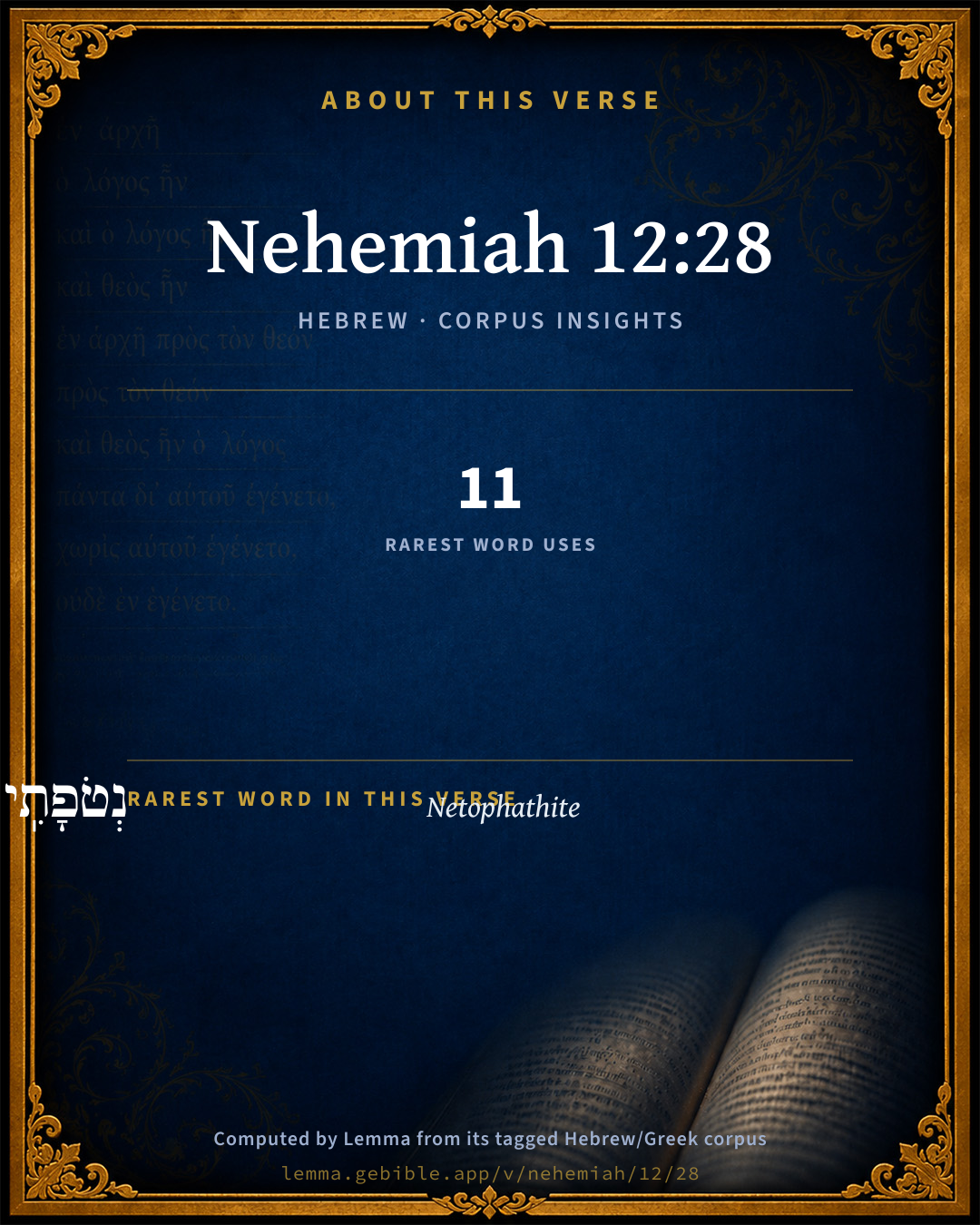
The rarest word here is נְטֹפָתִֽי Netophathite H5200 — appearing just 11 times in the whole Hebrew Bible.

Shared distinctive vocabulary

נְטֹפָתִֽי Netophathite H5200 occurs in 10 verses of the Hebrew Bible. Also found in:

Grammatical profile

  • 2 verbs
  • 6 nouns
  • 2 prepositions

Verb forms

  • וַיֵּאָ֣סְפ֔וּ Niphal · Sequential Imperfect
  • הַמְשֹׁרְרִ֑ים Polel · Participle Active

Repetition

A word recurs within this verse — often emphatic in Hebrew:

  • וּמִן from H4480 ×2

Cross-references

3

Topical passages linked to Nehemiah 12:28 in the Treasury of Scripture Knowledge — connected by theme and wording, ordered by reader-vote popularity; previews shown in the World English Bible.

  • 1 Chronicles 9:16 and Obadiah the son of Shemaiah, the son of Galal, the son of Jeduthun, and Berechiah the son of Asa, the son of Elkanah, who lived in the villages of the Netophathites.
  • 1 Chronicles 2:54 The sons of Salma: Bethlehem, and the Netophathites, Atroth Beth Joab, and half of the Manahathites, the Zorites.
  • Nehemiah 6:2 that Sanballat and Geshem sent to me, saying, Come, let us meet together in [one of] the villages in the plain of Ono. But they thought to do me mischief.

Cross-references courtesy of OpenBible.info (CC BY 4.0).

Hebrew and Greek witnesses Masoretic Hebrew ↔ Greek Septuagint

The same verse in the two great witnesses to the Old Testament, shown verse-for-verse.

These are two independent witnesses, not word-aligned to each other, and the Septuagint is shown in lemma (dictionary) form.

Hebrew Nehemiah 12:28 Masoretic · Westminster Leningrad Codex

וַיֵּאָ֣סְפ֔וּ בְּנֵ֖י הַמְשֹׁרְרִ֑ים וּמִן הַכִּכָּר֙ סְבִיב֣וֹת יְרוּשָׁלִַ֔ם וּמִן חַצְרֵ֖י נְטֹפָתִֽי

The sons of the singers gathered themselves together, both out of the plain round about Jerusalem, and from the villages of the Netophathites;

World English Bible · Public Domain

Greek LXX Structure differs

The Septuagint has no separate book of Nehemiah. Its Greek text is the second half of Esdras B (2 Esdras), chapters 11–23; Ezra is the first half (1–10).

A verse-for-verse comparison isn’t shown here because the chapters and verses don’t line up. Switch to the LXX edition with the MT / LXX toggle above to read the Greek directly.

Hebrew: Westminster Leningrad Codex (CC BY 4.0). Greek: Septuagint (public domain); English from a public-domain English Septuagint. How the Septuagint differs from the Hebrew →

Commentary

Notes on Nehemiah 12:28 from classic Christian and Jewish commentators (each source and its license shown beneath its notes). The classic Christian expositions comment on the surrounding passage and are grouped to its opening verse, so a note may address several verses; the Jewish commentaries on the Tanakh (Rashi and others) are per-verse, so they appear only where the commentator wrote on this verse.

Lemma curates 59 commentaries, every one of them public domain or Creative Commons licensed, each selected and text-cleaned for this edition rather than reprinted as found. About our sources →

Geneva Bible (1599)

Geneva Bible translators

Which were a certain family, and had their possessions in the fields, 1 Chron. 2:54.

Hebrew, the sons of the singers.

Geneva Bible (1599) marginal notes — public domain. Text via Bolls.life.

The Cambridge Bible for Schools and Colleges

gen. ed. J. J. S. Perowne

28. the plain country] R.V. the plain. Marg. ‘Or, circuit’. The word here used, ‘the kikkar,’ is technically applied to the Jordan valley, e.g. Gen_13:10-12; Gen_19:17; 2Sa_18:23. Here, however, as in Neh_3:22, it seems very doubtful whether this application is at all possible at a time when the territory occupied by the Jews was of so limited an area. If the special signification be here retained, only the southern most portion of the Jordan valley, the district of Jericho, can be intended. The other and more probable alternative is to give the word its strict meaning of ‘the circle,’ and to suppose that it is here used to denote the country ‘round about Jerusalem.’ This is not improbable; for (1) the word does not necessarily mean a level surface, but something circular; (2) the country villages occupied by the singers (Neh_12:29) were in the vicinity of Jerusalem. In confirmation of this, it should be remembered that, even in its special application, it is generally found with a qualifying substantive, e.g. ‘the plain, or kikkar = circuit, of the Jordan.’ (Gen_13:10-11; 1Ki_7:46. Cf. Mat_3:5, ἡ περίχωρος τοῦ Ἰορδάνου).

of Netophathi] R.V. of the Netophathites. See note on Ezr_2:22.

The Cambridge Bible for Schools and Colleges (gen. ed. J. J. S. Perowne; Cambridge University Press, 1878–1918) — public domain. Text from a community e-Sword module.

John Gill's Exposition

Also from the house of Gilgal,.... Which likewise was in a champaign country in the plains of Jericho, Deu 11:30,

and out of the fields of Geba; which was a Levitical city in the tribe of Benjamin, Jos 21:17

and Azmaveth; the same with Bethazmaveth, Neh 7:28 where it follows Anathoth and Netophah, as it does in Ezr 2:24, and was very probably in the tribe of Benjamin:

for the singers had builded them villages round about Jerusalem; that they might be near it, to do their duty when required; by which it appears that the said places were near Jerusalem.

John Gill's Exposition of the Whole Bible (1746–1763) — public domain (CC PDM 1.0). Text via the HelloAO Bible API.

Albert Barnes' Notes on the Bible

The plain country round about Jerusalem - Perhaps the valleys of Hinnom and Jehoshaphat, which enclose Jerusalem on three sides, are intended.

The villages of Netophathi - Rather, as in 1Ch 9:16. Netophah lay near Bethlehem 1Ch 2:54, and is perhaps represented by the modern Antubeh.

Albert Barnes' Notes on the Bible (1834–1885) — public domain. Text from a community e-Sword/MySword module.

Whedon's Commentary on the Bible

Daniel D. Whedon

28. The plain country — The ciccar, (הככר.) The word is always elsewhere applied to the Jordan valley, but the additional phrase round about Jerusalem has led most interpreters to understand here the country immediately around Jerusalem. Keil, however, with good reason, adheres to the established usage of the word.

Villages of Netophathi — Towns in the vicinity of Netopha, a village apparently in the neighbourhood of Bethlehem, (comp. Neh_7:26; 1Ch_2:54,) but not yet with certainty identified. Some suggest its identity with Beit Nettif, about fifteen miles southwest of Jerusalem.

Daniel D. Whedon (gen. ed.), Commentary on the Old and New Testaments (1874–1909) — public domain. Text from a community e-Sword module.

The Pulpit Commentary

The sons of the singers. i.e. the Levites who belonged to the class of singers. (1Ch_15:16-22 Neh_7:44, etc.) The plain country round about Jerusalem. Dean Stanley understands by this "the Jordan valley" ("Lectures on the Jewish Church," Third Series, p. 129); but that is a district too remote to be intended by the words "round about Jerusalem." The valleys of Hinnom and Jehoshaphat better suit the description. The villages of Netophathi. Rather, "of the Netophathites", (see 1Ch_9:16) or people of Netophah, which was a country town not far from Bethlehem.

The Pulpit Commentary (1880–1919), ed. H.D.M. Spence-Jones & Joseph S. Exell — public domain. Text from a community e-Sword module.

Rashi

Rabbi Shlomo Yitzchaki (Rashi)

and from the plain the singers came from [the plain] surrounding Jerusalem.

Rashi on the Tanakh — English translations: “The Judaica Press complete Tanach with Rashi, translated by A. J. Rosenberg” (CC BY 4.0); “Pentateuch with Rashi's commentary by M. Rosenbaum and A.M. Silbermann, 1929-1934” (public domain); “The Metsudah Tanach series, Lakewood, N.J” (CC BY 4.0); and “The Book of Joshua, Metsudah Publications, 1997” (CC BY 4.0). Text via Sefaria.

Lesson kit

Teaching starters — assembled from the data on this page, not authored interpretation. Every prompt links to the verse data it draws on. Edit before teaching.

Nehemiah, in the Historical, opens this verse with 10 words (9 distinct Hebrew lemmas). Its most distinctive word is Nᵉṭôphâthîy (“Netophathite”). A historical commentator’s framing appears above. Read the whole chapter for the surrounding context.

Discussion questions

  1. What does “Netophathite” (Nᵉṭôphâthîy) contribute to the verse as a whole?
  2. 2 Samuel 23:28 shares the word «Netophathite» with this verse. How do the two illuminate each other?
  3. “from” occurs 2× in this one verse. What is the effect of the repetition?
  4. These translations render this verse differently. What is at stake in choosing one wording over another?
  5. The verb «וַיֵּאָ֣סְפ֔וּ» is Niphal Sequential Imperfect. How does its form color the action?
  6. Reading how Geneva Bible (1599) and The Cambridge Bible for Schools and Colleges read this verse, where do the two commentators agree and where do they part?

Things to notice

Reading settings

Reading text

Shown beneath each verse's original-language words.

Old Testament
Old Testament edition

Read the OT as the Masoretic Hebrew (MT) or the Greek Septuagint (LXX).

English shown for the Greek Septuagint (in the Hebrew ↔ Greek comparison).

Comparing translations? Open the Compare panel on any verse page to stack up to four side by side.