Ezra 4:6

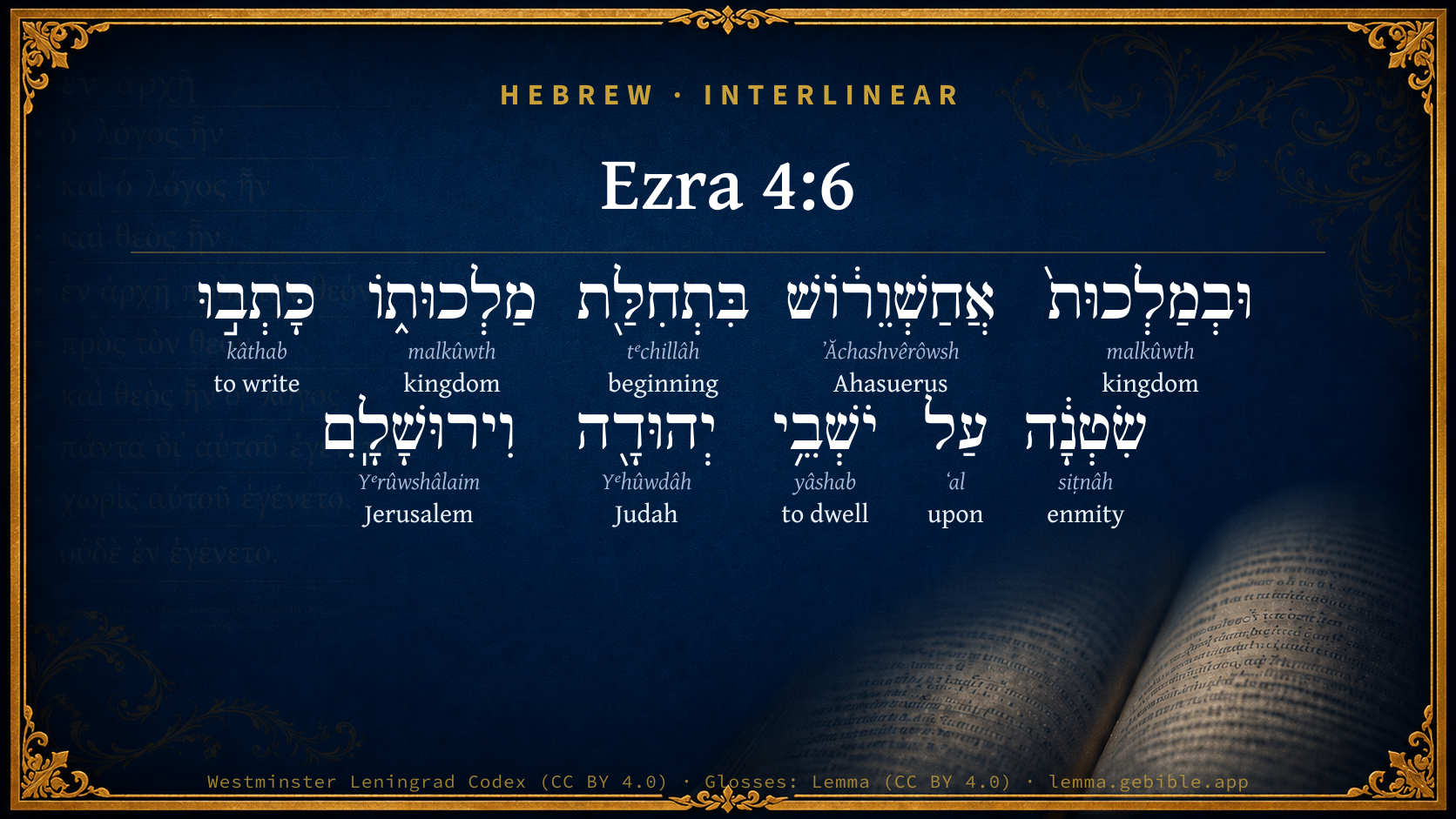
Hebrew (Westminster Leningrad Codex) Ezra 4:6 appears in the Hebrew Old Testament. The text above is from the Westminster Leningrad Codex. Each word links to its Strong’s number, a concise gloss, and parsing drawn from the Open Scriptures Hebrew Bible morphology. Click any word for its full Brown-Driver-Briggs (BDB) entry.
Download image
Cite this verse

Ezra 4:6 (World English Bible). Public Domain. Lemma interlinear Bible study tool, https://lemma.gebible.app/v/ezra/4/6.

Show BibTeX & RIS
BibTeX
RIS
English Translation
In the reign of Ahasuerus, in the beginning of his reign, wrote they an accusation against the inhabitants of Judah and Jerusalem.
World English Bible · Public Domain
Highlights
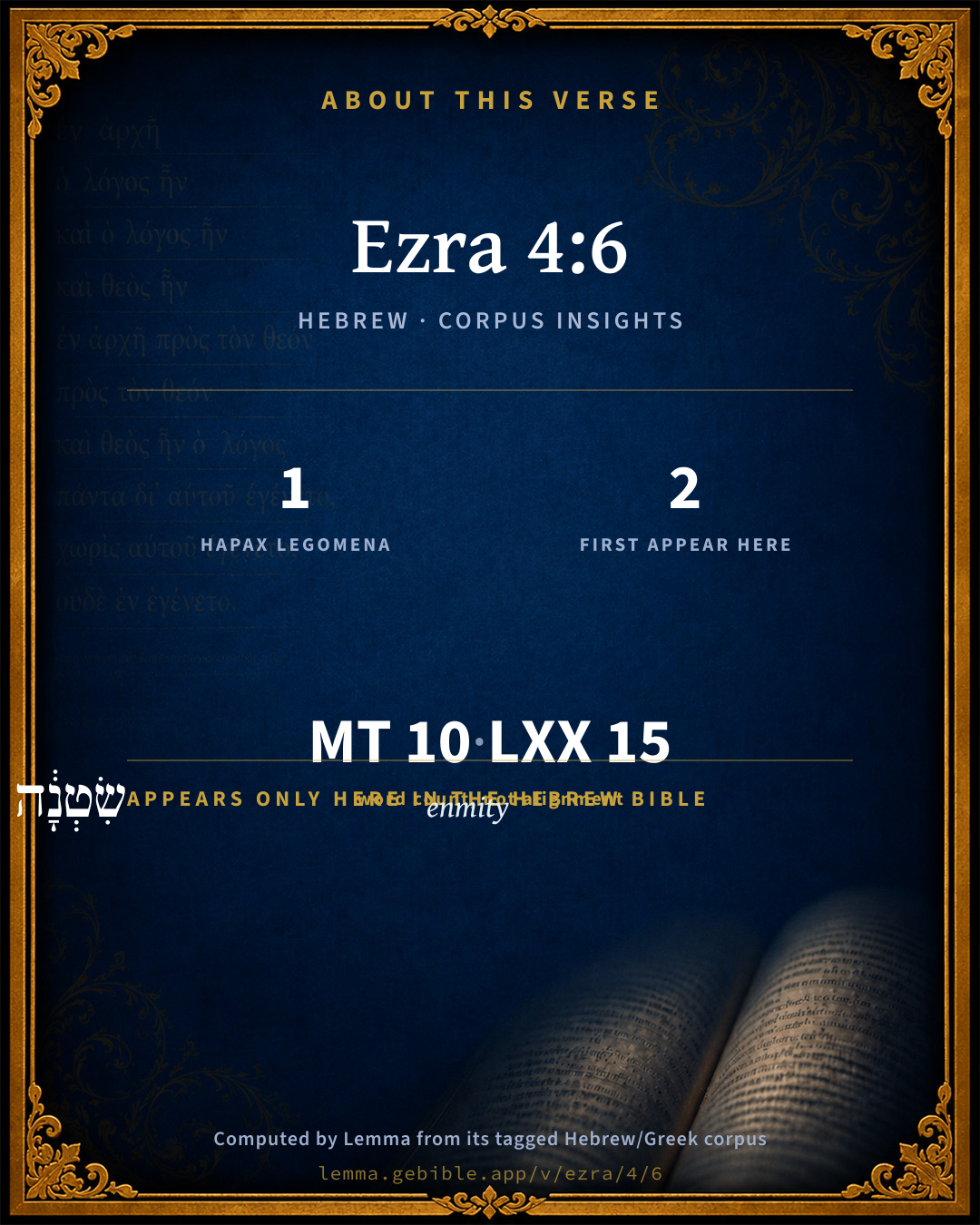
  • 1 hapax legomenon — only here in the Hebrew Bible
  • 2 first appearances in the Hebrew Bible
Full analysis ↓
Download a study sheet

One document with this verse’s original text, its word-by-word gloss line, the meaning frame, cross-references with their text, attributed commentary, and full source and license credits — printable, and it pastes into notes with its structure intact.

This verse Autodidact and up

Study sheet (.html) Plain text (.txt)

A passage Seminary Student

Up to 50 verses in one chapter. A passage sheet keeps up to 6 commentary sources and 12 cross-references per verse, in the order this page ranks them, and says so on the sheet whenever that leaves anything out. Ask for a single verse and you get the Autodidact verse sheet above.

Everything on this page stays free to read, with no account — the sheet is a download of what is already on screen, not access to it.

Want to remove ads? Support Godless Engineer
Compare translations 3

The same verse in 3 English versions, stacked beneath the original-language interlinear above. Click any original word for its lexicon entry.

Each is an independent rendering of the whole verse — the interlinear is not word-aligned to these translations.

Highlighted words mark where these versions differ — a whole-verse word diff, not a word-by-word alignment.

  • World English Bible Public Domain
    In the reign of Ahasuerus, in the beginning of his reign, wrote they an accusation against the inhabitants of Judah and Jerusalem.
  • King James Version Public Domain
    And in the reign of Ahasuerus, in the beginning of his reign, wrote they unto him an accusation against the inhabitants of Judah and Jerusalem.
  • unfoldingWord Literal Text CC BY-SA 4.0
    Now in the reign of Ahasuerus, in the beginning of his reign, they wrote an accusation against those who dwelled in Judah and Jerusalem.

unfoldingWord Literal Text — © unfoldingWord, licensed CC BY-SA 4.0. Word-aligned USFM3 via Door43 (git.door43.org/unfoldingWord/en_ult).

Versions to compare (up to 4)

3 of 4 selected

Show all 18 translations

Every available English version of this verse, each an independent rendering of the whole verse.

  • World English Bible Public Domain
    In the reign of Ahasuerus, in the beginning of his reign, wrote they an accusation against the inhabitants of Judah and Jerusalem.
  • Berean Standard Bible Public Domain
    At the beginning of the reign of Xerxes, an accusation was lodged against the people of Judah and Jerusalem.
  • Majority Standard Bible Public Domain
    At the beginning of the reign of Xerxes, an accusation was lodged against the people of Judah and Jerusalem.
  • King James Version Public Domain
    And in the reign of Ahasuerus, in the beginning of his reign, wrote they unto him an accusation against the inhabitants of Judah and Jerusalem.
  • American Standard Version (1901) Public Domain
    And in the reign of Ahasuerus, in the beginning of his reign, wrote they an accusation against the inhabitants of Judah and Jerusalem.
  • Revised Version (1885) Public Domain
    And in the reign of Ahasuerus, in the beginning of his reign, wrote they an accusation against the inhabitants of Judah and Jerusalem.
  • Geneva Bible (1599) Public Domain
    And in the reigne of Ahashuerosh (in the beginning of his reigne) wrote they an accusation against the inhabitants of Iudah and Ierusalem.
  • Douay-Rheims (1899) Public Domain
    And in the reign of Assuerus, in the beginning of his reign, they wrote an accusation against the inhabitants of Juda and Jerusalem.
  • Young's Literal Translation Public Domain
    And in the reign of Ahasuerus, in the commencement of his reign, they have written an accusation against the inhabitants of Judah and Jerusalem;
  • Literal Standard Version CC BY-SA 4.0
    And in the reign of Ahasuerus, in the commencement of his reign, they have written an accusation against the inhabitants of Judah and Jerusalem;
  • Unlocked Literal Bible CC BY-SA 4.0
    Then at the beginning of Ahasuerus' reign they wrote an accusation against the inhabitants of Judah and Jerusalem.
  • unfoldingWord Literal Text CC BY-SA 4.0
    Now in the reign of Ahasuerus, in the beginning of his reign, they wrote an accusation against those who dwelled in Judah and Jerusalem.
  • Darby Bible Public Domain
    And in the reign of Ahasuerus, in the beginning of his reign, they wrote an accusation against the inhabitants of Judah and Jerusalem.
  • World Messianic Bible Public Domain
    In the reign of Ahasuerus, in the beginning of his reign, they wrote an accusation against the inhabitants of Judah and Jerusalem.
  • Webster's Bible Public Domain
    And in the reign of Ahasuerus, in the beginning of his reign, they wrote to him an accusation against the inhabitants of Judah and Jerusalem.
  • Free Bible Version CC BY-SA 4.0
    When Ahasuerus became king the local people sent him a written accusation against the people of Judah and Jerusalem.
  • Bible in Basic English Public Domain
    And in the time of Ahasuerus, when he first became king, they put on record a statement against the people of Judah and Jerusalem.
  • JPS Tanakh (1917) Public Domain
    And in the reign of Ahasuerus, in the beginning of his reign, wrote they an accusation against the inhabitants of Judah and Jerusalem.

Literal Standard Version (2020), Covenant Press — licensed CC BY-SA 4.0. Text via the HelloAO Bible API (eBible.org). Unlocked Literal Bible (unfoldingWord) — licensed CC BY-SA 4.0. Text via the HelloAO Bible API (eBible.org). unfoldingWord Literal Text — © unfoldingWord, licensed CC BY-SA 4.0. Word-aligned USFM3 via Door43 (git.door43.org/unfoldingWord/en_ult). Free Bible Version, Dr. Jonathan Gallagher — licensed CC BY-SA 4.0. Text via the HelloAO Bible API (eBible.org).

Word by word

More ways to search: Search by grammar → Find every occurrence → Compare this word →

Practice this passage: Drill this verse → Learn its vocabulary →

About this verse

These counts appear in no published source. They are computed here, from the morphology-tagged text and Lemma’s own curated glosses. What Lemma adds →

10
words
9
distinct lemmas
Historical
section

Notable vocabulary

1 hapax legomenon — a word that appears only here in the entire Hebrew Bible:

  • שִׂטְנָ֔ה enmity H7855

First appearance in Scripture

These words make their first canonical appearance in the Hebrew Bible here:

  • אֲחַשְׁוֵר֔וֹשׁ Ahasuerus H325
  • שִׂטְנָ֔ה enmity H7855

Shared distinctive vocabulary

בִּתְחִלַּ֖ת beginning H8462 occurs in 21 verses of the Hebrew Bible. Also found in:

Grammatical profile

  • 2 verbs
  • 7 nouns
  • 1 preposition

Verb forms

  • כָּתְב֣וּ Qal · Perfect
  • יֹשְׁבֵ֥י Qal · Participle Active

Repetition

A word recurs within this verse — often emphatic in Hebrew:

  • וּבְמַלְכוּת֙ kingdom H4438 ×2

Hebrew & Septuagint length

In English translation the verse runs 22 words from the Hebrew and 24 from the Septuagint (LXX English) — closely comparable.

A rough comparison of the two English renderings, which tokenize alike — not a word-level alignment.

Word counts can differ between the Hebrew and the Greek without any difference in meaning — e.g. the Hebrew direct-object marker אֵת has no separate Greek word, and Greek often adds the article ὁ.

In the original languages it is 10 Hebrew tokens and 15 Greek tokens — but the two are counted differently (Hebrew bundles its prefixes and suffixes into one token; the Greek is in lemma form), so that isn’t a like-for-like length.

Cross-references

7

Topical passages linked to Ezra 4:6 in the Treasury of Scripture Knowledge — connected by theme and wording, ordered by reader-vote popularity; previews shown in the World English Bible.

  • Esther 1:1 Now it happened in the days of Ahasuerus (this is Ahasuerus who reigned from India even to Ethiopia, over one hundred twenty-seven provinces),
  • Daniel 9:1 In the first year of Darius the son of Ahasuerus, of the seed of the Medes, who was made king over the realm of the Chaldeans,
  • Matthew 27:37 They set up over his head the accusation against him written, "THIS IS JESUS, THE KING OF THE JEWS."
  • Acts 24:5–9 For we have found this man to be a plague, an instigator of insurrections among all the Jews throughout the world, and a ringleader of the sect of the Nazarenes.
  • Acts 24:13 Nor can they prove to you the things of which they now accuse me.
  • Acts 25:7 When he had come, the Jews who had come down from Jerusalem stood around him, bringing against him many and grievous charges which they could not prove,
  • Revelation 12:10 I heard a loud voice in heaven, saying, "Now is come the salvation, the power, and the Kingdom of our God, and the authority of his Christ; for the accuser of our brothers has been thrown down, who accuses them before our God day and night.

Cross-references courtesy of OpenBible.info (CC BY 4.0).

Hebrew and Greek witnesses Masoretic Hebrew ↔ Greek Septuagint

The same verse in the two great witnesses to the Old Testament, shown verse-for-verse.

These are two independent witnesses, not word-aligned to each other, and the Septuagint is shown in lemma (dictionary) form.

Hebrew Ezra 4:6 Masoretic · Westminster Leningrad Codex

וּבְמַלְכוּת֙ אֲחַשְׁוֵר֔וֹשׁ בִּתְחִלַּ֖ת מַלְכוּת֑וֹ כָּתְב֣וּ שִׂטְנָ֔ה עַל יֹשְׁבֵ֥י יְהוּדָ֖ה וִירוּשָׁלִָֽם

In the reign of Ahasuerus, in the beginning of his reign, wrote they an accusation against the inhabitants of Judah and Jerusalem.

World English Bible · Public Domain

Greek LXX Ezra 4:6 Septuagint · lemma form

καί ἐν βασιλεία ασουηρος ἐν ἀρχή βασιλεία αὐτός γράφω ἐπιστολή ἐπί οἰκέω ἰουδά καί ἰερουσαλήμ

And in the reign of Assuerus, even in the beginning of his reign, they wrote a letter against the inhabitants of Juda and Jerusalem.

LXX2012 (modern English Septuagint) · Public Domain

In the Septuagint this is one book — Esdras B (2 Esdras): Ezra is chapters 1–10, Nehemiah 11–23.

On this verse, Keil & Delitzsch discusses the Septuagint’s reading. Read the note in Commentary ↓

Hebrew: Westminster Leningrad Codex (CC BY 4.0). Greek: Septuagint (public domain); English from LXX2012 (modern English Septuagint) (Public Domain). How the Septuagint differs from the Hebrew →

Commentary

Notes on Ezra 4:6 from classic Christian and Jewish commentators (each source and its license shown beneath its notes). The classic Christian expositions comment on the surrounding passage and are grouped to its opening verse, so a note may address several verses; the Jewish commentaries on the Tanakh (Rashi and others) are per-verse, so they appear only where the commentator wrote on this verse.

Lemma curates 59 commentaries, every one of them public domain or Creative Commons licensed, each selected and text-cleaned for this edition rather than reprinted as found. About our sources →

Matthew Henry's Commentary

Cyrus stedfastly adhered to the Jews' interest, and supported his own grant. It was to no purpose to offer any thing to him in prejudice of it. What he did was from a good principle, and in the fear of God, and therefore he adhered to it. But, though his reign in all was thirty years, yet after the conquest of Babylon, and his decree for the release of the Jews, some think that he reigned but three years, others seven, and then either died or gave up that part of his government, in which his successor was Ahasuerus (Ezr 4:6), called also Artaxerxes (Ezr 4:7), supposed to be the same that in heathen authors is called Cambyses, who had never taken such cognizance of the despised Jews as to concern himself for them, nor had he that knowledge of the God of Israel which his predecessor had. To him these Samaritans applied by letter for an order to stop the building of the temple; and they did it in the beginning of his reign, being resolved to lose no time when they thought they had a king for their purpose. See how watchful the church's enemies are to take the first opportunity of doing it a mischief; let not its friends be less careful to do it a kindness. Here is,

I. The general purport of the letter which they sent to the king, to inform him of this matter. It is called (Ezr 4:6) an accusation against the inhabitants of Judah and Jerusalem. The devil is the accuser of the brethren (Rev 12:10), and he carries on his malicious designs against them, not only by accusing them himself before God, as he did Job, but by acting as a lying spirit in the mouths of his instruments, whom he employs to accuse them before magistrates and kings and to make them odious to the many and obnoxious to the mighty. Marvel not if the same arts be still used to depreciate serious godliness.

II. The persons concerned in writing this letter. The contrivers are named (Ezr 4:7) that plotted the thing, the writers (Ezr 4:8) that put it into form, and the subscribers (Ezr 4:9) that concurred in it and joined with them in this representation, this misrepresentation I should call it. Now see here, 1. How the rulers take counsel together against the Lord and his temple, with their companions. The building of the temple would do them no harm, yet they appear against it with the utmost concern and virulence, perhaps because the prophets of the God of Israel had foretold the famishing and perishing of all the gods of the heathen, Zep 2:11; Jer 10:11. 2. How the people concurred with them in imagining this vain thing. They followed the cry, though ignorant of the merits of the cause. All the several colonies of that plantation (nine are here mentioned), who had their denomination from the cities or countries of Assyria, Chaldea, Persia, etc., whence they came, set their hands, by their representatives, to this letter. Perhaps they were incensed against these returned Jews because many of the ten tribes were among them, whose estates they had got into their possession, and of whom they were therefore jealous, lest they should attempt the recovery of them hereafter.

III. A copy of the letter itself, which Ezra inserts here out of the records of the kingdom of Persia, into which it had been entered; and it is well we have it, that we may see whence the like methods, still taken to expose good people and baffle good designs, are copied.

1. They represent themselves as very loyal to the government, and greatly concerned for the honour and interest of it, and would have it thought that the king had no such loving faithful subjects in all his dominions as they were, none so sensible of their obligations to him, Ezr 4:14. Because we are salted with the salt of the palace (so it is in the margin), "we have our salary from the court, and could no more live without it than flesh could be preserved without salt;" or, as some think, their pay or pension was sent them in salt; or "Because we had our education in the palace, and were brought up at the king's table," as we find, Dan 1:5. These were those whom he intended to prefer; they did eat their portion of the king's meat. "Now, in consideration of this, it is not meet for us to see the king's dishonour;" and therefore they urge him to stop the building of the temple, which would certainly be the king's dishonour more than any thing else. Note, A secret enmity to Christ and his gospel is often gilded over with a pretended affection to Caesar and his power. The Jews hated the Roman government, and yet, to serve a turn, could cry, We have no king but Caesar. But (to allude to this), if those that lived upon the crown thought themselves bound in gratitude thus to support the interest of it, much more reason have we thus to argue ourselves into a pious concern for God's honour; we have our maintenance from the God of heaven and are salted with his salt, live upon his bounty and are the care of his providence; and therefore it is not meet for us to see his dishonour without resenting it and doing what we can to prevent it.

2. They represent the Jews as disloyal, and dangerous to the government, that Jerusalem was the rebellious and bad city (Ezr 4:12), hurtful to kings and provinces, Ezr 4:15. See how Jerusalem, the joy of the whole earth (Psa 48:2), is here reproached as the scandal of the whole earth. The enemies of the church could not do the bad things they design against it if they did not first give it a bad name. Jerusalem had been a loyal city to its rightful princes, and its present inhabitants were as well affected to the king and his government as any of his provinces whatsoever. Daniel, who was a Jew, had lately approved himself so faithful to his prince that his worst enemies could find no fault in his management, Dan 6:4. But thus was Elijah most unjustly charged with troubling Israel, the apostles with turning the world upside down, and Christ himself with perverting the nation and forbidding to give tribute to Caesar; and we must not think it strange if the same game be still played. Now here,

(1.) Their history of what was past was invidious, that within this city sedition had been moved of old time, and, for that cause, it was destroyed, Ezr 4:15. It cannot be denied but that there was some colour given for this suggestion by the attempts of Jehoiakim and Zedekiah to shake off the yoke of the king of Babylon, which, if they had kept close to their religion and the temple they were now rebuilding, they would never have come under. But it must be considered, [1.] That they were themselves, and their ancestors, sovereign princes, and their efforts to recover their rights, if there had not been in them the violation of an oath, for aught I know, would have been justifiable, and successful too, had they taken the right method and made their peace with God first. [2.] Though these Jews, and their princes, had been guilty of rebellion, yet it was unjust therefore to fasten this as an indelible brand upon this city, as if that must for ever after go under the name of the rebellious and bad city. The Jews, in their captivity, had given such specimens of good behaviour as were sufficient, with any reasonable men, to roll away that one reproach; for they were instructed (and we have reason to hope that they observed their instructions) to seek the peace of the city where they were captives and pray to the Lord for it, Jer 29:7. It was therefore very unfair, though not uncommon, thus to impute the iniquity of the fathers to the children.

(2.) Their information concerning what was now doing was grossly false in matter of fact. Very careful they were to inform the king that the Jews had set up the walls of this city, nay, had finished them (so it is in the margin) and joined the foundations (Ezr 4:12), when this was far from being the case. They had only begun to build the temple, which Cyrus commanded them to do, but, as for the walls, there was nothing done nor designed towards the repair of them, as appears by the condition they were in many years after (Neh 1:3), all in ruins. What shall be given, and what done, to these false tongues, nay, which is worse, these false pens? sharp arrows, doubtless, of the mighty, and coals of juniper, Psa 120:3, Psa 120:4. If they had not been perfectly lost to all virtue and honour they would not, and if they had not been very secure of the king's countenance they durst not, have written that to the king which all their neighbours knew to be a notorious lie. See Pro 29:12.

(3.) Their prognostics of the consequences were altogether groundless and absurd. They were very confident, and would have the king believe it upon their word, that if this city should be built, not only the Jews would pay no toll, tribute, or custom (Ezr 4:13), but (since a great lie is as soon spoken as a little one) that the king would have no portion at all on this side the river (Ezr 4:16), that all the countries on this side Euphrates would instantly revolt, drawn in to do so by their example; and, if the prince in possession should connive at this, he would wrong, not only himself, but his successors: Thou shalt endamage the revenue of the kings. See how every line in this letter breathes both the subtlety and malice of the old serpent.

Matthew Henry's Commentary on the Whole Bible (1708–1710) — public domain (CC PDM 1.0). Text via the HelloAO Bible API.

Trapp's Complete Commentary

John Trapp

Ezr 4:6 And in the reign of Ahasuerus, in the beginning of his reign, wrote they [unto him] an accusation against the inhabitants of Judah and Jerusalem.

Ver. 6. And in the reign of Ahasuerus] That is, of Cambyses, who is also called Artaxerxes in the next verse; for these two names were given to many kings of Persia; like as Pharaoh was to the kings of Egypt, as a title of honour. Ahasuerus signifieth a hereditary prince. Daniel calleth him the prince of the kingdom of Persia, Dan 10:13, because he was viceroy in his father’s absence. Infamous he is for many lewd pranks (as that he killed his brother, and then his own sister, after he had first married her, and made a law that any man might do the like), yet was he not so ungracious a son to Cyrus as our Henry II’s eldest son was; whom he not only crowned king during his own life, but also, to do him honour at his coronation, renounced the name of a king for that day, and, as sewer, served at the table. For which he was thus requited, My father, said he, is not dishonoured by attending on me; for I am both a king’s and a queen’s son, and so is not he.

In the beginning of his reign] As loth to lose time (Esau began in the very womb to persecute Jacob), and as taking their fittest season for granting of suits.

Wrote they an accusation] Heb. a Satanical suggestion, a diabolical accusation, hatched in hell, and dictated by the devil. He it is that acteth and agitateth the saints’ adversaries and accusers; sitting upon their tongues and pens, and setting an edge on them.

John Trapp, A Commentary or Exposition upon All the Books of the Old and New Testament (1647–1656) — public domain. Text from a community e-Sword module.

Joseph Benson's Commentary

Ezr 4:6. In the reign of Ahasuerus — A common name of divers kings of Persia. This Ahasuerus was probably Smerdis, one of the magi who seized the kingdom after Cambyses. Wrote they unto him an accusation against Judah and Jerusalem — Importing that they intended to set up for themselves, and not to depend upon the king of Persia.

Joseph Benson's Commentary on the Old and New Testaments (1811–1818) — public domain. Text from a community e-Sword module.

Keil & Delitzsch

C. F. Keil & F. Delitzsch

Complaints against the Jews to Kings Ahashverosh and Artachshasta. - The right understanding of this section depends upon the question, What kings of Persia are meant by Ahashverosh and Artachshasta? while the answer to this question is, in part at least, determined by the contents of the letter, Ezr 4:8-16, sent by the enemies of the Jews to the latter monarch.

Ezr 4:6-7

And in the reign of Ahashverosh, in the beginning of his reign, they wrote an accusation against the inhabitants of Judah and Jerusalem. שׂטנה, not to mention the name of the well, Gen 26:21, occurs here only, and means, according to its derivation from שׂטן, to bear enmity, the enmity; hence here, the accusation. ישׁבי על belongs to שׂטנה, not to כּתבוּ; the letter was sent, not to the inhabitants of Judah, but to the king against the Jews. The contents of this letter are not given, but may be inferred from the designation שׂטנה. The letter to Artachshasta then follows, Ezr 4:7-16. In his days, i.e., during his reign, wrote Bishlam, Mithredath, Tabeel, and the rest of their companions. כּנותו, for which the Keri offers the ordinary form כּנותיו mrof yra, occurs only here in the Hebrew sections, but more frequently in the Chaldee (comp. Ezr 4:9, Ezr 4:17, Ezr 4:23; Ezr 5:3, and elsewhere), in the sense of companions or fellow-citizens; according to Gesenius, it means those who bear the same surname (Kunje) together with another, though Ewald is of a different opinion; see 117, b, note. The singular would be written כּנת (Ewald, 187, d). And the writing of the letter was written in Aramaean (i.e., with Aramaean characters), and interpreted in (i.e., translated into) Aramaean. נשׁתּון is of Aryan origin, and connected with the modern Persian nuwishten, to write together; it signifies in Hebrew and Chaldee a letter: comp. Ezr 4:18, where נשׁתּונא is used for אגּרתּא of Ezr 4:11. Bertheau translates הנּשׁתּון כּתב, copy of the letter, and regards it as quite identical with the Chaldee אגּרתּא פּרשׁגן, Ezr 4:11; he can hardly, however, be in the right. כּתב does not mean a transcript or copy, but only a writing (comp. Est 4:8). This, too, does away with the inference "that the writer of this statement had before him only an Aramaean translation of the letter contained in the state-papers or chronicles which he made use of." It is not כּתב, the copy or writing, but הנּשׁתּון, the letter, that is the subject of ארמית מתרגּם, interpreted in Aramaean. This was translated into the Aramaean or Syrian tongue. The passage is not to be understood as stating that the letter was drawn up in the Hebrew or Samaritan tongue, and then translated into Aramaean, but simply that the letter was not composed in the native language of the writers, but in Aramaean. Thus Gesenius rightly asserts, in his Thes. p. 1264, et lingua aramaea scripta erat; in saying which תרגם does not receive the meaning concepit, expressit, but retains its own signification, to interpret, to translate into another language. The writers of the letter were Samaritans, who, having sprung from the intermingling of the Babylonian settlers brought in by Esarhaddon and the remnants of the Israelitish population, spoke a language more nearly akin to Hebrew than to Aramaean, which was spoken at the Babylonian court, and was the official language of the Persian kings and the Persian authorities in Western Asia. This Aramaean tongue had also its own characters, differing from those of the Hebrew and Samaritan. This is stated by the words ארמית כּתוּב, whence Bertheau erroneously infers that this Aramaean writing was written in other than the ordinary Aramaean, and perhaps in Hebrew characters.

This letter, too, of Bishlam and his companions seems to be omitted. There follows, indeed, in Ezr 4:8, etc., a letter to King Artachshasta, of which a copy is given in Ezr 4:11-16; but the names of the writers are different from those mentioned in Ezr 4:7. The three names, Bishlam, Mithredath, and Tabeel (Ezr 4:7), cannot be identified with the two names Rehum and Shimshai (Ezr 4:8). When we consider, however, that the writers named in Ezr 4:8 were high officials of the Persian king, sending to the monarch a written accusation against the Jews in their own and their associates' names, it requires but little stretch of the imagination to suppose that these personages were acting at the instance of the adversaries named in Ezr 4:7, the Samaritans Bishlam, Mithredath, and Tabeel, and merely inditing the complaints raised by these opponents against the Jews. This view, which is not opposed by the כּתב of Ezr 4:7, - this word not necessarily implying an autograph, - commends itself to our acceptance, first, because the notion that the contents of this letter are not given finds no analogy in Ezr 4:6, where the contents of the letter to Ahashverosh are sufficiently hinted at by the word שׂטנה; while, with regard to the letter of Ezr 4:7, we should have not a notion of its purport in case it were not the same which is given in Ezr 4:8, etc.

(Note: The weight of this argument is indirectly admitted by Ewald (Gesch. iv. p. 119) and Bertheau, inasmuch as both suppose that there is a long gap in the narrative, and regard the Aramaean letter mentioned in Ezr 4:7 to have been a petition, on the part of persons of consideration in the community at Jerusalem, to the new king, - two notions which immediately betray themselves to be the expedients of perplexity. The supposed "long gaps, which the chronicler might well leave even in transcribing from his documents" (Ew.), do not explain the abrupt commencement of Ezr 4:8. If a petition from the Jewish community to the king were spoken of in Ezr 4:7, the accusation against the Jews in Ezr 4:8 would certainly have been alluded to by at least a ו adversative, or some other adversative particle.)

Besides, the statement concerning the Aramaean composition of this letter would have been utterly purposeless if the Aramaean letter following in Ezr 4:8 had been an entirely different one. The information concerning the language in which the letter was written has obviously no other motive than to introduce its transcription in the original Aramaean. This conjecture becomes a certainty through the fact that the Aramaean letter follows in Ezr 4:8 without a copula of any kind. If any other had been intended, the ו copulative would not more have been omitted here than in Ezr 4:7. The letter itself, indeed, does not begin till Ezr 4:9, while Ezr 4:8 contains yet another announcement of it. This circumstance, however, is explained by the fact that the writers of the letters are other individuals than those named in Ezr 4:7, but chiefly by the consideration that the letter, together with the king's answer, being derived from an Aramaean account of the building of the temple, the introduction to the letter found therein was also transcribed.

Ezr 4:8

The writers of the letter are designated by titles which show them to have been among the higher functionaries of Artachshasta. Rehum is called טעם בּעל, dominus consilii v. decreti, by others consiliarius, royal counsellor, probably the title of the Persian civil governor (erroneously taken for a proper name in lxx, Syr., Arab.); Shimshai, ספרא, the Hebrew סופר, scribe, secretary. כּנמא is interpreted by Rashi and Aben Ezra by כּאשׁר נאמר, as we shall say; נמא is in the Talmud frequently an abbreviation of נאמר or נימר, of like signification with לאמר: as follows.

Ezr 4:9-11

After this introduction we naturally look for the letter itself in Ezr 4:9, instead of which we have (Ezr 4:9 and Ezr 4:10) a full statement of who were the senders; and then, after a parenthetical interpolation, "This is the copy of the letter," etc., the letter itself in Ezr 4:11. The statement is rather a clumsy one, the construction especially exhibiting a want of sequence. The verb to אדין is wanting; this follows in Ezr 4:11, but as an anacoluthon, after an enumeration of the names in Ezr 4:9 and Ezr 4:10 with שׁלחוּ. The sentence ought properly to run thus: "Then (i.e., in the days of Artachshasta) Rehum, etc., sent a letter to King Artachshasta, of which the following is a copy: Thy servants, the men on this side the river," etc. The names enumerated in Ezr 4:9 and Ezr 4:10 were undoubtedly all inserted in the superscription or preamble of the letter, to give weight to the accusation brought against the Jews. The author of the Chaldee section of the narrative, however, has placed them first, and made the copy of the letter itself begin only with the words, "Thy servants," etc. First come the names of the superior officials, Rehum and Shimshai, and the rest of their companions. The latter are then separately enumerated: The Dinaites, lxx Δειναῖοι, - so named, according to the conjecture of Ewald (Gesch. iii. p. 676), from the Median city long afterwards called Deinaver (Abulf. Gegr. ed. Paris. p. 414); the Apharsathchites, probably the Pharathiakites of Strabo (15:3. 12) (Παρητακηνοί, Herod. i. 101), on the borders of Persia and Media, described as being, together with the Elymaites, a predatory people relying on their mountain fastnesses; the Tarpelites, whom Junius already connects with the Τάπουροι dwelling east of Elymais (Ptol. vi. 2. 6); the Apharsites, probably the Persians (פרסיא with א prosthetic); the Archevites, probably so called from the city ארך, Gen 10:10, upon inscriptions Uruk, the modern Warka; the בּבליא, Babylonians, inhabitants of Babylon; the Shushanchites, i.e., the Susanites, inhabitants of the city of Susa; דּהוא, in the Keri דּהיא, the Dehavites, the Grecians (Δάοι, Herod. i. 125); and lastly, the Elamites, the people of Elam or Elymais. Full as this enumeration may seem, yet the motive being to name as many races as possible, the addition, "and the rest of the nations whom the great and noble Osnapper brought over and set in the city of Samaria, and the rest that are on this side the river," etc., is made for the sake of enhancing the statement. Prominence being given both here and Ezr 4:17 to the city of Samaria as the city in which Osnapper had settled the colonists here named, the "nations brought in by Osnapper" must be identical with those who, according to Ezr 4:2, and Kg2 17:24, had been placed in the cities of Samaria by King Esarhaddon. Hence Osnapper would seem to be merely another name for Esarhaddon. But the names Osnapper (lxx Ἀσσεναφάρ) and Asarhaddon (lxx Ἀσαραδάν) being too different to be identified, and the notion that Osnapper was a second name of Asarhaddon having but little probability, together with the circumstance that Osnapper is not called king, as Asarhaddon is Ezr 4:2, but only "the great and noble," it is more likely that he was some high functionary of Asarhaddon, who presided over the settlement of eastern races in Samaria and the lands west of the Euphrates. "In the cities," or at least the preposition ב, must be supplied from the preceding בּקריה before נהרה עבר שׁאר: and in the rest of the territory, or in the cities of the rest of the territory, on this side of Euphrates. עבר, trans, is to be understood of the countries west of Euphrates; matters being regarded from the point of view of the settlers, who had been transported from the territories east, to those west of Euphrates. וּכענת means "and so forth," and hints that the statement is not complete.

On comparing the names of the nations here mentioned with the names of the cities from which, according to Kg2 17:24, colonists were brought to Samaria, we find the inhabitants of most of the cities there named - Babylon, Cuthah, and Ava - here comprised under the name of the country as בּבליא, Babylonians; while the people of Hamath and Sepharvaim may fitly be included among "the rest of the nations," since certainly but few colonists would have been transported from the Syrian Hamath to Samaria. The main divergence between the two passages arises from the mention in our present verse, not only of the nations planted in the cities of Samaria, but of all the nations in the great region on this side of Euphrates (נהרה עבר). All these tribes had similar interests to defend in opposing the Jewish community, and they desired by united action to give greater force to their representation to the Persian monarch, and thus to hinder the people of Jerusalem from becoming powerful. And certainly they had some grounds for uneasiness lest the remnant of the Israelites in Palestine, and in other regions on this side the Euphrates, should combine with the Jerusalem community, and the thus united Israelites should become sufficiently powerful to oppose an effectual resistance to their heathen adversaries. On the anacoluthistic connection of Ezr 4:11. פּרשׁגן, Ezr 4:11, Ezr 4:23; Ezr 5:6; Ezr 7:11, and frequently in the Targums and the Syriac, written פּתשׁגן Est 3:14 and Est 4:8, is derived from the Zendish paiti (Sanscr. prati) and enghana (in Old-Persian thanhana), and signifies properly a counterword, i.e., counterpart, copy. The form with ר is either a corruption, or formed from a compound with fra; comp. Gildemeister in the Zeitschr. fr die Kunde des Morgenl. iv. p. 210, and Haug in Ewald's bibl. Jahrb. v. p. 163, etc. - The copy of the letter begins with עבדּיך, thy servants, the men, etc. The Chethib עבדיך is the original form, shortened in the Keri into עבדּך. Both forms occur elsewhere; comp. Dan 2:29; Dan 3:12, and other passages. The וכענת, etc., here stands for the full enumeration of the writers already given in Ezr 4:9, and also for the customary form of salutation.

Ezr 4:12-16

The letter. Ezr 4:12 "Be it known unto the king." On the form להוא for יהוא, peculiar to biblical Chaldee, see remarks on Dan 2:20. "Which are come up from thee," i.e., from the territory where thou art tarrying; in other words, from the country beyond Euphrates. This by no means leads to the inference, as Schrader supposes, that these Jews had been transported from Babylon to Jerusalem by King Artachshasta. מלק answers to the Hebrew עלה, and is used like this of the journey to Jerusalem. "Are come to us, to Jerusalem," עלינא, to us, that is, into the parts where we dwell, is more precisely defined by the words "to Jerusalem." "They are building the rebellious and bad city, and are setting up its walls and digging its foundations." Instead of מרדתּא (with Kamets and Metheg under )ר the edition of J. H. Mich. has מרדתּא, answering to the stat. abs. מרדא, Ezr 4:15; on the other hand, the edition of Norzi and several codices read מרדתּא, the feminine of מרוד. For בּאוּשׁתּא Norzi has באישׁתּא, from בּישׁ, a contraction of בּאישׁ. For אשׁכללוּ must be read, according to the Keri, שׁכללוּ שׁוּריּא. The Shaphel שׁכלל from כּלל, means to complete, to finish. אשּׁין, bases, foundations. יחיטוּ may be the imperf. Aphel of חוּט, formed after the example of יקּים for יקים, omitting the reduplication, יחיט. חוּט means to sew, to sew together, and may, like רפא, be understood of repairing walls or foundations. But it is more likely to be the imperf. Aphel of חטט, in Syriac hat, and in the Talmud, to dig, to dig out, fodit, excavavit - to dig out the foundations for the purpose of erecting new buildings.

Ezr 4:13

"Now be it known unto the king, that if this city be built up and ... they will not pay toll, tribute, and custom, and it (the city) will at last bring damage to the king." The three words מנדּה בלו והלך occur again, Ezr 4:20 and Ezr 7:24, in this combination as designating the different kinds of imposts. מנדּה, with resolved Dagesh forte, for מדּה (Ezr 4:20), signifies measure, then tax or custom measured to every one. בּלו, probably a duty on consumption, excise; הלך, a toll paid upon roads by travellers and their goods. The word אפּהם, which occurs only here, and has not been expressed by old translators, depends upon the Pehlevi word אודום: it is connected with the Sanscrit apa, in the superl. apama, and signifies at last, or in the future; comp. Haug, p. 156. מלכים, a Hebraized form for מלכין, Ezr 4:15, is perhaps only an error of transcription.

Ezr 4:14

"Now, because we eat the salt of the palace, and it does not become us to see the damage of the king, we send (this letter) and make known to the king." מלח מלח, to salt salt = to eat salt. To eat the salt of the palace is a figurative expression for: to be in the king's pay. See this interpretation vindicated from the Syriac and Persian in Gesen. thes. p. 790.

(Note: Luther, in translating "all we who destroyed the temple," follows the Rabbis, who, from the custom of scattering salt upon destroyed places, Jdg 9:45, understood these words as an expression figurative of destruction, and היכלא as the temple.)

ערוה, deprivation, emptying, here injury to the royal power or revenue. אריך, participle of ארך, answering to the Hebrew ערך, means fitting, becoming.

Ezr 4:15

"That search may be made in the book of the chronicles of thy fathers, so shalt thou find in the book of the Chronicles that this city has been a rebellious city, and hurtful to kings and countries, and that they have from of old stirred up sedition within it, on which account this city was (also) destroyed." יבקּר is used impersonally: let one seek, let search be made. דּכרניּא ספר, book of records, is the public royal chronicle in which the chief events of the history of the realm were recorded, called Est 6:1 the book of the records of daily events. Thy fathers are the predecessors of the king, i.e., his predecessors in government; therefore not merely the Median and Persian, but the Chaldean and Assyrian kings, to whose dominions the Persian monarchs had succeeded. אשׁתּדּוּר, a verbal noun from the Ithpeal of שׁדר, rebellion. עלמא יומת מן, from the days of eternity, i.e., from time immemorial. יומת is in the constructive state, plural, formed from the singular יומא. This form occurs only here and Ezr 4:19, but is analogous with the Hebrew poetical form ימות for ימים.

Ezr 4:16

After thus casting suspicion upon the Jews as a seditious people, their adversaries bring the accusation, already raised at the beginning of the letter, to a climax, by saying that if Jerusalem is rebuilt and fortified, the king will lose his supremacy over the lands on this side the river. דּנה לקבל, on this account, for this reason, that the present inhabitants of the fortified city Jerusalem are like its former inhabitants, thou wilt have no portion west of Euphrates, i.e., thou wilt have nothing more to do with the countries on this side the river-wilt forfeit thy sway over these districts.

Ezr 4:17-22

The royal answer to this letter. פּתגּמא - a word which has also passed into the Hebrew, Ecc 8:11; Est 1:20 - is the Zend. patigama, properly that which is to take place, the decree, the sentence; see on Dan 3:16. עבר וּשׁאר still depends upon בּ: those dwelling in Samaria and the other towns on this side the river. The royal letter begins with וּכעת שׁלם, "Peace," and so forth. כּעת is abbreviated from כּענת.

Ezr 4:18

"The letter which you sent to us has been plainly read before me." מפרשׁ part. pass. Peal, corresponds with the Hebrew part. Piel מפרשׁ, made plain, adverbially, plainly, and does not signify "translated into Persian."

Ezr 4:19

"And by me a command has been given, and search has been made; and it has been found that this city from of old hath lifted itself (risen) up against kings," etc. מתנשּׁא, lifted itself up rebelliously, as (in Hebrew) in Kg1 1:5.

Ezr 4:20

"There have been powerful kings in Jerusalem, and (rulers) exercising dominion over the whole region beyond the river" (westward of Euphrates). This applies in its full extent only to David and Solomon, and in a less degree to subsequent kings of Israel and Judah. On Ezr 4:20, comp. Ezr 4:13.

Ezr 4:21

"Give ye now commandment to hinder these people (to keep them from the work), that this city be not built until command (sc. to build) be given from me." יתּשׂם, Ithpeal of שׂוּם.

Ezr 4:22

"And be warned from committing an oversight in this respect," i.e., take heed to overlook nothing in this matter (זהיר, instructed, warned). "Why should the damage become great (i.e., grow), to bring injury to kings?"

Ezr 4:23

The result of this royal command. As soon as the copy of the letter was read before Rehum and his associates, they went up in haste to Jerusalem to the Jews, and hindered them by violence and force. אדרע with א prosthetic only here, elsewhere דּרע (= זרוע), arm, violence. Bertheau translates, "with forces and a host;" but the rendering of אדרע or זרוע by "force" can neither be shown to be correct from Eze 17:9 and Dan 11:15, Dan 11:31, nor justified by the translation of the lxx, ἐν ἵπποις καὶ δυνάμει.

Keil & Delitzsch — Biblical Commentary on the Old Testament (1861–1891) — public domain (CC PDM 1.0). Text via the HelloAO Bible API. (Old Testament only.)

The Expositor's Bible

THE COST OF AN IDEALISTS SUCCESS

Ezr_4:6-23

THE fourth chapter of the Book of Ezra contains an account of a correspondence between the Samaritan colonists and two kings of Persia, which follows sharply on the first mention of the intrigues of the enemies of Judah and Benjamin at the Persian court in the later days of Cyrus, and which precedes the description of the fortunes of the Jews in the reign of Darius. If this has its right chronological position in the narrative, it must relate to the interval during which the temple-building was in abeyance. In that case the two kings of Persia would be Cambyses, the son and successor of Cyrus, and Pseudo-Bardes. But the names in the text are Ahasuerus (Ahashverosh) and Artaxerxes (Artahshashta). It has been suggested that these are second names for the predecessors of Darius. Undoubtedly it was customary for Persian monarchs to have more than one name. But elsewhere in the Biblical narratives these two names are invariably applied to the successors of Darius-the first standing for the welt-known Xerxes and the second for Artaxerxes Longimanus. The presumption therefore is that the same kings are designated by them here. Moreover, when we examine the account of the correspondence with the Persian court, we find that this agrees best with the later period. The opening verses of the fourth chapter of Ezra deal with the building of the temple; the last verse of that chapter and the succeeding narrative of the fifth chapter resume the same topic. But the correspondence relates to the building of the walls of the city. There is not a word about any such work in the context. Then in the letter addressed to Artaxerxes the writers describe the builders of the walls as "the Jews which came up from thee." {Ezr_4:12} This description would not fit Zerubbabel and his followers, who migrated under Cyrus. But it would apply to those who accompanied Ezra to Jerusalem in the reign of Artaxerxes. Lastly, the reign of Pseudo-Bardes is too brief for all that would have to be crowded into it. It only occupied seven months. Yet a letter is sent up from the enemies of the Jews; inquiry is made into the history of Jerusalem by Persian officials at the court; a reply based on this inquiry is transmitted to Palestine; in consequence of this reply an expedition is organised which effectually stops the works at Jerusalem, but only after the exercise of force on the spot. It is nearly impossible for all this to have happened in so short a time as seven months. All the indications therefore concur to assign the correspondence to the later period.

The chronicler must have inserted this section out of its order for some reason of his own. Probably he desired to accentuate the impression of the malignant and persistent enmity of the colonists, and with this end in view described the later acts of antagonism directly after mentioning the first outbreak of opposition. It is just possible that he perceived the unfavourable character of his picture of the Jews in their curt refusal of assistance from their neighbours, and that he desired to balance this by an accumulation of weighty indictments against the people whom the Jews had treated so ungraciously.

In his account of the correspondence with the Persian court the chronicler seems to have taken note of three separate letters from the unfriendly colonists. First, he tells us that in the beginning of the reign of Ahasuerus they wrote an accusation against the Jews. {Ezr_4:6} This was before the mission of Ezra, therefore it was a continuance of the old opposition that had been seen in the intrigues that preceded the reign of Darius; it shows that after the death of that friendly monarch the slumbering fires broke out afresh. Next, he names certain men who wrote to Artaxerxes, and he adds that their letter was translated and written in the Aramaic language-the language which was the common medium of intercourse in trade and official affairs among the mixed races inhabiting Syria and all the regions west of the Euphrates. {Ezr_4:7} The reference to this language probably arises from the fact that the chronicler had seen a copy of the translation. He does not tell us anything either of the nationality of the writers or of the subject of their letter. It has been suggested that they were Jews in Jerusalem who wrote to plead their cause with the Persian king. The fact that two of them bore Persian names-viz., Bishlam and Mithredath-does not present a serious difficulty to this view, as we know that some Jews received such names, Zerubbabel, for example, being named Sheshbazzar. But as the previous passage refers to an accusation against the Jews, and as the following sentences give an account of a letter also written by the inimical colonists, it is scarcely likely that the intermediate colourless verse which mentions the letter of Bishlam and his companions is of a different character. We should expect some more explicit statement if that were the case. Moreover, it is most improbable that the passage which follows would begin abruptly without an adversative conjunction as is the case if it proceeded to describe a letter provoked by opposition to another letter just mentioned. Therefore we must regard Bishlam and his companions as enemies of the Jews. Now some who have accepted this view have maintained that the letter of Bishlam and his friends is no other than the letter ascribed to Rehum and Shimshai in the following verses. It is stated that the former letter was in the Aramaic language, and the letter which is ascribed to the two great officials is in that language. But the distinct statement that each group of men wrote a letter seems to imply that there were two letters written in the reign of Artaxerxes, or three in all.

The third letter is the only one that the chronicler has preserved. He gives it in the Aramaic language, and from Ezr_4:8, where this is introduced, to Ezr_6:18, his narrative proceeds in that language, probably because he found his materials in some Aramaic document.

Some have assigned this letter to the period of the reign of Artaxerxes prior to the mission of Ezra. But there are two reasons for thinking it must have been written after that mission. The first has been already referred to-viz., that the complaint about "the Jews which came up from thee" points to some large migration during the reign of Artaxerxes, which must be Ezras expedition. The second reason arises from a comparison of the results of the correspondence with the description of Jerusalem in the opening of the Book of Nehemiah. The violence of the Samaritans recorded in Ezr_4:23 will account for the deplorable state of Jerusalem mentioned in Neh_1:3, the effects of the invasion referred to in the former passage agreeing well with the condition of the dismantled city reported to Nehemiah. But in the history of Ezras expedition no reference is made to any such miserable state of affairs. Thus the correspondence must be assigned to the time between the close of Ezra and the beginning of Nehemiah.

It is to Ezras company, then, that the correspondence with Artaxerxes refers. There were two parties in Jerusalem, and the opposition was against the active reforming party, which now had the upper hand in the city. Immediately we consider this, the cause of the continuance and increase of the antagonism of the colonists becomes apparent. Ezras harsh reformation in the expulsion of foreign wives must have struck the divorced women as a cruel and insulting outrage. Driven back to their paternal homes with their burning wrongs, these poor women must have roused the utmost indignation among their people. Thus the reformer had stirred up a hornets nest. The legislator who ventures to interfere with the sacred privacy of domestic life excites the deepest passions, and a wise man will think twice before he meddles in so dangerous a business. Only the most imperative requirements of religion and righteousness can justify such a course, and even when it is justified nobody can foresee how far the trouble it brings may spread.

The letter which the chronicler transcribes seems to have been the most important of the three. It was written by two great Persian officials. In our English versions the first of these is called "the chancellor," and the second "the scribe." "The chancellor" was probably the governor of a large district, of which Palestine was but a provincial section, and "the scribe" his secretary. Accordingly it is apparent that the persistent enmity of the colonists, their misrepresentations, and perhaps their bribes, had resulted in instigating opposition to the Jews in very high places. The action of the Jews themselves may have excited suspicion in the mind of the Persian Satrap, for it would seem from his letter that they had just commenced to fortify their city. The names of the various peoples who are associated with these two great men in the title of the letter also show how far the opposition to the Jews had spread. They are given as the peoples whom Osnappar (Esar-bani-pal) had brought over and set in the city of Samaria, "and in the rest of the country beyond the river." {Ezr_4:10} That is to say, the settlers in the vast district west of the Euphrates are included. Here were Apharsathchites- who cannot be the Persians, as some have thought, because no Assyrian king ever seems to have penetrated to Persia, but may be the Paraetaceni of Herodotus, (1, 101), a Median people: Tarpelites- probably the people named among the Hebrews after Tubal: {Gen_10:2} Apharsites- also wrongly identified by some with the Persians, but probably another Median people: Archeviles, from the ancient Erech (Uruk): {Gen_10:10} Babylonians, not only from the city of Babylon, but also from its neighbourhood, Shushanchites, from Shusan (Susa), the capital of Susiana, Dehaites- possibly the Dai of Herodotus, (1, 125) because, though these were Persians, they were nomads who may have wandered far, Elamites, from the country of which Susa was capital. A terrific array! The very names would be imposing. All these people were now united in a common bond of enmity to the Jews of Jerusalem. Anticipating the fate of the Christians in the Roman Empire, though on very different grounds, the Jews seem to have been regarded by the peoples of Western Asia with positive antipathy as enemies of the human race. Their anti-social conduct had alienated all who knew them. But the letter of indictment brought a false charge against them. The opponents of the Jews could not formulate any charge out of their real grievances sufficiently grave to secure an adverse verdict from the supreme authority.

They therefore trumped up an accusation of treason. It was untrue, for the Jews at Jerusalem had always been the most peaceable and loyal subjects of the Great King. The search which was made into the previous history of the city could only have brought to light any evidence of a spirit of independence as far back as the time of the Babylonian invasions. Still this was enough to supplement the calumnies of the irritated opponents which the Satrap and his secretary had been persuaded to echo with all the authority of their high position. Moreover, Egypt was now in revolt, and the king may have been persuaded to suspect the Jews of sympathy with the rebels. So Jerusalem was condemned as a "bad city"; the Persian officials went up and forcibly stopped the building of the walls, and the Jews were reduced to a condition of helpless misery.

This was the issue of Ezras reformation. Can we call it a success? The answer to such a question will depend on what kind of success we may be looking for. Politically, socially, regarded from the standpoint of material profit and loss, there was nothing but the most dismal failure. But Ezra was not a statesman; he did not aim at national greatness, nor did he aim even at social amelioration. In our own day, when social improvements are regarded by many as the chief ends of government and philanthropy, it is difficult to sympathise with conduct which ran counter to the home comforts and commercial prosperity of the people. A policy which deliberately wrecked these obviously attractive objects of life in pursuit of entirely different aims is so completely remote from modern habits of thought and conduct that we have to make a considerable effort of imagination if we would understand the man who promoted it. How are we to picture him?

Ezra was an idealist. Now the success of an idealist is not to be sought for in material prosperity. He lives for his idea. If this idea triumphs he is satisfied, because he has attained the one kind of success he aimed at. He is not rich, but he never sowed the seed of wealth. He may never be honoured; he has determined to set himself against the current of popular fashion; how then can he expect popular favour? Possibly he may meet with misapprehension, contempt, hatred, death. The greatest Idealist the world ever saw was excommunicated as a heretic, insulted by His opponents, and deserted by most of His friends, tortured and crucified. The best of His disciples, those who had caught the enthusiasm of His idea, were treated as the offscouring of the earth. Yet we now recognise that the grandest victory ever achieved was won at Calvary, and we now regard the travels of St. Paul, through stoning and scourging, through Jewish hatred and Christian jealousy, on to the block, as nothing less than a magnificent triumphant march. The idealist succeeds when his idea is established.

Judged by this standard-the only fair standard-Ezras work cannot be pronounced a failure. On the contrary, he accomplished just what he aimed at. He established the separateness of the Jews. Among ourselves, more than two thousand years after his time, his great idea is still the most marked feature of his people. All along the ages it has provoked jealousy and suspicion, and often it has been met by cruel persecution. The separate people have been treated as only too separate from the rest of mankind. Thus the history of the Jews has become one long tragedy. It is infinitely sad. Yet it is incomparably more noble than the hollow comedy of existence to which the absence of all aims apart from personal pleasure reduces the story of those people who have sunk so low that they have no ideas. Moreover, with Ezra the racial idea was really subordinate to the religious idea. To secure the worship of God, free from all contamination-this was his ultimate purpose. In accomplishing it he must have a devoted people also free from contamination, a priesthood still more separate and consecrated, and a ritual carefully guarded and protected from defilement. Hence arose his great work in publishing the authoritative codified scriptures of the Jews. To a Christian all this has its defects-formalism, externalism, needless narrowness. Yet it succeeded in saving the religion of the Jews, and in transmitting that religion to future ages as a precious casket containing the seed of the great spiritual faith for which the world was waiting. There is something of the schoolmaster in Ezra, but he is like the law he loved so devoutly-a schoolmaster who brings us to Christ. He was needed both for his times and also in order to lay the foundation of coming ages. Who shall say that such a man was not sent of God? How can we deny to his unique work the inspiration of the Holy Spirit? The harshness of its outward features must not blind us to the sublimity of its inner thought or the beneficence of its ultimate purpose.

William Robertson Nicoll, ed., The Expositor's Bible (London: Hodder & Stoughton, 1887–1910) — public domain. 65 of 66 books (1 Corinthians is not separately keyed, as that volume carries no machine-parseable verse references); section-level commentary keyed to the opening verse. Introductory and overview sections not keyed to a specific passage are excluded.

Tyndale Open Study Notes

Tyndale Open Resources

4:6-23 These verses are a parenthetical discussion of later opposition to Jewish rebuilding efforts. The account actually belongs with much later events in the reign of Xerxes (486–465 BC) and Artaxerxes I (465–424 BC), but it is included here because it fits with the theme of opposition. Chronologically, 4:6 fits between chs 6 and 7, while 4:7-23 fits before Neh 1.

Tyndale Open Study Notes — © Tyndale Open Resources, licensed CC BY-SA 4.0. Text via the HelloAO Bible API.

Geneva Bible (1599)

Geneva Bible translators

He was also called Artaxerxes, which is a Persian name, some think it was Cambises Cyrus’ son, or Darius, as verse 5.

Geneva Bible (1599) marginal notes — public domain. Text via Bolls.life.

Jamieson, Fausset & Brown

Robert Jamieson, A. R. Fausset & David Brown

in the reign of Ahasuerus, in the beginning of his reign, wrote they . . . an accusation--Ahasuerus was a regal title, and the king referred to was successor of Darius, the famous Xerxes.

Jamieson, Fausset & Brown — Commentary Critical and Explanatory on the Whole Bible (1871) — public domain (CC PDM 1.0). Text via the HelloAO Bible API.

Adam Clarke's Commentary

Verse 6. In the reign of Ahasuerus] This is the person who is called Cambyses by the Greeks. He reigned seven years and five months; and during the whole of that time the building of the temple was interrupted.

Adam Clarke's Commentary on the Bible (1810–1826) — public domain. Text from a community e-Sword/MySword module.

Ellicott's Commentary for English Readers

(6) In the beginning of his reign.—This Ahasuerus, another name for Cambyses, reigned seven years; and his accession to the throne was the time seized by the Samaritans for their “accusation,” of which we hear nothing more; suffice that the building languished.

A Bible Commentary for English Readers, edited by Charles John Ellicott (1878–1897) — public domain. Text from a community e-Sword module.

The Cambridge Bible for Schools and Colleges

gen. ed. J. J. S. Perowne

6. Ahasuerus] R.V. margin ‘Or Xerxes. Heb. Ahashverosh’. The well-known Xerxes, the son of Darius, who reigned 20 years (485–465). He is generally identified with the Ahasuerus of the book ‘Esther’.

in the beginning of his reign] i.e. on the death of Darius, who had favoured the Jews.

unto him] R.V. omits these words, which are not found in the Hebrew.

an accusation] Heb. ‘sitnah’, which occurs elsewhere only in Gen_26:21 as the name of a well called ‘sitnah’ or ‘enmity’ by Isaac on account of the opposition of the Philistines. Akin to the name ‘Satan’, opposer. The LXX. misunderstanding the original renders by ἐπιστολή.

the inhabitants of Judah and Jerusalem] Another designation, cf. Ezr_4:1 ‘Judah and Benjamin’, Ezr_4:4 ‘the people of Judah’.

The Cambridge Bible for Schools and Colleges (gen. ed. J. J. S. Perowne; Cambridge University Press, 1878–1918) — public domain. Text from a community e-Sword module.

John Gill's Exposition

And in the days of Artaxerxes,.... The same with Ahasuerus, in the preceding verse; and who also is Cambyses, which is his name in Heathen authors, Artaxerxes being a common name to the kings of Persia; though some (f) think this was Smerdis, the magician and impostor, who was between Cambyses and Darius; but as he reigned but seven months, it is not very likely that he should be wrote unto, and an answer received from him; besides he sent to every nation he ruled over (g), and so to the Jews, and proclaimed to them freedom from tribute and the militia for three years, to ingratiate himself to them:

wrote Bishlam, Mithredath, Tabeel, and the rest of their companions; or his company; for Jarchi thinks only one person is meant; that Mithredath Tabeel is the name of one of the adversaries of Judah; and that Bishlam is an appellative, and signifies that he wrote in peace, or in a way of salutation and greeting; but they seem to be the names of governors in the cities of Samaria under the king of Persia: these wrote

to Artaxerxes king of Persia; instigated by the Samaritans:

and the writing of the letter was written in the Syrian tongue, and interpreted in the Syrian tongue; or Chaldee, of which Ezra gives a copy in the Chaldee language; the meaning either is, that it was written both in Syriac letters, and in the Syriac language; for sometimes words are written in one language and in the character of another, as the Syriac is sometimes written in, Hebrew characters, and the Hebrew in Roman; or else there was a postscript added to this letter, explaining some things in it, which also was written in the same language: some take (h) the word "nishtevan", rendered "written", to be the name of a province on the borders of the country beyond Euphrates, whose figure and characters were in high esteem, and fit to write in to kings; but the words and language were Syrian, and needed interpretation.

(f) Prideaux's Connect. par. 1. p. 175. Authors of the Universal History, vol. 5. p. 199, 203. So Vitringa, Hypotypos. Hist. Sacr. p. 108. (g) Herodot. Thalia, sive, l. 3. c. 67. Justin. l. 1. c. 9. (h) Praefat. Arugas Habbosem apud Buxtorf. de liter. Heb. add.

John Gill's Exposition of the Whole Bible (1746–1763) — public domain (CC PDM 1.0). Text via the HelloAO Bible API.

Albert Barnes' Notes on the Bible

Ahasuerus - Or, Cambyses, the son and successor of Cyrus. Persian kings had often two names.

Albert Barnes' Notes on the Bible (1834–1885) — public domain. Text from a community e-Sword/MySword module.

Haydock's Catholic Bible Commentary

Assuerus; otherwise called Cambyses, the son and successor of Cyrus. He is also, in the following verse, named Artaxerxes, by a name common to almost all the kings of Persia, (Calmet) after Memnon. (Diodorus xv.) Septuagint, "Arthasastha." Arta signifies "great," and xerxes, "warriour." (Herodotus vi. 98.) --- After Assuerus, some copies add, "he is Artaxerxes;" and Assuerus is so called in the Septuagint of Sixtus, 3 Esdras ii. 16. (Menochius)

George Leo Haydock (1774–1849), Haydock's Catholic Family Bible and Commentary, 1859 edition — public domain. Excludes Psalms (Douay-Rheims chapter numbering differs from Protestant) and Deuterocanonical books (Catholic canon only).

Matthew Poole's English Annotations

In the reign of Ahasuerus; which is supposed by divers learned men to be from this time a common name to divers succeeding kings of Persia. And this makes it seem doubtful who this was. This was either,

1. Xerxes the fourth and rich king of Persia, as he is called, Dan 11:2. Or rather,

2. Cambyses the son and successor of Cyrus, as may appear,

1. Because none but he and Smerdis were between Cyrus and this Darius.

2. Because Cambyses was known to be no friend to the Jewish nation nor religion; and therefore it is very improbable that these crafty, and malicious, and industrious enemies of the Jews would omit so great an opportunity when it was put into their hands.

Matthew Poole's English Annotations on the Holy Bible (1683–1685) — public domain. Text from a community e-Sword/MySword module.

Whedon's Commentary on the Bible

Daniel D. Whedon

6. Ahasuerus — It is quite generally allowed that by this king we are to understand Cambyses, the son and successor of Cyrus. Some, indeed, have sought to identify him with Xerxes, the Ahasuerus of the Book of Esther, but that hypothesis is utterly incompatible with the order of time evidently followed in this book. How Cambyses came to be called Ahasuerus by our author may not be now decided, but the difference in the names is not in itself sufficient to disprove the identity of the persons, and the son of Cyrus may have borne both these names. It appears that Smerdis was known by various names. See note on Ezr_4:7. And the writer of Esther (Ezr_1:1) is careful to define the Ahasuerus of his book, assuming that there was more than one Ahasuerus known to his readers. Cambyses is represented in all accounts that remain of him as one of the most passionate and tyrannical of kings. He early assassinated his brother Smerdis, being jealous of him as a rival. He is said to have married his own sisters, and to have brutally killed one of them in a fit of madness. He invaded and conquered Egypt, and this was the great deed of his reign. While absent upon this expedition he learned, according to Herodotus, that Smerdis the Magian had usurped his throne, and in his haste to mount his horse and return home to punish the impious pretender his sword accidentally struck his thigh, and he died soon after from the wound. So the Magian continued for a time in peaceable possession of the empire.

An accusation — שׂשׂנה. This Hebrew word is the feminine form of the name of Satan, (שׂשׂן,) the arch-adversary and accuser of mankind. This accusation against the Jews seems not to have accomplished any thing of note with this king of Persia, at least no result of it is recorded.

Daniel D. Whedon (gen. ed.), Commentary on the Old and New Testaments (1874–1909) — public domain. Text from a community e-Sword module.

The Pulpit Commentary

And in the reign of Ahasuerus. Some critics regard this Ahasuerus as identical with the Ahasuerus of Esther, who is generally allowed to be Xerxes, the son and successor of Darius Hystaspis, and the invader of Greece. In this case the Artaxerxes of the next verse is taken to be Artaxerxes Longimanus, and the entire passage, from ver. 6 to ver. 23 inclusively, is regarded as parenthetic, having reference to events which happened later than any of those recorded in ch. 6. But the evident nexus of vers. 23, 24 is fatal to this view, which has nothing in its favour beyond the sequence of the royal names, an uncertain argument in this instance, since we know that Persian kings had often more than one name. If on these grounds we reject the proposed identification, and regard the chapter as chronologically consecutive, Ahasuerus here must be explained as Cambyses, and the Artaxerxes of ver. 7 as Smerdis. This is the view most usually taken, and it seems to the present writer to present fewer difficulties than any other. In the beginning of his reign. As soon as ever a new king mounted the throne, fresh representations were made to him by the "adversaries," lest the work should be recommenced. Wrote they an accusation. Comp. vers. 12-16, by which we see the sort of "accusation that could be plausibly brought.

HOMILETICS Vers. 6-16.

The work maligned.

Besides "hiring counsellors," as mentioned in ver. 5; or, it may be, in order to provide these counsellors with documents to present and act on; we are here told that the Samaritan "adversaries" sent various letters to the Persian kings against the temple builders at Jerusalem. One of these, sent to a king here styled Ahasuerus, is merely referred to as an "accusation." Another and more successful one, sent "in the days of Artaxerxes," is described at full length. With many commentators of note and of various schools (see Wordsworth, in loc.), we shall assume these two kings, notwithstanding the apparent diversity of their names, to be Cambyses and the Pseudo-Smerdis, the son and pretended son, and two next successors, of Cyrus. In any case the latter-named letter (ver. 33), if not an exact copy, may be regarded as a fair sample, of what was sent. Looked at thus from the Jewish side of the question, it was a most formidable production: equally so whether we now consider, on the one hand, its writers; or, on the other hand, its contents.

I THE WRITERS. Much of the importance of a letter turns, of course, on this point. Were they

(1) persons of note? It is evident that they were in this case. "Bishlam, Mithredath, Tabeel"(ver. 7) were clearly well-known names at that time. No one then required to be told who they were. It is also evident that they were

(2) persons of much acuteness. They had their letter written in the Syrian or Aramaic language and characters, as being those used (Lange) in Western Persia in all official documents. Such a plan, of course, would give their letter all the better chance of perusal. Further, it was so contrived that some of those signing the letter should be

(3) men of rank. Every Persian governor (so Herodotus, quoted by Rawlinson) was accompanied to his province by a royal secretary, having an independent authority of his own. These correspond in this instance to the "chancellor" and the "scribe" who are described in ver. 8 as writing the "letter against Jerusalem." Bish-lam, etc., in all probability, were its concocters and framers; Rehum and Shimshai its official senders. Both sets appear also to have been

(4) men of much influence. Mention is made both of them and their "companions." They acted for others besides themselves; for others who could be named, but are not. At the same time, there were others named by them, as persons joining with them in sending this letter, whose names were such as to give it much additional weight. These were men, for example, who, in the matter of origin, represented very various cities, provinces, and races in the wide empire of Persia; such as ancient Erech, (Gen_10:10) mighty Babylon, royal Susa, and others. Yet they were men, again, who, as to recent history and present position, represented only the province from which the letter came, having been brought long ago to where they were by the same kind of imperial authority as that to which they appealed (ver. 10). All these things made them the right persons to address the ruler of the whole empire respecting a matter affecting the welfare of the whole empire, yet arising exclusively in that province of it in which they all dwelt. Not only so, these same individuals, as a matter of fact, represented the whole of that province. With the exception of those they wrote about, they were able to speak of themselves as all "the men on that side the river." In a word, numbers, rank, influence, authority, character, origin, situation the writers of the present letter had all these things on their side. It was, indeed, a great league; reminding us of what we read of in Psa_83:3-8, and Act_4:27, and (as something to happen hereafter) in Rev_20:7-9. In the presence of such a league the temple builders were like the two flocks described in 1Ki_20:27; or like the disciples when the Saviour said to them as in Mat_10:16.

II THE CONTENTS of the letter. These also were very formidable, because both weighty and well put. They comprised

1. A severe accusation. The returned Jews were described as rebuilding a city always notorious for its evil name Jerusalem "the rebellious" (ver. 12). Such a charge no chief governor could afford to pass by. Such a charge, also, in this instance, had a very plausible look. Situated as the temple was, at the eastern edge of the city heights, the building of its foundation and enclosures (the real work of the men of Jerusalem) might easily be misrepresented as a "making ready" of the "walls" of the "city" itself.

2. A plain warning. "In the judgment of us who live on the spot, this thing is even worse than it seems. The building of this city means, in reality, the building of a fortress against the king; and that means, in turn, serious loss of revenue; for no taxes of any sort will that city pay, whether in money, or kind, or for using the highways.

3. A skilful apology. Why do we refer at all to so unpleasant a contingency? Simply as a matter of duty, and because of our loyalty. Having eaten of the king"s salt (margin), being his dependents and subjects, (possibly also his covenanted servants 2Ch_13:5) we could not see even such possibility of hurt without speaking.

4. An appeal to history. Besides, the king can judge for himself on this subject. He has only to inquire for himself in the government records, and see what has always been said there about this city. Why, in fact, if not thus "rebellious," was it ever destroyed?

5. An appeal to reason. If things be thus, what must be the consequence the inevitable consequence of such a city being again established? Has our warning gone far enough, in reality? There will not only be rebellion here, but a rival sovereignty; not only some revenue, but a whole province, lost. Such, at any rate (so we assure the king), is our fear.

This subject illustrates

1. The perilous nature of Christian warfare. All the neighbours of the Jews were against them; all that could be urged was urged against them, and in the very best way. It would be difficult to improve the letter before us, considering the purpose in view. So many, so powerful, so subtle always are the enemies of the Church. (Comp. Mat_24:9; Luk_21:16, Act_28:22) Consider also, in a different sphere, Job_1:9-11; Rev_12:10; and the very meaning of the name Diabolus.

2. The secret of Christian vitality. How has the Church survived all this except by help from above? Could Jerusalem have survived this present league and letter if left to itself? Comp. "I have reserved to myself," in Rom_11:4; 1Ki_19:18.

3. The proper direction of Christian trust. With such enemies, with such accusers, to whom must we look for defence? Not to other men, not to ourselves, but only to the appointed "Advocate, Jesus Christ the righteous". (1Jn_2:1) He is more than all that are against us. (Num_14:9; Psa_27:1-3 Psa_118:6) Also, being our "propitiation", (1Jn_2:2) he can say more for us than they against us. (Comp. "I have prayed for thee," in Luk_22:31, Luk_22:32; and see Rom_8:33, Rom_8:34; Heb_7:25)

HOMILIES BY W. CLARKSON. Vers. 6-24.

Three thoughts from old documents.

The determined attempts made by the Samaritans to prevent the Jews from building the temple and the walls of Jerusalem are well illustrated in the correspondence between them and the king of Persia. Documents passed between the two of which we have the superscription and contents in these verses. They remind us

I THAT MEN MAY TAKE AN IMMENSITY OF TROUBLE TO DO OTHER PEOPLE HARM AND MAKE THEMSELVES INFAMOUS. These men, "in the days of Artaxerxes" (ver. 7), secured the sympathy and co-operation of the Persian "chancellor" and "scribe" (ver. 8); also of their "companions," various Persian colonists then living in Samaria (ver. 9), with "the rest of the nations" whom "Asnapper brought over and set in their cities" (ver. 10): with their aid and through their medium they gained access to King Artaxerxes, and induced him to listen to a long statement of complaint. They had a momentary success, as the king granted their prayer and arrested the work; but in the end their evil designs were defeated, and those against whom they plotted gained their end. All that these malignant Samaritans did was to annoy and delay without defeating their neighbours, while they have earned for themselves a most unenviable immortality. This document is only read now by those who will condemn their conduct. How often do we see men putting forth patient energy, expending great ingenuity and labour, to compass that in which it is best for them to fail, of which they will live to be ashamed. If there be a sense in which "all labour is profit", (Pro_14:23) it is also painfully true that thousands of men are laboriously engaged in doing work which will perish, and had better perish; in making a name and repute which they would be glad afterwards to hide. Well for those who are doing that which really serves, that which will stand, that for which other generations will not rebuke but bless them.

II THAT A TIME OF SPECIAL ACTIVITY WILL PROBABLY PROVE A TIME OF UNUSUAL ENDURANCE (vers. 12-16). The Jews at this time were actively engaged in building not merely in erecting stone walls, but in rebuilding a nation, in relaying the foundations of the kingdom and cause of God. Thus employed, they found themselves exposed to bitter hostility and deadly machination. Their nearest neighbours were plotting against them; and now they were doing that which is always found very difficult to endure they were misrepresenting and maligning them; they were reporting them to the king as a "rebellious and bad city" (ver. 12), bent on refusing to "pay toll, tribute, and custom" (ver. 13), "hurtful unto kings and provinces," intending to break off their allegiance, so that the king "would have no portion on this side the river." Though not incapable of turbulence, and not indisposed to throw off a foreign yoke when that should be possible, the Jews were not cherishing any purpose of this kind; they had been faithful subjects when in Persia, and they had honourable and loyal intentions now. This "accusation" (ver. 6) was essentially false; it was a malignant misrepresentation. When men are actively engaged in building the kingdom of Christ, they may expect Samaritan misrepresentations. Things will be said-by the ill-disposed which, as here, may have a colouring of truth, but which are essentially false. We must not mind misrepresentation when we are doing earnest and faithful work. The very excellency of our effort will bring down the hatred and opposition of those who are enemies of the truth, and our work and ourselves will be slandered; we may find ourselves members of a "sect everywhere spoken against." We shall not, then, forget who it was that was charged with sedition, and so far from being surprised that "the disciple is not above his master," we shall rejoice that we are counted worthy to "partake of the sufferings of Christ." No truly great work has ever been wrought which has not been covered at times with black clouds of misrepresentation.

III THAT SELFISHNESS AND JUSTICE ARE SELDOM ASSOCIATED TOGETHER. The king listened to those who seemed so desirous of serving him; he was inclined to believe those that were anxious his "revenue should not be endamaged" (ver. 13), who did not wish to "see the king"s dishonour" (ver. 14), and who took measures that he should not lose his "portion on one side the river" (ver. 16). And search being made, it was easy to find some incidents which might be construed in the sense of these complainants: the city "of old time had made insurrection," etc. (ver. 19); there had been "mighty kings" to whom "toll, tribute, and custom" had been paid, etc. there might be some possible danger too in the future; let the work cease for the present (ver. 21), for "why should damage grow to the hurt of the kings?" (ver. 22). Rather send bitter disappointment to the holiest hopes of a province than endanger the prosperity of kings. Thus does self-interest pervert justice. To save themselves from slight, remote, and contingent harm, men will cause much present and certain injury to their fellows. Selfishness is unfair and often cruel. To be true and just one must be disinterested. C.

The Pulpit Commentary (1880–1919), ed. H.D.M. Spence-Jones & Joseph S. Exell — public domain. Text from a community e-Sword module.

John Wesley's Explanatory Notes

Ahasuerus - A common name to divers kings of Persia. Cambyses the son and successor of Cyrus, was known to be no friend to the Jewish nation.

John Wesley, Explanatory Notes Upon the Whole Bible (1754–1765) — public domain. Text via the GEBible commentary corpus.

Scofield Reference Notes

C. I. Scofield

Ahasuerus

The Cambyses of secular history (529-521 BC); not the Ahasuerus of Esther, who is the Xerxes of secular history (485 BC). (See Scofield "Dan 5:31").

The Scofield Reference Bible (1917 edition), notes by C. I. Scofield — public domain. Text from a community e-Sword module.

Rashi

Rabbi Shlomo Yitzchaki (Rashi)

And in the reign of Ahasuerus who reigned after Cyrus; he is the Ahasuerus who took Esther.

they wrote an accusation not to build the Temple.

against the dwellers of Judea and Jerusalem to inform on them and to chide them not to build the Temple.

Rashi on the Tanakh — English translations: “The Judaica Press complete Tanach with Rashi, translated by A. J. Rosenberg” (CC BY 4.0); “Pentateuch with Rashi's commentary by M. Rosenbaum and A.M. Silbermann, 1929-1934” (public domain); “The Metsudah Tanach series, Lakewood, N.J” (CC BY 4.0); and “The Book of Joshua, Metsudah Publications, 1997” (CC BY 4.0). Text via Sefaria.

Lesson kit

Teaching starters — assembled from the data on this page, not authored interpretation. Every prompt links to the verse data it draws on. Edit before teaching.

Ezra, in the Historical, opens this verse with 10 words (9 distinct Hebrew lemmas). Its most distinctive word is siṭnâh (“enmity”). A historical commentator’s framing appears above. Read the whole chapter for the surrounding context.

Discussion questions

  1. How does “enmity” (siṭnâh) shape what this verse is saying?
  2. This verse holds 1 word here found nowhere else in the Hebrew Bible. What might the rare word draw attention to?
  3. 2 words here appear for the first time in Scripture. What is being introduced at this debut?
  4. Genesis 13:3 shares the word «beginning» with this verse. How do the two illuminate each other?
  5. “kingdom” occurs 2× in this one verse. What is the effect of the repetition?
  6. These translations render this verse differently; the difference is in the English rendering, not the original. What questions does that raise?
  7. The verb «כָּתְב֣וּ» is Qal Perfect. How does its form color the action?
  8. Reading how Matthew Henry's Commentary and Trapp's Complete Commentary read this verse, where do the two commentators agree and where do they part?

Things to notice

  • 1 word in this verse appears nowhere else in the Hebrew Bible.
  • 2 words make their first canonical appearance in Scripture here.
  • This verse counts 10 Hebrew ↔ 15 Greek words.
  • These translations choose different wording for 5 words in this verse.
  • “kingdom” occurs 2× in this single verse.

Reading settings

Reading text

Shown beneath each verse's original-language words.

Old Testament
Old Testament edition

Read the OT as the Masoretic Hebrew (MT) or the Greek Septuagint (LXX).

English shown for the Greek Septuagint (in the Hebrew ↔ Greek comparison).

Comparing translations? Open the Compare panel on any verse page to stack up to four side by side.