
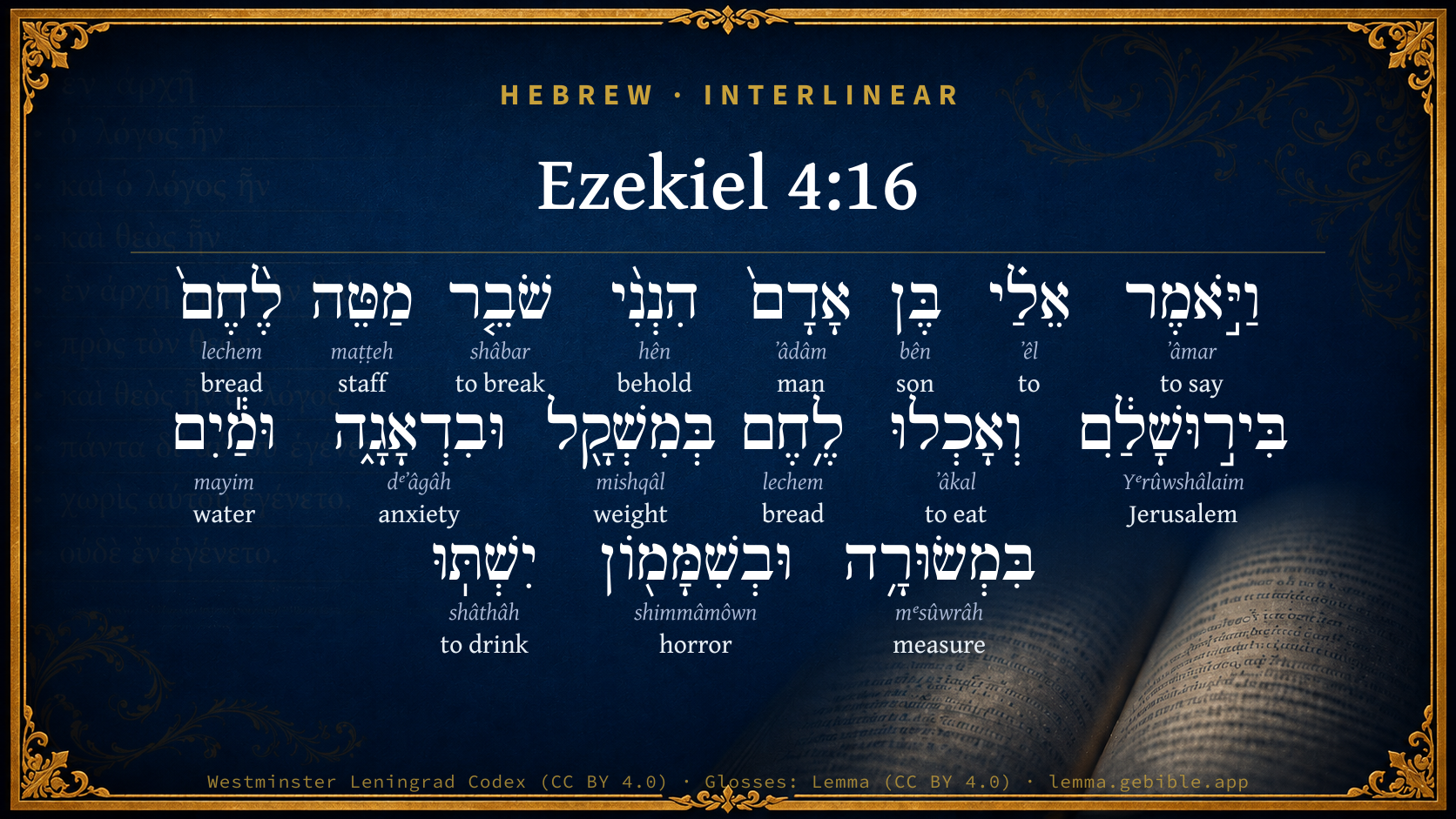
Ezekiel 4:16

Hebrew (Westminster Leningrad Codex) Ezekiel 4:16 appears in the Hebrew Old Testament. The text above is from the Westminster Leningrad Codex. Each word links to its Strong’s number, a concise gloss, and parsing drawn from the Open Scriptures Hebrew Bible morphology. Click any word for its full Brown-Driver-Briggs (BDB) entry.
Download image
Cite this verse

Ezekiel 4:16 (World English Bible). Public Domain. Lemma interlinear Bible study tool, https://lemma.gebible.app/v/ezekiel/4/16.

Show BibTeX & RIS
BibTeX
RIS
English Translation
Moreover he said to me, Son of man, behold, I will break the staff of bread in Jerusalem: and they shall eat bread by weight, and with fearfulness; and they shall drink water by measure, and in dismay:
World English Bible · Public Domain
Highlights
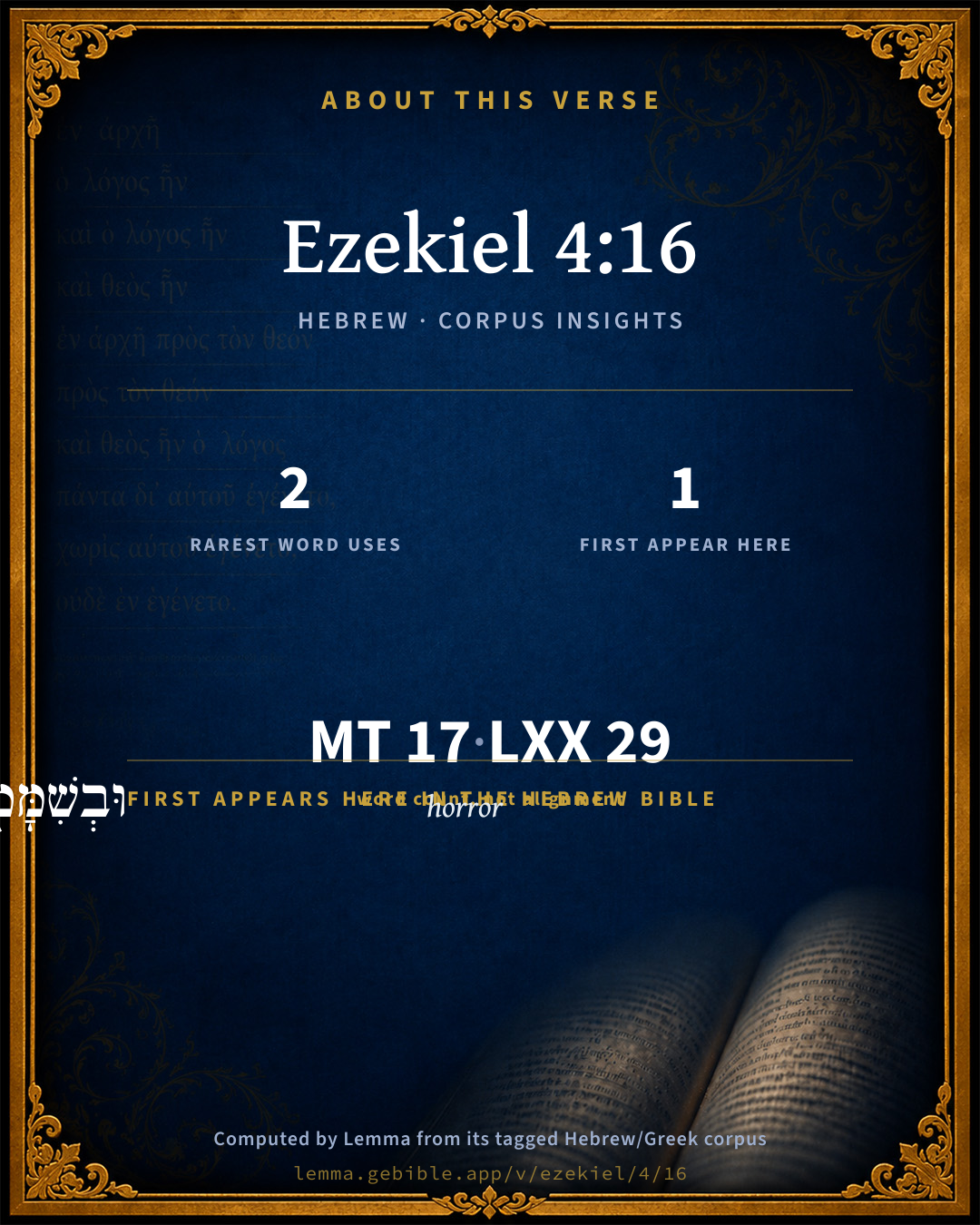
  • 1 first appearance in the Hebrew Bible
Full analysis ↓
Download a study sheet

One document with this verse’s original text, its word-by-word gloss line, the meaning frame, cross-references with their text, attributed commentary, and full source and license credits — printable, and it pastes into notes with its structure intact.

This verse Autodidact and up

Study sheet (.html) Plain text (.txt)

A passage Seminary Student

Up to 50 verses in one chapter. A passage sheet keeps up to 6 commentary sources and 12 cross-references per verse, in the order this page ranks them, and says so on the sheet whenever that leaves anything out. Ask for a single verse and you get the Autodidact verse sheet above.

Everything on this page stays free to read, with no account — the sheet is a download of what is already on screen, not access to it.

Want to remove ads? Support Godless Engineer
Compare translations 3

The same verse in 3 English versions, stacked beneath the original-language interlinear above. Click any original word for its lexicon entry.

Each is an independent rendering of the whole verse — the interlinear is not word-aligned to these translations.

Highlighted words mark where these versions differ — a whole-verse word diff, not a word-by-word alignment.

  • World English Bible Public Domain
    Moreover he said to me, Son of man, behold, I will break the staff of bread in Jerusalem: and they shall eat bread by weight, and with fearfulness; and they shall drink water by measure, and in dismay:
  • King James Version Public Domain
    Moreover he said unto me, Son of man, behold, I will break the staff of bread in Jerusalem: and they shall eat bread by weight, and with care; and they shall drink water by measure, and with astonishment:
  • unfoldingWord Literal Text CC BY-SA 4.0
    He also said to me, “Son of man! Behold! I am breaking the staff of bread in Jerusalem, and they will eat bread while rationing it in anxiety and drink water while rationing it in trembling.

unfoldingWord Literal Text — © unfoldingWord, licensed CC BY-SA 4.0. Word-aligned USFM3 via Door43 (git.door43.org/unfoldingWord/en_ult).

Versions to compare (up to 4)

3 of 4 selected

Show all 18 translations

Every available English version of this verse, each an independent rendering of the whole verse.

  • World English Bible Public Domain
    Moreover he said to me, Son of man, behold, I will break the staff of bread in Jerusalem: and they shall eat bread by weight, and with fearfulness; and they shall drink water by measure, and in dismay:
  • Berean Standard Bible Public Domain
    Then He told me, “Son of man, I am going to cut off the supply of food in Jerusalem. They will anxiously eat bread rationed by weight, and in despair they will drink water by measure.
  • Majority Standard Bible Public Domain
    Then He told me, “Son of man, I am going to cut off the supply of food in Jerusalem. They will anxiously eat bread rationed by weight, and in despair they will drink water by measure.
  • King James Version Public Domain
    Moreover he said unto me, Son of man, behold, I will break the staff of bread in Jerusalem: and they shall eat bread by weight, and with care; and they shall drink water by measure, and with astonishment:
  • American Standard Version (1901) Public Domain
    Moreover he said unto me, Son of man, behold, I will break the staff of bread in Jerusalem: and they shall eat bread by weight, and with fearfulness; and they shall drink water by measure, and in dismay:
  • Revised Version (1885) Public Domain
    Moreover he said unto me, Son of man, behold, I will break the staff of bread in Jerusalem: and they shall eat bread by weight, and with carefulness; and they shall drink water by measure, and with astonishment:
  • Geneva Bible (1599) Public Domain
    Moreouer, he said vnto me, Sonne of man, beholde, I will breake the staffe of bread in Ierusalem, and they shall eate bread by weight, and with care, and they shall drinke water by measure, and with astonishment.
  • Douay-Rheims (1899) Public Domain
    And he said to me: Son of man: Behold, I will break in pieces the staff of bread in Jerusalem: and they shall eat bread by weight, and with care: and they shall drink water by measure, and in distress.
  • Young's Literal Translation Public Domain
    And He saith unto me, `Son of man, lo, I am breaking the staff of bread in Jerusalem, and they have eaten bread by weight and with fear; and water by measure and with astonishment, they do drink;
  • Literal Standard Version CC BY-SA 4.0
    And He says to me, “Son of man, behold, I am breaking the staff of bread in Jerusalem, and they have eaten bread by weight and with fear; and water by measure and with astonishment, they drink;
  • Unlocked Literal Bible CC BY-SA 4.0
    He also said to me, “Son of man! Behold! I am breaking the staff of bread in Jerusalem, and they will eat bread while rationing it in anxiety and drink water while rationing it in trembling.
  • unfoldingWord Literal Text CC BY-SA 4.0
    He also said to me, “Son of man! Behold! I am breaking the staff of bread in Jerusalem, and they will eat bread while rationing it in anxiety and drink water while rationing it in trembling.
  • Darby Bible Public Domain
    And he said unto me, Son of man, behold, I break the staff of bread in Jerusalem; and they shall eat bread by weight, and with anxiety; and they shall drink water by measure, and with astonishment:
  • World Messianic Bible Public Domain
    Moreover he said to me, “Son of man, behold, I will break the staff of bread in Jerusalem. They will eat bread by weight, and with fearfulness. They will drink water by measure, and in dismay;
  • Webster's Bible Public Domain
    Moreover he said to me, Son of man, behold, I will break the staff of bread in Jerusalem: and they shall eat bread by weight, and with care; and they shall drink water by measure, and with astonishment.
  • Free Bible Version CC BY-SA 4.0
    Then he went on, “Son of man, watch! I am going to put a stop to Jerusalem's food supply. Worried sick, they will eat bread rationed by weight. Despairing at what's happening, they will drink water measured in small amounts.
  • Bible in Basic English Public Domain
    And he said to me, Son of man, see, I will take away from Jerusalem her necessary bread: they will take their bread by weight and with care, measuring out their drinking-water with fear and wonder:
  • JPS Tanakh (1917) Public Domain
    Moreover He said unto me: 'Son of man, behold, I will break the staff of bread in Jerusalem, and they shall eat bread by weight, and with anxiety; and they shall drink water by measure, and in appalment;

Literal Standard Version (2020), Covenant Press — licensed CC BY-SA 4.0. Text via the HelloAO Bible API (eBible.org). Unlocked Literal Bible (unfoldingWord) — licensed CC BY-SA 4.0. Text via the HelloAO Bible API (eBible.org). unfoldingWord Literal Text — © unfoldingWord, licensed CC BY-SA 4.0. Word-aligned USFM3 via Door43 (git.door43.org/unfoldingWord/en_ult). Free Bible Version, Dr. Jonathan Gallagher — licensed CC BY-SA 4.0. Text via the HelloAO Bible API (eBible.org).

Word by word

More ways to search: Search by grammar → Find every occurrence → Compare this word →

Practice this passage: Drill this verse → Learn its vocabulary →

וּבְשִׁמָּמ֖וֹן
shimmâmôwn
H8078
“and · in/at · horror”
Conjunction + Preposition + Noun, Common, Masculine, Singular, Absolute
Part of Speech
Conjunction + Preposition + Noun
Type
Common
Gender
Masculine
Number
Singular
State
Absolute
Full BDB Definition

Origin: from H8074

TWOT: 2409e

horror, dismay, appalment
  1. וַיֹּ֣אמֶר ʼâmar H559 “and · to say” Conjunction + Verb, Qal, Sequential Imperfect, 3rd Person, Masculine, Singular
  2. אֵלַ֗י ʼêl H413 “to · me” Preposition + Suffix, Personal, 1st Person, Common, Singular
  3. בֶּן bên H1121 “son of” Noun, Common, Masculine, Singular, Construct
  4. אָדָם֙ ʼâdâm H120 “man” Noun, Common, Masculine, Singular, Absolute
  5. הִנְנִ֨י hên H2005 “behold · me” Particle, Demonstrative + Suffix, Personal, 1st Person, Common, Singular
  6. שֹׁבֵ֤ר shâbar H7665 “breaking” Verb, Qal, Participle Active, Masculine, Singular, Absolute
  7. מַטֵּה maṭṭeh H4294 “staff of” Noun, Common, Masculine, Singular, Construct
  8. לֶ֨חֶם֙ lechem H3899 “bread” Noun, Common, Both, Singular, Absolute
  9. בִּיר֣וּשָׁלִַ֔ם Yᵉrûwshâlaim H3389 “in/at · Jerusalem” Preposition + Noun, Proper
  10. וְאָכְלוּ ʼâkal H398 “and · to eat” Conjunction + Verb, Qal, Sequential Perfect, 3rd Person, Common, Plural
  11. לֶ֥חֶם lechem H3899 “bread” Noun, Common, Both, Singular, Absolute
  12. בְּמִשְׁקָ֖ל mishqâl H4948 “in/at · weight” Preposition + Noun, Common, Masculine, Singular, Absolute
  13. וּבִדְאָגָ֑ה dᵉʼâgâh H1674 “and · in/at · anxiety” Conjunction + Preposition + Noun, Common, Feminine, Singular, Absolute
  14. וּמַ֕יִם mayim H4325 “and · water(s)” Conjunction + Noun, Common, Masculine, Plural, Absolute
  15. בִּמְשׂוּרָ֥ה mᵉsûwrâh H4884 “in/at · measure” Preposition + Noun, Common, Feminine, Singular, Absolute
  16. יִשְׁתּֽוּ shâthâh H8354 “to drink” Verb, Qal, Imperfect, 3rd Person, Masculine, Plural

About this verse

These counts appear in no published source. They are computed here, from the morphology-tagged text and Lemma’s own curated glosses. What Lemma adds →

17
words
16
distinct lemmas
Prophets
section

Notable vocabulary

The rarest word here is וּבְשִׁמָּמ֖וֹן horror H8078 — appearing just 2 times in the whole Hebrew Bible.

First appearance in Scripture

This word makes its first canonical appearance in the Hebrew Bible here:

  • וּבְשִׁמָּמ֖וֹן horror H8078

Shared distinctive vocabulary

וּבְשִׁמָּמ֖וֹן horror H8078 occurs in 2 verses of the Hebrew Bible. Also found in:

Grammatical profile

  • 4 verbs
  • 11 nouns
  • 1 preposition
  • 1 particle

Verb forms

  • וַיֹּ֣אמֶר Qal · Sequential Imperfect
  • שֹׁבֵ֤ר Qal · Participle Active
  • וְאָכְלוּ Qal · Sequential Perfect
  • יִשְׁתּֽוּ Qal · Imperfect

Repetition

A word recurs within this verse — often emphatic in Hebrew:

  • לֶ֨חֶם֙ bread H3899 ×2

Hebrew & Septuagint length

In English translation the verse runs 38 words from the Hebrew and 39 from the Septuagint (LXX English) — closely comparable.

A rough comparison of the two English renderings, which tokenize alike — not a word-level alignment.

Word counts can differ between the Hebrew and the Greek without any difference in meaning — e.g. the Hebrew direct-object marker אֵת has no separate Greek word, and Greek often adds the article ὁ.

In the original languages it is 17 Hebrew tokens and 29 Greek tokens — but the two are counted differently (Hebrew bundles its prefixes and suffixes into one token; the Greek is in lemma form), so that isn’t a like-for-like length.

Cross-references

11

Topical passages linked to Ezekiel 4:16 in the Treasury of Scripture Knowledge — connected by theme and wording, ordered by reader-vote popularity; previews shown in the World English Bible.

  • Ezekiel 5:16 when I shall send on them the evil arrows of famine, that are for destruction, which I will send to destroy you: and I will increase the famine on you, and will break your staff of bread;
  • Isaiah 3:1 For, behold, the Lord, Yahweh of Hosts, takes away from Jerusalem and from Judah supply and support, The whole supply of bread, And the whole supply of water;
  • Leviticus 26:26 When I break your staff of bread, ten women shall bake your bread in one oven, and they shall deliver your bread again by weight: and you shall eat, and not be satisfied.
  • Psalms 105:16 He called for a famine on the land. He destroyed the food supplies.
  • Ezekiel 4:10–11 Your food which you shall eat shall be by weight, twenty shekels a day: from time to time shall you eat it.
  • Ezekiel 12:18–19 Son of man, eat your bread with quaking, and drink your water with trembling and with fearfulness;
  • Ezekiel 14:13 Son of man, when a land sins against me by committing a trespass, and I stretch out my hand on it, and break the staff of the bread of it, and send famine on it, and cut off from it man and animal;
  • Psalms 60:3 You have shown your people hard things. You have made us drink the wine that makes us stagger.
  • Lamentations 1:11 All her people sigh, they seek bread; They have given their pleasant things for food to refresh the soul: Look, Yahweh, and see; for I am become abject.
  • Lamentations 4:9–10 Those who are killed with the sword are better than those who are killed with hunger; For these pine away, stricken through, for want of the fruits of the field.
  • Lamentations 5:9 We get our bread at the peril of our lives, Because of the sword of the wilderness.

Cross-references courtesy of OpenBible.info (CC BY 4.0).

Hebrew and Greek witnesses Masoretic Hebrew ↔ Greek Septuagint

The same verse in the two great witnesses to the Old Testament, shown verse-for-verse.

These are two independent witnesses, not word-aligned to each other, and the Septuagint is shown in lemma (dictionary) form.

Hebrew Ezekiel 4:16 Masoretic · Westminster Leningrad Codex

וַיֹּ֣אמֶר אֵלַ֗י בֶּן אָדָם֙ הִנְנִ֨י שֹׁבֵ֤ר מַטֵּה לֶ֨חֶם֙ בִּיר֣וּשָׁלִַ֔ם וְאָכְלוּ לֶ֥חֶם בְּמִשְׁקָ֖ל וּבִדְאָגָ֑ה וּמַ֕יִם בִּמְשׂוּרָ֥ה וּבְשִׁמָּמ֖וֹן יִשְׁתּֽוּ

Moreover he said to me, Son of man, behold, I will break the staff of bread in Jerusalem: and they shall eat bread by weight, and with fearfulness; and they shall drink water by measure, and in dismay:

World English Bible · Public Domain

Greek LXX Ezekiel 4:16 Septuagint · lemma form

καί εἶπον πρός ἐγώ υἱός ἄνθρωπος ἰδού ἐγώ συντρίβω στήριγμα ἄρτος ἐν ἰερουσαλήμ καί ἐσθίω ἄρτος ἐν σταθμός καί ἐν ἔνδεια καί ὕδωρ ἐν μέτρον καί ἐν ἀφανισμός πίνω

And he said to me, Son of man, behold, I break the support of bread in Jerusalem: and they shall eat bread by weight and in lack; and shall drink water by measure, and in a state of ruin:

LXX2012 (modern English Septuagint) · Public Domain

On this verse, The Cambridge Bible for Schools and Colleges discusses the Septuagint’s reading. Read the note in Commentary ↓

Hebrew: Westminster Leningrad Codex (CC BY 4.0). Greek: Septuagint (public domain); English from LXX2012 (modern English Septuagint) (Public Domain). How the Septuagint differs from the Hebrew →

Targum (Aramaic paraphrase)

1

The Targum is the ancient Jewish Aramaic paraphrase of the Hebrew Scriptures — an interpretive translation, not the Hebrew text itself. Onkelos (literal) and Pseudo-Jonathan (expansive) render the Torah, and Jonathan the Prophets. Coverage is partial: where no permissively-licensed English translation exists for a verse, only the Aramaic is shown. This is verse-level text, not a word-by-word alignment to the Hebrew.

  1. Targum Jonathan Prophets (Joshua–Malachi)
    וַאֲמַר לִי בַּר אָדָם הָא אֲנָא תָבֵר סְעִיד מֵיכְלָא בִּירוּשְׁלֵם וְיֵכְלוּן לַחְמָא בְּמַתְקַל וּבְיִצְפָּא וּמַיָא בְּצָדוּ וּבְאִשְׁתְּמָמוּ יִשְׁתּוּן:

    (no public-domain English translation for this verse)

    Targum Jonathan — Aramaic: “Mikraot Gedolot” (public domain). English: “Sefaria Community Translation” (CC0 1.0 (public-domain dedication)); “London "Chaldee Paraphrase," 1871” (public domain). Text via Sefaria.

Commentary

Notes on Ezekiel 4:16 from classic Christian and Jewish commentators (each source and its license shown beneath its notes). The classic Christian expositions comment on the surrounding passage and are grouped to its opening verse, so a note may address several verses; the Jewish commentaries on the Tanakh (Rashi and others) are per-verse, so they appear only where the commentator wrote on this verse.

Lemma curates 59 commentaries, every one of them public domain or Creative Commons licensed, each selected and text-cleaned for this edition rather than reprinted as found. About our sources →

Ellicott's Commentary for English Readers

(16) I will break the staff of bread in Jerusalem.—In Eze_4:16-17, the meaning of the foregoing symbolism is declared in plain language. Bread, as the chief article of food is put for all food, the specific for the general. There shall be extreme suffering and distress, as a part of the punishment for their long-continued sins.

A Bible Commentary for English Readers, edited by Charles John Ellicott (1878–1897) — public domain. Text from a community e-Sword module.

The Cambridge Bible for Schools and Colleges

gen. ed. J. J. S. Perowne

16. the staff of bread] i.e. the staff which bread is; a common figure, ch. Eze_5:16; Lev_26:26; Isa_3:1; Psa_105:16.

It is scarcely necessary to say that the symbolical actions of this chapter were not actually performed. They naturally passed through the mind of the prophet as described, but so far as others were concerned they were merely narrated. The truth expressed by the symbolical action was as plain when the action was merely described as it would have been had the action been performed and seen. It is evident that the actions referred to here could not have been performed because they are represented as being done simultaneously. It is while he presses the siege with arm uncovered that the prophet also lies on his side held down by bands, bearing the sin of the people (Eze_4:5; Eze_4:7-8), and it is while lying immoveable in this condition that he prepares cakes upon the coals and eats them (Eze_4:8-9). The prophet’s symbols merely express an idea; it is only when supposed to be actually performed that inconsistencies appear.

The siege and the hardships of it prolonged into the exile—the people’s bearing their sin—are the two chief ideas of the chapter. These are of course contemporaneous with one another so far, but they are spoken of separately in Eze_4:1-6, the siege in Eze_4:1-3, and the hardships of it and the exile in Eze_4:4-6. But from Eze_4:7 onwards they are somewhat mixed together. Cornill reconstructs the chapter in a very drastic way with the view of keeping the two things, the siege and the exile, distinct throughout. He groups the verses as follows: first, bearing the sin of the people, i.e. the exile with its uncleanness, Eze_4:4-6; Eze_4:8 (7 is a gloss), 9, 12–5; and secondly, the siege with its scarcity, Eze_4:1-3; Eze_4:10-11; Eze_4:16-17. This reconstruction of the text is too violent to have any probability. A different suggestion was made by Well. (Hist. p. 273, note), to the effect that in Eze_4:9, 390 is the right reading (though erroneously transferred also to Eze_4:5 for 190), and that the reference is exclusively to the siege, which the prophet calculated would last so long. Further, the prophet’s lying on his side and being bound with bands, Eze_4:8, is a different thing from his lying on his side, Eze_4:5. In Eze_4:5 he represented the bondage of the exile, in Eze_4:8 seq. the straitness of the siege. This view requires that Eze_4:13, which interprets Eze_4:8 seq. of eating unclean food in the dispersion, should be struck out as a gloss. The verse certainly appears in a shorter form in LXX., though there seems no ground for considering it wholly interpolated. And it is more natural that the repulsive symbol of Eze_4:12 should refer to the fact that all food eaten in exile was unclean rather than to uncleanness due to scarcity of fuel during the siege. The introduction too of a literal number of 390 days among other numbers of days which are symbolical is scarcely probable.

16, 17. Explanation of the symbol of eating bread by measure (Eze_4:10-11).

The Cambridge Bible for Schools and Colleges (gen. ed. J. J. S. Perowne; Cambridge University Press, 1878–1918) — public domain. Text from a community e-Sword module.

Trapp's Complete Commentary

John Trapp

Eze 4:16 Moreover he said unto me, Son of man, behold, I will break the staff of bread in Jerusalem: and they shall eat bread by weight, and with care; and they shall drink water by measure, and with astonishment:

Ver. 16. Behold, I will break {a} the staff of bread.] Bread shall be very scarce, and that which men have shall not nourish or satisfy them; they shall have appetitnm caninum. See Isa 3:1; {See Trapp on "Isa 3:1"} and take that good counsel, {Amo 5:14-15} lest we know the worth of good by the want of it.

{a} מקק contabescere, foetidum fieri.

John Trapp, A Commentary or Exposition upon All the Books of the Old and New Testament (1647–1656) — public domain. Text from a community e-Sword module.

Joseph Benson's Commentary

Eze 4:16-17. Behold, I will break the staff of bread in Jerusalem — I will cause a scarcity of bread in Jerusalem, 2Ki 25:3; and deprive it of the chief support of man’s life. And they shall eat their bread by weight and with care — Here we have a declaration of the meaning of what the prophet was ordered to do, Eze 4:10-11. It was intended to signify, that during the siege, the people of Jerusalem should eat their food very sparingly, and with great anxiety, for fear they should not be able to get a further supply, when what they had was consumed. That they may want bread and water — Or, so that they shall want bread and water: and be astonished one at another — Shall look upon one another astonished at each other’s ghastly, meager countenances, or at the greatness of their calamities; and consume away, &c. — And pine away with hunger and hardships, on account of their wickedness.

Joseph Benson's Commentary on the Old and New Testaments (1811–1818) — public domain. Text from a community e-Sword module.

Geneva Bible (1599)

Geneva Bible translators

That is, the force and strength wherewith it should nourish, Isa. 3:1; Ezek. 5:17 and 14:13.

Geneva Bible (1599) marginal notes — public domain. Text via Bolls.life.

Jamieson, Fausset & Brown

Robert Jamieson, A. R. Fausset & David Brown

staff of bread--bread by which life is supported, as a man's weight is by the staff he leans on (Lev 26:26; Psa 105:16; Isa 3:1).

by weight, and with care--in scant measure (Eze 4:10).

Jamieson, Fausset & Brown — Commentary Critical and Explanatory on the Whole Bible (1871) — public domain (CC PDM 1.0). Text via the HelloAO Bible API.

Adam Clarke's Commentary

Verse 16. I will break the staff of bread] They shall be besieged till all the bread is consumed, till the famine becomes absolute; see 2Kg 25:3: "And on the ninth of the fourth month, the famine prevailed in the city; and THERE WAS NO BREAD for the people of the land." All this was accurately foretold, and as accurately fulfilled.

Abp. Newcome on Eze 4:6 observes: "This number of years will take us back, with sufficient exactness, from the year in which Jerusalem was sacked by Nebuchadnezzar to the first year of Jeroboam's reign, when national idolatry began in Israel. The period of days seems to predict the duration of the siege by the Babylonians, Eze 4:9, deducting from the year five months and twenty-nine days, mentioned 2Kg 25:1-4, the time during which the Chaldeans were on their expedition against the Egyptians; see Jer 37:5." This amounts nearly to the same as that mentioned above.

Adam Clarke's Commentary on the Bible (1810–1826) — public domain. Text from a community e-Sword/MySword module.

John Calvin's Commentaries

God returns again to the citizens of Jerusalem, and announces that they should be so destroyed by famine, that they should be reduced to the last extremity, and all but consumed by want. But he places here two forms of punishment: he says, that he should break the staff of bread: then, that their abundance of bread should be small, because they would be compelled to eat their morsels by weight and fear, and to drink water by measure and astonishment. I said they were different forms, because even if bread was sufficient, God often breaks its staff, as he calls it. And this clearly appears from Leviticus 26:26, whence our Prophet has adopted this expression. For here Moses explains what it is to break the staff of bread; because, he says, ten women shall cook their bread in one dish, and then they must bona fide restore the quantity of meal given them; for the bread shall be weighed, and thou shalt eat and not be satisfied. There God had said, I will break the staff of bread: but a clearer explanation follows — namely, although wheat for cooking the bread should be sufficient, and the women should mutually observe each other that no theft should take place, but should return in weight what had been given out to them, yet its nourishment should be deficient. We see then that God breaks the staff of bread, when a sufficiently plentiful supply exists, but those who eat are not satisfied.

That this may appear more clearly, we muse assume the principle that men do not live by bread only, but by every word which proceedeth out of the mouth of God, (Deuteronomy 8:3,) for here God signifies that we are not nourished by virtue of the bread, properly speaking: for how can bread be life-giving when it wants both sense and vigor? We see then that there is no force in bread to nourish us which excludes the hidden grace of God, for we live by the word of God. The subject here is not the word of doctrine nor yet spiritual life; but Moses understands that we are sustained not by bread and wine and other food, or by any kind of drink, but by the secret virtue Of God whilst he inspires the bread with rigor for our nourishment. Bread then is our nourishment, but not by any peculiar or intrinsic virtue: this it has from another source, namely, the favor and ordination of God. As, therefore, a small portion of bread is sufficient; for us, so if any one gorge himself he will cry out sooner than be satisfied, unless God inspires the virtue. And for this reason Christ uses that passage against Satan: Man lives not by bread alone, (Matthew 4:4; Luke 4:4,) because he shows that the life of man was propped up by the secret virtue of God, and that God, whenever it pleases him, does not need these foreign assistances. God then can sustain us by himself: sometimes he uses bread, but only as an adventitious instrument; in the meantime he derogates nothing from his own virtue: hence a staff is taken metaphorically for a prop. For as old men already totter on their legs, and all their limbs being broken down by weakness, support themselves with a staff, so also bread is said to have a staff, because we are propped up by the nourishment. Our strength also becomes deficient, and hence he who takes nourishment is said to refresh himself with food. God, therefore, breaks the staff of bread when he renders men famished, even when they have a sufficient abundance of bread. Neither are they satisfied, how much soever they may gorge themselves, because the food loads instead of refreshes them.

This is the first punishment with which God threatens the Jews. Another also is added, namely, that they shall be destitute of bread. We see then that there is a double mode by which God punishes us by hunger. For although bread is sufficient, yet he breaks and destroys its staff, so that it cannot prop us up nor recall our lost vigor. At length he takes away our bread, because he either strikes our fruits with blight or hail, or makes us suffer under other calamities. Hence barrenness brings want, so that God will affect us with hunger both ways: for he says, behold! I will break the staff of bread in Jerusalem, and then he adds, they shall eat their bread by weight and in fear, they shall drink their water by measure and in astonishment, because in truth they shall be reduced to such straits that they shall scarcely dare to touch their bread, because while they look forward to the morrow they shall fear and be astonished. And he confirms this opinion in the next verse, that they shall be destitute of bread and water, and shall be astonished: for this explanation agrees better; therefore a man and his brother shall be astonished, that is, they shall look mutually on each other as if astonished. Thus those who are without wisdom and discern nothing but despair are accustomed to act: at length they shall pine away in their iniquity. Again God repeats that the Jews could not complain when he so grievously afflicts them, because they shall receive the reward of their own iniquity. Now follows —

John Calvin's Commentaries (1540-1563) — public domain. Text from the Calvin Translation Society English edition (1840s-50s) via the Christian Classics Ethereal Library (ccel.org). Calvin's coverage is partial (roughly two-thirds of the Bible); uncommented books and verses are honest gaps, never fabricated. The 19th-century editor's footnotes and remarks are omitted so the notes are faithfully Calvin's own voice.

John Gill's Exposition

Moreover he said unto me, son of man,.... What follows opens the design, and shows what was intended by the symbol of the miscellany bread, baked with cow dung, the prophet was to eat by measure, as, well as drink water by measure: namely, the sore famine that should be in Jerusalem at the time of the siege:

behold, I will break the staff of bread in Jerusalem: that is, take away bread, which is the staff of life, the support of it, and which strengthens man's heart; and also the nourishing virtue and efficacy from what they had. The sense is, that the Lord would both deprive them of a sufficiency of bread, the nourishment of man; and not suffer the little they had to be nourishing to them; what they ate would not satisfy them, nor do them much good; see Lev 26:26;

and they shall eat bread by weight, and with care; that they might not eat too much at a time, but have something for tomorrow; and to cause their little stock to last the longer, not knowing how long the siege would be:

and they shall drink water by measure, and with astonishment; that such a judgment should fall upon them, who thought themselves the people of God, and the favourites of heaven.

John Gill's Exposition of the Whole Bible (1746–1763) — public domain (CC PDM 1.0). Text via the HelloAO Bible API.

Albert Barnes' Notes on the Bible

The staff of bread - Bread is so called because it is that on which the support of life mainly depends.

With astonishment - With dismay and anxiety at the calamities which are befalling them.

Albert Barnes' Notes on the Bible (1834–1885) — public domain. Text from a community e-Sword/MySword module.

Haydock's Catholic Bible Commentary

Staff. As this supports the weak, so bread nourishes all men, (Worthington) particularly the bread of life. (St. Jerome) --- Very little food, (Calmet) and that of a nauseous kind, (Haydock) would be found during the siege. (Calmet)

George Leo Haydock (1774–1849), Haydock's Catholic Family Bible and Commentary, 1859 edition — public domain. Excludes Psalms (Douay-Rheims chapter numbering differs from Protestant) and Deuterocanonical books (Catholic canon only).

Matthew Poole's English Annotations

Here the Lord confirms his threat of famine by a solemn protestation that he would break the staff of bread; either take their, harvests away, and deny them bread, or withhold his blessing, the strength of bread, that it should not nourish and refresh, as Lev 26:26.

In Jerusalem, that sinful city.

By weight: see Eze 4:10.

With care; afraid and doubtful whether or where they shall have any more.

By measure: Eze 4:11.

With astonishment; amazed at the strangeness of their condition, and the wounds and death of many that fell by the enemies’ hand, attempting to fetch a little water; or astonished, their very eyes failing for thirst.

Matthew Poole's English Annotations on the Holy Bible (1683–1685) — public domain. Text from a community e-Sword/MySword module.

Whedon's Commentary on the Bible

Daniel D. Whedon

16, 17. These verses explain Eze_4:10-11.

Staff of bread — Or, staff (of life), which is bread (Lev_26:26; Isa_3:1). Expositors differ as to whether Ezekiel actually was compelled to eat this bread during the six months of the pictorial siege or not. There is no sufficient reason to doubt it. Certainly, if the painting of the tile and the pictured siege and the prophet’s lying upon his side were real acts, then this was also. Dr. Davidson’s objection that he is represented as making and eating the bread, while at the same time he is said to be lying motionless upon his side is by no means conclusive. Even if he were in a cataleptic condition, as some think, yet he might still have obeyed all these commands, the bread, of course, being made by his wife. But if, as we understand it, these commands to remain in a certain posture, motionless, applied only to the hours during which his picture-sermon was being preached, and not to his private life, then he might with his own hands have prepared the food. It could have been eaten lying upon his side, as one hand was not “bound” (Eze_4:7).

Consume away for their iniquity — “Another echo from the book which had so largely entered into the prophet’s education” (Lev_26:39). “Pine” in Hebrew is same as “consume.” “To the wretchedness of physical privation there was added the consciousness of the sufferers that it was caused by their own evil deeds.”

Daniel D. Whedon (gen. ed.), Commentary on the Old and New Testaments (1874–1909) — public domain. Text from a community e-Sword module.

The Pulpit Commentary

The staff of bread. The phrase occurs again in Eze_5:16 Eze_14:13, and also in Lev_26:26; Psa_105:16. In Isa_3:1 the thought is the same, but the Hebrew word is Different. they shall eat bread by weight, etc. The phrase occurs, it may be noted, Lev_26:26, one of the verses above referred to. The care and astonishment, implying that the wonted cheerfulness of meals would have departed, meet us again in Eze_12:19.

Vers. 16, 17. The chastisement of famine.

The striking and distressing symbolism described in this chapter must have brought with great vividness before the mind of the prophet, and before the minds of his companions in exile, the sufferings that were about to befall the metropolis which was the pride of their hearts. In the siege which was to come upon Jerusalem, the citizens should endure the horrors of privation, of hunger, and of thirst. It was foretold that in a sense this should be God"s appointment, the effect of that retributive Providence which devout minds cannot fail to recognize in the government of the world. If such events took place in accordance with what are called general laws, since those laws are the consequence and expression of the very constitution of society, none the less must the Divine hand be recognized, none the less must it be understood that Divine lessons are to be learned with reverent submission.

I A LESSON OF CORPORATE UNITY. As a city, Jerusalem had sinned by rejecting Jehovah"s worship, and by honouring the gods of the nations; by disobeying Jehovah"s laws, and following sinful impulses and indulging in sinful practices. As a city, Jerusalem sinned; as a city, Jerusalem suffered and fell. The innocent, no doubt, suffered with the guilty; those who mourned over the defection of Judah with those who were prominent agents in that defection. No man can live apart from his neighbours; least of all is this possible in the life of the city, which is characterized by a unity that may be designated corporate.

II A LESSON OF PHYSICAL DEPENDENCE. Bread, water, and fuel are mentioned in this chapter as necessaries of life; without them men are condemned to famine and to death. The body is in correlation to nature to the provision made for its sustenance and strength. If the supply be cut off, the body perishes. Familiar and commonplace as this truth is, men need, in their pride and self-confidence, to be reminded of it. The haughty Jews stood in need of the lesson. Let an army invest the city, and it is only a question of time; for the besieged, if unable to beat back the besiegers, must sooner or later surrender to the force of hunger, if not of arms.

III A LESSON OF DIVINE RETRIBUTION. It is in this light that the calamities attending a siege are presented by the prophet. Men may see in a beleaguered city only a political fact, a military incident, the consequence of well known causes, the cause of well understood effects. To see all this is justifiable; to see nothing but this is blindness. A thoughtful and pious mind will look through, will look above, all that is phenomenal. There is purpose in human affairs, there is Divine meaning, there is revelation. When men, oppressed by adversity and threatened with ruin, are "astonied one with another, and pine away in their iniquity," it is possible that they may be so stupefied as to recognize no moral law in their experience, their fate. but the enlightened discern in such events indication of the Divine displeasure and indignation with sin. Chastisement, punishment, is no chimera invented by a heated imagination; it is a sober, albeit a painful fact, from which there is no escape and no appeal. The judgments of God are abroad in the earth; and this is that the inhabitants thereof may learn righteousness.

IV A LESSON OF REPENTANCE AND OF MERCY. This lesson is not, indeed, explicitly presented in this passage; yet the whole prophetic symbolism leads up to it. Why are men hungry but that they may call for the bread of life? and upon whom shall they call but upon God? Whither shall the parched and thirsting turn but to him who has the water of life, for the quenching of their thirst and the satisfaction of their souls? To whom shall the afflicted address themselves but to him who can turn the outward curse into a spiritual blessing, who can make the scourge the means of healing, and the sword the means of life? In the midst of wrath God remembers mercy; and it is ever true that they who call upon the Name of the Lord shall be saved. T.

The Pulpit Commentary (1880–1919), ed. H.D.M. Spence-Jones & Joseph S. Exell — public domain. Text from a community e-Sword module.

unfoldingWord translationNotes

Door43 World Missions Community

Behold

"Look" or "Listen" or "Pay attention to what I am about to tell you"

I am breaking the staff of bread in Jerusalem

"I will stop the supply of food to Jerusalem"

the staff of bread

The supply is called a staff because some people need a staff to walk and do their work, and people need bread to live. Bread represents all kinds of food. AT: "the supply of food" (See: Metaphor and Synecdoche)

they will eat bread while rationing it in anxiety

You may need to make explicit why they will ration the bread. "they will carefully divide their bread because they fear that there will not be enough" (See: Assumed Knowledge and Implicit Information)

rationing

giving small amounts of something of which there is not enough to many people

rationing it in trembling

The word "shaking" is a metaphor for being afraid and "trembling" represents fear. AT: "rationing it while shaking" or "rationing it in fear" (See: Metonymy)

every man will be dismayed at his brother and waste away

Possible meanings are 1) "everyone will look at his brother and worry about how much food his brother eats and waste away" or 2) "every one of them will be dismayed and waste away" (See: Assumed Knowledge and Implicit Information)

waste away

The phrase "waste away" is usually used of flesh or wood rotting. Here it is a metaphor for wicked people becoming thin and dying because they have no food. (See: Metaphor)

translationWords

staff

bread

Jerusalem

brother

iniquity

unfoldingWord translationNotes — © Distant Shores Media and the Door43 World Missions Community, licensed CC BY-SA 4.0. Source: git.door43.org/Door43/en_tn.

Rashi

Rabbi Shlomo Yitzchaki (Rashi)

the staff of bread the support of bread, pozon de pan in Old French.

and with worry They will worry that their bread supply will be depleted.

דְּאָגָה means aynse in Old French, anxiety, and in our language [dialect] doubt, terror, fright.

Rashi on the Tanakh — English translations: “The Judaica Press complete Tanach with Rashi, translated by A. J. Rosenberg” (CC BY 4.0); “Pentateuch with Rashi's commentary by M. Rosenbaum and A.M. Silbermann, 1929-1934” (public domain); “The Metsudah Tanach series, Lakewood, N.J” (CC BY 4.0); and “The Book of Joshua, Metsudah Publications, 1997” (CC BY 4.0). Text via Sefaria.

Lesson kit

Teaching starters — assembled from the data on this page, not authored interpretation. Every prompt links to the verse data it draws on. Edit before teaching.

Ezekiel, in the Prophets, opens this verse with 17 words (16 distinct Hebrew lemmas). Its most distinctive word is shimmâmôwn (“horror”). A historical commentator’s framing appears above. Read the whole chapter for the surrounding context.

Discussion questions

  1. What does “horror” (shimmâmôwn) contribute to the verse as a whole?
  2. The word “horror” first appears here in Scripture. What is being introduced at this debut?
  3. Ezekiel 12:19 shares the word «horror» with this verse. How do the two illuminate each other?
  4. “bread” occurs 2× in this one verse. What is the effect of the repetition?
  5. These translations render this verse differently. What is at stake in choosing one wording over another?
  6. The verb «וַיֹּ֣אמֶר» is Qal Sequential Imperfect. How does its form color the action?
  7. Reading how Ellicott's Commentary for English Readers and The Cambridge Bible for Schools and Colleges read this verse, where do the two commentators agree and where do they part?

Things to notice

Reading settings

Reading text

Shown beneath each verse's original-language words.

Old Testament
Old Testament edition

Read the OT as the Masoretic Hebrew (MT) or the Greek Septuagint (LXX).

English shown for the Greek Septuagint (in the Hebrew ↔ Greek comparison).

Comparing translations? Open the Compare panel on any verse page to stack up to four side by side.