
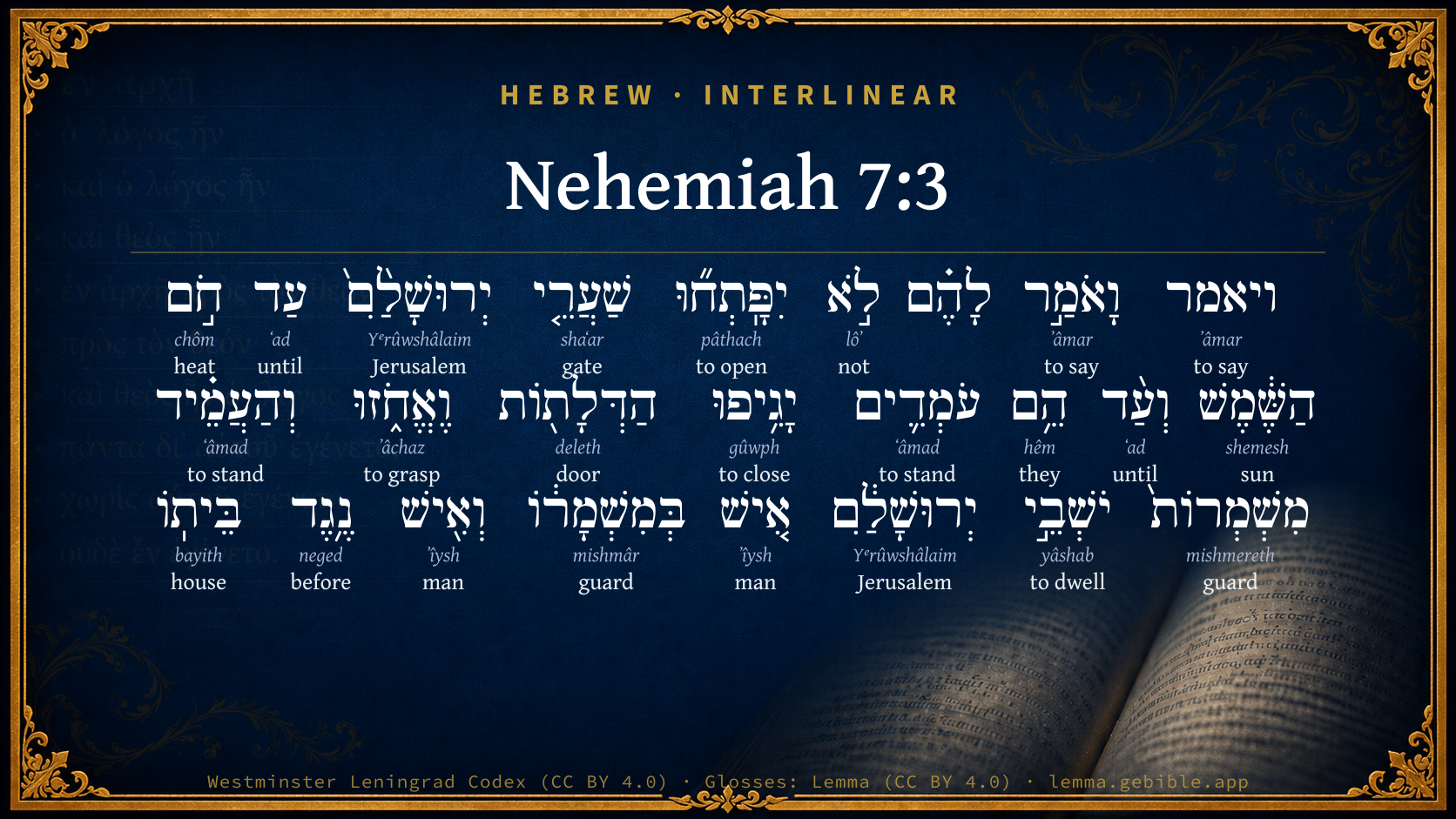
Nehemiah 7:3

Hebrew (Westminster Leningrad Codex) Nehemiah 7:3 appears in the Hebrew Old Testament. The text above is from the Westminster Leningrad Codex. Each word links to its Strong’s number, a concise gloss, and parsing drawn from the Open Scriptures Hebrew Bible morphology. Click any word for its full Brown-Driver-Briggs (BDB) entry.
Download image
Cite this verse

Nehemiah 7:3 (World English Bible). Public Domain. Lemma interlinear Bible study tool, https://lemma.gebible.app/v/nehemiah/7/3.

Show BibTeX & RIS
BibTeX
RIS
English Translation
I said to them, Don't let the gates of Jerusalem be opened until the sun be hot; and while they stand [on guard], let them shut the doors, and bar you them: and appoint watches of the inhabitants of Jerusalem, everyone in his watch, and everyone [to be] over against his house.
World English Bible · Public Domain
Highlights
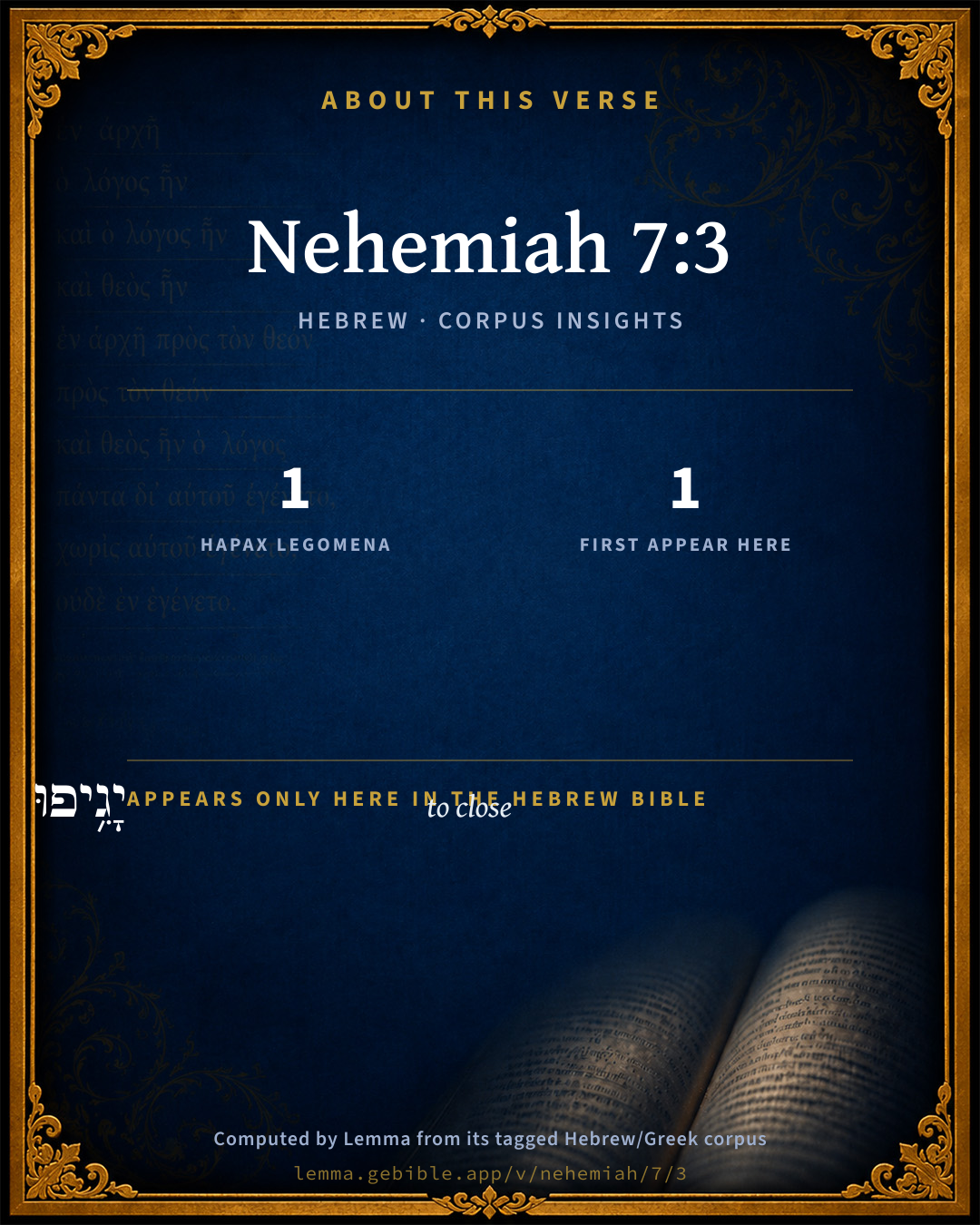
  • 1 hapax legomenon — only here in the Hebrew Bible
  • 1 first appearance in the Hebrew Bible
Full analysis ↓
Download a study sheet

One document with this verse’s original text, its word-by-word gloss line, the meaning frame, cross-references with their text, attributed commentary, and full source and license credits — printable, and it pastes into notes with its structure intact.

This verse Autodidact and up

Study sheet (.html) Plain text (.txt)

A passage Seminary Student

Up to 50 verses in one chapter. A passage sheet keeps up to 6 commentary sources and 12 cross-references per verse, in the order this page ranks them, and says so on the sheet whenever that leaves anything out. Ask for a single verse and you get the Autodidact verse sheet above.

Everything on this page stays free to read, with no account — the sheet is a download of what is already on screen, not access to it.

Want to remove ads? Support Godless Engineer
Compare translations 3

The same verse in 3 English versions, stacked beneath the original-language interlinear above. Click any original word for its lexicon entry.

Each is an independent rendering of the whole verse — the interlinear is not word-aligned to these translations.

Highlighted words mark where these versions differ — a whole-verse word diff, not a word-by-word alignment.

  • World English Bible Public Domain
    I said to them, Don't let the gates of Jerusalem be opened until the sun be hot; and while they stand [on guard], let them shut the doors, and bar you them: and appoint watches of the inhabitants of Jerusalem, everyone in his watch, and everyone [to be] over against his house.
  • King James Version Public Domain
    And I said unto them, Let not the gates of Jerusalem be opened until the sun be hot; and while they stand by, let them shut the doors, and bar them: and appoint watches of the inhabitants of Jerusalem, every one in his watch, and every one to be over against his house.
  • unfoldingWord Literal Text CC BY-SA 4.0
    And I said to them, “Let not the gates of Jerusalem be opened until the sun becomes hot. And while they are still standing, let them shut the doors, and they must bar them. And set up watches for those who dwell in Jerusalem, a man in his watch, and a man in front of his house.”

unfoldingWord Literal Text — © unfoldingWord, licensed CC BY-SA 4.0. Word-aligned USFM3 via Door43 (git.door43.org/unfoldingWord/en_ult).

Versions to compare (up to 4)

3 of 4 selected

Show all 18 translations

Every available English version of this verse, each an independent rendering of the whole verse.

  • World English Bible Public Domain
    I said to them, Don't let the gates of Jerusalem be opened until the sun be hot; and while they stand [on guard], let them shut the doors, and bar you them: and appoint watches of the inhabitants of Jerusalem, everyone in his watch, and everyone [to be] over against his house.
  • Berean Standard Bible Public Domain
    And I told them, “Do not open the gates of Jerusalem until the sun is hot. While the guards are on duty, keep the doors shut and securely fastened. And appoint the residents of Jerusalem as guards, some at their posts and some at their own homes.”
  • Majority Standard Bible Public Domain
    And I told them, “Do not open the gates of Jerusalem until the sun is hot. While the guards are on duty, keep the doors shut and securely fastened. And appoint the residents of Jerusalem as guards, some at their posts and some at their own homes.”
  • King James Version Public Domain
    And I said unto them, Let not the gates of Jerusalem be opened until the sun be hot; and while they stand by, let them shut the doors, and bar them: and appoint watches of the inhabitants of Jerusalem, every one in his watch, and every one to be over against his house.
  • American Standard Version (1901) Public Domain
    And I said unto them, Let not the gates of Jerusalem be opened until the sun be hot; and while they stand `on guard', let them shut the doors, and bar ye them: and appoint watches of the inhabitants of Jerusalem, every one in his watch, and every one `to be' over against his house.
  • Revised Version (1885) Public Domain
    And I said unto them, Let not the gates of Jerusalem be opened until the sun be hot; and while they stand on guard, let them shut the doors, and bar ye them: and appoint watches of the inhabitants of Jerusalem, every one in his watch, and every one to be over against his house.
  • Geneva Bible (1599) Public Domain
    And I saide vnto them, Let not the gates of Ierusalem be opened, vntill the heate of the sunne: and while they stande by, let them shut the doores, and make them fast: and I appointed wardes of the inhabitants of Ierusalem, euery one in his warde, and euery one ouer against his house.
  • Douay-Rheims (1899) Public Domain
    And I said to them: Let not the gates of Jerusalem be opened till the sun be hot. And while they were yet standing by, the gates were shut, and barred: and I set watchmen of the inhabitants of Jerusalem, every one by their courses, and every mall over against his house.
  • Young's Literal Translation Public Domain
    and I say to them, `Let not the gates of Jerusalem be opened till the heat of the sun, and while they are standing by let them shut the doors, and fasten, and appoint guards of the inhabitants of Jerusalem, each in his guard, and each over-against his house.'
  • Literal Standard Version CC BY-SA 4.0
    and I say to them, “Do not let the gates of Jerusalem be opened until the heat of the sun, and while they are standing by let them shut the doors, and fasten, and appoint guards of the inhabitants of Jerusalem, each at his watch, and each in front of his house.”
  • Unlocked Literal Bible CC BY-SA 4.0
    I said to them, “Do not open the gates of Jerusalem until the sun is hot. While the gatekeepers are on guard, you may shut the doors and bar them. Appoint guards from those who live in Jerusalem, some at the place of their guard station, and some in front of their own homes.”
  • unfoldingWord Literal Text CC BY-SA 4.0
    And I said to them, “Let not the gates of Jerusalem be opened until the sun becomes hot. And while they are still standing, let them shut the doors, and they must bar them. And set up watches for those who dwell in Jerusalem, a man in his watch, and a man in front of his house.”
  • Darby Bible Public Domain
    And I said to them that the gates of Jerusalem should not be opened until the sun was hot, and that they should shut the doors and bar them while they stood by; and that there should be appointed watches of the inhabitants of Jerusalem, every one in his watch, and every one over against his house.
  • World Messianic Bible Public Domain
    I said to them, “Don’t let the gates of Jerusalem be opened until the sun is hot; and while they stand guard, let them shut the doors, and you bar them; and appoint watches of the inhabitants of Jerusalem, everyone in his watch, with everyone near his house.”
  • Webster's Bible Public Domain
    And I said to them, Let not the gates of Jerusalem be opened until the sun shall be hot; and while they stand by, let them shut the doors, and bar them: and appoint watches of the inhabitants of Jerusalem, every one in his watch, and every one to be over against his house.
  • Free Bible Version CC BY-SA 4.0
    I told them, “Don't allow the gates of Jerusalem to be opened until the sun is hot, and make sure the guards shut and bolt the doors while they're still on duty. Appoint some of the residents of Jerusalem as guards, to be at their posts, standing in front of their own houses.”
  • Bible in Basic English Public Domain
    And I said to them, Do not let the doors of Jerusalem be open till the sun is high; and while the watchmen are in their places, let the doors be shut and locked: and let the people of Jerusalem be put on watch, every one in his watch, opposite his house.
  • JPS Tanakh (1917) Public Domain
    And I said unto them: 'Let not the gates of Jerusalem be opened until the sun be hot; and while they stand on guard, let them shut the doors, and bar ye them; and let watches be appointed of the inhabitants of Jerusalem, every one in his watch, and every one to be over against his house.'

Literal Standard Version (2020), Covenant Press — licensed CC BY-SA 4.0. Text via the HelloAO Bible API (eBible.org). Unlocked Literal Bible (unfoldingWord) — licensed CC BY-SA 4.0. Text via the HelloAO Bible API (eBible.org). unfoldingWord Literal Text — © unfoldingWord, licensed CC BY-SA 4.0. Word-aligned USFM3 via Door43 (git.door43.org/unfoldingWord/en_ult). Free Bible Version, Dr. Jonathan Gallagher — licensed CC BY-SA 4.0. Text via the HelloAO Bible API (eBible.org).

Word by word

More ways to search: Search by grammar → Find every occurrence → Compare this word →

Practice this passage: Drill this verse → Learn its vocabulary →

יָגִ֥יפוּ
gûwph
H1479
“to close”
Verb, Hiphil, Imperfect, 3rd Person, Masculine, Plural
Part of Speech
Verb
Stem
Hiphil
Form
Imperfect
Person
3rd Person
Gender
Masculine
Number
Plural
Full BDB Definition

Origin: a primitive root

TWOT: 329

to shut, close - (Hiphil) to close
  1. ויאמר ʼâmar H559 “and · to say” Conjunction + Verb, Qal, Sequential Imperfect, 3rd Person, Masculine, Singular
  2. וָאֹמַ֣ר ʼâmar H559 “and · to say” Conjunction + Verb, Qal, Sequential Imperfect, 1st Person, Common, Singular
  3. לֹ֣א lôʼ H3808 “not” Particle, Negative
  4. יִפָּֽתְח֞וּ pâthach H6605 “to open” Verb, Niphal, Imperfect, 3rd Person, Masculine, Plural
  5. שַׁעֲרֵ֤י shaʻar H8179 “gates of” Noun, Common, Masculine, Plural, Construct
  6. יְרוּשָׁלִַ֨ם֙ Yᵉrûwshâlaim H3389 “Jerusalem” Noun, Proper
  7. עַד ʻad H5704 “until” Preposition
  8. חֹ֣ם chôm H2527 “heat” Verb, Qal, Infinitive Construct
  9. הַשֶּׁ֔מֶשׁ shemesh H8121 “the · sun” Particle, Definite Article + Noun, Common, Both, Singular, Absolute
  10. וְעַ֨ד ʻad H5704 “and · until” Conjunction + Preposition
  11. הֵ֥ם hêm H1992 “they” Pronoun, Personal, 3rd Person, Masculine, Plural
  12. עֹמְדִ֛ים ʻâmad H5975 “standing” Verb, Qal, Participle Active, Masculine, Plural, Absolute
  13. הַדְּלָת֖וֹת deleth H1817 “the · doors” Particle, Definite Article + Noun, Common, Feminine, Plural, Absolute
  14. וֶאֱחֹ֑זוּ ʼâchaz H270 “and · grasp” Conjunction + Verb, Qal, Imperative, 2nd Person, Masculine, Plural
  15. וְהַעֲמֵ֗יד ʻâmad H5975 “and · to stand” Conjunction + Verb, Hiphil, Infinitive Absolute
  16. מִשְׁמְרוֹת֙ mishmereth H4931 “guards of” Noun, Common, Feminine, Plural, Construct
  17. יֹשְׁבֵ֣י yâshab H3427 “dwelling” Verb, Qal, Participle Active, Masculine, Plural, Construct
  18. יְרוּשָׁלִַ֔ם Yᵉrûwshâlaim H3389 “Jerusalem” Noun, Proper
  19. אִ֚ישׁ ʼîysh H376 “man” Noun, Common, Masculine, Singular, Absolute
  20. בְּמִשְׁמָר֔וֹ mishmâr H4929 “in/at · guard · his” Preposition + Noun, Common, Masculine, Singular, Construct + Suffix, Personal, 3rd Person, Masculine, Singular
  21. וְאִ֖ישׁ ʼîysh H376 “and · man” Conjunction + Noun, Common, Masculine, Singular, Absolute
  22. נֶ֥גֶד neged H5048 “before” Preposition
  23. בֵּיתֽוֹ bayith H1004 “house · his” Noun, Common, Masculine, Singular, Construct + Suffix, Personal, 3rd Person, Masculine, Singular

About this verse

These counts appear in no published source. They are computed here, from the morphology-tagged text and Lemma’s own curated glosses. What Lemma adds →

25
words
19
distinct lemmas
Historical
section

Notable vocabulary

1 hapax legomenon — a word that appears only here in the entire Hebrew Bible:

  • יָגִ֥יפוּ to close H1479

First appearance in Scripture

This word makes its first canonical appearance in the Hebrew Bible here:

  • יָגִ֥יפוּ to close H1479

Shared distinctive vocabulary

חֹ֣ם heat H2527 occurs in 13 verses of the Hebrew Bible. Also found in:

Grammatical profile

  • 9 verbs
  • 10 nouns
  • 1 pronoun
  • 4 prepositions
  • 1 particle

Verb forms

  • ויאמר Qal · Sequential Imperfect
  • וָאֹמַ֣ר Qal · Sequential Imperfect
  • יִפָּֽתְח֞וּ Niphal · Imperfect
  • חֹ֣ם Qal · Infinitive Construct
  • עֹמְדִ֛ים Qal · Participle Active
  • יָגִ֥יפוּ Hiphil · Imperfect
  • וֶאֱחֹ֑זוּ Qal · Imperative
  • וְהַעֲמֵ֗יד Hiphil · Infinitive Absolute
  • יֹשְׁבֵ֣י Qal · Participle Active

Repetition

Words recur within this verse — often emphatic in Hebrew:

  • ויאמר to say H559 ×2
  • יְרוּשָׁלִַ֨ם֙ Jerusalem H3389 ×2
  • עַד until H5704 ×2
  • עֹמְדִ֛ים to stand H5975 ×2
  • אִ֚ישׁ man H376 ×2

Cross-references

5

Topical passages linked to Nehemiah 7:3 in the Treasury of Scripture Knowledge — connected by theme and wording, ordered by reader-vote popularity; previews shown in the World English Bible.

  • Nehemiah 3:23 After them repaired Benjamin and Hasshub over against their house. After them repaired Azariah the son of Maaseiah the son of Ananiah beside his own house.
  • Nehemiah 3:28–30 Above the horse gate repaired the priests, everyone over against his own house.
  • Nehemiah 13:19 It came to pass that, when the gates of Jerusalem began to be dark before the Sabbath, I commanded that the doors should be shut, and commanded that they should not be opened until after the Sabbath: and some of my servants set I over the gates, that there should no burden be brought in on the Sabbath day.
  • Psalms 127:1 Unless Yahweh builds the house, They labor in vain who build it. Unless Yahweh watches over the city, The watchman guards it in vain.
  • Matthew 10:16 "Behold, I send you out as sheep in the midst of wolves. Therefore be wise as serpents, and harmless as doves.

Cross-references courtesy of OpenBible.info (CC BY 4.0).

Hebrew and Greek witnesses Masoretic Hebrew ↔ Greek Septuagint

The same verse in the two great witnesses to the Old Testament, shown verse-for-verse.

These are two independent witnesses, not word-aligned to each other, and the Septuagint is shown in lemma (dictionary) form.

Hebrew Nehemiah 7:3 Masoretic · Westminster Leningrad Codex

ויאמר וָאֹמַ֣ר לָהֶ֗ם לֹ֣א יִפָּֽתְח֞וּ שַׁעֲרֵ֤י יְרוּשָׁלִַ֨ם֙ עַד חֹ֣ם הַשֶּׁ֔מֶשׁ וְעַ֨ד הֵ֥ם עֹמְדִ֛ים יָגִ֥יפוּ הַדְּלָת֖וֹת וֶאֱחֹ֑זוּ וְהַעֲמֵ֗יד מִשְׁמְרוֹת֙ יֹשְׁבֵ֣י יְרוּשָׁלִַ֔ם אִ֚ישׁ בְּמִשְׁמָר֔וֹ וְאִ֖ישׁ נֶ֥גֶד בֵּיתֽוֹ

I said to them, Don't let the gates of Jerusalem be opened until the sun be hot; and while they stand [on guard], let them shut the doors, and bar you them: and appoint watches of the inhabitants of Jerusalem, everyone in his watch, and everyone [to be] over against his house.

World English Bible · Public Domain

Greek LXX Structure differs

The Septuagint has no separate book of Nehemiah. Its Greek text is the second half of Esdras B (2 Esdras), chapters 11–23; Ezra is the first half (1–10).

A verse-for-verse comparison isn’t shown here because the chapters and verses don’t line up. Switch to the LXX edition with the MT / LXX toggle above to read the Greek directly.

On this verse, The Cambridge Bible for Schools and Colleges discusses the Septuagint’s reading. Read the note in Commentary ↓

Hebrew: Westminster Leningrad Codex (CC BY 4.0). Greek: Septuagint (public domain); English from a public-domain English Septuagint. How the Septuagint differs from the Hebrew →

Commentary

Notes on Nehemiah 7:3 from classic Christian and Jewish commentators (each source and its license shown beneath its notes). The classic Christian expositions comment on the surrounding passage and are grouped to its opening verse, so a note may address several verses; the Jewish commentaries on the Tanakh (Rashi and others) are per-verse, so they appear only where the commentator wrote on this verse.

Lemma curates 59 commentaries, every one of them public domain or Creative Commons licensed, each selected and text-cleaned for this edition rather than reprinted as found. About our sources →

Trapp's Complete Commentary

John Trapp

Neh 7:3 And I said unto them, Let not the gates of Jerusalem be opened until the sun be hot; and while they stand by, let them shut the doors, and bar [them]: and appoint watches of the inhabitants of Jerusalem, every one in his watch, and every one [to be] over against his house.

Ver. 3. Until the sun be hot] The sun hath one of his names, in Hebrew, a calefaciendo, from heating, חמה, Job 30:28, there is nothing hid from the heat thereof, Psa 19:6. The name here given to the sun signifieth a minister, or servant; because it is the common servant of the world, whereby God ministeretb light, heat, and precious fruits to all people, Deu 4:19; Deu 33:14. It whirleth about the world with incredible swiftness; and is up in a morning before most people. Therefore till the sun be risen the gates must be kept shut, to keep out the enemy, who watcheth his opportunity.

And while they stand by] To see it done as it ought to be; lest, by the treachery or carelessness of under-officers, it should either be undone or ill-done. Let them feel with their hands, so some render it, etiam tractate (Junius), whether the gates are made fast or not.

And appoint watches] Heb. Set thou watches. He speaketh to the two Hananis, and bids each of them, whose turn it was, see to the well-doing of it. Xenophon saith of Cyrus, that when he gave anything in command he never said, Let some one do this, but, Do thou this, Hoc tu facias (Cyropaed.).

John Trapp, A Commentary or Exposition upon All the Books of the Old and New Testament (1647–1656) — public domain. Text from a community e-Sword module.

Joseph Benson's Commentary

Neh 7:3. Let not the gates be opened until the sun be hot — Till it be clear and broad day; when the people will be ready in case of an assault. While they stand by — The watches appointed to that end. Nehemiah was now about to return to the court, and left the charge of the city to these in his absence. Every one to be over against his house — That is, every one in his turn keeping watch with others, in that watching-place which is next to his house.

Joseph Benson's Commentary on the Old and New Testaments (1811–1818) — public domain. Text from a community e-Sword module.

Tyndale Open Study Notes

Tyndale Open Resources

7:3 The gatekeepers were apparently supposed to close the gates during the time in the afternoon when people were resting and were not prepared to defend the city from attack. Elsewhere, similar language refers to the portion of the day when the sun is the hottest and people retreat inside (Gen 18:1; 2 Sam 4:5).

Tyndale Open Study Notes — © Tyndale Open Resources, licensed CC BY-SA 4.0. Text via the HelloAO Bible API.

Geneva Bible (1599)

Geneva Bible translators

Hebrew, hold them, meaning, till the bars were put in.

To wit, they that are mentioned, verse 2.

Geneva Bible (1599) marginal notes — public domain. Text via Bolls.life.

Jamieson, Fausset & Brown

Robert Jamieson, A. R. Fausset & David Brown

Let not the gates of Jerusalem be opened until the sun be hot, &c.--In the East it is customary to open the gates of a city at sunrise, and to bar them at sunset--a rule which is very rarely, and not except to persons of authority, infringed upon. Nehemiah recommended that the gates of Jerusalem should not be opened so early; a precaution necessary at a time when the enemy was practising all sorts of dangerous stratagems, to ensure that the inhabitants were all astir and enjoyed the benefit of clear broad daylight for observing the suspicious movements of any enemy. The propriety of regularly barring the gates at sunset was, in this instance, accompanied with the appointment of a number of the people to act as sentinels, each mounting guard in front of his own house.

Jamieson, Fausset & Brown — Commentary Critical and Explanatory on the Whole Bible (1871) — public domain (CC PDM 1.0). Text via the HelloAO Bible API.

Adam Clarke's Commentary

Verse 3. Until the sun be hot] The meaning of this is, the gates were not to be opened before sunrise, and always shut at sunset. This is the custom to the present day in many of the cities of the East if a traveller arrives after sunset, he finds the gates shut; and on no consideration will they open them till the next morning, so that those who come late are obliged to lodge in the plain, or under the walls.

Every one - over against his house.] Each was obliged to guard that part of the wall that was opposite to his own dwelling.

Adam Clarke's Commentary on the Bible (1810–1826) — public domain. Text from a community e-Sword/MySword module.

The Cambridge Bible for Schools and Colleges

gen. ed. J. J. S. Perowne

3. I said unto them] The reading of the C’thib, ‘He said,’ is clearly wrong. The K’ri is supported by the LXX. and Vulg. ‘Them,’ Hanani and Hananiah.

until the sun be hot] Vulg. ‘Usque ad calorem solis,’ i.e. until the sun was high in the heavens; cf. 1Sa_11:9, ‘By the time the sun is hot.’ The customary practice was to open the gates at sunrise. By this regulation the enemy would be effectually prevented from obtaining any advantage by an entry into the city before the inhabitants were stirring. The LXX. (ἔως ἄμα τῷ ἡλίῳ) did not understand the sentence. Rashi also explains ‘until mid-day,’ erroneously. The shutting of the gates was a sign of suspicion: cf. the opposite description of security in Isa_60:11.

stand by] R.V. stand on guard. The meaning apparently is that the gates were to be shut while the regular watch was still on guard. The A.V. ‘stand by’ refers to Hanani and Hananiah, as if the gates were always to be shut in the presence of the governors. But it would have been an impossibility for the two officers to have been present at the fastening of each gate. The emphasis rests on the word ‘while.’ The guard of Levites are to be at their post, while the doors were being secured.

shut … bar] LXX. κλείσθωσαν … σφηνούσθωσαν, Vulg. ‘clausæ … oppilatæ.’ The versions give the general sense. The word rendered ‘shut’ occurs only here in the O.T. in the mood employed in this verse. The word rendered ‘bar’ means literally ‘to seize.’ Hence Rashi explains, ‘let them take hold of the doors in order to shut them;’ and other interpretations have been ‘take hold in order to see whether they were fastened,’ and ‘take hold of the keys.’ But the marginal rendering of the R.V. 1Ki_6:10, ‘he fastened the house,’ will illustrate its usage in the present verse.

appoint watches &c.] It does not appear whether Hanani and Hananiah are the subject or the Levite guards. The verb in the original is in the Infin. Abs. (cf. Neh_6:9) and expresses the command in general terms (LXX. στῆσον, Vulg. ‘posui’). The citizens themselves were to be organised for the defence of the place. Every man was to belong to a particular guardhouse, and take his turn in sentinel duty; and every man also was to be responsible for the protection of his own dwelling.

The Cambridge Bible for Schools and Colleges (gen. ed. J. J. S. Perowne; Cambridge University Press, 1878–1918) — public domain. Text from a community e-Sword module.

John Gill's Exposition

And I said unto them, let not the gates of Jerusalem be opened until the sun be hot,.... Or until the heat of the day, or near noon; at least not till the sun had been up some time, and shone out clearly, and caused much heat; that if any enemies were near, or lying in wait, they might be discovered, and the inhabitants also up and ready to defend themselves:

and while they stand by; according to Aben Ezra, Hanani and Hananiah were to be present at the opening and shutting of the gates, and so Grotius; but these being the chief rulers, it is not likely; but rather those whom they appointed to look after them, these were to stand by while their servants did it; they were not to leave it wholly to them, but to see it done themselves:

let them shut the doors, and bar them; or "lay hold" (a) on them, handle them to see whether they are shut fast or not:

and appoint watches of the inhabitants of Jerusalem, everyone in his watch, and everyone to be over against his house; no foreigners were to be of the watch, only inhabitants, and those everyone in their turn, and to be placed over against where they dwelt; and so it might be thought would be the more careful and diligent in their watch.

(a) "et tractate", Junius & Tremellius; "contrectate eas", Piscator.

John Gill's Exposition of the Whole Bible (1746–1763) — public domain (CC PDM 1.0). Text via the HelloAO Bible API.

Albert Barnes' Notes on the Bible

Until the sun be hot - An unusual precaution. The ordinary practice in the East is to open town gates at sunrise.

Albert Barnes' Notes on the Bible (1834–1885) — public domain. Text from a community e-Sword/MySword module.

Haydock's Catholic Bible Commentary

Sun. Literally, "the heat of the sun," or perfect daylight. (Haydock) --- They. Syriac and Arabic, "while it was still day," (Calmet) or the sun shone. Before dusk the gates were shut, to prevent any improper person from entering. (Haydock) --- House, on the walls. (Calmet) --- These things protect a city; as grace a guard over the senses, and watchfulness do the soul. (Worthington)

George Leo Haydock (1774–1849), Haydock's Catholic Family Bible and Commentary, 1859 edition — public domain. Excludes Psalms (Douay-Rheims chapter numbering differs from Protestant) and Deuterocanonical books (Catholic canon only).

Matthew Poole's English Annotations

Until the sun be hot, i.e. till it be clear and broad day; when enemies approaching may be discovered, and the people of the city will be ready for the defence in case of an assault.

While they stand by, i.e. the watches appointed to that end, as is manifest from the following words.

Every one to be over against his house, i.e. every one in his turn keeping watch with others in that watching-place which is next to his house.

Matthew Poole's English Annotations on the Holy Bible (1683–1685) — public domain. Text from a community e-Sword/MySword module.

Whedon's Commentary on the Bible

Daniel D. Whedon

3. Until the sun be hot — That is, until broad day. An earlier opening of the gates might expose the city to a sudden surprise.

While they stand by — While the guard specially set apart to watch the gates still occupy their stations, that is, before they withdraw from their posts for the night. This special guard were to stand by, or take their positions, early in the morning, before the gates were opened, and there they kept watch all day, and were not allowed to withdraw till the doors were shut and barred for the night.

Appoint watches of the inhabitants — That is, night watches.

After the gates were closed and fastened it was still necessary to maintain a guard upon the walls. The inhabitants of Jerusalem, without reference to class or distinction, were required to do this. The great body of the people doubtless served, not all at once, but by some set arrangement by which each one took his turn, and served an appointed time.

Every one in his watch — Every one had his well known watch-station.

Every one… his house — The same arrangement also provided that every dwelling had a special guard.

Daniel D. Whedon (gen. ed.), Commentary on the Old and New Testaments (1874–1909) — public domain. Text from a community e-Sword module.

The Pulpit Commentary

Let not the gates be opened until the sun be hot. The gates of towns in the East are usually opened at sunrise; but this cannot be the intention here. Some extra precaution is signified not, however, so much as Dathe supposes, who renders ante tempus meridianum, "before noon;" but rather something intermediate between this and the ordinary practice.

The Pulpit Commentary (1880–1919), ed. H.D.M. Spence-Jones & Joseph S. Exell — public domain. Text from a community e-Sword module.

John Wesley's Explanatory Notes

Hot - 'Till it be clear and broad day; when the people will be ready in case of an assault. They - The watches appointed to that end. Watches - Nehemiah was now about to return to the court, and left the charge of the city to these in his absence.

John Wesley, Explanatory Notes Upon the Whole Bible (1754–1765) — public domain. Text via the GEBible commentary corpus.

unfoldingWord translationNotes

Door43 World Missions Community

I said to them

The word "them" refers to Hanani and Hananiah.

Do not open the gates of Jerusalem until the sun is hot. While the gatekeepers are on guard, you may shut the doors and bar them

Possible meanings are 1) these actions were done by Hanani and Hananiah or 2) these actions were done by Hanani and Hananiah with the help of the gatekeepers or 3) the gatekeepers did these actions under the direction of Hanani and Hananiah.

the sun is hot

"the sun is high in the sky"

While the gatekeepers are on guard, you may shut the doors and bar them

"Shut the doors and bar them while the gatekeepers are still on guard"

gatekeepers

See how you translated this in Nehemiah 7:1

shut the doors and bar them

"close the gates and lock them"

Appoint guards from those who live in Jerusalem

"Assign guards from those people who live in Jerusalem"

guard station

"guard post" or "guard duty place"

no houses had yet been rebuilt

This can be stated in active form. AT: "the people had not yet rebuilt the houses" (See: Active or Passive)

translationWords

gate

Jerusalem

life

unfoldingWord translationNotes — © Distant Shores Media and the Door43 World Missions Community, licensed CC BY-SA 4.0. Source: git.door43.org/Door43/en_tn.

Rashi

Rabbi Shlomo Yitzchaki (Rashi)

until the sun becomes hot until midday, for the day was long.

and they shall stand until And as long as the doors are open, they shall stand; they shall not move until the doors are locked shut, and whoever wishes to leave may leave the city, and whoever wishes to enter may come and enter. They did all this because of the enemies.

and hold them They should hold the doors to lock them.

watches among the inhabitants of Jerusalem of the inhabitants of Jerusalem station watches, jetes in Old French, (groups of) watchmen.

Rashi on the Tanakh — English translations: “The Judaica Press complete Tanach with Rashi, translated by A. J. Rosenberg” (CC BY 4.0); “Pentateuch with Rashi's commentary by M. Rosenbaum and A.M. Silbermann, 1929-1934” (public domain); “The Metsudah Tanach series, Lakewood, N.J” (CC BY 4.0); and “The Book of Joshua, Metsudah Publications, 1997” (CC BY 4.0). Text via Sefaria.

Lesson kit

Teaching starters — assembled from the data on this page, not authored interpretation. Every prompt links to the verse data it draws on. Edit before teaching.

Nehemiah, in the Historical, opens this verse with 25 words (19 distinct Hebrew lemmas). Its most distinctive word is gûwph (“to close”). A historical commentator’s framing appears above. Read the whole chapter for the surrounding context.

Discussion questions

  1. What does “to close” (gûwph) contribute to the verse as a whole?
  2. 1 word here appears nowhere else in the Hebrew Bible. Why might the author reach for such rare wording?
  3. This is the first place “to close” appears in Scripture (first appears here). What does its debut here establish?
  4. How does Genesis 8:22, which shares the word «heat», read alongside this verse?
  5. What does the repetition of “to say” (2× in this one verse) do in this verse?
  6. These translations render this verse differently; the difference is in the English rendering, not the original. What questions does that raise?
  7. «ויאמר» is a Qal Sequential Imperfect verb. How does that grammatical form shape the action described?
  8. Compare how Trapp's Complete Commentary and Joseph Benson's Commentary read this verse. Where do they agree or differ?

Things to notice

  • 1 word in this verse appears nowhere else in the Hebrew Bible.
  • 1 word makes its first canonical appearance in Scripture here.
  • These translations choose different wording for 21 words in this verse.
  • “to say” occurs 2× in this single verse.
  • 19 distinct Hebrew lemmas span 25 words in this verse.

Reading settings

Reading text

Shown beneath each verse's original-language words.

Old Testament
Old Testament edition

Read the OT as the Masoretic Hebrew (MT) or the Greek Septuagint (LXX).

English shown for the Greek Septuagint (in the Hebrew ↔ Greek comparison).

Comparing translations? Open the Compare panel on any verse page to stack up to four side by side.