
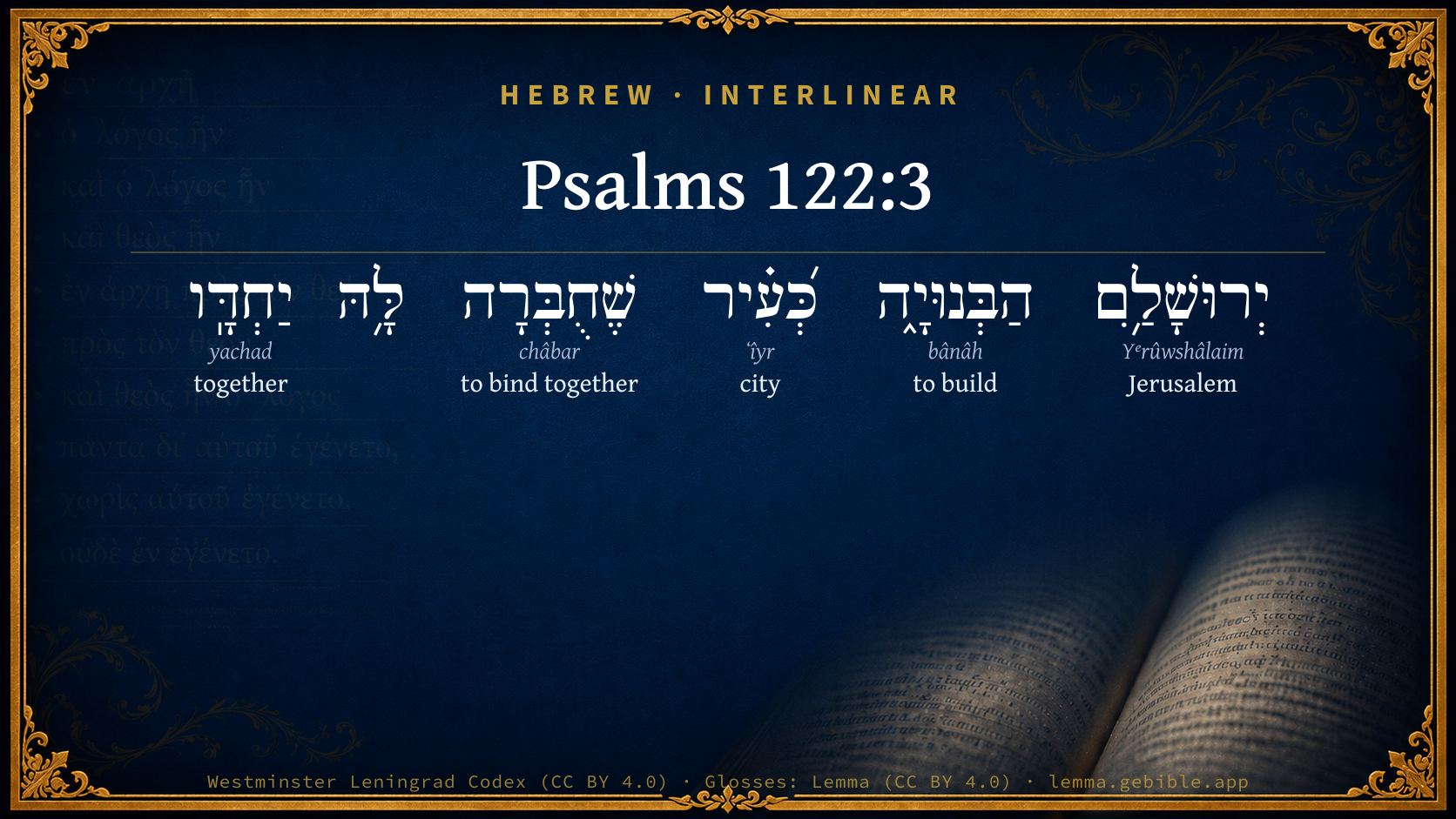
Psalms 122:3

Hebrew (Westminster Leningrad Codex) Psalms 122:3 appears in the Hebrew Old Testament. The text above is from the Westminster Leningrad Codex. Each word links to its Strong’s number, a concise gloss, and parsing drawn from the Open Scriptures Hebrew Bible morphology. Click any word for its full Brown-Driver-Briggs (BDB) entry.
Download image
Cite this verse

Psalms 122:3 (World English Bible). Public Domain. Lemma interlinear Bible study tool, https://lemma.gebible.app/v/psalms/122/3.

Show BibTeX & RIS
BibTeX
RIS
English Translation
Jerusalem, that is built as a city that is compact together;
World English Bible · Public Domain
Download a study sheet

One document with this verse’s original text, its word-by-word gloss line, the meaning frame, cross-references with their text, attributed commentary, and full source and license credits — printable, and it pastes into notes with its structure intact.

This verse Autodidact and up

Study sheet (.html) Plain text (.txt)

A passage Seminary Student

Up to 50 verses in one chapter. A passage sheet keeps up to 6 commentary sources and 12 cross-references per verse, in the order this page ranks them, and says so on the sheet whenever that leaves anything out. Ask for a single verse and you get the Autodidact verse sheet above.

Everything on this page stays free to read, with no account — the sheet is a download of what is already on screen, not access to it.

Want to remove ads? Support Godless Engineer
Compare translations 3

The same verse in 3 English versions, stacked beneath the original-language interlinear above. Click any original word for its lexicon entry.

Each is an independent rendering of the whole verse — the interlinear is not word-aligned to these translations.

Highlighted words mark where these versions differ — a whole-verse word diff, not a word-by-word alignment.

  • World English Bible Public Domain
    Jerusalem, that is built as a city that is compact together;
  • King James Version Public Domain
    Jerusalem is builded as a city that is compact together:
  • unfoldingWord Literal Text CC BY-SA 4.0
    Jerusalem, the one built like a city that is joined to itself together.

unfoldingWord Literal Text — © unfoldingWord, licensed CC BY-SA 4.0. Word-aligned USFM3 via Door43 (git.door43.org/unfoldingWord/en_ult).

Versions to compare (up to 4)

3 of 4 selected

Show all 18 translations

Every available English version of this verse, each an independent rendering of the whole verse.

  • World English Bible Public Domain
    Jerusalem, that is built as a city that is compact together;
  • Berean Standard Bible Public Domain
    Jerusalem is built up as a city united together,
  • Majority Standard Bible Public Domain
    Jerusalem is built up as a city united together,
  • King James Version Public Domain
    Jerusalem is builded as a city that is compact together:
  • American Standard Version (1901) Public Domain
    Jerusalem, that art builded As a city that is compact together;
  • Revised Version (1885) Public Domain
    Jerusalem, that art builded as a city that is compact together:
  • Geneva Bible (1599) Public Domain
    Ierusalem is builded as a citie, that is compact together in it selfe:
  • Douay-Rheims (1899) Public Domain
    May he not suffer thy foot to be moved: neither let him slumber that keepeth thee.
  • Young's Literal Translation Public Domain
    Jerusalem -- the builded one -- `Is' as a city that is joined to itself together.
  • Literal Standard Version CC BY-SA 4.0
    Jerusalem—the built one—[Is] as a city that is joined to itself together.
  • Unlocked Literal Bible CC BY-SA 4.0
    Jerusalem, built as a city carefully planned!
  • unfoldingWord Literal Text CC BY-SA 4.0
    Jerusalem, the one built like a city that is joined to itself together.
  • Darby Bible Public Domain
    Jerusalem, which art built as a city that is compact together,
  • World Messianic Bible Public Domain
    Jerusalem is built as a city that is compact together,
  • Webster's Bible Public Domain
    Jerusalem is built as a city that is compact together:
  • Free Bible Version CC BY-SA 4.0
    Jerusalem is built as a city where people can be together.
  • Bible in Basic English Public Domain
    O Jerusalem, you are like a town which is well joined together;
  • JPS Tanakh (1917) Public Domain
    Jerusalem, that art builded as a city that is compact together;

Literal Standard Version (2020), Covenant Press — licensed CC BY-SA 4.0. Text via the HelloAO Bible API (eBible.org). Unlocked Literal Bible (unfoldingWord) — licensed CC BY-SA 4.0. Text via the HelloAO Bible API (eBible.org). unfoldingWord Literal Text — © unfoldingWord, licensed CC BY-SA 4.0. Word-aligned USFM3 via Door43 (git.door43.org/unfoldingWord/en_ult). Free Bible Version, Dr. Jonathan Gallagher — licensed CC BY-SA 4.0. Text via the HelloAO Bible API (eBible.org).

Word by word

More ways to search: Search by grammar → Find every occurrence → Compare this word →

Practice this passage: Drill this verse → Learn its vocabulary →

שֶׁחֻבְּרָה
châbar
H2266
“who/which · to bind together”
Particle, Relative + Verb, Pual, Perfect, 3rd Person, Feminine, Singular
Part of Speech
Particle + Verb
Stem
Pual
Form
Perfect
Person
3rd Person
Gender
Feminine
Number
Singular
Full BDB Definition

Origin: a primitive root

TWOT: 598

to unite, join, bind together, be joined, be coupled, be in league, heap up, have fellowship with, be compact, be a charmer - (Qal) - to unite, be joined - to tie magic charms, charm - (Piel) - to unite with, make an ally of - to unite, join, ally - (Pual) - to be allied with, be united - to be joined together - (Hiphil) to join together, pile up (words) - (Hithpael) to join oneself to, make an alliance, league together
  1. יְרוּשָׁלִַ֥ם Yᵉrûwshâlaim H3389 “Jerusalem” Noun, Proper
  2. הַבְּנוּיָ֑ה bânâh H1129 “the · built” Particle, Definite Article + Verb, Qal, Participle Passive, Feminine, Singular, Absolute
  3. כְּ֝עִ֗יר ʻîyr H5892 “like/as · city” Preposition + Noun, Common, Feminine, Singular, Absolute
  4. יַחְדָּֽו yachad H3162 “together” Adverb

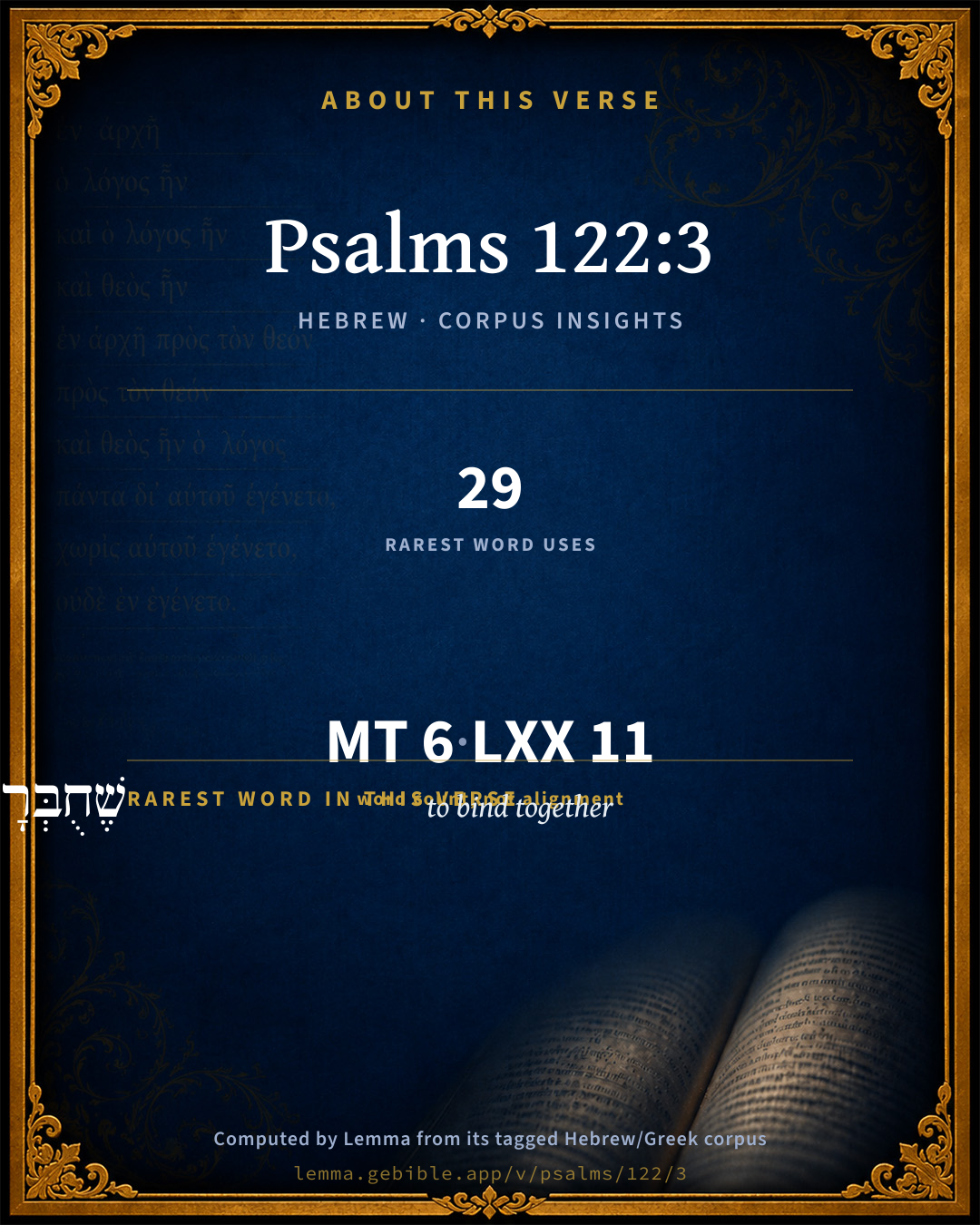
About this verse

These counts appear in no published source. They are computed here, from the morphology-tagged text and Lemma’s own curated glosses. What Lemma adds →

6
words
5
distinct lemmas
Wisdom
section

Shared distinctive vocabulary

שֶׁחֻבְּרָה to bind together H2266 occurs in 25 verses of the Hebrew Bible. Also found in:

Grammatical profile

  • 2 verbs
  • 2 nouns
  • 1 preposition
  • 1 adverb

Verb forms

  • הַבְּנוּיָ֑ה Qal · Participle Passive
  • שֶׁחֻבְּרָה Pual · Perfect

Hebrew & Septuagint length

In English translation the verse runs 11 words from the Hebrew and 10 from the Septuagint (LXX English) — closely comparable.

A rough comparison of the two English renderings, which tokenize alike — not a word-level alignment.

Word counts can differ between the Hebrew and the Greek without any difference in meaning — e.g. the Hebrew direct-object marker אֵת has no separate Greek word, and Greek often adds the article ὁ.

In the original languages it is 6 Hebrew tokens and 11 Greek tokens — but the two are counted differently (Hebrew bundles its prefixes and suffixes into one token; the Greek is in lemma form), so that isn’t a like-for-like length.

Cross-references

6

Topical passages linked to Psalms 122:3 in the Treasury of Scripture Knowledge — connected by theme and wording, ordered by reader-vote popularity; previews shown in the World English Bible.

  • 2 Samuel 5:9 David lived in the stronghold, and called it the city of David. David built round about from Millo and inward.
  • Ephesians 2:20–21 being built on the foundation of the apostles and prophets, Christ Jesus himself being the chief cornerstone;
  • Nehemiah 4:6 So we built the wall; and all the wall was joined together to half [the height] of it: for the people had a mind to work.
  • Psalms 147:2 Yahweh builds up Jerusalem. He gathers together the outcasts of Israel.
  • Ephesians 4:4–7 There is one body, and one Spirit, even as you also were called in one hope of your calling;
  • Revelation 21:10–27 He carried me away in the Spirit to a great and high mountain, and showed me the holy city, Jerusalem, coming down out of heaven from God,

Cross-references courtesy of OpenBible.info (CC BY 4.0).

Hebrew and Greek witnesses Masoretic Hebrew ↔ Greek Septuagint

The same verse in the two great witnesses to the Old Testament, shown verse-for-verse.

You’re reading Greek Psalm 121 (Hebrew Psalm 122). The Septuagint counts the superscription, so verse numbers can differ from the Hebrew — chapter-level alignment, not verse-by-verse. Numbering follows Rahlfs.

These are two independent witnesses, not word-aligned to each other, and the Septuagint is shown in lemma (dictionary) form.

Hebrew Psalms 122:3 Masoretic · Westminster Leningrad Codex

יְרוּשָׁלִַ֥ם הַבְּנוּיָ֑ה כְּ֝עִ֗יר שֶׁחֻבְּרָה לָּ֥הּ יַחְדָּֽו

Jerusalem, that is built as a city that is compact together;

World English Bible · Public Domain

Greek LXX Greek Psalm 121:3 Septuagint · lemma form

ἰερουσαλήμ οἰκοδομέω ὡς πόλις ὅς ὁ μετοχή αὐτός ἐπί ὁ αὐτός

Jerusalem is built as a city whose fellowship is complete.

LXX2012 (modern English Septuagint) · Public Domain

On this verse, Ellicott's Commentary for English Readers discusses the Septuagint’s reading. Read the note in Commentary ↓

Hebrew: Westminster Leningrad Codex (CC BY 4.0). Greek: Septuagint (public domain); English from LXX2012 (modern English Septuagint) (Public Domain). How the Septuagint differs from the Hebrew →

Commentary

Notes on Psalms 122:3 from classic Christian and Jewish commentators (each source and its license shown beneath its notes). The classic Christian expositions comment on the surrounding passage and are grouped to its opening verse, so a note may address several verses; the Jewish commentaries on the Tanakh (Rashi and others) are per-verse, so they appear only where the commentator wrote on this verse.

Lemma curates 59 commentaries, every one of them public domain or Creative Commons licensed, each selected and text-cleaned for this edition rather than reprinted as found. About our sources →

Trapp's Complete Commentary

John Trapp

Psa 122:3 Jerusalem is builded as a city that is compact together:

Ver. 3. Jerusalem is builded as a city, &c.] None such for uniformity of buildings or unanimity of citizens. There is no such oneness in all the world as among true Christians; and this the very heathens observed and commended. As the curtains of the tabernacle were joined by loops, so were they by love. And as the stones of the temple were so close cemented together that they seemed to be all but one stone, so was it among the primitive saints.

John Trapp, A Commentary or Exposition upon All the Books of the Old and New Testament (1647–1656) — public domain. Text from a community e-Sword module.

Joseph Benson's Commentary

Psa 122:3. Jerusalem is builded as a city, compact together — Hebrew, שׁחברה לה, shechubberah lah, quæ conjuncta est sibi, which is united, or, compacted to, or, in itself. The word signifies “the connection or joining of things aptly and closely to each other. Thus it is used of the coupling of the curtains of the tabernacle together, Exo 36:18. Hence it is used to denote the connection and society of friendship, affection, and purpose, Gen 14:3; Hos 4:17. In the place before us, both senses seem to be united. Jerusalem was compact as to its buildings, and the inhabitants of it were firmly united by mutual harmony and friendship.” — Chandler. This clause is rendered by Mudge, As a city that is placed in the centre of union. “Jerusalem,” says Dr. Delaney, “the great seat and centre of religion and justice, was the centre of union to all the tribes; the palace, the centre of the city; and the tabernacle, of the palace. Blessed and happy is that nation whose prince is the centre of union to his people, and God (that is, true religion) the common centre and cement both of people and prince.” — Life of David, book 2., chapter 12., page 162.

Joseph Benson's Commentary on the Old and New Testaments (1811–1818) — public domain. Text from a community e-Sword module.

J. A. Alexander on Psalms

Joseph Addison Alexander

3. (Psa 122:3) Jerusalem, the (one) built like a city which is joined to itself together. This seems to be a continuation of the address in the preceding verse. The unusual expressions in the last clause are intended to describe the city as substantially and strongly built. The sense is correctly given in the English Bible, a city that is compact together. This seems to imply that Jerusalem had recently assumed this character, and may therefore help to determine the period in the reign of David, when the psalm was written. See 2Sa 5:9. The abbreviated relative has by some been made a proof of later date; but it no doubt belonged from the beginning to the dialect of common life, though not commonly employed in writing till a later date. It occurs in the song of Deborah, Jdg 5:7, and elsewhere in the Book of Judges (Jdg 6:17; Jdg 7:12; Jdg 8:26).

Joseph Addison Alexander, The Psalms Translated and Explained (1850) — public domain. Text from a community e-Sword module.

Tyndale Open Study Notes

Tyndale Open Resources

122:3-5 Jerusalem is a metaphor for God’s heavenly dwelling. David was the archetype for God’s chosen rulers.

122:3 In the time of David and Solomon, Jerusalem was renowned as a place of security (1 Kgs 10:6-7).

Tyndale Open Study Notes — © Tyndale Open Resources, licensed CC BY-SA 4.0. Text via the HelloAO Bible API.

Geneva Bible (1599)

Geneva Bible translators

By the artificial joining and beauty of the houses, he meaneth the concord and love that was between the citizens.

Geneva Bible (1599) marginal notes — public domain. Text via Bolls.life.

Adam Clarke's Commentary

Verse 3. Jerusalem - compact together.] It is now well rebuilt, every part contributing to the strength of the whole. It is also a state of great political and spiritual union. It is the centre of union to all the tribes, for each tribe has an equal interest in that God who is worshipped there.

Adam Clarke's Commentary on the Bible (1810–1826) — public domain. Text from a community e-Sword/MySword module.

John Calvin's Commentaries

3. Jerusalem is built as a city. Here David begins to celebrate the praises of Jerusalem; and he does this with the design of encouraging the people to persevere with uniform steadfastness in their obedience. It was of great importance for the minds of the godly, instead of being drawn hither and thither, to be kept constantly fixed on that city, which was the bond of a holy unity. When the people came to be divided into two bodies, that was the commencement of melancholy devastation. It is not surprising, then, to find David commending with such earnestness the place which God had chosen, knowing, as he did, that the prosperity of the Church depended upon the children of Abraham worshipping God there in purity, according to the appointed observances of the law; and next, upon their acknowledging the royal seat which the same God had erected there by his own authority, and had taken under his own protection When it is said that Jerusalem is built as a city, it is not to be understood as referring only to the walls, or towers, or ditches of that city, but chiefly to the good order and holy polity by which it was distinguished, although I allow that there is some allusion to its ancient state. Salem, indeed, had been a noted town even from the beginning; but when God selected it to be the head of the kingdom, it changed its appearance, and in a manner its nature, so that then it began to deserve the name of a well-regulated city. At first sight it may seem a poor commendation to call Jerusalem a city; but it is to be observed that it is here exhibited as it were standing alone in the whole world — taking the precedence of all other cities, which will in vain attempt to equal it. David, certainly, in thus speaking, does not intend to divest other cities of the rank to which they may be entitled, but he raises Jerusalem higher, that it may appear conspicuous above them all, even as we find Isaiah, (Isaiah 2:2,) when speaking of mount Zion, asserting that it “shall be established in the top of the mountains, and shall be exalted above the hills.” In that passage the Prophet, to magnify this little hill, brings down the loftiest mountains of the world, that they may not obscure its glory. In like manner David here affirms that Jerusalem is compacted as a city, to induce the faithful, instead of gazing in all directions around them, to rest contented with the city which God had chosen, since they would nowhere find its equal. After having humbled all other cities, he shows, in a few words, the excellence of Jerusalem, representing it as regularly built, or fitly and neatly joined together in all its parts. Some take these words as expressing literally and without figure, that its citizens live together in peace and unity; but I see no impropriety in supposing that they describe, metaphorically, the peaceable state of a city. Thus the mutual concord which reigns among the citizens of a city, and by which they are united to each other, is compared to buildings, compacted together by a skillful and elegant workmanship, so that there is nothing imperfect, in joined together, or rent, but throughout a beautiful harmony’. By this David teaches us, that the Church can only remain in a state of safety when unanimity prevails in her, and when, being joined together by faith and charity, she cultivates a holy unity.

John Calvin's Commentaries (1540-1563) — public domain. Text from the Calvin Translation Society English edition (1840s-50s) via the Christian Classics Ethereal Library (ccel.org). Calvin's coverage is partial (roughly two-thirds of the Bible); uncommented books and verses are honest gaps, never fabricated. The 19th-century editor's footnotes and remarks are omitted so the notes are faithfully Calvin's own voice.

Ellicott's Commentary for English Readers

(3) This verse is somewhat perplexing. It is explained to refer either to the rebuilding of the city and reuniting of the parts which had been disconnected in the destruction, or, which is far better (see Introduction), is taken as a rustic’s impression on first seeing a compact city after being accustomed to straggling villages. The astonishment of Virgil’s shepherd is aptly compared: “Urbem quam dicunt Romam, Melibæe putavi, Stultus ego, huic nostræ similem.” But a far more satisfactory meaning is suggested by the LXX. They (comp. Symmachus) take the word rendered compact as a noun, meaning union. The verse then may run: Jerusalem, the (one) built like a city, union is in it together, i.e., it is the rallying point of all the tribes. (See next verse.)

A Bible Commentary for English Readers, edited by Charles John Ellicott (1878–1897) — public domain. Text from a community e-Sword module.

The Cambridge Bible for Schools and Colleges

gen. ed. J. J. S. Perowne

3. The exclamation of the pilgrims. Jerusalem that art built up as a city which is compacted together, lit. joined together for itself. This is generally understood to refer to the restoration of the city: the walls have been rebuilt, the ruined houses repaired, the gaps and vacant spaces filled up; the city once more presents an aspect of unity, continuity, solidity, widely different from the dilapidated condition in which Nehemiah found it (Neh_2:17; Neh_7:4). But the verb is used metaphorically as well as literally (e.g. Psa_94:20), and it is possible that the sight of the restored city is to the poet’s eye an emblem of the mutual harmony of its inhabitants or of the unity of the nation. Such a sense is suggested by Coverdale’s beautiful rendering that is at unity with itself, which seems to be a paraphrase of the Vulg. cuius participatio eius in idipsum, LXX ἧς ἡ μετοχὴ αὐτῆς ἐπιτοαυτό, ‘whose fellowship is together.’ This rendering however presumes a slightly different reading of the text.

The Targ. interprets the words of the heavenly Jerusalem—‘Jerusalem which is built in the firmament like a city that is united together upon earth.’

The Cambridge Bible for Schools and Colleges (gen. ed. J. J. S. Perowne; Cambridge University Press, 1878–1918) — public domain. Text from a community e-Sword module.

John Gill's Exposition

Whither the tribes go up, the tribes of the Lord,.... The twelve tribes of Israel; the males of them went up three times a year to Jerusalem to worship, at the feasts of passover, pentecost, and tabernacles; and was typical of the church of Christ, where the worship of God is carried on, his word preached, and ordinances administered; and whither saints go and attend for their own profit and the glory of God; this is the city of our solemnities, Isa 33:20;

unto the testimony of Israel; the ark of the testimony a symbol of the divine Presence. The law is called a testimony, because it testified the will of God to be done; this was put into an ark, which had its name from thence, and was typical of Christ, the end of the law for righteousness; and over the ark was the divine Presence: hither the tribes came to worship God, and to consult him;

"who (the Targum here says) testifies to Israel, that his divine Majesty dwells among them, when they go to confess unto the name of the Lord.''

The Gospel is called the testimony of Christ; and it is what testifies concerning his person, office, and grace, unto the Israel of God; and who go up to the house of God in order to hear it;

to give thanks unto the name of the Lord; for all his mercies and blessings, both temporal and spiritual; and which should be acknowledged, not only in a private manner, but publicly in the house of God; see Psa 100:4.

John Gill's Exposition of the Whole Bible (1746–1763) — public domain (CC PDM 1.0). Text via the HelloAO Bible API.

Albert Barnes' Notes on the Bible

Jerusalem is builded as a city that is compact together - literally, “joined to itself together;” that is, when one part is, as it were, bound closely to another part; not scattered or separate. The walls are all joined together; and the houses are all united to one another so as to make a compact place. The ground occupied by Jerusalem never could be large, as it was surrounded with valleys, except on the north, and hemmed in with hills, so that, from the necessity of the case, when it became the capital of the nation, it was densely crowded. This, moreover, was usual in ancient cities, when they were made compact for the sake of defense and protection.

Albert Barnes' Notes on the Bible (1834–1885) — public domain. Text from a community e-Sword/MySword module.

Matthew Poole's English Annotations

Partly in its buildings, which are not dispersed, as they are in villages, nor divided into two cities, as it was before, but united and enlarged, 1Ch 11:7,8; and principally in its government and religion, which was distinct and opposite, before David took the fort of Zion from the Jebusites.

Matthew Poole's English Annotations on the Holy Bible (1683–1685) — public domain. Text from a community e-Sword/MySword module.

The Treasury of David

Charles H. Spurgeon

Ver. 3. Jerusalem is builded as a city that is compact together. David saw in vision the city built; no more a waste, or a mere collection of tents, or a city upon paper, commenced but not completed. God's mercy to the Israelitish nation allowed of peace and plenty, sufficient for the uprise and perfecting of its capital: that City flourished in happy times, even as the church is only built up when all the people of God are prospering. Thanks be to God, Jerusalem is builded: the Lord by his glorious appearing has built up Zion. Furthermore, it is not erected as a set of booths, or a conglomeration of hovels, but as a city, substantial, architectural, designed, arranged, and defended. The church is a permanent and important institution, founded on a rock, builded with art, and arranged with wisdom. The city of God had this peculiarity about it, that it was not a long, straggling street, or a city of magnificent distances (as some mere skeleton places have been styled), but the allotted space was filled, the buildings were a solid block, a massive unity: this struck the dwellers in villages, and conveyed to them the idea of close neighbourhood, sure standing, and strong defence. No quarter could be surprised and sacked while other portions of the town were unaware of the assault: the ramparts surrounded every part of the metropolis, which was singularly one and indivisible. There was no flaw in this diamond of the world, this pearl of cities. In a church one of the most delightful conditions is the compactness of unity: "one Lord, one faith, one baptism." A church should be one in creed and one in heart, one in testimony and one in service, one in aspiration and one in sympathy. They greatly injure our Jerusalem who would build dividing walls within her; she needs compacting, not dividing. There is no joy in going up to a church which is rent with internal dissension: the gladness of holy men is aroused by the adhesiveness of love, the unity of life; it would be their sadness if they saw the church to be a house divided against itself. Some bodies of Christians appear to be periodically blown to fragments, and no gracious man is glad to be in the way when the explosions take place: thither the tribes do not go up, for strife and contention are not attractive forces.

Ver. 3. Jerusalem is builded as a city that is compact together. The deep depressions which secured the city must have always acted as its natural defence. But they also determined its natural boundaries. The city, wherever else it spread, could never overleap the valley of the Kedron or of Hinnom; and those two fosses, so to speak, became accordingly, as in the analogous case of the ancient towns of Etruria, the Necropolis of Jerusalem... The compression between these valleys probably occasioned the words of the Psalmist: "Jerusalem is built as a city that is at unity in itself." It is an expression not inapplicable even to the modern city, as seen from the east. But it was still more appropriate to the original city, if, as seems probable, the valley of Tyropoeon formed in earlier times a fosse within a fosse, shutting in Zion and Moriah into one compact mass not more than half a mile in breadth. Arthur Penrhyn Stanley (1815-1881), in "Sinai and Palestine."

Ver. 3. Jerusalem. It matters not how wicked or degraded a place may have been in former times, when it is sanctified to the use and service of God it becomes honourable. Jerusalem was formerly Jebus a place where the Jebusites committed their abominations, and where were all the miseries of those who hasten after another God. But now, since it is devoted to God's service, it is a city"compact together, ""the joy of the whole earth." William S. Plumer.

Ver. 3. Compact. Jerusalem was compactly built; every rood of ground, every foot of frontage, was valuable; house was joined to house; those who had gardens had them beyond the city walls, among the "paradises" of the valley of Jehoshaphat. Samuel Cox.

Ver. 3. Compact together. Methinks Philadelphia, the name of one of the seven golden candlesticks (Re 1:11-12), is a very proper fitting name for a church, which signifies brotherly love; and every congregation ought to be in a good sense the family of love. Breaches and divisions, distractions and heart burnings, may happen in other kingdoms which are without God in the world and strangers to the covenant of grace; yet let Jerusalem, the Church of God, be always like a city which is at unity within itself. John Pigot, 1643.

Ver. 3. As a city that is compact together. Can we say of the great universal church throughout the world, what the pilgrims said of Jerusalem when gazing on its splendour, from the surrounding hills, that it is built "as a city that is compact together"? A stately capital, throned on a base of rock, its spacious streets and noble edifices, beautiful in themselves, deriving added splendour from the taste and regularity of their arrangement, appears, both to the scoffing unbeliever and grieving Christian, a singularly inappropriate emblem of the divided and distracted, the jarring and warring church. If the church may be compared to a city in respect of magnitude, it is one in which every one builds on his own plan; in which the various masses which should embellish and support each other are studiously kept apart, suggesting less the idea of a compact and united capital than of detached and isolated forts, held by persons who keep themselves jealously aloof from each other, save when mutual hatred and heart burnings bring them together for conflict. There is some truth in the picture; alas! for the proud, foolish builders who give occasion to it, and who, instead of praying for and seeking the peace of Jerusalem, rejoice in exhibiting, perpetuating, and fomenting strife! But, blessed be God, there is yet more of falsehood than truth in it. With all our divisions the Christian Jerusalem is compact in itself together, What occupies the hearts and tongues of the myriads of worshippers that assemble themselves weekly in the sanctuaries of our beloved land, and of the millions that assemble beyond the Atlantic billows, but the one glorious gospel of the grace of God? Leave out from the computation the priest with his mass book, the cold Socinian without his Saviour, and the deluded orthodox professor who holds the truth in unrighteousness; still yonder and yonder and yonder, whatever their name, their place, or their outward worship, are myriads of true hearts, beating with one pulse, gazing on one hope, possessed of one conviction, and praying and pressing forward to one blessed home. Robert Nisbet.

Ver. 3-4. He commendeth Jerusalem, the figure of the church of God and of the corporation of his people, First, as a city for a community. Secondly, as the place of God's public assemblies for religious worship. Thirdly, as the place of public judicature, for governing the Lord's people under David, the type of Christ. Whence learn,

1. The church of God is not without cause compared to a city, and especially to Jerusalem, because of the union, concord, community of laws, mutual commodities, and conjunction of strength which should be among God's people: Jerusalem is builded as a city that is compact together.

2. That which commendeth a place most of anything is the erecting of the Lord's banner of love in it, and making it a place for his people to meet together for his worship: Jerusalem is a city whither the tribes go up.

3. Whatsoever civil distinction God's children have among themselves, and howsoever they dwell scattered in several places of the earth, yet as they are the Lord's people, they should entertain a communion and conjunction among themselves as members of one universal church, as the signification of the peoples meeting thrice in the year at Jerusalem did reach: Wither the tribes did go up, the tribes of the Lord.

4. As the tribes, so all particular churches, how far soever scattered, have one Lord, one covenant, one law and Scripture, signified by the tribes going up to the testimony of Israel, or to the Ark of the Covenant or testimony where the whole ordinances of God were to be exercised.

5. The end of the ordinances of God, of holy covenanting and communion, and joining in public worship, is to acknowledge the grace and goodness of God, and to, glorify him; for the tribes did go up to give thanks unto the name of the Lord. David Dickson.

Ver. 3.

1. A type of the New Jerusalem.

a) As chosen by God.

b) As founded upon a rock.

c) As taken from an enemy.

2. A type of its prosperity: "Builded as a city."

3. A type of its perfection: "Compact together." G. R.

Ver. 3. The unity of the church.

1. Implied in all covenant dealings.

2. Suggested by all Scriptural metaphors.

3. Prayed for by our Lord.

4. Promoted by the gifts of the Spirit.

5. To be maintained by us all.

Ver. 3-4. The united church the growing church.

Psalms 122:4*

Charles H. Spurgeon's The Treasury of David (1869–1885) — public domain. Psalms only. Text from a community e-Sword/MySword module.

Whedon's Commentary on the Bible

Daniel D. Whedon

3. Compact together—The city lay in a rocky region, between the valleys of Gihon on the west, and Kidron on the east, with an irregular circumference of (according to Josephus) thirty-three stadia (or a little less than three and four-fifths miles,) of the outer wall. The modern wall is about two and a half miles in circuit. Originally Jerusalem was composed of several sections, particularly the upper end lower city, (the name occurs five times in the Hebrew Bible, in the plural or dual,) lying on uneven ground, unequally fortified, and imperfectly united; but David captured, firmly united, and fortified the whole. 1Ch_11:7; 1Ch_11:9. The text, “compact together,” or joined to itself together, probably refers to the means of connexion between the different parts. It may be used, too, to illustrate the spiritual Jerusalem, the Church, “builded together for a habitation of God through the Spirit.” Eph_2:21-22

Daniel D. Whedon (gen. ed.), Commentary on the Old and New Testaments (1874–1909) — public domain. Text from a community e-Sword module.

The Pulpit Commentary

Jerusalem is builded as a city that is compact together; rather, Jerusalem that art builded. The primary reference is probably to the compact shape and look of the ancient city, which, as Josephus says, was "one and entire," with no straggling suburbs, shut in on the north by a wall, and on the three other sides both by walls and by deep, rocky valleys. But the material "compactness" was perhaps taken to symbolize the close internal union of the inhabitants one with another, whereby they were all knit together into one Church and people.

Religious attachment to places.

"One thing that would have struck a pilgrim to Jerusalem who should approach the city from its north-eastern side was its beauty. The stately buildings erected by Solomon on the south side of the temple area Solomon"s own house of judgment, the house of the Forest of Lebanon, the palaces of the kings of Zion, the palaces of the princes of Judah around it, the circuit of the walls, above all, the temple, with its courts, with its burnished roof, with its lofty gates, with its tower, surrounded as all this was on three sides by deep ravines and olive-clad hills. Possibly the pilgrim had seen Damascus, straggling out amid the. beautiful oasis which surrounds it in the plain of the Abana; or he had seen Memphis, a long string of buildings, thickly populated, extending for some twelve or fourteen miles along the west bank of the Nile. Compared with these, Jerusalem had the compact beauty of a highland fortress, its buildings as seen from below standing out against the clear Syrian sky, and conveying an impression of grace and strength that would long linger in the memory" (Liddon). The attachment of Mohammedans to the sacred city of Mecca is well known, and almost every religion has its special center, and every god his shrine. The realistic presentation of a divinity in some image involves the localization of his worship to some place. An unfamiliar instance of special interest in sacred places was given by Professor Minas Tcheraz to the Worlds Parliament." Speaking of the Armenian Church, he said, One result of the manifold persecutions has been to strengthen the attachment of the Armenians to the Church of St. Gregory the illuminator. Etchmiadzin has become a word of enchantment, graven in the soul of every Armenian. The Armenians of the mother country bow down with love before this sanctuary, which has already seen 1591 summers. And as regards those who have left their native land, if it is far from their eyes, it is not far from their hearts. A Persian monarch, Shah Abbas, had forcibly transported into his dominion fourteen thousand Armenian families. Like the captive Israelites at the remembrance of Jerusalem, these Armenians always sighed at the recollection of Etehmiadzin. In order to keep them in their new country, Shah Abbas conceived the project of destroying Etehmiadzin, of transporting the stones to Djoulfa (Ispahan), and there constructing a similar convent. He actually transported the central stone of the chief altar, the baptismal fonts, and other important pieces, but the emotion of the Armenians was so great that he was forced to give up his project of vandalism." The sentiment of Christians in relation to the Holy Sepulcher may be compared with the sentiment of the Jews in relation to the holy city and temple. And a subject which may be suggested for consideration is the value and the peril of this association of religion with places and buildings.

I THE VALUE OF THE ASSOCIATION OF RELIGION WITH PLACES. That value lies in the help which material things can be to the spiritual life of beings who have material forms. The wholly spiritual is at present unattainable by us. We are compelled to shape the spiritual in formal words, and to present the spiritual in material images. The sacraments are based on this value of sensible helps to spiritual feeling. And so historic and beautiful church-buildings cultivate reverence; familiar services nourish the spirit of worship; the church we have attended since childhood, or in which we have felt the power of Divine things, readily quickens emotion and renews faith. The hermit who retires even from hallowing associations, does but make new ones for himself, for none of us can afford to neglect the help that sacred places and things may be to us.

II THE PERIL THAT MAY LIE IN THE ASSOCIATION OF RELIGION WITH PLACES. It is the peril that always lies in the connection of the material with the spiritual. The material is always trying to encroach. In exaggeration we see this in the ignorant heathen who thinks of his image as a god, instead of as a help to the apprehension of God. This subtle peril lies in services, sacred buildings, sacraments, and even formal doctrines. They become absorbing in themselves, not agencies of the spiritual. R.T.

The emblem of spiritual unity.

"Compact together." Stanley thinks this term indicates the impression made on country visitors by the conformation of the ground on which the city of Jerusalem stood. "Those deep ravines which separate Jerusalem from the rocky plateau of which it forms a part, and acted as its natural defense, must also have determined its natural boundaries. The city, wherever else it spread, could never overleap the valley of the Kedron or of Hinnom. The expression of compactness was still more appropriate to the original city, it, as seems probable, the valley of Tyropoeon formed in earlier times a fosse within a fosse, shutting in Zion and Moriah into one compact mass, not more than half a mile in breadth." This compactness is taken as a type of the higher national unity. The nation restored from the Captivity was regarded as a whole nation, the distinction between Judah and Israel being no longer recognized. The sigma of unity was the gathering from all the tribes of worshippers at the Jerusalem feasts. The crowds of worshippers pressed into the area of the temple seemed to be represented by the compactness of the city.

I SPIRITUAL UNITY IS THE UNITY OF A COMMON LIFE. And the real sign of life is lore. Those multitudes of Jews in the temple had one common love, and so one common life. They loved Jerusalem, they loved the God who glorified Jerusalem by his presence. And so the Christian unity is the unity of a common life, whose sign is a common love to the Lord Jesus Christ. Every Christian will join in saying, "Grace be with all them who love cur Lord Jesus Christ in sincerity and in truth.

II SPIRITUAL UNITY IS THE UNITY OF A COMMON INTEREST. And that interest for Jews was the honor of Jehovah, the nation"s God; it is for Christians the honor of Jehovah-Jesus, the manifested God. How a common interest blends men together is seen in societies, clubs, conferences, etc. It is the secret of the unity of Churches.

III SPIRITUAL UNITY IS THE HARMONY OF VARIED FORMS. Different-shaped hills made up the unity of Jerusalem. Different-colored flowers make up the unity of the garden. Different moods in worshippers make up the unity of a religious service. Different mental apprehensions of truth make up the unity of the Christian doctrine. Reunion of mere samenesses is not a pleasing thing either to God or man. We do not care for things cut to an exact pattern, or pressed into one mould. In variety lies charm; and variety is not only consistent with unity, it is a condition of unity if the unity is to go deeper than mere appearances. "That vast society in whose ample bosom the souls of Christian men from generation to generation find shelter and warmth and nourishment, is the reality of which the old Syrian city was a material type. This is the Jerusalem of the Christian Creed, "I believe in one holy Catholic and Apostolic Church." There may be controversies among Christians as to the exact extent and direction of its walls, just as there are controversies among antiquarians as to the extent and direction of the walls of its material prototype, but as to its place in the thoughts and affections of the true Christian man there should be no room for controversy. No other association of men can have such claims on the heart of a Christian as the Church of God." "The true remedy for disappointment and sorrow on the score of shortcomings and differences within the sacred city is to be found in such prayers as we offer in our holiest service to the Divine Majesty, beseeching him to inspire continually the universal Church with the spirit of truth, unity, and concord. R.T.

The Pulpit Commentary (1880–1919), ed. H.D.M. Spence-Jones & Joseph S. Exell — public domain. Text from a community e-Sword module.

Rashi

Rabbi Shlomo Yitzchaki (Rashi)

The built-up Jerusalem When my son Solomon builds the Temple within it [Jerusalem], it will be built with the Shechinah, the Temple, the Ark, and the altar.

is like a city that was joined together within itself Like Shiloh, for Scripture compared them to one another, as it is said (Deut. 12:9): “to the rest and to the inheritance.” The rest is Shiloh. The inheritance is Jerusalem (see Sifrei Re’eh 66). And our Rabbis said (Ta’an. 5a): There is a Jerusalem in heaven, and the Jerusalem on earth is destined to be like it.

Rashi on the Tanakh — English translations: “The Judaica Press complete Tanach with Rashi, translated by A. J. Rosenberg” (CC BY 4.0); “Pentateuch with Rashi's commentary by M. Rosenbaum and A.M. Silbermann, 1929-1934” (public domain); “The Metsudah Tanach series, Lakewood, N.J” (CC BY 4.0); and “The Book of Joshua, Metsudah Publications, 1997” (CC BY 4.0). Text via Sefaria.

Lesson kit

Teaching starters — assembled from the data on this page, not authored interpretation. Every prompt links to the verse data it draws on. Edit before teaching.

Psalms, in the Wisdom, opens this verse with 6 words (5 distinct Hebrew lemmas). Its most distinctive word is châbar (“to bind together”). A historical commentator’s framing appears above. Read the whole chapter for the surrounding context.

Discussion questions

  1. What does “to bind together” (châbar) contribute to the verse as a whole?
  2. Genesis 14:3 shares the word «to bind together» with this verse. How do the two illuminate each other?
  3. These translations render this verse differently. What is at stake in choosing one wording over another?
  4. The verb «הַבְּנוּיָ֑ה» is Qal Participle Passive. How does its form color the action?
  5. Reading how Trapp's Complete Commentary and Joseph Benson's Commentary read this verse, where do the two commentators agree and where do they part?

Things to notice

Reading settings

Reading text

Shown beneath each verse's original-language words.

Old Testament
Old Testament edition

Read the OT as the Masoretic Hebrew (MT) or the Greek Septuagint (LXX).

English shown for the Greek Septuagint (in the Hebrew ↔ Greek comparison).

Comparing translations? Open the Compare panel on any verse page to stack up to four side by side.