
2 Chronicles 34:30

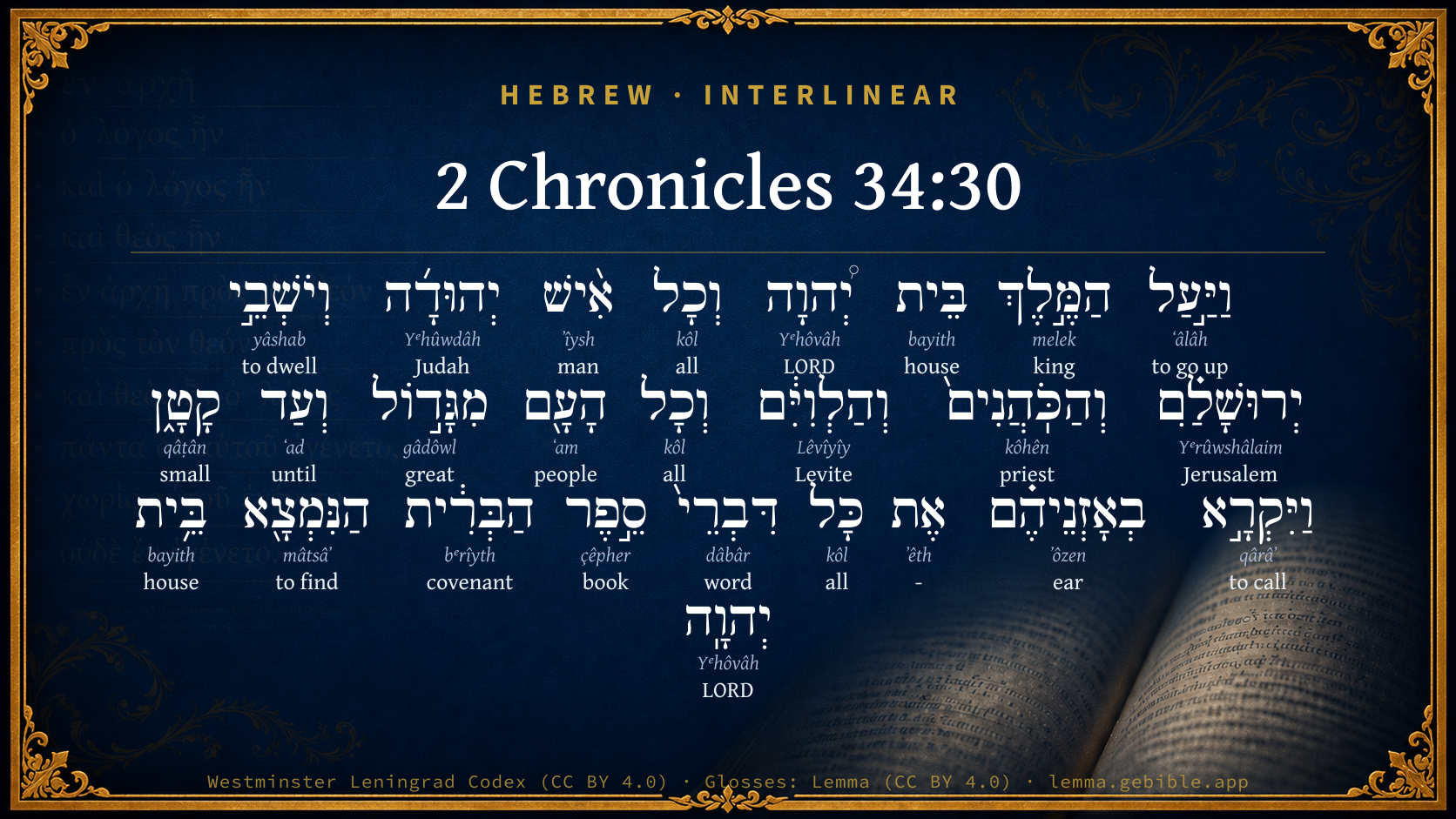
Hebrew (Westminster Leningrad Codex) 2 Chronicles 34:30 appears in the Hebrew Old Testament. The text above is from the Westminster Leningrad Codex. Each word links to its Strong’s number, a concise gloss, and parsing drawn from the Open Scriptures Hebrew Bible morphology. Click any word for its full Brown-Driver-Briggs (BDB) entry.
Download image
Cite this verse

2 Chronicles 34:30 (World English Bible). Public Domain. Lemma interlinear Bible study tool, https://lemma.gebible.app/v/2-chronicles/34/30.

Show BibTeX & RIS
BibTeX
RIS
English Translation
The king went up to the house of Yahweh, and all the men of Judah and the inhabitants of Jerusalem, and the priests, and the Levites, and all the people, both great and small: and he read in their ears all the words of the book of the covenant that was found in the house of Yahweh.
World English Bible · Public Domain
Download a study sheet

One document with this verse’s original text, its word-by-word gloss line, the meaning frame, cross-references with their text, attributed commentary, and full source and license credits — printable, and it pastes into notes with its structure intact.

This verse Autodidact and up

Study sheet (.html) Plain text (.txt)

A passage Seminary Student

Up to 50 verses in one chapter. A passage sheet keeps up to 6 commentary sources and 12 cross-references per verse, in the order this page ranks them, and says so on the sheet whenever that leaves anything out. Ask for a single verse and you get the Autodidact verse sheet above.

Everything on this page stays free to read, with no account — the sheet is a download of what is already on screen, not access to it.

Want to remove ads? Support Godless Engineer
Compare translations 3

The same verse in 3 English versions, stacked beneath the original-language interlinear above. Click any original word for its lexicon entry.

Each is an independent rendering of the whole verse — the interlinear is not word-aligned to these translations.

Highlighted words mark where these versions differ — a whole-verse word diff, not a word-by-word alignment.

  • World English Bible Public Domain
    The king went up to the house of Yahweh, and all the men of Judah and the inhabitants of Jerusalem, and the priests, and the Levites, and all the people, both great and small: and he read in their ears all the words of the book of the covenant that was found in the house of Yahweh.
  • King James Version Public Domain
    And the king went up into the house of the LORD, and all the men of Judah, and the inhabitants of Jerusalem, and the priests, and the Levites, and all the people, great and small: and he read in their ears all the words of the book of the covenant that was found in the house of the LORD.
  • unfoldingWord Literal Text CC BY-SA 4.0
    And the king went up to the house of Yahweh, and each man of Judah and the inhabitants of Jerusalem, and the priests, and the Levites, and all the people, from the great to the small. And he read in their ears all the words of the scroll of the covenant, the one that was found in the house of Yahweh.

unfoldingWord Literal Text — © unfoldingWord, licensed CC BY-SA 4.0. Word-aligned USFM3 via Door43 (git.door43.org/unfoldingWord/en_ult).

Versions to compare (up to 4)

3 of 4 selected

Show all 18 translations

Every available English version of this verse, each an independent rendering of the whole verse.

  • World English Bible Public Domain
    The king went up to the house of Yahweh, and all the men of Judah and the inhabitants of Jerusalem, and the priests, and the Levites, and all the people, both great and small: and he read in their ears all the words of the book of the covenant that was found in the house of Yahweh.
  • Berean Standard Bible Public Domain
    And he went up to the house of the LORD with all the people of Judah and Jerusalem, as well as the priests and the Levites—all the people small and great—and in their hearing he read all the words of the Book of the Covenant that had been found in the house of the LORD.
  • Majority Standard Bible Public Domain
    And he went up to the house of the LORD with all the people of Judah and Jerusalem, as well as the priests and the Levites—all the people great and small—and in their hearing he read all the words of the Book of the Covenant that had been found in the house of the LORD.
  • King James Version Public Domain
    And the king went up into the house of the LORD, and all the men of Judah, and the inhabitants of Jerusalem, and the priests, and the Levites, and all the people, great and small: and he read in their ears all the words of the book of the covenant that was found in the house of the LORD.
  • American Standard Version (1901) Public Domain
    And the king went up to the house of Jehovah, and all the men of Judah and the inhabitants of Jerusalem, and the priests, and the Levites, and all the people, both great and small: and he read in their ears all the words of the book of the covenant that was found in the house of Jehovah.
  • Revised Version (1885) Public Domain
    And the king went up to the house of the LORD, and all the men of Judah and the inhabitants of Jerusalem, and the priests, and the Levites, and all the people, both great and small: and he read in their ears all the words of the book of the covenant that was found in the house of the LORD.
  • Geneva Bible (1599) Public Domain
    And the King went vp into the house of the Lord, and all the men of Iudah, and the inhabitants of Ierusalem, and the Priests and the Leuites, and all the people from the greatest to the smallest, and hee read in their eares all the wordes of the booke of the couenant that was found in the house of the Lord.
  • Douay-Rheims (1899) Public Domain
    And went up to the house of the Lord, and all the men of Juda, and the inhabitants of Jerusalem, the priests and the Levites, and all the people from the least to the greatest. And the king read in their hearing, in the house of the Lord, all the words of the book.
  • Young's Literal Translation Public Domain
    and the king goeth up to the house of Jehovah, and every man of Judah, and the inhabitants of Jerusalem, and the priests, and the Levites, even all the people, from great even unto small, and he readeth in their ears all the words of the book of the covenant that is found in the house of Jehovah.
  • Literal Standard Version CC BY-SA 4.0
    and the king goes up to the house of YHWH, and [to] every man of Judah, and the inhabitants of Jerusalem, and the priests, and the Levites, even all the people, from great even to small, and he reads in their ears all the words of the scroll of the covenant that is found in the house of YHWH.
  • Unlocked Literal Bible CC BY-SA 4.0
    Then the king went up to the house of Yahweh, and all the men of Judah and the inhabitants of Jerusalem, and the priests, Levites, and all the people, from great to small. He then read in their hearing all the words of the book of the Covenant that had been found in the house of Yahweh.
  • unfoldingWord Literal Text CC BY-SA 4.0
    And the king went up to the house of Yahweh, and each man of Judah and the inhabitants of Jerusalem, and the priests, and the Levites, and all the people, from the great to the small. And he read in their ears all the words of the scroll of the covenant, the one that was found in the house of Yahweh.
  • Darby Bible Public Domain
    And the king went up into the house of Jehovah, and all the men of Judah and the inhabitants of Jerusalem, and the priests and the Levites, and all the people, great and small; and he read in their ears all the words of the book of the covenant which had been found in the house of Jehovah.
  • World Messianic Bible Public Domain
    The king went up to the LORD’s house with all the men of Judah and the inhabitants of Jerusalem—the priests, the Levites, and all the people, both great and small—and he read in their hearing all the words of the book of the covenant that was found in the LORD’s house.
  • Webster's Bible Public Domain
    And the king went into the house of the LORD, and all the men of Judah and the inhabitants of Jerusalem, and the priests, and the Levites, and all the people, great and small: and he read in their ears all the words of the book of the covenant that was found in the house of the LORD.
  • Free Bible Version CC BY-SA 4.0
    He went to the Lord's Temple with all the people of Judah and Jerusalem, together with the priests and the Levites, all the people from the least to the greatest, and he read to them the whole Book of the Agreement that had been discovered in the Lord's Temple.
  • Bible in Basic English Public Domain
    And the king went up to the house of the Lord, with all the men of Judah and the people of Jerusalem, and the priests and the Levites and all the people, small and great; and they were present at his reading of the book of the law which had come to light in the house of the Lord.
  • JPS Tanakh (1917) Public Domain
    And the king went up to the house of the LORD, and all the men of Judah and the inhabitants of Jerusalem, and the priests, and the Levites, and all the people, both great and small; and he read in their ears all the words of the book of the covenant that was found in the house of the LORD.

Literal Standard Version (2020), Covenant Press — licensed CC BY-SA 4.0. Text via the HelloAO Bible API (eBible.org). Unlocked Literal Bible (unfoldingWord) — licensed CC BY-SA 4.0. Text via the HelloAO Bible API (eBible.org). unfoldingWord Literal Text — © unfoldingWord, licensed CC BY-SA 4.0. Word-aligned USFM3 via Door43 (git.door43.org/unfoldingWord/en_ult). Free Bible Version, Dr. Jonathan Gallagher — licensed CC BY-SA 4.0. Text via the HelloAO Bible API (eBible.org).

Word by word

More ways to search: Search by grammar → Find every occurrence → Compare this word →

Practice this passage: Drill this verse → Learn its vocabulary →

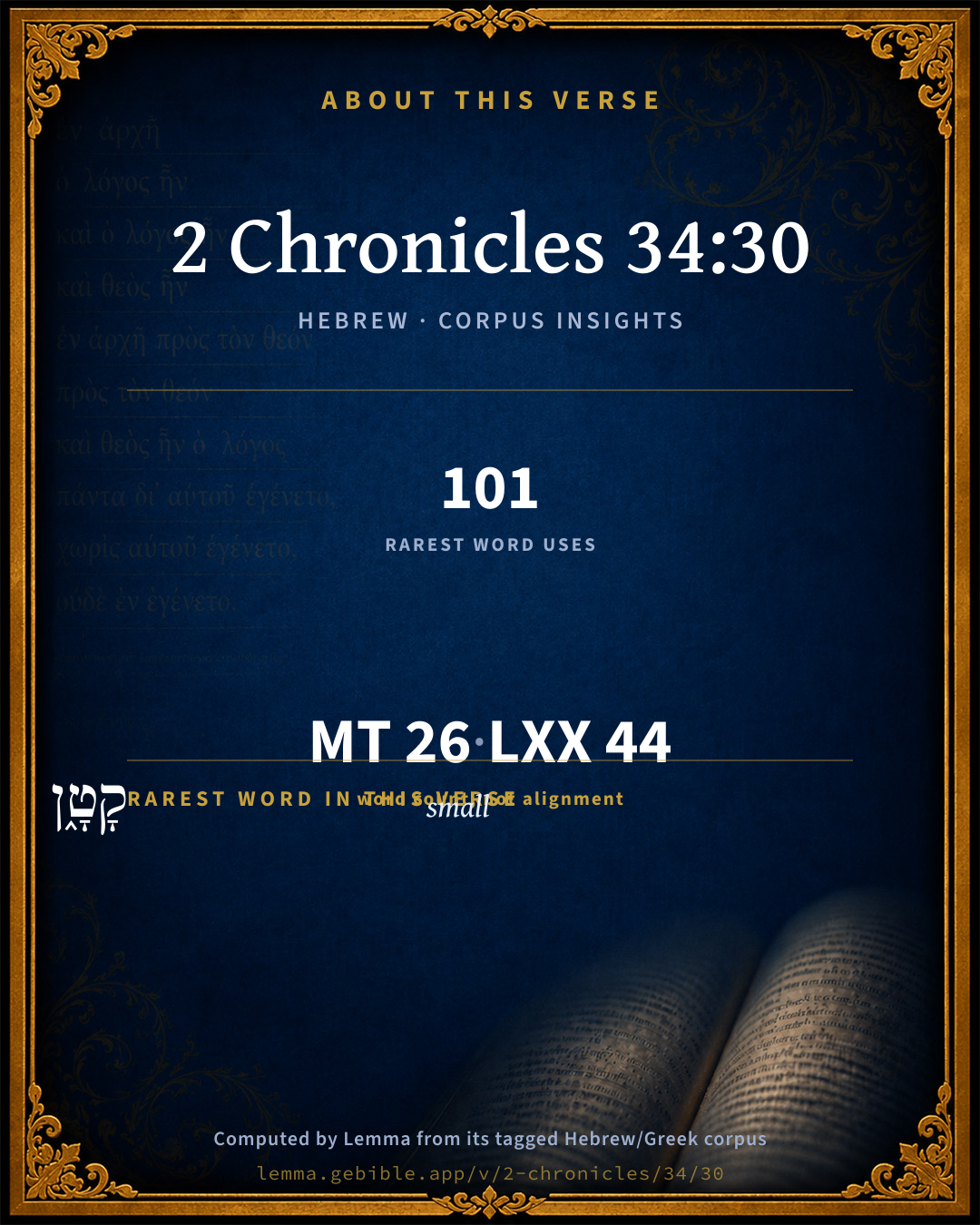
קָטָ֑ן
qâṭân
H6996
“small”
Adjective, Adjective, Masculine, Singular, Absolute
Part of Speech
Adjective
Type
Adjective
Gender
Masculine
Number
Singular
State
Absolute
Full BDB Definition

Origin: from H6962

TWOT: 2009a , 2009b

young, small, insignificant, unimportant - small - insignificant - young - unimportant
  1. וַיַּ֣עַל ʻâlâh H5927 “and · to go up” Conjunction + Verb, Qal, Sequential Imperfect, 3rd Person, Masculine, Singular
  2. הַמֶּ֣לֶךְ melek H4428 “the · king” Particle, Definite Article + Noun, Common, Masculine, Singular, Absolute
  3. בֵּית bayith H1004 “house of” Noun, Common, Masculine, Singular, Construct
  4. יְ֠הוָה Yᵉhôvâh H3068 “LORD” Noun, Proper
  5. וְכָל kôl H3605 “and · all of” Conjunction + Noun, Common, Masculine, Singular, Construct
  6. אִ֨ישׁ ʼîysh H376 “man of” Noun, Common, Masculine, Singular, Construct
  7. יְהוּדָ֜ה Yᵉhûwdâh H3063 “Judah” Noun, Proper
  8. וְיֹשְׁבֵ֣י yâshab H3427 “and · dwelling” Conjunction + Verb, Qal, Participle Active, Masculine, Plural, Construct
  9. יְרוּשָׁלִַ֗ם Yᵉrûwshâlaim H3389 “Jerusalem” Noun, Proper
  10. וְהַכֹּֽהֲנִים֙ kôhên H3548 “and · the · priests” Conjunction + Particle, Definite Article + Noun, Common, Masculine, Plural, Absolute
  11. וְהַלְוִיִּ֔ם Lêvîyîy H3881 “and · the · Levites” Conjunction + Particle, Definite Article + Noun, Gentilic, Masculine, Plural, Absolute
  12. וְכָל kôl H3605 “and · all of” Conjunction + Noun, Common, Masculine, Singular, Construct
  13. הָעָ֖ם ʻam H5971 “the · people” Particle, Definite Article + Noun, Common, Masculine, Singular, Absolute
  14. מִגָּד֣וֹל gâdôwl H1419 “from · great” Preposition + Adjective, Adjective, Masculine, Singular, Absolute
  15. וְעַד ʻad H5704 “and · until” Conjunction + Preposition
  16. וַיִּקְרָ֣א qârâʼ H7121 “and · to call” Conjunction + Verb, Qal, Sequential Imperfect, 3rd Person, Masculine, Singular
  17. בְאָזְנֵיהֶ֗ם ʼôzen H241 “in/at · ears · their” Preposition + Noun, Common, Feminine, Dual, Construct + Suffix, Personal, 3rd Person, Masculine, Plural
  18. אֶת ʼêth H853 “-” Particle, Direct Object
  19. כָּל kôl H3605 “all of” Noun, Common, Masculine, Singular, Construct
  20. דִּבְרֵי֙ dâbâr H1697 “words of” Noun, Common, Masculine, Plural, Construct
  21. סֵ֣פֶר çêpher H5612 “book of” Noun, Common, Masculine, Singular, Construct
  22. הַבְּרִ֔ית bᵉrîyth H1285 “the · covenant” Particle, Definite Article + Noun, Common, Feminine, Singular, Absolute
  23. הַנִּמְצָ֖א mâtsâʼ H4672 “the · finding” Particle, Definite Article + Verb, Niphal, Participle Active, Masculine, Singular, Absolute
  24. בֵּ֥ית bayith H1004 “house of” Noun, Common, Masculine, Singular, Construct
  25. יְהוָֽה Yᵉhôvâh H3068 “LORD” Noun, Proper

About this verse

These counts appear in no published source. They are computed here, from the morphology-tagged text and Lemma’s own curated glosses. What Lemma adds →

26
words
22
distinct lemmas
Historical
section

Grammatical profile

  • 4 verbs
  • 18 nouns
  • 2 adjectives
  • 1 preposition
  • 1 particle

Verb forms

  • וַיַּ֣עַל Qal · Sequential Imperfect
  • וְיֹשְׁבֵ֣י Qal · Participle Active
  • וַיִּקְרָ֣א Qal · Sequential Imperfect
  • הַנִּמְצָ֖א Niphal · Participle Active

Repetition

Words recur within this verse — often emphatic in Hebrew:

  • וְכָל all H3605 ×3
  • בֵּית house H1004 ×2
  • יְ֠הוָה LORD H3068 ×2

Hebrew & Septuagint length

In English translation the verse runs 57 words from the Hebrew and 57 from the Septuagint (LXX English) — the same length.

A rough comparison of the two English renderings, which tokenize alike — not a word-level alignment.

Word counts can differ between the Hebrew and the Greek without any difference in meaning — e.g. the Hebrew direct-object marker אֵת has no separate Greek word, and Greek often adds the article ὁ.

In the original languages it is 26 Hebrew tokens and 44 Greek tokens — but the two are counted differently (Hebrew bundles its prefixes and suffixes into one token; the Greek is in lemma form), so that isn’t a like-for-like length.

Cross-references

17

Topical passages linked to 2 Chronicles 34:30 in the Treasury of Scripture Knowledge — connected by theme and wording, ordered by reader-vote popularity; previews shown in the World English Bible.

  • Exodus 24:7 He took the book of the covenant and read it in the hearing of the people, and they said, "All that Yahweh has spoken will we do, and be obedient."
  • 2 Kings 23:2 The king went up to the house of Yahweh, and all the men of Judah and all the inhabitants of Jerusalem with him, and the priests, and the prophets, and all the people, both small and great: and he read in their ears all the words of the book of the covenant which was found in the house of Yahweh.
  • Deuteronomy 1:17 You shall not show partiality in judgment; you shall hear the small and the great alike; you shall not be afraid of the face of man; for the judgment is God's: and the cause that is too hard for you, you shall bring to me, and I will hear it.
  • Deuteronomy 17:18–20 It shall be, when he sits on the throne of his kingdom, that he shall write him a copy of this law in a book, out of [that which is] before the priests the Levites:
  • 2 Kings 23:21 The king commanded all the people, saying, Keep the Passover to Yahweh your God, as it is written in this book of the covenant.
  • 2 Chronicles 6:1–11 Then spoke Solomon, Yahweh has said that he would dwell in the thick darkness.
  • 2 Chronicles 15:12–13 They entered into the covenant to seek Yahweh, the God of their fathers, with all their heart and with all their soul;
  • 2 Chronicles 17:7–9 Also in the third year of his reign he sent his princes, even Ben Hail, and Obadiah, and Zechariah, and Nethanel, and Micaiah, to teach in the cities of Judah;
  • 2 Chronicles 18:30 Now the king of Syria had commanded the captains of his chariots, saying, Fight neither with small nor great, save only with the king of Israel.
  • 2 Chronicles 34:15 Hilkiah answered Shaphan the scribe, I have found the book of the law in the house of Yahweh. Hilkiah delivered the book to Shaphan.
  • 2 Chronicles 34:18–19 Shaphan the scribe told the king, saying, Hilkiah the priest has delivered me a book. Shaphan read therein before the king.
  • 2 Chronicles 34:24 Thus says Yahweh, Behold, I will bring evil on this place, and on the inhabitants of it, even all the curses that are written in the book which they have read before the king of Judah.
  • Nehemiah 8:1–5 All the people gathered themselves together as one man into the broad place that was before the water gate; and they spoke to Ezra the scribe to bring the book of the law of Moses, which Yahweh had commanded to Israel.
  • Jeremiah 31:31–32 Behold, the days come, says Yahweh, that I will make a new covenant with the house of Israel, and with the house of Judah:
  • Job 3:19 The small and the great are there. The servant is free from his master.
  • Ecclesiastes 1:12 I, the Preacher, was king over Israel in Jerusalem.
  • Ecclesiastes 12:9–10 Further, because the Preacher was wise, he still taught the people knowledge. Yes, he pondered, sought out, and set in order many proverbs.

Cross-references courtesy of OpenBible.info (CC BY 4.0).

Hebrew and Greek witnesses Masoretic Hebrew ↔ Greek Septuagint

The same verse in the two great witnesses to the Old Testament, shown verse-for-verse.

These are two independent witnesses, not word-aligned to each other, and the Septuagint is shown in lemma (dictionary) form.

Hebrew 2 Chronicles 34:30 Masoretic · Westminster Leningrad Codex

וַיַּ֣עַל הַמֶּ֣לֶךְ בֵּית יְ֠הוָה וְכָל אִ֨ישׁ יְהוּדָ֜ה וְיֹשְׁבֵ֣י יְרוּשָׁלִַ֗ם וְהַכֹּֽהֲנִים֙ וְהַלְוִיִּ֔ם וְכָל הָעָ֖ם מִגָּד֣וֹל וְעַד קָטָ֑ן וַיִּקְרָ֣א בְאָזְנֵיהֶ֗ם אֶת כָּל דִּבְרֵי֙ סֵ֣פֶר הַבְּרִ֔ית הַנִּמְצָ֖א בֵּ֥ית יְהוָֽה

The king went up to the house of Yahweh, and all the men of Judah and the inhabitants of Jerusalem, and the priests, and the Levites, and all the people, both great and small: and he read in their ears all the words of the book of the covenant that was found in the house of Yahweh.

World English Bible · Public Domain

Greek LXX 2 Chronicles 34:30 Septuagint · lemma form

καί ἀναβαίνω ὁ βασιλεύς εἰς οἶκος κύριος καί πᾶς ἰουδά καί ὁ καταοἰκέω ἰερουσαλήμ καί ὁ ἱερεύς καί ὁ λευείτης καί πᾶς ὁ λαός ἀπό μέγας ἕως μικρός καί ἀναγιγνώσκω ἐν οὖς αὐτός ὁ πᾶς λόγος βιβλίον ὁ διαθήκη ὁ εὑρίσκω ἐν οἶκος κύριος

And the king went up to the house of the Lord, he and all Juda, and the inhabitants of Jerusalem, and the priests, and the Levites, and all the people great and small: and he read in their ears all the words of the book of the covenant that were found in the house of the Lord.

LXX2012 (modern English Septuagint) · Public Domain

Hebrew: Westminster Leningrad Codex (CC BY 4.0). Greek: Septuagint (public domain); English from LXX2012 (modern English Septuagint) (Public Domain). How the Septuagint differs from the Hebrew →

Commentary

Notes on 2 Chronicles 34:30 from classic Christian and Jewish commentators (each source and its license shown beneath its notes). The classic Christian expositions comment on the surrounding passage and are grouped to its opening verse, so a note may address several verses; the Jewish commentaries on the Tanakh (Rashi and others) are per-verse, so they appear only where the commentator wrote on this verse.

Lemma curates 59 commentaries, every one of them public domain or Creative Commons licensed, each selected and text-cleaned for this edition rather than reprinted as found. About our sources →

Geneva Bible (1599)

Geneva Bible translators

Forasmuch as neither young nor old could be exempted from the curses contained therein, if they did transgress, he knew it pertained to all, and was his duty to see it read to all sorts, that everyone might learn to avoid those punishments by serving God aright.

Geneva Bible (1599) marginal notes — public domain. Text via Bolls.life.

Adam Clarke's Commentary

Verse 30. The king went] See on 2Kg 23:1.

Adam Clarke's Commentary on the Bible (1810–1826) — public domain. Text from a community e-Sword/MySword module.

Ellicott's Commentary for English Readers

(30) The Levites.—The chronicler substituted this for “the prophets” (Kings). It was a natural change to make, seeing that the prophetic order had long been extinct in his day. It may even be the result of an unconscious error, as the phrase “priests and Levites” is so frequent in his pages.

A Bible Commentary for English Readers, edited by Charles John Ellicott (1878–1897) — public domain. Text from a community e-Sword module.

The Cambridge Bible for Schools and Colleges

gen. ed. J. J. S. Perowne

30. the Levites] In 2 Kin. “the prophets.”

The Cambridge Bible for Schools and Colleges (gen. ed. J. J. S. Perowne; Cambridge University Press, 1878–1918) — public domain. Text from a community e-Sword module.

Albert Barnes' Notes on the Bible

The writer has characteristically substituted “Levites” for the “prophets” of 2Ki 23:2. No doubt Josiah was accompanied by priests, prophets, and Levites, but the writer of Kings thought it enough to mention the two former, and merged the Levites in the mass of the people. The writer of Chronicles, on the other hand, thinks the presence of Levites too important to he omitted, and as the prophets could be but few in number, passes them over.

Albert Barnes' Notes on the Bible (1834–1885) — public domain. Text from a community e-Sword/MySword module.

The Pulpit Commentary

The Levites. The parallel mentions "prophets" and omits "Levites," which latter our compiler is safe not to forget. When it is said in this verse, he read, the meaning, of course, is "the priests" read. (Deu_31:9)

The value of the Bible.

I THE BIBLE LOST. An unspeakable calamity.

1. To literature. Remark on the indebtedness of modern literature to the Bible.

2. To religion. Without the support and quickening derived from Scripture religion would speedily become languid.

3. To morality. Contrast in respect of morality countries possessing and countries lacking the Bible.

II THE BIBLE FOUND. A great mercy. More to be prized than the discovery of gold-mines, which can only contribute to man"s material wealth, or even of rare manuscripts by human authors, which enrich chiefly the intellect, the finding of the Bible by an individual or a nation for the first time, or the recovery of it after it has been for some time lost, is:

1. An occasion of great joy, and is usually felt to be such. Witness the gladness of Luther at finding the Bible in the convent at Erfurth. And ought to be:

2. A reason for special thankfulness, as it generally is to all who know its value as a revelation of Divine wisdom and love, and can appreciate its power to influence the hearts and lives of men.

III THE BIBLE READ. A blessed privilege.

1. Many might read the Bible who do not have it. A sad deprivation. This the case of the heathen generally and of numbers at home. An argument for missions.

2. Many have the Bible, yet do not read it. A grievous sin. This the case with thousands in Christendom to whom God"s Word is a strange book. An argument for preaching.

3. Many have the Bible, but cannot read it. A pitiful condition. This the case of those who through defective education or blindness are unable to read. An argument for Christian philanthropy.

4. Many have the Bible and read it. A happy experience. This the case of those who have learnt to recognize in the Bible God"s Word, and to appreciate its suitability to their soul"s needs. An argument for the inspiration of the Scriptures.

IV THE BIBLE OBEYED. An indispensable duty.

1. Obedience the end and aim of the Bible. The Bible not written for information merely, but for direction also. Designed not simply for the construction of creeds, but likewise for the regulation of conduct (Mat_6:24; Jam_1:22)

2. Obedience the only homage acceptable to the Bible. To read it, admire its literary beauty, study its theology, extol its excellences, circulate it, are good if these acts are accompanied by obedience, but if not they are comparatively worthless.

3. Obedience the best witness to the Divinity of the Bible. "If any man will do his will, he shall know of the doctrine, whether it be of God". (Joh_7:17) Those who know the Bible best, by giving practical obedience to its precepts are most fully convinced of its heavenly and supernatural origin.

4. Obedience the necessary means for obtaining the blessing of the Bible. Not the hearers of the Word, but the doers thereof, are justified before W. (Mat_7:21; Luk_11:28; (Rom_2:13)

The Pulpit Commentary (1880–1919), ed. H.D.M. Spence-Jones & Joseph S. Exell — public domain. Text from a community e-Sword module.

Rashi

Rabbi Shlomo Yitzchaki (Rashi)

the Scroll of the Covenant All the fright that the king experienced was due to the words (Deut. 28: 36): “The Lord will lead you,” and he saw that the Torah called it a covenant: “These are the words of the covenant.” Therefore, he too enacted a covenant and saw written immediately following it (ibid. 29:8): “And you shall keep the words, etc., and practice them.” Josiah also saw written immediately following (ibid. verses 9ff.): “You are standing today, all of you, etc....your children, your wives...that you should pass into the covenant...enacts with you today.” He said, “In such a manner, I too shall enact a covenant, for there it is written: ‘You are standing, etc.’ I too [will do so], ‘And he caused all those found in Jerusalem, both small and great, to stand.’”

Rashi on the Tanakh — English translations: “The Judaica Press complete Tanach with Rashi, translated by A. J. Rosenberg” (CC BY 4.0); “Pentateuch with Rashi's commentary by M. Rosenbaum and A.M. Silbermann, 1929-1934” (public domain); “The Metsudah Tanach series, Lakewood, N.J” (CC BY 4.0); and “The Book of Joshua, Metsudah Publications, 1997” (CC BY 4.0). Text via Sefaria.

Lesson kit

Teaching starters — assembled from the data on this page, not authored interpretation. Every prompt links to the verse data it draws on. Edit before teaching.

2 Chronicles, in the Historical, opens this verse with 26 words (22 distinct Hebrew lemmas). Its most distinctive word is qâṭân (“small”). A historical commentator’s framing appears above. Read the whole chapter for the surrounding context.

Discussion questions

  1. How does “small” (qâṭân) shape what this verse is saying?
  2. Exodus 24:7 shares this passage’s theme. How do the two illuminate each other?
  3. “all” occurs 3× in this one verse. What is the effect of the repetition?
  4. These translations render this verse differently; the difference is in the English rendering, not the original. What questions does that raise?
  5. The verb «וַיַּ֣עַל» is Qal Sequential Imperfect. How does its form color the action?
  6. Reading how Geneva Bible (1599) and Adam Clarke's Commentary read this verse, where do the two commentators agree and where do they part?

Things to notice

Reading settings

Reading text

Shown beneath each verse's original-language words.

Old Testament
Old Testament edition

Read the OT as the Masoretic Hebrew (MT) or the Greek Septuagint (LXX).

English shown for the Greek Septuagint (in the Hebrew ↔ Greek comparison).

Comparing translations? Open the Compare panel on any verse page to stack up to four side by side.