
Nehemiah 1:3

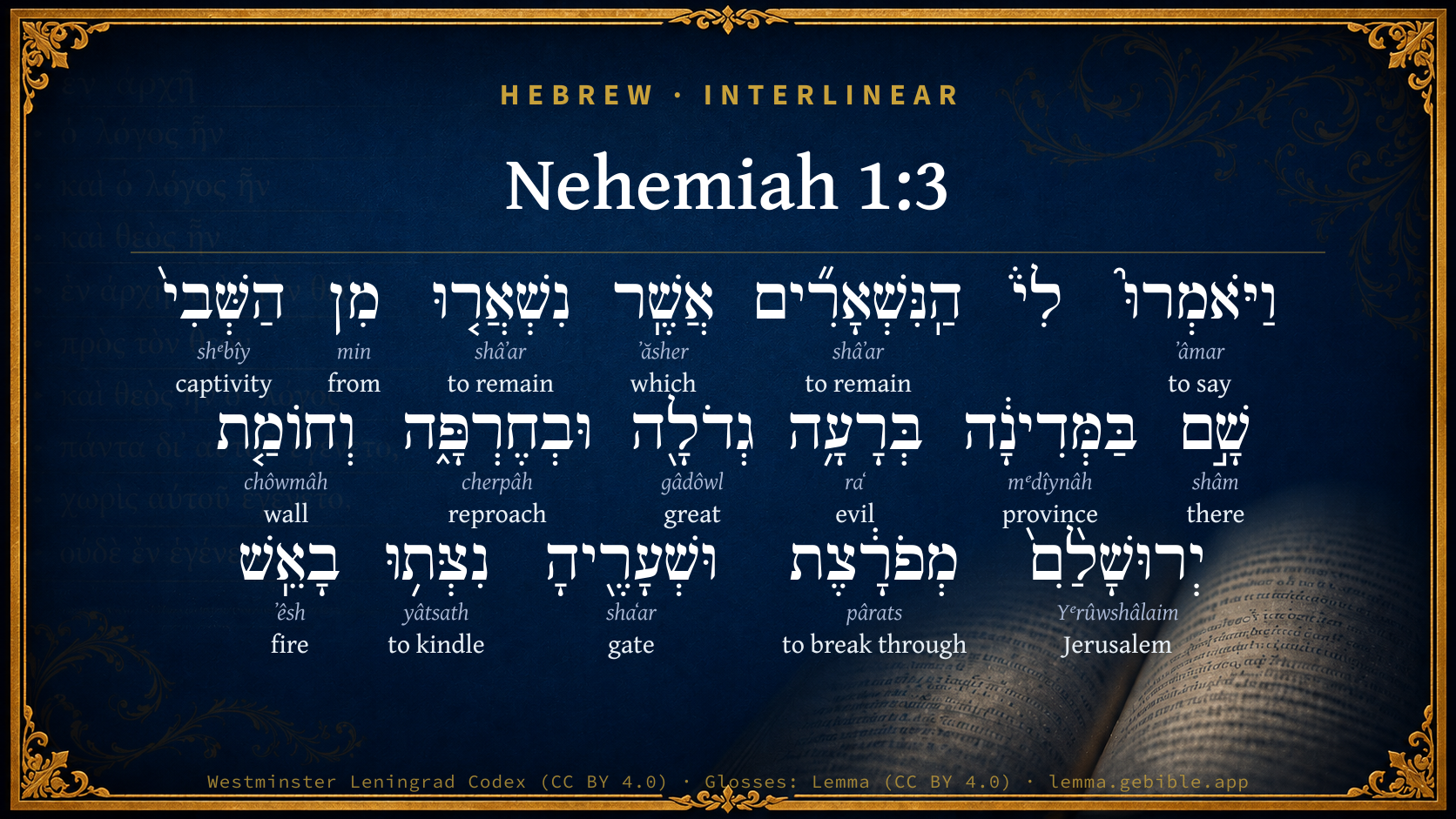
Hebrew (Westminster Leningrad Codex) Nehemiah 1:3 appears in the Hebrew Old Testament. The text above is from the Westminster Leningrad Codex. Each word links to its Strong’s number, a concise gloss, and parsing drawn from the Open Scriptures Hebrew Bible morphology. Click any word for its full Brown-Driver-Briggs (BDB) entry.
Download image
Cite this verse

Nehemiah 1:3 (World English Bible). Public Domain. Lemma interlinear Bible study tool, https://lemma.gebible.app/v/nehemiah/1/3.

Show BibTeX & RIS
BibTeX
RIS
English Translation
They said to me, The remnant who are left of the captivity there in the province are in great affliction and reproach: the wall of Jerusalem also is broken down, and the gates of it are burned with fire.
World English Bible · Public Domain
Download a study sheet

One document with this verse’s original text, its word-by-word gloss line, the meaning frame, cross-references with their text, attributed commentary, and full source and license credits — printable, and it pastes into notes with its structure intact.

This verse Autodidact and up

Study sheet (.html) Plain text (.txt)

A passage Seminary Student

Up to 50 verses in one chapter. A passage sheet keeps up to 6 commentary sources and 12 cross-references per verse, in the order this page ranks them, and says so on the sheet whenever that leaves anything out. Ask for a single verse and you get the Autodidact verse sheet above.

Everything on this page stays free to read, with no account — the sheet is a download of what is already on screen, not access to it.

Want to remove ads? Support Godless Engineer
Compare translations 3

The same verse in 3 English versions, stacked beneath the original-language interlinear above. Click any original word for its lexicon entry.

Each is an independent rendering of the whole verse — the interlinear is not word-aligned to these translations.

Highlighted words mark where these versions differ — a whole-verse word diff, not a word-by-word alignment.

  • World English Bible Public Domain
    They said to me, The remnant who are left of the captivity there in the province are in great affliction and reproach: the wall of Jerusalem also is broken down, and the gates of it are burned with fire.
  • King James Version Public Domain
    And they said unto me, The remnant that are left of the captivity there in the province are in great affliction and reproach: the wall of Jerusalem also is broken down, and the gates thereof are burned with fire.
  • unfoldingWord Literal Text CC BY-SA 4.0
    And they said to me, “The ones left behind, who were left behind from the captivity there in the province, are in great evil and in reproach. And the wall of Jerusalem is broken down, and its gates have been burned with fire.”

unfoldingWord Literal Text — © unfoldingWord, licensed CC BY-SA 4.0. Word-aligned USFM3 via Door43 (git.door43.org/unfoldingWord/en_ult).

Versions to compare (up to 4)

3 of 4 selected

Show all 18 translations

Every available English version of this verse, each an independent rendering of the whole verse.

  • World English Bible Public Domain
    They said to me, The remnant who are left of the captivity there in the province are in great affliction and reproach: the wall of Jerusalem also is broken down, and the gates of it are burned with fire.
  • Berean Standard Bible Public Domain
    And they told me, “The remnant who survived the exile are there in the province, in great trouble and disgrace. The wall of Jerusalem is broken down, and its gates are burned with fire.”
  • Majority Standard Bible Public Domain
    And they told me, “The remnant who survived the exile are there in the province, in great trouble and disgrace. The wall of Jerusalem is broken down, and its gates have been burned with fire.”
  • King James Version Public Domain
    And they said unto me, The remnant that are left of the captivity there in the province are in great affliction and reproach: the wall of Jerusalem also is broken down, and the gates thereof are burned with fire.
  • American Standard Version (1901) Public Domain
    And they said unto me, The remnant that are left of the captivity there in the province are in great affliction and reproach: the wall of Jerusalem also is broken down, and the gates thereof are burned with fire.
  • Revised Version (1885) Public Domain
    And they said unto me, The remnant that are left of the captivity there in the province are in great affliction and reproach: the wall of Jerusalem also is broken down, and the gates thereof are burned with fire.
  • Geneva Bible (1599) Public Domain
    And they sayde vnto me, The residue that are left of the captiuitie there in the prouince, are in great affliction and in reproche, and the wall of Ierusalem is broken downe, and the gates thereof are burnt with fire.
  • Douay-Rheims (1899) Public Domain
    And they said to me: They that have remained, and are left of the captivity there in the province, are in great affliction, and reproach: and the wall of Jerusalem is broken down, and the gates thereof are burnt with fire.
  • Young's Literal Translation Public Domain
    and they say to me, `Those left, who have been left of the captivity there in the province, `are' in great evil, and in reproach, and the wall of Jerusalem is broken down, and its gates have been burnt with fire.'
  • Literal Standard Version CC BY-SA 4.0
    and they say to me, “Those left, who have been left of the captivity there in the province, [are] in great evil, and in reproach, and the wall of Jerusalem is broken down, and its gates have been burned with fire.”
  • Unlocked Literal Bible CC BY-SA 4.0
    They said to me, “Those in the province who survived the captivity are in great trouble and disgrace because the wall of Jerusalem has been broken open, and its gates have been set on fire.”
  • unfoldingWord Literal Text CC BY-SA 4.0
    And they said to me, “The ones left behind, who were left behind from the captivity there in the province, are in great evil and in reproach. And the wall of Jerusalem is broken down, and its gates have been burned with fire.”
  • Darby Bible Public Domain
    And they said to me, Those who remain, that are left of the captivity there in the province, are in great affliction and reproach; and the wall of Jerusalem is in ruins, and its gates are burned with fire.
  • World Messianic Bible Public Domain
    They said to me, “The remnant who are left of the captivity there in the province are in great affliction and reproach. The wall of Jerusalem is also broken down, and its gates are burned with fire.”
  • Webster's Bible Public Domain
    And they said to me, The remnant that are left of the captivity there in the province are in great affliction and reproach: the wall of Jerusalem also is broken down, and its gates are burned with fire.
  • Free Bible Version CC BY-SA 4.0
    They told me, “The remnant who are left from the exile are there in the province, but they are having a great deal of trouble and feel humiliated. Jerusalem's walls have been knocked over, and its gates burned down.”
  • Bible in Basic English Public Domain
    They said to me, The small band of Jews now living there in the land are in great trouble and shame: the wall of Jerusalem has been broken down, and its doorways burned with fire.
  • JPS Tanakh (1917) Public Domain
    And they said unto me: 'The remnant that are left of the captivity there in the province are in great affliction and reproach; the wall of Jerusalem also is broken down, and the gates thereof are burned with fire.'

Literal Standard Version (2020), Covenant Press — licensed CC BY-SA 4.0. Text via the HelloAO Bible API (eBible.org). Unlocked Literal Bible (unfoldingWord) — licensed CC BY-SA 4.0. Text via the HelloAO Bible API (eBible.org). unfoldingWord Literal Text — © unfoldingWord, licensed CC BY-SA 4.0. Word-aligned USFM3 via Door43 (git.door43.org/unfoldingWord/en_ult). Free Bible Version, Dr. Jonathan Gallagher — licensed CC BY-SA 4.0. Text via the HelloAO Bible API (eBible.org).

Word by word

More ways to search: Search by grammar → Find every occurrence → Compare this word →

Practice this passage: Drill this verse → Learn its vocabulary →

נִצְּת֥וּ
yâtsath
H3341
“to kindle”
Verb, Niphal, Perfect, 3rd Person, Common, Plural
Part of Speech
Verb
Stem
Niphal
Form
Perfect
Person
3rd Person
Gender
Common
Number
Plural
Full BDB Definition

Origin: a primitive root

TWOT: 899

to kindle, burn, set on fire - (Qal) to kindle - (Niphal) - to be kindled - to be left desolate - (Hiphil) to set on fire, kindle
  1. וַיֹּאמְרוּ֮ ʼâmar H559 “and · to say” Conjunction + Verb, Qal, Sequential Imperfect, 3rd Person, Masculine, Plural
  2. הַֽנִּשְׁאָרִ֞ים shâʼar H7604 “the · remaining” Particle, Definite Article + Verb, Niphal, Participle Active, Masculine, Plural, Absolute
  3. אֲשֶֽׁר ʼăsher H834 “which” Particle, Relative
  4. נִשְׁאֲר֤וּ shâʼar H7604 “to remain” Verb, Niphal, Perfect, 3rd Person, Common, Plural
  5. מִן min H4480 “from” Preposition
  6. הַשְּׁבִי֙ shᵉbîy H7628 “the · captivity” Particle, Definite Article + Noun, Common, Both, Singular, Absolute
  7. שָׁ֣ם shâm H8033 “there” Adverb
  8. בַּמְּדִינָ֔ה mᵉdîynâh H4082 “in/at the · province” Preposition, Determined + Noun, Common, Feminine, Singular, Absolute
  9. בְּרָעָ֥ה raʻ H7451 “in/at · evil” Preposition + Noun, Common, Feminine, Singular, Absolute
  10. גְדֹלָ֖ה gâdôwl H1419 “great” Adjective, Adjective, Feminine, Singular, Absolute
  11. וּבְחֶרְפָּ֑ה cherpâh H2781 “and · in/at · reproach” Conjunction + Preposition + Noun, Common, Feminine, Singular, Absolute
  12. וְחוֹמַ֤ת chôwmâh H2346 “and · wall of” Conjunction + Noun, Common, Feminine, Singular, Construct
  13. יְרוּשָׁלִַ֨ם֙ Yᵉrûwshâlaim H3389 “Jerusalem” Noun, Proper
  14. מְפֹרָ֔צֶת pârats H6555 “broken through” Verb, Pual, Participle Passive, Feminine, Singular, Absolute
  15. וּשְׁעָרֶ֖יהָ shaʻar H8179 “and · gates · her” Conjunction + Noun, Common, Masculine, Plural, Construct + Suffix, Personal, 3rd Person, Feminine, Singular
  16. בָאֵֽשׁ ʼêsh H784 “in/at the · fire” Preposition, Determined + Noun, Common, Both, Singular, Absolute

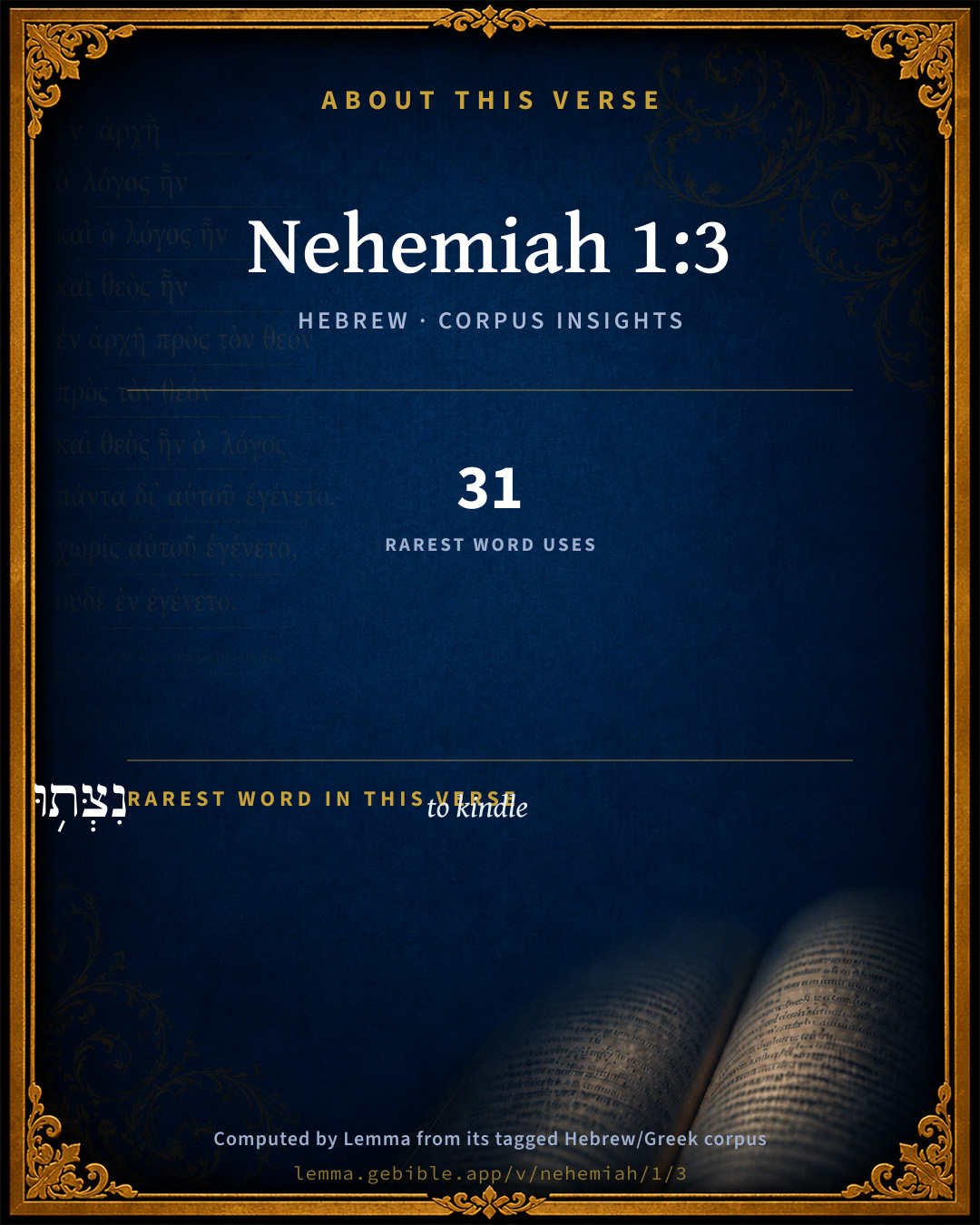
About this verse

These counts appear in no published source. They are computed here, from the morphology-tagged text and Lemma’s own curated glosses. What Lemma adds →

18
words
16
distinct lemmas
Historical
section

Shared distinctive vocabulary

נִצְּת֥וּ to kindle H3341 occurs in 28 verses of the Hebrew Bible. Also found in:

Grammatical profile

  • 5 verbs
  • 8 nouns
  • 1 adjective
  • 2 prepositions
  • 1 adverb
  • 1 particle

Verb forms

  • וַיֹּאמְרוּ֮ Qal · Sequential Imperfect
  • הַֽנִּשְׁאָרִ֞ים Niphal · Participle Active
  • נִשְׁאֲר֤וּ Niphal · Perfect
  • מְפֹרָ֔צֶת Pual · Participle Passive
  • נִצְּת֥וּ Niphal · Perfect

Repetition

A word recurs within this verse — often emphatic in Hebrew:

  • הַֽנִּשְׁאָרִ֞ים to remain H7604 ×2

Cross-references

28

Topical passages linked to Nehemiah 1:3 in the Treasury of Scripture Knowledge — connected by theme and wording, ordered by reader-vote popularity; previews shown in the World English Bible.

  • Nehemiah 2:17 Then said I to them, You see the evil case that we are in, how Jerusalem lies waste, and the gates of it are burned with fire: come, and let us build up the wall of Jerusalem, that we be no more a reproach.
  • 2 Kings 25:10 All the army of the Chaldeans, who were [with] the captain of the guard, broke down the walls of Jerusalem round about.
  • Ezra 5:8 Be it known to the king, that we went into the province of Judah, to the house of the great God, which is built with great stones, and timber is laid in the walls; and this work goes on with diligence and prospers in their hands.
  • Nehemiah 2:3 I said to the king, Let the king live forever: why should not my face be sad, when the city, the place of my fathers' tombs, lies waste, and the gates of it are consumed with fire?
  • Nehemiah 2:13 I went out by night by the valley gate, even toward the jackal's well, and to the dung gate, and viewed the walls of Jerusalem, which were broken down, and the gates of it were consumed with fire.
  • Nehemiah 7:6 These are the children of the province, who went up out of the captivity of those who had been carried away, whom Nebuchadnezzar the king of Babylon had carried away, and who returned to Jerusalem and to Judah, everyone to his city;
  • Nehemiah 9:36–37 Behold, we are servants this day, and as for the land that you gave to our fathers to eat the fruit of it and the good of it, behold, we are servants in it.
  • 1 Kings 9:7 then will I cut off Israel out of the land which I have given them; and this house, which I have made holy for my name, will I cast out of my sight; and Israel shall be a proverb and a byword among all peoples.
  • Ezra 2:1 Now these are the children of the province, who went up out of the captivity of those who had been carried away, whom Nebuchadnezzar the king of Babylon had carried away to Babylon, and who returned to Jerusalem and Judah, everyone to his city;
  • Nehemiah 11:3 Now these are the chiefs of the province who lived in Jerusalem: but in the cities of Judah lived everyone in his possession in their cities, [to wit], Israel, the priests, and the Levites, and the Nethinim, and the children of Solomon's servants.
  • Esther 1:1 Now it happened in the days of Ahasuerus (this is Ahasuerus who reigned from India even to Ethiopia, over one hundred twenty-seven provinces),
  • Psalms 44:11–14 You have made us like sheep for food, And have scattered us among the nations.
  • Psalms 79:4 We have become a reproach to our neighbors, A scoffing and derision to those who are around us.
  • Psalms 137:1–3 By the rivers of Babylon, there we sat down. Yes, we wept, when we remembered Zion.
  • Isaiah 5:5 Now I will tell you what I will do to my vineyard. I will take away its hedge, and it will be eaten up. I will break down its wall of it, and it will be trampled down.
  • Isaiah 32:9–14 Rise up, you women who are at ease, [and] hear my voice; you careless daughters, give ear to my speech.
  • Isaiah 43:28 Therefore I will profane the princes of the sanctuary; and I will make Jacob a curse, and Israel a reviling.
  • Isaiah 64:10–11 Your holy cities are become a wilderness, Zion is become a wilderness, Jerusalem a desolation.
  • Jeremiah 5:10 Go up on her walls, and destroy; but don't make a full end: take away her branches; for they are not Yahweh's.
  • Jeremiah 24:9 I will even give them up to be tossed back and forth among all the kingdoms of the earth for evil; to be a reproach and a proverb, a taunt and a curse, in all places where I shall drive them.
  • Jeremiah 29:18 I will pursue after them with the sword, with the famine, and with the pestilence, and will deliver them to be tossed back and forth among all the kingdoms of the earth, to be an object of horror, and an astonishment, and a hissing, and a reproach, among all the nations where I have driven them;
  • Jeremiah 39:8 The Chaldeans burned the king's house, and the houses of the people, with fire, and broke down the walls of Jerusalem.
  • Jeremiah 42:18 For thus says Yahweh of Hosts, the God of Israel: As my anger and my wrath has been poured forth on the inhabitants of Jerusalem, so shall my wrath be poured forth on you, when you shall enter into Egypt; and you shall be an object of horror, and an astonishment, and a curse, and a reproach; and you shall see this place no more.
  • Jeremiah 44:8–12 in that you provoke me to anger with the works of your hands, burning incense to other gods in the land of Egypt, where you are gone to sojourn; that you may be cut off, and that you may be a curse and a reproach among all the nations of the earth?
  • Jeremiah 52:14 All the army of the Chaldeans, who were with the captain of the guard, broke down all the walls of Jerusalem round about.
  • Lamentations 1:7 Jerusalem remembers in the days of her affliction and of her miseries all her pleasant things that were from the days of old: When her people fell into the hand of the adversary, and none did help her, The adversaries saw her, they did mock at her desolations.
  • Lamentations 3:61 You have heard their reproach, Yahweh, and all their devices against me,
  • Lamentations 5:1 Remember, Yahweh, what has come on us: Look, and see our reproach.

Cross-references courtesy of OpenBible.info (CC BY 4.0).

Hebrew and Greek witnesses Masoretic Hebrew ↔ Greek Septuagint

The same verse in the two great witnesses to the Old Testament, shown verse-for-verse.

These are two independent witnesses, not word-aligned to each other, and the Septuagint is shown in lemma (dictionary) form.

Hebrew Nehemiah 1:3 Masoretic · Westminster Leningrad Codex

וַיֹּאמְרוּ֮ לִי֒ הַֽנִּשְׁאָרִ֞ים אֲשֶֽׁר נִשְׁאֲר֤וּ מִן הַשְּׁבִי֙ שָׁ֣ם בַּמְּדִינָ֔ה בְּרָעָ֥ה גְדֹלָ֖ה וּבְחֶרְפָּ֑ה וְחוֹמַ֤ת יְרוּשָׁלִַ֨ם֙ מְפֹרָ֔צֶת וּשְׁעָרֶ֖יהָ נִצְּת֥וּ בָאֵֽשׁ

They said to me, The remnant who are left of the captivity there in the province are in great affliction and reproach: the wall of Jerusalem also is broken down, and the gates of it are burned with fire.

World English Bible · Public Domain

Greek LXX Structure differs

The Septuagint has no separate book of Nehemiah. Its Greek text is the second half of Esdras B (2 Esdras), chapters 11–23; Ezra is the first half (1–10).

A verse-for-verse comparison isn’t shown here because the chapters and verses don’t line up. Switch to the LXX edition with the MT / LXX toggle above to read the Greek directly.

Hebrew: Westminster Leningrad Codex (CC BY 4.0). Greek: Septuagint (public domain); English from a public-domain English Septuagint. How the Septuagint differs from the Hebrew →

Commentary

Notes on Nehemiah 1:3 from classic Christian and Jewish commentators (each source and its license shown beneath its notes). The classic Christian expositions comment on the surrounding passage and are grouped to its opening verse, so a note may address several verses; the Jewish commentaries on the Tanakh (Rashi and others) are per-verse, so they appear only where the commentator wrote on this verse.

Lemma curates 59 commentaries, every one of them public domain or Creative Commons licensed, each selected and text-cleaned for this edition rather than reprinted as found. About our sources →

Trapp's Complete Commentary

John Trapp

Neh 1:3 And they said unto me, The remnant that are left of the captivity there in the province [are] in great affliction and reproach: the wall of Jerusalem also [is] broken down, and the gates thereof are burned with fire.

Ver. 3. Are in great affliction and reproach] The Church is heir of the cross, saith Luther, Ecclesia est haeres crucis, and it was ever the portion of God’s people to be reproached, as David was by Doeg with devouring words, Psa 52:1. Their breath as fire shall devour you, Isa 33:11.

The wall of Jerusalem also is broken down] So that thieves and murderers came in, in the night, saith Comestor here, and slew many of them.

And the gates thereof are burnt with fire] They were burnt by the Chaldeans, and never yet repaired. And to keep a continual great watch was too great a charge and trouble.

John Trapp, A Commentary or Exposition upon All the Books of the Old and New Testament (1647–1656) — public domain. Text from a community e-Sword module.

Joseph Benson's Commentary

Neh 1:3. They said, The remnant that are left in the province — In Judea, which was now made a province under the Persian kings; are in great affliction and reproach — Despised and distressed by the neighbouring nations. The wall of Jerusalem also is broken down, &c. — The walls and gates continue as the Chaldeans left them after their conquest of the city, the Jews not being in a condition to rebuild them, nor having commission from the kings of Persia to do so, but only to build the temple, and their own private houses. This made their condition both very despicable, under the abiding marks of poverty and slavery, and very dangerous, for their enemies might, when they pleased, make an easy prey of them.

Joseph Benson's Commentary on the Old and New Testaments (1811–1818) — public domain. Text from a community e-Sword module.

Tyndale Open Study Notes

Tyndale Open Resources

1:3 The wall of Jerusalem has been torn down: This probably refers to a recent setback in Jerusalem (see Ezra 4:6-23), not to the Babylonian conquest in 586 BC. • disgrace: Foreigners could gloat about the destroyed city, using it as evidence that Israel’s God was too weak to protect it (cp. Joel 2:17; Mic 7:8-10).

Tyndale Open Study Notes — © Tyndale Open Resources, licensed CC BY-SA 4.0. Text via the HelloAO Bible API.

Geneva Bible (1599)

Geneva Bible translators

Meaning, in Judea.

Geneva Bible (1599) marginal notes — public domain. Text via Bolls.life.

Adam Clarke's Commentary

Verse 3. The wall of Jerusalem also is broken down] This must refer to the walls, which had been rebuilt after the people returned from their captivity: for it could not refer to the walls which were broken down and levelled with the dust by Nebuchadnezzar; for to hear of this could be no news to Nehemiah.

Adam Clarke's Commentary on the Bible (1810–1826) — public domain. Text from a community e-Sword/MySword module.

Ellicott's Commentary for English Readers

(3) And they said.—Nehemiah’s question and his friends answer refer first to the people and then to the city. As to the former the terms used have a deep pathos. Those who had returned to their country—now only the province—are, in the question, the Jews that had escaped; in the answer they are the Remnant that are left: both being from the captivity.

In great affliction and reproach.—In distress because of the contempt of the people around. All these expressions are familiar in the prophets; but they are united here in a peculiar and affecting combination. As to the city, the report is that the walls were still “broken down”: lying prostrate, with partial exceptions, as Nebuchadnezzar left them a hundred and forty-two years before (2Ki_25:10), and, moreover, what had not been recorded, “the gates thereof burned with fire.” Though the Temple had been rebuilt, there is no valid reason for supposing that. the walls of the city had been in part restored and again demolished.

A Bible Commentary for English Readers, edited by Charles John Ellicott (1878–1897) — public domain. Text from a community e-Sword module.

John Gill's Exposition

And they said unto me, the remnant that are left of the captivity there in the province,.... In Judea, now reduced to a province of the Persian empire:

are in great affliction and reproach; harassed and distressed, calumniated and vilified, by their enemies the Samaritans:

the wall of Jerusalem also is broken down, and the gates thereof are burnt with fire; that is, its wall and gates were in the same condition in which Nebuchadnezzar had left them, for since his times as yet they had never been set up; for this is not to be understood of what was lately done by their adversaries, which is not at all probable.

John Gill's Exposition of the Whole Bible (1746–1763) — public domain (CC PDM 1.0). Text via the HelloAO Bible API.

Albert Barnes' Notes on the Bible

The attempt to rebuild the wall in the time of the Pseudo-Smerdis Ezr 4:12-24 had been stopped. It still remained in ruins. The Assyrian sculptures show that it was the usual practice to burn the gates.

Albert Barnes' Notes on the Bible (1834–1885) — public domain. Text from a community e-Sword/MySword module.

Haydock's Catholic Bible Commentary

Province of Judea, subject to the Persians, as it was afterwards to the Romans; though, at present, they were allowed to have governors of their own nation. (Menochius) --- Reproach, on account of the surrounding enemies. (Haydock) --- Fire, recently; (Menochius. See 1 Esdras iv. 12., and xi. 9.) or rather by Nabuchodonosor; as the kings of Persia would not suffer the city to be fortified, for fear of a fresh rebellion. (Lyranus) (Tirinus) --- We find that little progress (chap. ii., and iv.; Calmet) had at least been made in the work, though the blame must rather be laid on the enemies of Israel, than on several of the kings of Persia, who seem to have authorized the undertaking, which Cambyses, or Smerdis, had for a time interrupted. They only specify, indeed, that leave was granted to build the temple. But they allowed them to erect houses for themselves, which could not have been done to any purpose, among so many enemies, unless they had been defended by some sort of fortifications. (Haydock)

George Leo Haydock (1774–1849), Haydock's Catholic Family Bible and Commentary, 1859 edition — public domain. Excludes Psalms (Douay-Rheims chapter numbering differs from Protestant) and Deuterocanonical books (Catholic canon only).

Matthew Poole's English Annotations

In the province, i.e. in Judea, which was now made a province under the Persian monarchs: See Poole "Ezr 5:8".

In great affliction and reproach; despised and distressed by the neighbouring nations.

The wall is broken down, and the gates thereof are burned, i.e. the walls and gates continue in the same woeful plight in which Nebuchadnezzar left them; the Jews not being yet in a condition to rebuild them, nor having commission from the kings of Persia to do so, but only to build the temple and their own private houses. And this made their enemies scorn them; who also would have ruined them, but for fear of offending the Persian king.

Matthew Poole's English Annotations on the Holy Bible (1683–1685) — public domain. Text from a community e-Sword/MySword module.

Whedon's Commentary on the Bible

Daniel D. Whedon

3. There in the province — The province of Judea. Comp. Ezr_5:8.

In great affliction and reproach — From the time of the arrival there of Zerubbabel and the first body of exiles until this date, the returned Jews had been vexed and troubled by neighbouring enemies — the descendants of the nations whom the eastern kings had settled in the cities of Samaria.

And though by the favour of the Persian kings they had succeeded in rebuilding the temple, they were still in a comparatively weak and helpless state, and their now implacable enemies, the Samaritans, would naturally take every opportunity that offered to trouble and distress them.

The wall… broken down, and the gates… burned — This partly explains their affliction and reproach. The returned exiles had never been able to rebuild the walls and gates of their loved city; and because they still remained in the ruined condition to which the Chaldean army had reduced them more than a century before, (2Ki_25:9-10,) it was a standing affliction and reproach to the Jews.

Some critics aver that this ruinous state of the wall and gates of Jerusalem must have been caused by some recent calamity — probably by those neighbouring heathen tribes whose daughters had been married to certain Jews, but had been lately put away by Ezra’s legislation, as described in Ezra 10. They urge that the destruction effected by Nebuchadnezzar’s army more than a hundred years before could have been no news to Nehemiah. But this, like the position of these same critics on the passage in Ezr_4:6-23, (where see notes,) lacks support in the Scripture history. If the walls of Jerusalem had ever been rebuilt since their destruction by Nebuchadnezzar, it is strange that no mention of it occurs in these histories. Their rebuilding by Nehemiah was considered of such importance that a considerable portion of this book is given to a description of it, and any previous work of the kind must have been of sufficient importance to demand, at least, a passing notice. But no such notice is found. The complaint of the Jews’ enemies in Ezr_4:12-16, that the returned exiles were building up the walls of the city, was, as we have shown in the notes there, a crafty misrepresentation, a perversion of the truth, for they were rebuilding the temple, not the city. A work of such importance as the rebuilding of the walls and gates of Jerusalem needs stronger evidence than that letter of the enemies of Judah, so manifestly given to misrepresentation, as the whole context shows.

It may not have been positively news to Nehemiah to be told that the walls and gates of Jerusalem were broken down and destroyed, but this fact was mentioned as showing the great cause or occasion of the affliction and reproach of the Jews at Jerusalem, and seems to have first suggested to Nehemiah the importance of having those walls and gates rebuilt. A work of such magnitude as the rebuilding of that ancient city, and especially of its defences, could not have been undertaken without express permission from the king, and no such permit had ever yet been granted since its destruction by the king of Babylon. The proclamations of Cyrus and Darius authorized only the rebuilding of the temple, and that any thing more than this had yet been attempted by the Jews is without proof.

Daniel D. Whedon (gen. ed.), Commentary on the Old and New Testaments (1874–1909) — public domain. Text from a community e-Sword module.

The Pulpit Commentary

The wall of Jerusalem also is broken down. It has been supposed, either that the demolition of the wall here referred to was quite recent, having occurred during the space of twelve years which intervenes between the Books of Ezra and Nehemiah, or else that it belonged to a time of depression which followed shortly after the completion of the temple by Zerubbabel (Ewald, "History of Israel," vol. 5. pp. 120, 121, and 148, note 3, E. Tr.); but there is really no reason to believe that the demolition effected under the orders of Nebuchadnezzar (2Ki_25:10) had ever hitherto been repaired, or the restoration of the wall even attempted. The Samaritan accusation in Ezr_4:12 falls short of a statement that the wall was restored, and, if it asserted the fact, would be insufficient authority for it. The supposition of Ewald, that "as soon as the city was rebuilt, the attempt would be made to fortify it" (p. 121, note 3), ignores the jealousy of the Persians and their power to step in and prevent a subject town from fortifying itself.

The Pulpit Commentary (1880–1919), ed. H.D.M. Spence-Jones & Joseph S. Exell — public domain. Text from a community e-Sword module.

John Wesley's Explanatory Notes

The province - In Judea, now a province under the Persian monarchs. The wall, &c. - The walls and gates continue as Nebuchadnezzar left them; the Jews not being in a condition to rebuild them, nor having commission from the kings of Persia to do so.

John Wesley, Explanatory Notes Upon the Whole Bible (1754–1765) — public domain. Text via the GEBible commentary corpus.

unfoldingWord translationNotes

Door43 World Missions Community

They said to me

Here "They" refers to Hanani and the other people who had come from Judah.

the province

Here "province" refers to Judah as an administrative district under the Persian Empire. AT: "the province of Judah" or "Judah" (See: Assumed Knowledge and Implicit Information)

the wall of Jerusalem has been broken open, and its gates have been set on fire

This can be stated in active form. AT: "armies have broken open the wall of Jerusalem and have set its gates on fire" (See: Active or Passive)

translationWords

captive

trouble

Jerusalem

gate

fire

unfoldingWord translationNotes — © Distant Shores Media and the Door43 World Missions Community, licensed CC BY-SA 4.0. Source: git.door43.org/Door43/en_tn.

Rashi

Rabbi Shlomo Yitzchaki (Rashi)

And they said to me They answered my first question first and my latter question last; first, concerning the Jews and afterwards, concerning the wall and the gates.

who remained Those Jews who remained in the province of Jerusalem are in great trouble and reproach because the gentiles plunder and pillage them.

and the wall of Jerusalem is breached And the wall of the city is breached, and the gates are burned with fire as they were before, for Israel had not built the wall of the city or its gates, only the Temple.

were burned Heb. נִצְתוּ, like נֻצְתוּ.

Rashi on the Tanakh — English translations: “The Judaica Press complete Tanach with Rashi, translated by A. J. Rosenberg” (CC BY 4.0); “Pentateuch with Rashi's commentary by M. Rosenbaum and A.M. Silbermann, 1929-1934” (public domain); “The Metsudah Tanach series, Lakewood, N.J” (CC BY 4.0); and “The Book of Joshua, Metsudah Publications, 1997” (CC BY 4.0). Text via Sefaria.

Lesson kit

Teaching starters — assembled from the data on this page, not authored interpretation. Every prompt links to the verse data it draws on. Edit before teaching.

Nehemiah, in the Historical, opens this verse with 18 words (16 distinct Hebrew lemmas). Its most distinctive word is yâtsath (“to kindle”). A historical commentator’s framing appears above. Read the whole chapter for the surrounding context.

Discussion questions

  1. The word yâtsath carries the sense “to kindle.” How does it shape the verse?
  2. How does Joshua 8:8, which shares the word «to kindle», read alongside this verse?
  3. What does the repetition of “to remain” (2× in this one verse) do in this verse?
  4. These translations render this verse differently. What is at stake in choosing one wording over another?
  5. «וַיֹּאמְרוּ֮» is a Qal Sequential Imperfect verb. How does that grammatical form shape the action described?
  6. Compare how Trapp's Complete Commentary and Joseph Benson's Commentary read this verse. Where do they agree or differ?

Things to notice

Reading settings

Reading text

Shown beneath each verse's original-language words.

Old Testament
Old Testament edition

Read the OT as the Masoretic Hebrew (MT) or the Greek Septuagint (LXX).

English shown for the Greek Septuagint (in the Hebrew ↔ Greek comparison).

Comparing translations? Open the Compare panel on any verse page to stack up to four side by side.