
Isaiah 27:13

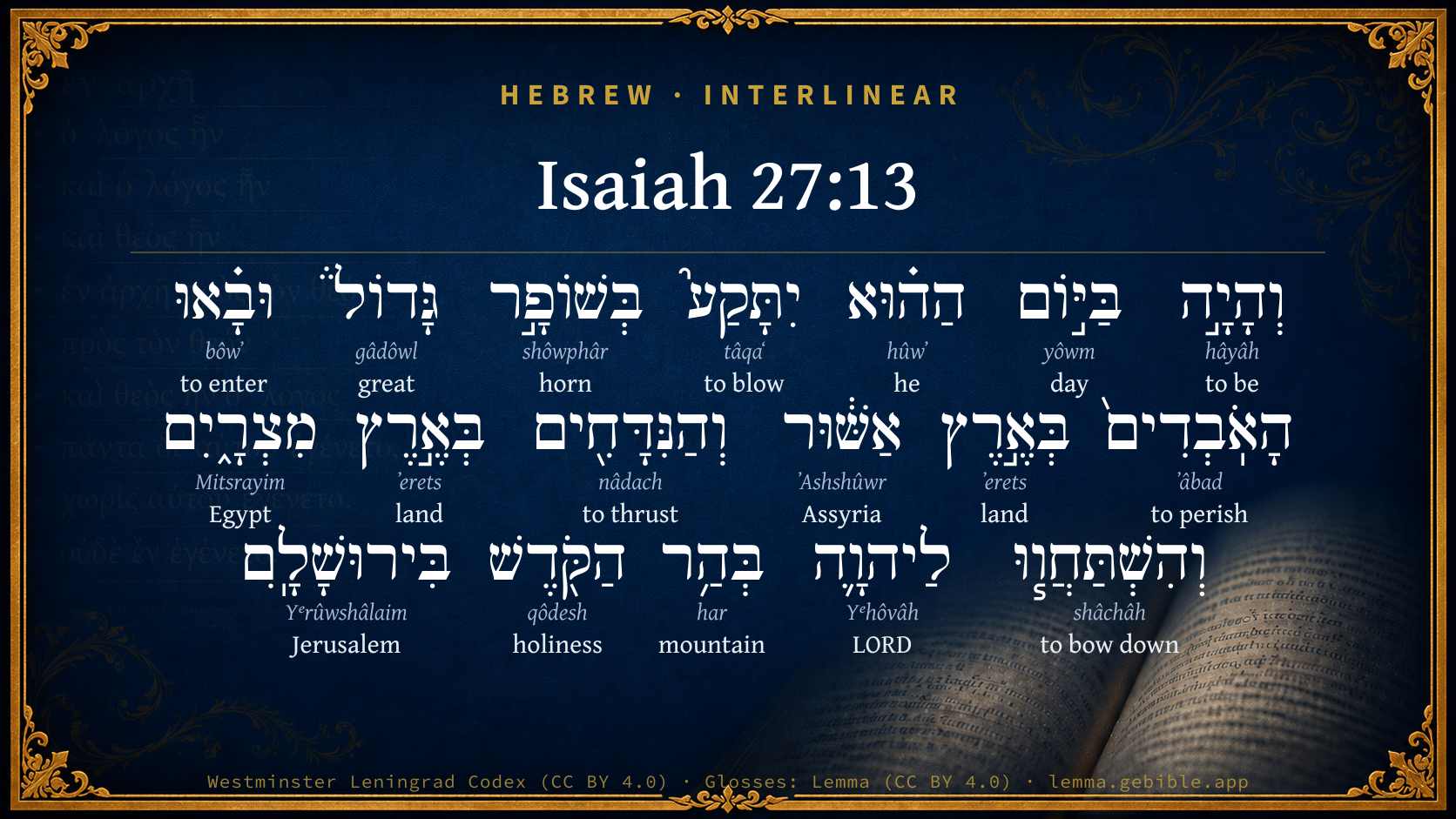
Hebrew (Westminster Leningrad Codex) Isaiah 27:13 appears in the Hebrew Old Testament. The text above is from the Westminster Leningrad Codex. Each word links to its Strong’s number, a concise gloss, and parsing drawn from the Open Scriptures Hebrew Bible morphology. Click any word for its full Brown-Driver-Briggs (BDB) entry.
Download image
Cite this verse

Isaiah 27:13 (World English Bible). Public Domain. Lemma interlinear Bible study tool, https://lemma.gebible.app/v/isaiah/27/13.

Show BibTeX & RIS
BibTeX
RIS
English Translation
It shall happen in that day, that a great trumpet shall be blown; and they shall come who were ready to perish in the land of Assyria, and those who were outcasts in the land of Egypt; and they shall worship Yahweh in the holy mountain at Jerusalem.
World English Bible · Public Domain
Download a study sheet

One document with this verse’s original text, its word-by-word gloss line, the meaning frame, cross-references with their text, attributed commentary, and full source and license credits — printable, and it pastes into notes with its structure intact.

This verse Autodidact and up

Study sheet (.html) Plain text (.txt)

A passage Seminary Student

Up to 50 verses in one chapter. A passage sheet keeps up to 6 commentary sources and 12 cross-references per verse, in the order this page ranks them, and says so on the sheet whenever that leaves anything out. Ask for a single verse and you get the Autodidact verse sheet above.

Everything on this page stays free to read, with no account — the sheet is a download of what is already on screen, not access to it.

Want to remove ads? Support Godless Engineer
Compare translations 3

The same verse in 3 English versions, stacked beneath the original-language interlinear above. Click any original word for its lexicon entry.

Each is an independent rendering of the whole verse — the interlinear is not word-aligned to these translations.

Highlighted words mark where these versions differ — a whole-verse word diff, not a word-by-word alignment.

  • World English Bible Public Domain
    It shall happen in that day, that a great trumpet shall be blown; and they shall come who were ready to perish in the land of Assyria, and those who were outcasts in the land of Egypt; and they shall worship Yahweh in the holy mountain at Jerusalem.
  • King James Version Public Domain
    And it shall come to pass in that day, that the great trumpet shall be blown, and they shall come which were ready to perish in the land of Assyria, and the outcasts in the land of Egypt, and shall worship the LORD in the holy mount at Jerusalem.
  • unfoldingWord Literal Text CC BY-SA 4.0
    And it will happen in that day, it will be blown upon a great shofar, and the perishing in the land of Assyria will come, and the banished in the land of Egypt, and they will bow down to Yahweh on the mountain of holiness in Jerusalem.

unfoldingWord Literal Text — © unfoldingWord, licensed CC BY-SA 4.0. Word-aligned USFM3 via Door43 (git.door43.org/unfoldingWord/en_ult).

Versions to compare (up to 4)

3 of 4 selected

Show all 18 translations

Every available English version of this verse, each an independent rendering of the whole verse.

  • World English Bible Public Domain
    It shall happen in that day, that a great trumpet shall be blown; and they shall come who were ready to perish in the land of Assyria, and those who were outcasts in the land of Egypt; and they shall worship Yahweh in the holy mountain at Jerusalem.
  • Berean Standard Bible Public Domain
    And in that day a great ram’s horn will sound, and those who were perishing in Assyria will come forth with those who were exiles in Egypt. And they will worship the LORD on the holy mountain in Jerusalem.
  • Majority Standard Bible Public Domain
    And in that day a great ram’s horn will sound, and those who were perishing in Assyria will come forth with those who were exiles in Egypt. And they will worship the LORD on the holy mountain in Jerusalem.
  • King James Version Public Domain
    And it shall come to pass in that day, that the great trumpet shall be blown, and they shall come which were ready to perish in the land of Assyria, and the outcasts in the land of Egypt, and shall worship the LORD in the holy mount at Jerusalem.
  • American Standard Version (1901) Public Domain
    And it shall come to pass in that day, that a great trumpet shall be blown; and they shall come that were ready to perish in the land of Assyria, and they that were outcasts in the land of Egypt; and they shall worship Jehovah in the holy mountain at Jerusalem.
  • Revised Version (1885) Public Domain
    And it shall come to pass in that day, that a great trumpet shall be blown; and they shall come which were ready to perish in the land of Assyria, and they that were outcasts in the land of Egypt; and they shall worship the LORD in the holy mountain at Jerusalem.
  • Geneva Bible (1599) Public Domain
    In that day also shall the great trumpet be blowen, and they shall come, which perished in the land of Asshur: and they that were chased into the lande of Egypt, and they shall worship the Lord in the holy Mount at Ierusalem.
  • Douay-Rheims (1899) Public Domain
    And it shall come to pass, that in that day a noise shall be made with a great trumpet, and they that were lost, shall come from the land of the Assyrians, and they that were outcasts in the land of Egypt, and they shall adore the Lord in the holy mount in Jerusalem.
  • Young's Literal Translation Public Domain
    And it hath come to pass, in that day, It is blown with a great trumpet, And come in have those perishing in the land of Asshur, And those cast out in the land of Egypt, And have bowed themselves to Jehovah, In the holy mount -- in Jerusalem!
  • Literal Standard Version CC BY-SA 4.0
    And it has come to pass in that day, || It is blown with a great horn, || And those perishing in the land of Asshur have come in, || And those cast out in the land of Egypt, || And have bowed themselves to YHWH, || In the holy mountain—in Jerusalem!
  • Unlocked Literal Bible CC BY-SA 4.0
    On that day a great trumpet will be blown; and the perishing ones in the land of Assyria will come, and the outcasts in the land of Egypt, they will worship Yahweh on the holy mountain in Jerusalem.
  • unfoldingWord Literal Text CC BY-SA 4.0
    And it will happen in that day, it will be blown upon a great shofar, and the perishing in the land of Assyria will come, and the banished in the land of Egypt, and they will bow down to Yahweh on the mountain of holiness in Jerusalem.
  • Darby Bible Public Domain
    And it shall come to pass in that day, [that] the great trumpet shall be blown; and they shall come that were perishing in the land of Assyria, and the outcasts in the land of Egypt, and they shall worship Jehovah in the holy mountain at Jerusalem.
  • World Messianic Bible Public Domain
    It will happen in that day that a great shofar will be blown; and those who were ready to perish in the land of Assyria, and those who were outcasts in the land of Egypt, shall come; and they will worship the LORD in the holy mountain at Jerusalem.
  • Webster's Bible Public Domain
    And it shall come to pass in that day, that the great trumpet shall be blown, and they shall come who were ready to perish in the land of Assyria, and the outcasts in the land of Egypt, and shall worship the LORD on the holy mount at Jerusalem.
  • Free Bible Version CC BY-SA 4.0
    At that time a loud trumpet will sound, and those who were dying in Assyria will return along with those exiled in Egypt. They will come and worship the Lord on the holy mountain in Jerusalem.
  • Bible in Basic English Public Domain
    And it will be in that day that a great horn will be sounded; and those who were wandering in the land of Assyria, and those who had been sent away into the land of Egypt, will come; and they will give worship to the Lord in the holy mountain at Jerusalem.
  • JPS Tanakh (1917) Public Domain
    And it shall come to pass in that day, that a great horn shall be blown; and they shall come that were lost in the land of Assyria, and they that were dispersed in the land of Egypt; and they shall worship the LORD in the holy mountain at Jerusalem.

Literal Standard Version (2020), Covenant Press — licensed CC BY-SA 4.0. Text via the HelloAO Bible API (eBible.org). Unlocked Literal Bible (unfoldingWord) — licensed CC BY-SA 4.0. Text via the HelloAO Bible API (eBible.org). unfoldingWord Literal Text — © unfoldingWord, licensed CC BY-SA 4.0. Word-aligned USFM3 via Door43 (git.door43.org/unfoldingWord/en_ult). Free Bible Version, Dr. Jonathan Gallagher — licensed CC BY-SA 4.0. Text via the HelloAO Bible API (eBible.org).

Word by word

More ways to search: Search by grammar → Find every occurrence → Compare this word →

Practice this passage: Drill this verse → Learn its vocabulary →

וְהַנִּדָּחִ֖ים
nâdach
H5080
“and · the · thrust”
Conjunction + Particle, Definite Article + Verb, Niphal, Participle Passive, Masculine, Plural, Absolute
Part of Speech
Conjunction + Particle + Verb
Stem
Niphal
Form
Participle Passive
Gender
Masculine
Number
Plural
State
Absolute
Full BDB Definition

Origin: a primitive root

TWOT: 1304

to impel, thrust, drive away, banish - (Qal) - to impel - to thrust away, banish - (Niphal) - to be impelled - to be thrust out, be banished - banished, outcast (participle) - to be driven away - to be thrust away, thrust aside - (Pual) to be thrust into - thrust (participle) - (Hiphil) - to thrust, move, impel - to thrust out, banish - to thrust away, thrust aside - (Hophal) to be chased, be hunted - chased, hunted (participle)
  1. וְהָיָ֣ה hâyâh H1961 “and · to be” Conjunction + Verb, Qal, Sequential Perfect, 3rd Person, Masculine, Singular
  2. בַּיּ֣וֹם yôwm H3117 “in/at the · day” Preposition, Determined + Noun, Common, Masculine, Singular, Absolute
  3. הַה֗וּא hûwʼ H1931 “the · he” Particle, Definite Article + Pronoun, Personal, 3rd Person, Masculine, Singular
  4. יִתָּקַע֮ tâqaʻ H8628 “to blow” Verb, Niphal, Imperfect, 3rd Person, Masculine, Singular
  5. בְּשׁוֹפָ֣ר shôwphâr H7782 “in/at · horn” Preposition + Noun, Common, Masculine, Singular, Absolute
  6. גָּדוֹל֒ gâdôwl H1419 “great” Adjective, Adjective, Masculine, Singular, Absolute
  7. וּבָ֗אוּ bôwʼ H935 “and · to enter” Conjunction + Verb, Qal, Sequential Perfect, 3rd Person, Common, Plural
  8. הָאֹֽבְדִים֙ ʼâbad H6 “the · perishing” Particle, Definite Article + Verb, Qal, Participle Active, Masculine, Plural, Absolute
  9. בְּאֶ֣רֶץ ʼerets H776 “in/at · land of” Preposition + Noun, Common, Both, Singular, Construct
  10. אַשּׁ֔וּר ʼAshshûwr H804 “Assyria” Noun, Proper
  11. בְּאֶ֣רֶץ ʼerets H776 “in/at · land of” Preposition + Noun, Common, Both, Singular, Construct
  12. מִצְרָ֑יִם Mitsrayim H4714 “Egypt” Noun, Proper
  13. וְהִשְׁתַּחֲו֧וּ shâchâh H7812 “and · to bow down” Conjunction + Verb, Hishtaphel, Sequential Perfect, 3rd Person, Common, Plural
  14. לַיהוָ֛ה Yᵉhôvâh H3068 “to/for · LORD” Preposition + Noun, Proper
  15. בְּהַ֥ר har H2022 “in/at · mountain of” Preposition + Noun, Common, Masculine, Singular, Construct
  16. הַקֹּ֖דֶשׁ qôdesh H6944 “the · holiness” Particle, Definite Article + Noun, Common, Masculine, Singular, Absolute
  17. בִּירוּשָׁלִָֽם Yᵉrûwshâlaim H3389 “in/at · Jerusalem” Preposition + Noun, Proper

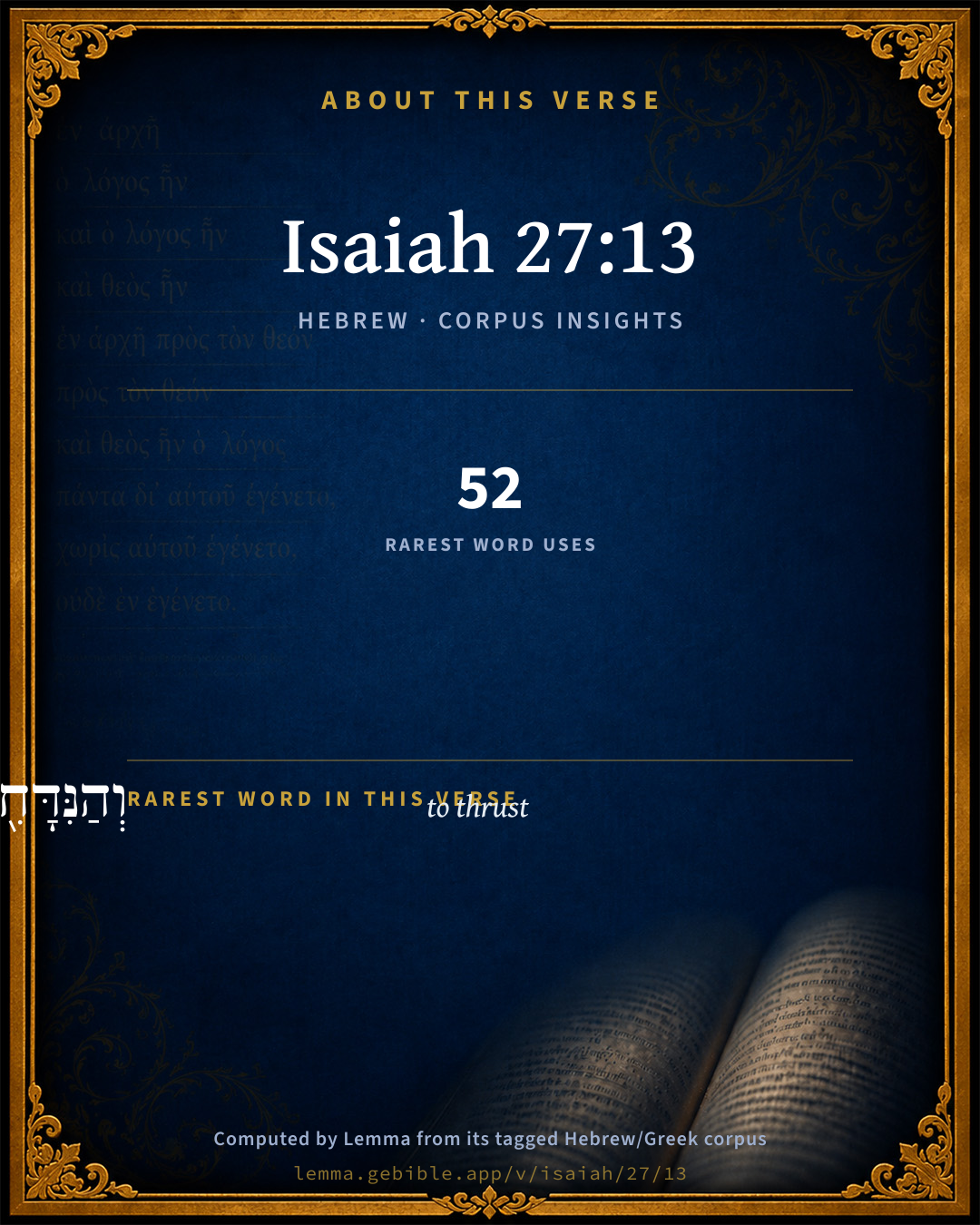
About this verse

These counts appear in no published source. They are computed here, from the morphology-tagged text and Lemma’s own curated glosses. What Lemma adds →

18
words
17
distinct lemmas
Prophets
section

Shared distinctive vocabulary

וְהַנִּדָּחִ֖ים to thrust H5080 occurs in 51 verses of the Hebrew Bible. Also found in:

Grammatical profile

  • 6 verbs
  • 10 nouns
  • 1 adjective
  • 1 pronoun

Verb forms

  • וְהָיָ֣ה Qal · Sequential Perfect
  • יִתָּקַע֮ Niphal · Imperfect
  • וּבָ֗אוּ Qal · Sequential Perfect
  • הָאֹֽבְדִים֙ Qal · Participle Active
  • וְהַנִּדָּחִ֖ים Niphal · Participle Passive
  • וְהִשְׁתַּחֲו֧וּ Hishtaphel · Sequential Perfect

Repetition

A word recurs within this verse — often emphatic in Hebrew:

  • בְּאֶ֣רֶץ land H776 ×2

Hebrew & Septuagint length

In English translation the verse runs 48 words from the Hebrew and 45 from the Septuagint (LXX English) — closely comparable.

A rough comparison of the two English renderings, which tokenize alike — not a word-level alignment.

Word counts can differ between the Hebrew and the Greek without any difference in meaning — e.g. the Hebrew direct-object marker אֵת has no separate Greek word, and Greek often adds the article ὁ.

Cross-references

38

Topical passages linked to Isaiah 27:13 in the Treasury of Scripture Knowledge — connected by theme and wording, ordered by reader-vote popularity; previews shown in the World English Bible.

  • Matthew 24:31 He will send out his angels with a great sound of a trumpet, and they will gather together his chosen ones from the four winds, from one end of the sky to the other.
  • Leviticus 25:9 Then you shall sound the loud trumpet on the tenth day of the seventh month. On the Day of Atonement you shall sound the trumpet throughout all your land.
  • Isaiah 19:23–25 In that day shall there be a highway out of Egypt to Assyria, and the Assyrian shall come into Egypt, and the Egyptian into Assyria; and the Egyptians shall worship with the Assyrians.
  • Hebrews 12:22 But you have come to Mount Zion, and to the city of the living God, the heavenly Jerusalem, and to innumerable hosts of angels,
  • 1 Chronicles 15:24 Shebaniah, and Joshaphat, and Nethanel, and Amasai, and Zechariah, and Benaiah, and Eliezer, the priests, did blow the trumpets before the ark of God: and Obed-edom and Jehiah were doorkeepers for the ark.
  • Isaiah 11:16 There shall be a highway for the remnant of his people, who shall remain, from Assyria; like as there was for Israel in the day that he came up out of the land of Egypt.
  • Zechariah 14:16 It will happen that everyone who is left of all the nations that came against Jerusalem will go up from year to year to worship the King, Yahweh of Hosts, and to keep the feast of tents.
  • Luke 4:18 "The Spirit of the Lord is on me, Because he has anointed me to preach good news to the poor. He has sent me to heal the brokenhearted, To proclaim release to the captives, Recovering of sight to the blind, To deliver those who are crushed,
  • Numbers 10:2–4 Make you two trumpets of silver; of beaten work shall you make them: and you shall use them for the calling of the congregation, and for the journeying of the camps.
  • Psalms 47:5 God has gone up with a shout, Yahweh with the sound of a trumpet.
  • Psalms 81:3 Blow the trumpet at the New Moon, At the full moon, on our feast day.
  • Psalms 89:15 Blessed are the people who learn to acclaim you. They walk in the light of your presence, Yahweh.
  • Isaiah 2:3 Many peoples shall go and say, "Come, let's go up to the mountain of Yahweh, To the house of the God of Jacob; And he will teach us of his ways, And we will walk in his paths. For out of Zion the law shall go forth, And the word of Yahweh from Jerusalem.
  • Isaiah 2:11 The lofty looks of man will be brought low, The haughtiness of men will be bowed down, And Yahweh alone will be exalted in that day.
  • Isaiah 11:12 He will set up an ensign for the nations, and will assemble the outcasts of Israel, and gather together the dispersed of Judah from the four corners of the earth.
  • Isaiah 16:3–4 Give counsel, execute justice; make your shade as the night in the midst of the noonday; hide the outcasts; don't betray the fugitive.
  • Isaiah 18:3 All you inhabitants of the world, and you dwellers on the earth, when an ensign is lifted up on the mountains, look; and when the trumpet is blown, listen.
  • Isaiah 19:21 Yahweh shall be known to Egypt, and the Egyptians shall know Yahweh in that day; yes, they shall worship with sacrifice and offering, and shall vow a vow to Yahweh, and shall perform it.
  • Isaiah 25:6 In this mountain will Yahweh of Hosts make to all peoples a feast of fat things, a feast of wines on the lees, of fat things full of marrow, of wines on the lees well refined.
  • Isaiah 56:8 The Lord Yahweh, who gathers the outcasts of Israel, says, Yet will I gather [others] to him, besides his own who are gathered.
  • Isaiah 66:18 For I [know] their works and their thoughts: [the time] comes, that I will gather all nations and languages; and they shall come, and shall see my glory.
  • Jeremiah 43:7 and they came into the land of Egypt; for they didn't obey the voice of Yahweh: and they came to Tahpanhes.
  • Jeremiah 44:28 Those who escape the sword shall return out of the land of Egypt into the land of Judah, few in number; and all the remnant of Judah, who have gone into the land of Egypt to sojourn there, shall know whose word shall stand, mine, or theirs.
  • Hosea 8:13 As for the sacrifices of my offerings, they sacrifice flesh and eat it; But Yahweh doesn't accept them. Now he will remember their iniquity, And punish their sins. They will return to Egypt.
  • Hosea 9:3 They won't dwell in Yahweh's land; But Ephraim will return to Egypt, And they will eat unclean food in Assyria.
  • Zechariah 9:13–16 For indeed I bend Judah as a bow for me. I have filled the bow with Ephraim; And I will stir up your sons, Zion, Against your sons, Greece, And will make you like the sword of a mighty man.
  • Zechariah 10:8–12 I will signal for them, and gather them; For I have redeemed them; And they will increase as they have increased.
  • John 4:21–24 Jesus said to her, "Woman, believe me, the hour comes, when neither in this mountain, nor in Jerusalem, will you worship the Father.
  • Romans 10:18 But I say, didn't they hear? Yes, most assuredly, "Their sound went out into all the earth, Their words to the ends of the world."
  • 1 Thessalonians 4:16 For the Lord himself will descend from heaven with a shout, with the voice of the archangel, and with God's trumpet. The dead in Christ will rise first,
  • Revelation 8:2 I saw the seven angels who stand before God, and seven trumpets were given to them.
  • Revelation 8:6–9:1 The seven angels who had the seven trumpets prepared themselves to sound.
  • Revelation 9:14 saying to the sixth angel who had one trumpet, "Free the four angels who are bound at the great river Euphrates!"
  • Revelation 10:7 but in the days of the voice of the seventh angel, when he is about to sound, then the mystery of God is finished, as he declared to his servants, the prophets.
  • Revelation 11:15–18 The seventh angel sounded, and great voices in heaven followed, saying, "The kingdom of the world has become the Kingdom of our Lord, and of his Christ. He will reign forever and ever!"
  • 2 Kings 17:6 In the ninth year of Hoshea the king of Assyria took Samaria, and carried Israel away to Assyria, and placed them in Halah, and on the Habor, the river of Gozan, and in the cities of the Medes.
  • Hosea 11:11 They will come trembling like a bird out of Egypt, And like a dove out of the land of Assyria; And I will settle them in their houses," says Yahweh.
  • Malachi 1:11 For from the rising of the sun even to the going down of the same, my name is great among the nations, and in every place incense will be offered to my name, and a pure offering: for my name is great among the nations," says Yahweh of Hosts.

Cross-references courtesy of OpenBible.info (CC BY 4.0).

Hebrew and Greek witnesses Masoretic Hebrew ↔ Greek Septuagint

The same verse in the two great witnesses to the Old Testament, shown verse-for-verse.

These are two independent witnesses, not word-aligned to each other, and the Septuagint is shown in lemma (dictionary) form.

Hebrew Isaiah 27:13 Masoretic · Westminster Leningrad Codex

וְהָיָ֣ה בַּיּ֣וֹם הַה֗וּא יִתָּקַע֮ בְּשׁוֹפָ֣ר גָּדוֹל֒ וּבָ֗אוּ הָאֹֽבְדִים֙ בְּאֶ֣רֶץ אַשּׁ֔וּר וְהַנִּדָּחִ֖ים בְּאֶ֣רֶץ מִצְרָ֑יִם וְהִשְׁתַּחֲו֧וּ לַיהוָ֛ה בְּהַ֥ר הַקֹּ֖דֶשׁ בִּירוּשָׁלִָֽם

It shall happen in that day, that a great trumpet shall be blown; and they shall come who were ready to perish in the land of Assyria, and those who were outcasts in the land of Egypt; and they shall worship Yahweh in the holy mountain at Jerusalem.

World English Bible · Public Domain

Greek LXX Isaiah 27:13 Septuagint · lemma form

καί εἰμί ἐν ὁ ἡμέρα ἐκεῖνος σαλπίζω ὁ σάλπιγξ ὁ μέγας καί ἥκω ὁ ἀποὀλλύω ἐν ὁ χώρα ὁ ἀσσύριος καί ὁ ἀποὀλλύω ἐν αἴγυπτος καί προςκυνέω ὁ κύριος ἐπί ὁ ὄρος ὁ ἅγιος ἐν ἰερουσαλήμ

And it shall come to pass in that day that they shall blow the great trumpet, and the lost ones in the land of the Assyrians shall come, and the lost ones in Egypt, and shall worship the Lord on the holy mountain in Jerusalem.

LXX2012 (modern English Septuagint) · Public Domain

Hebrew: Westminster Leningrad Codex (CC BY 4.0). Greek: Septuagint (public domain); English from LXX2012 (modern English Septuagint) (Public Domain). How the Septuagint differs from the Hebrew →

Targum (Aramaic paraphrase)

1

The Targum is the ancient Jewish Aramaic paraphrase of the Hebrew Scriptures — an interpretive translation, not the Hebrew text itself. Onkelos (literal) and Pseudo-Jonathan (expansive) render the Torah, and Jonathan the Prophets. Coverage is partial: where no permissively-licensed English translation exists for a verse, only the Aramaic is shown. This is verse-level text, not a word-by-word alignment to the Hebrew.

  1. Targum Jonathan Prophets (Joshua–Malachi)
    וִיהֵי בְּעִדָנָא הַהִיא יִתְקַע בְּשׁוֹפָרָא רַבָּא וְיֵיתוּן דִי גְלוֹ לְאַרְעָא דְאַתּוּר וּדְאִטַלְטָלוּ לְאַרְעָא דְמִצְרַיִם וְיִסְגְדוּן קֳדָם יְיָ בְּטוּרָא דְקוּדְשָׁא בִּירוּשְׁלֵם:

    And it shall come to pass at that time, that the great trumpet shall be blown, and they shall come, who had gone into captivity into the land of Assyria, and those who were cast into the land of Egypt, and they shall worship before the Lord, in the holy mountain at Jerusalem.

    Targum Jonathan — Aramaic: “Mikraot Gedolot” (public domain). English: “Sefaria Community Translation” (CC0 1.0 (public-domain dedication)); “London "Chaldee Paraphrase," 1871” (public domain). Text via Sefaria.

Commentary

Notes on Isaiah 27:13 from classic Christian and Jewish commentators (each source and its license shown beneath its notes). The classic Christian expositions comment on the surrounding passage and are grouped to its opening verse, so a note may address several verses; the Jewish commentaries on the Tanakh (Rashi and others) are per-verse, so they appear only where the commentator wrote on this verse.

Lemma curates 59 commentaries, every one of them public domain or Creative Commons licensed, each selected and text-cleaned for this edition rather than reprinted as found. About our sources →

Trapp's Complete Commentary

John Trapp

Isa 27:13 And it shall come to pass in that day, [that] the great trumpet shall be blown, and they shall come which were ready to perish in the land of Assyria, and the outcasts in the land of Egypt, and shall worship the LORD in the holy mount at Jerusalem.

Ver. 13. The great trumpet shall be blown.] Or, A blast shall be blown with a great trumpet. Tuba haec magna apostolica praedicatio est, saith Oecolampadius. This great trumpet is the gospel, the preaching whereof is of power to save those that perish, to put life into the dead. {Joh 5:25}

John Trapp, A Commentary or Exposition upon All the Books of the Old and New Testament (1647–1656) — public domain. Text from a community e-Sword module.

The Biblical Illustrator

Joseph S. Exell

Isa_27:13

The great trumpet shall be blown

The Gospel trumpet

I.

THE PREACHING OF THE GOSPEL IS HERE COMPARED TO THE BLOWING OF A TRUMPET.

1. This figurative expression may allude to the trumpet which sounded upon Mount Sinai, at the solemn promulgation of the law. And though the ministers of Christ must not blend the law and the Gospel together, yet they are not Gospel ministers who do not preach the law, both as a ministration of wrath and as a rule of duty.

2. The words may allude to the trump of jubilee, which was sounded throughout the land of Israel at the end of every forty-nine years, proclaiming redemption and liberty to all prisoners and slaves, and causing the following to be a year of national festivity and joy (Lev_25:8-13). This interesting period having been prefigurative of our redemption by Christ, of our deliverance from the curse of the law and the dominion of sin, and of our introduction to the glorious liberty of the children of God, it is with great propriety that the proclamation of the Gospel is compared to the trump of jubilee.

3. Trumpets were also used on other occasions, which may bear some allusion to the proclamation of the Gospel. The Jews had an annual solemnity, which by way of distinction was called the feast of trumpets, and which introduced the new year (Lev_23:24). And these demonstrations of joy, like the rest of that typical dispensation, were only the shadow of good things to come; all had a reference to the promulgation of the Gospel.

4. Whatever be the immediate allusion in the text it is evident that the principal design of a trumpet is to sound an alarm; and such is the direct object of the Gospel ministry.

5. The preaching of the Gospel is compared to a great trumpet. Great things were contained in Gods law, but still greater things are made known by the Gospel.

6. The great trumpet which was sounded by the first heralds of salvation, continues still to proclaim the same good tidings.

II. THE EFFECT WHICH WAS TO FOLLOW UPON THE SOUNDING OF THE GOSPEL TRUMPET. They shall come which were ready to perish. Men as sinners are in a perishing condition. But those only who see and feel their perishing condition actually come.

1. This coming implies repentance towards God.

2. Faith in our Lord Jesus Christ; for with this, all true repentance is invariably connected.

3. All that come unto God by a Mediator, will also come to Zion with their faces thitherward, openly professing their attachment to Christ, and devoting themselves to His service. The text, indeed, seems to be a prophecy of the union that should take place between Jews and Gentiles, under the Gospel dispensation, when they should be formed into one body, and equally participate in the blessings of salvation. The trumpet of the Gospel is still sounding in our ears, proclaiming the great jubilee, the day of salvation, and inviting us to seek the Lord in this welcome and accepted time. Have we embraced the invitation, and answered to the call? (B. Beddome, M. A.)

The Gospel trumpet

I. We make TWO EXPLANATORY REMARKS.

1. The prediction primarily refers to the proclamation of Cyrus for the deliverance of the Jews from captivity.

2. This prophecy has an ulterior reference to the times of the Messiah, and the inbringing of the Jews in the latter days.

II. We consider THE GREATNESS AND GRANDEUR OF THE GOSPEL here represented by a great trumpet. Trumpets were of very common use among Gods ancient people. They directed their journeys, animated them on the march, reused them to arms against the invader, and sounded the dreadful onset to battle, proclaimed the tidings of victory, and summoned the people to divide the spoil. The chief use of the instrument is to give strength to the human voice, that warnings or invitations might be more extensively heard. No kind of wind instrument was in more general use, and therefore no symbol could have been selected with which they were more familiarly acquainted. Their solemn assemblies were convened by its sound; and surely the greatness and the grandeur of the Gospel is hereby strikingly and significantly symbolised.

1. The greatness of the Gospel will appear from the dignity and moral grandeur of its Author.

2. From the gracious tidings it proclaims.

3. From the objects it hath already accomplished and is destined to achieve.

III. We notice that THE PREACHING OF THE GOSPEL IS THE GREAT ORDINANCE OF GOD FOR THE SALVATION OF MEN. The great trumpet shall be blown. Its sound shall be long and loud, that the proclamation of the glad tidings of great joy shall be universal. Conclusion--

1. Let Christians appreciate their advantages and highly prize the Gospel Psa_89:15).

2. Let Gospel despisers fear, and flee for refuge to the hope set before them in the Gospel (Heb_2:2).

3. Let all rejoice in the glorious results already secured and yet to be achieved by the preaching of the Gospel. (W. M Queen.)

The blast of the Gospel trumpet

I. THE PERIOD to which this promise or prophecy refers. That day. In the prophetical parts of Scripture, this phrase is often to be understood of New Testament times.

II. THE GREAT MEANS that God promises to employ in New Testament days for accomplishing His design among the Gentiles. The great trumpet shall be blown.

1. The Gospel intimates to all that hear it, the offering of a great sacrifice.

2. The Gospel contains an indication of a joyful and solemn feast.

3. The Gospel is the appointed means of gathering a solemn assembly. As me silver trumpets were used for gathering the assemblies in Israel, so the Gospel is employed, according to Christs appointment, for gathering a Church to Himself.

4. The Gospel is the great means of directing the march of the armies of the spiritual Israel, through the wilderness of this world. When the priests sounded an alarm with the trumpets, the tribes of Israel were to decamp, and set forward in their journeys, in that order which God had appointed.

5. The Gospel is the great means of calling forth the armies of the living God to that spiritual warfare in which they are engaged under Christ,--of directing their motion in the day of battle,--and of animating them to continue the combat, amidst all the dangers and terrors with which they often find themselves surrounded. The silver trumpets were also to be used to blow an alarm when Israel was called to go to war against any enemy that should oppress them in their land.

6. The Gospel proclaims an universal jubilee to all that hear it.

III. THE PERSONS UPON WHOM THE SOUND OF THIS GREAT TRUMPET SHALL TAKE EFFECT are described by two circumstances.

1. They are persons ready to perish. The original worn is still more emphatical--there shall come the perishing in the land of Assyrian All mankind are, by nature, in a perishing condition. Situated in desert land, which affords no provision but empty husks, we faint for spiritual thirst and hunger, and are ready to perish for want. Led captive by a cruel enemy, we are ready to perish by the weight of our chains. Enslaved by a tyrannical master, and employed in the vilest drudgery, we are ready to perish through fatigue and weariness. Sunk into a fearful pit, and struggling, without a possibility of extricating ourselves, in the miry clay, we must quickly perish without supernatural help. Above all, being condemned to death by a just sentence of the Court of Heaven, we are every moment in danger of perishing by the hand of justice.

2. They are outcasts. There seems to be here an allusion to the situation of the Hebrew children in Egypt, who, by Pharaohs inhuman decree, were all to be cast out into the river.

IV. THE PLACES FROM WHICH THESE PERSONS WERE TO BE GATHERED, by the sound of the great trumpet, are also two. The land of Assyria and the land of Egypt. These two countries are mentioned as examples: and what is here said of them has been verified, and will again be verified in all other countries resembling them. Perishing sinners have been gathered from every quarter.

V. THE END TO BE GAINED by the blast of this trumpet among them. This also is set before us in two particulars.

1. They shall come.

(1) They shall come to Christ by faith.

(2) They shall, come to the holy mount at Jerusalem. Jerusalem was of old the place of Gods solemn worship. Every person who feels the efficacy of the Gospel becomes a genuine citizen of the New Jerusalem. And from that time forth he takes pleasure in attending upon Gods ordinances; accounting a day in His courts better than a thousand.

(3) They come to God Himself who dwells in the holy mount.

2. As they come, they worship. This imports--

(1) Their cordial renunciation of all idolatry and false worship.

(2) Their careful and diligent observance of all those ordinances by which God has required Himself to be worshipped.

(3) Their carefulness to perform every act of worship in the manner that the Word of God has prescribed. (J. Young.)

The blowing of the great trumpet

I. THE BLOWING OF THE GREAT TRUMPET.

II. THE CHARACTERS IN WHOSE EARS AND HEARTS THIS GREAT TRUMPET IS TO BE BLOWN.

III. THE EFFECT WHICH THE BLOWING OF THE GREAT TRUMPET PRODUCES UPON THEM. (J. C. Philpot.)

The great trumpet

I. SEE HOW A COMPARISON OF SCRIPTURE WITH SCRIPTURE WILL ENABLE US TO UNDERSTAND THE WORD TRUMPET.

II. THE BLOWING OF THE TRUMPET.

III. THE RESULTS OF THAT BLOWING. (J. H. Crowder, M. A.)

The Gospel trumpet

I. THE GRANDEUR OF THE GOSPEL.

The great trumpet. It is elsewhere called a great light--a great salvation There is a grandeur in the glorious Gospel of God which soars far beyond all finite excellency and conception.

1. The period of its introduction is called the fulness of time.

2. The Gospel regards immediately the soul and eternity--the only two things in the world which are absolutely great.

3. The Gospel abounds with exceeding great and precious promises; it unfolds blessings that are incomprehensible in their nature and excellency.

4. Everything, compared with the Gospel, is trifling and mean.

II. THE DISPENSATION OF THE GOSPEL. The great trumpet is to be blown.

1. Who is to blow this trumpet? Men, and not angels. There is a difference here between the administration of the law and the dispensation of the Gospel.

2. How is this trumpet to be blown? Common sense says, in such a way as to answer the design of its being blown. There must be no ambiguity in our preaching. It should be blown courageously.

III. WHAT IS THE CONDITION OF THOSE TO WHOM THE GOSPEL IS ADDRESSED? Outcasts, and ready to perish. This is the figure; and what is the fact? Remember that at that time ye were without Christ, being aliens from the commonwealth of Israel, and strangers from the covenants of promise; having no hope, and without God in the world. You are not heathen; but turn to Scripture, and you will find that you are all by nature the children of wrath, even as others.

IV. Its ATTRACTION must be noticed. They shall come. Whatever knowledge the heathen had, they were utterly unable to carry it into effect, both for want of evidence and want of authority. None of them could speak in the name of that God who calleth the things that are not as though they were. Hence, we find Plato complaining that he was unable, by all his instructions, to bring over the inhabitants of a single village. Now, go to Thessalonica, to Corinth, to Colosse, to Ephesus; survey the character of the inhabitants before they received the Gospel: it is largely described by the apostle; we cannot suppose that the devil himself could make or wish them worse. Yet the apostle stands forth, and says, Such were some of you; ye were sometimes far off; ye were dead in trespasses and sins; but, you hath He quickened. Our Gospel came unto you, not in word only, but in power also; the kingdom of God is not in word, but in power. Accordingly, the Gospel is expressed evermore by images which indicate its efficacy. It is called a two-edged sword--leaven, which commences its operations in the centre, and extends them to the circumference until the whole is leavened--seed, which, though it looks dead, yet fills the earth with its fruit, thirty, sixty, a hundred fold. This success God Himself has ensured, or we could not reckon upon it. The Gospel never leaves people as it finds them: it enlightens their understandings; it prevails on their wills; it purifies their affections; it makes them new creatures. How can we honour the Gospel so much as by showing what it can do? The trumpet is blown; but it is heard--it is answered--they come.

1. How do they come? With weeping and with supplication; they come eagerly, hastening, running, flying like doves to their windows when they behold the approaching storm.

2. From whence do they come? From the dark dens of ignorance--from the lurking holes of hypocrisy--from the false refuges of pharisaism--from the service of sin--from the bondage of Satan.

3. To whom do they come! Christ is the only resource. What is faith, what is religion, but the soul in motion to Him, and negotiating all its affairs with Him!

V. THE EFFECT OF ITS INFLUENCE. They shall come and worship the Lord in the holy mount at Jerusalem. We ever find this dedication of themselves to God, in connection with the spread and influence of the Gospel. All the ends of the world shall hear, and shall turn unto God; all nations whom Thou hast made, shall come unto Thee and worship Thee; from the rising of the sun to the going down of the same, in every place men shall offer incense and a pure offering. The holy mount means the Church of God. And in this mount all who partake of Gospel grace, worship. They do so habitually, in the shop--in the warehouse--in the field; for whereer they seek Him, He is found. They do so in private. All these worship God in their families too. In His sanctuary also. CONCLUSION--

1. This Scripture has been fulfilled. Myriads in Heaven have exemplified its truth, the numbers that rejoice in it in our day are wonderful; but soon there shall he vaster accessions still. A nation shall be born in a day. Have you heard the sound of this trumpet? Have you obeyed?

2. If the sound of this peaceful trumpet is despised, I must remind you that another great trumpet will be blown. Ere long shall be heard the voice of the archangel, and the trump of God.

3. But, here are some who are alive to the text. You have heard the sound of this trumpet; you have come. What are you doing? Surely, you are giving thanks unto Him who has called you out of darkness into light; who has made you meet for the inheritance of the saints. Surely, you are endeavouring to bring others into the same condition. (W. Jay.)

The silver trumpet

As when the front and back doors of a barn are open, a gust of wind scatters the dust and chaff, so the Jews had been swept every whither--some wandering in Assyria, and some exiled in Egypt; but their coming back, as by the call of a trumpet, is here predicted. The passage is strongly descriptive of the exiled and perishing condition of sinful men, and of their return at the trumpet call of the Gospel.

1. Need I stop to prove that out of God we are in exile? Who here is at home in his sins? Does he not wander about looking for a home? You have been expatriated. You are in worse than Siberian exile. The chains are harder. The mine is darker. The climate is colder. The gloom is ghastlier. Lost in the land of Assyria! If a man has missed his way, the more he walks the more he is lost. He starts off and goes ten miles in the wrong direction. Nor can you find your way out of this spiritual confusion. Lost, and without food. Lost, and without water. Ingenious little children sometimes tell you how, with a few letters, they can spell a very large word. With three letters I can spell bereavement. With three letters I can spell disappointment. With three letters I can spell suffering. With three letters I can spell death. With three letters I can spell perdition. S-i-n, Sin. That is the cause of all our trouble now. That is the cause of our trouble for the future.

2. But upon this dark background of the text a light falls. Amidst the harsh discords there sound the sweet and thrilling notes of a great trumpet. A trumpet, God made, yet needing no giants to use it, but suited to faint lips and trembling hand and feeble lungs; so that sick Edward Payson, leaning against the pulpit, might hold it, and Frederick Robertson, worn out with ulcers and spinal complaints, might breathe through it. This Gospel trumpet is great in its power. On a still night you may hear the call of a brazen trumpet two or three miles; but this is so mighty that it is not only heard from heaven to earth, but it is to arrest the attention of all nations.

(1) This trumpet is great in its sweetness. In some musical instruments there is noise and crash and power, but no fineness of sound. Others can not only thunder, but weep and whisper and woo. Like that is the Gospel trumpet. In all tenderness and sweetness and sympathy it excels.

(2) The Gospel trumpet is a trumpet of alarm.

(3) It is one of recruit. War is declared. Who is on the Lords side? There is no neutral ground.

(4) The Gospel trumpet is one of assault. Let the wicked forsake His way, etc.

(5) This Gospel trumpet is also one of retreat. It is the part of good generalship sometimes to blow the trumpet of retreat. There is no need of your trying to face certain temptation; you are foolhardy to try it. Your only safety is in flight.

(6) This Gospel trumpet is one of victory.

(7) One of reveille. We, who are the soldiers of Christ, cannot always be marching and fighting. The evening will come; the shadows will gather; and we must go to the white tents of the grave. There we shall sleep soundly. But the night will pass along, and the first thing we shall hear will be the trumpet call sounding the reveille of the resurrection; and we will come up and fall into a long line of light, the sword of Christian conflict gleaming in the unsetting sun. The roll shall be called, and we shall answer to our names; and then we will go to the morning repast of heaven. (T. DeWitt Talmage, D. D.)

Blowing of the great trumpet

We shall look at the text as applying to heathens as well as Jews, even to all who are ignorant of and are rejecting the Lord Jesus Christ as their Saviour. With regard to these there are three things to be looked at--

I. THEIR URGENT NEED. They are described as ready to perish. The word is literally lost. The idea is that of a lost sheep. Or of a lost child who has left his home and wandered into the fields, or into the woods, and been overtaken by night and darkness. There is no one to care for him, no one to guide him, no one to shelter him. He is left to himself. A hundred things may happen that may be death to him. Without knowing it, he may be on the point of falling over a precipice or into a river. Now, a child or a man who has gone astray from God is ready to perish too. Still more is it true of everyone who is not a believer in the Lord Jesus Christ. It is true, alas! of many even in this highly favoured land of ours. It is true of the Jews. And what shall I say of the heathen.

II. THE HELP WANTED. What is to be done to meet this terrible state of things? If it were a dying man--a perishing child--we should ask, Is there anything that will save the dying one--any medicine or food--anything we can give--anything we can do? And that should be our question about the perishing millions all over the world.

1. The sounding of the trumpet may be regarded as typical of the preaching of the Gospel, by which both the outcasts of Israel and the ready to die of all nations are to be saved.

2. But there must be someone to sound the trumpet. It cannot sound of itself. It must be blown. And who are to do this, but those who have heard it and complied with its call themselves, and who, with hearts full of love and thankfulness, can sing, Blessed are the people that know the joyful sound? It is as much our duty to blow the trumpet as to hear it.

3. How, then, are we to blow the trumpet? None of us are too young or feeble to sound the trumpet ourselves. In our own way we can tell the story of redeeming love.

(1) The best that any of you can give is yourselves. He gives by far the largest contribution who gives himself.

(2) But where you cannot give yourselves you can do something by giving your money.

III. THE SUCCESS PROMISED. They which were ready to perish shall come. The return from the Jewish captivity was wonderful in its own way; but more and better is in store, for all Israel shall be saved. Already many Jews and Jewesses have been converted to Christ. And as regards the heathen world, the history of the progress of the Gospel in recent times reads almost like a chapter of the Acts of the Apostles. And yet it must be owned that anything like a complete fulfilment of the promise is still a thing of the future. What is to be done? The great trumpet must be sounded as it never has been. (J. H. Wilson, D. D.)

The urgency of missions

Are not missions to Jews and heathens and Mohammedans hopeless? They dont want them; they wont have them. But does it not only make the case the stronger if they do not know their need and their danger, and do not ask for help? Perhaps, in some cases, they refuse help when it is offered. And what of that? As I pass along the banks of a stream, I see something in a pool. On going nearer, I see it is the body of a boy. There is no cry for help, there is no outstretched hand. He is past all that. Am I, on that account, not to give help! Is not the call all the louder and more urgent? (J. H. Wilson, D. D.)

.

The Biblical Illustrator, edited by Joseph S. Exell (c. 1880s–1900s) — public domain. Text from a community e-Sword module.

The Preacher's Complete Homiletical Commentary

Joseph S. Exell (gen. ed.)

THE GOSPEL TRUMPET

Isa_27:13. And it shall come to pass in that day that the great trumpet, &c.

The Jews had been scattered every-whither—some wandering in Assyria, and some exiled in Egypt; but their coming back, as by the call of a trumpet, is here predicted. The passage is strongly descriptive of the exiled and perishing condition of sinful men, and of their return at the trumpet-call of the Gospel.

I. THE SINNER’S CONDITION. He is—

1. An exile.

2. He is ready to perish.

II. THE GOSPEL TRUMPET.

1. It was not fashioned by man.

2. It is great in its power. In a still night you may hear a brazen trumpet two or three miles away; but this is so mighty that it is not only heard from heaven to earth, but it is to arrest the attention of all nations. Men with physical hearing all gone catch the first strain of it. Men buried half a century in crimes have heard it. It is the power of God unto salvation. Instance some of the men who have heard it.

2. It is great in its sweetness.

3. It is a trumpet of alarm. It puts us on our guard against the foes who are advancing to destroy us.

4. It is a trumpet of recruit. It summons us to join the standard of the Son of God.

5. It is a trumpet of retreat. It warns us against the fool-hardiness of entering into temptation.

6. It is a trumpet of victory. It tells of victories achieved, and of others still more glorious yet to be won.

7. It is a trumpet of awakening. As chaplain I was a little while in the army. Early every morning we were awakened by a trumpet sounding the réveille. At that sound all the troops arose from the tents, hastened to their places in the line, and answered the roll-call. That done, they went to their morning rations. We who are the soldiers of Christ cannot always be marching and fighting. The evening will come. The shadows will gather, and we must go to the white tents of the grave. There we shall sleep soundly. But the night will pass along, and the first thing we shall hear will be the trumpet-call sounding the réveille of the resurrection; and we shall come up and fall into the long line of light, the trophies of Christian conflict gleaming in the unsetting sun. The roll shall be called, and we shall answer to our names; and then we shall go to the morning repast of heaven (1Co_15:52-55).—De Witt Talmage, D.D.: Christian World Pulpit, i. 410.

THE GREAT TRUMPET

Isa_27:13. And it shall come to pass in that day, &c.

This prophecy was literally fulfilled (Ezra 1); but it has a wider meaning, and thus also it shall be fulfilled.

I. THE GREATNESS OF THE GOSPEL. “The great trumpet.”

1. It is designed for the world. When liberty was proclaimed for the slaves of the West Indies, the slaves of America remained in bondage. When the slaves of America were liberated, the bondmen in Cuba, Peru, &c., were not set free. But here is a blessing for the whole world. “Which shall be to all people,.… a light to lighten the Gentiles” (Luk_2:10; Luk_2:32). One side of the earth can only enjoy the rays of the sun at the same time; but this “light” shall shed its rays on the whole world.

2. It is designed for the world in its most important interests. There are inventions and scientific discoveries—such as the steam-engine, &c.—which are valuable to the whole world. But they are valuable only in regard to the present life. But the Gospel meets the wants of the soul, and concerns the endless life beyond.

3. It is so great that all other things in the world are small in comparison with it; trade, learning, &c.

4. It is so great that it bestows greatness upon everything it touches. Upon oratory, although it is independent of excellency of speech. Upon any country in which it is proclaimed and accepted: e.g., Great Britain, America. Under its shelter liberty, learning, &c., flourish (H. E. I. 1124–1132).

II. THE MINISTRY OF THE GOSPEL. “The great trumpet shall be blown.” What is the good of a trumpet without some one to blow it? (Rom_10:14.)

1. Who is to blow it? Not angels (Heb_2:5). The law was given by the ministry of angels; by them the trumpet was blown on Mount Sinai (Act_7:53). But they recognise that the trumpet of the Gospel is to be blown by man (Act_5:20; Act_10:31-32). This treasure is in earthen vessels. Gideon’s Lamps. Men are better than angels for this purpose. This is proved by the fact that God ordered it so. But there are other minor satisfactory arguments, such as:

(1.) The danger of glorifying the missionary above the mission.

(2.) The angels’ disadvantages. They lack the necessary experience. Blessed lack, in all other respects! They have never been contaminated by sin, and hence know not how to speak to the heart of the sinner. By men the trumpet is now being blown, and will be blown to the end of time. The trumpeters are falling, ministers are dying, but the ministry is alive!

2. How is it to be blown?

(1.) Clearly (1Co_14:8). If the promises are proclaimed, care must be taken to show to whom they belong. So with the threatenings, &c.

(2.) Vigorously. It must be done thoroughly, or not at all.

(3.) Bravely (Eph_6:19). The question is not what will “take,” what is popular, what would please the masses, but “What saith the Lord?”

III. THE OBJECTS OF THE MINISTRY. “They which were ready to perish.”

1. Pagans are such (Romans 1) “Them which sat in the region and shadow of death” (Mat_4:16).

2. Every unconverted sinner. They are all to be addressed as those who are “ready to perish.” The matter cannot be compromised because they are seat-holders, contributors, &c. Your kindness shall not prevent our blowing from the trumpet the tones you need to hear.

IV. THE SUCCESS OF THE GOSPEL. “And they shall come which were ready to perish in the land of Assyria, and the outcasts in the land of Egypt, and shall worship the Lord in the holy mount at Jerusalem.”

1. Whence shall they come? From their Pharisaical hiding-places, the quicksands of excuses, &c. They are bound in the chains of slavery; but “they shall come!” This is as certain as the deliverance from Babylon. Take up your harps and strike them!

2. How will they come? Weeping. Without delay. Confidently.

3. Whither and to whom will they come?

(1.) To Christ; they cannot live without Him.

(2.) To His house.

APPLICATIONS.—

1. Thousands have come; will you?

2. God has another trumpet.—Gweithiau Rhyddiethol (pp. 174–176), by the late Rev. W. Ambrose, Portmadoc. Translated from the Welsh by the Rev. T. Johns, Llanelly.

The Preacher's Complete Homiletical Commentary (gen. ed. Joseph S. Exell; Funk & Wagnalls, c. 1892) — public domain (pre-1929). A full-Bible homiletical/sermon-outline anthology covering 65 of 66 books (2 John is absent from the source module). Text from a community e-Sword module.

Tyndale Open Study Notes

Tyndale Open Resources

27:13 The great trumpet was used to gather the people (see Matt 24:31).

Tyndale Open Study Notes — © Tyndale Open Resources, licensed CC BY-SA 4.0. Text via the HelloAO Bible API.

Geneva Bible (1599)

Geneva Bible translators

In the time of Cyrus, by whom they should be delivered: but this was chiefly accomplished under Christ.

Geneva Bible (1599) marginal notes — public domain. Text via Bolls.life.

Jamieson, Fausset & Brown

Robert Jamieson, A. R. Fausset & David Brown

great trumpet--image from the trumpets blown on the first day of the seventh month to summon the people to a holy convocation (Lev 23:24). Antitypically, the gospel trumpet (Rev 11:15; Rev 14:6) which the Jews shall hearken to in the last days (Zac 12:10; Zac 13:1). As the passover in the first month answers to Christ's crucifixion, so the day of atonement and the idea of "salvation" connected with the feast of tabernacles in the same seventh month, answer to the crowning of "redemption" at His second coming; therefore redemption is put last in Co1 1:30.

Assyria--whither the ten tribes had been carried; Babylonia is mainly meant, to which Assyria at that time belonged; the two tribes were restored, and some of the ten accompanied them. However, "Assyria" is designedly used to point ultimately to the future restoration of the ten fully, never yet accomplished (Jer 3:18).

Egypt--whither many had fled at the Babylonish captivity (Jer 41:17-18). Compare as to the future restoration, Isa 11:11-12, Isa 11:16; Isa 51:9-16 ("Rahab" being Egypt).

The twenty-eighth through thirty-third chapters form almost one continuous prophecy concerning the destruction of Ephraim, the impiety and folly of Judah, the danger of their league with Egypt, the straits they would be reduced to by Assyria, from which Jehovah would deliver them on their turning to Him; the twenty-eighth chapter refers to the time just before the sixth year of Hezekiak's reign, the rest not very long before his fourteenth year.

Next: Isaiah Chapter 28

Jamieson, Fausset & Brown — Commentary Critical and Explanatory on the Whole Bible (1871) — public domain (CC PDM 1.0). Text via the HelloAO Bible API.

Adam Clarke's Commentary

Verse 13. The great trumpet shall be blown] Does not this refer to the time spoken of by our Lord, Mt 24:31: He shall send forth his angels - the preachers of his Gospel with a great sound of a trumpet - the earnest invitation to be saved by Jesus Christ; and shall gather his elect - the Jews, his ancient chosen people, from the four winds - from all parts of the habitable globe in which they have been dispersed.

In this prophet there are several predictions relative to the conversion of Egypt to the true faith, which have not yet been fulfilled, and which must be fulfilled, for the truth of God cannot fail. Should Egypt ever succeed in casting off the Ottoman yoke, and fully establish its independence, it is most likely that the Gospel of Christ would have a speedy entrance into it; and, according to these prophecies, a wide and permanent diffusion. At present the Mohammedan power is a genuine antichrist. This also the Lord will remove in due time.

Adam Clarke's Commentary on the Bible (1810–1826) — public domain. Text from a community e-Sword/MySword module.

Ellicott's Commentary for English Readers

(13) The great trumpet shall be blown . . .—The symbolism had a probable origin in the silver trumpets which were used in the journeys of the Israelites “for the calling of the assembly and for the journeying of the camps” (Num_10:1-10), and which were solemnly blown in the year of Jubilee on the eve of the Day of Atonement (Lev_25:9). It re-appears in the Apocalyptic eschatology of Mat_24:31; 1Co_15:52; 1Th_4:16, standing there, as here, for any great event that heralds the fulfilment of a Divine purpose. That purpose, in this instance, is the proclamation of the Year of Redemption, the restoration of the dispersed of Israel from the countries of their exile, of which, as in Isa_11:11; Isa_19:23, Assyria and Egypt are the two chief representatives. (Comp. Zep_3:10.)

A Bible Commentary for English Readers, edited by Charles John Ellicott (1878–1897) — public domain. Text from a community e-Sword module.

The Cambridge Bible for Schools and Colleges

gen. ed. J. J. S. Perowne

13. the (a) great trumpet] Cf. ch. Isa_18:3; Zec_9:14; Mat_24:31; 1Co_15:52; 1Th_4:16.

they … which were ready to perish] the lost ones.

outcasts] Cf. ch. Isa_11:12.

The Cambridge Bible for Schools and Colleges (gen. ed. J. J. S. Perowne; Cambridge University Press, 1878–1918) — public domain. Text from a community e-Sword module.

John Gill's Exposition

And it shall come to pass in that day,.... When the Lord is about to do the above things, and in order to it. The Talmudists (k) apply this text to the world to come, or times of the Messiah, when the ten tribes shall be returned:

that the great trumpet shall be blown; meaning not the edict or proclamation of Cyrus, but the ministration of the Gospel, called a "trumpet", in allusion to those that were ordered by Moses to be made for the congregation of Israel, Num 10:1, or to the jubilee trumpet, Lev 25:9 or with respect to any trumpet giving a musical sound; the Gospel being a joyful sound, a sound of love, grace, and mercy through Christ, of peace, pardon, righteousness, and salvation by him; and which may be called a "great" one, the author of it, God, being great; and it is the effect of great love, and the produce of great wisdom; it proclaims and publishes great things, great promises, great truths, and a great salvation; it gives a great sound, which has and will again go into all the world, and reach to the ends of the earth; and has been, and will be, attended with great power; the "blowing" of it intends the ministry of the word, which to perform aright requires ability and skill; and here it respects the ministration of it in the latter day, when this Gospel trumpet will be blown more clearly, and without any jar, discord, and confusion; and more loudly, openly, and publicly; and more effectually, and to greater purpose:

and they shall come which were ready to perish in the land of Assyria, and the outcasts in the land of Egypt; all mankind are in a perishing condition, but all are not sensible of it; some are, and they become so through the preaching of the word, attended with the power and Spirit of God; whereby they are convinced of sin, and of their lost estate by nature; their consciences are loaded with guilt, their souls are filled with a sense of wrath; they have a sight of sin, but not of a Saviour from it, or of the pardon of it; they have a view of a broken law, which curses and condemns, and of injured justice brandishing its sword against them, but see they have no righteousness to satisfy one or the other; and find themselves in a starving condition, ready to perish with hunger; and are like the wretched infant "cast out" into the open field, to the "loathing" of its person: and these now, whether in Assyria or in Egypt, or wherever they are, the Gospel trumpet will reach them, and encourage them to come; and powerful and efficacious grace accompanying it will engage and cause them to "come" first to Christ as poor perishing sinners, and venture their souls on him for life and salvation; they shall come to him in a way of believing, for pardon, cleansing, rest, food, righteousness, and life; and then they shall come to his churches, and give up themselves unto them, to walk with them:

and shall worship the Lord in the holy mount at Jerusalem; in the Gospel church, signified frequently by Mount Zion and Jerusalem; see Heb 12:22 where the Jews shall come, when converted, and join themselves, and worship God internally and externally, in spirit and in truth: and it may be true of Mount Zion, and of Jerusalem, in a literal sense, which will be rebuilt, and inhabited by the Jews, and become a place of divine worship.

(k) T. Bab. Sanhedrin, fol. 110. 2. Midrash Kohelet. fol. 68. 3.

Next: Isaiah Chapter 28

John Gill's Exposition of the Whole Bible (1746–1763) — public domain (CC PDM 1.0). Text via the HelloAO Bible API.

Albert Barnes' Notes on the Bible

The great trumpet shall be blown - This verse is designed to describe in another mode the same fact as that stated in Isa 27:12, that Yahweh would re-collect his scattered people. The figure is derived from the trumpet which was blown to assemble a people for war (Grotius); or from the blowing of the trumpet on occasion of the great feasts and festivals of the Jews (Vitringa). The idea is, that God would summon the scattered people to return to their own land. The “way” in which this was done, or in which the will of God would be made known to them, is not specified. It is probable, however, that the reference here is to the decree of Cyrus Ezr 1:1, by which they were permitted to return to their own country.

Which were ready to perish - Who were reduced in numbers, and in power, and who were ready to be annihilated under their accumulated and long-continued trials.

In the land of Assyria - The ten tribes were carried away into Assyria 2Ki 17:6; and it is probable that many of the other two tribes were also in that land. A portion of the ten tribes would also be re-collected, and would return with the others to the land of their fathers. Assyria also constituted a considerable part of the kingdom of the Chaldeans, and the name Assyria may be given here to that country in general.

And the outcasts - Those who had fled in consternation to Egypt and to other places when these calamities were coming upon the nation (see Jer 41:17-18; Jer 42:15-22).

And shall worship the Lord - Their temple shall be rebuilt; their city shall be restored; and in the place where their fathers worshipped shall they also again adore the living God. This closes the prophecy which was commenced in Isa. 24; and the design of the whole is to comfort the Jews with the assurance, that though they were to be made captive in a distant land, yet they would be again restored to the land of their fathers, and again worship God there. It is almost needless to say that this prediction was completely fulfilled by the return of the Jews to their own country under the decree of Cyrus.

Albert Barnes' Notes on the Bible (1834–1885) — public domain. Text from a community e-Sword/MySword module.

Haydock's Catholic Bible Commentary

Trumpet. The preaching of the Gospel for the conversion of the Jews. (Challoner)

George Leo Haydock (1774–1849), Haydock's Catholic Family Bible and Commentary, 1859 edition — public domain. Excludes Psalms (Douay-Rheims chapter numbering differs from Protestant) and Deuterocanonical books (Catholic canon only).

Matthew Poole's English Annotations

The great trumpet; which may be heard even to the remotest parts of the earth. God shall summon them all together as it were by sound of trumpet, to wit, by an eminent call or act of his providence on their behalf. He alludes to the custom of calling the Israelites, together with trumpets; of which see Num 10:2,3.

The land of Assyria, where the ten tribes were carried captive. The land of Egypt, where many of the Jews were, as is manifest both from Scripture, as Jer 43:7; 44:28; Hos 8:13; Zec 10:10, and from other authors.

Matthew Poole's English Annotations on the Holy Bible (1683–1685) — public domain. Text from a community e-Sword/MySword module.

Whedon's Commentary on the Bible

Daniel D. Whedon

13. The great trumpet — An image taken from the trumpet blown to summon the people to holy convocation. Lev_23:24. Jehovah is, as it were, to summon his righteous ones to worship him on Mount Zion.

Ready to perish — That is, those who, in the region of the Euphrates, had not enjoyed religious opportunities, and those who, amid national trouble in Judah, had fled in consternation to Egypt. All these shall hear the call to return, and, purified from old vices, with intense zeal to serve Jehovah shall they come.

Thus closes these four chapters respecting the destiny of the true Israel, not alone of Judah, but the sincere and true of all tribes of Israel, who, one after another, were to be gathered as individuals or in colonies to Mount Zion.

PART 5.

Historico-prophetic discourses relating to Assyria and the Egyptian alliance, chapters 28-33.

Daniel D. Whedon (gen. ed.), Commentary on the Old and New Testaments (1874–1909) — public domain. Text from a community e-Sword module.

The Pulpit Commentary

The great trumpet shall be blown; rather, a great trumpet. (Mat_24:31 1Co_15:52 1Th_4:16) This imagery, and the return of the Israelites from Egypt and Assyria, point rather to the final gathering of Israel into the Church triumphant than to the return from the Babylonian captivity. Egypt and Assyria were certainly not the countries from which they came chiefly at that time. But they are the countries from which they will chiefly come when Jehovah "sets his hand again the second time to recover the remnant of his people". (Isa_11:11) The outcasts. (comp. Isa_11:12)

Restorations prove Divine forgiveness.

This is the answering truth to that dwelt on above, in the homily on ver. 9; God in his dealings with man never stops with sentiment. We know that he forgives us, because with the forgiveness he grants us restoration to his favor. Israel had grievously offended Jehovah by his unfaithfulness. Divine indignations had put the offending child away. But the child learned the lessons of judgment. The child came, penitent and humble, seeking forgiveness; and the Lord heard, granted the forgiveness, and sealed it in a gracious restoration. This is the vision of that great restoring-day. "They shall come which were ready to perish in the land of Assyria, and the outcasts in the land of Egypt, and shall worship the Lord in the holy mount at Jerusalem." Our Lord presented this truth in his exquisite picture of the prodigal son. The father forgives the penitent, and we might say, "That is enough; such a son can expect no more and deserves no more; forgiven, let him go away where he will." But love cannot stop at such limitations; it cannot be content until it can restore: it wants to seal its forgiveness; it would make it the fullest blessing possible; so the forgiven son is in his old place at the home-table; nay, he is even decked in the joy-robe, and made the occasion of a feast. He knows he is forgiven, for he is restored. In nothing do God"s ways appear to be higher than man"s ways than in this God can restore when he forgives, and man halts at the restoring work; he is seldom grand enough for that. We cannot restore our criminals even when they are penitent. We cannot put back into her place in society the woman a sinner," who bathes the feet of Jesus with penitential tears. The apostle makes an almost overwhelming demand on us when he says, "Brethren, if a man be overtaken in a fault, ye which are spiritual restore such a one in the spirit of meekness." How souls yearn for this sealing of forgiveness is seen in David"s prayer, "Restore unto me the joy of thy salvation." The subject may be treated under two divisions.

I DIVINE RESTORATION ASSURED IN EXAMPLES AND PROMISES. These assure us that it is God"s way of dealing, and so they become a persuasion to hope even in our penitence, and in our prayer for forgiveness.

II DIVINE RESTORATION REALIZED IN ACTUAL CIRCUMSTANCES. Not always outward circumstances; only so far as these may have been affected by the sin. Always in inward circumstances of mind and feeling. R.T.

The Pulpit Commentary (1880–1919), ed. H.D.M. Spence-Jones & Joseph S. Exell — public domain. Text from a community e-Sword module.

John Wesley's Explanatory Notes

Trumpet - God shall summon them altogether by sound of trumpet, by an eminent call of his providence. He alludes to the custom of calling the Israelites together with trumpets.

John Wesley, Explanatory Notes Upon the Whole Bible (1754–1765) — public domain. Text via the GEBible commentary corpus.

J. A. Alexander on Isaiah

Joseph Addison Alexander

“And it shall be (or come to pass) in that day, (that) a great trumpet shall be blown, and they shall come that were lost (or wandering) in the land of Assyria, and those cast out (or exiled) in the land of Egypt, and shall bow down to Jehovah, in the holy mountain, in Jerusalem.” The same event is here described as in the verse preceding, but with a change of figure. What is there represented as a gathering of olives by beating the tree, is now represented as a gathering of men by the blast of a trumpet, which here takes the place of a signal-pole or flag in Isa 11:12. This variety of forms, in which the same idea is expressed, clearly shows the whole description to be figurative. Assyria and Egypt may be either put for foreign countries generally, or with particular allusion to the actual emigration and dispersion of the Jews in these two regions. Assyria may here be used as a comprehensive term, in order to include both the Assyrian and Babylonian deportations. For although the ten tribes never were restored, individual members of them found their way back with the Jews from Babylon. On the whole, however, it is probable that Egypt and Assyria are here named, just as Babylonia and the islands of the sea might have been named instead of them, and just as all these names and others are connected elsewhere, to denote the various lands where Jews were scattered. The emigration of the people, especially after Nebuchadnezzar’s conquests, was of course not confined to their actual deportation by the enemy, nor was the restoration merely that of such as had been thus carried captive, but of all who, in consequence of that catastrophe or any other, had been transferred to foreign parts by exile, flight, or voluntary expatriation. The application of this verse to a future restoration of the Jews can neither be established nor disproved. If such a restoration can be otherwise shown to be a subject of prophecy, this passage may be naturally understood at least as comprehending it. But in itself considered, it appears to contain nothing which may not be naturally applied to events long past, or which has not found in those events an adequate fulfillment.

Joseph Addison Alexander, The Prophecies of Isaiah (1846–1847; New York: Scribner, 1870–1878) — public domain. Text from a community e-Sword module.

Rashi

Rabbi Shlomo Yitzchaki (Rashi)

those lost in the land of Assyria Since they were scattered in a distant land, within the Sambatyon River, he calls them, ‘lost.’

Rashi on the Tanakh — English translations: “The Judaica Press complete Tanach with Rashi, translated by A. J. Rosenberg” (CC BY 4.0); “Pentateuch with Rashi's commentary by M. Rosenbaum and A.M. Silbermann, 1929-1934” (public domain); “The Metsudah Tanach series, Lakewood, N.J” (CC BY 4.0); and “The Book of Joshua, Metsudah Publications, 1997” (CC BY 4.0). Text via Sefaria.

Ibn Ezra

Rabbi Abraham ibn Ezra

And it shall come to pass in that day, etc. Then all the children of Ephraim that are in exile will hasten to return to Jerusalem, seeing that their own kingdom has ceased to exist.

Ibn Ezra on the Tanakh — English translations: “Sefaria Community Translation” (CC0 1.0 (public-domain dedication)); “Yalkut, Sifsei Chachomim Chumash, Metsudah Publications, 2009” (CC BY 4.0); and “Commentary of Ibn Ezra on Isaiah - trans. by M. Friedlander, 1873” (public domain). Text via Sefaria.

Lesson kit

Teaching starters — assembled from the data on this page, not authored interpretation. Every prompt links to the verse data it draws on. Edit before teaching.

Isaiah, in the Prophets, opens this verse with 18 words (17 distinct Hebrew lemmas). Its most distinctive word is nâdach (“to thrust”). A historical commentator’s framing appears above. Read the whole chapter for the surrounding context.

Discussion questions

  1. What does “to thrust” (nâdach) contribute to the verse as a whole?
  2. Deuteronomy 4:19 shares the word «to thrust» with this verse. How do the two illuminate each other?
  3. “land” occurs 2× in this one verse. What is the effect of the repetition?
  4. The translations on this page render this verse differently — a whole-verse word diff, not a word-by-word alignment. What might account for the different wordings?
  5. The verb «וְהָיָ֣ה» is Qal Sequential Perfect. How does its form color the action?
  6. Reading how Trapp's Complete Commentary and The Biblical Illustrator read this verse, where do the two commentators agree and where do they part?

Things to notice

Reading settings

Reading text

Shown beneath each verse's original-language words.

Old Testament
Old Testament edition

Read the OT as the Masoretic Hebrew (MT) or the Greek Septuagint (LXX).

English shown for the Greek Septuagint (in the Hebrew ↔ Greek comparison).

Comparing translations? Open the Compare panel on any verse page to stack up to four side by side.